


ISO 3873
(Main)Industrial protective helmets
Industrial protective helmets
This document specifies physical and performance requirements, test methods and marking requirements for industrial protective helmets. This document describes the requirements for two helmet types. Type I — intended to protect the upper part of wearer’s head against impacts that may occur in an industrial setting, such as a falling object. Type II — intended to protect the head against impacts that may occur in an industrial setting, such as a falling object or a fall. NOTE The Type II helmet is intended to offer protection from falls from standing or a low height, e.g. standing height elevated by up to one metre. The Type II helmet is not intended to offer protection to the head in all falls and is unlikely to prevent serious head injury or death in uncontrolled falls from one level to another or from a position elevated on a ladder or scaffolding. The selection of a Type II helmet should be considered as one part of an overall safe system of work in the context of working at heights and managing the risks of falls from greater than two metres.
Casques de protection pour l'industrie
General Information
Relations
Buy Standard
Standards Content (Sample)
FINAL DRAFT
International
Standard
ISO/FDIS 3873
ISO/TC 94
Industrial protective helmets
Secretariat: SA
Casques de protection pour l'industrie
Voting begins on:
2024-12-06
Voting terminates on:
2025-01-31
RECIPIENTS OF THIS DRAFT ARE INVITED TO SUBMIT,
WITH THEIR COMMENTS, NOTIFICATION OF ANY
RELEVANT PATENT RIGHTS OF WHICH THEY ARE AWARE
AND TO PROVIDE SUPPOR TING DOCUMENTATION.
IN ADDITION TO THEIR EVALUATION AS
BEING ACCEPTABLE FOR INDUSTRIAL, TECHNO
LOGICAL, COMMERCIAL AND USER PURPOSES, DRAFT
INTERNATIONAL STANDARDS MAY ON OCCASION HAVE
TO BE CONSIDERED IN THE LIGHT OF THEIR POTENTIAL
TO BECOME STAN DARDS TO WHICH REFERENCE MAY BE
MADE IN NATIONAL REGULATIONS.
Reference number
ISO/FDIS 3873:2024(en) © ISO 2024
FINAL DRAFT
ISO/FDIS 3873:2024(en)
International
Standard
ISO/FDIS 3873
ISO/TC 94
Industrial protective helmets
Secretariat: SA
Casques de protection pour l'industrie
Voting begins on:
Voting terminates on:
RECIPIENTS OF THIS DRAFT ARE INVITED TO SUBMIT,
WITH THEIR COMMENTS, NOTIFICATION OF ANY
RELEVANT PATENT RIGHTS OF WHICH THEY ARE AWARE
AND TO PROVIDE SUPPOR TING DOCUMENTATION.
© ISO 2024
IN ADDITION TO THEIR EVALUATION AS
All rights reserved. Unless otherwise specified, or required in the context of its implementation, no part of this publication may
BEING ACCEPTABLE FOR INDUSTRIAL, TECHNO
LOGICAL, COMMERCIAL AND USER PURPOSES, DRAFT
be reproduced or utilized otherwise in any form or by any means, electronic or mechanical, including photocopying, or posting on
INTERNATIONAL STANDARDS MAY ON OCCASION HAVE
the internet or an intranet, without prior written permission. Permission can be requested from either ISO at the address below
TO BE CONSIDERED IN THE LIGHT OF THEIR POTENTIAL
or ISO’s member body in the country of the requester.
TO BECOME STAN DARDS TO WHICH REFERENCE MAY BE
MADE IN NATIONAL REGULATIONS.
ISO copyright office
CP 401 • Ch. de Blandonnet 8
CH-1214 Vernier, Geneva
Phone: +41 22 749 01 11
Email: copyright@iso.org
Website: www.iso.org
Published in Switzerland Reference number
ISO/FDIS 3873:2024(en) © ISO 2024
ii
ISO/FDIS 3873:2024(en)
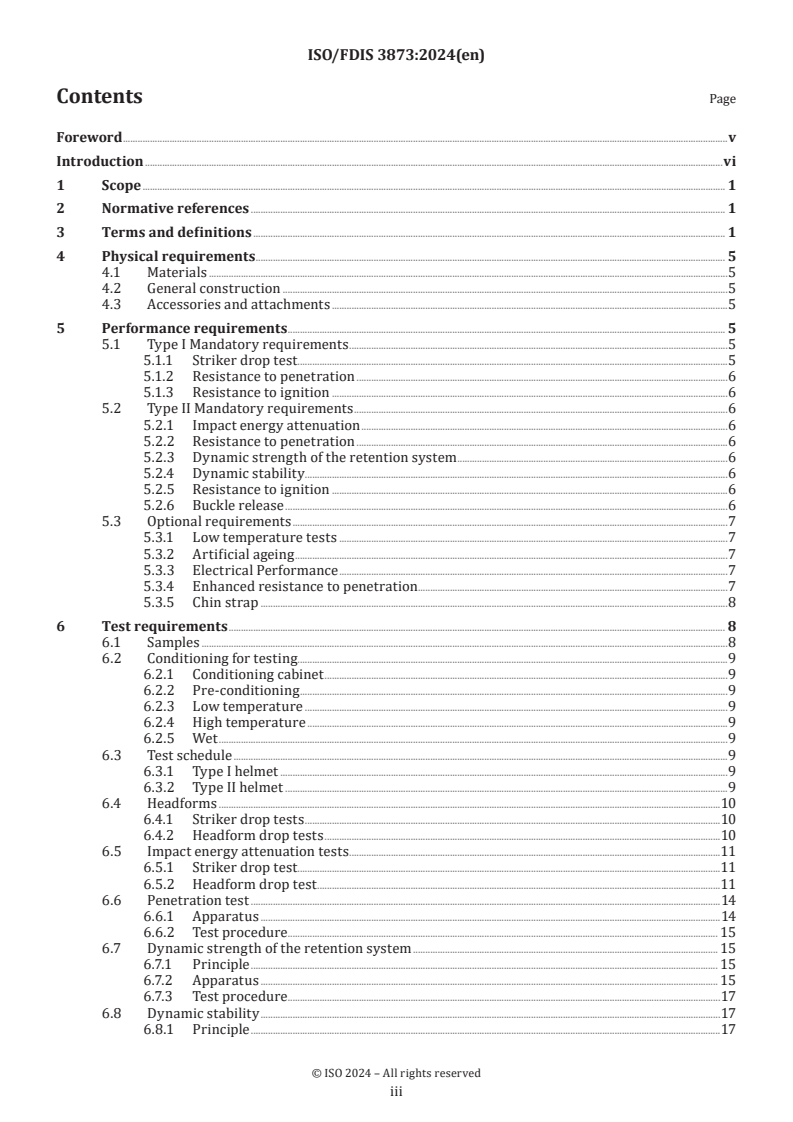
Contents Page
Foreword .v
Introduction .vi
1 Scope . 1
2 Normative references . 1
3 Terms and definitions . 1
4 Physical requirements . 5
4.1 Materials .5
4.2 General construction .5
4.3 Accessories and attachments .5
5 Performance requirements . . 5
5.1 Type I Mandatory requirements .5
5.1.1 Striker drop test.5
5.1.2 Resistance to penetration .6
5.1.3 Resistance to ignition .6
5.2 Type II Mandatory requirements .6
5.2.1 Impact energy attenuation .6
5.2.2 Resistance to penetration .6
5.2.3 Dynamic strength of the retention system .6
5.2.4 Dynamic stability . . .6
5.2.5 Resistance to ignition .6
5.2.6 Buckle release .6
5.3 Optional requirements .7
5.3.1 Low temperature tests .7
5.3.2 Artificial ageing .7
5.3.3 Electrical Performance .7
5.3.4 Enhanced resistance to penetration .7
5.3.5 Chin strap .8
6 Test requirements . 8
6.1 Samples .8
6.2 Conditioning for testing.9
6.2.1 Conditioning cabinet .9
6.2.2 Pre-conditioning .9
6.2.3 Low temperature .9
6.2.4 High temperature .9
6.2.5 Wet .9
6.3 Test schedule .9
6.3.1 Type I helmet .9
6.3.2 Type II helmet .9
6.4 Headforms .10
6.4.1 Striker drop tests .10
6.4.2 Headform drop tests .10
6.5 Impact energy attenuation tests .11
6.5.1 Striker drop test.11
6.5.2 Headform drop test .11
6.6 Penetration test .14
6.6.1 Apparatus .14
6.6.2 Test procedure. 15
6.7 Dynamic strength of the retention system . 15
6.7.1 Principle . 15
6.7.2 Apparatus . 15
6.7.3 Test procedure.17
6.8 Dynamic stability .17
6.8.1 Principle .17
iii
ISO/FDIS 3873:2024(en)
6.8.2 Apparatus .17
6.8.3 Test procedure.18
6.9 Resistance to ignition .18
6.9.1 Principle .18
6.9.2 Apparatus .19
6.9.3 Test procedure.19
6.9.4 Report.19
6.10 Electrical insulation test .19
6.10.1 Apparatus .
...
Formatted
...
Style Definition
...
Style Definition
...
Style Definition
...
Style Definition
...
ISO/FDIS 3873:2024(en)
Style Definition
...
ISO/TC 94/WG 2
Style Definition
...
Style Definition
...
Secretariat: SA
Style Definition
...
Date: 2024-11-15xx
Style Definition
...
Style Definition
...
Style Definition
...
Style Definition
...
Style Definition
...
Style Definition
...
Industrial protective helmets
Style Definition
...
Casques de protection pour l'industrie
Style Definition
...
Style Definition
...
Style Definition
...
Style Definition
...
Style Definition
...
Style Definition
...
Style Definition
...
Style Definition
...
FDIS stage Style Definition
...
Style Definition
...
Style Definition
...
Style Definition
...
Style Definition
...
Style Definition
...
Style Definition
...
Style Definition
...
Style Definition
...
Style Definition
...
Style Definition
...
Style Definition
...
Style Definition
...
Style Definition
...
Style Definition
...
Style Definition
...
Style Definition
...
Style Definition
...
Style Definition
...
Style Definition
...
Style Definition
...
Style Definition
...
Style Definition
...
Style Definition
...
Style Definition
...
Style Definition
...
Style Definition
...
Style Definition
...
Style Definition
...
Style Definition
...
Style Definition
...
Style Definition
...
Style Definition
...
Style Definition
...
Style Definition
...
Style Definition
...
Style Definition
...
Style Definition
...
Style Definition
...
Style Definition
...
Formatted
...
Formatted
...
Formatted
...
ISO /FDIS 3873:202X2024(en) Formatted: Font: 11 pt, Bold
Formatted: Font: 11 pt, Bold
Formatted: Font: 11 pt, Bold
Formatted: HeaderCentered, Space After: 0 pt, Line
spacing: single
All rights reserved. Unless otherwise specified, or required in the context of its implementation, no part of this publication
may be reproduced or utilized otherwise in any form or by any means, electronic or mechanical, including photocopying, Commented [eXtyles1]: The reference "ISO 2024" is to a
withdrawn standard
or posting on the internet or an intranet, without prior written permission. Permission can be requested from either ISO
at the address below or ISO’s member body in the country of the requester.
Formatted: Default Paragraph Font
Formatted: Default Paragraph Font
ISO copyright office
CP 401 • Ch. de Blandonnet 8
Formatted: Indent: Left: 0 cm, Right: 0 cm, Space
CH-1214 Vernier, Geneva
Before: 0 pt, No page break before, Adjust space
Phone: + 41 22 749 01 11
between Latin and Asian text, Adjust space between
EmailE-mail: copyright@iso.org
Asian text and numbers
Website: www.iso.orgwww.iso.org
Published in Switzerland
Formatted: Font: 10 pt
Formatted: Font: 10 pt
Formatted: Font: 11 pt
Formatted: FooterPageRomanNumber, Space After: 0
pt, Line spacing: single
ii © ISO #### 2024 – All rights reserved
ii
ISO/FDIS 3873:2024(en)
Formatted: Font: 11 pt, Bold
Formatted: Font: Bold
Formatted: HeaderCentered, Left
Contents
Formatted: Adjust space between Latin and Asian text,
Adjust space between Asian text and numbers
Foreword . vi
Introduction . viii
1 Scope . 1
2 Normative references . 1
3 Terms and definitions . 1
4 Physical requirements . 5
4.1 Materials . 5
4.2 General construction . 5
4.3 Accessories and attachments . 5
5 Performance requirements . 5
5.1 Type I Mandatory requirements . 5
5.2 Type II Mandatory requirements . 6
5.3 Optional requirements . 7
6 Test requirements . 8
6.1 Samples . 8
6.2 Conditioning for testing . 9
6.3 Test schedule . 9
6.4 Headforms . 11
6.5 Impact energy attenuation tests . 11
6.6 Penetration test . 15
6.7 Dynamic strength of the retention system . 15
6.8 Dynamic stability . 18
6.9 Resistance to ignition . 19
6.10 Electrical insulation test . 20
7 Marking . 21
7.1 Markings on the helmet . 21
7.2 Additional information . 21
8 Instructions for use . 22
Annex A (informative) Recommendations for the materials and construction of helmets . 23
Annex B (informative) Recommended method of construction of wooden headforms . 24
Foreword . v
Introduction . vii
1 Scope . 1
2 Normative references . 1
Formatted: Font: 10 pt
3 Terms and definitions . 1
Formatted: Font: 10 pt
4 Physical requirements . 5
Formatted: Font: 10 pt
4.1 Materials . 5
Formatted: FooterCentered, Left, Space Before: 0 pt,
4.2 General construction . 5
Tab stops: Not at 17.2 cm
4.3 Accessories and attachments . 5
Formatted: Font: 11 pt
5 Performance requirements . 5
Formatted: FooterPageRomanNumber, Left, Space
After: 0 pt, Tab stops: Not at 17.2 cm
© ISO 2024 – All rights reserved
iii
ISO /FDIS 3873:202X2024(en) Formatted: Font: 11 pt, Bold
Formatted: Font: 11 pt, Bold
Formatted: Font: 11 pt, Bold
5.1 Type I Mandatory requirements . 5
Formatted: HeaderCentered, Space After: 0 pt, Line
5.1.1 Striker drop test . 5
spacing: single
5.1.2 Resistance to penetration . 6
5.1.3 Resistance to ignition . 6
5.2 Type II Mandatory requirements . 6
5.2.1 Impact energy attenuation . 6
5.2.2 Resistance to penetration . 6
5.2.3 Dynamic strength of the retention system . 6
5.2.4 Helmet stability . 6
5.2.5 Resistance to ignition . 6
5.2.6 Buckle release . 6
5.3 Optional requirements . 7
5.3.1 Low temperature tests . 7
5.3.2 Artificial ageing . 7
5.3.3 Electrical Performance . 7
5.3.4 Enhanced resistance to penetration . 7
6 Test requirements . 8
6.1 Samples . 8
6.2 Conditioning for testing . 8
6.2.1 Conditioning cabinet. 8
6.2.2 Pre-conditioning . 9
6.2.3 Low temperature . 9
6.2.4 High temperature . 9
6.2.5 Wet . 9
6.3 Test schedule . 9
6.3.1 Type I helmet . 9
6.3.2 Type II helmet . 9
6.4 Headforms . 10
6.4.1 Striker drop tests . 10
6.4.2 Headform drop tests .
...
Questions, Comments and Discussion
Ask us and Technical Secretary will try to provide an answer. You can facilitate discussion about the standard in here.