


ISO 18976
(Main)Testing of refrigerant compressors
Testing of refrigerant compressors
The provisions of this document apply to Single-Stage and economised refrigerant compressors of the positive displacement type. Selected test methods are described for the determination of the refrigerating capacity, the power, the isentropic efficiency and the coefficient of performance. These test methods provide results of sufficient accuracy to permit consideration of the suitability of a refrigerant compressor to operate satisfactorily under any set of basic test conditions required for a given refrigeration installation. Attention is drawn in particular to a number of special precautions necessary to reduce testing losses to a minimum. This document applies only to tests carried out at the manufacturer’s works, or wherever the necessary equipment for testing to the accuracy required can be made available. The accuracy of measurement are specified in Clause 4. NOTE - Tests on complete refrigeration installations are dealt with in ISO 916. Annexes B and C, which provide additional information, do not form integral parts of this document.
Essais des compresseurs pour fluides frigorigènes
General Information
- Status
- Not Published
- Technical Committee
- ISO/TC 86/SC 4 - Testing and rating of refrigerant compressors
- Drafting Committee
- ISO/TC 86/SC 4 - Testing and rating of refrigerant compressors
- Current Stage
- 6000 - International Standard under publication
- Start Date
- 22-Nov-2025
- Completion Date
- 10-Jan-2026
Relations
- Effective Date
- 13-Sep-2025
Overview
ISO 18976 - Testing of refrigerant compressors - specifies selected test methods for single-stage and economised positive-displacement refrigerant compressors. The standard describes procedures to determine key performance metrics such as refrigerating capacity, power input, isentropic efficiency, and coefficient of performance (COP). Tests are intended to be carried out at the manufacturer’s works or at test facilities capable of the required measurement accuracy (see Clause 4 on uncertainty of measurement). Annex A addresses conversion of measured data for compressors with intermediate ports; Annexes B and C provide additional, informative guidance.
Key topics and technical requirements
- Scope and applicability: Applies to single-stage and economised positive-displacement compressors; does not cover complete refrigeration installations (see ISO 916).
- Performance metrics: Determination of refrigerating capacity, compressor power, isentropic efficiency and COP using standardized methods.
- Measurement uncertainty: Requirements and specified accuracy limits are given (Clause 4) to ensure results are comparable and suitable for installation assessment.
- Test methods: Multiple methods are defined, including calorimetric approaches (secondary-fluid, flooded, dry-system) and flow-meter/energy-balance techniques. Methods listed include A, B, C, D, F, G, M, with specific guidance on selection and calibration.
- General test requirements: Calibration of calorimeters, selection of test periods and steady-state criteria, pressure and temperature measuring points, oil circulation control, fractionation prevention, and data recording procedures.
- Power measurement and calculations: Procedures for measuring and calculating compressor power input and translating measured values to specified test conditions (Annex A).
- Test reporting: Standardized test report content and required test-result presentation.
Applications and who uses it
ISO 18976 is used by:
- Compressor manufacturers for factory acceptance testing, product validation and R&D.
- Test laboratories and independent certification bodies performing performance verification and type-testing.
- HVAC&R OEMs and system designers to select compressors and specify performance for system integration.
- Procurement, quality assurance and regulatory teams requiring traceable, comparable performance data for compliance, warranties and energy-efficiency claims.
Practical uses include product development, factory testing, performance comparison, warranty validation, and supporting energy-efficiency labeling or compliance documentation.
Related standards
- ISO 916 - Tests on complete refrigeration installations (complements ISO 18976 by covering whole-system tests).
- Referenced normative documents and refrigerant property sources are listed within ISO 18976 and should be used for thermophysical data and calculation consistency.
Keywords: ISO 18976, testing of refrigerant compressors, refrigerant compressor testing, calorimeter methods, flow meter methods, isentropic efficiency, COP, HVAC&R test standards.


Frequently Asked Questions
ISO 18976 is a draft published by the International Organization for Standardization (ISO). Its full title is "Testing of refrigerant compressors". This standard covers: The provisions of this document apply to Single-Stage and economised refrigerant compressors of the positive displacement type. Selected test methods are described for the determination of the refrigerating capacity, the power, the isentropic efficiency and the coefficient of performance. These test methods provide results of sufficient accuracy to permit consideration of the suitability of a refrigerant compressor to operate satisfactorily under any set of basic test conditions required for a given refrigeration installation. Attention is drawn in particular to a number of special precautions necessary to reduce testing losses to a minimum. This document applies only to tests carried out at the manufacturer’s works, or wherever the necessary equipment for testing to the accuracy required can be made available. The accuracy of measurement are specified in Clause 4. NOTE - Tests on complete refrigeration installations are dealt with in ISO 916. Annexes B and C, which provide additional information, do not form integral parts of this document.
The provisions of this document apply to Single-Stage and economised refrigerant compressors of the positive displacement type. Selected test methods are described for the determination of the refrigerating capacity, the power, the isentropic efficiency and the coefficient of performance. These test methods provide results of sufficient accuracy to permit consideration of the suitability of a refrigerant compressor to operate satisfactorily under any set of basic test conditions required for a given refrigeration installation. Attention is drawn in particular to a number of special precautions necessary to reduce testing losses to a minimum. This document applies only to tests carried out at the manufacturer’s works, or wherever the necessary equipment for testing to the accuracy required can be made available. The accuracy of measurement are specified in Clause 4. NOTE - Tests on complete refrigeration installations are dealt with in ISO 916. Annexes B and C, which provide additional information, do not form integral parts of this document.
ISO 18976 is classified under the following ICS (International Classification for Standards) categories: 27.200 - Refrigerating technology. The ICS classification helps identify the subject area and facilitates finding related standards.
ISO 18976 has the following relationships with other standards: It is inter standard links to ISO 917:1989. Understanding these relationships helps ensure you are using the most current and applicable version of the standard.
ISO 18976 is available in PDF format for immediate download after purchase. The document can be added to your cart and obtained through the secure checkout process. Digital delivery ensures instant access to the complete standard document.
Standards Content (Sample)
FINAL DRAFT
International
Standard
ISO/FDIS 18976
ISO/TC 86/SC 4
Testing of refrigerant compressors
Secretariat: SAC
Essais des compresseurs pour fluides frigorigènes
Voting begins on:
2025-09-26
Voting terminates on:
2025-11-21
RECIPIENTS OF THIS DRAFT ARE INVITED TO SUBMIT,
WITH THEIR COMMENTS, NOTIFICATION OF ANY
RELEVANT PATENT RIGHTS OF WHICH THEY ARE AWARE
AND TO PROVIDE SUPPOR TING DOCUMENTATION.
IN ADDITION TO THEIR EVALUATION AS
BEING ACCEPTABLE FOR INDUSTRIAL, TECHNO
LOGICAL, COMMERCIAL AND USER PURPOSES, DRAFT
INTERNATIONAL STANDARDS MAY ON OCCASION HAVE
TO BE CONSIDERED IN THE LIGHT OF THEIR POTENTIAL
TO BECOME STAN DARDS TO WHICH REFERENCE MAY BE
MADE IN NATIONAL REGULATIONS.
Reference number
ISO/FDIS 18976:2025(en) © ISO 2025
FINAL DRAFT
ISO/FDIS 18976:2025(en)
International
Standard
ISO/FDIS 18976
ISO/TC 86/SC 4
Testing of refrigerant compressors
Secretariat: SAC
Essais des compresseurs pour fluides frigorigènes
Voting begins on:
Voting terminates on:
RECIPIENTS OF THIS DRAFT ARE INVITED TO SUBMIT,
WITH THEIR COMMENTS, NOTIFICATION OF ANY
RELEVANT PATENT RIGHTS OF WHICH THEY ARE AWARE
AND TO PROVIDE SUPPOR TING DOCUMENTATION.
© ISO 2025
IN ADDITION TO THEIR EVALUATION AS
All rights reserved. Unless otherwise specified, or required in the context of its implementation, no part of this publication may
BEING ACCEPTABLE FOR INDUSTRIAL, TECHNO
LOGICAL, COMMERCIAL AND USER PURPOSES, DRAFT
be reproduced or utilized otherwise in any form or by any means, electronic or mechanical, including photocopying, or posting on
INTERNATIONAL STANDARDS MAY ON OCCASION HAVE
the internet or an intranet, without prior written permission. Permission can be requested from either ISO at the address below
TO BE CONSIDERED IN THE LIGHT OF THEIR POTENTIAL
or ISO’s member body in the country of the requester.
TO BECOME STAN DARDS TO WHICH REFERENCE MAY BE
MADE IN NATIONAL REGULATIONS.
ISO copyright office
CP 401 • Ch. de Blandonnet 8
CH-1214 Vernier, Geneva
Phone: +41 22 749 01 11
Email: copyright@iso.org
Website: www.iso.org
Published in Switzerland Reference number
ISO/FDIS 18976:2025(en) © ISO 2025
ii
ISO/FDIS 18976:2025(en)
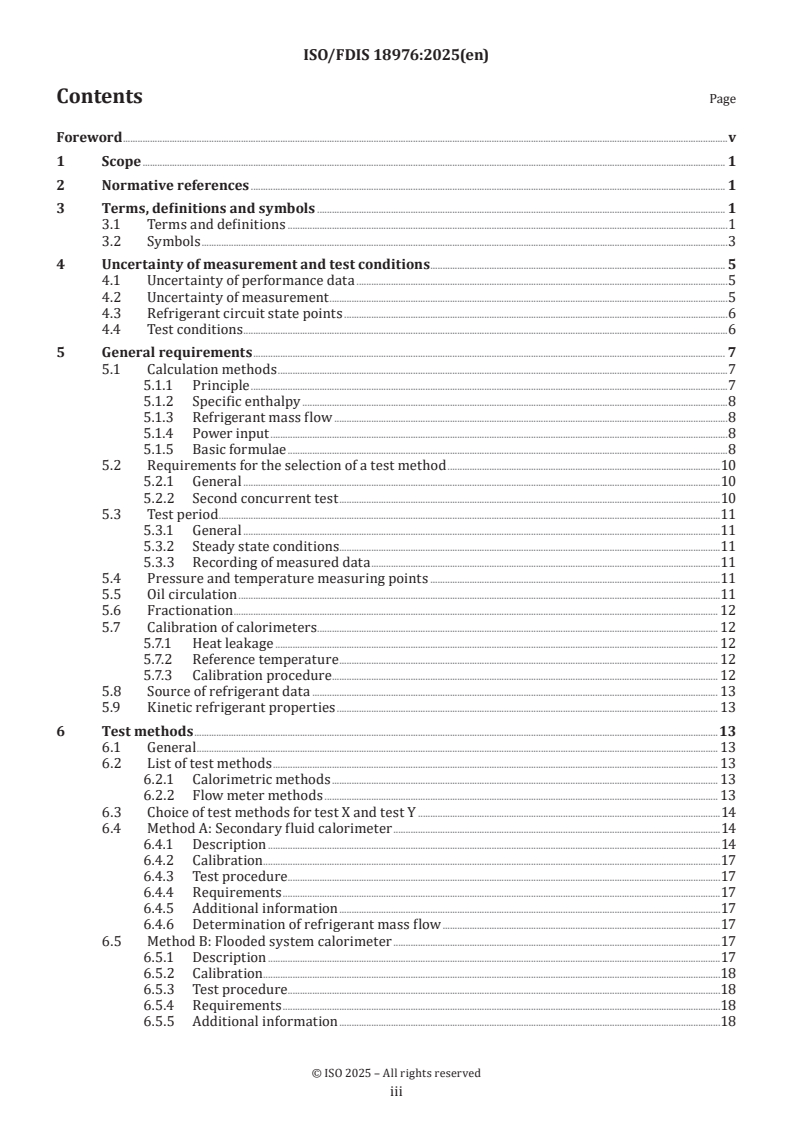
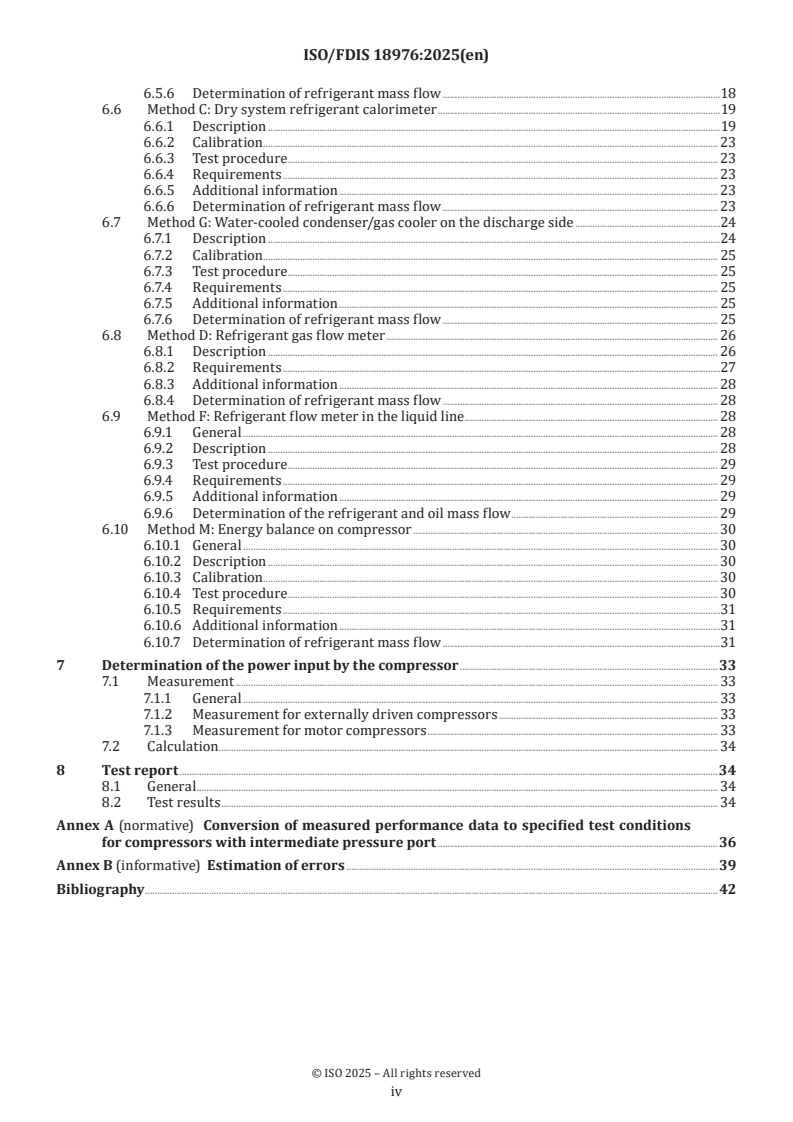
Contents Page
Foreword .v
1 Scope . 1
2 Normative references . 1
3 Terms, definitions and symbols . 1
3.1 Terms and definitions .1
3.2 Symbols .3
4 Uncertainty of measurement and test conditions . 5
4.1 Uncertainty of performance data .5
4.2 Uncertainty of measurement .5
4.3 Refrigerant circuit state points .6
4.4 Test conditions .6
5 General requirements . 7
5.1 Calculation methods .7
5.1.1 Principle .7
5.1.2 Specific enthalpy .8
5.1.3 Refrigerant mass flow .8
5.1.4 Power input .8
5.1.5 Basic formulae .8
5.2 Requirements for the selection of a test method .10
5.2.1 General .10
5.2.2 Second concurrent test .10
5.3 Test period .11
5.3.1 General .11
5.3.2 Steady state conditions . .11
5.3.3 Recording of measured data .11
5.4 Pressure and temperature measuring points .11
5.5 Oil circulation .11
5.6 Fractionation . 12
5.7 Calibration of calorimeters . . 12
5.7.1 Heat leakage . 12
5.7.2 Reference temperature . 12
5.7.3 Calibration procedure. 12
5.8 Source of refrigerant data . 13
5.9 Kinetic refrigerant properties . 13
6 Test methods .13
6.1 General . 13
6.2 List of test methods . 13
6.2.1 Calorimetric methods . 13
6.2.2 Flow meter methods . 13
6.3 Choice of test methods for test X and test Y .14
6.4 Method A: Secondary fluid calorimeter .14
6.4.1 Description .14
6.4.2 Calibration . . .17
6.4.3 Test procedure.17
6.4.4 Requirements .17
6.4.5 Additional information .17
6.4.6 Determination of refrigerant mass flow .17
6.5 Method B: Flooded system calorimeter .17
6.5.1 Description .17
6.5.2 Calibration . . .18
6.5.3 Test procedure.18
6.5.4 Requirements .18
6.5.5 Additional information .18
iii
ISO/FDIS 18976:2025(en)
6.5.6 Determination of refrigerant mass flow .18
6.6 Method C: Dry system refrigerant calorimeter .19
6.6.1 Description .19
6.6.2 Calibration . . . 23
6.6.3 Test procedure. 23
6.6.4 Requirements . 23
6.6.5 Additional information . 23
6.6.6 Determination of refrigerant mass flow . 23
6.7 Method G: Water-cooled condenser/gas cooler on the discharge side .24
6.7.1 Description .24
6.7.2 Calibration . . . 25
6.7.3 Test procedure. 25
6.7.4 Requirements . 25
6.7.5 Additional information . 25
6.7.6 Determination of refrigerant mass flow . 25
6.8 Method D: Refrigerant gas flow meter . 26
6.8.1 Description . 26
6.8.2 Requirements .27
6.8.3 Additional information . 28
6.8.4 Determination of refrigerant mass flow . 28
6.9 Method F: Refrigerant flow meter in the liquid line . 28
6.9.1 General . 28
6.9.2 Description . 28
6.9.3 Test procedure. 29
6.9.4 Requirements . 29
6.9.5 Additional information . 29
6.9.6 Determination of the refrigerant and oil mass flow . 29
6.10 Method M: Energy balance on compressor . 30
6.10.1 General . 30
6.10.2 Description . 30
6.10.3 Calibration . . . 30
6.10.4 Test procedure. 30
6.10.5 Requirements .31
6.10.6 Additional information .31
6.10.7 Determination of refrigerant mass flow .31
7 Determination of the power input by the compressor .33
7.1 Measurement . 33
7.1.1 General . 33
7.1.2 Measurement for externally driven compressors . 33
7.1.3 Measurement for motor compressors . 33
7.2 Calculation . 34
8 Test report .34
8.1 General . 34
8.2 Test results . 34
Annex A (normative) Conversion of measured performance data to specified test conditions
for compressors with intermediate pressure port .36
Annex B (informative) Estimation of errors .39
Bibliography .42
iv
ISO/FDIS 18976:2025(en)
Foreword
ISO (the International Organization for Standardization) is a worldwide federation of national standards
bodies (ISO member bodies). The work of preparing International Standards is normally carried out through
ISO technical committees. Each member body interested in a subject for which a technical committee
has been established has the right to be represented on that committee. International organizations,
governmental and non-governmental, in liaison with ISO, also take part in the work. ISO collaborates closely
with the International Electrotechnical Commission (IEC) on all matters of electrotechnical standardization.
The procedures used to develop this document and those intended for its further maintenance are described
in the ISO/IEC Directives, Part 1. In particular, the different approval criteria needed for the different types
of ISO documents should be noted. This document was drafted in accordance with the editorial rules of the
ISO/IEC Directives, Part 2 (see www.iso.org/directives).
ISO draws attention to the possibility that the implementation of this document may involve the use of (a)
patent(s). ISO takes no position concerning the evidence, validity or applicability of any claimed patent
rights in respect thereof. As of the date of publication of this document, ISO had not received notice of (a)
patent(s) which may be required to implement this document. However, implementers are cautioned that
this may not represent the latest information, which may be obtained from the patent database available at
www.iso.org/patents. ISO shall not be held responsible for identifying any or all such patent rights.
Any trade name used in this document is information given for the convenience of users and does not
constitute an endorsement.
For an explanation of the voluntary nature of standards, the meaning of ISO specific terms and expressions
related to conformity assessment, as well as information about ISO's adherence to the World Trade
Organization (WTO) principles in the Technical Barriers to Trade (TBT), see www.iso.org/iso/foreword.html.
This document was prepared by Technical Committee ISO/TC 86, Refrigeration and air-conditioning,
Subcommittee SC 4, Testing and rating of refrigerant compressors.
This first edition of ISO 18976 is a technical revision of ISO 917:1989, which was withdrawn in 2015.
The main changes are as follows:
— addition of two stage and economized compressors;
— Clause 2 was updated;
— Clause 3 was updated, additional terms defined because of, for example, refrigerant blends with
temperature glide;
— addition of the new Clause 4 “Uncertainty of measurement and test conditions”;
— deletion of the list of measuring devices;
— extraction of calibration of calorimetric methods into a separate clause;
— addition of transcritical application;
— addition of test requirements for inverter driven compressors;
— addition of cyclic capacity control;
— reference point numbering, symbols and indexes revised to allow for economised compressors and to
simplify formulae;
— former Annex B regarding the list of symbols was moved under Clause 3;
— the text content of former Annex C was revised and is now Annex B “Estimation of errors”;
— document was editorially revised.
v
ISO/FDIS 18976:2025(en)
Any feedback or questions on this document should be directed to the user’s national standards body. A
complete listing of these bodies can be found at www.iso.org/members.html.
vi
FINAL DRAFT International Standard ISO/FDIS 18976:2025(en)
Testing of refrigerant compressors
1 Scope
This document applies to single stage, two stage and economised refrigerant compressors. Selected test
methods are described for the determination of the refrigerating capacity, the power input, the isentropic
efficiency and where possible the volumetric efficiency. These test methods provide results of sufficient
accuracy to permit consideration of the suitability of a refrigerant compressor to operate satisfactorily
under any set of basic test conditions required for a given application.
NOTE Tests on complete refrigeration installations are dealt with in ISO 916.
2 Normative references
There are no normative references in this document.
3 Terms, definitions and symbols
For the purposes of this document, the following terms and definitions apply.
ISO and IEC maintain terminology databases for use in standardization at the following addresses:
— ISO Online browsing platform: available at https:// www .iso .org/ obp
— IEC Electropedia: available at https:// www .electropedia .org/
3.1 Terms and definitions
3.1.1
refrigerating capacity
Q
product of the refrigerant mass flow at the compressor inlet port and the difference between the specific
refrigerant enthalpy at the compressor inlet port and the specific enthalpy of fluid entering the evaporator
expansion device
3.1.2
subcooling
difference between the bubble point temperature of the refrigerant corresponding to its pressure and the
temperature of the liquid refrigerant
3.1.3
power input
P
power demand to drive the compressor
Note 1 to entry: The determination of the power input is specified in Clause 7.
3.1.4
coefficient of performance
COP
R
ratio of the refrigerating capacity to the power input
Note 1 to entry: Both, refrigerating capacity and power input are at the specified test condition.
ISO/FDIS 18976:2025(en)
Note 2 to entry: The test report should make clear whether the power input is referring to the electrical power or the
shaft power.
[SOURCE: EN 13771-2:2017, 3.1.6, modified — “power absorbed” was changed to “power input” and Note 2 to
entry was added]
3.1.5
subcritical operation
operating condition with discharge pressure below the critical pressure of the refrigerant
3.1.6
transcritical operation
operating condition with discharge pressure above and the suction pressure below the critical pressure
3.1.7
part load operation
operation with active capacity control at reduced capacity for compressors with capacity control mechanism
Note 1 to entry: On/off cycling of the compressor motor is not considered as capacity control.
[SOURCE: EN 13771-2:2017, 3.1.9]
3.1.8
fluid
liquid, gas or vapour including the state of appearance close to and above the critical pressure
3.1.9
volumetric efficiency
η
v
ratio of the actual volume rate of flow under compressor inlet conditions, at the requirements specified in
4.4, to the displacement of the compressor
3.1.10
isentropic efficiency
η
i
ratio of total isentropic compression power to the power input
Note 1 to entry: Total isentropic compression power is the sum of individual product of mass flow multiplied by the
isentropic change in enthalpy across the corresponding compression stage.
Note 2 to entry: The value according to this definition is only used as reference value for the necessary correction
calculation specified in this document.
3.1.11
oil circulation ratio
x
oil
ratio of the measured oil mass flow to the mass flow of the circulating oil/refrigerant mixture
Note 1 to entry: Oil circulation ratio can differ at the different compressor ports.
3.1.12
calorimeter
component of the test system refrigerant circuit intended to determine the refrigerant mass flow via an
energy balance
Note 1 to entry: To limit the uncertainty of the mass flow determination caused by the heat loss, calorimeters are
usually heat insulated.
Note 2 to entry: The compressor or the economiser heat exchanger can be utilised as calorimeter.
3.1.13
speed of rotation
number or rotations per unit time
ISO/FDIS 18976:2025(en)
3.1.14
economiser heat exchanger
heat exchanger in a system in which a partial mass flow is evaporated at intermediate pressure and lead to
the respective compressor port, to subcool the main mass flow after the condenser
Note 1 to entry: With this system design, the refrigeration capacity and the coefficient of performance increase. At the
same time, the discharge temperature falls.
Note 2 to entry: There are also other economiser systems possible without heat exchanger, e.g. with flash tank.
3.1.15
zeotropic refrigerant
blend composed of two or more refrigerants whose equilibrium vapor and liquid phase compositions are not
the same at any pressure below the critical pressure
[SOURCE: ISO 817:2024, 3.1.47, modified — The term “zeotrope” was replaced by the term “zeotropic
refrigerant” and the references to 3.1.7 and 3.1.37 were removed.]
3.2 Symbols
For the purposes of this document, the symbols of Table 1 and the indexes of Table 2 apply.
Table 1 — Symbols
SI
Symbol Designation
unit
A area m
a speed of sound m/s
c specific heat capacity of heating and cooling liquid J/(kg K)
d diameter m
f electrical frequency Hz
F heat leakage factor W/K
F flow factor for centrifugal compressor m
F
F head factor for centrifugal compressor —
H
F mass flow ratio —
m
h specific enthalpy J/kg
specific enthalpy of refrigerant gas at the compressor outlet pressure (2) having the
h same entropy as the refrigerant gas at the compressor inlet pressure (1) for calculation J/kg
i1-2
of the isentropic efficiency (specified test conditions)
specific enthalpy of refrigerant gas at the compressor outlet pressure (2) having the
h same entropy as the refrigerant gas at the compressor intermediate pressure port (7) J/kg
i7-2
for calculation of the isentropic efficiency (specified test conditions)
−1
n compressor speed of rotation s
P power input W
p absolute pressure Pa
m refrigerant mass flow as determined by the test kg/s
a
M refrigerant mass flow at the specified test conditions kg/s
m mass flow of heating or cooling liquid kg/s
f
m oil mass flow kg/s
oil
m mass flow of liquid refrigerant oil mixture kg/s
x
V refrigerant volume flow m /s
V volume flow of refrigerant oil mixture m /s
x
T absolute temperature K
ISO/FDIS 18976:2025(en)
TTaabbllee 11 ((ccoonnttiinnueuedd))
SI
Symbol Designation
unit
difference between fluid outlet of economiser heat exchanger and bubble temperature
ΔT K
eco
corresponding to intermediate pressure
t temperature °C
t mean surface temperature of the calorimeter °C
cal
t bubble point temperature of the refrigerant °C
b
t bubble point temperature of the secondary fluid °C
bs
t reference temperature °C
x
t inlet temperature of heating or cooling liquid °C
s1
t outlet temperature of heating or cooling liquid °C
s2
U electrical voltage V
V theoretical compressor displacement at declared speed m /s
sw
oil circulation ratio in the refrigerating system, expressed in mass of oil per mass of
x kg/kg
oil
mixture
η isentropic efficiency —
i
η volumetric efficiency —
v
v specific volume m /kg
density of refrigerant corresponding to pressure and temperature at which the flow rate
ρ kg/m
a
is measured
Q heat input to the calorimeter W
i
Q electrical input to the heater W
n
Q refrigerating capacity at the specified test conditions W
Table 2 — Indexes
Index Designation
a actual
amb ambient
1 refrigerant at the compressor inlet
2 refrigerant at the compressor outlet
3 refrigerant at the inlet of the condenser/gas cooler
4 refrigerant at the outlet of the condenser/gas cooler
5 refrigerant at the inlet of the expansion device
6 refrigerant at the outlet of the evaporator
7 refrigerant at the intermediate pressure port (connection to the compressor)
8 refrigerant at the inlet to flow meter
9 refrigerant at the inlet of expansion device C7
10 liquid outlet of refrigerant at the economiser heat exchanger (HX)
liquid refrigerant at bubble point corresponding to the pressure at the compressor outlet according
f2 to the specified test conditions, for subcritical operation or fluid refrigerant at the compressor outlet
pressure and the temperature of the gas cooler outlet at the specified test condition
liquid refrigerant at bubble point corresponding to the pressure at the compressor intermediate pres-
f7
sure port according to the specified test conditions, for subcritical operation
liquid refrigerant at bubble point corresponding to the pressure at the compressor intermediate pres-
f10
sure port plus the temperature difference of the economiser HX
b bubble
d dew
ISO/FDIS 18976:2025(en)
TTaabbllee 22 ((ccoonnttiinnueuedd))
Index Designation
i isentropic
cal calorimeter surface
crit critical point of refrigerant
f fluid
oil oil
s secondary fluid
x refrigerant/oil mixture
4 Uncertainty of measurement and test conditions
4.1 Uncertainty of performance data
All measuring instruments in the test setup shall be selected and calibrated so that the final result is within
the maximum uncertainties of the measured value as indicated:
— refrigerating capacity: ±2,5 %;
— electrical power input: ±1 %;
— mechanical power input: ±2,5 %.
4.2 Uncertainty of measurement
Uncertainty values are considered to cover a 95 % confidence interval, i.e. ±2 times the standard deviation.
This is also known as extended uncertainty. Except where otherwise stated in the particular clauses,
measurements shall be carried out within the maximum uncertainty of the measured value as indicated.
Where a percent value is stated, it is the relative uncertainty of the directly measured value.
— absolute pressure: ±1 %;
— electrical:
— current: ±1 %;
— frequency: ±0,2 %;
— power: ±1 %;
— voltage: ±1 %;
— refrigerant mass flow: ±1 %;
— refrigerant volume flow: ±1 %;
— speed of rotation: ±0,07 %;
— temperatures:
— temperature for differences: ±0,05 K;
— temperature differences measured directly: ±1 %;
— other temperatures: ±0,3 K;
— time: ±0,1 %;
— torque: ±1 %;
ISO/FDIS 18976:2025(en)
— water flow: ±1 %.
Adherence to these limits does not ensure the requirements of 4.1 are obtained automatically.
For the combined uncertainty of the performance data, see Annex B.
4.3 Refrigerant circuit state points
Figure 1 illustrates the state of the refrigerant as it passes through the system.
This is a general illustration showing conditions occurring in typical subcritical single stage systems, which
are not all relevant for compressor performances (e.g. the shown pressure drops), but still important for
inherent calculation. p-h diagrams relating to specific test methods do not show the various pressure drops
in order to keep diagrams as clear as possible.
a) Circuit diagram b) Pressure vs enthalpy diagram
Key
1 refrigerant gas at the compressor inlet
2 refrigerant gas at the compressor outlet
3 refrigerant gas at the inlet of the condenser or gas cooler
4 refrigerant at the outlet of the condenser or gas cooler
5 refrigerant fluid at the inlet of the expansion device
6 refrigerant gas at the outlet of the evaporator
A compressor
B condenser
C expansion device
D evaporator
Figure 1 — Refrigerant circuit
4.4 Test conditions
The specified test conditions under which the test is to be performed and their allowable deviations are
given in Table 3.
ISO/FDIS 18976:2025(en)
Table 3 — Specified test conditions and the allowable deviations
Allowable deviation during
Specified test conditions
the entire test period
a
Absolute pressure , compressor inlet, p ±1,0 %
a
Absolute pressure , compressor outlet, p ±1,0 %
a
Absolute pressure , compressor intermediate pressure port, p ±1,0 %
Refrigerant temperature at the compressor inlet, t ±3,0 K
Refrigerant temperature at the compressor intermediate pressure port, t ±3,0 K
Nominal compressor speed of rotation, n ±1,0 %
Nominal electrical voltage, U ±1,5 %
Nominal electrical frequency, f ±1,0 %
Ambient temperature, t ±3,0 K
amb
a
Dynamic deviations due to pulsations are not considered.
The values for the relevant specified test conditions shall be recorded.
For the calculation of refrigeration capacity, additional values can be necessary:
— gas cooler outlet temperature in case of transcritical operation;
— temperature difference at the liquid subcooler or aftercooler in case of two stage operation (flash tank
without temperature difference). The value of the pressure p shall be adjusted according to Annex A to
reach the requested temperature difference.
For cyclic capacity control the deviations of Table 3 refer to the average values per control cycle.
For operation with constant capacity, the deviations can be applied to one of the following:
— every single recorded value;
— the average values per minute;
— the average of the values for the test period, ±2 times standard deviation of the measured values.
For wet operation at point 7, intermediate pressure port [see Figure 3 a)], the correction of Annex A can still
be used. In this case the heat balance at the economiser heat exchanger can be used to determine the specific
enthalpy of the refrigerant at point 7.
For compressors with factory assembled economiser heat exchanger, where the temperature at point 7
cannot be measured, and thus the state of appearance, cannot be determined exactly, the same assumptions
as for the wet operation apply.
5 General requirements
5.1 Calculation methods
5.1.1 Principle
The determination of the refrigerating capacity at the specified test conditions comprises:
— the evaluation of the actual mass flow rate of the refrigerant, obtained for each test method used by
means of an apparatus which is inserted into the outer part of the test circuit, between the outlet and the
inlet of the compressor or by an energy balance on the compressor according to method M, as described
in Clause 6, when operating according to Table 3;
ISO/FDIS 18976:2025(en)
— the correction of this mass flow to the mass flow at the specified test conditions using the ratio of the
actual specific volume (v ) of the refrigerant gas at the compressor inlet to the specific volume of the gas
1a
at the specified test conditions (v );
— the product of the corrected mass flow and the difference between the specific enthalpies at the specified
test conditions of the refrigerant gas at the compressor inlet h and the fluid (refrigerant) entering the
evaporator expansion device h for single stage expansion cycles; for multiple stage expansion cycles
f2
h is used. The refrigerant at the inlet port(s) is superheated above the dew point temperature to the
f10
stated value.
NOTE For the purposes of this document, it is assumed that the volume flow rate is constant when the compressor
is operating according to Table 3.
5.1.2 Specific enthalpy
The value of the specific enthalpy is taken from recognised data of the thermodynamic properties of the
refrigerant used. The determining parameters are the temperature and pressure of the refrigerant at the
relevant cycle points.
NOTE Up to condensing temperatures of 0,95 × T , the liquid enthalpy depends on temperature only. Above
crit
0,95 × T , the enthalpy is determined by the temperature and pressure.
crit
5.1.3 Refrigerant mass flow
The refrigerant mass flow is either measured directly or calculated from measured values of temperatures,
pressure and heat flow (see the methods in Clause 6).
5.1.4 Power input
The power input only considers power to drive the compressor, see also Clause 7.
Power input for auxiliaries and accessories that are necessary for the operation of the compressor shall be
recorded and documented.
NOTE For compressors with a factory assembled or factory specified frequency inverter, the power input is the
electrical power at the input terminals of the inverter, see also Clause 7.
5.1.5 Basic formulae
5.1.5.1 Mass flow
Any refrigerant mass flow m entering or leaving the compressor as determined by measurement shall be
converted to the specified test conditions using Formula (1):
v n
a
mm=× × (1)
a
v n
a
For motor compressors, the correction factor n/n is replaced by f/f .
a a
5.1.5.2 Compressor refrigerating capacity
The refrigerating capacity for compressors is calculated using Formula (2):
Qm=× hh− (2)
()
12f
For compressors with an intermediate pressure port Formula (3) and Formula (4) apply:
Qm=×()hh− (3)
11 f10
ISO/FDIS 18976:2025(en)
tt=+ΔT (4)
ff10 7 eco
The value ΔT is a given value for the temperature difference at the economiser heat exchanger. If this
eco
value is 0, the performance data are for economiser operation with a flash tank.
NOTE The index f10 is used for the theoretical value corresponding to the pressure at the intermediate port plus
a temperature difference if an economiser heat exchanger is used (see also Table 2). The index f7 corresponds directly
to the pressure at the intermediate port.
Alternatively, to Formula (3) the capacity can be calculated as follows:
Qm=×()hh− +×mh()−h (5)
11 ff27 72
5.1.5.3 Volumetric efficiency
The volumetric efficiency η is calculated using Formula (6):
v
m
η =×v (6)
v 1
V
sw
NOTE Within the limits specified in this document, it is assumed that the volumetric efficiency is constant.
5.1.5.4 Power input and isentropic efficiency
The power input is converted from the measured power input to the specified test conditions using
Formula (7) to Formula (10).
The isentropic efficiency η is calculated using Formula (7):
i
P
ia
η = (7)
i
n
P ×
a
n
a
For motor compressors, the correction factor n/n is replaced by f/f .
a a
The isentropic power is the sum of isentropic powers for each mass flow rate entering the compressor.
Calculation of isentropic power demand at specified test conditions is done using Formula (8):
Pm=×()hh− +×mh()−h (8)
ii11−−21 77i 27
NOTE Single stage compression m = 0.
The isentropic power demand at actual test conditions is calculated using Formula (9):
Pm=×()hh− +×mh()−h (9)
ia 11ai −−21aa 77ai 27aa
The isentropic efficiency is assumed to be constant for conversions from actual (measured) conditions to
the specified test condition (p , p , p , t , t also including n or f ). Conversion is only allowed within the
1 2 7 1 7
deviations
...
Formatted: Font: 14 pt
ISO/DISFDIS 18976:2024(en)
ISO/TC 86/SC 4/WG 4
Secretariat: DIN SAC
Date: 2025-04-14
Formatted: English (United Kingdom)
Formatted: Cover Title_A1
Testing of refrigerant compressors
Essais des compresseurs pour fluides frigorigènes
FDIS stage
ISO/DISFDIS 18976:20242025(en)
Formatted: Font: 11 pt, Bold
Formatted: Font: Bold
Formatted: Default Paragraph Font
Formatted: Adjust space between Latin and Asian text,
All rights reserved. Unless otherwise specified, or required in the context of its implementation, no part of this publication
Adjust space between Asian text and numbers
may be reproduced or utilized otherwise in any form or by any means, electronic or mechanical, including photocopying,
or posting on the internet or an intranet, without prior written permission. Permission can be requested from either ISO
at the address below or ISO'sISO’s member body in the country of the requester.
ISO Copyright Officecopyright office
CP 401 • Ch. de Blandonnet 8
CH-1214 Vernier, Geneva
Formatted: zzCopyright address, Adjust space between
Phone: + 41 22 749 01 11
Latin and Asian text, Adjust space between Asian text
and numbers
Email: copyright@iso.org
Formatted: French (Switzerland)
E-mail: copyright@iso.org
Website: www.iso.orgwww.iso.org
Formatted: Italian (Italy)
Formatted: Italian (Italy)
Published in Switzerland.
Formatted: zzCopyright address, Adjust space between
Latin and Asian text, Adjust space between Asian text
and numbers
Formatted: German (Germany)
Formatted: German (Germany)
Formatted: Font: 10 pt
Formatted: Font: 10 pt
Formatted: FooterCentered, Left, Line spacing: single
Formatted: Font: 11 pt
Formatted: FooterPageRomanNumber, Left, Space
After: 0 pt, Line spacing: single
iii
ISO/FDIS 18976:2025(en)
Formatted: Font: Bold
Formatted: HeaderCentered
Contents Formatted: Adjust space between Latin and Asian text,
Adjust space between Asian text and numbers
Foreword . viii
1 Scope . 1
2 Normative references . 1
3 Terms, definitions and symbols . 1
3.1 Terms and definitions . 1
3.2 Symbols . 3
4 Uncertainty of measurement and test conditions . 5
4.1 Uncertainty of performance data . 5
4.2 Uncertainty of measurement . 6
4.3 Refrigerant circuit state points . 6
4.4 Test conditions . 7
5 General requirements . 8
5.1 Calculation methods . 8
5.2 Requirements for the selection of a test method . 12
5.3 Test period . 12
5.4 Pressure and temperature measuring points . 13
5.5 Oil circulation . 13
5.6 Fractionation . 14
5.7 Calibration of calorimeters . 14
5.8 Source of refrigerant data . 15
5.9 Kinetic refrigerant properties . 15
6 Test methods . 15
6.1 General . 15
6.2 List of test methods . 15
6.3 Choice of test methods for test X and test Y . 16
6.4 Method A: Secondary fluid calorimeter . 16
6.5 Method B: Flooded system calorimeter . 22
6.6 Method C: Dry system refrigerant calorimeter . 23
6.7 Method G: Water-cooled condenser/gas cooler on the discharge side . 31
6.8 Method D: Refrigerant gas flow meter . 34
6.9 Method F: Refrigerant flow meter in the liquid line . 38
6.10 Method M: Energy balance on compressor . 41
7 Determination of the power input by the compressor . 46
7.1 Measurement . 46
7.2 Calculation . 46
8 Test report . 46
8.1 General . 46
8.2 Test results . 47
Annex A (normative) Conversion of measured performance data to specified test conditions for
compressors with intermediate pressure port . 49
Annex B (informative) Estimation of errors . 54
Bibliography . 58
Formatted: Font: 10 pt
Formatted: Font: 10 pt
Foreword . v Formatted: Font: 11 pt
Formatted: FooterPageRomanNumber, Space After: 0
1 Scope . 1
pt, Line spacing: single
iv © ISO #### 2025 – All rights reserved
iv
ISO/DISFDIS 18976:20242025(en)
Formatted: Font: 11 pt, Bold
Formatted: Font: Bold
2 Normative references . 1
3 Terms, definitions and symbols . 1
3.1 Terms and definitions . 1
3.2 Symbols . 3
4 Uncertainty of measurement and test conditions . 6
4.1 Uncertainty of performance data . 6
4.2 Uncertainty of measurement . 6
4.3 Test conditions . 7
5 General requirements . 8
5.1 Calculation methods . 8
5.1.1 Principle . 8
5.1.2 Specific enthalpy . 8
5.1.3 Refrigerant mass flow . 8
5.1.4 Power input . 8
5.1.5 Basic formulae . 9
5.2 Requirements for the selection of test method . 10
5.2.1 General . 10
5.2.2 Second concurrent test . 11
5.3 Test period . 11
5.3.1 General . 11
5.3.2 Steady state conditions . 11
5.3.3 Recording of measured data . 11
5.4 Pressure and temperature measuring points . 11
5.5 Oil circulation . 12
5.6 Fractionation . 12
5.7 Calibration of calorimeters . 12
5.7.1 Heat leakage . 12
5.7.2 Reference temperature. 12
5.7.3 Calibration procedure . 12
5.8 Source of refrigerant data . 13
5.9 Kinetic refrigerant properties . 13
6 Test methods . 13
6.1 General . 13
6.2 List of test methods . 13
6.2.1 Calorimetric methods . 13
6.2.2 6.2.2 Flow meter methods . 13
6.3 Choice of test methods for test X and test Y . 13
6.4 Method A: Secondary fluid calorimeter . 14
6.4.1 Description . 14
6.4.2 Calibration . 16
6.4.3 Test procedure . 16
6.4.4 Requirements . 17
6.4.5 Additional information . 17
Formatted: Font: 10 pt
6.4.6 Determination of refrigerant mass flow . 17
Formatted: Font: 10 pt
6.5 Method B: Flooded system calorimeter . 17
6.5.1 Description . 17
Formatted: FooterCentered, Left, Line spacing: single
6.5.2 Calibration . 17
Formatted: Font: 11 pt
6.5.3 Test procedure . 18
6.5.4 Requirements . 18 Formatted: FooterPageRomanNumber, Left, Space
After: 0 pt, Line spacing: single
v
ISO/FDIS 18976:2025(en)
Formatted: Font: Bold
Formatted: HeaderCentered
6.5.5 Additional information . 18
6.5.6 Determination of refrigerant mass flow . 18
6.6 Method C: Dry system refrigerant calorimeter . 18
6.6.1 Description . 18
6.6.2 Calibration . 21
6.6.3 Test procedure . 21
6.6.4 Requirements . 22
6.6.5 Additional information . 22
6.6.6 Determination of refrigerant mass flow . 22
6.7 Method G: Water-cooled condenser/gas cooler on the discharge side . 22
6.7.1 Description . 22
6.7.2 Calibration . 23
6.7.3 Test procedure . 23
6.7.4 Requirements . 24
6.7.5 Additional information . 24
6.7.6 Determination of refrigerant mass flow . 24
6.8 Method D: Refrigerant gas flow meter . 24
6.8.1 Description . 24
6.8.2 Requirements . 26
6.8.3 Additional information . 27
6.8.4 Determination of refrigerant mass flow . 27
6.9 Method F: Refrigerant flow meter in the liquid line . 27
6.9.1 General . 27
6.9.2 Description . 27
6.9.3 Test procedure . 27
6.9.4 Requirements . 28
6.9.5 Additional information . 28
6.9.6 Determination of the refrigerant and oil mass flow. 28
6.10 Method M: Energy balance on compressor . 28
6.10.1 General . 28
6.10.2 Description . 28
6.10.3 Calibration . 29
6.10.4 Test procedure . 30
6.10.5 Requirements . 30
6.10.6 Additional information . 31
6.10.7 Determination of refrigerant mass flow . 31
7 Determination of the power input by the compressor . 32
7.1 Measurement . 32
7.1.1 General . 32
7.1.2 Measurement for externally driven compressors . 32
7.1.3 Measurement for motor compressors . 32
7.2 Calculation . 32
8 Test report . 33
8.1 General . 33
8.2 Basic data . 33
8.3 Additional data . 33
8.4 Test results . 33
Annex A (normative) Conversion of measured performance data to specified test conditions for
Formatted: Font: 10 pt
compressors with intermediate pressure port . 34
Formatted: Font: 10 pt
Annex B (informative) Estimation of errors . 37
Formatted: Font: 11 pt
B.1 Determination of uncertainty . 37
Formatted: FooterPageRomanNumber, Space After: 0
pt, Line spacing: single
vi © ISO #### 2025 – All rights reserved
vi
ISO/DISFDIS 18976:20242025(en)
Formatted: Font: 11 pt, Bold
Formatted: Font: Bold
B.2 Evaluating test result uncertainty . 38
B.3 Operating conditions influence on uncertainty . 38
Bibliography . 39
Formatted: Font: 10 pt
Formatted: Font: 10 pt
Formatted: FooterCentered, Left, Line spacing: single
Formatted: Font: 11 pt
Formatted: FooterPageRomanNumber, Left, Space
After: 0 pt, Line spacing: single
vii
ISO/FDIS 18976:2025(en)
Formatted: Font: Bold
Formatted: HeaderCentered
Foreword Formatted: Adjust space between Latin and Asian text,
Adjust space between Asian text and numbers
ISO (the International Organization for Standardization) is a worldwide federation of national standards
bodies (ISO member bodies). The work of preparing International Standards is normally carried out through
ISO technical committees. Each member body interested in a subject for which a technical committee has been
established has the right to be represented on that committee. International organizations, governmental and
non-governmental, in liaison with ISO, also take part in the work. ISO collaborates closely with the
International Electrotechnical Commission (IEC) on all matters of electrotechnical standardization.
The procedures used to develop this document and those intended for its further maintenance are described
in the ISO/IEC Directives, Part 1. In particular, the different approval criteria needed for the different types of
ISO documents should be noted. This document was drafted in accordance with the editorial rules of the
ISO/IEC Directives, Part 2 (see www.iso.org/directiveswww.iso.org/directives).
ISO draws attention to the possibility that the implementation of this document may involve the use of (a)
patent(s). ISO takes no position concerning the evidence, validity or applicability of any claimed patent rights
in respect thereof. As of the date of publication of this document, ISO had not received notice of (a) patent(s)
which may be required to implement this document. However, implementers are cautioned that this may not
represent the latest information, which may be obtained from the patent database available at
www.iso.org/patents.www.iso.org/patents. ISO shall not be held responsible for identifying any or all such
patent rights.
Any trade name used in this document is information given for the convenience of users and does not
constitute an endorsement.
For an explanation of the voluntary nature of standards, the meaning of ISO specific terms and expressions
related to conformity assessment, as well as information about ISO's adherence to the World Trade
Organization (WTO) principles in the Technical Barriers to Trade (TBT), see
www.iso.org/iso/foreword.htmlwww.iso.org/iso/foreword.html.
This document was prepared by Technical Committee ISO/TC 86, Refrigeration and air-conditioning,
Subcommittee SC 4, Testing and rating of refrigerant compressors.
The basis for this document was the already withdrawn This first edition of ISO 18976 is a technical revision
of ISO 917:1989, which has been technically revisedwas withdrawn in 2015.
Formatted: Default Paragraph Font
Formatted: Default Paragraph Font
The main changes are as follows:
Formatted: Default Paragraph Font
— — addition of two stage and economized compressors;
Formatted: Adjust space between Latin and Asian text,
Adjust space between Asian text and numbers, Tab
— — Clause 22 was updated;
stops: Not at 0.7 cm + 1.4 cm + 2.1 cm + 2.8 cm +
3.5 cm + 4.2 cm + 4.9 cm + 5.6 cm + 6.3 cm + 7 cm
— — Clause 33 was updated, additional terms defined because of, for example, refrigerant blends with
temperature glide;
— — addition of the new Clause 44 “Uncertainty of measurement and test conditions”;
— — deletion of the list of measuring devices;
— — extraction of calibration of calorimetric methods into a separate clause;
Formatted: Font: 10 pt
— — addition of transcritical application;
Formatted: Font: 10 pt
Formatted: Font: 11 pt
— — addition of test requirements for inverter driven compressors;
Formatted: FooterPageRomanNumber, Space After: 0
pt, Line spacing: single
viii © ISO #### 2025 – All rights reserved
viii
ISO/DISFDIS 18976:20242025(en)
Formatted: Font: 11 pt, Bold
Formatted: Font: Bold
— — addition of cyclic capacity control;
— — reference point numbering, symbols and indexes revised to allow for economised compressors and to
simplify formulae;
— — former Annex BAnnex B regarding the list of symbols was moved under Clause 3;3;
— — the text content of former Annex C was revised and is now Annex BAnnex B “Estimation of errors”;
— — document was editorially revised.
Any feedback or questions on this document should be directed to the user’s national standards body. A
Formatted: Adjust space between Latin and Asian text,
complete listing of these bodies can be found at www.iso.org/members.htmlwww.iso.org/members.html.
Adjust space between Asian text and numbers
Formatted: Font: 10 pt
Formatted: Font: 10 pt
Formatted: FooterCentered, Left, Line spacing: single
Formatted: Font: 11 pt
Formatted: FooterPageRomanNumber, Left, Space
After: 0 pt, Line spacing: single
ix
DRAFT International Standard ISO/DIS 18976:2024(en)
Formatted: Main Title 1, Space After: 0 pt, Adjust
Testing of refrigerant compressors
space between Latin and Asian text, Adjust space
between Asian text and numbers
1 Scope
Formatted: Adjust space between Latin and Asian text,
Adjust space between Asian text and numbers
This document applies to single stage, two stage, and economised refrigerant compressors. Selected test
methods are described for the determination of the refrigerating capacity, the power input, the isentropic
efficiency and where possible the volumetric efficiency. These test methods provide results of sufficient
accuracy to permit consideration of the suitability of a refrigerant compressor to operate satisfactorily under
any set of basic test conditions required for a given application.
NOTE Tests on complete refrigeration installations are dealt with in ISO 916.
Formatted: Default Paragraph Font
Formatted: Default Paragraph Font
2 Normative references
Formatted: Adjust space between Latin and Asian text,
Adjust space between Asian text and numbers, Tab
There are no normative references in this document.
stops: Not at 0.7 cm + 1.4 cm + 2.1 cm + 2.8 cm +
3.5 cm + 4.2 cm + 4.9 cm + 5.6 cm + 6.3 cm + 7 cm
3 Terms, definitions and symbols
Formatted: Adjust space between Latin and Asian text,
For the purposes of this document, the following terms and definitions apply. Adjust space between Asian text and numbers
Formatted: Adjust space between Latin and Asian text,
ISO and IEC maintain terminology databases for use in standardization at the following addresses:
Adjust space between Asian text and numbers
— — ISO Online browsing platform: available at https://www.iso.org/obphttps://www.iso.org/obp
Formatted: Adjust space between Latin and Asian text,
Adjust space between Asian text and numbers, Tab
— — IEC Electropedia: available at https://www.electropedia.org/https://www.electropedia.org/
stops: Not at 0.7 cm + 1.4 cm + 2.1 cm + 2.8 cm +
3.5 cm + 4.2 cm + 4.9 cm + 5.6 cm + 6.3 cm + 7 cm
3.1 Terms and definitions
Formatted: Adjust space between Latin and Asian text,
Adjust space between Asian text and numbers, Tab
3.1.1 3.1.1
stops: Not at 0.71 cm
refrigerating capacity
Formatted: TermNum3, Adjust space between Latin
Q
and Asian text, Adjust space between Asian text and
product of the refrigerant mass flow at the compressor inlet port and the difference between the specific
numbers
refrigerant enthalpy at the compressor inlet port and the specific enthalpy of fluid entering the evaporator
Formatted: Regular Italic, Font: Bold, Not Italic
expansion device
3.1.2 3.1.2
Formatted: English (United States)
subcooling
difference between the bubble point temperature of the refrigerant corresponding to its pressure and the
temperature of the liquid refrigerant
3.1.3 3.1.3
Formatted: English (United States)
power input
P Formatted: Regular Italic, Font: Bold, Not Italic
power demand to drive the compressor
Formatted: Adjust space between Latin and Asian text,
Adjust space between Asian text and numbers, Tab
Note 1 to entry: The determination of the power input is specified under Clause 7.in 7.
stops: Not at 0.7 cm + 1.4 cm + 2.1 cm + 2.8 cm +
3.5 cm + 4.2 cm + 4.9 cm + 5.6 cm + 6.3 cm + 7 cm
Formatted: Font: 11 pt
Formatted: Footer, Space After: 0 pt, Line spacing:
single, Tab stops: Not at 17.2 cm
ISO/FDIS 18976:2025(en)
Formatted
...
Formatted
...
3.1.4 3.1.4
Formatted
...
coefficient of performance
Formatted
...
COP
R
Formatted
...
ratio of the refrigerating capacity to the power input
Formatted
...
Formatted
Note 1 to entry: Both, refrigerating capacity and power input are at the specified test condition. .
Formatted
...
Note 2 to entry: The test report should make clear, whether the power input is referring to the electrical power or the
Formatted
...
shaft power.
[SOURCE: EN 13771-2:2017, 3.1.6, modified — “power absorbed” was changed to “power input” and Note 2
Formatted
...
to entry was added]
Formatted
...
3.1.5 3.1.5 Formatted
...
subcritical operation
Formatted
...
operating condition with discharge pressure below the critical pressure of the refrigerant
Formatted
...
3.1.6 3.1.6
Formatted
...
transcritical operation
Formatted
...
operating condition with discharge pressure above and the suction pressure below the critical pressure
Formatted
...
3.1.7 3.1.7
Formatted
...
part load operation
Formatted
operation with active capacity control at reduced capacity for compressors with capacity control mechanism
...
Formatted
...
Note 1 to entry: On/off cycling of the compressor motor is not considered as capacity control.
Formatted
...
[SOURCE: EN 1377213771-2:2017, 3.1.9]
Formatted
...
Formatted
...
3.1.8 3.1.8
fluid Formatted
...
liquid, gas or vapour including the state of appearance close to and above the critical pressure
Formatted
...
3.1.9 3.1.9 Formatted
...
volumetric efficiency
Formatted
...
η
v
Formatted
...
ratio of the actual volume rate of flow under compressor inlet conditions, at the requirements specified in
Formatted
4.4,4.4, to the displacement of the compressor
...
Formatted
...
3.1.10 3.1.10
Formatted
isentropic efficiency .
ηi
Formatted
...
ratio of total isentropic compression power to the power input
Formatted
...
Note 1 to entry: Total isentropic compression power is the sum of individual product of mass flow multiplied by the
Formatted
...
isentropic change in enthalpy across the corresponding compression stage.
Formatted
...
Note 2 to entry: The value according to this definition is only used as reference value for the necessary correction Formatted
...
calculation specified in this document.
Formatted
...
Formatted
3.1.11 3.1.11
...
oil circulation ratio
Formatted
...
x
oil
Formatted
...
ratio of the measured oil mass flow to the mass flow of the circulating oil/refrigerant mixture
Formatted
...
Note 1 to entry: Oil circulation ratio can differ at the different compressor ports.
Formatted
...
2 © ISO #### 2025 – All rights reserved
Formatted
...
Formatted
...
ISO/DISFDIS 18976:20242025(en)
Formatted
...
Formatted
...
Formatted
...
3.1.12 3.1.12
calorimeter
Formatted
...
component of the test system refrigerant circuit intended to determine the refrigerant mass flow via an energy
Formatted
...
balance
Formatted
...
Note 1 to entry: To limit the uncertainty of the mass flow determination caused by the heat loss, calorimeters are usually
Formatted
...
heat insulated.
Formatted
...
Note 2 to entry: The compressor or the economiser heat exchanger can be utilised as calorimeter.
Formatted
...
Formatted
...
3.1.13 3.1.13
speed of rotation Formatted
...
number or rotations per unit time
Formatted
...
3.1.14 3.1.14 Formatted
...
economiser heat exchanger
Formatted
...
heat exchanger in a system in which a partial mass flow is evaporated at intermediate pressure and lead to
Formatted
...
the respective compressor port, to subcool the main mass flow after the condenser
Formatted
...
Note 1 to entry: With this system design, the refrigeration capacity and the coefficient of performance increase. At the
Formatted
...
same time, the discharge temperature falls.
Formatted
...
Note 2 to entry: There are also other economiser systems possible without heat exchanger, e.g.,. with flash tank.
Formatted
...
3.1.15 3.1.15 Formatted
...
zeotropic refrigerant
Formatted
...
blend composed of two or more refrigerants whose equilibrium vapor and liquid phase compositions are not
Formatted
...
the same at any pressure below the critical pressure
Formatted Table
...
[SOURCE: ISO 817:2024, 3.1.47 –, modified: — The term “zeotrope” was replaced by the term “zeotropic
Formatted
...
refrigerant” and the references to 3.1.7 and 3.1.37 were removed.]
Formatted
...
3.2 Symbols
Formatted
...
Formatted
...
For the purposes of this document, the symbols of Table 1Table 1 and the indexes of Table 2Table 2 apply.
Formatted
...
Table 1 — Symbols
Formatted
...
SI Formatted
...
Symbol Designation
unit
Formatted
...
A area m
Formatted
...
a speed of sound m/s Formatted
...
c specific heat capacity of heating and cooling liquid J/(kg K) Formatted
...
Formatted
d diameter m
...
Formatted
f electrical frequency Hz
...
Formatted
...
F heat leakage factor W/K
Formatted
...
FF flow factor for centrifugal compressor m
Formatted
...
FH head factor for centrifugal compressor —
Formatted
...
F mass flow ratio —
m
Formatted
...
h specific enthalpy J/kg
Formatted
...
Formatted
...
Formatted
...
Formatted
...
Formatted
...
Formatted
...
Formatted
...
ISO/FDIS 18976:2025(en)
Formatted
...
Formatted
...
Formatted
...
SI
Symbol Designation
Formatted
...
unit
Formatted Table
...
specific enthalpy of refrigerant gas at the compressor outlet pressure (2) having the
h same entropy as the refrigerant gas at the compressor inlet pressure (1) for calculation J/kg Formatted
i1-2
...
of the isentropic efficiency (specified test conditions)
Formatted
...
specific enthalpy of refrigerant gas at the compressor outlet pressure (2) having the
Formatted
...
hi7-2 same entropy as the refrigerant gas at the compressor intermediate pressure port (7) J/kg
Formatted
for calculation of the isentropic efficiency (specified test conditions)
...
−1 Formatted
n compressor speed of rotation s .
Formatted
...
P power input W
Formatted
...
p absolute pressure Pa
Formatted
...
m refrigerant mass flow as determined by the test kg/s
a
Formatted
...
mM refrigerant mass flow at the specified test conditions kg/s
Formatted
...
mf mass flow of heating or cooling liquid kg/s
Formatted
...
moil oil mass flow kg/s
Formatted
...
m mass flow of liquid refrigerant oil mixture kg/s
x
Formatted
...
V refrigerant volume flow m /s
Formatted
...
Vx volume flow of refrigerant oil mixture m /s
Formatted
...
T absolute temperature K
Formatted
...
difference between fluid outlet of economiser heat exchanger and bubble temperature
ΔT K Formatted
eco
...
corresponding to intermediate pressure
Formatted
...
t temperature °C
Formatted
...
t mean surface temperature of the calorimeter °C
cal
Formatted
...
t bubble point temperature of the refrigerant °C
b
Formatted
...
tbs bubble point temperature of the secondary fluid °C
Formatted
...
tx reference temperature °C
Formatted
...
t inlet temperature of heating or cooling liquid °C
s1
Formatted
...
t outlet temperature of heating or cooling liquid °C
s2
Formatted
...
U electrical voltage V
Formatted
...
Vsw theoretical compressor displacement at declared speed m /s
Formatted
...
oil circulation ratio in the refrigerating system, expressed in mass of oil per mass of
Formatted
x kg/kg .
oil
mixture
Formatted
...
ηi isentropic efficiency —
Formatted
...
ηv volumetric efficiency —
Formatted
...
v specific volume m /kg
Formatted
...
density of refrigerant corresponding to pressure and temperature at which the flow rate
Formatted
ρa kg/m
...
is measured
Formatted
...
Q heat input to the calorimeter W
i
Formatted
...
Qn electrical input to the heater W
Formatted
...
Q refrigerating capacity at the specified test conditions W
Formatted
...
Formatted
...
Formatted
...
4 © ISO #### 2025 – All rights reserved
Formatted
...
Formatted
...
Formatted
...
Formatted
...
Formatted
...
Formatted
...
Formatted
...
ISO/DISFDIS 18976:20242025(en)
Formatted
...
Formatted
...
Formatted
...
Table 2 — Indexes
Formatted
...
Index Designation
Formatted
...
a actual
Formatted
...
amb ambient
Formatted
...
1 refrigerant at the compressor inlet
Formatted
...
2 refrigerant at the compressor outlet
Formatted Table
...
3 refrigerant at the inlet of the condenser/gas cooler Formatted
...
4 refrigerant at the outlet of the condenser/gas cooler Formatted
...
Formatted
5 refrigerant at the inlet of the expansion device
...
Formatted
6 refrigerant at the outlet of the evaporator .
Formatted
...
7 refrigerant at the intermediate pressure port (connection to the compressor)
Formatted
...
8 refrigerant at the inlet to flow meter
Formatted
...
9 refrigerant at the inlet of expansion device C7
Formatted
...
10 liquid outlet of refrigerant at the economiser heat exchanger (HX)
Formatted
...
liquid refrigerant at bubble point corresponding to the pressure at the compressor outlet according to
f2 the specified test conditions, for subcritical operation or fluid refrigerant at the compressor outlet Formatted
...
pressure and the temperature of the gas cooler outlet at the specified test condition
Formatted
...
liquid refrigerant at bubble point corresponding to the pressure at the compressor intermediate
Formatted
f7
...
pressure port according to the specified test conditions, for subcritical operation
Formatted
...
liquid refrigerant at bubble point corresponding to the pressure at the compressor intermediate
f10
Formatted
press
...
Questions, Comments and Discussion
Ask us and Technical Secretary will try to provide an answer. You can facilitate discussion about the standard in here.
Loading comments...