


ISO 22733-1:2022
(Main)Road vehicles - Test method to evaluate the performance of autonomous emergency braking systems - Part 1: Car-to-car
Road vehicles - Test method to evaluate the performance of autonomous emergency braking systems - Part 1: Car-to-car
This document specifies a method to evaluate the behaviour of a vehicle equipped with an autonomous emergency braking system (AEBS), or dynamic brake support (DBS) during several accident scenarios. Those accidents occur during a straight-line driving when the vehicle under test (VUT) approaches another vehicle in the same lane. Both vehicles are aligned in longitudinal axis to each other. The most important part of the vehicle behaviour during these accidents scenarios is the capacity to avoid or mitigate the collision. Systems requiring driver intervention are not in the scope of this document. NOTE Depending on accidentology, only a part of the scenarios can be used for an evaluation of performance. AEB system evaluation based upon this document is limited to longitudinal accident scenarios.
Véhicules routiers — Méthode d'essai pour évaluer la performance des systèmes automatiques de freinage d'urgence — Partie 1: Voiture à voiture
General Information
Relations
Overview - ISO 22733-1:2022 (autonomous emergency braking, car-to-car)
ISO 22733-1:2022 defines a standardized test method to evaluate autonomous emergency braking systems (AEBS/AEB) and optional dynamic brake support (DBS) for car‑to‑car, longitudinal crash scenarios. The standard covers straight‑line approaches where a vehicle under test (VUT) encounters another vehicle (aligned in the same lane), and it focuses on the system’s capacity to avoid or mitigate collisions. Systems that require driver intervention are out of scope. This Part 1 (car‑to‑car) is one element of the ISO 22733 series for AEB testing.
Key topics and technical requirements
- Scope and limits: Tests are limited to longitudinal (front/rear) accident geometries - e.g., CCRs (rear stationary), CCRm (rear moving), CCRb (rear braking).
- Test variables and metrics: Defines variables to measure and report such as:
- V: maximum VUT speed at which collision is avoided,
- impact speed: speed at first contact when collision occurs,
- A: mean and maximum longitudinal accelerations (A VUTmean, A VUTmax),
- activation times for AEBS and FCW,
- yaw rate, lateral offset, steering wheel velocity.
- Equivalent Vehicle Target (EVT): Use of ISO 19206‑1/3 compliant target vehicles or 3D targets to represent leading vehicles.
- Measuring equipment and data processing: Requirements for sensors, transducer installation, calibration and data handling.
- Test conditions and preparation: Test track, weather, surroundings, VUT conditions (tyres, braking system, loading), brake and tyre conditioning procedures.
- Test procedure: Scenario definitions, test conduct and execution, validity criteria, end‑of‑test conditions and determination of incremental speed steps.
- Optional DBS tests: Procedures for evaluating dynamic brake support performance.
- Reporting: Test report elements and informative annexes (brake application, report templates).
Applications - who uses ISO 22733-1:2022
- Vehicle manufacturers (OEMs) validating and tuning AEBS / AEB and DBS behavior.
- Tier‑1 suppliers and ADAS system developers for performance verification.
- Independent test laboratories and consumer NCAP organizations performing reproducible car‑to‑car AEB assessments.
- Regulatory and homologation bodies establishing safety requirements or conformity assessment.
- Safety engineers and vehicle dynamics teams assessing mitigation strategies and system integration.
Related standards
- ISO 19206‑1, ISO 19206‑3 - test devices/EVT requirements
- ISO 8855 - vehicle dynamics terminology
- ISO 15037‑1 - general vehicle dynamics test conditions
- ISO 22733 series - other parts covering different AEB scenarios
Keywords: ISO 22733-1:2022, AEB, AEBS, DBS, car-to-car, test method, vehicle dynamics, EVT, VUT, FCW, performance metrics.
Frequently Asked Questions
ISO 22733-1:2022 is a standard published by the International Organization for Standardization (ISO). Its full title is "Road vehicles - Test method to evaluate the performance of autonomous emergency braking systems - Part 1: Car-to-car". This standard covers: This document specifies a method to evaluate the behaviour of a vehicle equipped with an autonomous emergency braking system (AEBS), or dynamic brake support (DBS) during several accident scenarios. Those accidents occur during a straight-line driving when the vehicle under test (VUT) approaches another vehicle in the same lane. Both vehicles are aligned in longitudinal axis to each other. The most important part of the vehicle behaviour during these accidents scenarios is the capacity to avoid or mitigate the collision. Systems requiring driver intervention are not in the scope of this document. NOTE Depending on accidentology, only a part of the scenarios can be used for an evaluation of performance. AEB system evaluation based upon this document is limited to longitudinal accident scenarios.
This document specifies a method to evaluate the behaviour of a vehicle equipped with an autonomous emergency braking system (AEBS), or dynamic brake support (DBS) during several accident scenarios. Those accidents occur during a straight-line driving when the vehicle under test (VUT) approaches another vehicle in the same lane. Both vehicles are aligned in longitudinal axis to each other. The most important part of the vehicle behaviour during these accidents scenarios is the capacity to avoid or mitigate the collision. Systems requiring driver intervention are not in the scope of this document. NOTE Depending on accidentology, only a part of the scenarios can be used for an evaluation of performance. AEB system evaluation based upon this document is limited to longitudinal accident scenarios.
ISO 22733-1:2022 is classified under the following ICS (International Classification for Standards) categories: 43.040.40 - Braking systems. The ICS classification helps identify the subject area and facilitates finding related standards.
ISO 22733-1:2022 has the following relationships with other standards: It is inter standard links to ISO 22733-1:2021. Understanding these relationships helps ensure you are using the most current and applicable version of the standard.
You can purchase ISO 22733-1:2022 directly from iTeh Standards. The document is available in PDF format and is delivered instantly after payment. Add the standard to your cart and complete the secure checkout process. iTeh Standards is an authorized distributor of ISO standards.
Standards Content (Sample)
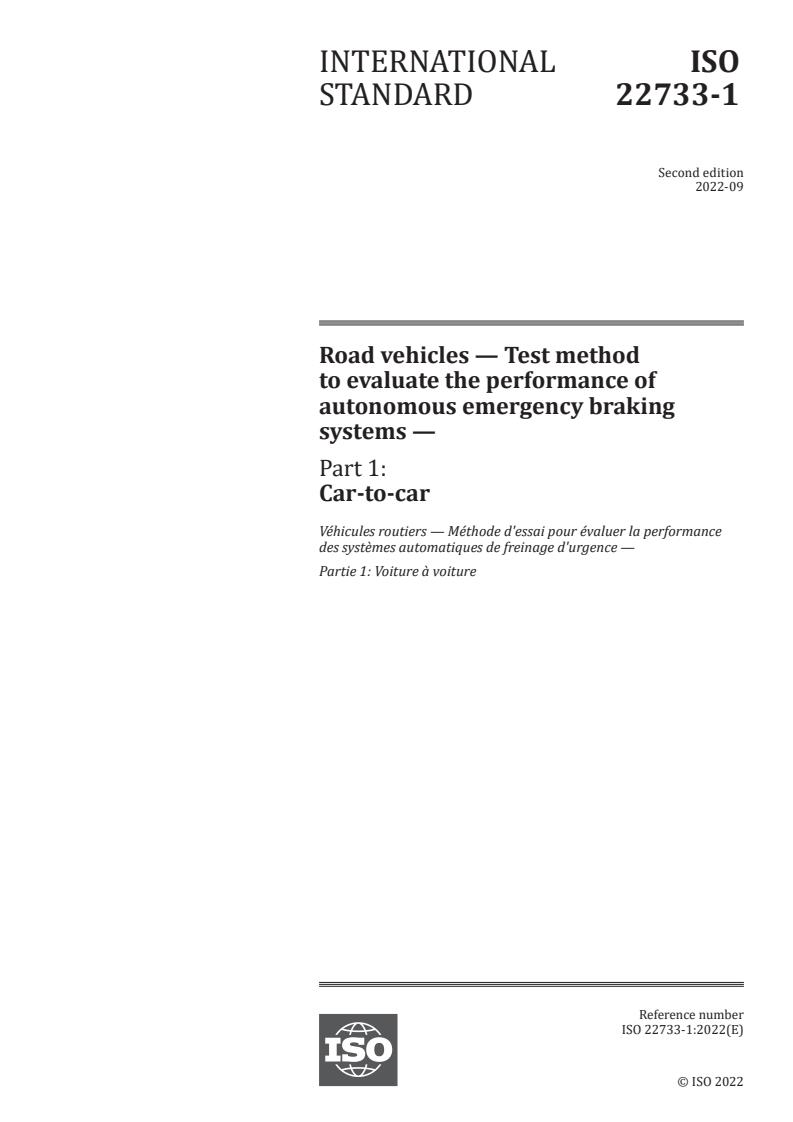
INTERNATIONAL ISO
STANDARD 22733-1
Second edition
2022-09
Road vehicles — Test method
to evaluate the performance of
autonomous emergency braking
systems —
Part 1:
Car-to-car
Véhicules routiers — Méthode d'essai pour évaluer la performance
des systèmes automatiques de freinage d'urgence —
Partie 1: Voiture à voiture
Reference number
© ISO 2022
All rights reserved. Unless otherwise specified, or required in the context of its implementation, no part of this publication may
be reproduced or utilized otherwise in any form or by any means, electronic or mechanical, including photocopying, or posting on
the internet or an intranet, without prior written permission. Permission can be requested from either ISO at the address below
or ISO’s member body in the country of the requester.
ISO copyright office
CP 401 • Ch. de Blandonnet 8
CH-1214 Vernier, Geneva
Phone: +41 22 749 01 11
Email: copyright@iso.org
Website: www.iso.org
Published in Switzerland
ii
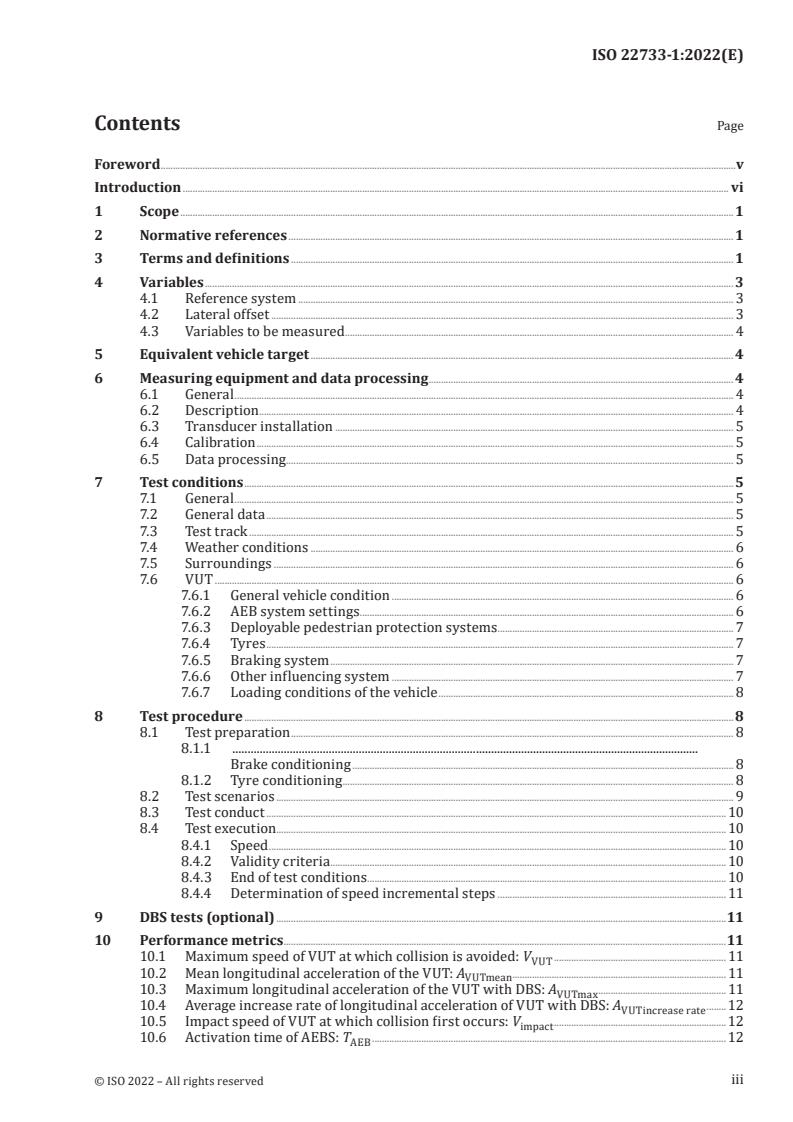
Contents Page
Foreword .v
Introduction . vi
1 S c op e . 1
2 Nor m at i ve r ef er enc e s . 1
3 Terms and definitions . 1
4 Va r i able s . 3
4.1 Reference system . 3
4 . 2 L at er a l of f s e t . 3
4.3 V ariables to be measured . 4
5 E quivalent vehicle target . 4
6 Measuring equipment and data processing . 4
6.1 General . 4
6 . 2 D e s c r ip t ion . 4
6 . 3 Tr a n s duc er i n s t a l l at ion . 5
6 .4 C a l ibr at ion . 5
6 . 5 Dat a pr o c e s s i n g. 5
7 Te s t c ond it ion s .5
7.1 G eneral . 5
7.2 G eneral data . 5
7. 3 Te s t t r ac k . 5
7.4 We at her c ond it ion s . 6
7. 5 Sur r ound i n g s . 6
7. 6 V U T . 6
7.6.1 G eneral vehicle condition . 6
7.6.2 A EB system settings . . 6
7.6.3 Deployable pedestrian protection systems . 7
7.6.4 Tyres . 7
7.6.5 Braking system . 7
7.6.6 Other influencing system . 7
7.6.7 Loading conditions of the vehicle . 8
8 Te s t pr o c e du r e .8
8 .1 Te s t pr ep a r at ion . 8
8.1.1 .
Brake conditioning . 8
8.1.2 Tyre conditioning . 8
8 . 2 Te s t s c en a r io s . 9
8 . 3 Te s t c onduc t . 10
8.4 T est execution . . 10
8 .4 .1 Sp ee d . 10
8.4.2 V alidity criteria . . 10
8.4.3 End of test conditions . . 10
8.4.4 D etermination of speed incremental steps . 11
9 D BS tests (optional) .11
10 Per f or m a nc e me t r ic s .11
10.1 M aximum speed of VUT at which collision is avoided: V . 11
VUT
10.2 M ean longitudinal acceleration of the VUT: A . 11
VUTmean
10.3 M aximum longitudinal acceleration of the VUT with DBS: A . 11
VUTmax
10.4 A verage increase rate of longitudinal acceleration of VUT with DBS: A .12
VUTincrease rate
10.5 I mpact speed of VUT at which collision first occurs: V .12
impact
10.6 A ctivation time of AEBS: T . 12
AEB
iii
10.7 A ctivation time of FCW: T . 12
FCW
10.8 M aximum yaw rate of the VUT: ψψ .12
VUT
10.9 L ateral offset of the VUT: Y . 12
VUT
10.10 M aximum steering wheel velocity of VUT: Ω .12
VUT
Annex A (informative) Brake application procedure .13
Annex B (informative) Test report.15
Bibliography .18
iv
Foreword
ISO (the International Organization for Standardization) is a worldwide federation of national standards
bodies (ISO member bodies). The work of preparing International Standards is normally carried out
through ISO technical committees. Each member body interested in a subject for which a technical
committee has been established has the right to be represented on that committee. International
organizations, governmental and non-governmental, in liaison with ISO, also take part in the work.
ISO collaborates closely with the International Electrotechnical Commission (IEC) on all matters of
electrotechnical standardization.
The procedures used to develop this document and those intended for its further maintenance are
described in the ISO/IEC Directives, Part 1. In particular, the different approval criteria needed for the
different types of ISO documents should be noted. This document was drafted in accordance with the
editorial rules of the ISO/IEC Directives, Part 2 (see www.iso.org/directives).
Attention is drawn to the possibility that some of the elements of this document may be the subject of
patent rights. ISO shall not be held responsible for identifying any or all such patent rights. Details of
any patent rights identified during the development of the document will be in the Introduction and/or
on the ISO list of patent declarations received (see www.iso.org/patents).
Any trade name used in this document is information given for the convenience of users and does not
constitute an endorsement.
For an explanation of the voluntary nature of standards, the meaning of ISO specific terms and
expressions related to conformity assessment, as well as information about ISO's adherence to the
World Trade Organization (WTO) principles in the Technical Barriers to Trade (TBT), see www.iso.org/
iso/foreword.html.
This document was prepared by Technical Committee ISO/TC 22, Road vehicles, Subcommittee SC 33,
Vehicle dynamics and chassis components.
This second edition cancels and replaces the first edition (ISO 22733-1:2021), which has been technically
revised.
The main changes are as follows:
— normative reference to ISO 19206-3 added in several clauses;
— editorial improvements.
A list of all parts in the ISO 22733 series can be found on the ISO website.
Any feedback or questions on this document should be directed to the user’s national standards body. A
complete listing of these bodies can be found at www.iso.org/members.html.
v
Introduction
The capacity to avoid or mitigate a collision during potential accident is an important part of the
performance of an autonomous emergency braking system. This document is intended to assess
performance of an autonomous emergency braking system under defined test scenario only.
NOTE Moreover, insufficient knowledge is available concerning the relationship between overall vehicle
dynamic properties and accident avoidance. (A substantial amount of work is necessary to acquire enough and
reliable data on the correlation between accident avoidance and vehicle dynamic properties in general and the
results of these tests in particular.)
vi
INTERNATIONAL STANDARD ISO 22733-1:2022(E)
Road vehicles — Test method to evaluate the performance
of autonomous emergency braking systems —
Part 1:
Car-to-car
1 S cope
This document specifies a method to evaluate the behaviour of a vehicle equipped with an autonomous
emergency braking system (AEBS), or dynamic brake support (DBS) during several accident scenarios.
Those accidents occur during a straight-line driving when the vehicle under test (VUT) approaches
another vehicle in the same lane. Both vehicles are aligned in longitudinal axis to each other.
The most important part of the vehicle behaviour during these accidents scenarios is the capacity to
avoid or mitigate the collision.
Systems requiring driver intervention are not in the scope of this document.
NOTE Depending on accidentology, only a part of the scenarios can be used for an evaluation of performance.
AEB system evaluation based upon this document is limited to longitudinal accident scenarios.
2 Normat ive references
The following documents are referred to in the text in such a way that some or all of their content
constitutes requirements of this document. For dated references, only the edition cited applies. For
undated references, the latest edition of the referenced document (including any amendments) applies.
ISO 8855, Road vehicles — Vehicle dynamics and road-holding ability — Vocabulary
ISO 15037-1:2019, Road vehicles — Vehicle dynamics test methods — Part 1: General conditions for
passenger cars
ISO 19206-1, Road vehicles — Test devices for target vehicles, vulnerable road users and other objects, for
assessment of active safety functions — Part 1: Requirements for passenger vehicle rear-end targets
ISO 19206-3, Road vehicles — Test devices for target vehicles, vulnerable road users and other objects, for
assessment of active safety functions — Part 3: Requirements for passenger vehicle 3D targets
3 Terms and definitions
For the purposes of this document, the terms and definitions given in ISO 8855, ISO 15037-1 and the
following apply.
ISO and IEC maintain terminology databases for use in standardization at the following addresses:
— ISO Online browsing platform: available at https:// www .iso .org/ obp
— IEC Electropedia: available at https:// www .electropedia .org/
3.1
AEB
autonomous emergency braking
braking applied automatically by the vehicle in response to the detection of a likely collision to reduce
the vehicle speed and potentially avoid the collision
3.2
CCRs
car-to-car rear stationary
collision in which a vehicle travels forward towards another stationary vehicle and the frontal structure
of the vehicle strikes the rear structure of the stationary vehicle
3.3
CCRm
car-to-car rear moving
collision in which a vehicle travels forward towards another vehicle travelling at constant speed and
the frontal structure of the vehicle strikes the rear structure of the leading vehicle
3.4
CCRb
car-to-car rear braking
collision in which a vehicle travels forward towards another vehicle travelling at constant speed and
then decelerates, and the frontal structure of the vehicle strikes the rear structure of the leading vehicle
3.5
DBS
dynamic brake support
system that further amplifies the driver braking demand in response to the detection of a likely collision
to achieve a greater deceleration
3.6
EVT
equivalent vehicle target
vehicle target as defined in ISO 19206-1 or ISO 19206-3
3.7
FCW
forward collision warning
audiovisual warning provided automatically by the vehicle in response to the detection of a likely
collision to alert the driver
3.8
peak braking coefficient
PBC
measure of tyre-to-road surface friction based on the maximum deceleration of a rolling tyre
Note 1 to entry: Measured using ASTM E1136-10, at a speed of 64,4 km/h, without water delivery.
3.9
TTC
time-to-collision
remaining time before the vehicle under test (VUT) (3.10) strikes the equivalent vehicle target (EVT)
(3.6), assuming that the VUT and EVT travel at constant speed
3.10
VUT
vehicle under test
vehicle tested with a pre-crash collision mitigation or avoidance system on board
3.11
T
AEB
time when the autonomous emergency braking (AEB) (3.1) system activates
Note 1 to entry: Activation time is determined by identifying the last data point where the filtered acceleration
2 2
signal is below −1 m/s , and then going back to the point in time where the acceleration first crossed −0,3 m/s .
3.12
T
FCW
time when the audible warning of the forward collision warning (FCW) (3.7) starts
Note 1 to entry: The starting point is determined by audible analysis or video analysis.
3.13
V
impact
vehicle velocity at which the vehicle under test (VUT) (3.10) hits the equivalent vehicle target (EVT) (3.6)
3.14
V
rel_impact
relative speed at which the vehicle under test (VUT) (3.10) hits the equivalent vehicle target (EVT) (3.6)
by subtracting the velocity of the EVT from V (3.13) at the time of collision
impact
4 Variable s
4.1 Reference system
The reference earth frame according to ISO 8855:2011, 2.8 is defined as:
— X axis: intended straight line path projected on the ground to front;
— Y axis: perpendicular to X axis on the ground to left;
— Z axis: perpendicular to the ground to the top.
4.2 Lateral offset
The lateral offset is determined as the lateral distance between the centre of the front of the VUT and
the centre of the rear of the EVT when measured in parallel to the intended straight-lined path as shown
in Figure 1.
Key
1 intended straight-lined path
2 VUT
3 VUT path
4 EVT
5 EVT path
a
Y
VUTe_ rror.
b
X
distance.
C
Y
EVTe_ rror.
Figure 1 — Coordinate system and notation
The lateral offset is defined as YY+ .
VUTe__rrorEVT error
The origin is an arbitrary point on X axis. The Y and Y are measured in the reference
VUT target_error
frame and the Y is identical to Y .
target_error EVTe_ rror
4.3 V ariables to be measured
Table 1 lists all relevant variables to be measured. All dynamic data shall be sampled and recorded at
a frequency of at least 100 Hz. EVT and VUT data shall be synchronized by using the differential GPS
(DGPS) time stamp of the EVT.
Table 1 — Variables to be measured
Variable Symbol
CCRs and CCRm: T equals TTC = 4 s T
0 0
CCRb: T when EVT starts decelerating
T , time when AEB activates T
Time
AEB AEB
T , time when FCW activates T
FCW FCW
T , time when VUT impacts EVT T
impact impact
Position of the VUT during the entire test
X , Y
VUT VUT
Position
Position of the EVT during the entire test X , Y
EVT EVT
Speed of the VUT during the entire test:
V
VUT
— V , speed when VUT impacts EVT V
impact impact
Speed
— V , relative speed when VUT impacts EVT V
reli_ mpact reli_ mpact
Speed of the EVT during the entire test V
EVT
Yaw velocity of the VUT during the entire test
ψ
VUT
Yaw velocity
Yaw velocity of the EVT during the entire test ψ
EVT
Acceleration of the VUT during the entire test
A
EVT
Acceleration
Acceleration of the EVT during the entire test A
EVT
An example of a test report is given in Annex B.
5 E quivalent vehicle target
The equivalent vehicle target (EVT) shall meet the requirements as defined in ISO 19206-1 or
ISO 19206-3.
6 Measur ing equipment and data processing
6.1 General
The test conditions on measurement equipment and data processing shall be in accordance with
ISO 15037-1:2019, Clause 6, unless otherwise specified below.
6.2 Description
VUT and EVT shall be equipped with data measurement and acquisition equipment to sample and
record data with an accuracy of at least:
— VUT and EVT speed to 0,1 km/h;
— VUT and EVT lateral and longitudinal position to 0,03 m;
— VUT and EVT yaw rate to 0,1°/s;
— VUT and EVT longitudinal acceleration to 0,1 m/s ;
— steering wheel velocity to 1,0°/s.
6.3 Transducer install ation
The transient vehicle pitch changes shall not adversely affect the measurement of the velocity and
distance variables for the chosen transducer system.
6.4 Calibration
All transducers shall be calibrated according to the manufacturer’s instructions. The transducer
manufacturer’s recommended application software and firmware version shall be used. If parts of
the measuring system can be adjusted, such calibration shall be performed immediately before the
beginning of the tests.
6.5 Data processing
Filter the measured data as follows:
— position and speed are not filtered and are used in their raw state;
— acceleration with a 12-pole phaseless Butterworth filter with a cut-off frequency of 10 Hz;
— yaw rate with a 12-pole phaseless Butterworth filter with a cut-off frequency of 10 Hz;
— force with a 12-pole phaseless Butterworth filter with a cut-off frequency of 10 Hz.
7 Test conditions
7.1 General
The test conditions shall be in accordance with ISO 15037-1:2019, Clause 6, unless otherwise specified
below.
7.2 General data
General data on the test vehicle and test conditions shall be recorded as specified in ISO 15037-1:2019,
6.4.1.
7.3 Test track
Conduct tests on a dry (no visible moisture on the surface), uniform, solid-paved surface with a
consistent slope between level and 1 %. The test surface shall have a minimal peak braking coefficient
(PBC) of 0,9.
The surface shall be paved and shall not contain any irregularities (e.g. large dips or cracks, manhole
covers or reflective studs) that may give rise to abnormal sensor measurements within a lateral
distance of 3,0 m to either side of the theoretical path line and with a longitudinal distance of 30 m
beyond the position of VUT/EVT at the end of the test.
Lane markings are allowed. However, testing may only be conducted in an area where typical road
markings depicting a driving lane may not be parallel to the test path within 3,0 m either side. Lines
or markings may cross the test path but may not be present in the area where AEB activation and/or
braking after FCW is expected.
7.4 Weather condition s
Conduct tests in dry conditions with ambient temperature above 0 °C and below 45 °C.
The surface temperature of the test track shall be between +10 °C and +50 °C.
No precipitation shall be falling and the horizontal
...
記事のタイトル:ISO 22733-1:2022 - 道路車両−自動緊急ブレーキシステムの性能評価方法−第1部:車車間 記事の内容:この文書は、自動緊急ブレーキシステム(AEBS)またはダイナミックブレーキサポート(DBS)を搭載した車両の振る舞いを、さまざまな事故シナリオで評価する方法を規定しています。これらの事故は、テスト対象車(VUT)が同じ車線の他の車両に接近する直線走行中に発生します。両方の車両は縦方向に揃えられます。これらの事故シナリオでは、衝突を回避または軽減する能力が最も重要です。本文書の対象は、運転者の介入を必要とするシステムは含まれていません。なお、事故分析に応じて、評価に使用できるシナリオの一部のみを利用することがあります。本文書に基づくAEBSシステムの評価は、縦方向の事故シナリオに限定されます。
ISO 22733-1:2022 is a standard that provides a test method to assess the performance of autonomous emergency braking systems (AEBS) or dynamic brake support (DBS) in vehicles. The method focuses on evaluating the behavior of a vehicle equipped with these systems during different accident scenarios that occur when the vehicle is driving in a straight line and approaches another vehicle in the same lane. The evaluation specifically looks at the vehicle's ability to avoid or mitigate collisions in these scenarios, and it does not cover systems that require driver intervention. It is worth noting that the evaluation of the AEBS based on this document is limited to longitudinal accident scenarios.
기사 제목: ISO 22733-1:2022 - 도로 차량 - 자율 비상 제동 시스템 성능 평가를 위한 시험 방법 - 제1부: 차대 차 기사 내용: 이 문서는 자율 비상 제동 시스템(AEBS)이나 동적 제동 지원(DBS)이 장착된 차량의 동작을 여러 사고 시나리오에서 평가하는 방법을 명시하고 있습니다. 이러한 사고는 테스트 차량(VUT)이 동일 차선 내 다른 차량에 접근하는 직선 주행 중에 발생합니다. 두 차량은 서로의 종축에 정렬됩니다. 이러한 사고 시나리오에서 차량의 동작은 충돌을 피하거나 완화하는 능력이 가장 중요합니다. 본 문서의 대상은 운전자 개입을 필요로하는 시스템은 포함되지 않습니다. 참고로, 사고분석에 따라 성능 평가에 사용될 수 있는 시나리오의 일부만 사용할 수 있습니다. 이 문서에 근거한 AEB 시스템 평가는 종방향 사고 시나리오로 제한됩니다.
Questions, Comments and Discussion
Ask us and Technical Secretary will try to provide an answer. You can facilitate discussion about the standard in here.
Loading comments...