

ISO 2010:2011
(Main)Slotted raised countersunk head screws — Product grade A
General Information
- Abstract
ISO 2010:2011 specifies the characteristics of countersunk slotted raised head screws of product grade A and with threads from M1,6 to M10 inclusive.
- Status
- Published
- Publication Date
- 25-Aug-2011
- Technical Committee
- ISO/TC 2/SC 11 - Fasteners with metric external thread
- Drafting Committee
- ISO/TC 2/SC 11 - Fasteners with metric external thread
- Current Stage
- 9093 - International Standard confirmed
- Start Date
- 26-Jun-2026
- Completion Date
- 29-Aug-2026
Buy Documents



ISO 2010:2011 - Slotted raised countersunk head screws -- Product grade A

ISO 2010:2011 - Slotted raised countersunk head screws — Product grade A/26/2011

ISO 2010:2011 - Vis a métaux a tete fraisée bombée fendue -- Grade A

ISO 2010:2011 - Vis à métaux à tête fraisée bombée fendue — Grade A/26/2011
Overview
ISO 2010:2011 - "Slotted raised countersunk head screws - Product grade A" is an international standard that specifies the characteristics, dimensions and basic requirements for countersunk slotted raised head screws of product grade A with metric threads from M1.6 to M10 inclusive. It defines dimensional data, nominal lengths, thread pitches and references the applicable mechanical property, tolerance and finishing standards used for manufacturing, inspection and procurement of these fasteners.
Key topics and requirements
- Scope: Covers raised countersunk (bugle-type) slotted head screws, product grade A, threads M1.6–M10.
- Dimensions and tolerances: Detailed dimensional tables (head, shank, thread length and related symbols per ISO 225) and preferred lengths. Typical thread pitches shown range from 0.35 mm to 1.5 mm depending on size.
- Material and mechanical properties: Steel, stainless steel and non‑ferrous options are covered. Recommended property classes include 4.8, 5.8 (steel) and A2‑50, A2‑70 (stainless steel), with mechanical-property requirements referenced to ISO 898‑1, ISO 3506‑1 and ISO 8839.
- Thread and tolerance classes: Uses general-purpose metric threads per ISO 261 / ISO 965‑2 and tolerance class 6g for external threads. Product grade tolerances follow ISO 4759‑1.
- Surface finish and coatings: Electroplating and passivation practices are referenced (ISO 4042, ISO 16048); non‑electrolytically applied zinc flake coatings per ISO 10683. Surface discontinuity limits per ISO 6157‑1.
- Acceptance and inspection: Acceptance inspection is specified by ISO 3269.
- Designation example: "Countersunk raised head screw ISO 2010 - M5 × 20 - 4.8" (indicates standard, thread size, nominal length and property class).
Applications and users
- Typical users: fastener manufacturers, component suppliers, product designers, mechanical engineers, procurement and quality inspection teams.
- Typical applications: assemblies requiring a flush countersunk finish with a raised head profile and slotted drive - consumer products, electronics, machinery, light‑duty structural joints and repair parts where metric small‑screw sizes (M1.6–M10) are used.
- Practical benefits: ensures interchangeability, consistent mechanical performance, agreed tolerances and appropriate surface finishes for corrosion resistance and assembly reliability.
Related standards
- ISO 225 (dimension symbols), ISO 261 / ISO 965‑2 (metric threads), ISO 898‑1 (mechanical properties - steel), ISO 3506‑1 (stainless steel), ISO 4759‑1 (tolerances), ISO 3269 (acceptance inspection), ISO 4042 / ISO 10683 / ISO 16048 (coatings and passivation), ISO 6157‑1 (surface discontinuities).
Keywords: ISO 2010, slotted raised countersunk head screws, product grade A, M1.6–M10, fastener dimensions, mechanical properties, screw tolerances.
Relations
- Consolidates
EN ISO 2010:2011 - Slotted raised countersunk head screws - Product grade A (ISO 2010:2011) - Effective Date
- 12-Feb-2026
- Effective Date
- 18-Sep-2010
Buy Documents
ISO 2010:2011 - Slotted raised countersunk head screws -- Product grade A
ISO 2010:2011 - Slotted raised countersunk head screws — Product grade A/26/2011
ISO 2010:2011 - Vis a métaux a tete fraisée bombée fendue -- Grade A
ISO 2010:2011 - Vis à métaux à tête fraisée bombée fendue — Grade A/26/2011
Frequently Asked Questions
ISO 2010:2011 is a standard published by the International Organization for Standardization (ISO). Its full title is "Slotted raised countersunk head screws — Product grade A". This standard covers: ISO 2010:2011 specifies the characteristics of countersunk slotted raised head screws of product grade A and with threads from M1,6 to M10 inclusive.
ISO 2010:2011 specifies the characteristics of countersunk slotted raised head screws of product grade A and with threads from M1,6 to M10 inclusive.
ISO 2010:2011 is classified under the following ICS (International Classification for Standards) categories: 21.060.10 - Bolts, screws, studs. The ICS classification helps identify the subject area and facilitates finding related standards.
ISO 2010:2011 has the following relationships with other standards: It is inter standard links to EN ISO 2010:2011, ISO 2010:1994. Understanding these relationships helps ensure you are using the most current and applicable version of the standard.
ISO 2010:2011 is available in PDF format for immediate download after purchase. The document can be added to your cart and obtained through the secure checkout process. Digital delivery ensures instant access to the complete standard document.
Standards Content (Sample)
INTERNATIONAL ISO
STANDARD 2010
Fourth edition
2011-09-01
Slotted raised countersunk head
screws — Product grade A
Vis à métaux à tête fraisée bombée fendue — Grade A
Reference number
©
ISO 2011
© ISO 2011
All rights reserved. Unless otherwise specified, no part of this publication may be reproduced or utilized in any form or by any means,
electronic or mechanical, including photocopying and microfilm, without permission in writing from either ISO at the address below or
ISO's member body in the country of the requester.
ISO copyright office
Case postale 56 • CH-1211 Geneva 20
Tel. + 41 22 749 01 11
Fax + 41 22 749 09 47
E-mail copyright@iso.org
Web www.iso.org
Published in Switzerland
ii © ISO 2011 – All rights reserved
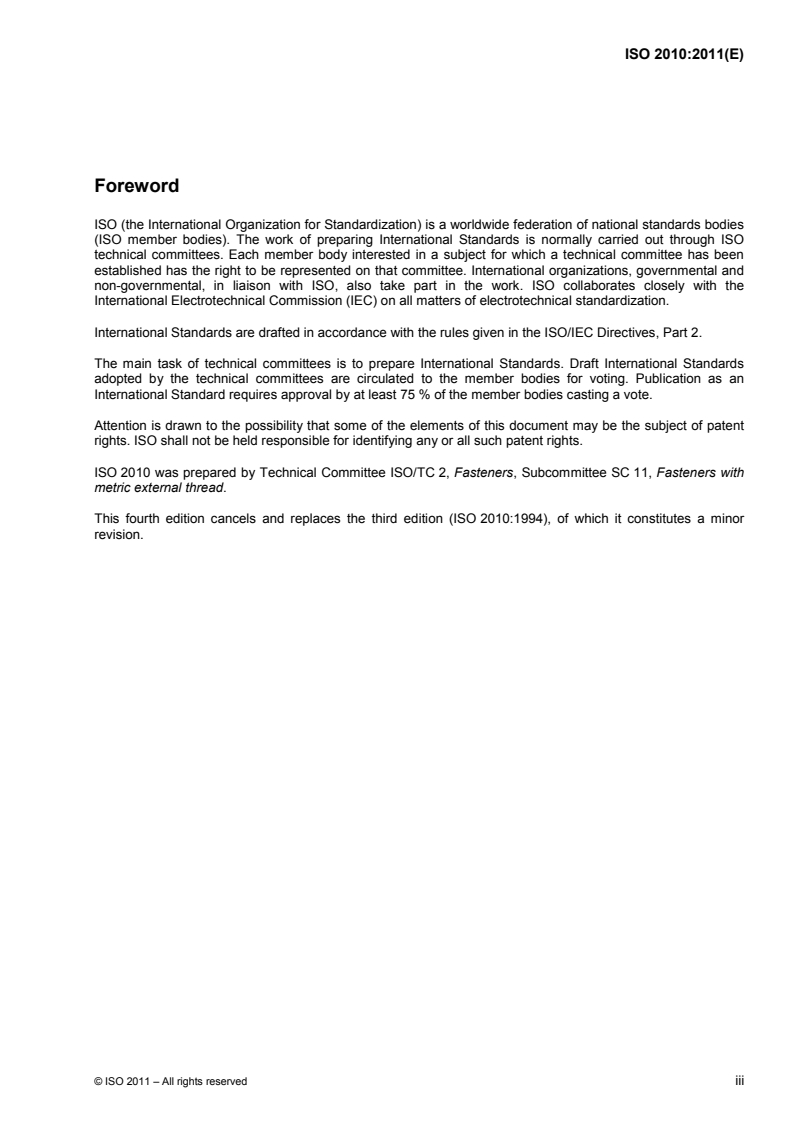
Foreword
ISO (the International Organization for Standardization) is a worldwide federation of national standards bodies
(ISO member bodies). The work of preparing International Standards is normally carried out through ISO
technical committees. Each member body interested in a subject for which a technical committee has been
established has the right to be represented on that committee. International organizations, governmental and
non-governmental, in liaison with ISO, also take part in the work. ISO collaborates closely with the
International Electrotechnical Commission (IEC) on all matters of electrotechnical standardization.
International Standards are drafted in accordance with the rules given in the ISO/IEC Directives, Part 2.
The main task of technical committees is to prepare International Standards. Draft International Standards
adopted by the technical committees are circulated to the member bodies for voting. Publication as an
International Standard requires approval by at least 75 % of the member bodies casting a vote.
Attention is drawn to the possibility that some of the elements of this document may be the subject of patent
rights. ISO shall not be held responsible for identifying any or all such patent rights.
ISO 2010 was prepared by Technical Committee ISO/TC 2, Fasteners, Subcommittee SC 11, Fasteners with
metric external thread.
This fourth edition cancels and replaces the third edition (ISO 2010:1994), of which it constitutes a minor
revision.
INTERNATIONAL STANDARD ISO 2010:2011(E)
Slotted raised countersunk head screws — Product grade A
1 Scope
This International Standard specifies the characteristics of countersunk slotted raised head screws of product
grade A and with threads from M1,6 to M10 inclusive.
If, in special cases, specifications other than those listed in this International Standard are required, they can
be selected from existing International Standards, for example ISO 261, ISO 888, ISO 898-1, ISO 965-2 and
ISO 3506-1.
2 Normative references
The following referenced documents are indispensable for the application of this document. For dated
references, only the edition cited applies. For undated references, the latest edition of the referenced
document (including any amendments) applies.
ISO 225, Fasteners — Bolts, screws, studs and nuts — Symbols and descriptions of dimensions
ISO 261, ISO general purpose metric screw threads — General plan
ISO 898-1, Mechanical properties of fasteners made of carbon steel and alloy steel — Part 1: Bolts, screws
and studs with specified property classes — Coarse thread and fine pitch thread
ISO 965-2, ISO general purpose metric screw threads — Tolerances — Part 2: Limits of sizes for general
purpose external and internal screw threads — Medium quality
ISO 3269, Fasteners — Acceptance inspection
ISO 3506-1, Mechanical properties of corrosion-resistant stainless steel fasteners — Part 1: Bolts, screws and
studs
ISO 4042, Fasteners — Electroplated coatings
ISO 4759-1, Tolerances for fasteners — Part 1: Bolts, screws, studs and nuts — Product grades A, B and C
ISO 6157-1, Fasteners — Surface discontinuities — Part 1: Bolts, screws and studs for general requirements
ISO 8839, Mechanical properties of fasteners — Bolts, screws, studs and nuts made of non-ferrous metals
ISO 8992, Fasteners — General requirements for bolts, screws, studs and nuts
ISO 10683, Fasteners — Non-electrolytically applied zinc flake coatings
ISO 16048, Passivation of corrosion-resistant stainless-steel fasteners
3 Dimensions
See Figure 1 and Table 1. Symbols and descriptions of dimensions are specified in ISO 225.
The shank diameter is approximately equal to the pitch diame
...
INTERNATIONAL ISO
STANDARD 2010
Fourth edition
2011-09-01
Slotted raised countersunk head
screws — Product grade A
Vis à métaux à tête fraisée bombée fendue — Grade A
Reference number
©
ISO 2011
© ISO 2011
All rights reserved. Unless otherwise specified, no part of this publication may be reproduced or utilized in any form or by any means,
electronic or mechanical, including photocopying and microfilm, without permission in writing from either ISO at the address below or
ISO's member body in the country of the requester.
ISO copyright office
Case postale 56 • CH-1211 Geneva 20
Tel. + 41 22 749 01 11
Fax + 41 22 749 09 47
E-mail copyright@iso.org
Web www.iso.org
Published in Switzerland
ii © ISO 2011 – All rights reserved
Foreword
ISO (the International Organization for Standardization) is a worldwide federation of national standards bodies
(ISO member bodies). The work of preparing International Standards is normally carried out through ISO
technical committees. Each member body interested in a subject for which a technical committee has been
established has the right to be represented on that committee. International organizations, governmental and
non-governmental, in liaison with ISO, also take part in the work. ISO collaborates closely with the
International Electrotechnical Commission (IEC) on all matters of electrotechnical standardization.
International Standards are drafted in accordance with the rules given in the ISO/IEC Directives, Part 2.
The main task of technical committees is to prepare International Standards. Draft International Standards
adopted by the technical committees are circulated to the member bodies for voting. Publication as an
International Standard requires approval by at least 75 % of the member bodies casting a vote.
Attention is drawn to the possibility that some of the elements of this document may be the subject of patent
rights. ISO shall not be held responsible for identifying any or all such patent rights.
ISO 2010 was prepared by Technical Committee ISO/TC 2, Fasteners, Subcommittee SC 11, Fasteners with
metric external thread.
This fourth edition cancels and replaces the third edition (ISO 2010:1994), of which it constitutes a minor
revision.
INTERNATIONAL STANDARD ISO 2010:2011(E)
Slotted raised countersunk head screws — Product grade A
1 Scope
This International Standard specifies the characteristics of countersunk slotted raised head screws of product
grade A and with threads from M1,6 to M10 inclusive.
If, in special cases, specifications other than those listed in this International Standard are required, they can
be selected from existing International Standards, for example ISO 261, ISO 888, ISO 898-1, ISO 965-2 and
ISO 3506-1.
2 Normative references
The following referenced documents are indispensable for the application of this document. For dated
references, only the edition cited applies. For undated references, the latest edition of the referenced
document (including any amendments) applies.
ISO 225, Fasteners — Bolts, screws, studs and nuts — Symbols and descriptions of dimensions
ISO 261, ISO general purpose metric screw threads — General plan
ISO 898-1, Mechanical properties of fasteners made of carbon steel and alloy steel — Part 1: Bolts, screws
and studs with specified property classes — Coarse thread and fine pitch thread
ISO 965-2, ISO general purpose metric screw threads — Tolerances — Part 2: Limits of sizes for general
purpose external and internal screw threads — Medium quality
ISO 3269, Fasteners — Acceptance inspection
ISO 3506-1, Mechanical properties of corrosion-resistant stainless steel fasteners — Part 1: Bolts, screws and
studs
ISO 4042, Fasteners — Electroplated coatings
ISO 4759-1, Tolerances for fasteners — Part 1: Bolts, screws, studs and nuts — Product grades A, B and C
ISO 6157-1, Fasteners — Surface discontinuities — Part 1: Bolts, screws and studs for general requirements
ISO 8839, Mechanical properties of fasteners — Bolts, screws, studs and nuts made of non-ferrous metals
ISO 8992, Fasteners — General requirements for bolts, screws, studs and nuts
ISO 10683, Fasteners — Non-electrolytically applied zinc flake coatings
ISO 16048, Passivation of corrosion-resistant stainless-steel fasteners
3 Dimensions
See Figure 1 and Table 1. Symbols and descriptions of dimensions are specified in ISO 225.
The shank diameter is approximately equal to the pitch diame
...
NORME ISO
INTERNATIONALE 2010
Quatrième édition
2011-09-01
Vis à métaux à tête fraisée bombée
fendue — Grade A
Slotted raised countersunk head screws — Product grade A
Numéro de référence
©
ISO 2011
DOCUMENT PROTÉGÉ PAR COPYRIGHT
© ISO 2011
Droits de reproduction réservés. Sauf prescription différente, aucune partie de cette publication ne peut être reproduite ni utilisée sous
quelque forme que ce soit et par aucun procédé, électronique ou mécanique, y compris la photocopie et les microfilms, sans l'accord écrit
de l'ISO à l'adresse ci-après ou du comité membre de l'ISO dans le pays du demandeur.
ISO copyright office
Case postale 56 • CH-1211 Geneva 20
Tel. + 41 22 749 01 11
Fax + 41 22 749 09 47
E-mail copyright@iso.org
Web www.iso.org
Publié en Suisse
ii © ISO 2011 – Tous droits réservés
Avant-propos
L'ISO (Organisation internationale de normalisation) est une fédération mondiale d'organismes nationaux de
normalisation (comités membres de l'ISO). L'élaboration des Normes internationales est en général confiée
aux comités techniques de l'ISO. Chaque comité membre intéressé par une étude a le droit de faire partie du
comité technique créé à cet effet. Les organisations internationales, gouvernementales et non
gouvernementales, en liaison avec l'ISO participent également aux travaux. L'ISO collabore étroitement avec
la Commission électrotechnique internationale (CEI) en ce qui concerne la normalisation électrotechnique.
Les Normes internationales sont rédigées conformément aux règles données dans les Directives ISO/CEI,
Partie 2.
La tâche principale des comités techniques est d'élaborer les Normes internationales. Les projets de Normes
internationales adoptés par les comités techniques sont soumis aux comités membres pour vote. Leur
publication comme Normes internationales requiert l'approbation de 75 % au moins des comités membres
votants.
L'attention est appelée sur le fait que certains des éléments du présent document peuvent faire l'objet de
droits de propriété intellectuelle ou de droits analogues. L'ISO ne saurait être tenue pour responsable de ne
pas avoir identifié de tels droits de propriété et averti de leur existence.
L'ISO 2010 a été élaborée par le comité technique ISO/TC 2, Éléments de fixation, sous-comité SC 11,
Éléments de fixation à filetage métrique extérieur.
Cette quatrième édition annule et remplace la troisième édition (ISO 2010:1994), qui a fait l'objet d'une
révision mineure.
NORME INTERNATIONALE ISO 2010:2011(F)
Vis à métaux à tête fraisée bombée fendue — Grade A
1 Domaine d'application
La présente Norme internationale spécifie les caractéristiques des vis à métaux à tête fraisée bombée fendue
de grade A et de diamètres de filetage M1,6 à M10 inclus.
Si, dans des cas particuliers, des spécifications autres que celles figurant dans la présente Norme
internationale sont requises, elles peuvent être choisies dans les Normes internationales existantes, par
exemple l'ISO 261, l'ISO 888, l'ISO 898-1, l'ISO 965-2 et l'ISO 3506-1.
2 Références normatives
Les documents de référence suivants sont indispensables pour l'application du présent document. Pour les
références datées, seule l'édition citée s'applique. Pour les références non datées, la dernière édition du
document de référence s'applique (y compris les éventuels amendements).
ISO 225, Éléments de fixation — Vis, goujons et écrous — Symboles et description des dimensions
ISO 261, Filetages métriques ISO pour usages généraux — Vue d'ensemble
ISO 898-1, Caractéristiques mécaniques des éléments de fixation en acier au carbone et en acier allié —
Partie 1: Vis, goujons et tiges filetées de classes de qualité spécifiées — Filetages à pas gros et filetages à
pas fin
ISO 965-2, Filetages métriques ISO pour usages généraux — Tolérances — Partie 2: Dimensions limites pour
filetages intérieurs et extérieurs d'usages généraux — Qualité moyenne
ISO 3269, Éléments de fixation — Contrôle de réception
ISO 3506-1, Caractéristiques mécaniques des éléments de fixation en acier inoxydable résistant à la
corrosion — Partie 1: Vis et goujons
ISO 4042, Éléments de fixation — Revêtements électrolytiques
ISO 4759-1, Tolérances des éléments de fixation — Partie 1: Vis, goujons et écrous — Grades A, B et C
ISO 6157-1, Éléments de fixation — Défauts de surface — Partie 1: Vis et goujons d'usage général
ISO 8839, Caractéristiques mécaniques des éléments de fixation — Vis, goujons et écrous en métaux non
ferreux
ISO 8992, Éléments de fixation — Exigences générales pour vis, goujons et écrous
ISO 10683, Éléments de fixation — Revêtements non électrolytiques de zinc lamellaire
ISO 16048, Passivation des éléments de fixation en acier inoxydable résistant à la corrosion
3 Dimensions
Voir Figure 1 et Tableau 1. Les symboles et la description des dimensions sont spécifiés dans l'ISO 225.
Le diamètre de tige est sensiblement ég
...
NORME ISO
INTERNATIONALE 2010
Quatrième édition
2011-09-01
Vis à métaux à tête fraisée bombée
fendue — Grade A
Slotted raised countersunk head screws — Product grade A
Numéro de référence
©
ISO 2011
DOCUMENT PROTÉGÉ PAR COPYRIGHT
© ISO 2011
Droits de reproduction réservés. Sauf prescription différente, aucune partie de cette publication ne peut être reproduite ni utilisée sous
quelque forme que ce soit et par aucun procédé, électronique ou mécanique, y compris la photocopie et les microfilms, sans l'accord écrit
de l'ISO à l'adresse ci-après ou du comité membre de l'ISO dans le pays du demandeur.
ISO copyright office
Case postale 56 • CH-1211 Geneva 20
Tel. + 41 22 749 01 11
Fax + 41 22 749 09 47
E-mail copyright@iso.org
Web www.iso.org
Publié en Suisse
ii © ISO 2011 – Tous droits réservés
Avant-propos
L'ISO (Organisation internationale de normalisation) est une fédération mondiale d'organismes nationaux de
normalisation (comités membres de l'ISO). L'élaboration des Normes internationales est en général confiée
aux comités techniques de l'ISO. Chaque comité membre intéressé par une étude a le droit de faire partie du
comité technique créé à cet effet. Les organisations internationales, gouvernementales et non
gouvernementales, en liaison avec l'ISO participent également aux travaux. L'ISO collabore étroitement avec
la Commission électrotechnique internationale (CEI) en ce qui concerne la normalisation électrotechnique.
Les Normes internationales sont rédigées conformément aux règles données dans les Directives ISO/CEI,
Partie 2.
La tâche principale des comités techniques est d'élaborer les Normes internationales. Les projets de Normes
internationales adoptés par les comités techniques sont soumis aux comités membres pour vote. Leur
publication comme Normes internationales requiert l'approbation de 75 % au moins des comités membres
votants.
L'attention est appelée sur le fait que certains des éléments du présent document peuvent faire l'objet de
droits de propriété intellectuelle ou de droits analogues. L'ISO ne saurait être tenue pour responsable de ne
pas avoir identifié de tels droits de propriété et averti de leur existence.
L'ISO 2010 a été élaborée par le comité technique ISO/TC 2, Éléments de fixation, sous-comité SC 11,
Éléments de fixation à filetage métrique extérieur.
Cette quatrième édition annule et remplace la troisième édition (ISO 2010:1994), qui a fait l'objet d'une
révision mineure.
NORME INTERNATIONALE ISO 2010:2011(F)
Vis à métaux à tête fraisée bombée fendue — Grade A
1 Domaine d'application
La présente Norme internationale spécifie les caractéristiques des vis à métaux à tête fraisée bombée fendue
de grade A et de diamètres de filetage M1,6 à M10 inclus.
Si, dans des cas particuliers, des spécifications autres que celles figurant dans la présente Norme
internationale sont requises, elles peuvent être choisies dans les Normes internationales existantes, par
exemple l'ISO 261, l'ISO 888, l'ISO 898-1, l'ISO 965-2 et l'ISO 3506-1.
2 Références normatives
Les documents de référence suivants sont indispensables pour l'application du présent document. Pour les
références datées, seule l'édition citée s'applique. Pour les références non datées, la dernière édition du
document de référence s'applique (y compris les éventuels amendements).
ISO 225, Éléments de fixation — Vis, goujons et écrous — Symboles et description des dimensions
ISO 261, Filetages métriques ISO pour usages généraux — Vue d'ensemble
ISO 898-1, Caractéristiques mécaniques des éléments de fixation en acier au carbone et en acier allié —
Partie 1: Vis, goujons et tiges filetées de classes de qualité spécifiées — Filetages à pas gros et filetages à
pas fin
ISO 965-2, Filetages métriques ISO pour usages généraux — Tolérances — Partie 2: Dimensions limites pour
filetages intérieurs et extérieurs d'usages généraux — Qualité moyenne
ISO 3269, Éléments de fixation — Contrôle de réception
ISO 3506-1, Caractéristiques mécaniques des éléments de fixation en acier inoxydable résistant à la
corrosion — Partie 1: Vis et goujons
ISO 4042, Éléments de fixation — Revêtements électrolytiques
ISO 4759-1, Tolérances des éléments de fixation — Partie 1: Vis, goujons et écrous — Grades A, B et C
ISO 6157-1, Éléments de fixation — Défauts de surface — Partie 1: Vis et goujons d'usage général
ISO 8839, Caractéristiques mécaniques des éléments de fixation — Vis, goujons et écrous en métaux non
ferreux
ISO 8992, Éléments de fixation — Exigences générales pour vis, goujons et écrous
ISO 10683, Éléments de fixation — Revêtements non électrolytiques de zinc lamellaire
ISO 16048, Passivation des éléments de fixation en acier inoxydable résistant à la corrosion
3 Dimensions
Voir Figure 1 et Tableau 1. Les symboles et la description des dimensions sont spécifiés dans l'ISO 225.
Le diamètre de tige est sensiblement ég
...