


ISO/IEC TR 18037:2004
(Main)Programming languages — C — Extensions to support embedded processors
Programming languages — C — Extensions to support embedded processors
ISO/IEC TR 18037:2004 specifies a series of extensions of the programming language C (as specified by ISO/IEC 9899:1999) to support features commonly found in embedded processors. ISO/IEC TR 18037:2004 deals with the following topics: extensions to support fixed-point arithmetic, named address spaces, and basic I/O hardware addressing. Each topic begins with a technical description of its features and ends with the editorial changes to ISO/IEC 9899:1999 necessary to fully specify the topic, and thereby provides a complete definition. Additional explanation and rationale are provided in annexes.
Langages de programmation — C — Extensions pour supporter les processeurs intégrés
General Information
- Status
- Withdrawn
- Publication Date
- 12-Jul-2004
- Withdrawal Date
- 12-Jul-2004
- Current Stage
- 9599 - Withdrawal of International Standard
- Start Date
- 11-Jun-2008
- Completion Date
- 12-Feb-2026
Relations
- Revised
ISO/IEC TR 18037:2008 - Programming languages — C — Extensions to support embedded processors - Effective Date
- 15-Apr-2008
Get Certified
Connect with accredited certification bodies for this standard

BSI Group
BSI (British Standards Institution) is the business standards company that helps organizations make excellence a habit.

NYCE
Mexican standards and certification body.
Sponsored listings
Frequently Asked Questions
ISO/IEC TR 18037:2004 is a technical report published by the International Organization for Standardization (ISO). Its full title is "Programming languages — C — Extensions to support embedded processors". This standard covers: ISO/IEC TR 18037:2004 specifies a series of extensions of the programming language C (as specified by ISO/IEC 9899:1999) to support features commonly found in embedded processors. ISO/IEC TR 18037:2004 deals with the following topics: extensions to support fixed-point arithmetic, named address spaces, and basic I/O hardware addressing. Each topic begins with a technical description of its features and ends with the editorial changes to ISO/IEC 9899:1999 necessary to fully specify the topic, and thereby provides a complete definition. Additional explanation and rationale are provided in annexes.
ISO/IEC TR 18037:2004 specifies a series of extensions of the programming language C (as specified by ISO/IEC 9899:1999) to support features commonly found in embedded processors. ISO/IEC TR 18037:2004 deals with the following topics: extensions to support fixed-point arithmetic, named address spaces, and basic I/O hardware addressing. Each topic begins with a technical description of its features and ends with the editorial changes to ISO/IEC 9899:1999 necessary to fully specify the topic, and thereby provides a complete definition. Additional explanation and rationale are provided in annexes.
ISO/IEC TR 18037:2004 is classified under the following ICS (International Classification for Standards) categories: 35.060 - Languages used in information technology. The ICS classification helps identify the subject area and facilitates finding related standards.
ISO/IEC TR 18037:2004 has the following relationships with other standards: It is inter standard links to ISO/IEC TR 18037:2008. Understanding these relationships helps ensure you are using the most current and applicable version of the standard.
ISO/IEC TR 18037:2004 is available in PDF format for immediate download after purchase. The document can be added to your cart and obtained through the secure checkout process. Digital delivery ensures instant access to the complete standard document.
Standards Content (Sample)
TECHNICAL ISO/IEC
REPORT TR
First edition
2004-07-15
Programming languages — C —
Extensions to support embedded
processors
Langages de programmation — C — Extensions pour supporter les
processeurs intégrés
Reference number
©
ISO/IEC 2004
PDF disclaimer
This PDF file may contain embedded typefaces. In accordance with Adobe's licensing policy, this file may be printed or viewed but
shall not be edited unless the typefaces which are embedded are licensed to and installed on the computer performing the editing. In
downloading this file, parties accept therein the responsibility of not infringing Adobe's licensing policy. The ISO Central Secretariat
accepts no liability in this area.
Adobe is a trademark of Adobe Systems Incorporated.
Details of the software products used to create this PDF file can be found in the General Info relative to the file; the PDF-creation
parameters were optimized for printing. Every care has been taken to ensure that the file is suitable for use by ISO member bodies. In
the unlikely event that a problem relating to it is found, please inform the Central Secretariat at the address given below.
© ISO/IEC 2004
All rights reserved. Unless otherwise specified, no part of this publication may be reproduced or utilized in any form or by any means,
electronic or mechanical, including photocopying and microfilm, without permission in writing from either ISO at the address below or
ISO's member body in the country of the requester.
ISO copyright office
Case postale 56 • CH-1211 Geneva 20
Tel. + 41 22 749 01 11
Fax + 41 22 749 09 47
E-mail copyright@iso.org
Web www.iso.org
Published in Switzerland
ii © ISO/IEC 2004 – All rights reserved
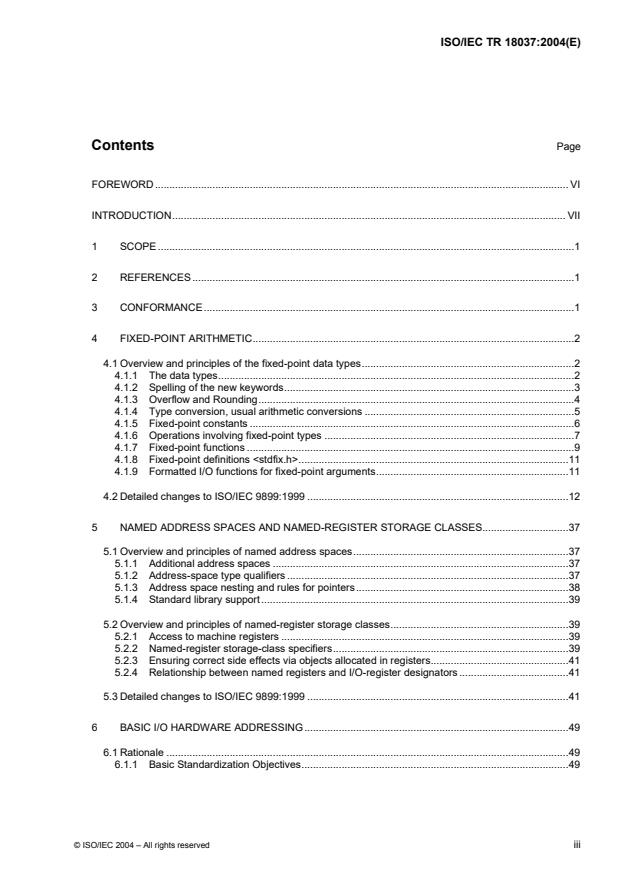
Contents Page
FOREWORD . VI
INTRODUCTION. VII
1 SCOPE .1
2 REFERENCES.1
3 CONFORMANCE.1
4 FIXED-POINT ARITHMETIC.2
4.1 Overview and principles of the fixed-point data types.2
4.1.1 The data types.2
4.1.2 Spelling of the new keywords.3
4.1.3 Overflow and Rounding.4
4.1.4 Type conversion, usual arithmetic conversions .5
4.1.5 Fixed-point constants .6
4.1.6 Operations involving fixed-point types .7
4.1.7 Fixed-point functions .9
4.1.8 Fixed-point definitions .11
4.1.9 Formatted I/O functions for fixed-point arguments.11
4.2 Detailed changes to ISO/IEC 9899:1999 .12
5 NAMED ADDRESS SPACES AND NAMED-REGISTER STORAGE CLASSES.37
5.1 Overview and principles of named address spaces.37
5.1.1 Additional address spaces .37
5.1.2 Address-space type qualifiers .37
5.1.3 Address space nesting and rules for pointers.38
5.1.4 Standard library support.39
5.2 Overview and principles of named-register storage classes.39
5.2.1 Access to machine registers .39
5.2.2 Named-register storage-class specifiers.39
5.2.3 Ensuring correct side effects via objects allocated in registers.41
5.2.4 Relationship between named registers and I/O-register designators .41
5.3 Detailed changes to ISO/IEC 9899:1999 .41
6 BASIC I/O HARDWARE ADDRESSING.49
6.1 Rationale .49
6.1.1 Basic Standardization Objectives.49
© ISO/IEC 2004 – All rights reserved iii
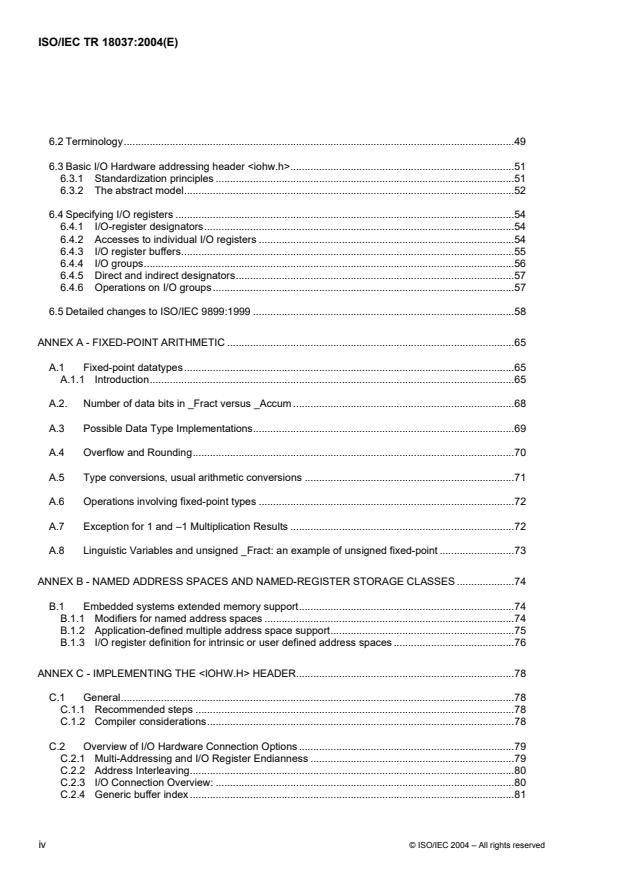
6.2 Terminology.49
6.3 Basic I/O Hardware addressing header .51
6.3.1 Standardization principles .51
6.3.2 The abstract model.52
6.4 Specifying I/O registers .54
6.4.1 I/O-register designators.54
6.4.2 Accesses to individual I/O registers .54
6.4.3 I/O register buffers.55
6.4.4 I/O groups.56
6.4.5 Direct and indirect designators.57
6.4.6 Operations on I/O groups.57
6.5 Detailed changes to ISO/IEC 9899:1999 .58
ANNEX A - FIXED-POINT ARITHMETIC .65
A.1 Fixed-point datatypes.65
A.1.1 Introduction.65
A.2. Number of data bits in _Fract versus _Accum .68
A.3 Possible Data Type Implementations.69
A.4 Overflow and Rounding.70
A.5 Type conversions, usual arithmetic conversions .71
A.6 Operations involving fixed-point types .72
A.7 Exception for 1 and –1 Multiplication Results .72
A.8 Linguistic Variables and unsigned _Fract: an example of unsigned fixed-point .73
ANNEX B - NAMED ADDRESS SPACES AND NAMED-REGISTER STORAGE CLASSES .74
B.1 Embedded systems extended memory support.74
B.1.1 Modifiers for named address spaces .74
B.1.2 Application-defined multiple address space support.75
B.1.3 I/O register definition for intrinsic or user defined address spaces .76
ANNEX C - IMPLEMENTING THE HEADER.78
C.1 General.78
C.1.1 Recommended steps .78
C.1.2 Compiler considerations.78
C.2 Overview of I/O Hardware Connection Options .79
C.2.1 Multi-Addressing and I/O Register Endianness .79
C.2.2 Address Interleaving.80
C.2.3 I/O Connection Overview: .80
C.2.4 Generic buffer index.81
iv © ISO/IEC 2004 – All rights reserved
C.3. I/O-register designators for different I/O addressing methods.82
C.4 Atomic operation .83
C.5 Read-modify-write operations and multi-addressing cases. .83
C.6 I/O initialization .84
C.7 Intrinsic Features for I/O Hardware Access .85
ANNEX D - MIGRATION PATH FOR IMPLEMENTATIONS.86
D.1 Migration path for implementations .86
D.2 implementation based on C macros.86
D.2.1 The access specification method .86
D.2.2 An implementation technique .87
D.2.3 Features .87
D.2.4 The header .88
D.2.5 The user’s I/O-register designator definitions .91
D.2.6 The driver function.92
ANNEX E - FUNCTIONALITY NOT INCLUDED IN THIS TECHNICAL REPORT.93
E.1 Circular buffers.93
E.2 Complex data types.94
E.3 Consideration of BCD data types for Embedded Systems .94
E.4 Modwrap overflow .94
ANNEX F - C++ COMPATIBILITY AND MIGRATION ISSUES.96
F.1 Fixed-point Arithmetic.96
F.2 Multiple Address Spaces Support .96
F.3 Basic I/O Hardware Addressing .96
© ISO/IEC 2004 – All rights reserved v
Foreword
ISO (the International Organization for Standardization) and IEC (the International Electrotechnical
Commission) form the specialized system for worldwide standardization. National bodies that are members of
ISO or IEC participate in the development of International Standards through technical committees
established by the respective organization to deal with particular fields of technical activity. ISO and IEC
technical committees collaborate in fields of mutual interest. Other international organizations, governmental
and non-governmental, in liaison with ISO and IEC, also take part in the work. In the field of information
technology, ISO and IEC have established a joint technical committee, ISO/IEC JTC 1.
International Standards are drafted in accordance with the rules given in the ISO/IEC Directives, Part 2.
The main task of the joint technical committee is to prepare International Standards. Draft International
Standards adopted by the joint technical committee are circulated to national bodies for voting. Publication as
an International Standard requires approval by at least 75 % of the national bodies casting a vote.
In exceptional circumstances, the joint technical committee may propose the publication of a Technical Report
of one of the following types:
— type 1, when the required support cannot be obtained for the publication of an International Standard,
despite repeated efforts;
— type 2, when the subject is still under technical development or where for any other reason there is the
future but not immediate possibility of an agreement on an International Standard;
— type 3, when the joint technical committee has collected data of a different kind from that which is normally
published as an International Standard (“state of the art”, for example).
Technical Reports of types 1 and 2 are subject to review within three years of publication, to decide whether
they can be transformed into International Standards. Technical Reports of type 3 do not necessarily have to
be reviewed until the data they provide are considered to be no longer valid or useful.
Attention is drawn to the possibility that some of the elements of this document may be the subject of patent
rights. ISO and IEC shall not be held responsible for identifying any or all such patent rights.
ISO/IEC TR 18037, which is a Technical Report of type 2, was prepared by Joint Technical Committee
ISO/IEC JTC 1, Information technology, Subcommittee SC 22, Programming languages, their environments
and system software interfaces.
vi © ISO/IEC 2004 – All rights reserved
Introduction
In the fast growing market of embedded systems there is an increasing need to write application
programs in a high-level language such as C. Basically there are two reasons for this trend:
programs for embedded systems become more complex (and hence are difficult to maintain in
assembly language), and processor models for embedded systems have a decreasing lifespan
(which implies more frequent re-adapting of applications to new instruction sets). The code
re-usability achieved by C-level programming is considered to be a major step forward in
addressing these issues.
Various technical areas have been identified where functionality offered by processors (such as
DSPs) that are used in embedded systems cannot easily be exploited by applications written in C.
Examples are fixed-point operations, usage of different memory spaces, low level I/O operations
and others. The current proposal addresses only a few of these technical areas.
Embedded processors are often used to analyze analogue signals and process these signals by
applying filtering algorithms to the data received. Typical applications can be found in all wireless
devices. The common data type used in filtering algorithms is the fixed-point data type, and in order
to achieve the necessary speed, embedded processors are often equipped with special hardware
for fixed-point data. The C language (as defined in ISO/IEC 9899:1999) does not provide support
for fixed-point arithmetic operations, currently leaving programmers with no option but to handcraft
most of their algorithms in assembly language. This Technical Report specifies a fixed-point data
type for C, definable in a range of precision and saturation options. Optimizing C compilers can
generate highly efficient code for fixed-point data as easily as for integer and floating-point data.
Many embedded processors have multiple distinct banks of memory and require that data be
grouped in different banks to achieve maximum performance. Ensuring the simultaneous flow of
data and coefficient data to the multiplier/accumulator of processors designed for FIR filtering, for
example, is critical to their operation. In order to allow the programmer to declare the memory
space from which a specific data object must be fetched, this Technical Report specifies basic
support for multiple address spaces. As a result, optimizing compilers can utilize the ability of
processors that support multiple address spaces, for instance, to read data from two separate
memories in a single cycle to maximize execution speed.
As the C language has matured over the years, various extensions for accessing basic I/O
hardware (iohw) registers have been added to address deficiencies in the language. Today almost
all C compilers for freestanding environments and embedded systems support some method of
direct access to registers from the C source level. However, these extensions have not been
iohw
consistent across dialects.
This Technical Report provides an approach to codifying common practice and providing a single
uniform syntax for basic iohw register addressing.
© ISO/IEC 2004 – All rights reserved vii
TECHNICAL REPORT ISO/IEC TR 18037:2004(E)
Programming languages — C — Extensions to support
embedded processors
1 Scope
This Technical Report specifies a series of extensions of the programming language C (as specified
by ISO/IEC 9899:1999) to support features commonly found in embedded processors. It deals with
the following topics: extensions to support fixed-point arithmetic, named address spaces, and basic
I/O hardware addressing.
Each clause in this Technical Report deals with a specific topic. The first subclauses of clauses 4, 5
and 6 contain a technical description of the features of the topic. These subclauses provide an
overview but do not contain all the fine details. The last subclause of each clause contains the
editorial changes to ISO/IEC 9899:1999 necessary to fully specify the topic in ISO/IEC 9899:1999,
and thereby provides a complete definition. Additional explanation and rationale are provided in the
Annexes.
2 References
The following referenced documents are indispensable for the application of this document. For
dated references, only the edition cited applies. For undated references, the latest edition of the
referenced document (including any amendments) applies.
ISO/IEC 9899:1999, Programming languages – C
3 Conformance
This Technical Report presents in three separate clauses specifications for three, in principle
independent, sets of functionality (clause 4: fixed-point arithmetic, clause 5: named address spaces
and named-register storage classes, and clause 6: basic I/O hardware addressing). As this is a
Technical Report there are no conformance requirements and implementers are free to select those
specifications that they need. However, if functionality is implemented from one of the clauses,
implementers are strongly encouraged to implement that clause in full, and not just a part of it.
If, at a later stage, a decision is taken to incorporate some or all of the text of this Technical Report
into the C standard, then at that moment the conformance issues with respect to (parts of) this text
need to be addressed (conformance with respect to freestanding implementations etc.)
© ISO/IEC 2004 – All rights reserved 1
4 Fixed-point arithmetic
4.1 Overview and principles of the fixed-point data types
4.1.1 The data types
For the purpose of this Technical Report, fixed-point data values are either fractional data values
(with value between -1.0 and +1.0), or data values with an integral part and a fractional part. As the
position of the radix point is known implicitly, operations on the values of these data types can be
implemented with (almost) the same efficiency as operations on integral values. Typical usage of
fixed-point data values and operations can be found in applications that convert analogue values to
digital representations and subsequently apply some filtering algorithm. For more information of
fixed-point data types, see clause A.1.1 in the Annex of this Technical Report.
For the purpose of this Technical Report, two groups of fixed-point data types are added to the
C language: the fract types and the accum types. The data value of a fract type has no integral
part, hence values of a fract type are between -1.0 and +1.0. The value range of an accum type
depends on the number of integral bits in the data type.
The fixed-point data types are designated with the corresponding new keywords and s
type-specifier
_Fract and _Accum. These type-specifiers can be used in combination with the existing type-
specifiers short, long, signed and unsigned to designate the following twelve fixed-point
types:
unsigned short _Fract unsigned short _Accum
unsigned _Fract unsigned _Accum
unsigned long _Fract unsigned long _Accum
signed short _Fract signed short _Accum
signed _Fract signed _Accum
signed long _Fract signed long _Accum
These twelve types are collectively called the primary fixed-point types. The fixed-point data types
short _Fract short _Accum
_Fract _Accum
long _Fract long _Accum
without either unsigned or signed are aliases for the corresponding signed fixed-point types.
For each primary fixed-point type there is a corresponding (but different) saturating fixed-point type,
designated with the type-specifier _Sat. The primary fixed-point types and the saturating fixed-
point types are collectively called the fixed-point types.
2 © ISO/IEC 2004 – All rights reserved
An implementation is required to support all above-mentioned twenty-four fixed-point data types.
Just as for integer types, there is no requirement that the types all have different formats.
The fixed-point types are assigned a fixed-point rank. The following types are listed in order of
increasing rank:
short _Fract, _Fract, long _Fract, short _Accum, _Accum, long _Accum
Each unsigned fixed-point type has the same size (in bytes) and the same rank as its corresponding
signed fixed-point type. Each saturating fixed-point type has the same representation and the same
rank as its corresponding primary fixed-point type.
The bits of an unsigned fixed-point type are divided into padding bits, fractional bits, and integral
bits. The bits of a signed fixed-point type are divided into padding bits, fractional bits, integral bits,
and a sign bit.
The fract fixed-point types have no integral bits; consequently, values of unsigned fract types are in
the range of 0 to 1, and values of signed fract types are in the range of -1 to 1. The minimal formats
for each type are:
signed short _Fract signed short _Accum
s.7 s4.7
signed _Fract s.15 signed _Accum s4.15
signed long _Fract s.23 signed long _Accum s4.23
unsigned short _Fract .7 unsigned short _Accum 4.7
unsigned _Fract unsigned _Accum
.15 4.15
unsigned long _Fract .23 unsigned long _Accum 4.23
(For the unsigned formats, the notation "x.y" means x integral bits and y fractional bits, for a total of
x + y non-padding bits. The added "s" in the signed formats denotes the sign bit.)
An implementation may give any of the fixed-point types more fractional bits, and may also give any
of the accum types more integral bits; the relevant restrictions are given in the text for the new
clause 6.2.5 (see clause 4.2 of this Technical Report).
For an example of unsigned fixed-point datatypes see A.8.
4.1.2 Spelling of the new keywords
The natural spelling of the newly introduced keywords _Fract, _Accum and _Sat, is fract,
accum and sat. However, in order to avoid nameclashes in existing programs the new keywords
are handled in the same way as the keyword in the ISO/IEC 9899:1999 standard: the
_Complex
formal names of the new keywords start with an underscore, followed by a capital letter, and in the
for fixed-point arithmetic required header , these formal names are used to define the
© ISO/IEC 2004 – All rights reserved 3
natural spellings as aliases, and may be used to define other spellings, for instance, in an
environment with pre-existing fixed-point support.
In the code fragments in this Technical Report, the natural spelling will be used.
For information on the usage of the new keywords in a combined C/C++ environment, see Annex F.
4.1.3 Overflow and Rounding
Conversion of a real numeric value to a fixed-point type may overflow and/or may require rounding.
When the source value does not fit within the range of the fixed-point type, the conversion
overflows. Of the two common approaches for fixed-point overflow handling (saturation and
modular wrap-around) only saturation is required by this Technical Report; for a description of
modular wrap-around, see Annex E.4. When calculating the saturated result on fixed-point
overflow, the source value is replaced by the closest available fixed-point value. (For unsigned
fixed-point types, this will be either zero or the maximal positive value of the fixed-point type. For
signed fixed-point types it will be the maximal negative or maximal positive value of the fixed-point
type.)
Overflow behavior is controlled in two ways:
- By using explicit saturating fixed-point types (e.g., _Sat _Fract).
- In the absence of an explicit saturating fixed-point type, overflow behavior is controlled by the
FX_FRACT_OVERFLOW and FX_ACCUM_OVERFLOW pragmas with SAT and DEFAULT as
possible states.
When the state of the FX_FRACT_OVERFLOW pragma is SAT, the overflow behavior on
_Fract types is saturation; otherwise, overflow on _Fract types has undefined behavior.
When the state of the FX_ACCUM_OVERFLOW pragma is SAT, the overflow behavior on
_Accum types is saturation; otherwise, overflow on _Accum types has undefined behavior.
The default state for the FX_FRACT_OVERFLOW and FX_ACCUM_OVERFLOW pragmas is
DEFAULT.
Note: the DEFAULT state of the overflow pragmas is intended to allow implementations to use
the most optimal instruction sequences irrespective of their overflow behavior for those
computations where the actual overflow behavior is not relevant; the actual overflow behavior
may be saturation, or anything else (including modular wrap-around) and may vary between
different occurrences of the same operation, or even between different executions of the same
operation.
If (after any overflow handling) the source value cannot be represented exactly by the fixed-point
type, the source value is rounded to either the closest fixed-point value greater than the source
value (rounded up) or to the closest fixed-point value less than the source value (rounded down).
Processors that support fixed-point arithmetic in hardware have no problems in attaining the
required precision without loss of speed; however, simulations using integer arithmetic may require
4 © ISO/IEC 2004 – All rights reserved
for multiplication and division extra instructions to get the correct result; often these additional
instructions are not needed if the required precision is 2 ulps . The FX_FULL_PRECISION
pragma provides a means to inform the implementation when a program requires full precision for
these operations (the state of the FX_FULL_PRECISION pragma is ''on''), or when the relaxed
requirements are allowed (the state of the FX_FULL_PRECISION pragma is ''off''). For more
discussion on this topic see A.4.
Whether rounding is up or down is implementation-defined and may differ for different values and
different situations; an implementation may specify that the rounding is indeterminable.
4.1.4 Type conversion, usual arithmetic conversions
All conversions between a fixed-point type and another arithmetic type (which can be another fixed-
point type) are defined. Overflow and rounding are handled according to the usual rules for the
destination type. Conversions from a fixed-point to an integer type round toward zero. The
rounding of conversions from a fixed-point type to a floating-point type is unspecified.
The usual arithmetic conversions in the C standard (see 6.3.1.8) imply three requirements:
1. given a pair of data types, the usual arithmetic conversions define the common type to be used;
2. then, if necessary, the usual arithmetic conversions require that each operand is converted to
that common type; and
3. it is required that the resulting type after the operation is again of the common type.
For the combination of an integer type and a fixed-point type, or the combination of a fract type and
an accum type the usual arithmetic rules may lead to useless results (converting an integer to a
fixed-point type) or to gratuitous loss of precision.
In order to get useful and attainable results, the usual arithmetic conversions do not apply to the
combination of an integer type and a fixed-point type, or the combination of two fixed-point types.
In these cases:
1. the result of the operation is calculated using the values of the two operands, with their full
precision;
2. if one operand has signed fixed-point type and the other operand has unsigned fixed-point type,
then the unsigned fixed-point operand is converted to its corresponding signed fixed-point type
and the resulting type is the type of the converted operand;
3. the result type is the type with the highest rank, whereby a fixed-point conversion rank is always
greater than an integer conversion rank; if the type of either of the operands is a saturating fixed-
point type, the result type shall be the saturating fixed-point type corresponding to the type with
the highest rank; the resulting value is converted (taking into account rounding and overflow) to
the precision of the resulting type.
unit in the last place: precision up to the last bit
© ISO/IEC 2004 – All rights reserved 5
EXAMPLE: in the following code fragment:
fract f = 0.25r;
int i = 3;
f = f * i;
the variable f gets the value 0.75.
Note that as a consequence of the above, in the following fragment
fract r, r1, r2; int i;
r1 = r * i; r2 = r * (fract) i;
the result values r1 and r2 may not be the same.
If one of the operands has a floating type and the other operand has a fixed-point type, the fixed-
point operand is converted to the floating type in the usual way.
It is recommended that a conforming compilation system provide an option to produce a diagnostic
message whenever the usual arithmetic conversions cause a fixed-point operand to be converted to
floating-point.
4.1.5 Fixed-point constants
A fixed-constant is defined analogous to a floating-constant (see 6.4.4.2), with suffixes k (K) and r
(R) for accum type constants and fract type constants; for the short variants the suffix h (H) should
be added as well.
The type of a fixed-point constant depends on its fixed-suffix as follows (note that the suffix is case
insensitive; the table below only give lowercase letters):
Suffix Fixed-point type
hr short _Fract
uhr unsigned short _Fract
r _Fract
ur unsigned _Fract
lr long _Fract
ulr unsigned long _Fract
hk short _Accum
uhk unsigned short _Accum
k _Accum
uk unsigned _Accum
6 © ISO/IEC 2004 – All rights reserved
lk long _Accum
ulk unsigned long _Accum
A fixed-point constant shall evaluate to a value that is in the range for the indicated type. An
exception to this requirement is made for constants of one of the fract types with value 1; these
constants shall denote the maximal value for the type.
4.1.6 Operations involving fixed-point types
4.1.6.1 Unary operators
4.1.6.1.1 Prefix and postfix increment and decrement operators
The prefix and postfix ++ and -- operators have their usual meaning of adding or subtracting the
integer value 1 to or from the operand and returning the value before or after the addition or
subtraction as the result.
4.1.6.1.2 Unary arithmetic operators
The unary arithmetic operators plus (+) and negation (-) are defined for fixed-point operands, with
the result type being the same as that of the operand. The negation operation is equivalent to
subtracting the operand from the integer value zero. It is not allowed to apply the complement
operator (~) to a fixed-point operand. The result of the logical negation operator ! applied to a
fixed-point operand is 0 if the operand compares unequal to 0, 1 if the value of the operand
compares equal to 0; the result has type int.
4.1.6.2 Binary operators
4.1.6.2.1 Binary arithmetic operators
The binary arithmetic operators +, -, *, and / are supported for fixed-point data types, with their
usual arithmetic meaning, whereby the usual arithmetic conversions for expressions involving fixed-
point type operands, as described in 4.1.4, are applied.
If the result type of an arithmetic operation is a fixed-point type, for operators other than * and /, the
calculated result is the mathematically exact result with overflow handling and rounding performed
to the full precision of the result type as explained in 4.1.3. The and operators may return either
* /
this rounded result or, depending of the state of the FX_FULL_PRECISION pragma, the closest
larger or closest smaller value representable by the result fixed-point type. (Between rounding and
this optional adjustment, the multiplication and division operations permit a mathematical error of
almost 2 units in the last place of the result type.)
If the mathematical result of the * operator is exactly 1, the closest smaller value representable by
the fixed point result type may be returned as the result, even if the result type can represent the
value 1 exactly. Correspondingly, if the mathematical result of the * operator is exactly -1, the
© ISO/IEC 2004 – All rights reserved 7
closest larger value representable by the fixed point result type may be returned as the result, even
if the result type can represent the value -1 exactly. The circumstances in which a 1 or -1 result
might be replaced in this manner are implementation-defined.
Note that the special treatment of the values 1 and -1 as result of a * operation, as indicated in this
paragraph, is only included to ensure that certain specific implementations, that otherwise would not
be conformant, can conform to this Technical Report; it is the intention to deprecate this treatment in
future revisions of this specification. For more discussion, see Annex A.7.
If the value of the second operand of the / operator is zero, the behavior is undefined.
According to the rules above, the result type of an arithmetic operation where (at least) one operand
has a fixed-point type is always a fixed-point type. Other combinations of operand and result types
for arithmetic operations are supported through special functions. The generic function names for
these functions are mulifx, divifx, fxdivi and idivfx, where fx stands for one of r, lr,
k, lk, ur, ulr, uk and ulk. The muli functions multiply an integer operand by a fixed-point
operand and return an integer value; the functions divide the first (integer) operand by a fixed-
divi
point operand (divifx) yielding a fixed-point type result, or divide two integer operands (fxdivi)
yielding a fixed-point type result; the idivfx functions divide the two fixed-point type operands
(with the same type) and return an integer result.
4.1.6.2.2 Bitwise shift operators
Shifts of fixed-point values using the standard << and >> operators are defined to be equivalent to
multiplication or division by a power of two (including the resulting overflow and rounding behavior).
The right operand must have integer type and must be nonnegative and less than the total number
of (nonpadding) bits of the fixed-point operand (the left operand). The result type is the same as
that of the fixed-point operand. An exact result is calculated and then converted to the result type in
the same way as the other fixed-point arithmetic operators.
4.1.6.2.3 Relational operators, equality operators
The standard relational operators (<, <=, >=, and >) and equality operators (==, and !=) accept
fixed-point operands. When comparing fixed-point values with fixed-point values or integer values,
the values are compared directly; the values of the operands are not converted before the
comparison is made. Otherwise, the usual arithmetic conversions are applied before the
comparison is made.
4.1.6.3 Assignment operators
The standard assignment operators +=, -=, *=, and /= are defined in the usual way when either
operand is fixed-point.
The standard assignment operators <<= and >>= are defined in the usual way when the left
operand is fixed-point.
8 © ISO/IEC 2004 – All rights reserved
4.1.6.4 Example of fixed-point usage
fract
The following example calculating a scaled dot-product of two vectors clarifies how the
fixed-point features are intended to be used.
Example:
fract a[N], b[N], z;
long accum acc = 0;
for ( int ix = 0; ix < N; ix++ )
acc += (long accum) a[ix] * b[ix];
z = acc >> SCALE;
This example is without any explicit rounding and with default overflow handling.
4.1.7 Fixed-point functions
4.1.7.1 The fixed-point absolute value functions
The absolute value functions absfx, where fx stands for one of hr, r, lr, hk, k or lk, take one
fixed-point type argument (corresponding to fx); the result type is the same as the type of the
argument.
The absolute value functions compute the absolute value of a fixed-point value. If the exact result
value cannot be represented, the saturated result value is returned.
4.1.7.2 The fixed-point rounding functions
The rounding functions roundfx, where fx stands for one of hr, r, lr, hk, k or lk, take two
arguments: a fixed-point argument (corresponding to fx) and an integer argument; the result type is
the same as the type of the first argument. Similarly the rounding functions roundufx take an
unsigned fixed-point argument as first argument, and the result type is the same unsigned
fixed-point type.
The value of the second argument must be nonnegative and less than the number of fractional bits
in the fixed-point type of the first argument. The rounding functions compute the value of the first
argument, rounded to the number of fractional bits specified in the second argument. The rounding
applied is to-nearest, with unspecified rounding direction in the halfway case. Fractional bits beyond
the rounding point are set to zero in the result. If the exact result value cannot be represented, the
saturated result value is returned.
© ISO/IEC 2004 – All rights reserved 9
4.1.7.3 The fixed-point bit countls functions
The bit count functions countlsfx, where fx stands for one of hr, r, lr, hk, k, lk, uhr, ur,
ulr, uhk, uk or ulk, take one fixed-point type argument (corresponding to fx); the result type is
.
int
The integer return value of the above functions is defined as follows:
- if the value of the fixed-point argument is non-zero, the return value is the largest integer k for
which the expression does not overflow;
a<
- if the value of the fixed-point argument is zero, an integer value is returned that is at least as
large as N-1, where N is the total number of (nonpadding) bits of the fixed-point type of the
argument.
4.1.7.4 The bitwise fixed-point to integer conversion functions
The bitwise fixed-point to integer conversion functions bitsfx, where fx stands for one of hr, r,
lr, hk, k, lk, uhr, ur, ulr, uhk, uk or ulk, take one fixed-point type argument (corresponding
to ); the type of the function is an implementation-defined integer type (for signed
fx int_fx_t
fixed-point types) or (for unsigned fixed-point types), defined in the
uint_fx_t
headerfile, that is large enough to hold all the bits in the fixed-point type.
The bitwise fixed-point to integer conversion functions return an integer value equal to the fixed-
F
point value of the argument multiplied by 2 , where F is the number of fractional bits in the fixed-
point type. The result type is an integer type big enough to hold all valid result values for the given
fixed-point argument type. For example, if the fract type has 15 fractional bits, then after the
declaration
fract a = 0.5;
the value of is 0.5 * 2^15 = 0x4000.
bitsr(a)
4.1.7.5 The bitwise integer to fixed-point conversion functions
The bitwise fixed-point to integer conversion functions fxbits, where fx stands for one of hr, r,
, , , , , , , , or , take one argument with type or
lr hk k lk uhr ur ulr uhk uk ulk int_fx_t
uint_fx_t, the result type is a fixed-point type (corresponding to fx).
The bitwise fixed-point to integer conversion functions return an fixed-point value equal to the
F
integer value of the argument divided by 2 , where F is the number of fractional bits in the fixed-
point result type of the function. For example, if has 15 fractional bits, then the value of
fract
rbits(0x2000) is 0.25.
10 © ISO/IEC 2004 – All rights reserved
4.1.7.6 Type-generic fixed-point functions
The
...
Questions, Comments and Discussion
Ask us and Technical Secretary will try to provide an answer. You can facilitate discussion about the standard in here.
Loading comments...