


ISO/FDIS 14622
(Main)Space systems — Structural design — Loads and induced environment
Space systems — Structural design — Loads and induced environment
This International Standard defines the principles used to determine loads and the induced environment during the service life of a space flight vehicle and its components, taking account of the notions of probability, combined loads, corresponding safety factors and lifecycle.
Systèmes spatiaux — Conception des structures — Charges et environnement induit
La présente Norme internationale définit les principes de détermination des charges et de l'environnement induit durant la vie en utilisation d'un transport spatial et de ses constituants, compte tenu de la notion de probabilité, de combinaison de charges, des facteurs de sécurité correspondants et du cycle de vie.
General Information
Relations
Buy Standard
Standards Content (Sample)
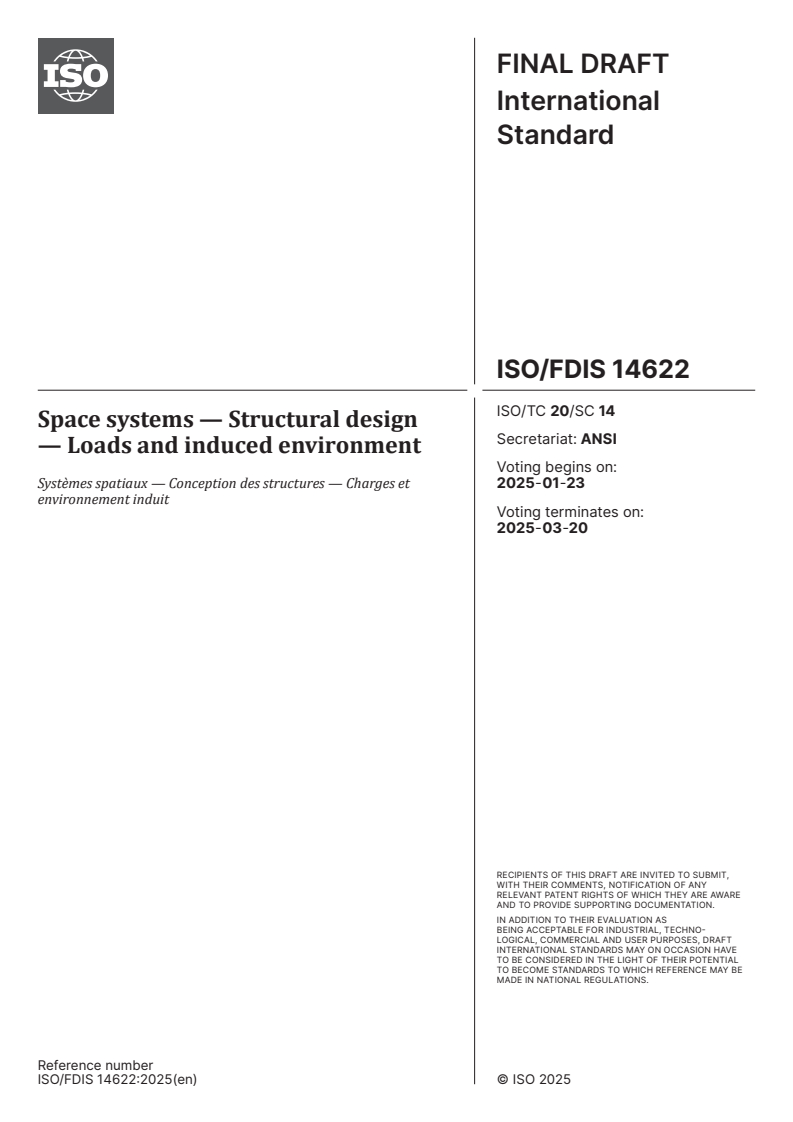
FINAL DRAFT
International
Standard
ISO/TC 20/SC 14
Space systems — Structural design
Secretariat: ANSI
— Loads and induced environment
Voting begins on:
Systèmes spatiaux — Conception des structures — Charges et 2025-01-23
environnement induit
Voting terminates on:
2025-03-20
RECIPIENTS OF THIS DRAFT ARE INVITED TO SUBMIT,
WITH THEIR COMMENTS, NOTIFICATION OF ANY
RELEVANT PATENT RIGHTS OF WHICH THEY ARE AWARE
AND TO PROVIDE SUPPOR TING DOCUMENTATION.
IN ADDITION TO THEIR EVALUATION AS
BEING ACCEPTABLE FOR INDUSTRIAL, TECHNO
LOGICAL, COMMERCIAL AND USER PURPOSES, DRAFT
INTERNATIONAL STANDARDS MAY ON OCCASION HAVE
TO BE CONSIDERED IN THE LIGHT OF THEIR POTENTIAL
TO BECOME STAN DARDS TO WHICH REFERENCE MAY BE
MADE IN NATIONAL REGULATIONS.
Reference number
FINAL DRAFT
International
Standard
ISO/TC 20/SC 14
Space systems — Structural design
Secretariat: ANSI
— Loads and induced environment
Voting begins on:
Systèmes spatiaux — Conception des structures — Charges et
environnement induit
Voting terminates on:
RECIPIENTS OF THIS DRAFT ARE INVITED TO SUBMIT,
WITH THEIR COMMENTS, NOTIFICATION OF ANY
RELEVANT PATENT RIGHTS OF WHICH THEY ARE AWARE
AND TO PROVIDE SUPPOR TING DOCUMENTATION.
© ISO 2025
IN ADDITION TO THEIR EVALUATION AS
All rights reserved. Unless otherwise specified, or required in the context of its implementation, no part of this publication may
BEING ACCEPTABLE FOR INDUSTRIAL, TECHNO
LOGICAL, COMMERCIAL AND USER PURPOSES, DRAFT
be reproduced or utilized otherwise in any form or by any means, electronic or mechanical, including photocopying, or posting on
INTERNATIONAL STANDARDS MAY ON OCCASION HAVE
the internet or an intranet, without prior written permission. Permission can be requested from either ISO at the address below
TO BE CONSIDERED IN THE LIGHT OF THEIR POTENTIAL
or ISO’s member body in the country of the requester.
TO BECOME STAN DARDS TO WHICH REFERENCE MAY BE
MADE IN NATIONAL REGULATIONS.
ISO copyright office
CP 401 • Ch. de Blandonnet 8
CH-1214 Vernier, Geneva
Phone: +41 22 749 01 11
Email: copyright@iso.org
Website: www.iso.org
Published in Switzerland Reference number
ii
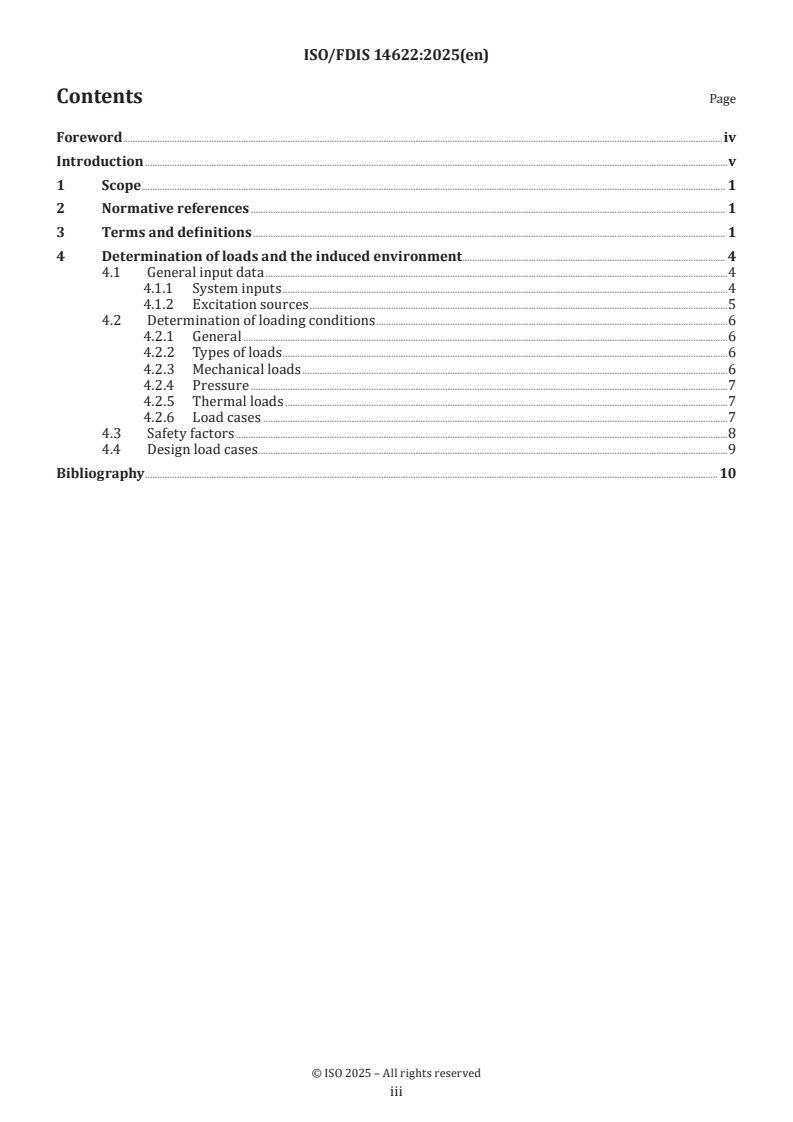
Contents Page
Foreword .iv
Introduction .v
1 Scope . 1
2 Normative references . 1
3 Terms and definitions . 1
4 Determination of loads and the induced environment . 4
4.1 General input data .4
4.1.1 System inputs .4
4.1.2 Excitation sources .5
4.2 Determination of loading conditions .6
4.2.1 General .6
4.2.2 Types of loads .6
4.2.3 Mechanical loads .6
4.2.4 Pressure .7
4.2.5 Thermal loads .7
4.2.6 Load cases .7
4.3 Safety factors .8
4.4 Design load cases .9
Bibliography .10
iii
Foreword
ISO (the International Organization for Standardization) is a worldwide federation of national standards
bodies (ISO member bodies). The work of preparing International Standards is normally carried out through
ISO technical committees. Each member body interested in a subject for which a technical committee
has been established has the right to be represented on that committee. International organizations,
governmental and non-governmental, in liaison with ISO, also take part in the work. ISO collaborates closely
with the International Electrotechnical Commission (IEC) on all matters of electrotechnical standardization.
The procedures used to develop this document and those intended for its further maintenance are described
in the ISO/IEC Directives, Part 1. In particular, the different approval criteria needed for the different types
of ISO documents should be noted. This document was drafted in accordance with the editorial rules of the
ISO/IEC Directives, Part 2 (see www.iso.org/directives).
ISO draws attention to the possibility that the implementation of this document may involve the use of (a)
patent(s). ISO takes no position concerning the evidence, validity or applicability of any claimed /patent
rights in respect thereof. As of the date of publication of this document, ISO had not received notice of (a)
patent(s) which may be required to implement this document. However, implementers are cautioned that
this may not represent the latest information, which may be obtained from the patent database available at
www.iso.org/patents. ISO shall not be held responsible for identifying any or all such patent rights.
Any trade name used in this document is information given for the convenience of users and does not
constitute an endorsement.
For an explanation of the voluntary nature of standards, the meaning of ISO specific terms and expressions
related to conformity assessment, as well as information about ISO's adherence to the World Trade
Organization (WTO) principles in the Technical Barriers to Trade (TBT), see www.iso.org/iso/foreword.html.
This document was prepared by Technical Committee ISO/TC 20, Aircraft and space vehicles, Subcommittee
SC 14, Space systems and operations.
This second edition cancels and replaces the first edition (ISO 14622:2000), which has been technically
revised.
The main changes are as follows:
— updates of the terms and definitions to harmonize with the other structural-related ISO documents,
— clarifications on the value of safety factors,
— A bibliography has been added.
Any feedback or questions on this document should be directed to the user’s national standards body. A
complete listing of these bodies can be found at www.iso.org/members.html.
iv
Introduction
The structures of a space system have to be designed in such a way that the capacity to fulfil the mission
is ensured. During the different phases of the service life, structures are indeed submitted to a number of
mechanical and/or thermal loads which may damage materials with a number of possible consequences:
— permanent deformation that may prevent the successive operation of a mechanical function,
— rupture of secondary structures which may indirectly endanger the mission (malfunction and/or release
of dangerous debris),
— rupture of primary structures which directly lead to the loss of the mission.
The probability of such events has to be reduced to an acceptable level.
This is why the identification of the different loads both in terms of nature and intensity is of primary
importance.
In the early developments of aeronautics, aircrafts were sized against a static force equivalent to a multiple
of the gravity. This situation has soon changed to use estimations and measurements of the different loads.
Nowadays, simulations of the different physics involved allows getting accurate assessments of the main
loads and the corresponding statistical distribution.
This document describes the different types of load sources and the principle of the deterministic sizing,
where safety of factors are applied on the loads.
v
FINAL DRAFT International Standard ISO/FDIS 14622:2025(en)
Space systems — Structural design — Loads and induced
environment
1 Scope
This document defines the principles used to determine loads and the induced environment during the
service life of a space system and its components, taking account of the notions of probability, combined
loads, corresponding safety factors and life cycle.
2 Normative references
There are no normative references in this document.
3 Terms and definitions
For the purposes of this document, the following terms and definitions apply.
ISO and IEC maintain terminology databases for use in standardization at the following addresses:
— ISO Online browsing platform: available at https:// www .iso .org/ obp
— IEC Electropedia: available at https:// www .electropedia .org/
3.1
authority
organization, institution or company responsible for the management of the development of a space system (3.13)
3.2
dynamic load
time-dependent load with deterministic or stochastic variation
3.3
environment
combination of thermal and acoustic fields applied on a structure and which, together with loads and
pressure, define the mechanical condition of the structure
Note 1 to entry: Humidity and chemical conditions are not considered in this context but should be considered for the
choice of material and or surface protection.
Note 2 to entry: Shocks are considered as loads and are thus not part of the environment.
[SOURCE: ISO 10786:2011, 3.18]
3.4
hydrostatic pressure
pressure at a level below the liquid level in the tank, which is induced by the height of liquid above this level,
plus quasi-static accelerations
3.5
launch vehicle
vehicle designed to transport payloads to space
[SOURCE: ISO 10795:2019, 3.139, modified — The preferred term "launcher" has been removed.]
3.6
limit load
maximum load, or combination of loads, which a structure or a component in a structural assembly is
expected to experience during its service life, in association with the applicable operating environments (3.3)
Note 1 to entry: Load is a generic term for thermal load, pressure, external mechanical load (force, moment, or enforced
displacement) or internal mechanical load (residual stress, pretension, or inertial load).
Note 2 to entry: The corresponding stress or strain is called limit stress or limit strain.
[SOURCE: ISO 10785:2011, 3.19, modified — “maximum expected load” has been changed to "maximum
load"; note 3 and note 4 to entry have been removed.]
3.7
maximum expected operating pressure
MEOP
highest differential pressure which a pressurized hardware item is expected to experience during its service
life and retain its functionality, in association with its applicable operating environments (3.3)
Note 1 to entry: MEOP includes the effects of temperature, peaks, relief pressures, regulator pressure, vehicle
acceleration, phase changes, transient pressure (3.17) excursions, and relief valve tolerance.
[SOURCE: ISO 24638:2021, 3.17 modified — The admitted terms have been removed; notes 2 and 3 to entry
have been deleted.]
3.8
oscillating load
vibration load
load whose amplitude or direction varies within a frequency range for which the structure dynamic
response is significant
Note 1 to entry: This load can be induced by:
— POGO effect;
— buffeting;
— vortex shedding due to ground wind;
— flutter;
— acoustic environment (3.3);
— rotation of parts;
— combustion instabilities.
3.9
proof pressure
differential pressure applied during the proof test and which is equal to the MEOP (3.7) multiplied by a proof
factor J
P
3.10
safety factor
multiplying factor to be applied to limit loads (3.6) and/or maximum expected operating pressure (MEOP) (3.7)
Note 1 to entry: The factor is defined in order to account for the statistical variations of loads and structural strength
(3.15
...
Style Definition
...
Style Definition
...
Style Definition
...
Style Definition
...
Style Definition
...
Style Definition
...
ISO/TC 20/SC 14
Style Definition
...
Style Definition
...
Secretariat: ANSI
Style Definition
...
Second edition
Style Definition
...
Style Definition
...
2024-12-13
Style Definition
...
Date: 2025-xx
Style Definition
...
Style Definition
...
Style Definition
...
Style Definition
...
Style Definition
...
Style Definition
...
Space systems — Structural design — Loads and induced
Style Definition
...
environment
Style Definition
...
Systèmes spatiaux — Conception des structures — Charges et environnement induit
Style Definition
...
Style Definition
...
Style Definition
...
Style Definition
...
Style Definition
...
Style Definition
...
Style Definition
...
Style Definition
...
FDIS stage
Style Definition
...
Style Definition
...
Style Definition
...
Style Definition
...
Style Definition
...
Style Definition
...
Style Definition
...
Style Definition
...
Style Definition
...
Style Definition
...
Style Definition
...
Style Definition
...
Style Definition
...
Style Definition
...
Style Definition
...
Style Definition
...
Style Definition
...
Style Definition
...
Style Definition
...
Style Definition
...
Style Definition
...
Style Definition
...
Style Definition
...
Style Definition
...
Style Definition
...
Style Definition
...
Style Definition
...
Style Definition
...
Style Definition
...
Style Definition
...
Style Definition
...
Style Definition
...
Style Definition
...
Style Definition
...
Style Definition
...
Formatted
...
Formatted
...
ISO/DISFDIS 14622:2024(E2025(en)
Formatted: Font: Bold
Formatted: Font: Bold
Formatted: Font: Bold
Formatted: HeaderCentered
All rights reserved. Unless otherwise specified, or required in the context of its implementation, no part of this publication Commented [eXtyles1]: The reference "ISO 2024" is to a
withdrawn standard
may be reproduced or utilized otherwise in any form or by any means, electronic or mechanical, including photocopying,
or posting on the internet or an intranet, without prior written permission. Permission can be requested from either ISO
Formatted: Default Paragraph Font
at the address below or ISO’s member body in the country of the requester.
Formatted: Adjust space between Latin and Asian text,
Adjust space between Asian text and numbers
ISO copyright office
CP 401 • Ch. de Blandonnet 8
CH-1214 Vernier, Geneva
Phone: + 41 22 749 01 11
Formatted: French (France)
EmailE-mail: copyright@iso.org
Formatted: French (France)
Website: www.iso.orgwww.iso.org
Formatted: French (France)
Published in Switzerland
Formatted: FooterPageRomanNumber, Line spacing:
single
ICS 49.140
Price based on 9 pages
Error! Reference source not found.
ii
Formatted: Font: Bold
Formatted: Font: Bold
Formatted: HeaderCentered, Left
Contents Page
Formatted: Adjust space between Latin and Asian text,
Adjust space between Asian text and numbers, Tab
Foreword . iv
stops: Not at 0.71 cm + 18 cm
Introduction . v
1 Scope . 1
2 Normative references . 1
3 Terms and definitions . 1
4 Determination of loads and the induced environment . 5
4.1 General input data . 5
4.2 Determination of loading conditions . 7
4.3 Safety factors . 9
4.4 Design load cases . 10
Bibliography . 11
Foreword . iv
1 Scope . 2
2 Normative references . 2
3 Terms and definitions . 2
4 Determination of loads and the induced environment . 8
4.1 General input data . 8
4.2 Determination of loading conditions . 9
4.3 Safety factors . 11
4.4 Design load cases . 12
4.5 Calculated safety margins . 12
Formatted: Font: 10 pt
Formatted: Font: 10 pt
Formatted: FooterCentered, Left, Space Before: 0 pt,
Line spacing: single
Formatted: Font: 11 pt
Formatted: FooterPageRomanNumber, Left, Space
After: 0 pt, Line spacing: single
iii
ISO/DISFDIS 14622:2024(E2025(en)
Formatted: Font: Bold
Formatted: Font: Bold
Formatted: Font: Bold
Foreword
Formatted: HeaderCentered
ISO (the International Organization for Standardization) is a worldwide federation of national standards
Formatted: Adjust space between Latin and Asian text,
bodies (ISO member bodies). The work of preparing International Standards is normally carried out through Adjust space between Asian text and numbers
ISO technical committees. Each member body interested in a subject for which a technical committee has been
established has the right to be represented on that committee. International organizations, governmental and
non-governmental, in liaison with ISO, also take part in the work. ISO collaborates closely with the
International Electrotechnical Commission (IEC) on all matters of electrotechnical standardization.
The procedures used to develop this document and those intended for its further maintenance are described
in the ISO/IEC Directives, Part 1. In particular, the different approval criteria needed for the different types of
ISO documents should be noted. This document was drafted in accordance with the editorial rules of the
ISO/IEC Directives, Part 2 (see www.iso.org/directiveswww.iso.org/directives).
ISO draws attention to the possibility that the implementation of this document may involve the use of (a)
patent(s). ISO takes no position concerning the evidence, validity or applicability of any claimed /patent rights
in respect thereof. As of the date of publication of this document, ISO had not received notice of (a) patent(s)
which may be required to implement this document. However, implementers are cautioned that this may not
represent the latest information, which may be obtained from the patent database available at
www.iso.org/patents.www.iso.org/patents. ISO shall not be held responsible for identifying any or all such
patent rights.
Any trade name used in this document is information given for the convenience of users and does not
constitute an endorsement.
For an explanation of the voluntary nature of standards, the meaning of ISO specific terms and expressions
related to conformity assessment, as well as information about ISO's adherence to the World Trade
Organization (WTO) principles in the Technical Barriers to Trade (TBT), see
www.iso.org/iso/foreword.htmlwww.iso.org/iso/foreword.html.
This document was prepared by Technical Committee ISO/TC 20, Aircraft and space vehicles, Subcommittee
SC 14, Space systems and operations.
This second edition cancels and replaces the first edition (ISO 14622:2000), which has been technically
Formatted: Default Paragraph Font
revised.
Formatted: Default Paragraph Font
Formatted: Default Paragraph Font
The main changes are as follows:
Formatted: Adjust space between Latin and Asian text,
— — updates of the terms and definitions to harmonize with the other structural-related ISO documents,
Adjust space between Asian text and numbers, Tab
stops: Not at 0.7 cm + 1.4 cm + 2.1 cm + 2.8 cm +
— — clarifications on the value of safety factors,
3.5 cm + 4.2 cm + 4.9 cm + 5.6 cm + 6.3 cm + 7 cm
— — A bibliography has been added. Formatted: Adjust space between Latin and Asian text,
Adjust space between Asian text and numbers
Any feedback or questions on this document should be directed to the user’s national standards body. A
Commented [eXtyles2]: The URL
complete listing of these bodies can be found at www.iso.org/members.html.www.iso.org/members.html.
https://www.iso.org/members.html has been redirected to
http://www.iso.org/about/members. Please verify the URL.
Formatted: FooterPageRomanNumber, Line spacing:
single
ICS 49.140
Price based on 9 pages
Error! Reference source not found.
iv
Formatted: Font: Bold
Formatted: Font: Bold
Formatted: HeaderCentered, Left
Introduction
The structures of a space system have to be designed in such a way that the capacity to fulfil the mission is
ensured. During the different phases of the service life, structures are indeed submitted to a number of
mechanical and/or thermal loads which may damage materials with a number of possible consequences:
— — permanent deformation that may prevent the successive operation of a mechanical function,
Formatted: Adjust space between Latin and Asian text,
Adjust space between Asian text and numbers, Tab
— — rupture of secondary structures which may indirectly endanger the mission (malfunction and/or stops: Not at 0.7 cm + 1.4 cm + 2.1 cm + 2.8 cm +
release of dangerous debris), 3.5 cm + 4.2 cm + 4.9 cm + 5.6 cm + 6.3 cm + 7 cm
— — rupture of primary structures which directly lead to the loss of the mission.
The probability of such events has to be reduced to an acceptable level.
Formatted: Adjust space between Latin and Asian text,
Adjust space between Asian text and numbers
This is why the identification of the different loads both in terms of nature and intensity is of primary
importance.
In the early developments of aeronautics, aircrafts were sized against a static force equivalent to a multiple of
the gravity. This situation has soon changed to use estimations and measurements of the different loads.
Nowadays, simulations of the different physics involved allows getting accurate assessments of the main loads
and the corresponding statistical distribution.
This document describes the different types of load sources and the principle of the deterministic sizing,
where safety of factors are applied on the loads.
Formatted: Font: 10 pt
Formatted: Font: 10 pt
Formatted: FooterCentered, Left, Space Before: 0 pt,
Line spacing: single
Formatted: Font: 11 pt
Formatted: FooterPageRomanNumber, Left, Space
After: 0 pt, Line spacing: single
v
Final DRAFT International Standard
Formatted: Main Title 1, Adjust space between Latin
Space systems — Structural design — Loads and induced
and Asian text, Adjust space between Asian text and
environment
numbers
1 Scope
This document defines the principles used to determine loads and the induced environment during the service
life of a space system and its components, taking account of the notions of probability, combined loads,
corresponding safety factors and life cycle.
2 Normative references
There are no normative references in this document.
3 Terms and definitions
For the purposes of this document, the following terms and definitions apply.
ISO and IEC maintain terminology databases for use in standardization at the following addresses:
— — ISO Online browsing platform: available at https://www.iso.org/obphttps://www.iso.org/obp
Commented [eXtyles3]: The URL
https://www.iso.org/obp has been redirected to
https://www.iso.org/obp/ui. Please verify the URL.
— — IEC Electropedia: available at https://www.electropedia.org/https://www.electropedia.org/
Formatted: Adjust space between Latin and Asian text,
3.1 3.1
Adjust space between Asian text and numbers, Tab
authority
stops: Not at 0.7 cm + 1.4 cm + 2.1 cm + 2.8 cm +
organization, institution or company responsible for the management of the development of a space system 3.5 cm + 4.2 cm + 4.9 cm + 5.6 cm + 6.3 cm + 7 cm
(3.13)(3.13)
Formatted: TermNum2, Adjust space between Latin
and Asian text, Adjust space between Asian text and
3.2 3.2
numbers
dynamic load
time-dependent load with deterministic or stochastic variation
3.3 3.3
environment
combination of thermal and acoustic fields applied on a structure and which, together with loads and pressure,
define the mechanical condition of the structure
Note 1 to entry: Humidity and chemical conditions are not considered in this context but should be considered for the Formatted: Adjust space between Latin and Asian text,
...
Questions, Comments and Discussion
Ask us and Technical Secretary will try to provide an answer. You can facilitate discussion about the standard in here.