


ISO 14953:2024
(Main)Space systems - Structural design - Determination of loading levels for static qualification testing of launch vehicles
Space systems - Structural design - Determination of loading levels for static qualification testing of launch vehicles
This document specifies a procedure for determining the loading level of a qualification test of a launch vehicle structure and takes into account all the minimum allowable strength characteristics necessary for these structures.
Systèmes spatiaux — Conception des structures — Détermination des niveaux de chargement pour un essai statique de qualification des véhicules lanceurs
La présente Norme internationale spécifie une procédure de détermination des niveaux de chargement pour un essai de qualification d'une structure d'un lanceur compte tenu de ses caractéristiques minimales admissibles du point de vue de la résistance. Elle sert à obtenir la résistance spécifiée nécessaire pour tous les exemplaires d'une structure fabriqués en série qui ont satisfait les critères de l'assurance produit.
General Information
Relations
Overview
ISO 14953:2024 is a critical international standard developed by ISO for space systems engineering, specifically focusing on the structural design of launch vehicles. This standard establishes a detailed procedure for determining loading levels in static qualification testing of launch vehicle structures. It ensures the test loads accurately reflect the minimum allowable strength characteristics necessary to verify structural integrity and mission reliability. By adhering to ISO 14953:2024, engineers and manufacturers can confidently validate the structural design against real-world service life conditions, including mechanical, thermal, and geometric factors.
Key Topics
Qualification Test Loading Calculation
The core of ISO 14953:2024 lies in calculating the corrected external loading (P_Q) for qualification tests. This calculation adjusts design limit loads using a corrected safety factor that incorporates various correction factors to reflect real operational variances.Corrected Safety Factor (J_C)
This safety factor is a multiplicative composite considering:- Thickness variations (K_min)
- Influence of adjacent structures (K_adj)
- Thermal gradients (K_T)
- Temperature effects on material properties (K_θ)
- Dispersions in material and geometry (K_σ)
- Geometric imperfections affecting buckling behavior (K_imp)
Correction Factors
ISO 14953:2024 defines rigorous methods to calculate and apply each correction factor, ensuring precise reflection of manufacturing tolerances, operational environment, and structural sensitivities. For instance, K_min addresses minimum manufacturing thickness in metals, while K_adj assesses test boundary condition adequacy compared to flight configurations.Implementation Guidance
The standard instructs selecting the lowest corrected load among critical structure areas for qualification to ensure conservative yet realistic testing. It also allows for alternative test modes if the scenario demands, provided they are fully justified.
Applications
ISO 14953:2024 serves an essential role in the aerospace sector, particularly in the design, verification, and certification phases of launch vehicle development. Its applications include:
- Static Structural Qualification Testing
Ensuring that launch vehicle structures withstand limit loads during qualification tests simulating flight conditions. - Flight-Ready Structural Verification
Validating structural integrity by accounting for real-life load variations and imperfections, reducing risk of in-service failure. - Design Safety Assurance
Providing standardized safety factors and correction methodologies to harmonize testing levels across different designs and manufacturers. - Regulatory Compliance
Supporting adherence to international aerospace standards and facilitating acceptance by national and international space agencies.
Related Standards
ISO 14953:2024 complements a suite of space systems standards, including:
- ISO 10786:2011 - Structural components and assemblies for space systems
- ISO 10795:2019 - Space systems programme management and quality vocabulary
- ISO 16454:2007 - Structural design stress analysis requirements
- ISO 24638:2021 - Pressure components and pressure system integration in space systems
- IEC 60050-192:2015 - International Electrotechnical Vocabulary on dependability, relevant for failure mode terminology
By integrating these standards, organizations can fully address mechanical, thermal, and reliability aspects critical to launch vehicle structural qualification.
Keywords: ISO 14953:2024, launch vehicle structural design, static qualification testing, loading level determination, aerospace standards, corrected safety factor, structural integrity, space systems engineering, launch vehicle testing, qualification test loading, correction factors, structural qualification compliance.
Frequently Asked Questions
ISO 14953:2024 is a standard published by the International Organization for Standardization (ISO). Its full title is "Space systems - Structural design - Determination of loading levels for static qualification testing of launch vehicles". This standard covers: This document specifies a procedure for determining the loading level of a qualification test of a launch vehicle structure and takes into account all the minimum allowable strength characteristics necessary for these structures.
This document specifies a procedure for determining the loading level of a qualification test of a launch vehicle structure and takes into account all the minimum allowable strength characteristics necessary for these structures.
ISO 14953:2024 is classified under the following ICS (International Classification for Standards) categories: 49.140 - Space systems and operations. The ICS classification helps identify the subject area and facilitates finding related standards.
ISO 14953:2024 has the following relationships with other standards: It is inter standard links to ISO 14953:2000. Understanding these relationships helps ensure you are using the most current and applicable version of the standard.
You can purchase ISO 14953:2024 directly from iTeh Standards. The document is available in PDF format and is delivered instantly after payment. Add the standard to your cart and complete the secure checkout process. iTeh Standards is an authorized distributor of ISO standards.
Standards Content (Sample)
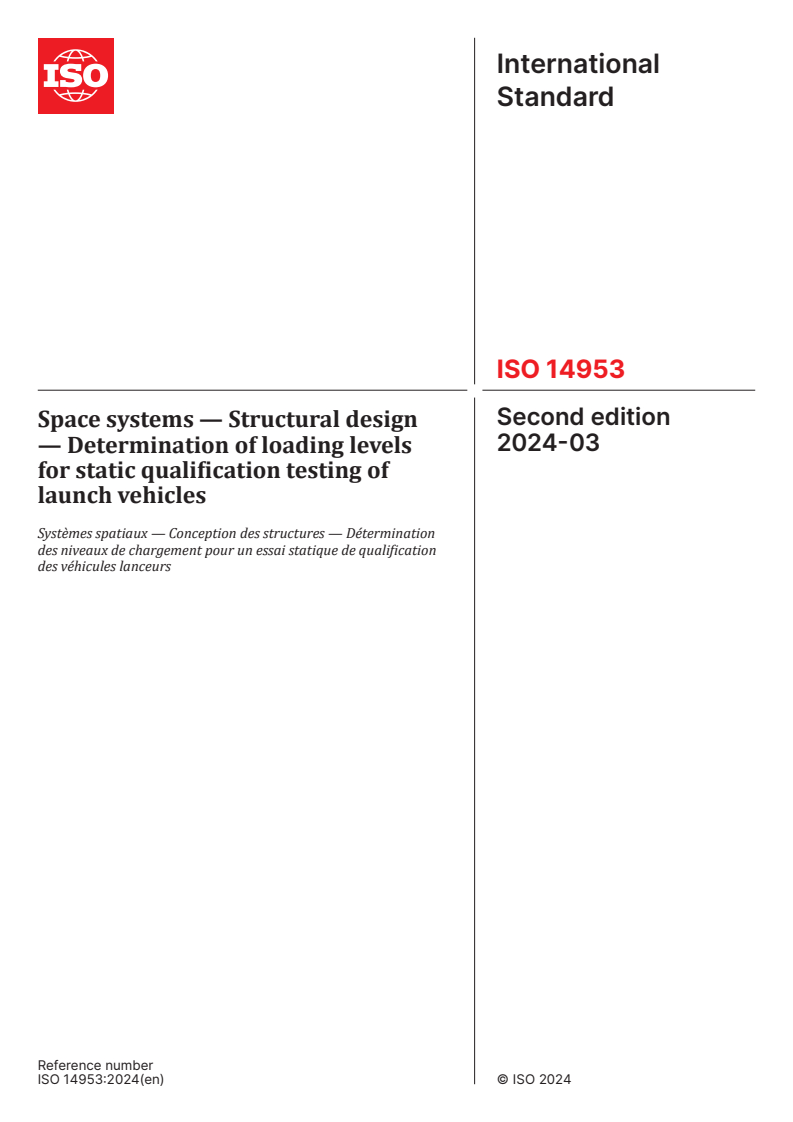
International
Standard
ISO 14953
Second edition
Space systems — Structural design
2024-03
— Determination of loading levels
for static qualification testing of
launch vehicles
Systèmes spatiaux — Conception des structures — Détermination
des niveaux de chargement pour un essai statique de qualification
des véhicules lanceurs
Reference number
© ISO 2024
All rights reserved. Unless otherwise specified, or required in the context of its implementation, no part of this publication may
be reproduced or utilized otherwise in any form or by any means, electronic or mechanical, including photocopying, or posting on
the internet or an intranet, without prior written permission. Permission can be requested from either ISO at the address below
or ISO’s member body in the country of the requester.
ISO copyright office
CP 401 • Ch. de Blandonnet 8
CH-1214 Vernier, Geneva
Phone: +41 22 749 01 11
Email: copyright@iso.org
Website: www.iso.org
Published in Switzerland
ii
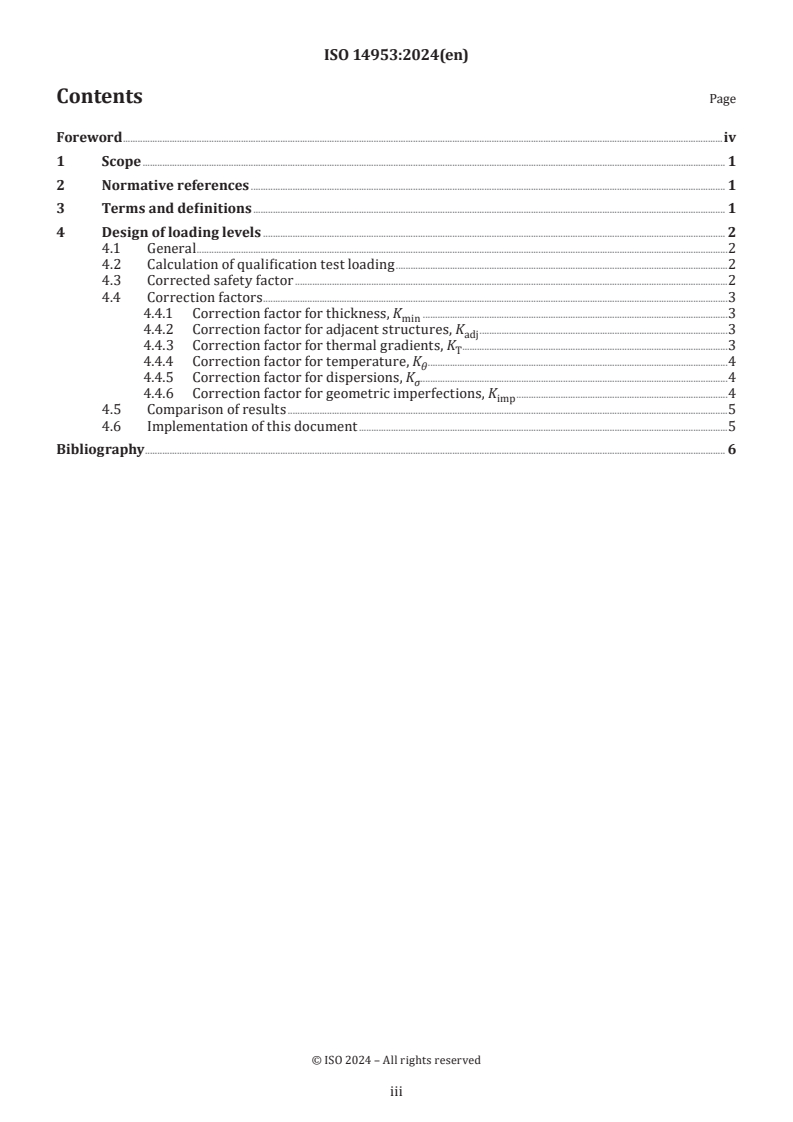
Contents Page
Foreword .iv
1 Scope . 1
2 Normative references . 1
3 Terms and definitions . 1
4 Design of loading levels . 2
4.1 General .2
4.2 Calculation of qualification test loading .2
4.3 Corrected safety factor .2
4.4 Correction factors .3
4.4.1 Correction factor for thickness, K .3
min
4.4.2 Correction factor for adjacent structures, K .3
adj
4.4.3 Correction factor for thermal gradients, K .3
T
4.4.4 Correction factor for temperature, K .4
θ
4.4.5 Correction factor for dispersions, K .4
σ
4.4.6 Correction factor for geometric imperfections, K .4
imp
4.5 Comparison of results .5
4.6 Implementation of this document .5
Bibliography . 6
iii
Foreword
ISO (the International Organization for Standardization) is a worldwide federation of national standards
bodies (ISO member bodies). The work of preparing International Standards is normally carried out through
ISO technical committees. Each member body interested in a subject for which a technical committee
has been established has the right to be represented on that committee. International organizations,
governmental and non-governmental, in liaison with ISO, also take part in the work. ISO collaborates closely
with the International Electrotechnical Commission (IEC) on all matters of electrotechnical standardization.
The procedures used to develop this document and those intended for its further maintenance are described
in the ISO/IEC Directives, Part 1. In particular, the different approval criteria needed for the different types
of ISO document should be noted. This document was drafted in accordance with the editorial rules of the
ISO/IEC Directives, Part 2 (see www.iso.org/directives).
ISO draws attention to the possibility that the implementation of this document may involve the use of (a)
patent(s). ISO takes no position concerning the evidence, validity or applicability of any claimed patent
rights in respect thereof. As of the date of publication of this document, ISO had not received notice of (a)
patent(s) which may be required to implement this document. However, implementers are cautioned that
this may not represent the latest information, which may be obtained from the patent database available at
www.iso.org/patents. ISO shall not be held responsible for identifying any or all such patent rights.
Any trade name used in this document is information given for the convenience of users and does not
constitute an endorsement.
For an explanation of the voluntary nature of standards, the meaning of ISO specific terms and expressions
related to conformity assessment, as well as information about ISO's adherence to the World Trade
Organization (WTO) principles in the Technical Barriers to Trade (TBT), see www.iso.org/iso/foreword.html.
This document was prepared by Technical Committee ISO/TC 20, Aircraft and space vehicles, Subcommittee
SC 14, Space systems and operations.
This second edition cancels and replaces the first edition (ISO 14953:2000), which has been technically
revised.
The main changes are as follows:
— the formula for J has been changed so that all the terms are multiplicative,
C
— a new correction factor has been introduced to take into account the structure imperfections.
Any feedback or questions on this document should be directed to the user’s national standards body. A
complete listing of these bodies can be found at www.iso.org/members.html.
iv
International Standard ISO 14953:2024(en)
Space systems — Structural design — Determination of
loading levels for static qualification testing of launch
vehicles
1 Scope
This document specifies a procedure for determining the loading level of a qualification test of a launch
vehicle structure and takes into account all the minimum allowable strength characteristics necessary for
these structures.
2 Normative references
There are no normative references in this document.
3 Terms and definitions
For the purposes of this document, the following terms and definitions apply.
ISO and IEC maintain terminology databases for use in standardization at the following addresses:
— ISO Online browsing platform: available at https:// www .iso .org/ obp
— IEC Electropedia: available at https:// www .electropedia .org/
3.1
external loading
system of forces, moments and pressures external to a structure and applied to that structure
3.2
failure mode
manner in which failure occurs
Note 1 to entry: A failure mode may be defined by the function lost or other state transition that occurred.
Note 2 to entry: Structural failure modes include: rupture, collapse, detrimental deformation, excessive wear or any
other phenomenon resulting in an inability to sustain loads, pressures and corresponding environments, or that
jeopardizes mission success.
[SOURCE: IEC 60050-192:2015, 192-03-17, modified — Note 2 to entry has been added reflecting the
definition in ISO 10786:2011, 3.19.]
3.3
limi
...
Questions, Comments and Discussion
Ask us and Technical Secretary will try to provide an answer. You can facilitate discussion about the standard in here.
Loading comments...