


ISO 1795:2007
(Main)Rubber, raw natural and raw synthetic — Sampling and further preparative procedures
Rubber, raw natural and raw synthetic — Sampling and further preparative procedures
ISO 1795:2007 specifies a method for the sampling of raw rubber in bales, blocks or packages and further procedures carried out on the samples to prepare test samples for chemical and physical tests.
Caoutchouc, naturel brut et synthétique brut — Méthodes d'échantillonnage et de préparation ultérieure
General Information
- Status
- Withdrawn
- Publication Date
- 06-May-2007
- Withdrawal Date
- 06-May-2007
- Current Stage
- 9599 - Withdrawal of International Standard
- Start Date
- 26-Jun-2017
- Completion Date
- 12-Feb-2026
Relations
- Revised
ISO 1795:2017 - Rubber, raw natural and raw synthetic — Sampling and further preparative procedures - Effective Date
- 28-Nov-2015
- Revises
ISO 1795:2000 - Rubber, raw natural and raw synthetic — Sampling and further preparative procedures - Effective Date
- 15-Apr-2008
Get Certified
Connect with accredited certification bodies for this standard

Smithers Quality Assessments
US management systems and product certification.

DIN CERTCO
DIN Group product certification.
Sponsored listings
Frequently Asked Questions
ISO 1795:2007 is a standard published by the International Organization for Standardization (ISO). Its full title is "Rubber, raw natural and raw synthetic — Sampling and further preparative procedures". This standard covers: ISO 1795:2007 specifies a method for the sampling of raw rubber in bales, blocks or packages and further procedures carried out on the samples to prepare test samples for chemical and physical tests.
ISO 1795:2007 specifies a method for the sampling of raw rubber in bales, blocks or packages and further procedures carried out on the samples to prepare test samples for chemical and physical tests.
ISO 1795:2007 is classified under the following ICS (International Classification for Standards) categories: 83.040.10 - Latex and raw rubber. The ICS classification helps identify the subject area and facilitates finding related standards.
ISO 1795:2007 has the following relationships with other standards: It is inter standard links to ISO 1795:2017, ISO 1795:2000. Understanding these relationships helps ensure you are using the most current and applicable version of the standard.
ISO 1795:2007 is available in PDF format for immediate download after purchase. The document can be added to your cart and obtained through the secure checkout process. Digital delivery ensures instant access to the complete standard document.
Standards Content (Sample)
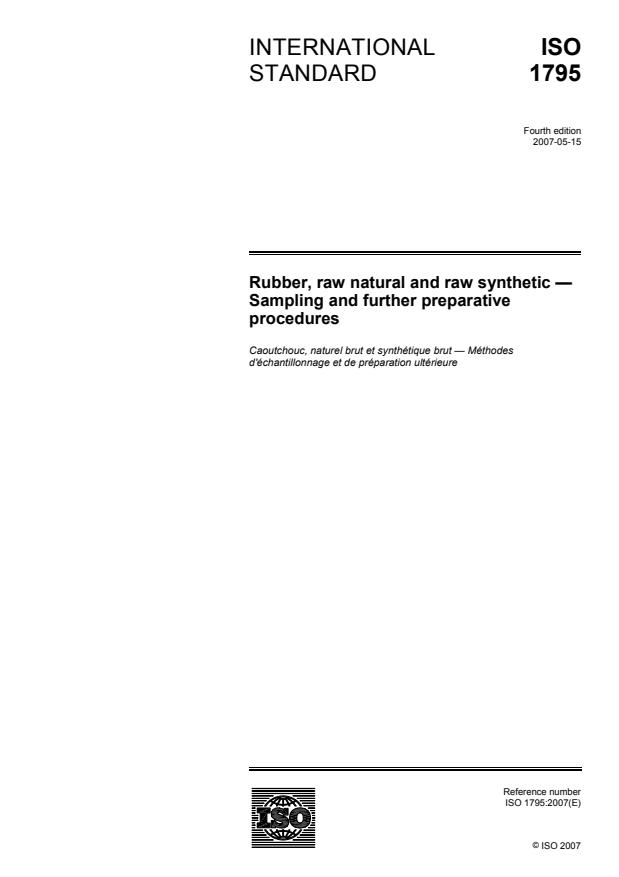
INTERNATIONAL ISO
STANDARD 1795
Fourth edition
2007-05-15
Rubber, raw natural and raw synthetic —
Sampling and further preparative
procedures
Caoutchouc, naturel brut et synthétique brut — Méthodes
d'échantillonnage et de préparation ultérieure
Reference number
©
ISO 2007
PDF disclaimer
This PDF file may contain embedded typefaces. In accordance with Adobe's licensing policy, this file may be printed or viewed but
shall not be edited unless the typefaces which are embedded are licensed to and installed on the computer performing the editing. In
downloading this file, parties accept therein the responsibility of not infringing Adobe's licensing policy. The ISO Central Secretariat
accepts no liability in this area.
Adobe is a trademark of Adobe Systems Incorporated.
Details of the software products used to create this PDF file can be found in the General Info relative to the file; the PDF-creation
parameters were optimized for printing. Every care has been taken to ensure that the file is suitable for use by ISO member bodies. In
the unlikely event that a problem relating to it is found, please inform the Central Secretariat at the address given below.
© ISO 2007
All rights reserved. Unless otherwise specified, no part of this publication may be reproduced or utilized in any form or by any means,
electronic or mechanical, including photocopying and microfilm, without permission in writing from either ISO at the address below or
ISO's member body in the country of the requester.
ISO copyright office
Case postale 56 • CH-1211 Geneva 20
Tel. + 41 22 749 01 11
Fax + 41 22 749 09 47
E-mail copyright@iso.org
Web www.iso.org
Published in Switzerland
ii © ISO 2007 – All rights reserved
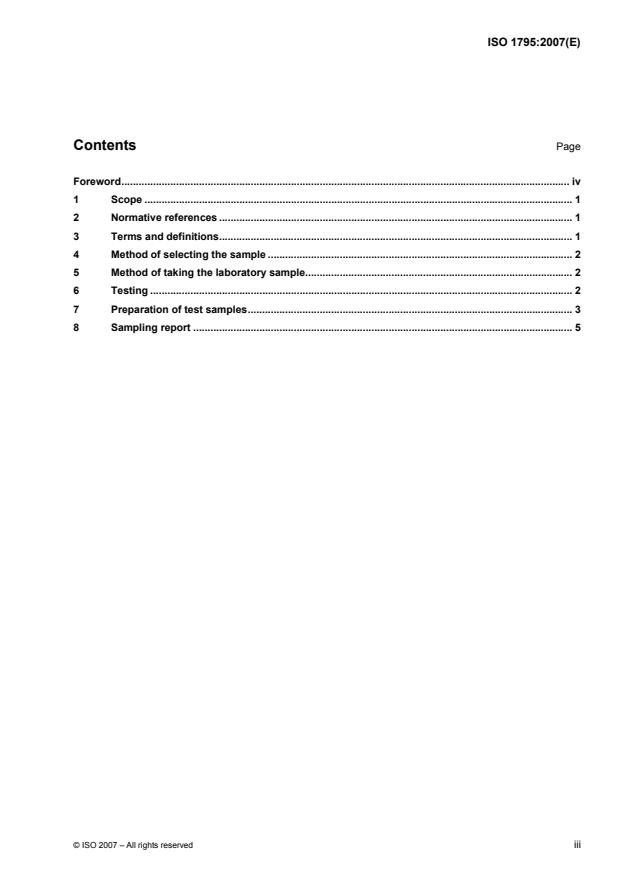
Contents Page
Foreword. iv
1 Scope . 1
2 Normative references . 1
3 Terms and definitions. 1
4 Method of selecting the sample . 2
5 Method of taking the laboratory sample. 2
6 Testing . 2
7 Preparation of test samples. 3
8 Sampling report . 5
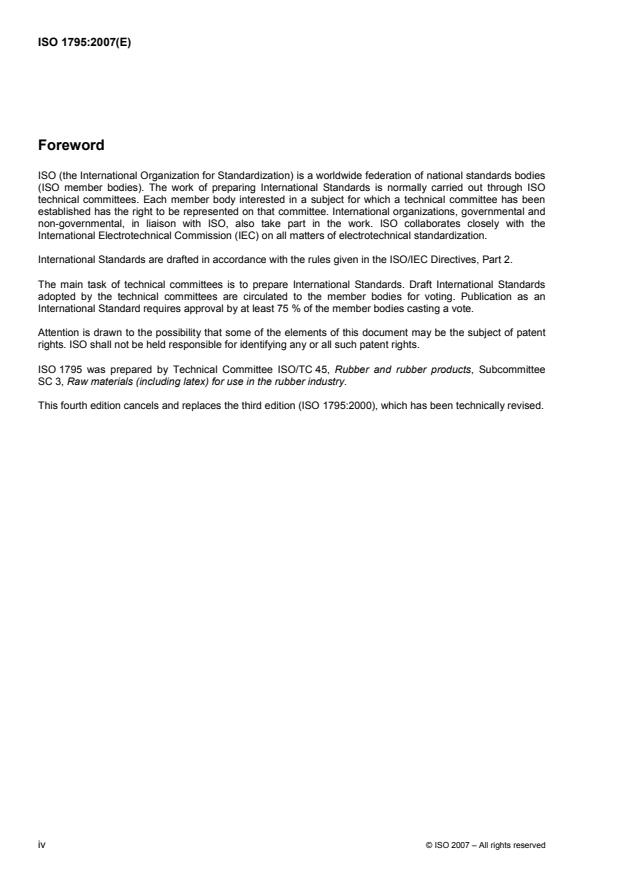
Foreword
ISO (the International Organization for Standardization) is a worldwide federation of national standards bodies
(ISO member bodies). The work of preparing International Standards is normally carried out through ISO
technical committees. Each member body interested in a subject for which a technical committee has been
established has the right to be represented on that committee. International organizations, governmental and
non-governmental, in liaison with ISO, also take part in the work. ISO collaborates closely with the
International Electrotechnical Commission (IEC) on all matters of electrotechnical standardization.
International Standards are drafted in accordance with the rules given in the ISO/IEC Directives, Part 2.
The main task of technical committees is to prepare International Standards. Draft International Standards
adopted by the technical committees are circulated to the member bodies for voting. Publication as an
International Standard requires approval by at least 75 % of the member bodies casting a vote.
Attention is drawn to the possibility that some of the elements of this document may be the subject of patent
rights. ISO shall not be held responsible for identifying any or all such patent rights.
ISO 1795 was prepared by Technical Committee ISO/TC 45, Rubber and rubber products, Subcommittee
SC 3, Raw materials (including latex) for use in the rubber industry.
This fourth edition cancels and replaces the third edition (ISO 1795:2000), which has been technically revised.
iv © ISO 2007 – All rights reserved
INTERNATIONAL STANDARD ISO 1795:2007(E)
Rubber, raw natural and raw synthetic — Sampling and further
preparative procedures
WARNING — Persons using this International Standard should be familiar with normal laboratory
practice. This International Standard does not purport to address all of the safety problems, if any,
associated with its use. It is the responsibility of the user to establish appropriate safety and health
practices and to ensure compliance with any national regulatory conditions.
1 Scope
This International Standard specifies a method for the sampling of raw rubber in bales, blocks or packages
and further procedures carried out on the samples to prepare test samples for chemical and physical tests.
2 Normative references
The following referenced documents are indispensable for the application of this document. For dated
references, only the edition cited applies. For undated references, the latest edition of the referenced
document (including any amendments) applies.
ISO 248, Rubber, raw — Determination of volatile-matter content
ISO 289-1, Rubber, unvulcanized — Determinations using a shearing-disc viscometer — Part 1:
Determination of Mooney viscosity
ISO 1658, Natural rubber (NR) — Evaluation procedure
ISO 2393, Rubber test mixes — Preparation, mixing and vulcanization — Equipment and procedures
ISO 2930, Rubber, raw natural — Determination of plasticity retention index (PRI)
ISO 3951-2, Sampling procedures for inspection by variables — Part 2: General specification for single
sampling plans indexed by acceptance quality limit (AQL) for lot-by-lot inspection of independent quality
characteristics
ISO 23529, Rubber — General procedures for preparing and conditioning test pieces for physical test
methods
3 Terms and definitions
For the purposes of this document, the following terms and definitions apply.
NOTE All references to “bales” include blocks and packages of rubber in chip, powder or sheet form.
3.1
lot
assembly of bales of rubber bearing the same grade and lot marks
3.2
sample
group of bales selected to represent the lot
3.3
laboratory sample
rubber taken from a bale of the sample to represent the bale
3.4
combined laboratory sample
quantity of rubber which represents the sample, prepared by blending together equal parts of each of the
laboratory samples to give a homogeneous sample
3.5
test sample
rubber taken from the laboratory sample or the combined laboratory sample for testing, including the
preparation of test pieces
3.6
test piece
rubber taken from a test sample in order to carry out a specific test
NOTE Some standards use the synonymous term “test specimen”.
4 Method of selecting the sample
The greater the number of bales in the sample, the more representative is the sample of the lot, but in most
cases practical considerations impose a limit on what is possible. The number of bales to be chosen at
random shall be agreed between customer and supplier. If applicable, a statistical sampling plan chosen from
ISO 3951-2 shall be used.
5 Method of taking the laboratory sample
The preferred method of taking a laboratory sample from each of the selected bales is the following.
Remove the outer wrapping sheets, polyethylene wrapping, bale coating or other surface material from the
bale and make two cuts, without the use of lubrica
...
Questions, Comments and Discussion
Ask us and Technical Secretary will try to provide an answer. You can facilitate discussion about the standard in here.
Loading comments...