

ISO 13761:2017
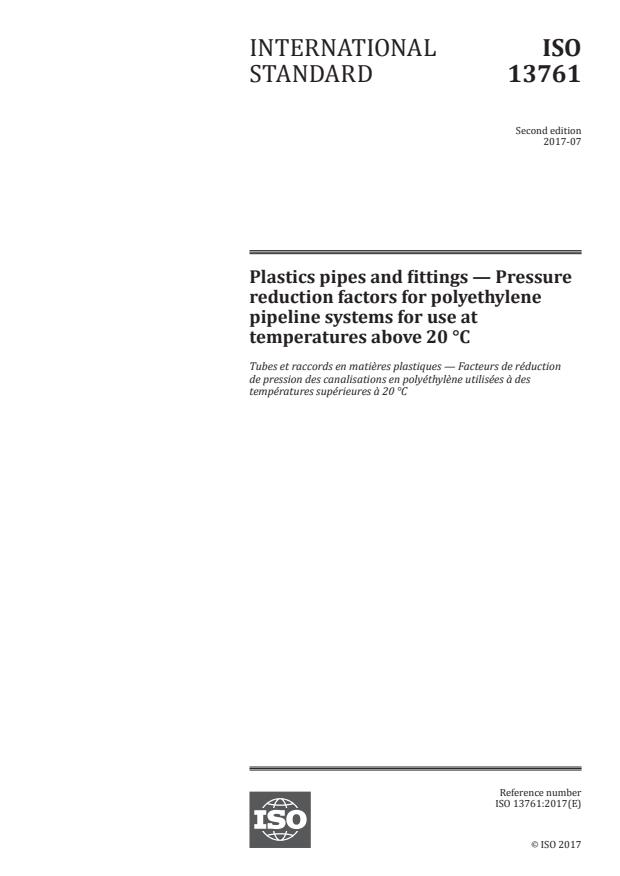
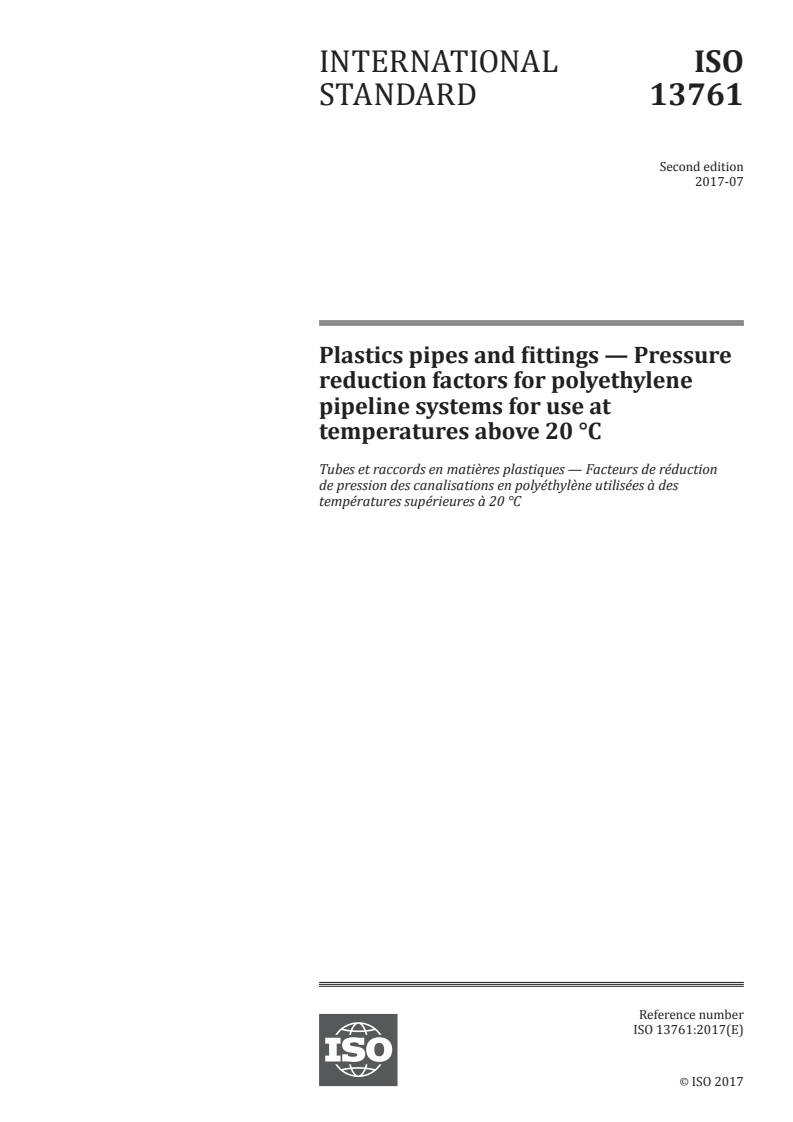
(Main)Plastics pipes and fittings — Pressure reduction factors for polyethylene pipeline systems for use at temperatures above 20 degrees C
General Information
- Abstract
ISO 13761:2017 specifies a method for the derivation of pressure reduction factors to obtain the allowable operating pressure for operation of polyethylene (PE) pipeline systems at temperatures between 20 °C and 40 °C or 50 °C, dependent on the classification of the material used for manufacture.
- Status
- Published
- Publication Date
- 17-Jul-2017
- Technical Committee
- ISO/TC 138/SC 5 - General properties of pipes, fittings and valves of plastic materials and their accessories -- Test methods and basic specifications
- Drafting Committee
- ISO/TC 138/SC 5/WG 5 - Polyolefin pipes
- Current Stage
- 9093 - International Standard confirmed
- Start Date
- 16-Jan-2023
- Completion Date
- 29-Aug-2026
Buy Documents

ISO 13761:2017 - Plastics pipes and fittings -- Pressure reduction factors for polyethylene pipeline systems for use at temperatures above 20 degrees C
ISO 13761:2017 - Plastics pipes and fittings — Pressure reduction factors for polyethylene pipeline systems for use at temperatures above 20 degrees C/18/2017
Overview
ISO 13761:2017 - Plastics pipes and fittings - Pressure reduction factors for polyethylene pipeline systems for use at temperatures above 20 °C - specifies how to derive pressure reduction factors to determine the allowable operating pressure of polyethylene (PE) pipeline systems when operated above 20 °C. The standard covers temperature ranges up to 40 °C or 50 °C depending on the PE material classification (PE 100, PE 80, PE 63, PE 40) and provides tabulated and graphical reduction factors to adjust nominal pressure ratings for elevated temperatures.
Key topics and requirements
- Scope and applicability: Reduction factors apply to PE 100 and PE 80 materials up to 50 °C; PE 63 and PE 40 are covered up to 40 °C.
- Derivation method: Select the pressure reduction factor from the standard’s table or graph and multiply the system nominal pressure (PN at 20 °C) by that factor to obtain allowable operating pressure:
- Allowable operating pressure = PN × reduction factor
- Tabulated values: The standard provides specific reduction factors (e.g., PE 100: 1.00 at 20 °C; 0.63 at 50 °C) to streamline calculations.
- Temperature-duration considerations: Users must consider maximum continuous operating temperature and duration. Basing design solely on peak temperature can lead to overdesign.
- Extrapolation and testing: ISO 13761 permits the use of higher factors where justified by test-data analysis in accordance with ISO 9080:2012 (long‑term hydrostatic strength extrapolation). Extrapolation time limits and factors are defined by ISO 9080.
- Design lifetime: ISO 13761 does not specify an expected design life; lifetime predictions should be derived per ISO 9080 using appropriate extrapolation limits.
Practical applications
- Use by pipeline designers and engineers to calculate allowable pressures for water, gas, and industrial fluid distribution when service temperatures exceed 20 °C.
- Adoption by pipe and fitting manufacturers to publish temperature-adjusted pressure ratings for PE products (PE 100, PE 80, PE 63, PE 40).
- Reference for asset owners, utilities, and contractors performing system specification, safety assessments, or pressure-temperature qualification for in-service pipelines.
- Input to engineering standards, system selection tools, and compliance documentation where elevated-temperature operation of polyethylene pipelines must be justified.
Related standards
- ISO 9080:2012 - Determination of the long‑term hydrostatic strength of thermoplastics (extrapolation).
- ISO 13760 - Miner’s rule / cumulative damage calculations for plastics pipes.
- ISO 15494 - Metric series and system specifications for PE and related piping components.
Keywords: ISO 13761:2017, pressure reduction factors, polyethylene pipeline systems, allowable operating pressure, PE 100, PE 80, PE 63, PE 40, ISO 9080, elevated temperature operation.
Relations
- Effective Date
- 10-Nov-2012
Buy Documents
ISO 13761:2017 - Plastics pipes and fittings -- Pressure reduction factors for polyethylene pipeline systems for use at temperatures above 20 degrees C
ISO 13761:2017 - Plastics pipes and fittings — Pressure reduction factors for polyethylene pipeline systems for use at temperatures above 20 degrees C/18/2017
Get Certified
Connect with accredited certification bodies for this standard

Institut za varilstvo d.o.o. (Welding Institute)
Slovenia's leading welding institute since 1952. ISO 3834, EN 1090, pressure equipment certification, NDT personnel, welder qualification. Only IIW Au
Sponsored listings
Frequently Asked Questions
ISO 13761:2017 is a standard published by the International Organization for Standardization (ISO). Its full title is "Plastics pipes and fittings — Pressure reduction factors for polyethylene pipeline systems for use at temperatures above 20 degrees C". This standard covers: ISO 13761:2017 specifies a method for the derivation of pressure reduction factors to obtain the allowable operating pressure for operation of polyethylene (PE) pipeline systems at temperatures between 20 °C and 40 °C or 50 °C, dependent on the classification of the material used for manufacture.
ISO 13761:2017 specifies a method for the derivation of pressure reduction factors to obtain the allowable operating pressure for operation of polyethylene (PE) pipeline systems at temperatures between 20 °C and 40 °C or 50 °C, dependent on the classification of the material used for manufacture.
ISO 13761:2017 is classified under the following ICS (International Classification for Standards) categories: 23.040.20 - Plastics pipes; 23.040.45 - Plastics fittings. The ICS classification helps identify the subject area and facilitates finding related standards.
ISO 13761:2017 has the following relationships with other standards: It is inter standard links to ISO 13761:1996. Understanding these relationships helps ensure you are using the most current and applicable version of the standard.
ISO 13761:2017 is available in PDF format for immediate download after purchase. The document can be added to your cart and obtained through the secure checkout process. Digital delivery ensures instant access to the complete standard document.
Standards Content (Sample)
INTERNATIONAL ISO
STANDARD 13761
Second edition
2017-07
Plastics pipes and fittings — Pressure
reduction factors for polyethylene
pipeline systems for use at
temperatures above 20 °C
Tubes et raccords en matières plastiques — Facteurs de réduction
de pression des canalisations en polyéthylène utilisées à des
températures supérieures à 20 °C
Reference number
©
ISO 2017
© ISO 2017, Published in Switzerland
All rights reserved. Unless otherwise specified, no part of this publication may be reproduced or utilized otherwise in any form
or by any means, electronic or mechanical, including photocopying, or posting on the internet or an intranet, without prior
written permission. Permission can be requested from either ISO at the address below or ISO’s member body in the country of
the requester.
ISO copyright office
Ch. de Blandonnet 8 • CP 401
CH-1214 Vernier, Geneva, Switzerland
Tel. +41 22 749 01 11
Fax +41 22 749 09 47
copyright@iso.org
www.iso.org
ii © ISO 2017 – All rights reserved
Contents Page
Foreword .iv
Introduction .v
1 Scope . 1
2 Normative references . 1
3 Terms and definitions . 1
4 Principle . 1
5 Procedure. 1
5.1 Determination of the applicable pressure reduction factor . 1
5.2 Analysis of data by extrapolation . 2
5.3 Design lifetime . 2
Bibliography . 4
Foreword
ISO (the International Organization for Standardization) is a worldwide federation of national standards
bodies (ISO member bodies). The work of preparing International Standards is normally carried out
through ISO technical committees. Each member body interested in a subject for which a technical
committee has been established has the right to be represented on that committee. International
organizations, governmental and non-governmental, in liaison with ISO, also take part in the work.
ISO collaborates closely with the International Electrotechnical Commission (IEC) on all matters of
electrotechnical standardization.
The procedures used to develop this document and those intended for its further maintenance are
described in the ISO/IEC Directives, Part 1. In particular the different approval criteria needed for the
different types of ISO documents should be noted. This document was drafted in accordance with the
editorial rules of the ISO/IEC Directives, Part 2 (see www .iso .org/ directives).
Attention is drawn to the possibility that some of the elements of this document may be the subject of
patent rights. ISO shall not be held responsible for identifying any or all such patent rights. Details of
any patent rights identified during the development of the document will be in the Introduction and/or
on the ISO list of patent declarations received (see www .iso .org/ patents).
Any trade name used in this document is information given for the convenience of users and does not
constitute an endorsement.
For an explanation on the voluntary nature of standards, the meaning of ISO specific terms and
expressions related to conformity assessment, as well as information about ISO’s adherence to the
World Trade Organization (WTO) principles in the Technical Barriers to Trade (TBT) see the following
URL: w w w . i s o .org/ iso/ foreword .html.
This document was prepared by Technical Committee ISO/TC 138, Plastic pipes, fittings and valves
for the transport of fluids, Subcommittee SC 5, General properties of pipes, fittings and valves of plastic
materials and their accessories — Test metho
...
INTERNATIONAL ISO
STANDARD 13761
Second edition
2017-07
Plastics pipes and fittings — Pressure
reduction factors for polyethylene
pipeline systems for use at
temperatures above 20 °C
Tubes et raccords en matières plastiques — Facteurs de réduction
de pression des canalisations en polyéthylène utilisées à des
températures supérieures à 20 °C
Reference number
©
ISO 2017
© ISO 2017, Published in Switzerland
All rights reserved. Unless otherwise specified, no part of this publication may be reproduced or utilized otherwise in any form
or by any means, electronic or mechanical, including photocopying, or posting on the internet or an intranet, without prior
written permission. Permission can be requested from either ISO at the address below or ISO’s member body in the country of
the requester.
ISO copyright office
Ch. de Blandonnet 8 • CP 401
CH-1214 Vernier, Geneva, Switzerland
Tel. +41 22 749 01 11
Fax +41 22 749 09 47
copyright@iso.org
www.iso.org
ii © ISO 2017 – All rights reserved
Contents Page
Foreword .iv
Introduction .v
1 Scope . 1
2 Normative references . 1
3 Terms and definitions . 1
4 Principle . 1
5 Procedure. 1
5.1 Determination of the applicable pressure reduction factor . 1
5.2 Analysis of data by extrapolation . 2
5.3 Design lifetime . 2
Bibliography . 4
Foreword
ISO (the International Organization for Standardization) is a worldwide federation of national standards
bodies (ISO member bodies). The work of preparing International Standards is normally carried out
through ISO technical committees. Each member body interested in a subject for which a technical
committee has been established has the right to be represented on that committee. International
organizations, governmental and non-governmental, in liaison with ISO, also take part in the work.
ISO collaborates closely with the International Electrotechnical Commission (IEC) on all matters of
electrotechnical standardization.
The procedures used to develop this document and those intended for its further maintenance are
described in the ISO/IEC Directives, Part 1. In particular the different approval criteria needed for the
different types of ISO documents should be noted. This document was drafted in accordance with the
editorial rules of the ISO/IEC Directives, Part 2 (see www .iso .org/ directives).
Attention is drawn to the possibility that some of the elements of this document may be the subject of
patent rights. ISO shall not be held responsible for identifying any or all such patent rights. Details of
any patent rights identified during the development of the document will be in the Introduction and/or
on the ISO list of patent declarations received (see www .iso .org/ patents).
Any trade name used in this document is information given for the convenience of users and does not
constitute an endorsement.
For an explanation on the voluntary nature of standards, the meaning of ISO specific terms and
expressions related to conformity assessment, as well as information about ISO’s adherence to the
World Trade Organization (WTO) principles in the Technical Barriers to Trade (TBT) see the following
URL: w w w . i s o .org/ iso/ foreword .html.
This document was prepared by Technical Committee ISO/TC 138, Plastic pipes, fittings and valves
for the transport of fluids, Subcommittee SC 5, General properties of pipes, fittings and valves of plastic
materials and their accessories — Test metho
...