

ISO 13491-1:2016
(Main)Financial services — Secure cryptographic devices (retail) — Part 1: Concepts, requirements and evaluation methods
General Information
- Abstract
ISO 13491-1:2016 specifies the security characteristics for secure cryptographic devices (SCDs) based on the cryptographic processes defined in ISO 9564, ISO 16609, and ISO 11568. ISO 13491-1:2016 has two primary purposes: - to state the security characteristics concerning both the operational characteristics of SCDs and the management of such devices throughout all stages of their life cycle; ? to provide guidance for methodologies to verify compliance with those requirements. This information is contained in Annex A. ISO 13491-2 specifies checklists to be used to evaluate secure cryptographic devices (SCDs) incorporating cryptographic processes as specified in ISO 9564-1, ISO 9564-2, ISO 16609, ISO 11568-1, ISO 11568-2, ISO 11568-3, ISO 11568-4, ISO 11568-5, and ISO 11568-6 in the financial services environment. Annex A provides an informative illustration of the concepts of security levels described in this part of ISO 13491 as being applicable to SCDs. ISO 13491-1:2016 does not address issues arising from the denial of service of an SCD. Specific requirements for the security characteristics and management of specific types of SCD functionality used in the retail financial services environment are contained in ISO 13491‑2.
- Status
- Withdrawn
- Publication Date
- 16-Mar-2016
- Technical Committee
- ISO/TC 68/SC 2 - Financial Services, security
- Drafting Committee
- ISO/TC 68/SC 2/WG 13 - Security in retail banking
- Current Stage
- 9599 - Withdrawal of International Standard
- Start Date
- 17-Jul-2024
- Completion Date
- 29-Aug-2026
Buy Documents

ISO 13491-1:2016 - Financial services — Secure cryptographic devices (retail) — Part 1: Concepts, requirements and evaluation methods/17/2016

ISO 13491-1:2016 - Financial services -- Secure cryptographic devices (retail)
Overview - What ISO 13491-1:2016 covers
ISO 13491-1:2016 defines the security characteristics and evaluation methods for secure cryptographic devices (SCDs) used in the retail financial services environment. It addresses both the operational characteristics of SCDs and the management of devices across their life cycle, and provides guidance (Annex A) on methodologies to verify compliance. The standard is based on cryptographic processes referenced in ISO 9564, ISO 16609, and ISO 11568 and is complemented by ISO 13491-2, which supplies compliance checklists.
Key topics and technical requirements
ISO 13491-1 focuses on measurable security properties and management controls rather than implementation details. Major technical topics include:
- Attack scenarios - identification of threats such as penetration, monitoring, manipulation, modification and substitution.
- Physical security requirements - device construction and environmental protection to resist tampering.
- Tamper properties:
- Tamper-evident: indicators that reveal unauthorized access.
- Tamper-resistant: design measures that increase effort needed to attack.
- Tamper-responsive: mechanisms that detect tampering and protect or erase sensitive material.
- Logical security requirements - cryptographic and administrative controls, including:
- Dual control and separation of duties.
- Unique key per device and proper handling of cryptographic keys.
- Device software authentication and assurance of genuine devices.
- Protection of sensitive device states and support for multiple cryptographic relationships.
- Device management and life cycle - requirements and protection methods across phases such as manufacturing, commissioning (initial key loading), active/inactive operation, repair, decommissioning and destruction.
- Accountability, audit and control - traceability and processes to detect and respond to compromise.
- Evaluation methods - informative guidance in Annex A to help verify compliance (note: ISO 13491-2 provides formal checklists).
Important exclusion: ISO 13491-1 does not address denial-of-service (DoS) issues.
Practical applications and who uses this standard
ISO 13491-1 is used to design, qualify and manage SCDs in retail payment systems. Typical users include:
- Device manufacturers (PIN pads, secure modules, payment terminals)
- Payment processors, banks and card issuers
- Security architects and integrators implementing payment solutions
- Certifiers, auditors and conformity assessment bodies
- Regulators and risk managers assessing payment-device controls
Adoption helps reduce fraud, protect PINs, MACs, cryptographic keys and other sensitive data, and supports demonstrable compliance during procurement and certification.
Related standards
- ISO 13491-2 - Security compliance checklists for retail SCDs
- ISO 9564 - PIN management and security
- ISO 16609 - (cryptographic processes referenced)
- ISO 11568 series - Key management for devices in retail financial services
Keywords: ISO 13491-1, secure cryptographic devices, SCDs, retail financial services, tamper-evident, tamper-resistant, tamper-responsive, device life cycle, cryptographic key management, evaluation methods.
Relations
- Effective Date
- 06-Jun-2022
- Effective Date
- 10-Dec-2011
Buy Documents
ISO 13491-1:2016 - Financial services — Secure cryptographic devices (retail) — Part 1: Concepts, requirements and evaluation methods/17/2016
ISO 13491-1:2016 - Financial services -- Secure cryptographic devices (retail)
Get Certified
Connect with accredited certification bodies for this standard

BSI Group
BSI (British Standards Institution) is the business standards company that helps organizations make excellence a habit.

NYCE
Mexican standards and certification body.
Sponsored listings
Frequently Asked Questions
ISO 13491-1:2016 is a standard published by the International Organization for Standardization (ISO). Its full title is "Financial services — Secure cryptographic devices (retail) — Part 1: Concepts, requirements and evaluation methods". This standard covers: ISO 13491-1:2016 specifies the security characteristics for secure cryptographic devices (SCDs) based on the cryptographic processes defined in ISO 9564, ISO 16609, and ISO 11568. ISO 13491-1:2016 has two primary purposes: - to state the security characteristics concerning both the operational characteristics of SCDs and the management of such devices throughout all stages of their life cycle; ? to provide guidance for methodologies to verify compliance with those requirements. This information is contained in Annex A. ISO 13491-2 specifies checklists to be used to evaluate secure cryptographic devices (SCDs) incorporating cryptographic processes as specified in ISO 9564-1, ISO 9564-2, ISO 16609, ISO 11568-1, ISO 11568-2, ISO 11568-3, ISO 11568-4, ISO 11568-5, and ISO 11568-6 in the financial services environment. Annex A provides an informative illustration of the concepts of security levels described in this part of ISO 13491 as being applicable to SCDs. ISO 13491-1:2016 does not address issues arising from the denial of service of an SCD. Specific requirements for the security characteristics and management of specific types of SCD functionality used in the retail financial services environment are contained in ISO 13491‑2.
ISO 13491-1:2016 specifies the security characteristics for secure cryptographic devices (SCDs) based on the cryptographic processes defined in ISO 9564, ISO 16609, and ISO 11568. ISO 13491-1:2016 has two primary purposes: - to state the security characteristics concerning both the operational characteristics of SCDs and the management of such devices throughout all stages of their life cycle; ? to provide guidance for methodologies to verify compliance with those requirements. This information is contained in Annex A. ISO 13491-2 specifies checklists to be used to evaluate secure cryptographic devices (SCDs) incorporating cryptographic processes as specified in ISO 9564-1, ISO 9564-2, ISO 16609, ISO 11568-1, ISO 11568-2, ISO 11568-3, ISO 11568-4, ISO 11568-5, and ISO 11568-6 in the financial services environment. Annex A provides an informative illustration of the concepts of security levels described in this part of ISO 13491 as being applicable to SCDs. ISO 13491-1:2016 does not address issues arising from the denial of service of an SCD. Specific requirements for the security characteristics and management of specific types of SCD functionality used in the retail financial services environment are contained in ISO 13491‑2.
ISO 13491-1:2016 is classified under the following ICS (International Classification for Standards) categories: 35.240.40 - IT applications in banking. The ICS classification helps identify the subject area and facilitates finding related standards.
ISO 13491-1:2016 has the following relationships with other standards: It is inter standard links to ISO 13491-1:2024, ISO 13491-1:2007. Understanding these relationships helps ensure you are using the most current and applicable version of the standard.
ISO 13491-1:2016 is available in PDF format for immediate download after purchase. The document can be added to your cart and obtained through the secure checkout process. Digital delivery ensures instant access to the complete standard document.
Standards Content (Sample)
INTERNATIONAL ISO
STANDARD 13491-1
Third edition
2016-03-15
Financial services — Secure
cryptographic devices (retail) —
Part 1:
Concepts, requirements and
evaluation methods
Services financiers — Dispositifs cryptographiques de sécurité
(services aux particuliers) —
Partie 1: Concepts, exigences et méthodes d’évaluation
Reference number
©
ISO 2016
© ISO 2016, Published in Switzerland
All rights reserved. Unless otherwise specified, no part of this publication may be reproduced or utilized otherwise in any form
or by any means, electronic or mechanical, including photocopying, or posting on the internet or an intranet, without prior
written permission. Permission can be requested from either ISO at the address below or ISO’s member body in the country of
the requester.
ISO copyright office
Ch. de Blandonnet 8 • CP 401
CH-1214 Vernier, Geneva, Switzerland
Tel. +41 22 749 01 11
Fax +41 22 749 09 47
copyright@iso.org
www.iso.org
ii © ISO 2016 – All rights reserved
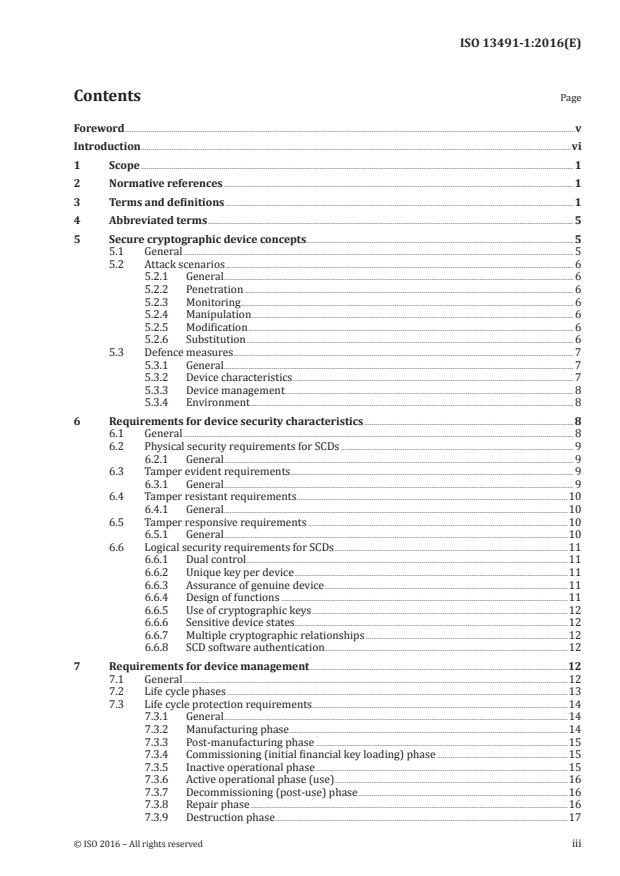
Contents Page
Foreword .v
Introduction .vi
1 Scope . 1
2 Normative references . 1
3 Terms and definitions . 1
4 Abbreviated terms . 5
5 Secure cryptographic device concepts . 5
5.1 General . 5
5.2 Attack scenarios . 6
5.2.1 General. 6
5.2.2 Penetration . 6
5.2.3 Monitoring . 6
5.2.4 Manipulation . 6
5.2.5 Modification . 6
5.2.6 Substitution . 6
5.3 Defence measures . . 7
5.3.1 General. 7
5.3.2 Device characteristics . 7
5.3.3 Device management . 8
5.3.4 Environment . 8
6 Requirements for device security characteristics . 8
6.1 General . 8
6.2 Physical security requirements for SCDs . 9
6.2.1 General. 9
6.3 Tamper evident requirements . 9
6.3.1 General. 9
6.4 Tamper resistant requirements .10
6.4.1 General.10
6.5 Tamper responsive requirements .10
6.5.1 General.10
6.6 Logical security requirements for SCDs .11
6.6.1 Dual control .11
6.6.2 Unique key per device .11
6.6.3 Assurance of genuine device .11
6.6.4 Design of functions .11
6.6.5 Use of cryptographic keys .12
6.6.6 Sensitive device states.12
6.6.7 Multiple cryptographic relationships .12
6.6.8 SCD software authentication .12
7 Requirements for device management .12
7.1 General .12
7.2 Life cycle phases .13
7.3 Life cycle protection requirements.14
7.3.1 General.14
7.3.2 Manufacturing phase.14
7.3.3 Post-manufacturing phase .15
7.3.4 Commissioning (initial financial key loading) phase .15
7.3.5 Inactive operational phase .15
7.3.6 Active operational phase (use) .16
7.3.7 Decommissioning (post-use) phase .16
7.3.8 Repair phase .16
7.3.9 Destruction phase .17
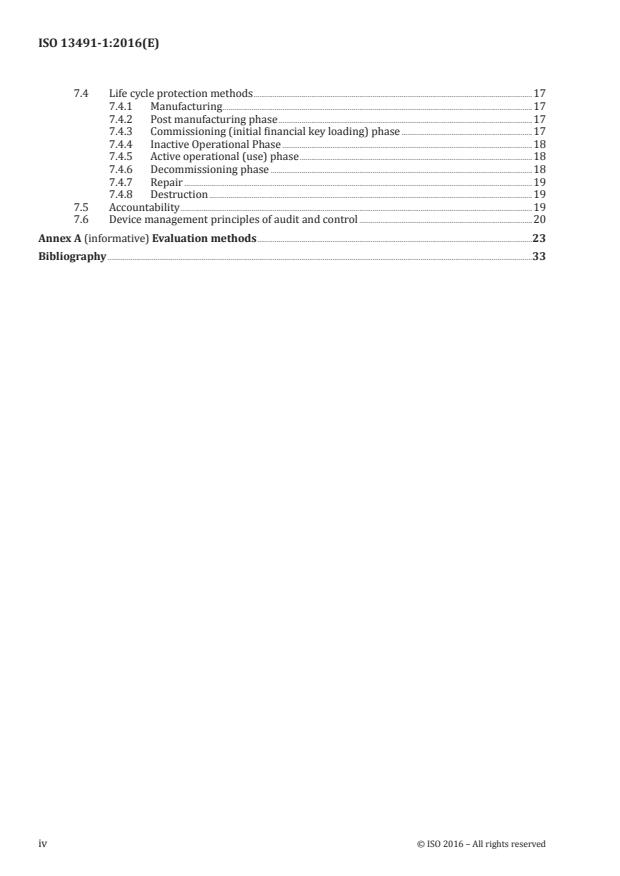
7.4 Life cycle protection methods .17
7.4.1 Manufacturing .17
7.4.2 Post manufacturing phase .17
7.4.3 Commissioning (initial financial key loading) phase .17
7.4.4 Inactive Operational Phase .18
7.4.5 Active operational (use) phase .18
7.4.6 Decommissioning phase .18
7.4.7 Repair .19
7.4.8 Destruction .19
7.5 Accountability .19
7.6 Device management principles of audit and control .20
Annex A (informative) Evaluation methods .23
Bibliography .33
iv © ISO 2016 – All rights reserved
Foreword
ISO (the International Organization for Standardization) is a worldwide federation of national standards
bodies (ISO member bodies). The work of preparing International Standards is normally carried out
through ISO technical committees. Each member body interested in a subject for which a technical
committee has been established has the right to be represented on that committee. International
organizations, governmental and non-governmental, in liaison with ISO, also take part in the work.
ISO collaborates closely with the International Electrotechnical Commission (IEC) on all matters of
electrotechnical standardization.
The procedures used to develop this document and those intended for its further maintenance are
described in the ISO/IEC Directives, Part 1. In particular the different approval criteria needed for the
different types of ISO documents should be noted. This document was drafted in accordance with the
editorial rules of the ISO/IEC Directives, Part 2 (see www.iso.org/directives).
Attention is drawn to the possibility that some of the elements of this document may be the subject of
patent rights. ISO shall not be held responsible for identifying any or all such patent rights. Details of
any patent rights identified during the development of the document will be in the Introduction and/or
on the ISO list of patent declarations received (see www.iso.org/patents).
Any trade name used in this document is information given for the convenience of users and does not
constitute an endorsement.
For an explanation on the meaning of ISO specific terms and expressions related to conformity
assessment, as well as information about ISO’s adherence to the WTO principles in the Technical
Barriers to Trade (TBT) see the following URL: Foreword - Supplementary information
The committee responsible for this document is ISO/TC 68, Financial services, Subcommittee SC 2,
Security.
This third edition cancels and replaces the second edition (ISO 13491-1:2007), which has been
technically revised.
ISO 13491 consists of the following parts, under the general title Financial services — Secure
cryptographic devices (retail):
— Part 1: Concepts, requirements and evaluation methods
— Part 2: Security compliance checklists for devices used in financial transactions
Introduction
ISO 13491 describes both the physical and logical characteristics and the management of the secure
cryptographic devices (SCDs) used to protect messages, cryptographic keys, and other sensitive
information used in a retail financial services environment.
This part of ISO 13491 contains the security requirements for SCDs. ISO 13491-2 is a tool for measuring
compliance against these requirements. It provides a checklist of
— characteristics that a device has to possess,
— how devices have to be managed, and
— characteristics of the operational environments.
The security of retail electronic payment systems is largely dependent upon the security of these
cryptographic devices. This security is based upon the premise that computer files can be accessed and
manipulated, communications lines can be “tapped”, and authorized data or control inputs into system
equipment can be replaced with unauthorized inputs. When personal identification numbers (PINs),
message authentication codes (MACs), cryptographic keys, and other sensitive data are processed,
there is a risk of tampering or other compromise to disclose or modify such data. The risk of financial
loss is reduced through the appropriate use of cryptographic devices that have proper characteristics
and are properly managed.
Appropriate device characteristics are necessary to ensure that the device has the proper operational
capabilities and provides adequate protection for the data it contains. Appropriate device management
is necessary to ensure that the device is legitimate, that it has not been modified in an unauthorized
manner (e.g. by “bugging”), and that any sensitive data placed within the device (e.g. cryptographic
keys) has not been subject to disclosure or change.
Absolute security is not achievable in practical terms. Cryptographic security depends upon each life
cycle phase of the SCD and the complementary combination of appropriate management procedures and
secure cryptographic characteristics. These management procedures implement preventive measures
to reduce the opportunity for a breach of SCD security. This aims for a high probability of detection of
any unauthorized access to sensitive or confidential data should device characteristics fail to prevent
or detect the security compromise.
vi © ISO 2016 – All rights reserved
INTERNATIONAL STANDARD ISO 13491-1:2016(E)
Financial services — Secure cryptographic devices
(retail) —
Part 1:
Concepts, requirements and evaluation methods
1 Scope
This part of ISO 13491 specifies the security characteristics for secure cryptographic devices (SCDs)
based on the cryptographic processes defined in ISO 9564, ISO 16609, and ISO 11568.
This part of ISO 13491 has two primary purposes:
— to state the security characteristics concerning both the operational characteristics of SCDs and the
management of such devices throughout all stages of their life cycle;
— to provide guidance for methodologies to verify compliance with those requirements. This
information is contained in Annex A.
ISO 13491-2 specifies checklists to be used to evaluate secure cryptographic devices (SCDs)
incorporating cryptographic processes as specified in ISO 9564-1, ISO 9564-2, ISO 16609, ISO 11568-1,
ISO 11568-2, ISO 11568-3, ISO 11568-4, ISO 11568-5, and ISO 11568-6 in the financial services
environment.
Annex A provides an informative illustration of the concepts of security levels described in this part of
ISO 13491 as being applicable to SCDs.
This part of ISO 13491 does not address issues arising from the denial of service of an SCD.
Specific requirements for the security characteristics and management of specific types of SCD
functionality used in the retail financial services environment are contained in ISO 13491-2.
2 Normative references
The following documents, in whole or in part, are normatively referenced in this document and are
indispensable for its application. For dated references, only the edition cited applies. For undated
references, the latest edition of the referenced document (including any amendments) applies.
ISO 11568-1, Banking — Key management (retail) — Part 1: Principles
ISO 11568-2, Financial services — Key management (retail) — Part 2: Symmetric ciphers, their key
management and life cycle
ISO 11568-4, Banking — Key management (retail) — Part 4: Asymmetric cryptosystems — Key
management and life cycle
3 Terms and definitions
For the purposes of this document, the following terms and definitions apply.
3.1
accreditation authority
authority responsible for the accreditation of evaluation agencies and supervision of their work in order
to guarantee the reproducibility of the evaluation results
3.2
accredited evaluation agency
body accredited in accordance with a set of rules and accepted by the approval authority for the purpose
of evaluation
Note 1 to entry: An example of a set of rules is ISO/IEC 17025.
3.3
approval authority
authority responsible for the approval of devices and for issuance of the approval letter (3.4)
3.4
approval letter
output of the approval authority (3.3) based on the results from an evaluation review body (3.20)
3.5
assessment checklist
list of claims, organized by device type, and contained in ISO 13491-2
3.6
assessment report
output of the assessment review body (3.7), based on the results from an assessor (3.8)
3.7
assessment review body
group with responsibility for reviewing and making judgements on the results from the assessor (3.8)
3.8
assessor
person who checks, assesses, reviews, and evaluates compliance with an informal evaluation on behalf
of the sponsor (3.33) or assessment review body (3.7)
3.9
attack
attempt by an adversary on the device to obtain or modify sensitive information (3.30) or a service they
are not authorized to obtain or modify
3.10
evaluation certificate
output of the accreditation authority based on the results from an accredited evaluation agency (3.2)
3.11
controller
entity responsible for the secure management of an SCD (3.28)
3.12
deliverables
documents, equipment, and any other items or information needed by the evaluators to perform an
evaluation of the SCD (3.28)
3.13
device compromise
successful defeat of the physical or logical protections provided by the SCD (3.28), resulting in the
potential disclosure of sensitive information (3.30) or unauthorized use of the SCD
3.14
device security
security of the SCD (3.28) related to its characteristics only, without reference to a specific operational
environment (3.26)
2 © ISO 2016 – All rights reserved
3.15
device management
processes, including procedures, controlling the access to and use of the device which may vary
depending on the deployed environment
3.16
dual control
process of utilizing two or more separate entities (usually persons) operating in concert to protect
sensitive functions (3.31) or information whereby no single entity is able to access or utilize the materials
EXAMPLE A cryptographic key is an example of the type of material protected by dual control.
3.17
environment-dependent security
security of an SCD (3.28) as part of an operational environment (3.26)
3.18
evaluation agency
organization trusted by the design, manufacturing, and sponsoring entities which evaluates the SCD
(3.28) (using specialist skills and tools) in accordance with ISO 13491
3.19
evaluation report
output of the evaluation review body (3.20), based on the results from an evaluation agency (3.18) or auditor
3.20
evaluation review body
group with responsibility for reviewing, and making judgements on, the results of the evaluation
agency (3.18)
3.21
financial key
cryptographic key used to protect financial transaction data between the PED and the entity processing
the transaction, e.g. the entity’s public key used for mutual authentication with the PED, the initial
DUKPT keys, Terminal Master Keys, and PIN encryption keys
3.22
formal claim
statement about the characteristics and functions of an SCD (3.28)
3.23
hardware security module
HSM
SCD (3.28) that provides a set of secure cryptographic services, e.g. key generation, cryptogram
creation, PIN translation, and certificate signing
3.24
key loading device
KLD
SCD (3.28) that loads keys into other SCDs
3.25
logical security
ability of a device to withstand attacks (3.9) through its functional interface
3.26
operational environment
environment in which the SCD (3.28) is operated, i.e. the system of which it is part, the location where it
is placed, the persons operating and using it, and the entities communicating with it
3.27
physical security
ability of a device to withstand attacks (3.9) against its physical construction, including physical
characteristics such as electromagnetic emissions and power fluctuations, the analysis of which can
lead to side channel attacks
3.28
secure cryptographic device
SCD
device that provides physically and logically protected cryptographic services and storage (e.g. PIN
entry device (PED) or HSM (3.23)), and which may be integrated into a larger system, such as an
automated teller machine (ATM) or point of sale (POS) terminal
3.29
security scheme
configuration that supports the secure status of the device
3.30
sensitive data
sensitive information
data, status information, cryptographic keys, PINs, etc., which need to be protected against unauthorized
disclosure, alteration, or destruction
3.31
sensitive function
those functions which are accessible when the device is in a sensitive state (3.32)
3.32
sensitive state
device condition that provides access to the secure operator interface, such that it can only be entered
when the device is under dual control (3.16)
3.33
sponsor
entity that submits the SCD (3.28) for evaluation
Note 1 to entry: Sponsor in this context does not refer to the “sponsor” of a transaction.
3.34
tamper evident characteristic
characteristic that provides evidence that an attack (3.9) has been attempted
3.35
tamper resistant characteristic
characteristic that provides passive physical protection against an attack (3.9)
3.36
tamper responsive characteristic
characteristic that provides an active response to the detection of an attack (3.9)
4 © ISO 2016 – All rights reserved
4 Abbreviated terms
ATM automated teller machine
MAC message authentication code
PIN personal identification number
POS point of sale
SCD secure cryptographic device
5 Secure cryptographic device concepts
5.1 General
Cryptography is used in retail financial services to help ensure the following objectives:
a) the integrity and authenticity of sensitive data, e.g. by MAC-ing transaction details;
b) the confidentiality of secret information, e.g. by encrypting customer PINs;
c) the confidentiality, integrity, and authenticity of cryptographic keys;
d) the security of other sensitive operations, e.g. PIN verification.
To ensure that the above objectives are met, the following threats to the security of the cryptographic
processing shall be countered:
— unauthorized use, disclosure, or modification of cryptographic keys and other sensitive information;
— unauthorized use or modification of cryptographic services.
A secure cryptographic device (SCD) is a physically and logically secure hardware device providing a
defined set of cryptographic functions, access controls, and secure key storage. SCDs are employed to
protect against these threats. The requirements of this part of ISO 13491 pertain to the SCD and not the
system in which the SCD may be integrated. However, it is important to analyse the interfaces between
the SCD and the remainder of the system to ensure that the SCD may not be compromised.
Since absolute security is not achievable in practical terms, it is not realistic to describe an SCD as being
“tamper proof” or “physically secure”. With enough cost, effort, and skill, virtually any security scheme
can be defeated. Furthermore, as technology continues to evolve, new techniques may be developed to
attack a security scheme that was previously believed to be immune to feasible attack. Therefore, it is
more realistic to categorize an SCD as possessing a degree of tamper protection where an acceptable
degree is one that is deemed adequate to deter any attack envisaged as feasible during the operational
life of the device taking into account the equipment, skills, and other costs to the adversary in mounting
a successful attack and the financial benefits that the adversary could realize from such an attack.
Security of retail payment systems includes the physical and logical aspects of device security, the
security of the operational environment, and management of the device. These factors establish jointly
the security of the devices and the applications in which they are used. The security needs are derived
from an assessment of the risks arising from the intended applications.
The required security characteristics will depend on the intended application and operational
environment and on the attack types that need to be considered. A risk assessment should be made as
an aid to selecting the most appropriate method of evaluating the security of the device. The results
are then assessed in order to accept the devices for a certain application and environment. Evaluation
methods are given in Annex A.
5.2 Attack scenarios
5.2.1 General
SCDs are subject to the following five primary classes of attack, which may be used in combination:
— penetration;
— monitoring;
— manipulation;
— modification;
— substitution.
These attack scenarios do not form an exhaustive list, but are an indication of the main areas of concern
and are described below.
NOTE The Internet has enabled new classes of attackers who share information enabling the dissemination
of exploits to be both wide reaching and rapid and to market attacks developed against particular SCDs
(particularly point of sale devices). These later attackers expend considerable time, effort, and expertise to
develop an attack which is packaged and then sold to other attackers.
5.2.2 Penetration
Penetration is an attack which involves the physical perforation or unauthorized opening of the device
to ascertain sensitive data contained within it, e.g. cryptographic keys.
5.2.3 Monitoring
Monitoring is an attack which may involve the monitoring of electromagnetic (EM) radiation, power
consumption differentials, timing differentials, and other side channel attacks, etc. for the purposes of
discovering sensitive information contained within the device. Alternatively, it may involve the visual,
aural, or electronic monitoring of sensitive data being entered into the device.
5.2.4 Manipulation
Manipulation involves the unauthorized sending to the device of a sequence of inputs, varying
the external inputs to the device (such as power or clock signals), or subjecting the device to other
environmental stresses so as to cause the disclosure of sensitive information or to obtain a service in
an unauthorized manner. An example of this would be causing the device to enter its “test mode” in
order that sensitive information could be disclosed or the device integrity manipulated.
5.2.5 Modification
Modification is the unauthorized alteration of the logical or physical characteristics of the device, e.g.
inserting or overlaying a PIN-disclosing “bug” in, or on, a PIN pad between the point of PIN entry and the
point of PIN encryption. The purpose of modification is to alter the device rather than to immediately
disclose information contained within the device. Following modification, the device shall be made (or
shall remain) operational in order for the attack to be successful. The unauthorized replacement of a
cryptographic key contained within a device is a form of modification.
5.2.6 Substitution
Substitution is the unauthorized replacement of one device with another. The replacement device might
be a look-alike “counterfeit” or emulating device having all or some of the correct logical characteristics
plus some unauthorized functions such as a PIN-disclosing bug.
6 © ISO 2016 – All rights reserved
The replacement device might also be a once-legitimate device that has been subject to unauthorized
modifications and then substituted for another legitimate device.
Substitution may include removal of the device in order to perform a penetration or modification
attack in an environment better suited to such attacks. Substitution can be seen as a special case of
modification in which the adversary does not actually modify the target device, but instead replaces it
with a modified substitute.
5.3 Defence measures
5.3.1 General
To defend against the attack scenarios discussed above, the following three factors work together to
provide the security required:
— device characteristics;
— device management;
— environment.
While in some cases, a single factor, e.g. device characteristics, may be dominant, the normal situation
is that all factors are necessary to achieve the desired result.
5.3.2 Device characteristics
SCDs are designed and implemented with logical and physical security so as to deter attack scenarios
such as those described in 5.2.
Physical security characteristics can be subdivided into the following three classes:
— tamper evidence characteristics;
— tamper resistance characteristics;
— tamper response characteristics.
SCDs shall require a combination of all three of these classes of characteristics. Other physical security
characteristics may be required to defend against other passive attacks, such as monitoring. Physical
security characteristics may also help defend against modification or substitution.
The intent of tamper evidence is to provide evidence that an attack has been attempted and may or
may not have resulted in the unauthorized disclosure, use, or modification of the sensitive information.
The disclosure of an attempted attack could be in the form of physical evidence, such as damage to the
external casing. The evidence could also be that the device is no longer in its expected location. Tamper
evidence provides an indication that the device may have been penetrated or modified.
The intent of tamper resistance is to block attacks by employing passive barriers or logical design
features. Barriers are usually single purpose and are designed to block a particular threat, such as a
penetration attack. The logical protection measures are designed typically to prevent the leakage of
sensitive information or to prevent the illicit modification of system or application software. Tamper
resistance provides a barrier of protection, the circumvention of which may lead to tamper evidence
and result in tamper responsiveness. In this context, “tampering” is understood to also cover purely
passive attacks, e.g. EM radiation monitoring
The intent of tamper response is to employ active mechanisms against attacks. When the active
protection mechanisms are triggered, the protected information is either erased or rendered unusable.
The implementation of the various security characteristics is dependent on the designer’s knowledge
and experience of known attacks against the particular implementation. For that reason, attacks are
usually directed to discovering which, if any, of the known threats the implementer failed to address.
The attacker will also attempt to discover new attacks that are likely to be unknown to the implementer.
Evaluation of the security of an SCD is difficult, and not conclusive, in that the evaluation normally only
proves that the design successfully blocks attacks known to the evaluator at the time of the evaluation,
but does not, or cannot, evaluate resistance to unknown attacks.
5.3.3 Device management
Device management refers to the external controls placed on the device during its life cycle and by its
environments (see Clause 7). These controls include
— key management methods,
— security practices, and
— operational procedures.
The primary objective of device management is to ensure that device characteristics are not subject to
unauthorized alteration during the life of the device.
5.3.4 Environment
The objective of environment security is to control access to the SCD and its services, thus preventing,
or at least detecting, attacks on the SCD. Throughout its life cycle, an SCD will reside in a variety of
environments (see Clause 7). These environments may be characterized as ranging from highly
controlled to minimally controlled. A highly controlled environment is one that includes constant
surveillance by trusted individuals, while a minimally controlled environment may not include any
special environmental security supplements. If the security of an SCD is dependent on some function
of a controlled environment, it shall be satisfactorily proven that the controlled environment actually
provides this function.
6 Requirements for device security characteristics
6.1 General
Device characteristics of an SCD may be categorized as either physical or logical, as described below.
— Physical characteristics are the physical components that comprise the SCD and the way the device
is constructed using those components.
— Logical characteristics are the way that inputs are processed to produce device outputs or to change
logical state.
The SCD shall have characteristics that ensure the device or its interface does not compromise any
sensitive data which is input to or output from the device, or stored or processed in the device.
Where the SCD is operated in a controlled environment, the requirements for device characteristics
may rely on the protection provided by the controlled environment and the management of the device.
A physically secure device is a hardware device which cannot be feasibly penetrated or manipulated to
disclose all or part of any cryptographic key, PIN, or other secret value resident within the device.
Penetration of the device shall cause the automatic and immediate erasure of all PINs, cryptographic
keys, and other secret values and all useful residues of those contained within the device, i.e. the device
has tamper response characteristics.
A device shall only be operated as a physically secure device when it can be ensured that the device’s
internal operation has not been modified, (e.g. the insertion within the device of an active or passive
“tapping” mechanism).
8 © ISO 2016 – All rights reserved
6.2 Physical security requirements for SCDs
6.2.1 General
— An SCD shall be so designed that any failure of a part in the device, or use of a part outside the device
specification, does not result in the disclosure or undetected modification of sensitive data.
— An SCD shall be so designed and constructed such that without physical penetration of the device,
any unauthorized access to, or modification of, sensitive data (including device software) that are
input, stored, or processed in it is impractical.
It is advisable that an SCD should be so designed and constructed that any additions of external devices
which intercept or substitute data input to or output from the SCD for the purpose of masquerade have
a high probability of being detected and/or recognized as not being part of a correct device.
— An SCD shall be so designed and constructed such that regular maintenance does not require access
to internal areas that could compromise security.
— An SCD shall be so designed and constructed such that repair, if it requires access to internal areas
that could compromise security, shall cause immediate erasure of all cryptographic keys and other
sensitive data.
— An SCD, including its data entry functions, shall be so designed, constructed, and/or deployed such
that secret and sensitive data are shielded from monitoring by any practical attack.
— Each tamper protection mechanism shall be protected against modification or circumvention.
NOTE This may be accomplished through the use of additional tamper protection mechanisms, i.e. a layered
defence.
6.3 Tamper evident requirements
6.3.1 General
Tamper evidence provides an indication that an attack has been attempted. If a device claims to rely on
tamper evident characteristics to defend against substitution, penetration, or modification attacks, the
manner in which the device defends against the attacks shall be as described in 6.3.1.1 to 6.3.1.3.
6.3.1.1 Substitution
— To protect against substitution with a forged or compromised device, the device shall be so
designed that it is not practical for an attacker to construct a duplicate from commercially available
components which can reasonably be mistaken for a genuine device.
6.3.1.2 Penetration
— To ensure that penetration of an SCD is detected, the device shall be so designed and constructed that
any successful penetration shall require that the device be subject to physical damage or prolonged
absence from its authorized location such that the device cannot be placed back into service without
a high probability of detection when returned to operational use.
6.3.1.3 Modification
— To ensure that modification of an SCD is detected, the device shall be so designed and constructed
that any successful modification shall require that the device be subject to physical damage or
prolonged absence from its authorized location such that the device cannot be placed back into
service without a high probability of detection when returned to operational use.
6.3.1.4 Monitoring
— The device should be designed and constructed in such a way that any unauthorized additions to the
exterior of the device, intended to monitor it for secret or sensitive information, shall have a high
probability of being visually detected before such monitoring can occur.
6.4 Tamper resistant requirements
6.4.1 General
Tamper resistance provides passive physical protection against attacks. If a device claims to rely
on tamper resistance characteristics to defend against penetration, modification, monitoring, or
substitution/removal attacks, the manner in which the device defends against the attacks shall be as
described in 6.4.1.1 to 6.4.1.3 and optionally, 6.4.1.4.
6.4.1.1 Penetration
— An SCD shall be protected against successful penetration by being tamper resistant to such a
degree that its passive resistance is sufficient to make penetration impracticable in its intended
environment.
6.4.1.2 Modification
— An SCD shall be protected against successful modification by being tamper resistant to such a degree
that its passive resistance is sufficient to make modification of an SCD (e.g. the implantation of a bug
within the SCD) in its intended environment impracticable without rendering the SCD inoperable.
— The unauthorized modification of any key or other sensitive data stored within the SCD shall cause
damage such that the SCD is rendered inoperable.
6.4.1.3 Monitoring
— The SCD shall not reveal secret or sensitive information (e.g. PINs or cryptographic keys) except
a) when enciphered with the appropriate legitimate key, or
b) in an authorized manner (e.g. PIN mailers).
— The SCD shall protect against electromagnetic emissions such that no sensitive information could
feasibly be disclosed by monitoring the device.
— The SCD shall not display the digits of entered PINs in clear text.
— Where parts of the device cannot be appropriately protected from monitoring, these parts of the
device shall not display, store, transmit, or process secret or sensitive information.
6.4.1.4 Substitution/removal
— In order to protect against substitution/removal, the device should be secured in such a manner
that it is not practical to remove the device from its intended place of operation.
6.5 Tamper responsive requirements
6.5.1 General
Tamper responsiveness provides active protection against attacks.
10 © ISO 2016 – All rights reserved
Where an SCD employs a tamper response mechanism, the integrity of the mechanism shall be ensured
by employing tamper resistant characteristics and optionally, tamper response characteris
...
INTERNATIONAL ISO
STANDARD 13491-1
Third edition
2016-03-15
Financial services — Secure
cryptographic devices (retail) —
Part 1:
Concepts, requirements and
evaluation methods
Services financiers — Dispositifs cryptographiques de sécurité
(services aux particuliers) —
Partie 1: Concepts, exigences et méthodes d’évaluation
Reference number
©
ISO 2016
© ISO 2016, Published in Switzerland
All rights reserved. Unless otherwise specified, no part of this publication may be reproduced or utilized otherwise in any form
or by any means, electronic or mechanical, including photocopying, or posting on the internet or an intranet, without prior
written permission. Permission can be requested from either ISO at the address below or ISO’s member body in the country of
the requester.
ISO copyright office
Ch. de Blandonnet 8 • CP 401
CH-1214 Vernier, Geneva, Switzerland
Tel. +41 22 749 01 11
Fax +41 22 749 09 47
copyright@iso.org
www.iso.org
ii © ISO 2016 – All rights reserved
Contents Page
Foreword .v
Introduction .vi
1 Scope . 1
2 Normative references . 1
3 Terms and definitions . 1
4 Abbreviated terms . 5
5 Secure cryptographic device concepts . 5
5.1 General . 5
5.2 Attack scenarios . 6
5.2.1 General. 6
5.2.2 Penetration . 6
5.2.3 Monitoring . 6
5.2.4 Manipulation . 6
5.2.5 Modification . 6
5.2.6 Substitution . 6
5.3 Defence measures . . 7
5.3.1 General. 7
5.3.2 Device characteristics . 7
5.3.3 Device management . 8
5.3.4 Environment . 8
6 Requirements for device security characteristics . 8
6.1 General . 8
6.2 Physical security requirements for SCDs . 9
6.2.1 General. 9
6.3 Tamper evident requirements . 9
6.3.1 General. 9
6.4 Tamper resistant requirements .10
6.4.1 General.10
6.5 Tamper responsive requirements .10
6.5.1 General.10
6.6 Logical security requirements for SCDs .11
6.6.1 Dual control .11
6.6.2 Unique key per device .11
6.6.3 Assurance of genuine device .11
6.6.4 Design of functions .11
6.6.5 Use of cryptographic keys .12
6.6.6 Sensitive device states.12
6.6.7 Multiple cryptographic relationships .12
6.6.8 SCD software authentication .12
7 Requirements for device management .12
7.1 General .12
7.2 Life cycle phases .13
7.3 Life cycle protection requirements.14
7.3.1 General.14
7.3.2 Manufacturing phase.14
7.3.3 Post-manufacturing phase .15
7.3.4 Commissioning (initial financial key loading) phase .15
7.3.5 Inactive operational phase .15
7.3.6 Active operational phase (use) .16
7.3.7 Decommissioning (post-use) phase .16
7.3.8 Repair phase .16
7.3.9 Destruction phase .17
7.4 Life cycle protection methods .17
7.4.1 Manufacturing .17
7.4.2 Post manufacturing phase .17
7.4.3 Commissioning (initial financial key loading) phase .17
7.4.4 Inactive Operational Phase .18
7.4.5 Active operational (use) phase .18
7.4.6 Decommissioning phase .18
7.4.7 Repair .19
7.4.8 Destruction .19
7.5 Accountability .19
7.6 Device management principles of audit and control .20
Annex A (informative) Evaluation methods .23
Bibliography .33
iv © ISO 2016 – All rights reserved
Foreword
ISO (the International Organization for Standardization) is a worldwide federation of national standards
bodies (ISO member bodies). The work of preparing International Standards is normally carried out
through ISO technical committees. Each member body interested in a subject for which a technical
committee has been established has the right to be represented on that committee. International
organizations, governmental and non-governmental, in liaison with ISO, also take part in the work.
ISO collaborates closely with the International Electrotechnical Commission (IEC) on all matters of
electrotechnical standardization.
The procedures used to develop this document and those intended for its further maintenance are
described in the ISO/IEC Directives, Part 1. In particular the different approval criteria needed for the
different types of ISO documents should be noted. This document was drafted in accordance with the
editorial rules of the ISO/IEC Directives, Part 2 (see www.iso.org/directives).
Attention is drawn to the possibility that some of the elements of this document may be the subject of
patent rights. ISO shall not be held responsible for identifying any or all such patent rights. Details of
any patent rights identified during the development of the document will be in the Introduction and/or
on the ISO list of patent declarations received (see www.iso.org/patents).
Any trade name used in this document is information given for the convenience of users and does not
constitute an endorsement.
For an explanation on the meaning of ISO specific terms and expressions related to conformity
assessment, as well as information about ISO’s adherence to the WTO principles in the Technical
Barriers to Trade (TBT) see the following URL: Foreword - Supplementary information
The committee responsible for this document is ISO/TC 68, Financial services, Subcommittee SC 2,
Security.
This third edition cancels and replaces the second edition (ISO 13491-1:2007), which has been
technically revised.
ISO 13491 consists of the following parts, under the general title Financial services — Secure
cryptographic devices (retail):
— Part 1: Concepts, requirements and evaluation methods
— Part 2: Security compliance checklists for devices used in financial transactions
Introduction
ISO 13491 describes both the physical and logical characteristics and the management of the secure
cryptographic devices (SCDs) used to protect messages, cryptographic keys, and other sensitive
information used in a retail financial services environment.
This part of ISO 13491 contains the security requirements for SCDs. ISO 13491-2 is a tool for measuring
compliance against these requirements. It provides a checklist of
— characteristics that a device has to possess,
— how devices have to be managed, and
— characteristics of the operational environments.
The security of retail electronic payment systems is largely dependent upon the security of these
cryptographic devices. This security is based upon the premise that computer files can be accessed and
manipulated, communications lines can be “tapped”, and authorized data or control inputs into system
equipment can be replaced with unauthorized inputs. When personal identification numbers (PINs),
message authentication codes (MACs), cryptographic keys, and other sensitive data are processed,
there is a risk of tampering or other compromise to disclose or modify such data. The risk of financial
loss is reduced through the appropriate use of cryptographic devices that have proper characteristics
and are properly managed.
Appropriate device characteristics are necessary to ensure that the device has the proper operational
capabilities and provides adequate protection for the data it contains. Appropriate device management
is necessary to ensure that the device is legitimate, that it has not been modified in an unauthorized
manner (e.g. by “bugging”), and that any sensitive data placed within the device (e.g. cryptographic
keys) has not been subject to disclosure or change.
Absolute security is not achievable in practical terms. Cryptographic security depends upon each life
cycle phase of the SCD and the complementary combination of appropriate management procedures and
secure cryptographic characteristics. These management procedures implement preventive measures
to reduce the opportunity for a breach of SCD security. This aims for a high probability of detection of
any unauthorized access to sensitive or confidential data should device characteristics fail to prevent
or detect the security compromise.
vi © ISO 2016 – All rights reserved
INTERNATIONAL STANDARD ISO 13491-1:2016(E)
Financial services — Secure cryptographic devices
(retail) —
Part 1:
Concepts, requirements and evaluation methods
1 Scope
This part of ISO 13491 specifies the security characteristics for secure cryptographic devices (SCDs)
based on the cryptographic processes defined in ISO 9564, ISO 16609, and ISO 11568.
This part of ISO 13491 has two primary purposes:
— to state the security characteristics concerning both the operational characteristics of SCDs and the
management of such devices throughout all stages of their life cycle;
— to provide guidance for methodologies to verify compliance with those requirements. This
information is contained in Annex A.
ISO 13491-2 specifies checklists to be used to evaluate secure cryptographic devices (SCDs)
incorporating cryptographic processes as specified in ISO 9564-1, ISO 9564-2, ISO 16609, ISO 11568-1,
ISO 11568-2, ISO 11568-3, ISO 11568-4, ISO 11568-5, and ISO 11568-6 in the financial services
environment.
Annex A provides an informative illustration of the concepts of security levels described in this part of
ISO 13491 as being applicable to SCDs.
This part of ISO 13491 does not address issues arising from the denial of service of an SCD.
Specific requirements for the security characteristics and management of specific types of SCD
functionality used in the retail financial services environment are contained in ISO 13491-2.
2 Normative references
The following documents, in whole or in part, are normatively referenced in this document and are
indispensable for its application. For dated references, only the edition cited applies. For undated
references, the latest edition of the referenced document (including any amendments) applies.
ISO 11568-1, Banking — Key management (retail) — Part 1: Principles
ISO 11568-2, Financial services — Key management (retail) — Part 2: Symmetric ciphers, their key
management and life cycle
ISO 11568-4, Banking — Key management (retail) — Part 4: Asymmetric cryptosystems — Key
management and life cycle
3 Terms and definitions
For the purposes of this document, the following terms and definitions apply.
3.1
accreditation authority
authority responsible for the accreditation of evaluation agencies and supervision of their work in order
to guarantee the reproducibility of the evaluation results
3.2
accredited evaluation agency
body accredited in accordance with a set of rules and accepted by the approval authority for the purpose
of evaluation
Note 1 to entry: An example of a set of rules is ISO/IEC 17025.
3.3
approval authority
authority responsible for the approval of devices and for issuance of the approval letter (3.4)
3.4
approval letter
output of the approval authority (3.3) based on the results from an evaluation review body (3.20)
3.5
assessment checklist
list of claims, organized by device type, and contained in ISO 13491-2
3.6
assessment report
output of the assessment review body (3.7), based on the results from an assessor (3.8)
3.7
assessment review body
group with responsibility for reviewing and making judgements on the results from the assessor (3.8)
3.8
assessor
person who checks, assesses, reviews, and evaluates compliance with an informal evaluation on behalf
of the sponsor (3.33) or assessment review body (3.7)
3.9
attack
attempt by an adversary on the device to obtain or modify sensitive information (3.30) or a service they
are not authorized to obtain or modify
3.10
evaluation certificate
output of the accreditation authority based on the results from an accredited evaluation agency (3.2)
3.11
controller
entity responsible for the secure management of an SCD (3.28)
3.12
deliverables
documents, equipment, and any other items or information needed by the evaluators to perform an
evaluation of the SCD (3.28)
3.13
device compromise
successful defeat of the physical or logical protections provided by the SCD (3.28), resulting in the
potential disclosure of sensitive information (3.30) or unauthorized use of the SCD
3.14
device security
security of the SCD (3.28) related to its characteristics only, without reference to a specific operational
environment (3.26)
2 © ISO 2016 – All rights reserved
3.15
device management
processes, including procedures, controlling the access to and use of the device which may vary
depending on the deployed environment
3.16
dual control
process of utilizing two or more separate entities (usually persons) operating in concert to protect
sensitive functions (3.31) or information whereby no single entity is able to access or utilize the materials
EXAMPLE A cryptographic key is an example of the type of material protected by dual control.
3.17
environment-dependent security
security of an SCD (3.28) as part of an operational environment (3.26)
3.18
evaluation agency
organization trusted by the design, manufacturing, and sponsoring entities which evaluates the SCD
(3.28) (using specialist skills and tools) in accordance with ISO 13491
3.19
evaluation report
output of the evaluation review body (3.20), based on the results from an evaluation agency (3.18) or auditor
3.20
evaluation review body
group with responsibility for reviewing, and making judgements on, the results of the evaluation
agency (3.18)
3.21
financial key
cryptographic key used to protect financial transaction data between the PED and the entity processing
the transaction, e.g. the entity’s public key used for mutual authentication with the PED, the initial
DUKPT keys, Terminal Master Keys, and PIN encryption keys
3.22
formal claim
statement about the characteristics and functions of an SCD (3.28)
3.23
hardware security module
HSM
SCD (3.28) that provides a set of secure cryptographic services, e.g. key generation, cryptogram
creation, PIN translation, and certificate signing
3.24
key loading device
KLD
SCD (3.28) that loads keys into other SCDs
3.25
logical security
ability of a device to withstand attacks (3.9) through its functional interface
3.26
operational environment
environment in which the SCD (3.28) is operated, i.e. the system of which it is part, the location where it
is placed, the persons operating and using it, and the entities communicating with it
3.27
physical security
ability of a device to withstand attacks (3.9) against its physical construction, including physical
characteristics such as electromagnetic emissions and power fluctuations, the analysis of which can
lead to side channel attacks
3.28
secure cryptographic device
SCD
device that provides physically and logically protected cryptographic services and storage (e.g. PIN
entry device (PED) or HSM (3.23)), and which may be integrated into a larger system, such as an
automated teller machine (ATM) or point of sale (POS) terminal
3.29
security scheme
configuration that supports the secure status of the device
3.30
sensitive data
sensitive information
data, status information, cryptographic keys, PINs, etc., which need to be protected against unauthorized
disclosure, alteration, or destruction
3.31
sensitive function
those functions which are accessible when the device is in a sensitive state (3.32)
3.32
sensitive state
device condition that provides access to the secure operator interface, such that it can only be entered
when the device is under dual control (3.16)
3.33
sponsor
entity that submits the SCD (3.28) for evaluation
Note 1 to entry: Sponsor in this context does not refer to the “sponsor” of a transaction.
3.34
tamper evident characteristic
characteristic that provides evidence that an attack (3.9) has been attempted
3.35
tamper resistant characteristic
characteristic that provides passive physical protection against an attack (3.9)
3.36
tamper responsive characteristic
characteristic that provides an active response to the detection of an attack (3.9)
4 © ISO 2016 – All rights reserved
4 Abbreviated terms
ATM automated teller machine
MAC message authentication code
PIN personal identification number
POS point of sale
SCD secure cryptographic device
5 Secure cryptographic device concepts
5.1 General
Cryptography is used in retail financial services to help ensure the following objectives:
a) the integrity and authenticity of sensitive data, e.g. by MAC-ing transaction details;
b) the confidentiality of secret information, e.g. by encrypting customer PINs;
c) the confidentiality, integrity, and authenticity of cryptographic keys;
d) the security of other sensitive operations, e.g. PIN verification.
To ensure that the above objectives are met, the following threats to the security of the cryptographic
processing shall be countered:
— unauthorized use, disclosure, or modification of cryptographic keys and other sensitive information;
— unauthorized use or modification of cryptographic services.
A secure cryptographic device (SCD) is a physically and logically secure hardware device providing a
defined set of cryptographic functions, access controls, and secure key storage. SCDs are employed to
protect against these threats. The requirements of this part of ISO 13491 pertain to the SCD and not the
system in which the SCD may be integrated. However, it is important to analyse the interfaces between
the SCD and the remainder of the system to ensure that the SCD may not be compromised.
Since absolute security is not achievable in practical terms, it is not realistic to describe an SCD as being
“tamper proof” or “physically secure”. With enough cost, effort, and skill, virtually any security scheme
can be defeated. Furthermore, as technology continues to evolve, new techniques may be developed to
attack a security scheme that was previously believed to be immune to feasible attack. Therefore, it is
more realistic to categorize an SCD as possessing a degree of tamper protection where an acceptable
degree is one that is deemed adequate to deter any attack envisaged as feasible during the operational
life of the device taking into account the equipment, skills, and other costs to the adversary in mounting
a successful attack and the financial benefits that the adversary could realize from such an attack.
Security of retail payment systems includes the physical and logical aspects of device security, the
security of the operational environment, and management of the device. These factors establish jointly
the security of the devices and the applications in which they are used. The security needs are derived
from an assessment of the risks arising from the intended applications.
The required security characteristics will depend on the intended application and operational
environment and on the attack types that need to be considered. A risk assessment should be made as
an aid to selecting the most appropriate method of evaluating the security of the device. The results
are then assessed in order to accept the devices for a certain application and environment. Evaluation
methods are given in Annex A.
5.2 Attack scenarios
5.2.1 General
SCDs are subject to the following five primary classes of attack, which may be used in combination:
— penetration;
— monitoring;
— manipulation;
— modification;
— substitution.
These attack scenarios do not form an exhaustive list, but are an indication of the main areas of concern
and are described below.
NOTE The Internet has enabled new classes of attackers who share information enabling the dissemination
of exploits to be both wide reaching and rapid and to market attacks developed against particular SCDs
(particularly point of sale devices). These later attackers expend considerable time, effort, and expertise to
develop an attack which is packaged and then sold to other attackers.
5.2.2 Penetration
Penetration is an attack which involves the physical perforation or unauthorized opening of the device
to ascertain sensitive data contained within it, e.g. cryptographic keys.
5.2.3 Monitoring
Monitoring is an attack which may involve the monitoring of electromagnetic (EM) radiation, power
consumption differentials, timing differentials, and other side channel attacks, etc. for the purposes of
discovering sensitive information contained within the device. Alternatively, it may involve the visual,
aural, or electronic monitoring of sensitive data being entered into the device.
5.2.4 Manipulation
Manipulation involves the unauthorized sending to the device of a sequence of inputs, varying
the external inputs to the device (such as power or clock signals), or subjecting the device to other
environmental stresses so as to cause the disclosure of sensitive information or to obtain a service in
an unauthorized manner. An example of this would be causing the device to enter its “test mode” in
order that sensitive information could be disclosed or the device integrity manipulated.
5.2.5 Modification
Modification is the unauthorized alteration of the logical or physical characteristics of the device, e.g.
inserting or overlaying a PIN-disclosing “bug” in, or on, a PIN pad between the point of PIN entry and the
point of PIN encryption. The purpose of modification is to alter the device rather than to immediately
disclose information contained within the device. Following modification, the device shall be made (or
shall remain) operational in order for the attack to be successful. The unauthorized replacement of a
cryptographic key contained within a device is a form of modification.
5.2.6 Substitution
Substitution is the unauthorized replacement of one device with another. The replacement device might
be a look-alike “counterfeit” or emulating device having all or some of the correct logical characteristics
plus some unauthorized functions such as a PIN-disclosing bug.
6 © ISO 2016 – All rights reserved
The replacement device might also be a once-legitimate device that has been subject to unauthorized
modifications and then substituted for another legitimate device.
Substitution may include removal of the device in order to perform a penetration or modification
attack in an environment better suited to such attacks. Substitution can be seen as a special case of
modification in which the adversary does not actually modify the target device, but instead replaces it
with a modified substitute.
5.3 Defence measures
5.3.1 General
To defend against the attack scenarios discussed above, the following three factors work together to
provide the security required:
— device characteristics;
— device management;
— environment.
While in some cases, a single factor, e.g. device characteristics, may be dominant, the normal situation
is that all factors are necessary to achieve the desired result.
5.3.2 Device characteristics
SCDs are designed and implemented with logical and physical security so as to deter attack scenarios
such as those described in 5.2.
Physical security characteristics can be subdivided into the following three classes:
— tamper evidence characteristics;
— tamper resistance characteristics;
— tamper response characteristics.
SCDs shall require a combination of all three of these classes of characteristics. Other physical security
characteristics may be required to defend against other passive attacks, such as monitoring. Physical
security characteristics may also help defend against modification or substitution.
The intent of tamper evidence is to provide evidence that an attack has been attempted and may or
may not have resulted in the unauthorized disclosure, use, or modification of the sensitive information.
The disclosure of an attempted attack could be in the form of physical evidence, such as damage to the
external casing. The evidence could also be that the device is no longer in its expected location. Tamper
evidence provides an indication that the device may have been penetrated or modified.
The intent of tamper resistance is to block attacks by employing passive barriers or logical design
features. Barriers are usually single purpose and are designed to block a particular threat, such as a
penetration attack. The logical protection measures are designed typically to prevent the leakage of
sensitive information or to prevent the illicit modification of system or application software. Tamper
resistance provides a barrier of protection, the circumvention of which may lead to tamper evidence
and result in tamper responsiveness. In this context, “tampering” is understood to also cover purely
passive attacks, e.g. EM radiation monitoring
The intent of tamper response is to employ active mechanisms against attacks. When the active
protection mechanisms are triggered, the protected information is either erased or rendered unusable.
The implementation of the various security characteristics is dependent on the designer’s knowledge
and experience of known attacks against the particular implementation. For that reason, attacks are
usually directed to discovering which, if any, of the known threats the implementer failed to address.
The attacker will also attempt to discover new attacks that are likely to be unknown to the implementer.
Evaluation of the security of an SCD is difficult, and not conclusive, in that the evaluation normally only
proves that the design successfully blocks attacks known to the evaluator at the time of the evaluation,
but does not, or cannot, evaluate resistance to unknown attacks.
5.3.3 Device management
Device management refers to the external controls placed on the device during its life cycle and by its
environments (see Clause 7). These controls include
— key management methods,
— security practices, and
— operational procedures.
The primary objective of device management is to ensure that device characteristics are not subject to
unauthorized alteration during the life of the device.
5.3.4 Environment
The objective of environment security is to control access to the SCD and its services, thus preventing,
or at least detecting, attacks on the SCD. Throughout its life cycle, an SCD will reside in a variety of
environments (see Clause 7). These environments may be characterized as ranging from highly
controlled to minimally controlled. A highly controlled environment is one that includes constant
surveillance by trusted individuals, while a minimally controlled environment may not include any
special environmental security supplements. If the security of an SCD is dependent on some function
of a controlled environment, it shall be satisfactorily proven that the controlled environment actually
provides this function.
6 Requirements for device security characteristics
6.1 General
Device characteristics of an SCD may be categorized as either physical or logical, as described below.
— Physical characteristics are the physical components that comprise the SCD and the way the device
is constructed using those components.
— Logical characteristics are the way that inputs are processed to produce device outputs or to change
logical state.
The SCD shall have characteristics that ensure the device or its interface does not compromise any
sensitive data which is input to or output from the device, or stored or processed in the device.
Where the SCD is operated in a controlled environment, the requirements for device characteristics
may rely on the protection provided by the controlled environment and the management of the device.
A physically secure device is a hardware device which cannot be feasibly penetrated or manipulated to
disclose all or part of any cryptographic key, PIN, or other secret value resident within the device.
Penetration of the device shall cause the automatic and immediate erasure of all PINs, cryptographic
keys, and other secret values and all useful residues of those contained within the device, i.e. the device
has tamper response characteristics.
A device shall only be operated as a physically secure device when it can be ensured that the device’s
internal operation has not been modified, (e.g. the insertion within the device of an active or passive
“tapping” mechanism).
8 © ISO 2016 – All rights reserved
6.2 Physical security requirements for SCDs
6.2.1 General
— An SCD shall be so designed that any failure of a part in the device, or use of a part outside the device
specification, does not result in the disclosure or undetected modification of sensitive data.
— An SCD shall be so designed and constructed such that without physical penetration of the device,
any unauthorized access to, or modification of, sensitive data (including device software) that are
input, stored, or processed in it is impractical.
It is advisable that an SCD should be so designed and constructed that any additions of external devices
which intercept or substitute data input to or output from the SCD for the purpose of masquerade have
a high probability of being detected and/or recognized as not being part of a correct device.
— An SCD shall be so designed and constructed such that regular maintenance does not require access
to internal areas that could compromise security.
— An SCD shall be so designed and constructed such that repair, if it requires access to internal areas
that could compromise security, shall cause immediate erasure of all cryptographic keys and other
sensitive data.
— An SCD, including its data entry functions, shall be so designed, constructed, and/or deployed such
that secret and sensitive data are shielded from monitoring by any practical attack.
— Each tamper protection mechanism shall be protected against modification or circumvention.
NOTE This may be accomplished through the use of additional tamper protection mechanisms, i.e. a layered
defence.
6.3 Tamper evident requirements
6.3.1 General
Tamper evidence provides an indication that an attack has been attempted. If a device claims to rely on
tamper evident characteristics to defend against substitution, penetration, or modification attacks, the
manner in which the device defends against the attacks shall be as described in 6.3.1.1 to 6.3.1.3.
6.3.1.1 Substitution
— To protect against substitution with a forged or compromised device, the device shall be so
designed that it is not practical for an attacker to construct a duplicate from commercially available
components which can reasonably be mistaken for a genuine device.
6.3.1.2 Penetration
— To ensure that penetration of an SCD is detected, the device shall be so designed and constructed that
any successful penetration shall require that the device be subject to physical damage or prolonged
absence from its authorized location such that the device cannot be placed back into service without
a high probability of detection when returned to operational use.
6.3.1.3 Modification
— To ensure that modification of an SCD is detected, the device shall be so designed and constructed
that any successful modification shall require that the device be subject to physical damage or
prolonged absence from its authorized location such that the device cannot be placed back into
service without a high probability of detection when returned to operational use.
6.3.1.4 Monitoring
— The device should be designed and constructed in such a way that any unauthorized additions to the
exterior of the device, intended to monitor it for secret or sensitive information, shall have a high
probability of being visually detected before such monitoring can occur.
6.4 Tamper resistant requirements
6.4.1 General
Tamper resistance provides passive physical protection against attacks. If a device claims to rely
on tamper resistance characteristics to defend against penetration, modification, monitoring, or
substitution/removal attacks, the manner in which the device defends against the attacks shall be as
described in 6.4.1.1 to 6.4.1.3 and optionally, 6.4.1.4.
6.4.1.1 Penetration
— An SCD shall be protected against successful penetration by being tamper resistant to such a
degree that its passive resistance is sufficient to make penetration impracticable in its intended
environment.
6.4.1.2 Modification
— An SCD shall be protected against successful modification by being tamper resistant to such a degree
that its passive resistance is sufficient to make modification of an SCD (e.g. the implantation of a bug
within the SCD) in its intended environment impracticable without rendering the SCD inoperable.
— The unauthorized modification of any key or other sensitive data stored within the SCD shall cause
damage such that the SCD is rendered inoperable.
6.4.1.3 Monitoring
— The SCD shall not reveal secret or sensitive information (e.g. PINs or cryptographic keys) except
a) when enciphered with the appropriate legitimate key, or
b) in an authorized manner (e.g. PIN mailers).
— The SCD shall protect against electromagnetic emissions such that no sensitive information could
feasibly be disclosed by monitoring the device.
— The SCD shall not display the digits of entered PINs in clear text.
— Where parts of the device cannot be appropriately protected from monitoring, these parts of the
device shall not display, store, transmit, or process secret or sensitive information.
6.4.1.4 Substitution/removal
— In order to protect against substitution/removal, the device should be secured in such a manner
that it is not practical to remove the device from its intended place of operation.
6.5 Tamper responsive requirements
6.5.1 General
Tamper responsiveness provides active protection against attacks.
10 © ISO 2016 – All rights reserved
Where an SCD employs a tamper response mechanism, the integrity of the mechanism shall be ensured
by employing tamper resistant characteristics and optionally, tamper response characteris
...