


ISO/TR 18228-7:2021
(Main)Design using geosynthetics — Part 7: Reinforcement
Design using geosynthetics — Part 7: Reinforcement
This document provides general considerations to support the design guidance to geotechnical and civil engineers involved in the design of structures in which a geotextile is used as reinforcement. The key potential failure mechanisms are described, and guidance is proposed to select engineering properties.
Conception utilisant des géosynthétiques — Partie 7: Renforcement
General Information
Standards Content (Sample)
TECHNICAL ISO/TR
REPORT 18228-7
First edition
2021-06
Design using geosynthetics —
Part 7:
Reinforcement
Design pour géosynthétiques —
Partie 7: Renforcement
Reference number
©
ISO 2021
© ISO 2021
All rights reserved. Unless otherwise specified, or required in the context of its implementation, no part of this publication may
be reproduced or utilized otherwise in any form or by any means, electronic or mechanical, including photocopying, or posting
on the internet or an intranet, without prior written permission. Permission can be requested from either ISO at the address
below or ISO’s member body in the country of the requester.
ISO copyright office
CP 401 • Ch. de Blandonnet 8
CH-1214 Vernier, Geneva
Phone: +41 22 749 01 11
Email: copyright@iso.org
Website: www.iso.org
Published in Switzerland
ii © ISO 2021 – All rights reserved
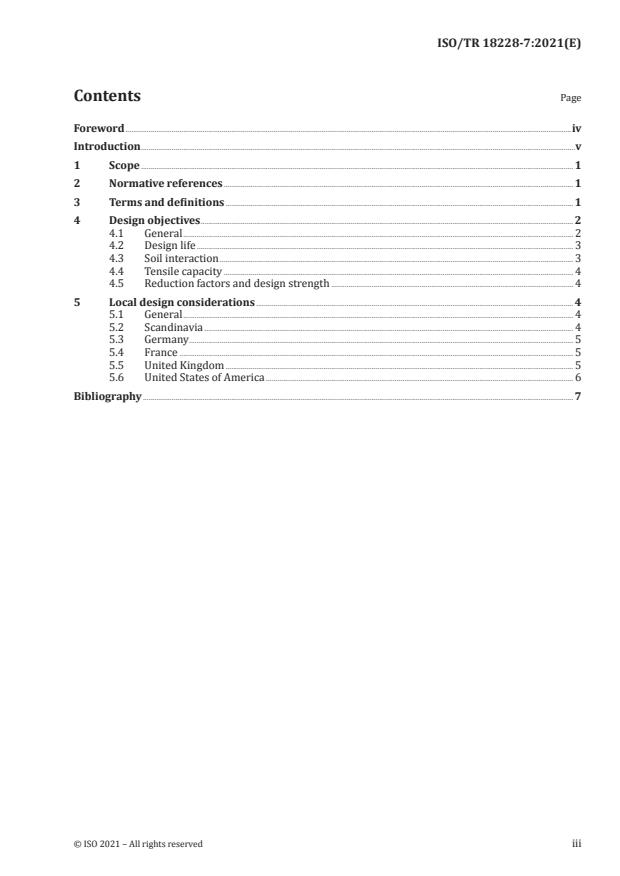
Contents Page
Foreword .iv
Introduction .v
1 Scope . 1
2 Normative references . 1
3 Terms and definitions . 1
4 Design objectives . 2
4.1 General . 2
4.2 Design life . 3
4.3 Soil interaction . 3
4.4 Tensile capacity . 4
4.5 Reduction factors and design strength . 4
5 Local design considerations . 4
5.1 General . 4
5.2 Scandinavia . 4
5.3 Germany . 5
5.4 France . 5
5.5 United Kingdom . 5
5.6 United States of America . 6
Bibliography . 7
Foreword
ISO (the International Organization for Standardization) is a worldwide federation of national standards
bodies (ISO member bodies). The work of preparing International Standards is normally carried out
through ISO technical committees. Each member body interested in a subject for which a technical
committee has been established has the right to be represented on that committee. International
organizations, governmental and non-governmental, in liaison with ISO, also take part in the work.
ISO collaborates closely with the International Electrotechnical Commission (IEC) on all matters of
electrotechnical standardization.
The procedures used to develop this document and those intended for its further maintenance are
described in the ISO/IEC Directives, Part 1. In particular, the different approval criteria needed for the
different types of ISO documents should be noted. This document was drafted in accordance with the
editorial rules of the ISO/IEC Directives, Part 2 (see www .iso .org/ directives).
Attention is drawn to the possibility that some of the elements of this document may be the subject of
patent rights. ISO shall not be held responsible for identifying any or all such patent rights. Details of
any patent rights identified during the development of the document will be in the Introduction and/or
on the ISO list of patent declarations received (see www .iso .org/ patents).
Any trade name used in this document is information given for the convenience of users and does not
constitute an endorsement.
For an explanation of the voluntary nature of standards, the meaning of ISO specific terms and
expressions related to conformity assessment, as well as information about ISO's adherence to the
World Trade Organization (WTO) principles in the Technical Barriers to Trade (TBT), see www .iso .org/
iso/ foreword .html.
This document was prepared by Technical Committee ISO/TC 221, Geosynthetics.
A list of all parts in the ISO/TR 18228 series can be found on the ISO website.
Any feedback or questions on this document should be directed to the user’s national standards body. A
complete listing of these bodies can be found at www .iso .org/ members .html.
iv © ISO 2021 – All rights reserved
Introduction
The ISO/TR 18228 series provides guidance for designs using geosynthetics for soils and below ground
structures in contact with natural soils, fills and asphalt. The series contains parts which cover designs
using geosynthetics, including guidance for characterization of the materials to be used and other
factors affecting the design and performance of the systems which are particular to each part, with
ISO/TR 18228-1 providing general guidance relevant to the subsequent parts of the series.
The series is generally written in a limit state format and guidelines are provided in terms of partial
material factors and load factors for various applications and design lives, where appropriate.
This document includes information relating to the reinforcement function. Reinforcement is based on
the application of a tensile element and the interaction between the tensile elements and the soil mass
to enhance the properties of fill soils either imported or in situ. Details of design methodology adopted
in a number of regions are provided.
TECHNICAL REPORT ISO/TR 18228-7:2021(E)
Design using geosynthetics —
Part 7:
Reinforcement
1 Scope
This document provides general considerations to support the design guidance to geotechnical and civil
engineers involved in the design of structures in which a geotextile is used as reinforcement. The key
potential failure mechanisms are described, and guidance is proposed to select engineering properties.
2 Normative references
The following documents are referred to in the text in such a way that some or all of their content
constitutes requirements of this document. For dated references, only the edition cited applies. For
undated references, the latest edition of the referenced document (including any amendments) applies.
ISO 10318-1, Geosynthetics — Part 1: Terms and definitions
3 Terms and definitions
For the purposes of this document, the terms and definitions given in ISO 10318-1 and the following
apply.
ISO and IEC maintain terminological databases for use in standardization at the following addresses:
— ISO Online browsing platform: available at https:// www .iso .org/ obp
— IEC Electropedia: available at http:// www .electropedia .org/
3.1
reinforced soil
material in which tensile elements act through interface friction, bearing or other means to improve
stability for in situ soil or other fills.
3.2
reinforced fill structure
soil structure which would be unstable without the inclusion of tensile reinforcement elements
EXAMPLE Reinforced soil walls, bridge abutments and steep slopes.
3.3
basal reinforcement
reinforcement element placed at the base of embankments or below foundations of buildings to provide
additional resistance to avoid foundation failure, control of settlements, to increase the amount of load
transfer onto rigid inclusions or spanning over voided zones.
3.4
veneer reinforcement
reinforcement of a relative thin layer of soil placed as surface layer on slopes, with the reinforcement
placed parallel to the slope.
4 Design objectives
4.1 General
This document contains a summary of several worldwide codes and their recommended applications
for geosynthetic reinforcement. The main objectives of the summary are to increase designer/
consultant user knowledge of geosynthetic reinforcements and to provide references for appropriate
code selection in each country.
“Soil Reinforcement” is a general term for tensile elements used with placed or in situ soil or other
material to act through interface friction and/or bearing to improve the characteristics of the
resulting soil mass. Soil reinforcements for this section are limited to uniaxial analysis considerations
for structures such as retaining walls, abutments, slopes and basal (foundation) reinforcements.
Other applications requiring multiaxial analysis are not considered in this section. The applications
considered the reinforcement elements are always in tension and soils are fills.
Reinforcement applications considered in this document include:
— Reinforced fill structures (as shown in Figures 1 and 2) to create:
— vertical, battered or inclined earth retaining walls,
— load bearing structures like bridge abutments,
— reinforced steep slopes.
a) Wall b) Abutment
Figure 1 — Walls and abutments
Figure 2 — Reinforced slopes
— Basal reinforcement for embankments (as shown in Figure 3) in various situations:
— embankments in soft soils,
— embankments on network of vertical inclusions of multiple nature,
— embankments overbridging voids.
2 © ISO 2021 – All rights reserved
a) Basal reinforcement b) Basal mattress
c) Piled embankments d) Reinforcement over areas prone to subsidence
Figu
...
Questions, Comments and Discussion
Ask us and Technical Secretary will try to provide an answer. You can facilitate discussion about the standard in here.
Loading comments...