

ISO 124:2014
(Main)Latex, rubber — Determination of total solids content
General Information
- Abstract
ISO 124:2014 specifies methods for the determination of the total solids content of natural rubber field and concentrated latices and synthetic rubber latex. These methods are not necessarily suitable for latex from natural sources other than the Hevea brasiliensis, for vulcanized latex, for compounded latex, or for artificial dispersions of rubber.
- Status
- Published
- Publication Date
- 11-Mar-2014
- Drafting Committee
- ISO/TC 45/SC 3/WG 2 - Latex
- Current Stage
- 9093 - International Standard confirmed
- Start Date
- 14-Jun-2024
- Completion Date
- 29-Aug-2026
Buy Documents

ISO 124:2014 - Latex, rubber -- Determination of total solids content

ISO 124:2014 - Latex, rubber — Determination of total solids content/12/2014

ISO 124:2014 - Latex de caoutchouc -- Détermination des matieres solides totales

ISO 124:2014 - Latex de caoutchouc — Détermination des matières solides totales/18/2014
Overview
ISO 124:2014 - "Latex, rubber - Determination of total solids content" defines standardized laboratory methods to measure the total solids content (TSC) of natural (Hevea brasiliensis) field and concentrated latices and of synthetic rubber latex. The standard specifies sampling references, apparatus, drying procedures (atmospheric and vacuum), calculation of TSC and reporting requirements. It excludes latex from non‑Hevea natural sources, vulcanized or compounded latex, and artificial dispersions.
Key topics and technical requirements
- Scope & exclusions: Applies to natural Hevea field and concentrated latices and synthetic rubber latex; not suitable for vulcanized/compounded latex or artificial dispersions.
- Sampling: Follow ISO 123 (Rubber latex - Sampling) for representative test portions.
- Apparatus: Lipless flat dishes (~60 mm), ovens (70 °C, 105 °C or 100–160 °C range), vacuum oven (125 °C, <20 kPa), analytical balance readable to 0.1 mg.
- Drying procedures:
- Atmospheric heating: 70 °C ±5 °C for 16 h or 105 °C ±5 °C for 2 h (repeat until constant mass). Heating at 70 °C is the preferred method in case of dispute.
- Elevated atmospheric temperatures for synthetic latex (by agreement): up to 130 °C (CR limit) or 160 °C for other synthetics with recommended short durations (e.g., 130 °C ~40 min; 160 °C ~20 min - see Annex A).
- Vacuum drying: 125 °C at pressure below 20 kPa for 45–60 min (synthetic latex), with controlled pressure reduction to prevent foaming.
- Mass stability criteria: Reweigh until difference between successive weighings is <0.5 mg.
- Calculation: TSC (%) = (m1 / m0) × 100, where m0 = mass before drying and m1 = mass after drying.
- Quality control: Perform duplicate determinations; duplicates must not differ by more than 0.2% mass fraction. Precision data and interlaboratory statistics are given in Annex B.
- Test report requirements: Must reference ISO 124:2014 and include drying method/temperature, sample ID, average result and units, unusual observations, and any optional or omitted operations.
Applications and who uses it
- Latex producers and processors use ISO 124:2014 for product specification, batch control and concentration checks.
- Quality control and materials testing laboratories apply the method to verify TSC for acceptance testing and process monitoring.
- Rubber product manufacturers and compounders use TSC data to adjust formulations and drying/curing processes.
- R&D and standards organizations rely on consistent TSC measurement for comparative studies and regulatory conformity.
Related standards
- ISO 123 - Rubber latex - Sampling (normative reference)
- ISO 3251 - Determination of residue after drying (related test)
- ISO/TR 9272 - Terminology and precision/statistical methods referenced in Annex B
Keywords: ISO 124:2014, total solids content, rubber latex testing, latex TSC, drying method, vacuum oven, natural rubber latex, synthetic latex, ISO 123.
Relations
- Effective Date
- 25-Aug-2026
- Effective Date
- 06-Jun-2022
- Effective Date
- 14-Apr-2012
Buy Documents
ISO 124:2014 - Latex, rubber -- Determination of total solids content
ISO 124:2014 - Latex, rubber — Determination of total solids content/12/2014
ISO 124:2014 - Latex de caoutchouc -- Détermination des matieres solides totales
ISO 124:2014 - Latex de caoutchouc — Détermination des matières solides totales/18/2014
Get Certified
Connect with accredited certification bodies for this standard

DIN CERTCO
DIN Group product certification.

Smithers Quality Assessments
US management systems and product certification.
Sponsored listings
Frequently Asked Questions
ISO 124:2014 is a standard published by the International Organization for Standardization (ISO). Its full title is "Latex, rubber — Determination of total solids content". This standard covers: ISO 124:2014 specifies methods for the determination of the total solids content of natural rubber field and concentrated latices and synthetic rubber latex. These methods are not necessarily suitable for latex from natural sources other than the Hevea brasiliensis, for vulcanized latex, for compounded latex, or for artificial dispersions of rubber.
ISO 124:2014 specifies methods for the determination of the total solids content of natural rubber field and concentrated latices and synthetic rubber latex. These methods are not necessarily suitable for latex from natural sources other than the Hevea brasiliensis, for vulcanized latex, for compounded latex, or for artificial dispersions of rubber.
ISO 124:2014 is classified under the following ICS (International Classification for Standards) categories: 83.040.10 - Latex and raw rubber. The ICS classification helps identify the subject area and facilitates finding related standards.
ISO 124:2014 has the following relationships with other standards: It is inter standard links to EN ISO 3251:2019, ISO 21301-2:2019, ISO 124:2011. Understanding these relationships helps ensure you are using the most current and applicable version of the standard.
ISO 124:2014 is available in PDF format for immediate download after purchase. The document can be added to your cart and obtained through the secure checkout process. Digital delivery ensures instant access to the complete standard document.
Standards Content (Sample)
INTERNATIONAL ISO
STANDARD 124
Seventh edition
2014-03-15
Latex, rubber — Determination of
total solids content
Latex de caoutchouc — Détermination des matières solides totales
Reference number
©
ISO 2014
© ISO 2014
All rights reserved. Unless otherwise specified, no part of this publication may be reproduced or utilized otherwise in any form
or by any means, electronic or mechanical, including photocopying, or posting on the internet or an intranet, without prior
written permission. Permission can be requested from either ISO at the address below or ISO’s member body in the country of
the requester.
ISO copyright office
Case postale 56 • CH-1211 Geneva 20
Tel. + 41 22 749 01 11
Fax + 41 22 749 09 47
E-mail copyright@iso.org
Web www.iso.org
Published in Switzerland
ii © ISO 2014 – All rights reserved
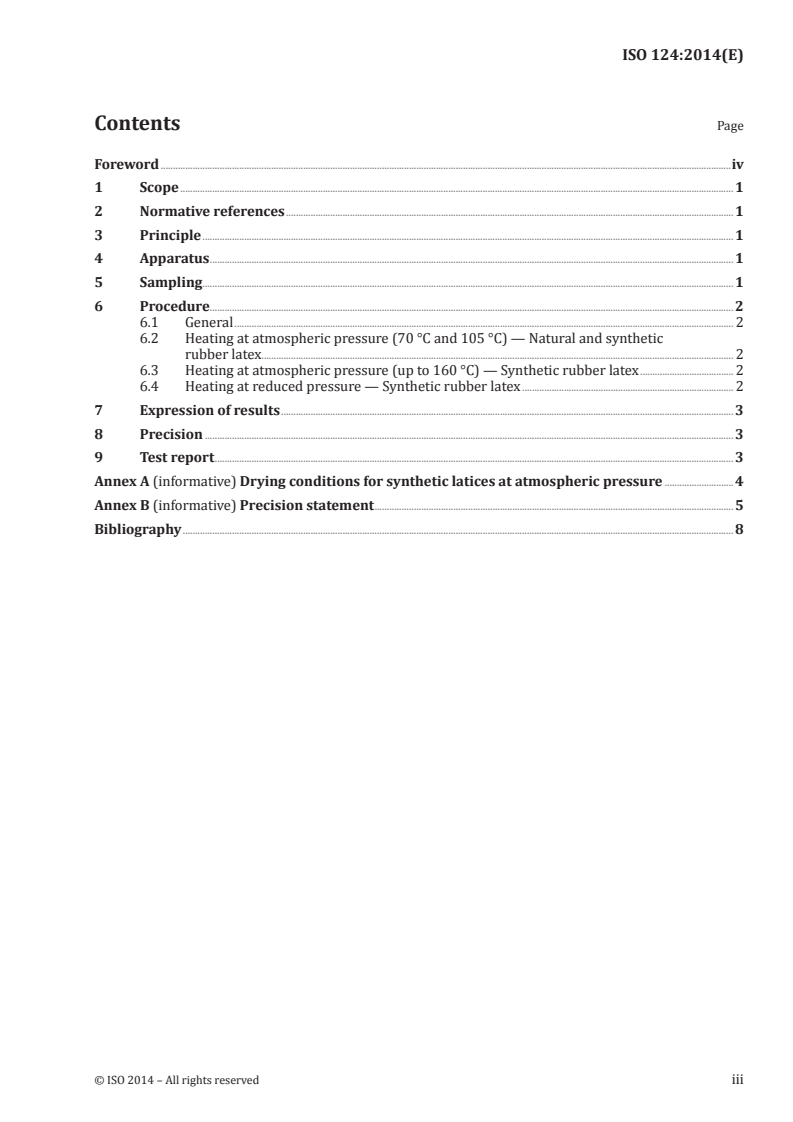
Contents Page
Foreword .iv
1 Scope . 1
2 Normative references . 1
3 Principle . 1
4 Apparatus . 1
5 Sampling . 1
6 Procedure. 2
6.1 General . 2
6.2 Heating at atmospheric pressure (70 °C and 105 °C) — Natural and synthetic
rubber latex. 2
6.3 Heating at atmospheric pressure (up to 160 °C) — Synthetic rubber latex . 2
6.4 Heating at reduced pressure — Synthetic rubber latex . 2
7 Expression of results . 3
8 Precision . 3
9 Test report . 3
Annex A (informative) Drying conditions for synthetic latices at atmospheric pressure .4
Annex B (informative) Precision statement . 5
Bibliography . 8
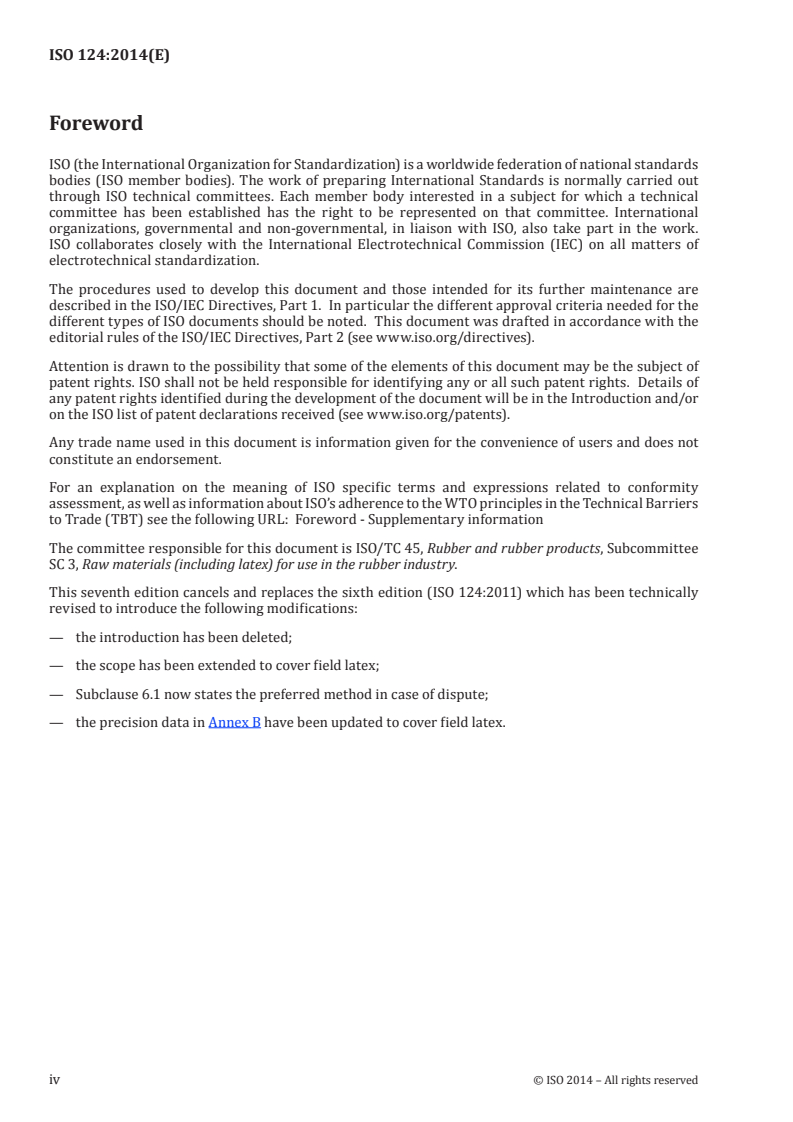
Foreword
ISO (the International Organization for Standardization) is a worldwide federation of national standards
bodies (ISO member bodies). The work of preparing International Standards is normally carried out
through ISO technical committees. Each member body interested in a subject for which a technical
committee has been established has the right to be represented on that committee. International
organizations, governmental and non-governmental, in liaison with ISO, also take part in the work.
ISO collaborates closely with the International Electrotechnical Commission (IEC) on all matters of
electrotechnical standardization.
The procedures used to develop this document and those intended for its further maintenance are
described in the ISO/IEC Directives, Part 1. In particular the different approval criteria needed for the
different types of ISO documents should be noted. This document was drafted in accordance with the
editorial rules of the ISO/IEC Directives, Part 2 (see www.iso.org/directives).
Attention is drawn to the possibility that some of the elements of this document may be the subject of
patent rights. ISO shall not be held responsible for identifying any or all such patent rights. Details of
any patent rights identified during the development of the document will be in the Introduction and/or
on the ISO list of patent declarations received (see www.iso.org/patents).
Any trade name used in this document is information given for the convenience of users and does not
constitute an endorsement.
For an explanation on the meaning of ISO specific terms and expressions related to conformity
assessment, as well as information about ISO’s adherence to the WTO principles in the Technical Barriers
to Trade (TBT) see the following URL: Foreword - Supplementary information
The committee responsible for this document is ISO/TC 45, Rubber and rubber products, Subcommittee
SC 3, Raw materials (including latex) for use in the rubber industry.
This seventh edition cancels and replaces the sixth edition (ISO 124:2011) which has been technically
revised to introduce the following modifications:
— the introduction has been deleted;
— the scope has been extended to cover field latex;
— Subclause 6.1 now states the preferred method in case of dispute;
— the precision data in Annex B have been updated to cover field latex.
iv © ISO 2014 – All rights reserved
INTERNATIONAL STANDARD ISO 124:2014(E)
Latex, rubber — Determination of total solids content
WARNING — Persons using this International Standard should be familiar with normal laboratory
practice. This International Standard does not purport to address all of the safety problems, if
any, associated with its use. It is the responsibility of the user to establish appropriate safety and
health practices and to ensure compliance with any national regulatory conditions.
1 Scope
This International Standard specifies methods for the determination of the total solids content of natural
rubber field and concentrated latices and synthetic rubber latex. These methods are not necessarily
suitable for latex from natural sources other than the Hevea brasiliensis, for vulcanized latex, for
compounded latex, or for artificial dispersions of rubber.
2 Normative references
The following documents, in whole or in part, are normatively referenced in this document and are
indispensable for its application. For dated references, only the edition cited applies. For undated
references, the latest edition of the referenced document (including any amendments) applies.
ISO 123, Rubber latex — Sampling
3 Principle
A test portion of the latex is dried to constant mass under specified conditions, either at atmospheric
pressure or under vacuum. The total solids content is determined by weighing before and after drying
to constant mass.
[1]
NOTE The determination of the residue after drying for a specific period of time is the subject of ISO 3251.
4 Apparatus
Usual laboratory equipment, and in particular, the following.
4.1 Flat-bottomed dishes, lipless, of diameter approximately 60 mm.
4.2 Ovens, capable of being maintained at 70 °C ± 5 °C, 105 °C ± 5 °C, or at another selected temperature
between 100 °C and 160 °C accurate to ±5 °C.
1)
4.3 Vacuum oven, capable of being maintained at 125 °C ± 2 °C and at a pressure below 20 kPa .
4.4 Analytical balance, capable of being read to 0,1 mg.
5 Sampling
Carry out sampling in accordance with one of the methods specified in ISO 123.
1) 1 kPa = 1 kN/m .
6 Procedure
6.1 General
For natural rubber latex, proceed in accordance with 6.2; and for synthetic rubber latex proceed in
accordance with 6.2, 6.3, or 6.4. Perform the determination in duplicate.
In case of dispute, heating the latex at 70 °C is the preferred method.
6.2 Heating at atmospheric pressure (70 °C and 105 °C) — Natural and synthetic rub-
ber latex
Weigh, to the nearest 0,1 mg, a dish (4.1). Pour into the dish 2,0 g ± 0,5 g of latex and determine the exact
mass (m ) by weighing to the nearest 0,1 mg. Gently swirl the contents of the dish to ensure that the
latex covers the bottom. If desired, approximately 1 cm of distilled water or water of equivalent purity
can be added and mixed with the latex by swirling.
Place the dish in the oven (4.2) so that it is horizontal, and heat it at 70 °C ± 5 °C for 16 h, or at 105 °C ± 5 °C
for 2 h, or until the test portion has lost its whiteness.
NOTE 1 The disappearance of whiteness is the first indication of dryness. Dry latex film is translucent.
Remove the dish from the oven and allow it to cool to ambient temperature in a desiccator. Remove the
dish and weigh.
Return the dish to the oven for 30 min at 70 °C ± 5 °C or 15 min at 105 °C ± 5 °C. Remove the dish and
allow it to cool to ambient temperature in a desiccator as before and reweigh.
Repeat the drying procedure for periods of 30 min or 15 min, as appropriate until the loss in mass
between two successive weightings is less than 0,5 mg.
Record the mass of the dried latex (m ).
If after heating at 105 °C ± 5 °C, the dried deposit becomes excessively sticky, repeat the determination
at 70 °C ± 5 °C.
NOTE 2 Stickiness is symptomatic of oxidation of some rubbers when exposed to air at too high a temperature.
6.3 Heating at atmospheric pressure (up to 160 °C) — Synthetic rubber latex
By agreement between the interested parties, the drying process can be carried out at temp
...
INTERNATIONAL ISO
STANDARD 124
Seventh edition
2014-03-15
Latex, rubber — Determination of
total solids content
Latex de caoutchouc — Détermination des matières solides totales
Reference number
©
ISO 2014
© ISO 2014
All rights reserved. Unless otherwise specified, no part of this publication may be reproduced or utilized otherwise in any form
or by any means, electronic or mechanical, including photocopying, or posting on the internet or an intranet, without prior
written permission. Permission can be requested from either ISO at the address below or ISO’s member body in the country of
the requester.
ISO copyright office
Case postale 56 • CH-1211 Geneva 20
Tel. + 41 22 749 01 11
Fax + 41 22 749 09 47
E-mail copyright@iso.org
Web www.iso.org
Published in Switzerland
ii © ISO 2014 – All rights reserved
Contents Page
Foreword .iv
1 Scope . 1
2 Normative references . 1
3 Principle . 1
4 Apparatus . 1
5 Sampling . 1
6 Procedure. 2
6.1 General . 2
6.2 Heating at atmospheric pressure (70 °C and 105 °C) — Natural and synthetic
rubber latex. 2
6.3 Heating at atmospheric pressure (up to 160 °C) — Synthetic rubber latex . 2
6.4 Heating at reduced pressure — Synthetic rubber latex . 2
7 Expression of results . 3
8 Precision . 3
9 Test report . 3
Annex A (informative) Drying conditions for synthetic latices at atmospheric pressure .4
Annex B (informative) Precision statement . 5
Bibliography . 8
Foreword
ISO (the International Organization for Standardization) is a worldwide federation of national standards
bodies (ISO member bodies). The work of preparing International Standards is normally carried out
through ISO technical committees. Each member body interested in a subject for which a technical
committee has been established has the right to be represented on that committee. International
organizations, governmental and non-governmental, in liaison with ISO, also take part in the work.
ISO collaborates closely with the International Electrotechnical Commission (IEC) on all matters of
electrotechnical standardization.
The procedures used to develop this document and those intended for its further maintenance are
described in the ISO/IEC Directives, Part 1. In particular the different approval criteria needed for the
different types of ISO documents should be noted. This document was drafted in accordance with the
editorial rules of the ISO/IEC Directives, Part 2 (see www.iso.org/directives).
Attention is drawn to the possibility that some of the elements of this document may be the subject of
patent rights. ISO shall not be held responsible for identifying any or all such patent rights. Details of
any patent rights identified during the development of the document will be in the Introduction and/or
on the ISO list of patent declarations received (see www.iso.org/patents).
Any trade name used in this document is information given for the convenience of users and does not
constitute an endorsement.
For an explanation on the meaning of ISO specific terms and expressions related to conformity
assessment, as well as information about ISO’s adherence to the WTO principles in the Technical Barriers
to Trade (TBT) see the following URL: Foreword - Supplementary information
The committee responsible for this document is ISO/TC 45, Rubber and rubber products, Subcommittee
SC 3, Raw materials (including latex) for use in the rubber industry.
This seventh edition cancels and replaces the sixth edition (ISO 124:2011) which has been technically
revised to introduce the following modifications:
— the introduction has been deleted;
— the scope has been extended to cover field latex;
— Subclause 6.1 now states the preferred method in case of dispute;
— the precision data in Annex B have been updated to cover field latex.
iv © ISO 2014 – All rights reserved
INTERNATIONAL STANDARD ISO 124:2014(E)
Latex, rubber — Determination of total solids content
WARNING — Persons using this International Standard should be familiar with normal laboratory
practice. This International Standard does not purport to address all of the safety problems, if
any, associated with its use. It is the responsibility of the user to establish appropriate safety and
health practices and to ensure compliance with any national regulatory conditions.
1 Scope
This International Standard specifies methods for the determination of the total solids content of natural
rubber field and concentrated latices and synthetic rubber latex. These methods are not necessarily
suitable for latex from natural sources other than the Hevea brasiliensis, for vulcanized latex, for
compounded latex, or for artificial dispersions of rubber.
2 Normative references
The following documents, in whole or in part, are normatively referenced in this document and are
indispensable for its application. For dated references, only the edition cited applies. For undated
references, the latest edition of the referenced document (including any amendments) applies.
ISO 123, Rubber latex — Sampling
3 Principle
A test portion of the latex is dried to constant mass under specified conditions, either at atmospheric
pressure or under vacuum. The total solids content is determined by weighing before and after drying
to constant mass.
[1]
NOTE The determination of the residue after drying for a specific period of time is the subject of ISO 3251.
4 Apparatus
Usual laboratory equipment, and in particular, the following.
4.1 Flat-bottomed dishes, lipless, of diameter approximately 60 mm.
4.2 Ovens, capable of being maintained at 70 °C ± 5 °C, 105 °C ± 5 °C, or at another selected temperature
between 100 °C and 160 °C accurate to ±5 °C.
1)
4.3 Vacuum oven, capable of being maintained at 125 °C ± 2 °C and at a pressure below 20 kPa .
4.4 Analytical balance, capable of being read to 0,1 mg.
5 Sampling
Carry out sampling in accordance with one of the methods specified in ISO 123.
1) 1 kPa = 1 kN/m .
6 Procedure
6.1 General
For natural rubber latex, proceed in accordance with 6.2; and for synthetic rubber latex proceed in
accordance with 6.2, 6.3, or 6.4. Perform the determination in duplicate.
In case of dispute, heating the latex at 70 °C is the preferred method.
6.2 Heating at atmospheric pressure (70 °C and 105 °C) — Natural and synthetic rub-
ber latex
Weigh, to the nearest 0,1 mg, a dish (4.1). Pour into the dish 2,0 g ± 0,5 g of latex and determine the exact
mass (m ) by weighing to the nearest 0,1 mg. Gently swirl the contents of the dish to ensure that the
latex covers the bottom. If desired, approximately 1 cm of distilled water or water of equivalent purity
can be added and mixed with the latex by swirling.
Place the dish in the oven (4.2) so that it is horizontal, and heat it at 70 °C ± 5 °C for 16 h, or at 105 °C ± 5 °C
for 2 h, or until the test portion has lost its whiteness.
NOTE 1 The disappearance of whiteness is the first indication of dryness. Dry latex film is translucent.
Remove the dish from the oven and allow it to cool to ambient temperature in a desiccator. Remove the
dish and weigh.
Return the dish to the oven for 30 min at 70 °C ± 5 °C or 15 min at 105 °C ± 5 °C. Remove the dish and
allow it to cool to ambient temperature in a desiccator as before and reweigh.
Repeat the drying procedure for periods of 30 min or 15 min, as appropriate until the loss in mass
between two successive weightings is less than 0,5 mg.
Record the mass of the dried latex (m ).
If after heating at 105 °C ± 5 °C, the dried deposit becomes excessively sticky, repeat the determination
at 70 °C ± 5 °C.
NOTE 2 Stickiness is symptomatic of oxidation of some rubbers when exposed to air at too high a temperature.
6.3 Heating at atmospheric pressure (up to 160 °C) — Synthetic rubber latex
By agreement between the interested parties, the drying process can be carried out at temp
...
NORME ISO
INTERNATIONALE 124
Septième édition
2014-03-15
Latex de caoutchouc — Détermination
des matières solides totales
Latex, rubber — Determination of total solids content
Numéro de référence
©
ISO 2014
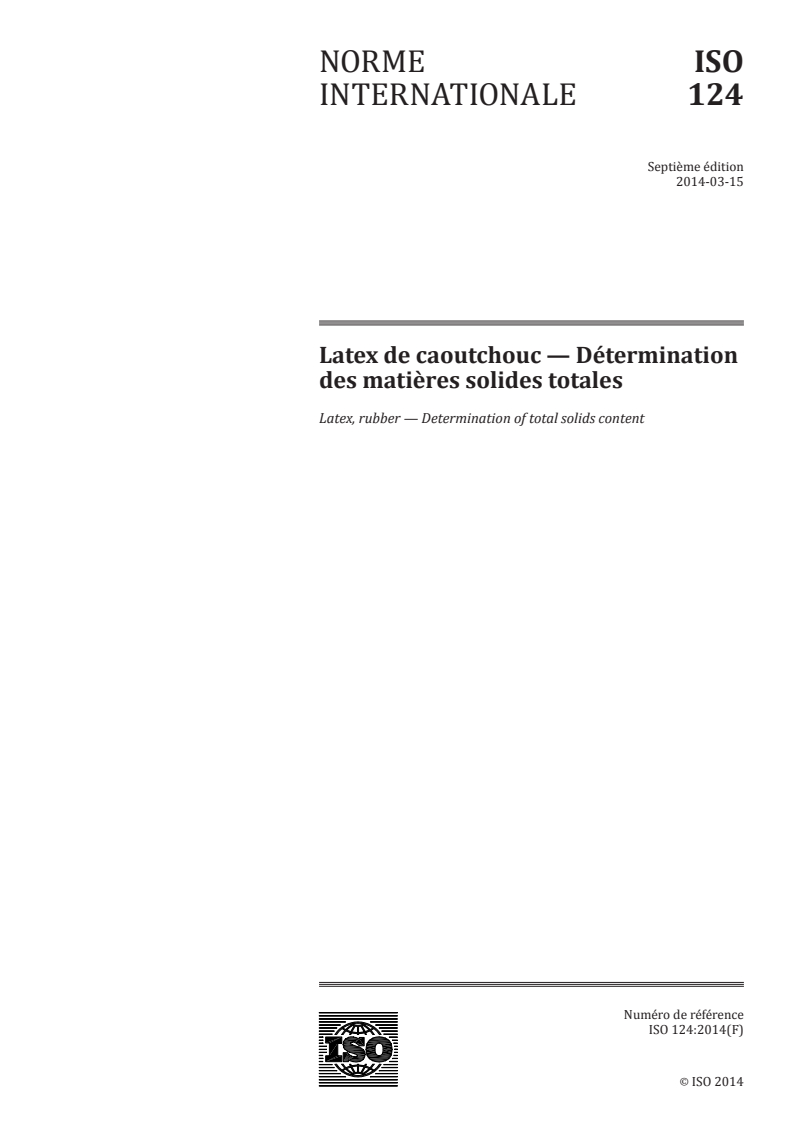
DOCUMENT PROTÉGÉ PAR COPYRIGHT
© ISO 2014
Droits de reproduction réservés. Sauf indication contraire, aucune partie de cette publication ne peut être reproduite ni utilisée
sous quelque forme que ce soit et par aucun procédé, électronique ou mécanique, y compris la photocopie, l’affichage sur
l’internet ou sur un Intranet, sans autorisation écrite préalable. Les demandes d’autorisation peuvent être adressées à l’ISO à
l’adresse ci-après ou au comité membre de l’ISO dans le pays du demandeur.
ISO copyright office
Case postale 56 • CH-1211 Geneva 20
Tel. + 41 22 749 01 11
Fax + 41 22 749 09 47
E-mail copyright@iso.org
Web www.iso.org
Publié en Suisse
ii © ISO 2014 – Tous droits réservés
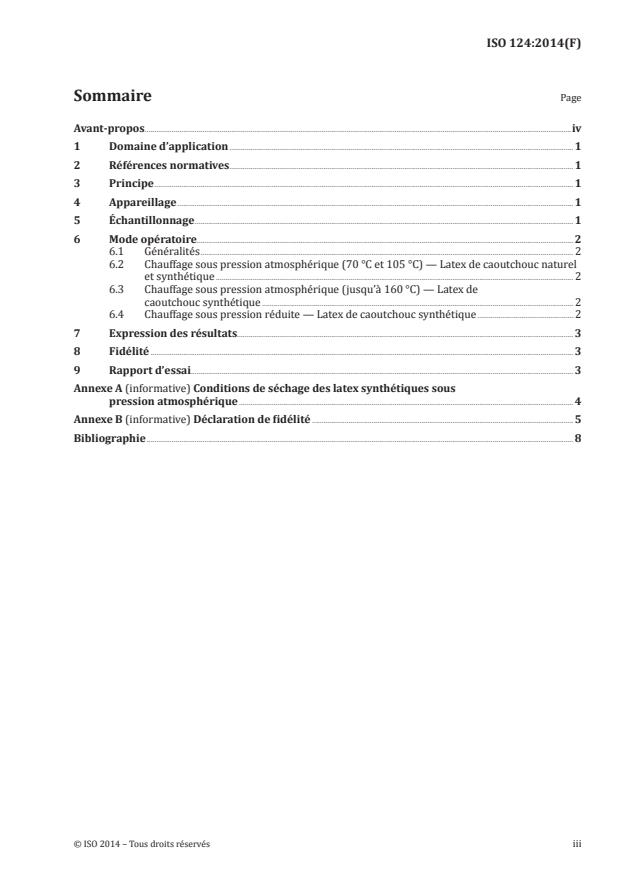
Sommaire Page
Avant-propos .iv
1 Domaine d’application . 1
2 Références normatives . 1
3 Principe . 1
4 Appareillage . 1
5 Échantillonnage . 1
6 Mode opératoire. 2
6.1 Généralités . 2
6.2 Chauffage sous pression atmosphérique (70 °C et 105 °C) — Latex de caoutchouc naturel
et synthétique . 2
6.3 Chauffage sous pression atmosphérique (jusqu’à 160 °C) — Latex de
caoutchouc synthétique . 2
6.4 Chauffage sous pression réduite — Latex de caoutchouc synthétique . 2
7 Expression des résultats. 3
8 Fidélité . 3
9 Rapport d’essai . 3
Annexe A (informative) Conditions de séchage des latex synthétiques sous
pression atmosphérique . 4
Annexe B (informative) Déclaration de fidélité . 5
Bibliographie . 8
Avant-propos
L’ISO (Organisation internationale de normalisation) est une fédération mondiale d’organismes
nationaux de normalisation (comités membres de l’ISO). L’élaboration des Normes internationales est
en général confiée aux comités techniques de l’ISO. Chaque comité membre intéressé par une étude
a le droit de faire partie du comité technique créé à cet effet. Les organisations internationales,
gouvernementales et non gouvernementales, en liaison avec l’ISO participent également aux travaux.
L’ISO collabore étroitement avec la Commission électrotechnique internationale (CEI) en ce qui concerne
la normalisation électrotechnique.
Les procédures utilisées pour élaborer le présent document et celles destinées à sa mise à jour sont
décrites dans les Directives ISO/CEI, Partie 1. Il convient, en particulier de prendre note des différents
critères d’approbation requis pour les différents types de documents ISO. Le présent document a été
rédigé conformément aux règles de rédaction données dans les Directives ISO/CEI, Partie 2 (voir www.
iso.org/directives).
L’attention est appelée sur le fait que certains des éléments du présent document peuvent faire l’objet de
droits de propriété intellectuelle ou de droits analogues. L’ISO ne saurait être tenue pour responsable
de ne pas avoir identifié de tels droits de propriété et averti de leur existence. Les détails concernant les
références aux droits de propriété intellectuelle ou autres droits analogues identifiés lors de l’élaboration
du document sont indiqués dans l’Introduction et/ou dans la liste des déclarations de brevets reçues par
l’ISO (voir www.iso.org/brevets).
Les appellations commerciales éventuellement mentionnées dans le présent document sont données
pour information, par souci de commodité, à l’intention des utilisateurs et ne sauraient constituer un
engagement.
Pour une explication de la signification des termes et expressions spécifiques de l’ISO liés à l’évaluation de
la conformité, ou pour toute information au sujet de l’adhésion de l’ISO aux principes de l’OMC concernant
les obstacles techniques au commerce (OTC), voir le lien suivant: Avant-propos — Informations
supplémentaires.
Le comité chargé de l’élaboration du présent document est ISO/TC 45, Élastomères et produits à base
d’élastomères, sous-comité SC 3, Matières premières (y compris le latex) à l’usage de l’industrie des
élastomères.
Cette septième édition annule et remplace la sixième édition (ISO 124:2011), qui a fait l’objet d’une
révision technique, afin d’introduire les modifications suivantes:
— l’introduction a été supprimée;
— le domaine d’application a été étendu pour couvrir le latex de plantation;
— le paragraphe 6.1 indique maintenant la méthode préférentielle en cas de litige;
— les données de fidélité en Annexe B ont été mises à jour pour inclure le latex de plantation.
iv © ISO 2014 – Tous droits réservés
NORME INTERNATIONALE ISO 124:2014(F)
Latex de caoutchouc — Détermination des matières solides
totales
AVERTISSEMENT — Il convient que les utilisateurs de la présente Norme internationale
connaissent bien les pratiques courantes de laboratoire. La présente Norme internationale n’a
pas pour but de traiter tous les problèmes de sécurité qui sont, le cas échéant, liés à son utilisation.
Il incombe à l’utilisateur d’établir des pratiques appropriées en matière d’hygiène et de sécurité,
et de s’assurer de la conformité à la réglementation nationale en vigueur.
1 Domaine d’application
La présente Norme internationale spécifie des méthodes pour la détermination des matières solides
totales dans le latex de plantation, le latex de concentré de caoutchouc naturel et le latex de caoutchouc
synthétique. Ces méthodes ne conviennent pas nécessairement au latex d’origine naturelle autre que
celui de l’Hevea brasiliensis, au latex vulcanisé, aux mélanges de latex, ou aux dispersions artificielles de
caoutchouc.
2 Références normatives
Les documents suivants, en tout ou partie, sont référencés de manière normative dans le présent
document et sont indispensables pour son application. Pour les références datées, seule l’édition citée
s’applique. Pour les références non datées, la dernière édition du document de référence s’applique (y
compris les éventuels amendements).
ISO 123, Latex de caoutchouc — Échantillonnage
3 Principe
Une prise d’essai de latex est séchée à masse constante dans des conditions spécifiées, sous pression
atmosphérique ou sous vide. Les matières solides totales sont déterminées par pesée avant et après
séchage à masse constante.
[1]
NOTE La détermination du résidu après séchage pendant une durée spécifique fait l’objet de l’ISO 3251 .
4 Appareillage
Matériel courant de laboratoire, et en particulier, ce qui suit.
4.1 Récipients à fond plat, sans rebord, d’environ 60 mm de diamètre.
4.2 Étuves, pouvant être maintenues à 70 °C ± 5 °C, 105 °C ± 5 °C ou à une autre température comprise
entre 100 °C et 160 °C avec une précision de ± 5 °C.
4.3 Étuve de séchage à vide, pouvant être maintenue à 125 °C ± 2 °C et à une pression inférieure à
1)
20 kPa .
4.4 Balance analytique, permettant une lecture à 0,1 mg près.
5 Échantillonnage
Effectuer l’échantillonnage conformément à l’une des méthodes spécifiées dans l’ISO 123.
1) 1 kPa = 1 kN/m .
6 Mode opératoire
6.1 Généralités
Pour le latex de caoutchouc naturel, procéder conformément à 6.2; et pour le latex de caoutchouc
synthétique, procéder conformément à 6.2, 6.3, ou 6.4. Effectuer la détermination en double.
En cas de litige, le chauffage du latex à 70 °C est la méthode préférentielle.
6.2 Chauffage sous pression atmosphérique (70 °C et 105 °C) — Latex de caoutchouc
naturel et synthétique
Peser, à 0,1 mg près, un récipient (4.1). Verser dans le récipient 2,0 g ± 0,5 g de latex et déterminer la
masse exacte (m ) par pesée à 0,1 mg près. Remuer doucement le contenu du récipient, afin que le latex
recouvre le fond. Si nécessaire, il est possible d’ajouter environ 1 cm d’eau distillée ou d’eau de pureté
équivalente, en brassant pour la mélanger avec le latex.
Placer le récipient dans l’étuve (4.2) de façon qu’il soit horizontal, et le chauffer à 70 °C ± 5 °C pendant
16 h, ou à 105 °C ± 5 °C pendant 2 h, ou jusqu’à ce que la prise d’essai perde sa blancheur.
NOTE 1 La disparition de la blancheur est la première indication de la sécheresse. Le film sec de latex est
translucide.
Retirer le récipient de l’étuve et le laisser refroidir à température ambiante dans un dessiccateur. Retirer
le récipient et peser.
Remettre le récipient dans l’étuve pendant 30 min à 70 °C ± 5 °C ou pendant 15 min à 105 °C ± 5 °C. Retirer
le récipient et le laisser refroidir à température ambiante dans un dessiccateur, comme précédemment,
et peser à nouveau.
Répéter le processus de séchage pour des périodes de 30 min ou 15 min, comme approprié, jusqu’à ce
que la perte de masse entre deux pesées successives soit inférieure à 0,5 mg.
Consigner la masse du latex séché (m ).
Si après chauffage à 105 °C ± 5 °C, le dépôt sec devient excessivement collant, répéter la détermination
à 70 °C ± 5 °C.
NOTE 2 Le caractère collant est symptomatique de l’oxydation de certains caoutchoucs une fois exposée à l’air
à une températur
...
NORME ISO
INTERNATIONALE 124
Septième édition
2014-03-15
Latex de caoutchouc — Détermination
des matières solides totales
Latex, rubber — Determination of total solids content
Numéro de référence
©
ISO 2014
DOCUMENT PROTÉGÉ PAR COPYRIGHT
© ISO 2014
Droits de reproduction réservés. Sauf indication contraire, aucune partie de cette publication ne peut être reproduite ni utilisée
sous quelque forme que ce soit et par aucun procédé, électronique ou mécanique, y compris la photocopie, l’affichage sur
l’internet ou sur un Intranet, sans autorisation écrite préalable. Les demandes d’autorisation peuvent être adressées à l’ISO à
l’adresse ci-après ou au comité membre de l’ISO dans le pays du demandeur.
ISO copyright office
Case postale 56 • CH-1211 Geneva 20
Tel. + 41 22 749 01 11
Fax + 41 22 749 09 47
E-mail copyright@iso.org
Web www.iso.org
Publié en Suisse
ii © ISO 2014 – Tous droits réservés
Sommaire Page
Avant-propos .iv
1 Domaine d’application . 1
2 Références normatives . 1
3 Principe . 1
4 Appareillage . 1
5 Échantillonnage . 1
6 Mode opératoire. 2
6.1 Généralités . 2
6.2 Chauffage sous pression atmosphérique (70 °C et 105 °C) — Latex de caoutchouc naturel
et synthétique . 2
6.3 Chauffage sous pression atmosphérique (jusqu’à 160 °C) — Latex de
caoutchouc synthétique . 2
6.4 Chauffage sous pression réduite — Latex de caoutchouc synthétique . 2
7 Expression des résultats. 3
8 Fidélité . 3
9 Rapport d’essai . 3
Annexe A (informative) Conditions de séchage des latex synthétiques sous
pression atmosphérique . 4
Annexe B (informative) Déclaration de fidélité . 5
Bibliographie . 8
Avant-propos
L’ISO (Organisation internationale de normalisation) est une fédération mondiale d’organismes
nationaux de normalisation (comités membres de l’ISO). L’élaboration des Normes internationales est
en général confiée aux comités techniques de l’ISO. Chaque comité membre intéressé par une étude
a le droit de faire partie du comité technique créé à cet effet. Les organisations internationales,
gouvernementales et non gouvernementales, en liaison avec l’ISO participent également aux travaux.
L’ISO collabore étroitement avec la Commission électrotechnique internationale (CEI) en ce qui concerne
la normalisation électrotechnique.
Les procédures utilisées pour élaborer le présent document et celles destinées à sa mise à jour sont
décrites dans les Directives ISO/CEI, Partie 1. Il convient, en particulier de prendre note des différents
critères d’approbation requis pour les différents types de documents ISO. Le présent document a été
rédigé conformément aux règles de rédaction données dans les Directives ISO/CEI, Partie 2 (voir www.
iso.org/directives).
L’attention est appelée sur le fait que certains des éléments du présent document peuvent faire l’objet de
droits de propriété intellectuelle ou de droits analogues. L’ISO ne saurait être tenue pour responsable
de ne pas avoir identifié de tels droits de propriété et averti de leur existence. Les détails concernant les
références aux droits de propriété intellectuelle ou autres droits analogues identifiés lors de l’élaboration
du document sont indiqués dans l’Introduction et/ou dans la liste des déclarations de brevets reçues par
l’ISO (voir www.iso.org/brevets).
Les appellations commerciales éventuellement mentionnées dans le présent document sont données
pour information, par souci de commodité, à l’intention des utilisateurs et ne sauraient constituer un
engagement.
Pour une explication de la signification des termes et expressions spécifiques de l’ISO liés à l’évaluation de
la conformité, ou pour toute information au sujet de l’adhésion de l’ISO aux principes de l’OMC concernant
les obstacles techniques au commerce (OTC), voir le lien suivant: Avant-propos — Informations
supplémentaires.
Le comité chargé de l’élaboration du présent document est ISO/TC 45, Élastomères et produits à base
d’élastomères, sous-comité SC 3, Matières premières (y compris le latex) à l’usage de l’industrie des
élastomères.
Cette septième édition annule et remplace la sixième édition (ISO 124:2011), qui a fait l’objet d’une
révision technique, afin d’introduire les modifications suivantes:
— l’introduction a été supprimée;
— le domaine d’application a été étendu pour couvrir le latex de plantation;
— le paragraphe 6.1 indique maintenant la méthode préférentielle en cas de litige;
— les données de fidélité en Annexe B ont été mises à jour pour inclure le latex de plantation.
iv © ISO 2014 – Tous droits réservés
NORME INTERNATIONALE ISO 124:2014(F)
Latex de caoutchouc — Détermination des matières solides
totales
AVERTISSEMENT — Il convient que les utilisateurs de la présente Norme internationale
connaissent bien les pratiques courantes de laboratoire. La présente Norme internationale n’a
pas pour but de traiter tous les problèmes de sécurité qui sont, le cas échéant, liés à son utilisation.
Il incombe à l’utilisateur d’établir des pratiques appropriées en matière d’hygiène et de sécurité,
et de s’assurer de la conformité à la réglementation nationale en vigueur.
1 Domaine d’application
La présente Norme internationale spécifie des méthodes pour la détermination des matières solides
totales dans le latex de plantation, le latex de concentré de caoutchouc naturel et le latex de caoutchouc
synthétique. Ces méthodes ne conviennent pas nécessairement au latex d’origine naturelle autre que
celui de l’Hevea brasiliensis, au latex vulcanisé, aux mélanges de latex, ou aux dispersions artificielles de
caoutchouc.
2 Références normatives
Les documents suivants, en tout ou partie, sont référencés de manière normative dans le présent
document et sont indispensables pour son application. Pour les références datées, seule l’édition citée
s’applique. Pour les références non datées, la dernière édition du document de référence s’applique (y
compris les éventuels amendements).
ISO 123, Latex de caoutchouc — Échantillonnage
3 Principe
Une prise d’essai de latex est séchée à masse constante dans des conditions spécifiées, sous pression
atmosphérique ou sous vide. Les matières solides totales sont déterminées par pesée avant et après
séchage à masse constante.
[1]
NOTE La détermination du résidu après séchage pendant une durée spécifique fait l’objet de l’ISO 3251 .
4 Appareillage
Matériel courant de laboratoire, et en particulier, ce qui suit.
4.1 Récipients à fond plat, sans rebord, d’environ 60 mm de diamètre.
4.2 Étuves, pouvant être maintenues à 70 °C ± 5 °C, 105 °C ± 5 °C ou à une autre température comprise
entre 100 °C et 160 °C avec une précision de ± 5 °C.
4.3 Étuve de séchage à vide, pouvant être maintenue à 125 °C ± 2 °C et à une pression inférieure à
1)
20 kPa .
4.4 Balance analytique, permettant une lecture à 0,1 mg près.
5 Échantillonnage
Effectuer l’échantillonnage conformément à l’une des méthodes spécifiées dans l’ISO 123.
1) 1 kPa = 1 kN/m .
6 Mode opératoire
6.1 Généralités
Pour le latex de caoutchouc naturel, procéder conformément à 6.2; et pour le latex de caoutchouc
synthétique, procéder conformément à 6.2, 6.3, ou 6.4. Effectuer la détermination en double.
En cas de litige, le chauffage du latex à 70 °C est la méthode préférentielle.
6.2 Chauffage sous pression atmosphérique (70 °C et 105 °C) — Latex de caoutchouc
naturel et synthétique
Peser, à 0,1 mg près, un récipient (4.1). Verser dans le récipient 2,0 g ± 0,5 g de latex et déterminer la
masse exacte (m ) par pesée à 0,1 mg près. Remuer doucement le contenu du récipient, afin que le latex
recouvre le fond. Si nécessaire, il est possible d’ajouter environ 1 cm d’eau distillée ou d’eau de pureté
équivalente, en brassant pour la mélanger avec le latex.
Placer le récipient dans l’étuve (4.2) de façon qu’il soit horizontal, et le chauffer à 70 °C ± 5 °C pendant
16 h, ou à 105 °C ± 5 °C pendant 2 h, ou jusqu’à ce que la prise d’essai perde sa blancheur.
NOTE 1 La disparition de la blancheur est la première indication de la sécheresse. Le film sec de latex est
translucide.
Retirer le récipient de l’étuve et le laisser refroidir à température ambiante dans un dessiccateur. Retirer
le récipient et peser.
Remettre le récipient dans l’étuve pendant 30 min à 70 °C ± 5 °C ou pendant 15 min à 105 °C ± 5 °C. Retirer
le récipient et le laisser refroidir à température ambiante dans un dessiccateur, comme précédemment,
et peser à nouveau.
Répéter le processus de séchage pour des périodes de 30 min ou 15 min, comme approprié, jusqu’à ce
que la perte de masse entre deux pesées successives soit inférieure à 0,5 mg.
Consigner la masse du latex séché (m ).
Si après chauffage à 105 °C ± 5 °C, le dépôt sec devient excessivement collant, répéter la détermination
à 70 °C ± 5 °C.
NOTE 2 Le caractère collant est symptomatique de l’oxydation de certains caoutchoucs une fois exposée à l’air
à une températur
...