

ISO 787-24:2026
(Main)General methods of test for pigments and extenders — Part 24: Photometric methods for determining the relative tinting strength of coloured pigments and the relative scattering power of white pigments
- Abstract
This document specifies photometric methods of test for comparing in the visible spectrum: the tinting strength of two similar coloured pigments dispersed in an alkyd resin without a drier; the scattering power of two white pigments of the same type dispersed in an alkyd resin without a drier. This document does not apply to the comparison of coloured pigments that on reduction differ greatly in colour.
- Status
- Published
- Publication Date
- 15-Oct-2026
- Technical Committee
- ISO/TC 256 - Pigments, dyestuffs and extenders
- Drafting Committee
- ISO/TC 256/WG 3 - General test methods for colorants and extenders
- Current Stage
- 6060 - International Standard published - 60 Publication
- Start Date
- 16-Oct-2026
- Due Date
- 16-Oct-2026
- Completion Date
- 16-Oct-2026
Buy Documents
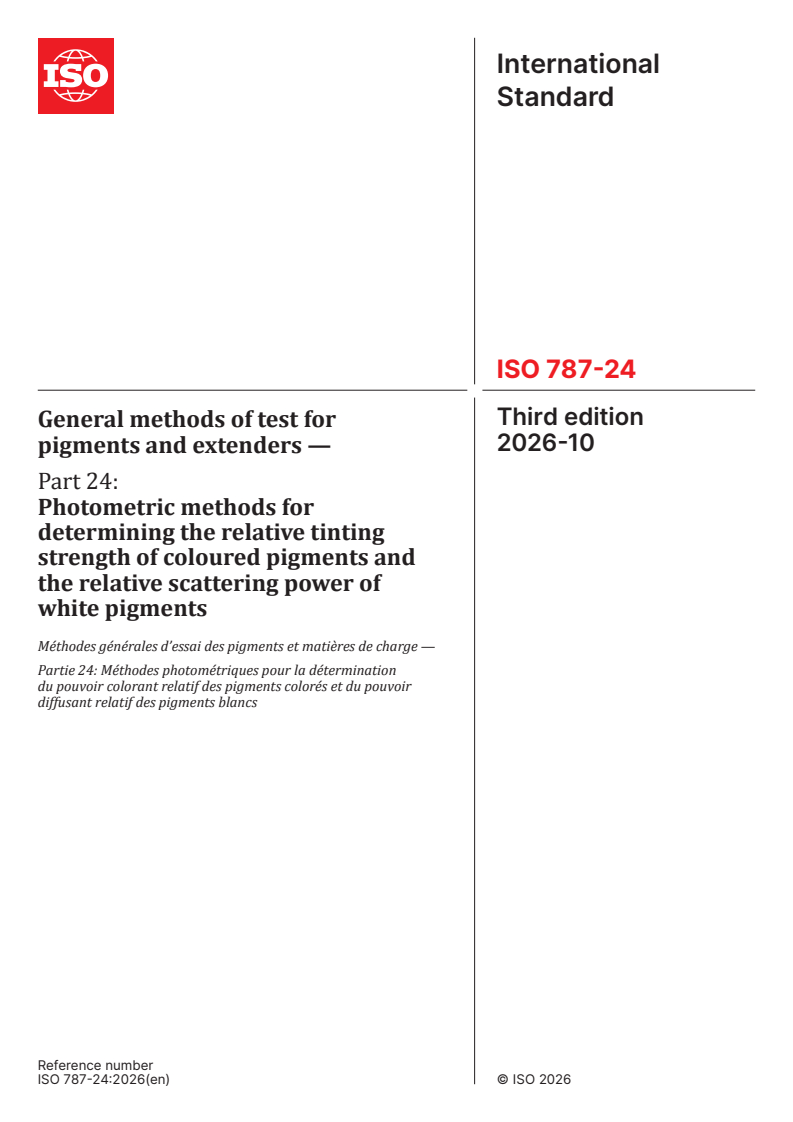

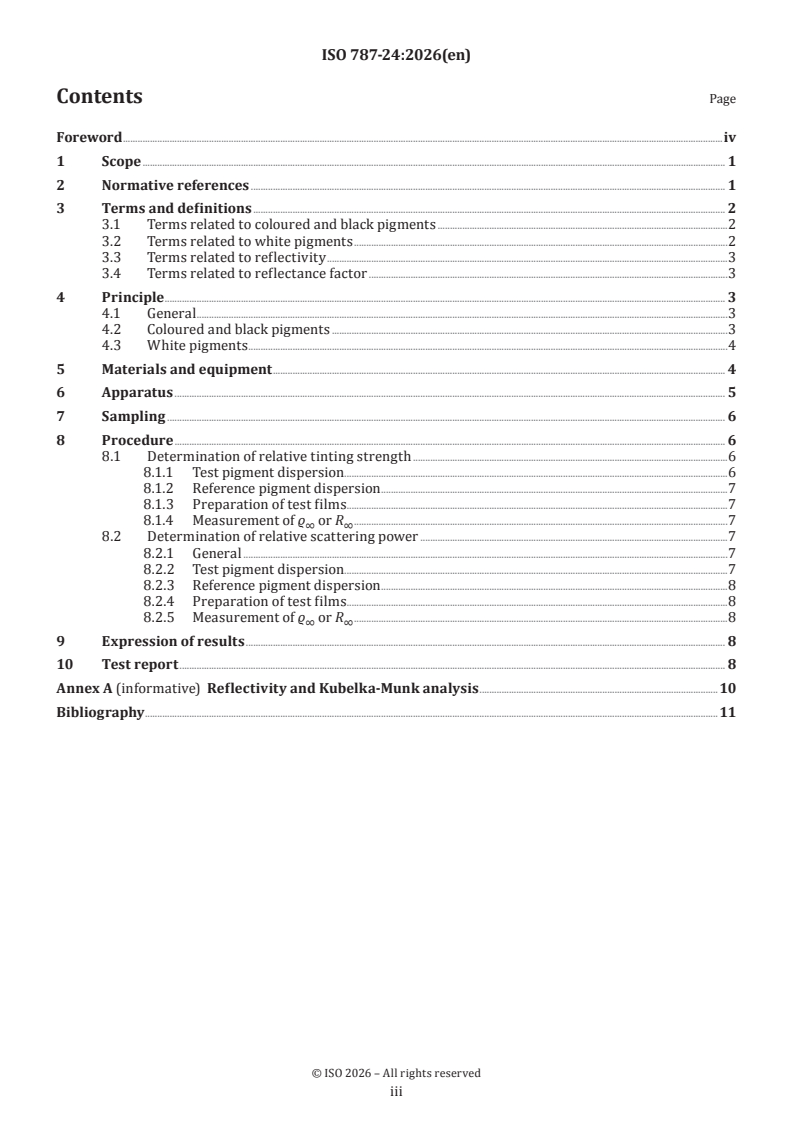
ISO 787-24:2026 - General methods of test for pigments and extenders — Part 24: Photometric methods for determining the relative tinting strength of coloured pigments and the relative scattering power of white pigments
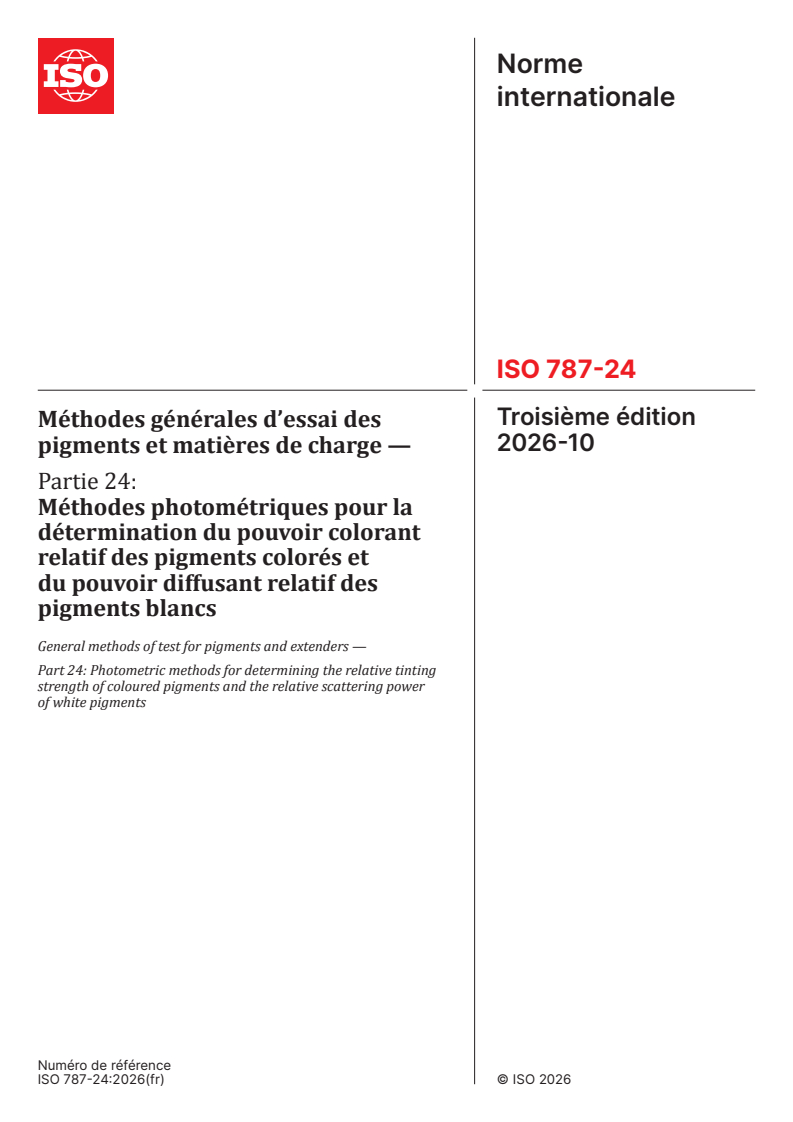
ISO 787-24:2026 - Méthodes générales d’essai des pigments et matières de charge — Partie 24: Méthodes photométriques pour la détermination du pouvoir colorant relatif des pigments colorés et du pouvoir diffusant relatif des pigments blancs
ISO 787-24:2026 is an ISO standard from the general methods of test for pigments and extenders series. It specifies photometric methods in the visible spectrum for comparing the relative tinting strength of similar coloured pigments and the relative scattering power of white pigments, using dispersions in alkyd resin without a drier. It is written for laboratory and quality-control work where instrumental comparison is needed instead of visual matching.
What does ISO 787-24:2026 specify?
ISO 787-24:2026 sets out how to compare coloured pigments, black pigments and white pigments by measuring reflected light from prepared paste films. The scope is limited to similar coloured pigments and to white pigments of the same type; it does not apply to coloured pigments that change greatly in colour on reduction.
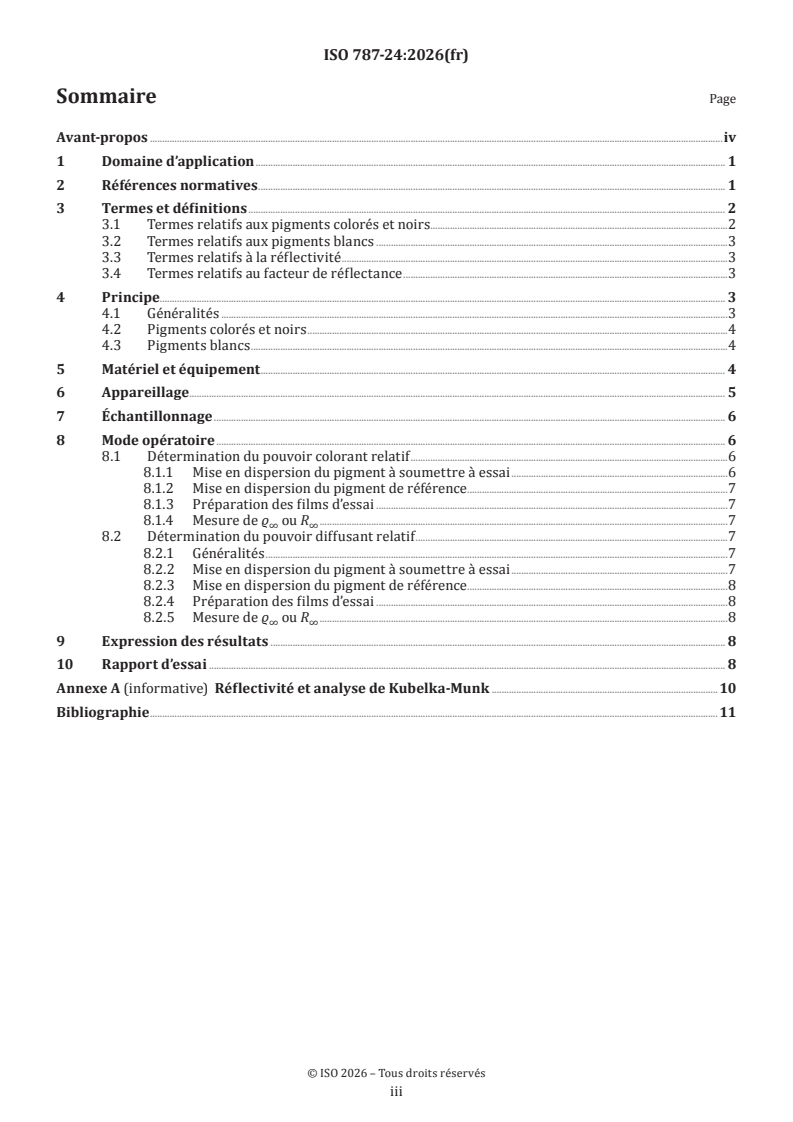
The document is organized into clauses for scope, normative references, terms and definitions, principle, materials and equipment, apparatus, sampling, procedure, expression of results and test report. Annex A is informative and explains reflectivity and Kubelka-Munk analysis.
What are the key requirements of ISO 787-24:2026?
ISO 787-24:2026 requires two separate preparation routes: one for relative tinting strength and one for relative scattering power. In both cases, the test and reference pigments are dispersed in specified binders, made into film specimens, and measured photometrically.
Key technical points
- Clause 4 says the methods are an instrumental alternative to the visual methods in ISO 787-16 and ISO 787-17. In practice, that means the result comes from measured reflectance rather than matched visual judgment.
- Clause 5 defines the paste systems used for the measurements. The white pigment paste uses titanium dioxide, alkyd resin and calcium stearate, while the black pigment paste uses lampblack carbon black, alkyd resin and fumed silica. The alkyd resin and pigment ingredients are checked against the tables in Clause 5, so the test starts from known, repeatable materials.
- Clause 6 sets the apparatus. A triple-roll mill and an automatic muller are used for dispersion, and the photometric measurement can be made with a spectrophotometer or a tristimulus colorimeter. This matters because the instrument choice affects which geometry and filters are used.
- Clause 6.2 gives limits for the automatic muller, including plate condition, speed and heating control. The paste film holders in Clause 6.3 must produce a uniform opaque film, because any unevenness will change the reading.
- Clause 7 requires a representative sample in accordance with ISO 15528. This is important because the method compares pigments, not just one convenient subsample.
- Clause 8.1 prepares coloured-pigment dispersions in white pigment paste and measures at the wavelength giving minimum reflectivity or reflectance factor. The result is relative tinting strength, and the chosen grinding force, mass or alternative dispersion method must be reported if they differ by agreement.
- Clause 8.2 prepares white-pigment dispersions in black pigment paste at a pigment volume concentration of 17 %. Measurements are made at 550 nm or with a Y-filter, unless the parties agree to use another wavelength or another tristimulus basis.
- Clause 9 requires Saunderson correction and Kubelka-Munk calculation before the final percentage result is reported. In practice, the measured optical response is converted into a comparable pigment property.
- Clause 10 requires the report to identify the product and agreed reference pigment, the measuring geometry, any deviations, any anomalies, the date, and the calculated result.
What terms does ISO 787-24:2026 define?
- Tinting strength - the ability of a colourant to colour other materials because of its absorptive power.
- Relative tinting strength - the tinting strength of the test colourant expressed as a percentage of a reference colourant.
- Scattering power - the ability of a pigmented medium to partly diffuse incident light.
- Relative scattering power - the scattering power of the test white pigment expressed as a percentage of a reference white pigment.
- Reflectivity (ϱ) - the reflectance of a paste or paint film thick enough that more thickness does not change the reflectance.
- Reflectance factor (R∞) - the ratio of reflected radiant flux from a thick paste or paint film to that from a perfect reflecting diffuser.
- Absorption index / scattering index - the spectral absorption or scattering coefficient of the pigmented binder divided by pigment concentration.
Who uses ISO 787-24:2026?
ISO 787-24:2026 is used by pigment manufacturers, coating laboratories, and quality-control teams that need a repeatable photometric comparison of pigments. It is also useful for buyers and technical specifiers in the pigments, paints, varnishes and related raw-materials supply chain when they need comparable test results for coloured or white pigments.
What changed in ISO 787-24:2026 from the previous edition?
ISO 787-24:2026 is the third edition and replaces ISO 787-24:1985. The foreword states these main changes: the introduction was deleted, the normative references were updated, the definitions in Clause 3 were revised and aligned where needed with ISO 18451-1, “absorbance index” was changed to “absorption index”, Subclause 4.1 was added, the relative tinting strength symbol was changed, the method was opened to other tinting-strength criteria with reference to ISO 18314-2, the blackness value requirement and related test method were updated, the carbon black and fumed silica requirements were revised, Clause 6.3 was expanded to allow non-contact measurement on a moving carrier, Clause 6.4 added more light-source options, Annex A was modified and subdivided, Annex B was deleted, and a bibliography was added.
Which standards are used with ISO 787-24:2026?
ISO 787-24:2026 relies on several other standards for test methods and material checks:
- ISO 15528 - representative sampling.
- ISO 18314-2 - Saunderson correction, Kubelka-Munk equation, and alternative tinting-strength criteria.
- ISO 18314-3 - blackness value test method for lampblack-type carbon black.
- ISO 2114, ISO 3219, ISO 4629 - alkyd resin acid value, viscosity and hydroxyl content.
- ISO 4652, ISO 6209, ISO 787-2, ISO 787-9, ISO 787-10, ISO 9277 - supporting test methods for carbon black, pH, volatile matter, density and BET surface area.
- ISO 591-1 - titanium dioxide pigment requirements for the white pigment paste.
- Related documents in the series and bibliography include ISO 787-16, ISO 787-17, ISO 1524, ISO 18451-1 and ISO 20427.
What does the ISO 787-24:2026 document contain?
ISO 787-24:2026 contains the photometric principle, the prepared white and black pigment paste systems, apparatus details, sampling guidance, test procedures, result calculations and reporting requirements. It also includes three material requirement tables in Clause 5, formulas for relative tinting strength and relative scattering power, and Annex A on reflectivity, the Kubelka-Munk equation and the Saunderson correction. These parts support routine laboratory comparison, method agreement between parties, and documented reporting of pigment performance.
Relations
- Effective Date
- 12-Feb-2026
- Effective Date
- 11-Nov-2023
- Effective Date
- 28-Oct-2023
Buy Documents
ISO 787-24:2026 - General methods of test for pigments and extenders — Part 24: Photometric methods for determining the relative tinting strength of coloured pigments and the relative scattering power of white pigments
ISO 787-24:2026 - Méthodes générales d’essai des pigments et matières de charge — Partie 24: Méthodes photométriques pour la détermination du pouvoir colorant relatif des pigments colorés et du pouvoir diffusant relatif des pigments blancs
Frequently Asked Questions
ISO 787-24:2026 is a standard published by the International Organization for Standardization (ISO). Its full title is "General methods of test for pigments and extenders — Part 24: Photometric methods for determining the relative tinting strength of coloured pigments and the relative scattering power of white pigments". This standard covers: This document specifies photometric methods of test for comparing in the visible spectrum: the tinting strength of two similar coloured pigments dispersed in an alkyd resin without a drier; the scattering power of two white pigments of the same type dispersed in an alkyd resin without a drier. This document does not apply to the comparison of coloured pigments that on reduction differ greatly in colour.
This document specifies photometric methods of test for comparing in the visible spectrum: the tinting strength of two similar coloured pigments dispersed in an alkyd resin without a drier; the scattering power of two white pigments of the same type dispersed in an alkyd resin without a drier. This document does not apply to the comparison of coloured pigments that on reduction differ greatly in colour.
ISO 787-24:2026 is classified under the following ICS (International Classification for Standards) categories: 87.060.10 - Pigments and extenders. The ICS classification helps identify the subject area and facilitates finding related standards.
ISO 787-24:2026 has the following relationships with other standards: It is inter standard links to EN ISO 787-24:2026, ISO/IEC 19075-7:2021, ISO 787-24:1985. Understanding these relationships helps ensure you are using the most current and applicable version of the standard.
ISO 787-24:2026 is available in PDF format for immediate download after purchase. The document can be added to your cart and obtained through the secure checkout process. Digital delivery ensures instant access to the complete standard document.
Standards Content (Sample)
Contents
- 1 Scope
- 2 Normative references
- 3 Terms and definitions
- 3.1 Terms related to coloured and black pigments
- 3.1.1 tinting strength
- 3.1.2 spectral absorption coefficient
- 3.1.3 absorption index
- 3.1.4 relative tinting strength
- 3.2 Terms related to white pigments
- 3.2.1 scattering power
- 3.2.2 spectral scattering coefficient
- 3.2.3 scattering index
- 3.2.4 relative scattering power
- 3.3 Terms related to reflectivity
- 3.3.1 reflectivity
- 3.4 Terms related to reflectance factor
- 3.4.1 reflectance factor
- 4 Principle
- 4.1 General
- 4.2 Coloured and black pigments
- 4.3 White pigments
- 5 Materials and equipment
- 6 Apparatus
- 7 Sampling
- 8 Procedure
- 8.1 Determination of relative tinting strength
- 8.2 Determination of relative scattering power
- 9 Expression of results
- 10 Test report
- Annex A
- Bibliography
1 Scope
This document specifies photometric methods of test for comparing in the visible spectrum:
a) the tinting strength of two similar coloured pigments dispersed in an alkyd resin without a drier; b) the scattering power of two white pigments of the same type dispersed in an alkyd resin without a drier.
This document does not apply to the comparison of coloured pigments that on reduction differ greatly in colour.
2 Normative references
The following documents are referred to in the text in such a way that some or all of their content constitutes requirements of this document. For dated references, only the edition cited applies. For undated references, the latest edition of the referenced document (including any amendments) applies. ISO 591-1, Titanium dioxide pigments for paints — Part 1: Specifications and methods of test ISO 787-2, General methods of test for pigments and extenders — Part 2: Determination of matter volatile at 105 °C ISO 787-9, General methods of test for pigments and extenders — Part 9: Determination of pH value of an aqueous suspension ISO 787-10, General methods of test for pigments and extenders — Part 10: Determination of density — Pyknometer method ISO 3219 (all parts), Rheology ISO 2114, Plastics (polyester resins) and paints and varnishes (binders) — Determination of partial acid value and total acid value ISO 4629 (all parts), Binders for paints and varnishes — Determination of hydroxyl value ISO 4652, Rubber compounding ingredients — Carbon black — Determination of specific surface area by nitrogen adsorption methods — Single-point procedures ISO 6209, Rubber compounding ingredients — Carbon black — Determination of solvent-extractable material ISO 9277, Determination of the specific surface area of solids by gas adsorption — BET method ISO 15528, Paints, varnishes and raw materials for paints and varnishes — Sampling
ISO 787-24:2026(en) ISO 18314-2, Analytical colorimetry — Part 2: Saunderson correction, solutions of the Kubelka-Munk equation, tinting strength, depth of shade and hiding power ISO 18314-3, Analytical colorimetry — Part 3: Special indices
3 Terms and definitions
For the purposes of this document, the following terms and definitions apply. ISO and IEC maintain terminology databases for use in standardization at the following addresses:
- ISO Online browsing platform: available at https:// www .iso .org/ obp
- IEC Electropedia: available at https:// www .electropedia .org/
3.1 Terms related to coloured and black pigments
3.1.1 tinting strength
colour strength measure of the ability of a colourant to colour other materials because of its absorptive power [SOURCE: ISO 18451-1:2019, 3.122]
3.1.2 spectral absorption coefficient
K(λ) fraction of the diffusely incident spectral radiant flux of wavelength λ that is absorbed in an elementary layer within a material, divided by the thickness of the layer (Kubelka-Munk analysis) Note 1 to entry: K(λ) is a measure of the tinting strength (3.1.1) of coloured pigments in a material.
3.1.3 absorption index
K (λ) p spectral absorption coefficient (3.1.2) of the pigmented binder divided by the pigment concentration C :
m K
K
p C m where C is the pigment concentration, for example, expressed as the ratio by mass of pigment to binder m
3.1.4 relative tinting strength
relative colour strength C rel percentage ratio of the tinting strength (3.1.1) of the colourant under test related to the tinting strength (3.1.1) of a reference colourant [SOURCE: ISO 18451-1:2019, 3.105, modified — the symbol C has been added.] rel
3.2 Terms related to white pigments
3.2.1 scattering power
ability of a pigmented material to partly diffuse the incident light
ISO 787-24:2026(en)
3.2.2 spectral scattering coefficient
S(λ) net transfer of spectral radiant flux of wavelength λ in the outward direction from an elementary layer within a body of material illuminated from outside, divided by the product of the thickness of the layer and the difference between the magnitude of the flux in the two directions through the layer (Kubelka-Munk analysis) Note 1 to entry: S(λ) is a measure of the scattering power (3.2.1) of white pigments in a material and is expressed in units of reciprocal film thickness.
3.2.3 scattering index
S (λ) p spectral scattering coefficient (3.2.2) of the pigmented binder divided by the pigment concentration C :
m S
S
p C m
3.2.4 relative scattering power
percentage ratio of the scattering power of the white pigment under test to the scattering power of a reference white pigment [SOURCE: ISO 18451-1:2019, 3.104, modified — in the definition “scattering index” has been replaced twice by “scattering power”.]
3.3 Terms related to reflectivity
3.3.1 reflectivity
ϱ
reflectance of a paste or a paint film whose thickness is such that any further increase in thickness gives no further change in reflectance Note 1 to entry: For Kubelka-Munk analysis, see ISO 18314-2 and Annex A.
3.4 Terms related to reflectance factor
3.4.1 reflectance factor
R
ratio of the radiant flux reflected in the directions within a given cone by a paste or a paint film to that reflected in the same directions by a perfect reflecting diffuser identically irradiated, when the thickness of the paste or the paint film is such that any further increase in thickness gives no further change in the ratio
4 Principle
4.1 General
The methods of test specified in this document provide an instrumental alternative to those specified in ISO 787-16 and ISO 787-17 respectively, avoiding the necessity of visual matching.
4.2 Coloured and black pigments
Equal masses of a coloured test pigment p1 and of an agreed reference pigment p2 are separately dispersed in the same mass of the same white pigment paste. The reflectivity, ϱ , or the reflectance factor, R , of each
ISO 787-24:2026(en) dispersion is measured photometrically at a wavelength giving a minimum value of ϱ or R . From the
corresponding values of K/S, the relative tinting strength, C , of the test pigment is given by Formula (1):
rel KS/ K
p1 p1 C 100 100 (1) rel K KS/
p2 p2 where K is the absorption index of the coloured test pigment p1; p1 K is the absorption index of the agreed reference pigment p2; p2 K /S is the K/S value corresponding to ϱ or R of the coloured test pigment p1; p1 ∞ ∞ K /S is the K/S value corresponding to ϱ or R of the agreed reference pigment p2. p2 ∞ ∞ A different tinting strength criterion, i.e. one that is not dependent on the minimal value of ϱ or R may be
used by agreement between the interested parties but shall be stated in the test report (for examples, see ISO 18314-2).
NOTE For some of the equalizing tinting strength criteria defined in ISO 18314-2, the mass of the test pigment is varied and is not required to be equal to that of the reference pigment.
4.3 White pigments
Equal masses of a white test pigment p3 and of an agreed reference pigment p4 are separately dispersed in the same mass of the same black pigment paste. The reflectivity, ϱ , or the reflectance factor, R , of each
dispersion is measured photometrically at 550 nm or using a Y-filter. From the corresponding values of K/S, the relative scattering power, S , of the test pigment, is given by Formula (2):
r KS/ S
p4 p3 S 100 100 (2) r S KS/
p4 p3 where S is the scattering index of the white test pigment p3; p3 S is the scattering index of the agreed reference pigment p4; p4 K/S is the K/S value corresponding to ϱ or R of the white test pigment p3; p3 ∞ ∞ K/S is the K/S value corresponding to ϱ or R of the agreed reference pigment p4. p4 ∞ ∞ For certain purposes, it is recommended to compare the scattering power of white pigments at other wavelengths; by agreement between the interested parties, the tristimulus values X or Z or the spectral reflectance or the reflectance factor at an agreed wavelength may be measured and used for the calculation of the relative scattering power.
...
Contents
- 1 Domaine d’application
- 2 Références normatives
- 3 Termes et définitions
- 3.1 Termes relatifs aux pigments colorés et noirs
- 3.1.1 pouvoir colorant
- 3.1.2 coefficient d'absorption spectrale
- 3.1.3 indice d'absorption
- 3.1.4 pouvoir colorant relatif
- 3.2 Termes relatifs aux pigments blancs
- 3.2.1 pouvoir diffusant
- 3.2.2 coefficient de diffusion spectrale
- 3.2.3 indice de diffusion
- 3.2.4 pouvoir diffusant relatif
- 3.3 Termes relatifs à la réflectivité
- 3.3.1 réflectivité
- 3.4 Termes relatifs au facteur de réflectance
- 3.4.1 facteur de réflectance
- 4 Principe
- 4.1 Généralités
- 4.2 Pigments colorés et noirs
- 4.3 Pigments blancs
- 5 Matériel et équipement
- 6 Appareillage
- 7 Échantillonnage
- 8 Mode opératoire
- 8.1 Détermination du pouvoir colorant relatif
- 8.2 Détermination du pouvoir diffusant relatif
- 9 Expression des résultats
- 10 Rapport d’essai
- Annexe A
- Bibliographie
1 Domaine d’application
Le présent document spécifie des méthodes d’essai photométriques pour la comparaison dans le spectre visible.
a) le pouvoir colorant de deux pigments colorés similaires dispersés dans une résine alkyde sans siccatif; b) le pouvoir diffusant de deux pigments blancs du même type dispersés dans une résine alkyde sans siccatif.
Le présent document ne s'applique pas à la comparaison de pigments colorés dont la couleur varie considérablement en fonction de la réduction.
2 Références normatives
Les documents suivants sont cités dans le texte de sorte qu’ils constituent, pour tout ou partie de leur contenu, des exigences du présent document. Pour les références datées, seule l’édition citée s’applique. Pour les références non datées, la dernière édition du document de référence s'applique (y compris les éventuels amendements).
ISO 591-1, Pigments de dioxyde de titane pour peintures — Partie 1: Spécifications et méthodes d'essai ISO 787-2, Méthodes générales d'essai des pigments et matières de charge — Partie 2: Détermination de la teneur en matière volatile à 105 °C ISO 787-9, Méthodes générales d’essai des pigments et matières de charge — Partie 9: Détermination du pH d’une suspension aqueuse ISO 787-10, Méthodes générales d'essai des pigments et matières de charge — Partie 10: Détermination de la masse volumique — Méthode utilisant un pycnomètre ISO 3219 (toutes les parties), Rhéologie ISO 2114, Plastiques (résines de polyesters) et peintures et vernis (liants) — Détermination de l'indice d'acide partiel et de l'indice d'acide total ISO 4629 (toutes les parties), Liants pour peintures et vernis — Détermination de l’indice d’hydroxyle ISO 4652, Ingrédients de mélange du caoutchouc — Noir de carbone — Détermination de la surface spécifique par méthodes par adsorption d'azote — Modes opératoires à un point de mesure ISO 6209, Ingrédients de mélange du caoutchouc — Noir de carbone — Détermination des matières extractibles par les solvants
ISO 787-24:2026(fr) ISO 9277, Détermination de l'aire massique (surface spécifique) des solides par adsorption de gaz — Méthode BET ISO 15528, Peintures, vernis et matières premières pour peintures et vernis — Échantillonnage ISO 18314-2, Analyse colorimétrique — Partie 2: Correction de Saunderson, solutions de l'équation de Kubelka- Munk, pouvoir colorant, profondeur de teinte et pouvoir masquant ISO 18314-3, Analyse colorimétrique — Partie 3: Indices spéciaux
3 Termes et définitions
Pour les besoins du présent document, les termes et définitions suivants s’appliquent. L’ISO et l’IEC tiennent à jour des bases de données terminologiques destinées à être utilisées en normalisation, consultables aux adresses suivantes:
- ISO Online browsing platform: disponible à l’adresse https:// www .iso .org/ obp
- IEC Electropedia: disponible à l’adresse https:// www .electropedia .org/
3.1 Termes relatifs aux pigments colorés et noirs
3.1.1 pouvoir colorant
intensité de la couleur mesure de l’aptitude d’une matière colorante à colorer d’autres matériaux en raison de son pouvoir absorbant [SOURCE: ISO 18451-1:2019, 3.122]
3.1.2 coefficient d'absorption spectrale
K(λ) fraction du flux d'un rayonnement incident diffus, de longueur d'onde λ, qui est absorbée par une couche élémentaire à l'intérieur d'un matériau, divisée par l'épaisseur de la couche (analyse de Kubelka-Munk) Note 1 à l'article: K(λ) est une mesure du pouvoir colorant (3.1.1) des pigments colorés dans un matériau.
3.1.3 indice d'absorption
K (λ) p coefficient d'absorption spectrale (3.1.2) du liant pigmenté divisé par la concentration pigmentaire C :
m K
K
p C m où C est la concentration du pigment exprimée, par exemple, comme le rapport en masses du pigment au m liant
3.1.4 pouvoir colorant relatif
intensité relative de la couleur C rel rapport, exprimé en pourcentage, entre le pouvoir colorant (3.1.1) de la matière colorante en essai et le pouvoir colorant (3.1.1) d'une matière colorante de référence [SOURCE: ISO 18451-1:2019, 3.105, modifié — le symbole C a été ajouté.] rel
ISO 787-24:2026(fr)
3.2 Termes relatifs aux pigments blancs
3.2.1 pouvoir diffusant
aptitude d'un matériau pigmenté à diffuser partiellement la lumière incidente
3.2.2 coefficient de diffusion spectrale
S(λ) fraction du flux de rayonnement spectral, de longueur d’onde λ, renvoyée à l’extérieur par une couche élémentaire située à l’intérieur d’un matériau illuminé de l’extérieur, divisée par le produit de l’épaisseur de la couche par la différence de grandeur du flux dans les deux directions au travers de la couche (analyse de Kubelka-Munk) Note 1 à l'article: S(λ) est une mesure du pouvoir diffusant (3.2.1) des colorants blancs incorporés dans un matériau et s’exprime comme l’inverse de l’épaisseur du film.
3.2.3 indice de diffusion
S (λ) p coefficient de diffusion spectrale (3.2.2) du liant pigmenté divisé par la concentration pigmentaire C :
m S
S
p C m
3.2.4 pouvoir diffusant relatif
rapport, exprimé en pourcentage, entre le pouvoir diffusant du pigment blanc en essai et le pouvoir diffusant d'un pigment blanc de référence [SOURCE: ISO 18451-1:2019, 3.104, modifié — dans la définition, “indice de diffusion” a été remplacé deux fois par “pouvoir diffusant”.]
3.3 Termes relatifs à la réflectivité
3.3.1 réflectivité
ϱ
facteur de réflexion d’une pâte ou d’un feuil dont l'épaisseur est telle qu’une augmentation de l’épaisseur ne modifie pas le facteur de réflexion Note 1 à l'article: Pour l’analyse de Kubelka-Munk, voir l’ISO 18314-2 et l’Annexe A.
3.4 Termes relatifs au facteur de réflectance
3.4.1 facteur de réflectance
R
rapport du flux réfléchi dans un angle solide donné par une pâte ou un film de peinture au flux réfléchi dans le même angle solide par un diffuseur parfait illuminé dans les mêmes conditions, lorsque l’augmentation de l’épaisseur de la pâte ou du film de peinture est sans effet sur ledit rapport
4 Principe
4.1 Généralités
Les méthodes d’essai spécifiées dans le présent document constituent une alternative instrumentale à celles spécifiées dans l’ISO 787-16 et l’ISO 787-17 respectivement, en évitant la nécessité d’une adaptation visuelle.
ISO 787-24:2026(fr)
4.2 Pigments colorés et noirs
Des masses égales du pigment coloré soumis à essai p1 et d’un pigment de référence convenu p2 sont dispersées séparément dans une même masse d’une même pâte de pigment blanc. La réflectivité ϱ ou le
facteur de réflectance R , de chaque dispersion est mesuré(e) photométriquement à une longueur d’onde
correspondant à la valeur minimale de ϱ ou R . À partir des valeurs correspondantes de K/S, le pouvoir
colorant relatif K , du pigment soumis à essai est donné par la Formule (1):
r KS/ K
p1 p1 c 100 100 (1) rel K KS/
p2 p2 où K est l'indice d'absorption du pigment coloré soumis à essai p1; p1 K est l'indice d'absorption du pigment de référence convenu p2; p2 K /S est la valeur de K/S correspondant à ϱ ou R du pigment coloré soumis à essai p1; p1 ∞ ∞ K /S est la valeur de K/S correspondant à ϱ ou R du pigment de référence convenu p2. p2 ∞ ∞ Un critère de résistance à la coloration différent, c’est-à-dire qui ne dépend pas de la valeur minimale de ϱ
ou R , peut être utilisé après accord entre les parties intéressées, mais il doit être mentionné dans le rapport
d’essai (pour des exemples, voir l’ISO 18314-2).
NOTE Pour certains des critères d'égalisation du pouvoir colorant définis dans l'ISO 18314-2, la masse du pigment d'essai varie et il n'est pas exigé qu'elle soit égale à celle du pigment de référence.
4.3 Pigments blancs
Des masses égales du pigment blanc soumis à essai p3 et d’un pigment de référence convenu p sont
dispersées séparément dans une même masse de la même pâte de pigment noir. La réflectivité ϱ ou le
facteur de réflectance R de chaque dispersion est mesuré(e) photométriquement à 550 nm ou en utilisant
un filtre Y. À partir des valeurs correspondantes de K/S, le pouvoir diffusant relatif, S , du pigment soumis à r essai, est donné par la Formule (2):
KS/ S
p4 p3 S 100 100 (2) r S KS/
p4 p3 où S est l'indice de diffusion du pigment d'essai blanc p3; p3 S est l'indice de diffusion du pigment de référence convenu p4; p4 K/S est la valeur de K/S correspondant à ϱ ou R du pigment blanc soumis à essai p3; p3 ∞ ∞ K/S est la valeur de K/S correspondant à ϱ ou R du pigment de référence convenu p4. p4 ∞ ∞ Dans certains cas, il est parfois intéressant de comparer le pouvoir diffusant des pigments blancs à d’autres longueurs d’onde; par accord entre les parties intéressées, les valeurs tristimulus X ou Z ou la réflectance spectrale ou le facteur de réflectance à une longueur d’onde convenue peuvent être utilisés pour le calcul du pouvoir diffusant relatif.
...