

ISO 5149-2
(Main)Refrigerating systems and heat pumps — Safety and environmental requirements — Part 2: Design, construction, testing, marking and documentation
General Information
- Abstract
ISO 5149-2:2014 is applicable to the design, construction, and installation of refrigerating systems, including piping, components, materials, and ancillary equipment directly associated with such systems, which are not covered in ISO 5149‑1, ISO 5149‑3, or ISO 5149‑4. It also specifies requirements for testing, commissioning, marking, and documentation. Requirements for secondary heat-transfer circuits are excluded except for any safety devices associated with the refrigerating system. ISO 5149-2:2014 is applicable to new refrigerating systems, extensions or modifications of already existing systems, and for used systems, being transferred to and operated on another site. ISO 5149-2:2014 applies to: a) refrigerating systems, stationary or mobile, of all sizes including heat pumps; b) secondary cooling or heating systems; c) the location of the refrigerating systems; and d)replaced parts and added components after the adoption of this part of ISO 5149, if they are not identical in function and in capacity. ISO 5149-2:2014 does not cover "motor vehicle air conditioners". It does not apply to goods in storage, with respect to spoilage or contamination, but it also applies in the case of the conversion of a system for another refrigerant.
- Status
- Not Published
- Current Stage
- 6000 - International Standard under publication
- Start Date
- 22-Sep-2026
- Completion Date
- 26-Sep-2026
Buy Documents
ISO/FDIS 5149-2 - Refrigerating systems and heat pumps — Safety and environmental requirements — Part 2: Design, construction, testing, marking and documentation
REDLINE ISO/FDIS 5149-2 - Refrigerating systems and heat pumps — Safety and environmental requirements — Part 2: Design, construction, testing, marking and documentation
Overview
ISO 5149-2 is a key international standard for the safety and environmental requirements of refrigerating systems and heat pumps. Part 2 focuses on design, construction, testing, marking, and documentation, supporting safer and more consistent implementation across refrigeration projects.
This standard is applicable to:
- New refrigerating systems
- Extensions or modifications to existing systems
- Used systems transferred to and operated at another site
- Stationary or mobile systems of all sizes, including heat pumps
- Secondary cooling or heating systems
- The location of refrigerating systems
- Replaced parts and added components that are not identical in function and capacity
- Conversion of a system for another refrigerant
ISO 5149-2 is designed to help reduce risks to persons, property, and the environment by addressing the physical and chemical characteristics of refrigerants and the operating conditions found in refrigeration cycles.
Key Topics
ISO 5149-2 covers practical requirements that support reliable system performance and safety throughout the equipment lifecycle. Core topics include:
- Design and construction of refrigerating systems
- Piping, components, materials, and ancillary equipment
- Testing and commissioning before operation
- Marking and documentation for traceability and compliance
- Pressure protection and safety devices
- Monitoring and measuring instruments
- Electrical requirements
- Protection against hot surfaces, moving parts, and explosion hazards
- Requirements for ventilated enclosures
The standard also includes annexes that support implementation, such as:
- A checklist for external visual inspection
- Additional requirements for systems using ammonia
- Determination of assembly category
- Intrinsic safety test requirements
- Informative guidance on pressure relief devices and stress corrosion cracking
Applications
ISO 5149-2 is highly relevant for professionals involved in the engineering, manufacturing, installation, and compliance management of refrigeration and heat pump systems. It is especially useful in:
- Commercial and industrial refrigeration projects
- Heat pump system design and installation
- System upgrades, retrofits, and refrigerant conversions
- Safety reviews and documentation control
- Risk reduction planning for equipment installed in occupied or sensitive locations
By supporting consistent design and verification practices, ISO 5149-2 helps organizations improve refrigeration safety compliance and strengthen environmental responsibility.
Related Standards
ISO 5149-2 is part of the broader ISO 5149 series on refrigerating systems and heat pumps. Related standards include:
- ISO 5149-1 - Vocabulary
- ISO 5149-3 - Installation site requirements
- ISO 5149-4 - Operation, maintenance, repair and recovery
- ISO 817 - Refrigerants designation and safety classification
- ISO 14903 - Tightness qualification of components and joints
- ISO 21922 - Valves, testing, and marking
- ISO 24664 - Pressure relief device calculation methods
These related documents provide a broader framework for refrigeration system safety, environmental protection, and lifecycle management.
Relations
- Effective Date
- 19-Nov-2022
- Effective Date
- 19-Nov-2022
Buy Documents
ISO/FDIS 5149-2 - Refrigerating systems and heat pumps — Safety and environmental requirements — Part 2: Design, construction, testing, marking and documentation
REDLINE ISO/FDIS 5149-2 - Refrigerating systems and heat pumps — Safety and environmental requirements — Part 2: Design, construction, testing, marking and documentation
Get Certified
Connect with accredited certification bodies for this standard

DNV
DNV is an independent assurance and risk management provider.

Lloyd's Register
Lloyd's Register is a global professional services organisation specialising in engineering and technology.
DNV Energy Systems
Energy and renewable energy certification.
Sponsored listings
Frequently Asked Questions
ISO 5149-2 is a draft published by the International Organization for Standardization (ISO). Its full title is "Refrigerating systems and heat pumps — Safety and environmental requirements — Part 2: Design, construction, testing, marking and documentation". This standard covers: ISO 5149-2:2014 is applicable to the design, construction, and installation of refrigerating systems, including piping, components, materials, and ancillary equipment directly associated with such systems, which are not covered in ISO 5149‑1, ISO 5149‑3, or ISO 5149‑4. It also specifies requirements for testing, commissioning, marking, and documentation. Requirements for secondary heat-transfer circuits are excluded except for any safety devices associated with the refrigerating system. ISO 5149-2:2014 is applicable to new refrigerating systems, extensions or modifications of already existing systems, and for used systems, being transferred to and operated on another site. ISO 5149-2:2014 applies to: a) refrigerating systems, stationary or mobile, of all sizes including heat pumps; b) secondary cooling or heating systems; c) the location of the refrigerating systems; and d)replaced parts and added components after the adoption of this part of ISO 5149, if they are not identical in function and in capacity. ISO 5149-2:2014 does not cover "motor vehicle air conditioners". It does not apply to goods in storage, with respect to spoilage or contamination, but it also applies in the case of the conversion of a system for another refrigerant.
ISO 5149-2:2014 is applicable to the design, construction, and installation of refrigerating systems, including piping, components, materials, and ancillary equipment directly associated with such systems, which are not covered in ISO 5149‑1, ISO 5149‑3, or ISO 5149‑4. It also specifies requirements for testing, commissioning, marking, and documentation. Requirements for secondary heat-transfer circuits are excluded except for any safety devices associated with the refrigerating system. ISO 5149-2:2014 is applicable to new refrigerating systems, extensions or modifications of already existing systems, and for used systems, being transferred to and operated on another site. ISO 5149-2:2014 applies to: a) refrigerating systems, stationary or mobile, of all sizes including heat pumps; b) secondary cooling or heating systems; c) the location of the refrigerating systems; and d)replaced parts and added components after the adoption of this part of ISO 5149, if they are not identical in function and in capacity. ISO 5149-2:2014 does not cover "motor vehicle air conditioners". It does not apply to goods in storage, with respect to spoilage or contamination, but it also applies in the case of the conversion of a system for another refrigerant.
ISO 5149-2 is classified under the following ICS (International Classification for Standards) categories: 27.080 - Heat pumps; 27.200 - Refrigerating technology. The ICS classification helps identify the subject area and facilitates finding related standards.
ISO 5149-2 has the following relationships with other standards: It is inter standard links to ISO 5149-2:2014, ISO 5149-2:2014/Amd 1:2020. Understanding these relationships helps ensure you are using the most current and applicable version of the standard.
ISO 5149-2 is available in PDF format for immediate download after purchase. The document can be added to your cart and obtained through the secure checkout process. Digital delivery ensures instant access to the complete standard document.
Standards Content (Sample)
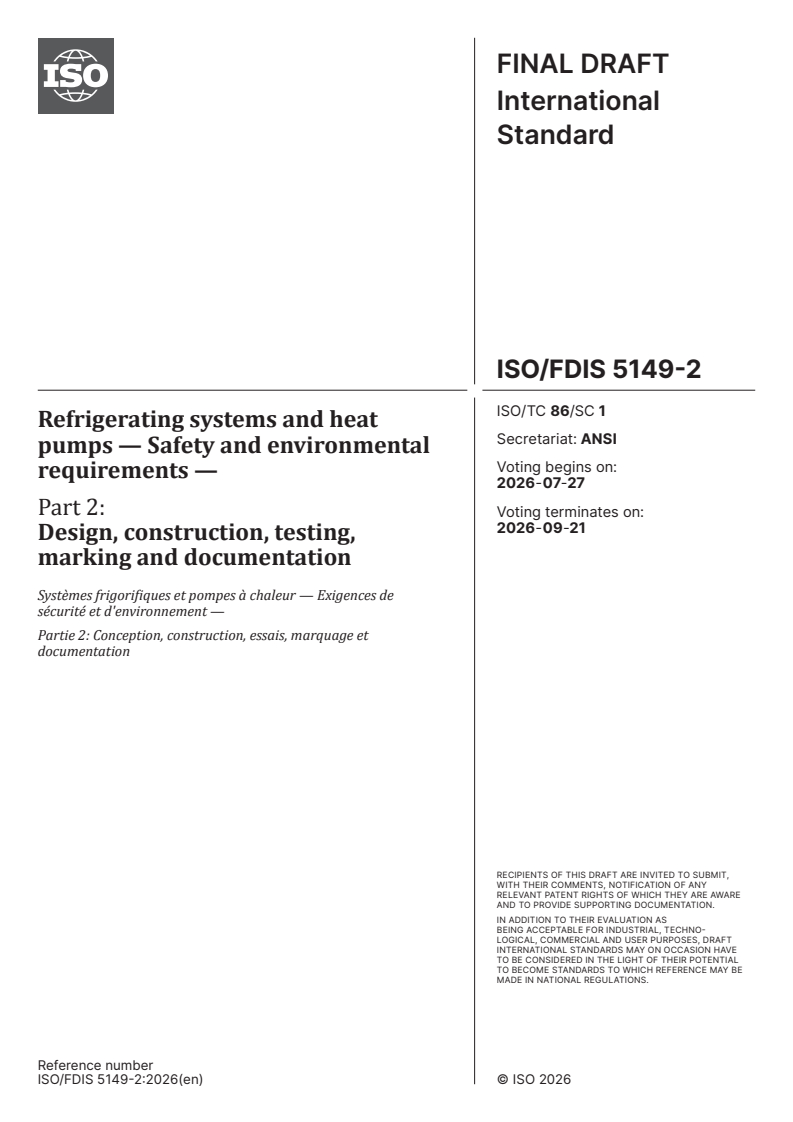
FINAL DRAFT
International
Standard
ISO/FDIS 5149-2
ISO/TC 86/SC 1
Refrigerating systems and heat
Secretariat: ANSI
pumps — Safety and environmental
Voting begins on:
requirements —
2026-07-27
Part 2:
Voting terminates on:
2026-09-21
Design, construction, testing,
marking and documentation
Systèmes frigorifiques et pompes à chaleur — Exigences de
sécurité et d'environnement —
Partie 2: Conception, construction, essais, marquage et
documentation
RECIPIENTS OF THIS DRAFT ARE INVITED TO SUBMIT,
WITH THEIR COMMENTS, NOTIFICATION OF ANY
RELEVANT PATENT RIGHTS OF WHICH THEY ARE AWARE
AND TO PROVIDE SUPPOR TING DOCUMENTATION.
IN ADDITION TO THEIR EVALUATION AS
BEING ACCEPTABLE FOR INDUSTRIAL, TECHNO-
LOGICAL, COMMERCIAL AND USER PURPOSES, DRAFT
INTERNATIONAL STANDARDS MAY ON OCCASION HAVE
TO BE CONSIDERED IN THE LIGHT OF THEIR POTENTIAL
TO BECOME STAN DARDS TO WHICH REFERENCE MAY BE
MADE IN NATIONAL REGULATIONS.
Reference number
ISO/FDIS 5149-2:2026(en) © ISO 2026
FINAL DRAFT
ISO/FDIS 5149-2:2026(en)
International
Standard
ISO/FDIS 5149-2
ISO/TC 86/SC 1
Refrigerating systems and heat
Secretariat: ANSI
pumps — Safety and environmental
Voting begins on:
requirements —
Part 2:
Voting terminates on:
Design, construction, testing,
marking and documentation
Systèmes frigorifiques et pompes à chaleur — Exigences de
sécurité et d'environnement —
Partie 2: Conception, construction, essais, marquage et
documentation
RECIPIENTS OF THIS DRAFT ARE INVITED TO SUBMIT,
WITH THEIR COMMENTS, NOTIFICATION OF ANY
RELEVANT PATENT RIGHTS OF WHICH THEY ARE AWARE
AND TO PROVIDE SUPPOR TING DOCUMENTATION.
© ISO 2026
IN ADDITION TO THEIR EVALUATION AS
All rights reserved. Unless otherwise specified, or required in the context of its implementation, no part of this publication may
BEING ACCEPTABLE FOR INDUSTRIAL, TECHNO-
LOGICAL, COMMERCIAL AND USER PURPOSES, DRAFT
be reproduced or utilized otherwise in any form or by any means, electronic or mechanical, including photocopying, or posting on
INTERNATIONAL STANDARDS MAY ON OCCASION HAVE
the internet or an intranet, without prior written permission. Permission can be requested from either ISO at the address below
TO BE CONSIDERED IN THE LIGHT OF THEIR POTENTIAL
or ISO’s member body in the country of the requester.
TO BECOME STAN DARDS TO WHICH REFERENCE MAY BE
MADE IN NATIONAL REGULATIONS.
ISO copyright office
CP 401 • Ch. de Blandonnet 8
CH-1214 Vernier, Geneva
Phone: +41 22 749 01 11
Email: copyright@iso.org
Website: www.iso.org
Published in Switzerland Reference number
ISO/FDIS 5149-2:2026(en) © ISO 2026
ii
ISO/FDIS 5149-2:2026(en)
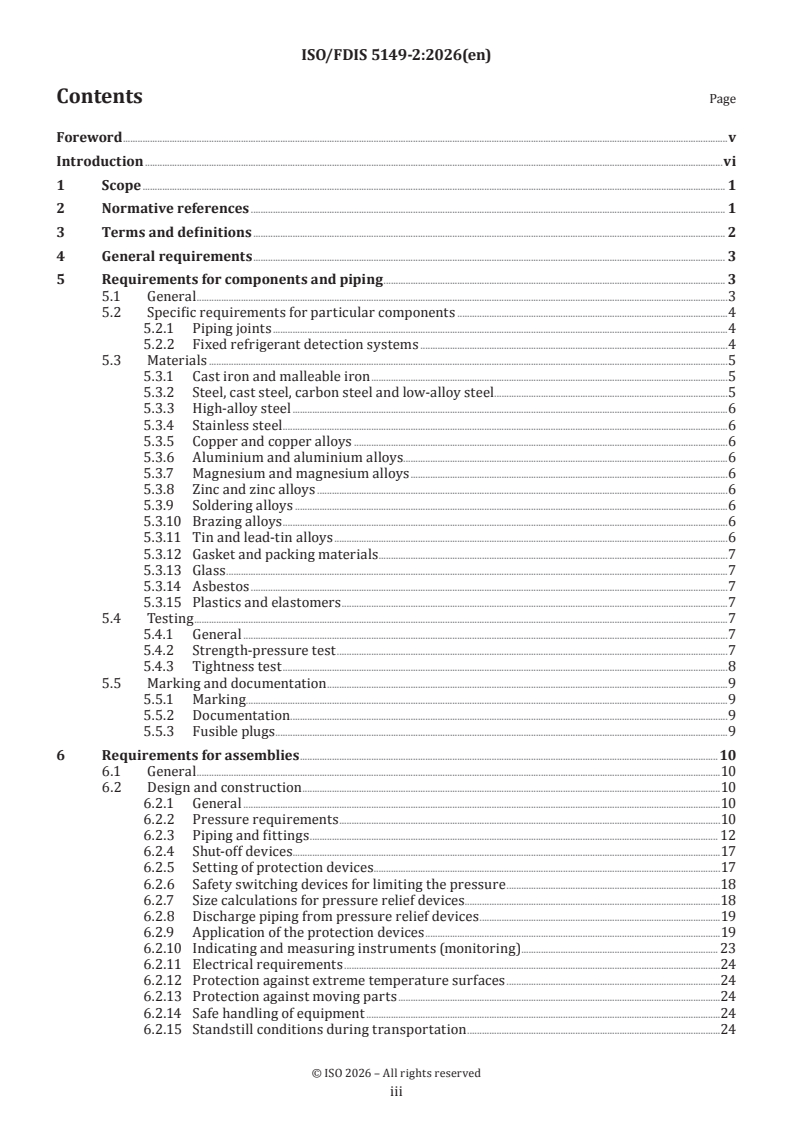
Contents Page
Foreword .v
Introduction .vi
1 Scope . 1
2 Normative references . 1
3 Terms and definitions . 2
4 General requirements . 3
5 Requirements for components and piping . 3
5.1 General .3
5.2 Specific requirements for particular components .4
5.2.1 Piping joints .4
5.2.2 Fixed refrigerant detection systems .4
5.3 Materials .5
5.3.1 Cast iron and malleable iron .5
5.3.2 Steel, cast steel, carbon steel and low-alloy steel .5
5.3.3 High-alloy steel .6
5.3.4 Stainless steel .6
5.3.5 Copper and copper alloys .6
5.3.6 Aluminium and aluminium alloys.6
5.3.7 Magnesium and magnesium alloys .6
5.3.8 Zinc and zinc alloys .6
5.3.9 Soldering alloys .6
5.3.10 Brazing alloys .6
5.3.11 Tin and lead-tin alloys .6
5.3.12 Gasket and packing materials . .7
5.3.13 Glass .7
5.3.14 Asbestos .7
5.3.15 Plastics and elastomers .7
5.4 Testing .7
5.4.1 General .7
5.4.2 Strength-pressure test .7
5.4.3 Tightness test .8
5.5 Marking and documentation .9
5.5.1 Marking . .9
5.5.2 Documentation.9
5.5.3 Fusible plugs .9
6 Requirements for assemblies .10
6.1 General .10
6.2 Design and construction .10
6.2.1 General .10
6.2.2 Pressure requirements .10
6.2.3 Piping and fittings . 12
6.2.4 Shut-off devices.17
6.2.5 Setting of protection devices . .17
6.2.6 Safety switching devices for limiting the pressure .18
6.2.7 Size calculations for pressure relief devices.18
6.2.8 Discharge piping from pressure relief devices .19
6.2.9 Application of the protection devices .19
6.2.10 Indicating and measuring instruments (monitoring). 23
6.2.11 Electrical requirements .24
6.2.12 Protection against extreme temperature surfaces .24
6.2.13 Protection against moving parts .24
6.2.14 Safe handling of equipment .24
6.2.15 Standstill conditions during transportation .24
iii
ISO/FDIS 5149-2:2026(en)
6.2.16 Protection against explosion hazards .24
6.2.17 Requirements for class IV ventilated enclosures . 26
6.3 Testing . 26
6.3.1 Tests . 26
6.3.2 Strength-pressure test .27
6.3.3 Tightness test .27
6.3.4 Test of the complete installation before putting it into operation . 29
6.4 Marking and documentation . 30
6.4.1 General . 30
6.4.2 Marking . . . 30
6.4.3 Documentation.31
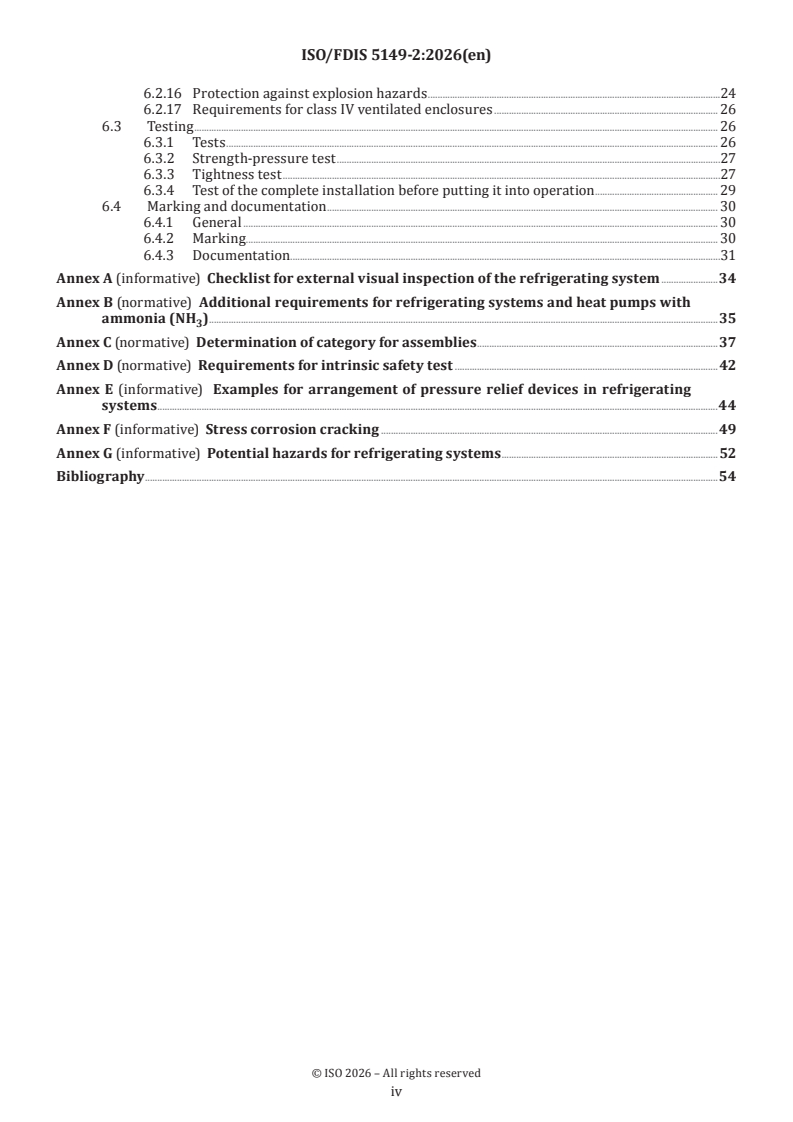
Annex A (informative) Checklist for external visual inspection of the refrigerating system .34
Annex B (normative) Additional requirements for refrigerating systems and heat pumps with
ammonia (NH ) .35
Annex C (normative) Determination of category for assemblies .37
Annex D (normative) Requirements for intrinsic safety test .42
Annex E (informative) Examples for arrangement of pressure relief devices in refrigerating
systems .44
Annex F (informative) Stress corrosion cracking .49
Annex G (informative) Potential hazards for refrigerating systems .52
Bibliography .54
iv
ISO/FDIS 5149-2:2026(en)
Foreword
ISO (the International Organization for Standardization) is a worldwide federation of national standards
bodies (ISO member bodies). The work of preparing International Standards is normally carried out through
ISO technical committees. Each member body interested in a subject for which a technical committee
has been established has the right to be represented on that committee. International organizations,
governmental and non-governmental, in liaison with ISO, also take part in the work. ISO collaborates closely
with the International Electrotechnical Commission (IEC) on all matters of electrotechnical standardization.
The procedures used to develop this document and those intended for its further maintenance are described
in the ISO/IEC Directives, Part 1. In particular, the different approval criteria needed for the different types
of ISO document should be noted. This document was drafted in accordance with the editorial rules of the
ISO/IEC Directives, Part 2 (see www.iso.org/directives).
ISO draws attention to the possibility that the implementation of this document may involve the use of (a)
patent(s). ISO takes no position concerning the evidence, validity or applicability of any claimed patent
rights in respect thereof. As of the date of publication of this document, ISO had not received notice of (a)
patent(s) which may be required to implement this document. However, implementers are cautioned that
this may not represent the latest information, which may be obtained from the patent database available at
www.iso.org/patents. ISO shall not be held responsible for identifying any or all such patent rights.
Any trade name used in this document is information given for the convenience of users and does not
constitute an endorsement.
For an explanation of the voluntary nature of standards, the meaning of ISO specific terms and expressions
related to conformity assessment, as well as information about ISO's adherence to the World Trade
Organization (WTO) principles in the Technical Barriers to Trade (TBT), see www.iso.org/iso/foreword.html.
This document was prepared by Technical Committee ISO/TC 86, Refrigeration and air-conditioning,
Subcommittee SC 1, Safety and environmental requirements for refrigerating systems.
This second edition cancels and replaces the first edition (ISO 5149-2:2014), which has been technically
revised. It also incorporates the Amendment ISO 5149-2:2014/Amd 1:2020.
The main changes are as follows:
— alignment of the document with EN 378-2, with the future aim of merging the two documents;
— introduction of the hot surface ignition temperature (HSIT).
A list of all parts in the ISO 5149 series can be found on the ISO website.
Any feedback or questions on this document should be directed to the user’s national standards body. A
complete listing of these bodies can be found at www.iso.org/members.html.
v
ISO/FDIS 5149-2:2026(en)
Introduction
The purpose of this document is to encourage the safe design, construction, installation, operation and
disposal of refrigerating systems.
The industry response to environmental issues has accelerated the introduction of alternative refrigerants.
The entry of new refrigerants and blends in the market and the introduction of new safety classifications
prompted the revision of this document.
This document is directed to the safety of persons and property on or near the premises where refrigeration
facilities are located. It includes specifications for fabricating a tight system.
This document is intended to minimize possible hazards to persons, property and the environment from
refrigerating systems and refrigerants. These hazards are associated with the physical and chemical
characteristics of refrigerants as well as the pressures and temperatures occurring in the refrigeration
cycles (see Annex G).
Attention is drawn to hazards common to all compression systems, such as high temperature at discharge,
liquid slugging, erroneous operation or reduction in mechanical strength caused by corrosion, erosion,
thermal stress, fatigue stresses, liquid hammer or vibration.
Corrosion, however, should have special consideration as conditions specific to refrigerating systems and
heat pumps arise due to the alternate frosting and defrosting or the covering of equipment by insulation.
vi
FINAL DRAFT International Standard ISO/FDIS 5149-2:2026(en)
Refrigerating systems and heat pumps — Safety and
environmental requirements —
Part 2:
Design, construction, testing, marking and documentation
1 Scope
This document specifies the design, construction and installation of refrigerating systems, including piping,
components, materials and ancillary equipment directly associated with such systems, which are not
covered in ISO 5149-1, ISO 5149-3, or ISO 5149-4. It also specifies requirements for testing, commissioning,
marking and documentation. Requirements for secondary heat-transfer circuits are excluded except for any
safety devices associated with the refrigerating system.
This document is applicable to new refrigerating systems, extensions or modifications of already existing
systems, and for used systems, being transferred to and operated on another site.
This document is applicable to:
a) refrigerating systems, stationary or mobile, of all sizes, except vehicle air conditioning systems covered
by a specific product standard;
NOTE Example of specific product standard is ISO 13043 and SAE J 639.
b) secondary cooling or heating systems;
c) the location of the refrigerating systems;
d) replaced parts and added components after the adoption of this document, if they are not identical in
function and in capacity;
e) the conversion of a system for another refrigerant.
This document does not apply to goods in storage, with respect to spoilage or contamination.
2 Normative references
The following documents are referred to in the text in such a way that some or all of their content constitutes
requirements of this document. For dated references, only the edition cited applies. For undated references,
the latest edition of the referenced document (including any amendments) applies.
ISO 817, Refrigerants — Designation and safety classification
ISO 4126-1, Safety devices for protection against excessive pressure — Part 1: Safety valves
ISO 4126-2, Safety devices for protection against excessive pressure — Part 2: Bursting disc safety devices
1)
ISO 5149-1:— , Refrigerating systems and heat pumps — Safety and environmental requirements — Part 1:
Vocabulary
ISO 5149-4, Refrigerating systems and heat pumps — Safety and environmental requirements — Part 4:
Operation, maintenance, repair and recovery
1) Under preparation. Stage at the time of publication: ISO/DIS 5149-1:2026.
ISO/FDIS 5149-2:2026(en)
ISO 7010, Graphical symbols — Safety colours and safety signs — Registered safety signs
ISO 12100, Safety of machinery — General principles for design — Risk assessment and risk reduction
ISO 13732-1, Ergonomics of the thermal environment — Methods for the assessment of human responses to
contact with surfaces — Part 1: Hot surfaces
ISO 13732-3, Ergonomics of the thermal environment — Methods for the assessment of human responses to
contact with surfaces — Part 3: Cold surfaces
ISO 13971, Refrigeration systems and heat pumps — Flexible pipe elements, vibration isolators, expansion joints
and non-metallic tubes — Requirements and classification
ISO 14903, Refrigerating systems and heat pumps — Qualification of tightness of components and joints
ISO 21922, Refrigerating systems and heat pumps — Valves — Requirements, testing and marking
ISO 24664, Refrigerating systems and heat pumps — Pressure relief devices and their associated piping —
Methods for calculation
IEC 60079-29-1, Explosive atmospheres — Part 29-1: Gas detectors — Performance requirements of detectors
for flammable gases
IEC 60204-1, Safety of machinery — Electrical equipment of machines — Part 1: General requirements
IEC 60335-2-34, Household and similar electrical appliances — Safety — Part 2-34: Particular requirements for
motor-compressors
IEC 60335-2-40, Household and similar electrical appliances — Safety — Part 2-40: Particular requirements for
electrical heat pumps, air-conditioners and dehumidifiers
IEC 60335-2-75, Household and similar electrical appliances — Safety — Part 2-75: Particular requirements for
commercial dispensing appliances and vending machines
IEC 60335-2-89, Household and similar electrical appliances — Safety — Part 2-89: Particular requirements for
commercial refrigerating appliances and ice-makers with an incorporated or remote refrigerant unit or motor-
compressor
IEC 60335-2-118, Household and similar electrical appliances — Safety — Part 2-118: Particular requirements
for professional ice-cream makers
IEC 60079-10-1:2020, Explosive atmospheres — Part 10-1: Classification of areas — Explosive gas atmospheres
IEC 60730-2-6, Automatic electrical controls — Part 2-6: Particular requirements for automatic electrical
pressure sensing controls including mechanical requirements
IEC 62990-1, Workplace Atmospheres — Part 1: Gas detectors — Performance requirements of detectors for
toxic gases
IEC/TS 63542, Refrigerant detection systems for flammable refrigerants
3 Terms and definitions
For the purposes of this document, the definitions and abbreviations given in ISO 5149-1 apply.
ISO and IEC maintain terminology databases for use in standardization at the following addresses:
— ISO Online browsing platform: available at https:// www .iso .org/ obp
— IEC Electropedia: available at https:// www .electropedia .org/
ISO/FDIS 5149-2:2026(en)
4 General requirements
Refrigerating systems and components shall be designed and constructed with the intention to eliminate
possible hazards to persons, property and the environment (see Annex G for potential hazards for
refrigerating systems). Deliberate discharge of refrigerants shall only be permitted in a manner which is not
harmful to persons, property and the environment.
Refrigerating appliances or systems constructed according to product standards such as IEC 60335-2-24 or
IEC 60335-2-89 are presumed to be in conformity with this document.
IEC 60335-2-40 requires appliances to conform to the requirements of this document with regard to
mechanical strength and pressure safety. In all other respects, appliances constructed according to
IEC 60335-2-40 are presumed to be in conformity with this document.
NOTE Information for mechanical strength and pressure safety can be found in Clause 5 and Clause 6.
5 Requirements for components and piping
5.1 General
Components and piping shall conform to the related standards or requirements given in Table 1. Components
not included in Table 1 shall conform to relevant national standards or codes. For components not listed in
Table 1 and not covered by national standards or codes, the requirements of 5.2 to 5.5 shall apply.
Table 1 — Components and piping requirements
Components and piping Requirements
Detector 5.2.2
Fired heat exchangers 5.2 to 5.5
Heat exchangers:
— pipe coil without air (tube in tube)
5.2 to 5.5
— multi-tubular (shell and tubes)
Plate heat exchangers 5.2 to 5.5
Headers and coils with air as secondary fluid 5.2 to 5.5
Receiver/accumulator/economizer 5.2 to 5.5
Oil separator 5.2 to 5.5
Drier 5.2 to 5.5
Filter 5.2 to 5.5
Muffler 5.2 to 5.5
Hermetic positive displacement compressor IEC 60335-2-34 or IEC 60204–1
Semi-hermetic positive displacement compressor IEC 60335-2-34 or IEC 60204–1
Open positive displacement compressor 5.2 to 5.5
Non-positive displacement compressor IEC 60204–1
Pump IEC 60204–1 combined with 5.4.3 and 5.5.1
Piping 5.2 to 5.5
Piping joints 5.2 to 5.5
Permanent joints 5.2 to 5.5
Non-permanent joints 5.2 to 5.5
Flexible piping ISO 13971
Safety switching devices for limiting the pressure 5.2 to 5.5
Control pressure switch 5.2 to 5.5
ISO/FDIS 5149-2:2026(en)
TTabablele 1 1 ((ccoonnttiinnueuedd))
Components and piping Requirements
Safety valve ISO 4126-1 or ISO 24664 combined with 5.4.3
Bursting disc ISO 4126-2 or ISO 24664 combined with 5.4.3
Valve ISO 21922
Isolating valves ISO 21922
Hand-operated valves ISO 21922
Capped valves ISO 21922
Liquid level indicators ISO 21922
Gauges 5.2 to 5.5
Soldering materials 5.3.9
Brazing materials 5.3.10
Welding materials 5.3
If the component contains electrical components and if the component standard does not cover electrical
safety, then the component shall fulfil the electrical requirements of IEC 60335-2-40, IEC 60335-2-34,
IEC 60335-2-89 or IEC 60204–1, as relevant.
Piping and vessels manufactured in copper or carbon steel can suffer from stress corrosion cracking.
Guidance on design is given in Annex F.
5.2 Specific requirements for particular components
5.2.1 Piping joints
Joints shall be designed so that they are not damaged because of freezing of water on the outside. They shall
be suitable for the pipe, the piping material and the pressure, temperature and fluid.
Coated (e.g. galvanized) pipes shall not be welded unless all coating has been completely removed from the
joint area. Welded joints shall be suitably protected.
5.2.2 Fixed refrigerant detection systems
5.2.2.1 General
The detector for the detection of refrigerant gases shall be a pre-set (indicating or alarm only) refrigerant
detector/sensor or a proportional (transmitter or measuring) refrigerant detector. The refrigerant detection
system shall be accurate at the pre-set alarm point and reliable according to the relevant standards, as
specified below.
The detection system shall conform to one of the following standards, where applicable:
— For detection systems where sensors are incorporated in the control of the refrigerating system,
IEC 60335-2-40 and IEC TS 63542 shall apply, where relevant.
— For detection systems separately installed at the installation site, such as a machinery room or other,
IEC 60079-29-1 and IEC 62990-1 shall apply, where relevant.
An appropriate maintenance period shall be established for each type of detector used. The t response
time of the detector, including the optional delay time specified by the system manufacturer, shall be 30 s or
less.
The detector shall be suitable for foreseeable variations in power supply voltage experienced at the
installation site and shall be triggered at the set value within the tolerances defined in the listed standards,
where specified.
ISO/FDIS 5149-2:2026(en)
Where vibration requirements are specified, they shall apply to the detection system and not to the entire
refrigerating system.
5.2.2.2 Refrigerant detection system output and general performance
A refrigerant detector shall give at least one output signal at a pre-set alarm point set by the manufacturer
of the detector. The pre-set alarm point shall not be adjustable on site. It should also have a separate output
for the fault signal.
The refrigerant detection system shall maintain the same performance between 0 °C and 30 °C. For
application outside this temperature range, the detector shall be specified for safe operation at the
temperature for the specific application.
The pre-set alarm point for the refrigerant detection system shall be set at no more than 25 % of the lower
flammability limit (LFL) or 50 % of the acute toxicity exposure limit/oxygen deprivation limit (ATEL/ODL).
The pre-set alarm value for the oxygen detector shall be 19,5 % by volume.
The value shall be selected to ensure that the output signal is triggered at or below the alarm threshold
value under all expected mains power voltage conditions.
The accuracy of the alarm threshold level and the long-term drift shall be recorded in the instruction manual
specified in 6.4.3.3 in order to demonstrate that the alarm threshold level is within the limit specified and
will be assured through the lifetime of the detector.
The refrigerant sensors or the parts containing the refrigerant sensors shall be marked or tagged with:
— year of manufacturing and where relevant, date of expiration;
— reference number or other means for identifying the refrigerant sensor.
5.2.2.3 Information on resistance to contaminants and high concentrations
The effect of contaminants or high concentrations of refrigerant gas on the accuracy, alarm threshold level
and the performance of the sensor as stated by the detector manufacturer, and minimum requirements for
maintenance, calibration and replacement shall be included in the instruction manual.
5.3 Materials
5.3.1 Cast iron and malleable iron
Cast iron and malleable iron shall only be used when suitable for the particular application, in accordance
with the requirements of this document.
NOTE 1 Since some grades of cast iron are brittle, their application is dependent on temperature, stress and design
considerations.
NOTE 2 Malleable iron has two general classifications with several different grades in each. These can have very
different mechanical properties.
5.3.2 Steel, cast steel, carbon steel and low-alloy steel
Steel, cast steel, carbon steel and low-alloy steel can be used for all parts carrying refrigerant and also for
heat-transfer medium circuits. Where there is a combination of low temperatures and high pressure or
where corrosion risks or thermal stresses are present, steel with adequate impact strength shall be used,
paying regard to thickness, the lowest operating temperature and its welding properties.
NOTE Guidance on stress corrosion cracking in carbon steel vessels is given in Clause F.3.
ISO/FDIS 5149-2:2026(en)
5.3.3 High-alloy steel
High-alloy steel can be required where there is a combination of low temperatures and high pressure
or where corrosion risks or thermal stresses are present. The impact strength shall be adequate for the
particular duty and the material suitable for welding, if required.
5.3.4 Stainless steel
When using stainless steel, the grade of stainless steel shall be compatible with the process fluids and
possible atmospheric impurities, e.g. sodium chloride (NaCl) and sulphuric acid (H SO ).
2 4
5.3.5 Copper and copper alloys
Copper in contact with refrigerants shall be oxygen-free or de-oxidized.
Copper and alloys with a high percentage of copper shall not be used for parts carrying ammonia unless
their compatibility has been previously established.
NOTE Guidance on stress corrosion cracking in copper pipes is given in Clause F.2.
5.3.6 Aluminium and aluminium alloys
Aluminium and aluminium alloys may be used in any part of the refrigerant circuit provided that its strength
is adequate and it is compatible with the refrigerants and the lubricants being used.
Aluminium used for gaskets for use with ammonia shall be of at least 99,5 % purity. Aluminium alloys
containing more than 2 % magnesium shall not be used with halogenated refrigerants unless their
compatibility has been previously established.
Aluminium and its alloys shall not be used in contact with methyl chloride (CH Cl).
5.3.7 Magnesium and magnesium alloys
Magnesium and magnesium alloys shall not be used unless their compatibility with refrigerants has been
previously established.
5.3.8 Zinc and zinc alloys
Zinc shall not be used in continuous contact with the refrigerants ammonia and methyl chloride (CH Cl).
External zinc coating of components is permissible.
Electro-zinc plating of components is permissible.
5.3.9 Soldering alloys
Soldering alloys shall not be used for refrigerant containment purposes.
5.3.10 Brazing alloys
Brazing alloys shall not be used unless their compatibility with refrigerants and lubricants has been
established.
5.3.11 Tin and lead-tin alloys
Tin and lead-tin alloys can be corroded by halogenated refrigerants and shall not be used unless their
compatibility has been previously established.
Copper-free lead antimony or lead-tin alloys may be used for valve seats.
ISO/FDIS 5149-2:2026(en)
5.3.12 Gasket and packing materials
Gasket and packing materials for sealing joints and for sealing stuffing boxes on valves shall be resistant
to the refrigerants, oil and lubricants used and shall be suitable for the expected range of pressures and
temperatures.
5.3.13 Glass
Glass may be used in refrigerant circuits and for terminal insulators, indicators and sight glasses, but it shall
be resistant to the pressures, temperatures and chemical actions which can occur.
5.3.14 Asbestos
Asbestos shall not be used.
5.3.15 Plastics and elastomers
When plastics or elastomers are used, they shall be:
— suitable for the mechanical, electrical, thermal, chemical and long-term creep stresses to which they are
subjected;
— compatible with refrigerant or refrigerant-oil mixtures with which they are in contact.
5.4 Testing
5.4.1 General
All components, except type-approved components including piping consisting of type-tested components,
shall undergo the following tests:
a) strength-pressure test (see 5.4.2);
b) tightness test (see 5.4.3);
c) functional test (see 6.3.1).
The results of these tests shall be recorded. Tests according to the relevant component standard are
considered to satisfy these testing requirements. When agreed by the manufacturer of the refrigerating
system assembly, some or all tests may be executed on the refrigerating system assembly (see 6.3).
5.4.2 Strength-pressure test
5.4.2.1 Individual strength-pressure test
Each component shall be strength-pressure-tested individually at minimum 1,43 × P (where P is the
S S
maximum allowable pressure). The individual strength-pressure test shall be carried out as a hydrostatic
pressure test by means of water (under the condition that the refrigeration circuit shall not be contaminated
when the test is complete) or some other liquid, except where a component cannot be pressure-tested with
liquid for technical reasons. In that case, the component shall be tested by means of air or some other non-
hazardous gas. Adequate precautions shall be taken to prevent danger to people and to minimize risk to
property.
As an alternative, the components can be type-approved by testing at 3 × P or by testing according to the
S
fatigue test as described in 5.4.2.2.
If the maximum continuous operating temperature exceeds 125 °C for copper or aluminium, or 200 °C for
steel, then the type-approved strength test pressure shall be increased according to the ratio of allowable
stress at the test temperature and that at the maximum continuous operating temperature based on a
known pressure vessel code or a published national or international standard. For example, if the material
ISO/FDIS 5149-2:2026(en)
2 2
of the component has an allowable stress of 35 N/mm at test temperature and 27 N/mm at maximum
continuous operating temperature, then the type-approved test shall be conducted at 3,9 times (3 × 35/27)
of maximum allowable pressure.
5.4.2.2 Fatigue test
As an alternative to the pressure test as mentioned in 5.4.2.1, the components shall be subjected to a
strength-pressure test at 2 × P provided they conform to the fatigue test as described in this subclause.
S
Three test samples shall be filled with fluid and shall be connected to a pressure-driving source. The
pressure shall be raised and lowered between the upper and lower cyclic values at a rate specified by the
manufacturer for a total number of 250 000 cycles. The entire specified pressure excursion shall occur
during each cycle.
For safety purposes, it is recommended to use a non-compressible fluid:
— For the first cycle, the maximum P for the low-pressure side components or the maximum P for the
S S
high-pressure side components shall be applied.
— For the test cycles, the upper-pressure value shall not be less than 0,7 × P and the lower-pressure value
S
shall not be greater than 0,2 × P . The upper-pressure value shall be 0,9 × P for water heat exchangers in
S S
the refrigerating system.
— For the final test cycle, the test pressure shall be increased to 1,4 × P (two times of 0,7 × P ). The pressure
S S
shall be 1,8 × P (two times of 0,9 × P ) for water heat exchangers in the refrigerating system.
S S
The strength-pressure test at 2 × P shall be performed on three samples, other than the samples used for the
S
fatigue test. If the maximum continuous operating temperature exceeds 125 °C for copper or aluminium, or
200 °C for steel, the fatigue test shall be conducted at least 10 °C above the maximum operating temperature.
5.4.2.3 Acceptance criteria
In the case of individual strength test at minimum 1,43 × P , permanent deformation shall not result from
S
these tests.
In the case of type approval, it is deemed that the components are designed to withstand a pressure not less
than three times the component's maximum allowable pressure without rupture (or not less than two times
the component's maximum allowable pressure without rupture after the fatigue test). Confirmation shall be
provided by testing.
The component shall not rupture, burst or leak after completion of the fatigue test.
5.4.3 Tightness test
The tightness test shall be performed according to the type approval procedure as specified in ISO 14903.
Components not covered by the scope of ISO 14903 shall be tested with detection equipment with a
sensitivity of 3 g/year of refrigerant or better, under a pressure of at least 0,25 × P . The acceptance criterion
S
is that no leak shall be detected.
The manufacturer of the refrigerating assembly may agree with the component manufacturer to execute
some or all component tightness tests on the refrigerating system assembly (see 6.3.3).
Tightness test shall be conducted only after the component has passed a strength-pressure test or has been
verified by a type test.
For environmental and safety reasons, nitrogen, helium and carbon dioxide are preferred test media. Tracers
may be added to the test gases. Mixtures of air and other gases should be avoided as certain mixtures can be
dangerous. Air may be used if the hazard of ignition is eliminated and the safety of the workers is ensured.
Oxygen shall not be used for tightness tests.
ISO/FDIS 5149-2:2026(en)
After testing, care shall be taken to ensure that the test medium is relieved safely.
5.5 Marking and documentation
5.5.1 Marking
Components shall be marked with the following items, unless the component standard is published and
requires more specific marking items:
a) the name or logo of the manufacturer;
b) the type designation;
c) the serial number or batch number, if one exists;
d) the year of manufacture, for components of nominal size greater than DN 25;
e) the design pressure or maximum allowable pressure;
f) the applicable refrigerant (where appropriate);
g) the capacity of the main function (where appropriate).
When agreed by the manufacturer of the refrigerating system assemb
...
Style Definition
...
Style Definition
...
Style Definition
...
Style Definition
...
Style Definition
...
Style Definition
ISO/FDIS 5149-2:2026(en) .
Style Definition
...
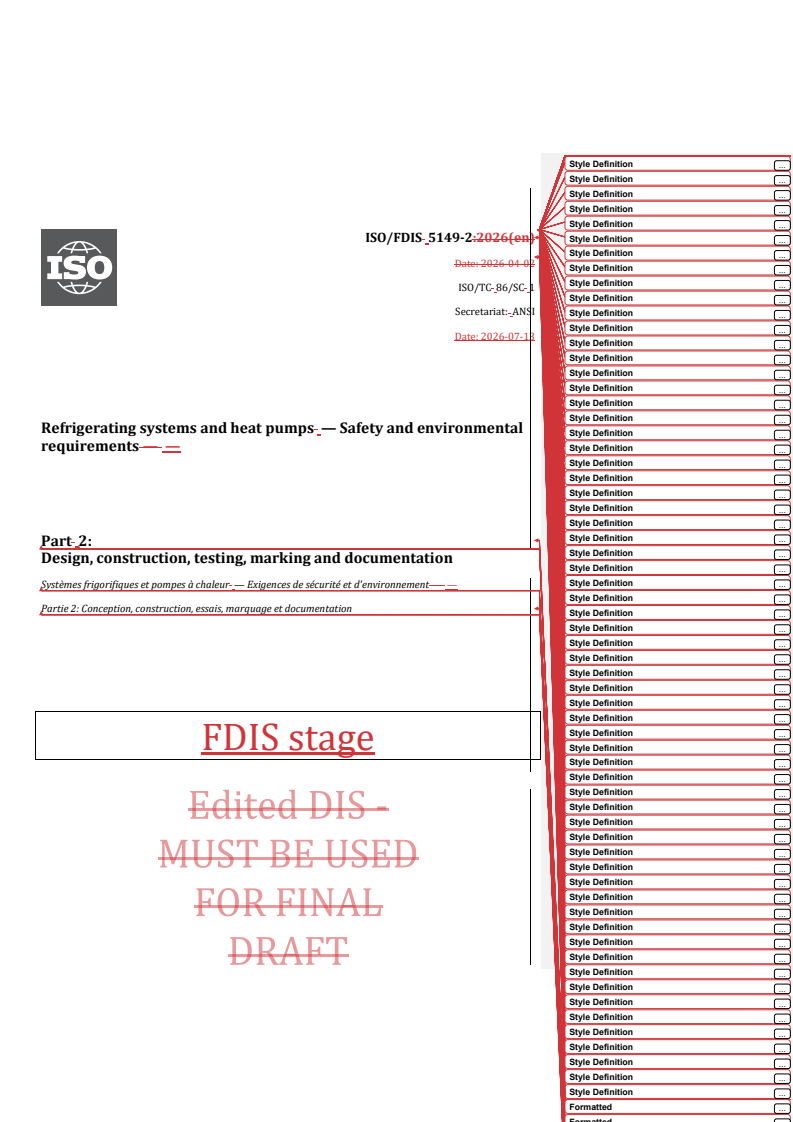
Date: 2026-04-02
Style Definition
...
Style Definition
...
ISO/TC 86/SC 1
Style Definition
...
Secretariat: ANSI
Style Definition
...
Style Definition
...
Date: 2026-07-13
Style Definition
...
Style Definition
...
Style Definition
...
Style Definition
...
Style Definition
...
Style Definition
...
Refrigerating systems and heat pumps — Safety and environmental
Style Definition
...
requirements — — Style Definition
...
Style Definition
...
Style Definition
...
Style Definition
...
Style Definition
...
Style Definition
...
Style Definition
...
Part 2:
Style Definition
...
Design, construction, testing, marking and documentation
Style Definition
...
Style Definition
...
Systèmes frigorifiques et pompes à chaleur — Exigences de sécurité et d'environnement — —
Style Definition
...
Partie 2: Conception, construction, essais, marquage et documentation
Style Definition
...
Style Definition
...
Style Definition
...
Style Definition
...
Style Definition
...
Style Definition
...
Style Definition
...
Style Definition
...
Style Definition
...
FDIS stage
Style Definition
...
Style Definition
...
Style Definition
...
Style Definition
...
Style Definition
...
Style Definition
...
Style Definition
...
Style Definition
...
Style Definition
...
Style Definition
...
Style Definition
...
Style Definition
...
Style Definition
...
Style Definition
...
Style Definition
...
Style Definition
...
Style Definition
...
Style Definition
...
Style Definition
...
Style Definition
...
Style Definition
...
Style Definition
...
Style Definition
...
Style Definition
...
Formatted
...
Formatted
ISO/DISFDIS 5149-2:20242026(en) Formatted: HeaderCentered, Left
Formatted: Default Paragraph Font
Formatted: Default Paragraph Font
All rights reserved. Unless otherwise specified, or required in the context of its implementation, no part of this publication
Adjust space between Latin and Asian
Formatted:
may be reproduced or utilized otherwise in any form or by any means, electronic or mechanical, including photocopying,
text, Adjust space between Asian text and numbers,
or posting on the internet or an intranet, without prior written permission. Permission can be requested from either ISO
Border: Top: (No border), Bottom: (No border)
at the address below or ISO'sISO’s member body in the country of the requester.
Formatted: Right: 1.5 cm, Gutter: 0 cm, Section start:
New page, Header distance from edge: 1.27 cm,
ISO Copyright Officecopyright office
Footer distance from edge: 0.5 cm
CP 401 • Ch. de Blandonnet 8
CH-1214 Vernier, Geneva
Phone: + 41 22 749 01 11
Formatted: French (Switzerland)
Email: copyright@iso.org
E-mail: copyright@iso.org
Website: www.iso.orgwww.iso.org
Formatted: zzCopyright address, Adjust space
between Latin and Asian text, Adjust space between
Asian text and numbers, Border: Top: (No border),
Published in Switzerland.
Bottom: (No border)
iiii
ISO/FDIS 5149-2:2026(en) Formatted: HeaderCentered, Left
Adjust space between Latin and Asian
Formatted:
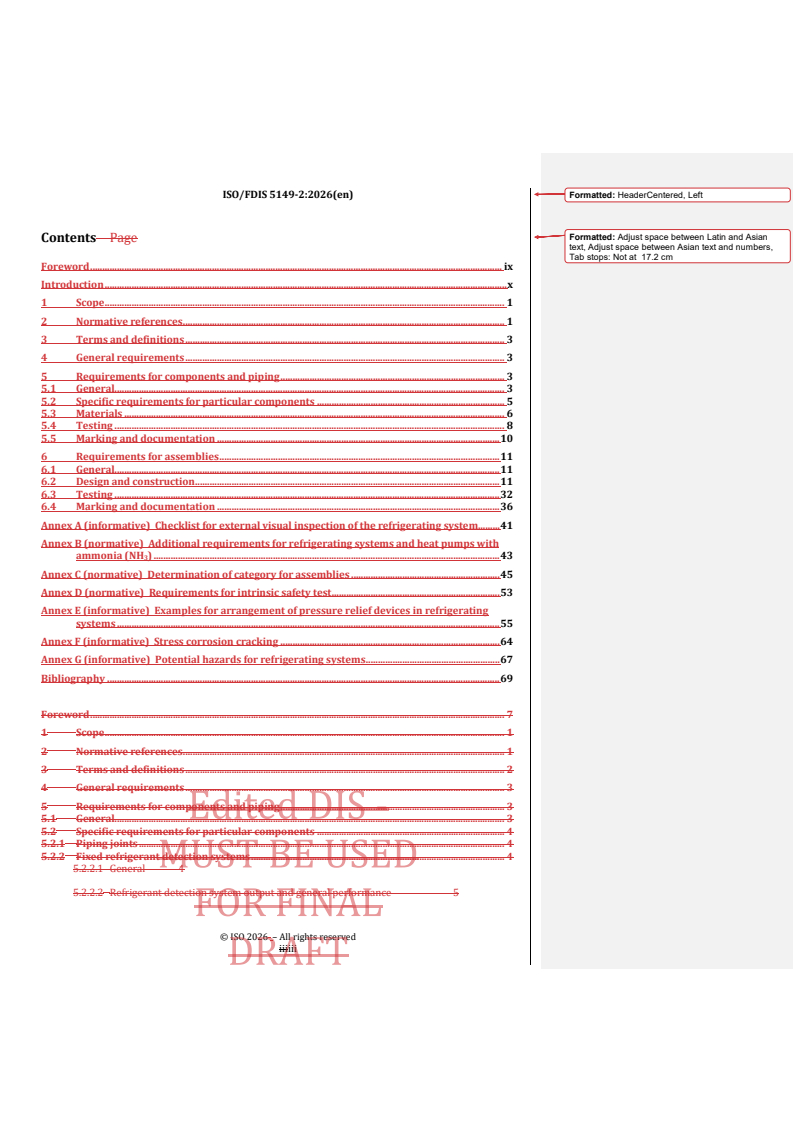
Contents Page
text, Adjust space between Asian text and numbers,
Tab stops: Not at 17.2 cm
Foreword . ix
Introduction . x
1 Scope . 1
2 Normative references . 1
3 Terms and definitions . 3
4 General requirements . 3
5 Requirements for components and piping . 3
5.1 General. 3
5.2 Specific requirements for particular components . 5
5.3 Materials . 6
5.4 Testing . 8
5.5 Marking and documentation . 10
6 Requirements for assemblies . 11
6.1 General. 11
6.2 Design and construction . 11
6.3 Testing . 32
6.4 Marking and documentation . 36
Annex A (informative) Checklist for external visual inspection of the refrigerating system. 41
Annex B (normative) Additional requirements for refrigerating systems and heat pumps with
ammonia (NH ) . 43
Annex C (normative) Determination of category for assemblies . 45
Annex D (normative) Requirements for intrinsic safety test . 53
Annex E (informative) Examples for arrangement of pressure relief devices in refrigerating
systems . 55
Annex F (informative) Stress corrosion cracking . 64
Annex G (informative) Potential hazards for refrigerating systems . 67
Bibliography . 69
Foreword . 7
1 Scope . 1
2 Normative references . 1
3 Terms and definitions . 2
4 General requirements . 3
5 Requirements for components and piping . 3
5.1 General. 3
5.2 Specific requirements for particular components . 4
5.2.1 Piping joints . 4
5.2.2 Fixed refrigerant detection systems . 4
5.2.2.1 General 4
5.2.2.2 Refrigerant detection system output and general performance 5
iiiiii
ISO/DISFDIS 5149-2:20242026(en) Formatted: HeaderCentered, Left
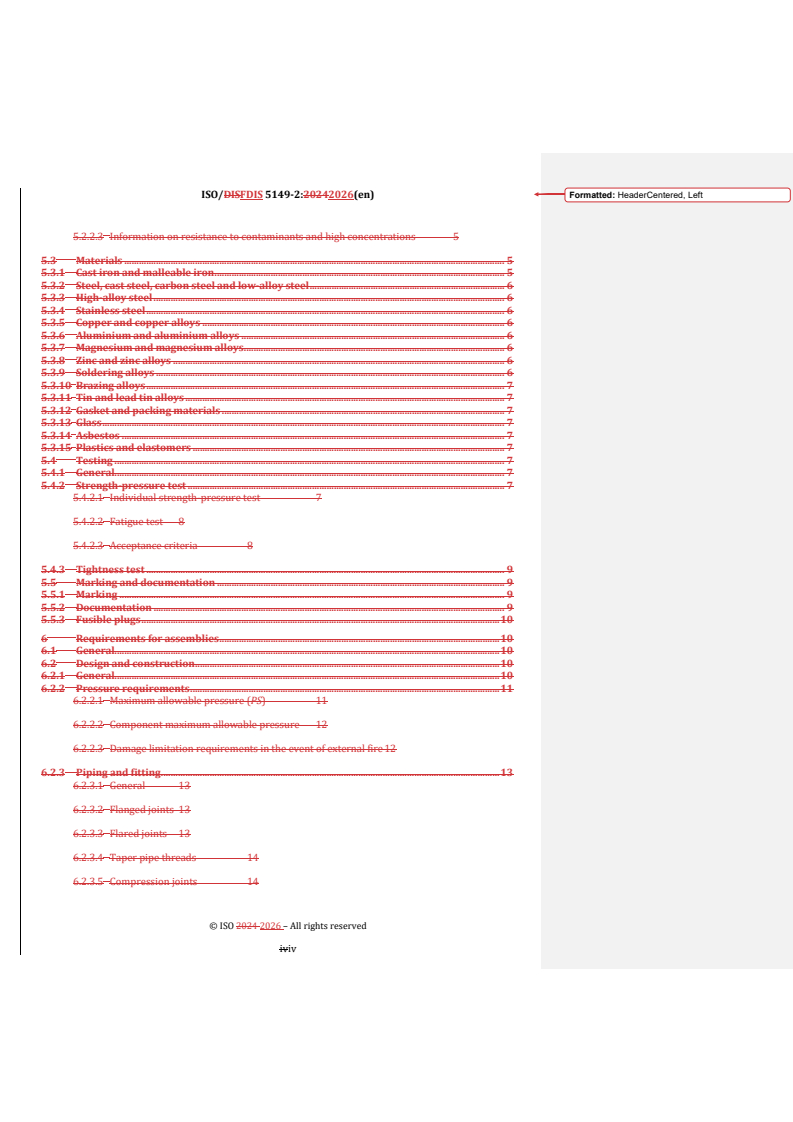
5.2.2.3 Information on resistance to contaminants and high concentrations 5
5.3 Materials . 5
5.3.1 Cast iron and malleable iron . 5
5.3.2 Steel, cast steel, carbon steel and low-alloy steel . 6
5.3.3 High-alloy steel . 6
5.3.4 Stainless steel . 6
5.3.5 Copper and copper alloys . 6
5.3.6 Aluminium and aluminium alloys . 6
5.3.7 Magnesium and magnesium alloys . 6
5.3.8 Zinc and zinc alloys . 6
5.3.9 Soldering alloys . 6
5.3.10 Brazing alloys . 7
5.3.11 Tin and lead tin alloys . 7
5.3.12 Gasket and packing materials . 7
5.3.13 Glass . 7
5.3.14 Asbestos . 7
5.3.15 Plastics and elastomers . 7
5.4 Testing . 7
5.4.1 General. 7
5.4.2 Strength-pressure test . 7
5.4.2.1 Individual strength-pressure test 7
5.4.2.2 Fatigue test 8
5.4.2.3 Acceptance criteria 8
5.4.3 Tightness test . 9
5.5 Marking and documentation . 9
5.5.1 Marking . 9
5.5.2 Documentation . 9
5.5.3 Fusible plugs . 10
6 Requirements for assemblies . 10
6.1 General. 10
6.2 Design and construction . 10
6.2.1 General. 10
6.2.2 Pressure requirements . 11
6.2.2.1 Maximum allowable pressure (PS) 11
6.2.2.2 Component maximum allowable pressure 12
6.2.2.3 Damage limitation requirements in the event of external fire 12
6.2.3 Piping and fitting . 13
6.2.3.1 General 13
6.2.3.2 Flanged joints 13
6.2.3.3 Flared joints 13
6.2.3.4 Taper pipe threads 14
6.2.3.5 Compression joints 14
iviv
ISO/FDIS 5149-2:2026(en) Formatted: HeaderCentered, Left
6.2.3.6 Requirements for piping installed at site 14
6.2.3.7 Spacing for pipe supports 15
6.2.3.8 Protection of piping 15
6.2.3.9 Piping in ducts or shafts 16
6.2.3.10 Location 16
6.2.3.11 Accessibility of piping and joints 16
6.2.3.12 Piping for accessories and measurements 16
6.2.3.13 Drain and vent connections 17
6.2.4 Shut-off devices. 17
6.2.4.1 Isolating valves 17
6.2.4.2 Hand-operated valves 17
6.2.4.3 Change of gland packing/seal 17
6.2.4.4 High-risk release areas 17
6.2.4.5 Arrangement of shut-off devices 18
6.2.5 Setting of protection devices . 18
6.2.5.1 General 18
6.2.5.2 Pressure relief to atmosphere from the low-pressure side 18
6.2.6 Safety switching devices for limiting the pressure . 18
6.2.6.1 Electro-mechanical safety switching devices for limiting the pressure 18
6.2.6.2 Electronic safety switching for limiting the pressure 18
6.2.6.3 Arrangement of safety switching devices 19
6.2.7 Size calculations for pressure relief devices . 19
6.2.7.1 Calculations 19
6.2.7.2 Fusible plugs 19
6.2.7.3 Bursting disc 19
6.2.8 Discharge piping from pressure relief devices . 19
6.2.8.1 General 19
6.2.8.2 Indication device for pressure relief devices 20
6.2.9 Application of the protection devices . 20
6.2.9.1 General 20
6.2.9.2 Protection of the refrigerating system against excessive pressure 20
vv
ISO/DISFDIS 5149-2:20242026(en) Formatted: HeaderCentered, Left
6.2.9.3 Overflow valves 24
6.2.9.4 Isolation and arrangement of protection devices for refrigerating systems 24
6.2.9.5 Protection of the secondary cooling and heating system 24
6.2.10 Indicating and measuring instruments (monitoring) . 25
6.2.10.1 General 25
6.2.10.2 Arrangement of refrigerant pressure indicators 25
6.2.10.3 Liquid level indicators on receivers 25
6.2.11 Electrical requirements . 25
6.2.12 Protection against extreme temperature surfaces . 26
6.2.13 Protection against moving parts . 26
6.2.14 Safe handling of equipment. 26
6.2.15 Standstill conditions during transportation . 26
6.2.16 Protection against explosion hazards . 26
6.2.17 Requirements for ventilated enclosures . 27
6.3 Testing . 28
6.3.1 Tests . 28
6.3.2 Strength-pressure test . 28
6.3.3 Tightness test . 29
6.3.3.1 General 29
6.3.3.2 For self-contained systems with refrigerant charge less than 5 kg which are tested with
refrigerant in the system 30
6.3.3.3 For systems not covered by 6.3.3.2 30
6.3.4 Test of the complete installation before putting it into operation . 31
6.3.4.1 General 31
6.3.4.2 Inspection of refrigerating system 31
6.3.4.3 Verification of safety devices 32
6.3.4.4 Refrigerant piping 32
6.3.4.5 Visual inspection of the complete installation 32
6.4 Marking and documentation . 32
6.4.1 General. 32
6.4.2 Marking . 32
6.4.2.1 General 32
6.4.2.2 Refrigerating systems 32
6.4.2.3 Piping and valves 33
6.4.3 Documentation . 33
6.4.3.1 Certificates 33
6.4.3.2 Documentation at operating site 33
vivi
ISO/FDIS 5149-2:2026(en) Formatted: HeaderCentered, Left
6.4.3.3 Instruction manual 34
6.4.3.4 Drawings 35
6.4.3.5 Logbook 35
Annex A (informative) Checklist for external visual inspection of the refrigerating system. 36
Annex B (normative) Additional requirements for refrigerating systems and heat pumps with
ammonia (NH ) . 38
B.1 Systems with a refrigerant charge above 50 kg . 38
B.2 Systems with a refrigerant charge above 4 500 kg . 38
B.3 Emergency stop system for refrigerating systems with a refrigerant charge above
4 500 kg . 38
B.4 Oil drain that can be actuated during normal operation . 39
Annex C (normative) Determination of category for assemblies . 40
C.1 General. 40
C.2 Safety classification of the refrigerant . 40
C.3 Determination of the maximum allowable pressure of the refrigerating assembly . 40
C.4 Determination of the state (liquid or gas) of the refrigerant . 40
C.5 Determination of category of components . 41
C.5.1 General. 41
C.5.2 Pressure vessels . 41
C.5.3 Piping . 42
C.5.4 Safety accessories . 43
C.5.5 Joining of pressure equipment . 43
C.5.6 Determination of category of the refrigerating assembly . 44
Annex D (normative) Requirements for intrinsic safety test . 46
D.1 General. 46
D.2 Determination of the maximum pressure during abnormal operation . 46
D.2.1 Determination of the pressure at the high-pressure side (P ) . 46
HIS
D.2.2 Determination of the pressure at the low-pressure side (PLIS) . 46
D.2.3 Determination of P and P for reversible heat pumps . 47
HIS LIS
Annex E (informative) Examples for arrangement of pressure relief devices in refrigerating
systems . 48
Annex F (informative) Stress corrosion cracking . 53
F.1 General. 53
F.2 Stress corrosion in copper . 53
F.3 Stress corrosion in steel . 53
F.4 Factors that influence stress corrosion cracking . 54
F.4.1 General. 54
viivii
ISO/DISFDIS 5149-2:20242026(en) Formatted: HeaderCentered, Left
F.4.2 Yield strength . 54
F.4.3 Temperature. 54
F.4.4 Oxygen content . 54
F.4.5 Water content . 54
F.4.6 Age of equipment . 54
F.4.7 Avoiding stress corrosion cracking . 55
F.4.8 Conclusions . 55
Annex G (informative) Potential hazards for refrigerating systems . 56
Bibliography . 58
viiiviii
ISO/FDIS 5149-2:2026(en) Formatted: HeaderCentered, Left
Adjust space between Latin and Asian
Formatted:
Foreword
text, Adjust space between Asian text and numbers
ISO (the International Organization for Standardization) is a worldwide federation of national standards
bodies (ISO member bodies). The work of preparing International Standards is normally carried out through
ISO technical committees. Each member body interested in a subject for which a technical committee has been
established has the right to be represented on that committee. International organizations, governmental and
non-governmental, in liaison with ISO, also take part in the work. ISO collaborates closely with the
International Electrotechnical Commission (IEC) on all matters of electrotechnical standardization.
The procedures used to develop this document and those intended for its further maintenance are described
in the ISO/IEC Directives, Part 1. In particular, the different approval criteria needed for the different types of
ISO document should be noted. This document was drafted in accordance with the editorial rules of the
ISO/IEC Directives, Part 2 (see www.iso.org/directives). English (United Kingdom)
Formatted:
ISO draws attention to the possibility that the implementation of this document may involve the use of (a)
patent(s). ISO takes no position concerning the evidence, validity or applicability of any claimed patent rights
in respect thereof. As of the date of publication of this document, ISO had not received notice of (a) patent(s)
which may be required to implement this document. However, implementers are cautioned that this may not
represent the latest information, which may be obtained from the patent database available at
www.iso.org/patents.www.iso.org/patents. ISO shall not be held responsible for identifying any or all such
patent rights.
Any trade name used in this document is information given for the convenience of users and does not
constitute an endorsement.
For an explanation of the voluntary nature of standards, the meaning of ISO specific terms and expressions
related to conformity assessment, as well as information about ISO's adherence to the World Trade
Organization (WTO) principles in the Technical Barriers to Trade (TBT), see
www.iso.org/iso/foreword.htmlwww.iso.org/iso/foreword.html. Formatted: English (United Kingdom)
This document was prepared by Technical Committee ISO/TC 86, Refrigeration and air-conditioning, Adjust space between Latin and Asian
Formatted:
text, Adjust space between Asian text and numbers
Subcommittee SC 1, Safety and environmental requirements for refrigerating systems.
This second edition cancels and replaces the first edition (ISO 5149-2:2014), which has been technically Formatted: Default Paragraph Font
revised. It also incorporates the Amendment ISO 5149-2:2014/Amd 1:2020.
Formatted: Default Paragraph Font
Default Paragraph Font
Formatted:
The main changes are as follows:
Default Paragraph Font
Formatted:
— — alignment of the document with EN 378-2, with the future aim of merging the two documents; Default Paragraph Font
Formatted:
Formatted: Default Paragraph Font
— — introduction of the hot surface ignition temperature (HSIT).
Formatted: Default Paragraph Font
Formatted: Adjust space between Latin and Asian
A list of all parts in the ISO 5149 series can be found on the ISO website.
text, Adjust space between Asian text and numbers,
Tab stops: Not at 0.7 cm + 1.4 cm + 2.1 cm + 2.8 cm
Any feedback or questions on this document should be directed to the user’s national standards body. A
+ 3.5 cm + 4.2 cm + 4.9 cm + 5.6 cm + 6.3 cm + 7
complete listing of these bodies can be found at www.iso.org/members.htmlwww.iso.org/members.html.
Formatted: Default Paragraph Font
Formatted: Default Paragraph Font
Default Paragraph Font
Formatted:
Formatted: Adjust space between Latin and Asian
text, Adjust space between Asian text and numbers
ixix
ISO/DISFDIS 5149-2:20242026(en) Formatted: HeaderCentered, Left
Introduction
The purpose of this document is to encourage the safe design, construction, installation, operation and
disposal of refrigerating systems.
The industry response to environmental issues has accelerated the introduction of alternative refrigerants.
The entry of new refrigerants and blends in the market and the introduction of new safety classifications
prompted the revision of this document.
This document is directed to the safety of persons and property on or near the premises where refrigeration
facilities are located. It includes specifications for fabricating a tight system.
This document is intended to minimize possible hazards to persons, property and the environment from
refrigerating systems and refrigerants. These hazards are associated with the physical and chemical
characteristics of refrigerants as well as the pressures and temperatures occurring in the refrigeration cycles
(see Annex G).Annex G).
Attention is drawn to hazards common to all compression systems, such as high temperature at discharge,
liquid slugging, erroneous operation or reduction in mechanical strength caused by corrosion, erosion,
thermal stress, fatigue stresses, liquid hammer or vibration.
Corrosion, however, should have special consideration as conditions specific to refrigerating systems and heat
pumps arise due to the alternate frosting and defrosting or the covering of equipment by insulation.
xx
FINAL DRAFT International Standard ISO/FDIS 5149-2:2026(en)
Refrigerating systems and heat pumps — Safety and environmental
requirements — —
Main Title 2, Adjust space between Latin
Formatted:
Part 2:
and Asian text, Adjust space between Asian text and
numbers
Design, construction, testing, marking and documentation
Formatted: Right: 1.5 cm, Gutter: 0 cm, Section start:
New page, Header distance from edge: 1.27 cm,
1 Scope
Footer distance from edge: 0.5 cm
This document specifies the design, construction and installation of refrigerating systems, including piping,
components, materials and ancillary equipment directly associated with such systems, which are not covered
Formatted: Default Paragraph Font
in ISO 5149-1, ISO 5149-3, or ISO 5149-4. It also specifies requirements for testing, commissioning, marking
Default Paragraph Font
and documentation. Requirements for secondary heat-transfer circuits are excluded except for any safety Formatted:
devices associated with the refrigerating system.
Formatted: Default Paragraph Font
Formatted: Default Paragraph Font
This document is applicable to new refrigerating systems, extensions or modifications of already existing
Formatted: Default Paragraph Font
systems, and for used systems, being transferred to and operated on another site.
Formatted: Default Paragraph Font
This document is applicable to: Default Paragraph Font
Formatted:
Formatted: Default Paragraph Font
a) a) refrigerating systems, stationary or mobile, of all sizes, except vehicle air conditioning systems
Formatted: Default Paragraph Font
covered by a specific product standard;
Formatted: Numbered + Level: 1 + Numbering Style:
a, b, c, … + Start at: 1 + Alignment: Left + Aligned at: 0
NOTE Example of specific product standard is ISO 13043 and SAE J 639.
cm + Indent at: 0 cm, Adjust space between Latin and
Asian text, Adjust space between Asian text and
b) b) secondary cooling or heating systems;
numbers, Tab stops: Not at 0.7 cm + 1.4 cm + 2.1 cm
+ 2.8 cm + 3.5 cm + 4.2 cm + 4.9 cm + 5.6 cm +
6.3 cm + 7 cm
c) c) the location of the refrigerating systems;
Formatted: Default Paragraph Font
d) d) replaced parts and added components after the adoption of this document, if they are not
Formatted: Default Paragraph Font
identical in function and in capacity;
Formatted: Default Paragraph Font
Default Paragraph Font
Formatted:
e) e) the conversion of a system for another refrigerant.
Formatted: Adjust space between Latin and Asian
text, Adjust space between Asian text and numbers
This document does not apply to goods in storage, with respect to spoilage or contamination.
Formatted: Default Paragraph Font
Default Paragraph Font
2 Normative references Formatted:
Formatted: Default Paragraph Font
The following documents are referred to in the text in such a way that some or all of their content constitutes
Formatted: Default Paragraph Font
requirements of this document. For dated references, only the edition cited applies. For undated references,
Formatted: Adjust space between Latin and Asian
the latest edition of the referenced document (including any amendments) applies.
text, Adjust space between Asian text and numbers,
Tab stops: Not at 0.7 cm + 1.4 cm + 2.1 cm + 2.8 cm
ISO 817, Refrigerants — Designation and safety classification
+ 3.5 cm + 4.2 cm + 4.9 cm + 5.6 cm + 6.3 cm + 7
Formatted: Default Paragraph Font
ISO 4126--1, Safety devices for protection against excessive pressure — Part 1: Safety valves
Default Paragraph Font
Formatted:
Formatted: Default Paragraph Font
ISO 4126--2, Safety devices for protection against excessive pressure — Part 2: Bursting disc safety devices
Formatted: Default Paragraph Font
Formatted: Font: Not Bold
Footer
Formatted:
ISO/DISFDIS 5149-2:20242026(en) Formatted: HeaderCentered, Left
1 1)
ISO 5149--1:—, :— , Refrigerating systems and heat pumps — Safety and environmental requirements — Default Paragraph Font
Formatted:
Part 1: Vocabulary
Formatted: Default Paragraph Font
ISO 5149-4, Refrigerating systems and heat pumps — Safety and environmental requirements — Part 4:
Operation, maintenance, repair and recovery
ISO 7010, Graphical symbols — Safety colours and safety signs — Registered safety signs Default Paragraph Font
Formatted:
Formatted: Default Paragraph Font
ISO 12100, Safety of machinery — General principles for design — Risk assessment and risk reduction
Formatted: Adjust space between Latin and Asian
text, Adjust space between Asian text and numbers,
ISO 13732-1, Ergonomics of the thermal environment — Methods for the assessment of human responses to
Tab stops: Not at 0.7 cm + 1.4 cm + 2.1 cm + 2.8 cm
contact with surfaces — Part 1: Hot surfaces + 3.5 cm + 4.2 cm + 4.9 cm + 5.6 cm + 6.3 cm + 7
Formatted: Default Paragraph Font
ISO 13732-3, Ergonomics of the thermal environment — Methods for the assessment of human responses to
contact with surfaces — Part 3: Cold surfaces
ISO 13971, Refrigeration systems and heat pumps — Flexible pipe elements, vibration isolators, expansion Default Paragraph Font
Formatted:
joints and non-metallic tubes — Requirements and classification
Formatted: Default Paragraph Font
Formatted: Adjust space between Latin and Asian
ISO 14903, Refrigerating systems and heat pumps — Qualification of tightness of components and joints
text, Adjust space between Asian text and numbers,
Tab stops: Not at 0.7 cm + 1.4 cm + 2.1 cm + 2.8 cm
ISO 21922, Refrigerating systems and heat pumps — Valves — Requirements, testing and marking — Pressure + 3.5 cm + 4.2 cm + 4.9 cm + 5.6 cm + 6.3 cm + 7
relief devices and their associated piping — Valves
Formatted: Default Paragraph Font
Formatted: Default Paragraph Font
ISO 24664, Refrigerating systems and heat pumps — Pressure relief devices and their associated piping —
Default Paragraph Font
Formatted:
Methods for calculation
IEC 60079--29--1, Explosive atmospheres — Part 29-1: Gas detectors — Performance requirements of Formatted: Default Paragraph Font
detectors for flammable gases
IEC 60204--1, Safety of machinery — Electrical equipment of machines — Part 1: General requirements Default Paragraph Font
Formatted:
Default Paragraph Font
IEC 60335--2-34, Household and similar electrical appliances — Safety — Part 2-34: Particular requirements Formatted:
for motor-compressors
IEC 60335--2--40, Household and similar electrical appliances — Safety — Part 2-40: Particular requirements Formatted: Default Paragraph Font
for electrical heat pumps, air-conditioners and dehumidifiers
IEC 60335-2-75, Household and similar electrical appliances — Safety — Part 2-75: Particular requirements Default Paragraph Font
Formatted:
for commercial dispensing appliances and vending machines
IEC 60335--2--89, Household and similar electrical appliances — Safety — Part 2-89: Particular requirements Formatted: Default Paragraph Font
for commercial refrigerating appliances and ice-makers with an incorporated or remote refrigerant unit or
motor-compressor
IEC 60335-2-118, Household and similar electrical appliances — Safety — Part 2-118: Particular Formatted: Default Paragraph Font
requirements for professional ice-cream makers
IEC 60079--10--1:2020, Explosive atmospheres — Part 10-1: Classification of areas — Explosive gas Formatted: Default Paragraph Font
atmospheres
Under preparation. Stage at the time of publication: ISO/DIS 5149-1:2024.
1)
Under preparation. Stage at the time of publication: ISO/DIS 5149-1:2026.
Formatted: FooterPageNumber
ISO/FDIS 5149-2:2026(en) Formatted: HeaderCentered, Left
IEC 60730--2--6, Automatic electrical controls — Part 2-6: Particular requirements for automatic electrical Default Paragraph Font
Formatted:
pressure sensing controls including mechanical requirements
Formatted: Default Paragraph Font
Formatted: Default Paragraph Font
IEC 62990--1, Workplace Atmospheres — Part 1: Gas detectors — Performance requirements of detectors for
Formatted: Default Paragraph Font
toxic gases
Default Paragraph Font
Formatted:
IEC /TS 63542, Refrigerant detection systems for flammable refrigerants
Formatted: Default Paragraph Font
Formatted: Default Paragraph Font
3 Terms and definitions
Formatted: Default Paragraph Font
Formatted: Default Paragraph Font
For the purposes of this document, the definitions and abbreviations given in ISO 5149--1 apply.
Default Paragraph Font
Formatted:
ISO and IEC maintain terminology databases for use in standardization at the following addresses:
Formatted: Default Paragraph Font
Formatted: Adjust space between Latin and Asian
— — ISO Online browsing platform: available at https://www.iso.org/obphttps://www.iso.org/obp
text, Adjust space between Asian text and numbers
Default Paragraph Font
Formatted:
— — IEC Electropedia: available at https://www.electropedia.org/https://www.electropedia.org/
Formatted: Default Paragraph Font
Formatted: Default Paragraph Font
4 General requirements
Formatted: Adjust space between Latin and Asian
text, Adjust space between Asian text and numbers,
Refrigerating systems and components shall be designed and constructed with the intention to eliminate
Tab stops: Not at 0.7 cm + 1.4 cm + 2.1 cm + 2.8 cm
possible hazards to persons, property and the environment (see Annex GAnnex G for potential hazards for
+ 3.5 cm + 4.2 cm + 4.9 cm + 5.6 cm + 6.3 cm + 7
refrigerating systems). Deliberate discharge of refrigerants shall only be permitted in a manner which is not
Formatted: Adjust space between Latin and Asian
harmful to persons, property and the environment and in accordance with local or national laws.
text, Adjust space between Asian text and numbers
Formatted: Widow/Orphan control, Adjust space
Refrigerating appliances or systems constructed according to product standards such as IEC 60335--2--24 or
between Latin and Asian text, Adjust space between
IEC 60335--2--89 are presumed to be in conformity with this document.
Asian text and numbers
Formatted: Default Paragraph Font
IEC 60335--2--40 requires appliances to conform to the requirements of this document with regard to
Default Paragraph Font
Formatted:
mechanical strength and pressure safety. In all other respects, appliances constructed according to
Formatted: Default Paragraph Font
IEC 60335--2--40 are presumed to be in conformity with this document.
Formatted: Default Paragraph Font
NOTE Information for mechanical strength and pressure safety can be found in Clause 5 and Clause 6.Clause 5 and
Formatted: Default Paragraph Font
Clause 6.
Default Paragraph Font
Formatted:
Formatted: Default Paragraph Font
5 Requirements for components and piping
Formatted: Default Paragraph Font
5.1 General
Formatted: Default Paragraph Font
Default Paragraph Font
Formatted:
Components and piping shall conform to the related standards or requirements given in Table 1.Table 1.
Formatted: Default Paragraph Font
Components not included in Table 1Table 1 shall conform to relevant national standards or codes. For
components not listed in Table 1Table 1 and not covered by national standards or codes, the requirements of Formatted: Default Paragraph Font
5.25.2 to 5.55.5 shall apply.
Formatted: Default Paragraph Font
Default Paragraph Font
Formatted:
Formatted: Default Paragraph Font
Formatted: Default Paragraph Font
Formatted
...
Formatted
...
Formatted
...
Formatted
...
Formatted: Default Paragraph Font
Formatted: FooterPageNumber
Formatted
...
Formatted
...
Formatted
ISO/DISFDIS 5149-2:20242026(en) .
Formatted
...
Formatted
...