

ISO/PRF 19976-1
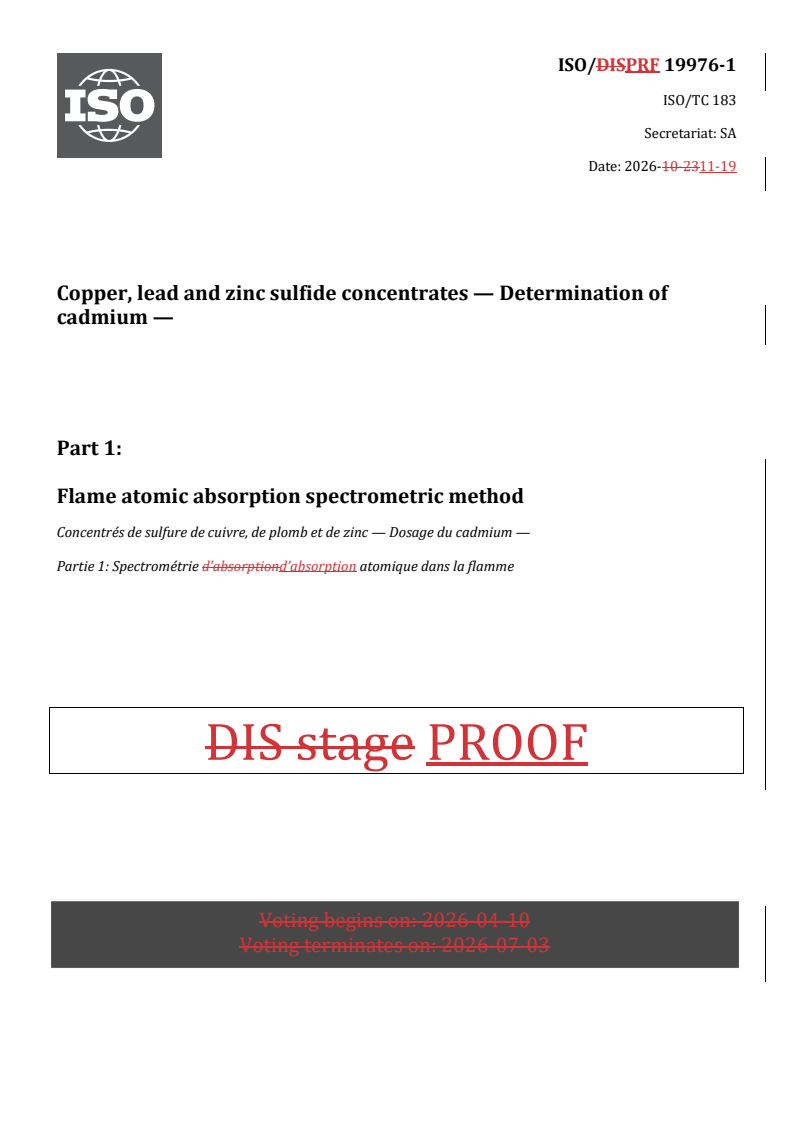
(Main)Copper, lead and zinc sulfide concentrates — Determination of cadmium — Part 1: Flame atomic absorption spectrometric method
- Abstract
This document specifies a flame atomic absorption spectrometric method for the determination of the mass fraction of cadmium in copper, lead and zinc sulfide concentrates as follows: a) for copper sulfide concentrates, the method is applicable to the determination of mass fractions of cadmium from 0,01 % to 0,30 %; b) for lead sulfide concentrates, the method is applicable to the determination of mass fractions of cadmium from 0,01 % to 0,30 %; c) for zinc sulfide concentrates, the method is applicable to the determination of mass fractions of cadmium from 0,05 % to 0,30 %.
- Status
- Not Published
- Technical Committee
- ISO/TC 183 - Copper, lead, zinc and nickel ores and concentrates
- Drafting Committee
- ISO/TC 183 - Copper, lead, zinc and nickel ores and concentrates
- Current Stage
- 5020 - Proof sent to secretariat or FDIS ballot initiated: 8 weeks - 50 Approval
- Start Date
- 19-Nov-2026
Buy Documents
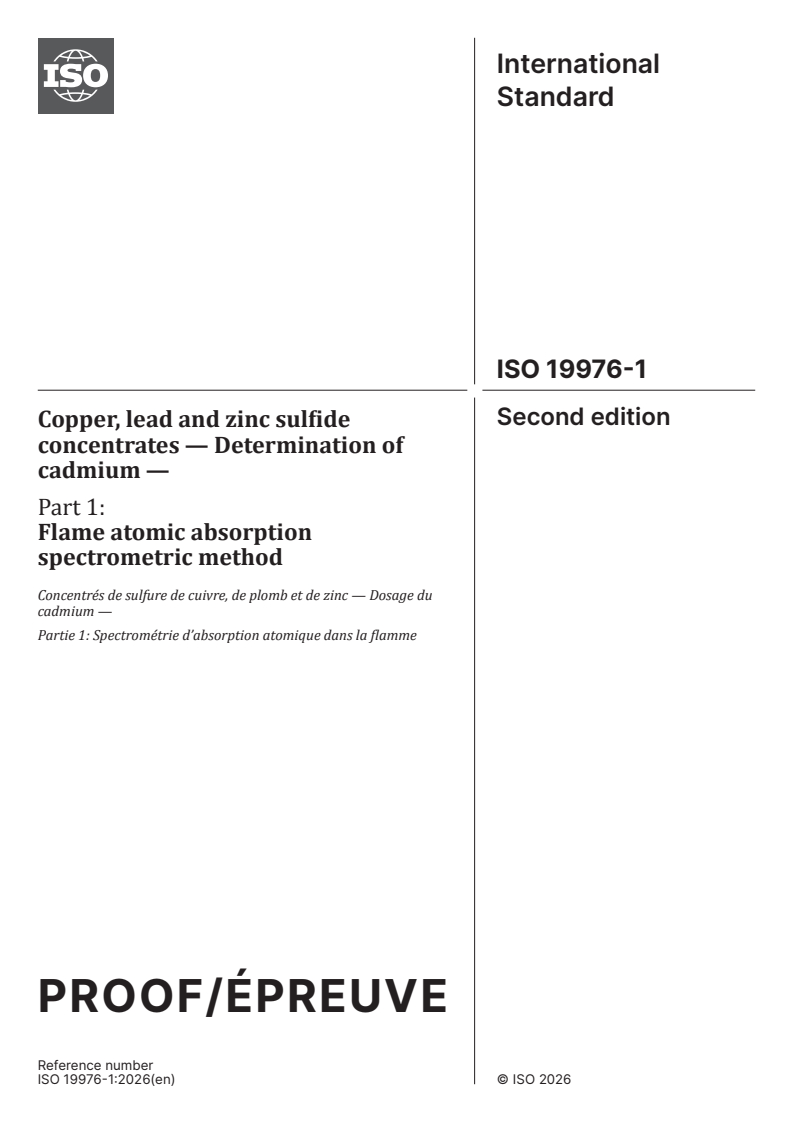
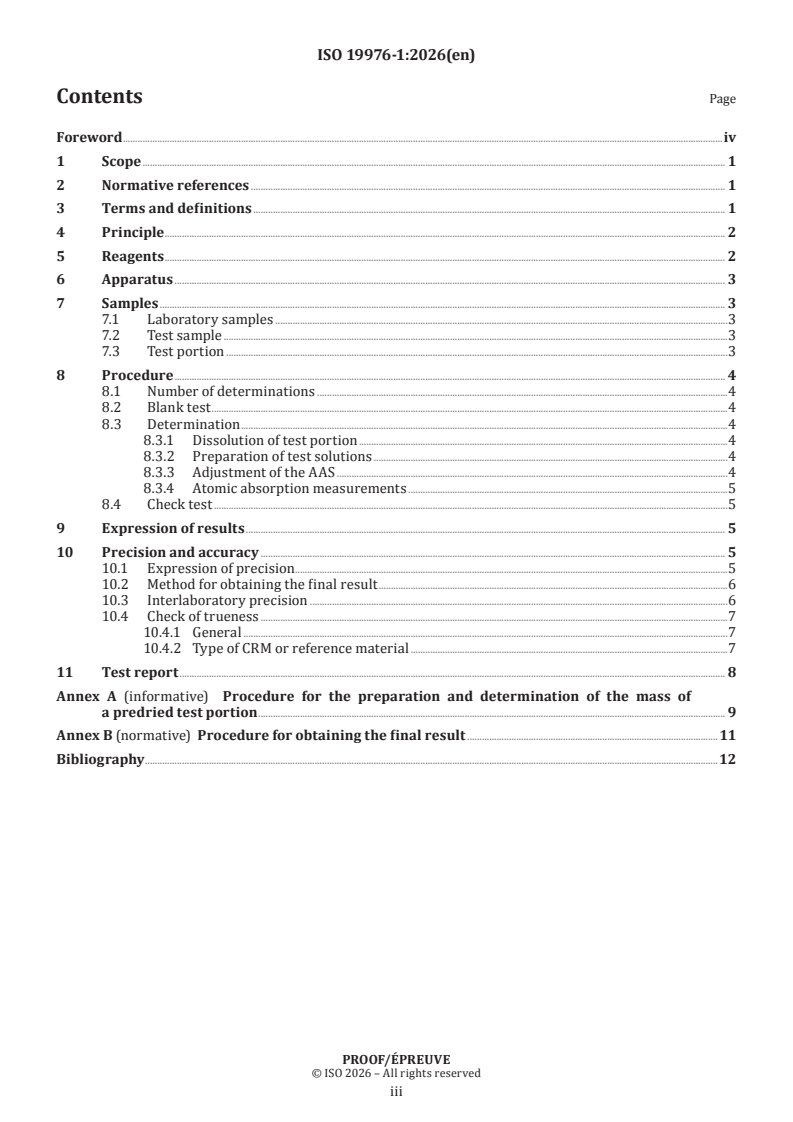
ISO/PRF 19976-1 - Copper, lead and zinc sulfide concentrates — Determination of cadmium — Part 1: Flame atomic absorption spectrometric method
REDLINE ISO/PRF 19976-1 - Copper, lead and zinc sulfide concentrates — Determination of cadmium — Part 1: Flame atomic absorption spectrometric method
ISO/PRF 19976-1 is an ISO method for determining cadmium in copper, lead and zinc sulfide concentrates by flame atomic absorption spectrometry. It is written for laboratories and technical staff who need a standard procedure for measuring cadmium mass fraction in these concentrates and reporting the result on a controlled basis.
The document covers sample preparation, reagent preparation, AAS measurement, calculation of the cadmium result, precision checks and the test report. It also gives a separate annex for predried test portions and a normative annex for deciding the final result from duplicate measurements.
What does ISO/PRF 19976-1 specify?
ISO/PRF 19976-1 specifies a flame atomic absorption spectrometric method for cadmium in copper, lead and zinc sulfide concentrates. The scope gives the cadmium ranges for each material type, so users can check whether the method matches the concentration level they need to measure.
| Annex | What it covers |
|---|---|
| Annex A | Preparation and mass determination of a predried test portion |
| Annex B | Procedure for obtaining the final result |
The main body is organized into clauses on scope, normative references, terms and definitions, principle, reagents, apparatus, samples, procedure, expression of results, precision and accuracy, and test report. In practice, that means the document takes a laboratory from sample receipt through measurement and reporting.
What are the key requirements of ISO/PRF 19976-1?
The method starts with dissolution of the test portion in hydrochloric acid and nitric acid, followed by hydrofluoric acid to remove silicon and perchloric acid before measurement by AAS at 228.8 nm with deuterium background correction. This matters because the chemistry of the dissolution step controls whether cadmium is released cleanly enough for an accurate reading.
The document requires laboratory samples to be taken and prepared according to ISO 12743, and the test sample to be prepared in accordance with ISO 9599. If predried test portions are used, Annex A applies instead of the moisture-correction route.
At least duplicate determinations are required, and a blank test is run in parallel with the same reagents but without the test portion. The blank is used to check reagent quality, so an abnormal blank signals that the reagents or preparation need attention before results are accepted.
The reagent and calibration steps are specific. The standard uses analytical-grade reagents, fresh cadmium calibration solutions, class A volumetric glassware, and an AAS fitted with a cadmium hollow cathode lamp and a deuterium lamp. For the measurement itself, the document asks for three readings on each standard solution and uses the mean absorbance only when the spread is small enough.
Sample handling differs for lead concentrates: the dissolved solution is filtered through insoluble filter paper before dilution. The dilution guide in Table 1 selects the aliquot and final volume so the cadmium concentration falls within the calibration range, which helps keep the measurement in the working part of the instrument response.
The result is calculated from the measured concentration, the blank value, the dilution factors, the test portion mass and the hygroscopic moisture content determined by ISO 9599. If predried test samples are used, the moisture correction is set to zero. The result is reported to two decimal places, or to three decimal places when cadmium is below 0.1 %.
Precision and accuracy are handled with separate formulas for copper, lead and zinc concentrates. The document also gives a rule for checking agreement between laboratories and a trueness check using a certified reference material.
What terms does ISO/PRF 19976-1 use?
- Atomic absorption spectrometry (AAS) - the measurement technique used to determine cadmium from absorbance at 228.8 nm.
- Test portion - the weighed portion of the sample taken for analysis, typically about 0.50 g.
- Blank test - a parallel run without test portion, used to check the reagents and procedure.
- Hygroscopic moisture content - the moisture in the sample that is used for result correction unless the test portion is predried.
- Certified reference material (CRM) - a reference material used to check trueness against a certified value.
- Repeatability conditions - conditions where the same method, sample, operator and equipment are used over a short time in one laboratory.
- Intralaboratory / interlaboratory precision - measures of variation within one laboratory and between laboratories, used in the precision formulas.
Who uses ISO/PRF 19976-1?
ISO/PRF 19976-1 is used by analytical laboratories that test copper, lead and zinc sulfide concentrates for cadmium. It is also relevant to mine operators, concentrate producers, buyers, and quality control teams that need a common method for specification checks, incoming inspection, process control or certificate work.
It is especially useful where results must be comparable across laboratories, because the document includes duplicate testing, blank checking, precision formulas and a final-result decision procedure.
What changed in ISO/PRF 19976-1 from the previous edition?
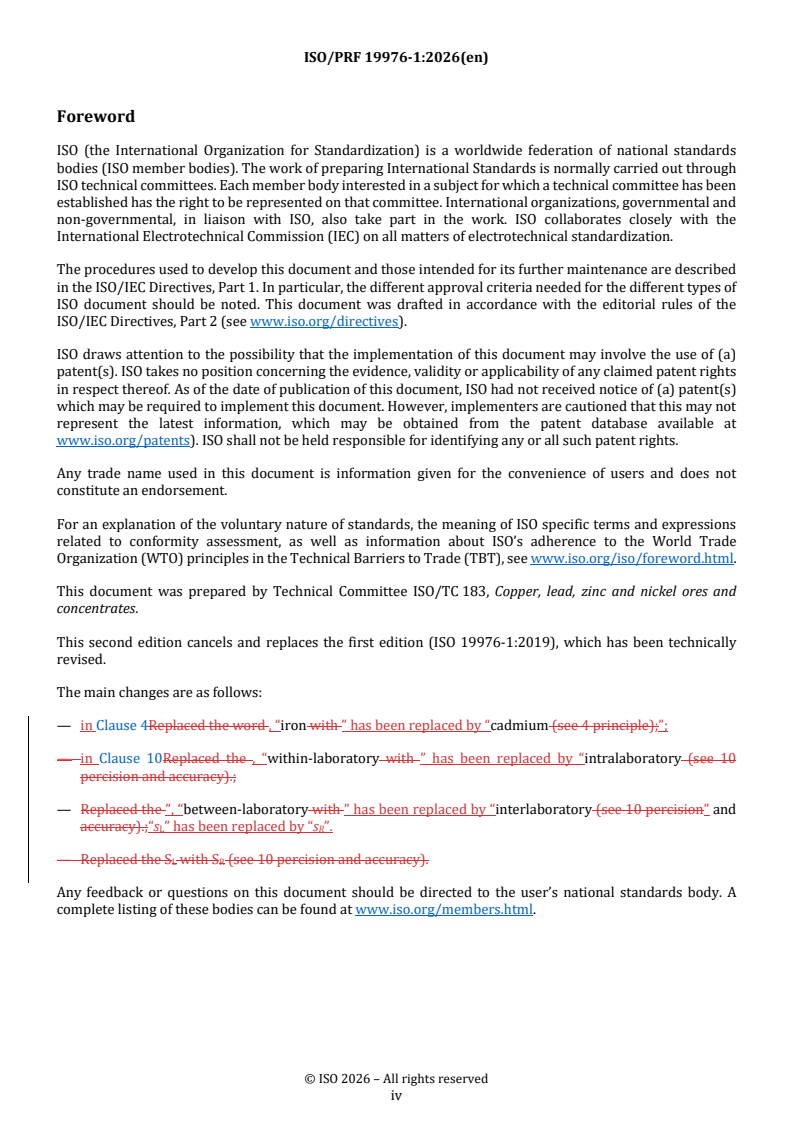
ISO/PRF 19976-1 replaces ISO 19976-1:2019 and is described as technically revised. The stated changes are a revision of Clause 4 to refer to cadmium in the principle, and terminology updates in Clause 10 from within-laboratory and between-laboratory wording to intralaboratory and interlaboratory wording, together with updated precision symbols.
Which standards are used with ISO/PRF 19976-1?
- ISO 385 - defines the burettes used for volumetric work.
- ISO 648 - covers single-volume pipettes used to prepare calibration and test solutions.
- ISO 1042 - covers one-mark volumetric flasks used for dilution.
- ISO 4787 - gives methods for testing and using volumetric instruments.
- ISO 9599 - provides the hygroscopic moisture method used in the cadmium calculation.
- ISO 12743 - gives the sampling procedures for metal and moisture content.
- ISO 33405 - sets how reference materials are characterized and assessed for homogeneity and stability.
What does the ISO/PRF 19976-1 document contain?
The document contains the full analytical sequence from sampling through reporting. It includes the chemical dissolution procedure, the reagent list and preparation instructions, apparatus requirements, the sample-handling steps, the calibration and measurement procedure, the result formula, precision equations, and the test report items.
Table 1 gives the dilution guide used to place the test solution in the calibration range. Annex A gives a drying-and-weighing method for predried test portions, and Annex B gives the flowchart for deciding the final result from duplicate measurements. The bibliography identifies ISO 9599 as the moisture method used in the calculation.
Relations
- Effective Date
- 30-Oct-2025
Buy Documents
ISO/PRF 19976-1 - Copper, lead and zinc sulfide concentrates — Determination of cadmium — Part 1: Flame atomic absorption spectrometric method
REDLINE ISO/PRF 19976-1 - Copper, lead and zinc sulfide concentrates — Determination of cadmium — Part 1: Flame atomic absorption spectrometric method
Get Certified
Connect with accredited certification bodies for this standard

Bureau Veritas Chile
Bureau Veritas certification services in Chile.
Bureau Veritas Peru
Bureau Veritas certification services in Peru.
BVQI Peru
Bureau Veritas certification in Peru.
Sponsored listings
Frequently Asked Questions
ISO/PRF 19976-1 is a draft published by the International Organization for Standardization (ISO). Its full title is "Copper, lead and zinc sulfide concentrates — Determination of cadmium — Part 1: Flame atomic absorption spectrometric method". This standard covers: This document specifies a flame atomic absorption spectrometric method for the determination of the mass fraction of cadmium in copper, lead and zinc sulfide concentrates as follows: a) for copper sulfide concentrates, the method is applicable to the determination of mass fractions of cadmium from 0,01 % to 0,30 %; b) for lead sulfide concentrates, the method is applicable to the determination of mass fractions of cadmium from 0,01 % to 0,30 %; c) for zinc sulfide concentrates, the method is applicable to the determination of mass fractions of cadmium from 0,05 % to 0,30 %.
This document specifies a flame atomic absorption spectrometric method for the determination of the mass fraction of cadmium in copper, lead and zinc sulfide concentrates as follows: a) for copper sulfide concentrates, the method is applicable to the determination of mass fractions of cadmium from 0,01 % to 0,30 %; b) for lead sulfide concentrates, the method is applicable to the determination of mass fractions of cadmium from 0,01 % to 0,30 %; c) for zinc sulfide concentrates, the method is applicable to the determination of mass fractions of cadmium from 0,05 % to 0,30 %.
ISO/PRF 19976-1 is classified under the following ICS (International Classification for Standards) categories: 73.060.99 - Other metalliferous minerals. The ICS classification helps identify the subject area and facilitates finding related standards.
ISO/PRF 19976-1 has the following relationships with other standards: It is inter standard links to ISO 19976-1:2019. Understanding these relationships helps ensure you are using the most current and applicable version of the standard.
ISO/PRF 19976-1 is available in PDF format for immediate download after purchase. The document can be added to your cart and obtained through the secure checkout process. Digital delivery ensures instant access to the complete standard document.
Standards Content (Sample)
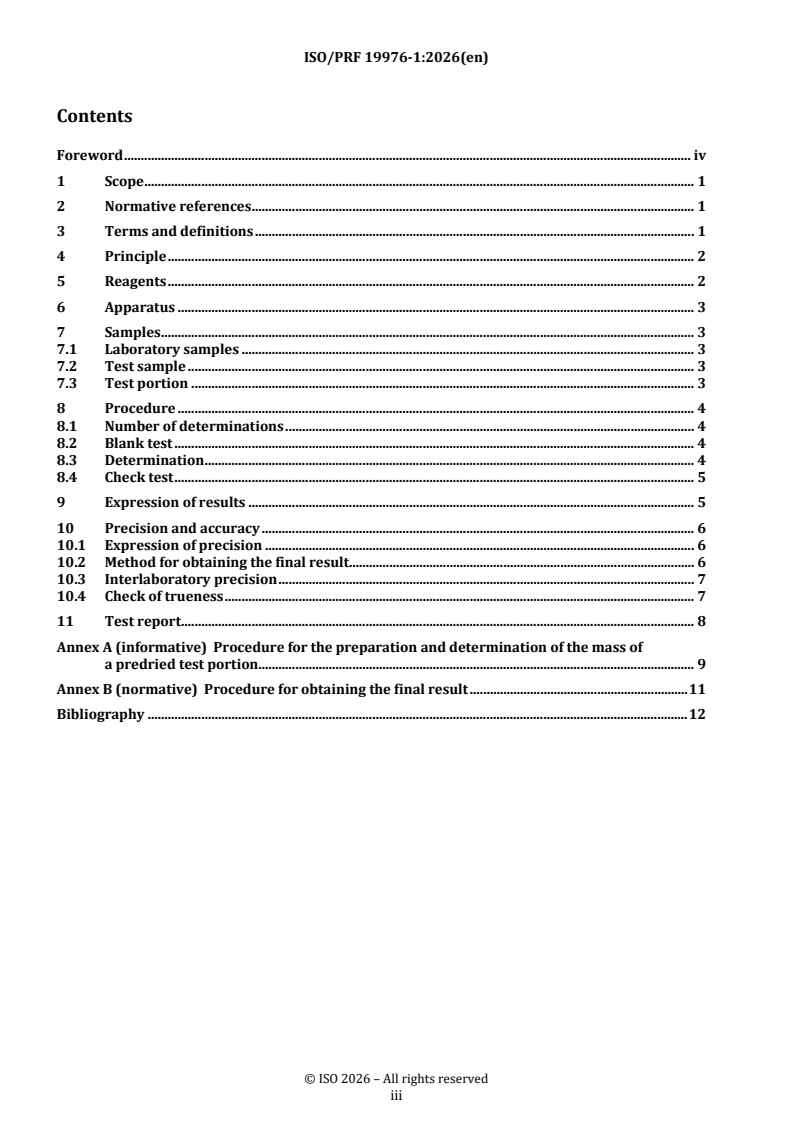
Contents
- 1 Scope
- 2 Normative references
- 3 Terms and definitions
- 4 Principle
- 5 Reagents
- 6 Apparatus
- 7 Samples
- 7.1 Laboratory samples
- 7.2 Test sample
- 7.3 Test portion
- 8 Procedure
- 8.1 Number of determinations
- 8.2 Blank test
- 8.3 Determination
- 8.4 Check test
- 9 Expression of results
- 10 Precision and accuracy
- 10.1 Expression of precision
- 10.2 Method for obtaining the final result
- 10.3 Interlaboratory precision
- 10.4 Check of trueness
- 11 Test report
- Annex A
- Annex B
- Bibliography
1 Scope
WARNING — The use of this document can involve hazardous materials, operations and equipment. It is the responsibility of the user of this document to establish appropriate health and safety practices. This document specifies a flame atomic absorption spectrometric method for the determination of the mass fraction of cadmium in copper, lead and zinc sulfide concentrates as follows:
a) for copper sulfide concentrates, the method is applicable to the determination of mass fractions of cadmium from 0,01 % to 0,30 %; b) for lead sulfide concentrates, the method is applicable to the determination of mass fractions of cadmium from 0,01 % to 0,30 %; c) for zinc sulfide concentrates, the method is applicable to the determination of mass fractions of cadmium from 0,05 % to 0,30 %.
2 Normative references
The following documents are referred to in the text in such a way that some or all of their content constitutes requirements of this document. For dated references, only the edition cited applies. For undated references, the latest edition of the referenced document (including any amendments) applies. ISO 385, Laboratory glassware — Burettes ISO 648, Laboratory glassware — Single-volume pipettes ISO 1042, Laboratory glassware — One-mark volumetric flasks ISO 4787, Laboratory glass and plastic ware — Volumetric instruments — Methods for testing of capacity and for use ISO 9599, Copper, lead, zinc and nickel sulfide concentrates — Determination of hygroscopic moisture content of the analysis sample — Gravimetric method ISO 12743, Copper, lead, zinc and nickel concentrates — Sampling procedures for determination of metal and moisture content ISO 33405, Reference materials — Approaches for characterization and assessment of homogeneity and stability
3 Terms and definitions
No terms and definitions are listed in this document.
ISO and IEC maintain terminology databases for use in standardization at the following addresses:
- ISO Online browsing platform: available at https:// www .iso .org/ obp PROOF/ÉPREUVE
ISO 19976-1:2026(en) - IEC Electropedia: available at http:// www .electropedia .org/
4 Principle
The test portion is dissolved in hydrochloric acid and nitric acid. Hydrofluoric acid is added to remove silicon. Then perchloric acid is added and the cadmium concentration in the test portion is determined using an atomic absorption spectrometer (AAS) with a deuterium lamp for background correction at 228,8 nm.
5 Reagents
During the analysis, use only reagents of recognized analytical grade and distilled water or water of equivalent purity.
5.1 Hydrochloric acid, concentrated (ρ 1,19 g/ml).
5.2 Hydrochloric acid, diluted 1+1.
Slowly add 500 ml of concentrated hydrochloric acid (5.1) to 500 ml of water, while stirring. 5.3 Hydrochloric acid, diluted 1+9.
Slowly add 50 ml of concentrated hydrochloric acid (5.1) to 450 ml of water, while stirring. 5.4 Nitric acid, concentrated (ρ 1,42 g/ml).
5.5 Hydrofluoric acid, concentrated (ρ 1,15 g/ml).
5.6 Perchloric acid, concentrated (ρ 1,70 g/ml).
5.7 Cadmium metal, minimum purity 99,99 %.
5.8 Cadmium, standard solution, 1 ml contains 1 mg of Cd.
Weigh, to the nearest 0,1 mg, 1,000 0 g of cadmium metal (5.7) into a 250 ml beaker. Add 10 ml of water and 5 ml of nitric acid (5.4). Cover and warm gently (if necessary) until the cadmium metal is dissolved. Heat to remove nitrogen oxides, then allow to cool and add about 50 ml of water. Transfer the solution to a 1 000 ml one-mark volumetric flask, add 40 ml of hydrochloric acid (5.2), fill up nearly to the mark with water, mix and cool to room temperature, then fill up exactly to the mark with water and mix again. 5.9 Cadmium, standard solution, 1 ml contains 100 μg of Cd.
Pipette 10,00 ml of cadmium standard solution (5.8) into a 100 ml one-mark volumetric flask. Add 20 ml of hydrochloric acid (5.2), fill up nearly to the mark with water, mix and cool to room temperature. Then, fill up exactly to the mark with water and mix again.
5.10 Cadmium, standard solution, 1 ml contains 10 μg of Cd.
Pipette 10,00 ml of cadmium standard solution (5.9) into a 100 ml one-mark volumetric flask. Add 18 ml of hydrochloric acid (5.2), fill up nearly to the mark with water, mix and cool to room temperature. Then, fill up exactly to the mark with water and mix again.
5.11 Cadmium calibration solutions.
Prepare a series of calibration solutions by adding, from a pipette, 0,0 ml, 2,00 ml, 4,00 ml, 6,00 ml, 7,00 ml, 8,00 ml, 9,00 ml and 10,00 ml of cadmium standard solution (5.10) into a series of 100 ml one-mark volumetric flasks. Dilute to the mark with hydrochloric acid (5.3) and mix thoroughly. PROOF/ÉPREUVE
ISO 19976-1:2026(en) These standards contain 0,0 μg, 0,2 μg, 0,4 μg, 0,6 μg, 0,7 μg, 0,8 μg, 0,9 μg and 1,0 μg of cadmium per ml and shall be freshly prepared.
Calibration solutions should be prepared at the same ambient temperature as that at which the determinations are conducted.
6 Apparatus
Ordinary laboratory equipment and the following shall be used. 6.1 Volumetric glassware, of class A conforming to ISO 385, ISO 648 and ISO 1042, and used in accordance with ISO 4787.
Other measuring instruments, approved types, auxiliary devices and materials may be used, provided that their technical and metrological characteristics are not inferior to those of the referenced standards. 6.2 Polytetrafluoroethylene beaker, of capacity 200 ml, or a glass-carbon beaker. 6.3 Analytical balance, sensitive to 0,1 mg.
6.4 AAS, equipped with a cadmium hollow cathode lamp and a deuterium lamp for background correction. The following instrument conditions should be used:
- Flame: air-acetylene.
- Wavelength: 228,8 nm.
- Slit width: 0,2 nm.
1) 6.5 Insoluble filter paper, Whatman® No. 40 or equivalent.
7 Samples
7.1 Laboratory samples
Laboratory samples shall be taken and prepared in accordance with the procedures described in ISO 12743.
7.2 Test sample
Prepare an air-equilibrated test sample in accordance with ISO 9599. NOTE A test sample is not required if predried test portions are to be used (see Annex A).
7.3 Test portion
Taking multiple increments, extract approximately 0,50 g from the test sample and weigh to the nearest 0,1 mg. At the same time as test portions are being weighed for analysis, weigh test portions for the determination of hygroscopic moisture in accordance with ISO 9599. Alternatively, the method specified in Annex A can be used to prepare predried test portions directly from the laboratory sample.
1) This information is given for the convenience of users of this document and does not constitute an endorsement by ISO of the product named. Equivalent products may be used if they can be shown to lead to the same results. PROOF/ÉPREUVE
ISO 19976-1:2026(en)
8 Procedure
8.1 Number of determinations
Carry out the determinations at least in duplicate, as far as possible under repeatability conditions, on each test sample.
...
Contents
- 1 Scope
- 2 Normative references
- 3 Terms and definitions
- 4 Principle
- 5 Reagents
- 6 Apparatus
- 7 Samples
- 7.1 Laboratory samplesamples
- 7.2 Test sample
- 7.3 Test portion
- 8 Procedure
- 8.1 Number of determinations
- 8.2 Blank test
- 8.3 Determination
- 8.4 Check test
- 9 Expression of results
- 10 Precision and accuracy
- 10.1 Expression of precision
- 10.2 Method for obtaining the final result
- 10.3 Interlaboratory precision
- 10.4 Check of trueness
- 11 Test report
- Annex A
- Annex B
- Bibliography
1 Scope
WARNING — The use of this document can involve hazardous materials, operations and equipment. It is the responsibility of the user of this document to establish appropriate health and safety practices. This document specifies a flame atomic absorption spectrometric method for the determination of the mass fraction of cadmium in copper, lead and zinc sulfide concentrates as follows:
a) for copper sulfide concentrates, the method is applicable to the determination of mass fractions of cadmium from 0,01 % to 0,30 %; b) for lead sulfide concentrates, the method is applicable to the determination of mass fractions of cadmium from 0,01 % to 0,30 %; c) for zinc sulfide concentrates, the method is applicable to the determination of mass fractions of cadmium from 0,05 % to 0,30 %.
2 Normative references
The following documents are referred to in the text in such a way that some or all of their content constitutes requirements of this document. For dated references, only the edition cited applies. For undated references, the latest edition of the referenced document (including any amendments) applies. ISO 385, Laboratory glassware — Burettes ISO 648, Laboratory glassware — Single-volume pipettes ISO 1042, Laboratory glassware — One-mark volumetric flasks ISO 4787, Laboratory glass and plastic ware — Volumetric instruments — Methods for testing of capacity and for use ISO 9599, Copper, lead, zinc and nickel sulfide concentrates — Determination of hygroscopic moisture content of the analysis sample — Gravimetric method ISO 12743, Copper, lead, zinc and nickel concentrates — Sampling procedures for determination of metal and moisture content ISO 33405, Reference materials — Approaches for characterization and assessment of homogeneity and stability
3 Terms and definitions
No terms and definitions are listed in this document.
ISO and IEC maintain terminology databases for use in standardization at the following addresses:
- ISO Online browsing platform: available at https://www.iso.org/obp
ISO/PRF 19976-1:2026(en) - IEC Electropedia: available at http://www.electropedia.org/
4 Principle
The test portion is dissolved in hydrochloric acid and nitric acid. Hydrofluoric acid is added to remove silicon. Then perchloric acid is added and the cadmium concentration in the test portion is determined using an atomic absorption spectrometer (AAS) with a deuterium lamp for background correction at 228,8 nm.
5 Reagents
During the analysis, use only reagents of recognized analytical grade and distilled water or water of equivalent purity.
5.1 Hydrochloric acid, concentrated (ρ 1,19 g/ml).
5.2 Hydrochloric acid, diluted 1+1.
Slowly add 500 ml of concentrated hydrochloric acid (5.1) to 500 ml of water, while stirring. 5.3 Hydrochloric acid, diluted 1+9.
Slowly add 50 ml of concentrated hydrochloric acid (5.1) to 450 ml of water, while stirring. 5.4 Nitric acid, concentrated (ρ 1,42 g/ml).
5.5 Hydrofluoric acid, concentrated (ρ 1,15 g/ml).
5.6 Perchloric acid, concentrated (ρ 1,70 g/ml).
5.7 Cadmium metal, minimum purity 99,99 %.
5.8 Cadmium, standard solution, 1 ml contains 1 mg of Cd.
Weigh, to the nearest 0,1 mg, 1,000 0 g of cadmium metal (5.7) into a 250 ml beaker. Add 10 ml of water and 5 ml of nitric acid (5.4). Cover and warm gently (if necessary) until the cadmium metal is dissolved. Heat to remove nitrogen oxides, then allow to cool and add about 50 ml of water. Transfer the solution to a 1 000 ml one-mark volumetric flask, add 40 ml of hydrochloric acid (5.2), fill up nearly to the mark with water, mix and cool to room temperature, then fill up exactly to the mark with water and mix again. 5.9 Cadmium, standard solution, 1 ml contains 100 μg of Cd.
Pipette 10,00 ml of cadmium standard solution (5.8) into a 100 ml one-mark volumetric flask. Add 20 ml of hydrochloric acid (5.2), fill up nearly to the mark with water, mix and cool to room temperature, then. Then, fill up exactly to the mark with water and mix again.
5.10 Cadmium, standard solution, 1 ml contains 10 μg of Cd.
Pipette 10,00 ml of cadmium standard solution (5.9) into a 100 ml one-mark volumetric flask. Add 18 ml of hydrochloric acid (5.2), fill up nearly to the mark with water, mix and cool to room temperature, then. Then, fill up exactly to the mark with water and mix again.
5.11 Cadmium calibration solutions.
Prepare a series of calibration solutions by adding, from a pipette, 0,0 ml, 2,00 ml, 4,00 ml, 6,00 ml, 7,00 ml, 8,00 ml, 9,00 ml and 10,00 ml of cadmium standard solution (5.10) into a series of 100 ml one-mark volumetric flasks. Dilute to the mark with hydrochloric acid (5.3) and mix thoroughly.
ISO/PRF 19976-1:2026(en) These standards contain 0,0 µg μg, 0,2 µg μg, 0,4 µg μg, 0,6 µg μg, 0,7 µg μg, 0,8 µg μg, 0,9 µg μg and 1,0 µg μg of cadmium per ml and shall be freshly prepared.
Calibration solutions should be prepared at the same ambient temperature as that at which the determinations will beare conducted.
6 Apparatus
Ordinary laboratory equipment and the following shall be used. 6.1 Volumetric glassware, of class A conforming to ISO 385, ISO 648 and ISO 1042, and used in accordance with ISO 4787.
It is permissible to use otherOther measuring instruments, approved types, auxiliary devices and materials whosemay be used, provided that their technical and metrological characteristics are not inferior to those mentioned aboveof the referenced standards.
6.2 Polytetrafluoroethylene beaker, of capacity 200 ml, or a glass-carbon beaker. 6.3 Analytical balance, sensitive to 0,1 mg.
6.4 AAS, equipped with a cadmium hollow cathode lamp and a deuterium lamp for background correction. The following instrument conditions should be used:
- flameFlame: air-acetylene;.
- wavelengthWavelength: 228,8 nm;.
- slitSlit width: 0,2 nm.
1) 6.5 InsolublesInsoluble filter paper, Whatman® No. 40 or equivalent.
7 Samples
7.1 Laboratory samplesamples
Laboratory samples shall be taken and prepared in accordance with the procedures described in ISO 12743.
7.2 Test sample
Prepare an air-equilibrated test sample in accordance with ISO 9599. NOTE A test sample is not required if pre-driedpredried test portions are to be used (see Annex A).
7.3 Test portion
Taking multiple increments, extract approximately 0,50 g from the test sample and weigh to the nearest 0,1 mg. At the same time as test portions are being weighed for analysis, weigh test portions for the determination of hygroscopic moisture in accordance with ISO 9599.
1) This information is given for the convenience of users of this document and does not constitute an endorsement by ISO of the product named. Equivalent products may be used if they can be shown to lead to the same results.
ISO/PRF 19976-1:2026(en) Alternatively, the method specified in Annex A can be used to prepare pre-driedpredried test portions directly from the laboratory sample.
8 Procedure
8.1 Number of determinations
Carry out the determinations at least in duplicate, as far as possible under repeatability conditions, on each test sample.
NOTE Repeatability conditions exist wherewhen mutually independent test results are obtained with the same method on identical test material in the same laboratory by the same operator using the same equipment, within short intervals of time.
...