

ISO 12759-3:2019
(Main)Fans — Efficiency classification for fans — Part 3: Fans without drives at maximum operating speed
General Information
- Abstract
This document establishes a system for the classification of fan efficiency for all fan types which have a nominal fan shaft power rating of 0,125 kW and above. This document is applicable to fans only. It does not apply to drives or the system in which fans are installed. This document can be used by legislators or regulatory bodies for defining future energy saving targets.
- Status
- Published
- Publication Date
- 10-Mar-2019
- Technical Committee
- ISO/TC 117 - Fans
- Drafting Committee
- ISO/TC 117/WG 11 - Energy efficiency classification
- Current Stage
- 9060 - Close of review
- Completion Date
- 02-Sep-2029
Buy Documents


ISO 12759-3:2019 - Fans -- Efficiency classification for fans
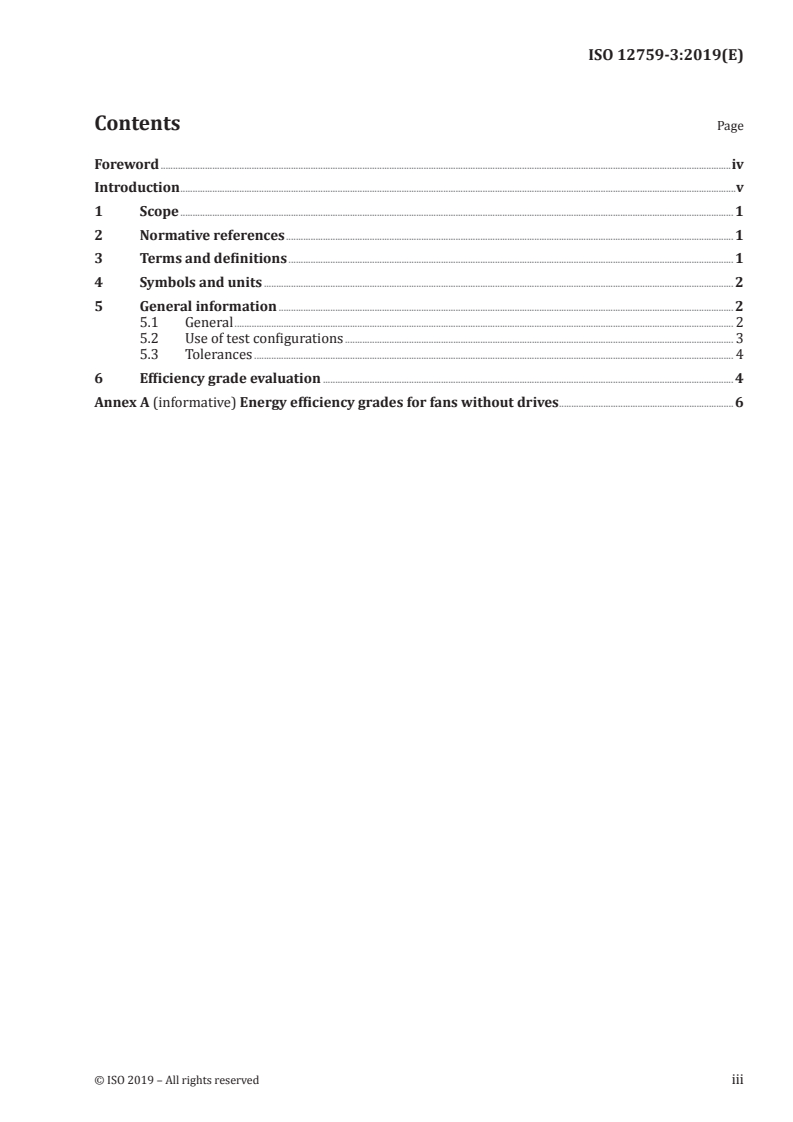

ISO 12759-3:2019 - Fans — Efficiency classification for fans — Part 3: Fans without drives at maximum operating speed/11/2019



ISO 12759-3:2019 - Ventilateurs -- Classification du rendement des ventilateurs
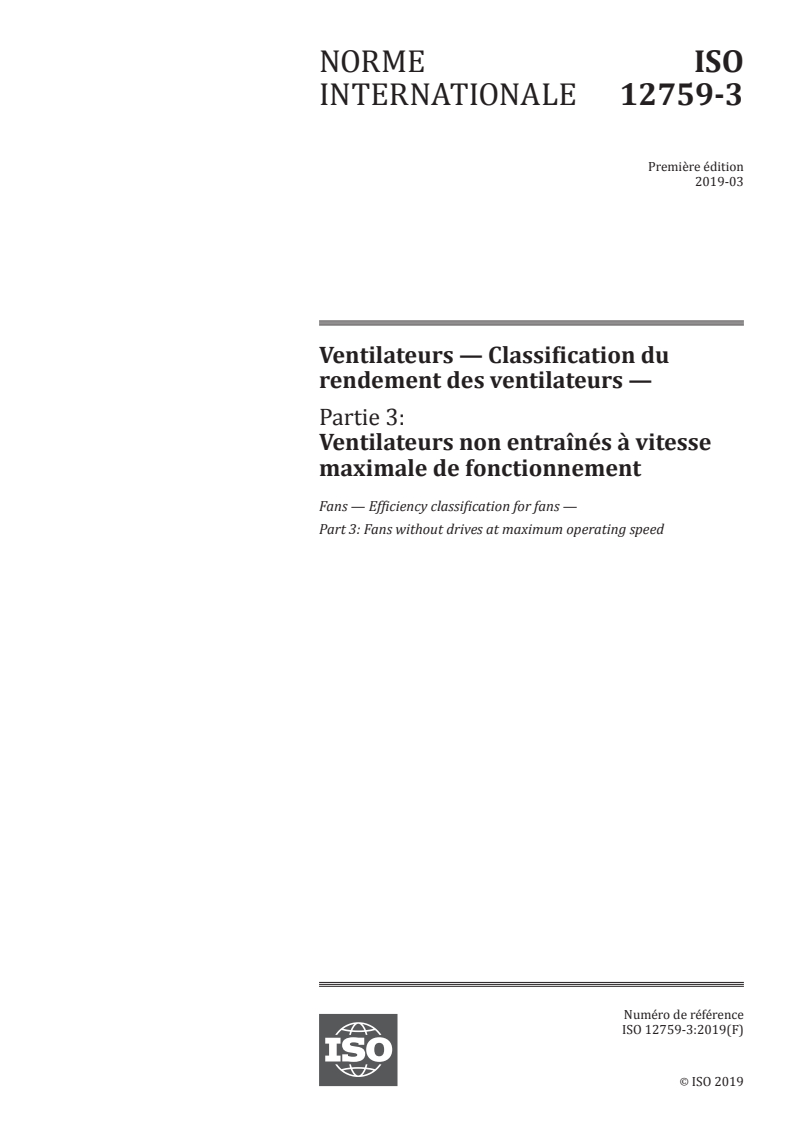

ISO 12759-3:2019 - Ventilateurs — Classification du rendement des ventilateurs — Partie 3: Ventilateurs non entraînés à vitesse maximale de fonctionnement/11/2019
Overview
ISO 12759-3:2019 - Fans - Efficiency classification for fans - Part 3: Fans without drives at maximum operating speed establishes a uniform system to classify the energy efficiency of fans that have no attached drive (impeller-only or “fan without drives”) and a nominal shaft power ≥ 0.125 kW. The standard defines how to determine a fan’s optimum (peak) efficiency at its maximum permissible rotational speed and assigns a Fan Efficiency Grade (FEG) (for example FEG85, FEG80, FEG71) based on the best-efficiency point. It is intended for manufacturers, test laboratories and regulators and can be used by legislators to set energy-saving targets.
Key topics and requirements
- Scope and applicability: Applies to fans only (not motors, belts, VFDs or broader systems); nominal shaft power 0.125 kW and above.
- Efficiency metric: Efficiency is taken at the fan’s best-efficiency point (optimum efficiency) at maximum operating speed.
- FEG classification: Defines fixed efficiency grades (FEG50 through FEG90 ranges) tied to fan impeller diameter; a fan’s grade is determined by comparing its peak efficiency to grade boundary curves. Annex A provides the boundary Formula (A.1) and constants plus tabulated grade limits (Table A.2).
- Testing and configurations: Manufacturers shall declare the test configuration used. Four standardized configurations (Categories A–D from ISO 5801:2017) are referenced for determining the operating point.
- Normative references and tolerances: Relies on ISO 5801 (performance testing), ISO 13348 (tolerances and data presentation) and ISO 13349 (vocabulary). Specified measurement tolerances and conversion methods apply.
- Labeling rules: A fan is assigned an FEG when its optimum efficiency falls between the upper and lower limits for its size; no FEG is assigned below FEG50.
Applications and users
- Manufacturers: design verification, product certification, marketing and performance claims.
- Test laboratories: standardized test methods and reporting for consistent FEG assignment.
- Regulators and legislators: defining minimum efficiency requirements and energy-saving targets for fan products.
- Specifiers, purchasers and energy auditors: comparing fan options for HVAC, ventilation, process engineering, drying, pneumatic conveying and agricultural fans.
Related standards
- ISO 5801:2017 - Fans - Performance testing using standardized airways
- ISO 13348:2007 - Industrial fans - Tolerances, methods of conversion and technical data presentation
- ISO 13349 - Fans - Vocabulary and definitions
Keywords: ISO 12759-3:2019, fan efficiency classification, fans without drives, Fan Efficiency Grade (FEG), best efficiency point, ISO 5801, energy efficiency for fans.
Relations
- Effective Date
- 12-Feb-2026
- Effective Date
- 06-Jun-2022
- Effective Date
- 11-Oct-2014
- Effective Date
- 11-Oct-2014
Buy Documents
ISO 12759-3:2019 - Fans -- Efficiency classification for fans
ISO 12759-3:2019 - Fans — Efficiency classification for fans — Part 3: Fans without drives at maximum operating speed/11/2019
ISO 12759-3:2019 - Ventilateurs -- Classification du rendement des ventilateurs
ISO 12759-3:2019 - Ventilateurs — Classification du rendement des ventilateurs — Partie 3: Ventilateurs non entraînés à vitesse maximale de fonctionnement/11/2019
Get Certified
Connect with accredited certification bodies for this standard

Institut za varilstvo d.o.o. (Welding Institute)
Slovenia's leading welding institute since 1952. ISO 3834, EN 1090, pressure equipment certification, NDT personnel, welder qualification. Only IIW Au
Sponsored listings
Frequently Asked Questions
ISO 12759-3:2019 is a standard published by the International Organization for Standardization (ISO). Its full title is "Fans — Efficiency classification for fans — Part 3: Fans without drives at maximum operating speed". This standard covers: This document establishes a system for the classification of fan efficiency for all fan types which have a nominal fan shaft power rating of 0,125 kW and above. This document is applicable to fans only. It does not apply to drives or the system in which fans are installed. This document can be used by legislators or regulatory bodies for defining future energy saving targets.
This document establishes a system for the classification of fan efficiency for all fan types which have a nominal fan shaft power rating of 0,125 kW and above. This document is applicable to fans only. It does not apply to drives or the system in which fans are installed. This document can be used by legislators or regulatory bodies for defining future energy saving targets.
ISO 12759-3:2019 is classified under the following ICS (International Classification for Standards) categories: 23.120 - Ventilators. Fans. Air-conditioners. The ICS classification helps identify the subject area and facilitates finding related standards.
ISO 12759-3:2019 has the following relationships with other standards: It is inter standard links to prEN ISO 12759-3, ISO/TR 18637:2016, ISO 12759:2010/Amd 1:2013, ISO 12759:2010. Understanding these relationships helps ensure you are using the most current and applicable version of the standard.
ISO 12759-3:2019 is available in PDF format for immediate download after purchase. The document can be added to your cart and obtained through the secure checkout process. Digital delivery ensures instant access to the complete standard document.
Standards Content (Sample)
INTERNATIONAL ISO
STANDARD 12759-3
First edition
2019-03
Fans — Efficiency classification for
fans —
Part 3:
Fans without drives at maximum
operating speed
Ventilateurs — Classification du rendement des ventilateurs —
Partie 3: Ventilateurs non entraînés à vitesse maximale de
fonctionnement
Reference number
©
ISO 2019
© ISO 2019
All rights reserved. Unless otherwise specified, or required in the context of its implementation, no part of this publication may
be reproduced or utilized otherwise in any form or by any means, electronic or mechanical, including photocopying, or posting
on the internet or an intranet, without prior written permission. Permission can be requested from either ISO at the address
below or ISO’s member body in the country of the requester.
ISO copyright office
CP 401 • Ch. de Blandonnet 8
CH-1214 Vernier, Geneva
Phone: +41 22 749 01 11
Fax: +41 22 749 09 47
Email: copyright@iso.org
Website: www.iso.org
Published in Switzerland
ii © ISO 2019 – All rights reserved
Contents Page
Foreword .iv
Introduction .v
1 Scope . 1
2 Normative references . 1
3 Terms and definitions . 1
4 Symbols and units . 2
5 General information . 2
5.1 General . 2
5.2 Use of test configurations . 3
5.3 Tolerances . 4
6 Efficiency grade evaluation . 4
Annex A (informative) Energy efficiency grades for fans without drives . 6
Foreword
ISO (the International Organization for Standardization) is a worldwide federation of national standards
bodies (ISO member bodies). The work of preparing International Standards is normally carried out
through ISO technical committees. Each member body interested in a subject for which a technical
committee has been established has the right to be represented on that committee. International
organizations, governmental and non-governmental, in liaison with ISO, also take part in the work.
ISO collaborates closely with the International Electrotechnical Commission (IEC) on all matters of
electrotechnical standardization.
The procedures used to develop this document and those intended for its further maintenance are
described in the ISO/IEC Directives, Part 1. In particular, the different approval criteria needed for the
different types of ISO documents should be noted. This document was drafted in accordance with the
editorial rules of the ISO/IEC Directives, Part 2 (see www .iso .org/directives).
Attention is drawn to the possibility that some of the elements of this document may be the subject of
patent rights. ISO shall not be held responsible for identifying any or all such patent rights. Details of
any patent rights identified during the development of the document will be in the Introduction and/or
on the ISO list of patent declarations received (see www .iso .org/patents).
Any trade name used in this document is information given for the convenience of users and does not
constitute an endorsement.
For an explanation of the voluntary nature of standards, the meaning of ISO specific terms and
expressions related to conformity assessment, as well as information about ISO's adherence to the
World Trade Organization (WTO) principles in the Technical Barriers to Trade (TBT) see www .iso
.org/iso/foreword .html.
This document was prepared by Technical Committee ISO/TC 117, Fans.
This first edition cancels and replaces ISO 12759:2010, which has been technically revised. It also
incorporates the Amendment ISO 12759:2010/Amd.1:2013.
A list of all parts in the ISO 12759 series can be found on the ISO website.
Any feedback or questions on this document should be directed to the user’s national standards body. A
complete listing of these bodies can be found at www .iso .org/members .html.
iv © ISO 2019 – All rights reserved
Introduction
The last decade has seen both an escalation in the price and an increasing recognition of the finite life
of many of the fossil fuels currently used. There is also a belief by many that climatic change is due to
increasing levels of carbon dioxide in the atmosphere. This has led to many nations reviewing methods
of energy generation and usage.
To maintain economic growth there is therefore a need to promote energy efficiency. This requires
better selection of equipment by users and thus better design of this equipment by its manufacturers.
Fans of all types are used for ventilation and air conditioning, for process engineering (drying,
pneumatic conveying and combustion air supply) and for agriculture. Indeed, energy usage by fans has
been calculated to be nearly 20 % of total worldwide energy usage.
The fan industry is of a global nature, with a considerable degree of exporting and licensing. To
ensure that the defining fan performance characteristics are common throughout the world a series
of standards have been developed. It is the belief of the industry that there is now a need for minimum
efficiency standards to be recognized. To encourage their implementation, a classification system is
proposed which incorporates a series of efficiency bands. With improvements in technology and
manufacturing processes, the minimum efficiency levels can be reviewed and increased in time.
There have been comments concerning the long-standing definition of wide bands used in this
document so that, for example, a fan measured as having an efficiency of 68 % is classified as belonging
to class FEG71. In other parts of the ISO 12759 series fans are classified as belonging to a certain class
only if the measured value is equal to or greater than the class number.
Work is being undertaken to reach a more common approach between the various parts of the ISO 12759
series, for example by renaming the classes or by introducing narrower classes, so that a fan measured
with an efficiency of 68 % is said to belong to class FEG68.
INTERNATIONAL STANDARD ISO 12759-3:2019(E)
Fans — Efficiency classification for fans —
Part 3:
Fans without drives at maximum operating speed
1 Scope
This document establishes a system for the classification of fan efficiency for all fan types which have a
nominal fan shaft power rating of 0,125 kW and above. This document is applicable to fans only. It does
not apply to drives or the system in which fans are installed. This document can be used by legislators
or regulatory bodies for defining future energy saving targets.
2 Normative references
The following documents are referred to in the text in such a way that some or all of their content
constitutes requirements of this document. For dated references, only the edition cited applies. For
undated references, the latest edition of the referenced document (including any amendments) applies.
ISO 5801:2017, Fans — Performance testing using standardized airways
ISO 13348:2007, Industrial fans — Tolerances, methods of conversion and technical data presentation
ISO 13349, Fans — Vocabulary and definitions of categories
3 Terms and definitions
For the purposes of this document, the following terms and definitions apply.
ISO and IEC maintain terminological databases for use in standardization at the following addresses:
— ISO Online browsing platform: available at https: //www .iso .org/obp
— IEC Electropedia: available at http: //www .electropedia .org/
3.1
fan
rotary bladed machine which receives mechanical energy and utilizes it by means of one or more
impellers fitted with blades to maintain a continuous flow of air or other gas passing through it and
whose work per unit mass does not normally exceed 25 kJ/kg
Note 1 to entry: Fans are defined according to their test configuration, function, fluid path and operating
conditions (see ISO 13349).
3.2
fan size
nominal diameter of the impeller
3.3
drive
mechanism used to power the fan
Note 1 to entry: A drive can include the motor and any combination of devices such as couplings and mechanical
or electrical transmissions such as belts, chains, gears and variable frequency drives (VFDs).
3.4
fan without drives
fan without attachments or accessories
Note 1 to entry: See Figure 1.
3.5
optimum efficiency
maximum efficiency achieved on the fan air characteristic with all operational parameters, except the
air system resistance, being fixed
3.6
fan efficiency grade
FEG
value detailing the efficiency metric for a fan without drives
4 Symbols and units
The following primary symbols and units for the parameters listed shall be used.
Symbol Term Unit
d Fan size (diameter) mm
a
η Optimum efficiency Expressed as a decimal
opt
a
Efficiency in percent (%) divided by 100 equals the
...
INTERNATIONAL ISO
STANDARD 12759-3
First edition
2019-03
Fans — Efficiency classification for
fans —
Part 3:
Fans without drives at maximum
operating speed
Ventilateurs — Classification du rendement des ventilateurs —
Partie 3: Ventilateurs non entraînés à vitesse maximale de
fonctionnement
Reference number
©
ISO 2019
© ISO 2019
All rights reserved. Unless otherwise specified, or required in the context of its implementation, no part of this publication may
be reproduced or utilized otherwise in any form or by any means, electronic or mechanical, including photocopying, or posting
on the internet or an intranet, without prior written permission. Permission can be requested from either ISO at the address
below or ISO’s member body in the country of the requester.
ISO copyright office
CP 401 • Ch. de Blandonnet 8
CH-1214 Vernier, Geneva
Phone: +41 22 749 01 11
Fax: +41 22 749 09 47
Email: copyright@iso.org
Website: www.iso.org
Published in Switzerland
ii © ISO 2019 – All rights reserved
Contents Page
Foreword .iv
Introduction .v
1 Scope . 1
2 Normative references . 1
3 Terms and definitions . 1
4 Symbols and units . 2
5 General information . 2
5.1 General . 2
5.2 Use of test configurations . 3
5.3 Tolerances . 4
6 Efficiency grade evaluation . 4
Annex A (informative) Energy efficiency grades for fans without drives . 6
Foreword
ISO (the International Organization for Standardization) is a worldwide federation of national standards
bodies (ISO member bodies). The work of preparing International Standards is normally carried out
through ISO technical committees. Each member body interested in a subject for which a technical
committee has been established has the right to be represented on that committee. International
organizations, governmental and non-governmental, in liaison with ISO, also take part in the work.
ISO collaborates closely with the International Electrotechnical Commission (IEC) on all matters of
electrotechnical standardization.
The procedures used to develop this document and those intended for its further maintenance are
described in the ISO/IEC Directives, Part 1. In particular, the different approval criteria needed for the
different types of ISO documents should be noted. This document was drafted in accordance with the
editorial rules of the ISO/IEC Directives, Part 2 (see www .iso .org/directives).
Attention is drawn to the possibility that some of the elements of this document may be the subject of
patent rights. ISO shall not be held responsible for identifying any or all such patent rights. Details of
any patent rights identified during the development of the document will be in the Introduction and/or
on the ISO list of patent declarations received (see www .iso .org/patents).
Any trade name used in this document is information given for the convenience of users and does not
constitute an endorsement.
For an explanation of the voluntary nature of standards, the meaning of ISO specific terms and
expressions related to conformity assessment, as well as information about ISO's adherence to the
World Trade Organization (WTO) principles in the Technical Barriers to Trade (TBT) see www .iso
.org/iso/foreword .html.
This document was prepared by Technical Committee ISO/TC 117, Fans.
This first edition cancels and replaces ISO 12759:2010, which has been technically revised. It also
incorporates the Amendment ISO 12759:2010/Amd.1:2013.
A list of all parts in the ISO 12759 series can be found on the ISO website.
Any feedback or questions on this document should be directed to the user’s national standards body. A
complete listing of these bodies can be found at www .iso .org/members .html.
iv © ISO 2019 – All rights reserved
Introduction
The last decade has seen both an escalation in the price and an increasing recognition of the finite life
of many of the fossil fuels currently used. There is also a belief by many that climatic change is due to
increasing levels of carbon dioxide in the atmosphere. This has led to many nations reviewing methods
of energy generation and usage.
To maintain economic growth there is therefore a need to promote energy efficiency. This requires
better selection of equipment by users and thus better design of this equipment by its manufacturers.
Fans of all types are used for ventilation and air conditioning, for process engineering (drying,
pneumatic conveying and combustion air supply) and for agriculture. Indeed, energy usage by fans has
been calculated to be nearly 20 % of total worldwide energy usage.
The fan industry is of a global nature, with a considerable degree of exporting and licensing. To
ensure that the defining fan performance characteristics are common throughout the world a series
of standards have been developed. It is the belief of the industry that there is now a need for minimum
efficiency standards to be recognized. To encourage their implementation, a classification system is
proposed which incorporates a series of efficiency bands. With improvements in technology and
manufacturing processes, the minimum efficiency levels can be reviewed and increased in time.
There have been comments concerning the long-standing definition of wide bands used in this
document so that, for example, a fan measured as having an efficiency of 68 % is classified as belonging
to class FEG71. In other parts of the ISO 12759 series fans are classified as belonging to a certain class
only if the measured value is equal to or greater than the class number.
Work is being undertaken to reach a more common approach between the various parts of the ISO 12759
series, for example by renaming the classes or by introducing narrower classes, so that a fan measured
with an efficiency of 68 % is said to belong to class FEG68.
INTERNATIONAL STANDARD ISO 12759-3:2019(E)
Fans — Efficiency classification for fans —
Part 3:
Fans without drives at maximum operating speed
1 Scope
This document establishes a system for the classification of fan efficiency for all fan types which have a
nominal fan shaft power rating of 0,125 kW and above. This document is applicable to fans only. It does
not apply to drives or the system in which fans are installed. This document can be used by legislators
or regulatory bodies for defining future energy saving targets.
2 Normative references
The following documents are referred to in the text in such a way that some or all of their content
constitutes requirements of this document. For dated references, only the edition cited applies. For
undated references, the latest edition of the referenced document (including any amendments) applies.
ISO 5801:2017, Fans — Performance testing using standardized airways
ISO 13348:2007, Industrial fans — Tolerances, methods of conversion and technical data presentation
ISO 13349, Fans — Vocabulary and definitions of categories
3 Terms and definitions
For the purposes of this document, the following terms and definitions apply.
ISO and IEC maintain terminological databases for use in standardization at the following addresses:
— ISO Online browsing platform: available at https: //www .iso .org/obp
— IEC Electropedia: available at http: //www .electropedia .org/
3.1
fan
rotary bladed machine which receives mechanical energy and utilizes it by means of one or more
impellers fitted with blades to maintain a continuous flow of air or other gas passing through it and
whose work per unit mass does not normally exceed 25 kJ/kg
Note 1 to entry: Fans are defined according to their test configuration, function, fluid path and operating
conditions (see ISO 13349).
3.2
fan size
nominal diameter of the impeller
3.3
drive
mechanism used to power the fan
Note 1 to entry: A drive can include the motor and any combination of devices such as couplings and mechanical
or electrical transmissions such as belts, chains, gears and variable frequency drives (VFDs).
3.4
fan without drives
fan without attachments or accessories
Note 1 to entry: See Figure 1.
3.5
optimum efficiency
maximum efficiency achieved on the fan air characteristic with all operational parameters, except the
air system resistance, being fixed
3.6
fan efficiency grade
FEG
value detailing the efficiency metric for a fan without drives
4 Symbols and units
The following primary symbols and units for the parameters listed shall be used.
Symbol Term Unit
d Fan size (diameter) mm
a
η Optimum efficiency Expressed as a decimal
opt
a
Efficiency in percent (%) divided by 100 equals the
...
NORME ISO
INTERNATIONALE 12759-3
Première édition
2019-03
Ventilateurs — Classification du
rendement des ventilateurs —
Partie 3:
Ventilateurs non entraînés à vitesse
maximale de fonctionnement
Fans — Efficiency classification for fans —
Part 3: Fans without drives at maximum operating speed
Numéro de référence
©
ISO 2019
DOCUMENT PROTÉGÉ PAR COPYRIGHT
© ISO 2019
Tous droits réservés. Sauf prescription différente ou nécessité dans le contexte de sa mise en œuvre, aucune partie de cette
publication ne peut être reproduite ni utilisée sous quelque forme que ce soit et par aucun procédé, électronique ou mécanique,
y compris la photocopie, ou la diffusion sur l’internet ou sur un intranet, sans autorisation écrite préalable. Une autorisation peut
être demandée à l’ISO à l’adresse ci-après ou au comité membre de l’ISO dans le pays du demandeur.
ISO copyright office
Case postale 401 • Ch. de Blandonnet 8
CH-1214 Vernier, Genève
Tél.: +41 22 749 01 11
Fax: +41 22 749 09 47
E-mail: copyright@iso.org
Web: www.iso.org
Publié en Suisse
ii © ISO 2019 – Tous droits réservés
Sommaire Page
Avant-propos .iv
Introduction .v
1 Domaine d'application . 1
2 Références normatives . 1
3 Termes et définitions . 1
4 Symboles et unités . 2
5 Informations générales . 2
5.1 Généralités . 2
5.2 Utilisation des configurations d’essai. 3
5.3 Tolérances . 4
6 Évaluation de la classe de rendement . 4
Annexe A (informative) Classes de rendement des ventilateurs seuls . 6
Avant-propos
L'ISO (Organisation internationale de normalisation) est une fédération mondiale d'organismes
nationaux de normalisation (comités membres de l'ISO). L'élaboration des Normes internationales est
en général confiée aux comités techniques de l'ISO. Chaque comité membre intéressé par une étude
a le droit de faire partie du comité technique créé à cet effet. Les organisations internationales,
gouvernementales et non gouvernementales, en liaison avec l'ISO participent également aux travaux.
L'ISO collabore étroitement avec la Commission électrotechnique internationale (IEC) en ce qui
concerne la normalisation électrotechnique.
Les procédures utilisées pour élaborer le présent document et celles destinées à sa mise à jour sont
décrites dans les Directives ISO/IEC, Partie 1. Il convient, en particulier, de prendre note des différents
critères d'approbation requis pour les différents types de documents ISO. Le présent document a été
rédigé conformément aux règles de rédaction données dans les Directives ISO/IEC, Partie 2 (voir www
.iso .org/directives).
L'attention est attirée sur le fait que certains des éléments du présent document peuvent faire l'objet de
droits de propriété intellectuelle ou de droits analogues. L'ISO ne saurait être tenue pour responsable
de ne pas avoir identifié de tels droits de propriété et averti de leur existence. Les détails concernant
les références aux droits de propriété intellectuelle ou autres droits analogues identifiés lors de
l'élaboration du document sont indiqués dans l'Introduction et/ou dans la liste des déclarations de
brevets reçues par l'ISO (voir www .iso .org/brevets).
Les appellations commerciales éventuellement mentionnées dans le présent document sont données
pour information, par souci de commodité, à l’intention des utilisateurs et ne sauraient constituer un
engagement.
Pour une explication de la nature volontaire des normes, la signification des termes et expressions
spécifiques de l'ISO liés à l'évaluation de la conformité, ou pour toute information au sujet de l'adhésion
de l'ISO aux principes de l’Organisation mondiale du commerce (OMC) concernant les obstacles
techniques au commerce (OTC), voir www .iso .org/avant -propos.
Le présent document a été élaboré par le comité technique ISO/TC 117, Ventilateurs.
Cette première édition annule et remplace l'ISO 12759:2010 qui a fait l’objet d’une révision technique.
Elle incorpore également l’Amendement ISO 12759:2010/Amd.1:2013.
Une liste de toutes les parties de la série ISO 12759 se trouve sur le site web de l’ISO.
Il convient d’adresser tout retour ou toute question concernant le présent document à l’organisme
national de normalisation de l’utilisateur. La liste complète de ces organismes est disponible à l’adresse
www .iso .org/members .html.
iv © ISO 2019 – Tous droits réservés
Introduction
Au cours des dix dernières années, on a assisté non seulement à une escalade des prix, mais aussi à une
prise de conscience accrue des ressources limitées que constituent de nombreux combustibles fossiles
actuellement utilisés. On pense également que le changement climatique est dû à une augmentation
du dioxyde de carbone dans l'atmosphère. Tout cela a conduit de nombreuses nations à revoir leurs
méthodes de production et d'utilisation de l'énergie.
Afin de maintenir la croissance économique, il est donc nécessaire de promouvoir l'efficacité
énergétique. Cela implique que les utilisateurs choisissent mieux leurs équipements et donc que les
fabricants en améliorent la conception.
Des ventilateurs de tous types sont utilisés pour la ventilation et la climatisation, pour l’ingénierie des
procédés (séchage, transport pneumatique, alimentation en air de combustion) et pour l’agriculture.
En fait, des calculs ont montré que la consommation d'énergie par les ventilateurs représentait près de
20 % de l’utilisation mondiale.
L'industrie des ventilateurs est mondiale, avec un pourcentage important d'exportations et de
concessions de licences. Afin de garantir que la définition des caractéristiques de performance des
ventilateurs soit la même dans le monde entier, une série de normes a été élaborée. Ce secteur industriel
pense qu'il est désormais nécessaire de reconnaître le besoin d'élaborer des normes de rendement
minimal. Afin d'encourager leur mise en œuvre, un système de classification, constitué d'une série de
plages de rendement, est proposé. En fonction des améliorations des technologies et des procédés de
fabrication, les classes de rendement minimal pourront être révisées et augmentées par la suite.
Des observations ont été formulées au sujet de la définition traditionnelle des bandes larges utilisée
dans le présent document, par exemple, un ventilateur dont le rendement mesuré est de 68 % est classé
comme appartenant à la classe FEG71. Dans les autres parties de la série ISO 12759, les ventilateurs
sont classés comme appartenant à une certaine classe uniquement si la valeur mesurée est égale ou
supérieure au numéro de classe.
Des travaux sont en cours pour parvenir à une approche plus commune entre les différentes parties de
la série ISO 12759, par exemple en renommant les classes ou en introduisant des classes plus étroites,
de sorte qu'un ventilateur dont le rendement mesuré est de 68 % appartienne à la classe FEG68.
NORME INTERNATIONALE ISO 12759-3:2019(F)
Ventilateurs — Classification du rendement des
ventilateurs —
Partie 3:
Ventilateurs non entraînés à vitesse maximale de
fonctionnement
1 Domaine d'application
Le présent document établit un système de classification du rendement de tous les types de ventilateurs
ayant une puissance à l’arbre du ventilateur de 0,125 kW et plus. Le présent document s’applique
exclusivement aux ventilateurs. Il ne s’applique pas aux entraînements, ni aux systèmes dans lesquels les
ventilateurs sont installés. Le présent document peut être utilisé par les législateurs ou les organismes
de réglementation pour définir les cibles futures en matière d'économie d'énergie.
2 Références normatives
Les documents suivants sont cités dans le texte de sorte qu’ils constituent, pour tout ou partie de leur
contenu, des exigences du présent document. Pour les références datées, seule l’édition citée s’applique.
Pour les références non datées, la dernière édition du document de référence s'applique (y compris les
éventuels amendements).
ISO 5801:2017, Ventilateurs — Essais aérauliques sur circuits normalisés
ISO 13348:2007, Ventilateurs industriels — Tolérances, méthodes de conversion et présentation des
données techniques
ISO 13349, Ventilateurs — Vocabulaire et définitions des catégories
3 Termes et définitions
Pour les besoins du présent document, les termes et définitions suivants s’appliquent.
L’ISO et l’IEC tiennent à jour des bases de données terminologiques destinées à être utilisées en
normalisation, consultables aux adresses suivantes:
— ISO Online browsing platform: disponible à l’adresse https: //www .iso .org/obp
— IEC Electropedia: disponible à l’adresse http: //www .electropedia .org/
3.1
ventilateur
turbomachine qui reçoit de l'énergie mécanique et l'utilise à l'aide d'une ou plusieurs roues à aubes de
manière à entretenir un écoulement continu d'air ou d'un autre gaz qui le traverse et dont le travail
massique ne dépasse pas normalement 25 kJ/kg
Note 1 à l'article: Les ventilateurs sont définis en fonction de leur configuration d’essai, de leur fonction, de la
trajectoire du fluide et des conditions de fonctionnement (voir ISO 13349).
3.2
taille de ventilateur
diamètre nominal de la roue
3.3
entraînement
tout mécanisme utilisé pour entraîner le ventilateur
Note 1 à l'article: Un ventilateur peut comporter un moteur et toute combinaison d’appareils à savoir les couples et
les transmissions mécaniques ou électriques telles que les courroies, les chaînes, les engrenages et les variateurs
électroniques de vitesse (VFD).
3.4
ventilateur seul
ventilateur sans accessoires ou accouplements
Note 1 à l'article: Voir Figure 1.
3.5
rendement optimal
rendement maximal obtenu sur la caractéristique aéraulique du ventilateur, tous les paramètres
opérationnels, sauf la résistance du circuit d'air, étant fixes
3.6
classe de rendement du ventilateur seul
FEG
valeur détaillant la mesure de rendement d'un ventilateur seul
4 Symboles et unités
Les symboles et unités de base suivants doivent être utilisés pour les grandeurs énumérées.
Symbole Terme Unité
d Taille de ventilateur (diamètre) mm
η Rendement optimal Exprimé sous la forme
opt
a
d’un nombre décimal
a
Le rendement en pourcentage (%), divisé par 100 équivaut au rendement exprimé sous la forme d’un nombre décimal.
5 Informations générales
5.1 Généralités
Il existe plusieurs types de ventilateurs, du ventilateur fabriqué à l'unité pour un besoin précis aux
gammes de ventilateurs certifiées produites en série et en grandes quantités. Un
...
NORME ISO
INTERNATIONALE 12759-3
Première édition
2019-03
Ventilateurs — Classification du
rendement des ventilateurs —
Partie 3:
Ventilateurs non entraînés à vitesse
maximale de fonctionnement
Fans — Efficiency classification for fans —
Part 3: Fans without drives at maximum operating speed
Numéro de référence
©
ISO 2019
DOCUMENT PROTÉGÉ PAR COPYRIGHT
© ISO 2019
Tous droits réservés. Sauf prescription différente ou nécessité dans le contexte de sa mise en œuvre, aucune partie de cette
publication ne peut être reproduite ni utilisée sous quelque forme que ce soit et par aucun procédé, électronique ou mécanique,
y compris la photocopie, ou la diffusion sur l’internet ou sur un intranet, sans autorisation écrite préalable. Une autorisation peut
être demandée à l’ISO à l’adresse ci-après ou au comité membre de l’ISO dans le pays du demandeur.
ISO copyright office
Case postale 401 • Ch. de Blandonnet 8
CH-1214 Vernier, Genève
Tél.: +41 22 749 01 11
Fax: +41 22 749 09 47
E-mail: copyright@iso.org
Web: www.iso.org
Publié en Suisse
ii © ISO 2019 – Tous droits réservés
Sommaire Page
Avant-propos .iv
Introduction .v
1 Domaine d'application . 1
2 Références normatives . 1
3 Termes et définitions . 1
4 Symboles et unités . 2
5 Informations générales . 2
5.1 Généralités . 2
5.2 Utilisation des configurations d’essai. 3
5.3 Tolérances . 4
6 Évaluation de la classe de rendement . 4
Annexe A (informative) Classes de rendement des ventilateurs seuls . 6
Avant-propos
L'ISO (Organisation internationale de normalisation) est une fédération mondiale d'organismes
nationaux de normalisation (comités membres de l'ISO). L'élaboration des Normes internationales est
en général confiée aux comités techniques de l'ISO. Chaque comité membre intéressé par une étude
a le droit de faire partie du comité technique créé à cet effet. Les organisations internationales,
gouvernementales et non gouvernementales, en liaison avec l'ISO participent également aux travaux.
L'ISO collabore étroitement avec la Commission électrotechnique internationale (IEC) en ce qui
concerne la normalisation électrotechnique.
Les procédures utilisées pour élaborer le présent document et celles destinées à sa mise à jour sont
décrites dans les Directives ISO/IEC, Partie 1. Il convient, en particulier, de prendre note des différents
critères d'approbation requis pour les différents types de documents ISO. Le présent document a été
rédigé conformément aux règles de rédaction données dans les Directives ISO/IEC, Partie 2 (voir www
.iso .org/directives).
L'attention est attirée sur le fait que certains des éléments du présent document peuvent faire l'objet de
droits de propriété intellectuelle ou de droits analogues. L'ISO ne saurait être tenue pour responsable
de ne pas avoir identifié de tels droits de propriété et averti de leur existence. Les détails concernant
les références aux droits de propriété intellectuelle ou autres droits analogues identifiés lors de
l'élaboration du document sont indiqués dans l'Introduction et/ou dans la liste des déclarations de
brevets reçues par l'ISO (voir www .iso .org/brevets).
Les appellations commerciales éventuellement mentionnées dans le présent document sont données
pour information, par souci de commodité, à l’intention des utilisateurs et ne sauraient constituer un
engagement.
Pour une explication de la nature volontaire des normes, la signification des termes et expressions
spécifiques de l'ISO liés à l'évaluation de la conformité, ou pour toute information au sujet de l'adhésion
de l'ISO aux principes de l’Organisation mondiale du commerce (OMC) concernant les obstacles
techniques au commerce (OTC), voir www .iso .org/avant -propos.
Le présent document a été élaboré par le comité technique ISO/TC 117, Ventilateurs.
Cette première édition annule et remplace l'ISO 12759:2010 qui a fait l’objet d’une révision technique.
Elle incorpore également l’Amendement ISO 12759:2010/Amd.1:2013.
Une liste de toutes les parties de la série ISO 12759 se trouve sur le site web de l’ISO.
Il convient d’adresser tout retour ou toute question concernant le présent document à l’organisme
national de normalisation de l’utilisateur. La liste complète de ces organismes est disponible à l’adresse
www .iso .org/members .html.
iv © ISO 2019 – Tous droits réservés
Introduction
Au cours des dix dernières années, on a assisté non seulement à une escalade des prix, mais aussi à une
prise de conscience accrue des ressources limitées que constituent de nombreux combustibles fossiles
actuellement utilisés. On pense également que le changement climatique est dû à une augmentation
du dioxyde de carbone dans l'atmosphère. Tout cela a conduit de nombreuses nations à revoir leurs
méthodes de production et d'utilisation de l'énergie.
Afin de maintenir la croissance économique, il est donc nécessaire de promouvoir l'efficacité
énergétique. Cela implique que les utilisateurs choisissent mieux leurs équipements et donc que les
fabricants en améliorent la conception.
Des ventilateurs de tous types sont utilisés pour la ventilation et la climatisation, pour l’ingénierie des
procédés (séchage, transport pneumatique, alimentation en air de combustion) et pour l’agriculture.
En fait, des calculs ont montré que la consommation d'énergie par les ventilateurs représentait près de
20 % de l’utilisation mondiale.
L'industrie des ventilateurs est mondiale, avec un pourcentage important d'exportations et de
concessions de licences. Afin de garantir que la définition des caractéristiques de performance des
ventilateurs soit la même dans le monde entier, une série de normes a été élaborée. Ce secteur industriel
pense qu'il est désormais nécessaire de reconnaître le besoin d'élaborer des normes de rendement
minimal. Afin d'encourager leur mise en œuvre, un système de classification, constitué d'une série de
plages de rendement, est proposé. En fonction des améliorations des technologies et des procédés de
fabrication, les classes de rendement minimal pourront être révisées et augmentées par la suite.
Des observations ont été formulées au sujet de la définition traditionnelle des bandes larges utilisée
dans le présent document, par exemple, un ventilateur dont le rendement mesuré est de 68 % est classé
comme appartenant à la classe FEG71. Dans les autres parties de la série ISO 12759, les ventilateurs
sont classés comme appartenant à une certaine classe uniquement si la valeur mesurée est égale ou
supérieure au numéro de classe.
Des travaux sont en cours pour parvenir à une approche plus commune entre les différentes parties de
la série ISO 12759, par exemple en renommant les classes ou en introduisant des classes plus étroites,
de sorte qu'un ventilateur dont le rendement mesuré est de 68 % appartienne à la classe FEG68.
NORME INTERNATIONALE ISO 12759-3:2019(F)
Ventilateurs — Classification du rendement des
ventilateurs —
Partie 3:
Ventilateurs non entraînés à vitesse maximale de
fonctionnement
1 Domaine d'application
Le présent document établit un système de classification du rendement de tous les types de ventilateurs
ayant une puissance à l’arbre du ventilateur de 0,125 kW et plus. Le présent document s’applique
exclusivement aux ventilateurs. Il ne s’applique pas aux entraînements, ni aux systèmes dans lesquels les
ventilateurs sont installés. Le présent document peut être utilisé par les législateurs ou les organismes
de réglementation pour définir les cibles futures en matière d'économie d'énergie.
2 Références normatives
Les documents suivants sont cités dans le texte de sorte qu’ils constituent, pour tout ou partie de leur
contenu, des exigences du présent document. Pour les références datées, seule l’édition citée s’applique.
Pour les références non datées, la dernière édition du document de référence s'applique (y compris les
éventuels amendements).
ISO 5801:2017, Ventilateurs — Essais aérauliques sur circuits normalisés
ISO 13348:2007, Ventilateurs industriels — Tolérances, méthodes de conversion et présentation des
données techniques
ISO 13349, Ventilateurs — Vocabulaire et définitions des catégories
3 Termes et définitions
Pour les besoins du présent document, les termes et définitions suivants s’appliquent.
L’ISO et l’IEC tiennent à jour des bases de données terminologiques destinées à être utilisées en
normalisation, consultables aux adresses suivantes:
— ISO Online browsing platform: disponible à l’adresse https: //www .iso .org/obp
— IEC Electropedia: disponible à l’adresse http: //www .electropedia .org/
3.1
ventilateur
turbomachine qui reçoit de l'énergie mécanique et l'utilise à l'aide d'une ou plusieurs roues à aubes de
manière à entretenir un écoulement continu d'air ou d'un autre gaz qui le traverse et dont le travail
massique ne dépasse pas normalement 25 kJ/kg
Note 1 à l'article: Les ventilateurs sont définis en fonction de leur configuration d’essai, de leur fonction, de la
trajectoire du fluide et des conditions de fonctionnement (voir ISO 13349).
3.2
taille de ventilateur
diamètre nominal de la roue
3.3
entraînement
tout mécanisme utilisé pour entraîner le ventilateur
Note 1 à l'article: Un ventilateur peut comporter un moteur et toute combinaison d’appareils à savoir les couples et
les transmissions mécaniques ou électriques telles que les courroies, les chaînes, les engrenages et les variateurs
électroniques de vitesse (VFD).
3.4
ventilateur seul
ventilateur sans accessoires ou accouplements
Note 1 à l'article: Voir Figure 1.
3.5
rendement optimal
rendement maximal obtenu sur la caractéristique aéraulique du ventilateur, tous les paramètres
opérationnels, sauf la résistance du circuit d'air, étant fixes
3.6
classe de rendement du ventilateur seul
FEG
valeur détaillant la mesure de rendement d'un ventilateur seul
4 Symboles et unités
Les symboles et unités de base suivants doivent être utilisés pour les grandeurs énumérées.
Symbole Terme Unité
d Taille de ventilateur (diamètre) mm
η Rendement optimal Exprimé sous la forme
opt
a
d’un nombre décimal
a
Le rendement en pourcentage (%), divisé par 100 équivaut au rendement exprimé sous la forme d’un nombre décimal.
5 Informations générales
5.1 Généralités
Il existe plusieurs types de ventilateurs, du ventilateur fabriqué à l'unité pour un besoin précis aux
gammes de ventilateurs certifiées produites en série et en grandes quantités. Un
...