


ISO 9211-3:2008
(Main)Optics and photonics — Optical coatings — Part 3: Environmental durability
Optics and photonics — Optical coatings — Part 3: Environmental durability
ISO 9211 identifies surface treatments of components and substrates excluding ophthalmic optics (spectacles) by the application of optical coatings and gives a standard form for their specification. It defines the general characteristics and the test and measurement methods whenever necessary. It is not intended to define the process method. ISO 9211-3:2008 specifies categories of use for optical coatings and identifies which environmental tests are necessary to prove that the coatings meet the required specification.
Optique et photonique — Traitements optiques — Partie 3: Durabilité environnementale
L'ISO 9211 décrit les traitements de surface des composants et des substrats, à l'exclusion de l'optique ophtalmique (lunettes), par l'application de traitements optiques, et normalise leur spécification. Elle définit les caractéristiques générales et les méthodes d'essai et de mesure toutes les fois où cela est nécessaire. Elle n'est pas destinée à définir la méthode de fabrication. L'ISO 9211-3:2008 spécifie les catégories d'utilisation des traitements optiques et identifie les essais d'environnement nécessaires pour prouver que les traitements répondent aux spécifications requises.
General Information
- Status
- Withdrawn
- Publication Date
- 22-Jun-2008
- Technical Committee
- ISO/TC 172/SC 3 - Optical materials and components
- Drafting Committee
- ISO/TC 172/SC 3/WG 2 - Coatings
- Current Stage
- 9599 - Withdrawal of International Standard
- Start Date
- 06-Feb-2024
- Completion Date
- 12-Feb-2026
Relations
- Effective Date
- 06-Jun-2022
- Effective Date
- 15-Apr-2008



Frequently Asked Questions
ISO 9211-3:2008 is a standard published by the International Organization for Standardization (ISO). Its full title is "Optics and photonics — Optical coatings — Part 3: Environmental durability". This standard covers: ISO 9211 identifies surface treatments of components and substrates excluding ophthalmic optics (spectacles) by the application of optical coatings and gives a standard form for their specification. It defines the general characteristics and the test and measurement methods whenever necessary. It is not intended to define the process method. ISO 9211-3:2008 specifies categories of use for optical coatings and identifies which environmental tests are necessary to prove that the coatings meet the required specification.
ISO 9211 identifies surface treatments of components and substrates excluding ophthalmic optics (spectacles) by the application of optical coatings and gives a standard form for their specification. It defines the general characteristics and the test and measurement methods whenever necessary. It is not intended to define the process method. ISO 9211-3:2008 specifies categories of use for optical coatings and identifies which environmental tests are necessary to prove that the coatings meet the required specification.
ISO 9211-3:2008 is classified under the following ICS (International Classification for Standards) categories: 37.020 - Optical equipment. The ICS classification helps identify the subject area and facilitates finding related standards.
ISO 9211-3:2008 has the following relationships with other standards: It is inter standard links to ISO 9211-3:2024, ISO 9211-3:1994. Understanding these relationships helps ensure you are using the most current and applicable version of the standard.
ISO 9211-3:2008 is available in PDF format for immediate download after purchase. The document can be added to your cart and obtained through the secure checkout process. Digital delivery ensures instant access to the complete standard document.
Standards Content (Sample)
INTERNATIONAL ISO
STANDARD 9211-3
Second edition
2008-07-01
Optics and photonics — Optical
coatings —
Part 3:
Environmental durability
Optique et photonique — Traitements optiques —
Partie 3: Durabilité environnementale
Reference number
©
ISO 2008
PDF disclaimer
This PDF file may contain embedded typefaces. In accordance with Adobe's licensing policy, this file may be printed or viewed but
shall not be edited unless the typefaces which are embedded are licensed to and installed on the computer performing the editing. In
downloading this file, parties accept therein the responsibility of not infringing Adobe's licensing policy. The ISO Central Secretariat
accepts no liability in this area.
Adobe is a trademark of Adobe Systems Incorporated.
Details of the software products used to create this PDF file can be found in the General Info relative to the file; the PDF-creation
parameters were optimized for printing. Every care has been taken to ensure that the file is suitable for use by ISO member bodies. In
the unlikely event that a problem relating to it is found, please inform the Central Secretariat at the address given below.
© ISO 2008
All rights reserved. Unless otherwise specified, no part of this publication may be reproduced or utilized in any form or by any means,
electronic or mechanical, including photocopying and microfilm, without permission in writing from either ISO at the address below or
ISO's member body in the country of the requester.
ISO copyright office
Case postale 56 • CH-1211 Geneva 20
Tel. + 41 22 749 01 11
Fax + 41 22 749 09 47
E-mail copyright@iso.org
Web www.iso.org
Published in Switzerland
ii © ISO 2008 – All rights reserved
Foreword
ISO (the International Organization for Standardization) is a worldwide federation of national standards bodies
(ISO member bodies). The work of preparing International Standards is normally carried out through ISO
technical committees. Each member body interested in a subject for which a technical committee has been
established has the right to be represented on that committee. International organizations, governmental and
non-governmental, in liaison with ISO, also take part in the work. ISO collaborates closely with the
International Electrotechnical Commission (IEC) on all matters of electrotechnical standardization.
International Standards are drafted in accordance with the rules given in the ISO/IEC Directives, Part 2.
The main task of technical committees is to prepare International Standards. Draft International Standards
adopted by the technical committees are circulated to the member bodies for voting. Publication as an
International Standard requires approval by at least 75 % of the member bodies casting a vote.
Attention is drawn to the possibility that some of the elements of this document may be the subject of patent
rights. ISO shall not be held responsible for identifying any or all such patent rights.
ISO 9211-3 was prepared by Technical Committee ISO/TC 172, Optics and photonics, Subcommittee SC 3,
Optical materials and components.
This second edition cancels and replaces the first edition (ISO 9211-3:1994) subclauses 3.1 to 3.5 of which
have been technically revised or deleted and renumbered; Table 1 of which has been expanded and
technically revised and Table 2 of which has been deleted and replaced by new informative Annex A.
ISO 9211 consists of the following parts, under the general title Optics and photonics — Optical coatings:
⎯ Part 1: Definitions
⎯ Part 2: Optical properties
⎯ Part 3: Environmental durability
⎯ Part 4: Specific test methods
INTERNATIONAL STANDARD ISO 9211-3:2008(E)
Optics and photonics — Optical coatings —
Part 3:
Environmental durability
1 Scope
ISO 9211 identifies surface treatments of components and substrates excluding ophthalmic optics
(spectacles) by the application of optical coatings and gives a standard form for their specification. It defines
the general characteristics and the test and measurement methods whenever necessary. It is not intended to
define the process method.
This part of ISO 9211 specifies categories of use for optical coatings and identifies which environmental tests
are necessary to prove that the coatings meet the required specification. Definitions and the extent of testing
are given in ISO 9022-1.
2 Normative references
The following referenced documents are indispensable for the application of this document. For dated
references, only the edition cited applies. For undated references, the latest edition of the referenced
document (including any amendments) applies.
ISO 9022-1, Optics and optical instruments — Environmental test methods — Part 1: Definitions, extent of
testing
ISO 9022-2, Optics and optical instruments — Environmental test methods — Part 2: Cold, heat and humidity
ISO 9022-4, Optics and optical instruments — Environmental test methods — Part 4: Salt mist
ISO 9022-6, Optics and optical instruments — Environmental test methods — Part 6: Dust
ISO 9022-9:1994, Optics and optical instruments — Environmental test methods — Part 9: Solar radiation
ISO 9022-11, Optics and optical instruments — Environmental test methods — Part 11: Mould growth
ISO 9022-12, Optics and optical instruments — Environmental test methods — Part 12: Contamination
ISO 9022-14, Optics and optical instruments — Environmental test methods — Part 14: Dew, hoarfrost, ice
ISO 9211-4, Optics and optical instruments — Optical coatings — Part 4: Specific test methods
3 Categories of use
3.1 Definitions of categories
Five categories of use are defined. Each category requires either different environmental tests and/or different
severity of testing. These categories are listed below in order of severity of requirement.
Category A
This category refers to components in applications which would normally only apply when they are to be
mounted internally within sealed units. In this category, handling is in a protected and controlled environment
and should only take place with extreme care. Physical contact with the optically coated surface is
discouraged.
Category B
This category refers to applications where components will be exposed only to a controlled environment. Such
applications may involve mild abrasion such as occurs with carefully controlled cleaning.
Category C
This category refers to applications where components will be exposed to normal outdoor ambient conditions
and cleaning but without severe abrasion and scratching.
Category D
This category refers to applications where components will be exposed to severe outdoor ambient conditions
and uncontrolled cleaning with the risk of severe abrasion and scratching.
Category O
This category refers to applications which require special, non standard, specifications. Since the specification
of the components in such cases will not exactly fit into one of the categories A to D, the recommended way to
specify in such a case is to indicate first the category in which most requirements are satisfied. The
exceptional requirements can then be specified from other categories or by indicating the test degree of
severity.
EXAMPLE “Category C; Abrasion, Humidity: Category B; Adhesion: 03”.
3.2 Operating and storage conditions
The temperature specifications listed in Table 1 are meant as storage conditions. For some types of coating,
e.g. bandpass filters and accurate edge filters, it may be necessary that spectral tolerances shall be
maintained within a certain temperature range. This should be specified separately, according to the
requirements of the application.
3.3 Influence of the substrate
It should be kept in mind that it is not the coating but the entire coating-substrate combination which
determines the category of use.
For instance, coatings on glass, normally satisfying category C, might not do so when applied to sensitive or
unstable substrates. This is likely to become apparent with the rain, solubility, humidity, heat, and salt spray
tests, for example.
3.4 Cemented coatings
This part of ISO 9211 does not apply to cemented coatings. The environmental stability of such a substrate-
coating-cement-substrate combination depends too much on properties of the cement, as well as the (relative)
properties, e.g. thermal expansion, of the two substrate components involved.
2 © ISO 2008 – All rights reserved
4 Specifications
The mechanical and chemical properties of coated optical elements, and more generally their environmental
durability, can be assessed by
...
NORME ISO
INTERNATIONALE 9211-3
Deuxième édition
2008-07-01
Optique et photonique — Traitements
optiques —
Partie 3:
Durabilité environnementale
Optics and photonics — Optical coatings —
Part 3: Environmental durability
Numéro de référence
©
ISO 2008
PDF – Exonération de responsabilité
Le présent fichier PDF peut contenir des polices de caractères intégrées. Conformément aux conditions de licence d'Adobe, ce fichier
peut être imprimé ou visualisé, mais ne doit pas être modifié à moins que l'ordinateur employé à cet effet ne bénéficie d'une licence
autorisant l'utilisation de ces polices et que celles-ci y soient installées. Lors du téléchargement de ce fichier, les parties concernées
acceptent de fait la responsabilité de ne pas enfreindre les conditions de licence d'Adobe. Le Secrétariat central de l'ISO décline toute
responsabilité en la matière.
Adobe est une marque déposée d'Adobe Systems Incorporated.
Les détails relatifs aux produits logiciels utilisés pour la création du présent fichier PDF sont disponibles dans la rubrique General Info
du fichier; les paramètres de création PDF ont été optimisés pour l'impression. Toutes les mesures ont été prises pour garantir
l'exploitation de ce fichier par les comités membres de l'ISO. Dans le cas peu probable où surviendrait un problème d'utilisation,
veuillez en informer le Secrétariat central à l'adresse donnée ci-dessous.
DOCUMENT PROTÉGÉ PAR COPYRIGHT
© ISO 2008
Droits de reproduction réservés. Sauf prescription différente, aucune partie de cette publication ne peut être reproduite ni utilisée sous
quelque forme que ce soit et par aucun procédé, électronique ou mécanique, y compris la photocopie et les microfilms, sans l'accord écrit
de l'ISO à l'adresse ci-après ou du comité membre de l'ISO dans le pays du demandeur.
ISO copyright office
Case postale 56 • CH-1211 Geneva 20
Tel. + 41 22 749 01 11
Fax + 41 22 749 09 47
E-mail copyright@iso.org
Web www.iso.org
Publié en Suisse
ii © ISO 2008 – Tous droits réservés
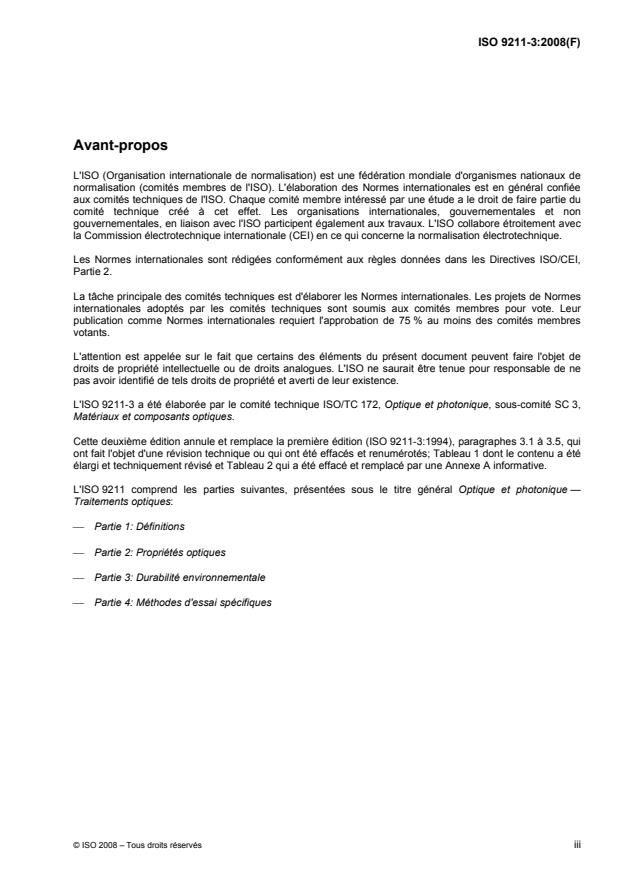
Avant-propos
L'ISO (Organisation internationale de normalisation) est une fédération mondiale d'organismes nationaux de
normalisation (comités membres de l'ISO). L'élaboration des Normes internationales est en général confiée
aux comités techniques de l'ISO. Chaque comité membre intéressé par une étude a le droit de faire partie du
comité technique créé à cet effet. Les organisations internationales, gouvernementales et non
gouvernementales, en liaison avec l'ISO participent également aux travaux. L'ISO collabore étroitement avec
la Commission électrotechnique internationale (CEI) en ce qui concerne la normalisation électrotechnique.
Les Normes internationales sont rédigées conformément aux règles données dans les Directives ISO/CEI,
Partie 2.
La tâche principale des comités techniques est d'élaborer les Normes internationales. Les projets de Normes
internationales adoptés par les comités techniques sont soumis aux comités membres pour vote. Leur
publication comme Normes internationales requiert l'approbation de 75 % au moins des comités membres
votants.
L'attention est appelée sur le fait que certains des éléments du présent document peuvent faire l'objet de
droits de propriété intellectuelle ou de droits analogues. L'ISO ne saurait être tenue pour responsable de ne
pas avoir identifié de tels droits de propriété et averti de leur existence.
L'ISO 9211-3 a été élaborée par le comité technique ISO/TC 172, Optique et photonique, sous-comité SC 3,
Matériaux et composants optiques.
Cette deuxième édition annule et remplace la première édition (ISO 9211-3:1994), paragraphes 3.1 à 3.5, qui
ont fait l'objet d'une révision technique ou qui ont été effacés et renumérotés; Tableau 1 dont le contenu a été
élargi et techniquement révisé et Tableau 2 qui a été effacé et remplacé par une Annexe A informative.
L'ISO 9211 comprend les parties suivantes, présentées sous le titre général Optique et photonique —
Traitements optiques:
⎯ Partie 1: Définitions
⎯ Partie 2: Propriétés optiques
⎯ Partie 3: Durabilité environnementale
⎯ Partie 4: Méthodes d'essai spécifiques
NORME INTERNATIONALE ISO 9211-3:2008(F)
Optique et photonique — Traitements optiques —
Partie 3:
Durabilité environnementale
1 Domaine d'application
L'ISO 9211 décrit les traitements de surface des composants et des substrats, à l'exclusion de l'optique
ophtalmique (lunettes), par l'application de traitements optiques, et normalise leur spécification. Elle définit les
caractéristiques générales et les méthodes d'essai et de mesure toutes les fois où cela est nécessaire. Elle
n'est pas destinée à définir la méthode de fabrication.
La présente partie de l'ISO 9211 spécifie les catégories d'utilisation des traitements optiques et identifie les
essais d'environnement nécessaires pour prouver que les traitements répondent aux spécifications requises.
Les définitions ainsi que la portée des essais sont données dans l'ISO 9022-1.
2 Références normatives
Les documents de référence suivants sont indispensables pour l'application du présent document. Pour les
références datées, seule l'édition citée s'applique. Pour les références non datées, la dernière édition du
document de référence s'applique (y compris les éventuels amendements).
ISO 9022-1, Optique et instruments d'optique — Méthodes d'essais d'environnement — Partie 1: Définitions,
portée des essais
ISO 9022-2, Optique et instruments d'optique — Méthodes d'essais d'environnement — Partie 2: Froid,
chaleur et humidité
ISO 9022-4, Optique et instruments d'optique — Méthodes d'essais d'environnement — Partie 4: Brouillard
salin
ISO 9022-6, Optique et instruments d'optique — Méthodes d'essais d'environnement — Partie 6: Poussière
ISO 9022-9:1994, Optique et instruments d'optique — Méthodes d'essais d'environnement — Partie 9:
Rayonnement solaire
ISO 9022-11, Optique et instruments d'optique — Méthodes d'essais d'environnement — Partie 11:
Moisissures
ISO 9022-12, Optique et instruments d'optique — Méthodes d'essais d'environnement — Partie 12:
Contamination
ISO 9022-14, Optique et instruments d'optique — Méthodes d'essais d'environnement — Partie 14: Rosée,
givre, glace
ISO 9211-4, Optique et instruments d'optique — Traitements optiques — Partie 4: Méthodes d'essai
spécifiques
3 Catégories d'utilisation
3.1 Définition des catégories
Cinq catégories d'utilisation sont définies. Chaque catégorie nécessite des essais d'environnement différents
et/ou des essais de sévérité différente. Ces catégories sont énumérées ci-dessous par ordre de sévérité
d'exigence.
Catégorie A
Cette catégorie fait référence aux composants d'utilisations et s'appliquent normalement uniquement quand ils
sont montés à l'intérieur d'unités étanches. Dans cette catégorie, le traitement est réalisé dans un
environnement protégé et contrôlé et il convient de procéder avec les plus grandes précautions.
Catégorie B
Cette catégorie fait référence aux utilisations dans lesquelles les composants sont exposés uniquement à un
environnement contrôlé. De telles utilisations peuvent comporter une abrasion douce telle qu'un nettoyage
soigneusement contrôlé.
Catégorie C
Cette catégorie fait référence aux utilisations dans lesquelles les composants sont exposés à des conditions
climatiques extérieures normales et à un nettoyage mais sans être exposés à des conditions d'abrasion et de
rayage rigoureuses.
Catégorie D
Cette catégorie fait référence aux utilisations dans lesquelles les composants sont exposés à des conditions
climatiques extérieures rigoureuses et à un nettoyage non contrôlé dans des conditions d'abrasion et de
rayage rigoureuses.
Catégorie O
Cette catégorie fait référence à des applications qui nécessitent des spécifications spéciales, non normalisées.
Étant donné que les applications des composants dans de tels cas ne sont pas exactement adaptées à l'une
des catégories A à D. La méthode de spécification recommandée dans un tel cas consiste à indiquer en
premier lieu la catégorie dans laquelle la plupart des exigences sont respectées. Les exigences
exceptionnelles peuvent alors être spécifiées sur la base des autres catégories ou en indiquant le degré de
sévérité requis pour l'essai.
EXEMPLE «Catégorie C, Abrasion, Humidité: Catégorie B, Adhérence: 03».
3.2 Conditions de fonctionnement et de stockage
Les spécifications de température données dans le Tableau 1 sont considérées comme des conditions de
stockage. Pour certains types de traitements, par exemple filtres passe-bande et filtres passe-haut ou
passe-bas de précision, il peut s'avérer nécessaire de maintenir les tolérances spectrales dans une plage de
températures donnée. Il convient de spécifier séparément cette condition en fonction des exigences de
l'application.
3.3 Influence du substrat
Il convient de ne pas oublier que ce n'est pas seulement le traitement, mais l'ensemble formé par le traitement
et le substrat, qui permet de déterminer la catégorie d'utilisation.
Par exemple, les traitements du verre qui répondent normalement aux exigences de la catégorie C peuvent
sortir de cette catégorie s'ils sont appliqués à un substrat sensible ou instable. Ceci est susceptible
d'apparaître, par exemple, au cours des essais de pluie, de solubilité, d'humidité, de chaleur et de brouillard
salin.
2 © ISO 2008 – Tous droits réservés
3.4 Traitements collés
La présente partie de l'ISO 9211 ne s'applique pas aux traitements collés. La stabilité aux conditions
d'environnement d'une telle combinaison de substrat/traitement/colle/substrat dépend trop des propriétés de
la colle, ainsi que des propriétés (relatives) des deux substrats impliqués, par exemple la dilatation thermique.
4 Spécifications
Les propriétés mécaniques et chimiques des éléments optiques traités, et plus généralement leur
comportement aux conditions d'environnement, peuvent être évalués à l'aide d'un grand nombre de
...
Questions, Comments and Discussion
Ask us and Technical Secretary will try to provide an answer. You can facilitate discussion about the standard in here.
Loading comments...