

ISO/DTS 32005.2
(Main)Document management — Portable Document Format — PDF 1.7 and 2.0 structure namespace inclusion in ISO 32000-2
- Abstract
This document specifies containment requirements for tagged PDF documents that use the PDF 1.7 namespace and the PDF 2.0 namespace. These containment requirements extend, and entirely comply with, the rules and provisions already specified for tagged PDF documents within ISO 32000-2.
- Status
- Not Published
- Technical Committee
- ISO/TC 171/SC 2 - Document file formats, EDMS systems and authenticity of information
- Drafting Committee
- ISO/TC 171/SC 2/WG 9 - PDF universal accessibility
- Current Stage
- 5000 - FDIS registered for formal approval
- Start Date
- 05-Aug-2026
- Completion Date
- 10-Oct-2026
Buy Documents
ISO/DTS 32005 - Document management — Portable Document Format — PDF 1.7 and 2.0 structure namespace inclusion in ISO 32000-2
REDLINE ISO/DTS 32005 - Document management — Portable Document Format — PDF 1.7 and 2.0 structure namespace inclusion in ISO 32000-2
ISO/DTS 32005.2 is an ISO technical specification in Document management - Portable Document Format. Published by ISO, it covers PDF 1.7 and 2.0 structure namespace inclusion in ISO 32000-2. It specifies containment requirements for tagged PDF documents that use the PDF 1.7 namespace and the PDF 2.0 namespace, for software that creates or checks conforming tagged PDF files.
What does ISO/DTS 32005.2 specify?
ISO/DTS 32005.2 specifies how tagged PDF documents may use the PDF 1.7 namespace and the PDF 2.0 namespace together. Its scope is containment: which structure elements may appear inside other structure elements, and which rules apply when PDF 1.7 and PDF 2.0 elements are mixed.
The document is organized into clauses 1 to 8, followed by a bibliography. Clause 1 states the scope, Clause 2 lists normative references, Clause 3 defines terms, Clause 4 gives notation rules, Clause 5 covers declaration of conformance, Clause 6 explains namespace use, Clause 7 covers attributes, and Clause 8 gives the parent-child rules for standard structure elements.
Clause 8 is the main technical body. It presents the allowed structural relationships for many tagged PDF element types, so implementers can build or validate structure trees with predictable nesting.
What are the key requirements of ISO/DTS 32005.2?
ISO/DTS 32005.2 adds requirements on top of ISO 32000-2 and keeps full compatibility with it. In practice, that means a file can meet ISO 32000-2 and this document together, but the document adds extra structure and namespace rules that writers and validators must follow.
Conformance and document versioning
Clause 5 says a PDF document can claim conformance to ISO/DTS 32005.2 if it also conforms to ISO 32000-2. If a conformance declaration is used, it shall follow the PDF Declarations specification and use the claim form shown in Clause 5.
Clause 6.1 says documents conforming to ISO/DTS 32005.2 shall be versioned as PDF 2.0, using either the header or the Version entry in the catalog dictionary. For a producer, this matters because the file has to present itself as PDF 2.0 even when it includes PDF 1.7 structure elements.
When PDF 1.7 can stand alone
Clause 6.2 allows a document to use ISO 32000-1 inclusion rules when all structure elements are PDF 1.7 elements, whether they are explicit, in the default standard structure namespace, or role mapped to that namespace. In that case, namespaces are not required for those structure elements.
If a document includes any structure element in a namespace other than the PDF 1.7 namespace or the default standard structure namespace, the document shall follow the mixed-namespace rules in Clauses 6.3 to 6.6. This matters because a mixed file has to be consistent across all tagged content, not just part of it.
How shared and unique elements are handled
Clause 6.3 says structure element types that are common to both namespaces shall use the PDF 2.0 namespace and follow the inclusion rules in ISO 32000-2, Annex L, plus this document. Clause 6.4 says PDF 2.0 elements shall explicitly declare their namespace and may contain unique PDF 1.7 elements and PDF 2.0 elements.
Clause 6.5 allows unique PDF 1.7 elements in a document, but they shall follow the descriptions and inclusion rules that correspond to ISO 32000-1 and to Clause 6. The document also limits which unique PDF 1.7 grouping elements and inline-level elements are permitted, so implementers need to check the element type against the permitted lists.
Custom structure types and role mapping
Clause 6.6 says custom element types may be present and shall have an explicitly defined namespace, except where exempted by Clause 6.2. For writers, that means custom tagging is allowed only when the namespace is made clear, so processors can distinguish standard structure from private or application-specific structure.
Attributes
Clause 7 says structure attributes may be applied to structure elements using the ISO 32000-2 mechanism. The attributes defined in ISO 32000-2 are a superset of those in ISO 32000-1, so both PDF 1.7 and PDF 2.0 elements may use ISO 32000-2 attributes as allowed by the attribute definitions.
Clause 7.2 and 7.3 distinguish attribute owners and attribute namespaces. In practice, this lets a producer attach the right attributes to the right structure elements while keeping ownership and namespace information explicit for processors.
Parent-child containment rules
Clause 8 is the core implementation section. It defines the allowed children and parents for standard structure elements in the PDF 1.7 and PDF 2.0 namespaces, and says that elements shall not have parent or child elements that are not explicitly listed there.
This matters for validation and interchange: a tagged PDF file can be checked structurally, not just visually. Clause 8 also applies to structure elements that are role mapped into the PDF 2.0 or PDF 1.7 namespace, so mapping does not relax the containment rules.
What terms does ISO/DTS 32005.2 define?
- interactive processor - A processor that requires or allows human interaction with the content and other objects in the document during processing, such as a file viewing tool.
- processor - A software application that can read and process conforming files.
- writer - A software application that can write conforming files.
- PDF - Portable Document Format, the file format defined in ISO 32000-1.
- PDF 1.7 namespace - The standard structure namespace for PDF 1.7, as defined in ISO 32000-1:2008.
- PDF 2.0 namespace - The standard structure namespace for PDF 2.0, as defined in ISO 32000-2:2020.
- PDF 1.7 element - A standard structure element type defined in the PDF 1.7 namespace.
- unique PDF 1.7 element - A standard structure element type whose type is defined solely in the PDF 1.7 namespace.
Who uses ISO/DTS 32005.2?
ISO/DTS 32005.2 is used by people who create, read, validate, or exchange tagged PDF files that mix PDF 1.7 and PDF 2.0 structure. That includes PDF software developers, document management teams, and quality or validation teams checking structure-tree conformance.
It is especially relevant when a tool must preserve tagged structure across production and processing workflows. Writers use it to decide which structure elements and nesting patterns are allowed, while processors use it to interpret those structures consistently.
What changed in ISO/DTS 32005.2 from the previous edition?
ISO/DTS 32005.2 cancels and replaces the first edition, ISO/TS 32005 series:2023. The document states two main technical changes:
- backward compatible updates to the hierarchical inclusion rules to address errata
- reintroduction of categories for structure element types
Which standards are used with ISO/DTS 32005.2?
- ISO 32000-1:2008 - Provides the PDF 1.7 definitions used for the PDF 1.7 namespace, PDF 1.7 elements, and related inclusion rules.
- ISO 32000-2:2020 - Provides the PDF 2.0 framework, tagged PDF rules, namespaces, structure attributes, and Annex L hierarchical inclusion rules that this document extends.
- ISO 32000 (all parts) - The series reference for Portable document format.
- PDF Declarations - Defines the conformance declaration format used when a PDF file claims conformity with this document.
What does the ISO/DTS 32005.2 document contain?
Clause 4 explains the notation used for PDF operators, keywords, dictionary keys, token characters, and text string characters. It shows how the document marks PDF names and character values so readers can interpret examples correctly.
Clause 5 gives the conformance declaration model and includes an RDF/XML example. That section is useful for tool builders who need to embed or check a formal claim of conformance.
Clause 6 is a practical namespace guide for mixed tagged PDF files. It covers standalone PDF 1.7 usage, shared elements, PDF 2.0-only elements, PDF 1.7-only elements, and role mapping.
Clause 7 describes structure attributes, including attribute owners and attribute namespaces. Clause 8 contains the detailed containment tables, with the permitted parent-child combinations for standard structure types such as Annot, Art, BlockQuote, Figure, Table, TR, Ruby, Warichu, and StructTreeRoot.
Relations
- Effective Date
- 25-May-2024
Buy Documents
ISO/DTS 32005 - Document management — Portable Document Format — PDF 1.7 and 2.0 structure namespace inclusion in ISO 32000-2
REDLINE ISO/DTS 32005 - Document management — Portable Document Format — PDF 1.7 and 2.0 structure namespace inclusion in ISO 32000-2
Get Certified
Connect with accredited certification bodies for this standard

BSI Group
BSI (British Standards Institution) is the business standards company that helps organizations make excellence a habit.

NYCE
Mexican standards and certification body.
Sponsored listings
Frequently Asked Questions
ISO/DTS 32005.2 is a draft published by the International Organization for Standardization (ISO). Its full title is "Document management — Portable Document Format — PDF 1.7 and 2.0 structure namespace inclusion in ISO 32000-2". This standard covers: This document specifies containment requirements for tagged PDF documents that use the PDF 1.7 namespace and the PDF 2.0 namespace. These containment requirements extend, and entirely comply with, the rules and provisions already specified for tagged PDF documents within ISO 32000-2.
This document specifies containment requirements for tagged PDF documents that use the PDF 1.7 namespace and the PDF 2.0 namespace. These containment requirements extend, and entirely comply with, the rules and provisions already specified for tagged PDF documents within ISO 32000-2.
ISO/DTS 32005.2 is classified under the following ICS (International Classification for Standards) categories: 35.240.30 - IT applications in information, documentation and publishing; 37.100.99 - Other standards related to graphic technology. The ICS classification helps identify the subject area and facilitates finding related standards.
ISO/DTS 32005.2 has the following relationships with other standards: It is inter standard links to ISO/TS 32005:2023. Understanding these relationships helps ensure you are using the most current and applicable version of the standard.
ISO/DTS 32005.2 is available in PDF format for immediate download after purchase. The document can be added to your cart and obtained through the secure checkout process. Digital delivery ensures instant access to the complete standard document.
Standards Content (Sample)
FINAL DRAFT
Technical
Specification
ISO/DTS 32005
ISO/TC 171/SC 2
Document management — Portable
Secretariat: ANSI
Document Format — PDF 1.7 and
Voting begins on:
2.0 structure namespace inclusion
2026-03-04
in ISO 32000-2
Voting terminates on:
2026-04-29
Gestion de documents — Format de document portable —
Inclusion des espaces de noms de structures PDF 1.7 et 2.0 dans
l'ISO 32000-2
RECIPIENTS OF THIS DRAFT ARE INVITED TO SUBMIT,
WITH THEIR COMMENTS, NOTIFICATION OF ANY
RELEVANT PATENT RIGHTS OF WHICH THEY ARE AWARE
AND TO PROVIDE SUPPOR TING DOCUMENTATION.
IN ADDITION TO THEIR EVALUATION AS
BEING ACCEPTABLE FOR INDUSTRIAL, TECHNO
LOGICAL, COMMERCIAL AND USER PURPOSES, DRAFT
INTERNATIONAL STANDARDS MAY ON OCCASION HAVE
TO BE CONSIDERED IN THE LIGHT OF THEIR POTENTIAL
TO BECOME STAN DARDS TO WHICH REFERENCE MAY BE
MADE IN NATIONAL REGULATIONS.
Reference number
ISO/DTS 32005:2026(en) © ISO 2026
FINAL DRAFT
ISO/DTS 32005:2026(en)
Technical
Specification
ISO/DTS 32005
ISO/TC 171/SC 2
Document management — Portable
Secretariat: ANSI
Document Format — PDF 1.7 and
Voting begins on:
2.0 structure namespace inclusion
in ISO 32000-2
Voting terminates on:
Gestion de documents — Format de document portable —
Inclusion des espaces de noms de structures PDF 1.7 et 2.0 dans
l'ISO 32000-2
RECIPIENTS OF THIS DRAFT ARE INVITED TO SUBMIT,
WITH THEIR COMMENTS, NOTIFICATION OF ANY
RELEVANT PATENT RIGHTS OF WHICH THEY ARE AWARE
AND TO PROVIDE SUPPOR TING DOCUMENTATION.
© ISO 2026
IN ADDITION TO THEIR EVALUATION AS
All rights reserved. Unless otherwise specified, or required in the context of its implementation, no part of this publication may
BEING ACCEPTABLE FOR INDUSTRIAL, TECHNO
LOGICAL, COMMERCIAL AND USER PURPOSES, DRAFT
be reproduced or utilized otherwise in any form or by any means, electronic or mechanical, including photocopying, or posting on
INTERNATIONAL STANDARDS MAY ON OCCASION HAVE
the internet or an intranet, without prior written permission. Permission can be requested from either ISO at the address below
TO BE CONSIDERED IN THE LIGHT OF THEIR POTENTIAL
or ISO’s member body in the country of the requester.
TO BECOME STAN DARDS TO WHICH REFERENCE MAY BE
MADE IN NATIONAL REGULATIONS.
ISO copyright office
CP 401 • Ch. de Blandonnet 8
CH-1214 Vernier, Geneva
Phone: +41 22 749 01 11
Email: copyright@iso.org
Website: www.iso.org
Published in Switzerland Reference number
ISO/DTS 32005:2026(en) © ISO 2026
ii
ISO/DTS 32005:2026(en)
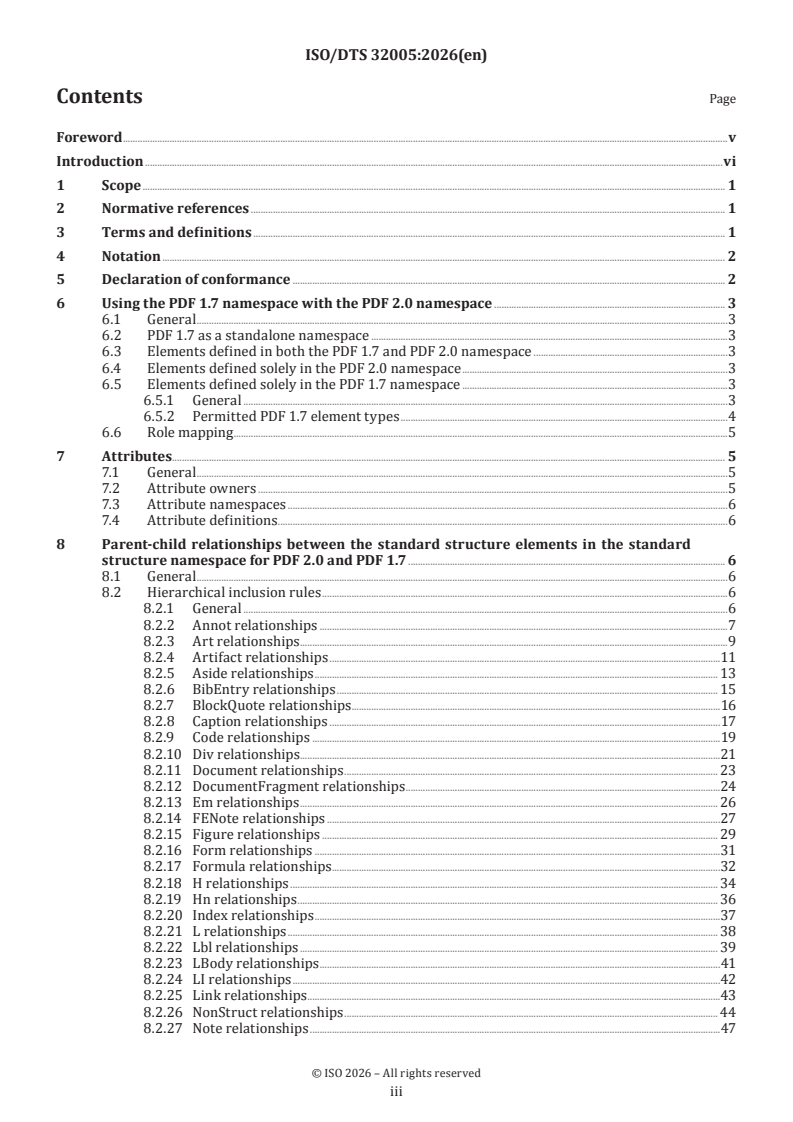
Contents Page
Foreword .v
Introduction .vi
1 Scope . 1
2 Normative references . 1
3 Terms and definitions . 1
4 Notation . 2
5 Declaration of conformance . 2
6 Using the PDF 1.7 namespace with the PDF 2.0 namespace . 3
6.1 General .3
6.2 PDF 1.7 as a standalone namespace .3
6.3 Elements defined in both the PDF 1.7 and PDF 2.0 namespace .3
6.4 Elements defined solely in the PDF 2.0 namespace .3
6.5 Elements defined solely in the PDF 1.7 namespace .3
6.5.1 General .3
6.5.2 Permitted PDF 1.7 element types .4
6.6 Role mapping .5
7 Attributes . 5
7.1 General .5
7.2 Attribute owners .5
7.3 Attribute namespaces .6
7.4 Attribute definitions.6
8 Parent-child relationships between the standard structure elements in the standard
structure namespace for PDF 2.0 and PDF 1.7 . 6
8.1 General .6
8.2 Hierarchical inclusion rules .6
8.2.1 General .6
8.2.2 Annot relationships .7
8.2.3 Art relationships .9
8.2.4 Artifact relationships .11
8.2.5 Aside relationships . 13
8.2.6 BibEntry relationships . 15
8.2.7 BlockQuote relationships .16
8.2.8 Caption relationships .17
8.2.9 Code relationships .19
8.2.10 Div relationships.21
8.2.11 Document relationships . 23
8.2.12 DocumentFragment relationships .24
8.2.13 Em relationships . 26
8.2.14 FENote relationships .27
8.2.15 Figure relationships . 29
8.2.16 Form relationships .31
8.2.17 Formula relationships . .32
8.2.18 H relationships . 34
8.2.19 Hn relationships . 36
8.2.20 Index relationships .37
8.2.21 L relationships . 38
8.2.22 Lbl relationships . 39
8.2.23 LBody relationships .41
8.2.24 LI relationships .42
8.2.25 Link relationships .43
8.2.26 NonStruct relationships . 44
8.2.27 Note relationships .47
iii
ISO/DTS 32005:2026(en)
8.2.28 P relationships . 49
8.2.29 Part relationships . 50
8.2.30 Private relationships .52
8.2.31 Quote relationships . 53
8.2.32 RB relationships . 55
8.2.33 Reference relationships . 56
8.2.34 RP relationships . 58
8.2.35 RT relationships . 58
8.2.36 Ruby relationships .59
8.2.37 Sect relationships . 60
8.2.38 Span relationships . .62
8.2.39 Strong relationships . 63
8.2.40 StructTreeRoot relationships . . 65
8.2.41 Sub relationships . 65
8.2.42 Table relationships .67
8.2.43 TBody relationships . 68
8.2.44 TD relationships . 68
8.2.45 TFoot relationships . 69
8.2.46 TH relationships .70
8.2.47 THead relationships .71
8.2.48 Title relationships .71
8.2.49 TOC relationships . 73
8.2.50 TOCI relationships . 73
8.2.51 TR relationships .74
8.2.52 Warichu relationships. 75
8.2.53 WP relationships .76
8.2.54 WT relationships . 77
Bibliography .78
iv
ISO/DTS 32005:2026(en)
Foreword
ISO (the International Organization for Standardization) is a worldwide federation of national standards
bodies (ISO member bodies). The work of preparing International Standards is normally carried out through
ISO technical committees. Each member body interested in a subject for which a technical committee
has been established has the right to be represented on that committee. International organizations,
governmental and non-governmental, in liaison with ISO, also take part in the work. ISO collaborates closely
with the International Electrotechnical Commission (IEC) on all matters of electrotechnical standardization.
The procedures used to develop this document and those intended for its further maintenance are described
in the ISO/IEC Directives, Part 1. In particular, the different approval criteria needed for the different types
of ISO document should be noted. This document was drafted in accordance with the editorial rules of the
ISO/IEC Directives, Part 2 (see www.iso.org/directives).
ISO draws attention to the possibility that the implementation of this document may involve the use of (a)
patent(s). ISO takes no position concerning the evidence, validity or applicability of any claimed patent
rights in respect thereof. As of the date of publication of this document, ISO had not received notice of (a)
patent(s) which may be required to implement this document. However, implementers are cautioned that
this may not represent the latest information, which may be obtained from the patent database available at
www.iso.org/patents. ISO shall not be held responsible for identifying any or all such patent rights.
Any trade name used in this document is information given for the convenience of users and does not
constitute an endorsement.
For an explanation of the voluntary nature of standards, the meaning of ISO specific terms and expressions
related to conformity assessment, as well as information about ISO's adherence to the World Trade
Organization (WTO) principles in the Technical Barriers to Trade (TBT), see www.iso.org/iso/foreword.html.
This document was prepared by Technical Committee ISO/TC 171, Document management applications,
Subcommittee SC 2, Document file formats, EDMS systems and authenticity of information.
This second edition cancels and replaces the first edition (ISO/TS 32005:2023), which has been technically
revised.
The main changes are as follows:
— backward compatible updates to the hierarchical inclusion rules to address errata;
— reintroduction of categories for structure element types.
Any feedback or questions on this document should be directed to the user’s national standards body. A
complete listing of these bodies can be found at www.iso.org/members.html.
v
ISO/DTS 32005:2026(en)
Introduction
ISO 32000-2 introduced the mechanism for defining namespaces within a logically structured PDF document,
identified two recognized namespaces for tagged PDF documents, and provided strict hierarchical inclusion
rules for the standard structure namespace for PDF 2.0. However, ISO 32000-2 did not specify restrictions
and inclusion rules for the standard structure namespace for PDF 1.7. This document extends the hierarchical
inclusion rules to address both the standard structure namespace for PDF 2.0 and the standard structure
namespace for PDF 1.7.
The primary purpose of this document is to extend the rules already defined within ISO 32000-2 to resolve
any ambiguity.
This document uses custom notation to convey additional meaning, as specified in Clause 4.
vi
FINAL DRAFT Technical Specification ISO/DTS 32005:2026(en)
Document management — Portable Document Format — PDF
1.7 and 2.0 structure namespace inclusion in ISO 32000-2
1 Scope
This document specifies containment requirements for tagged PDF documents that use the PDF 1.7
namespace and the PDF 2.0 namespace. These containment requirements extend, and entirely comply with,
the rules and provisions already specified for tagged PDF documents within ISO 32000-2:2020.
2 Normative references
The following documents are referred to in the text in such a way that some or all of their content constitutes
requirements of this document. For dated references, only the edition cited applies. For undated references,
the latest edition of the referenced document (including any amendments) applies.
ISO 32000-1:2008, Document management — Portable document format — Part 1: PDF 1.7
ISO 32000-2:2020, Document management — Portable document format — Part 2: PDF 2.0
Declarations P.D.F. PDF ASSOCIATION. PDF Declarations. Available from: https:// www .pdfa .org/ resource/
pdf -declarations/ .
3 Terms and definitions
For the purposes of this document, the following terms and definitions apply.
ISO and IEC maintain terminology databases for use in standardization at the following addresses:
— ISO Online browsing platform: available at https:// www .iso .org/ obp
— IEC Electropedia: available at https:// www .electropedia .org
3.1
PDF
Portable Document Format defined in ISO 32000-1
[SOURCE: ISO 32000-1:2008, 4.38, modified — the definition has been modified to fit the context of this
document.]
3.2
PDF 1.7 namespace
standard structure namespace for PDF 1.7
3.3
PDF 2.0 namespace
standard structure namespace for PDF 2.0
3.4
PDF 1.7 element
standard structure element type defined in the namespace for PDF 1.7
3.5
PDF 2.0 element
standard structure element type defined in the namespace for PDF 2.0
ISO/DTS 32005:2026(en)
3.6
processor
software application that is able to read and process conforming files
3.7
unique PDF 1.7 element
standard structure element whose type is defined solely in the PDF 1.7 namespace (3.2)
3.8
writer
software application that is able to write conforming files
4 Notation
PDF operators, PDF keywords, the names of keys in PDF dictionaries, and other predefined names are
written in bold sans serif font; operands of PDF operators or values of dictionary keys are written in italic
font. Some names can also be used as values, depending on the context, and so the styling of the content will
be context specific.
EXAMPLE 1 The Default value for the TR2 key.
Token characters used to delimit objects and describe the structure of PDF files, as defined in
ISO 32000-2:2020, 7.2.1, may be identified by their ISO/IEC 646 character name written in upper case in
bold font followed by a parenthetic two digit hexadecimal character value with the suffix “h”.
EXAMPLE 2 CARRIAGE RETURN (0Dh).
Text string characters, as defined by ISO 32000-2:2020, 7.9.2, may be identified by their ISO/IEC 10646
character name written in uppercase in bold font followed by a parenthetic four digit hexadecimal character
code value with the prefix “U+”.
EXAMPLE 3 EN SPACE (U+2002).
5 Declaration of conformance
This document defines additional requirements that are fully compliant with ISO 32000-2. As such, a
PDF document can conform to all the requirements of ISO 32000-2 and the requirements defined in this
document, retaining compliance with both standards. However, not all files which are compliant with
ISO 32000-2 will be compliant with this document.
To enable interchange and to identify that a given PDF document conforms to the requirements defined in
this document, that PDF document may include a PDF declaration of conformance with this document. When
such a PDF declaration is present, it shall conform to the requirements of the PDF Declarations specification.
Such claim of conformance shall take the form described in Table 1.
Table 1 — Declaration of conformance to this document
Key Type
URI identifier http:// pdfa .org/ declarations #iso32005 _2
Mandatory field(s) none
Standard ISO/TS 32005
Version 2
URI https:// www .pdfa .org/ resource/ ISO -32005/
Level N/A
Technology reliance ISO 32000-2
EXAMPLE Conformance declaration for a PDF file conforming to this document
ISO/DTS 32005:2026(en)
http://pdfa.org/declarations#iso32005_2
6 Using the PDF 1.7 namespace with the PDF 2.0 namespace
6.1 General
ISO 32000-2 permits the use of both the PDF 1.7 namespace and the PDF 2.0 namespace but does not indicate
how they are to be used together in the same document. The following clauses clarify this usage.
NOTE ISO 32000-2 does not restrict the interaction of the two namespaces.
PDF documents conforming to this document shall be versioned as PDF 2.0 using either the header or the
value of the Version entry in the document’s catalog dictionary (see ISO 32000-2:2020, 7.7.2).
6.2 PDF 1.7 as a standalone namespace
If all structure elements used in a given document are PDF 1.7 elements, either explicitly, through the default
standard structure namespace or role mapped to an element in the default standard structure namespace,
then the requirements of ISO 32000-1 shall be used for their inclusion. In such cases, the use of namespaces
shall not be required and those structure elements are exempt from the provisions specified in 6.3, 6.4 and
6.5.
If any document has structure elements that use a namespace other than the PDF 1.7 namespace or the
default standard structure namespace, then that document shall conform to the requirements specified in
6.3, 6.4 and 6.5.
6.3 Elements defined in both the PDF 1.7 and PDF 2.0 namespace
A subset of the PDF 1.7 elements and the PDF 2.0 elements are common between the two namespaces. All
structure elements whose type is common to both the PDF 1.7 namespace and the PDF 2.0 namespace shall
use the PDF 2.0 namespace and follow the inclusion rules defined in ISO 32000-2:2020, Annex L, and in
Clause 6 of this document (except as exempted by 6.2).
6.4 Elements defined solely in the PDF 2.0 namespace
PDF 2.0 elements shall explicitly declare their namespace using the PDF 2.0 namespace and may contain
unique PDF 1.7 elements and PDF 2.0 elements, as defined in Clause 6.
NOTE ISO 32000-2:2020, Annex M identifies the new elements that are solely defined for the PDF 2.0 namespace.
6.5 Elements defined solely in the PDF 1.7 namespace
6.5.1 General
Unique PDF 1.7 elements may be included in a document. When such structure elements are included (except
as exempted in 6.2), those elements shall conform to the requirements defined in Clause 6 and may be
children of PDF 2.0 elements and may include unique PDF 1.7 elements or PDF 2.0 elements.
NOTE ISO 32000-2:2020, Annex M identifies the elements that are solely defined for the PDF 1.7 namespace.
ISO/DTS 32005:2026(en)
6.5.2 Permitted PDF 1.7 element types
6.5.2.1 General
ISO 32000-2 does not directly define the element types outside of the PDF 2.0 namespace. Instead, it refers
to the definition of those elements in ISO 32000-1. To ensure consistency, unique PDF 1.7 elements (except as
exempted by 6.2) shall match the descriptions and follow the inclusion rules specified in Clause 6.
6.5.2.2 Grouping structure elements
The unique PDF 1.7 elements that are a grouping element type are defined in Table 2 and shall be the only
PDF 1.7 namespace grouping elements permissible in a document (except as exempted by 6.2).
Table 2 — Standard structure types for unique PDF 1.7 grouping elements
Structure
Category Description
type
Art Grouping (Article) A relatively self-contained body of text constituting a single narrative or
exposition. Articles should be disjoint; that is, they should not contain other articles as
constituent elements.
BlockQuote Grouping or (Block quotation) A portion of content quoted from another source other than the sur-
Block rounding content.
NOTE 1 The BlockQuote structure element groups larger units of quoted content, see
Quote (Table 3) for inline quotation.
NOTE 2 The BlockQuote structure element differs from the DocumentFragment struc-
ture element, in that DocumentFragment implies unchanged and contiguous portions of
another document, whereas BlockQuote often includes modification or contextualization.
BlockQuote is permitted to both contain or be a child of DocumentFragment (see 8.2.7).
NOTE 3 The source for a BlockQuote can include content from the same document.
TOC Grouping (Table of contents) A list made up of table of contents item entries (structure type TOCI)
and/or other nested table of contents entries (TOC).
A TOC entry that includes only TOCI entries represents a flat hierarchy. A TOC entry
that includes other nested TOC entries (and possibly TOCI entries) represents a more
complex hierarchy. Ideally, the hierarchy of a top-level TOC entry reflects the structure
of the main body of the document.
NOTE 4 Lists of figures and tables, as well as bibliographies, can be treated as tables of
contents for purposes of the standard structure types.
When parts of a TOC have descriptive text, that text shall use Caption to identify its
purpose. When multiple parts of the TOC have descriptive text at the same level within
that TOC, then Part shall be used to subdivide that TOC into the described (captioned)
sub-parts, with each Part having its own Caption.
TOCI Internal to (Table of contents item) An individual entry within a table of contents (TOC).
TOC
Index Grouping (Index) A sequence of entries containing identifying text accompanied by reference
elements (structure type Reference; see Table 3) that point out occurrences of the
specified text in the main body of a document.
Private Grouping (Private element) A grouping element containing private content belonging to the
or Block or application producing it. The structural significance of this element type is unspecified
Inline and shall be determined entirely by the writer. Neither the Private element nor any
of its descendants (including content) have defined semantic significance and may be
ignored by processors, both when consuming the content and when exporting to other
document formats.
NOTE 5 The definitions in this table are taken from ISO 32000-1, but have been updated for clarity and their categories have
been added.
ISO/DTS 32005:2026(en)
6.5.2.3 Inline-level structure elements
The unique PDF 1.7 elements that are an inline-level element type are defined in Table 3 and shall be the only
PDF 1.7 namespace inline-level structure elements permissible in a document (except as exempted by 6.2).
Table 3 — Standard structure types for unique PDF 1.7 inline-level structure elements
Structure
Category Description
type
Quote Grouping, (Quotation) An inline portion of content quoted from another source other than the
Block or Inline surrounding content.
The quoted text should be contained inline within a single block-level unit of content.
This differs from the block-level element BlockQuote (see Table 2), which consists of
one or more complete paragraphs (or other elements presented as if they were com-
plete paragraphs).
Note Grouping, (Note) An item of explanatory text, such as a footnote or an endnote, that is referred
Block or Inline to from within the body of the document. It may have a label (structure type Lbl; see
ISO 32000-2:2020, Table 368) as a child.
The note may be included as a child of the structure element in the body text that re-
fers to it, or it may be included elsewhere (such as in an endnotes section) and accessed
by means of a reference (structure type Reference).
Tagged PDF does not prescribe the placement of footnotes in the page content order.
They may be either inline or at the end of the page, at the discretion of the writer.
Reference Grouping, (Reference) A citation to content elsewhere in the document.
Block or Inline
BibEntry Grouping, (Bibliography entry) A reference identifying the external source of some cited content.
Block or Inline It may contain a label (structure type Lbl; see ISO 32000-2:2020, Table 368) as a child.
Although a bibliography entry is likely to include component parts identifying the cited
content’s author, work, publisher, and so forth, no standard structure types are defined
at this level of detail.
Code Grouping, (Code) A fragment of computer program text.
Block or Inline
NOTE The definitions in this table are taken from ISO 32000-1, but have been updated for clarity and their categories have
been added.
6.6 Role mapping
Custom element types may be present in a document and shall have an explicitly defined namespace except
as exempted by 6.2.
7 Attributes
7.1 General
ISO 32000-2 defines a mechanism for applying structure attributes to structure elements (see
ISO 32000-2:2020, 14.7.6). While both ISO 32000-2 and ISO 32000-1 defined this mechanism, ISO 32000-2
extended it to additionally make use of namespaces (see ISO 32000-2:2020, Table 360). Clause 7 specifies the
requirements for a file containing structure attributes.
7.2 Attribute owners
Attribute owners (see ISO 32000-2:2020, Table 376) identify sets of attributes that are available for use with
structure elements. For each attribute, attribute owners also restrict the structure element type with which
they may be used.
The attributes defined within the various attribute owners in ISO 32000-2 are a superset of those defined in
ISO 32000-1. As such, regardless of whether a given structure element is a unique PDF 1.7 element or a PDF
ISO/DTS 32005:2026(en)
2.0 element, that structure element may use any structure attribute defined in ISO 32000-2, as restricted by
those attributes’ definition.
7.3 Attribute namespaces
As an alternative to attribute owners, ISO 32000-2 defines a mechanism for identifying a namespace for
a given set of attributes (see ISO 32000-2:2020, Table 360). Attribute objects identifying their owner as a
namespace may occur on any structure element regardless of that structure element’s namespace.
7.4 Attribute definitions
The attribute definitions in ISO 32000-2 are a superset of those in ISO 32000-1. As such, regardless of
whether an attribute is present on a unique PDF 1.7 element or a PDF 2.0 element, the attribute definition
and requirements shall be those defined in ISO 32000-2.
8 Parent-child relationships between the standard structure elements in the
standard structure namespace for PDF 2.0 and PDF 1.7
8.1 General
ISO 32000-2 defines the standard structure element types within ISO 32000-2:2020, 14.8.4 and identifies
the PDF 1.7 namespace and the PDF 2.0 namespace in ISO 32000-2:2020, 14.8.6. ISO 32000-2:2020, Annex L
specifies the requirements for hierarchical inclusion of the PDF 2.0 elements.
[1]
8.2 extends the rules for hierarchical inclusion to both the PDF 2.0 elements and PDF 1.7 elements.
NOTE A compact representation of the hierarchical inclusion rules defined in 8.2 can be found in Reference [1].
8.2 Hierarchical inclusion rules
8.2.1 General
This subclause defines the acceptable children of the standard structure elements defined in the PDF 1.7
namespace and the PDF 2.0 namespace. PDF 1.7 elements and PDF 2.0 elements shall not have child or parent
PDF 1.7 elements or PDF 2.0 elements that are not explicitly listed in this clause.
NOTE 1 The hierarchical rules defined in this clause describe the elements that are permissible as children of each
structure type. However, further contextual restrictions are described in Clause 6 and ISO 32000-2:2020, 14.8 “Tagged
PDF”.
NOTE 2 The hierarchical rules included in this subclause extend those found in ISO 32000-2:2020, Annex L, and
can be considered complete for all elements permitted by this document. These extensions pertain to unique PDF 1.7
elements and their interaction with other PDF 1.7 elements and PDF 2.0 elements. These requirements fully conform
to those found in ISO 32000-2 and associated errata for PDF 2.0 elements.
These containment requirements shall also apply to structure elements that are role mapped into the PDF
2.0 namespace or PDF 1.7 namespace (except as exempted by 6.2). Table 4 provides a legend for use in
interpreting Table 5 to Table 108.
ISO/DTS 32005:2026(en)
Table 4 — Legend for valid usage of structure types
Value Valid usage relative to other standard structure types
ø shall not occur
0.n may be present as a child element with one or more occurrences, but is not required to be
present
0.1* or 0.n* may be present, but shall only be present when the parent element is used as a grouping level
element
1.n shall be present as a child element with one or more occurrences
0.1 may be present, but not more than once
1 shall be present with one occurrence
‡ for containment rules, refer to the respective structure element type’s description
0.n§ may be present as a child element with one or more occurrences, but is not required to be
present and relies on errata for alignment with ISO 32000-2
[a] for specific provisions when and how these structure elements or content can be contained
inside a Ruby structure element, see ISO 32000-2:2020, 14.8.4.7.3
[b] for specific provisions when and how these structure elements or content can be contained
inside a Warichu structure element, see ISO 32000-2:2020, 14.8.4.7.3
NOTE 1 Determination of whether a structure element is acting as a grouping level element is dependent both on its own parent
element and on the child elements it contains, and is not solely dependent on the parent element.
NOTE 2 Certain structure element types act as pass-through elements and so their parent element passes through the
containment transitively to the child element.
NOTE 3 StructTreeRoot refers to the structure tree root dictionary (see “ISO 32000-2:2020, Table 354 — Entries in the structure
tree root”) and is not the name of a structure element.
NOTE 4 A content item refers to page content (see ISO 32000-2:2020, 14.8.2 “Tagged PDF and page content”) or PDF objects (see
ISO 32000-2:2020, 14.7 “PDF objects as content items”) and does not refer to the name of a structure element type.
8.2.2 Annot relationships
8.2.2.1 Annot child relationships
Table 5 defines the child elements that may be present and the containment rules they shall follow when
included within Annot.
Table 5 — Child elements allowed in Annot
Child structure type Child occurrences
Annot 0.n
Art 0.n
Artifact 0.n
Aside 0.n*
BibEntry 0.n
BlockQuote 0.n*
Caption 0.1*
Code 0.n
Div 0.n
DocumentFragment 0.n*
Em 0.n
FENote 0.n
Figure 0.n
Form 0.n*
Formula 0.n
ISO/DTS 32005:2026(en)
TTabablele 5 5 ((ccoonnttiinnueuedd))
Child structure type Child occurrences
H 0.n*
Hn 0.n*
L 0.n*
Lbl 0.n
Link 0.n
NonStruct 0.n
Note 0.n
P 0.n*
Part 0.n*
Private 0.n
Quote 0.n
Reference 0.n*
Ruby 0.n
Sect 0.n
Span 0.n
Strong 0.n
Sub 0.n
Table 0.n*
Title 0.n*
Warichu 0.n
content item 0.n
8.2.2.2 Annot parent relationships
Table 6 defines the parent elements that shall be permitted to contain Annot.
Table 6 — Parent elements that can contain Annot
Parent structure type Parent occurrences
Annot 0.n
Art 0.n
Artifact 0.n
Aside 0.n
BibEntry 0.n
BlockQuote 0.n
Caption 0.n
Code 0.n
Div ‡
Document 0.n
DocumentFragment 0.n
Em 0.n
FENote 0.n
Figure 0.n
Formula 0.n
H 0.n
Hn 0.n
ISO/DTS 32005:2026(en)
TTabablele 6 6 ((ccoonnttiinnueuedd))
Parent structure type Parent occurrences
Index 0.n
Lbl 0.n
LBody 0.n
Link 0.n
NonStruct ‡
Note 0.n
P 0.n
Part ‡
Quote 0.n
RB 0.n
Reference 0.n
RP 0.n
RT 0.n
Sect 0.n
Span 0.n
Strong 0.n
Sub 0.n
TD 0.n
TH 0.n
Title 0.n
TOCI 0.n
WP 0.n
WT 0.n
8.2.3 Art relationships
8.2.3.1 Art child relationships
Table 7 defines the child elements that shall be permitted within Art.
Table 7 — Child elements allowed in Art
Child structure type Child occurrences
Annot 0.n
Artifact 0.n
Aside 0.n
BlockQuote 0.n
Caption 0.1
Code 0.n
Div 0.n
DocumentFragment 0.n
FENote 0.n
Figure 0.n
Form 0.n
Formula 0.n
H 0.1
ISO/DTS 32005:2026(en)
TTabablele 7 7 ((ccoonnttiinnueuedd))
Child structure type Child occurrences
Hn 0.n
Index 0.n
L 0.n
Lbl 0.n
Link 0.n
NonStruct 0.n
Note 0.n
P 0.n
Part 0.n
Private 0.n
Reference 0.n
Sect 0.n
Table 0.n
Title 0.n
TOC 0.n
8.2.3.2 Art parent relationships
Table 8 defines the parent elements that shall be permitted to contain Art.
Table 8 — Parent elements that can contain Art
Parent structure type Parent occurrences
Annot 0.n
Artifact 0.n
Aside 0.n
BlockQuote 0.n
Caption 0.n
Code 0.n
Div ‡
Document 0.n
DocumentFragment 0.n
FENote 0.n
Figure 0.n
LBody 0.n
Link 0.n
NonStruct ‡
Note 0.n
Part ‡
Reference 0.n
Sect 0.n
TD 0.n
TH 0.n
ISO/DTS 32005:2026(en)
8.2.4 Artifact relationships
8.2.4.1 Artifact child relationships
Table 9 defines the child elements that shall be permitted within Artifact.
Table 9 — Child elements allowed in Artifact
Child structure type Child occurrences
Annot 0.
...
Style Definition
...
Style Definition
...
Reference number of working document: ISO TC 171/SC 2/WG 9 N 0000 Style Definition
...
Style Definition
...
Date: 2025-10-16
Style Definition
...
Reference number of project: ISO/DTS 32005 Style Definition
...
Style Definition
...
Committee identification: ISO/TC 171/SC 2/WG 9
Style Definition
...
Secretariat: ANSI
Style Definition
...
Style Definition
...
Date: 2026-02-17
Style Definition
...
Style Definition
...
Style Definition
...
Style Definition
...
Style Definition
...
Document management — Portable Document Format — PDF 1.7
Style Definition
...
and 2.0 structure namespace inclusion in ISO 32000-2
Style Definition
...
Style Definition
...
Gestion de documents — Format de document portable — Inclusion de l’espacedes espaces de noms de
Style Definition
...
structurestructures PDF 1.7 et 2.0 dans l’ISOl'ISO 32000-2
Style Definition
...
Style Definition
...
Style Definition
...
Style Definition
...
Style Definition
...
Style Definition
...
Style Definition
...
Style Definition
...
Style Definition
...
Style Definition
...
Style Definition
...
Style Definition
...
Style Definition
...
Style Definition
...
Style Definition
...
Style Definition
...
Style Definition
...
Style Definition
...
Style Definition
...
Style Definition
...
Style Definition
...
Style Definition
...
Style Definition
...
Style Definition
...
Style Definition
...
Style Definition
...
Style Definition
...
Style Definition
...
Style Definition
...
Style Definition
...
Style Definition
...
Style Definition
...
Style Definition
...
Style Definition
...
Style Definition
...
Style Definition
...
Style Definition
...
Style Definition
...
St l D fi iti
ISO/DTS 32005:(en)
Formatted: Default Paragraph Font
All rights reserved. Unless otherwise specified, or required in the context of its implementation, no part of this publication
may be reproduced or utilized otherwise in any form or by any means, electronic or mechanical, including photocopying,
or posting on the internet or an intranet, without prior written permission. Permission can be requested from either ISO
at the address below or ISO’s member body in the country of the requester.
ISO copyright office
Formatted: zzCopyright address
CP 401 • Ch. de Blandonnet 8
CH-1214 Vernier, Geneva
Phone: + 41 22 749 01 11
Email: copyright@iso.org
E-mail: copyright@iso.org
Website: www.iso.orgwww.iso.org
Formatted: German (Germany)
Formatted: German (Germany)
Published in Switzerland
Formatted: zzCopyright address
Formatted: PAGEBREAK
ii
ISO/DTS 32005:(en)
Contents
Foreword . vi
Introduction . vii
1 Scope . 1
2 Normative references . 1
3 Terms and definitions . 1
4 Notation . 2
5 Declaration of conformance . 3
6 Using the PDF 1.7 namespace with the PDF 2.0 namespace . 3
6.1 General. 3
6.2 PDF 1.7 as a standalone namespace . 4
6.3 Elements defined in both the PDF 1.7 and PDF 2.0 namespace . 4
6.4 Elements defined solely in the PDF 2.0 namespace. 4
6.5 Elements defined solely in the PDF 1.7 namespace. 4
6.6 Role mapping . 6
7 Attributes . 6
7.1 General. 6
7.2 Attribute owners . 6
7.3 Attribute namespaces . 7
7.4 Attribute definitions . 7
8 Parent-child relationships between the standard structure elements in the standard
structure namespace for PDF 2.0 and PDF 1.7 . 7
8.1 General. 7
8.2 Hierarchical inclusion rules . 7
Bibliography . 100
Foreword . 1
Introduction . 1
1 Scope . 1
2 Normative references . 1
3 Terms and definitions . 1
4 Notation . 1
5 Declaration of conformance . 1
6 Using the PDF 1.7 namespace with the PDF 2.0 namespace . 1
6.1 General . 1
6.2 PDF 1.7 as a standalone namespace . 1
6.3 Elements defined in both the PDF 1.7 and PDF 2.0 namespace . 1
6.4 Elements defined solely in the PDF 2.0 namespace . 1
6.5 Elements defined solely in the PDF 1.7 namespace . 1
6.5.1 General . 1
6.5.2 Permitted PDF 1.7 element types . 1
6.6 Role mapping . 1
7 Attributes . 1
7.1 General . 1
7.2 Attribute owners . 1
7.3 Attribute namespaces . 1
iii
ISO/DTS 32005:(en)
7.4 Attribute definitions . 1
8 Parent-child relationships between the standard structure elements in the standard structure
namespace for PDF 2.0 and PDF 1.7 . 1
8.1 General . 1
8.2 Hierarchical inclusion rules . 1
8.2.1 General . 1
8.2.2 Annot relationships . 1
8.2.3 Art relationships . 1
8.2.4 Artifact relationships . 1
8.2.5 Aside relationships . 1
8.2.6 BibEntry relationships . 1
8.2.7 BlockQuote relationships . 1
8.2.8 Caption relationships . 1
8.2.9 Code relationships . 1
8.2.10 Div relationships . 1
8.2.11 Document relationships . 1
8.2.12 DocumentFragment relationships . 1
8.2.13 Em relationships . 1
8.2.14 FENote relationships . 1
8.2.15 Figure relationships . 1
8.2.16 Form relationships . 1
8.2.17 Formula relationships . 1
8.2.18 H relationships . 1
8.2.19 Hn relationships . 1
8.2.20 Index relationships . 1
8.2.21 L relationships . 1
8.2.22 Lbl relationships . 1
8.2.23 LBody relationships . 1
8.2.24 LI relationships . 1
8.2.25 Link relationships . 1
8.2.26 NonStruct relationships . 1
8.2.27 Note relationships . 1
8.2.28 P relationships . 1
8.2.29 Part relationships . 1
8.2.30 Private relationships . 1
8.2.31 Quote relationships . 1
8.2.32 RB relationships . 1
8.2.33 Reference relationships . 1
8.2.34 RP relationships . 1
8.2.35 RT relationships . 1
8.2.36 Ruby relationships . 1
8.2.37 Sect relationships . 1
8.2.38 Span relationships . 1
8.2.39 Strong relationships . 1
8.2.40 StructTreeRoot relationships . 1
8.2.41 Sub relationships . 1
8.2.42 Table relationships . 1
8.2.43 TBody relationships . 1
8.2.44 TD relationships . 1
8.2.45 TFoot relationships . 1
8.2.46 TH relationships . 1
iv
ISO/DTS 32005:(en)
8.2.47 THead relationships . 1
8.2.48 Title relationships . 1
8.2.49 TOC relationships . 1
8.2.50 TOCI relationships . 1
8.2.51 TR relationships . 1
8.2.52 Warichu relationships . 1
8.2.53 WP relationships . 1
8.2.54 WT relationships . 1
Bibliography . 1
v
ISO/DTS 32005:(en)
Foreword
ISO (the International Organization for Standardization) is a worldwide federation of national standards
bodies (ISO member bodies). The work of preparing International Standards is normally carried out through
ISO technical committees. Each member body interested in a subject for which a technical committee has been
established has the right to be represented on that committee. International organizations, governmental and
non-governmental, in liaison with ISO, also take part in the work. ISO collaborates closely with the
International Electrotechnical Commission (IEC) on all matters of electrotechnical standardization.
The procedures used to develop this document and those intended for its further maintenance are described
in the ISO/IEC Directives, Part 1. In particular, the different approval criteria needed for the different types of
ISO documentsdocument should be noted. This document was drafted in accordance with the editorial rules
of the ISO/IEC Directives, Part 2 (see www.iso.org/directiveswww.iso.org/directives).
Attention is drawnISO draws attention to the possibility that some of the elementsimplementation of this
document may beinvolve the subjectuse of (a) patent(s). ISO takes no position concerning the evidence,
validity or applicability of any claimed patent rights. in respect thereof. As of the date of publication of this
document, ISO had not received notice of (a) patent(s) which may be required to implement this document.
However, implementers are cautioned that this may not represent the latest information, which may be
obtained from the patent database available at www.iso.org/patents. ISO shall not be held responsible for
identifying any or all such patent rights. Details of any patent rights identified during the development of the
document will be in the Introduction and/or on the ISO list of patent declarations received (see
www.iso.org/patents).
Any trade name used in this document is information given for the convenience of users and does not
constitute an endorsement.
For an explanation of the voluntary nature of standards, the meaning of ISO specific terms and expressions
related to conformity assessment, as well as information about ISO’sISO's adherence to the World Trade
Organization (WTO) principles in the Technical Barriers to Trade (TBT), see
www.iso.org/iso/foreword.htmlwww.iso.org/iso/foreword.html.
This document was prepared by Technical Committee ISO/TC 171, Document management applications,
Subcommittee SC 2, Document file formats, EDMS systems and authenticity of information.
A list of all parts inThis second edition cancels and replaces the first edition (ISO /TS 32005 series:2023),
which has been technically revised.
The main changes are as follows:
— backward compatible updates to the hierarchical inclusion rules to address errata;
— reintroduction of categories for structure element types.
Any feedback or questions on this document should be directed to the user’s national standards body. A
complete listing of these bodies can be found on the ISO website.at www.iso.org/members.html.
vi
ISO/DTS 32005:(en)
Introduction
ISO 32000-2 introduced the mechanism for defining namespaces within a logically structured PDF document;,
identified two recognized namespaces for tagged PDF documents;, and provided strict hierarchical inclusion
rules for the standard structure namespace for PDF 2.0. However, ISO 32000-2 did not specify restrictions and
inclusion rules for the standard structure namespace for PDF 1.7. This document extends the hierarchical
inclusion rules to address both the standard structure namespace for PDF 2.0 and the standard structure
namespace for PDF 1.7.
The primary purpose of this document is to extend the rules already defined within ISO 32000-2 to resolve
any ambiguity.
This document uses custom notation to convey additional meaning, as specified in Clause 4.
vii
ISO/DTS 32005:2025(E)
Document management — Portable Document Format — PDF 1.7 and 2.0 structure namespace inclusion
in ISO 32000-2
The PDF Association may maintain an ongoing series of application notes for guiding developers and
users of this document. These application notes are available at https://www.pdfa.org/. The PDF
Association will also retain copies of the specific non-ISO normative references of this document which
are publicly available electronic documents.
viii © ISO 2025 – All rights reserved
ISO/DTS 32005:2025(E:(en)
Formatted: Font: Bold
Formatted: Font: Bold
Formatted: HeaderCentered, Left, Space After: 0 pt,
Line spacing: single
Document management — Portable Document Format — PDF 1.7 and
Formatted: Main Title 1
2.0 structure namespace inclusion in ISO 32000-2
Formatted: Left: 1.5 cm, Right: 1.5 cm, Header
1 1 Scope
distance from edge: 1.27 cm, Footer distance from
This document specifies containment requirements for tagged PDF documents that use the PDF 1.7
namespace and the PDF 2.0 namespace. These containment requirements extend, and entirely comply with,
the rules and provisions already specified for tagged PDF documents within ISO 32000-2:2020.ISO 32000- Formatted: Default Paragraph Font, French
2:2020. (Switzerland), Border: : (No border)
Formatted: Default Paragraph Font, French
2 2 Normative references
(Switzerland)
Formatted: French (Switzerland)
The following documents are referred to in the text in such a way that some or all of their content constitutes
Formatted: Default Paragraph Font, French
requirements of this document. For dated references, only the edition cited applies. For undated references,
(Switzerland)
the latest edition of the referenced document (including any amendments) applies.
Formatted: French (Switzerland)
ISO 32000-1:2008, Document management — — Portable document format — — Part 1: PDF 1.7
Formatted: Default Paragraph Font, French
(Switzerland)
ISO 32000-2:2020, Document management — — Portable document format — — Part 2: PDF 2.0
Formatted: French (Switzerland)
ISO 32000 (all parts), Document management – Portable document format
Formatted: Default Paragraph Font, French
(Switzerland)
PDF DECLARATIONS, P.D.F. PDF ASSOCIATION. PDF Declarations. Available from:
Formatted: Default Paragraph Font, French
https://www.pdfa.org/resource/pdf-declarations/https://www.pdfa.org/resource/pdf-declarations/.
(Switzerland)
Formatted: Default Paragraph Font, French
3 3 Terms and definitions
(Switzerland)
For the purposes of this document, the following terms and definitions apply.
Formatted: French (Switzerland)
Formatted: Default Paragraph Font, French
ISO and IEC maintain terminology databases for use in standardization at the following addresses:
(Switzerland), Border: : (No border)
— — ISO Online browsing platform: available at https://www.iso.org/obphttps://www.iso.org/obp Formatted: Default Paragraph Font, French
(Switzerland)
— — IEC Electropedia: available at https://www.electropedia.orghttps://www.electropedia.org
Formatted: French (Switzerland)
Formatted: Default Paragraph Font, French
3.1
(Switzerland)
interactive processor
processor (3.7) that requires or allows human interaction with the content and other objects contained in the Formatted: French (Switzerland)
document during the software’s processing phase
Formatted: Default Paragraph Font, French
(Switzerland)
Note 1 to entry: A file viewing tool is an example of an interactive processor; a raster image processor is an example of a
Formatted: French (Switzerland)
processor that is not interactive.
Formatted
...
3.1 3.2
Formatted
...
PDF
Portable Document Format Formatted
...
Formatted: French (Switzerland)
file format defined in ISO 32000ISO 32000-1
Formatted: Small caps
3.3
Formatted: Default Paragraph Font
[SOURCE: ISO 32000-1:2008, 4.38, modified — the definition has been modified to fit the context of this
Formatted: TermNum2
document.]
Formatted: Font: 11 pt
Formatted: FooterPageNumber, Line spacing: single
ISO/DTS 32005:2025(E:(en)
Formatted: Font: Bold
Formatted: Font: Bold
Formatted: HeaderCentered, Space After: 0 pt, Line
3.2
spacing: single
PDF 1.7 namespace
standard structure namespace for PDF 1.7
as defined in ISO 32000-1:2008
3.3 3.4
Formatted: TermNum2
PDF 2.0 namespace
standard structure namespace for PDF 2.0
as defined in ISO 32000-2:2020
3.4 3.5
Formatted: TermNum2
PDF 1.7 element
standard structure element type defined in the namespace for PDF 1.7
as defined in ISO 32000-1:2008
3.5 3.6
Formatted: TermNum2
PDF 2.0 element
standard structure element type defined in the namespace for PDF 2.0
as defined in ISO 32000-2:2020
3.6 3.7
Formatted: TermNum2
processor
software application that is able to read and process conforming files
3.7 3.8
Formatted: TermNum2
unique PDF 1.7 element
standard structure element whose type is defined solely in the PDF 1.7 namespace (3.3(3.2)
3.8 3.9
Formatted: TermNum2
writer
software application that is able to write conforming files
4 4 Notation
PDF operators, PDF keywords, the names of keys in PDF dictionaries, and other predefined names are written
in bold sans serif font; operands of PDF operators or values of dictionary keys are written in italic font. Some
names can also be used as values, depending on the context, and so the styling of the content will be context
specific.
EXAMPLE 1 The Default value for the TR2 key.
Token characters used to delimit objects and describe the structure of PDF files, as defined in ISO 32000-
2:2020, 7.2.1,ISO 32000-2:2020, 7.2.1, may be identified by their ISO/IEC 646 character name written in upper
case in bold font followed by a parenthetic two digit hexadecimal character value with the suffix “h”.
EXAMPLE 2 CARRIAGE RETURN (0Dh).
Formatted: Font: 10 pt
Text string characters, as defined by ISO 32000-2:2020, 7.9.2,ISO 32000-2:2020, 7.9.2, may be identified by
Formatted: Font: 10 pt
their ISO/IEC 10646 character name written in uppercase in bold font followed by a parenthetic four digit
Formatted: Font: 11 pt
hexadecimal character code value with the prefix “U+”.
Formatted: FooterPageNumber, Space Before: 0 pt,
EXAMPLE 3 EN SPACE (U+2002).
Line spacing: single
2 © ISO 2025 2026 – All rights reserved
ISO/DTS 32005:2025(E:(en)
Formatted: Font: Bold
Formatted: Font: Bold
Formatted: HeaderCentered, Left, Space After: 0 pt,
5 5 Declaration of conformance
Line spacing: single
This document defines additional requirements that are fully compliant with ISO 32000-2. As such, a PDF
document can conform to all the requirements of ISO 32000-2 and the requirements defined in this document,
retaining compliance with both standards. However, not all files which are compliant with ISO 32000-2 will
be compliant with this document.
To enable interchange and to identify that a given PDF document conforms to the requirements defined in this
document, that PDF document may include a PDF declaration of conformance with this document. When such
Formatted: Font: Not Bold
a PDF declaration is present, it shall conform to the requirements of the PDF Declarations specification. Such
Formatted: Font: Not Bold
claim of conformance shall take the form described in Table 1Table 1.
Formatted: Table header, Left, Space Before: 0 pt,
Table 1 — Declaration of conformance to this document
After: 0 pt, Line spacing: single, Don't keep with next,
Tab stops: Not at 1.4 cm + 2.1 cm + 2.8 cm + 3.5 cm
Key Type
+ 4.2 cm + 4.9 cm + 5.6 cm + 6.3 cm + 7 cm
http://pdfa.org/declarations#iso32005_2http:/
URI identifier Formatted: Don't keep with next
/pdfa.org/declarations#iso32005_2
Formatted: Don't keep with next
Mandatory field(s) none
Formatted: Don't keep with next
Standard ISO/TS 32005
Formatted: Don't keep with next
Version 2
Formatted: Don't keep with next
URI https://www.pdfa.org/resource/ISO-
Formatted: Don't keep with next
32005/https://www.pdfa.org/resource/ISO-
Formatted: Space Before: 12 pt
32005/
Formatted: Default Paragraph Font
Level N/A
Formatted: Default Paragraph Font
Technology ISO 32000-2
Reliancereliance Formatted: Default Paragraph Font
Formatted: Default Paragraph Font
EXAMPLE — Conformance declaration for a PDF file conforming to this document
Formatted: Default Paragraph Font
Formatted: Default Paragraph Font
Formatted: Default Paragraph Font
Formatted: Default Paragraph Font
Formatted: Default Paragraph Font
Formatted: Default Paragraph Font
http://pdfa.org/declarations#iso32005_2
Formatted: Default Paragraph Font
Formatted: Default Paragraph Font
Formatted: Default Paragraph Font
Formatted: Default Paragraph Font
Formatted: Default Paragraph Font
6 6 Using the PDF 1.7 namespace with the PDF 2.0 namespace
Formatted: Default Paragraph Font
6.1 6.1 General
Formatted: Default Paragraph Font
ISO 32000-2 permits the use of both the PDF 1.7 namespace and the PDF 2.0 namespace but does not indicate Formatted: Default Paragraph Font
how they are to be used together in the same document. The following clauses clarify this usage.
Formatted: Default Paragraph Font
NOTE ISO 32000-2 does not restrict the interaction of the two namespaces. Formatted: Line spacing: single, Tab stops: Not at
0.71 cm
Formatted: Font: 11 pt
Formatted: FooterPageNumber, Line spacing: single
ISO/DTS 32005:2025(E:(en)
Formatted: Font: Bold
Formatted: Font: Bold
Formatted: HeaderCentered, Space After: 0 pt, Line
PDF documents conforming to this document shall be versioned as PDF 2.0 using either the header or the
spacing: single
value of the Version entry in the document’s catalog dictionary (see ISO 32000-2:2020, 7.7.2).ISO 32000-
2:2020, 7.7.2).
6.2 6.2 PDF 1.7 as a standalone namespace
If all structure elements used in a given document are PDF 1.7 elements, either explicitly, through the default
standard structure namespace or role mapped to an element in the default standard structure namespace,
then the requirements of ISO 32000-1 shall be used for their inclusion. In such cases, the use of namespaces
shall not be required and those structure elements are exempt from the provisions specified in 6.3, 6.4 and
6.56.3, 6.4 and 6.5.
If any document has structure elements that use a namespace other than the PDF 1.7 namespace or the default
standard structure namespace, then that document shall conform to the requirements specified in 6.3, 6.4 and
6.56.3, 6.4 and 6.5.
6.3 6.3 Elements defined in both the PDF 1.7 and PDF 2.0 namespace
A subset of the PDF 1.7 elements and the PDF 2.0 elements are common between the two namespaces. All
structure elements whose type is common to both the PDF 1.7 namespace and the PDF 2.0 namespace shall
use the PDF 2.0 namespace and follow the inclusion rules defined in ISO 32000-2:2020, Annex L,ISO 32000-
2:2020, Annex L, and in Clause 6Clause 6 of this document (except as exempted by 6.26.2).
6.4 6.4 Elements defined solely in the PDF 2.0 namespace
PDF 2.0 elements shall explicitly declare their namespace using the PDF 2.0 namespace and may contain
unique PDF 1.7 elements and PDF 2.0 elements, as defined in Clause 6Clause 6.
NOTE ISO 32000-2:2020, Annex MISO 32000-2:2020, Annex M identifies the new elements that are solely defined
Formatted: Line spacing: single, Tab stops: Not at
for the PDF 2.0 namespace.
0.71 cm
6.5 6.5 Elements defined solely in the PDF 1.7 namespace
6.5.1 6.5.1 General
Unique PDF 1.7 elements may be included in a document. When such structure elements are included (except
as exempted in 6.26.2), those elements shall conform to the requirements defined in Clause 6Clause 6 and may
be children of PDF 2.0 elements and may include unique PDF 1.7 elements or PDF 2.0 elements.
NOTE ISO 32000-2:2020, Annex MISO 32000-2:2020, Annex M identifies the elements that are solely defined for
Formatted: Line spacing: single, Tab stops: Not at
the PDF 1.7 namespace.
0.71 cm
6.5.2 6.5.2 Permitted PDF 1.7 element types
6.5.2.1 6.5.2.1 General
ISO 32000-2 does not directly define the element types outside of the PDF 2.0 namespace. Instead, it refers to
the definition of those elements in ISO 32000-1. To ensure consistency, unique PDF 1.7 elements (except as
exempted by 6.26.2) shall match the descriptions and follow the inclusion rules specified in Clause 6Clause 6.
6.5.2.2 6.5.2.2 Grouping structure elements
Formatted: Font: 10 pt
The unique PDF 1.7 elements that are a grouping element type are defined in Table 2Table 2 and shall be the
Formatted: Font: 10 pt
only PDF 1.7 namespace grouping elements permissible in a document (except as exempted by 6.26.2).
Formatted: Font: 11 pt
Formatted: FooterPageNumber, Space Before: 0 pt,
Line spacing: single
4 © ISO 2025 2026 – All rights reserved
ISO/DTS 32005:2025(E:(en)
Formatted: Font: Bold
Formatted: Font: Bold
Formatted: HeaderCentered, Left, Space After: 0 pt,
Table 2 — Standard structure types for unique PDF 1.7 grouping elements
Line spacing: single
Structure
Formatted: Table header, Left, Space Before: 0 pt,
Category Description
type
After: 0 pt, Line spacing: single, Don't keep with next,
Tab stops: Not at 1.4 cm + 2.1 cm + 2.8 cm + 3.5 cm
Art Grouping (Article) A relatively self-contained body of text constituting a single narrative or
+ 4.2 cm + 4.9 cm + 5.6 cm + 6.3 cm + 7 cm
exposition. Articles should be disjoint; that is, they should not contain other articles as
constituent elements.
Formatted: Font: Not Bold
BlockQuot Grouping or (Block quotation) A portion of content quoted from another source other than the
Formatted: Font: Not Bold
e Block surrounding content.
Formatted: Font: Not Bold
NOTE 1 The BlockQuote structure element groups larger units of quoted
Formatted: Don't keep with next
content, see Quote (Table 3(Table 3) for inline quotation.
Formatted: Don't keep with next
NOTE 2 The BlockQuote structure element differs from the
DocumentFragment structure element, in that DocumentFragment implies
Formatted: Table body, Space Before: 0 pt, Line
unchanged and contiguous portions of another document, whereas BlockQuote often
spacing: single, Don't keep with next, Tab stops: Not at
includeincludes modification or contextualization. BlockQuote is permitted to both
0.71 cm
contain or be a child of DocumentFragment (see 8.2.78.2.7).
NOTE 3 The source for a BlockQuote can include content from the same
document.
TOC Grouping (Table of contents) A list made up of table of contents item entries (structure type
Formatted: Don't keep with next
TOCI) and/or other nested table of contents entries (TOC).
A TOC entry that includes only TOCI entries represents a flat hierarchy. A TOC entry
that includes other nested TOC entries (and possibly TOCI entries) represents a more
complex hierarchy. Ideally, the hierarchy of a top-level TOC entry reflects the structure
of the main body of the document.
NOTE 4 Lists of figures and tables, as well as bibliographies, can be treated as
Formatted: Table body, Space Before: 0 pt, Line
tables of contents for purposes of the standard structure types.
spacing: single, Don't keep with next, Tab stops: Not at
When parts of a TOC have descriptive text, that text shall use Caption to identify its
0.71 cm
purpose. When multiple parts of the TOC have descriptive text at the same level within
Formatted: Don't keep with next
that TOC, then Part shall be used to subdivide that TOC into the described (captioned)
sub-parts, with each Part having its own Caption.
TOCI Internal to (Table of contents item) An individual entry within a table of contents (TOC).
Formatted: Don't keep with next
TOC
Index Grouping (Index) A sequence of entries containing identifying text accompanied by reference
Formatted: Don't keep with next
elements (structure type Reference; see Table 3Table 3) that point out occurrences of
the specified text in the main body of a document.
Private Grouping or (Private element) A grouping element containing private content belonging to the
Block or application producing it. The structural significance of this element type is unspecified
Inline and shall be determined entirely by the writer. Neither the Private element nor any of
its descendants (including content) have defined semantic significance and may be
ignored by processors, both when consuming the content and when exporting to other
document formats.
NOTE 5 The definitions in this table are taken from ISO 32000-1, but have been updated for clarity and their categories
Formatted: Table footer, Space Before: 0 pt, Line
have been added.
spacing: single, Tab stops: Not at 0.71 cm
6.5.2.3 6.5.2.3 Inline-level structure elements
Formatted: Space Before: 12 pt
The unique PDF 1.7 elements that are an inline-level element type are defined in Table 3Table 3 and shall be
the only PDF 1.7 namespace inline-level structure elements permissible in a document (except as exempted
by Clause 6.26.2).
Formatted: Font: 11 pt
Formatted: FooterPageNumber, Line spacing: single
ISO/DTS 32005:2025(E:(en)
Formatted: Font: Bold
Formatted: Font: Bold
Formatted: HeaderCentered, Space After: 0 pt, Line
Table 3 — Standard structure types for unique PDF 1.7 inline-level structure elements
spacing: single
Structure
Formatted: Table header, Left, Space Before: 0 pt,
Category Description
type
After: 0 pt, Line spacing: single, Don't keep with next,
Tab stops: Not at 1.4 cm + 2.1 cm + 2.8 cm + 3.5 cm
Quote Grouping, (Quotation) An inline portion of content quoted from another source other than the
+ 4.2 cm + 4.9 cm + 5.6 cm + 6.3 cm + 7 cm
Block or surrounding content.
Inline
Formatted: Font: Not Bold
The quoted text should be contained inline within a single block-level unit of content.
This differs from the block-level element BlockQuote (see Table 2Table 2), which
Formatted: Font: Not Bold
consists of one or more complete paragraphs (or other elements presented as if they
Formatted: Font: Not Bold
were complete paragraphs).
Formatted: Don't keep with next
Note Grouping, (Note) An item of explanatory text, such as a footnote or an endnote, that is referred to
Block or from within the body of the document. It may have a label (structure type Lbl; see
Formatted: Don't keep with next
Inline ISO 32000-2:2020, Table 368)ISO 32000-2:2020, Table 368) as a child.
Formatted: Font: Not Bold
The note may be included as a child of the structure element in the body text that
refers to it, or it may be included elsewhere (such as in an endnotes section) and
accessed by means of a reference (structure type Reference).
Tagged PDF does not prescribe the placement of footnotes in the page content order.
They may be either inline or at the end of the page, at the discretion of the writer.
Reference Grouping, (Reference) A citation to content elsewhere in the document.
Formatted: Don't keep with next
Block or
Inline
BibEntry Grouping, (Bibliography entry) A reference identifying the external source of some cited content.
Formatted: Don't keep with next
Block or It may contain a label (structure type Lbl; see ISO 32000-2:2020, Table
Inline 368)ISO 32000-2:2020, Table 368) as a child.
Although a bibliography entry is likely to include component parts identifying the cited
content’s author, work, publisher, and so forth, no standard structure types are defined
at this level of detail.
Code Grouping, (Code) A fragment of computer program text.
Block or
Inline
NOTE The definitions in this table are taken from ISO 32000-1, but have been updated for clarity and their categories
Formatted: Table footer, Space Before: 0 pt, Line
have been added.
spacing: single, Tab stops: Not at 0.71 cm
6.6 6.6 Role mapping
Formatted: Space Before: 12 pt
Custom element types may be present in a document and shall have an explicitly defined namespace except
as exempted by 6.26.2.
7 7 Attributes
7.1 7.1 General
ISO 32000-2 defines a mechanism for applying structure attributes to structure elements (see ISO 32000-
2:2020, 14.7.6).ISO 32000-2:2020, 14.7.6). While both ISO 32000-2 and ISO 32000-1 defined this mechanism,
ISO 32000-2 extended it to additionally make use of namespaces (see ISO 32000-2:2020, Table 360). Clause
7ISO 32000-2:2020, Table 360). Clause 7 specifies the requirements for a file containing structure attributes.
7.2 7.2 Attribute owners
Formatted: Font: 10 pt
Attribute owners (see ISO 32000-2:2020, Table 376)ISO 32000-2:2020, Table 376) identify sets of attributes
Formatted: Font: 10 pt
that are available for use with structure elements. For each attribute, attribute owners also restrict the
Formatted: Font: 11 pt
structure element type with which they may be used.
Formatted: FooterPageNumber, Space Before: 0 pt,
Line spacing: single
6 © ISO 2025 2026 – All rights reserved
ISO/DTS 32005:2025(E:(en)
Formatted: Font: Bold
Formatted: Font: Bold
Formatted: HeaderCentered, Left, Space After: 0 pt,
The attributes defined within the various attribute owners in ISO 32000-2 are a superset of those defined in
Line spacing: single
ISO 32000-1. As such, regardless of whether a given structure element is a unique PDF 1.7 element or a PDF
2.0 element, that structure element may use any st
...