

ISO/FDIS 17218
(Main)Sterile acupuncture needles for single use
General Information
- Abstract
ISO 17218:2014 specifies the requirements for the sterile acupuncture needles for single use (specialized for filiform needles).
- Status
- Not Published
- Technical Committee
- ISO/TC 249 - Traditional Chinese medicine
- Current Stage
- 5020 - FDIS ballot initiated: 2 months. Proof sent to secretariat
- Start Date
- 21-Sep-2026
- Completion Date
- 21-Sep-2026
Buy Documents
ISO/FDIS 17218 - Sterile acupuncture needles for single use
REDLINE ISO/FDIS 17218 - Sterile acupuncture needles for single use
Overview
ISO/FDIS 17218: Sterile Acupuncture Needles for Single Use sets international requirements for sterile, single-use acupuncture needles, with a specialization for filiform (thread-like) needles. Developed by the International Organization for Standardization (ISO), this standard ensures the safety, quality, and performance of acupuncture needles used in medical and traditional therapies globally. It covers various aspects including needle configuration, materials, dimensions, sterility, packaging, labelling, and handling - all critical for healthcare providers and manufacturers alike.
Key Topics
Needle Components and Types
- Specifies the structure: tip, body, root, handle, and tail.
- Covers needle variations: with and without guide tubes.
- Defines multiple handle designs including ring, plain, flower, metal tube, and plastic handles.
Material and Biocompatibility
- Requires biocompatibility assessment for needle bodies, adhering to ISO 10993-1 principles.
- Manufacturers may use stainless steels (per ISO 15510) or clinically validated materials ensuring safety for patient use.
Dimensional Requirements
- Sets nominal sizes for length and diameter of needle bodies and handles.
- Lists tolerances for precision in manufacturing.
Performance and Safety
- Details criteria for sharpness, surface finish, and mechanical strength.
- Prescribes methods for testing puncture performance, corrosion resistance, and needle breakage.
- Enforces validated sterilization methods to guarantee sterility of each unit.
Packaging and Labelling
- Outlines requirements for primary and secondary packaging to maintain sterility and assure safe transit and storage.
- Stipulates labelling content for traceability, user safety, and regulatory compliance.
Applications
ISO/FDIS 17218 is crucial for a range of stakeholders:
Manufacturers of Acupuncture Needles
- Guidance for material selection, biocompatibility testing, precision manufacturing, and sterilization validation.
- Ensures compliance with regulatory standards for international markets.
Healthcare Providers and Clinics
- Assures safe, high-quality needles for acupuncture procedures, reducing risks of infection or injury.
- Supports procurement decisions and aligns with hospital accreditation requirements.
Regulatory Authorities
- Provides a basis for approving products and monitoring market compliance.
- Facilitates harmonized quality assurance practices worldwide.
Suppliers and Distributors
- Enhances supply chain confidence through certified packaging, labelling, and documented product lots.
Related Standards
- ISO 10993-1: Biological evaluation of medical devices
- ISO 3696: Water for analytical laboratory use
- ISO 6507-1: Vickers hardness test for metallic materials
- ISO 11135 / ISO 11137-1 / ISO 17665: Sterilization requirements for health care products
- ISO 11607-1: Packaging for terminally sterilized medical devices
- ISO 15223-1: Symbols to be used with information to be supplied by the manufacturer
- ISO 15510: Stainless steels - Chemical composition
Practical Value
Implementing ISO/FDIS 17218 ensures that sterile acupuncture needles for single use meet rigorous safety, performance, and quality benchmarks. This protects both patient welfare and practitioner reputation, enabling access to compliant products in diverse global markets. Manufacturers benefit from clear process and documentation guidelines, while regulatory bodies and end-users gain confidence in product safety and efficacy. Adhering to this standard is fundamental for any organization involved in producing, distributing, or utilizing acupuncture needles in clinical settings.
Relations
- Effective Date
- 01-Mar-2025
Buy Documents
ISO/FDIS 17218 - Sterile acupuncture needles for single use
REDLINE ISO/FDIS 17218 - Sterile acupuncture needles for single use
Get Certified
Connect with accredited certification bodies for this standard

BSI Group
BSI (British Standards Institution) is the business standards company that helps organizations make excellence a habit.

TÜV Rheinland
TÜV Rheinland is a leading international provider of technical services.

TÜV SÜD
TÜV SÜD is a trusted partner of choice for safety, security and sustainability solutions.
Sponsored listings
Frequently Asked Questions
ISO/FDIS 17218 is a draft published by the International Organization for Standardization (ISO). Its full title is "Sterile acupuncture needles for single use". This standard covers: ISO 17218:2014 specifies the requirements for the sterile acupuncture needles for single use (specialized for filiform needles).
ISO 17218:2014 specifies the requirements for the sterile acupuncture needles for single use (specialized for filiform needles).
ISO/FDIS 17218 is classified under the following ICS (International Classification for Standards) categories: 11.040.25 - Syringes, needles an catheters. The ICS classification helps identify the subject area and facilitates finding related standards.
ISO/FDIS 17218 has the following relationships with other standards: It is inter standard links to ISO 17218:2014. Understanding these relationships helps ensure you are using the most current and applicable version of the standard.
ISO/FDIS 17218 is available in PDF format for immediate download after purchase. The document can be added to your cart and obtained through the secure checkout process. Digital delivery ensures instant access to the complete standard document.
Standards Content (Sample)
FINAL DRAFT
International
Standard
ISO/TC 249/SC 1
Sterile acupuncture needles for
Secretariat: SAC
single use
Voting begins on:
Aiguilles d'acupuncture stériles à usage unique 2026-09-21
Voting terminates on:
2026-11-16
RECIPIENTS OF THIS DRAFT ARE INVITED TO SUBMIT,
WITH THEIR COMMENTS, NOTIFICATION OF ANY
RELEVANT PATENT RIGHTS OF WHICH THEY ARE AWARE
AND TO PROVIDE SUPPOR TING DOCUMENTATION.
IN ADDITION TO THEIR EVALUATION AS
BEING ACCEPTABLE FOR INDUSTRIAL, TECHNO
LOGICAL, COMMERCIAL AND USER PURPOSES, DRAFT
INTERNATIONAL STANDARDS MAY ON OCCASION HAVE
TO BE CONSIDERED IN THE LIGHT OF THEIR POTENTIAL
TO BECOME STAN DARDS TO WHICH REFERENCE MAY BE
MADE IN NATIONAL REGULATIONS.
Reference number
FINAL DRAFT
International
Standard
ISO/TC 249/SC 1
Sterile acupuncture needles for
Secretariat: SAC
single use
Voting begins on:
Aiguilles d'acupuncture stériles à usage unique
Voting terminates on:
RECIPIENTS OF THIS DRAFT ARE INVITED TO SUBMIT,
WITH THEIR COMMENTS, NOTIFICATION OF ANY
RELEVANT PATENT RIGHTS OF WHICH THEY ARE AWARE
AND TO PROVIDE SUPPOR TING DOCUMENTATION.
© ISO 2026
IN ADDITION TO THEIR EVALUATION AS
All rights reserved. Unless otherwise specified, or required in the context of its implementation, no part of this publication may
BEING ACCEPTABLE FOR INDUSTRIAL, TECHNO
LOGICAL, COMMERCIAL AND USER PURPOSES, DRAFT
be reproduced or utilized otherwise in any form or by any means, electronic or mechanical, including photocopying, or posting on
INTERNATIONAL STANDARDS MAY ON OCCASION HAVE
the internet or an intranet, without prior written permission. Permission can be requested from either ISO at the address below
TO BE CONSIDERED IN THE LIGHT OF THEIR POTENTIAL
or ISO’s member body in the country of the requester.
TO BECOME STAN DARDS TO WHICH REFERENCE MAY BE
MADE IN NATIONAL REGULATIONS.
ISO copyright office
CP 401 • Ch. de Blandonnet 8
CH-1214 Vernier, Geneva
Phone: +41 22 749 01 11
Email: copyright@iso.org
Website: www.iso.org
Published in Switzerland Reference number
ii
Contents Page
Foreword .iv
Introduction .v
1 Scope . 1
2 Normative references . 1
3 Terms and definitions . 1
4 Configuration. 2
4.1 Acupuncture needle configuration .2
4.2 Acupuncture needle types .2
4.3 Types of needle handles .3
5 Requirements . 4
5.1 Materials .4
5.2 Dimensions .5
5.2.1 Size designation .5
5.2.2 Tolerance of dimensions .5
5.2.3 Dimensions of needle handle.6
5.3 Performance requirements .6
5.3.1 Appearance and cleanliness .6
5.3.2 Drawing strength .7
5.3.3 Hardness of the needle body .7
5.3.4 Resistance to breakage of the needle body .8
5.3.5 Intensity and puncture performance of the needle tip .8
5.3.6 Resistance to corrosion of the needle body .8
5.4 Sterility assurance .9
6 Package . 9
6.1 Primary package .9
6.2 Secondary package .9
7 Labelling . 9
7.1 General .9
7.2 Primary package .9
7.3 Secondary package .10
8 Transit and storage .10
Annex A (informative) Test methods for the intensity and sharpness of the tip of the needle .11
Annex B (informative) Test methods for the puncture performance of the tip of the needle .15
Annex C (informative) Test method for resistance to corrosion . 19
Bibliography .21
iii
Foreword
ISO (the International Organization for Standardization) is a worldwide federation of national standards
bodies (ISO member bodies). The work of preparing International Standards is normally carried out through
ISO technical committees. Each member body interested in a subject for which a technical committee
has been established has the right to be represented on that committee. International organizations,
governmental and non-governmental, in liaison with ISO, also take part in the work. ISO collaborates closely
with the International Electrotechnical Commission (IEC) on all matters of electrotechnical standardization.
The procedures used to develop this document and those intended for its further maintenance are described
in the ISO/IEC Directives, Part 1. In particular, the different approval criteria needed for the different types
of ISO document should be noted. This document was drafted in accordance with the editorial rules of the
ISO/IEC Directives, Part 2 (see www.iso.org/directives).
ISO draws attention to the possibility that the implementation of this document may involve the use of (a)
patent(s). ISO takes no position concerning the evidence, validity or applicability of any claimed patent
rights in respect thereof. As of the date of publication of this document, ISO had not received notice of (a)
patent(s) which may be required to implement this document. However, implementers are cautioned that
this may not represent the latest information, which may be obtained from the patent database available at
www.iso.org/patents). ISO shall not be held responsible for identifying any or all such patent rights.
Any trade name used in this document is information given for the convenience of users and does not
constitute an endorsement.
For an explanation of the voluntary nature of standards, the meaning of ISO specific terms and expressions
related to conformity assessment, as well as information about ISO's adherence to the World Trade
Organization (WTO) principles in the Technical Barriers to Trade (TBT), see www.iso.org/iso/foreword.
html.
This document was prepared by Technical Committee ISO/TC 249, Traditional medicine, Subcommittee SC 1,
Traditional Chinese medicine.
This second edition cancels and replaces the first edition (ISO 17218:2014), of which it constitutes a minor
revision. The changes are as follows:
— in Clause 2, additional documents have been added as normative references;
— in Clause 5.1, changes made to the text;
— in 5.2.3, 5.3.1.1c), 6.1, 8.1 and 8.2, some instances of the word “should” have been changed to “shall”.
Any feedback or questions on this document should be directed to the user’s national standards body. A
complete listing of these bodies can be found at www.iso.org/members.html.
iv
Introduction
This document applies to sterile acupuncture needles for single use (specialized for filiform needles) used
by professional acupuncturists for acupuncture treatment. Sterile acupuncture needles for single use are
sterilized by the manufacturer, and the healthcare professional can open the sealed package and use the
needle immediately.
In order to encourage innovation, this document does not enforce the combination of the needle diameter
and length. However, considering the clinical usage requirements, the standard provides the specifications
for the needle diameter and length.
The sharpness and puncture performance of the needle tip are of very important clinical significance.
Annex A states the guidelines and the evaluation methods for the intensity and the sharpness of the needle
tip, while Annex B provides two qualitative and quantitative evaluation methods to determine the puncture
performance of the needle tip.
The qualitative methods to evaluate the puncture performance of needle tip are described in Annex B. The
methods are simple, direct and practical. It makes them especially suitable for routine inspection and for
cross-comparison of the acupuncture needles’ clinical applications. They also play a very important role
in the enhancement of the quality of the needle tip. The methods to evaluate the puncture performance of
the needle tip can be used to further evaluate the puncture and puncture performance of the acupuncture
needle. Currently, the more appropriate method is to use the needle tip to pierce through polyurethane
material; however, this method has not yet been implemented internationally.
Considering the consistency of standards in the future, this standard provides the methods to evaluate the
puncture performance of the needle tip and ranks 5.3.5.2 as recommended. The standard does not provide
the sharpness index of the piercing through polyurethane material by the needle tip. This index will be
added to the standard when it becomes appropriate. To improve product quality, all inspection reports
should include the inspection information as well as the results of the performance evaluation.
Since every manufacturer’s design, production, and sterilization methods are different, no regulations
exist for the materials of the acupuncture needle handle. Still, the needle body and the needle handle of
acupuncture needle should have good biocompatibility.
In order to ensure product safety and efficacy, the manufacturer should perform risk analysis and enforce
risk management, and take into account relevant background data of the medical devices and clinical
practice throughout the entire duration of the product’s life cycle. ISO 14971 has provided manufacturers a
framework for the effective management of hazards associated with the use of medical devices.
In some countries, the requirements proposed here are subject to legal sanctions. Please be aware of rules
and regulations.
v
FINAL DRAFT International Standard ISO/FDIS 17218:2026(en)
Sterile acupuncture needles for single use
1 Scope
This document specifies the requirements for the sterile acupuncture needles for single use (specialized for
filiform needles).
2 Normative references
The following documents are referred to in the text in such a way that some or all of their content constitutes
requirements of this document. For dated references, only the edition cited applies. For undated references,
the latest edition of the referenced document (including any amendments) applies.
ISO 3696, Water for analytical laboratory use — Specification and test methods
ISO 6507-1, Metallic materials — Vickers hardness test — Part 1: Test method
ISO 10993-1, Biological evaluation of medical devices — Part 1: Requirements and general principles for the
evaluation of biological safety within a risk management process
ISO 15223-1, Medical devices — Symbols to be used with information to be supplied by the manufacturer — Part
1: General requirements
3 Terms and definitions
For the purposes of this document, the following terms and definitions apply.
3.1
body of the needle
part of the acupuncture needle that is inserted into the human body
Note 1 to entry: See Figure 1.
3.2
handle of the needle
part of the acupuncture needle that is not inserted into the human body
Note 1 to entry: See Figure 1.
3.3
tip of the needle
sharp apex at the end of the acupuncture needle body that is inserted into the human body
Note 1 to entry: See Figure 1.
3.4
root of the needle
part of the acupuncture needle that connects the needle body to the needle handle
Note 1 to entry: See Figure 1.
3.5
tail of the needle
end part of the needle handle at the opposite side of the tip of the needle
Note 1 to entry: See Figure 1.
3.6
sterile acupuncture needle
acupuncture needle that has been sterilized
3.7
guide tube
assistant tool in the shape of a slender, long tube into which the needle is placed and used for easy insertion
3.8
hardness of the needle body
measure of resistance of the acupuncture needle body to permanent deformation
3.9
primary package
sealed or closed packaging system that forms a microbial barrier, directly enclosing the acupuncture needle
Note 1 to entry: The primary package is usually the smallest unit package of use and the package that is in direct
contact with one or more acupuncture needles.
3.10
secondary package
package containing one or more primary packages for distribution and storage
4 Configuration
4.1 Acupuncture needle configuration
The configuration of the acupuncture needle and the name of each of its parts are shown in Figure 1.
Key
1 tip of the needle
2 body of the needle
3 root of the needle
4 handle of the needle
5 tail of the needle
Figure 1 — Example of typical structure of acupuncture needle
4.2 Acupuncture needle types
The acupuncture needle includes two types:
— acupuncture needle with a guide tube; and
— acupuncture needle without a guide tube.
The acupuncture needle with guide tube is shown in Figure 2. However, no uniform requirement is provided
for the fixing method of the needle tube.
Key
1 guide tube
Figure 2 — The acupuncture needle with a guide tube
4.3 Types of needle handles
The types of needle handles include the ring handle, the plain handle, the flower handle, the metal tube
handle, and the plastic handle, etc. The types of needle handles are not limited to those shown in the Figure 3.
Key
1 ring handle
2 plain handle
3 flower handle
4 metal tube handle
5 plastic handle
l length of the needle body
l length of the needle handle
⌀d diameter of the needle body
Figure 3 — Example of types of handles of acupuncture needles
5 Requirements
5.1 Materials
The biocompatibility of the body of the needle shall be assessed and documented according to the guidance
and principles given in ISO 10993-1.
Conformance is demonstrated by:
a) analogy with published data; or
b) the selection of materials already shown to be biocompatible by proven clinical use in a similar
application; or
c) experience with similar devices already on the market together with evidence of traceability to the
materials used in the acupuncture needle; or
d) compliance with published procedures for biological evaluation of:
1) Cytotoxicity;
2) Sensitization;
3) Intracutaneous reactivity;
4) Ethylene oxide sterilization residuals (if using ethylene oxide (EO) to sterilize).
If the material of the body of the needle is changed, or if there is a new coating on the surface of the needle
body, or if there is risk indicating that these may cause side-effects to the human body, then evaluation and
testing shall be in accordance with ISO 10993-1.
NOTE There is no uniform regulation regarding materials of the needle handle and body. Currently, the popularly
used material of the needle body is made of X5CrNi18–9, X7CrNi18–9 Austenite Stainless Steel, etc. which are given in
[1]
ISO 15510 .
5.2 Dimensions
5.2.1 Size designation
The size of the acupuncture needle shall be designated by the following:
a) the nominal diameter of the body of acupuncture needle, expressed in millimetres; and
b) the nominal length of the body of acupuncture needle, expressed in millimetres.
The size of acupuncture needle shall be referred to as “the designated metric size” and specified as the
diameter of the needle body × the length of the needle body.
EXAMPLE Ø 0,30 × 40 mm
5.2.2 Tolerance of dimensions
5.2.2.1 Diameter of the needle body
When measured by a micrometer or similar equipment, the nominal diameter of the body of acupuncture
needle shall comply with Table 1.
Table 1 — Nominal diameter of needle body
Nominal diameter of needle body
Tolerance
d
0,10 ≤ d < 0,25 ±0,008
0,25 ≤ d ≤ 0,45 ±0,015
0,45 < d ≤ 0,80 ±0,020
5.2.2.2 Length of body of the needle
When measured by vernier calipers or similar equipment, the nominal length of the body of acupuncture
needle shall comply with Table 2.
Table 2 — Nominal length of needle body
Nominal length of needle body
Tolerance
l
5 ≤ l ≤ 25 ±0,50
25 < l ≤ 60 ±1,00
60 < l ≤ 100 ±2,00
100 < l ≤ 200 ±3,00
5.2.3 Dimensions of needle handle
The handle of acupuncture needles shall be of suitable diameter and length for the intended purpose or
manipulation.
The length of the handle of acupuncture needles (l ) shall be no less than 13 mm.
The dimensions of the coiling handle wire used in the manufacturing of ring handles, plain handles and
flower handles shall comply with Table 3. The diameter of the plastic handle and the metal tube handle shall
comply with Table 4.
Table 3 — Diameter of the coiling handle wire
Nominal diameter of needle body
Diameter of the coiling handle wire
d
0,10 ≤ d < 0,20 0,30
0,20 ≤ d < 0,30 0,35
0,30 ≤ d < 0,40 0,40
0,40 ≤ d < 0,50 0,45
0,50 ≤ d ≤ 0,80 0,50
Table 4 — Diameter of the plastic handle and the metal tube handle and coiling handle which are
joined by other method than coiling around the needle body
Dimensions in millimetres
Type of needle handle Diameter of needle handle
Metal tube handle, Plastic handle, etc. 0,80 to 2,50
NOTE These diameters are only applicable to “Cylinder-shaped” handle.
5.3 Performance requirements
5.3.1 Appearance and cleanliness
5.3.1.1 When inspected by normal or
...
Formatted: French (France)
ISO/DISFDIS 17218
Formatted: French (France)
ISO/TC 249/SC 1
Secretariat: SAC
Date: 2026-05-2209-07
Sterile acupuncture needles for single use
Aiguilles d'acupuncture stériles à usage unique
DISFDIS stage
ISO/DISFDIS 17218:2026(en)
All rights reserved. Unless otherwise specified, or required in the context of its implementation, no part of this publication
may be reproduced or utilized otherwise in any form or by any means, electronic or mechanical, including photocopying,
or posting on the internet or an intranet, without prior written permission. Permission can be requested from either ISO
at the address below or ISO’s member body in the country of the requester.
ISO copyright office
CP 401 • Ch. de Blandonnet 8
CH-1214 Vernier, Geneva
Phone: + 41 22 749 01 11
Formatted: French (France)
E-mail: copyright@iso.org
Website: www.iso.org
Published in Switzerland
ii
ISO/DISFDIS 17218:2026(en)
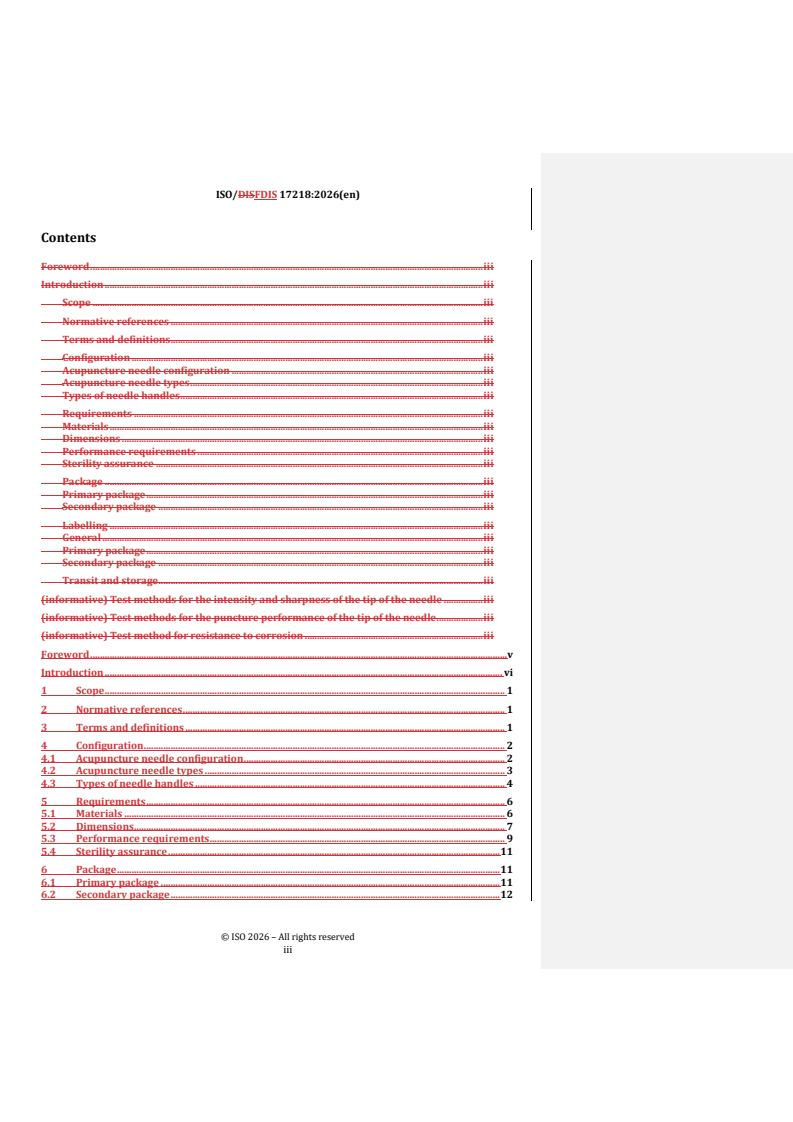
Contents
Foreword . iii
Introduction . iii
Scope . iii
Normative references . iii
Terms and definitions . iii
Configuration . iii
Acupuncture needle configuration . iii
Acupuncture needle types . iii
Types of needle handles . iii
Requirements . iii
Materials . iii
Dimensions . iii
Performance requirements . iii
Sterility assurance . iii
Package . iii
Primary package . iii
Secondary package . iii
Labelling . iii
General . iii
Primary package . iii
Secondary package . iii
Transit and storage . iii
(informative) Test methods for the intensity and sharpness of the tip of the needle . iii
(informative) Test methods for the puncture performance of the tip of the needle . iii
(informative) Test method for resistance to corrosion . iii
Foreword . v
Introduction . vi
1 Scope . 1
2 Normative references . 1
3 Terms and definitions . 1
4 Configuration . 2
4.1 Acupuncture needle configuration . 2
4.2 Acupuncture needle types . 3
4.3 Types of needle handles . 4
5 Requirements . 6
5.1 Materials . 6
5.2 Dimensions . 7
5.3 Performance requirements . 9
5.4 Sterility assurance . 11
6 Package . 11
6.1 Primary package . 11
6.2 Secondary package . 12
iii
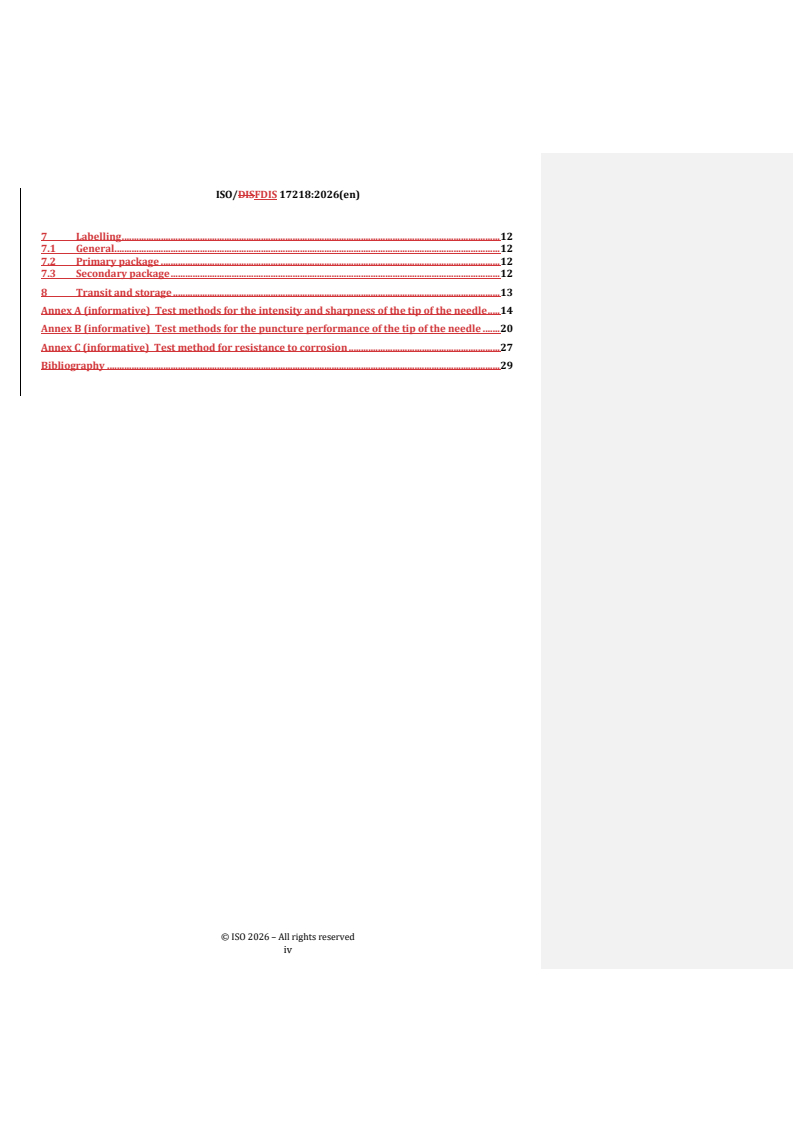
ISO/DISFDIS 17218:2026(en)
7 Labelling . 12
7.1 General . 12
7.2 Primary package . 12
7.3 Secondary package . 12
8 Transit and storage . 13
Annex A (informative) Test methods for the intensity and sharpness of the tip of the needle . 14
Annex B (informative) Test methods for the puncture performance of the tip of the needle . 20
Annex C (informative) Test method for resistance to corrosion . 27
Bibliography . 29
iv
ISO/DISFDIS 17218:2026(en)
Foreword
ISO (the International Organization for Standardization) is a worldwide federation of national standards
bodies (ISO member bodies). The work of preparing International Standards is normally carried out through
ISO technical committees. Each member body interested in a subject for which a technical committee has been
established has the right to be represented on that committee. International organizations, governmental and
non-governmental, in liaison with ISO, also take part in the work. ISO collaborates closely with the
International Electrotechnical Commission (IEC) on all matters of electrotechnical standardization.
The procedures used to develop this document and those intended for its further maintenance are described
in the ISO/IEC Directives, Part 1. In particular, the different approval criteria needed for the different types of
ISO documentsdocument should be noted. This document was drafted in accordance with the editorial rules
of the ISO/IEC Directives, Part 2 (see www.iso.org/directives).
Attention is drawnISO draws attention to the possibility that some of the elementsimplementation of this
document may beinvolve the subject of use of (a) patent(s). ISO takes no position concerning the evidence,
validity or applicability of any claimed patent rights. ISO shall not be held responsible for identifying any or
all such patent rights. Details of any patent rights identified during the development in respect thereof. As of
the date of publication of this document will be in the Introduction and/or on the ISO list of patent declarations
, ISO had not received (seenotice of (a) patent(s) which may be required to implement this document.
However, implementers are cautioned that this may not represent the latest information, which may be
obtained from the patent database available at www.iso.org/patents). ISO shall not be held responsible for
identifying any or all such patent rights.
Any trade name used in this document is information given for the convenience of users and does not
constitute an endorsement.
For an explanation onof the voluntary nature of standards, the meaning of ISO specific terms and expressions
related to conformity assessment, as well as information about ISO's adherence to the World Trade
Organization (WTO) principles in the Technical Barriers to Trade (TBT)), see the following URL: Foreword -
Supplementary informationwww.iso.org/iso/foreword.html.
The committee responsible for thisThis document iswas prepared by Technical Committee ISO/TC 249,
Traditional medicine, Subcommittee SC 1, Traditional Chinese medicine.
Formatted: Font: Not Italic
This second edition cancels and replaces the first edition (ISO 17218:2014), of which it constitutes a minor
revision. The changes are as follows:
— in Clause 2, additional documents have been added as normative references;
— in Clause 5.1, changes made to the text;
— in 5.2.3, 5.3.1.1c), 6.1, 8.1 and 8.2, some instances of the word “should” have been changed to “shall”.
Any feedback or questions on this document should be directed to the user’s national standards body. A
complete listing of these bodies can be found at www.iso.org/members.html.
v
ISO/DISFDIS 17218:2026(en)
Introduction
This International Standarddocument applies to sterile acupuncture needles for single use (specialized for
filiform needles) used by professional acupuncturists for acupuncture treatment. Sterile acupuncture needles
for single use are sterilized by the manufacturer, and the healthcare professional can open the sealed package
and use the needle immediately.
In order to encourage innovation, this International Standarddocument does not enforce the combination of
the needle diameter and length. However, considering the clinical usage requirements, the standard provides
the specifications for the needle diameter and length.
The sharpness and puncture performance of the needle tip are of very important clinical significance. Annex
A states the guidelines and the evaluation methods for the intensity and the sharpness of the needle tip, while
Annex B provides two qualitative and quantitative evaluation methods to determine the puncture
performance of the needle tip.
The qualitative methods to evaluate the puncture performance of needle tip are described in Annex B. The
methods are simple, direct and practical. It makes them especially suitable for routine inspection and for cross-
comparison of the acupuncture needles’ clinical applications. They also play a very important role in the
enhancement of the quality of the needle tip. The methods to evaluate the puncture performance of the needle
tip can be used to further evaluate the puncture and puncture performance of the acupuncture needle.
Currently, the more appropriate method is to use the needle tip to pierce through polyurethane material;
however, this method has not yet been implemented internationally.
Considering the consistency of standards in the future, this standard provides the methods to evaluate the
puncture performance of the needle tip and ranks 5.3.5.2 as recommended. The standard does not provide the
sharpness index of the piercing through polyurethane material by the needle tip. This index will be added to
the standard when it becomes appropriate. To improve product quality, all inspection reports should include
the inspection information as well as the results of the performance evaluation.
Since every manufacturer’s design, production, and sterilization methods are different, no regulations exist
for the materials of the acupuncture needle handle. Still, the needle body and the needle handle of acupuncture
needle should have good biocompatibility.
In order to ensure product safety and efficacy, the manufacturer should perform risk analysis and enforce risk
management in addition to adhering to the requirements of local rules, and regulations, thetake into account
relevant background data of the medical devices and clinical practice throughout the entire duration of the
product’s life cycle. ISO 14971 has provided manufacturers a framework for the effective management of
hazards associated with the use of medical devices.
In some countries, the requirements proposed here are subject to legal sanctions. SuchPlease be aware of rules
and regulations should take precedence over the standards set forth in this document.
vi
ISO/DISFDIS 17218:2026(en)
Sterile acupuncture needles for single use
1 Scope
This International Standarddocument specifies the requirements for the sterile acupuncture needles for single
use (specialized for filiform needles).
2 Normative references
The following documents are referred to in the text in such a way that some or all of their content constitutes
requirements of this document. For dated references, only the edition cited applies. For undated references,
the latest edition of the referenced document (including any amendments) applies.
ISO 3696, Water for analytical laboratory use — Specification and test methods
ISO 6507-1, Metallic materials — Vickers hardness test — Part 1: Test method
ISO 10993-1, Biological evaluation of medical devices — Part 1: Requirements and general principles for the
evaluation of biological safety within a risk management process
ISO 11135, Sterilization of health-care products — Ethylene oxide — Requirements for the development,
validation and routine control of a sterilization process for medical devices
ISO 11137-1, Sterilization of health care products — Radiation — Part 1: Requirements for the development,
validation and routine control of a sterilization process for medical devices
ISO 11607-1, Packaging for terminally sterilized medical devices — Part 1: Requirements for materials, sterile
barrier systems and packaging systems
ISO 15223-1, Medical devices — Symbols to be used with information to be supplied by the manufacturer — Part
1: General requirements
ISO 15510, Stainless steels — Chemical composition
ISO 17665, Sterilization of health care products — Moist heat — Requirements for the development, validation
and routine control of a sterilization process for medical devices
3 Terms and definitions
For the purposes of this document, the following terms and definitions apply.
3.1
body of the needle
part of the acupuncture needle that is inserted into the human body
Note 1 to entry: See Figure 1.
3.2
handle of the needle
part of the acupuncture needle that is not inserted into the human body
Note 1 to entry: See Figure 1.
ISO/DISFDIS 17218:2026(en)
3.3
tip of the needle
sharp apex at the end of the acupuncture needle body that is inserted into the human body
Note 1 to entry: See Figure 1.
3.4
root of the needle
part of the acupuncture needle that connects the needle body to the needle handle
Note 1 to entry: See Figure 1.
3.5
tail of the needle
end part of the needle handle at the opposite side of the tip of the needle
Note 1 to entry: See Figure 1.
3.6
sterile acupuncture needle
acupuncture needle that has been sterilized
3.7
guide tube
assistant tool in the shape of a slender, long tube into which the needle is placed and used for easy insertion
3.8
hardness of the needle body
measure of resistance of the acupuncture needle body to permanent deformation
3.9
primary package
sealed or closed packaging system that forms a microbial barrier, directly enclosing the acupuncture needle
Note 1 to entry: The primary package is usually the smallest unit package of use and the package that is in direct contact
with one or more acupuncture needles.
3.10
secondary package
package containing one or more primary packages for distribution and storage
4 Configuration
4.1 Acupuncture needle configuration
The configuration of the acupuncture needle and the name of each of its parts are shown in Figure 1.
ISO/DISFDIS 17218:2026(en)
Key
1 tip of the needle
2 body of the needle
3 root of the needle
4 handle of the needle
5 tail of the needle
Figure 1 — Example of typical structure of acupuncture needle
4.2 Acupuncture needle types
The acupuncture needle includes two types:
— acupuncture needle with a guide tube; and
— acupuncture needle without a guide tube.
The acupuncture needle with guide tube is shown in Figure 2. However, no uniform requirement is provided
for the fixing method of the needle tube.
Key
1 guide tube
Figure 2 — The acupuncture needle with a guide tube
ISO/DISFDIS 17218:2026(en)
4.3 Types of needle handles
The types of needle handles include the ring handle, the plain handle, the flower handle, the metal tube handle,
and the plastic handle, etc. The types of needle handles are not limited to those shown in the Figure 3.
ISO/DISFDIS 17218:2026(en)
ISO/DISFDIS 17218:2026(en)
Key
1 ring handle
2 plain handle
3 flower handle
4 metal tube handle
5 plastic handle
l1 length of the needle body
l2 length of the needle handle
⌀d diameter of the needle body
Figure 3 — Example of types of handles of acupuncture needles
5 Requirements
5.1 Materials
The biocompatibility of the body of the needle shall be assessed and documented according to the guidance
and principles given in ISO 10993-1.
ComplianceConformance is demonstrated by:
ISO/DISFDIS 17218:2026(en)
a) analogy with published data; or
b) the selection of materials already shown to be biocompatible by proven clinical use in a similar
application; or
c) experience with similar devices already on the market together with evidence of traceability to the
materials used in the acupuncture needle; or
d) compliance with published procedures for biological evaluation of:
1) Cytotoxicity;
2) Sensitization;
3) Intracutaneous reactivity;
4) Ethylene oxide sterilization residuals (if using ethylene oxide (EO.) to sterilize).
If the material of the body of the needle is changed and/, or if there is a new coating on the surface of the
needle body, andor if there is risk indicating that these may cause side-effects to the human body, then
evaluation and testing shall be in accordance with ISO 10993 series-1.
NOTE There is no uniform regulation regarding materials of the needle handle and body. Currently, the popularly
used material of the needle body is made of X5CrNi18–9, X7CrNi18–9 Austenite Stainless Steel, etc. which are given in
[1]
ISO 15510ISO 15510ISO 15510 .
5.2 Dimensions
5.2.1 Size designation
The size of the acupuncture needle shall be designated by the following:
a) the nominal diameter of the body of acupuncture needle, expressed in millimetres; and
b) the nominal length of the body of acupuncture needle, expressed in millimetres.
The size of acupuncture needle shall be referred to as “the designated metric size” and specified as the
diameter of the needle body × the length of the needle body.
EXAMPLE Ø 0,30 × 40 mm
5.2.2 Tolerance of dimensions
5.2.2.1 Diameter of the needle body
When measured by a micrometer or similar equipment, the nominal diameter of the body of acupuncture
needle shall comply with Table 1.
Table 1 — Nominal diameter of needle body
Dimensions in millimetres
Nominal diameter of needle body
Tolerance
d
0,10 ≤ d < 0,25 ±0,008
Formatted Table
0,25 ≤ d ≤ 0,45 ±0,015
ISO/DISFDIS 17218:2026(en)
Nominal diameter of needle body
Tolerance
d
0,45 < d ≤ 0,80 ±0,020
5.2.2.2 Length of body of the needle
When measured by vernier calipers or similar equipment, the nominal length of the body of acupuncture
needle shall comply with Table 2.
Table 2 — Nominal length of needle body
Dimensions in millimetres
Nominal length of needle body
Tolerance
l
5 ≤ l1 ≤ 25 ±0,50
Formatted Table
25 < l ≤ 60 ±1,00
60 < l1 ≤ 100 ±2,00
100 < l ≤ 200 ±3,00
5.2.3 Dimensions of needle handle
The handle of acupuncture needles shall be of suitable diameter and length for the intended purpose or
manipulation.
The length of the handle of acupuncture needles (l ) shall be no less than 13 mm.
The dimensions of the coiling handle wire used in the manufacturing of ring handles, plain handles and flower
handles shall comply with Table 3. The diameter of the plastic handle and the metal tube handle shall comply
with Table 4.
Table 3 — Diameter of the coiling handle wire
Dimensions in millimetres
Nominal diameter of needle body
Diameter of the coiling handle wire
d
0,10 ≤ d < 0,20 0,30
Formatted Table
0,20 ≤ d < 0,30 0,35
0,30 ≤ d < 0,40 0,40
0,40 ≤ d < 0,50 0,45
0,50 ≤ d ≤ 0,80 0,50
ISO/DISFDIS 17218:2026(en)
Table 4 — Diameter of the plastic handle and the metal tube handle and coiling handle which are
joined by other method than coiling around the needle body
NOTE These diameters are only applicable to “Cylinder-shaped” handle.
Dimensions in millimetres
Type of needle handle Di
...