

ISO 11040-8:2026
(Main)Prefilled syringes — Part 8: Requirements and test methods for finished prefilled syringes
- Abstract
This document is applicable to aseptically processed or terminally sterilized finished prefilled syringes (intended for single use only) based on syringe barrel components addressed in ISO 11040-4 or ISO 11040-6, together with a plunger stopper (sealing the back end) based on components addressed in ISO 11040-5 and a front end closure for parenteral preparations with focus on quality, functional performance and safety requirements, as well as relevant test methods. Finished prefilled syringes which have undergone an additional preparation step by the user before injection (e.g. diluent-containing syringes that have been emptied for reconstitution and in which the reconstituted injectable product has been aspirated after reconstitution) are excluded from the scope of this document. NOTE 1 This document can also be used as a guidance for other types, designs and/or sizes of finished prefilled syringes, for example dual chamber prefilled syringes. NOTE 2 For finished prefilled syringes that are used in needle-based injection systems, see also ISO 11608 (all parts). NOTE 3 Attention is drawn to applicable national or regional regulations and pharmacopoeias, such as Ph.Eur. [2], USP [3] or JP [4]. NOTE 4 Finished prefilled syringes for parenteral preparations which are medical devices or which, according to the principal mode of action of the product (i.e. the means by which the product achieves its principal intended action), are borderline between medical devices and medicinal products fall within the scope of this document, even if they are not always regulated as medicinal products.
- Status
- Published
- Publication Date
- 07-Jun-2026
- Current Stage
- 6060 - International Standard published
- Start Date
- 08-Jun-2026
- Due Date
- 14-Jul-2026
- Completion Date
- 08-Jun-2026
ISO 11040-8:2026 is an International Standard from ISO for finished prefilled syringes. It specifies quality, functional performance and safety requirements, plus test methods, for aseptically processed or terminally sterilized single-use finished prefilled syringes. It is written for manufacturers, developers, test labs and quality teams that need to verify the final syringe as a container closure system and delivery device.
What does ISO 11040-8:2026 specify?
ISO 11040-8:2026 applies to finished prefilled syringes built from barrel components addressed in ISO 11040-4 or ISO 11040-6, a plunger stopper based on ISO 11040-5, and a front end closure for parenteral preparations. It focuses on the finished product as presented to the user, including quality, functional performance and safety, together with relevant test methods.
The standard excludes finished prefilled syringes that the user prepares further before injection, such as a syringe emptied for reconstitution and then refilled after reconstitution. It can also be used as guidance for other designs and sizes, including dual chamber prefilled syringes.
The document is organized into Clauses 1 to 8 and four annexes.
| Annex | What it covers |
|---|---|
| Annex A | Normative test method for break-loose and extrusion forces |
| Annex B | Informative test method for residual volume |
| Annex C | Normative test methods for liquid leakage resistance |
| Annex D | Informative test method for administration time with defined constant test force |
What are the key requirements of ISO 11040-8:2026?
ISO 11040-8:2026 requires the manufacturer to define the intended use, then verify that the finished prefilled syringe matches that use through design, functional and pharmaceutical checks. In practice, the standard treats the syringe, its contents and any connected components as one system, so the test plan has to reflect the actual way the product will be used.
Intended use, risk management and usability
Clause 4 requires the manufacturer to define the intended medical indication, patient group, route and site of administration, use environment, expected transport and storage conditions, and any extra components or devices. This matters because these choices determine the forces, interfaces and risks that need to be tested.
Clause 4 also requires a risk-based approach through the product life cycle, using the principles of ISO 14971, and it requires usability to be validated in line with IEC 62366-1. For a buyer or reviewer, this means the standard expects evidence that the syringe can be used safely and as intended, not just that it passes a bench test.
System characterization
Clause 5 requires critical dimensions to be defined with attention to user interfaces, interfaces with connectors or other devices, and plunger stopper position. The document also requires the selected components and materials to suit the intended use and manufacturing process.
Clause 5 further requires the manufacturer to describe the contents of the finished prefilled syringe, including attributes such as viscosity, density, surface tension, pH, osmolality, filling volume and head space. These properties matter because they can change handling forces, delivery behavior and leak risk.
Functional performance testing
Clause 6 is the main performance section. It requires the manufacturer to set functional requirements based on intended use, to justify which of them are tested over shelf life, and to use a risk-based sampling plan with a confidence level of 95%.
Key tests include:
- Break-loose and extrusion forces - tested with the finished prefilled syringe as intended for use, at a defined constant speed, using Annex A.
- Flange breakage resistance - tested for both glass and plastic barrels with the finished prefilled syringe, using the relevant ISO 11040-4 or ISO 11040-6 method and the stated limits.
- Front end closure pull-off forces and torques - verified for Luer lock adaptor collars, tip caps, needle shields and rigid tip caps, with limits set by the intended use where needed.
- Connectivity with small-bore connectors - tested with the actual connector system intended for use, following ISO 80369-1, ISO 80369-7 and ISO 80369-20.
- Residual volume - assessed with the intended contents and any supporting components, because dead space affects delivered volume and overfill.
- Needle penetration and pull-out force - tested for staked needles in glass or plastic barrels.
- Sharps injury protection - if present, the feature or device has to meet ISO 23908.
- Liquid leakage resistance - tested at the plunger stopper under axial force, and burst resistance is also checked under higher internal pressure conditions where relevant.
- Markings - graduation marks or indicator lines have to be accurate for the intended use.
- Administration time - may be measured with a defined constant test force or force profile to show suitability for manual use or needle-based injection systems.
- Unintended plunger stopper movement - the design has to control stopper movement so sterility is maintained under foreseeable pressure or temperature changes.
Pharmaceutical requirements
Clause 7 requires the container closure system to be suitable for the intended contents with respect to protection, safety, compatibility and functional performance. It addresses interactions between the system and the injectable product, biological hazards and microbiological requirements, container closure integrity, deliverable volume, and particles.
In practice, this means the standard expects evidence that the syringe does not harm the product, does not lose sterility, and delivers the labelled amount when used as instructed.
What terms does ISO 11040-8:2026 define?
Finished prefilled syringe - the marketed prefilled container closure system for parenteral preparations, including filling, assembly of additional components, aseptic processing or terminal sterilization as applicable, and final packaging.
Manufacturer - the person or legal entity responsible for the design, development, manufacture, packaging and labelling of the finished prefilled syringe before market placement or service.
Needle-based injection system - an injection system intended for parenteral administration using a needle or cannula and a multi-dose or single-dose container.
User - the patient or health care giver, such as clinical personnel, a doctor or a lay person, who handles, prepares, applies or disposes of the finished prefilled syringe.
Who uses ISO 11040-8:2026?
ISO 11040-8:2026 is used by manufacturers of prefilled syringes, syringe component suppliers, drug-product developers, and test laboratories that verify functional performance. It is also relevant to quality assurance, regulatory affairs and purchasing teams that need to check whether a supplier’s evidence covers the intended use.
The standard is especially relevant for parenteral products, single-use syringes, and syringe systems used manually or in combination with needle-based injection systems. It also helps teams working on connected systems, such as syringes with staked needles, connectors, sharps injury protection or added administration devices.
What changed in ISO 11040-8:2026 from the previous edition?
ISO 11040-8:2026 is the second edition and it replaces ISO 11040-8:2016. The main changes stated for this edition are:
- the document has been revised for consistent terminology and language
- a basic statistical approach for design verification testing has been added
- terms and definitions in Clause 3 were revised, deleted or added
- the intended use definition was clarified
- break-loose and extrusion force testing was revised and a new Annex A was added
- the former burst resistance content was removed and partly moved into liquid leakage resistance
- flange breakage resistance was revised, and front end breakage resistance was deleted
- front end closure pull-off force and torque requirements were revised
- connectivity with small-bore connectors was clarified
- residual volume was clarified and a new Annex B was added
- needle penetration force and needle pull-out force were revised
- liquid leakage resistance was revised and a new Annex C was added
- administration time with defined constant test force was added, with a new Annex D
- unintended plunger stopper movement was added
- pharmacopoeia references were added where relevant in Clause 7
Which standards are used with ISO 11040-8:2026?
ISO 11040-8:2026 is used together with several related standards, depending on the syringe design and the intended system.
- ISO 11040-4 - glass barrels and related test methods for glass-based systems
- ISO 11040-5 - plunger stoppers for injectables
- ISO 11040-6 - plastic barrels and related test methods for plastic-based systems
- ISO 23908 - sharps injury protection mechanisms and tests
- ISO 80369-1, ISO 80369-7 and ISO 80369-20 - small-bore connector requirements and common test methods
- IEC 62366-1 - usability engineering for medical devices
- ISO 14971 - risk management applied to the product life cycle
- ISO 10993-1 - biological evaluation within a risk management process
- ISO 13408-1 and ISO 17665 - aseptic processing and moist heat sterilization requirements
- ISO 11608 (all parts) - needle-based injection systems, when the finished prefilled syringe is used in that context
- ISO 7864 - sterile hypodermic needles for single use
- ISO 7886-1:2017 - cited as a comparator for graduation marks
What does the ISO 11040-8:2026 document contain?
ISO 11040-8:2026 contains system-level requirements in Clauses 4 to 7, plus a report section in Clause 8. It also includes a figure showing how plunger stopper position can be measured and a figure showing the theoretical sterile barrier zone of the plunger stopper.
Annex A gives the detailed force-test procedure for break-loose and extrusion forces, including the apparatus, setup, procedure and reporting items. Annex C gives two leakage procedures and includes a formula linking applied force, internal pressure and syringe cross-section.
Annex B and Annex D provide informative test methods for residual volume and administration time. Together, the annexes support design verification, functional testing and documentation of finished prefilled syringes.
Relations
- Effective Date
- 22-Oct-2022
Get Certified
Connect with accredited certification bodies for this standard

BSI Group
BSI (British Standards Institution) is the business standards company that helps organizations make excellence a habit.

TÜV Rheinland
TÜV Rheinland is a leading international provider of technical services.

TÜV SÜD
TÜV SÜD is a trusted partner of choice for safety, security and sustainability solutions.
Sponsored listings
Frequently Asked Questions
ISO 11040-8:2026 is a standard published by the International Organization for Standardization (ISO). Its full title is "Prefilled syringes — Part 8: Requirements and test methods for finished prefilled syringes". This standard covers: This document is applicable to aseptically processed or terminally sterilized finished prefilled syringes (intended for single use only) based on syringe barrel components addressed in ISO 11040-4 or ISO 11040-6, together with a plunger stopper (sealing the back end) based on components addressed in ISO 11040-5 and a front end closure for parenteral preparations with focus on quality, functional performance and safety requirements, as well as relevant test methods. Finished prefilled syringes which have undergone an additional preparation step by the user before injection (e.g. diluent-containing syringes that have been emptied for reconstitution and in which the reconstituted injectable product has been aspirated after reconstitution) are excluded from the scope of this document. NOTE 1 This document can also be used as a guidance for other types, designs and/or sizes of finished prefilled syringes, for example dual chamber prefilled syringes. NOTE 2 For finished prefilled syringes that are used in needle-based injection systems, see also ISO 11608 (all parts). NOTE 3 Attention is drawn to applicable national or regional regulations and pharmacopoeias, such as Ph.Eur. [2], USP [3] or JP [4]. NOTE 4 Finished prefilled syringes for parenteral preparations which are medical devices or which, according to the principal mode of action of the product (i.e. the means by which the product achieves its principal intended action), are borderline between medical devices and medicinal products fall within the scope of this document, even if they are not always regulated as medicinal products.
This document is applicable to aseptically processed or terminally sterilized finished prefilled syringes (intended for single use only) based on syringe barrel components addressed in ISO 11040-4 or ISO 11040-6, together with a plunger stopper (sealing the back end) based on components addressed in ISO 11040-5 and a front end closure for parenteral preparations with focus on quality, functional performance and safety requirements, as well as relevant test methods. Finished prefilled syringes which have undergone an additional preparation step by the user before injection (e.g. diluent-containing syringes that have been emptied for reconstitution and in which the reconstituted injectable product has been aspirated after reconstitution) are excluded from the scope of this document. NOTE 1 This document can also be used as a guidance for other types, designs and/or sizes of finished prefilled syringes, for example dual chamber prefilled syringes. NOTE 2 For finished prefilled syringes that are used in needle-based injection systems, see also ISO 11608 (all parts). NOTE 3 Attention is drawn to applicable national or regional regulations and pharmacopoeias, such as Ph.Eur. [2], USP [3] or JP [4]. NOTE 4 Finished prefilled syringes for parenteral preparations which are medical devices or which, according to the principal mode of action of the product (i.e. the means by which the product achieves its principal intended action), are borderline between medical devices and medicinal products fall within the scope of this document, even if they are not always regulated as medicinal products.
ISO 11040-8:2026 is classified under the following ICS (International Classification for Standards) categories: 11.040.25 - Syringes, needles an catheters. The ICS classification helps identify the subject area and facilitates finding related standards.
ISO 11040-8:2026 has the following relationships with other standards: It is inter standard links to ISO 11040-8:2016. Understanding these relationships helps ensure you are using the most current and applicable version of the standard.
ISO 11040-8:2026 is available in PDF format for immediate download after purchase. The document can be added to your cart and obtained through the secure checkout process. Digital delivery ensures instant access to the complete standard document.
Standards Content (Sample)
International
Standard
ISO 11040-8
Second edition
Prefilled syringes —
2026-06
Part 8:
Requirements and test methods for
finished prefilled syringes
Seringues préremplies —
Partie 8: Exigences et méthodes d'essai pour les seringues
préremplies prêtes à l'emploi
Reference number
© ISO 2026
All rights reserved. Unless otherwise specified, or required in the context of its implementation, no part of this publication may
be reproduced or utilized otherwise in any form or by any means, electronic or mechanical, including photocopying, or posting on
the internet or an intranet, without prior written permission. Permission can be requested from either ISO at the address below
or ISO’s member body in the country of the requester.
ISO copyright office
CP 401 • Ch. de Blandonnet 8
CH-1214 Vernier, Geneva
Phone: +41 22 749 01 11
Email: copyright@iso.org
Website: www.iso.org
Published in Switzerland
ii
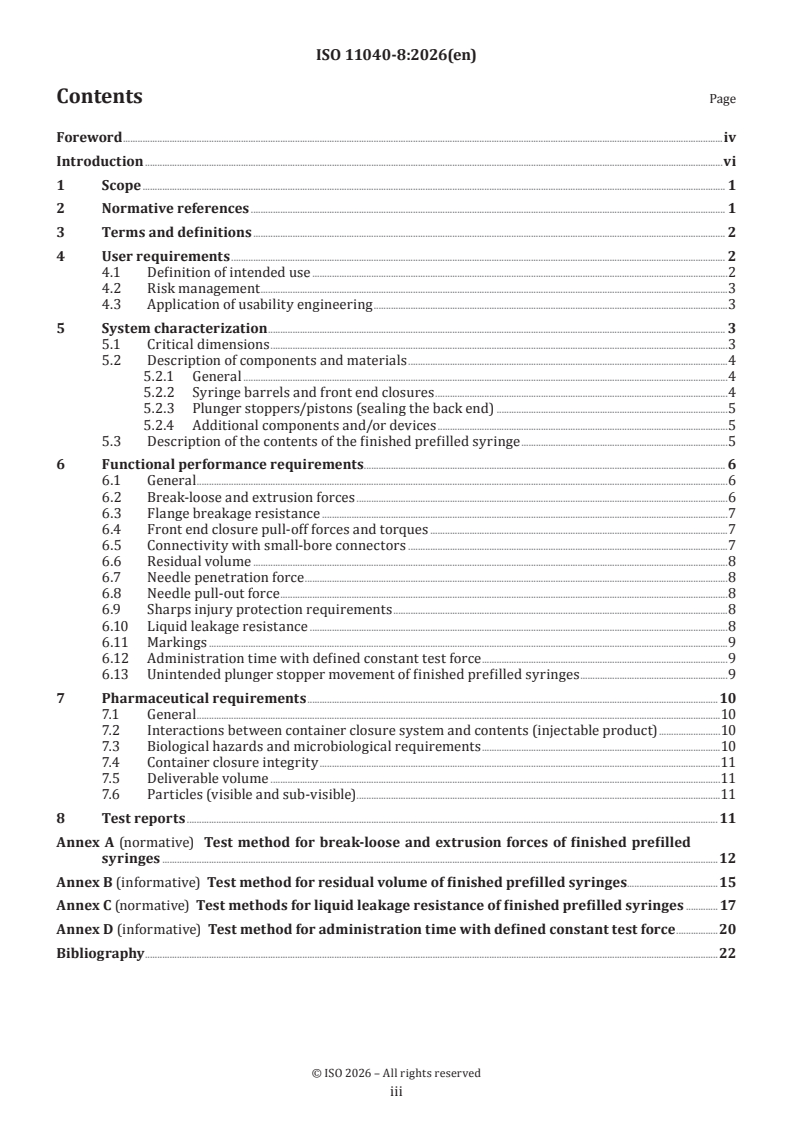
Contents Page
Foreword .iv
Introduction .vi
1 Scope . 1
2 Normative references . 1
3 Terms and definitions . 2
4 User requirements . 2
4.1 Definition of intended use .2
4.2 Risk management .3
4.3 Application of usability engineering .3
5 System characterization .3
5.1 Critical dimensions .3
5.2 Description of components and materials .4
5.2.1 General .4
5.2.2 Syringe barrels and front end closures .4
5.2.3 Plunger stoppers/pistons (sealing the back end) .5
5.2.4 Additional components and/or devices .5
5.3 Description of the contents of the finished prefilled syringe .5
6 Functional performance requirements. 6
6.1 General .6
6.2 Break-loose and extrusion forces .6
6.3 Flange breakage resistance .7
6.4 Front end closure pull-off forces and torques .7
6.5 Connectivity with small-bore connectors .7
6.6 Residual volume .8
6.7 Needle penetration force .8
6.8 Needle pull-out force .8
6.9 Sharps injury protection requirements .8
6.10 Liquid leakage resistance .8
6.11 Markings .9
6.12 Administration time with defined constant test force .9
6.13 Unintended plunger stopper movement of finished prefilled syringes .9
7 Pharmaceutical requirements .10
7.1 General .10
7.2 Interactions between container closure system and contents (injectable product) .10
7.3 Biological hazards and microbiological requirements .10
7.4 Container closure integrity .11
7.5 Deliverable volume .11
7.6 Particles (visible and sub-visible) .11
8 Test reports .11
Annex A (normative) Test method for break-loose and extrusion forces of finished prefilled
syringes .12
Annex B (informative) Test method for residual volume of finished prefilled syringes .15
Annex C (normative) Test methods for liquid leakage resistance of finished prefilled syringes . 17
Annex D (informative) Test method for administration time with defined constant test force .20
Bibliography .22
iii
Foreword
ISO (the International Organization for Standardization) is a worldwide federation of national standards
bodies (ISO member bodies). The work of preparing International Standards is normally carried out through
ISO technical committees. Each member body interested in a subject for which a technical committee
has been established has the right to be represented on that committee. International organizations,
governmental and non-governmental, in liaison with ISO, also take part in the work. ISO collaborates closely
with the International Electrotechnical Commission (IEC) on all matters of electrotechnical standardization.
The procedures used to develop this document and those intended for its further maintenance are described
in the ISO/IEC Directives, Part 1. In particular the different approval criteria needed for the different types
of ISO documents should be noted. This document was drafted in accordance with the editorial rules of the
ISO/IEC Directives, Part 2 (see www.iso.org/directives).
ISO draws attention to the possibility that the implementation of this document may involve the use of (a)
patent(s). ISO takes no position concerning the evidence, validity or applicability of any claimed patent
rights in respect thereof. As of the date of publication of this document, ISO had not received notice of (a)
patent(s) which may be required to implement this document. However, implementers are cautioned that
this may not represent the latest information, which may be obtained from the patent database available at
www.iso.org/patents. ISO shall not be held responsible for identifying any or all such patent rights.
Any trade name used in this document is information given for the convenience of users and does not
constitute an endorsement.
For an explanation on the meaning of ISO specific terms and expressions related to conformity assessment,
as well as information about ISO’s adherence to the World Trade Organization (WTO) principles in the
Technical Barriers to Trade (TBT) see the following URL: www.iso.org/iso/foreword.html.
The document was prepared by Technical Committee ISO/TC 76, Transfusion, infusion and injection, and
blood processing equipment for medical and pharmaceutical use.
This second edition cancels and replaces the first edition (ISO 11040-8:2016), which has been technically
revised.
The main changes are as follows.
— The entire document has been revised for consistent use of terms and language.
— A basic statistical approach for design verification testing of functional performance requirements has
been included in the Clause and in 6.1.
— Single terms and definitions (see Clause 3) have been revised, deleted or included.
— The definition of intended use (see 4.1) has been revised for clarity.
— Break-loose and extrusion forces (see 6.2) has been revised; it has been clarified to perform testing with
the finished prefilled syringe as intended for use. A new Annex A, with the respective test method, has
been introduced.
— The former subclause for burst resistance was removed; parts of its contents have been included in the
revised subclause for liquid leakage resistance (see 6.10).
— Flange breakage resistance (see 6.3) has been revised to include specification limits and a test method
reference. It was clarified to perform testing with the finished prefilled syringe, with further instructions.
Front end breakage resistance requirements have been deleted.
— Front end closure pull-off forces and torques (see 6.4) have been revised to clarify test methods and
specification limits.
— Connectivity with small-bore connectors (see 6.5) was clarified to perform testing with the finished
prefilled syringe as intended for use.
iv
— Residual volume (see 6.6) was clarified to perform testing with the finished prefilled syringe as intended
for use. A new Annex B, with the respective test method, has been introduced.
— Needle penetration force (see 6.7) and needle pull-out force (6.8) were revised to clarify test methods
and specification limits.
— Liquid leakage resistance (see 6.10) was combined with parts of the contents of former subclause for
burst resistance and revised. A new Annex C, with the respective test methods, has been introduced.
— A new subclause for administration time with defined constant test force (see 6.12) has been included. A
new Annex D, with the respective test method, has been introduced.
— A new subclause for unintended plunger stopper movement of finished prefilled syringes (see 6.13) has
been introduced.
— Where applicable, references to pharmacopoeias have been included in the subclauses to pharmaceutical
requirements (see Clause 7).
A list of all parts in the ISO 11040 series can be found on the ISO website.
Any feedback or questions on this document should be directed to the user’s national standards body. A
complete listing of these bodies can be found at www.iso.org/members.html.
v
Introduction
Historically, injectable (parenteral) liquid pharmaceutical products have been mainly provided in primary
containers (i.e. ampoules and vials) which required the liquid to be transferred into a hypodermic syringe
and combined with the appropriate injection needle before administration. This procedure is not only time-
consuming, but also presents a multitude of possibilities for contamination and use errors.
Over the past decades, the presentation of liquid pharmaceutical products in prefilled syringes for single
use, many with staked needles, has become more prevalent. The simplicity of use that is provided not only
benefits their use in the clinical setting, but also enables these to be used by lay users in a home setting.
The standardization of the requirements for prefilled syringes has been addressed by ISO/TC 76 in two
ways:
— the specifications of the components of the prefilled syringe prior to filling are included in the previous
parts of the ISO 11040 series;
— the requirements for the final prefilled syringe, presented to the user as a finished product, are addressed
in this document.
Finished prefilled syringes can require marketing authorization as a medicinal product, in some regions as a
combination product or as a medical device, depending on their contents and the intended use. The syringe
plays a dual role in the finished product — as a container closure system and as a delivery device. Safety,
functional performance and usability need to be considered, also in case of intended use in combination
with pre-attached, co-packaged or cross-referenced additional components and/or devices. This document
addresses the syringe and its contents as a system, with the intent to ensure the successful application for
its intended use. In this context, the minimal configuration of a finished prefilled syringe is the syringe
barrel filled with the intended contents (i.e. the injectable product) and closed with a front end closure and a
plunger stopper (sealing the back end). Additional components (e.g. either attachment of a needle for single
use or assembly of a plunger rod or both) may need to be added by the manufacturer or user to make it ready
for administration by manual injection according to its intended use. Alternatively, such a finished prefilled
syringe may be combined by the manufacturer or user with a device for administration by a needle-based
injection system according to its intended use.
This document includes requirements for the design verification of the finished prefilled syringe’s functional
performance requirements in accordance with its design specifications. The test methods and other aspects
of testing described in this document are intended to verify the design at a confidence level of 95 %. They
are not intended to stipulate acceptance criteria for lot release (e.g. acceptable quality limits, probability
content, probability or other) in the context of manufacturing processes. Finished prefilled syringes based
on customised components can still be tested in accordance with this document. Testing at component, sub-
assembly, or in-process level can be sufficient for design verification of specific requirements if the influence
of processing on the finished prefilled syringe can be ruled out.
There are other international and national standards and guidance publications and, in some countries,
national regulations that are applicable to medical devices and medicinal products and combinations
thereof. Their requirements might supersede or complement this document. Developers and manufacturers
of finished prefilled syringes are encouraged to investigate and determine whether there are any other
requirements relevant to the safety and functional performance or marketability of their products.
In this document, the conjunctive “or” is used as an “inclusive or” so a statement is true if any combination of
the conditions is true.
In this document the following verbal forms are used.
— “Shall” indicates requirements.
— “Should” indicates recommendations.
— “May” indicates permissions.
— "Can" indicates possibility or capability.
vi
International Standard ISO 11040-8:2026(en)
Prefilled syringes —
Part 8:
Requirements and test methods for finished prefilled
syringes
1 Scope
This document is applicable to aseptically processed or terminally sterilized finished prefilled syringes
(intended for single use only) based on syringe barrel components addressed in ISO 11040-4 or ISO 11040-6,
together with a plunger stopper (sealing the back end) based on components addressed in ISO 11040-5 and
a front end closure for parenteral preparations with focus on quality, functional performance and safety
requirements, as well as relevant test methods.
Finished prefilled syringes which have undergone an additional preparation step by the user before injection
(e.g. diluent-containing syringes that have been emptied for reconstitution and in which the reconstituted
injectable product has been aspirated after reconstitution) are excluded from the scope of this document.
NOTE 1 This document can also be used as a guidance for other types, designs and/or sizes of finished prefilled
syringes, for example dual chamber prefilled syringes.
NOTE 2 For finished prefilled syringes that are used in needle-based injection systems, see also ISO 11608 (all parts)
[1]
.
[2]
NOTE 3 Attention is drawn to applicable national or regional regulations and pharmacopoeias, such as Ph.Eur. ,
[3] [4]
USP or JP .
NOTE 4 Finished prefilled syringes for parenteral preparations which are medical devices or which, according to
the principal mode of action of the product (i.e. the means by which the product achieves its principal intended action),
are borderline between medical devices and medicinal products fall within the scope of this document, even if they
are not always regulated as medicinal products.
2 Normative references
The following documents are referred to in the text in such a way that some or all of their content constitutes
requirements of this document. For dated references, only the edition cited applies. For undated references,
the latest edition of the referenced document (including any amendments) applies.
ISO 11040-4, Prefilled syringes — Part 4: Glass barrels for injectables and sterilized subassembled syringes
ready for filling
ISO 11040-4:2024, Prefilled syringes — Part 4: Glass barrels for injectables and sterilized subassembled syringes
ready for filling
ISO 11040-5, Prefilled syringes — Part 5: Plunger stoppers for injectables
ISO 11040-6:2019, Prefilled syringes — Part 6: Plastic barrels for injectables and sterilized subassembled
syringes ready for filling
ISO 11040-6, Prefilled syringes — Part 6: Plastic barrels for injectables and sterilized subassembled syringes
ready for filling
ISO 23908, Sharps injury protection — Sharps protection mechanisms for single-use needles, introducers for
catheters and needles used for blood testing, monitoring, sampling and medical substance administration —
Requirements and test methods
ISO 80369-1, Small-bore connectors for liquids and gases in healthcare applications — Part 1: General
requirements
ISO 80369-7, Small-bore connectors for liquids and gases in healthcare applications — Part 7: Connectors for
intravascular or hypodermic applications
ISO 80369-20, Small-bore connectors for liquids and gases in healthcare applications — Part 20: Common test
methods
IEC 62366-1, Medical devices — Part 1: Application of usability engineering to medical devices
3 Terms and definitions
For the purposes of this document, the following terms and definitions apply.
ISO and IEC maintain terminology databases for use in standardization at the following addresses:
— ISO Online browsing platform: available at https:// www .iso .org/ obp
— IEC Electropedia: available at https:// www .electropedia .org/
3.1
finished prefilled syringe
prefilled container closure system for parenteral preparations as marketed, including, for example,
filling with the intended contents and assembly of additional components, aseptic processing or terminal
sterilization as applicable, and final packaging by the manufacturer (3.2)
3.2
manufacturer
natural or legal person holding the licence (e.g. marketing authorisation or other as applicable) for the
injectable product with responsibility for the design, development, manufacture, packaging and labelling of
a finished prefilled syringe (3.1), before it is placed on the market or put into service, regardless of whether
these operations are carried out by that person or on that person's behalf by a third party
3.3
needle-based injection system
injection system intended for parenteral administration of medicinal products using a needle or cannula
and a multi-dose or single-dose container
[5]
[SOURCE: ISO 11608-1:2022 , 3.15]
3.4
user
patient or health care giver (e.g. clinical personnel, doctor, lay person) who handles (e.g. prepares, applies,
disposes of) the finished prefilled syringe (3.1)
4 User requirements
4.1 Definition of intended use
The manufacturer shall define the intended use of the finished prefilled syringe. Aspects to be considered
shall include the following:
— intended medical indication and criticality of administration, e.g. in emergency situations;
— patient population including their health status and the user profile;
— the target route and/or site and frequency of administration;
— the use environment, e.g. clinical or home setting;
— additional components and/or devices (see 5.2.4) that are used for application, e.g. plunger rods/piston
rods, finger flange extensions/backstops, sterile hypodermic needles, needleless small-bore connectors,
filters, tubing, vial adapters, needle-based injection systems;
— characteristics of the expected environmental conditions during transport, storage and use;
— operating principle if applicable, and interactions between the user, the environment and the finished
prefilled syringe including additional components and/or devices, if applicable.
4.2 Risk management
Manufacturers shall follow a risk-based approach during the design, development, manufacture and life
[6]
cycle of the finished prefilled syringe like exemplarily described by ISO 14971 . Risk management shall
consider the intended use, interactions between container closure system and contents, and environmental
conditions. This can result in product-specific requirements and test methods that differ from what is
outlined in this document.
If the finished prefilled syringe is intended to be used in combination with pre-attached, co-packaged or
cross-referenced components and/or devices, the manufacturer shall ensure that the whole combination,
including the connectivity with other components and/or devices, is safe, usable and does not impair the
specified functional performance of the single components and/or devices.
[7]
NOTE For risk management of manufacturing processes, see ICH Q9 Quality Risk Management .
4.3 Application of usability engineering
The usability of the finished prefilled syringe shall be considered and validated according to a process
conforming to IEC 62366-1.
[8]
NOTE 1 For further information on usability engineering of medical devices, see ANSI/AAMI HE75 .
NOTE 2 The instructions for use are part of the user interface to be validated in the usability testing.
5 System characterization
5.1 Critical dimensions
Critical dimensions shall be defined considering the intended use of the finished prefilled syringe. Particular
attention shall be paid to, but not limited to, the following:
— interfaces with users;
— interfaces and connectivity with other components (e.g. needleless small-bore connectors or sterile
hypodermic needles);
— interfaces with other devices (e.g. sharps injury protection features or needle-based injection systems);
— the plunger stopper position depending on the intended use [e.g. for manual injection or for use in needle-
based injection systems] (see Figure 1).
Figure 1 shows examples of measuring the plunger stopper position for finished prefilled syringes.
a) Example 1 b) Example 2
Key
1 plunger stopper
l distance from the plunger stopper to the top of the 90° cone (mechanical or optical gauge) at the syringe
barrel front end shoulders
l and l distance from the plunger stopper to the back end of the syringe (proximal or distal edge of the flange)
2 3
Figure 1 — Examples of measuring the plunger stopper position for finished prefilled syringes
5.2 Description of components and materials
5.2.1 General
The selected components and materials shall be suitable for the intended use and the intended manufacturing
processes (e.g. component sterilization and/or terminal sterilization process if applicable).
The interfaces with other components and/or devices (e.g. tubing or needle-based injection systems) shall
be considered.
5.2.2 Syringe barrels and front end closures
ISO 11040-4 and ISO 11040-6 shall apply.
The syringe barrel can include a staked needle. The needle dimensions including inner and outer diameters
(gauge) and exposed needle length shall be consistent with the intended use, considering, for example, route
of administration, use in needle-based injection systems and content properties.
5.2.3 Plunger stoppers/pistons (sealing the back end)
ISO 11040-5 shall apply.
[9]
NOTE The dimensional requirements of ISO 11040-5 apply to component level. Plunger stopper dimensions are
different in compressed and uncompressed state.
5.2.4 Additional components and/or devices
Additional components and/or devices required for or supporting the intended use can include but are not
limited to the following:
— plunger rods/piston rods;
— add-on finger flanges/backstops;
[10]
— sterile hypodermic needles with 6 % Luer conical fitting in accordance with ISO 7864 ;
— sharps injury protection features (integrated or combined with the finished prefilled syringe prior to
[11]
use) in accordance with ISO 23908 ;
— other devices with small-bore connectors with 6 % Luer conical fitting, for example:
— filters;
— valves;
— needle-less Luer-activated devices;
— tubing;
— vial adapters.
Finished prefilled syringes can be used in needle-based injection systems if appropriately qualified.
The interfaces with the relevant components and/or devices shall be considered.
5.3 Description of the contents of the finished prefilled syringe
Quality attributes of the contents critical to the functional performance of the finished prefilled syringe
shall be defined. Those relevant for interactions between container closure system and contents (injectable
product) and/or affecting administration can include but are not limited to the following:
— viscosity;
— density;
— surface tension;
— pH;
— osmolality;
— filling volume including filling tolerances;
— head space volume and composition.
These quality attributes are temperature dependent and can change over time.
6 Functional performance requirements
6.1 General
Based on the intended use (see 4.1) the manufacturer shall ensure that the finished prefilled syringe
fulfils the corresponding functional performance requirements until the end of product shelf life. The
manufacturer shall establish and document, through a risk-based assessment, which functional performance
requirements of the finished prefilled syringe shall be tested in stability studies at time points up to the
end of product shelf life. For requirements where no performance degradation is expected over time, initial
design verification testing may be sufficient if justified. The tests described in subclauses 6.2 to 6.12 should
be considered but are not necessarily all inclusive.
[12]
NOTE For conducting stability studies, see Reference .
The sampling plans for design verification testing should ensure a probability content level, determined to
be appropriate by risk assessment, with a confidence level of 95 %. The confidence level of 95 % means that
there is a 5 % risk of incorrectly concluding that the testing has demonstrated the reliability level based on
the specific units in the testing sample. The reliability level is the reliability goal or target level of reliability
that the product is expected to achieve. The confidence level of 95 % is the minimum confidence level
commonly used. The typical choice of reliability level is 90 %, 95 %, 97,5 % or 99 %, which is determined by
the level of risk that can be accepted depending on the intended use of the product. The sample size should
be selected based on the required confidence and reliability levels.
EXAMPLE If a process has achieved a 95 % confidence and a 99 % reliability, it has demonstrated with a 95 %
confidence that at least 99 % of the units in the population are conforming to the requirements.
A sample size of 30 units is considered statistically significant as it fulfils the following criteria.
— The central limit theorem states that the distribution of sample means is normally distributed or
transformed if the sample size is 30 units or more. This means that the mean value of a sample is close to
the mean value of the population, regardless of the distribution of the data.
— The law of large numbers also states that the more data points a sample contains, the more accurate
are the results. With fewer than 30 data points, it is difficult to draw reliable conclusions as there is not
enough data to reduce variability and bias.
— In addition, a sample size of 30 units can provide a more complete picture of a histogram that reveals the
underlying distribution of the data.
Specification limits for the functional parameters shall be defined based on the intended use. Testing at
component, sub-assembly, or in-process level can be sufficient and data maybe leveraged for design
verification of specific requirements if the influence of processing on the finished prefilled syringe can be
ruled out. Furthermore, for certain functional tests, the use of a representative surrogate fluid instead of
the final injectable product is permissible, provided its selection is justified by a risk-based assessment
demonstrating that it represents a worst-case condition for the attribute being tested.
6.2 Break-loose and extrusion forces
Break loose and extrusion forces testing shall be conducted with the finished prefilled syringe as intended
for use (e.g. with attached needle or with assembled plunger rod). Finished prefilled syringes intended
for administration by manual injection shall be assembled with the same plunger rod as for application
according to the intended use (i.e. the plunger rod the product is placed on the market with); for those
intended for administration by a needle-based injection system the plunger rod of the used injection system
may be used if applicable, or an appropriate substitute plunger rod (e.g. of the used tensile and compression
testing machine). For the tests, the temperature of the contents shall be as for application according to the
intended use.
It shall be considered that the break-loose and extrusion forces can change over product shelf life depending
on environmental conditions.
The finished prefilled syringe shall be tested according to Annex A for break-loose and extrusion forces
with constant test speed. The test speed shall be defined based on the intended use, considering injection
duration requirements with the impact of different syringe sizes, filling volumes, needle dimensions (in
particular the inner diameter) as well as the content properties.
6.3 Flange breakage resistance
Flange breakage resistance of finished prefilled syringes shall be tested. The specification limits stated in
ISO 11040-4:2024, 5.4.4 shall apply as minimum requirements for both finished prefilled syringes with glass
barrels (in accordance with ISO 11040-4) or with plastic barrels (in accordance with ISO 11040-6). The
specification limits may be adapted based on the intended use.
NOTE 1 For finished prefilled syringes that are used in needle-based injection systems, the stated specification
limits can be adapted to higher values depending on the intended use.
The test method ISO 11040-4:2024, C.1 is applicable to finished prefilled syringes with glass barrels and
is performed with the finished prefilled syringe. Accordingly, the test method ISO 11040-6:2019, C.1 is
applicable to finished prefilled syringes with plastic barrels and is performed with the finished prefilled
syringe.
[13]
NOTE 2 The failure mode for plastic barrels (in accordance with ISO 11040-6 ) can be different than breakage,
for example deformation.
For testing purposes, the tip cap or needle shield (or other front end closure) is removed from the finished
prefilled syringe, the plunger stopper is manually depressed (i.e. the syringe emptied) and may remain in
the syringe but the plunger rod is removed to allow the use of the loading pin required by the test method
instead. The removal of add-on finger flanges/backstops for testing flange breakage resistance is permissible
if required to perform the test method.
6.4 Front end closure pull-off forces and torques
The following test methods shall apply:
— ISO 11040-4:2024, G3 Luer lock adaptor collar pull-off force; the specification limits of ISO 11040-4:2024,
6.5.3.5 apply;
— ISO 11040-4:2024, G4 Luer lock adaptor collar torque resistance; the specification limits of
ISO 11040-4:2024, 6.5.3.5 apply;
— ISO 11040-4:2024, G5 Luer lock rigid tip cap unscrewing torque; according specification limits shall be
defined based on the intended use;
— ISO 11040-4:2024, G6 Pull-off force of the tip cap or the needle shield; according specification limits shall
be defined based on the intended use.
6.5 Connectivity with small-bore connectors
Additional small-bore connectors to be used in the fluid path of the finished prefilled syringe according
to the intended use shall be tested for connectivity and leakage following ISO 80369-1, ISO 80369-7 and
ISO 80369-20. The finished prefilled syringe with the intended contents shall be tested with the same
additional small-bore connectors as for application according to the intended use (either pre-attached, co-
packaged or cross-referenced). When the finished prefilled syringe is intended for use with a specific pre-
attached, co-packaged, or cross-referenced small-bore connector, testing shall focus on the integrity and
functional performance of the combined system for its intended use (e.g. secure attachment, absence of
leakage during administration). It is recognized that direct application of all test methods in accordance with
ISO 80369-20 may not be feasible with the intended small-bore connector; in such case, the manufacturer
shall perform and document a risk-based assessment to define appropriate functional testing, for example
with a reference small-bore connector.
Additional considerations are required for the use of needle-less Luer-activated devices. Although, for
example, the threaded part of such a device is covered by ISO 80369-7, the internal design and function are
not covered by this document. Connectivity and functionality need to be verified in order to prevent cone
breakage or cone blockage.
[14] [13]
Additionally, see ISO 11040-4 and ISO 11040-6 for testing Luer connectors/Luer lock adapters.
6.6 Residual volume
The residual volume (dead space) of the finished prefilled syringe should be tested according to Annex B
with the intended contents and in combination with additional components and/or devices as intended for
use. For the test, the temperature of the contents shall be as for application according to the intended use.
The residual volume can depend on the content properties (e.g. viscosity) and, for example, on the needle
dimensions (in particular the inner diameter). It is determined, for example, to define a potential overfill for
the manufacturing process in order to achieve the correct deliverable volume (see 7.5).
6.7 Needle penetration force
Needle penetration force for finished prefilled syringes with glass barrels and a staked needle shall be
tested according to ISO 11040-4:2024, Annex F; for those with plastic barrels and a staked needle it shall be
tested according to ISO 11040-6:2019, Annex F. The specification limits for needle penetration force stated
in ISO 11040-4:2024, 6.5.2.4 shall apply for both finished prefilled syringes with glass barrels (in accordance
with ISO 11040-4) and finished prefilled syringes with plastic barrels (in accordance with ISO 11040-6).
NOTE Terminal sterilization using moist heat can affect the, for example, silicone lubrication layer on the needle.
6.8 Needle pull-out force
Needle pull-out force for finished prefilled syringes with glass barrels and a staked needle shall be
tested according to ISO 11040-4:2024, G.1; for those with plastic barrels and a staked needle it shall be
tested according to ISO 11040-6:2019, G.1. The specification limits for needle pull-out force stated in
ISO 11040-4:2024, 6.5.2.6 shall apply as minimum requirements for both finished prefilled syringes with
glass barrels (in accordance with ISO 11040-4) and finished prefilled syringes with plastic barrels (in
accordance with ISO 11040-6).
6.9 Sharps injury protection requirements
If the finished prefilled syringe has integrated sharps injury protection features (or is combined with a
sharps injury protection device before use), it shall meet the requirements of ISO 23908.
6.10 Liquid leakage resistance
The finished prefilled syringe shall be tested in accordance with the procedures described in Annex C for
liquid leakage resistance by applying an axial force to the plunger stopper through the same plunger rod as
for application and under the same conditions according to the intended use, consistent with the maximum
force generated during administration.
The finished prefilled syringe shall be tested with the intended front end closure in accordance with the
procedure for liquid leakage at the plunger stopper (see Clause C.2).
When used, for example, in needle-based injection systems, significantly higher forces can act on finished
prefilled syringes compared to manual injection, whereby the increased pressure in the syringe can lead
to bursting under certain circumstances. Thus, the finished prefilled syringe shall be tested in accordance
with the procedure for burst resistance (see Clause C.3) with an additional, irreversible sealing of the front
end (i.e. replacing the front end closure). Test pressures and acceptance criteria shall be defined according
to the requirements of the needle-based injection system with adding to the test pressure a safety margin of
20 %.
6.11 Markings
All graduation marks or indicator lines (e.g. preprinted directly on the syringe barrel or printed on a label)
shall be verified to be as accurate as appropriate for the intended use.
NOTE If graduation marks or indicator lines are used (e.g. preprinted directly on the syringe barrel or printed on
[15]
a label), ISO 7886-1:2017 , Table 1, can be considered.
6.12 Administration time with defined constant test force
The administration of the injectable product is determined by the applicable time and/or required force.
The administration time is of relevance when considering the capabilities of the intended users for manual
injection or the functional force profile of the needle-based injection system. Applying a defined constant
test force (or force profile if applicable) results in different injection speeds and administration times, which
can be used to determine the suitability of the finished prefilled syringe for the intended use. Therefore,
in addition to break-loose and extrusion forces (see 6.2), the finished prefilled syringe may be tested for
characterization purposes in accordance with Annex D for administration time with a defined constant test
force (or force profile if applicable).
6.13 Unintended plunger stopper movement of finished prefilled syringes
The plunger stopper in accordance with ISO 11040-5 is a component of the container closure system
and shall ensure that the contents of the finished prefilled syringe remain enclosed and protected from
microbial contamination. It is designed to move for administration of the injectable product, but unintended
movement can compromise container closure integrity and sterility. Such movement may occur due to air
pressure or temperature changes, phase transitions, or assembly forces. Risks related to plunger stopper
movement shall be assessed during design and development.
If the plunger stopper moves beyond the length of the sterile barrier zone, defined by the sealing contact
areas at its distal and proximal ends (see Figure 2), sterility may be lo
...