

ISO/DIS 14119
(Main)Safety of machinery -- Interlocking devices associated with guards -- Principles for design and selection
Safety of machinery -- Interlocking devices associated with guards -- Principles for design and selection
Sécurité des machines -- Dispositifs de verrouillage associés à des protecteurs -- Principes de conception et de choix
General Information
RELATIONS
Buy Standard
Standards Content (sample)
DRAFT INTERNATIONAL STANDARD
ISO/DIS 14119
ISO/TC 199 Secretariat: DIN
Voting begins on: Voting terminates on:
2021-01-06 2021-03-26
Safety of machinery — Interlocking devices associated
with guards — Principles for design and selection
Sécurité des machines — Dispositifs de verrouillage associés à des protecteurs — Principes de conception
et de choixICS: 13.110
THIS DOCUMENT IS A DRAFT CIRCULATED
This document is circulated as received from the committee secretariat.
FOR COMMENT AND APPROVAL. IT IS
THEREFORE SUBJECT TO CHANGE AND MAY
NOT BE REFERRED TO AS AN INTERNATIONAL
STANDARD UNTIL PUBLISHED AS SUCH.
IN ADDITION TO THEIR EVALUATION AS
ISO/CEN PARALLEL PROCESSING
BEING ACCEPTABLE FOR INDUSTRIAL,
TECHNOLOGICAL, COMMERCIAL AND
USER PURPOSES, DRAFT INTERNATIONAL
STANDARDS MAY ON OCCASION HAVE TO
BE CONSIDERED IN THE LIGHT OF THEIR
POTENTIAL TO BECOME STANDARDS TO
WHICH REFERENCE MAY BE MADE IN
Reference number
NATIONAL REGULATIONS.
ISO/DIS 14119:2021(E)
RECIPIENTS OF THIS DRAFT ARE INVITED
TO SUBMIT, WITH THEIR COMMENTS,
NOTIFICATION OF ANY RELEVANT PATENT
RIGHTS OF WHICH THEY ARE AWARE AND TO
PROVIDE SUPPORTING DOCUMENTATION. ISO 2021
---------------------- Page: 1 ----------------------
ISO/DIS 14119:2021(E)
COPYRIGHT PROTECTED DOCUMENT
© ISO 2021
All rights reserved. Unless otherwise specified, or required in the context of its implementation, no part of this publication may
be reproduced or utilized otherwise in any form or by any means, electronic or mechanical, including photocopying, or posting
on the internet or an intranet, without prior written permission. Permission can be requested from either ISO at the address
below or ISO’s member body in the country of the requester.ISO copyright office
CP 401 • Ch. de Blandonnet 8
CH-1214 Vernier, Geneva
Phone: +41 22 749 01 11
Email: copyright@iso.org
Website: www.iso.org
Published in Switzerland
ii © ISO 2021 – All rights reserved
---------------------- Page: 2 ----------------------
ISO/DIS 14119:2021(E)
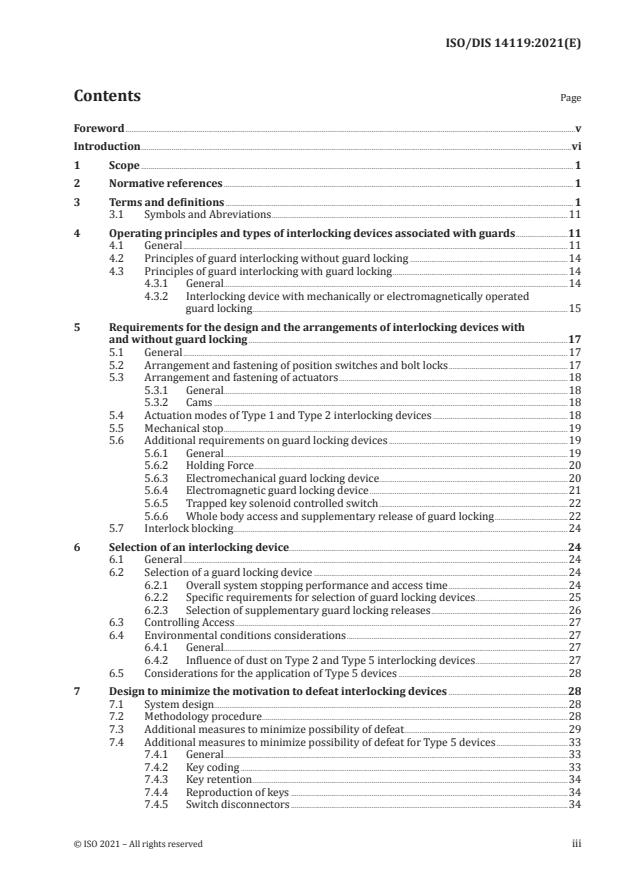
Contents Page
Foreword ..........................................................................................................................................................................................................................................v
Introduction ................................................................................................................................................................................................................................vi
1 Scope ................................................................................................................................................................................................................................. 1
2 Normative references ...................................................................................................................................................................................... 1
3 Terms and definitions ..................................................................................................................................................................................... 1
3.1 Symbols and Abreviations ..........................................................................................................................................................11
4 Operating principles and types of interlocking devices associated with guards ...........................11
4.1 General ........................................................................................................................................................................................................11
4.2 Principles of guard interlocking without guard locking ..................................................................................14
4.3 Principles of guard interlocking with guard locking ...........................................................................................14
4.3.1 General...................................................................................................................................................................................14
4.3.2 Interlocking device with mechanically or electromagnetically operatedguard locking ........................................................................................................................................... .........................15
5 Requirements for the design and the arrangements of interlocking devices withand without guard locking ......................................................................................................................................................................17
5.1 General ........................................................................................................................................................................................................17
5.2 Arrangement and fastening of position switches and bolt locks ..............................................................17
5.3 Arrangement and fastening of actuators .......................................................................................................................18
5.3.1 General...................................................................................................................................................................................18
5.3.2 Cams ........................................................................................................................................................................................18
5.4 Actuation modes of Type 1 and Type 2 interlocking devices ......................................................................18
5.5 Mechanical stop ...................................................................................................................................................................................19
5.6 Additional requirements on guard locking devices .............................................................................................19
5.6.1 General...................................................................................................................................................................................19
5.6.2 Holding Force ...................................................................................................................................................................20
5.6.3 Electromechanical guard locking device ..................................................................................................20
5.6.4 Electromagnetic guard locking device .......................................................................................................21
5.6.5 Trapped key solenoid controlled switch ..................................................................................................22
5.6.6 Whole body access and supplementary release of guard locking ......................................22
5.7 Interlock blocking ......... .....................................................................................................................................................................24
6 Selection of an interlocking device.................................................................................................................................................24
6.1 General ........................................................................................................................................................................................................24
6.2 Selection of a guard locking device ....................................................................................................................................24
6.2.1 Overall system stopping performance and access time ..............................................................24
6.2.2 Specific requirements for selection of guard locking devices ................................................25
6.2.3 Selection of supplementary guard locking releases .......................................................................26
6.3 Controlling Access .............................................................................................................................................................................27
6.4 Environmental conditions considerations ...................................................................................................................27
6.4.1 General...................................................................................................................................................................................27
6.4.2 Influence of dust on Type 2 and Type 5 interlocking devices ................................................27
6.5 Considerations for the application of Type 5 devices ........................................................................................28
7 Design to minimize the motivation to defeat interlocking devices ..............................................................28
7.1 System design........................................................................................................................................................................................28
7.2 Methodology procedure ...............................................................................................................................................................28
7.3 Additional measures to minimize possibility of defeat ......... ............................................................................29
7.4 Additional measures to minimize possibility of defeat for Type 5 devices .....................................33
7.4.1 General...................................................................................................................................................................................33
7.4.2 Key coding ..........................................................................................................................................................................33
7.4.3 Key retention ....................................................................................................................................................................34
7.4.4 Reproduction of keys ................................................................................................................................................34
7.4.5 Switch disconnectors ................................................................................................................................................34
© ISO 2021 – All rights reserved iii---------------------- Page: 3 ----------------------
ISO/DIS 14119:2021(E)
8 Control requirements ...................................................................................................................................................................................35
8.1 General ........................................................................................................................................................................................................35
8.2 Assessment of faults and fault exclusions ....................................................................................................................35
8.2.1 Assessment of faults ..................................................................................................................................................35
8.3 Measures to prevent common cause failures ............................................................................................................38
8.3.1 Direct and non-direct mechanical action of the position switches ofType 1 interlocking devices .................................................................................................................................38
8.3.2 Power medium diversity ........................................................................................................................................39
8.4 Release of guard locking device ............................................................................................................................................40
8.5 Logical series connection of interlocking devices .................................................................................................40
8.6 Electrical and environmental conditions ......................................................................................................................40
8.6.1 General...................................................................................................................................................................................40
8.6.2 Performance considerations ...............................................................................................................................41
8.6.3 Immunity from disturbance ................................................................................................................................41
8.6.4 Electrical operating conditions ........................................................................................................................41
8.6.5 Clearances and creepage distances ..............................................................................................................41
9 Information for use .........................................................................................................................................................................................41
9.1 General ........................................................................................................................................................................................................41
9.2 Information for use given by the manufacturer of interlocking devices ............................................41
9.2.1 Marking .................................................................................................................................................................................41
9.2.2 Instructions .......................................................................................................................................................................42
9.3 Information for use given by the manufacturer of the machine ...............................................................43
Annex A (informative) Type 1 interlocking device — Examples ..........................................................................................44
Annex B (informative) Type 2 interlocking device — Examples ..........................................................................................49
Annex C (informative) Type 3 interlocking device — Example..............................................................................................51
Annex D (informative) Type 4 interlocking devices — Examples .......................................................................................53
Annex E (informative) Examples of other interlocking devices ............................................................................................55
Annex F (informative) Example of guard locking devices ...........................................................................................................56
Annex G (informative) Application examples of interlocking devices used within a safety
function .......................................................................................................................................................................................................................61
Annex H (informative) Motivation to defeat interlocking devices (Defeating of protective
devices) .......................................................................................................................................................................................................................67
Annex I (informative) Examples for maximum static action forces ..................................................................................73
Annex J (normative) Test procedures ...............................................................................................................................................................75
Annex K (normative) Safety of machinery — Interlocking devices associated with guards —
Principles for design and selection ................................................................................................................................................77
Annex L (normative) Type 5 interlocking devices — trapped key interlocking systems ...........................93
Annex ZA (informative) Relationship between this European Standard and the essential
requirements of 2006/42/EC aimed to be covered ..................................................................................................111
Bibliography .........................................................................................................................................................................................................................114
iv © ISO 2021 – All rights reserved---------------------- Page: 4 ----------------------
ISO/DIS 14119:2021(E)
Foreword
ISO (the International Organization for Standardization) is a worldwide federation of national standards
bodies (ISO member bodies). The work of preparing International Standards is normally carried out
through ISO technical committees. Each member body interested in a subject for which a technical
committee has been established has the right to be represented on that committee. International
organizations, governmental and non-governmental, in liaison with ISO, also take part in the work.
ISO collaborates closely with the International Electrotechnical Commission (IEC) on all matters of
electrotechnical standardization.The procedures used to develop this document and those intended for its further maintenance are
described in the ISO/IEC Directives, Part 1. In particular, the different approval criteria needed for the
different types of ISO documents should be noted. This document was drafted in accordance with the
editorial rules of the ISO/IEC Directives, Part 2 (see www .iso .org/ directives).
Attention is drawn to the possibility that some of the elements of this document may be the subject of
patent rights. ISO shall not be held responsible for identifying any or all such patent rights. Details of
any patent rights identified during the development of the document will be in the Introduction and/or
on the ISO list of patent declarations received (see www .iso .org/ patents).Any trade name used in this document is information given for the convenience of users and does not
constitute an endorsement.For an explanation of the voluntary nature of standards, the meaning of ISO specific terms and
expressions related to conformity assessment, as well as information about ISO's adherence to the
World Trade Organization (WTO) principles in the Technical Barriers to Trade (TBT), see www .iso .org/
iso/ foreword .html.This document was prepared by Technical Committee ISO/TC 199, Safety of machinery.
This second edition cancels and replaces the first edition (ISO 14119:2013), which has been technically
revised.The main changes compared to the previous edition are as follows:
— ISO/TS 19837 “Safety of machinery — Trapped key interlocking devices — Principles for design and
selection” is integrated as new normative Annex L with specific requirements for type 5 interlocking
devices ‑ key interlocking devices;— “Trapped key interlocking systems” are defined as “Type 5 interlocking systems”;
— Table 4 is improved and renamed into “Additional measures in case foreseeable motivation for
defeat continues to exist depending on type of interlocking devices”;— test procedures are described in a new normative Annex J;
— ISO/TR 24119 “Safety of machinery — Evaluation of fault masking serial connection of interlocking
devices associated with guards with potential free contacts” integrated in a new normative Annex K.
Any feedback or questions on this document should be directed to the user’s national standards body. A
complete listing of these bodies can be found at www .iso .org/ members .html.© ISO 2021 – All rights reserved v
---------------------- Page: 5 ----------------------
ISO/DIS 14119:2021(E)
Introduction
The structure of safety standards in the field of machinery is as follows:
a) Type‑A standards (basic safety standards) giving basic concepts, principles for design, and general
aspects that can be applied to all machinery;b) Type‑B standards (generic safety standards) dealing with one safety aspect or one type of
safeguard that can be used across a wide range of machinery:— Type‑B1 standards on particular safety aspects (e.g. safety distances, surface temperature, noise);
— Type‑B2 standards on safeguards (e.g. two‑hand controls, interlocking devices, pressure‑
sensitive devices, guards);c) Type‑C standards (machine safety standards) dealing with detailed safety requirements for a
particular machine or group of machines.This document is a Type‑B2 standard as stated in ISO 12100.
The requirements of this document can be supplemented or modified by a Type‑C standard.
For machines which are covered by the scope of a Type‑C standard and which have been designed and
built according to the requirements of that standard, the requirements of that Type‑C standard take
precedence.This International Standard has been prepared to give guidance to machinery designers and writers of
product safety standards on how to design and select interlocking devices associated with guards.
Relevant clauses of this International Standard, used alone or in conjunction with provisions from
other standards, may be used as a basis for verification procedures for the suitability of a device for
interlocking duties.The informative Annexes A to F describe the technology and the typical characteristics of the defined
interlocking devices types 1 to 4. Other solutions may be adopted, provided that they comply with
the principles of this standard. The informative Annexes G to I give information on particular aspects
like interlocking devices used within safety functions, risk assessment considering the motivation to
defeat and static action forces. The informative Annex J describes a holding force test and an impact
resistance test for guard locking devices. Normative Annex K provides information on the masking of
faults in series connection of interlocking devices. Normative Annex L provides requirements for type 5
interlocking systems (trapped key interlocking systems) and describes their technology.
vi © ISO 2021 – All rights reserved---------------------- Page: 6 ----------------------
DRAFT INTERNATIONAL STANDARD ISO/DIS 14119:2021(E)
Safety of machinery — Interlocking devices associated
with guards — Principles for design and selection
1 Scope
This International Standard specifies principles for the design and selection — independent of the nature
of the energy source — of interlocking devices associated with guards and provides guidance of measures
to minimize the possibility of defeat of interlocking devices in a reasonably foreseeable manner.
This International Standard covers the parts of guards which actuate interlocking devices and
principles for the design, selection and application of trapped key interlocking devices and systems for
machinery applications, independent of the type of energy used to control them or that they control
NOTE ISO 14120 specifies general requirements for the design and construction of guards provided
primarily to protect persons from mechanical hazards. The processing of the signal from the interlocking device
to stop the machine and prevent unexpected start up is dealt with in ISO 13849‑1 or IEC 62061:2015.
2 Normative referencesThe following documents are referred to in the text in such a way that some or all of their content
constitutes requirements of this document. For dated references, only the edition cited applies. For
undated references, the latest edition of the referenced document (including any amendments) applies.
EN 13906-1, Cylindrical helical springs made from round wire and bar — Calculation and design — Part 1:
Compression springsISO 12100:2010, Safety of machinery — General principles for design — Risk assessment and risk reduction
ISO 13849-1:2015, Safety of machinery — Safety-related parts of control systems — Part 1: General
principles for designISO 13849-2:2012, Safety of machinery — Safety-related parts of control systems — Part 2: Validation
IEC 60204-1:2016, modified, Safety of machinery — Electrical equipment of machines — Part 1: General
requirementsIEC 60947-5-1:2016, + COR: 2016, Low voltage switchgear and controlgear — Part 5‑1: Control circuit
devices and switching elements — Electromechanical control circuit devicesIEC 60947-5-3:2013, Low‑voltage switchgear and controlgear — Part 5‑3: Control circuit devices
and switching elements — Requirements for proximity devices with defined behaviour under fault
conditions (PDDB)IEC 62061:2015, Safety of machinery — Functional safety of safety‑related electrical, electronic and
programmable electronic control systems3 Terms and definitions
For the purposes of this document, the terms and definitions given in ISO 12100, ISO 13849‑1 and the
following apply.ISO and IEC maintain terminological databases for use in standardization at the following addresses:
— ISO Online browsing platform: available at https:// www .iso .org/ obp© ISO 2021 – All rights reserved 1
---------------------- Page: 7 ----------------------
ISO/DIS 14119:2021(E)
— IEC Electropedia: available at http:// www .electropedia .org/
3.1
interlocking device
interlock
mechanical, electrical or other type of device, the purpose of which is to prevent the operation of
hazardous machine functions under specified conditions (generally as long as a guard is not closed)
Note 1 to entry: See Figure 1 and Table 1.[SOURCE: ISO 12100:2010, 3.28.1]
Key
1 guard 4 position switch
2 interlocking device 5 actuating system
3 actuator 6 output system
Direction of opening
Figure 1 — Example of an interlocking device
3.2
interlocking guard
guard associated with an interlocking device so that, together with the control system of the machine,
the following functions are performed:— the hazardous machine functions associated with the guard cannot operate until the guard is closed;
— if the guard is opened while hazardous machine functions are operating, a stop command is given;
— when the guard is closed, the hazardous machine functions associated with by the guard can
operate. The closure of the guard does not by itself start the hazardous machine functions.
Note 1 to entry: An interlocking guard can contain/be equipped with one or more interlocking devices. These
interlocking devices can also be of different types.[SOURCE: ISO 12100:2010, 3.27.4]
2 © ISO 2021 – All rights reserved
---------------------- Page: 8 ----------------------
ISO/DIS 14119:2021(E)
3.3
interlocking guard with a start function
control guard
special form of an interlocking guard which, once it has reached its closed position, gives a command to
initiate the hazardous machine function(s) without the use of a separate start control
Note 1 to entry: ISO 12100:2010, 6.3.3.2.5 gives detailed provisions regarding the condition of use.
[SOURCE: ISO 12100:2010, 3.27.6]3.4
guard locking device
device intended to lock a guard in the closed position and linked to the control system
3.5interlocking guard with locking function
guard associated with an interlocking device and a guard locking device so that, together with the
control system of the machine, the following functions are performed:— the hazardous machine functions associated with the guard cannot operate until the guard is closed
and locked;— the guard remains closed and locked until the risk due to the hazardous machine functions associated
with the guard has ceased, and— when the guard is closed and locked, the hazardous machine functions associated with the guard
can operate (the closure and locking of the guard do not by themselves start the hazardous machine
functions)[SOURCE: ISO 12100:2010, 3.27.5]
3.6
safety–related part of a control system
SRP/CS
part of a control system that performs a safety function, starting from safety‑related input(s) to
generate safety‑related output(s)Note 1 to entry: The combined safety‑related parts of a control system start at the point where the safety‑related
input signals are initiated (including e.g. the actuating cam and the roller of the position switch) and end at the
output of the power control elements (including, for example, the main contacts of a contactor).
Note 2 to entry: If monitoring systems are used for diagnostics, they are also considered as SRP/CS.
[SOURCE: ISO 13849-1:2015, 3.1.1]3.7
Defeat
defeat in a reasonably foreseeable manner
reasonably foreseeable action, either manually or by using readily available objects, that makes
interlocking devices inoperative or bypasses them with the result that a machine is used in a manner
not intended by the designer or without the necessary protective measuresNote 1 to entry: This definition includes the removal of position switches or actuators using tools that are needed
for the intended use of the machine or that are readily available (screw drivers, wrenches, hexagon keys, pliers).
Note 2 to entry: Readily available objects for substitute actuation include:— screws, needles and sheet-metal pieces,
— objects in daily use such as keys, coins, adhesive
...
PROJET DE NORME INTERNATIONALE
ISO/DIS 14119
ISO/TC 199 Secrétariat: DIN
Début de vote: Vote clos le:
2021-01-06 2021-03-26
Sécurité des machines — Dispositifs de verrouillage associés
à des protecteurs — Principes de conception et de choix
Safety of machinery — Interlocking devices associated with guards — Principles for design and selection
ICS: 13.110CE DOCUMENT EST UN PROJET DIFFUSÉ POUR
OBSERVATIONS ET APPROBATION. IL EST DONC
SUSCEPTIBLE DE MODIFICATION ET NE PEUT
Le présent document est distribué tel qu’il est parvenu du secrétariat du comité.
ÊTRE CITÉ COMME NORME INTERNATIONALEAVANT SA PUBLICATION EN TANT QUE TELLE.
OUTRE LE FAIT D’ÊTRE EXAMINÉS POUR
ÉTABLIR S’ILS SONT ACCEPTABLES À DES
FINS INDUSTRIELLES, TECHNOLOGIQUES ET
COMMERCIALES, AINSI QUE DU POINT DE VUE TRAITEMENT PARALLÈLE ISO/CEN
DES UTILISATEURS, LES PROJETS DE NORMES
INTERNATIONALES DOIVENT PARFOIS ÊTRE
CONSIDÉRÉS DU POINT DE VUE DE LEUR
POSSIBILITÉ DE DEVENIR DES NORMES
POUVANT SERVIR DE RÉFÉRENCE DANS LA
RÉGLEMENTATION NATIONALE.
Numéro de référence
LES DESTINATAIRES DU PRÉSENT PROJET
ISO/DIS 14119:2021(F)
SONT INVITÉS À PRÉSENTER, AVEC LEURS
OBSERVATIONS, NOTIFICATION DES DROITS
DE PROPRIÉTÉ DONT ILS AURAIENT
ÉVENTUELLEMENT CONNAISSANCE ET À
FOURNIR UNE DOCUMENTATION EXPLICATIVE. ISO 2021
---------------------- Page: 1 ----------------------
ISO/DIS 14119:2021 (F)
ISO/DIS 14119:2021(F)
Sommaire Page
Avant-propos .................................................................................................................................................................. vi
Introduction ................................................................................................................................................................ viii
1 Domaine d'application .................................................................................................................................. 1
2 Références normatives .................................................................................................................................. 1
3 Termes et définitions ..................................................................................................................................... 2
3.1 Symboles et abréviations ............................................................................................................................ 13
4 Principes de fonctionnement et types des dispositifs de verrouillage associés à des
protecteurs ..................................................................................................................................................... 14
4.1 Généralités ......................................................................................................................................................... 14
4.2 Principes du verrouillage du protecteur sans blocage du protecteur ...................................... 16
4.3 Principes des protecteurs avec dispositif d'interverrouillage ..................................................... 17
4.3.1 Généralités ........................................................................................................................................ 17
4.3.2 Dispositif d'interverrouillage à commande mécanique ou électromagnétique ... 19
5 Spécifications relatives à la conception et au montage des dispositifs de verrouillage et
d'interverrouillage ...................................................................................................................................... 21
5.1 Généralités ......................................................................................................................................................... 21
5.2 Montage et fixation des interrupteurs de position et des serrures à pêne ............................. 21
5.3 Montage et fixation des actionneurs ....................................................................................................... 22
5.3.1 Généralités ........................................................................................................................................ 22
5.3.2 Cames .................................................................................................................................................. 22
5.4 Modes d'actionnement des dispositifs de verrouillage de type 1 et de type 2 ..................... 22
5.5 Butée mécanique............................................................................................................................................. 23
5.6 Spécifications supplémentaires relatives aux dispositifs de blocage du protecteur .......... 23
5.6.1 Généralités ........................................................................................................................................ 23
5.6.2 Force de maintien .......................................................................................................................... 24
5.6.3 Dispositif de blocage électromécanique du protecteur .................................................. 24
5.6.4 Dispositif de blocage électromagnétique du protecteur ................................................ 25
5.6.5 Interrupteur à clé captive commandé par solénoïde ...................................................... 26
5.6.6 Accès de l'ensemble du corps et déblocage supplémentaire du protecteur .......... 27
5.7 Blocage du système de verrouillage ....................................................................................................... 29
6 Choix d'un dispositif de verrouillage .................................................................................................... 29
6.1 Généralités ......................................................................................................................................................... 29
6.2 Choix d'un dispositif de blocage du protecteur .................................................................................. 30
6.2.1 Temps de réponse global et temps d'accès ......................................................................... 30
6.2.2 Spécifications particulières pour le choix des dispositifs de blocage duprotecteur .......................................................................................................................................... 31
6.2.3 Choix des systèmes supplémentaires de déblocage du protecteur ........................... 32
6.3 Contrôle de l'accès .......................................................................................................................................... 32
DOCUMENT PROTÉGÉ PAR COPYRIGHT6.4 Considérations relatives aux conditions d'environnement .......................................................... 32
6.4.1 Généralités ........................................................................................................................................ 32
© ISO 20216.4.2 Influence de la poussière sur les dispositifs de verrouillage de type 2 et de
Tous droits réservés. Sauf prescription différente ou nécessité dans le contexte de sa mise en oeuvre, aucune partie de cette
publication ne peut être reproduite ni utilisée sous quelque forme que ce soit et par aucun procédé, électronique ou mécanique,
type 5 ................................................................................................................................................... 33
y compris la photocopie, ou la diffusion sur l’internet ou sur un intranet, sans autorisation écrite préalable. Une autorisation peut
être demandée à l’ISO à l’adresse ci-après ou au comité membre de l’ISO dans le pays du demandeur.
ISO copyright officeCase postale 401 • Ch. de Blandonnet 8
CH-1214 Vernier, Geneva © ISO 2021 – Tous droits réservés
iii
Tél.: +41 22 749 01 11
Fax: +41 22 749 09 47
E-mail: copyright@iso.org
Website: www.iso.org
Publié en Suisse
ii © ISO 2021 – Tous droits réservés
---------------------- Page: 2 ----------------------
ISO/DIS 14119:2021 (F)
Sommaire Page
Avant-propos .................................................................................................................................................................. vi
Introduction ................................................................................................................................................................ viii
1 Domaine d'application .................................................................................................................................. 1
2 Références normatives .................................................................................................................................. 1
3 Termes et définitions ..................................................................................................................................... 2
3.1 Symboles et abréviations ............................................................................................................................ 13
4 Principes de fonctionnement et types des dispositifs de verrouillage associés à des
protecteurs ..................................................................................................................................................... 14
4.1 Généralités ......................................................................................................................................................... 14
4.2 Principes du verrouillage du protecteur sans blocage du protecteur ...................................... 16
4.3 Principes des protecteurs avec dispositif d'interverrouillage ..................................................... 17
4.3.1 Généralités ........................................................................................................................................ 17
4.3.2 Dispositif d'interverrouillage à commande mécanique ou électromagnétique ... 19
5 Spécifications relatives à la conception et au montage des dispositifs de verrouillage et
d'interverrouillage ...................................................................................................................................... 21
5.1 Généralités ......................................................................................................................................................... 21
5.2 Montage et fixation des interrupteurs de position et des serrures à pêne ............................. 21
5.3 Montage et fixation des actionneurs ....................................................................................................... 22
5.3.1 Généralités ........................................................................................................................................ 22
5.3.2 Cames .................................................................................................................................................. 22
5.4 Modes d'actionnement des dispositifs de verrouillage de type 1 et de type 2 ..................... 22
5.5 Butée mécanique............................................................................................................................................. 23
5.6 Spécifications supplémentaires relatives aux dispositifs de blocage du protecteur .......... 23
5.6.1 Généralités ........................................................................................................................................ 23
5.6.2 Force de maintien .......................................................................................................................... 24
5.6.3 Dispositif de blocage électromécanique du protecteur .................................................. 24
5.6.4 Dispositif de blocage électromagnétique du protecteur ................................................ 25
5.6.5 Interrupteur à clé captive commandé par solénoïde ...................................................... 26
5.6.6 Accès de l'ensemble du corps et déblocage supplémentaire du protecteur .......... 27
5.7 Blocage du système de verrouillage ....................................................................................................... 29
6 Choix d'un dispositif de verrouillage .................................................................................................... 29
6.1 Généralités ......................................................................................................................................................... 29
6.2 Choix d'un dispositif de blocage du protecteur .................................................................................. 30
6.2.1 Temps de réponse global et temps d'accès ......................................................................... 30
6.2.2 Spécifications particulières pour le choix des dispositifs de blocage duprotecteur .......................................................................................................................................... 31
6.2.3 Choix des systèmes supplémentaires de déblocage du protecteur ........................... 32
6.3 Contrôle de l'accès .......................................................................................................................................... 32
6.4 Considérations relatives aux conditions d'environnement .......................................................... 32
6.4.1 Généralités ........................................................................................................................................ 32
6.4.2 Influence de la poussière sur les dispositifs de verrouillage de type 2 et de
type 5 ................................................................................................................................................... 33
© ISO 2021 – Tous droits réservésiii
---------------------- Page: 3 ----------------------
ISO/DIS 14119:2021 (F)
6.5 Considérations relatives à l'application des dispositifs de type 5 ............................................. 33
7 Conception visant à réduire au minimum les motifs de neutralisation des dispositifs de
verrouillage .................................................................................................................................................... 34
7.1 Conception du système ................................................................................................................................ 34
7.2 Procédure méthodologique........................................................................................................................ 34
7.3 Mesures supplémentaires visant à restreindre la possibilité de neutralisation .................. 36
7.4 Mesures supplémentaires visant à restreindre la possibilité de neutralisation pour les
dispositifs de type 5 ....................................................................................................................................... 40
7.4.1 Généralités ........................................................................................................................................ 40
7.4.2 Codage des clés ............................................................................................................................... 40
7.4.3 Retenue des clés ............................................................................................................................. 41
7.4.4 Reproduction de clés .................................................................................................................... 41
7.4.5 Interrupteurs-sectionneurs ....................................................................................................... 42
8 Spécifications relatives aux commandes ............................................................................................. 42
8.1 Généralités ........................................................................................................................................................ 42
8.2 Évaluation des défauts et exclusion de défauts ................................................................................. 43
8.2.1 Évaluation des défauts ................................................................................................................. 43
8.3 Mesures visant à empêcher les défaillances de cause commune ............................................... 47
8.3.1 Action mécanique directe et non directe des interrupteurs de position desdispositifs de verrouillage de type 1 ...................................................................................... 47
8.3.2 Diversité des formes d'énergie................................................................................................. 48
8.4 Déblocage du dispositif de blocage du protecteur ........................................................................... 49
8.5 Connexion logique en série de dispositifs de verrouillage ............................................................ 49
8.6 Conditions électriques et d'environnement ........................................................................................ 49
8.6.1 Généralités ........................................................................................................................................ 49
8.6.2 Considérations relatives à la performance ......................................................................... 50
8.6.3 Protection contre les perturbations ....................................................................................... 50
8.6.4 Conditions électriques de fonctionnement ......................................................................... 50
8.6.5 Distances de sécurité et distances d'isolement ................................................................. 50
9 Informations pour l'utilisation ............................................................................................................... 50
9.1 Généralités ........................................................................................................................................................ 50
9.2 Informations pour l'utilisation fournies par le fabricant de dispositifs de verrouillage .. 50
9.2.1 Marquage ........................................................................................................................................... 50
9.2.2 Instructions ...................................................................................................................................... 51
9.3 Informations pour l'utilisation fournies par le fabricant de la machine ................................. 52
(informative) Exemples de dispositifs de verrouillage de type 1 .......................................... 53
(informative) Exemples de dispositifs de verrouillage de type 2 .......................................... 58
(informative) Exemple de dispositif de verrouillage de type 3 ............................................... 60
(informative) Exemples de dispositifs de verrouillage de type 4 .......................................... 62
(informative) Exemples d'autres dispositifs de verrouillage .................................................. 65
(informative) Exemple de dispositifs de blocage du protecteur ............................................ 66
(informative) Exemples d'application de dispositifs de verrouillage utilisés dans une
fonction de sécurité ..................................................................................................................................... 71
(informative) Motifs de neutralisation d'un dispositif de verrouillage (neutralisation
des dispositifs de protection) .................................................................................................................. 78
(informative) Exemples de forces maximales d'action statique .............................................. 85
© ISO 2021 – Tous droits réservés---------------------- Page: 4 ----------------------
ISO/DIS 14119:2021 (F)
(normative) Modes opératoires d'essai ............................................................................................ 87
(normative) Sécurité des machines — Dispositifs de verrouillage associés à desprotecteurs — Principes de conception et de choix ........................................................................ 89
(normative) Dispositifs de verrouillage de type 5 — Systèmes de verrouillage à clé
captive ............................................................................................................................................................ 107
Annexe ZA (informative) Relation entre la présente Norme européenne et les exigences
essentielles concernées de la Directive européenne 2006/42/CE .......................................... 126
Bibliographie ............................................................................................................................................................. 130
© ISO 2021 – Tous droits réservés---------------------- Page: 5 ----------------------
ISO/DIS 14119:2021 (F)
Avant-propos
L'ISO (Organisation internationale de normalisation) est une fédération mondiale d'organismes nationaux
de normalisation (comités membres de l'ISO). L'élaboration des Normes internationales est en général
confiée aux comités techniques de l'ISO. Chaque comité membre intéressé par une étude a le droit de faire
partie du comité technique créé à cet effet. Les organisations internationales, gouvernementales et non
gouvernementales, en liaison avec l'ISO participent également aux travaux. L'ISO collabore étroitement
avec la Commission électrotechnique internationale (IEC) en ce qui concerne la normalisation
électrotechnique.Les procédures utilisées pour élaborer le présent document et celles destinées à sa mise à jour sont
décrites dans les Directives ISO/IEC, Partie 1. Il convient, en particulier de prendre note des différents
critères d'approbation requis pour les différents types de documents ISO. Le présent document a été
rédigé conformément aux règles de rédaction données dans les Directives ISO/IEC, Partie 2
(voir www.iso.org/directives).L'attention est attirée sur le fait que certains des éléments du présent document peuvent faire l'objet de
droits de propriété intellectuelle ou de droits analogues. L'ISO ne saurait être tenue pour responsable de
ne pas avoir identifié de tels droits de propriété et averti de leur existence. Les détails concernant les
références aux droits de propriété intellectuelle ou autres droits analogues identifiés lors de l'élaboration
du document sont indiqués dans l'Introduction et/ou dans la liste des déclarations de brevets reçues par
l'ISO (voir www.iso.org/brevets).Les appellations commerciales éventuellement mentionnées dans le présent document sont données pour
information, par souci de commodité à l'intention des utilisateurs et ne sauraient constituer un
engagement.Pour une explication de la nature volontaire des normes, la signification des termes et expressions
spécifiques de l'ISO liés à l'évaluation de la conformité, ou pour toute information au sujet de l'adhésion de
l'ISO aux principes de l'Organisation mondiale du commerce (OMC) concernant les obstacles techniques au
commerce (OTC), voir le lien suivant : www.iso.org/iso/fr/avant-propos.Le présent document a été élaboré par le comité technique ISO/TC 199, Sécurité des machines.
Cette deuxième édition annule et remplace la première édition (ISO 14119:2013), dont elle constitue une
révision technique.Les principales modifications par rapport à l'édition précédente sont les suivantes :
l'ISO/TS 19837 « Sécurité des machines — Dispositifs de verrouillage à clé captive — Principes de
conception et sélection » est intégrée en tant que nouvelle Annexe L normative avec des exigences
spécifiques pour les dispositifs de verrouillage de type 5 - dispositifs de verrouillage à clé ;
les « systèmes de verrouillage à clé captive » sont définis comme des « systèmes de verrouillage de
type 5 » ; le Tableau 4 a été amélioré et renommé « Mesures supplémentaires en cas de persistance de motif
prévisible de neutralisation en fonction du type de dispositif de verrouillage » ;
© ISO 2021 – Tous droits réservés---------------------- Page: 6 ----------------------
ISO/DIS 14119:2021 (F)
les modes opératoires d'essai sont décrits dans une nouvelle Annexe normative J ;
l'ISO/TR 24119 « Sécurité des machines — Évaluation des défauts masqués dans les connexions en
séries des protecteurs avec dispositifs de verrouillage ayant des contacts libres » est intégrée dans une
nouvelle Annexe normative K.Il convient que l'utilisateur adresse tout retour d'information ou toute question concernant le présent
document à l'organisme national de normalisation de son pays. Une liste exhaustive desdits organismes se
trouve à l'adresse : www.iso.org/fr/members.html.© ISO 2021 – Tous droits réservés
vii
---------------------- Page: 7 ----------------------
ISO/DIS 14119:2021 (F)
Introduction
La structure des normes de sécurité dans le domaine des machines est la suivante :
a) normes de type A (normes fondamentales de sécurité), contenant des notions fondamentales, des
principes de conception et des aspects généraux relatifs aux machines ;b) normes de type B (normes génériques de sécurité), traitant d'un aspect de la sécurité ou d'un moyen
de protection qui peut être utilisé pour une large gamme de machines : normes de type B1 traitant d'aspects particuliers de sécurité (par exemple, distances de sécurité,
température superficielle, bruit) ; normes de type B2, traitant de moyens de protection (par exemple, commandes bimanuelles,
dispositifs de verrouillage, dispositifs sensibles à la pression, protecteurs) ;c) normes de type C (normes de sécurité par catégorie de machines), traitant des exigences de sécurité
détaillées s'appliquant à une machine particulière ou à un groupe de machines particulier.
Le présent document est une norme de type B2 telle que définie dans l'ISO 12100.Les exigences du présent document peuvent faire l'objet de compléments ou être modifiées par une norme
de type C.Pour les machines couvertes par le domaine d'application d'une norme de type C et qui ont été conçues et
construites conformément aux exigences de cette norme, les exigences de cette norme de type C prévalent.
La présente Norme internationale a été élaborée en vue de fournir aux concepteurs de machines et aux
rédacteurs de normes de sécurité des produits un guide de conception et de choix des dispositifs de
verrouillage associés à des protecteurs.Les articles applicables de présente Norme internationale, utilisés seuls ou conjointement avec les
dispositions d'autres normes, peuvent servir de base pour la vérification de l'aptitude d'un dispositif à
accomplir une fonction de verrouillage.Les Annexes informatives A à F décrivent la technologie et les caractéristiques types des dispositifs de
verrouillage définis des types 1 à 4. D'autres solutions peuvent être adoptées, pourvu qu'elles soient
conformes aux principes de la présente norme. Les Annexes informatives G à I donnent des informations
sur des aspects particuliers tels que les dispositifs de verrouillage utilisés dans des fonctions de sécurité,
l'appréciation du risque tenant compte des motifs de neutralisation et des forces d'action statique.
L'Annexe informative J décrit un essai de force de maintien et un essai de résistance aux chocs pour les
dispositifs de blocage de protecteur. L'Annexe normative K fournit des informations concernant le
masquage de défauts dans la connexion en série de dispositifs de verrouillage. L'Annexe normative L
donne des exigences concernant les systèmes de verrouillage de type 5 (systèmes de verrouillage à clé
captive et décrit leur technologie.© ISO 2021 – Tous droits réservés
viii
---------------------- Page: 8 ----------------------
PROJET DE NORME INTERNATIONALE ISO/DIS 14119:2021 (F)
Sécurité des machines — Dispositifs de verrouillage associés à des
protecteurs — Principes de conception et de choix
1 Domaine d'application
La présente Norme internationale spécifie des principes de conception et de choix — indépendamment
de la nature de la source d'énergie — des dispositifs de verrouillage associés à des protecteurs et
fournit des recommandations concernant les mesures visant à minimiser la possibilité de neutralisation
des dispositifs de verrouillage d'une manière raisonnablement prévisible.La présente Norme internationale couvre les parties des protecteurs qui actionnent les dispositifs de
verrouillage, ainsi que les principes de conception, de sélection et d'application des dispositifs de
verrouillage à clé captive et des systèmes destinés aux applications de machines, indépendamment du
type d'énergie utilisé pour les contrôler ou qu'ils contrôlent.NOTE L'ISO 14120 spécifie les spécifications générales relatives à la conception et à la construction des
protecteurs principalement destinés à préserver les personnes des phénomènes dangereux mécaniques. Le
traitement du signal issu du dispositif de verrouillage entraînant l'arrêt de la machine et empêchant toute mise en
marche intempestive est pris en considération dans l'ISO 13849-1 ou l'IEC 62061:2015.
2 Références normativesLes documents suivants sont cités dans le texte de sorte qu'ils constituent, pour tout ou partie de leur
contenu, des exigences du présent document. Pour les références datées, seule l'édition citée s'applique.
Pour les références non datées, la dernière édition du document de référence s'applique (y compris les
éventuels amendements).EN 13906-1, Ressorts hélicoïd
...
Questions, Comments and Discussion
Ask us and Technical Secretary will try to provide an answer. You can facilitate discussion about the standard in here.