


ISO 15513:2000
(Main)Cranes — Competency requirements for crane drivers (operators), slingers, signallers and assessors
Cranes — Competency requirements for crane drivers (operators), slingers, signallers and assessors
This International Standard gives competency requirements applicable for the selection, training, assessment and verification of crane drivers (operators), slingers, signallers and their assessors. This International Standard does not cover additional competency requirements needed for special operations, e.g. man-lifting, pile-driving or pile-pulling. NOTE 1 Responsibilities for the performance of tasks are given in ISO 12480-1. However, personnel need to be aware of the responsibilities of others; inclusion in the training programme should not infer any changes in responsibilities. NOTE 2 For training of drivers (operators), see ISO 9926.
Appareils de levage à charge suspendue — Compétences requises pour les conducteurs (opérateurs), les élingueurs, les signaleurs et les contrôleurs
General Information
Standards Content (Sample)
INTERNATIONAL ISO
STANDARD 15513
First edition
2000-05-01
Cranes — Competency requirements for
crane drivers (operators), slingers,
signallers and assessors
Appareils de levage à charge suspendue — Compétences requises pour
les conducteurs (opérateurs), les élingueurs, les signaleurs et les
contrôleurs
Reference number
©
ISO 2000
PDF disclaimer
This PDF file may contain embedded typefaces. In accordance with Adobe's licensing policy, this file may be printed or viewed but shall not
be edited unless the typefaces which are embedded are licensed to and installed on the computer performing the editing. In downloading this
file, parties accept therein the responsibility of not infringing Adobe's licensing policy. The ISO Central Secretariat accepts no liability in this
area.
Adobe is a trademark of Adobe Systems Incorporated.
Details of the software products used to create this PDF file can be found in the General Info relative to the file; the PDF-creation parameters
were optimized for printing. Every care has been taken to ensure that the file is suitable for use by ISO member bodies. In the unlikely event
that a problem relating to it is found, please inform the Central Secretariat at the address given below.
All rights reserved. Unless otherwise specified, no part of this publication may be reproduced or utilized in any form or by any means, electronic
or mechanical, including photocopying and microfilm, without permission in writing from either ISO at the address below or ISO's member body
in the country of the requester.
ISO copyright office
Case postale 56 � CH-1211 Geneva 20
Tel. + 41 22 749 01 11
Fax + 41 22 734 10 79
E-mail copyright@iso.ch
Web www.iso.ch
Printed in Switzerland
ii © ISO 2000 – All rights reserved
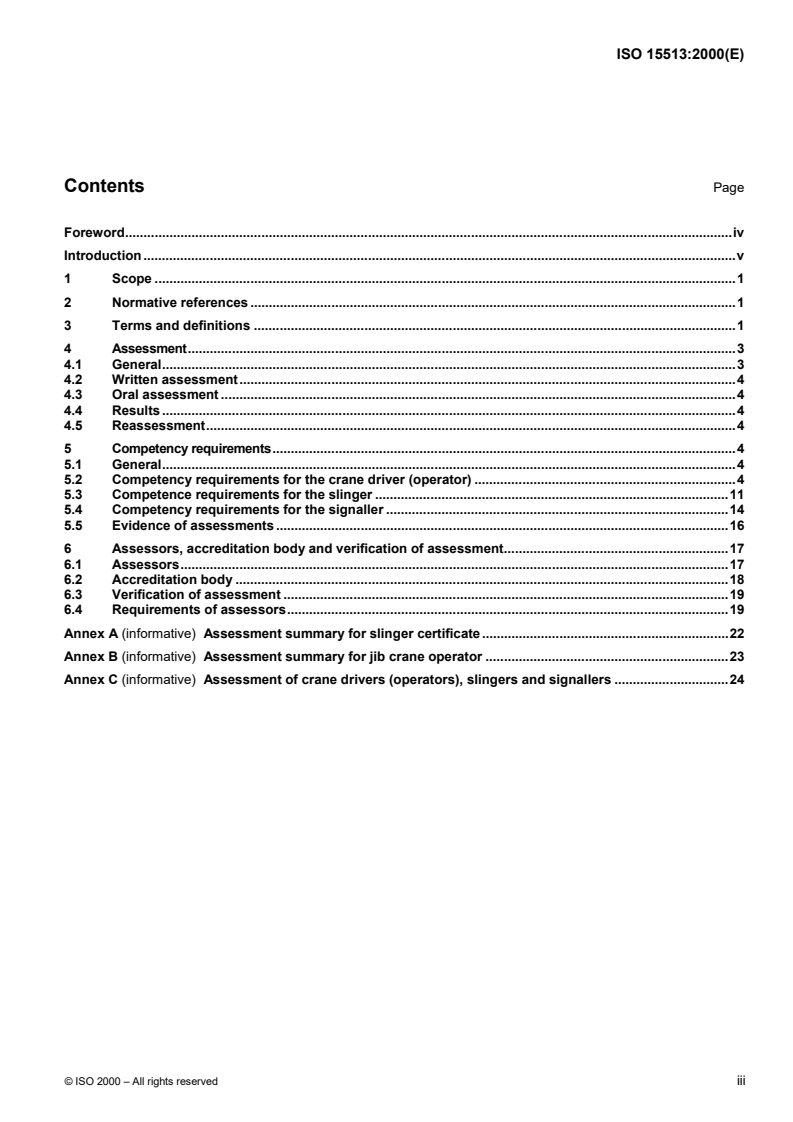
Contents Page
Foreword.iv
Introduction.v
1 Scope .1
2 Normative references .1
3 Terms and definitions .1
4 Assessment.3
4.1 General.3
4.2 Written assessment.4
4.3 Oral assessment .4
4.4 Results .4
4.5 Reassessment.4
5 Competency requirements.4
5.1 General.4
5.2 Competency requirements for the crane driver (operator) .4
5.3 Competence requirements for the slinger .11
5.4 Competency requirements for the signaller .14
5.5 Evidence of assessments .16
6 Assessors, accreditation body and verification of assessment.17
6.1 Assessors.17
6.2 Accreditation body .18
6.3 Verification of assessment .19
6.4 Requirements of assessors.19
Annex A (informative) Assessment summary for slinger certificate.22
Annex B (informative) Assessment summary for jib crane operator .23
Annex C (informative) Assessment of crane drivers (operators), slingers and signallers .24
Foreword
ISO (the International Organization for Standardization) is a worldwide federation of national standards bodies (ISO
member bodies). The work of preparing International Standards is normally carried out through ISO technical
committees. Each member body interested in a subject for which a technical committee has been established has
the right to be represented on that committee. International organizations, governmental and non-governmental, in
liaison with ISO, also take part in the work. ISO collaborates closely with the International Electrotechnical
Commission (IEC) on all matters of electrotechnical standardization.
International Standards are drafted in accordance with the rules given in the ISO/IEC Directives, Part 3.
Draft International Standards adopted by the technical committees are circulated to the member bodies for voting.
Publication as an International Standard requires approval by at least 75 % of the member bodies casting a vote.
Attention is drawn to the possibility that some of the elements of this International Standard may be the subject of
patent rights. ISO shall not be held responsible for identifying any or all such patent rights.
International Standard ISO 15513 was prepared by Technical Committee ISO/TC 96, Cranes, Subcommittee SC 5,
Use, operation and maintenance.
Annexes A, B and C of this International Standard are for information only.
iv © ISO 2000 – All rights reserved
Introduction
The objective of this International Standard is to achieve uniform competency standards for work involving crane
drivers (operator) slingers, signallers and their assessors.
INTERNATIONAL STANDARD ISO 15513:2000(E)
Cranes — Competency requirements for crane drivers (operators),
slingers, signallers and assessors
1 Scope
This International Standard gives competency requirements applicable for the selection, training, assessment and
verification of crane drivers (operators), slingers, signallers and their assessors.
This International Standard does not cover additional competency requirements needed for special operations, e.g.
man-lifting, pile-driving or pile-pulling.
NOTE 1 Responsibilities for the performance of tasks are given in ISO 12480-1. However, personnel need to be aware of the
responsibilities of others; inclusion in the training programme should not infer any changes in responsibilities.
NOTE 2 For training of drivers (operators), see ISO 9926.
2 Normative references
The following normative documents contain provisions which, through reference in this text, constitute provisions of
this International Standard. For dated references, subsequent amendments to, or revisions of, any of these
publications do not apply. However, parties to agreements based on this International Standard are encouraged to
investigate the possibility of applying the most recent editions of the normative documents indicated below. For
undated references, the latest edition of the normative document referred to applies. Members of ISO and IEC
maintain registers of currently valid International Standards.
ISO 4306-1:1990, Cranes — Vocabulary — Part 1: General.
ISO 4306-2: 1994, Cranes — Vocabulary — Part 2: Mobile cranes.
ISO 4306-3:1991, Cranes — Vocabulary — Part 3: Tower cranes.
ISO 9926 (all parts), Cranes — Training of drivers.
ISO 12480-1:1997, Cranes — Safe use — Part 1: General.
3 Terms and definitions
For the purposes of this International Standard, the definitions of crane types given in ISO 4306-1, ISO 4306-2,
ISO 4306-3 and ISO 12480-1 apply, together with the following definitions. For definitions of crane personnel see
also ISO 12480-1.
3.1
accreditation
process of granting official formal recognition to assessors and other successful candidates of competency
assessments
NOTE Accreditation normally involves the provision of a statement of competency, an award or some other formal credit
arrangement by a training authority, a vocational educational institution or an accreditation body.
3.2
accreditation body
organization which oversees the assessment of candidates to prescribed competency standards
3.3
assessment
process of judging competency against prescribed standards of performance
3.4
assessor
person who makes judgements of skills and knowledge of a crane driver (operator), slinger and/or signaller
NOTE The assessment process ensures that the outcome of the training and educational programmes presented to
trainees provides the required standard of competency. The accreditation body manages the assessment system and ongoing
accreditation.
3.5
competency
ability to perform the activities within an occupation or function to the standard expected in the task
NOTE Competent use and operation of industrial equipment is defined in terms of core knowledge and skills and
applications required for particular types of work associated with the use and application of different classes of equipment. It
covers demonstrated knowledge and skills in identifying hazards and eliminating or minimizing risks arising from hazards, safe
and healthy work practices, and employer and employee responsibilities as defined in the general duties of care, occupational
health and safety legislation.
3.5.1
competency standard
standard which reflects the specification of knowledge and skill, and the application of that knowledge and skill to
the standard of performance required in the task
NOTE Competency standards are developed by the interested parties, based upon the organization of work, expressed in
terms of workplace results, and should be regularly reviewed to ensure their continuing relevance to the workplace.
3.5.2
element of competency
basic building block of the unit of competency which describes an action or outcome which is demonstrable and
assessable
3.5.3
unit of competency
discrete product comprising a title, a short description of purpose where appropriate, and the elements of
competency, together with their associated performance criteria
NOTE Elements of competency describe the lowest logical, identifiable and discrete subgrouping of actions and knowledge
whichcontributetoand buildaunitofcompetency.
3.6
crane driver [operator]
person who operates the crane for the purpose of positioning loads or erecting the crane
NOTE 1 Adapted from ISO 12480-1.
NOTE 2 For mobile cranes, the term “operator’’ is often used instead of “driver’’, and the term “driver” is then used to refer to
that person who operates only those controls which move the crane from place to place.
3.7
crane shut-down
preparation for leaving the crane unattended
2 © ISO 2000 – All rights reserved
3.8
performance criterion
evaluative statement which specifies what is to be assessed and the required level of performance
NOTE The performance criteria specify the activities, skills, knowledge and understanding which are evidenced by
competent performance.
3.9
signaller
person responsible for relaying the signal from the slinger to the crane driver
NOTE The signaller may be given the responsibility for directing movements of the crane and load instead of the slinger,
provided that only one person has the responsibility at any one time. For further information on signallers' duties, etc. see 5.5.1
and 5.5.2 in ISO 12480-1:1997.
3.10
slinger
person responsible for attaching and detaching the load to and from the crane load-lifting attachment and for the
use of the correct lifting gear and equipment in accordance with the operating plan for proper positioning of loads
NOTE According to 5.4.1 in ISO 12480-1:1997, the slinger is responsible for initiating the planned movement of the crane
and load. If there is more than one slinger, only one of them should have this responsibility at any one time, depending on their
positions relative to the crane. For further information on slingers' duties, etc. see 5.4.1 and 5.4.2 in ISO 12480-1:1997.
4 Assessment
4.1 General
4.1.1 An assessment shall be made of the following persons:
a) assessor;
b) operator/driver;
c) slinger;
d) signaller.
4.1.2 The competencies which an assessor shall possess before being authorized as an assessor for the
purposes of this International Standard are:
a) technical knowledge relating to the operation and management of the particular type of crane or slinging
techniques for which the person is to be authorized to assess applicants; and
b) ability to judge competencies against prescribed standards.
4.1.3 The competencies which an operator/driver shall possess before being authorized to operate a crane or
hoist are a technical knowledge and practical capability relating to the correct and safe operation of the particular
type of crane (see 5.3.1 in ISO 12480-1:1997).
4.1.4 The competencies which a slinger shall possess before being authorized as a slinger are:
a) the application of slinging techniques and
b) the capability to direct the crane driver (operator).
4.1.5 The competency which a signaller shall possess before being authorized as a signaller is the application of
signalling methods.
4.2 Written assessment
Where the assessment process includes a written assessment paper, the following criteria shall be observed.
a) The written assessment should be constructed to not exceed a duration of 60 min.
b) Sufficient time shall be given to a candidate to complete the test.
NOTE If the assessor becomes aware the candidate has a written-language deficiency, additional time may be permitted to
complete the paper.
c) Assistance may be given to the candidate with a written-language deficiency. Any person rendering such
assistance shall not prompt the candidate nor help the candidate in any other way. If the candidate has limited
literacy skills, the answers may be accepted orally. In this case the assessor shall record all answers. In some
certificate classes, specific literacy skills are required to meet the competencies, i.e. estimation or calculation
of loads or reading of a load chart. In these situations, oral assistance shall not be rendered.
d) The candidate shall be suitably proficient in the language to be able to read the questions set in the
assessment without assistance.
e) The candidate shall express the technical requirements for the assessment in a manner in which they can be
correctly interpreted. Incorrect spelling or grammar shall not prejudice the result of the assessment.
f) If additional time or assistance has been permitted, this shall be clearly stated, with the reason, on the
Assessment Report.
4.3 Oral assessment
Where the candidate has limited spoken ability of the language of the assessment, the assessor should provide
additional explanation, without compromising the assessment, at a level appropriate to the work and equipment.
4.4 Results
In order to be considered “Competent”, the candidates shall achieve sufficient marks in every area and section to
demonstrate competence. A candidate who does not attain such a result shall be considered “Not Yet Competent”
and marked accordingly.
4.5 Reassessment
Where an assessment indicates “Not Yet Competent” in an area or section of the paper, the candidate may be
reassessed for that area or section only after additional training in that area or section.
5 Competency requirements
5.1 General
Subclauses 5.2, 5.3 and 5.4 detail the parameters for assessing the skills and knowledge of the crane driver
(operator), slinger and signaller.
5.2 Competency requirements for the crane driver (operator)
5.2.1 General
The requirements are subdivided into the following competency units:
4 © ISO 2000 – All rights reserved
a) Competency unit 1 — Access and secure equipment and work area
� Plan work,
� conduct routine checks and inspections,
� test controls and safety devices,
� shut down the crane.
b) Competency unit 2 — Secure and transfer load
� Secure load,
� conduct trial lift,
� transfer load.
c) Competency unit 3 — Set-up, assembly and disassembly of cranes where such operations are carried
out by the crane driver
� Plan assembly/disassembly,
� set up crane,
� disassemble crane.
d) Competency unit 4 — Carry out special operations
� Displace crane,
� carry out multiple-crane lift.
5.2.2 Competency unit 1 — Assess and secure equipment and work area
5.2.2.1 Element of competence — Plan work
Performance criteria:
a) a workplace operations plan is developed in consultation with the relevant authorized workplace personnel.
The plan takes into account job requirements, priorities, workplace rules and procedures, identified hazards
and hazard control measures;
b) site hazards, such as those listed below, are identified and correct hazard control strategies developed in
accordance with the appropriate standard:
� overhead power lines;
� trees;
� overhead service lines such as steam, gas, water, telephone;
� underground services;
� uneven and/or unstable ground;
� allowable floor loading as appropriate;
� presence of other workers and persons;
� surrounding buildings/vessels/structures/equipment;
� hazardous materials;
� corrosive substances;
� barricades;
� inadequate lighting;
� radio interference;
� inclement weather;
� other equipment
c) emergency procedures are planned to take into account the location of first-aid and fire-fighting equipment,
amenities and access/exit points in the workplace for emergency vehicles and emergency personnel. This
includes, where necessary, deciding to abort crane operations where levels of illumination are inadequate;
d) precautions are taken to accommodate the effects of weather conditions in accordance with the appropriate
standard. This includes, where necessary, deciding to abort crane operations where weather conditions
exceed acceptable limits;
e) the operations plan ensures that the work area is correctly illuminated and restricted to authorized personnel
only;
f) the crane load chart is located and information on permissible loads, radii, weights, boom and jib
configurations noted and taken into account in operational plans;
g) the signals and signalling systems to be used are confirmed with associated personnel, in accordance with the
appropriate standard;
h) the use of safety tags on electrical switches/isolators (where relevant) is noted and correct hazard control
procedures developed in consultation with authorized personnel.
5.2.2.2 Element of competence — Conduct routine checks and inspections
Performance criteria:
a) routine pre-operational equipment checks are carried out in accordance with the checklist provided for the
crane and all lifting attachments fitted to the crane;
b) the service log book for the cranes is checked to ensure all service requirements have been met and action
taken as required;
c) prior to operation, equipment and site area are visually checked for any evidence of damage, structural
weakness or interference, and any faults reported to an authorized person for corrective action. All defects
shall be correctly recorded in the relevant log book.
5.2.2.3 Element of competence — Test controls and safety devices
Performance criteria:
a) the crane is started in accordance with equipment procedures and checks made for any abnormal noise or
movement. Any abnormal operation is reported to an authorized person for corrective action;
b) the operating and emergency controls and safety devices are located and identified, and their correct
operation tested in accordance with prescribed procedures;
6 © ISO 2000 – All rights reserved
c) all communication equipment, lighting and alarm systems are checked for correct operation;
d) damaged or inoperative controls, communication equipment, safety devices, guards, lighting or alarms, etc.
are reported to authorized personnel for corrective action, and all defects entered into the crane´s service log
book;
e) the operation radii of the crane for intended operations is/are verified and measured, taking into account the
estimated increase in radius due to boom deflection. The boom is slewed at the planned radii to check that
there are no unanticipated complications or obstructions of boom/load or tail-swing equipment.
5.2.2.4 Element of competence — Shut down crane
Performance criteria:
a) the crane is shut down using the correct sequence of procedures in accordance with manufacturer´s
instructions;
b) routine post-operational equipment checks are carried out in accordance with the checklist provided for the
crane;
c) the relevant motion locks and brakes are applied;
d) all lifting equipment is checked in consultation with associated personnel for any signs of wear or damage in
accordance with the appropriate standard. All defects shall be correctly recorded in the relevant log book;
e) all damaged equipment is segregated and reported to an authorized person for corrective action or
replacement. All defects shall be correctly recorded in the relevant log book;
f) the crane and equipment are correctly stowed and secured in accordance with manufacturer´s instructions and
the appropriate standard.
5.2.3 Competency unit 2 — Secure and transfer load
5.2.3.1 Element of competence — Secure load
Performance criteria:
a) the mass of the load and rigging in use is correctly assessed in consultation with associated personnel;
b) the sling configuration and choice of lifting gear are checked, in consultation with associated personnel, to
ensure:
� they are appropriate for safe operation,
� they will not damage the load,
� they satisfy the requirements of the appropriate standard,
� corrective action is taken when required,
� all defects are correctly recorded in the relevant log book.
c) the use of packing or dunnage to protect the load or to facilitate the connection of lifting gear is checked for
correct application in consultation with associated personnel. Corrective action is taken if required;
d) cranes fitted with lifting attachments (e.g. grabs, forks, clamps) shall be operated in accordance with the
instructions of the lifting attachment manufacturer.
5.2.3.2 Element of competence — Conduct trial lift
Performance criteria:
a) a trial lift, particularly for near-capacity loads or loads of unusual weight distribution or shape, is carried out
according to workplace procedures;
b) with the load just suspended off the lifting plane, checks are made in consultation with associated personnel
that:
� the load is correctly slung,
� all crane equipment is functioning properly,
� hydraulic or pneumatic systems (where relevant) are at the required operating pressure;
c) where a trial lift reveals an unacceptable operational situation, the load is lowered and appropriate corrective
action taken;
d) where load-measuring devices are fitted, the assessed weight is verified and load/radius calculations are
revised as required;
e) planned hazard control strategies are implemented.
5.2.3.3 Element of competence — Transfer load
Performance criteria:
a) load is hoisted and lowered into position using all relevant crane movements in accordance with the
appropriate standard. The necessary movements may include:
� luffing;
� slewing;
� hoisting (raising and lowering);
� telescoping boom;
� travelling.
b) jib is positioned to ensure load to be lifted is vertically under hook;
c) each load is assessed in consultation with associated personnel for the need for a tag handline. Where control
of the load is critical, a decision is made to attach a suitable tagline;
d) all required signals are correctly given and interpreted in accordance with the appropriate standard;
e) planned hazard-control strategies are implemented.
5.2.3.4 Range statement for competency units 5.2.2 and 5.2.3
This range statement applies to competency units 5.2.2 and 5.2.3.
All elements are to be satisfied in the normal workplace environment(s) or equivalent.
The performance criteria for these units of competence is applicable to all configurations of the following cranes:
� tower cranes;
8 © ISO 2000 – All rights reserved
� derrick cranes;
� slewing cranes;
� bridge or gantry cranes;
� loader cranes;
� non-slewing mobile cranes;
� slewing mobile cranes.
5.2.4 Competency unit 3 — Set-up, assembly and disassembly where such operations are carried out by
the crane driver
5.2.4.1 Element of competence — Plan assembly/disassembly
Performance criteria:
a) a suitable unobstructed level workplace site is selected for the assembly of the boom or jib;
b) a suitable firm and level standing is correctly chosen and prepared for the location of the crane;
c) the qualification of person(s) authorized to supervise the crane erection/dismantling are checked to verify they
hold the required certificates/experience;
d) planned procedures for both the assembly and disassembly of the crane are developed in accordance with the
appropriate standard and other statutory regulations.
5.2.4.2 Element of competence — Set up crane
Performance criteria:
a) the planned procedures for the assembly of the boom/jib are carried out in accordance with the manufacturer´s
instructions and the requirements of the appropriate standard and other relevant statutory regulations;
b) the outriggers and stabilizers are correctly deployed in accordance with manufacturer´s instructions and the
appropriate standard and other relevant statutory regulations;
c) plate packing is correctly used under the footplates to adequately distribute the load to ensure that the load
capacity of the standing crane is not exceeded;
d) the block is reeved and the boom raised in accordance with the manufacturer´s instructions;
e) set operator's aids and confirm that they complement the crane configuration.
5.2.4.3 Element of competence — Disassemble crane
Performance criteria:
a) the planned procedure for the disassembling of the boom/jib are carried out in accordance with manufacturer´s
instructions and the requirements of the appropriate standard and other relevant statutory regulations;
b) the outriggers and stabilizer are secured and stowed in accordance with manufacturer´s instructions;
c) planned hazard control measures are implemented.
5.2.4.4 Range statement for elements 5.2.4.1 to 5.2.4.3
This range statement applies to elements 5.2.4.1 to 5.2.4.3.
All elements shall be satisfied in the normal workplace environment(s) or equivalent.
The performance criteria for these elements of competence are applicable to all configurations of crane for which
assembly/disassembly is performed or normally supervised by the crane driver/operator.
5.2.4.5 Element of competence — Erect and disassemble tower crane
Performance criteria:
a) plans are developed and/or interpreted for the erection, climbing and disassembly of tower cranes, in
conjunction with associated personnel, in accordance with the appropriate standard;
b) certification/experience of associated personnel for the erection of tower cranes is confirmed;
c) planned procedures for the erection, climbing and disassembly of tower cranes are carried out in cooperation
with associated personnel and in accordance with manufacturer's instructions and relevant requirements;
d) planned hazard control measures are implemented.
5.2.4.6 Range statement for element 5.2.4.5
This range statement applies to element 5.2.4.5.
All elements shall be satisfied in the normal workplace environment(s) or equivalent.
The performance criteria for this element of competence are applicable to all configurations of tower crane.
5.2.5 Competency unit 4 — Carry out special operations with mobile or tower cranes
5.2.5.1 Element of competence — Displacement of crane with or without load
Performance criteria:
a) route to be travelled is planned to ensure that the crane traverses firm and level surfaces;
b) where slopes are unavoidable, an authorized person is consulted to ensure the feasibility of operation and that
the necessary hazard-control measures are in place;
c) the crane is displaced in accordance with the appropriate standard. This includes:
� maintaining minimum speed;
� gentle acceleration and braking (to minimize load swing);
� carrying the load near to the ground surface;
� use of tagline ropes.
5.2.5.2 Element of competence — Carry out multiple-crane lift
Performance criteria:
a) approval to carry out a multiple-crane lift is obtained from the appropriate authority.
10 © ISO 2000 – All rights reserved
b) the multiple lift is planned and approved by an authorized person, including:
� assessment of the share of the load to be carried by each crane;
� determination of the types of crane suitable for use;
� safety margins and hazard-control measures to be used in the lift;
� sequence of operations.
c) the previously planned operations are carried out under supervision of an authorized person in accordance
with the appropriate standards, code of practice and other regulations.
5.2.5.3 Range statement for competency unit 5.2.5
This range statement applies to the competency unit 5.2.5.
All elements shall be satisfied in the normal workplace environment(s) or equivalent.
The performance criteria for this unit of competence apply to all configurations of crane.
5.2.5.2 is not applicable to tower cranes.
5.2.6 Evidence of competence for crane operation
Evidence of competence for crane operation includes the satisfactory application of:
� current legislation, standards and code of practice, and
� the hierarchy of hazard-control measures, with elimination, substitution, isolation and engineering control
measures being selected before safe work practices and personal protective equipment.
5.3 Competence requirements for the slinger
5.3.1 General
The requirements are subdivided into the following competency units:
a) Competency unit 1 — Plan and prepare work
� Plan job,
� select and inspect materials and tools.
b) Competency unit 2 — Complete slinger's work
� Move loads
5.3.2 Competency unit 1 — Plan and prepare work
5.3.2.1 Element of competence — Plan job
Performance criteria:
a) potential hazards associated with the use of cranes and other load moving equipment are identified and
measures to eliminate or control these hazards are planned;
b) site informa
...
Questions, Comments and Discussion
Ask us and Technical Secretary will try to provide an answer. You can facilitate discussion about the standard in here.