

ISO 28522:2009
(Main)Ships and marine technology — Hydraulic oil systems — Guidance for assembly and flushing
General Information
- Abstract
ISO 28522:2009 provides guidance for assembly and flushing of hydraulic oil systems. The aim of the flushing process is twofold: to remove dirt from the erection, installation, and to demonstrate that the pipes and the system as a whole are sufficiently clean. ISO 28522:2009 gives guidelines to ensure that pipes and components are mounted and tested correctly. It also gives practical conditions for the flushing oil and filter.
- Status
- Published
- Publication Date
- 08-Feb-2009
- Technical Committee
- ISO/TC 8/SC 3 - Piping and machinery
- Drafting Committee
- ISO/TC 8/SC 3 - Piping and machinery
- Current Stage
- 9060 - Close of review
- Completion Date
- 04-Mar-2030
Overview
ISO 28522:2009 - Ships and marine technology - Hydraulic oil systems - Guidance for assembly and flushing - provides practical guidance for assembling, flushing, testing and commissioning hydraulic oil pipework and components on ships. The standard’s primary objective is twofold: remove dirt introduced during erection and installation and demonstrate that pipes and the overall system meet required cleanliness levels before entering service.
Key topics and technical requirements
- Assembly checks
- Verify blank-offs on pipes and components are undamaged; repeat cleaning if needed.
- Blow through assembled pipework with dry high‑pressure air or nitrogen; lint‑free cloths may be pulled through pipes.
- Leak tests with dry air and/or soap and water; components can be bypassed or blanked-off during testing.
- Shock testing
- Pipe systems shall be shock tested a minimum of 25 cycles at the specified test pressure with components bypassed.
- Flushing procedure
- Use a flush‑rig with the correct filter rated by beta ratio (β) - defined as (particles > x µm at filter intake) / (particles > x µm at filter discharge).
- Connect equivalent pipe dimensions and flush separately to avoid pressure loss; circuits should be connected in series.
- Bypass or blank off built‑in components during initial flushing; vibrating units may be used.
- Maintain flush oil temperature at least equal to expected service temperature but not exceeding 60 °C (disposal max 80 °C).
- Continue flushing until cleanliness criteria are met (see ISO 28521 for specific cleanliness tables and recommended flow velocities).
- Pressure testing
- Conduct pressure tests (with components bypassed/blanked-off) to verify pipe strength and system integrity.
- Commissioning
- Replace non‑system flushing oil with designated system oil (use a filter when filling).
- Start pump units, manage breathing/refilling, set pressure regulating/relief valves, and invite supplier representative to verify cleanliness. Documentation of achieved cleanliness follows ISO 28521.
Practical applications and users
ISO 28522 is intended for shipbuilders, marine system integrators, naval architects, shipboard engineers, hydraulic technicians and maintenance crews responsible for:
- Commissioning new hydraulic systems on vessels and offshore units
- Overseeing installation quality and cleanliness verification
- Planning flushing and testing activities to minimize contamination-related failures
Related standards
- ISO 28521 (referenced throughout ISO 28522) - provides the detailed grades of cleanliness, flushing acceptance criteria and recommended flow velocities (listed as to be published in the ISO 28522 document).
Keywords: ISO 28522, hydraulic oil systems, flushing, marine hydraulic systems, assembly guidance, cleanliness, beta ratio, pressure testing, commissioning.
Get Certified
Connect with accredited certification bodies for this standard

DNV
DNV is an independent assurance and risk management provider.

Lloyd's Register
Lloyd's Register is a global professional services organisation specialising in engineering and technology.

FSC International
Forest Stewardship Council certification.
Sponsored listings
Frequently Asked Questions
ISO 28522:2009 is a standard published by the International Organization for Standardization (ISO). Its full title is "Ships and marine technology — Hydraulic oil systems — Guidance for assembly and flushing". This standard covers: ISO 28522:2009 provides guidance for assembly and flushing of hydraulic oil systems. The aim of the flushing process is twofold: to remove dirt from the erection, installation, and to demonstrate that the pipes and the system as a whole are sufficiently clean. ISO 28522:2009 gives guidelines to ensure that pipes and components are mounted and tested correctly. It also gives practical conditions for the flushing oil and filter.
ISO 28522:2009 provides guidance for assembly and flushing of hydraulic oil systems. The aim of the flushing process is twofold: to remove dirt from the erection, installation, and to demonstrate that the pipes and the system as a whole are sufficiently clean. ISO 28522:2009 gives guidelines to ensure that pipes and components are mounted and tested correctly. It also gives practical conditions for the flushing oil and filter.
ISO 28522:2009 is classified under the following ICS (International Classification for Standards) categories: 47.020.99 - Other standards related to shipbuilding and marine structures. The ICS classification helps identify the subject area and facilitates finding related standards.
ISO 28522:2009 is available in PDF format for immediate download after purchase. The document can be added to your cart and obtained through the secure checkout process. Digital delivery ensures instant access to the complete standard document.
Standards Content (Sample)
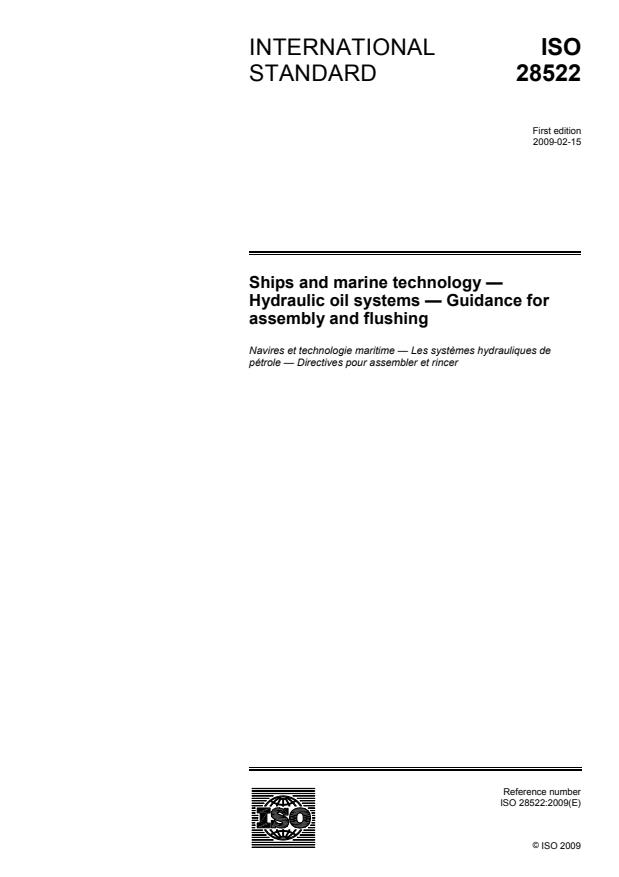
INTERNATIONAL ISO
STANDARD 28522
First edition
2009-02-15
Ships and marine technology —
Hydraulic oil systems — Guidance for
assembly and flushing
Navires et technologie maritime — Les systèmes hydrauliques de
pétrole — Directives pour assembler et rincer
Reference number
©
ISO 2009
PDF disclaimer
This PDF file may contain embedded typefaces. In accordance with Adobe's licensing policy, this file may be printed or viewed but
shall not be edited unless the typefaces which are embedded are licensed to and installed on the computer performing the editing. In
downloading this file, parties accept therein the responsibility of not infringing Adobe's licensing policy. The ISO Central Secretariat
accepts no liability in this area.
Adobe is a trademark of Adobe Systems Incorporated.
Details of the software products used to create this PDF file can be found in the General Info relative to the file; the PDF-creation
parameters were optimized for printing. Every care has been taken to ensure that the file is suitable for use by ISO member bodies. In
the unlikely event that a problem relating to it is found, please inform the Central Secretariat at the address given below.
© ISO 2009
All rights reserved. Unless otherwise specified, no part of this publication may be reproduced or utilized in any form or by any means,
electronic or mechanical, including photocopying and microfilm, without permission in writing from either ISO at the address below or
ISO's member body in the country of the requester.
ISO copyright office
Case postale 56 • CH-1211 Geneva 20
Tel. + 41 22 749 01 11
Fax + 41 22 749 09 47
E-mail copyright@iso.org
Web www.iso.org
Published in Switzerland
ii © ISO 2009 – All rights reserved
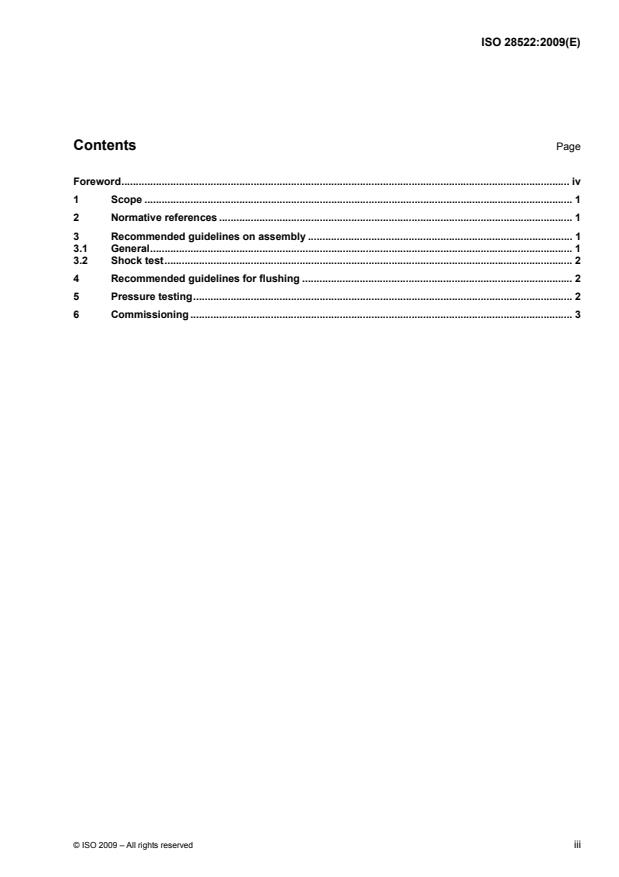
Contents Page
Foreword. iv
1 Scope . 1
2 Normative references . 1
3 Recommended guidelines on assembly . 1
3.1 General. 1
3.2 Shock test. 2
4 Recommended guidelines for flushing . 2
5 Pressure testing. 2
6 Commissioning . 3
Foreword
ISO (the International Organization for Standardization) is a worldwide federation of national standards bodies
(ISO member bodies). The work of preparing International Standards is normally carried out through ISO
technical committees. Each member body interested in a subject for which a technical committee has been
established has the right to be represented on that committee. International organizations, governmental and
non-governmental, in liaison with ISO, also take part in the work. ISO collaborates closely with the
International Electrotechnical Commission (IEC) on all matters of electrotechnical standardization.
International Standards are drafted in accordance with the rules given in the ISO/IEC Directives, Part 2.
The main task of technical committees is to prepare International Standards. Draft International Standards
adopted by the technical committees are circulated to the member bodies for voting. Publication as an
International Standard requires approval by at least 75 % of the member bodies casting a vote.
Attention is drawn to the possibility that some of the elements of this document may be the subject of patent
rights. ISO shall not be held responsible for identifying any or all such patent rights.
ISO 28522 was prepared by Technical Committee ISO/TC 8, Ships and marine technology, Subcommittee
SC 3, Piping and machinery.
iv © ISO 2009 – All rights reserved
INTERNATIONAL STANDARD ISO 28522:2009(E)
Ships and marine technology — Hydraulic oil systems —
Guidance for assembly and flushing
1 Scope
This International Standard provides guidance for assembly and flushing of hydraulic oil systems. The aim of
the flushing process is twofold:
⎯ to remove dirt from the erection, installation, and
⎯ to demonstrate that the pipes and the system as a whole are sufficiently clea
...