


ISO/IEC 29100:2024
(Main)Information technology — Security techniques — Privacy framework
Information technology — Security techniques — Privacy framework
This document provides a privacy framework which: — specifies a common privacy terminology; — defines the actors and their roles in processing personally identifiable information (PII); — describes privacy safeguarding considerations; — provides references to known privacy principles for information technology. This document is applicable to natural persons and organizations involved in specifying, procuring, architecting, designing, developing, testing, maintaining, administering, and operating information and communication technology systems or services where privacy controls are required for the processing of PII.
Technologies de l'information — Techniques de sécurité — Cadre privé
La présente Norme internationale fournit un cadre pour la protection de la vie privée qui: — spécifie une terminologie commune relative à la protection de la vie privée; — définit les acteurs et leurs rôles dans le traitement de données à caractère personnel (DCP); — décrit les éléments à prendre en considération pour la protection de la vie privée; et — fournit des références à des principes connus de protection de la vie privée pour les technologies de l'information. La présente Norme internationale s'applique aux personnes physiques et aux organismes participant à la spécification, à la fourniture, à l'architecture, à la conception, au développement, aux essais, à la maintenance, à l'administration et à l'exploitation des systèmes ou services de technologies de l'information et de la communication dans lesquels des mesures de protection de la vie privée sont requises pour le traitement de DCP.
General Information
- Status
- Published
- Publication Date
- 15-Feb-2024
- Current Stage
- 6060 - International Standard published
- Start Date
- 16-Feb-2024
- Due Date
- 27-Apr-2024
- Completion Date
- 16-Feb-2024
Relations
- Effective Date
- 29-Oct-2022
- Effective Date
- 29-Oct-2022
Overview
ISO/IEC 29100:2024 - Information technology - Security techniques - Privacy framework - is an international standard that defines a high-level privacy framework for the protection of personally identifiable information (PII) in information and communication technology (ICT) systems. The second edition updates the original 2011 publication and consolidates terminology, actor roles, safeguarding considerations, and references to established privacy principles. ISO/IEC 29100:2024 is intended for organizations and individuals involved in specifying, procuring, designing, developing, operating, and maintaining ICT systems where privacy controls are required.
Key topics and requirements
ISO/IEC 29100:2024 structures practical privacy guidance around clear topics and requirements:
- Common privacy terminology - standardized definitions for PII, anonymization, consent, identifiability, opt‑in/opt‑out, pseudonymous data, sensitive PII, metadata, and related terms.
- Actors and roles - identification of key stakeholders such as PII principals, PII controllers, PII processors, and third parties, plus their interactions and responsibilities.
- Recognizing PII - guidance on identifiers, other distinguishing characteristics, linked information, unsolicited PII and what constitutes PII in ICT contexts.
- Privacy safeguarding considerations - organizational, legal/regulatory, contractual and business factors that influence safeguarding requirements.
- Privacy principles - referenced principles include:
- Consent and choice
- Purpose legitimacy and specification
- Collection limitation and data minimization
- Use, retention and disclosure limitation
- Accuracy and quality
- Openness, transparency and notice
- Individual participation and access
- Accountability, information security and privacy compliance
- Privacy policies and controls - high‑level expectations for policies and technical/organizational controls to protect PII.
- Annex mapping - correspondence to ISO/IEC 27000 family concepts to align privacy with information security.
Applications and who should use it
ISO/IEC 29100:2024 is practical for:
- IT architects, developers and system designers building systems that process PII.
- Procurement and vendor management teams defining privacy requirements in contracts and outsourced processes.
- Privacy officers, risk assessors and compliance teams performing privacy impact assessments and defining safeguarding needs.
- Security and operations teams implementing privacy controls, access management, data retention and anonymization measures.
- Legal and governance functions aligning ICT practices with regulatory and contractual obligations.
Use cases include drafting privacy-aware requirements, shaping vendor contracts, developing privacy policies, guiding pseudonymization/anonymization decisions, and aligning information security and data protection programs.
Related standards
- ISO/IEC 29100:2024 includes an annex mapping to the ISO/IEC 27000 series and is intended to complement existing information security standards and privacy engineering initiatives.
Keywords: ISO/IEC 29100:2024, privacy framework, PII, privacy principles, data protection, privacy controls, information security, PII controller, PII processor, data minimization, consent.

Get Certified
Connect with accredited certification bodies for this standard

BSI Group
BSI (British Standards Institution) is the business standards company that helps organizations make excellence a habit.

Bureau Veritas
Bureau Veritas is a world leader in laboratory testing, inspection and certification services.

DNV
DNV is an independent assurance and risk management provider.
Sponsored listings
Frequently Asked Questions
ISO/IEC 29100:2024 is a standard published by the International Organization for Standardization (ISO). Its full title is "Information technology — Security techniques — Privacy framework". This standard covers: This document provides a privacy framework which: — specifies a common privacy terminology; — defines the actors and their roles in processing personally identifiable information (PII); — describes privacy safeguarding considerations; — provides references to known privacy principles for information technology. This document is applicable to natural persons and organizations involved in specifying, procuring, architecting, designing, developing, testing, maintaining, administering, and operating information and communication technology systems or services where privacy controls are required for the processing of PII.
This document provides a privacy framework which: — specifies a common privacy terminology; — defines the actors and their roles in processing personally identifiable information (PII); — describes privacy safeguarding considerations; — provides references to known privacy principles for information technology. This document is applicable to natural persons and organizations involved in specifying, procuring, architecting, designing, developing, testing, maintaining, administering, and operating information and communication technology systems or services where privacy controls are required for the processing of PII.
ISO/IEC 29100:2024 is classified under the following ICS (International Classification for Standards) categories: 35.030 - IT Security. The ICS classification helps identify the subject area and facilitates finding related standards.
ISO/IEC 29100:2024 has the following relationships with other standards: It is inter standard links to ISO/IEC 29100:2011, ISO/IEC 29100:2011/Amd 1:2018. Understanding these relationships helps ensure you are using the most current and applicable version of the standard.
ISO/IEC 29100:2024 is available in PDF format for immediate download after purchase. The document can be added to your cart and obtained through the secure checkout process. Digital delivery ensures instant access to the complete standard document.
Standards Content (Sample)
International
Standard
ISO/IEC 29100
Second edition
Information technology — Security
2024-02
techniques — Privacy framework
Technologies de l'information — Techniques de sécurité — Cadre
privé
Reference number
© ISO/IEC 2024
All rights reserved. Unless otherwise specified, or required in the context of its implementation, no part of this publication may
be reproduced or utilized otherwise in any form or by any means, electronic or mechanical, including photocopying, or posting on
the internet or an intranet, without prior written permission. Permission can be requested from either ISO at the address below
or ISO’s member body in the country of the requester.
ISO copyright office
CP 401 • Ch. de Blandonnet 8
CH-1214 Vernier, Geneva
Phone: +41 22 749 01 11
Email: copyright@iso.org
Website: www.iso.org
Published in Switzerland
© ISO/IEC 2024 – All rights reserved
ii
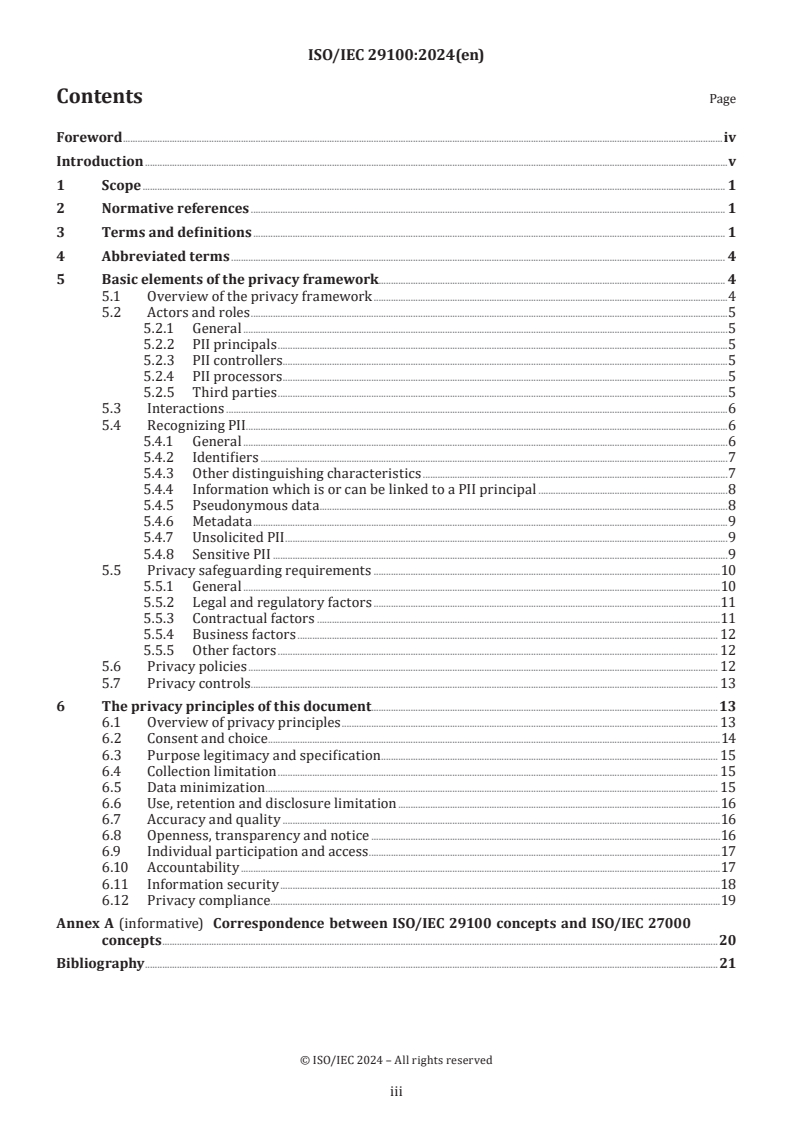
Contents Page
Foreword .iv
Introduction .v
1 Scope . 1
2 Normative references . 1
3 Terms and definitions . 1
4 Abbreviated terms . 4
5 Basic elements of the privacy framework. 4
5.1 Overview of the privacy framework .4
5.2 Actors and roles .5
5.2.1 General .5
5.2.2 PII principals .5
5.2.3 PII controllers.5
5.2.4 PII processors .5
5.2.5 Third parties .5
5.3 Interactions .6
5.4 Recognizing PII .6
5.4.1 General .6
5.4.2 Identifiers .7
5.4.3 Other distinguishing characteristics .7
5.4.4 Information which is or can be linked to a PII principal .8
5.4.5 Pseudonymous data .8
5.4.6 Metadata .9
5.4.7 Unsolicited PII .9
5.4.8 Sensitive PII .9
5.5 Privacy safeguarding requirements .10
5.5.1 General .10
5.5.2 Legal and regulatory factors .11
5.5.3 Contractual factors .11
5.5.4 Business factors . 12
5.5.5 Other factors . 12
5.6 Privacy policies . 12
5.7 Privacy controls . . 13
6 The privacy principles of this document.13
6.1 Overview of privacy principles . 13
6.2 Consent and choice .14
6.3 Purpose legitimacy and specification . 15
6.4 Collection limitation . 15
6.5 Data minimization . 15
6.6 Use, retention and disclosure limitation .16
6.7 Accuracy and quality .16
6.8 Openness, transparency and notice .16
6.9 Individual participation and access .17
6.10 Accountability .17
6.11 Information security .18
6.12 Privacy compliance . . .19
Annex A (informative) Correspondence between ISO/IEC 29100 concepts and ISO/IEC 27000
concepts .20
Bibliography .21
© ISO/IEC 2024 – All rights reserved
iii
Foreword
ISO (the International Organization for Standardization) and IEC (the International Electrotechnical
Commission) form the specialized system for worldwide standardization. National bodies that are
members of ISO or IEC participate in the development of International Standards through technical
committees established by the respective organization to deal with particular fields of technical activity.
ISO and IEC technical committees collaborate in fields of mutual interest. Other international organizations,
governmental and non-governmental, in liaison with ISO and IEC, also take part in the work.
The procedures used to develop this document and those intended for its further maintenance are described
in the ISO/IEC Directives, Part 1. In particular, the different approval criteria needed for the different types
of document should be noted. This document was drafted in accordance with the editorial rules of the ISO/
IEC Directives, Part 2 (see www.iso.org/directives or www.iec.ch/members_experts/refdocs).
ISO and IEC draw attention to the possibility that the implementation of this document may involve the
use of (a) patent(s). ISO and IEC take no position concerning the evidence, validity or applicability of any
claimed patent rights in respect thereof. As of the date of publication of this document, ISO and IEC had not
received notice of (a) patent(s) which may be required to implement this document. However, implementers
are cautioned that this may not represent the latest information, which may be obtained from the patent
database available at www.iso.org/patents and https://patents.iec.ch. ISO and IEC shall not be held
responsible for identifying any or all such patent rights.
Any trade name used in this document is information given for the convenience of users and does not
constitute an endorsement.
For an explanation of the voluntary nature of standards, the meaning of ISO specific terms and expressions
related to conformity assessment, as well as information about ISO's adherence to the World Trade
Organization (WTO) principles in the Technical Barriers to Trade (TBT) see www.iso.org/iso/foreword.html.
In the IEC, see www.iec.ch/understanding-standards.
This document was prepared by Joint Technical Committee ISO/IEC JTC 1, Information technology,
Subcommittee SC 27, Information security, cybersecurity and privacy protection.
This second edition cancels and replaces the first edition (ISO/IEC 29100:2011), of which it constitutes a
minor revision. It also incorporates the Amendment ISO/IEC 29100:2011/Amd 1:2018.
The main changes are as follows:
— Clause 2 (normative references) has been added and cross-references have been updated throughout the
document;
— replaced the term "secondary use” with “secondary purpose” in Clause 3;
— bibliography has been updated.
Any feedback or questions on this document should be directed to the user’s national standards
body. A complete listing of these bodies can be found at www.iso.org/members.html and
www.iec.ch/national-committees.
© ISO/IEC 2024 – All rights reserved
iv
Introduction
This document provides a high-level framework for the protection of personally identifiable information
(PII) within information and communication technology (ICT) systems. It is general in nature and places
organizational, technical, and procedural aspects in an overall privacy framework.
The privacy framework is intended to help organizations define their privacy safeguarding requirements
related to PII within an ICT environment by:
— specifying a common privacy terminology;
— defining the actors and their roles in processing PII;
— describing privacy safeguarding requirements; and
— referencing known privacy principles.
Due to the increasing number of information and communication technologies that process PII, it is
important to have international information security standards that provide a common understanding for
the protection of PII. This document is intended to enhance existing security standards by adding a focus
relevant to the processing of PII.
The increasing commercial use and value of PII, the sharing of PII across jurisdictions, and the growing
complexity of ICT systems, can make it difficult for an organization to ensure privacy and to achieve
compliance with the various applicable laws. Privacy stakeholders can prevent uncertainty and distrust
from arising by handling privacy matters properly and avoiding cases of PII misuse.
Use of this document will:
— aid in the design, implementation, operation, and maintenance of ICT systems that handle and protect
PII;
— spur innovative solutions to enable the protection of PII within ICT systems; and
— improve organizations’ privacy programs through the use of best practices.
The privacy framework provided within this document can serve as a basis for additional privacy
standardization initiatives, such as for:
— a technical reference architecture;
— the implementation and use of specific privacy technologies and overall privacy management;
— privacy controls for outsourced data processes;
— privacy risk assessments; or
— specific engineering specifications.
© ISO/IEC 2024 – All rights reserved
v
International Standard ISO/IEC 29100:2024(en)
Information technology — Security techniques — Privacy
framework
1 Scope
This document provides a privacy framework which:
— specifies a common privacy terminology;
— defines the actors and their roles in processing personally identifiable information (PII);
— describes privacy safeguarding considerations;
— provides references to known privacy principles for information technology.
This document is applicable to natural persons and organizations involved in specifying, procuring,
architecting, designing, developing, testing, maintaining, administering, and operating information and
communication technology systems or services where privacy controls are required for the processing of
PII.
2 Normative references
There are no normative references in this document
3 Terms and definitions
For the purposes of this document, the following terms and definitions apply.
ISO and IEC maintain terminology databases for use in standardization at the following addresses:
— ISO Online browsing platform: available at https:// www .iso .org/ obp
— IEC Electropedia: available at https:// www .electropedia .org/
3.1
anonymity
characteristic of information that does not permit a personally identifiable information principal (3.9) to be
identified directly or indirectly
3.2
anonymization
process by which personally identifiable information (PII) (3.7) is irreversibly altered in such a way that a
PII principal (3.9) can no longer be identified directly or indirectly, either by the PII controller alone or in
collaboration with any other party
3.3
anonymized data
data that has been produced as the output of a personally identifiable information (3.7) anonymization (3.2)
process
3.4
consent
personally identifiable information (PII) principal’s (3.9) freely given, specific and informed agreement to the
processing of their PII
© ISO/IEC 2024 – All rights reserved
3.5
identifiability
condition which results in a personally identifiable information (PII) principal (3.9) being identified, directly
or indirectly, on the basis of a given set of PII
3.6
opt-in
process or type of policy whereby the personally identifiable information (PII) principal (3.9) is required to
take an action to express explicit, prior consent (3.4) for their PII to be processed for a particular purpose
Note 1 to entry: A different term that is often used with the privacy principle "consent and choice" is “opt-out”.
It describes a process or type of policy whereby the PII principal is required to take a separate action in order to
withhold or withdraw consent, or oppose a specific type of processing. The use of an opt-out policy presumes that the
PII controller has the right to process the PII in the intended way. This right can be implied by some action of the PII
principal different from consent (e.g. placing an order in an online shop).
3.7
personally identifiable information
PII
information that (a) can be used to establish a link between the information and the natural person to whom
such information relates, or (b) is or might be directly or indirectly linked to a natural person
Note 1 to entry: The “natural person” in the definition is the PII principal (3.9). To determine whether a PII principal is
identifiable, account should be taken of all the means which can reasonably be used by the privacy stakeholder holding
the data, or by any other party, to establish the link between the set of PII and the natural person.
3.8
PII controller
privacy stakeholder (or privacy stakeholders) that determines the purposes and means for processing
personally identifiable information (PII) (3.7) other than natural persons who use data for personal purposes
Note 1 to entry: A PII controller sometimes instructs others [e.g. PII processors (3.10)] to process PII on its behalf while
the responsibility for the processing remains with the PII controller.
3.9
PII principal
data subject
natural person to whom the personally identifiable information (PII) (3.7) relates
3.10
PII processor
privacy stakeholder that processes personally identifiable information (PII) (3.7) on behalf of and in
accordance with the instructions of a PII controller (3.8)
3.11
privacy breach
situation where personally identifiable information (3.7) is processed in violation of one or more relevant
privacy safeguarding requirements
3.12
privacy control
measure that treats privacy risks by reducing their likelihood or their consequences
Note 1 to entry: Privacy controls include organizational, physical and technical measures, e.g. policies, procedures,
guidelines, legal contracts, management practices or organizational structures.
Note 2 to entry: Control is also used as a synonym for safeguard or countermeasure.
© ISO/IEC 2024 – All rights reserved
3.13
privacy enhancing technology
PET
privacy control (3.12), consisting of information and communication technology (ICT) measures, products,
or services that protect privacy by eliminating or reducing personally identifiable information (PII) (3.7) or
by preventing unnecessary and/or undesired processing of PII, all without losing the functionality of the ICT
system
Note 1 to entry: Examples of PETs include, but are not limited to, anonymization (3.2) and pseudonymization (3.22)
tools that eliminate, reduce, mask, or de-identify PII or that prevent unnecessary, unauthorized and/or undesirable
processing of PII.
Note 2 to entry: Masking is the process of obscuring elements of PII.
3.14
privacy policy
overall intention and direction, rules and commitment, as formally expressed by the personally identifiable
information (PII) controller (3.8) related to the processing of PII (3.7) in a particular setting
3.15
privacy preference
specific choices made by a personally identifiable information (PII) principal (3.9) about how their PII (3.7)
should be processed for a particular purpose
3.16
privacy principle
shared value governing the privacy protection of personally identifiable information (PII) (3.7) when
processed in information and communication technology systems
3.17
privacy risk
effect of uncertainty on privacy
1)
Note 1 to entry: Risk is defined as the “effect of uncertainty on objectives” in ISO Guide 73 and ISO 31000.
Note 2 to entry: Uncertainty is the state, even partial, of deficiency of information related to, understanding or
knowledge of, an event, its consequence, or likelihood.
3.18
privacy impact assessment
privacy risk assessment
overall process of identifying, analysing, evaluating, consulting, communicating and planning the treatment
of potential privacy impacts with regard to the processing of personally identifiable information (3.7), framed
within an organization’s broader risk management framework
3.19
privacy safeguarding requirement
requirement that an organization takes into account when processing personally identifiable information
(PII) (3.7) with respect to the privacy protection of PII
3.20
privacy stakeholder
natural or legal person, public authority, agency or any other body that can affect, be affected by, or perceive
themselves to be affected by a decision or activity related to personally identifiable information (PII) (3.7)
processing
1) Withdrawn.
© ISO/IEC 2024 – All rights reserved
3.21
processing of PII
operation or set of operations performed upon personally identifiable information (PII) (3.7)
Note 1 to entry: Examples of processing operations of PII include, but are not limited to, the collection, storage,
alteration, retrieval, consultation, disclosure, anonymization (3.2), pseudonymization (3.22), dissemination or
otherwise making available, deletion or destruction of PII.
3.22
pseudonymization
process applied to personally identifiable information (PII) (3.7) which replaces identifying information with
an alias
Note 1 to entry: Pseudonymization can be performed either by PII principals (3.9) themselves or by PII controllers
(3.8). Pseudonymization can be used by PII principals to consistently use a resource or service without disclosing
their identity to this resource or service (or between services), while still being held accountable for that use.
Note 2 to entry: Pseudonymization does not rule out the possibility that there can be (a restricted set of) privacy
stakeholders (3.20) other than the PII controller of the pseudonymized data which are able to determine the PII
principal’s identity based on the alias and data linked to it.
3.23
sensitive PII
category of personally identifiable information (PII) (3.7), either whose nature is sensitive, such as those
that relate to the PII principal’s (3.9) most intimate sphere, or that can have a significant impact on the PII
principal
Note 1 to entry: In some jurisdictions or in specific contexts, sensitive PII is defined in reference to the nature of the
PII and can consist of PII revealing the racial origin, political opinions or religious or other beliefs, personal data on
health, sex life or criminal convictions, as well as other PII that can be defined as sensitive.
3.24
third party
privacy stakeholder (3.20) other than the personally identifiable information (PII) principal (3.9), the PII
controller (3.8) and the PII processor (3.10), and the natural persons who are authorized to process the data
under the direct authority of the PII controller or the PII processor
4 Abbreviated terms
ICT information and communication technology
PET privacy enhancing technology
PII personally identifiable information
5 Basic elements of the privacy framework
5.1 Overview of the privacy framework
The following components relate to privacy and the processing of PII in ICT systems and make up the privacy
framework described in this document:
— actors and roles;
— interactions;
— recognizing PII;
— privacy safeguarding requirements;
— privacy policies;
© ISO/IEC 2024 – All rights reserved
— privacy controls.
For the development of this privacy framework, concepts, definitions and recommendations from other
official sources have been taken into consideration. These sources can be found in Reference [3].
[4]-[25]
NOTE In order to make it easier to use ISO/IEC 27000 and related international standards concerning ISMS
in the specific context of privacy and to integrate privacy concepts in the ISO/IEC 27000 context, Table A.1 shows how
the concepts from References [4] to [25] correspond with the concepts used in this document.
5.2 Actors and roles
5.2.1 General
For the purposes of this document, it is important to identify the actors involved in the processing of PII.
There are four types of actors who can be involved in the processing of PII: PII principals, PII controllers, PII
processors and third parties.
5.2.2 PII principals
PII principals provide their PII for processing to PII controllers and PII processors and, when it is not
otherwise provided by applicable law, they give consent and determine their privacy preferences for how
their PII should be processed. PII principals can include, for example, an employee listed in the human
resources system of a company, the consumer mentioned in a credit report, and a patient listed in an
electronic health record. It is not always necessary that the respective natural person is identified directly by
name in order to be considered a PII principal. If the natural person to whom the PII relates can be identified
indirectly (e.g. through an account identifier, social security number, or even through the combination of
available attributes), he or she is considered to be the PII principal for that PII set.
5.2.3 PII controllers
A PII controller determines why (purpose) and how (means) the processing of PII takes place. The PII
controller should ensure adherence to the privacy principles in this framework during the processing
of PII under its control (e.g. by implementing the necessary privacy controls). There can be more than
one PII controller for the same PII set or set of operations performed upon PII (for the same or different
legitimate purposes). In this case, the different PII controllers shall work together and make the necessary
arrangements to ensure the privacy principles are adhered to during the processing of PII. A PII controller
can also decide to have all or part of the processing operations carried out by a different privacy stakeholder
on its behalf. It is expected that PII controllers carefully assess whether or not they are processing sensitive
PII and implement reasonable and appropriate privacy and security controls, as well as any potential adverse
effects for PII principals as identified during a privacy risk assessment.
NOTE Legal requirements can apply.
5.2.4 PII processors
A PII processor carries out the processing of PII on behalf of a PII controller, acts on behalf of, or in accordance
with the instructions of the PII controller, observes the stipulated privacy requirements and implements the
corresponding privacy controls.
NOTE In some jurisdictions, the PII processor is bound by a contract.
5.2.5 Third parties
A third party can receive PII from a PII controller or a PII processor. A third party does not process PII on
behalf of the PII controller. Generally, the third party will become a PII controller in its own right once it has
received the PII in question.
© ISO/IEC 2024 – All rights reserved
5.3 Interactions
The actors identified in 5.2 can interact with each other in a variety of ways. As far as the possible flows of
PII among the PII principal, the PII controller and the PII processor are concerned, the following scenarios
can be identified:
a) the PII principal provides PII to a PII controller (e.g. when registering for a service provided by the PII
controller);
b) the PII controller provides PII to a PII processor which processes that PII on behalf of the PII controller
(e.g. as part of an outsourcing agreement);
c) the PII principal provides PII to a PII processor which processes that PII on behalf of the PII controller;
d) the PII controller provides the PII principal with PII which is related to the PII principal (e.g. pursuant to
a request made by the PII principal);
e) the PII processor provides PII to the PII principal (e.g. as directed by the PII controller);
f) the PII processor provides PII to the PII controller (e.g. after having performed the service for which it
was appointed).
The roles of the PII principal, PII controller, PII processor and a third party in these scenarios are illustrated
in Table 1.
There is a need to distinguish between PII processors and third parties because the legal control of the PII
remains with the original PII controller when it is sent over to the PII processor, whereas a third party can
become a PII controller in its own right once it has received the PII in question. For instance, where a third
party makes the decision to transfer PII it has received from a PII controller to yet another party, it will be
acting as a PII controller in its own right and will therefore no longer be considered a third party.
As far as the possible flows of PII among the PII controllers and PII processors on the one hand, and third
parties on the other hand are concerned, the following scenarios can be identified:
g) the PII controller provides PII to a third party (e.g. in the context of a business agreement); and
h) the PII processor provides PII to a third party (e.g. as directed by the PII controller).
The roles of the PII controller and a third party in these scenarios are also illustrated in Table 1.
Table 1 — Possible flows of PII among the PII principal, PII controller, PII processor and a third
party and their roles
PII principal PII controller PII processor Third party
Scenario a) PII provider PII recipient — —
Scenario b) — PII provider PII recipient —
Scenario c) PII provider — PII recipient —
Scenario d) PII recipient PII provider — —
Scenario e) PII recipient — PII provider —
Scenario f) — PII recipient PII provider —
Scenario g) — PII provider — PII recipient
Scenario h) — — PII provider PII recipient
5.4 Recognizing PII
5.4.1 General
To determine whether or not a natural person should be considered identifiable, several factors need to be
taken into account. In particular, account should be taken of all the means which can reasonably be used by
© ISO/IEC 2024 – All rights reserved
the privacy stakeholder holding the data, or by any other party, to identify that natural person. ICT systems
should support mechanisms that will make the PII principal aware of such PII and provide the natural person
with appropriate controls over the sharing of that information. 5.4.2 to 5.4.8 provide additional clarification
on how to determine whether or not a PII principal should be considered identifiable.
5.4.2 Identifiers
In certain instances, identifiability of the PII principal can be very clear (e.g. when the information contains or
is associated with an identifier which is used to refer to or communicate with the PII principal). Information
can be considered to be PII in at least the following instances:
— if it contains or is associated with an identifier which refers to a natural person (e.g. a social security
number);
— if it contains or is associated with an identifier which can be related to a natural person (e.g. a passport
number, an account number);
— if it contains or is associated with an identifier which can be used to establish a communication with an
identified natural person (e.g. a precise geographical location, a telephone number); or
— if it contains a reference which links the data to any of the identifiers above.
5.4.3 Other distinguishing characteristics
Information does not necessarily need to be associated with an identifier in order to be considered PII.
Information will also be considered PII if it contains or is associated with a characteristic which distinguishes
a natural person from other natural persons (e.g. biometric data).
Any attribute which takes on a value which uniquely identifies a PII principal is considered as a distinguishing
characteristic. Whether or not a given characteristic distinguishes a natural person from other natural
persons can change depending on the context of use. For instance, while the last name of a natural person
can be insufficient to identify that natural person on a global scale, it will often be sufficient to distinguish a
natural person on a company scale.
In addition, there can also be situations in which a natural person is identifiable even if there is no single
attribute that uniquely identifies him or her. This is the case where a combination of several attributes taken
together distinguishes this natural person from other natural persons. Whether or not a natural person is
identifiable on the basis of a combination of attributes can also be dependent on the specific domain. For
instance, the combination of the attributes “female”, “45” and “lawyer” can be sufficient to identify a natural
person within a particular company, but will often be insufficient to identify that natural person outside of
that company.
Table 2 provides some examples of attributes that can be PII, depending on the domain. These examples are
informative.
© ISO/IEC 2024 – All rights reserved
Table 2 — Example of attributes that can be used to identify natural persons
Examples
Age or special needs of vulnerable natural persons
Allegations of criminal conduct
Any information collected during health services
Bank account or credit card number
Biometric identifier
Credit card statements
Criminal convictions or committed offences
Criminal investigation reports
Customer number
Date of birth
Diagnostic health information
Disabilities
Doctor bills
Employees’ salaries and human resources files
Financial profile
Gender
GPS position
GPS trajectories
Home address
IP address
Location derived from telecommunications systems
Medical history
Name
National identifiers (e.g. passport number)
Personal e-mail address
Personal identification numbers (PIN) or passwords
Personal interests derived from tracking use of internet websites
Personal or behavioural profile
Personal telephone number
Photograph or video identifiable to a natural person
Product and service preferences
Racial or ethnic origin
Religious or philosophical beliefs
Sexual orientation
Trade-union membership
Utility bills
5.4.4 Information which is or can be linked to a PII principal
If the information in question does not identify a PII principal, it should be determined whether the
information is or can be linked to an identity of a natural person.
Once the relationship with an identifiable natural person is established, it needs to be decided whether the
information says something about this natural person, for instance if it refers to her or his characteristics
or behaviour. Examples include medical records, financial profiles, or the personal interests derived from
tracking use of internet websites. Also, simple attribute statements about a natural person such as age or
gender of a natural person can qualify the linked information as PII. Regardless, if the relationship with an
identifiable natural person can be established, such information shall be treated as PII.
5.4.5 Pseudonymous data
In order to restrict the ability of PII controllers and processors to identify the PII principal, identity
information can be replaced by aliases. This replacement is usually performed by a PII provider before
transmitting the PII to a PII recipient, in particular in the scenarios a, b, c, g and h listed in Table 1.
Certain business processes rely on designated processors who perform the substitution and control the
assignment table or function. This is often the case wherever sensitive data needs to be processed by privacy
stakeholders that did not collect them.
© ISO/IEC 2024 – All rights reserved
The substitution is considered pseudonymization, provided that:
a) the remaining attributes linked to the alias do not suffice to identify the PII principal to whom they
relate; and
b) the alias assignment is such that it cannot be reversed by reasonable efforts of the privacy stakeholders
other than those that performed them.
Pseudonymization retains linkability. Different data associated with the same pseudonym can be linked.
The larger the set of data associated with a given pseudonym, the larger is the risk that property a) is
violated. Moreover, the smaller the group of natural persons to which a set of pseudonymous data relates, the
greater the likelihood of a PII principal being identifiable. Attributes contained directly in the information
in question and attributes that can be easily linked to this information (e.g. by using a search engine or
cross-referencing with other databases) should be taken into account when determining whether or not the
information relates to an identifiable natural person.
Pseudonymization contrasts with anonymization. Anonymization processes also fulfil properties a) and b)
above, but destroy linkability. During anonymization, identity information is either erased or substituted
by aliases for which the assignment function or table is destroyed. Thus, anonymized data are no longer PII.
5.4.6 Metadata
PII can be stored in an ICT system in such a way that it is not readily visible to the system user (i.e. to the PII
principal). Examples include the PII principal’s name stored as metadata in the properties of a document,
and comments or tracked changes stored as metadata in a word processing document. If the PII principal
became aware of the existence of the PII or the processing of the PII for such a purpose, it is possible that he
or she prefers that the PII is not processed in such a way or is shared publicly.
5.4.7 Unsolicited PII
PII that was unsolicited by a PII controller or PII processor (i.e. unintentionally obtained) can also be
stored in an ICT system. For example, a PII principal can potentially provide PII to a PII controller that was
not requested or sought by the PII controller (e.g. additional PII provided in the context of an anonymous
feedback form on a website). The risk of collecting unsolicited PII can be reduced by considering privacy
safeguarding measures at the time of the design of the system (also referred to as the concept of “privacy by
design”).
5.4.8 Sensitive PII
Sensitivity extends to all PII from which sensitive PII can be derived. For instance, medical prescriptions can
reveal detailed information about the PII principal’s health. Even if PII does not contain direct information
about the PII principal’s sexual orientation or health, if it can be used to infer such information, the PII can
be sensitive. For purposes of this document, PII shall be treated as sensitive PII where such inference and
knowledge of the identity of the PII principal is reasonably possible.
NOTE 1 In some jurisdictions, what constitutes sensitive PII is also defined explicitly in legislation. Examples include
information revealing race, ethnic origin, religious or philosophical beliefs, political opinions, trade union membership,
sexual lifestyle or orientation, and the physical or mental health of the PII principal. In other jurisdictions, sensitive
PII can include information that can facilitate identity theft or otherwise result in significant financial harm to the
natural person (e.g. credit card numbers, bank account information, or government-issued identifiers such as passport
numbers, social security numbers or drivers’ license numbers), and information that can be used to determine the PII
principal’s real time location.
The processing of sensitive PII requires special precautions.
NOTE 2 In some jurisdictions, the processing of sensitive PII can be prohibited by applicable law even with the PII
principal’s opt-in consent. Some jurisdictions can require implementation of specific controls where certain types of
sensitive PII are processed (e.g. a requirement to encrypt medical PII when transmitting it over a public network).
© ISO/IEC 2024 – All rights reserved
5.5 Privacy safeguarding requirements
5.5.1 General
Organizations are motivated to protect PII for a variety of reasons: to protect the PII principal’s privacy,
to meet legal and regulatory requirements, to practice corporate responsibility and to enhance consumer
trust. The purpose of this clause is to provide an overview of the different factors that can influence the
privacy safeguarding requirements that are relevant to a particular organization or privacy stakeholder
processing PII.
Privacy safeguarding requirements can relate to many different aspects of PII processing, e.g. the collection
and retention of PII, the transfer of PII to third parties, the contractual relationship among PII controllers
and PII processors and the international transfer of PII. Privacy safeguarding requirements can also vary
in specificity. They can be very general in nature, e.g. consisting of an enumeration of high-level privacy
principles which an organization is expected to take into account when processing PII. However, privacy
safeguarding requirements can also involve very specific restrictions on the processing of certain types of
PII, or mandate the implementation of specific privacy controls.
The design of any ICT system that involves the processing of PII should be preceded by an identification
of relevant privacy safeguarding requirements. The privacy implications of new or substantially modified
ICT systems involving the processing of PII should be resolved before those ICT systems are implemented.
Organizations routinely perform broad risk management activities and develop risk profiles related to their
ICT systems.
Risk management is def
...
Questions, Comments and Discussion
Ask us and Technical Secretary will try to provide an answer. You can facilitate discussion about the standard in here.
Loading comments...