

ISO 19901-7:2013
(Main)Petroleum and natural gas industries — Specific requirements for offshore structures — Part 7: Stationkeeping systems for floating offshore structures and mobile offshore units
General Information
- Abstract
ISO 19901-7:2013 specifies methodologies for - the design, analysis and evaluation of stationkeeping systems for floating structures used by the oil and gas industries to support production, storage, drilling, well intervention and production, production and storage, drilling, well intervention, production and storage, and - the assessment of stationkeeping systems for site-specific applications of mobile offshore units (e.g. mobile offshore drilling units, construction units, and pipelay units). ISO 19901-7:2013 is applicable to the following types of stationkeeping systems, which are either covered directly in ISO 19901-7:2013 or through reference to other guidelines: - spread moorings (catenary, taut-line and semi-taut-line moorings); - single point moorings, anchored by spread mooring arrangements; - dynamic positioning systems; - thruster-assisted moorings. Descriptions of the characteristics and of typical components of these systems are given in an informative annex. The requirements of ISO 19901-7:2013 mainly address spread mooring systems and single point mooring systems with mooring lines composed of steel chain and wire rope. ISO 19901-7:2013 also provides guidance on the application of the methodology to synthetic fibre rope mooring systems, and includes additional requirements related to the unique properties of synthetic fibre ropes. ISO 19901-7:2013 is applicable to single anchor leg moorings (SALMs) and other single point mooring systems (e.g. tower soft yoke systems) only to the extent to which the requirements are relevant. ISO 19901-7:2013 is not applicable to the vertical moorings of tension leg platforms (TLPs).
- Status
- Withdrawn
- Publication Date
- 25-Apr-2013
- Technical Committee
- ISO/TC 67/SC 7 - Offshore structures
- Drafting Committee
- ISO/TC 67/SC 7/WG 5 - Floating systems
- Current Stage
- 9599 - Withdrawal of International Standard
- Start Date
- 14-Jul-2026
- Completion Date
- 29-Aug-2026
Buy Documents
ISO 19901-7:2013 - Petroleum and natural gas industries — Specific requirements for offshore structures — Part 7: Stationkeeping systems for floating offshore structures and mobile offshore units Released:4/26/2013
ISO 19901-7:2013 - Industries du pétrole et du gaz naturel — Exigences spécifiques relatives aux structures en mer — Partie 7: Systemes de maintien en position des structures en mer flottantes et des unités mobiles en mer Released:4/26/2013
Overview
ISO 19901-7:2013 specifies methodologies for the design, analysis and evaluation of stationkeeping systems for floating offshore structures and the assessment of stationkeeping for mobile offshore units. It covers mooring and positioning systems used in petroleum and natural gas offshore operations-supporting production, storage, drilling, well intervention, construction and pipelay activities. The standard defines functional, safety, planning, inspection and analytical requirements and includes informative guidance on typical system components.
Key topics and technical requirements
- Types of stationkeeping systems covered
- Spread moorings (catenary, taut-line, semi-taut-line)
- Single point moorings (anchored by spread mooring arrangements)
- Dynamic positioning (DP) systems
- Thruster-assisted moorings
- Design and analysis methodology
- Definition of exposure levels, design situations and limit states
- Environmental actions: wind, waves, current and indirect actions
- Mooring analysis: offsets, motions, line response, anchor loads and line geometry constraints
- Fatigue analysis procedure and fatigue safety factors
- Transient and dynamic analyses (including thruster-assisted scenarios)
- Mooring hardware and materials
- Guidance on mooring line components, winching and monitoring equipment
- Specific guidance for synthetic fibre rope mooring systems (creep, stiffness, fatigue and model testing)
- In-service requirements
- Inspection, monitoring and maintenance for mobile and permanent moorings
- Operational and personnel considerations for DP systems
- Informative annexes
- Descriptions of typical stationkeeping components and regional guidance
- Annex A incorporates detailed guidance (including material aligned with API RP 2SK on anchor design and vortex-induced motions)
Practical applications and users
ISO 19901-7 is intended for engineers, designers, operators and regulators working with:
- Floating production, storage and offloading (FPSO) units, semi-submersibles, spars and ship-shaped structures
- Mobile offshore drilling units (MODUs), pipelay and construction units
- Mooring contractors, naval architects, offshore operations planners and maintenance teams
Practical uses include selecting appropriate mooring or DP solutions, performing site-specific mooring analyses, fatigue assessments, anchor and hardware specification, and developing inspection/maintenance programs.
Related standards
- ISO 19900 - General requirements for offshore structures
- Other parts of ISO 19901 (Metocean, seismic, topsides, geotechnical, marine operations)
- ISO 19904 / ISO 19905 series (floating structures and site-specific assessments)
- Informative alignment with API RP 2SK and API RP 2SM for anchor and synthetic rope guidance
Keywords: ISO 19901-7, stationkeeping systems, mooring analysis, dynamic positioning, floating offshore structures, synthetic fibre rope mooring, spread mooring, single point mooring, fatigue analysis.
Relations
- Effective Date
- 25-Aug-2026
- Effective Date
- 25-Aug-2026
- Effective Date
- 25-Aug-2026
- Effective Date
- 25-Aug-2026
- Effective Date
- 25-Aug-2026
- Effective Date
- 25-Aug-2026
- Effective Date
- 25-Aug-2026
- Effective Date
- 25-Aug-2026
- Effective Date
- 25-Aug-2026
- Effective Date
- 25-Feb-2026
- Effective Date
- 12-Feb-2026
- Effective Date
- 06-Jun-2022
- Effective Date
- 13-Aug-2022
- Effective Date
- 12-Feb-2011
Buy Documents
ISO 19901-7:2013 - Petroleum and natural gas industries — Specific requirements for offshore structures — Part 7: Stationkeeping systems for floating offshore structures and mobile offshore units Released:4/26/2013
ISO 19901-7:2013 - Industries du pétrole et du gaz naturel — Exigences spécifiques relatives aux structures en mer — Partie 7: Systemes de maintien en position des structures en mer flottantes et des unités mobiles en mer Released:4/26/2013
Get Certified
Connect with accredited certification bodies for this standard

Element Materials Technology
Materials testing and product certification.

ABS Group Brazil
ABS Group certification services in Brazil.

ABS Quality Evaluations Inc.
American Bureau of Shipping quality certification.
Sponsored listings
Frequently Asked Questions
ISO 19901-7:2013 is a standard published by the International Organization for Standardization (ISO). Its full title is "Petroleum and natural gas industries — Specific requirements for offshore structures — Part 7: Stationkeeping systems for floating offshore structures and mobile offshore units". This standard covers: ISO 19901-7:2013 specifies methodologies for - the design, analysis and evaluation of stationkeeping systems for floating structures used by the oil and gas industries to support production, storage, drilling, well intervention and production, production and storage, drilling, well intervention, production and storage, and - the assessment of stationkeeping systems for site-specific applications of mobile offshore units (e.g. mobile offshore drilling units, construction units, and pipelay units). ISO 19901-7:2013 is applicable to the following types of stationkeeping systems, which are either covered directly in ISO 19901-7:2013 or through reference to other guidelines: - spread moorings (catenary, taut-line and semi-taut-line moorings); - single point moorings, anchored by spread mooring arrangements; - dynamic positioning systems; - thruster-assisted moorings. Descriptions of the characteristics and of typical components of these systems are given in an informative annex. The requirements of ISO 19901-7:2013 mainly address spread mooring systems and single point mooring systems with mooring lines composed of steel chain and wire rope. ISO 19901-7:2013 also provides guidance on the application of the methodology to synthetic fibre rope mooring systems, and includes additional requirements related to the unique properties of synthetic fibre ropes. ISO 19901-7:2013 is applicable to single anchor leg moorings (SALMs) and other single point mooring systems (e.g. tower soft yoke systems) only to the extent to which the requirements are relevant. ISO 19901-7:2013 is not applicable to the vertical moorings of tension leg platforms (TLPs).
ISO 19901-7:2013 specifies methodologies for - the design, analysis and evaluation of stationkeeping systems for floating structures used by the oil and gas industries to support production, storage, drilling, well intervention and production, production and storage, drilling, well intervention, production and storage, and - the assessment of stationkeeping systems for site-specific applications of mobile offshore units (e.g. mobile offshore drilling units, construction units, and pipelay units). ISO 19901-7:2013 is applicable to the following types of stationkeeping systems, which are either covered directly in ISO 19901-7:2013 or through reference to other guidelines: - spread moorings (catenary, taut-line and semi-taut-line moorings); - single point moorings, anchored by spread mooring arrangements; - dynamic positioning systems; - thruster-assisted moorings. Descriptions of the characteristics and of typical components of these systems are given in an informative annex. The requirements of ISO 19901-7:2013 mainly address spread mooring systems and single point mooring systems with mooring lines composed of steel chain and wire rope. ISO 19901-7:2013 also provides guidance on the application of the methodology to synthetic fibre rope mooring systems, and includes additional requirements related to the unique properties of synthetic fibre ropes. ISO 19901-7:2013 is applicable to single anchor leg moorings (SALMs) and other single point mooring systems (e.g. tower soft yoke systems) only to the extent to which the requirements are relevant. ISO 19901-7:2013 is not applicable to the vertical moorings of tension leg platforms (TLPs).
ISO 19901-7:2013 is classified under the following ICS (International Classification for Standards) categories: 75.180.10 - Exploratory, drilling and extraction equipment. The ICS classification helps identify the subject area and facilitates finding related standards.
ISO 19901-7:2013 has the following relationships with other standards: It is inter standard links to EN ISO 19901-4:2016, EN ISO 19904-1:2019, EN ISO 19905-3:2022, EN ISO 19900:2019, EN ISO 19906:2019, EN ISO 20257-1:2020, EN ISO 19900:2013, EN ISO 19905-3:2019, EN ISO 19901-1:2015, EN ISO 19901-4:2025, EN ISO 19901-7:2013, ISO 22880:2004, ISO 19901-7:2026, ISO 19901-7:2005. Understanding these relationships helps ensure you are using the most current and applicable version of the standard.
ISO 19901-7:2013 is available in PDF format for immediate download after purchase. The document can be added to your cart and obtained through the secure checkout process. Digital delivery ensures instant access to the complete standard document.
Standards Content (Sample)
INTERNATIONAL ISO
STANDARD 19901-7
Second edition
2013-05-01
Petroleum and natural gas industries —
Specific requirements for offshore
structures —
Part 7:
Stationkeeping systems for floating
offshore structures and mobile offshore
units
Industries du pétrole et du gaz naturel — Exigences spécifiques
relatives aux structures en mer —
Partie 7: Systèmes de maintien en position des structures en mer
flottantes et des unités mobiles en mer
Reference number
©
ISO 2013
© ISO 2013
All rights reserved. Unless otherwise specified, no part of this publication may be reproduced or utilized in any form or by any means,
electronic or mechanical, including photocopying and microfilm, without permission in writing from either ISO at the address below or
ISO's member body in the country of the requester.
ISO copyright office
Case postale 56 CH-1211 Geneva 20
Tel. + 41 22 749 01 11
Fax + 41 22 749 09 47
E-mail copyright@iso.org
Web www.iso.org
Published in Switzerland
ii © ISO 2013 – All rights reserved
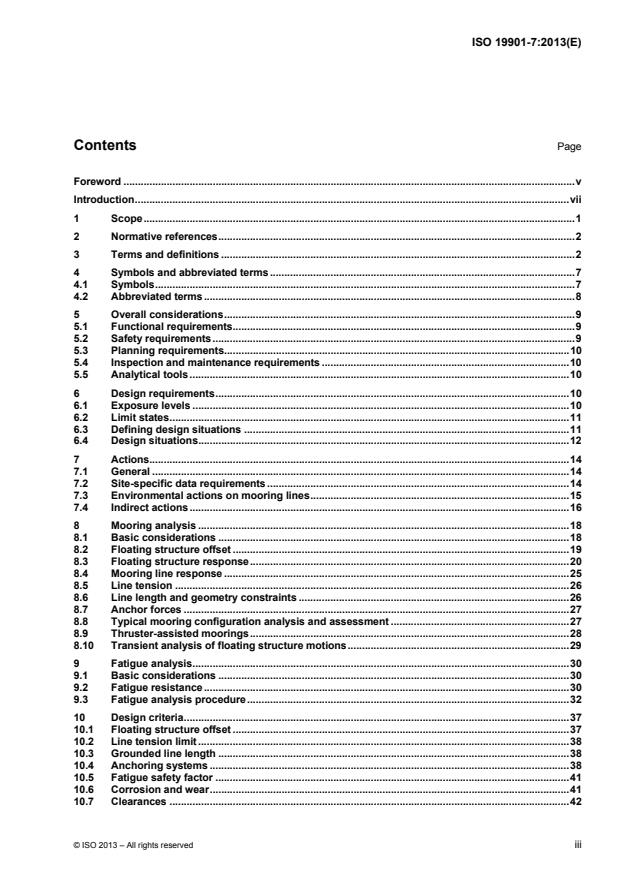
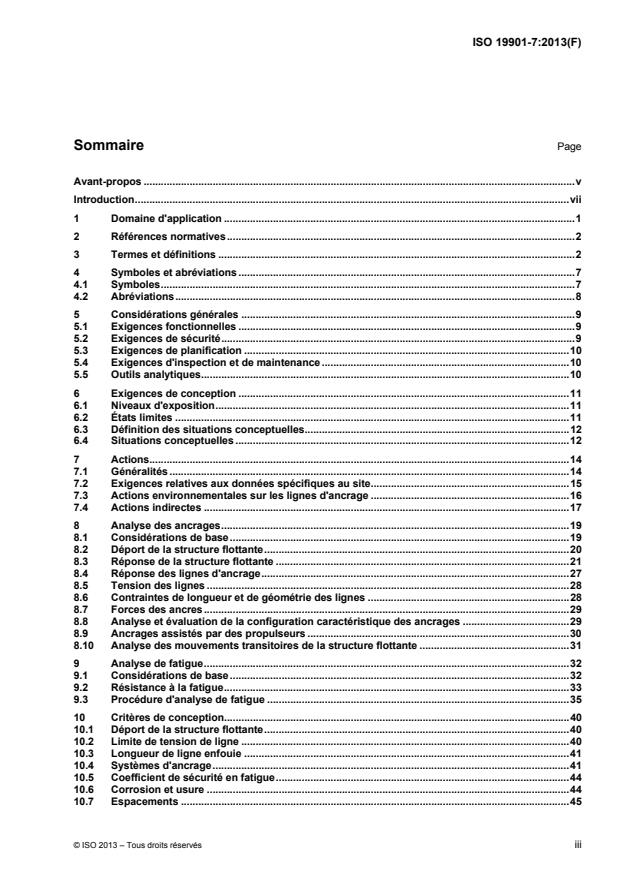
Contents Page
Foreword . v
Introduction . vii
1 Scope . 1
2 Normative references . 2
3 Terms and definitions . 2
4 Symbols and abbreviated terms . 7
4.1 Symbols . 7
4.2 Abbreviated terms . 8
5 Overall considerations . 9
5.1 Functional requirements. 9
5.2 Safety requirements . 9
5.3 Planning requirements . 10
5.4 Inspection and maintenance requirements . 10
5.5 Analytical tools . 10
6 Design requirements . 10
6.1 Exposure levels . 10
6.2 Limit states . 11
6.3 Defining design situations . 11
6.4 Design situations . 12
7 Actions. 14
7.1 General . 14
7.2 Site-specific data requirements . 14
7.3 Environmental actions on mooring lines . 15
7.4 Indirect actions . 16
8 Mooring analysis . 18
8.1 Basic considerations . 18
8.2 Floating structure offset . 19
8.3 Floating structure response . 20
8.4 Mooring line response . 25
8.5 Line tension . 26
8.6 Line length and geometry constraints . 26
8.7 Anchor forces . 27
8.8 Typical mooring configuration analysis and assessment . 27
8.9 Thruster-assisted moorings . 28
8.10 Transient analysis of floating structure motions . 29
9 Fatigue analysis . 30
9.1 Basic considerations . 30
9.2 Fatigue resistance . 30
9.3 Fatigue analysis procedure . 32
10 Design criteria . 37
10.1 Floating structure offset . 37
10.2 Line tension limit . 38
10.3 Grounded line length . 38
10.4 Anchoring systems . 38
10.5 Fatigue safety factor . 41
10.6 Corrosion and wear . 41
10.7 Clearances . 42
10.8 Supporting structures .42
11 Mooring hardware .42
11.1 Mooring line components .42
11.2 Winching equipment .43
11.3 Monitoring equipment .43
12 In-service inspection, monitoring and maintenance .44
12.1 General .44
12.2 Mobile moorings .44
12.3 Permanent moorings .44
13 Dynamic positioning system .46
13.1 Basic considerations .46
13.2 Design and analysis .47
13.3 Design, test and maintenance .48
13.4 Operating personnel .48
13.5 Determination of stationkeeping capability .48
14 Synthetic fibre rope mooring .48
14.1 Basic considerations .48
14.2 Fibre rope mooring analysis .49
14.3 Fatigue analysis .50
14.4 Creep analysis .50
14.5 Design criteria .50
14.6 Model testing .51
Annex A (informative) Additional information and guidance .52
Annex B (informative) Regional information . 169
Bibliography . 176
iv © ISO 2013 – All rights reserved
Foreword
ISO (the International Organization for Standardization) is a worldwide federation of national standards bodies
(ISO member bodies). The work of preparing International Standards is normally carried out through ISO
technical committees. Each member body interested in a subject for which a technical committee has been
established has the right to be represented on that committee. International organizations, governmental and
non-governmental, in liaison with ISO, also take part in the work. ISO collaborates closely with the
International Electrotechnical Commission (IEC) on all matters of electrotechnical standardization.
International Standards are drafted in accordance with the rules given in the ISO/IEC Directives, Part 2.
The main task of technical committees is to prepare International Standards. Draft International Standards
adopted by the technical committees are circulated to the member bodies for voting. Publication as an
International Standard requires approval by at least 75 % of the member bodies casting a vote.
Attention is drawn to the possibility that some of the elements of this document may be the subject of patent
rights. ISO shall not be held responsible for identifying any or all such patent rights.
ISO 19901-7 was prepared by Technical Committee ISO/TC 67, Materials, equipment and offshore structures
for petroleum, petrochemical and natural gas industries, Subcommittee SC 7, Offshore structures.
This second edition cancels and replaces the first edition (ISO 19901-7:2005), which has been technically
revised.
This second edition of ISO 19901-7 includes several major additions and changes, primarily to Annex A
(informative). The largest change is the addition of detailed informative text incorporated directly from API RP
2SK on all types of anchor design. In the first edition of this International Standard, this material was
previously addressed only by reference to API RP 2SK. Informative material has also been added from
API RP 2SK regarding the analysis and mitigation of vortex-induced motions of large cylindrical hulls.
Consequently, the normative text has been modified to remove reference to API RP 2SK and to cross-
reference portions of the expanded informative annex.
The other significant change is the updating of guidance on polyester rope mooring design to conform to the
provisions of the recent amendment to API RP 2SM. The changes include new definitions of stiffness,
recognition of effective filter barriers, removal of the prohibition against the rope touching the sea floor, and
more detail on minimum tension requirements, among others. Additionally, minor corrections were made to
the text in 7.4.4 (Wind actions) and 8.3.4 (Riser considerations), and the terminology "most probable
maximum" has been standardized throughout. Finally, the Norwegian clause of Annex B has been updated at
the request of Norway, and a new Canadian clause has been added.
ISO 19901 consists of the following parts, under the general title Petroleum and natural gas industries —
Specific requirements for offshore structures:
Part 1: Metocean design and operating considerations
Part 2: Seismic design procedures and criteria
Part 3: Topsides structure
Part 4: Geotechnical and foundation design considerations
Part 5: Weight control during engineering and construction
Part 6: Marine operations
Part 7: Stationkeeping systems for floating offshore structures and mobile offshore units
The following parts are under preparation:
Part 8: Marine soil investigations
ISO 19901 is one of a series of International Standards for offshore structures. The full series consists of the
following International Standards:
ISO 19900, Petroleum and natural gas industries — General requirements for offshore structures
ISO 19901 (all parts), Petroleum and natural gas industries — Specific requirements for offshore
structures
ISO 19902, Petroleum and natural gas industries — Fixed steel offshore structures
ISO 19903, Petroleum and natural gas industries — Fixed concrete offshore structures
ISO 19904-1, Petroleum and natural gas industries — Floating offshore structures — Part 1: Monohulls,
semi-submersibles and spars
ISO 19905-1, Petroleum and natural gas industries — Site-specific assessment of mobile offshore
units — Part 1: Jack-ups
ISO/TR 19905-2, Petroleum and natural gas industries — Site-specific assessment of mobile offshore
units — Part 2: Jack-ups commentary and detailed sample calculation
ISO 19905-3, Petroleum and natural gas industries — Site-specific assessment of mobile offshore
1)
units — Part 3: Floating units
ISO 19906, Petroleum and natural gas industries — Arctic offshore structures
1) Under preparation.
vi © ISO 2013 – All rights reserved
Introduction
The series of International Standards applicable to types of offshore structure, ISO 19900 to ISO 19906,
constitutes a common basis covering those aspects that address design requirements and assessments of all
offshore structures used by the petroleum, petrochemical and natural gas industries worldwide. Through their
application, the intention is to achieve reliability levels appropriate for manned and unmanned offshore
structures, whatever type of structure and nature or combination of materials used.
It is important to recognize that structural integrity is an overall concept comprising models for describing
actions, structural analyses, design rules, safety elements, workmanship, quality control procedures and
national requirements, all of which are mutually dependent. The modification of one aspect of design in
isolation can disturb the balance of reliability inherent in the overall concept or structural system. The
implications involved in modifications therefore need to be considered in relation to the overall reliability of all
offshore structural systems.
The series of International Standards applicable to types of offshore structure is intended to provide wide
latitude in the choice of structural configurations, materials and techniques without hindering innovation.
Sound engineering judgement is therefore necessary in the use of these International Standards.
This part of ISO 19901 was developed in response to the worldwide offshore industry’s demand for a coherent
and consistent definition of methodologies to analyse, design and evaluate stationkeeping systems used for
floating production and/or storage platforms of various types (e.g. semi-submersibles, spar platforms, ship-
shaped structures) and to assess site-specific applications of mobile offshore units (such as mobile offshore
drilling units, pipelay units, construction units).
Stationkeeping is a generic term covering systems for keeping a floating structure, which is under the constant
influence of external actions, on a pre-defined location and/or heading with limited excursions. Stationkeeping
systems resist external actions by means of any combination of the following:
mooring systems (e.g. spread moorings or single point moorings);
dynamic positioning systems (generally consisting of thrusters).
The external actions generally consist of wind, wave, current and ice actions on the floating structure, mooring
and/or risers.
Some background to, and guidance on, the use of this part of ISO 19901 is provided in informative Annex A.
The clause numbering in Annex A is the same as in the normative text to facilitate cross-referencing.
Regional information, where available, is provided in informative Annex B.
INTERNATIONAL STANDARD ISO 19901-7:2013(E)
Petroleum and natural gas industries — Specific requirements
for offshore structures —
Part 7:
Stationkeeping systems for floating offshore structures and
mobile offshore units
1 Scope
This part of ISO 19901 specifies methodologies for
a) the design, analysis and evaluation of stationkeeping systems for floating structures used by the oil and
gas industries to support
1) production,
2) storage,
3) drilling, well intervention and production,
4) production and storage,
5) drilling, well intervention, production and storage, and
b) the assessment of stationkeeping systems for site-specific applications of mobile offshore units (e.g.
mobile offshore drilling units, construction units, and pipelay units).
Most stationkeeping systems used with the class of floating structures covered by a) are termed “permanent
mooring systems”, for which this part of ISO 19901 is applicable to all aspects of the life cycle and includes
requirements relating to the manufacture of mooring components, as well as considerations for in-service
inspections. Most stationkeeping systems used with mobile offshore units, the class covered by b), are termed
“mobile mooring systems”. Throughout this part of ISO 19901, the term “floating structure”, sometimes
shortened to “structure”, is used as a generic term to indicate any member of the two classes, a) and b).
This part of ISO 19901 is applicable to the following types of stationkeeping systems, which are either covered
directly in this part of ISO 19901 or through reference to other guidelines:
spread moorings (catenary, taut-line and semi-taut-line moorings);
single point moorings, anchored by spread mooring arrangements;
dynamic positioning systems;
thruster-assisted moorings.
Descriptions of the characteristics and of typical components of these systems are given in Annex A.
The requirements of this part of ISO 19901 mainly address spread mooring systems and single point mooring
systems with mooring lines composed of steel chain and wire rope. This part of ISO 19901 also provides
guidance on the application of the methodology to synthetic fibre rope mooring systems, and includes
additional requirements related to the unique properties of synthetic fibre ropes.
This part of ISO 19901 is applicable to single anchor leg moorings (SALMs) and other single point mooring
systems (e.g. tower soft yoke systems) only to the extent to which the requirements are relevant.
This part of ISO 19901 is not applicable to the vertical moorings of tension leg platforms (TLPs).
The methodology described in this part of ISO 19901 identifies a set of coherent analysis tools that, combined
with an understanding of the site-specific metocean conditions, the characteristics of the floating structure
under consideration, and other factors, can be used to determine the adequacy of the stationkeeping system
to meet the functional requirements of this part of ISO 19901.
NOTE For moorings deployed in ice-prone environments, additional requirements are given in ISO 19906.
2 Normative references
The following referenced documents are indispensable for the application of this document. For dated
references, only the edition cited applies. For undated references, the latest edition of the referenced
document (including any amendments) applies.
ISO 19900, Petroleum and natural gas industries — General requirements for offshore structures
ISO 19901-1, Petroleum and natural gas industries — Specific requirements for offshore structures — Part 1:
Metocean design and operating considerations
ISO 19904-1, Petroleum and natural gas industries — Floating offshore structures — Part 1: Monohulls, semi-
submersibles and spars
3 Terms and definitions
For the purposes of this document, the following terms and definitions apply.
3.1
action
external load applied to the structure (direct action) or an imposed deformation or acceleration (indirect action)
EXAMPLE An imposed deformation can be caused by fabrication tolerances, settlement, temperature change or
moisture variation.
NOTE An earthquake typically generates imposed accelerations.
[ISO 19900:2002]
3.2
action effect
effect of actions on structural components
[ISO 19900:2002]
EXAMPLE Internal forces, moments, stresses, strains, rigid body motions or elastic deformations.
3.3
catenary mooring
mooring system where the restoring action is provided by the distributed weight of mooring lines
[ISO 19900:2002]
2 © ISO 2013 – All rights reserved
3.4
characteristic value
value assigned to a basic variable, an action or a resistance from which the design value can be found by the
application of a partial factor
NOTE 1 The value usually has a prescribed probability of not being violated which, in the case of an action, will
normally relate to a reference period.
NOTE 2 Adapted from ISO 19900:2002, definition 2.7.
3.5
design criteria
quantitative formulations that describe the conditions to be fulfilled for each limit state
[ISO 19900:2002]
3.6
design service life
assumed period for which a structure or a structural component is to be used for its intended purpose with
anticipated maintenance, but without substantial repair being necessary
NOTE Adapted from ISO 19900:2002, definition 2.12.
3.7
design situation
set of physical conditions during a certain reference period for which the design will demonstrate that relevant
limit states are not exceeded
NOTE Adapted from ISO 19900:2002, definition 2.13.
3.8
dynamic action
action that induces acceleration of a structure or a structural component of a magnitude sufficient to require
specific consideration
3.9
dynamic positioning
DP
stationkeeping technique consisting primarily of a system of automatically controlled on-board thrusters, which
generate appropriate thrust vectors to counter the mean and slowly varying induced actions
3.10
expected value
first-order statistical moment of the probability density function for the considered variable that, in the case of a
time-dependent parameter, can be associated with a specific reference period
3.11
fit-for-purpose
fitness-for-purpose
meeting the intent of an International Standard although not meeting specific provisions of that International
Standard in local areas, such that failure in these areas will not cause unacceptable risk to life-safety or the
environment
[ISO 19900:2002]
3.12
floating structure
structure where the full weight is supported by buoyancy
[ISO 19900:2002]
NOTE The full weight includes lightship weight, mooring system pre-tension, riser pre-tension, operating weight, etc.
3.13
limit state
state beyond which the structure no longer fulfils the relevant design criteria
[ISO 19900:2002]
3.14
maintenance
set of activities performed during the operating life of a structure to ensure it is fit-for-purpose
3.15
minimum breaking strength
MBS
RCS certified strength of a chain, wire rope, fibre rope or accessories
3.16
mobile mooring system
mooring system, generally retrievable, intended for deployment at a specific location for a short-term operation,
such as those for mobile offshore units (MOUs)
3.17
mobile offshore drilling unit
MODU
structure capable of engaging in drilling and well intervention operations for exploration or exploitation of
subsea petroleum resources
3.18
mobile offshore unit
MOU
structure intended to be frequently relocated to perform a particular function
[ISO 19900:2002]
EXAMPLE Pipelaying vessel or barge, offshore construction structure, accommodation structure (floatel), service
structure, or mobile offshore drilling units.
3.19
mooring component
general class of component used in the mooring of floating structures
EXAMPLE Chain, steel wire rope, synthetic fibre rope, clump weight, buoy, winch/windlass, fairlead or anchor.
3.20
owner
representative of the company or companies which own a development, who can be the operator on behalf of
co-licensees
3.21
permanent mooring system
mooring system normally used to moor floating structures deployed for long-term operations, such as those
for a floating production system (FPS)
4 © ISO 2013 – All rights reserved
3.22
proximity
closeness in distance
NOTE 1 Mooring systems are considered to be in proximity to a surface installation (or facility) if any part of the other
installation lies within a contour described by the set of offsets coinciding with each line reaching 100 % MBS in the intact
or redundancy check condition, whichever is larger.
NOTE 2 Mooring systems are considered to be in proximity to a sea floor installation (or facility) if any part of the other
installation lies within a polygon formed by the anchor locations.
3.23
RCS
recognized classification society
member of the international association of classification societies (IACS), with recognized and relevant
competence and experience in floating structures, and with established rules and procedures for
classification/certification of installations used in petroleum-related activities
3.24
resistance
capacity of a structure, a component or a cross-section of a component to withstand action effects without
exceeding a limit state
NOTE This definition is at variance with that specified in ISO 19900:2002.
3.25
return period
average period between occurrences of an event or of a particular value being exceeded
NOTE The offshore industry commonly uses a return period measured in years for environmental events. The return
period is equal to the reciprocal of the annual probability of exceedance of the event.
[ISO 19901-1:2005]
3.26
riser
piping connecting the process facilities or drilling equipment on the floating structure with the subsea facilities
or pipelines, or reservoir
NOTE 1 Possible functions include drilling and well intervention, production, injection, subsea systems control and
export of produced fluids.
NOTE 2 Adapted from ISO 19900:2002, definition 2.29.
3.27
semi-submersible
floating structure normally consisting of a deck structure with a number of widely spaced, large cross-section,
supporting columns connected to submerged pontoons
NOTE Pontoon/column geometry is usually chosen to minimize global motions in a broad range of wave frequencies.
3.28
serviceability
ability of a structure or structural component to perform adequately for normal functional use
3.29
significant value
statistical measure of a zero-mean random variable equal to twice the standard deviation of the variable
3.30
single point mooring
mooring system that allows the floating structure to which it is connected to vary its heading (weathervane)
EXAMPLE One example of a single point mooring is a turret mooring system where a number of mooring lines are
attached to a turret, which includes bearings to allow the structure to rotate.
3.31
ship-shaped structure
monohull floating structure having a geometry similar to that of ocean-going ships
3.32
spar platform
deep-draught, small water-plane area floating structure
3.33
spread mooring
mooring system consisting of multiple mooring lines terminated at different locations on a floating structure,
and extending outwards, providing an almost constant structure heading
3.34
stationkeeping system
system capable of limiting the excursions of a floating structure within prescribed limits
3.35
structural component
physically distinguishable part of a structure
[ISO 19900:2002]
3.36
structure
organized combination of connected components designed to withstand actions and provide adequate rigidity
[ISO 19900:2002]
3.37
taut-line mooring
mooring system where the restoring action is provided by elastic deformation of mooring lines
[ISO 19900:2002]
3.38
thruster-assisted mooring
stationkeeping system consisting of mooring lines and thrusters
3.39
verification
examination made to confirm that an activity, product, or service is in accordance with specified requirements
3.40
weathervaning
process by which a floating structure passively varies its heading in response to time-varying environmental
actions
6 © ISO 2013 – All rights reserved
4 Symbols and abbreviated terms
4.1 Symbols
C coefficient (non-dimensional unless otherwise specified)
–1
D annual fatigue damage, in years
d diameter of the mooring line or component, in metres (m)
F direct action, in newtons (N), or a direct action per unit length, in newtons per metre, (N/m)
f frequency, in hertz (Hz)
K fatigue constant (non-dimensional unless otherwise specified)
k axial stiffness, in newtons per metre (N/m)
L design service life, in years
l length, in metres (m)
M mass, in kilograms (kg)
m inverse slope of T-N or S-N fatigue curves
N total number of (permissible) cycles
-1
n number of cycles per annum, in year
P probability of occurrence
S offset or motion, in metres (m)
S stress range, in megapascals (MPa)
R
s standard deviation
T tension force, in newtons (N); or non-dimensional tension ratio
t time, period or duration, in seconds (s)
v velocity, in metres per second (m/s)
W submerged weight, in newtons (N), or weight per unit length, in newtons per metre (N/m)
gamma function
design safety factor
bandwidth parameter for the wave frequency
annual creep elongation, percent per year
ratio of the standard deviation of the tension variations around the mean tension to a reference breaking
strength
density, in kilograms per cubic metre (kg/m )
4.2 Abbreviated terms
ALS accidental limit state
CALM catenary anchor leg mooring
DP dynamic positioning
FEA finite element analysis
FLS fatigue limit state
FMEA failure modes and effects analysis
FPS floating production system
FPSO floating production, storage and offloading structure
FSO floating storage and offloading structure
HMPE high modulus polyethylene
IACS International Association of Classification Societies
IMCA International Marine Contractors Association
IMO International Maritime Organization
LTM long-term mooring
MBS minimum breaking strength
MDS mooring design states
MODU mobile offshore drilling unit
MOU mobile offshore unit
ORQ oil rig quality
RAO response amplitude operator
RCS recognized classification society
ROV remotely operated vehicle
SALM single anchor leg mooring
SAW submerged arc welding
SIM structural integrity management
SLS serviceability limit state
TAM thruster-assisted mooring
TLP tension leg platform
ULS ultimate limit state
VIM vortex-induced motion
VIV vortex-induced vibration
8 © ISO 2013 – All rights reserved
5 Overall considerations
5.1 Functional requirements
The function of a stationkeeping system is to restrict the horizontal excursion of a floating structure within
prescribed limits, as well as to provide means of active or passive directional control when the structure’s
orientation is important for safety or operational considerations.
The limiting criteria for excursions and orientation are generally established either by the owner of the floating
structure or by direct derivation from design requirements including those related to
safety of personnel,
protection of the environment,
stability and serviceability of the floating structure,
serviceability of the topsides equipment,
integrity and serviceability of drilling, production, export or other types of risers,
access to and clearances with respect to nearby subsea or surface installations, and
any other special positioning requirement.
Compliance of the stationkeeping system design with the requirements outlined above shall be established
using the analysis methodologies given in Clauses 8 and 9, and the design criteria specified in Clause 10. The
effects of external actions on the floating structure such as line tensions, structure offsets and anchor forces
shall be evaluated for all relevant design situations, and shall be compared with the system and component
resistances to ensure the existence of reserve strengths against mooring line breakage, offset exceedance,
anchor slippage or other undesirable occurrences.
5.2 Safety requirements
Safety of life, environment and property shall be the main principles to be respected at all times through
competent design or assessment, which ensures the ability of the floating structure and its stationkeeping
system to withstand environmental and other external actions likely to occur during the design service
lives of the structure and stationkeeping system, or duration of site-specific deployment of an MOU,
definition of safe operating procedures so that risks of injuries to personnel are identified and minimized,
identification and assessment of possible accidental events, as summarized in ISO 19900, and
minimization of their consequences,
performance of a risk assessment to ensure that possible malfunctions do not pose a danger to life or
structure integrity, and
compliance with all relevant regulations, see ISO 19904-1.
The implications of the above items shall be incorporated in the stationkeeping system design or assessment,
and in the development of the operational philosophy.
5.3 Planning requirements
Planning shall be carried out before actual design or assessment is started in order to ensure that the
stationkeeping system is able to perform its intended function according to 5.1. The initial planning shall
include the determination of all conditions and criteria, in accordance with the general requirements and
conditions specified in ISO 19900.
5.4 Inspection and maintenance requirements
The integrity of a stationkeeping system and its serviceability throughout the design service life are not only
strongly dependent on a competent design, but also on the quality control exercised in manufacture, the
supervision on-site, handling during transport and installation, and the manner in which the system is used
and maintained.
At the planning stage, a philosophy for inspection and maintenance shall be developed and documented, to
ensure full consistency with the design of the stationkeeping system and its components. A critical
assessment shall be made of the ability to actually achieve the intended objectives through inspection and
maintenance efforts. Relevant requirements related to inspection and maintenance requirements are given in
Clause 12.
5.5 Analytical tools
Most of the analytical procedures and calculations described, specified and referenced in this part of
ISO 19901 are commonly performed with the assistance of computer-aided engineering tools. Many of these
consist of commercially available, widely used software suites which, when employed by experienced and
well-trained users, may be considered de facto industry standards. For these software systems, the original
author is expected to have performed adequate validation and verification, and to maintain evidence thereof.
In other cases, particularly in technological areas undergoing rapid evolution, innovative analytical approaches
and techniques are often embedded in original, proprietary software solutions. In such cases, the developer is
expected to validate the adequacy of the results by, for instance, comparison with test data or field
measurements.
In any case, the designer shall document that the tools and modelling protocols used in the design and
analysis activities have been shown to provide results considered acceptable in terms of consistency and
accuracy when compared to test data, field measurements, or to the results of other similar tools.
6 Design requirements
6.1 Exposure levels
6.1.1 General
Like all offshore structures, floating structures vary in size, complexity, mission, performance requirements,
manning levels, criticality to the asset development strategy, possible hazards, etc. In order to define
appropriate design situations and design criteria for a particular structure, the concept of exposure levels was
introduced.
According to this philosophy, an offshore structure at a particular location is characterized by a specific
exposure level. Associated with each exposure level are appropriate design situations and design criteria for
the structure’s intended service.
Exposure levels are determined considering in combination life safety and consequences of failure for a given
structure. Life safety is a direct function of the structure’s expected manning levels during the environmental
design situation. Consequences of failure are mainly related to the potential risk to life of personnel brought in
to respond to any incident, the potential risk of environmental damage and the potential risk of economic
losses.
10 © ISO 2013 – All rights reserved
These concepts and definitions apply to the design of the class of floating structures covered under a) but not
to those of b) (mobile offshore units) as given in the Scope of this part of ISO 19901.
The definition of the exposure level for floating structures is given in ISO 19904-1.
6.1.2 Exposure levels for stationkeeping systems
The exposure level assigned to a permanent stationkeeping system shall be no less onerous than the
exposure level of the floating structure to which it is connected.
6.2 Limit states
6.2.1 General
The general principles on which design requirements for offshore structures are based are documented in
ISO 19900. These state that design verification of a system and its components shall be performed with
reference to a specified set of limit states beyond which the structure or the system no longer satisfies the
requirements of Clause 5.
For each limit state, appropriate design situations shall be defined, calculation models shall be established,
design criteria shall be defined, and adequate procedures shall be followed to verify compliance with design
requirements.
6.2.2 Limit states for stationkeeping systems
ISO 19900 identifies four categories of limit states:
ultimate limit states (ULS);
serviceability limit states (SLS);
fatigue limit states (FLS);
accidental limit states (ALS).
6.3 Defining design situations
The definition of specific design situations for the stationkeeping system is the responsibility of the owner in
accordance with the requirements of a regulatory authority where one exists. Aspects to be considered in
determining design situations include
service requirements for the stationkeeping system,
design service life,
hazards (e.g. accidental events) to which the stationkeeping system and the connected floating structure
can be exposed during its design service life,
potential consequences of partial or complete stationkeeping system failure, and
nature and severity of environmental conditions to be expected during the design service life.
6.4 Design situations
6.4.1 General
Provisions related to the consideration of environmental conditions and their application are given in
ISO 19900, and these shall be complied with in conjunction with the further requirements of ISO 19901-1 and
those of this part of ISO 19901.
Design situations include all the service and operational requirements resulting from the intended use of the
floating structure and the environmental conditions that could affect the stationkeeping system according to
ISO 19900.
In particular, an environmental design situation consists of a
...
NORME ISO
INTERNATIONALE 19901-7
Deuxième édition
2013-05-01
Industries du pétrole et du gaz naturel —
Exigences spécifiques relatives aux
structures en mer —
Partie 7:
Systèmes de maintien en position des
structures en mer flottantes et des unités
mobiles en mer
Petroleum and natural gas industries — Specific requirements for
offshore structures —
Part 7: Stationkeeping systems for floating offshore structures and
mobile offshore units
Numéro de référence
©
ISO 2013
DOCUMENT PROTÉGÉ PAR COPYRIGHT
© ISO 2013
Droits de reproduction réservés. Sauf prescription différente, aucune partie de cette publication ne peut être reproduite ni utilisée sous
quelque forme que ce soit et par aucun procédé, électronique ou mécanique, y compris la photocopie et les microfilms, sans l'accord écrit
de l'ISO à l'adresse ci-après ou du comité membre de l'ISO dans le pays du demandeur.
ISO copyright office
Case postale 56 CH-1211 Geneva 20
Tel. + 41 22 749 01 11
Fax + 41 22 749 09 47
E-mail copyright@iso.org
Web www.iso.org
Publié en Suisse
ii © ISO 2013 – Tous droits réservés
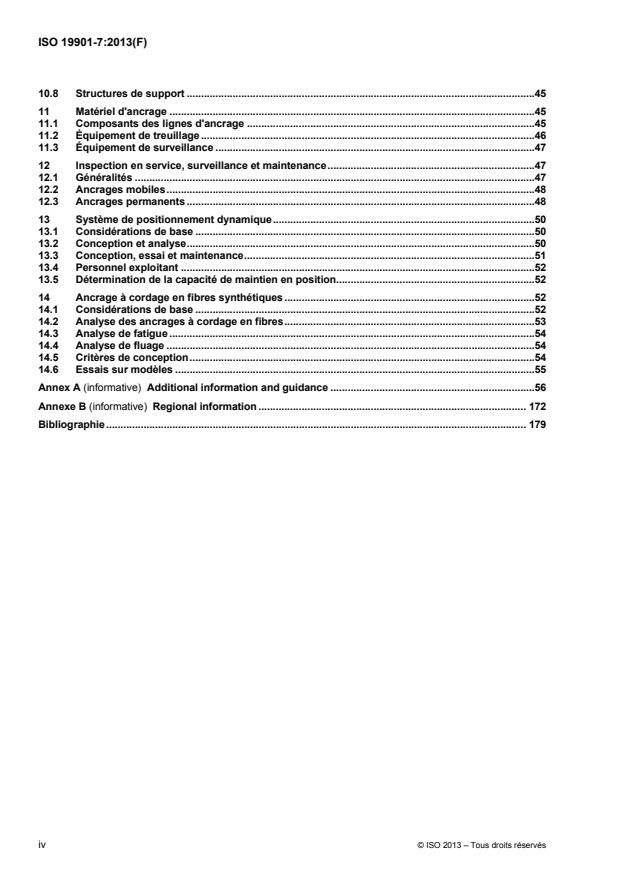
Sommaire Page
Avant-propos . v
Introduction . vii
1 Domaine d'application . 1
2 Références normatives . 2
3 Termes et définitions . 2
4 Symboles et abréviations . 7
4.1 Symboles . 7
4.2 Abréviations . 8
5 Considérations générales . 9
5.1 Exigences fonctionnelles . 9
5.2 Exigences de sécurité . 9
5.3 Exigences de planification . 10
5.4 Exigences d'inspection et de maintenance . 10
5.5 Outils analytiques . 10
6 Exigences de conception . 11
6.1 Niveaux d'exposition . 11
6.2 États limites . 11
6.3 Définition des situations conceptuelles . 12
6.4 Situations conceptuelles . 12
7 Actions. 14
7.1 Généralités . 14
7.2 Exigences relatives aux données spécifiques au site . 15
7.3 Actions environnementales sur les lignes d'ancrage . 16
7.4 Actions indirectes . 17
8 Analyse des ancrages . 19
8.1 Considérations de base . 19
8.2 Déport de la structure flottante . 20
8.3 Réponse de la structure flottante . 21
8.4 Réponse des lignes d'ancrage . 27
8.5 Tension des lignes . 28
8.6 Contraintes de longueur et de géométrie des lignes . 28
8.7 Forces des ancres . 29
8.8 Analyse et évaluation de la configuration caractéristique des ancrages . 29
8.9 Ancrages assistés par des propulseurs . 30
8.10 Analyse des mouvements transitoires de la structure flottante . 31
9 Analyse de fatigue . 32
9.1 Considérations de base . 32
9.2 Résistance à la fatigue . 33
9.3 Procédure d'analyse de fatigue . 35
10 Critères de conception . 40
10.1 Déport de la structure flottante . 40
10.2 Limite de tension de ligne . 40
10.3 Longueur de ligne enfouie . 41
10.4 Systèmes d'ancrage . 41
10.5 Coefficient de sécurité en fatigue . 44
10.6 Corrosion et usure . 44
10.7 Espacements . 45
10.8 Structures de support .45
11 Matériel d'ancrage .45
11.1 Composants des lignes d'ancrage .45
11.2 Équipement de treuillage .46
11.3 Équipement de surveillance .47
12 Inspection en service, surveillance et maintenance .47
12.1 Généralités .47
12.2 Ancrages mobiles .48
12.3 Ancrages permanents .48
13 Système de positionnement dynamique .50
13.1 Considérations de base .50
13.2 Conception et analyse .50
13.3 Conception, essai et maintenance .51
13.4 Personnel exploitant .52
13.5 Détermination de la capacité de maintien en position.52
14 Ancrage à cordage en fibres synthétiques .52
14.1 Considérations de base .52
14.2 Analyse des ancrages à cordage en fibres .53
14.3 Analyse de fatigue .54
14.4 Analyse de fluage .54
14.5 Critères de conception .54
14.6 Essais sur modèles .55
Annex A (informative) Additional information and guidance .56
Annexe B (informative) Regional information . 172
Bibliographie . 179
iv © ISO 2013 – Tous droits réservés
Avant-propos
L'ISO (Organisation internationale de normalisation) est une fédération mondiale d'organismes nationaux de
normalisation (comités membres de l'ISO). L'élaboration des Normes internationales est en général confiée
aux comités techniques de l'ISO. Chaque comité membre intéressé par une étude a le droit de faire partie du
comité technique créé à cet effet. Les organisations internationales, gouvernementales et non
gouvernementales, en liaison avec l'ISO participent également aux travaux. L'ISO collabore étroitement avec
la Commission électrotechnique internationale (CEI) en ce qui concerne la normalisation électrotechnique.
Les Normes internationales sont rédigées conformément aux règles données dans les Directives ISO/CEI,
Partie 2.
La tâche principale des comités techniques est d'élaborer les Normes internationales. Les projets de Normes
internationales adoptés par les comités techniques sont soumis aux comités membres pour vote. Leur
publication comme Normes internationales requiert l'approbation de 75 % au moins des comités membres
votants.
L'attention est appelée sur le fait que certains des éléments du présent document peuvent faire l'objet de
droits de propriété intellectuelle ou de droits analogues. L'ISO ne saurait être tenue pour responsable de ne
pas avoir identifié de tels droits de propriété et averti de leur existence.
L'ISO 19901-7 a été élaborée par le comité technique ISO/TC 67, Matériel, équipement et structures en mer
pour les industries pétrolière, pétrochimique et du gaz naturel, sous-comité SC 7, Structures en mer.
Cette deuxième édition annule et remplace la première édition (ISO 19901-7:2005), qui a fait l'objet d'une
révision technique.
Cette deuxième édition de l’ISO 19901-7 comprend plusieurs modifications et ajouts importants, apportés
principalement à l'Annexe A (informative). La modification la plus importante porte sur l'ajout d'un texte
informatif détaillé pris directement dans l'API RP 2SK concernant tous les types de systèmes d'ancrage. Dans
la première édition de la présente Norme internationale, ce document n'était précédemment mentionné que
par référence à l'API RP 2SK. Un texte informatif, pris dans l'API RP 2SK, a été également ajouté pour fournir
des détails sur l'analyse de l'atténuation des mouvements induits par les vortex des coques cylindriques de
grandes dimensions. En conséquence, le texte normatif a été modifié pour supprimer la référence à
l'API RP 2SK et pour établir des renvois à des parties de l'annexe informative étendue.
La seule autre modification porte sur la mise à jour du guide relatif à la conception de l'ancrage des cordages
en polyester afin d'assurer la conformité aux dispositions du récent amendement apporté à l'API RP 2SM. Les
modifications comprennent de nouvelles définitions de rigidité, la prise en compte des barrières filtrantes
effectives, la suppression des dispositions interdisant le contact des cordages avec le fond marin, et des
informations plus détaillées sur les exigences de tensions minimales, entre autres. Par ailleurs, des
corrections mineures ont été apportées au texte du paragraphe 7.4.4, intitulé «Actions induites par le vent», et
au paragraphe 8.3.4, intitulé «Considérations liées au tubes prolongateurs», et la mention «maximal(e) le (la)
plus probable» a été normalisée partout dans le texte. Enfin, l’article norvégien dans l’Annexe B a été mis à
jour à la demande de la Norvège et un nouvel article canadien a été ajouté.
L'ISO 19901 comprend les parties suivantes, présentées sous le titre général Industries du pétrole et du gaz
naturel — Exigences spécifiques relatives aux structures en mer:
Partie 1: Dispositions océano-météorologiques pour la conception et l'exploitation
Partie 2: Procédures de conception et critères sismiques
Partie 3: Superstructures
Partie 4: Bases conceptuelles des fondations
Partie 5: Contrôles des poids durant la conception et la fabrication
Partie 6: Opérations marines
Partie 7: Systèmes de maintien en position des structures en mer flottantes et des unités mobiles en mer
Les parties suivantes sont en cours de préparation:
Partie 8: Investigations des sols en mer
L'ISO 19901 fait partie d'une série de Normes internationales sur les structures en mer. La série comprend les
Normes internationales suivantes:
ISO 19900, Industries du pétrole et du gaz naturel — Exigences générales pour les structures en mer
ISO 19901 (toutes les parties), Industries du pétrole et du gaz naturel — Exigences spécifiques relatives
aux structures en mer
ISO 19902, Industries du pétrole et du gaz naturel — Structures en mer fixes en acier
ISO 19903, Industries du pétrole et du gaz naturel — Structures en mer fixes en béton
ISO 19904-1, Industries du pétrole et du gaz naturel — Structures en mer flottantes — Partie 1: Unités
monocoques, semi-submersibles et unités spars
ISO 19905-1, Industries du pétrole et du gaz naturel — Évaluation liée au site des unités marines
mobiles — Partie 1: Plates-formes auto-élévatrices
ISO/TR 19905-2, Industries du pétrole et du gaz naturel — Évaluation spécifique au site d'unités mobiles
en mer — Partie 2: Compléments sur les plates-formes auto-élévatrices
ISO 19905-3, Industries du pétrole et du gaz naturel — Évaluation liée au site des unités marines —
1)
Partie 3: Structures en mer flottantes
ISO 19906, Industries du pétrole et du gaz naturel — Structures arctiques en mer
1) En préparation.
vi © ISO 2013 – Tous droits réservés
Introduction
La série de Normes internationales applicables aux types de structures en mer, de l'ISO 19900 à l'ISO 19906,
constitue une base commune couvrant les aspects traitant des exigences de conception et de l'évaluation de
l'ensemble des structures en mer utilisées par les industries du pétrole, de la pétrochimie et du gaz naturel
dans le monde entier. Par leur application, l'objectif est d'obtenir des niveaux de fiabilité adaptés aux
structures en mer habitées et non habitées, quels que soient le type de structure et la nature ou la
combinaison de matériaux utilisés.
Il est important d'admettre que l'intégrité structurelle représente un concept global comprenant des modèles
de description d'actions, des analyses structurelles, des règles de conception, des éléments de sécurité, la
réalisation, des procédures de contrôle qualité et des exigences nationales qui sont interdépendants. La
modification isolée d'un aspect de conception peut perturber l'équilibre de fiabilité inhérent au concept global
ou au système structurel. Par conséquent, les implications des modifications doivent être considérées par
rapport à la fiabilité globale de l'ensemble des systèmes de structures en mer.
La série de Normes internationales applicables aux types de structures en mer a pour objectif de donner toute
latitude en ce qui concerne le choix des configurations structurelles, des matériaux et des techniques sans
entraver l'innovation. L'utilisation de ces Normes internationales nécessite donc une bonne appréciation en
matière d'ingénierie.
La présente partie de l'ISO 19901 a été élaborée en réponse à la demande exprimée par l'industrie offshore
mondiale d'une définition cohérente et pertinente des méthodologies d'analyse, de conception et d'évaluation
des systèmes de maintien en position utilisés pour les plates-formes de production et/ou de stockage
flottantes de différents types (par exemple les unités semi-submersibles, les plates-formes spars, les
structures en forme de navires), ainsi que des méthodologies d'appréciation des applications spécifiques au
site des unités mobiles en mer (telles que les unités mobiles de forage en mer, les unités de pose de pipelines
et les unités de construction).
Le terme générique «maintien en position» couvre les systèmes destinés à maintenir une structure flottante,
constamment soumise à l'influence d'actions externes, dans une position et/ou à un cap prédéfini avec des
excursions limitées. Les systèmes de maintien en position résistent aux actions externes par une
combinaison:
de systèmes d'ancrage (ancrages étalés ou en un seul point, par exemple);
de systèmes de positionnement dynamique (généralement constitués de propulseurs).
Les actions externes comprennent généralement les actions du vent, des vagues, des courants et de la glace
sur la structure flottante, le système d'ancrage et/ou les tubes prolongateurs.
L'Annexe A (informative) fournit un contexte et des lignes directrices pour l'utilisation de la présente partie de
l'ISO 19901. La numérotation des paragraphes de l'Annexe A est identique à celle du texte normatif afin de
faciliter le repérage.
L'Annexe B (informative) livre des informations régionales, le cas échéant.
NORME INTERNATIONALE ISO 19901-7:2013(F)
Industries du pétrole et du gaz naturel — Exigences spécifiques
relatives aux structures en mer —
Partie 7:
Systèmes de maintien en position des structures en mer
flottantes et des unités mobiles en mer
1 Domaine d'application
La présente partie de l'ISO 19901 spécifie des méthodologies pour:
a) la conception, l'analyse et l'évaluation des systèmes de maintien en position des structures flottantes que
les industries du pétrole et du gaz utilisent pour
1) la production,
2) le stockage,
3) le forage, l'intervention sur un puits et la production,
4) la production et le stockage,
5) le forage, l'intervention sur un puits et la production et le stockage, et
b) l'évaluation des systèmes de maintien en position pour les applications spécifiques au site des unités
mobiles en mer (unités mobiles de forage en mer, unités de construction et unités de pose de pipelines,
par exemple).
La plupart des systèmes de maintien en position utilisés avec la classe de structures flottantes couverte par a)
sont appelés «systèmes d'ancrage permanents», pour lesquels la présente partie de l'ISO 19901 est
applicable à tous les aspects du cycle de vie et inclut des exigences relatives à la fabrication des composants
d'ancrage, ainsi que des considérations liées aux inspections en service. La plupart des systèmes de maintien
en position utilisés avec la classe d'unités mobiles en mer couverte par b) sont appelés «systèmes d'ancrage
mobiles». Tout au long de la présente partie de l’ISO 19901, le terme «structure flottante», parfois raccourci
en «structure», sert de terme générique pour désigner un élément quelconque des deux classes a) et b).
La présente partie de l'ISO 19901 est applicable aux types de systèmes suivants de maintien en position qui
sont couverts soit directement dans de la présente partie de l’ISO 19901, soit par référence à d'autres lignes
directrices:
ancrages étalés (ancrages caténaires, tendus et semi-tendus);
ancrages en un seul point, ancrés par des systèmes d'ancrage étalés;
systèmes de positionnement dynamique;
ancrages assistés par des propulseurs.
L'Annexe A décrit les caractéristiques et les composants classiques de ces systèmes.
Les exigences de la présente partie de l'ISO 19901 concernent principalement les systèmes d'ancrage étalés
et en un seul point dont les lignes d'ancrage sont composées de chaînes et de câbles en acier. La présente
partie de l’ISO 19901 fournit également des lignes directrices pour l'application de la méthodologie aux
systèmes d'ancrage à cordage en fibres synthétiques, ainsi que des exigences supplémentaires liées aux
propriétés spécifiques de ces cordages en fibres synthétiques.
La présente partie de l’ISO 19901 s'applique aux ancrages sur point unique avec une seule tige d'ancre
(SALM) et aux autres systèmes d'ancrage en un seul point (systèmes d'ancrage souple pour tours fixes, par
exemple), uniquement dans la mesure où les exigences sont pertinentes pour ces systèmes.
Les exigences de la présente partie de l’ISO 19901 ne s'appliquent pas aux ancrages verticaux des plates-
formes à ancrage tendu (TLP).
La méthodologie décrite dans la présente partie de l'ISO 19901 identifie un ensemble d'outils d'analyse
cohérents qui, combinés avec la compréhension des conditions océano-météorologiques spécifiques au site,
les caractéristiques de la structure flottante en question et d'autres facteurs, peut servir à déterminer l'aptitude
du système de maintien en position à satisfaire aux exigences fonctionnelles de la présente partie de
l’ISO 19901.
NOTE Pour les ancrages déployés dans des environnements sujets au gel, des exigences supplémentaires sont
données dans l'ISO 19906.
2 Références normatives
Les documents de référence suivants sont indispensables pour l’application du présent document. Pour les
références datées, seule l’édition citée s’applique. Pour les références non datées, la dernière édition du
document de référence s’applique (y compris les éventuels amendements).
ISO 19900, Industries du pétrole et du gaz naturel — Exigences générales pour les structures en mer
ISO 19901-1, Industries du pétrole et du gaz naturel — Exigences spécifiques relatives aux structures en
mer — Partie 1: Dispositions océano-météorologiques pour la conception et l'exploitation
ISO 19904-1, Industries du pétrole et du gaz naturel — Structures en mer flottantes — Partie 1: Unités
monocoques, unités semi-submersibles et unités spars
3 Termes et définitions
Pour les besoins du présent document, les termes et définitions suivants s'appliquent.
3.1
action
charge extérieure appliquée à la structure (action directe), ou déformation ou accélération imposée (action
indirecte)
EXEMPLE Une déformation imposée peut être causée par des tolérances de fabrication, un tassement, ou des
variations de température ou d'humidité.
NOTE Un tremblement de terre induit généralement des accélérations imposées.
[ISO 19900:2002]
3.2
effet d'une action
effet d'actions exercées sur des éléments de structure
[ISO 19900:2002]
EXEMPLE Forces internes, moments, contraintes, déformations, mouvements de corps rigides ou déformations
élastiques.
2 © ISO 2013 – Tous droits réservés
3.3
ancrage caténaire
système d'ancrage qui fait intervenir le poids des lignes d'ancrage pour équilibrer les actions
[ISO 19900:2002]
3.4
valeur caractéristique
valeur donnée à une variable de base, une action ou une résistance à partir de laquelle la valeur conceptuelle
peut être déterminée en appliquant un coefficient partiel
NOTE 1 Cette valeur a généralement une probabilité prédéfinie de ne pas être enfreinte qui, dans le cas d'une action,
se rapportera normalement à une période de référence.
NOTE 2 Adapté de l'ISO 19900:2002, définition 2.7.
3.5
critères de conception
formulations quantitatives servant à décrire les conditions à remplir pour chaque état limite
[ISO 19900:2002]
3.6
durée de vie en service
période présumée pendant laquelle une plate-forme ou un élément de structure doit être utilisé, sous
condition de maintenance mais sans que des réparations substantielles soient nécessaires
NOTE Adapté de l'ISO 19900:2002, définition 2.12.
3.7
situation conceptuelle
ensemble de conditions physiques pendant une certaine période de référence, pour lequel le concept doit
apporter la preuve que les états limites retenus ne sont pas dépassés
NOTE Adapté de l'ISO 19900:2002, définition 2.13.
3.8
action dynamique
action induisant l'accélération d'une structure ou d'un élément de structure d'une amplitude suffisante pour
nécessiter une considération spécifique
3.9
positionnement dynamique
DP
technique de maintien de la position consistant principalement en un système de propulseurs embarqués à
commande automatique, qui génèrent des vecteurs de poussée appropriés pour contrer les actions induites
moyennes et variant lentement
3.10
valeur attendue
moment statistique de premier ordre de la fonction de densité de probabilité pour la variable considérée qui,
dans le cas d'un paramètre dépendant du temps, peut être associé à une période de référence spécifique
3.11
apte à l'usage
aptitude à l'usage
condition d'une structure conforme à une Norme internationale sans pour autant en respecter toutes les
dispositions pour ce qui est de certaines zones localisées, de sorte qu'une défaillance dans ces zones
n'entraînera pas de risques inacceptables présentant un danger pour les personnes ou pour l'environnement
[ISO 19900:2002]
3.12
structure flottante
structure dont la masse est supportée en totalité par la poussée hydrostatique
[ISO 19900:2002]
NOTE La masse totale comprend la masse à vide, la pré-tension du système d'ancrage, la pré-tension du tube
prolongateur, la masse en exploitation, etc.
3.13
état limite
état au-delà duquel la structure ne remplit plus les critères de conception retenus
[ISO 19900:2002]
3.14
maintenance
ensemble des activités réalisées pendant la durée d'exploitation d'une structure afin d'en garantir l'aptitude à
l'usage
3.15
résistance minimale à la rupture
MBS
résistance d'une chaîne, d'un câble métallique, d'un cordage en fibres ou d'accessoires, certifiée par une RCS
3.16
système d'ancrage mobile
système d'ancrage, généralement récupérable, destiné au déploiement à un emplacement spécifique pour
une exploitation à court terme, telle que pour les unités mobiles en mer (MOU)
3.17
unité mobile de forage en mer
MODU
structure capable de s'engager dans des opérations de forage et d'intervention sur un puits en vue de
l'exploration ou de l'exploitation de ressources pétrolières sous-marines
3.18
unité mobile en mer
MOU
structure destinée à être fréquemment déplacée pour remplir une tâche déterminée
[ISO 19900:2002]
EXEMPLE Navire ou barge de pose, structure de construction en mer, structure habitable (hôtel flottant), structure
de service ou unités mobiles de forage en mer.
3.19
composants d'ancrage
classe générale de composants utilisés pour l'ancrage des structures flottantes
EXEMPLE Chaîne, câble métallique, cordage en fibres synthétiques, crapaud, bouée, treuil/guindeau, chaumard ou
ancre.
3.20
propriétaire
représentant de la société ou des sociétés qui possèdent un droit de développement, et qui peuvent être le
(les) opérateur(s) agissant pour le compte des co-licenciés
4 © ISO 2013 – Tous droits réservés
3.21
système d'ancrage permanent
système d'ancrage normalement utilisé pour ancrer les structures flottantes déployées pour l'exploitation à
long terme, telle que pour un système de production flottant (FPS)
3.22
proximité
voisinage immédiat
NOTE 1 Les systèmes d'ancrage sont considérés comme étant à proximité d'une installation si une partie de l'autre
installation se situe dans un contour décrit par l'ensemble des déports coïncidant avec chaque ligne atteignant 100 % de
la MBS pour la condition intacte ou de contrôle par redondance, la plus grande des deux valeurs étant retenue.
NOTE 2 Les systèmes d'ancrage sont considérés comme étant à proximité d'une installation sur le fond marin si une
partie de l'autre installation se situe dans un polygone formé par les positions des ancres.
3.23
société de classification reconnue
RCS
membre de l'Association internationale des sociétés de classification (IACS) ayant une compétence et une
expérience reconnues et appropriées dans les structures flottantes, et ayant des règles et des procédures
établies relatives à la classification/certification des installations utilisées dans les activités pétrolières
3.24
résistance
capacité d'une structure, d'un élément ou d'une section transversale d'un élément, à supporter les effets d'une
action sans dépasser un état limite
NOTE Cette définition est une variante de celle spécifiée dans l'ISO 19900:2002.
3.25
période de retour
période moyenne entre les apparitions d'un événement ou d'une valeur particulière dépassée
NOTE L'industrie offshore utilise généralement une période de retour mesurée en années pour les événements
environnementaux. La période de retour est égale à l'inverse de la probabilité annuelle pour que l'événement soit dépassé.
[ISO 19901-1:2005]
3.26
tube prolongateur
canalisation reliant les installations de traitement ou les équipements de forage de la structure flottante, aux
installations sous-marines ou aux pipelines, ou à un réservoir
NOTE 1 Les fonctions possibles comprennent le forage et l'intervention sur un puits, la production, l'injection, la
commande des systèmes sous-marins et l'exportation des fluides produits.
NOTE 2 Adapté de l'ISO 19900:2002, définition 2.29.
3.27
semi-submersible
structure flottante normalement constituée d'une structure de pont ayant un certain nombre de colonnes de
support largement espacées, à grande section transversale, connectées à des pontons immergés
NOTE La géométrie des pontons/colonnes est habituellement choisie pour minimiser les mouvements globaux dans
une vaste plage de fréquences de vagues.
3.28
aptitude au service
aptitude d'une structure ou d'un élément de structure à se comporter de manière satisfaisante dans des
conditions d'utilisation normales
3.29
valeur significative
mesure statistique d'une variable aléatoire de moyenne nulle égale au double de l'écart-type de la variable
3.30
ancrage en un seul point
système d'ancrage permettant à la structure flottante à laquelle il est raccordé de faire varier son cap (évitage)
EXEMPLE Un exemple d'ancrage en un seul point est un système d'ancrage à tourelle où un certain nombre de
lignes sont attachées à une tourelle comprenant des paliers qui permettent la rotation de la structure.
3.31
structure en forme de navire
structure flottante monocoque présentant une géométrie similaire à celle des navires de haute mer
3.32
plate-forme spar
structure flottante à petite surface de flottaison et à grand tirant d'eau
3.33
ancrage étalé
système d'ancrage constitué de multiples lignes d'ancrage aboutissant à différents emplacements d'une
structure flottante et se prolongeant vers l'extérieur, donnant un cap pratiquement constant à la structure
3.34
système de maintien en position
système capable de limiter les excursions d'une structure flottante dans des limites prescrites
3.35
élément de structure
partie de la structure qui peut s'identifier physiquement
[ISO 19900:2002]
3.36
structure
assemblage d'éléments connectés entre eux de manière à supporter des actions en apportant une rigidité
suffisante à l'ensemble
[ISO 19900:2002]
3.37
ancrage tendu
système d'ancrage pour lequel la force de rappel est fournie par la déformation élastique des lignes d'ancrage
[ISO 19900:2002]
3.38
ancrage assisté par des propulseurs
système de maintien en position constitué de lignes d'ancrage et de propulseurs
6 © ISO 2013 – Tous droits réservés
3.39
vérification
examen effectué pour confirmer qu'une activité, un produit ou un service est conforme aux exigences
spécifiées
3.40
évitage
processus par lequel une structure flottante change de cap de manière passive, en réponse à des actions
environnementales qui varient dans le temps
4 Symboles et abréviations
4.1 Symboles
C Coefficient (sans dimension, sauf spécification contraire)
–1
D Endommagement annuel dû à la fatigue, en années
d Diamètre de la ligne ou de l'élément d'ancrage, en mètres (m)
F Action directe, en newtons (N), ou action directe par unité de longueur, en newtons par mètre (N/m)
f Fréquence, en hertz (Hz)
K Constante de fatigue (sans dimension, sauf spécification contraire)
k Rigidité axiale, en newtons par mètre (N/m)
L Durée de vie en service, en années
l Longueur, en mètres (m)
M Masse, en kilogrammes (kg)
m Pente inverse des courbes de fatigue T-N ou S-N
N Nombre total de cycles (admissibles)
n Nombre de cycles par an, 1 par an
P Probabilité d'occurrence
S Déport ou déplacement, en mètres (m)
S Plage de contraintes, en mégapascals (MPa)
R
s Écart-type
T Force de tension, en newtons (N), ou taux de tension sans dimension
t Temps, période ou durée, en secondes (s)
v Vitesse, en mètres par seconde (m/s)
W Poids immergé, en newtons (N), ou poids par unité de longueur, en newtons par mètre (N/m)
Fonction gamma
Coefficient de sécurité pour la conception
Paramètre de largeur de bande pour la fréquence des vagues
Allongement annuel au fluage, en pourcentage par an
Rapport entre l'écart-type des variations de tension autour de la tension moyenne et une résistance
de référence à la rupture
Masse volumique, en kilogrammes par mètre cube (kg/m )
4.2 Abréviations
ALS État limite accidentel
CALM Ancrage à câble d'ancre en forme de courbe de chaînette
DP Positionnement dynamique
FEA Analyse par la méthode des éléments finis
FLS État limite de fatigue
FMEA Analyse des modes de défaillance et de leurs effets
FPS Système de production flottant
FPSO Structure de production, de stockage et de déchargement flottante
FSO Structure de stockage et de déchargement flottante
HMPE Polyéthylène à module élevé
IACS Association internationale des sociétés de classification
IMCA Association internationale des entrepreneurs en milieu sous-marin
IMO Organisation maritime internationale
LTM Ancrage à long terme
MBS Résistance minimale à la rupture
MDS États conceptuels des ancrages
MODU Unité mobile de forage en mer
MOU Unité mobile en mer
ORQ Qualité d'une plate-forme pétrolière
RAO Opérateur à amplitude de réponse
RCS Société de classification reconnue
ROV Véhicule commandé à distance
SALM Ancrage sur point unique avec une seule tige
SAW Soudage à l'arc sous flux en poudre
SIM Gestion de l'intégrité structurelle
8 © ISO 2013 – Tous droits réservés
SLS État limite d'aptitude au service
TAM Ancrage assisté par des propulseurs
TLP Plate-forme à ancrage tendu
ULS État limite ultime
VIM Mouvements induits par des vortex
VIV Vibrations induites par des vortex
5 Considérations générales
5.1 Exigences fonctionnelles
Un système de maintien en position a pour fonction de restreindre l'excursion horizontale d'une structure
flottante dans des limites prescrites, ainsi que de fournir des moyens de commande directionnelle active ou
passive lorsque l'orientation de la structure est importante du point de vue de la sécurité ou de l'exploitation.
Les critères de limitation des excursions et de l'orientation sont généralement fixés par le propriétaire de la
structure flottante ou par déduction directe à partir des exigences de conception, y compris celles liées à:
la sécurité du personnel,
la protection de l'environnement,
la stabilité et l'aptitude au service de la structure flottante,
l'aptitude au service des équipements des superstructures,
l'intégrité et l'aptitude au service des tubes de forage, de production, d'exportation ou d'autres types de
tubes prolongateurs,
l'accès et les espacements par rapport aux installations de surface ou sous-marines voisines, et
toute autre exigence spéciale relative au positionnement.
La conformité de la conception du système de maintien en position par rapport aux exigences exposées
ci-dessus doit être établie en utilisant les méthodologies d'analyse indiquées aux Articles 8 et 9, ainsi que les
critères de conception spécifiés à l'Article 10. Les effets des actions externes sur la structure flottante, telles
que les tensions exercées sur les lignes, les déports de structure et les forces des ancres, doivent être
évalués pour toutes les situations conceptuelles pertinentes et doivent être comparés aux résistances du
système et des composants pour s'assurer de l'existence de résistances de réserve contre la rupture des
lignes d'ancrage, le dépassement du déport, le glissement des ancres ou d'autres phénomènes indésirables.
5.2 Exigences de sécurité
La sécurité des personnes et la sauvegarde de l'environnement et des biens doivent être les principaux
principes à respecter en permanence par:
la conception ou l'évaluation pertinente, qui garantit la capacité de la structure flottante et de son système
de maintien en position à résister aux actions environnementales ou à d'autres actions externes
susceptibles de se produire au cours de la durée de vie en service de la structure et du système de
maintien en position, ou pendant la durée du déploiement d'une MOU spécifique au site,
la définition de procédures d'exploitation sûres qui identifient et minimisent les risques de blessure du
personnel,
l'identification et l'évaluation des éventuels événements accidentels, tel que résumé dans l'ISO 19900, et
la minimisation de leurs conséquences,
la réalisation d'une évaluation des risques pour s'assurer que d'éventuels dysfonctionnements ne créent
pas un danger pour la vie des personnes ou l'intégrité de la structure, et
la conformité à toutes les réglementations pertinentes (voir l’ISO 19904-1).
Les implications des points qui précèdent doivent être incorporées dans la conception ou l'évaluation du
système de maintien en position, ainsi que dans l'élaboration de la philosophie d'exploitation.
5.3 Exigences de planification
La planification doit être effectuée avant le début de la conception ou de l'évaluation effective afin de s'assurer
que le système de maintien en position est capable de remplir sa fonction prévue conformément en 5.1. La
planification initiale doit inclure la détermination de l'ensemble des conditions et critères, conformément aux
exigences générales et aux conditions spécifiées dans l'ISO 19900.
5.4 Exigences d'inspection et de maintenance
L'intégrité d'un système de maintien en position et son aptitude au service tout au long de la durée de vie en
service dépendent non seulement fortement de la pertinence de la conception, mais également de la maîtrise
de la qualité exercée lors de la fabrication, de la supervision sur site, de la manutention lors du transport et de
l'installation, et de la manière dont le système est utilisé et entretenu.
Lors de la phase de planification, une philosophie d'inspection et de maintenance doit être élaborée et
documentée afin de garantir une totale cohérence avec la conception du système de maintien en position et
de ses composants. Une évaluation critique doit être réalisée sur la capacité à atteindre réellement les
objectifs prévus par le biais des efforts d'inspection et de maintenance. L'Article 12 spécifie les exigences
pertinentes en matière d'inspection et de maintenance.
5.5 Outils analytiques
La plupart des procédures analytiques et des calculs décrits, spécifiés et référencés dans la présente partie
de l'ISO 19901 sont généralement exécutés à l'aide d'outils d'ingénierie assistée par ordinateur. Un grand
nombre de ces outils sont des logiciels très répandus et disponibles dans le commerce qui, dès lors qu'ils sont
employés par des utilisateurs expérimentés et correctement formés, peuvent être considérés comme des
normes industrielles de facto. Pour ces systèmes logiciels, l'auteur d'origine est supposé avoir effectué les
validations et vérifications appropriées, et être en mesure d'en apporter la preuve.
Dans d'autres cas, notamment dans les domaines technologiques en rapide évolution, des approches et des
techniques analytiques innovantes sont souvent employées dans les solutions logicielles propriétaires
d'origine. Dans ces cas, le développeur est supposé valider l'adéquation des résultats, par exemple par
comparaison avec des données d'essai ou des mesures sur le terrain.
Dans tous les cas, le concepteur doit prod
...