

ISO 14135-2:2021
(Main)Optics and photonics — Specifications for telescopic sights — Part 2: High-performance instruments
General Information
- Abstract
This document applies to high-performance telescopic sights, used on hand-held firearms and airguns. It contains a classification of the usage of telescopic sights and specifies interfaces, minimum requirements and tolerances to their performances. General-purpose telescopic sights are specified in ISO 14135-1.
- Status
- Published
- Publication Date
- 10-Feb-2021
- Technical Committee
- ISO/TC 172/SC 4 - Telescopic systems
- Drafting Committee
- ISO/TC 172/SC 4/WG 2 - Telescopic devices
- Current Stage
- 9092 - International Standard to be revised
- Start Date
- 14-Apr-2025
- Completion Date
- 29-Aug-2026
Buy Documents


ISO 14135-2:2021 - Optics and photonics -- Specifications for telescopic sights
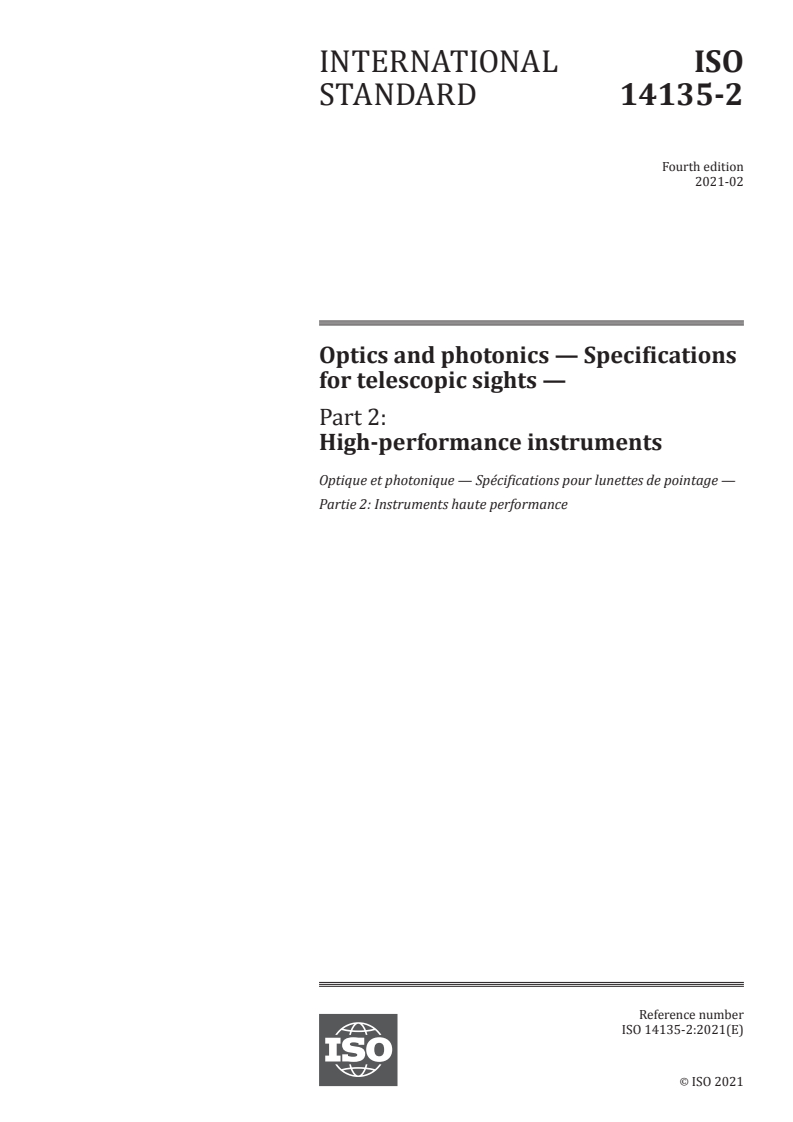
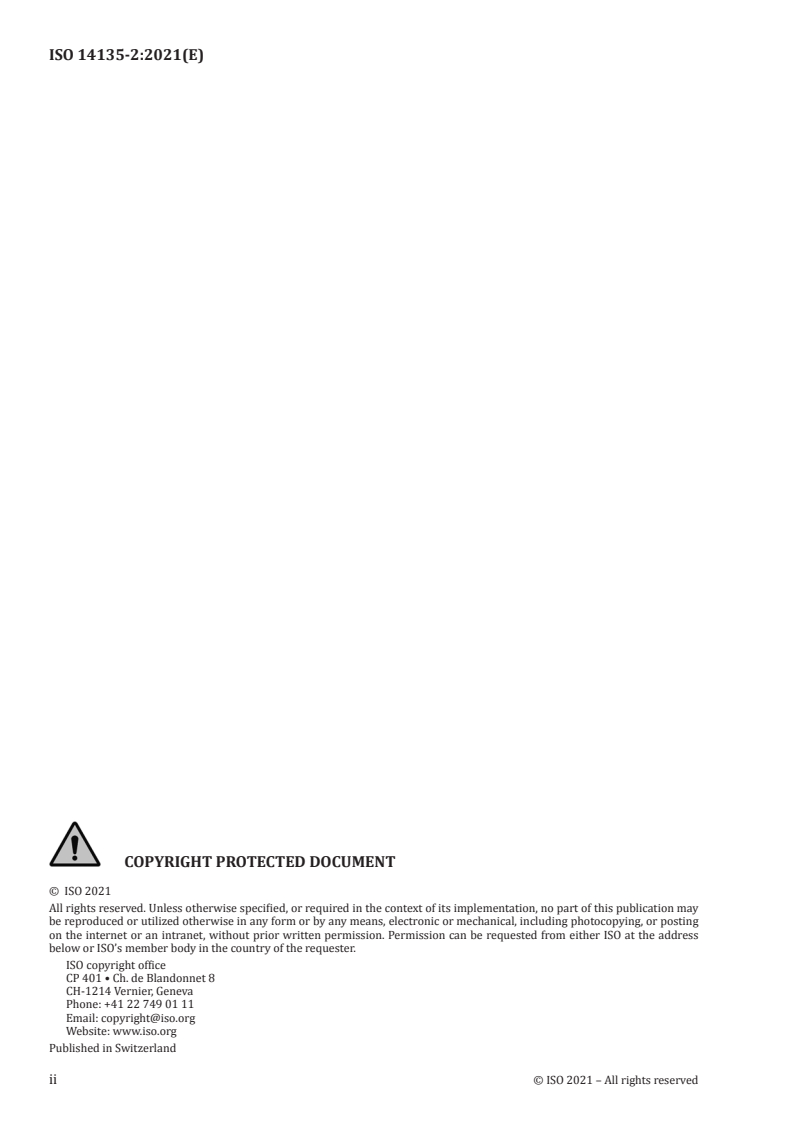
ISO 14135-2:2021 - Optics and photonics — Specifications for telescopic sights — Part 2: High-performance instruments/11/2021
Overview
ISO 14135-2:2021 is an international standard from ISO that defines specifications for high-performance telescopic sights used on hand-held firearms and airguns. As Part 2 of the ISO 14135 series, this standard covers the classification, performance requirements, interfaces, and tolerances for advanced telescopic sights, distinguishing them from general-purpose models covered in ISO 14135-1. It is essential for manufacturers, testing labs, and regulatory bodies to ensure product performance, safety, and compliance in the optics and photonics sector, particularly in precision shooting applications.
Key Topics
Classification of Telescopic Sights
- Divides telescopic sights based on their intended use: airguns, pistols, and rifles.
- High-performance scopes are differentiated by stricter requirements in performance and construction.
Performance Requirements & Tolerances
- Specifies minimum acceptable values and tolerances for essential characteristics such as:
- Eye relief
- Resolution
- Diopter adjustment range
- Reticle adjustment and tracking
- Magnification consistency and field of view
- Outlines acceptable deviation limits to ensure reliable performance.
- Specifies minimum acceptable values and tolerances for essential characteristics such as:
Interfaces and Mounting
- Defines the mechanical interfaces for mounting telescopic sights, including central and objective tube dimensions, cylindrical shapes, and dovetail configurations.
- Provides recommended interface dimensions for compatibility with various firearm and airgun platforms.
Marking and Information
- Sets required markings for identification, including magnification, manufacturer, serial numbers, and country of origin.
- Requires detailed product information in brochures or manuals, such as technical specifications, operational range, water tightness, and dimensions.
Conformity Assessment
- Details how products may be designated and marked as compliant with ISO 14135-2, ensuring global recognition of quality for high-performance instruments.
Applications
ISO 14135-2:2021 is highly relevant in the following applications:
Manufacturing of Telescopic Sights
- Guides optical and mechanical design to meet international quality standards.
- Ensures manufacturing processes align with recognized tolerances and minimum performance levels for high-performance scopes.
Testing and Quality Control
- Provides a basis for consistent testing procedures using referenced ISO test methods (e.g., ISO 14490 series).
- Supports third-party and in-house verification, ensuring products meet safety and quality benchmarks.
Procurement and Regulation
- Assists governmental and commercial buyers in specifying requirements for precision optics.
- Facilitates compliance with safety, trade, and import/export regulations for optical instruments.
Technical Documentation and Marketing
- Ensures uniform product labeling and consumer information, facilitating clear comparison and informed purchasing decisions.
Research and Development
- Lays down a framework for innovation in optics, focusing on enhancing key performance indicators such as resolution, transmission, and durability.
Related Standards
Professionals using ISO 14135-2:2021 should also consult these related ISO standards for a comprehensive approach to optics and telescopic system quality:
- ISO 14135-1: Optics and photonics - Specifications for telescopic sights - Part 1: General-purpose instruments
- ISO 14132-1 & ISO 14132-3: Vocabulary for telescopic systems and terminology for telescopic sights
- ISO 14490-1, ISO 14490-3, ISO 14490-5, ISO 14490-7: Test methods for telescopic systems, including assessment of basic characteristics, telescopic sights specifics, transmittance, and resolution limits
- ISO 20711: Environmental requirements for telescopic systems
Implementing ISO 14135-2:2021 supports high-quality, reliable, and safe telescopic sights, ensuring user confidence and adherence to global optics standards.
Relations
- Effective Date
- 23-Apr-2020
Buy Documents
ISO 14135-2:2021 - Optics and photonics -- Specifications for telescopic sights
ISO 14135-2:2021 - Optics and photonics — Specifications for telescopic sights — Part 2: High-performance instruments/11/2021
Frequently Asked Questions
ISO 14135-2:2021 is a standard published by the International Organization for Standardization (ISO). Its full title is "Optics and photonics — Specifications for telescopic sights — Part 2: High-performance instruments". This standard covers: This document applies to high-performance telescopic sights, used on hand-held firearms and airguns. It contains a classification of the usage of telescopic sights and specifies interfaces, minimum requirements and tolerances to their performances. General-purpose telescopic sights are specified in ISO 14135-1.
This document applies to high-performance telescopic sights, used on hand-held firearms and airguns. It contains a classification of the usage of telescopic sights and specifies interfaces, minimum requirements and tolerances to their performances. General-purpose telescopic sights are specified in ISO 14135-1.
ISO 14135-2:2021 is classified under the following ICS (International Classification for Standards) categories: 37.020 - Optical equipment. The ICS classification helps identify the subject area and facilitates finding related standards.
ISO 14135-2:2021 has the following relationships with other standards: It is inter standard links to ISO 14135-2:2017. Understanding these relationships helps ensure you are using the most current and applicable version of the standard.
ISO 14135-2:2021 is available in PDF format for immediate download after purchase. The document can be added to your cart and obtained through the secure checkout process. Digital delivery ensures instant access to the complete standard document.
Standards Content (Sample)
INTERNATIONAL ISO
STANDARD 14135-2
Fourth edition
2021-02
Optics and photonics — Specifications
for telescopic sights —
Part 2:
High-performance instruments
Optique et photonique — Spécifications pour lunettes de pointage —
Partie 2: Instruments haute performance
Reference number
©
ISO 2021
© ISO 2021
All rights reserved. Unless otherwise specified, or required in the context of its implementation, no part of this publication may
be reproduced or utilized otherwise in any form or by any means, electronic or mechanical, including photocopying, or posting
on the internet or an intranet, without prior written permission. Permission can be requested from either ISO at the address
below or ISO’s member body in the country of the requester.
ISO copyright office
CP 401 • Ch. de Blandonnet 8
CH-1214 Vernier, Geneva
Phone: +41 22 749 01 11
Email: copyright@iso.org
Website: www.iso.org
Published in Switzerland
ii © ISO 2021 – All rights reserved
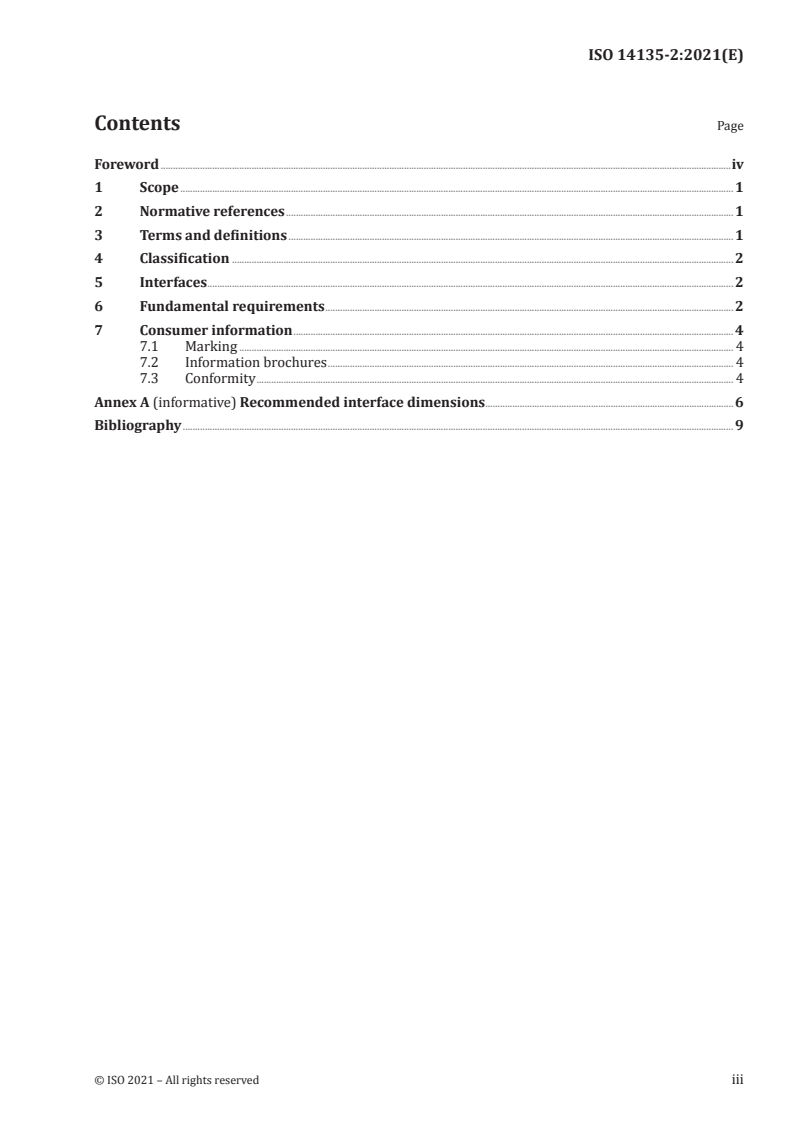
Contents Page
Foreword .iv
1 Scope . 1
2 Normative references . 1
3 Terms and definitions . 1
4 Classification . 2
5 Interfaces . 2
6 Fundamental requirements . 2
7 Consumer information . 4
7.1 Marking . 4
7.2 Information brochures . 4
7.3 Conformity . 4
Annex A (informative) Recommended interface dimensions . 6
Bibliography . 9
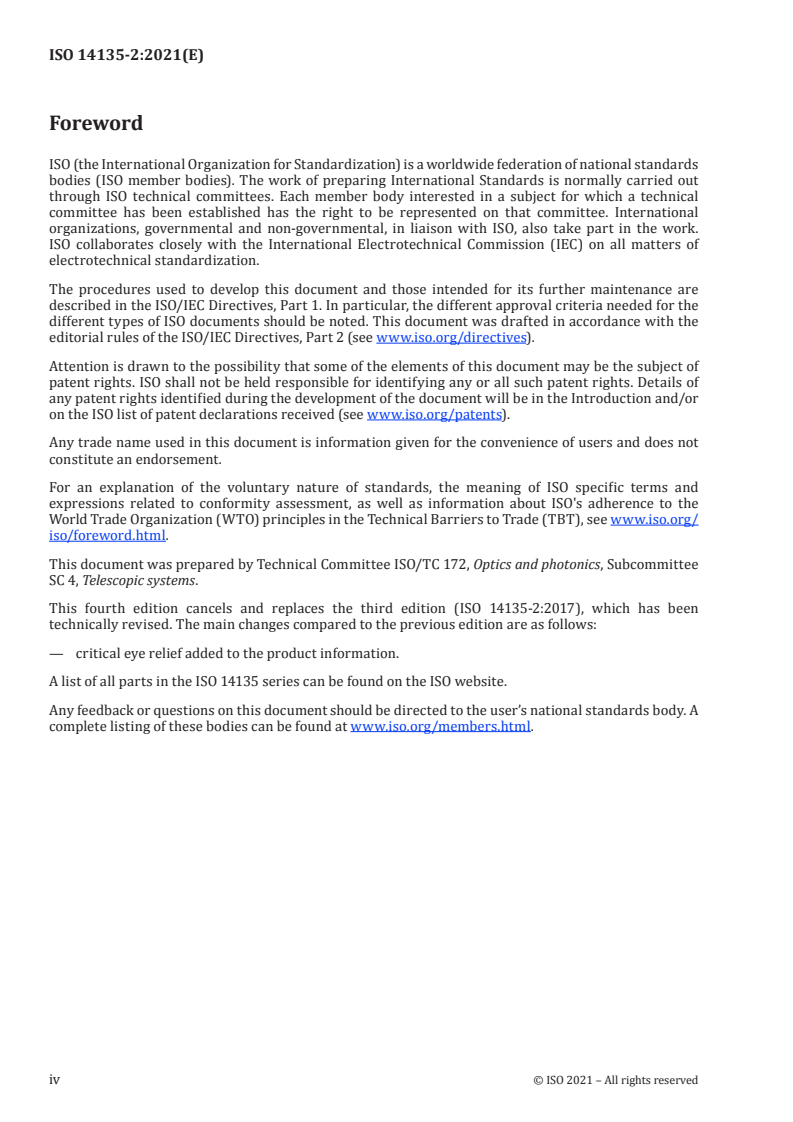
Foreword
ISO (the International Organization for Standardization) is a worldwide federation of national standards
bodies (ISO member bodies). The work of preparing International Standards is normally carried out
through ISO technical committees. Each member body interested in a subject for which a technical
committee has been established has the right to be represented on that committee. International
organizations, governmental and non-governmental, in liaison with ISO, also take part in the work.
ISO collaborates closely with the International Electrotechnical Commission (IEC) on all matters of
electrotechnical standardization.
The procedures used to develop this document and those intended for its further maintenance are
described in the ISO/IEC Directives, Part 1. In particular, the different approval criteria needed for the
different types of ISO documents should be noted. This document was drafted in accordance with the
editorial rules of the ISO/IEC Directives, Part 2 (see www .iso .org/ directives).
Attention is drawn to the possibility that some of the elements of this document may be the subject of
patent rights. ISO shall not be held responsible for identifying any or all such patent rights. Details of
any patent rights identified during the development of the document will be in the Introduction and/or
on the ISO list of patent declarations received (see www .iso .org/ patents).
Any trade name used in this document is information given for the convenience of users and does not
constitute an endorsement.
For an explanation of the voluntary nature of standards, the meaning of ISO specific terms and
expressions related to conformity assessment, as well as information about ISO's adherence to the
World Trade Organization (WTO) principles in the Technical Barriers to Trade (TBT), see www .iso .org/
iso/ foreword .html.
This document was prepared by Technical Committee ISO/TC 172, Optics and photonics, Subcommittee
SC 4, Telescopic systems.
This fourth edition cancels and replaces the third edition (ISO 14135-2:2017), which has been
technically revised. The main changes compared to the previous edition are as follows:
— critical eye relief added to the product information.
A list of all parts in the ISO 14135 series can be found on the ISO website.
Any feedback or questions on this document should be directed to the user’s national standards body. A
complete listing of these bodies can be found at www .iso .org/ members .html.
iv © ISO 2021 – All rights reserved
INTERNATIONAL STANDARD ISO 14135-2:2021(E)
Optics and photonics — Specifications for telescopic
sights —
Part 2:
High-performance instruments
1 Scope
This document applies to high-performance telescopic sights, used on hand-held firearms and
airguns. It contains a classification of the usage of telescopic sights and specifies interfaces, minimum
requirements and tolerances to their performances.
General-purpose telescopic sights are specified in ISO 14135-1.
2 Normative references
The following documents are referred to in the text in such a way that some or all of their content
constitutes requirements of this document. For dated references, only the edition cited applies. For
undated references, the latest edition of the referenced document (including any amendments) applies.
ISO 14132-1, Optics and photonics — Vocabulary for telescopic systems — Part 1: General terms and
alphabetical indexes of terms in ISO 14132
ISO 14132-3, Optics and photonics — Vocabulary for telescopic systems — Part 3: Terms for telescopic sights
ISO 14490-1, Optics and optical instruments — Test methods for telescopic systems — Part 1: Test methods
for basic characteristics
ISO 14490-3, Optics and photonics — Test methods for telescopic systems — Part 3: Test methods for
telescopic sights
ISO 14490-5, Optics and photonics — Test methods for telescopic systems — Part 5: Test methods for
transmittance
ISO 14490-7, Optics and photonics — Test methods for telescopic systems — Part 7: Test methods for limit
of resolution
ISO 20711, Optics and photonics — Environmental requirements — Test requirements for telescopic systems
3 Terms and definitions
For the purposes of this document, the terms and definitions given in ISO 14132-1 and ISO 14132-3 apply.
ISO and IEC maintain terminological databases for use in standardization at the following addresses:
— ISO Online browsin
...
INTERNATIONAL ISO
STANDARD 14135-2
Fourth edition
2021-02
Optics and photonics — Specifications
for telescopic sights —
Part 2:
High-performance instruments
Optique et photonique — Spécifications pour lunettes de pointage —
Partie 2: Instruments haute performance
Reference number
©
ISO 2021
© ISO 2021
All rights reserved. Unless otherwise specified, or required in the context of its implementation, no part of this publication may
be reproduced or utilized otherwise in any form or by any means, electronic or mechanical, including photocopying, or posting
on the internet or an intranet, without prior written permission. Permission can be requested from either ISO at the address
below or ISO’s member body in the country of the requester.
ISO copyright office
CP 401 • Ch. de Blandonnet 8
CH-1214 Vernier, Geneva
Phone: +41 22 749 01 11
Email: copyright@iso.org
Website: www.iso.org
Published in Switzerland
ii © ISO 2021 – All rights reserved
Contents Page
Foreword .iv
1 Scope . 1
2 Normative references . 1
3 Terms and definitions . 1
4 Classification . 2
5 Interfaces . 2
6 Fundamental requirements . 2
7 Consumer information . 4
7.1 Marking . 4
7.2 Information brochures . 4
7.3 Conformity . 4
Annex A (informative) Recommended interface dimensions . 6
Bibliography . 9
Foreword
ISO (the International Organization for Standardization) is a worldwide federation of national standards
bodies (ISO member bodies). The work of preparing International Standards is normally carried out
through ISO technical committees. Each member body interested in a subject for which a technical
committee has been established has the right to be represented on that committee. International
organizations, governmental and non-governmental, in liaison with ISO, also take part in the work.
ISO collaborates closely with the International Electrotechnical Commission (IEC) on all matters of
electrotechnical standardization.
The procedures used to develop this document and those intended for its further maintenance are
described in the ISO/IEC Directives, Part 1. In particular, the different approval criteria needed for the
different types of ISO documents should be noted. This document was drafted in accordance with the
editorial rules of the ISO/IEC Directives, Part 2 (see www .iso .org/ directives).
Attention is drawn to the possibility that some of the elements of this document may be the subject of
patent rights. ISO shall not be held responsible for identifying any or all such patent rights. Details of
any patent rights identified during the development of the document will be in the Introduction and/or
on the ISO list of patent declarations received (see www .iso .org/ patents).
Any trade name used in this document is information given for the convenience of users and does not
constitute an endorsement.
For an explanation of the voluntary nature of standards, the meaning of ISO specific terms and
expressions related to conformity assessment, as well as information about ISO's adherence to the
World Trade Organization (WTO) principles in the Technical Barriers to Trade (TBT), see www .iso .org/
iso/ foreword .html.
This document was prepared by Technical Committee ISO/TC 172, Optics and photonics, Subcommittee
SC 4, Telescopic systems.
This fourth edition cancels and replaces the third edition (ISO 14135-2:2017), which has been
technically revised. The main changes compared to the previous edition are as follows:
— critical eye relief added to the product information.
A list of all parts in the ISO 14135 series can be found on the ISO website.
Any feedback or questions on this document should be directed to the user’s national standards body. A
complete listing of these bodies can be found at www .iso .org/ members .html.
iv © ISO 2021 – All rights reserved
INTERNATIONAL STANDARD ISO 14135-2:2021(E)
Optics and photonics — Specifications for telescopic
sights —
Part 2:
High-performance instruments
1 Scope
This document applies to high-performance telescopic sights, used on hand-held firearms and
airguns. It contains a classification of the usage of telescopic sights and specifies interfaces, minimum
requirements and tolerances to their performances.
General-purpose telescopic sights are specified in ISO 14135-1.
2 Normative references
The following documents are referred to in the text in such a way that some or all of their content
constitutes requirements of this document. For dated references, only the edition cited applies. For
undated references, the latest edition of the referenced document (including any amendments) applies.
ISO 14132-1, Optics and photonics — Vocabulary for telescopic systems — Part 1: General terms and
alphabetical indexes of terms in ISO 14132
ISO 14132-3, Optics and photonics — Vocabulary for telescopic systems — Part 3: Terms for telescopic sights
ISO 14490-1, Optics and optical instruments — Test methods for telescopic systems — Part 1: Test methods
for basic characteristics
ISO 14490-3, Optics and photonics — Test methods for telescopic systems — Part 3: Test methods for
telescopic sights
ISO 14490-5, Optics and photonics — Test methods for telescopic systems — Part 5: Test methods for
transmittance
ISO 14490-7, Optics and photonics — Test methods for telescopic systems — Part 7: Test methods for limit
of resolution
ISO 20711, Optics and photonics — Environmental requirements — Test requirements for telescopic systems
3 Terms and definitions
For the purposes of this document, the terms and definitions given in ISO 14132-1 and ISO 14132-3 apply.
ISO and IEC maintain terminological databases for use in standardization at the following addresses:
— ISO Online browsin
...