

ISO 22391-3:2009
(Main)Plastics piping systems for hot and cold water installations — Polyethylene of raised temperature resistance (PE-RT) — Part 3: Fittings
General Information
- Abstract
ISO 22391-3:2009 specifies the characteristics of fittings for piping systems made of polyethylene of raised temperature resistance (PE-RT), Type I and polyethylene of raised temperature resistance (PE-RT), Type II, intended to be used for hot and cold water installations within buildings for the conveyance of water, whether or not the water is intended for human consumption (domestic systems) and for heating systems, under the design pressures and temperatures appropriate to the class of application according to ISO 22391-1. ISO 22391-3:2009 covers a range of service conditions (classes of application), design pressures and pipe dimension classes, and also specifies test parameters and test methods. In conjunction with the other parts of ISO 22391, it is applicable to fittings made of PE-RT, as well as to those made of other materials, intended to be fitted to pipes conforming to ISO 22391-2 for hot and cold water installations, the joints of which are in accordance with ISO 22391-5. It is applicable to the following types of fitting: - mechanical fittings; - socket fusion fitting; - electrofusion fittings; - fittings with incorporated inserts.
- Status
- Published
- Publication Date
- 23-Nov-2009
- Technical Committee
- ISO/TC 138/SC 2 - Plastics pipes and fittings for water supplies
- Drafting Committee
- ISO/TC 138/SC 2 - Plastics pipes and fittings for water supplies
- Current Stage
- 9092 - International Standard to be revised
- Start Date
- 10-Mar-2026
- Completion Date
- 29-Aug-2026
Buy Documents
ISO 22391-3:2009 - Plastics piping systems for hot and cold water installations — Polyethylene of raised temperature resistance (PE-RT) — Part 3: Fittings Released:11/24/2009
ISO 22391-3:2009 - Systemes de canalisations en plastique pour les installations d'eau chaude et froide — Polyéthylene de meilleure résistance a la température (PE-RT) — Partie 3: Raccords Released:11/24/2009
ISO 22391-3:2009 - Plastics piping systems for hot and cold water installations — Polyethylene of raised temperature resistance (PE-RT) — Part 3: Fittings Released:3/9/2012
Overview
ISO 22391-3:2009 specifies requirements for fittings used in plastics piping systems made from polyethylene of raised temperature resistance (PE-RT), Type I and Type II, for hot and cold water installations within buildings (domestic and heating systems). The standard defines the characteristics, service classes, design pressures/temperatures, test parameters and methods that fittings must meet when used with pipes conforming to ISO 22391-2 and jointed per ISO 22391-5.
Key topics and technical requirements
- Scope of fittings covered: mechanical fittings (compression, crimped, flanged, flat-seat unions), socket fusion fittings, electrofusion fittings, and fittings with incorporated inserts.
- Material requirements: Rules for fittings made of PE-RT identical to pipe material and for fittings made from other plastics or metallic inserts. PE-RT fitting materials are assessed via injection-moulded tubular test pieces.
- Hydrostatic performance: Defined hydrostatic (hoop) stress tests using ISO 1167 test methods. Example control points:
- PE-RT Type I: 9.9 MPa at 20 °C (1 h) and 3.4 MPa at 95 °C (1 000 h)
- PE-RT Type II: 10.8 MPa at 20 °C (1 h) and 3.6 MPa at 95 °C (1 000 h)
- Physical and chemical tests: Melt mass/volume-flow (ISO 1133/1133-1), long-term hydrostatic strength evaluation (ISO 9080) and other material characterizations.
- Geometrical and sealing requirements: Dimensions for sockets (socket fusion/electrofusion), metallic fitting dimensions, and elastomeric seal material standards (EN 681 series, ISO 23711).
- System performance and marking: Requirements for overall system fitness for purpose, marking and traceability of fittings, and limits tied to design temperatures in ISO 22391-1.
Practical applications and users
ISO 22391-3 is used to ensure safe, reliable PE-RT piping systems for:
- Building services designers and specifiers selecting fittings for potable water and heating systems
- Manufacturers developing and approving PE-RT fittings, electrofusion or socket-fusion products
- Test laboratories and certification bodies performing hydrostatic and long-term performance tests
- Installers and plumbers verifying compatibility, jointing method (socket/electrofusion/mechanical) and marking
- Procurement teams and building code authorities that require compliance with international system standards
Related standards
- ISO 22391-1 - General (design classes, temperatures)
- ISO 22391-2 - Pipes (material and dimensional requirements)
- ISO 22391-5 - Fitness for purpose of the system
- Test and material standards referenced: ISO 1167, ISO 9080, ISO 1133, EN 681-1/2, ISO 23711
Keywords: ISO 22391-3, PE-RT fittings, plastics piping systems, hot and cold water installations, electrofusion fittings, socket fusion, hydrostatic test, melt flow rate, design pressure.
Relations
- Effective Date
- 09-Feb-2026
- Effective Date
- 09-Feb-2026
- Effective Date
- 09-Feb-2026
- Effective Date
- 09-Feb-2026
- Referred By
EN 1264-4:2021 - Water based surface embedded heating and cooling systems - Part 4: Installation - Effective Date
- 09-Feb-2026
- Effective Date
- 09-Feb-2026
- Effective Date
- 09-Feb-2026
- Effective Date
- 12-Feb-2026
- Consolidates
ISO 16588:2002 - Water quality — Determination of six complexing agents — Gas-chromatographic method - Effective Date
- 06-Jun-2022
- Effective Date
- 27-Nov-2021
- Effective Date
- 24-Jul-2021
- Effective Date
- 15-Apr-2008
Buy Documents
ISO 22391-3:2009 - Plastics piping systems for hot and cold water installations — Polyethylene of raised temperature resistance (PE-RT) — Part 3: Fittings Released:11/24/2009
ISO 22391-3:2009 - Systemes de canalisations en plastique pour les installations d'eau chaude et froide — Polyéthylene de meilleure résistance a la température (PE-RT) — Partie 3: Raccords Released:11/24/2009
ISO 22391-3:2009 - Plastics piping systems for hot and cold water installations — Polyethylene of raised temperature resistance (PE-RT) — Part 3: Fittings Released:3/9/2012
Get Certified
Connect with accredited certification bodies for this standard

DIBt (Deutsches Institut für Bautechnik)
German Institute for Building Technology.
DIN CERTCO
DIN Group product certification.
Zavod za gradbeništvo Slovenije (ZAG) - Inšpekcija
ZAG inspection body for construction products, structures, and materials.
Sponsored listings
Frequently Asked Questions
ISO 22391-3:2009 is a standard published by the International Organization for Standardization (ISO). Its full title is "Plastics piping systems for hot and cold water installations — Polyethylene of raised temperature resistance (PE-RT) — Part 3: Fittings". This standard covers: ISO 22391-3:2009 specifies the characteristics of fittings for piping systems made of polyethylene of raised temperature resistance (PE-RT), Type I and polyethylene of raised temperature resistance (PE-RT), Type II, intended to be used for hot and cold water installations within buildings for the conveyance of water, whether or not the water is intended for human consumption (domestic systems) and for heating systems, under the design pressures and temperatures appropriate to the class of application according to ISO 22391-1. ISO 22391-3:2009 covers a range of service conditions (classes of application), design pressures and pipe dimension classes, and also specifies test parameters and test methods. In conjunction with the other parts of ISO 22391, it is applicable to fittings made of PE-RT, as well as to those made of other materials, intended to be fitted to pipes conforming to ISO 22391-2 for hot and cold water installations, the joints of which are in accordance with ISO 22391-5. It is applicable to the following types of fitting: - mechanical fittings; - socket fusion fitting; - electrofusion fittings; - fittings with incorporated inserts.
ISO 22391-3:2009 specifies the characteristics of fittings for piping systems made of polyethylene of raised temperature resistance (PE-RT), Type I and polyethylene of raised temperature resistance (PE-RT), Type II, intended to be used for hot and cold water installations within buildings for the conveyance of water, whether or not the water is intended for human consumption (domestic systems) and for heating systems, under the design pressures and temperatures appropriate to the class of application according to ISO 22391-1. ISO 22391-3:2009 covers a range of service conditions (classes of application), design pressures and pipe dimension classes, and also specifies test parameters and test methods. In conjunction with the other parts of ISO 22391, it is applicable to fittings made of PE-RT, as well as to those made of other materials, intended to be fitted to pipes conforming to ISO 22391-2 for hot and cold water installations, the joints of which are in accordance with ISO 22391-5. It is applicable to the following types of fitting: - mechanical fittings; - socket fusion fitting; - electrofusion fittings; - fittings with incorporated inserts.
ISO 22391-3:2009 is classified under the following ICS (International Classification for Standards) categories: 23.040.45 - Plastics fittings; 91.140.60 - Water supply systems; 93.025 - External water conveyance systems. The ICS classification helps identify the subject area and facilitates finding related standards.
ISO 22391-3:2009 has the following relationships with other standards: It is inter standard links to EN ISO 22391-1:2009, CEN ISO/TS 22391-7:2011, EN ISO 22391-2:2009, EN ISO 11855-5:2015, EN 1264-4:2021, CEN ISO/TS 22391-7:2018, EN ISO 21003-3:2008, EN ISO 22391-3:2009, ISO 16588:2002, ISO 22391-3:2009/Amd 1:2020, ISO 22391-3:2009/Amd 2:2021, ISO 22391-3:2007. Understanding these relationships helps ensure you are using the most current and applicable version of the standard.
ISO 22391-3:2009 is available in PDF format for immediate download after purchase. The document can be added to your cart and obtained through the secure checkout process. Digital delivery ensures instant access to the complete standard document.
Standards Content (Sample)
INTERNATIONAL ISO
STANDARD 22391-3
Second edition
2009-12-01
Plastics piping systems for hot and cold
water installations — Polyethylene of
raised temperature resistance (PE-RT) —
Part 3:
Fittings
Systèmes de canalisations en plastique pour les installations d'eau
chaude et froide — Polyéthylène de meilleure résistance à la
température (PE-RT) —
Partie 3: Raccords
Reference number
©
ISO 2009
PDF disclaimer
This PDF file may contain embedded typefaces. In accordance with Adobe's licensing policy, this file may be printed or viewed but
shall not be edited unless the typefaces which are embedded are licensed to and installed on the computer performing the editing. In
downloading this file, parties accept therein the responsibility of not infringing Adobe's licensing policy. The ISO Central Secretariat
accepts no liability in this area.
Adobe is a trademark of Adobe Systems Incorporated.
Details of the software products used to create this PDF file can be found in the General Info relative to the file; the PDF-creation
parameters were optimized for printing. Every care has been taken to ensure that the file is suitable for use by ISO member bodies. In
the unlikely event that a problem relating to it is found, please inform the Central Secretariat at the address given below.
© ISO 2009
All rights reserved. Unless otherwise specified, no part of this publication may be reproduced or utilized in any form or by any means,
electronic or mechanical, including photocopying and microfilm, without permission in writing from either ISO at the address below or
ISO's member body in the country of the requester.
ISO copyright office
Case postale 56 • CH-1211 Geneva 20
Tel. + 41 22 749 01 11
Fax + 41 22 749 09 47
E-mail copyright@iso.org
Web www.iso.org
Published in Switzerland
ii © ISO 2009 – All rights reserved
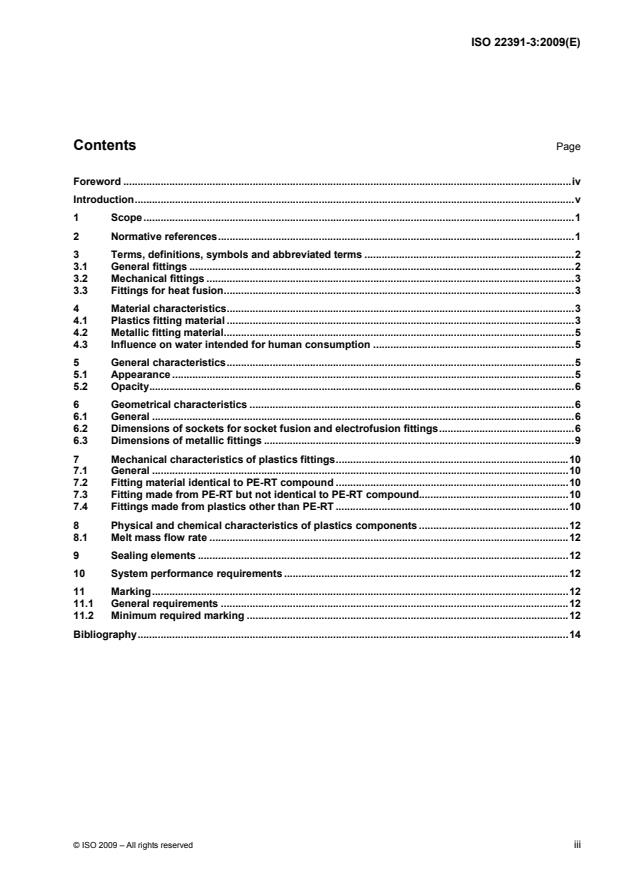
Contents Page
Foreword .iv
Introduction.v
1 Scope.1
2 Normative references.1
3 Terms, definitions, symbols and abbreviated terms .2
3.1 General fittings .2
3.2 Mechanical fittings .3
3.3 Fittings for heat fusion.3
4 Material characteristics.3
4.1 Plastics fitting material .3
4.2 Metallic fitting material.5
4.3 Influence on water intended for human consumption .5
5 General characteristics.5
5.1 Appearance .5
5.2 Opacity.6
6 Geometrical characteristics .6
6.1 General .6
6.2 Dimensions of sockets for socket fusion and electrofusion fittings.6
6.3 Dimensions of metallic fittings .9
7 Mechanical characteristics of plastics fittings.10
7.1 General .10
7.2 Fitting material identical to PE-RT compound .10
7.3 Fitting made from PE-RT but not identical to PE-RT compound.10
7.4 Fittings made from plastics other than PE-RT .10
8 Physical and chemical characteristics of plastics components .12
8.1 Melt mass flow rate .12
9 Sealing elements .12
10 System performance requirements .12
11 Marking.12
11.1 General requirements .12
11.2 Minimum required marking .12
Bibliography.14
Foreword
ISO (the International Organization for Standardization) is a worldwide federation of national standards bodies
(ISO member bodies). The work of preparing International Standards is normally carried out through ISO
technical committees. Each member body interested in a subject for which a technical committee has been
established has the right to be represented on that committee. International organizations, governmental and
non-governmental, in liaison with ISO, also take part in the work. ISO collaborates closely with the
International Electrotechnical Commission (IEC) on all matters of electrotechnical standardization.
International Standards are drafted in accordance with the rules given in the ISO/IEC Directives, Part 2.
The main task of technical committees is to prepare International Standards. Draft International Standards
adopted by the technical committees are circulated to the member bodies for voting. Publication as an
International Standard requires approval by at least 75 % of the member bodies casting a vote.
Attention is drawn to the possibility that some of the elements of this document may be the subject of patent
rights. ISO shall not be held responsible for identifying any or all such patent rights.
ISO 22391-3 was prepared by Technical Committee ISO/TC 138, Plastics pipes, fittings and valves for the
transport of fluids, Subcommittee SC 2, Plastics pipes and fittings for water supplies.
This second edition cancels and replaces the first edition (ISO 22391-3:2007), which is extended from only
dealing with PE-RT material (referred to as Type I) to cover PE-RT materials Type I and Type II.
1)
ISO 22391 consists of the following parts , under the general title Plastics piping systems for hot and cold
water installations — Polyethylene of raised temperature resistance (PE-RT):
⎯ Part 1: General
⎯ Part 2: Pipes
⎯ Part 3: Fittings
⎯ Part 5: Fitness for purpose of the system
1) This System Standard does not incorporate a Part 4: Ancillary equipment or a Part 6: Guidance for installation. For
ancillary equipment, separate standards can apply. Guidance for installation of plastics piping systems made from different
materials, intended to be used for hot and cold water installations, is covered by ENV 12108.
iv © ISO 2009 – All rights reserved
Introduction
The System Standard, of which this is Part 3, specifies the requirements for a piping system and its
components when made from polyethylene of raised temperature resistance (PE-RT). The piping system is
intended to be used for hot and cold water installations.
In respect of potential adverse effects on the quality of water intended for human consumption caused by the
products covered by ISO 22391, the following are relevant.
a) This part of ISO 22391 provides no information as to whether the products can be used without restriction.
b) Existing national regulations concerning the use and/or characteristics of the products remain in force.
This part of ISO 22391 specifies the general aspects of the plastics piping system. At the date of publication of
this part of ISO 22391, System Standards Series for piping systems of other plastics materials used for the
same application are the following:
ISO 15874 (all parts), Plastics piping systems for hot and cold water installations — Polypropylene (PP)
ISO 15875 (all parts), Plastics piping systems for hot and cold water installations — Crosslinked polyethylene
(PE-X)
ISO 15876 (all parts), Plastics piping systems for hot and cold water installations — Polybutylene (PB)
ISO 15877 (all parts), Plastics piping systems for hot and cold water installations — Chlorinated
poly(vinyl chloride) (PVC-C)
INTERNATIONAL STANDARD ISO 22391-3:2009(E)
Plastics piping systems for hot and cold water installations —
Polyethylene of raised temperature resistance (PE-RT) —
Part 3:
Fittings
1 Scope
This part of ISO 22391 specifies the characteristics of fittings for piping systems made of
⎯ polyethylene of raised temperature resistance (PE-RT), Type I, and
⎯ polyethylene of raised temperature resistance (PE-RT), Type II,
intended to be used for hot and cold water installations within buildings for the conveyance of water, whether
or not the water is intended for human consumption (domestic systems) and for heating systems, under the
design pressures and temperatures appropriate to the class of application according to ISO 22391-1.
This part of ISO 22391 covers a range of service conditions (classes of application), design pressures and
pipe dimension classes, and also specifies test parameters and test methods. In conjunction with the other
parts of ISO 22391, it is applicable to fittings made of PE-RT, as well as to those made of other materials,
intended to be fitted to pipes conforming to ISO 22391-2 for hot and cold water installations, the joints of which
are in accordance with ISO 22391-5.
This part of ISO 22391 is applicable to the following types of fitting:
⎯ mechanical fittings;
⎯ socket fusion fitting;
⎯ electrofusion fittings;
⎯ fittings with incorporated inserts.
It is not applicable to values of design temperature, maximum design temperature or malfunction temperature
in excess of those specified in ISO 22391-1.
NOTE It is the responsibility of the purchaser or specifier to make the appropriate selections from these aspects,
taking into account their particular requirements and any relevant national regulations and installation practices or codes.
2 Normative references
The following referenced documents are indispensable for the application of this document. For dated
references, only the edition cited applies. For undated references, the latest edition of the referenced
document (including any amendments) applies.
ISO 7-1, Pipe threads where pressure-tight joints are made on the threads — Part 1: Dimensions, tolerances
and designation
ISO 228-1, Pipe threads where pressure-tight joints are not made on the threads — Part 1: Dimensions,
tolerances and designation
ISO 1133-1, Plastics — Determination of the melt volume-flow rate (MVR) and the melt mass-flow rate (MFR)
of thermoplastics — Part 1: Standard method
ISO 1167-1, Thermoplastics pipes, fittings and assemblies for the conveyance of fluids — Determination of
the resistance to internal pressure — Part 1: General method
ISO 1167-2, Thermoplastics pipes, fittings and assemblies for the conveyance of fluids — Determination of
the resistance to internal pressure — Part 2: Preparation of pipe test pieces
ISO 3126, Plastics piping systems — Plastics components — Determination of dimensions
ISO 7686, Plastics pipes and fittings — Determination of opacity
ISO 9080, Plastics piping and ducting systems — Determination of long-term hydrostatic strength of
thermoplastic materials in pipe form by extrapolation
ISO 23711, Elastomeric seals — Requirements for materials for pipe joint seals used in water and drainage
applications — Thermoplastic elastomers
ISO 22391-1:2009, Plastics piping systems for hot and cold water installations — Polyethylene of raised
temperature resistance (PE-RT) — Part 1: General
ISO 22391-2:2009, Plastics piping systems for hot and cold water installations — Polyethylene of raised
temperature resistance (PE-RT) — Part 2: Pipes
ISO 22391-5, Plastics piping systems for hot and cold water installations — Polyethylene of raised
temperature resistance (PE-RT) — Part 5: Fitness for purpose of the system
EN 681-1, Elastomeric seals — Materials requirements for pipe joint seals used in water and drainage
applications — Part 1: Vulcanized rubber
EN 681-2, Elastomeric seals — Materials requirements for pipe joint seals used in water and drainage
applications — Part 2: Thermoplastic elastomers
EN 1254-3, Copper and copper alloys — Plumbing fittings — Part 3: Fittings with compression ends for use
with plastics pipes
EN 10088-1, Stainless steels — Part 1: List of stainless steels
3 Terms, definitions, symbols and abbreviated terms
For the purposes of this document, the terms, definitions, symbols and abbreviated terms given in
ISO 22391-1 and the following apply.
3.1 General fittings
3.1.1
fitting
component of a piping system, which connects two or more pipes and/or fittings together, without any
additional function
2 © ISO 2009 – All rights reserved
3.2 Mechanical fittings
3.2.1
compression fitting
fitting in which the joint is made by the compression of a ring or sleeve on the outside wall of the pipe with or
without additional sealing elements and with internal support
3.2.2
crimped fitting
fitting in which the joint is made by crimping of the fitting and/or a ring on the outside wall of the pipe by means
of a special tool
3.2.3
flanged fitting
fitting in which the pipe connection consists of two mating flanges which are mechanically pressed together
and sealed by the compression of an elastomeric sealing element between them
3.2.4
flat seat union fitting
fitting in which the pipe connection consists primarily of two components, at least one of which normally
incorporates a flat sealing surface, which are mechanically pressed together by means of a screwed nut or
similar and sealed by the compression of an elastomeric sealing element between them
3.3 Fittings for heat fusion
3.3.1
socket fusion fitting
fitting in which the joint with the pipe is made by melting together the outer part of the pipe with the inner part
of the fitting by means of heat induced by a heated tool
3.3.2
electrofusion fitting
fitting in which the joint with the pipe is made by melting together the outer part of the pipe and the inner part
of the fitting by means of heat induced by current flowing in an appropriate resistor inserted in the fitting body
3.3.3
fitting with incorporated inserts
fitting in which the joint is made by means of connecting threads or other outlets, inserted in the plastics body,
combined with fusion ends for socket welding or electrofusion
4 Material characteristics
4.1 Plastics fitting material
4.1.1 Fitting material identical to PE-RT pipe material
The material from which fittings are made shall be in accordance with the requirements for pipes as specified
in ISO 22391-2.
When tested using the test method and the test parameters in accordance with Table 1 or 2, injection
moulded tubular test pieces shall withstand the hydrostatic (hoop) stress without bursting or leakage.
Table 1 — Mechanical characteristics of tubular test pieces made of PE-RT Type I by injection
moulding
Test parameters
Characteristic Requirement Test methods
For individual tests
Hydrostatic Test
Test period
Number of
(hoop) stress temperature
test pieces
MPa °C h
9,9 20 1 3
3,4 95 1 000 3
No bursting or ISO 1167-1
Resistance to
leakage during and
internal pressure
For all tests
test period ISO 1167-2
Sampling procedure Not specified
Type of end cap Type a)
Orientation of test piece Not specified
Type of test Water-in-water
Table 2 — Mechanical characteristics of tubular test pieces made of PE-RT Type II by injection
moulding
Test parameters
Characteristic Requirement Test methods
For individual tests
Hydrostatic Test
Test period
Number of
(hoop) stress temperature
test pieces
MPa °C h
10,8 20 1 3
3,6 95 1 000 3
No bursting or ISO 1167-1
Resistance to
leakage during and
internal pressure
For all tests
test period ISO 1167-2
Sampling procedure Not specified
Type of end cap Type a)
Orientation of test piece Not specified
Type of test Water-in-water
4.1.2 PE-RT fitting material not identical to PE-RT pipe material
4.1.2.1 Evaluation of σ values and control points
LCL
The fitting material, in the form of injection-moulded tubular test pieces, shall be evaluated in accordanc
...
NORME ISO
INTERNATIONALE 22391-3
Deuxième édition
2009-12-01
Systèmes de canalisations en plastique
pour les installations d'eau chaude et
froide — Polyéthylène de meilleure
résistance à la température (PE-RT) —
Partie 3:
Raccords
Plastics piping systems for hot and cold water installations —
Polyethylene of raised temperature resistance (PE-RT) —
Part 3: Fittings
Numéro de référence
©
ISO 2009
PDF – Exonération de responsabilité
Le présent fichier PDF peut contenir des polices de caractères intégrées. Conformément aux conditions de licence d'Adobe, ce fichier
peut être imprimé ou visualisé, mais ne doit pas être modifié à moins que l'ordinateur employé à cet effet ne bénéficie d'une licence
autorisant l'utilisation de ces polices et que celles-ci y soient installées. Lors du téléchargement de ce fichier, les parties concernées
acceptent de fait la responsabilité de ne pas enfreindre les conditions de licence d'Adobe. Le Secrétariat central de l'ISO décline toute
responsabilité en la matière.
Adobe est une marque déposée d'Adobe Systems Incorporated.
Les détails relatifs aux produits logiciels utilisés pour la création du présent fichier PDF sont disponibles dans la rubrique General Info
du fichier; les paramètres de création PDF ont été optimisés pour l'impression. Toutes les mesures ont été prises pour garantir
l'exploitation de ce fichier par les comités membres de l'ISO. Dans le cas peu probable où surviendrait un problème d'utilisation,
veuillez en informer le Secrétariat central à l'adresse donnée ci-dessous.
DOCUMENT PROTÉGÉ PAR COPYRIGHT
© ISO 2009
Droits de reproduction réservés. Sauf prescription différente, aucune partie de cette publication ne peut être reproduite ni utilisée sous
quelque forme que ce soit et par aucun procédé, électronique ou mécanique, y compris la photocopie et les microfilms, sans l'accord écrit
de l'ISO à l'adresse ci-après ou du comité membre de l'ISO dans le pays du demandeur.
ISO copyright office
Case postale 56 • CH-1211 Geneva 20
Tel. + 41 22 749 01 11
Fax + 41 22 749 09 47
E-mail copyright@iso.org
Web www.iso.org
Publié en Suisse
ii © ISO 2009 – Tous droits réservés
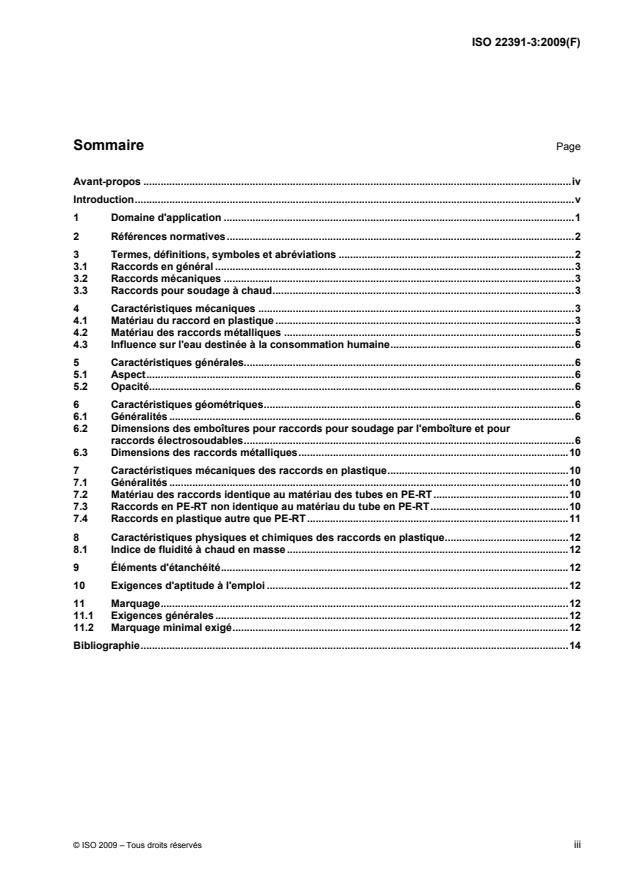
Sommaire Page
Avant-propos .iv
Introduction.v
1 Domaine d'application .1
2 Références normatives.2
3 Termes, définitions, symboles et abréviations .2
3.1 Raccords en général .3
3.2 Raccords mécaniques .3
3.3 Raccords pour soudage à chaud.3
4 Caractéristiques mécaniques .3
4.1 Matériau du raccord en plastique .3
4.2 Matériau des raccords métalliques .5
4.3 Influence sur l'eau destinée à la consommation humaine.6
5 Caractéristiques générales.6
5.1 Aspect.6
5.2 Opacité.6
6 Caractéristiques géométriques.6
6.1 Généralités .6
6.2 Dimensions des emboîtures pour raccords pour soudage par l'emboîture et pour
raccords électrosoudables.6
6.3 Dimensions des raccords métalliques.10
7 Caractéristiques mécaniques des raccords en plastique.10
7.1 Généralités .10
7.2 Matériau des raccords identique au matériau des tubes en PE-RT.10
7.3 Raccords en PE-RT non identique au matériau du tube en PE-RT.10
7.4 Raccords en plastique autre que PE-RT.11
8 Caractéristiques physiques et chimiques des raccords en plastique.12
8.1 Indice de fluidité à chaud en masse.12
9 Éléments d'étanchéité.12
10 Exigences d'aptitude à l'emploi .12
11 Marquage.12
11.1 Exigences générales.12
11.2 Marquage minimal exigé.12
Bibliographie.14
Avant-propos
L'ISO (Organisation internationale de normalisation) est une fédération mondiale d'organismes nationaux de
normalisation (comités membres de l'ISO). L'élaboration des Normes internationales est en général confiée
aux comités techniques de l'ISO. Chaque comité membre intéressé par une étude a le droit de faire partie du
comité technique créé à cet effet. Les organisations internationales, gouvernementales et non
gouvernementales, en liaison avec l'ISO participent également aux travaux. L'ISO collabore étroitement avec
la Commission électrotechnique internationale (CEI) en ce qui concerne la normalisation électrotechnique.
Les Normes internationales sont rédigées conformément aux règles données dans les Directives ISO/CEI,
Partie 2.
La tâche principale des comités techniques est d'élaborer les Normes internationales. Les projets de Normes
internationales adoptés par les comités techniques sont soumis aux comités membres pour vote. Leur
publication comme Normes internationales requiert l'approbation de 75 % au moins des comités membres
votants.
L'attention est appelée sur le fait que certains des éléments du présent document peuvent faire l'objet de
droits de propriété intellectuelle ou de droits analogues. L'ISO ne saurait être tenue pour responsable de ne
pas avoir identifié de tels droits de propriété et averti de leur existence.
L'ISO 22391-3 a été élaborée par le comité technique ISO/TC 138, Tubes, raccords et robinetterie en
matières plastiques pour le transport des fluides, sous-comité SC 2, Tubes et raccords en matières plastiques
pour adduction et distribution d'eau.
Cette deuxième édition annule et remplace la première édition (ISO 22391-3:2007), qui a été élargie pour
couvrir les matériaux en PE-RT de Type I et de Type II. La première édition ne traitant que du matériau en
PE-RT couramment désigné de Type I.
1)
L'ISO 22391 comprend les parties suivantes , présentées sous le titre général Systèmes de canalisations en
plastique pour les installations d'eau chaude et froide — Polyéthylène de meilleure résistance à la
température (PE-RT):
⎯ Partie 1: Généralités
⎯ Partie 2: Tubes
⎯ Partie 3: Raccords
⎯ Partie 5: Aptitude à l'emploi du système
1) La présente norme de système n'incorpore pas de Partie 4: Équipement annexe ou de Partie 6: Directives pour
l'installation. Pour l'équipement annexe, des normes séparées peuvent s'appliquer. Des directives pour l'installation des
systèmes de canalisations en plastique fabriqués à partir de différents matériaux, destinés aux installations d'eau chaude
et froide, sont traitées par l'ENV 12108.
iv © ISO 2009 – Tous droits réservés
Introduction
La norme de système, dont la présente partie est la Partie 3, spécifie les exigences relatives à un système de
canalisations et ses composants lorsqu'ils sont en polyéthylène de meilleure résistance à la température
(PE-RT). Le système de canalisations est destiné à être utilisé pour les installations d'eau chaude et froide.
Pour tenir compte des éventuels effets défavorables sur la qualité de l'eau destinée à la consommation
humaine, causés par les produits couverts par l'ISO 22391, les suivants sont pertinents:
a) la présente partie de l'ISO 22391 ne fournit aucune information sur la possibilité ou non d'utiliser les
produits sans restriction;
b) les réglementations nationales existantes relatives à l'utilisation et/ou aux caractéristiques des produits
restent en vigueur.
La présente partie de l'ISO 22391 spécifie les aspects généraux des systèmes de canalisations en plastique.
À la date de publication de la présente partie de l'ISO 22391, la série des normes de système pour les
systèmes de canalisations en d'autres matériaux plastiques utilisés pour la même application sont les
suivantes:
ISO 15874 (toutes les parties), Systèmes de canalisations en plastique pour les installations d'eau chaude et
froide — Polypropylène (PP)
ISO 15875 (toutes les parties), Systèmes de canalisations en plastique pour les installations d'eau chaude et
froide — Polyéthylène réticulé (PE-X)
ISO 15876 (toutes les parties), Systèmes de canalisations en plastique pour les installations d'eau chaude et
froide — Polybutène (PB)
ISO 15877 (toutes les parties), Systèmes de canalisations en plastique pour les installations d'eau chaude et
froide — Poly(chlorure de vinyle) chloré (PVC-C)
NORME INTERNATIONALE ISO 22391-3:2009(F)
Systèmes de canalisations en plastique pour les installations
d'eau chaude et froide — Polyéthylène de meilleure résistance à
la température (PE-RT) —
Partie 3:
Raccords
1 Domaine d'application
La présente partie de l'ISO 22391 spécifie les caractéristiques des raccords des systèmes de canalisations en
⎯ polyéthylène de meilleure résistance à la température (PE-RT), Type I, et
⎯ polyéthylène de meilleure résistance à la température (PE-RT), Type II,
destinés aux installations d'eau chaude et froide à l'intérieur des bâtiments ainsi qu'au transport de l'eau,
destinée ou non à la consommation humaine (systèmes domestiques) et aux installations de chauffage, à des
pressions et des températures de service spécifiées correspondant à la classe d'application conformément à
l'ISO 22391-1.
La présente partie de l'ISO 22391 couvre une gamme de conditions de service (classes d'application), de
pressions de service et de classes de dimension du tube, et spécifie également les paramètres et les
méthodes d'essai. Lorsqu'elle est utilisée conjointement avec les autres parties de l'ISO 22391, elle s'applique
respectivement aux tubes PE-RT, aux raccords, à leurs assemblages et aux assemblages ayant des
composants de PE-RT, ainsi qu'à d'autres matériaux, plastiques ou non plastiques, utilisés pour les
installations d'eau chaude et froide, dont les assemblages sont conformes à l'ISO 22391-5.
La présente partie de l'ISO 22391 s'applique aux types de raccords suivants:
⎯ raccords mécaniques;
⎯ raccords pour soudage par emboîture;
⎯ raccords électrosoudables;
⎯ raccords avec inserts incorporés.
Elle ne s'applique pas aux valeurs de température de service, de température maximale de service, ou de
température de dysfonctionnement qui dépassent celles spécifiées dans l'ISO 22391-1.
NOTE Il est de la responsabilité de l'acheteur ou du spécificateur de réaliser une sélection appropriée de ces aspects,
en tenant compte des exigences particulières et des réglementations nationales et pratiques ou codes d'installation
pertinents.
2 Références normatives
Les documents de référence suivants sont indispensables pour l'application du présent document. Pour les
références datées, seule l'édition citée s'applique. Pour les références non datées, la dernière édition du
document de référence s'applique (y compris les éventuels amendements).
ISO 7-1, Filetages de tuyauterie pour raccordement avec étanchéité dans le filet — Partie 1: Dimensions,
tolérances et désignation
ISO 228-1, Filetages de tuyauterie pour raccordement sans étanchéité dans le filet — Partie 1: Dimensions,
tolérances et désignation
ISO 1133-1, Plastiques — Détermination de l'indice de fluidité à chaud des thermoplastiques, en masse
(MFR) et en volume (MVR) — Partie 1: Méthode normale
ISO 1167-1, Tubes, raccords et assemblages en matières thermoplastiques pour le transport des fluides —
Détermination de la résistance à la pression interne — Partie 1: Méthode générale
ISO 1167-2, Tubes, raccords et assemblages en matières thermoplastiques pour le transport des fluides —
Détermination de la résistance à la pression interne — Partie 2: Préparation des éprouvettes tubulaires
ISO 3126, Systèmes de canalisations en plastiques — Composants en plastiques — Détermination des
dimensions
ISO 7686, Tubes et raccords en matières plastiques — Détermination de l'opacité
ISO 9080, Systèmes de canalisations et de gaines en matières plastiques — Détermination de la résistance
hydrostatique à long terme des matières thermoplastiques sous forme de tubes par extrapolation
ISO 23711, Garnitures d'étanchéité en caoutchouc — Spécification des matériaux pour garnitures
d'étanchéité utilisées dans le domaine de l'eau et du drainage — Élastomères thermoplastiques
ISO 22391-1:2009, Systèmes de canalisations en plastique pour les installations d'eau chaude et froide —
Polyéthylène de meilleure résistance à la température (PE-RT) — Partie 1: Généralités
ISO 22391-2:2009, Systèmes de canalisations en plastique pour les installations d'eau chaude et froide —
Polyéthylène de meilleure résistance à la température (PE-RT) — Partie 2: Tubes
ISO 22391-5, Systèmes de canalisations en plastique pour les installations d'eau chaude et froide —
Polyéthylène de meilleure résistance à la température (PE-RT) — Partie 5: Aptitude à l'emploi du système
EN 681-1, Garnitures d'étanchéité en caoutchouc — Spécification des matériaux pour garnitures d'étanchéité
pour joints de canalisations utilisées dans le domaine de l'eau et de l'évacuation — Partie 1: Caoutchouc
vulcanisé
EN 681-2, Garnitures d'étanchéité en caoutchouc — Spécification des matériaux pour garnitures d'étanchéité
utilisées dans le domaine de l'eau et du drainage — Partie 2: Élastomères thermoplastiques
EN 1254-3, Cuivre et alliages de cuivre — Raccords — Partie 3: Raccords à compression pour tuyaux en
plastique
EN 10088-1, Aciers inoxydables — Partie 1: Liste des aciers inoxydables
3 Termes, définitions, symboles et abréviations
Pour les besoins du présent document, les termes, définitions, symboles et abréviations donnés dans
l'ISO 22391-1 ainsi que les suivants s'appliquent.
2 © ISO 2009 – Tous droits réservés
3.1 Raccords en général
3.1.1
raccord
composant d'un système de canalisations qui raccorde deux ou plusieurs tubes et/ou raccords entre eux,
sans aucune autre fonction
3.2 Raccords mécaniques
3.2.1
raccord par compression
raccord dans lequel l'assemblage est réalisé par la compression d'une bague ou d'un manchon sur la paroi
extérieure du tube, à l'aide d'un support interne avec ou sans élément d'étanchéité
3.2.2
raccord à sertir
raccord dans lequel l'assemblage est réalisé par la compression du raccord et/ou d'une bague sur la paroi
extérieure du tube au moyen d'un outil spécifique
3.2.3
raccord à bride
raccord dans lequel l'assemblage des tubes est réalisé par deux brides mécaniquement pressées l'une contre
l'autre et dont l'étanchéité est assurée par la compression d'un joint en élastomère
3.2.4
raccord à joint plat
raccord dans lequel l'assemblage des tubes est réalisé essentiellement par deux composants, dont l'un au
moins comporte une surface d'étanchéité plane et qui sont mécaniquement comprimés l'un contre l'autre par
un écrou ou autre et dont l'étanchéité est assurée par la compression d'un joint en élastomère
3.3 Raccords pour soudage à chaud
3.3.1
raccord pour soudage par l'emboîture
raccord dans lequel l'assemblage avec le tube est réalisé par soudage de la partie extérieure du tube avec la
partie intérieure du raccord au moyen de chaleur induite par un outil chauffé
3.3.2
raccord électrosoudable
raccord dans lequel l'assemblage avec le tube est réalisé par fusion de la partie extérieure du tube avec la
partie intérieure du raccord au moyen de chaleur induite par un courant circulant dans une résistance intégrée
dans le corps du raccord
3.3.3
raccord avec inserts incorporés
raccord dans lequel l'assemblage est réalisé au moyen de filetages ou autres jonctions intégrés dans le corps
en plastique, associés à des extrémités destinées au soudage par l'emboîture ou à l'électrosoudage
4 Caractéristiques mécaniques
4.1 Matériau du raccord en plastique
4.1.1 Matériau du raccord identique au matériau des tubes en PE-RT
Le matériau à utiliser pour les raccords doit être conforme aux exigences spécifiées pour les tubes dans
l'ISO 22391-2.
Lors des essais effectués selon la méthode d'essai spécifiée dans le Tableau 1 ou 2, à l'aide des paramètres
indiqués, les éprouvettes tubulaires moulées par injection doivent supporter la contrainte hydrostatique (de
paroi) sans éclatement ou fuite.
Tableau 1 — Caractéristiques mécaniques des éprouvettes tubulaires en PE-RT de Type I moulées par
injection
Paramètre d'essai
Méthode
Caractéristique Exigence
d'essai
Pour les essais individuels
Contrainte
Température
hydrostatique Durée
Nombre
d'essai
(de paroi)
d'éprouvettes
MPa °C h
9,9 20 1 3
Pas de fuite ni ISO 1167-1
3,4 95 1 000 3
Résistance à la
d'éclatement et
pression interne
durant l'essai ISO 1167-2
Pour tous les essais
Procédure d'échantillonnage Non spécifiée
Type d'embout Type a)
Orientation de l'éprouvette Non spécifiée
Type d'essai Eau dans l'eau
Tableau 2 — Caractéristiques mécaniques des éprouvettes tubulaires en PE-RT de Type II moulées
par injection
Paramètre d'essai
Méthode
Caractéristique Exigence
d'essai
Pour les essais individuels
Contrainte
Température
hydrostatique Durée
Nombre
d'essai
(de paroi)
d'éprouvettes
MPa °C h
10,8 20 1 3
Pas de fuite ni ISO 1167-1
3,6 95 1 000 3
Résistance à la
d'éclatement et
pression interne
durant l'essai ISO 1167-2
Pour tous les essais
Procédure d'échantillonnage Non spécifiée
Type d'embout Type a)
Orientation de l'éprouvette Non spécifiée
Type d'essai Eau dans l'eau
4.1.2 Matériau du raccord non identique au matériau des tubes en PE-RT
4.1.2.1 Évaluation des valeurs σ et des points de contrôle
LCL
Le matériau du raccord utilisé sous forme d'éprouvettes tubulaires moulées par injection doit être évalué selon
la méthode donnée dans l'ISO 9080 ou toute méthode équivalente, où les essais de pression interne sont
réalisés selon l'ISO 1167-1 et l'ISO 1167-2 pour déterminer les valeurs de σ . Les valeu
...
МЕЖДУНАРОДНЫЙ ISO
СТАНДАРТ 22391-3
Второе издание
2009-12-01
Системы пластмассовых
трубопроводов для горячего и
холодного водоснабжения.
Полиэтилен повышенной
термостойкости (PE-RT).
Часть 3.
Фитинги
Plastics piping systems for hot and cold water installations —
Polyethylene raised temperature resistance (PE-RT) —
Part 3: Fittings
Ответственность за подготовку русской версии несёт GOST R
(Российская Федерация) в соответствии со статьёй 18.1 Устава ISO
Ссылочный номер
©
ISO 2009
Отказ от ответственности при работе в PDF
Настоящий файл PDF может содержать интегрированные шрифты. В соответствии с условиями лицензирования, принятыми
фирмой Adobe, этот файл можно распечатать или вывести на экран, но его нельзя изменить, пока не будет получена
лицензия на загрузку интегрированных шрифтов в компьютер, на котором ведется редактирование. В случае загрузки
настоящего файла заинтересованные стороны принимают на себя ответственность за соблюдение лицензионных условий
фирмы Adobe. Центральный секретариат ISO не несет никакой ответственности в этом отношении.
Adobe − торговый знак фирмы Adobe Systems Incorporated.
Подробности, относящиеся к программным продуктам, использованным для создания настоящего файла PDF, можно найти в
рубрике General Info файла; параметры создания PDF были оптимизированы для печати. Были приняты во внимание все
меры предосторожности с тем, чтобы обеспечить пригодность настоящего файла для использования комитетами-членами
ISO. В редких случаях возникновения проблемы, связанной со сказанным выше, просьба проинформировать Центральный
секретариат по адресу, приведенному ниже.
ДОКУМЕНТ ЗАЩИЩЁН АВТОРСКИМ ПРАВОМ
© ISO 2009
Все права сохраняются. Если не указано иное, никакую часть настоящей публикации нельзя копировать или использовать в
какой-либо форме или каким-либо электронным или механическим способом, включая фотокопии и микрофильмы, без
предварительного письменного согласия ISO по адресу, указанному ниже, или членов ISO в стране регистрации пребывания.
ISO copyright office
Case postale 56 • CH-1211 Geneva 20
Tel. + 41 22 749 01 11
Fax + 41 22 749 09 47
E-mail copyright@iso.org
Web www.iso.org
Опубликовано в Швейцарии
ii © ISO 2009 – Все права сохраняются
Содержание Страница
Предисловие .iv
Введение .v
1 Область применения .1
2 Нормативные ссылки .2
3 Термины, определения, обозначения и аббревиатуры .2
3.1 Фитинги.3
3.2 Механические фитинги.3
3.3 Фитинги, соединяемые плавлением .3
4 Характеристики материала.4
4.1 Пластмассовые материалы фитингов.4
4.2 Металлический материал для фитингов .6
4.3 Влияние на воду, предназначенную для потребления людьми.6
5 Общие характеристики .6
5.1 Внешний вид.6
5.2 Непрозрачность .6
6 Геометрические характеристики .6
6.1 Общие положения .6
6.2 Размеры втулок для фитингов с наплавляемым раструбом и электросплавных
фитингов .6
6.3 Размеры металлических фитингов.9
7 Механические характеристики пластмассовых фитингов.10
7.1 Общие положения .10
7.2 Материал фитинга, идентичный составу PE-RT.10
7.3 Фитинг, изготовленный из PE-RT, но не идентичного составу PE-RT трубы.10
7.4 Фитинги, изготовленные из других пластмасс, кроме PE-RT.10
8 Физические и химические характеристики пластмассовых компонентов .12
8.1 Массовая скорость течения расплава .12
9 Уплотнительные элементы.12
10 Требования к рабочим характеристикам системы.12
11 Маркировка .12
11.1 Общие требования .12
11.2 Минимальный объем необходимых для маркировки данных .12
Библиография.14
Предисловие
Международная организация по стандартизации (ISO) является всемирной федерацией национальных
организаций по стандартизации (комитетов-членов ISO). Разработка международных стандартов
обычно осуществляется техническими комитетами ISO. Каждый комитет-член, заинтересованный в
деятельности, для которой был создан технический комитет, имеет право быть представленным в этом
комитете. Международные правительственные и неправительственные организации, имеющие связи с
ISO, также принимают участие в работах. ISO работает в тесном сотрудничестве с Международной
электротехнической комиссией (IEC) по всем вопросам стандартизации в области электротехники.
Международные стандарты разрабатываются в соответствии с правилами, установленными в
Директивах ISO/IEC, Часть 2.
Основная задача технических комитетов состоит в подготовке международных стандартов. Проекты
международных стандартов, одобренные техническими комитетами, рассылаются комитетам-членам
на голосование. Их опубликование в качестве международных стандартов требует одобрения, по
меньшей мере, 75 % комитетов-членов, принимающих участие в голосовании.
Следует иметь в виду, что некоторые элементы этого документа могут быть объектом патентных прав.
ISO не должен нести ответственность за идентификацию какого-либо одного или всех патентных прав.
ISO 22391-3 был подготовлен Техническим комитетом ISO/TC 138, Пластмассовые трубы, фитинги и
клапаны для транспортировки жидкостей, Подкомитетом SC 2, Пластмассовые трубы и фитинги
для водоснабжения.
Настоящее второе издание отменяет и заменяет первое издание (ISO 22391-3:2007), которое
распространялось только на материал PE-RT (именуемый Тип I), и расширяет его до описания
материалов PE-RT типа I и типа II.
1)
ISO 22391 состоит из следующих частей под общим названием Системы пластмассовых
трубопроводов для горячего и холодного водоснабжения. Полиэтилен повышенной
термостойкости (PE-RT):
⎯ Часть 1. Общие положения
⎯ Часть 2. Трубы
⎯ Часть 3. Фитинги
⎯ Часть 5. Соответствие системы назначению
1) Настоящая система стандартов не включает в себя часть 4: Вспомогательное оборудование и часть 6:
Руководство по монтажу оборудования. По вспомогательному оборудованию можно использовать специальные
стандарты. Руководство по монтажу пластмассовых систем трубопроводов, изготовленных из различных
материалов и предназначенных для горячего и холодного водоснабжения, приведено в ENV 12108.
iv © ISO 2009 – Все права сохраняются
Введение
Система стандартов, в которую входит и настоящая Часть 3, устанавливает требования к системам
трубопроводов и их составным частям, изготовленным из полиэтилена повышенной термостойкости
(PE-RT). Системы трубопроводов предназначены для применения в установках горячего и холодного
водоснабжения.
В отношении потенциальной возможности отрицательного влияния рассматриваемых в ISO 22391
изделий на качество воды, предназначенной для потребления людьми, необходимо учесть
следующее:
a) Настоящая часть ISO 22391 не дает никакой информации, определяющей, могут или нет эти
изделия использоваться без ограничений.
b) Существующие национальные правила, касающиеся использования и/или характеристик этих
изделий, остаются в силе.
Настоящая часть ISO 22391 устанавливает основные характеристики систем пластмассовых
трубопроводов. На момент опубликования настоящей части ISO 22391 существовала следующая
серия системы стандартов для систем трубопроводов из других пластических материалов,
используемых для аналогичных практических задач:
ISO 15874 (все части), Системы пластмассовых трубопроводов для горячего и холодного
водоснабжения. Полипропилен (РР)
ISO 15875 (все части), Системы пластмассовых трубопроводов для горячего и холодного
водоснабжения. Сетчатый полиэтилен (РE-X)
ISO 15876 (все части), Системы пластмассовых трубопроводов для горячего и холодного
водоснабжения. Полибутилен (PB)
ISO 15877 (все части), Системы пластмассовых трубопроводов для горячего и холодного
водоснабжения. Хлорированный поливинилхлорид (PVC-C)
МЕЖДУНАРОДНЫЙ СТАНДАРТ ISO 22391-3:2009(R)
Системы пластмассовых трубопроводов для горячего и
холодного водоснабжения. Полиэтилен повышенной
термостойкости (PE-RT).
Часть 3.
Фитинги
1 Область применения
Настоящая часть ISO 22391 устанавливает основные характеристики систем трубопроводов,
изготовленных из
⎯ полиэтилена повышенной термостойкости (PE-RT), типа I и
⎯ полиэтилена повышенной термостойкости (PE-RT), типа II,
предназначенных для горячего и холодного водоснабжения в зданиях, независимо от того,
предназначается вода для потребления людьми (система питьевого водоснабжения) или для систем
отопления при установленных проектных давлениях и температурах в соответствии с классом
эксплуатации согласно ISO 22391-1.
Настоящая часть ISO 22391 охватывает диапазон условий эксплуатации (классы эксплуатации),
проектные давления и классы размеров труб, а также устанавливает параметры испытаний и методы
испытаний. Вместе с другими частями ISO 22391 эта часть применима к фитингам из PE-RT, также как
к фитингам из других материалов, предназначенным для установки на трубы, используемые для
горячего и холодного водоснабжения, в соответствии с ISO 22391-2, и соединения которых должны
соответствовать ISO 22391-5.
Настоящая часть ISO 22391 применима к следующим типам фитингов:
⎯ механические фитинги;
⎯ фитинги раструбные (под соединение плавлением враструб);
⎯ фитинги под электроплавку;
⎯ фитинги с системой внутренних колец.
Настоящая часть не применима к значениям проектной температуры, максимальной расчетной
температуры или температуры нарушения функционирования системы, превышающим установленные
в ISO 22391-1.
ПРИМЕЧАНИЕ Покупатель или представитель заказчика под свою ответственность осуществляют
соответствующий выбор из данных характеристик с учетом своих индивидуальных требований и соответствующих
национальных регламентов, практики монтажа или технических условий.
2 Нормативные ссылки
Следующие ссылочные документы обязательны для применения в настоящем документе. В случае
датированных ссылок применяются только цитированные издания. При недатированных ссылках
используется последнее издание ссылочного документа (включая все изменения).
ISO 7-1, Резьбы трубные, обеспечивающие герметичность соединения. Часть 1. Размеры, допуски
и обозначение
ISO 228-1, Резьбы трубные, не обеспечивающие герметичность соединения. Часть 1. Обозначения,
размеры и допуски
ISO 1133-1, Пластмассы . Определение индекса текучести расплава термопластов по массе (MFR)
и по объему (MVR). Часть 1. Стандартный метод
ISO 1167-1, Термопластичные трубы, фитинги и узлы для передачи текучих сред. Определение
стойкости к внутреннему давлению. Часть 1. Общий метод
ISO 1167-2, Термопластичные трубы, фитинги и узлы для передачи текучих сред. Определение
стойкости к внутреннему давлению. Часть 2. Приготовление кусков труб к испытаниям
ISO 3126, Пластмассовые системы трубопроводов. Пластмассовые компоненты. Определение
размеров
ISO 7686, Пластмассовые трубы и фитинги. Определение непрозрачности
ISO 9080, Системы трубопроводов и каналов термопластичные. Определение предела длительной
гидростатической прочности термопластичных материалов для труб методом экстраполяции
ISO 23711, Уплотнения эластомерные. Требования к материалам для уплотнений соединений
водопроводных и дренажных труб. Термопластичные эластомеры
ISO 22391-1:2009, Системы пластмассовых трубопроводов для горячего и холодного
водоснабжения. Полиэтилен повышенной термостойкости (PE-RT). Часть 1. Общие положения
ISO 22391-2:2009, Системы пластмассовых трубопроводов для горячего и холодного
водоснабжения. Полиэтилен повышенной термостойкости (PE-RT).Часть 2. Трубы
ISO 22391-5, Системы пластмассовых трубопроводов для горячего и холодного водоснабжения.
Полиэтилен повышенной термостойкости (PE-RT). Часть 5. Соответствие назначению системы
EN 681-1, Уплотнения эластомерные. Требования к материалам уплотнений, используемых в
соединениях труб для водоснабжения и дренажа. Часть 1. Вулканизированная резина
EN 681-2, Уплотнения эластомерные. Требования к материалам уплотнений, используемых в
соединениях труб для водоснабжения и дренажа. Часть 2. Термопластичные эластомеры
EN 1254-3, Медь и сплавы меди. Водопроводные фитинги. Часть 3. Фитинги с прессуемыми
торцами для применения с пластмассовыми трубами
EN 10088-1, Стали нержавеющие. Часть 1. Перечень нержавеющих сталей
3 Термины, определения, обозначения и аббревиатуры
Применительно к настоящему документу используются термины, определения, обозначения и
аббревиатуры, приведенные в ISO 22391-1.
2 © ISO 2009 – Все права сохраняются
3.1 Фитинги
3.1.1
фитинг
fitting
элемент трубопроводной арматуры, предназначенный для соединения двух или более труб и/или
фитингов вместе, без выполнения каких-либо других функций
3.2 Механические фитинги
3.2.1
компрессионный (обжимной) фитинг
compression fitting
фитинг, в котором соединение осуществляется посредством обжимки кольца или втулки на наружной
стенке трубы с дополнительными уплотняющими элементами или без них и с внутренней опорой
3.2.2
пресс-фитинг
crimped fitting
фитинг, в котором соединение обеспечивается обжиманием фитинга и/или втулки вокруг трубы (с
наружной стороны) с помощью специального инструмента
3.2.3
фланцевый фитинг
flanged fitting
фитинг, в котором соединение труб обеспечивается двумя контрфланцами, механически
прижимаемыми друг к другу, герметичность соединения обеспечивается сжатием эластичного
уплотняющего элемента, расположенного между фланцами
3.2.4
накидная резьбовая муфта с плоским седлом
flat seat union fitting
фитинг, в котором соединение труб обеспечивается, в основном, двумя компонентами, из которых, по
меньшей мере, один обычно включает плоскую уплотняющую поверхность; компоненты механически
прижимаются друг к другу с помощью затягивающейся гайки или чем-то подобным, а герметичность
обеспечивается эластичным уплотнителем между ними
3.3 Фитинги, соединяемые плавлением
3.3.1
фитинг под соединение плавлением враструб
socket fusion fitting
фитинг, в котором соединение с трубой осуществляется посредством сплавления внешней части
трубы с внутренней частью фитинга под действием тепла, индуцируемого инструментом
3.3.2
электрофузионная муфта
electrofusion fitting
фитинг, в котором соединение с трубой осуществляется посредством сплавления внешней части
трубы с внутренней частью фитинга с помощью тепла, индуцируемого электрическим током,
проходящим через соответствующий закладной электронагреватель
3.3.3
фитинги с системой внутренних вкладок
fitting with incorporated inserts
фитинг, в котором соединение обеспечивается с помощью соединительной резьбы или втулок,
установленных в пластмассовом корпусе и соединенных со сплавляемыми концами под сварку
враструб или электроплавку
4 Характеристики материала
4.1 Пластмассовые материалы фитингов
4.1.1 Материал фитинга, идентичный материалу PE-RT трубы
Материал, из которого изготавливают фитинги, должен соответствовать требованиям, установленным
для труб в ISO 22391-2.
При испытании с использованием метода и параметров испытания, соответствующих Таблице 1 или 2,
формованные испытуемые образцы в форме отрезка трубы должны выдерживать гидростатическое
(окружное) напряжение без разрушения или утечки.
Таблица 1 — Механические характеристики трубчатых испытуемых образцов, изготовленных
литьем под давлением из PE-RT Типа I
Параметр испытания
Методы
Характеристика Требование
испытания
Для индивидуальных испытаний
Гидростати-
ческое Температура Время
Количество
(окружное) испытания испытания
испытуемых
напряжение
образцов
MПa °C ч
Отсутствие
9,9 20 1 3
Стойкость к разрыва или ISO 1167-1
3,4 95 1 000 3
внутреннему утечки во и
давлению время ISO 1167-2
Для всех испытаний
испытания
Процедура отбора Не установлена
Тип торцевой заглушки Тип a)
Ориентация испытуемого Не установлена
образца
Тип испытания Вода в воде
Таблица 2 — Механические характеристики трубчатых испытуемых образцов, изготовленных
литьем под давлением из PE-RT Типа II
Параметр испытания
Методы
Характеристика Требование
испытания
Для индивидуальных испытаний
Гидростатиче
ское Температура Время
Количество
(окружное) испытания испытания
испытательных
напряжение
образцов
MПa °C ч
10,8 20 1 3
Отсутствие
Стойкость к разрыва или ISO 1167-1
3,6 95 1 000 3
внутреннему утечки во и
давлению время ISO 1167-2
Для всех испытаний
испытания
Процедура отбора Не установлена
Тип торцевой заглушки Тип a)
Ориентация испытуемого Не установлена
образца
Тип испытания Вода в воде
4 © ISO 2009 – Все права сохраняются
4.1.2 Материал PE-RT фитинга, не идентичный материалу PE-RT трубы
4.1.2.1 Оценка значений σ и контрольные точки
LCL
Материал фитинга, в форме трубчатых испытуемых образцов, полученных литьем под давлением, следует
оценивать в соответствии с ISO 9080 или аналогичным документом, а для определения значений σ
LCL
следует проводить испытания на внутреннее давление в соответствии с ISO
...