

ISO/FDIS 6032
(Main)Pigments and extenders — Fumed alumina for paints and varnishes
- Abstract
This document specifies requirements and corresponding methods of test for fumed alumina in powder form for paints and varnishes application.
- Status
- Not Published
- Technical Committee
- ISO/TC 256 - Pigments, dyestuffs and extenders
- Drafting Committee
- ISO/TC 256/WG 7 - Functional pigments and extenders
- Current Stage
- 5020 - Proof sent to secretariat or FDIS ballot initiated: 8 weeks - 50 Approval
- Start Date
- 19-Nov-2026
- Due Date
- 19-Nov-2026
- Completion Date
- 19-Nov-2026
Buy Documents
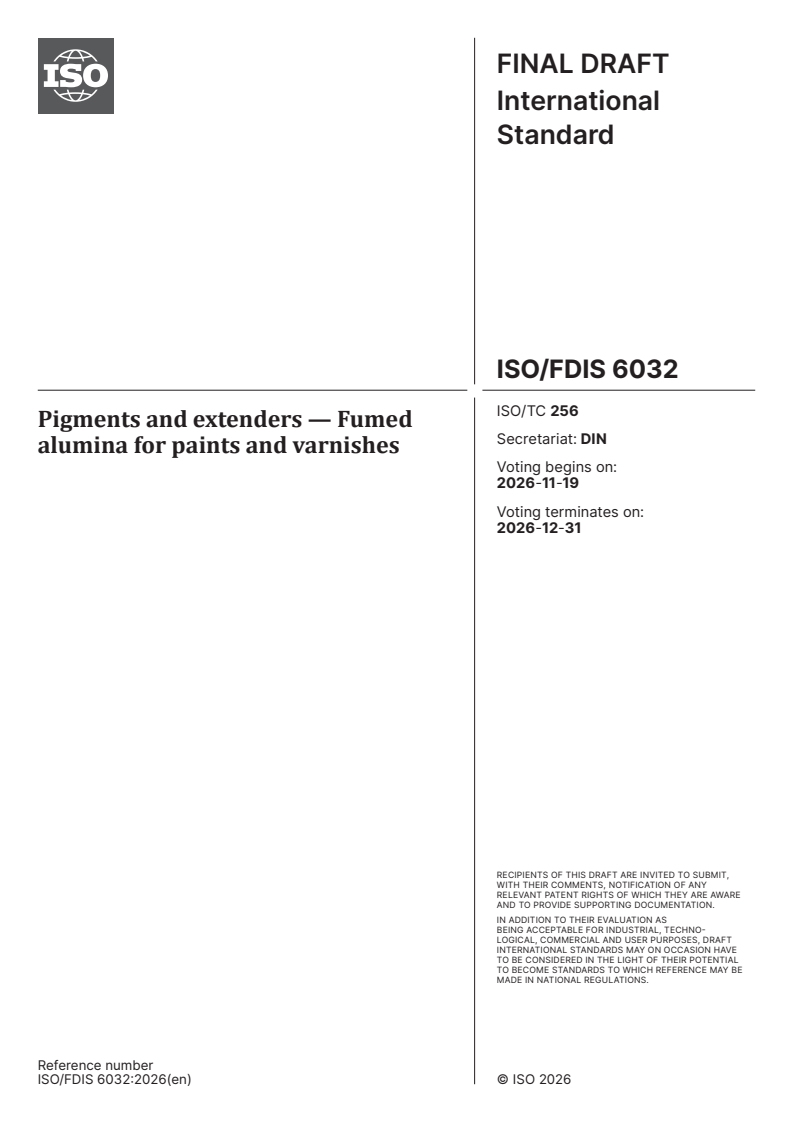
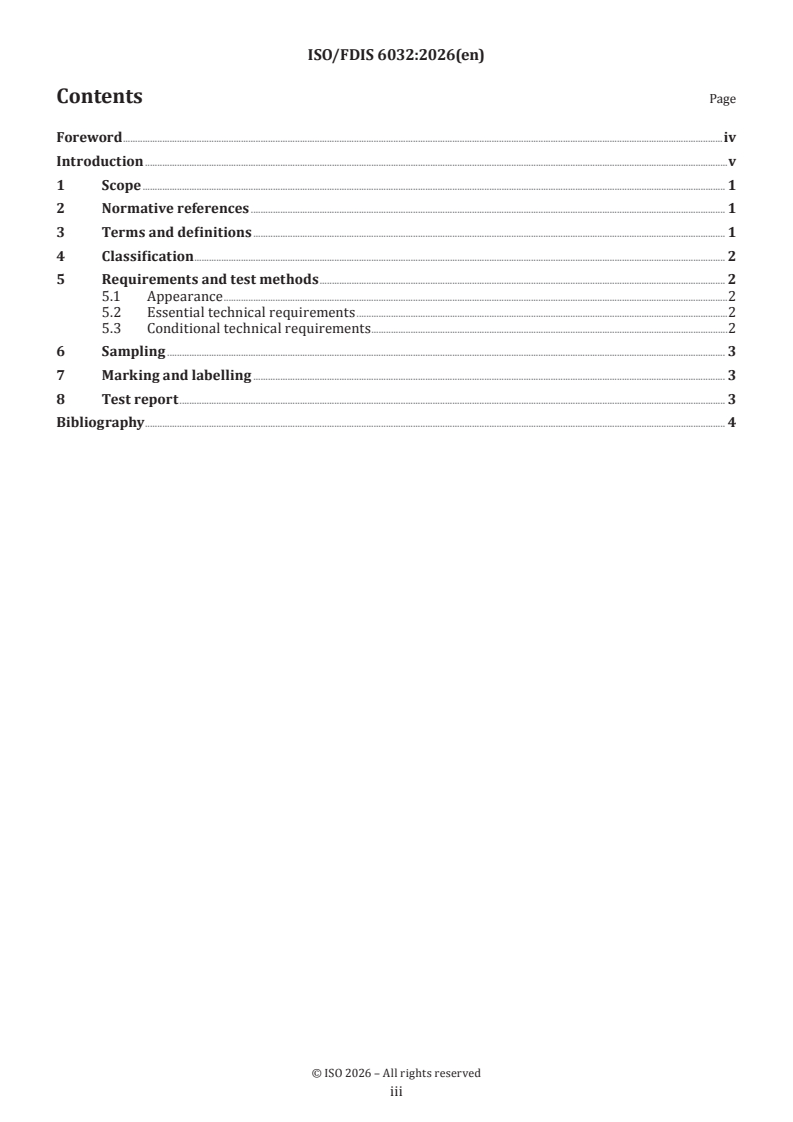
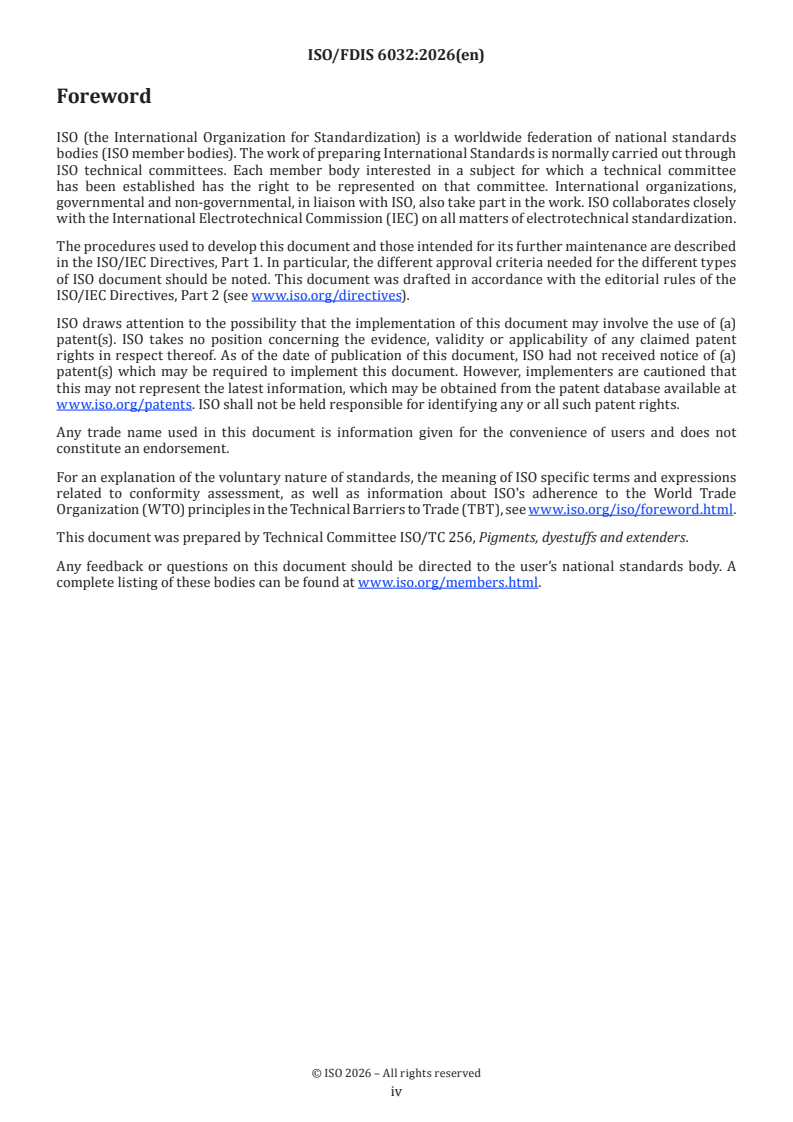
ISO/FDIS 6032 - Pigments and extenders — Fumed alumina for paints and varnishes

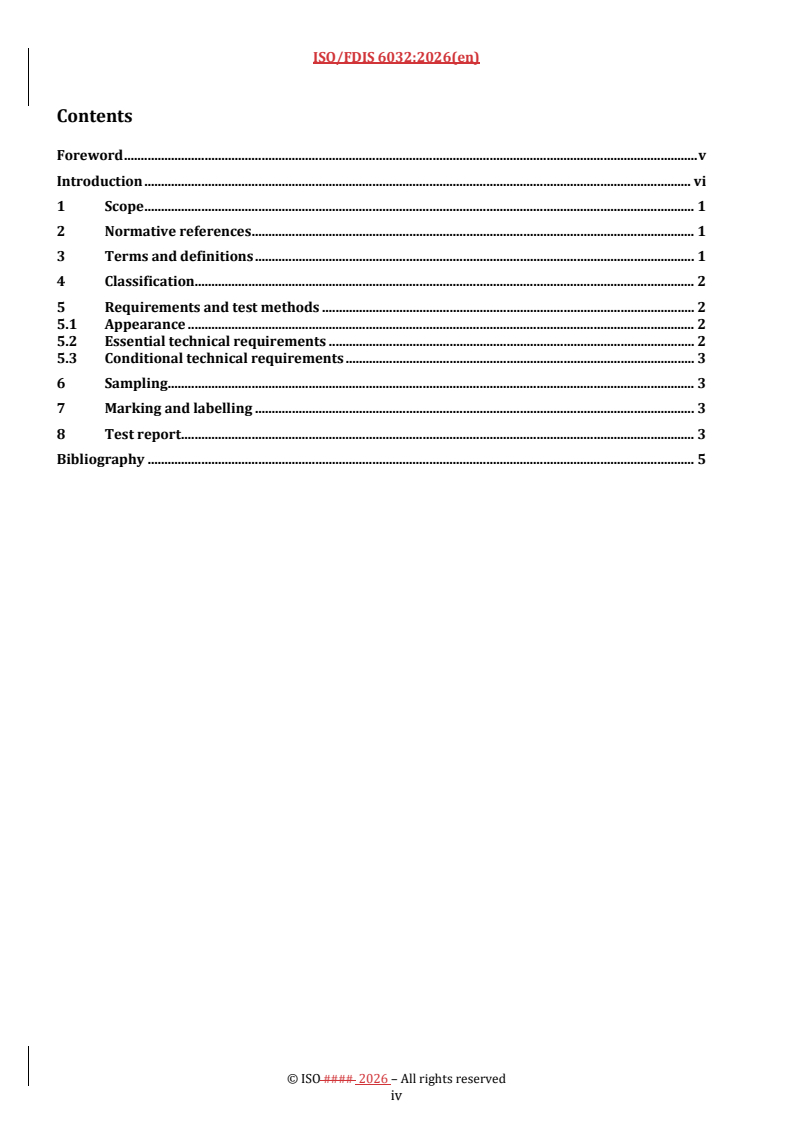
REDLINE ISO/FDIS 6032 - Pigments and extenders — Fumed alumina for paints and varnishes
ISO/FDIS 6032 is an ISO document on fumed alumina in powder form for paints and varnishes. It sets requirements, test methods, sampling, marking and test report content so manufacturers and users can describe and check the material in a consistent way.
What does ISO/FDIS 6032 specify?
ISO/FDIS 6032 specifies fumed alumina for use in paints and varnishes and organizes the subject in clauses 1 to 8. Clause 1 gives the scope, Clause 2 lists the referenced standards, Clause 3 gives terms and definitions, Clause 4 classifies the material, Clause 5 gives requirements and test methods, and Clauses 6 to 8 cover sampling, marking and labelling, and the test report.
The standard focuses on powder-form fumed alumina. In practice, that means it is aimed at material identification, routine quality checks, and the information that should accompany a tested batch.
What are the key requirements of ISO/FDIS 6032?
ISO/FDIS 6032 separates the material into hydrophilic and hydrophobic types and then gives different essential test limits for each. It also sets a second group of conditional checks that are used when the parties agree to apply them.
Classification and appearance
Clause 4 classifies fumed alumina as hydrophilic or hydrophobic according to whether it can be dispersed in water. Clause 5.1 says the material should appear as a white powder without visible impurities. In practice, this is the first quick check for identity and cleanliness before deeper testing.
Essential technical requirements
Clause 5.2 gives the core requirements for each type in Tables 1 and 2 and links each requirement to a test method. The main checks are matter volatile at 105 °C, pH value, specific surface area by the BET method, and residue on a 45 µm sieve. For users, these are the parameters that show whether the product is dry enough, chemically suitable, and within the intended particle-surface range for paint and varnish use.
For hydrophilic fumed alumina, the test suspension is water-based. For hydrophobic fumed alumina, the test uses an ethanol-water suspension. That difference matters because the dispersion medium changes how the material behaves during measurement.
Conditional technical requirements
Clause 5.3 lists additional properties that apply by agreement between the interested parties. These are apparent density after tamping, impurity content, particle size, and crystal structure. In practice, these checks help when a buyer or supplier needs a fuller specification for processing, storage, or performance.
Clause 5.3 also limits impurity reporting to the main elements Na, Ca, Fe, Zn and Cu. That makes the impurity result more useful for comparing lots and tracking contamination concerns.
Sampling, marking, and reporting
Clause 6 requires a representative sample in accordance with ISO 15528. Clause 7 requires clear outer-pack marking, including the manufacturer, product name, type, net weight, batch number or production date, and a “keep away from rain” mark. Clause 8 requires the test report to identify the product, cite ISO 6032, state the method used, give the results and pass/fail relation to the specification, record any agreed deviation, note anomalies, and give the test date.
What terms does ISO/FDIS 6032 define?
ISO/FDIS 6032 uses a small set of core terms that readers need to interpret the test requirements correctly.
- Fumed alumina - a nano-scale white powder made by high-temperature hydrolysis of aluminium chloride in a hydrogen-oxygen flame.
- Impurity - a metallic or non-metallic element present in the material that was not intentionally added.
- Hydrophilic - the type of fumed alumina that can be dispersed in water.
- Hydrophobic - the type of fumed alumina that cannot be dispersed in water.
- Specific surface area - the surface-area measure used in the requirements, determined by the BET method.
- BET - Brunauer-Emet-Teller, the method named in the standard for specific surface area measurement.
Who uses ISO/FDIS 6032?
ISO/FDIS 6032 is written for manufacturers and users of fumed alumina for paints and varnishes. It is also useful for testing and quality personnel who need a common basis for classifying the material, running the specified tests, preparing samples, and writing reports that others can compare directly. The introduction also says it helps interested parties communicate about requirements for high-performance paint and varnish formulations.
Which standards are used with ISO/FDIS 6032?
ISO/FDIS 6032 relies on several other ISO documents for test methods and terminology:
- ISO 787-2 - matter volatile at 105 °C.
- ISO 787-9 - pH value of an aqueous suspension.
- ISO 787-11 - tamped volume and apparent density after tamping.
- ISO 787-18 - residue on sieve by the mechanical flushing procedure.
- ISO 3169 - chemical analysis of impurities in aluminium oxide powders by ICP-OES.
- ISO 9277 - specific surface area by gas adsorption, using the BET method.
- ISO 13320 - particle size analysis by laser diffraction.
- ISO 15528 - sampling of paints, varnishes and raw materials.
- ISO 19950 - determination of alpha alumina content by X-ray diffraction net peak areas.
- ISO 18451-1 - general terminology for pigments, dyestuffs and extenders.
What does the ISO/FDIS 6032 document contain?
ISO/FDIS 6032 contains a short technical specification centered on Tables 1 to 3. Those tables assign the required property checks to each material type and point to the test methods used for routine verification and agreed additional testing.
The document also includes the basic handling and documentation parts needed in practice: representative sampling, outer-package marking, and the minimum test report content. The introduction explains why fumed alumina is used in paints and varnishes, including its role in optical behavior, surface effects, and performance-related properties.
Buy Documents
ISO/FDIS 6032 - Pigments and extenders — Fumed alumina for paints and varnishes
REDLINE ISO/FDIS 6032 - Pigments and extenders — Fumed alumina for paints and varnishes
Frequently Asked Questions
ISO/FDIS 6032 is a draft published by the International Organization for Standardization (ISO). Its full title is "Pigments and extenders — Fumed alumina for paints and varnishes". This standard covers: This document specifies requirements and corresponding methods of test for fumed alumina in powder form for paints and varnishes application.
This document specifies requirements and corresponding methods of test for fumed alumina in powder form for paints and varnishes application.
ISO/FDIS 6032 is classified under the following ICS (International Classification for Standards) categories: 87.060.10 - Pigments and extenders. The ICS classification helps identify the subject area and facilitates finding related standards.
ISO/FDIS 6032 is available in PDF format for immediate download after purchase. The document can be added to your cart and obtained through the secure checkout process. Digital delivery ensures instant access to the complete standard document.
Standards Content (Sample)
Contents
- Introduction
- 1 Scope
- 2 Normative references
- 3 Terms and definitions
- 3.1 fumed alumina
- 3.2 impurity
- 4 Classification
- 5 Requirements and test methods
- 5.1 Appearance
- 5.2 Essential technical requirements
- 5.3 Conditional technical requirements
- 6 Sampling
- 7 Marking and labelling
- 8 Test report
- Bibliography
Introduction
Fumed alumina is a nano-scale white powder produced by the high-temperature hydrolysis of aluminium chloride in a hydrogen-oxygen flame. It has special optical properties, which can reflect UV lights without influencing the visible light in fluorescent lamp coating. It has positive electricity on the surface, which can greatly increase the powder adsorption force and the powder loading rate. Adding a small amount of fumed alumina into paints, varnishes and powder coatings can improve corrosion resistance, wear resistance, and increase the powder flow rate and anti-blocking properties.
Fumed alumina is an important functional additive in the application of paints and varnishes. Both manufacturers and users can benefit from this document, which provides fumed alumina requirements in order to develop high-performance paints and varnishes. Furthermore, this document can also facilitate communication among interested parties.
FINAL DRAFT International Standard ISO/FDIS 6032:2026(en) Pigments and extenders — Fumed alumina for paints and varnishes
1 Scope
This document specifies requirements and corresponding methods of test for fumed alumina in powder form to be used in paints and varnishes.
...
Contents
- Introduction
- 1 Scope
- 2 Normative references
- 3 Terms and definitions
- 4 Classification
- 5 Requirements and test methods
- 5.1 Appearance
- 5.2 Essential technical requirements
- 5.3 Conditional technical requirements
- 6 Sampling
- 7 Marking and labelling
- 8 Test report
- Bibliography
Introduction
Fumed alumina is a nano-scale white powder produced by the high-temperature hydrolysis of aluminium chloride in a hydrogen-oxygen flame. It has special optical properties, which can reflect UV lights without influencing the visible light in fluorescent lamp coating. It has positive electricity on the surface, which can greatly increase the powder adsorption force and the powder loading rate. Adding a small amount of fumed alumina into paints, varnishes and powder coatings can improve corrosion resistance, wear resistance, and increase the powder flow rate and anti-blocking properties.
Fumed alumina is an important functional additive in the application of paints and varnishes. Both manufacturers and users require such acan benefit from this document, which provides fumed alumina requirements in order to develop high-performance paints and varnishes. Furthermore, this document can also facilitate communication among interested parties.
DRAFT International Standard ISO/DIS 6032:2026(en)
Pigments and extenders — Fumed alumina for paints and varnishes
1 Scope
This document specifies requirements and corresponding methods of test for fumed alumina in powder form to be used in paints and varnishes.
...