

ISO 9022-12:2015
(Main)Optics and photonics — Environmental test methods — Part 12: Contamination
General Information
- Abstract
ISO 9022-12:2015 specifies the methods relating to the environmental tests of optical instruments including additional assemblies from other fields (e.g. mechanical, chemical, and electronic devices), under equivalent conditions, for their ability to resist the influence of contamination, i.e. contact with corrosive chemical substances (hereafter called test agents). However, complete instruments or assemblies are only tested as specified in ISO 9022-12:2015 in exceptional cases. Normally, representative samples such as material items or surface coatings on representative substrates are used for testing. The tests described in ISO 9022-12:2015 are designed for the selection of materials and components for instruments likely to suffer contamination during service life, rather than for regular production control. The purpose of testing is to investigate the resistance of an instrument and, in particular, of instrument surfaces, coatings, or synthetic materials, to a short exposure to the test agents.
- Status
- Published
- Publication Date
- 24-Mar-2015
- Technical Committee
- ISO/TC 172/SC 1 - Fundamental standards
- Drafting Committee
- ISO/TC 172/SC 1/WG 3 - Environmental test methods
- Current Stage
- 9093 - International Standard confirmed
- Start Date
- 24-Oct-2025
- Completion Date
- 29-Aug-2026
Buy Documents

ISO 9022-12:2015 - Optics and photonics -- Environmental test methods
REDLINE ISO 9022-12:2015 - Optics and photonics -- Environmental test methods

ISO 9022-12:2015 - Optics and photonics — Environmental test methods — Part 12: Contamination/25/2015
REDLINE ISO 9022-12:2015 - Optics and photonics — Environmental test methods — Part 12: Contamination/25/2015
Overview
ISO 9022-12:2015 - "Optics and photonics - Environmental test methods - Part 12: Contamination" defines laboratory methods to evaluate the resistance of optical instruments, materials, surface coatings and synthetic components to contamination by corrosive chemical substances (test agents). The standard is focused on short‑term exposures used for materials selection and component qualification rather than routine production control. Complete instruments are tested only in exceptional cases; the norm normally uses representative samples or coated substrates to simulate likely service contamination.
Key topics and technical requirements
- Scope & purpose: Tests simulate contact with corrosive test agents to assess degradation of surfaces, coatings and synthetic materials and to support selection of resistant materials for optical systems.
- Specimens: Representative sample sheets or parts; coating application and thickness must match the intended instrument finish. Sample dimensions are specified for repeatability.
- Test pad (felt pad): Standardized felt pads drenched with test agent are the exposure medium. Key pad characteristics specified include:
- colour: white
- mass density: 0.25–0.30 g/cm³
- pH: 5–8 (measured per Annex A)
- thickness: 1 mm; diameter: 9 mm
- pads used once only
- Test arrangement: Pads are placed on specimens and weighted (approx. 43 g) to ensure contact; a PTFE capsule is used over the pad when test agents could attack the weight.
- Conditioning methods: The standard defines groups of test agents and severity levels, including:
- Method 86 - basic cosmetic substances and artificial hand sweat (degrees of severity with exposure times such as 1, 7, 30 days)
- Method 87 - laboratory agents (acids, solvents; varied dilution and exposure times)
- Method 88 - production plant resources (hydraulic, synthetic oils, etc.)
- Method 89 - fuels and resources for aircraft, naval and land vehicles
- Procedure & evaluation: Preconditioning, exposure sequence, recovery and acceptance criteria are defined; environmental test codes and reporting conventions are included. ISO 9022-1 is normatively referenced for ambient conditions and definitions.
Applications and users
- Materials engineers and coatings developers selecting corrosion‑resistant finishes for lenses, housings and mounts
- Optical and photonics manufacturers validating component compatibility with workplace contaminants (laboratory, industrial, aerospace environments)
- Environmental test laboratories performing standardized contamination exposure tests
- Quality assurance, procurement and design teams specifying environmental resilience in contracts and product specifications
Related standards
- ISO 9022‑1: Definitions and extent of testing (normative reference)
- Other ISO 9022 parts relevant to optics environmental testing: Parts 2, 3, 4, 6, 7, 8, 9, 11, 14, 17, 20, 22, 23 (see ISO 9022 series for complementary environmental tests)
Keywords: ISO 9022-12:2015, contamination testing, optics and photonics, environmental test methods, test agents, felt pad, material selection, surface coatings.
Relations
- Consolidated By
ISO 14050:2020 - Environmental management — Vocabulary - Effective Date
- 06-Jun-2022
- Effective Date
- 04-Oct-2014
Buy Documents
ISO 9022-12:2015 - Optics and photonics -- Environmental test methods
REDLINE ISO 9022-12:2015 - Optics and photonics -- Environmental test methods
ISO 9022-12:2015 - Optics and photonics — Environmental test methods — Part 12: Contamination/25/2015
REDLINE ISO 9022-12:2015 - Optics and photonics — Environmental test methods — Part 12: Contamination/25/2015
Frequently Asked Questions
ISO 9022-12:2015 is a standard published by the International Organization for Standardization (ISO). Its full title is "Optics and photonics — Environmental test methods — Part 12: Contamination". This standard covers: ISO 9022-12:2015 specifies the methods relating to the environmental tests of optical instruments including additional assemblies from other fields (e.g. mechanical, chemical, and electronic devices), under equivalent conditions, for their ability to resist the influence of contamination, i.e. contact with corrosive chemical substances (hereafter called test agents). However, complete instruments or assemblies are only tested as specified in ISO 9022-12:2015 in exceptional cases. Normally, representative samples such as material items or surface coatings on representative substrates are used for testing. The tests described in ISO 9022-12:2015 are designed for the selection of materials and components for instruments likely to suffer contamination during service life, rather than for regular production control. The purpose of testing is to investigate the resistance of an instrument and, in particular, of instrument surfaces, coatings, or synthetic materials, to a short exposure to the test agents.
ISO 9022-12:2015 specifies the methods relating to the environmental tests of optical instruments including additional assemblies from other fields (e.g. mechanical, chemical, and electronic devices), under equivalent conditions, for their ability to resist the influence of contamination, i.e. contact with corrosive chemical substances (hereafter called test agents). However, complete instruments or assemblies are only tested as specified in ISO 9022-12:2015 in exceptional cases. Normally, representative samples such as material items or surface coatings on representative substrates are used for testing. The tests described in ISO 9022-12:2015 are designed for the selection of materials and components for instruments likely to suffer contamination during service life, rather than for regular production control. The purpose of testing is to investigate the resistance of an instrument and, in particular, of instrument surfaces, coatings, or synthetic materials, to a short exposure to the test agents.
ISO 9022-12:2015 is classified under the following ICS (International Classification for Standards) categories: 37.020 - Optical equipment. The ICS classification helps identify the subject area and facilitates finding related standards.
ISO 9022-12:2015 has the following relationships with other standards: It is inter standard links to ISO 14050:2020, ISO 9022-12:1994. Understanding these relationships helps ensure you are using the most current and applicable version of the standard.
ISO 9022-12:2015 is available in PDF format for immediate download after purchase. The document can be added to your cart and obtained through the secure checkout process. Digital delivery ensures instant access to the complete standard document.
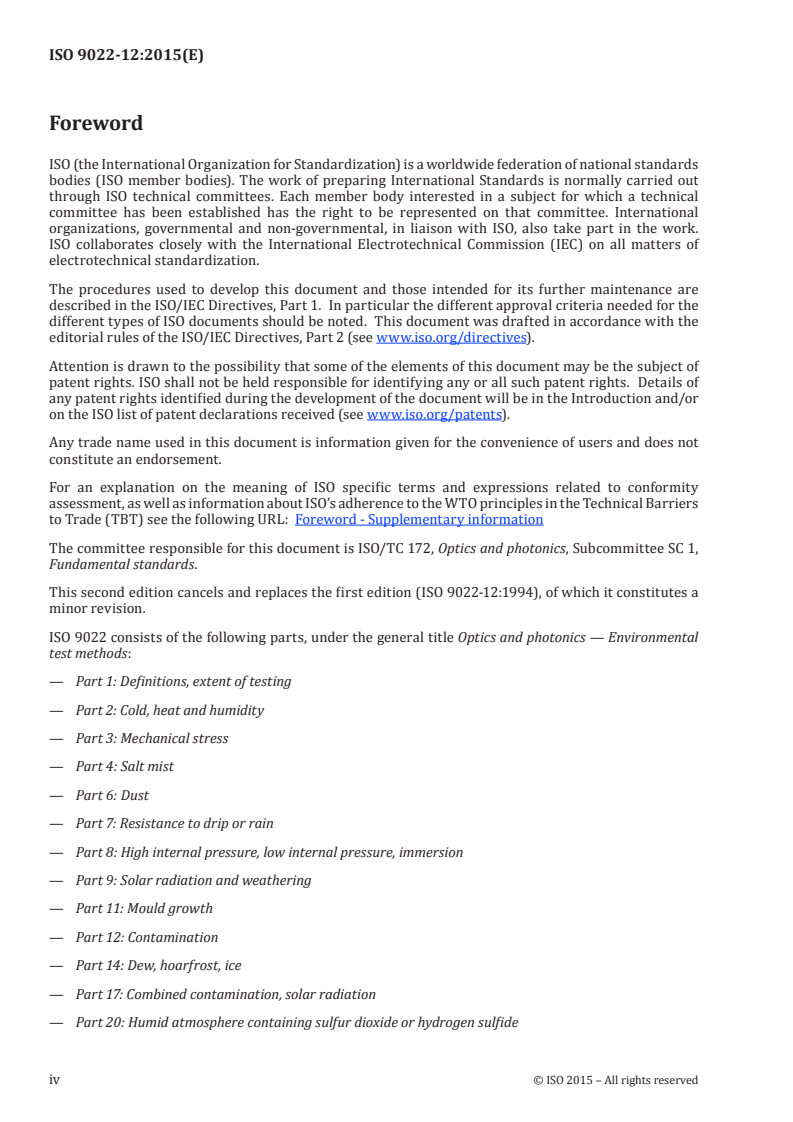
Standards Content (Sample)
INTERNATIONAL ISO
STANDARD 9022-12
Second edition
2015-04-01
Optics and photonics —
Environmental test methods —
Part 12:
Contamination
Optique et photonique — Méthodes d’essais d’environnement —
Partie 12: Contamination
Reference number
©
ISO 2015
© ISO 2015
All rights reserved. Unless otherwise specified, no part of this publication may be reproduced or utilized otherwise in any form
or by any means, electronic or mechanical, including photocopying, or posting on the internet or an intranet, without prior
written permission. Permission can be requested from either ISO at the address below or ISO’s member body in the country of
the requester.
ISO copyright office
Case postale 56 • CH-1211 Geneva 20
Tel. + 41 22 749 01 11
Fax + 41 22 749 09 47
E-mail copyright@iso.org
Web www.iso.org
Published in Switzerland
ii © ISO 2015 – All rights reserved
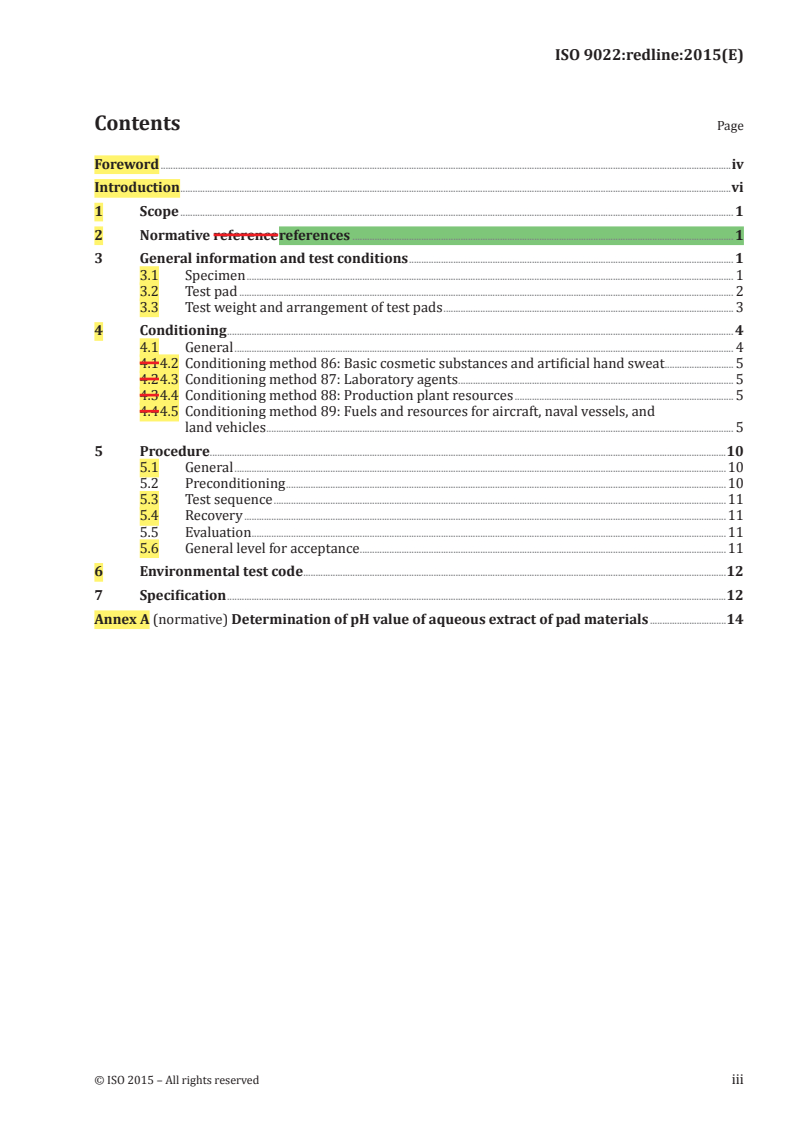
Contents Page
Foreword .iv
Introduction .vi
1 Scope . 1
2 Normative references . 1
3 General information and test conditions . 1
3.1 Specimen . 1
3.2 Test pad . 2
3.3 Test weight and arrangement of test pads . 3
4 Conditioning . 4
4.1 General . 4
4.2 Conditioning method 86: Basic cosmetic substances and artificial hand sweat . 4
4.3 Conditioning method 87: Laboratory agents . 4
4.4 Conditioning method 88: Production plant resources . 4
4.5 Conditioning method 89: Fuels and resources for aircraft, naval vessels, and
land vehicles . 4
5 Procedure. 7
5.1 General . 7
5.2 Preconditioning . 7
5.3 Test sequence . 8
5.4 Recovery . 8
5.5 Evaluation . 8
5.6 General level for acceptance . 8
6 Environmental test code . 9
7 Specification . 9
Annex A (normative) Determination of pH value of aqueous extract of pad materials .10
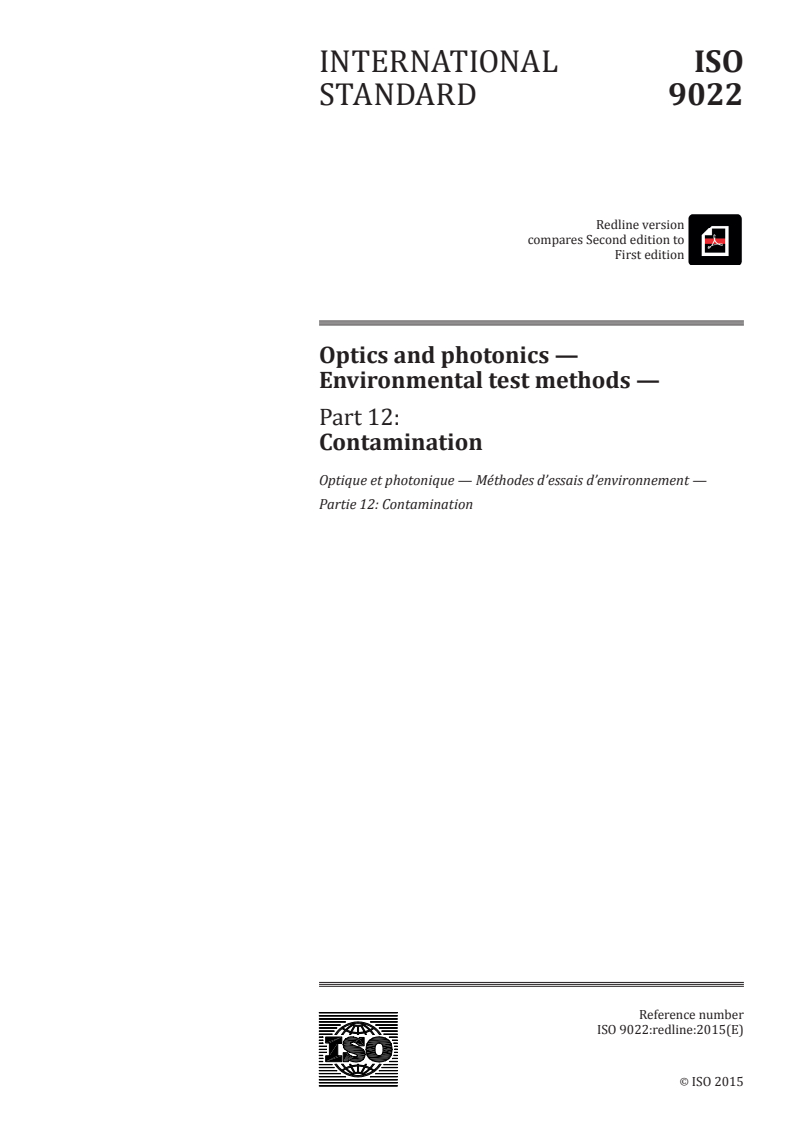
Foreword
ISO (the International Organization for Standardization) is a worldwide federation of national standards
bodies (ISO member bodies). The work of preparing International Standards is normally carried out
through ISO technical committees. Each member body interested in a subject for which a technical
committee has been established has the right to be represented on that committee. International
organizations, governmental and non-governmental, in liaison with ISO, also take part in the work.
ISO collaborates closely with the International Electrotechnical Commission (IEC) on all matters of
electrotechnical standardization.
The procedures used to develop this document and those intended for its further maintenance are
described in the ISO/IEC Directives, Part 1. In particular the different approval criteria needed for the
different types of ISO documents should be noted. This document was drafted in accordance with the
editorial rules of the ISO/IEC Directives, Part 2 (see www.iso.org/directives).
Attention is drawn to the possibility that some of the elements of this document may be the subject of
patent rights. ISO shall not be held responsible for identifying any or all such patent rights. Details of
any patent rights identified during the development of the document will be in the Introduction and/or
on the ISO list of patent declarations received (see www.iso.org/patents).
Any trade name used in this document is information given for the convenience of users and does not
constitute an endorsement.
For an explanation on the meaning of ISO specific terms and expressions related to conformity
assessment, as well as information about ISO’s adherence to the WTO principles in the Technical Barriers
to Trade (TBT) see the following URL: Foreword - Supplementary information
The committee responsible for this document is ISO/TC 172, Optics and photonics, Subcommittee SC 1,
Fundamental standards.
This second edition cancels and replaces the first edition (ISO 9022-12:1994), of which it constitutes a
minor revision.
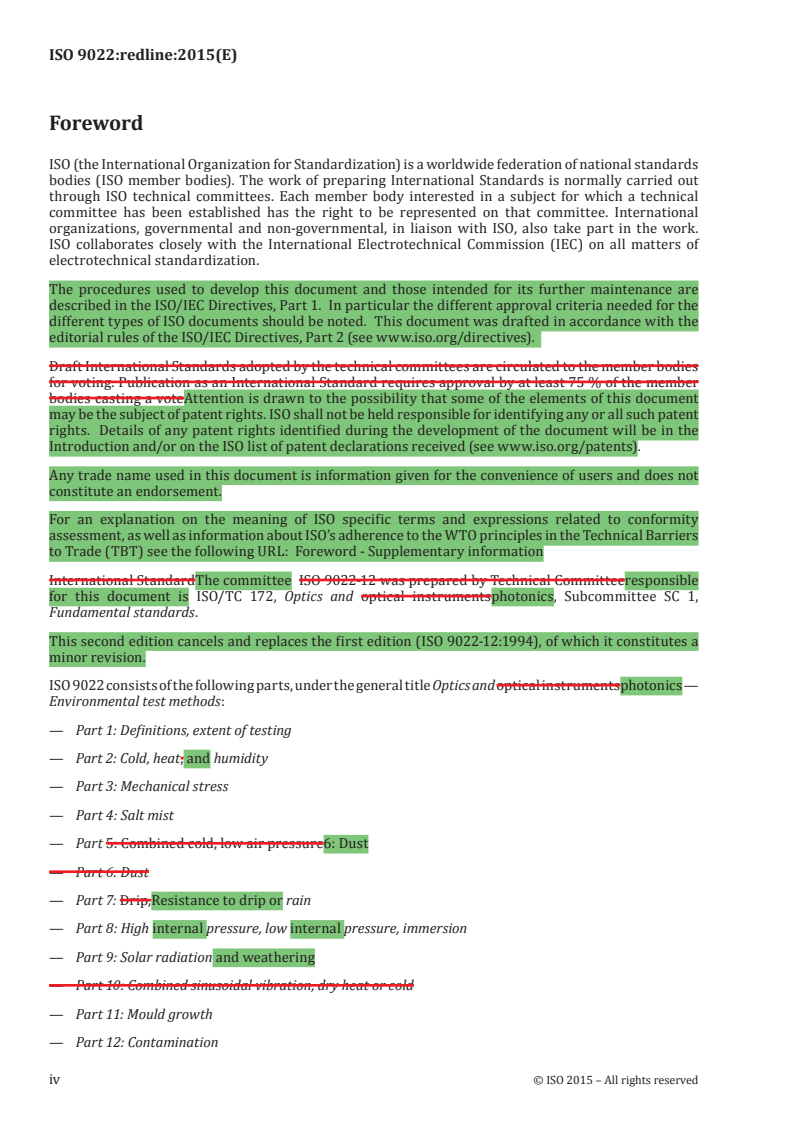
ISO 9022 consists of the following parts, under the general title Optics and photonics — Environmental
test methods:
— Part 1: Definitions, extent of testing
— Part 2: Cold, heat and humidity
— Part 3: Mechanical stress
— Part 4: Salt mist
— Part 6: Dust
— Part 7: Resistance to drip or rain
— Part 8: High internal pressure, low internal pressure, immersion
— Part 9: Solar radiation and weathering
— Part 11: Mould growth
— Part 12: Contamination
— Part 14: Dew, hoarfrost, ice
— Part 17: Combined contamination, solar radiation
— Part 20: Humid atmosphere containing sulfur dioxide or hydrogen sulfide
iv © ISO 2015 – All rights reserved
— Part 22: Combined cold, dry heat or temperature change with bump or random vibration
— Part 23: Low pressure combined with cold, ambient temperature and dry and damp heat
Introduction
Optical instruments are affected during their use by a number of different environmental parameters
which they are required to resist without significant reduction in performance and to remain within
defined specifications.
The type and severity of these parameters depend on the conditions of use of the instrument (for
example, in the laboratory or workshop) and on its geographical location. The environmental effects
on optical instrument performance in the tropics and subtropics are totally different from those found
when they are used in arctic regions. Individual parameters cause a variety of different and overlapping
effects on instrument performance.
The manufacturer attempts to ensure, and the user naturally expects, that instruments will resist the
likely rigours of their environment throughout their life. This expectation can be assessed by exposure
of the instrument to a range of simulated environmental parameters under controlled laboratory
conditions. The severity of these conditions is often increased to obtain meaningful results in a relatively
short period of time.
In order to allow assessment and comparison of the response of optical instruments to appropriate
environmental conditions, ISO 9022 contains details of a number of laboratory tests which reliably
simulate a variety of different environments. The tests are based largely on IEC standards, modified
where necessary to take into account features special to optical instruments.
As a result of continuous progress in all fields, optical instruments are no longer only precision-
engineered optical products, but, depending on their range of application, also contain additional
assemblies from other fields. For this reason, the principal function of the instrument is to be assessed to
determine which International Standard should be used for testing. If the optical function is of primary
importance, then ISO 9022 is applicable, but if other functions take precedence then the appropriate
International Standard in the field concerned should be applied. Cases can arise where application of
both ISO 9022 and other appropriate International Standards will be necessary.
vi © ISO 2015 – All rights reserved
INTERNATIONAL STANDARD ISO 9022-12:2015(E)
Optics and photonics — Environmental test methods —
Part 12:
Contamination
1 Scope
This part of ISO 9022 specifies the methods relating to the environmental tests of optical instruments
including additional assemblies from other fields (e.g. mechanical, chemical, and electronic devices),
under equivalent conditions, for their ability to resist the influence of contamination, i.e. contact with
1)
corrosive chemical substances (hereafter called test agents).
However, complete instruments or assemblies are only tested as specified in this part of ISO 9022 in
exceptional cases (see 5.3). Normally, representative samples such as material items or surface coatings
on representative substrates are used for testing.
The tests described in this part of ISO 9022 are designed for the selection of materials and components
for instruments likely to suffer contamination during service life, rather than for regular production
control.
The purpose of testing is to investigate the resistance of an instrument and, in particular, of instrument
surfaces, coatings, or synthetic materials, to a short exposure to the test agents.
2 Normative references
The following documents, in whole or in part, are normatively referenced in this document and are
indispensable for its application. For dated references, only the edition cited applies. For undated
references, the latest edition of the referenced document (including any amendments) applies.
ISO 9022-1, Optics and photonics — Environmental test methods — Part 1: Definitions, extent of testing
3 General information and test conditions
The test shall be conducted under ambient atmospheric conditions in accordance with ISO 9022-1.
The test agents listed from each conditioning method (Clause 4) represent different chemical groups.
3.1 Specimen
Unless the testing of complete instruments or assemblies is required in the relevant specification,
representative samples shall be used for testing. Representative sample sheets of at least 1 mm thickness
and having dimensions as shown in Figure 1 shall be used as substrates for the testing of non-metallic
coatings.
NOTE Sample sheets of 140 mm ± 2 mm or 280 mm ± 2 mm in length can also be specified in the relevant
specification.
1) Another possible source of service contamination to which optical instruments can be exposed is radioactive
elements and isotopes, and hazardous chemical substances (e.g. 2:2-dichlorodiethysulfide). However, as these
materials may only be handled, used for testing, and stored by special, officially approved laboratories, they were
not used as test reagents.
Dimensions in millimetres
Key
1 marking area (on the back)
a 210 ± 2 (280 ± 2)
b 95 ± 5 (140 ± 2)
Figure 1 — Sample sheet
Coatings to be tested shall be of the same structure as the coating intended for the instrument or for
parts of the instrument.
Prior to applying the coating, prepare the surface of the sample sheet in the same manner as required
for the original instrument. The coating shall completely surround the sample sheet so as to cover,
particularly, edges, corners, and edges of holes. The coating shall not be degraded by identification
marking; numbers, etc. shall be punched prior to applying the coating.
Particular care shall be taken to apply the coating in such a manner that the dry film will meet the
thickness required for the instrument with a tolerance of ± 5 µm. The specimens shall be protected from
contamination until commencement of the tests.
If sample sheets as shown in Figure 1 are not available, as level a surface as possible of representative
instrument parts shall be used as test areas for testing synthetic materials. Where such surfaces are not
sufficient in size to support the test pad (3.2), the specimen shall be half immersed in the test agent in
order to permit testing under the required conditions.
3.2 Test pad
Felt pads having the following characteristics and dren
...
INTERNATIONAL ISO
STANDARD 9022
Redline version
compares Second edition to
First edition
Optics and photonics —
Environmental test methods —
Part 12:
Contamination
Optique et photonique — Méthodes d’essais d’environnement —
Partie 12: Contamination
Reference number
ISO 9022:redline:2015(E)
©
ISO 2015
ISO 9022:redline:2015(E)
IMPORTANT — PLEASE NOTE
This is a mark-up copy and uses the following colour coding:
Text example 1 — indicates added text (in green)
Text example 2 — indicates removed text (in red)
— indicates added graphic figure
— indicates removed graphic figure
1.x . — Heading numbers containg modifications are highlighted in yellow in
the Table of Contents
DISCLAIMER
This Redline version provides you with a quick and easy way to compare the main changes
between this edition of the standard and its previous edition. It doesn’t capture all single
changes such as punctuation but highlights the modifications providing customers with
the most valuable information. Therefore it is important to note that this Redline version is
not the official ISO standard and that the users must consult with the clean version of the
standard, which is the official standard, for implementation purposes.
© ISO 2015
All rights reserved. Unless otherwise specified, no part of this publication may be reproduced or utilized otherwise in any form
or by any means, electronic or mechanical, including photocopying, or posting on the internet or an intranet, without prior
written permission. Permission can be requested from either ISO at the address below or ISO’s member body in the country of
the requester.
ISO copyright office
Case postale 56 • CH-1211 Geneva 20
Tel. + 41 22 749 01 11
Fax + 41 22 749 09 47
E-mail copyright@iso.org
Web www.iso.org
Published in Switzerland
ii © ISO 2015 – All rights reserved
ISO 9022:redline:2015(E)
Contents Page
Foreword .iv
Introduction .vi
1 Scope . 1
2 Normative reference references . 1
3 General information and test conditions . 1
3.1 Specimen . 1
3.2 Test pad . 2
3.3 Test weight and arrangement of test pads . 3
4 Conditioning . 4
4.1 General . 4
4.1 4.2 Conditioning method 86: Basic cosmetic substances and artificial hand sweat . 5
4.2 4.3 Conditioning method 87: Laboratory agents . 5
4.3 4.4 Conditioning method 88: Production plant resources . 5
4.4 4.5 Conditioning method 89: Fuels and resources for aircraft, naval vessels, and
land vehicles . 5
5 Procedure.10
5.1 General .10
5.2 Preconditioning .10
5.3 Test sequence .11
5.4 Recovery .11
5.5 Evaluation .11
5.6 General level for acceptance .11
6 Environmental test code .12
7 Specification .12
Annex A (normative) Determination of pH value of aqueous extract of pad materials .14
ISO 9022:redline:2015(E)
Foreword
ISO (the International Organization for Standardization) is a worldwide federation of national standards
bodies (ISO member bodies). The work of preparing International Standards is normally carried out
through ISO technical committees. Each member body interested in a subject for which a technical
committee has been established has the right to be represented on that committee. International
organizations, governmental and non-governmental, in liaison with ISO, also take part in the work.
ISO collaborates closely with the International Electrotechnical Commission (IEC) on all matters of
electrotechnical standardization.
The procedures used to develop this document and those intended for its further maintenance are
described in the ISO/IEC Directives, Part 1. In particular the different approval criteria needed for the
different types of ISO documents should be noted. This document was drafted in accordance with the
editorial rules of the ISO/IEC Directives, Part 2 (see www.iso.org/directives).
Draft International Standards adopted by the technical committees are circulated to the member bodies
for voting. Publication as an International Standard requires approval by at least 75 % of the member
bodies casting a voteAttention is drawn to the possibility that some of the elements of this document
may be the subject of patent rights. ISO shall not be held responsible for identifying any or all such patent
rights. Details of any patent rights identified during the development of the document will be in the
Introduction and/or on the ISO list of patent declarations received (see www.iso.org/patents).
Any trade name used in this document is information given for the convenience of users and does not
constitute an endorsement.
For an explanation on the meaning of ISO specific terms and expressions related to conformity
assessment, as well as information about ISO’s adherence to the WTO principles in the Technical Barriers
to Trade (TBT) see the following URL: Foreword - Supplementary information
International StandardThe committee ISO 9022-12 was prepared by Technical Committeeresponsible
for this document is ISO/TC 172, Optics and optical instrumentsphotonics, Subcommittee SC 1,
Fundamental standards.
This second edition cancels and replaces the first edition (ISO 9022-12:1994), of which it constitutes a
minor revision.
ISO 9022 consists of the following parts, under the general title Optics and optical instrumentsphotonics —
Environmental test methods:
— Part 1: Definitions, extent of testing
— Part 2: Cold, heat, and humidity
— Part 3: Mechanical stress
— Part 4: Salt mist
— Part 5: Combined cold, low air pressure6: Dust
— Part 6: Dust
— Part 7: Drip,Resistance to drip or rain
— Part 8: High internal pressure, low internal pressure, immersion
— Part 9: Solar radiation and weathering
— Part 10: Combined sinusoidal vibration, dry heat or cold
— Part 11: Mould growth
— Part 12: Contamination
iv © ISO 2015 – All rights reserved
ISO 9022:redline:2015(E)
— Part 13: Combined shock, bump or free fall, dry heat or cold
— Part 14: Dew, hoarfrost, ice
— Part 15: Combined random vibration wide band: reproducibility medium, in dry heat or cold
— Part 16: Combined bounce or steady-state acceleration, in dry heat or cold
— Part 17: Combined contamination, solar radiation
— Part 18: Combined damp heat and low internal pressure20: Humid atmosphere containing sulfur
dioxide or hydrogen sulfide
— Part 19: Temperature cycles combined with sinusoidal22: Combined cold, dry heat or temperature
change with bump or random vibration
— Part 20: Humid atmosphere containing sulfur dioxide or hydrogen sulfide23: Low pressure combined
with cold, ambient temperature and dry and damp heat
Annex A forms an integral part of this part of ISO 9022.
ISO 9022:redline:2015(E)
Introduction
Optical instruments are affected during their use by a number of different environmental parameters
which they are required to resist without significant reduction in performance and to remain within
defined specifications.
The type and severity of these parameters depend on the conditions of use of the instrument (for example,
in the laboratory or workshop) and on its geographical location. The environmental effects on optical
instrument performance in the tropics and subtropics are totally different from those found when they
are used in the arctic regions. Individual parameters cause a variety of different and overlapping effects
on instrument performance.
The manufacturer attempts to ensure, and the user naturally expects, that instruments will resist the
likely rigours of their environment throughout their life. This expectation can be assessed by exposure
of the instrument to a range of simulated environmental parameters under controlled laboratory
conditions. The severity of these conditions is often increased to obtain meaningful results in a relatively
short period of time.
In order to allow assessment and comparison of the response of optical instruments to appropriate
environmental conditions, ISO 9022 contains details of a number of laboratory tests which reliably
simulate a variety of different environments. The tests are based largely on IEC standards, modified
where necessary to take into account features special to optical instruments.
It should be noted that, asAs a result of continuous progress in all fields, optical instruments are no
longer only precision-engineered optical products, but, depending on their range of application, also
contain additional assemblies from other fields. For this reason, the principal function of the instrument
mustis to be assessed to determine which International Standard should be used for testing. If the
optical function is of primary importance, then ISO 9022ISO 9022 is applicable, but if other functions
take precedence then the appropriate International Standard in the field concerned should be applied.
Cases maycan arise where application of both ISO 9022ISO 9022 and other appropriate International
Standards will be necessary.
vi © ISO 2015 – All rights reserved
INTERNATIONAL STANDARD ISO 9022:redline:2015(E)
Optics and photonics — Environmental test methods —
Part 12:
Contamination
1 Scope
This part of ISO 9022 specifies methods for the testingthe methods relating to the environmental tests
of optical instruments and instruments containing optical componentsincluding additional assemblies
from other fields (e.g. mechanical, chemical, and electronic devices), under equivalent conditions, for
their ability to resist the influence of contamination, i.e. contact with corrosive chemical substances
1)
(hereafter called test agents).
However, complete instruments or assemblies are only tested as specified in this part of ISO 9022 in
exceptional cases (see 5.3). Normally, representative samples such as material items or surface coatings
on representative substrates are used for testing.
The tests described in this part of ISO 9022 are designed for the selection of materials and components for
instruments likely to suffer contamination during service life, rather than for regular production control.
The purpose of testing is to investigate the resistance of an instrument and, in particular, of instrument
surfaces, coatings, or synthetic materials, to a short exposure to the test agents.
2 Normative reference references
The following standard contains provisions which, through reference in this text, constitute provisions
of this part of documents, in whole or in part, are normatively referenced in this document and are
indispensable for its applicationISO 9022. At the time of publication, the edition indicated was valid. All
standards are subject to revision, and parties to agreements based on this part ofFor dated references,
only the edition cited applies. For undated references, ISO 9022 are encouraged to investigate the
possibility of applying the most recentthe latest edition of the standard indicated below. Members of IEC
and ISO maintain registers of currently valid International Standardsreferenced document (including
any amendments) applies.
2)
ISO 9022-1:1994 , Optics and optical instruments photonics — Environmental test methods — Part 1:
Definitions, extent of testing.
3 General information and test conditions
The test shall be conducted under ambient atmospheric conditions in accordance with ISO 9022-1.
The test agents listed from each conditioning method (Clause 4) represent different chemical groups.
3.1 Specimen
Unless the testing of complete instruments or assemblies is required in the relevant specification,
representative samples shall be used for testing. Representative materialssample sheets of at least
1) Another possible source of service contamination to which optical instruments can be exposed is radioactive
elements and isotopes, and hazardous chemical substances (e.g. 2:2-dichlorodiethysulfide). However, as these
materials may only be handled, used for testing, and stored by special, officially approved laboratories, they were
not used as test reagents.
2) To be published.
ISO 9022:redline:2015(E)
1 mm thickness and having dimensions as shown in Figure 1 shall be used as substrates for the testing
of non-metallic coatings.
NOTE 1 Sample sheets of 140 mm ± 2 mm or 280 mm ± 2 mm in length maycan also be specified in the relevant
specification.
Dimensions in millimetres
Key
1 marking area (on the back)
a 210 ± 2 (280 ± 2)
b 95 ± 5 (140 ± 2)
Figure 1 — Sample sheet
Coatings to be tested shall be of the same structure as the coating intended for the instrument or for
parts of the instrument.
Prior to applying the coating, prepare the surface of the specimensample sheet in the same manner as
required for the original instrument. The coating shall completely surround the specimensample sheet
so as to cover, particularly, edges, corners, and edges of holes. The coating shall not be degraded by
identification marking; numbers, etc. shall be punched prior to applying the coating.
Particular care shall be taken to apply the coating in such a manner that the dry film will meet the
thickness required for the instrument with a tolerance of ± 5 μmµm. The specimens shall be protected
from contamination until commencement of the tests.
If specimenssample sheets as shown in Figure 1 are not available, as level a surface as possible of
representative instrument parts shall be used as test areas for testing synthetic materials. Where such
surfaces are not sufficient in size to support the test pad (3.2), the specimen shall be half immersed in
the test agent in order to permit testing under the required conditions.
3.2 Test pad
Felt pads having the following characteristics and drenched with test agent shall be used as test media:
colour: white
colour: white
2 © ISO 2015 – All rights reserved
ISO 9022:redline:2015(E)
3 3
mass density: 0,25 g/cm to 0,30 g/cm
pH: 5 to 8 (for measurement, see Annex A)
thickness: 1 mm
diameter 9 mm
3 3
mass density: 0,25 g/cm to 0,30 g/cm
pH: 5 to 8 (for measurement, see annex A)
thickness: 1 mm
diameter: 9 mm
The felt pads shall be used only once.
Figure 1 — Sample sheet
3.3 Test weight and arrangement of test pads
For the duration of the test, the felt pad, drenched in test agent, shall be weighted by means of a high-
grade steel (e.g. X 5 CrNi 18 9 or X 5 CeNi 18 10) weight as shown in Figure 2.
Dimensions in millimetres
⌀20
⌀8
⌀1
Tolerances
Dimension Tolerance
0,5 to 6 ± 0,1
> 6 to 30 ± 0,2
± 0,3
> 30 to 120
⌀10
⌀13
Key
1 specimen
2 drenched felt pad
0,9
ISO 9022:redline:2015(E)
3 weight approx. 43 g
Figure 2 — Weight and test arrangement
Where corrosive agents (such as concentrated acids or acids developing corrosive vapour) capable of
attacking the weight are used for testing, the test pad shall be covered with a polytetrafluoroethylene
(PTFE) capsule as shown in Figure 3 before placing the weight on it.
Figure 2 — Weight and test arrangement
Figure 3 — Capsule
Normally, up to 21 test pads can be placed on a specimen with dimensions as shown in Figure 1,
...
INTERNATIONAL ISO
STANDARD 9022-12
Second edition
2015-04-01
Optics and photonics —
Environmental test methods —
Part 12:
Contamination
Optique et photonique — Méthodes d’essais d’environnement —
Partie 12: Contamination
Reference number
©
ISO 2015
© ISO 2015
All rights reserved. Unless otherwise specified, no part of this publication may be reproduced or utilized otherwise in any form
or by any means, electronic or mechanical, including photocopying, or posting on the internet or an intranet, without prior
written permission. Permission can be requested from either ISO at the address below or ISO’s member body in the country of
the requester.
ISO copyright office
Case postale 56 • CH-1211 Geneva 20
Tel. + 41 22 749 01 11
Fax + 41 22 749 09 47
E-mail copyright@iso.org
Web www.iso.org
Published in Switzerland
ii © ISO 2015 – All rights reserved
Contents Page
Foreword .iv
Introduction .vi
1 Scope . 1
2 Normative references . 1
3 General information and test conditions . 1
3.1 Specimen . 1
3.2 Test pad . 2
3.3 Test weight and arrangement of test pads . 3
4 Conditioning . 4
4.1 General . 4
4.2 Conditioning method 86: Basic cosmetic substances and artificial hand sweat . 4
4.3 Conditioning method 87: Laboratory agents . 4
4.4 Conditioning method 88: Production plant resources . 4
4.5 Conditioning method 89: Fuels and resources for aircraft, naval vessels, and
land vehicles . 4
5 Procedure. 7
5.1 General . 7
5.2 Preconditioning . 7
5.3 Test sequence . 8
5.4 Recovery . 8
5.5 Evaluation . 8
5.6 General level for acceptance . 8
6 Environmental test code . 9
7 Specification . 9
Annex A (normative) Determination of pH value of aqueous extract of pad materials .10
Foreword
ISO (the International Organization for Standardization) is a worldwide federation of national standards
bodies (ISO member bodies). The work of preparing International Standards is normally carried out
through ISO technical committees. Each member body interested in a subject for which a technical
committee has been established has the right to be represented on that committee. International
organizations, governmental and non-governmental, in liaison with ISO, also take part in the work.
ISO collaborates closely with the International Electrotechnical Commission (IEC) on all matters of
electrotechnical standardization.
The procedures used to develop this document and those intended for its further maintenance are
described in the ISO/IEC Directives, Part 1. In particular the different approval criteria needed for the
different types of ISO documents should be noted. This document was drafted in accordance with the
editorial rules of the ISO/IEC Directives, Part 2 (see www.iso.org/directives).
Attention is drawn to the possibility that some of the elements of this document may be the subject of
patent rights. ISO shall not be held responsible for identifying any or all such patent rights. Details of
any patent rights identified during the development of the document will be in the Introduction and/or
on the ISO list of patent declarations received (see www.iso.org/patents).
Any trade name used in this document is information given for the convenience of users and does not
constitute an endorsement.
For an explanation on the meaning of ISO specific terms and expressions related to conformity
assessment, as well as information about ISO’s adherence to the WTO principles in the Technical Barriers
to Trade (TBT) see the following URL: Foreword - Supplementary information
The committee responsible for this document is ISO/TC 172, Optics and photonics, Subcommittee SC 1,
Fundamental standards.
This second edition cancels and replaces the first edition (ISO 9022-12:1994), of which it constitutes a
minor revision.
ISO 9022 consists of the following parts, under the general title Optics and photonics — Environmental
test methods:
— Part 1: Definitions, extent of testing
— Part 2: Cold, heat and humidity
— Part 3: Mechanical stress
— Part 4: Salt mist
— Part 6: Dust
— Part 7: Resistance to drip or rain
— Part 8: High internal pressure, low internal pressure, immersion
— Part 9: Solar radiation and weathering
— Part 11: Mould growth
— Part 12: Contamination
— Part 14: Dew, hoarfrost, ice
— Part 17: Combined contamination, solar radiation
— Part 20: Humid atmosphere containing sulfur dioxide or hydrogen sulfide
iv © ISO 2015 – All rights reserved
— Part 22: Combined cold, dry heat or temperature change with bump or random vibration
— Part 23: Low pressure combined with cold, ambient temperature and dry and damp heat
Introduction
Optical instruments are affected during their use by a number of different environmental parameters
which they are required to resist without significant reduction in performance and to remain within
defined specifications.
The type and severity of these parameters depend on the conditions of use of the instrument (for
example, in the laboratory or workshop) and on its geographical location. The environmental effects
on optical instrument performance in the tropics and subtropics are totally different from those found
when they are used in arctic regions. Individual parameters cause a variety of different and overlapping
effects on instrument performance.
The manufacturer attempts to ensure, and the user naturally expects, that instruments will resist the
likely rigours of their environment throughout their life. This expectation can be assessed by exposure
of the instrument to a range of simulated environmental parameters under controlled laboratory
conditions. The severity of these conditions is often increased to obtain meaningful results in a relatively
short period of time.
In order to allow assessment and comparison of the response of optical instruments to appropriate
environmental conditions, ISO 9022 contains details of a number of laboratory tests which reliably
simulate a variety of different environments. The tests are based largely on IEC standards, modified
where necessary to take into account features special to optical instruments.
As a result of continuous progress in all fields, optical instruments are no longer only precision-
engineered optical products, but, depending on their range of application, also contain additional
assemblies from other fields. For this reason, the principal function of the instrument is to be assessed to
determine which International Standard should be used for testing. If the optical function is of primary
importance, then ISO 9022 is applicable, but if other functions take precedence then the appropriate
International Standard in the field concerned should be applied. Cases can arise where application of
both ISO 9022 and other appropriate International Standards will be necessary.
vi © ISO 2015 – All rights reserved
INTERNATIONAL STANDARD ISO 9022-12:2015(E)
Optics and photonics — Environmental test methods —
Part 12:
Contamination
1 Scope
This part of ISO 9022 specifies the methods relating to the environmental tests of optical instruments
including additional assemblies from other fields (e.g. mechanical, chemical, and electronic devices),
under equivalent conditions, for their ability to resist the influence of contamination, i.e. contact with
1)
corrosive chemical substances (hereafter called test agents).
However, complete instruments or assemblies are only tested as specified in this part of ISO 9022 in
exceptional cases (see 5.3). Normally, representative samples such as material items or surface coatings
on representative substrates are used for testing.
The tests described in this part of ISO 9022 are designed for the selection of materials and components
for instruments likely to suffer contamination during service life, rather than for regular production
control.
The purpose of testing is to investigate the resistance of an instrument and, in particular, of instrument
surfaces, coatings, or synthetic materials, to a short exposure to the test agents.
2 Normative references
The following documents, in whole or in part, are normatively referenced in this document and are
indispensable for its application. For dated references, only the edition cited applies. For undated
references, the latest edition of the referenced document (including any amendments) applies.
ISO 9022-1, Optics and photonics — Environmental test methods — Part 1: Definitions, extent of testing
3 General information and test conditions
The test shall be conducted under ambient atmospheric conditions in accordance with ISO 9022-1.
The test agents listed from each conditioning method (Clause 4) represent different chemical groups.
3.1 Specimen
Unless the testing of complete instruments or assemblies is required in the relevant specification,
representative samples shall be used for testing. Representative sample sheets of at least 1 mm thickness
and having dimensions as shown in Figure 1 shall be used as substrates for the testing of non-metallic
coatings.
NOTE Sample sheets of 140 mm ± 2 mm or 280 mm ± 2 mm in length can also be specified in the relevant
specification.
1) Another possible source of service contamination to which optical instruments can be exposed is radioactive
elements and isotopes, and hazardous chemical substances (e.g. 2:2-dichlorodiethysulfide). However, as these
materials may only be handled, used for testing, and stored by special, officially approved laboratories, they were
not used as test reagents.
Dimensions in millimetres
Key
1 marking area (on the back)
a 210 ± 2 (280 ± 2)
b 95 ± 5 (140 ± 2)
Figure 1 — Sample sheet
Coatings to be tested shall be of the same structure as the coating intended for the instrument or for
parts of the instrument.
Prior to applying the coating, prepare the surface of the sample sheet in the same manner as required
for the original instrument. The coating shall completely surround the sample sheet so as to cover,
particularly, edges, corners, and edges of holes. The coating shall not be degraded by identification
marking; numbers, etc. shall be punched prior to applying the coating.
Particular care shall be taken to apply the coating in such a manner that the dry film will meet the
thickness required for the instrument with a tolerance of ± 5 µm. The specimens shall be protected from
contamination until commencement of the tests.
If sample sheets as shown in Figure 1 are not available, as level a surface as possible of representative
instrument parts shall be used as test areas for testing synthetic materials. Where such surfaces are not
sufficient in size to support the test pad (3.2), the specimen shall be half immersed in the test agent in
order to permit testing under the required conditions.
3.2 Test pad
Felt pads having the following characteristics and dren
...
INTERNATIONAL ISO
STANDARD 9022
Redline version
compares Second edition to
First edition
Optics and photonics —
Environmental test methods —
Part 12:
Contamination
Optique et photonique — Méthodes d’essais d’environnement —
Partie 12: Contamination
Reference number
ISO 9022:redline:2015(E)
©
ISO 2015
ISO 9022:redline:2015(E)
IMPORTANT — PLEASE NOTE
This is a mark-up copy and uses the following colour coding:
Text example 1 — indicates added text (in green)
Text example 2 — indicates removed text (in red)
— indicates added graphic figure
— indicates removed graphic figure
1.x . — Heading numbers containg modifications are highlighted in yellow in
the Table of Contents
DISCLAIMER
This Redline version provides you with a quick and easy way to compare the main changes
between this edition of the standard and its previous edition. It doesn’t capture all single
changes such as punctuation but highlights the modifications providing customers with
the most valuable information. Therefore it is important to note that this Redline version is
not the official ISO standard and that the users must consult with the clean version of the
standard, which is the official standard, for implementation purposes.
© ISO 2015
All rights reserved. Unless otherwise specified, no part of this publication may be reproduced or utilized otherwise in any form
or by any means, electronic or mechanical, including photocopying, or posting on the internet or an intranet, without prior
written permission. Permission can be requested from either ISO at the address below or ISO’s member body in the country of
the requester.
ISO copyright office
Case postale 56 • CH-1211 Geneva 20
Tel. + 41 22 749 01 11
Fax + 41 22 749 09 47
E-mail copyright@iso.org
Web www.iso.org
Published in Switzerland
ii © ISO 2015 – All rights reserved
ISO 9022:redline:2015(E)
Contents Page
Foreword .iv
Introduction .vi
1 Scope . 1
2 Normative reference references . 1
3 General information and test conditions . 1
3.1 Specimen . 1
3.2 Test pad . 2
3.3 Test weight and arrangement of test pads . 3
4 Conditioning . 4
4.1 General . 4
4.1 4.2 Conditioning method 86: Basic cosmetic substances and artificial hand sweat . 5
4.2 4.3 Conditioning method 87: Laboratory agents . 5
4.3 4.4 Conditioning method 88: Production plant resources . 5
4.4 4.5 Conditioning method 89: Fuels and resources for aircraft, naval vessels, and
land vehicles . 5
5 Procedure.10
5.1 General .10
5.2 Preconditioning .10
5.3 Test sequence .11
5.4 Recovery .11
5.5 Evaluation .11
5.6 General level for acceptance .11
6 Environmental test code .12
7 Specification .12
Annex A (normative) Determination of pH value of aqueous extract of pad materials .14
ISO 9022:redline:2015(E)
Foreword
ISO (the International Organization for Standardization) is a worldwide federation of national standards
bodies (ISO member bodies). The work of preparing International Standards is normally carried out
through ISO technical committees. Each member body interested in a subject for which a technical
committee has been established has the right to be represented on that committee. International
organizations, governmental and non-governmental, in liaison with ISO, also take part in the work.
ISO collaborates closely with the International Electrotechnical Commission (IEC) on all matters of
electrotechnical standardization.
The procedures used to develop this document and those intended for its further maintenance are
described in the ISO/IEC Directives, Part 1. In particular the different approval criteria needed for the
different types of ISO documents should be noted. This document was drafted in accordance with the
editorial rules of the ISO/IEC Directives, Part 2 (see www.iso.org/directives).
Draft International Standards adopted by the technical committees are circulated to the member bodies
for voting. Publication as an International Standard requires approval by at least 75 % of the member
bodies casting a voteAttention is drawn to the possibility that some of the elements of this document
may be the subject of patent rights. ISO shall not be held responsible for identifying any or all such patent
rights. Details of any patent rights identified during the development of the document will be in the
Introduction and/or on the ISO list of patent declarations received (see www.iso.org/patents).
Any trade name used in this document is information given for the convenience of users and does not
constitute an endorsement.
For an explanation on the meaning of ISO specific terms and expressions related to conformity
assessment, as well as information about ISO’s adherence to the WTO principles in the Technical Barriers
to Trade (TBT) see the following URL: Foreword - Supplementary information
International StandardThe committee ISO 9022-12 was prepared by Technical Committeeresponsible
for this document is ISO/TC 172, Optics and optical instrumentsphotonics, Subcommittee SC 1,
Fundamental standards.
This second edition cancels and replaces the first edition (ISO 9022-12:1994), of which it constitutes a
minor revision.
ISO 9022 consists of the following parts, under the general title Optics and optical instrumentsphotonics —
Environmental test methods:
— Part 1: Definitions, extent of testing
— Part 2: Cold, heat, and humidity
— Part 3: Mechanical stress
— Part 4: Salt mist
— Part 5: Combined cold, low air pressure6: Dust
— Part 6: Dust
— Part 7: Drip,Resistance to drip or rain
— Part 8: High internal pressure, low internal pressure, immersion
— Part 9: Solar radiation and weathering
— Part 10: Combined sinusoidal vibration, dry heat or cold
— Part 11: Mould growth
— Part 12: Contamination
iv © ISO 2015 – All rights reserved
ISO 9022:redline:2015(E)
— Part 13: Combined shock, bump or free fall, dry heat or cold
— Part 14: Dew, hoarfrost, ice
— Part 15: Combined random vibration wide band: reproducibility medium, in dry heat or cold
— Part 16: Combined bounce or steady-state acceleration, in dry heat or cold
— Part 17: Combined contamination, solar radiation
— Part 18: Combined damp heat and low internal pressure20: Humid atmosphere containing sulfur
dioxide or hydrogen sulfide
— Part 19: Temperature cycles combined with sinusoidal22: Combined cold, dry heat or temperature
change with bump or random vibration
— Part 20: Humid atmosphere containing sulfur dioxide or hydrogen sulfide23: Low pressure combined
with cold, ambient temperature and dry and damp heat
Annex A forms an integral part of this part of ISO 9022.
ISO 9022:redline:2015(E)
Introduction
Optical instruments are affected during their use by a number of different environmental parameters
which they are required to resist without significant reduction in performance and to remain within
defined specifications.
The type and severity of these parameters depend on the conditions of use of the instrument (for example,
in the laboratory or workshop) and on its geographical location. The environmental effects on optical
instrument performance in the tropics and subtropics are totally different from those found when they
are used in the arctic regions. Individual parameters cause a variety of different and overlapping effects
on instrument performance.
The manufacturer attempts to ensure, and the user naturally expects, that instruments will resist the
likely rigours of their environment throughout their life. This expectation can be assessed by exposure
of the instrument to a range of simulated environmental parameters under controlled laboratory
conditions. The severity of these conditions is often increased to obtain meaningful results in a relatively
short period of time.
In order to allow assessment and comparison of the response of optical instruments to appropriate
environmental conditions, ISO 9022 contains details of a number of laboratory tests which reliably
simulate a variety of different environments. The tests are based largely on IEC standards, modified
where necessary to take into account features special to optical instruments.
It should be noted that, asAs a result of continuous progress in all fields, optical instruments are no
longer only precision-engineered optical products, but, depending on their range of application, also
contain additional assemblies from other fields. For this reason, the principal function of the instrument
mustis to be assessed to determine which International Standard should be used for testing. If the
optical function is of primary importance, then ISO 9022ISO 9022 is applicable, but if other functions
take precedence then the appropriate International Standard in the field concerned should be applied.
Cases maycan arise where application of both ISO 9022ISO 9022 and other appropriate International
Standards will be necessary.
vi © ISO 2015 – All rights reserved
INTERNATIONAL STANDARD ISO 9022:redline:2015(E)
Optics and photonics — Environmental test methods —
Part 12:
Contamination
1 Scope
This part of ISO 9022 specifies methods for the testingthe methods relating to the environmental tests
of optical instruments and instruments containing optical componentsincluding additional assemblies
from other fields (e.g. mechanical, chemical, and electronic devices), under equivalent conditions, for
their ability to resist the influence of contamination, i.e. contact with corrosive chemical substances
1)
(hereafter called test agents).
However, complete instruments or assemblies are only tested as specified in this part of ISO 9022 in
exceptional cases (see 5.3). Normally, representative samples such as material items or surface coatings
on representative substrates are used for testing.
The tests described in this part of ISO 9022 are designed for the selection of materials and components for
instruments likely to suffer contamination during service life, rather than for regular production control.
The purpose of testing is to investigate the resistance of an instrument and, in particular, of instrument
surfaces, coatings, or synthetic materials, to a short exposure to the test agents.
2 Normative reference references
The following standard contains provisions which, through reference in this text, constitute provisions
of this part of documents, in whole or in part, are normatively referenced in this document and are
indispensable for its applicationISO 9022. At the time of publication, the edition indicated was valid. All
standards are subject to revision, and parties to agreements based on this part ofFor dated references,
only the edition cited applies. For undated references, ISO 9022 are encouraged to investigate the
possibility of applying the most recentthe latest edition of the standard indicated below. Members of IEC
and ISO maintain registers of currently valid International Standardsreferenced document (including
any amendments) applies.
2)
ISO 9022-1:1994 , Optics and optical instruments photonics — Environmental test methods — Part 1:
Definitions, extent of testing.
3 General information and test conditions
The test shall be conducted under ambient atmospheric conditions in accordance with ISO 9022-1.
The test agents listed from each conditioning method (Clause 4) represent different chemical groups.
3.1 Specimen
Unless the testing of complete instruments or assemblies is required in the relevant specification,
representative samples shall be used for testing. Representative materialssample sheets of at least
1) Another possible source of service contamination to which optical instruments can be exposed is radioactive
elements and isotopes, and hazardous chemical substances (e.g. 2:2-dichlorodiethysulfide). However, as these
materials may only be handled, used for testing, and stored by special, officially approved laboratories, they were
not used as test reagents.
2) To be published.
ISO 9022:redline:2015(E)
1 mm thickness and having dimensions as shown in Figure 1 shall be used as substrates for the testing
of non-metallic coatings.
NOTE 1 Sample sheets of 140 mm ± 2 mm or 280 mm ± 2 mm in length maycan also be specified in the relevant
specification.
Dimensions in millimetres
Key
1 marking area (on the back)
a 210 ± 2 (280 ± 2)
b 95 ± 5 (140 ± 2)
Figure 1 — Sample sheet
Coatings to be tested shall be of the same structure as the coating intended for the instrument or for
parts of the instrument.
Prior to applying the coating, prepare the surface of the specimensample sheet in the same manner as
required for the original instrument. The coating shall completely surround the specimensample sheet
so as to cover, particularly, edges, corners, and edges of holes. The coating shall not be degraded by
identification marking; numbers, etc. shall be punched prior to applying the coating.
Particular care shall be taken to apply the coating in such a manner that the dry film will meet the
thickness required for the instrument with a tolerance of ± 5 μmµm. The specimens shall be protected
from contamination until commencement of the tests.
If specimenssample sheets as shown in Figure 1 are not available, as level a surface as possible of
representative instrument parts shall be used as test areas for testing synthetic materials. Where such
surfaces are not sufficient in size to support the test pad (3.2), the specimen shall be half immersed in
the test agent in order to permit testing under the required conditions.
3.2 Test pad
Felt pads having the following characteristics and drenched with test agent shall be used as test media:
colour: white
colour: white
2 © ISO 2015 – All rights reserved
ISO 9022:redline:2015(E)
3 3
mass density: 0,25 g/cm to 0,30 g/cm
pH: 5 to 8 (for measurement, see Annex A)
thickness: 1 mm
diameter 9 mm
3 3
mass density: 0,25 g/cm to 0,30 g/cm
pH: 5 to 8 (for measurement, see annex A)
thickness: 1 mm
diameter: 9 mm
The felt pads shall be used only once.
Figure 1 — Sample sheet
3.3 Test weight and arrangement of test pads
For the duration of the test, the felt pad, drenched in test agent, shall be weighted by means of a high-
grade steel (e.g. X 5 CrNi 18 9 or X 5 CeNi 18 10) weight as shown in Figure 2.
Dimensions in millimetres
⌀20
⌀8
⌀1
Tolerances
Dimension Tolerance
0,5 to 6 ± 0,1
> 6 to 30 ± 0,2
± 0,3
> 30 to 120
⌀10
⌀13
Key
1 specimen
2 drenched felt pad
0,9
ISO 9022:redline:2015(E)
3 weight approx. 43 g
Figure 2 — Weight and test arrangement
Where corrosive agents (such as concentrated acids or acids developing corrosive vapour) capable of
attacking the weight are used for testing, the test pad shall be covered with a polytetrafluoroethylene
(PTFE) capsule as shown in Figure 3 before placing the weight on it.
Figure 2 — Weight and test arrangement
Figure 3 — Capsule
Normally, up to 21 test pads can be placed on a specimen with dimensions as shown in Figure 1,
...