

ISO/FDIS 15686-2
(Main)Buildings and civil engineering works — Service life planning — Part 2: Process considerations
- Abstract
This International Standard identifies and establishes process considerations for service life planning and a systematic framework for undertaking service life planning of a planned building or construction work throughout its life cycle (or remaining life cycle for existing buildings or construction works). The life cycle incorporates initiation, project definition, design, construction, commissioning, operation, maintenance, refurbishment, replacement, deconstruction and ultimate disposal, recycling or re-use of the asset (or parts thereof), including its components, systems and building services. This International Standard is applicable to the service life planning of individual buildings. A series of service life plans, developed in accordance with this International Standard, can be used as input data to the strategic property management of a number of buildings.
- Status
- Not Published
- Technical Committee
- ISO/TC 59/SC 14 - Design life
- Drafting Committee
- ISO/TC 59/SC 14 - Design life
- Current Stage
- 5020 - FDIS ballot initiated: 2 months. Proof sent to secretariat
- Start Date
- 01-Oct-2026
- Completion Date
- 01-Oct-2026
Buy Documents


ISO/FDIS 15686-2 - Buildings and civil engineering works — Service life planning — Part 2: Process considerations
REDLINE ISO/FDIS 15686-2 - Buildings and civil engineering works — Service life planning — Part 2: Process considerations
ISO/FDIS 15686-2 is an ISO standard from ISO on service life planning for buildings and civil engineering works. It sets out the process considerations for planning, estimating, predicting and reviewing service life over the life cycle of a constructed asset, for the people who define requirements, design, build, maintain, assess and manage the asset.
What does ISO/FDIS 15686-2 specify?
ISO/FDIS 15686-2 specifies how to plan for service life across the life cycle of a building or construction work, and how to use design life, reference service-life data and service life estimates in that process. It is written for planned assets and for existing assets when only the remaining life cycle is being considered.
The scope covers a wide range of holdings, from a portfolio to a single building, a facility within a building, or part of a network of constructed assets. It also applies to a broad set of stakeholders, from owners and managers to occupants and other users.
The document is organized into these main parts:
- Clause 1 - Scope
- Clause 2 - Normative references
- Clause 3 - Terms and definitions
- Clause 4 - Service life planning - requirements and design
- Clause 5 - Service life predictions and estimates
- Clause 6 - Service life performance reviews
- Annex A (informative) - Service life review reports
Annex A supports the review process with report guidance and review stages.
What are the key requirements of ISO/FDIS 15686-2?
ISO/FDIS 15686-2 requires service life planning to be tied to the intended use and operating environment of the asset, and to the maintenance, replacement and repair actions that may be needed over time. In practice, that means the client and design team must set a realistic life objective early and carry it through design, construction and operation.
Design life has to be defined early
Clause 4.1 says the client shall define the design life in the initial brief, and may also specify it for specific assets. The standard gives design life categories for whole buildings and for components or assemblies, including short term, replaceable, maintainable and lifelong parts.
This matters because different parts of the same asset may not have the same expected duration. The design should show which items are intended to be replaced, which can be maintained, and which should last for the full building life.
Component life and asset life have to be reconciled
Clause 4.2 requires the design life of the asset to be determined from available knowledge of the predicted service life of each component and the proposed operating conditions. If a component is expected to last less than the asset design life, the client and responsible parties have to agree how performance will be maintained, or the design life requirement has to be adjusted.
In practice, this means maintenance and replacement planning is part of design, not an afterthought. The person responsible also has to keep records of the data sources used and check that the evidence is robust enough for the decision.
Performance criteria and consequences of failure have to be considered
Clause 4.2 requires the appropriate performance criteria and the data needed to demonstrate compliance to be identified as part of design. It also requires the consequences of failure to be considered where relevant.
That is particularly important for assets that present health and safety risks, cannot be inspected easily for degradation, or are not practical to replace. For those assets, the design life may need to match the life of the building or constructed asset.
Service life predictions must follow a structured process
Clause 5.1 says a predicted service life distribution of a component (PSLDC) shall be determined using the systematic approach in ISO 15686-3, including identification of information, test procedures, testing, interpretation and reporting. The PSLDC is generally described by an expectation value and a standard deviation.
The standard also allows a single predicted service life of a component (PSLC) by agreement with the client where testing is very costly or time-consuming. The practical point is that the level of certainty in the result has to be clear, along with the assumptions and constraints behind it.
Reference service-life data have to be selected and documented carefully
Clause 5.2 says an estimated service life (ESL) is obtained by modifying a reference service life (RSL) for the object-specific in-use conditions. RSL data records have to include the RSL value, the reference in-use conditions, critical properties, performance requirements and data quality.
The standard gives examples of suitable sources such as manufacturer information, national codes, technical approval bodies, databases and empirical data from practice. Data should be rejected if significant degradation agents are missing or if the assumed performance requirements differ too much from the object being assessed.
The factor method is one accepted way to estimate service life
Clause 5.4 says the factor method shall be used to obtain an ESL by modifying an RSL for differences between reference and object-specific in-use conditions. The seven factor categories are component quality, design, installation, external environment, internal environment, usage and maintenance.
The method can be used as a checklist or with multiplication by factors A to G. The choice of level depends on the purpose of the estimate, the quality of the data, the expertise of the user and the time and resources available.
Residual service life has to reflect current condition and current demands
Clause 5.5 says a residual service life estimate may be prepared during the service life of the asset. It has to take account of the current condition, the anticipated operating conditions and any changes in performance requirements since the original design.
This is the part of the standard that supports condition-led decisions about repair, replacement or continued use. It links the estimate to the actual state of the asset, not just the original design assumptions.
Service life reviews need a structured and proportionate process
Clause 6 sets out a six-stage service life review process and says the review should be proportionate to the criticality and risk of the item being reviewed. The review covers scope and aims, the asset boundary, service life information, service life factors, the evidence review and the report.
In practice, that means the reviewer focuses effort on the components that matter most - for example items with major safety, operational or cost consequences, items exposed to special hazards, or innovative items with limited track record.
What terms does ISO/FDIS 15686-2 define?
ISO/FDIS 15686-2 defines key review and planning terms used in the service life process.
- Service life performance review - a systematic second-party examination of requirements, design proposals and instructions to judge whether they are adequate for service life performance.
- Terminal critical property - the property that first fails to meet its performance requirement in a given service environment.
- Life care - the measures that support achievement of the design life, including cleaning, maintenance, repair, refurbishment, protection and control of use.
- Performance over time - a description of how a critical property changes with time.
- Pre-briefing - the earliest project stage when the need for construction, site suitability and feasibility are assessed.
- Predicted service life distribution - the probability distribution function of the predicted service life of a component.
Who uses ISO/FDIS 15686-2?
ISO/FDIS 15686-2 is intended primarily for people who need to set, assess or manage service life information. The introduction names owners and users, design, construction and facilities or asset management teams, maintainers, value appraisers, insurers, technical auditors, developers of construction product standards, clients, funders, sponsors, regulators, and users of reference service life data for EPD’s, LCA or LCC.
That makes the standard relevant when someone has to decide what service life to specify, what evidence is acceptable, how to document assumptions, or how to review whether an asset is likely to perform as intended.
What changed in ISO/FDIS 15686-2 from the previous edition?
ISO/FDIS 15686-2 is identified as the third edition, and the foreword states that, together with ISO 15686-1:- and ISO 15686-3:-, it cancels and replaces ISO 15686-1:2011, ISO 15686-2:2012, ISO 15686-3:2002, ISO 15686-4:2014, ISO 15686-8:2008, ISO/TS 15686-9:2008 and ISO 15686-10:2010.
The stated changes are that the relationship to the revised text in ISO 15686-1:- and ISO 15686-3:- and to former and retained parts of the series is shown, and that this part now describes the processes for performance audits and reviews, reference service life and estimation, and some service life prediction processes, while the detailed methodology is handled in ISO 15686-3:-.
Which standards are used with ISO/FDIS 15686-2?
ISO/FDIS 15686-2 relies on these referenced and companion standards:
- ISO 6707-1 - provides vocabulary for buildings and civil engineering works.
- ISO 15686-1 - gives the general principles and framework for service life planning.
- ISO 15686-3 - covers methods, data and communication, including the detailed methodology behind predictions and the factor method.
- ISO 15686-7:2017 - provides performance evaluation for feedback from service life data from practice, including condition surveys and residual service life support.
- ISO 15686-5 - is named as the part dealing with life-cycle costing.
- ISO 15686-7:2017, Annex A - is cited for environmental classification and assessment of microenvironments.
What does the ISO/FDIS 15686-2 document contain?
ISO/FDIS 15686-2 contains tables, figures and procedures that turn service life planning into a structured workflow. Table 1 and Table 2 set out design life categories for assets and components, Table 3 gives a hierarchy of constructed assets, Table 4 defines types of service life, Table 5 links service life sources to methods, and Table 6 shows common service life metrics.
The document also includes Figure 1 for data selection, Figure 2 for deterioration and service life distribution, and Figure 3 for the six-stage review process. Annex A gives suggested report headings and review stages across the asset life cycle, which is useful when the output has to support design decisions, audits, handover, operation, refurbishment or disposal.
Relations
- Effective Date
- 22-Oct-2022
- Effective Date
- 22-Oct-2022
- Effective Date
- 22-Oct-2022
- Effective Date
- 22-Oct-2022
- Effective Date
- 22-Oct-2022
- Effective Date
- 22-Oct-2022
- Effective Date
- 22-Oct-2022
Buy Documents
ISO/FDIS 15686-2 - Buildings and civil engineering works — Service life planning — Part 2: Process considerations
REDLINE ISO/FDIS 15686-2 - Buildings and civil engineering works — Service life planning — Part 2: Process considerations
Get Certified
Connect with accredited certification bodies for this standard

DIBt (Deutsches Institut für Bautechnik)
German Institute for Building Technology.
DIN CERTCO
DIN Group product certification.

Aboma Certification B.V.
Specialized in construction, metal, and transport sectors.
Sponsored listings
Frequently Asked Questions
ISO/FDIS 15686-2 is a draft published by the International Organization for Standardization (ISO). Its full title is "Buildings and civil engineering works — Service life planning — Part 2: Process considerations". This standard covers: This International Standard identifies and establishes process considerations for service life planning and a systematic framework for undertaking service life planning of a planned building or construction work throughout its life cycle (or remaining life cycle for existing buildings or construction works). The life cycle incorporates initiation, project definition, design, construction, commissioning, operation, maintenance, refurbishment, replacement, deconstruction and ultimate disposal, recycling or re-use of the asset (or parts thereof), including its components, systems and building services. This International Standard is applicable to the service life planning of individual buildings. A series of service life plans, developed in accordance with this International Standard, can be used as input data to the strategic property management of a number of buildings.
This International Standard identifies and establishes process considerations for service life planning and a systematic framework for undertaking service life planning of a planned building or construction work throughout its life cycle (or remaining life cycle for existing buildings or construction works). The life cycle incorporates initiation, project definition, design, construction, commissioning, operation, maintenance, refurbishment, replacement, deconstruction and ultimate disposal, recycling or re-use of the asset (or parts thereof), including its components, systems and building services. This International Standard is applicable to the service life planning of individual buildings. A series of service life plans, developed in accordance with this International Standard, can be used as input data to the strategic property management of a number of buildings.
ISO/FDIS 15686-2 is classified under the following ICS (International Classification for Standards) categories: 91.040.01 - Buildings in general. The ICS classification helps identify the subject area and facilitates finding related standards.
ISO/FDIS 15686-2 has the following relationships with other standards: It is inter standard links to ISO 15686-2:2012, ISO 15686-10:2010, ISO 15686-3:2002, ISO 15686-4:2014, ISO 15686-8:2008, ISO/TS 15686-9:2008, ISO 15686-1:2011. Understanding these relationships helps ensure you are using the most current and applicable version of the standard.
ISO/FDIS 15686-2 is available in PDF format for immediate download after purchase. The document can be added to your cart and obtained through the secure checkout process. Digital delivery ensures instant access to the complete standard document.
Standards Content (Sample)
FINAL DRAFT
International
Standard
ISO/TC 59/SC 14
Buildings and civil engineering
Secretariat: BSI
works — Service life planning —
Voting begins on:
2026-10-01
Part 2:
Process considerations
Voting terminates on:
2026-11-26
Bâtiments et biens immobiliers construits — Prévision de la
durée de vie —
Partie 2: Considérations relatives au processus
RECIPIENTS OF THIS DRAFT ARE INVITED TO SUBMIT,
WITH THEIR COMMENTS, NOTIFICATION OF ANY
RELEVANT PATENT RIGHTS OF WHICH THEY ARE AWARE
AND TO PROVIDE SUPPOR TING DOCUMENTATION.
IN ADDITION TO THEIR EVALUATION AS
BEING ACCEPTABLE FOR INDUSTRIAL, TECHNO-
LOGICAL, COMMERCIAL AND USER PURPOSES, DRAFT
INTERNATIONAL STANDARDS MAY ON OCCASION HAVE
TO BE CONSIDERED IN THE LIGHT OF THEIR POTENTIAL
TO BECOME STAN DARDS TO WHICH REFERENCE MAY BE
MADE IN NATIONAL REGULATIONS.
Reference number
FINAL DRAFT
International
Standard
ISO/TC 59/SC 14
Buildings and civil engineering
Secretariat: BSI
works — Service life planning —
Voting begins on:
Part 2:
Process considerations
Voting terminates on:
Bâtiments et biens immobiliers construits — Prévision de la
durée de vie —
Partie 2: Considérations relatives au processus
RECIPIENTS OF THIS DRAFT ARE INVITED TO SUBMIT,
WITH THEIR COMMENTS, NOTIFICATION OF ANY
RELEVANT PATENT RIGHTS OF WHICH THEY ARE AWARE
AND TO PROVIDE SUPPOR TING DOCUMENTATION.
© ISO 2026
IN ADDITION TO THEIR EVALUATION AS
All rights reserved. Unless otherwise specified, or required in the context of its implementation, no part of this publication may
BEING ACCEPTABLE FOR INDUSTRIAL, TECHNO-
LOGICAL, COMMERCIAL AND USER PURPOSES, DRAFT
be reproduced or utilized otherwise in any form or by any means, electronic or mechanical, including photocopying, or posting on
INTERNATIONAL STANDARDS MAY ON OCCASION HAVE
the internet or an intranet, without prior written permission. Permission can be requested from either ISO at the address below
TO BE CONSIDERED IN THE LIGHT OF THEIR POTENTIAL
or ISO’s member body in the country of the requester.
TO BECOME STAN DARDS TO WHICH REFERENCE MAY BE
MADE IN NATIONAL REGULATIONS.
ISO copyright office
CP 401 • Ch. de Blandonnet 8
CH-1214 Vernier, Geneva
Phone: +41 22 749 01 11
Email: copyright@iso.org
Website: www.iso.org
Published in Switzerland Reference number
ii
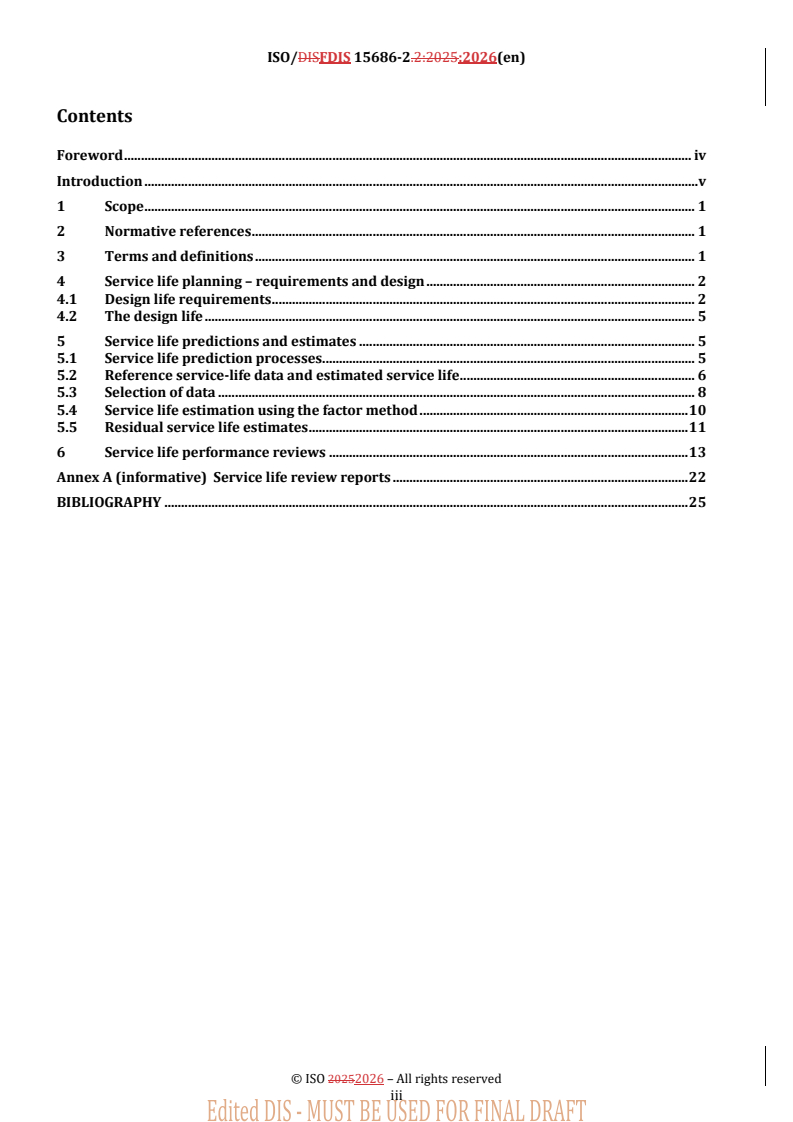
Contents Page
Foreword .iv
Introduction .v
1 Scope . 1
2 Normative references . 1
3 Terms and definitions . 1
4 Service life planning – requirements and design . 2
4.1 Design life requirements .2
4.2 The design life .5
5 Service life predictions and estimates . 5
5.1 Service life prediction processes .5
5.2 Reference service-life data and estimated service life .6
5.2.1 General .6
5.2.2 Provision of reference service-life data .6
5.2.3 Data sources .7
5.2.4 Data evaluation .7
5.3 Selection of data .8
5.3.1 General .8
5.3.2 Data sources .8
5.3.3 Rejection of data .8
5.3.4 Similarity of in-use conditions .8
5.3.5 Consideration of data quality .9
5.3.6 Form of data.9
5.4 Service life estimation using the factor method .9
5.5 Residual service life estimates .10
6 Service life performance reviews .11
Annex A (informative) Service life review reports .18
BIBLIOGRAPHY .21
iii
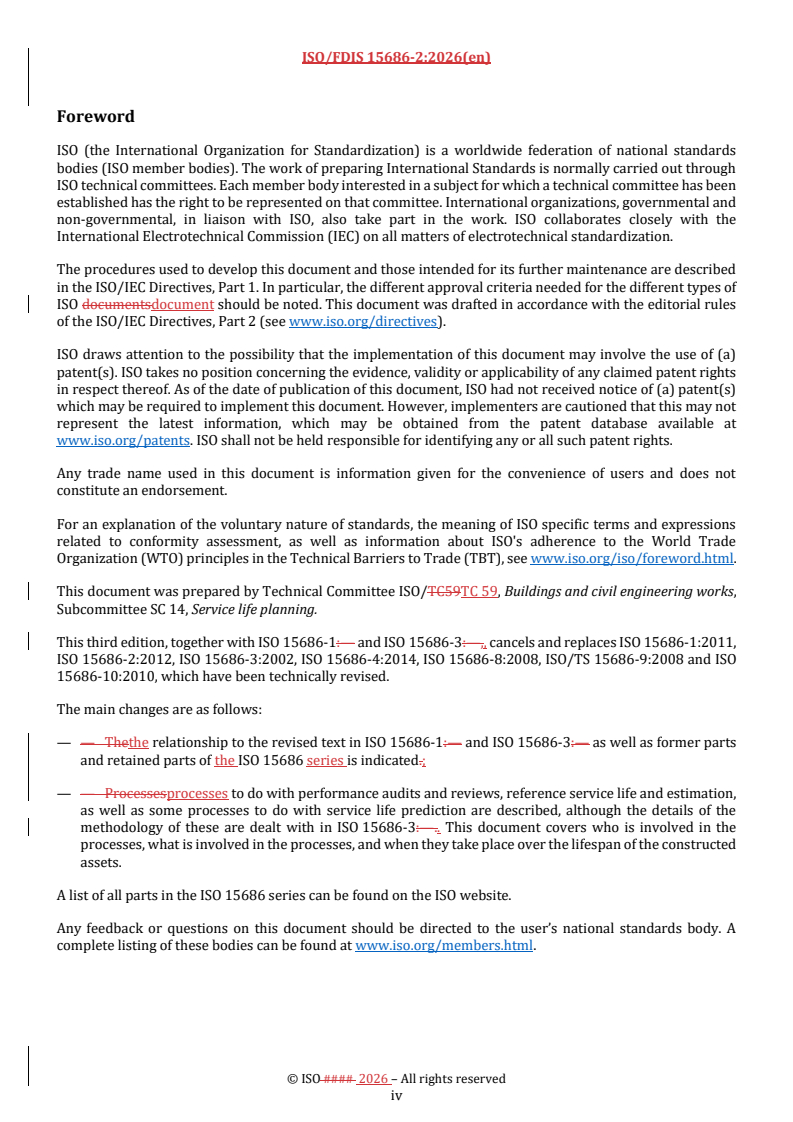
Foreword
ISO (the International Organization for Standardization) is a worldwide federation of national standards
bodies (ISO member bodies). The work of preparing International Standards is normally carried out through
ISO technical committees. Each member body interested in a subject for which a technical committee
has been established has the right to be represented on that committee. International organizations,
governmental and non-governmental, in liaison with ISO, also take part in the work. ISO collaborates closely
with the International Electrotechnical Commission (IEC) on all matters of electrotechnical standardization.
The procedures used to develop this document and those intended for its further maintenance are described
in the ISO/IEC Directives, Part 1. In particular, the different approval criteria needed for the different types
of ISO document should be noted. This document was drafted in accordance with the editorial rules of the
ISO/IEC Directives, Part 2 (see www.iso.org/directives).
ISO draws attention to the possibility that the implementation of this document may involve the use of (a)
patent(s). ISO takes no position concerning the evidence, validity or applicability of any claimed patent
rights in respect thereof. As of the date of publication of this document, ISO had not received notice of (a)
patent(s) which may be required to implement this document. However, implementers are cautioned that
this may not represent the latest information, which may be obtained from the patent database available at
www.iso.org/patents. ISO shall not be held responsible for identifying any or all such patent rights.
Any trade name used in this document is information given for the convenience of users and does not
constitute an endorsement.
For an explanation of the voluntary nature of standards, the meaning of ISO specific terms and expressions
related to conformity assessment, as well as information about ISO's adherence to the World Trade
Organization (WTO) principles in the Technical Barriers to Trade (TBT), see www.iso.org/iso/foreword.html.
This document was prepared by Technical Committee ISO/TC 59, Buildings and civil engineering works,
Subcommittee SC 14, Service life planning.
This third edition, together with ISO 15686-1 and ISO 15686-3, cancels and replaces ISO 15686-1:2011,
ISO 15686-2:2012, ISO 15686-3:2002, ISO 15686-4:2014, ISO 15686-8:2008, ISO/TS 15686-9:2008 and
ISO 15686-10:2010, which have been technically revised.
The main changes are as follows:
— the relationship to the revised text in ISO 15686-1 and ISO 15686-3 as well as former parts and retained
parts of the ISO 15686 series is indicated;
— processes to do with performance audits and reviews, reference service life and estimation, as well as
some processes to do with service life prediction are described, although the details of the methodology
of these are dealt with in ISO 15686-3. This document covers who is involved in the processes, what is
involved in the processes, and when they take place over the lifespan of the constructed assets.
A list of all parts in the ISO 15686 series can be found on the ISO website.
Any feedback or questions on this document should be directed to the user’s national standards body. A
complete listing of these bodies can be found at www.iso.org/members.html.
iv
Introduction
Service life planning is a design process that seeks to ensure that the service life of a building, civil
engineering works, or other constructed asset will equal or exceed its design life. This document deals
with who is involved in the processes of service life planning, what those processes are, and when they are
carried out. It should be read in conjunction with the general principles in ISO 15686-1 and methods and
communication in ISO 15686-3. ISO 15686-5 describes the life cycle costing process; ISO 15686-7 focuses on
the process related to performance evaluation for feedback from service life data from practice.
This document is intended primarily, but not exclusively, for the following user groups, who are also the
primary actors in the processes described:
a) building or civil engineering owners and users;
b) design, construction and facilities or asset management teams;
c) manufacturers who provide data on long-term performance of products (and those who provide test
data or technical approvals);
d) maintainers of buildings and civil engineering assets;
e) value appraisers of buildings and civil engineering assets;
f) insurers of buildings and civil engineering assets;
g) technical auditors of buildings and civil engineering assets;
h) developers of construction product standards;
i) clients, funders, and sponsors of buildings and civil engineering assets;
j) users of reference service life data as inputs to assessments of sustainability such as environmental
product declarations (EPD’s), life cycle assessment (LCA) or life cycle costing (LCC);
k) regulators of any group listed above.
Service life planning is a group of processes designed to determine a design life, or to generate a reference
service life, or an estimated, residual or predicted service life of constructed assets and the various parts
which comprise them, i.e. how long they will continue to function satisfactorily. These processes may
include consideration of management interventions to replace or repair some parts to ensure continued
functionality and serviceability.
Service life planning is generic, i.e. applicable to all types of components of buildings or constructed works,
and is meant to serve as a guide to all kinds of prediction processes. The processes can be used to assess
innovative components or can be used in the assessment of existing data in order to appraise their value for
service life planning and reveal where complementary studies are necessary.
These processes can be undertaken at any stage from early design right through the lifespan. Where they
take place during the planning phase of the life cycle of the asset, they comprise either an estimate or a
prediction of projected performance. Where the processes take place during the service life of the asset, they
concern the residual service life estimation of future performance. Depending on the scope of the estimate
or the prediction, they may include projected performance beyond the life cycle of the works in which the
parts are currently embedded.
Because service life planning is concerned with future performance, there are inevitably assumptions made
about a future operating conditions, future policies and practice. It is therefore important that it is clear that
predictions and estimates are not guarantees or warranties of future performance. Equally it is important
that the level of reliance to be placed on the estimate or prediction is clear. Examination of assumptions and
the evidence used to form the prediction or estimate can be needed.
Depending on the priorities of the client for the service life planning the focus can be on appropriate
design, maintenance, or refurbishment of the constructed assets. The processes can need to take account
v
of changing strategic, operational or policy requirements, risk, reliability or value management aspects, but
these are not the primary focus of this document. However, where these considerations affect the estimate
or prediction, they should be included in any service life planning reporting.
vi
FINAL DRAFT International Standard ISO/FDIS 15686-2:2026(en)
Buildings and civil engineering works — Service life
planning —
Part 2:
Process considerations
1 Scope
This document provides requirements and guidance on the use of design life, service life predictions or
reference service-life data and on the application of these data for the purposes of calculating estimated
or residual service life using the factor method. It gives guidelines for the use of evidence on which the
reliability of the predicted or estimated service life depends.
This document establishes when to specify or verify functional performance requirements during the
service life of constructed assets and when to check their capability to meet identified requirements.
This document is applicable to any scope of holdings, whether a set (or portfolio), a single building (large or
small) or a facility which is part of a building (such as one group of spaces, one floor or several floors) or part
of a network of constructed assets.
It is applicable to the range of roles of stakeholders, from the owners and managers to the occupants, tenants
or other users.
This document does not describe specific test methods. It does not cover limitation of service life due to
obsolescence. It does not give guidance on the values of service life factors A to G.
2 Normative references
The following documents are referred to in the text in such a way that some or all of their content constitutes
requirements of this document. For dated references, only the edition cited applies. For undated references,
the latest edition of the referenced document (including any amendments) applies.
ISO 6707-1, Buildings and civil engineering works — Vocabulary — Part 1: General terms
ISO 15686-1, Buildings and civil engineering works — Service life planning — Part 1: General principles and
framework
ISO 15686-3, Buildings and civil engineering works — Service life planning — Part 3: Methods, data and
communication
ISO 15686-7:2017, Buildings and constructed assets — Service life planning — Part 7: Performance evaluation
for feedback of service life data from practice
3 Terms and definitions
For the purposes of this document, the terms and definitions given in ISO 6707-1 and in ISO 15686-1 and the
following apply.
ISO and IEC maintain terminology databases for use in standardization at the following addresses:
— ISO Online browsing platform: available at https:// www .iso .org/ obp
— IEC Electropedia: available at https:// www .electropedia .org/
3.1
service life performance review
systematic second-party examination of requirements, initial and detailed design proposals, and
instructions for installation, commissioning and life care (3.3), to determine their adequacy in relation to
service life performance
3.2
terminal critical property
property that first fails to maintain the corresponding performance requirement when subjected to
exposure in a particular service environment
3.3
life care
measures that promote achievement of the design life, including cleaning, maintenance, servicing, repair,
refurbishment, protection, control of use and avoidance of neglect
3.4
performance over time
description of how a critical property varies with time
3.5
pre-briefing
earliest stage in the consideration of a construction project when the need for construction works is assessed
and the suitability of sites is assessed and technical, economic and other feasibilities are calculated
[SOURCE: ISO 6707-4:2021, 3.5.1, modified — "project" was replaced by "construction project".]
3.6
predicted service life distribution
probability distribution function of the predicted service life
4 Service life planning – requirements and design
4.1 Design life requirements
The basic concept of service life planning is that assets shall reliably meet or exceed required performance
for the duration of design life to maintain their intended use and function. In order to achieve this, the
following aspects shall be considered:
— requirements for service life which vary from project to project and from one asset to another depending
on intended use and operating environment, and the cost, difficulty, frequency and extent of anticipated
maintenance, replacement and repair;
— very durable, long lasting construction is usually more expensive and can restrict the design to a limited
range of materials. Consequently, a long design life requirement can increase the initial cost of the
project, though not necessarily the life cycle cost, and can limit the design solutions that meet the brief.
Therefore, the designer may challenge excessive design life requirements as well as other aspects of the
brief, such as the initial budget;
— financing of construction often presumes a design life at least as long as the period of any loan used to
finance the project, which can be secured on the project value.
The client shall define the design life of the building or constructed asset in the initial brief, which should
reflect the overall requirements – this may entail guidance from designers. The client may also choose to
specify the design life for specific assets. This may be undertaken in conjunction with the designer.
Design life categories are given in Table 1 and categories for parts are given in Table 2. These descriptions
shall have the following minimum design life requirements unless a specific design life is stated.
Table 1 — Minimum design life requirements
Minimum
Category Design life category Examples design life Typical range of design life in years
in years
Site huts, sales
offices
1 Temporary _
Minor storage
Up to 10
buildings
Short life Industri-
al buildings (e.g.
warehouse)
2 Short life 10
Temporary build-
ings (e.g. class- 10 to 25
rooms)
Retail or office
refurbishments
Medium-hazard
industrial
Commercial and
personal services
occupancies (low
rise)
Car parks 25 to 50
Medium or high-
rise commercial
3 Medium life 20
and office buildings
Stand-alone park-
ing or civil engi-
neering structures
(e.g. pedestrian
footbridge)
High-hazard indus-
trial or civil engi-
neering structures 25 to 99
(e.g. electricity
substation)
TTabablele 1 1 ((ccoonnttiinnueuedd))
Minimum
Category Design life category Examples design life Typical range of design life in years
in years
Single or multiple
unit residential
Mid- and high-rise
commercial and
office buildings
Public infrastruc-
ture buildings
(e.g. hospitals,
power generating
stations, train sta- 50 to 99
tions, public water
4 Typical life treatment facilities 50
and emergency
response facilities)
Educational build-
ings, performing
arts buildings,
religious and other
assembly occupan-
cies
Detention, care,
and treatment
occupancies
Civic and high qual-
ity public buildings
or civil engineering
structures
5 Long life 100
Monumental and 120 to indefinite
heritage buildings
or civil engineering
structures
NOTE Specific periods can be determined for particular buildings in any of the categories 2 to 4, provided they
do not exceed the period suggested for the next category below in Table 1, for example, prefabricated or industrial
buildings can be designed for a design life of 20 years or more.
Buildings or civil engineering works may include replaceable and maintainable components (see Table 2).
Any existing national design life requirements guidance should be reviewed in considering the periods of
minimum design life (as Table 1) or design life category (as Table 2).
Table 2 — Categories of design life for components or assemblies
Category Description Typical examples Design life requirements
Shorter than the design life of
1 Short term Door actuators and motors, taps the building and can be readily
replaced.
Shorter than the building design
life and replacement can be
Most floor finishes and building servic-
2 Replaceable envisaged at design stage. Should
es components
be designed to allow for replace-
ment.
Will last, with periodic treat-
ment, for the life of the building
Most external claddings, doors and
3 Maintainable or until planned major refurbish-
windows
ment. Should normally be de-
signed to allow for replacement.
Foundations and the main structural Should last for the design life of
4 Lifelong
elements the building.
4.2 The design life
The design life of an asset shall be determined using available knowledge about the predicted service life of
each component that is to be used in the asset and the proposed operating conditions of the asset.
Where the estimated service life of any component is less than the design life of the building or constructed
asset, a decision shall be agreed with the client as to how performance can be maintained over the life of
building or constructed asset (e.g. by replacement or other maintenance) or the design life requirement shall
be adjusted to match the actual design life.
Service life planning shall include projections of the needs for, and timing of, maintenance and replacement
activities over the life cycle of the building or constructed asset. The person responsible for the service life
planning shall assess data on which the projections depend for robustness and reliability, and records of the
data sources shall be kept.
As part of design the appropriate performance criteria for the assets shall be identified, together with any
data requirements to demonstrate compliance with requirements.
The consequences of failure shall be considered if relevant in determination of design life.
Assets that would present a high risk to health and safety in the event of failure, or those which cannot
readily be inspected for degradation, or which are not practically feasible to replace, can require a design
life that matches that of the building or other constructed asset.
5 Service life predictions and estimates
5.1 Service life prediction processes
A predicted service life distribution of a component (PSLDC) shall be determined in accordance with the
systematic approach or methodology as described in ISO 15686-3, including consideration of:
— the identification of necessary information;
— the selection or development of test procedures (exposure programmes and evaluation methods);
— testing;
— interpretation of data;
— reporting of results.
The PSLDC shall generally be described by at least two parameters, the expectation value and the standard
deviation. However, by agreement with the client, where tests are very costly or time-consuming, a single
value predicted service life of a component (PSLC) can be agreed as acceptable.
NOTE 1 The choice of the single-value reference service life of the component (RSLC) for replaceable, non-structural
components, can be the expectation value (i.e. the mean or median) PSLC of the distribution. However, scheduled
maintenance plans, when considered alongside other replaceable components or other circumstances, can result in a
more conservative choice. This can be covered by local codes, standards or normative requirements applicable for that
type of asset.
The communication of the service life prediction and any derived reference service life (RSL) should include
the constraints and assumptions in respect of both the asset tested and the operating conditions, in addition
to any specific methodology adopted and results of tests undertaken.
NOTE 2 Guidance on service life prediction methods can be found in ISO 15686-3. Service life predictions can be
based on evidence from previous use, on comparisons with the known service life of similar components, on tests of
degradation in specific conditions or on a combination of these. These predictions form the basis of reference service
lives, and therefore of estimates of service life also.
5.2 Reference service-life data and estimated service life
5.2.1 General
An estimated service life (ESL) for an asset shall be undertaken by modifying a RSL applicable to such an
asset. This shall include consideration of how conditions assumed in generating the RSL differ from the in-
use conditions to which the asset is subjected, i.e. the object-specific in-use conditions.
As much information as possible on the conditions under which the RSL is generated should be communicated
when RSL data, including the relevant reference in-use conditions.
RSL data are formatted into an RSL data record that shall contain the RSL value and the appurtenant reference
in-use conditions as well as additional information on critical properties, performance requirements and
data quality.
NOTE 1 RSL data do not include the actual values of the factors A to G but the information needed to estimate these
factors.
For the generation of new PSLDC data, the methodology as described in 5.1 shall be used.
NOTE 2 Guidance on service life estimation methods can be found in ISO 15686-3. For the provision of RSL data, the
capturing of existing general data of any kind is acceptable.
5.2.2 Provision of reference service-life data
Providers of RSL data shall consider:
— sources of existing general data;
— assess such data in terms of RSL data;
— analysis of data from feedback from practice as described in ISO 15686-7.
NOTE Providers of data can include manufacturers of building and construction products, test laboratories,
national assessment bodies and technical approval organizations, database holders or other data providers.
The process of providing RSL data shall follow the process shown in Figure 1.
Formatting general data as RSL data shall be undertaken in accordance with the considerations indicated in
5.1 generally.
Figure 1 — Data selection process
5.2.3 Data sources
Data providers shall consider whether the following types of data can provide or influence the selection of
suitable RSLs:
— manufacturers of building and construction products in-house information concerning the service
life and durability of their products (manufacturers’ data can be made public in documents such as a
product’s declarations, company websites or databases);
— national building codes may list typical service lives of components, and boards of Agrément and
technical approval bodies in local states may provide assessments of service lives in their certificates or
reports of national product evaluation services;
— Other sources of information such as databases, published tables based on empirical time-to-failure
assessments and judgements of experienced professionals (more scattered empirical knowledge from
pre
...
ISO/DISFDIS 15686-2.2:2025(en)
ISO/TC 59/SC 14
Secretariat: BSI
Date: 2025-11-062026-09-15
Buildings and civil engineering works— — Service life planning— —
Part 2:
Process considerations
Bâtiments et biens immobiliers construits — Prévision de la durée de vie —
Partie 2: Considérations relatives au processus
FDIS stage
All rights reserved. Unless otherwise specified, or required in the context of its implementation, no part of this publication
may be reproduced or utilized otherwise in any form or by any means, electronic or mechanical, including photocopying,
or posting on the internet or an intranet, without prior written permission. Permission can be requested from either ISO
at the address below or ISO’s member body in the country of the requester.
ISO copyright office
CP 401 • Ch. de Blandonnet 8
CH-1214 Vernier, Geneva
Phone: + 41 22 749 01 11
EmailE-mail: copyright@iso.org
Website: www.iso.org
Published in Switzerland
© ISO #### 2026 – All rights reserved
ii
ISO/DISFDIS 15686-2.2:2025:2026(en)
Contents
Foreword . iv
Introduction . v
1 Scope . 1
2 Normative references . 1
3 Terms and definitions . 1
4 Service life planning – requirements and design . 2
4.1 Design life requirements . 2
4.2 The design life . 5
5 Service life predictions and estimates . 5
5.1 Service life prediction processes. 5
5.2 Reference service-life data and estimated service life . 6
5.3 Selection of data . 8
5.4 Service life estimation using the factor method . 10
5.5 Residual service life estimates . 11
6 Service life performance reviews . 13
Annex A (informative) Service life review reports . 22
BIBLIOGRAPHY . 25
iii
Foreword
ISO (the International Organization for Standardization) is a worldwide federation of national standards
bodies (ISO member bodies). The work of preparing International Standards is normally carried out through
ISO technical committees. Each member body interested in a subject for which a technical committee has been
established has the right to be represented on that committee. International organizations, governmental and
non-governmental, in liaison with ISO, also take part in the work. ISO collaborates closely with the
International Electrotechnical Commission (IEC) on all matters of electrotechnical standardization.
The procedures used to develop this document and those intended for its further maintenance are described
in the ISO/IEC Directives, Part 1. In particular, the different approval criteria needed for the different types of
ISO documentsdocument should be noted. This document was drafted in accordance with the editorial rules
of the ISO/IEC Directives, Part 2 (see www.iso.org/directives).
ISO draws attention to the possibility that the implementation of this document may involve the use of (a)
patent(s). ISO takes no position concerning the evidence, validity or applicability of any claimed patent rights
in respect thereof. As of the date of publication of this document, ISO had not received notice of (a) patent(s)
which may be required to implement this document. However, implementers are cautioned that this may not
represent the latest information, which may be obtained from the patent database available at
www.iso.org/patents. ISO shall not be held responsible for identifying any or all such patent rights.
Any trade name used in this document is information given for the convenience of users and does not
constitute an endorsement.
For an explanation of the voluntary nature of standards, the meaning of ISO specific terms and expressions
related to conformity assessment, as well as information about ISO's adherence to the World Trade
Organization (WTO) principles in the Technical Barriers to Trade (TBT), see www.iso.org/iso/foreword.html.
This document was prepared by Technical Committee ISO/TC59TC 59, Buildings and civil engineering works,
Subcommittee SC 14, Service life planning.
This third edition, together with ISO 15686-1:— and ISO 15686-3:—,, cancels and replaces ISO 15686-1:2011,
ISO 15686-2:2012, ISO 15686-3:2002, ISO 15686-4:2014, ISO 15686-8:2008, ISO/TS 15686-9:2008 and ISO
15686-10:2010, which have been technically revised.
The main changes are as follows:
— — Thethe relationship to the revised text in ISO 15686-1:— and ISO 15686-3:— as well as former parts
and retained parts of the ISO 15686 series is indicated.;
— — Processesprocesses to do with performance audits and reviews, reference service life and estimation,
as well as some processes to do with service life prediction are described, although the details of the
methodology of these are dealt with in ISO 15686-3:—. This document covers who is involved in the
processes, what is involved in the processes, and when they take place over the lifespan of the constructed
assets.
A list of all parts in the ISO 15686 series can be found on the ISO website.
Any feedback or questions on this document should be directed to the user’s national standards body. A
complete listing of these bodies can be found at www.iso.org/members.html.
© ISO #### 2026 – All rights reserved
iv
ISO/DISFDIS 15686-2.2:2025:2026(en)
Introduction
Service life planning is a design process that seeks to ensure that the service life of a building, civil engineering
works, or other constructed asset will equal or exceed its design life. This document deals with who is involved
in the processes of service life planning, what those processes are, and when they are carried out. It should be
read in conjunction with the general principles in ISO 15686-1 and methods and communication in ISO 15686-
3. ISO 15686-5 describes the life cycle costing process; ISO 15686-7 focuses on the process related to
performance evaluation for feedback from service life data from practice.
This document is intended primarily, but not exclusively, for the following user groups, who are also the
primary actors in the processes described:
a) a) building or civil engineering owners and users;
b) b) design, construction and facilities or asset management teams;
c) c) manufacturers who provide data on long-term performance of products (and those who
provide test data or technical approvals);
d) d) maintainers of buildings and civil engineering assets;
e) e) value appraisers of buildings and civil engineering assets;
f) f) insurers of buildings and civil engineering assets;
g) g) technical auditors of buildings and civil engineering assets;
h) h) developers of construction product standards;
i) i) clients, funders, and sponsors of buildings and civil engineering assets;
j) j) users of reference service life data as inputs to assessments of sustainability such as
environmental product declarations (EPD’s), life cycle assessment (LCA) or life cycle costing (LCC).);
k) k) Regulatorsregulators of any group listed above.
Service life planning is a group of processes designed to determine a design life, or to generate a reference
service life, or an estimated, residual or predicted service life of constructed assets and the various parts which
comprise them, i.e. how long they will continue to function satisfactorily. These processes may include
consideration of management interventions to replace or repair some parts to ensure continued functionality
and serviceability.
Service life planning is generic, i.e. applicable to all types of components of buildings or constructed works,
and is meant to serve as a guide to all kinds of prediction processes. The processes can be used to assess
innovative components or can be used in the assessment of existing data in order to appraise their value for
service life planning and reveal where complementary studies are necessary.
These processes can be undertaken at any stage from early design right through the lifespan. Where they take
place during the planning phase of the life cycle of the asset, they comprise either an estimate or a prediction
of projected performance. Where the processes take place during the service life of the asset, they concern the
residual service life estimation of future performance. Depending on the scope of the estimate or the
prediction, they may include projected performance beyond the life cycle of the works in which the parts are
currently embedded.
v
Because service life planning is concerned with future performance, there are inevitably assumptions made
about a future operating conditions, future policies and practice. It is therefore important that it is clear that
predictions and estimates are not guarantees or warranties of future performance. Equally it is important that
the level of reliance to be placed on the estimate or prediction is clear. Examination of assumptions and the
evidence used to form the prediction or estimate can be needed.
Depending on the priorities of the client for the service life planning the focus can be on appropriate design,
maintenance, or refurbishment of the constructed assets. The processes can need to take account of changing
strategic, operational or policy requirements, risk, reliability or value management aspects, but these are not
the primary focus of this document. However, where these considerations affect the estimate or prediction,
they should be included in any service life planning reporting.
© ISO #### 2026 – All rights reserved
vi
DRAFT International Standard ISO/DIS 15686-2.2:2025(en)
Buildings and civil engineering works — — Service life planning— —
Part 2:
Process considerations
1 Scope
This document provides requirements and guidance on the use of design life, service life predictions or
reference service-life data and on the application of these data for the purposes of calculating estimated or
residual service life using the factor method. It gives guidelines for the use of evidence on which the reliability
of the predicted or estimated service life depends.
This document establishes when to specify or verify functional performance requirements during the service
life of constructed assets and when to check their capability to meet identified requirements.
This document is applicable to any scope of holdings, whether a set (or portfolio), a single building (large or
small) or a facility which is part of a building (such as one group of spaces, one floor or several floors) or part
of a network of constructed assets.
It is applicable to the range of roles of stakeholders, from the owners and managers to the occupants, tenants
or other users.
This document does not describe specific test methods. It does not cover limitation of service life due to
obsolescence. It does not give guidance on the values of service life factors A to G.
2 Normative references
The following documents are referred to in the text in such a way that some or all of their content constitutes
requirements of this document. For dated references, only the edition cited applies. For undated references,
the latest edition of the referenced document (including any amendments) applies.
ISO 15686- 6707-1, Buildings and civil engineering works– — Vocabulary — Part 1: General terms
ISO 15686-1, Buildings and civil engineering works — Service Life Planning –life planning — Part 1 Concepts:
General principles and Principlesframework
ISO 15686--3, Buildings and civil engineering works –— Service Life Planning –life planning — Part 3: Methods,
data and communication
ISO 15686--7:2017, Buildings and civil engineering worksconstructed assets — Service life planning — Part 7:
Performance evaluation for feedback of service life data from practice
3 Terms and definitions
For the purposes of this document, the terms and definitions given in ISO 6707-1 and in ISO 15686-1 and the
following apply.
ISO and IEC maintain terminology databases for use in standardization at the following addresses:
— — ISO Online browsing platform: available at https://www.iso.org/obp
— — IEC Electropedia: available at https://www.electropedia.org/
3.1 3.1
service life performance review
systematic second-party examination of requirements, initial and detailed design (3.1.23) proposals, and
instructions for installation, commissioning and life care (3.3(3.1.59),), to determine their adequacy in relation
to service life (3.1.113.1) (3.1.113.2) performance (3.1.78.1) (3.1.78.2)
3.2 3.2
terminal critical property
property that first fails to maintain the corresponding performance requirement (3.1.85.2) when subjected to
exposure in a particular service environment (3.1.30)
3.3 3.3
life care
measures that promote achievement of the design life (3.1.20),, including cleaning, maintenance (3.1.65),,
servicing, repair (3.1.107),, refurbishment (3.1.103),, protection, control of use and avoidance of neglect
3.4 3.4
performance over time
description of how a critical property varies with time
3.5 3.5
pre-briefing
earliest stage in the consideration of a construction project when the need for constructedconstruction works
is assessed and the suitability (3.1.121) of sites areis assessed and technical, economic and other feasibilities
are calculated
[SOURCE: ISO6704ISO 6707-4:2021, 3.5.1, modified — "project" was replaced by "construction project".]
3.6 3.6
predicted service life distribution
probability distribution function of the predicted service life (3.1.89.1)
4 Service life planning – requirements and design
4.1 Design life requirements
The basic concept of service life planning is that assets shall reliably meet or exceed required performance for
the duration of design life to maintain their intended use and function. In order to achieve this, the following
aspects shall be considered:
— — Requirementsrequirements for service life which vary from project to project and from one asset to
another depending on intended use and operating environment, and the cost, difficulty, frequency and
extent of anticipated maintenance, replacement and repair.;
— — Veryvery durable, long lasting construction is usually more expensive and can restrict the design to a
limited range of materials. Consequently, a long design life requirement can increase the initial cost of the
project, though not necessarily the life cycle cost, and can limit the design solutions that meet the brief.
Therefore, the designer may challenge excessive design life requirements as well as other aspects of the
brief, such as the initial budget.;
© ISO #### 2026 – All rights reserved
ISO/DISFDIS 15686-2.2:2025:2026(en)
— — Financingfinancing of construction often presumes a design life at least as long as the period of any
loan used to finance the project, which can be secured on the project value.
The client shall define the design life of the building or constructed asset in the initial brief, which should
reflect the overall requirements – this may entail guidance from designers. The client may also choose to
specify the design life for specific assets. This may be undertaken in conjunction with the designer.
Design life categories are given in Table 1 Table 1 and categories for parts are given in Table 2 Table 2. These
descriptions shall have the following minimum design life requirements unless a specific design life is stated.
Table 1 — Minimum design life requirements
Minimum
Design life design
Category Examples Typical range of design life in years
category life in
years
Site huts, sales
offices
1 Temporary _
Minor storage
Up to 10
buildings
Short life
Industrial
buildings (e.g.
warehouse)
2 Short life 10
Temporary
buildings (e.g. 10 to 25
classrooms)
Retail or office
refurbishments
Medium-hazard
industrial
Commercial and
personal services
occupancies (low
rise)
Car parks 25 to 50
Medium or high-
rise commercial
and office
3 Medium life 20
buildings
Stand-alone
parking or civil
engineering
structures (e.g.
pedestrian
footbridge)
High-hazard
industrial or civil
engineering
25 to 99
structures (e.g.
electricity
substation).)
Minimum
Design life design
Category Examples Typical range of design life in years
category life in
years
Single or multiple
unit residential
Mid- and high-rise
commercial and
office buildings
Public
infrastructure
buildings (e.g.
hospitals, power
generating
stations, train
50 to 99
stations, public
water treatment
facilities and
4 Typical life 50
emergency
response
facilities)
Educational
buildings,
Performingperfor
ming arts
buildings,
religious and
other assembly
occupancies
Detention, care,
and treatment
occupancies
Civic and high
quality public
buildings or civil
engineering
structures
5 Long life 100
Monumental and 120 to indefinite
heritage buildings
or civil
engineering
structures
NOTE 1 Specific periods can be determined for particular buildings in any of the categories 2 to 4, provided they do
not exceed the period suggested for the next category below in Table 1 Table 1,, for example, prefabricated or industrial
buildings can be designed for a design life of 20 years or more.
Buildings or civil engineering works may include replaceable and maintainable components (see Table 2 See
Table 2).). Any existing national design life requirements guidance should be reviewed in considering the
periodsof periods of minimum design life (as Table 1 Table 1)) or design life category (as Table 2 Table 2).).
© ISO #### 2026 – All rights reserved
ISO/DISFDIS 15686-2.2:2025:2026(en)
Table 2 — Categories of design life for components or assemblies
Categor
Description Typical Examplesexamples Design life requirements
y
Shorter than the design life of
1 Short term Door actuators and motors, taps the building and can be readily
replaced.
Shorter than the building design
life and replacement can be
Most floor finishes and building
2 Replaceable envisaged at design stage.
services components
Should be designed to allow for
replacement.
Will last, with periodic
treatment, for the life of the
Most external claddings, doors and building or until planned major
3 Maintainable
windows refurbishment. Should normally
be designed to allow for
replacement.
Foundations and the main structural Should last for the design life of
4 Lifelong
elements. the building.
4.2 The design life
The design life of an asset shall be determined using available knowledge about the predicted service life of
each component that is to be used in the asset and the proposed operating conditions of the asset.
Where the estimated service life of any component is less than the design life of the building or constructed
asset, a decision shall be agreed with the client as to how performance can be maintained over the life of
building or constructed asset (e.g. by replacement or other maintenance) or the design life requirement shall
be adjusted to match the actual design life.
Service life planning shall include projections of the needs for, and timing of, maintenance and replacement
activities over the life cycle of the building or constructed asset. The person responsible for the service life
planning shall assess data on which the projections depend for robustness and reliability, and records of the
data sources shall be kept.
As part of design the appropriate performance criteria for the assets shall be identified, together with any data
requirements to demonstrate compliance with requirements.
The consequences of failure shall be considered if relevant in determination of design life.
Assets that would present a high risk to health and safety in the event of failure, or those which cannot readily
be inspected for degradation, or which are not practically feasible to replace, can require a design life that
matches that of the building or other constructed asset.
5 Service life predictions and estimates
5.1 Service life prediction processes
A predicted service life distribution of a component (PSLDC) shall be determined in accordance with the
systematic approach or methodology as described in ISO 15686-3, including consideration of:
— — the identification of necessary information;
— — the selection or development of test procedures (exposure programmes and evaluation methods);
— — testing;
— — interpretation of data;
— — reporting of results.
The PSLDC shall generally be described by at least two parameters, the expectation value and the standard
deviation. However, by agreement with the client, where tests are very costly or time-consuming, a single
value predicted service life of a component (PSLC) can be agreed as acceptable.
NOTE 1 The choice of the single-value reference service life of the component (RSLC) for replaceable, non-structural
components, can be the expectation value (i.e. the mean or median) PSLC of the distribution. However, scheduled
maintenance plans, when considered alongside other replaceable components or other circumstances, can result in a
more conservative choice. This can be covered by local codes, standards or normative requirements applicable for that
type of asset.
The communication of the service life prediction and any derived reference service life (RSL) should include
the constraints and assumptions in respect of both the asset tested and the operating conditions, in addition
to any specific methodology adopted and results of tests undertaken.
NOTE 2 Guidance on service life prediction methods can be found in ISO 15686-3. Service life predictions can be based
on evidence from previous use, on comparisons with the known service life of similar components, on tests of degradation
in specific conditions or on a combination of these. These predictions form the basis of reference service lives, and
therefore of estimates of service life also.
5.2 Reference service-life data and estimated service life
5.2.1 General
An estimated service life (ESL) for an asset shall be undertaken by modifying a RSL applicable to such an asset.
This shall include consideration of how conditions assumed in generating the RSL differ from the in-use
conditions to which the asset is subjected, i.e. the object-specific in-use conditions.
As much information as possible on the conditions under which the RSL is generated should be communicated
when RSL data, including the relevant reference in-use conditions.
RSL data are formatted into an RSL data record that shall contain the RSL value and the appurtenant reference
in-use conditions as well as additional information on critical properties, performance requirements and data
quality.
NOTE 1 RSL data do not include the actual values of the factors A to G but the information needed to estimate these
factors.
For the generation of new PSLDC data, the methodology as described in 5.15.1 shall be used.
NOTE 2 Guidance on service life estimation methods can be found in ISO 15686-3. For the provision of RSL data, the
capturing of existing general data of any kind is acceptable.
5.2.2 Provision of reference service-life data
Providers of RSL data shall consider:
— — sources of existing general data;
— — assess such data in terms of RSL data;
© ISO #### 2026 – All rights reserved
ISO/DISFDIS 15686-2.2:2025:2026(en)
— — analysis of data from feedback from practice as described in ISO 15686-7.
NOTE Providers of data can include manufacturers of building and construction products, test laboratories, national
assessment bodies and technical approval organizations, database holders or other data providers.
The process of providing RSL data shall follow the process shown in Figure 1 Figure 1.
Formatting general data as RSL data shall be undertaken in accordance with the considerations indicated in
5.15.1 generally.
Figure 1 — TheData selection process of selecting data
5.2.3 Data sources
Data providers shall consider whether the following types of data can provide or influence the selection of
suitable RSLs:
— — Manufacturersmanufacturers of building and construction products in-house information concerning
the service life and durability of their products. Manufacturers’ (manufacturers’ data can be made public
in documents such as a product’s declarations, company websites or databases.);
— — Nationalnational building codes may list typical service lives of components, and boards of Agrément
and technical approval bodies in local states may provide assessments of service lives in their certificates
or reports of national product evaluation services.;
— — Other sources of information such as databases, published tables based on empirical time-to-failure
assessments and judgements of experienced professionals. More (more scattered empirical knowledge
from previous experience and observations of similar constructions or materials in similar in-use
conditions should also be used.).
NOTE The vast amount of existing data of scattered quality constitutes an important source of information,
especially if data generated based on ISO 15686-2 are not available.
The quality and completeness of data should be considered, and data should be utilised which captures the
assumed conditions on which the RSL is based in preference to those sources which do not provide this
information.
5.2.4 Data evaluation
RSL data shall contain at least a general description of the material or component and data on service life, in
an indicated outdoor (or indoor) environment, and should encompass all relevant information concerning the
generation of the service-life data. The following types of data shall form part of an RSL data record:
— — in-use conditions structured according to all corresponding factor categories;
— — critical properties;
— — performance requirements.
5.3 Selection of data
5.3.1 General
Users of RSL data shall:
a) a) find service-life data;
b) b) assess the appropriateness of using these data as RSL data.
The process of selecting RSL data shall follow the process outlined in Figure 1 Figure 1.
As an alternative to selecting RSL data, users of data may select general data, in which case the data are then
structured and formatted as RSL data. Selection of general data shall follow the process outlined in Figure 1
Figure 1.
The normal route of selection of data is expected to become selection of RSL data, however, if general data is
the only available source of information the process shown in Figure 1 Figure 1 should be used.
© ISO #### 2026 – All rights reserved
ISO/DISFDIS 15686-2.2:2025:2026(en)
5.3.2 Data sources
In determining whether to use RSL data or general data, service life planners shall consider the following.
Databases providing RSL data records have the advantage that data are given in a format ready for that
purpose. However, this does not imply that RSL data records should always be selected even if available. When
general data on service life, other than RSL data records, are of higher quality or more appropriate for the
object-specific in-use conditions, these shall be used.
If data found are not given as RSL data records, data shall first be assessed taking account of the following
considerations:
Ensuring that data are appropriate to use for the object of the service life planning proc
...