

ISO/IEC 11889-4:2009
(Main)Information technology — Trusted Platform Module — Part 4: Commands
General Information
- Abstract
ISO/IEC 11889 defines the Trusted Platform Module (TPM), a device that enables trust in computing platforms in general. ISO/IEC 11889-4:2009 defines the commands, actions of the commands, and the parameters to the commands that provide the TPM functionality.
- Status
- Published
- Publication Date
- 17-May-2009
- Withdrawal Date
- 17-May-2009
- Technical Committee
- ISO/IEC JTC 1 - Information technology
- Drafting Committee
- ISO/IEC JTC 1 - Information technology
- Current Stage
- 9093 - International Standard confirmed
- Start Date
- 14-Feb-2017
- Completion Date
- 29-Aug-2026
Overview
ISO/IEC 11889-4:2009 - "Information technology - Trusted Platform Module - Part 4: Commands" is the ISO standard that specifies the command set for the Trusted Platform Module (TPM). As part of the ISO/IEC 11889 family, this part details the individual TPM commands, the actions they cause, and the parameters they accept and return. First published in 2009, the document is intended for implementers who need a formal, interoperable definition of TPM behavior for platform trust, attestation and cryptographic services.
Key Topics
This part organizes and defines TPM functionality by command families, including:
- Admin and startup commands (TPM_Init, TPM_Startup, TPM_SaveState)
- Testing and self-test operations (TPM_SelfTestFull, TPM_GetTestResult)
- Ownership and physical presence management (TPM_TakeOwnership, TPM_OwnerClear, TSC_PhysicalPresence)
- Capability and auditing commands (TPM_GetCapability, TPM_GetAuditDigest, TPM_SetOrdinalAuditStatus)
- Storage and key management (TPM_Seal, TPM_Unseal, TPM_CreateWrapKey, TPM_LoadKey2)
- Migration and endorsement key handling (TPM_CreateMigrationBlob, TPM_CreateEndorsementKeyPair)
- Cryptographic primitives and services (TPM_SHA1Start/Complete, TPM_Sign, TPM_GetRandom)
- Integrity reporting and PCR operations (TPM_Extend, TPM_PCRRead, TPM_Quote/Quote2)
- Authorization, delegation and session management (TPM_OIAP, TPM_OSAP, TPM_Delegate_* commands)
- Non-volatile storage, monotonic counters, transport and DAA (NV_Read/Write, TPM_CreateCounter, TPM_EstablishTransport, TPM_DAA_*)
The specification lists inputs/outputs, parameter sizes and expected behaviors for each command, providing the authoritative reference for conformant TPM firmware and host software.
Applications
ISO/IEC 11889-4:2009 is used by:
- TPM firmware and silicon vendors implementing the device command interface
- BIOS/UEFI and OS developers integrating TPM-based secure boot, measured boot and attestation
- Security architects and system integrators designing platform integrity, key management and hardware-backed authentication
- Enterprise and cloud providers deploying device attestation, disk encryption and trusted key storage
- Certification bodies and test labs validating conformance to TPM command behavior
Practical uses include secure key storage, platform integrity measurement, remote attestation, sealed data bound to platform state, and hardware-based cryptographic services.
Related Standards
- Other parts of the ISO/IEC 11889 TPM family (architecture and data structures)
- Trusted Computing Group (TCG) TPM specifications and conformance test suites
Keywords: ISO/IEC 11889-4:2009, Trusted Platform Module, TPM commands, TPM functionality, TPM specification, platform integrity, hardware security, TPM cryptographic functions, TPM auditing, TPM key management.
Relations
- Effective Date
- 10-May-2014
Get Certified
Connect with accredited certification bodies for this standard

BSI Group
BSI (British Standards Institution) is the business standards company that helps organizations make excellence a habit.

Bureau Veritas
Bureau Veritas is a world leader in laboratory testing, inspection and certification services.

DNV
DNV is an independent assurance and risk management provider.
Sponsored listings
Frequently Asked Questions
ISO/IEC 11889-4:2009 is a standard published by the International Organization for Standardization (ISO). Its full title is "Information technology — Trusted Platform Module — Part 4: Commands". This standard covers: ISO/IEC 11889 defines the Trusted Platform Module (TPM), a device that enables trust in computing platforms in general. ISO/IEC 11889-4:2009 defines the commands, actions of the commands, and the parameters to the commands that provide the TPM functionality.
ISO/IEC 11889 defines the Trusted Platform Module (TPM), a device that enables trust in computing platforms in general. ISO/IEC 11889-4:2009 defines the commands, actions of the commands, and the parameters to the commands that provide the TPM functionality.
ISO/IEC 11889-4:2009 is classified under the following ICS (International Classification for Standards) categories: 35.030 - IT Security; 35.040 - Information coding. The ICS classification helps identify the subject area and facilitates finding related standards.
ISO/IEC 11889-4:2009 has the following relationships with other standards: It is inter standard links to ISO/IEC 11889-4:2015. Understanding these relationships helps ensure you are using the most current and applicable version of the standard.
ISO/IEC 11889-4:2009 is available in PDF format for immediate download after purchase. The document can be added to your cart and obtained through the secure checkout process. Digital delivery ensures instant access to the complete standard document.
Standards Content (Sample)
INTERNATIONAL ISO/IEC
STANDARD 11889-4
First edition
2009-05-15
Information technology — Trusted
Platform Module —
Part 4:
Commands
Technologies de l'information — Module de plate-forme de confiance —
Partie 4: Commandes
Reference number
©
ISO/IEC 2009
PDF disclaimer
This PDF file may contain embedded typefaces. In accordance with Adobe's licensing policy, this file may be printed or viewed but
shall not be edited unless the typefaces which are embedded are licensed to and installed on the computer performing the editing. In
downloading this file, parties accept therein the responsibility of not infringing Adobe's licensing policy. The ISO Central Secretariat
accepts no liability in this area.
Adobe is a trademark of Adobe Systems Incorporated.
Details of the software products used to create this PDF file can be found in the General Info relative to the file; the PDF-creation
parameters were optimized for printing. Every care has been taken to ensure that the file is suitable for use by ISO member bodies. In
the unlikely event that a problem relating to it is found, please inform the Central Secretariat at the address given below.
© ISO/IEC 2009
All rights reserved. Unless otherwise specified, no part of this publication may be reproduced or utilized in any form or by any means,
electronic or mechanical, including photocopying and microfilm, without permission in writing from either ISO at the address below or
ISO's member body in the country of the requester.
ISO copyright office
Case postale 56 • CH-1211 Geneva 20
Tel. + 41 22 749 01 11
Fax + 41 22 749 09 47
E-mail copyright@iso.org
Web www.iso.org
Published in Switzerland
ii © ISO/IEC 2009 – All rights reserved
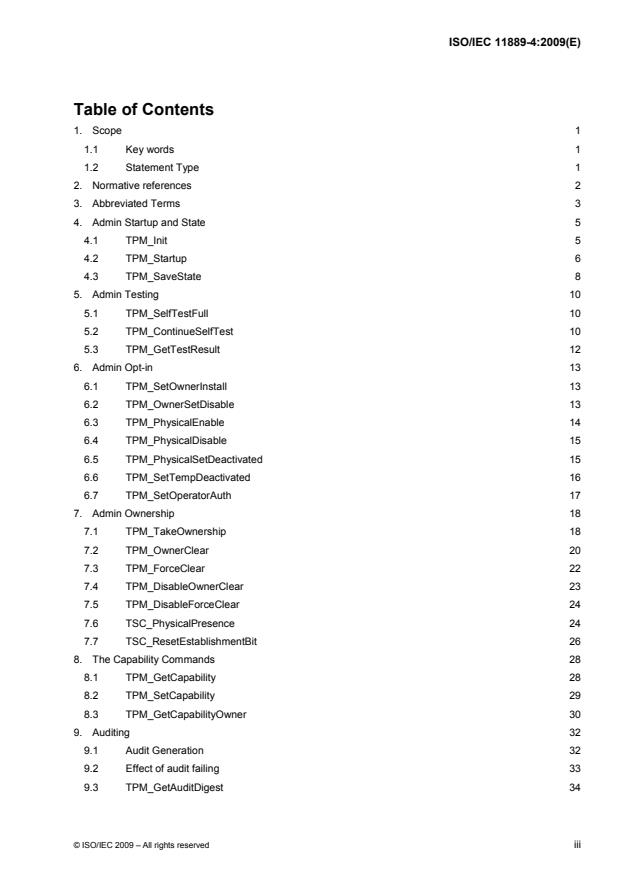
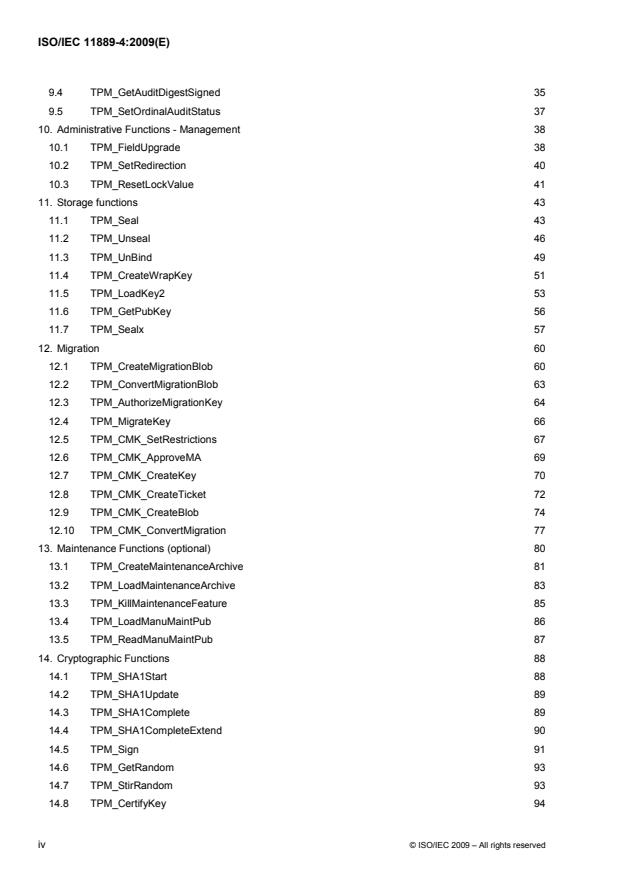
Table of Contents
1. Scope 1
1.1 Key words 1
1.2 Statement Type 1
2. Normative references 2
3. Abbreviated Terms 3
4. Admin Startup and State 5
4.1 TPM_Init 5
4.2 TPM_Startup 6
4.3 TPM_SaveState 8
5. Admin Testing 10
5.1 TPM_SelfTestFull 10
5.2 TPM_ContinueSelfTest 10
5.3 TPM_GetTestResult 12
6. Admin Opt-in 13
6.1 TPM_SetOwnerInstall 13
6.2 TPM_OwnerSetDisable 13
6.3 TPM_PhysicalEnable 14
6.4 TPM_PhysicalDisable 15
6.5 TPM_PhysicalSetDeactivated 15
6.6 TPM_SetTempDeactivated 16
6.7 TPM_SetOperatorAuth 17
7. Admin Ownership 18
7.1 TPM_TakeOwnership 18
7.2 TPM_OwnerClear 20
7.3 TPM_ForceClear 22
7.4 TPM_DisableOwnerClear 23
7.5 TPM_DisableForceClear 24
7.6 TSC_PhysicalPresence 24
7.7 TSC_ResetEstablishmentBit 26
8. The Capability Commands 28
8.1 TPM_GetCapability 28
8.2 TPM_SetCapability 29
8.3 TPM_GetCapabilityOwner 30
9. Auditing 32
9.1 Audit Generation 32
9.2 Effect of audit failing 33
9.3 TPM_GetAuditDigest 34
© ISO/IEC 2009 – All rights reserved iii
9.4 TPM_GetAuditDigestSigned 35
9.5 TPM_SetOrdinalAuditStatus 37
10. Administrative Functions - Management 38
10.1 TPM_FieldUpgrade 38
10.2 TPM_SetRedirection 40
10.3 TPM_ResetLockValue 41
11. Storage functions 43
11.1 TPM_Seal 43
11.2 TPM_Unseal 46
11.3 TPM_UnBind 49
11.4 TPM_CreateWrapKey 51
11.5 TPM_LoadKey2 53
11.6 TPM_GetPubKey 56
11.7 TPM_Sealx 57
12. Migration 60
12.1 TPM_CreateMigrationBlob 60
12.2 TPM_ConvertMigrationBlob 63
12.3 TPM_AuthorizeMigrationKey 64
12.4 TPM_MigrateKey 66
12.5 TPM_CMK_SetRestrictions 67
12.6 TPM_CMK_ApproveMA 69
12.7 TPM_CMK_CreateKey 70
12.8 TPM_CMK_CreateTicket 72
12.9 TPM_CMK_CreateBlob 74
12.10 TPM_CMK_ConvertMigration 77
13. Maintenance Functions (optional) 80
13.1 TPM_CreateMaintenanceArchive 81
13.2 TPM_LoadMaintenanceArchive 83
13.3 TPM_KillMaintenanceFeature 85
13.4 TPM_LoadManuMaintPub 86
13.5 TPM_ReadManuMaintPub 87
14. Cryptographic Functions 88
14.1 TPM_SHA1Start 88
14.2 TPM_SHA1Update 89
14.3 TPM_SHA1Complete 89
14.4 TPM_SHA1CompleteExtend 90
14.5 TPM_Sign 91
14.6 TPM_GetRandom 93
14.7 TPM_StirRandom 93
14.8 TPM_CertifyKey 94
iv © ISO/IEC 2009 – All rights reserved
14.9 TPM_CertifyKey2 98
15. Endorsement Key Handling 101
15.1 TPM_CreateEndorsementKeyPair 101
15.2 TPM_CreateRevocableEK 102
15.3 TPM_RevokeTrust 104
15.4 TPM_ReadPubek 105
15.5 TPM_OwnerReadInternalPub 106
16. Identity Creation and Activation 107
16.1 TPM_MakeIdentity 107
16.2 TPM_ActivateIdentity 110
17. Integrity Collection and Reporting 113
17.1 TPM_Extend 113
17.2 TPM_PCRRead 114
17.3 TPM_Quote 115
17.4 TPM_PCR_Reset 116
17.5 TPM_Quote2 118
18. Changing AuthData 120
18.1 TPM_ChangeAuth 120
18.2 TPM_ChangeAuthOwner 122
19. Authorization Sessions 123
19.1 TPM_OIAP 123
19.1.1 Actions to validate an OIAP session 124
19.2 TPM_OSAP 125
19.2.1 Actions to validate an OSAP session 128
19.3 TPM_DSAP 129
19.4 TPM_SetOwnerPointer 132
20. Delegation Commands 134
20.1 TPM_Delegate_Manage 134
20.2 TPM_Delegate_CreateKeyDelegation 137
20.3 TPM_Delegate_CreateOwnerDelegation 139
20.4 TPM_Delegate_LoadOwnerDelegation 142
20.5 TPM_Delegate_ReadTable 144
20.6 TPM_Delegate_UpdateVerification 145
20.7 TPM_Delegate_VerifyDelegation 147
21. Non-volatile Storage 148
21.1 TPM_NV_DefineSpace 149
21.2 TPM_NV_WriteValue 152
21.3 TPM_NV_WriteValueAuth 154
21.4 TPM_NV_ReadValue 156
21.5 TPM_NV_ReadValueAuth 158
© ISO/IEC 2009 – All rights reserved v
22. Session Management 160
22.1 TPM_KeyControlOwner 160
22.2 TPM_SaveContext 162
22.3 TPM_LoadContext 164
23. Eviction 167
23.1 TPM_FlushSpecific 167
24. Timing Ticks 169
24.1 TPM_GetTicks 169
24.2 TPM_TickStampBlob 170
25. Transport Sessions 172
25.1 TPM_EstablishTransport 172
25.2 TPM_ExecuteTransport 175
25.3 TPM_ReleaseTransportSigned 181
26. Monotonic Counter 184
26.1 TPM_CreateCounter 184
26.2 TPM_IncrementCounter 185
26.3 TPM_ReadCounter 186
26.4 TPM_ReleaseCounter 187
26.5 TPM_ReleaseCounterOwner 188
27. DAA commands 190
27.1 TPM_DAA_Join 190
27.2 TPM_DAA_Sign 205
28. Deprecated commands 215
28.1 Key commands 215
28.1.1 TPM_EvictKey 215
28.1.2 TPM_Terminate_Handle 216
28.2 Context management 217
28.2.1 TPM_SaveKeyContext 217
28.2.2 TPM_LoadKeyContext 218
28.2.3 TPM_SaveAuthContext 219
28.2.4 TPM_LoadAuthContext 220
28.3 DIR commands 220
28.3.1 TPM_DirWriteAuth 221
28.3.2 TPM_DirRead 222
28.4 Change Auth 222
28.4.1 TPM_ChangeAuthAsymStart 223
28.4.2 TPM_ChangeAuthAsymFinish 226
28.5 TPM_Reset 228
28.6 TPM_OwnerReadPubek 229
28.7 TPM_DisablePubekRead 230
vi © ISO/IEC 2009 – All rights reserved
28.8 TPM_LoadKey 231
29. Deleted Commands 234
29.1 TPM_GetCapabilitySigned 234
29.2 TPM_GetOrdinalAuditStatus 234
29.3 TPM_CertifySelfTest 235
30. Bibliography 237
© ISO/IEC 2009 – All rights reserved vii
List of Tables
Table 1. TPM_Init Incoming Parameters and Sizes 6
Table 2. TPM_Init Outgoing Parameters and Sizes 6
Table 3. TPM_SaveState Incoming Parameters and Sizes 9
Table 4. TPM_SaveState Outgoing Parameters and Sizes 9
Table 5. TPM_SelfTestFull Incoming Operands and Sizes 10
Table 6. TPM_SelfTestFull Outgoing Operands and Sizes 10
Table 7. TPM_ContinueSelfTest Incoming Operands and Sizes 10
Table 8. TPM_ContinueSelfTest Outgoing Operands and Sizes 11
Table 9. TPM_GetTestResult Incoming Operands and Sizes 12
Table 10. TPM_GetTestResult Outgoing Operands and Sizes 12
Table 11. TPM_SetOwnerInstall Incoming Operands and Sizes 13
Table 12. TPM_SetOwnerInstall Outgoing Operands and Sizes 13
Table 13. TPM_OwnerSetDisable Incoming Operands and Sizes 13
Table 14. TPM_OwnerSetDisable Outgoing Operands and Sizes 14
Table 15. TPM_PhysicalEnable Incoming Operands and Sizes 14
Table 16. TPM_PhysicalEnable Outgoing Operands and Sizes 14
Table 17. TPM_PhysicalDisable Incoming Operands and Sizes 15
Table 18. TPM_PhysicalEnable Outgoing Operands and Sizes 15
Table 19. TPM_PhysicalSetDeactivated Incoming Operands and Sizes 15
Table 20. TPM_PhysicalSetDeactivated Outgoing Operands and Sizes 15
Table 21. TPM_SetTemp Deactivated Incoming Operands and Sizes 16
Table 22. TPM_SetTemp Deactivated Outgoing Operands and Sizes 16
Table 23. TPM_SetOperatorAuth Incoming Operands and Sizes 17
Table 24. TPM_SetOperatorAuth Outgoing Operands and Sizes 17
Table 25. TPM_TakeOwnership Incoming Operands and Sizes 18
Table 26. TPM_TakeOwnership Outgoing Operands and Sizes 19
Table 27. TPM_OwnerClear Incoming Operands and Sizes 20
Table 28. TPM_OwnerClear Outgoing Operands and Sizes 20
Table 29. TPM_ForceClear Incoming Operands and Sizes 22
Table 30. TPM_ForceClear Outgoing Operands and Sizes 23
Table 31. TPM_DisableOwnerClear Incoming Operands and Sizes 23
Table 32. TPM_DisableOwnerClear Outgoing Operands and Sizes 23
Table 33. TPM_DisableForceClear Incoming Operands and Sizes 24
Table 34. TPM_DisableForceClear Outgoing Operands and Sizes 24
Table 35. TSC_PhysicalPresence Incoming Operands and Sizes 25
Table 36. TSC_PhysicalPresence Outgoing Operands and Sizes 25
Table 37. TCG_ResetEstablishmentBit Incoming Operands and Sizes 27
Table 38. TCG_ResetEstablishmentBit Outgoing Operands and Sizes 27
Table 39. TPM_GetCapability Incoming Parameters and Sizes 28
viii © ISO/IEC 2009 – All rights reserved
Table 40. TPM_GetCapability Outgoing Parameters and Sizes 28
Table 41. TPM_SetCapability Incoming Parameters and Sizes 29
Table 42. TPM_SetCapability Outgoing Parameters and Sizes 30
Table 43. TPM_GetCapabilityOwner Incoming Operands and Sizes 30
Table 44. TPM_GetCapabilityOwner Outgoing Operands and Sizes 31
Table 45. TPM_GetAuditDigest Incoming Parameters and Sizes 34
Table 46. TPM_GetAuditDigest Outgoing Parameters and Sizes 34
Table 47. TPM_GetAuditDigestSigned Incoming Parameters and Sizes 35
Table 48. TPM_GetAuditDigestSigned Outgoing Parameters and Sizes 36
Table 49. TPM_SetOrdinalAuditStatus Incoming Parameters and Sizes 37
Table 50. TPM_SetOrdinalAuditStatus Outgoing Parameters and Sizes 37
Table 51. TPM_FieldUpgrade Parameters 38
Table 52. TPM_SetRedirection Incoming Operands and Sizes 40
Table 53. TPM_SetRedirection Outgoing Operands and Sizes 40
Table 54. TPM_ResetLockValue Incoming Operands and Sizes 41
Table 55. TPM_ResetLockValue Outgoing Operands and Sizes 42
Table 56. TPM_Seal Incoming Operands and Sizes 44
Table 57. TPM_Seal Outgoing Operands and Sizes 44
Table 58. TPM_Unseal Incoming Operands and Sizes 46
Table 59. TPM_Unseal Outgoing Operands and Sizes 47
Table 60. TPM_UnBind Incoming Operands and Sizes 49
Table 61. TPM_UnBind Outgoing Operands and Sizes 50
Table 62. TPM_CreateWrapKey Incoming Operands and Sizes 51
Table 63. TPM_CreateWrapKey Outgoing Operands and Sizes 51
Table 64. TPM_WrapKey Incoming Operands and Sizes 54
Table 65. TPM_WrapKey Outgoing Operands and Sizes 54
Table 66. TPM_GetPubKey Incoming Operands and Sizes 56
Table 67. TPM_GetPubKey Outgoing Operands and Sizes 56
Table 68. TPM_Sealx Incoming Operands and Sizes 57
Table 69. TPM_Sealx Outgoing Operands and Sizes 58
Table 70. TPM_CreateMigrationBlob Incoming Operands and Sizes 61
Table 71. TPM_CreateMigrationBlob Outgoing Operands and Sizes 62
Table 72. TPM_ConvertMigrationBlob Incoming Operands and Sizes 63
Table 73. TPM_ConvertMigrationBlob Outgoing Operands and Sizes 64
Table 74. TPM_AuthorizeMigrationKey Incoming Operands and Sizes 65
Table 75. TPM_AuthorizeMigrationKey Outgoing Operands and Sizes 65
Table 76. TPM_MigrateKey Incoming Operands and Sizes 66
Table 77. TPM_MigrateKey Outgoing Operands and Sizes 67
Table 78. TPM_CMK_SetRestrictions Incoming Operands and Sizes 67
Table 79. TPM_CMK_SetRestrictions Outgoing Operands and Sizes 68
© ISO/IEC 2009 – All rights reserved ix
Table 80. TPM_CMK_ApproveMA Incoming Operands and Sizes 69
Table 81. TPM_CMK_ApproveMA Outgoing Operands and Sizes 69
Table 82. TPM_CMK_CreateKey Incoming Operands and Sizes 70
Table 83. TPM_CMK_CreateKey Outgoing Operands and Sizes 71
Table 84. TPM_CMK_CreateTicket Incoming Operands and Sizes 73
Table 85. TPM_CMK_CreateTicket Outgoing Operands and Sizes 73
Table 86. TPM_CMK_CreateBlob Incoming Operands and Sizes 74
Table 87. TPM_CMK_CreateBlob Outgoing Operands and Sizes 75
Table 88. TPM_CMK_ConvertMigration Incoming Operands and Sizes 77
Table 89. TPM_CMK_ConvertMigration Outgoing Operands and Sizes 78
Table 90. TPM_CreateMaintenanceArchive Incoming Operands and Sizes 81
Table 91. TPM_CreateMaintenanceArchive Outgoing Operands and Sizes 81
Table 92. TPM_LoadMaintenanceArchive Incoming Operands and Sizes 83
Table 93. TPM_LoadMaintenanceArchive Outgoing Operands and Sizes 83
Table 94. TPM_KillMaintenanceFeature Incoming Operands and Sizes 85
Table 95. TPM_KillMaintenanceFeature Outgoing Operands and Sizes 85
Table 96. TPM_LoadManuMaintPub Incoming Operands and Sizes 86
Table 97. TPM_LoadManuMaintPub Outgoing Operands and Sizes 86
Table 98. TPM_ReadManuMaintPub Incoming Operands and Sizes 87
Table 99. TPM_ReadManuMaintPub Outgoing Operands and Sizes 87
Table 100. TPM_SHA1Start Incoming Operands and Sizes 88
Table 101. TPM_SHA1Start Outgoing Operands and Sizes 88
Table 102. TPM_SHA1Update Incoming Operands and Sizes 89
Table 103. TPM_SHA1Update Outgoing Operands and Sizes 89
Table 104. TPM_SHA1Complete Incoming Operands and Sizes 89
Table 105. TPM_SHA1Complete Outgoing Operands and Sizes 90
Table 106. TPM_SHA1CompleteExtend Incoming Operands and Sizes 90
Table 107. TPM_SHA1CompleteExtend Outgoing Operands and Sizes 90
Table 108. TPM_Sign Incoming Operands and Sizes 91
Table 109. TPM_Sign Outgoing Operands and Sizes 91
Table 110. TPM_GetRandom Incoming Operands and Sizes 93
Table 111. TPM_GetRandom Outgoing Operands and Sizes 93
Table 112. TPM_StirRandom Incoming Operands and Sizes 93
Table 113. TPM_StirRandom Outgoing Operands and Sizes 94
Table 114. TPM_CertifyKey Incoming Operands and Sizes 95
Table 115. TPM_CertifyKey Outgoing Operands and Sizes 95
Table 116. TPM_CertifyKey2 Incoming Operands and Sizes 98
Table 117. TPM_CertifyKey2 Outgoing Operands and Sizes 99
Table 118. TPM_CreateEndorsementKeyPair Incoming Operands and Sizes 101
Table 119. TPM_CreateEndorsementKeyPair Outgoing Operands and Sizes 101
x © ISO/IEC 2009 – All rights reserved
Table 120. TPM_CreateRevocableEK Incoming Operands and Sizes 103
Table 121. TPM_CreateRevocableEK Outgoing Operands and Sizes 103
Table 122. TPM_RevokeTrust Incoming Operands and Sizes 104
Table 123. TPM_RevokeTrust Outgoing Operands and Sizes 104
Table 124. TPM_ReadPubek Incoming Operands and Sizes 105
Table 125. TPM_ReadPubek Outgoing Operands and Sizes 105
Table 126. TPM_OwnerReadInternalPub Incoming Operands and Sizes 106
Table 127. TPM_OwnerReadInternalPub Outgoing Operands and Sizes 106
Table 128. TPM_MakeIdentity Incoming Operands and Sizes 107
Table 129. TPM_MakeIdentity Outgoing Operands and Sizes 108
Table 130. Properties of the new identity 108
Table 131. TPM_ ActivateIdentity Incoming Parameters and Sizes 110
Table 132. TPM_ ActivateIdentity Outgoing Parameters and Sizes 111
Table 133. TPM_ Extend Incoming Operands and Sizes 113
Table 134. TPM_Extend Outgoing Operands and Sizes 113
Table 135. TPM_ PCRRead Incoming Operands and Sizes 114
Table 136. TPM_ PCRRead Outgoing Operands and Sizes 114
Table 137. TPM_Quote Incoming Operands and Sizes 115
Table 138. TPM_Quote Outgoing Operands and Sizes 115
Table 139. TPM_PCR_Reset Incoming Parameters and Sizes 117
Table 140. TPM_PCR_Reset Outgoing Parameters and Sizes 117
Table 141. TPM_Quote2 Incoming Operands and Sizes 118
Table 142. TPM_Quote2 Outgoing Operands and Sizes 118
Table 143. TPM_ChangeAuth Incoming Operands and Sizes 120
Table 144. TPM_ChangeAuth Outgoing Operands and Sizes 121
Table 145. TPM_ChangeAuthOwner Incoming Operands and Sizes 122
Table 146. TPM_ChangeAuthOwner Outgoing Operands and Sizes 122
Table 147. TPM_OIAP Incoming Operands and Sizes 123
Table 148. TPM-OIAP Outgoing Operands and Sizes 123
Table 149. TPM_OSAP Incoming Operands and Sizes 125
Table 150. TPM_OSAP Outgoing Operands and Sizes 125
Table 151. TPM_DSAP Incoming Operands and Sizes 129
Table 152. TPM_DSAP Outgoing Operands and Sizes 129
Table 153. TPM_SetOwnerPointer Incoming Operands and Sizes 132
Table 154. TPM_SetOwnerPointer Outgoing Operands and Sizes 133
Table 155. TPM_Delegate_Manage Incoming Operands and Sizes 135
Table 156. TPM_Delegate_Manage Outgoing Operands and Sizes 135
Table 157. TPM_Delegate_CreateKeyDelegation Incoming Operands and Sizes 137
Table 158. TPM_Delegate_CreateKeyDelegation Outgoing Operands and Sizes 138
Table 159. TPM_Delegate_CreateOwnerDelegation Incoming Operands and Sizes 140
© ISO/IEC 2009 – All rights reserved xi
Table 160. TPM_Delegate_CreateOwnerDelegation Outgoing Operands and Sizes 140
Table 161. TPM_Delegate_LoadOwnerDelegation Incoming Operands and Sizes 142
Table 162. TPM_Delegate_LoadOwnerDelegation Outgoing Operands and Sizes 143
Table 163. TPM_Delegate_ReadTable Incoming Operands and Sizes 144
Table 164. TPM_Delegate_ReadTable Outgoing Operands and Sizes 144
Table 165. TPM_Delegate_UpdateVerification Incoming Operands and Sizes 145
Table 166. TPM_Delegate_UpdateVerification Outgoing Operands and Sizes 146
Table 167. TPM_Delegate_VerifyDelegation Incoming Operands and Sizes 147
Table 168. TPM_Delegate_VerifyDelegation Outgoing Operands and Sizes 147
Table 169. TPM_NV_DefineSpace Incoming Operands and Sizes 149
Table 170. TPM_NV_DefineSpace Outgoing Operands and Sizes 149
Table 171. TPM_NV_WriteValue Incoming Operands and Sizes 152
Table 172. TPM_NV_WriteValue Outgoing Operands and Sizes 152
Table 173. TPM_NV_WriteValueAuth Incoming Operands and Sizes 154
Table 174.TPM_NV_WriteValueAuth Outgoing Operands and Sizes 155
Table 175. TPM_NV_ReadValue Incoming Operands and Sizes 156
Table 176. TPM_NV_ReadValue Outgoing Operands and Sizes 156
Table 177. TPM_NV_ReadValueAuth Incoming Operands and Sizes 158
Table 178. TPM_NV_ReadValueAuth Outgoing Operands and Sizes 158
Table 179. TPM_KeyControlOwner Incoming Parameters and Sizes 161
Table 180. TPM_KeyControlOwner Outgoing Parameters and Sizes 161
Table 181. TPM_SaveContext Incoming Parameters and Sizes 162
Table 182. TPM_SaveContext Outgoing Parameters and Sizes 162
Table 183. TPM_LoadContext Incoming Parameters and Sizes 164
Table 184. TPM_LoadContext Outgoing Parameters and Sizes 165
Table 185. TPM_FlushSpecific Incoming Parameters and Sizes 167
Table 186. TPM_FlushSpecific Outgoing Parameters and Sizes 167
Table 187. TPM_GetTicks Incoming Parameters and Sizes 169
Table 188. TPM_GetTicks Outgoing Parameters and Sizes 169
Table 189. TPM_TickStampBlob Incoming Parameters and Sizes 170
Table 190. TPM_TickStampBlob Outgoing Parameters and Sizes 171
Table 191. TPM_EstablishTransport Incoming Parameters and Sizes 172
Table 192. TPM_EstablishTransport Outgoing Parameters and Sizes 173
Table 193. TPM_ExecuteTransport Incoming Parameters and Sizes 175
Table 194. TPM_ExecuteTransport Outgoing Parameters and Sizes 176
Table 195. TPM_ReleaseTransportSigned Incoming Parameters and Sizes 181
Table 196. TPM_ReleaseTransportSigned Outgoing Parameters and Sizes 182
Table 197. TPM_CreateCounter Incoming Parameters and Sizes 184
Table 198. TPM_CreateCounter Outgoing Parameters and Sizes 184
Table 199. TPM_IncrementCounter Incoming Parameters and Sizes 185
xii © ISO/IEC 2009 – All rights reserved
Table 200. TPM_IncrementCounter Outgoing Parameters and Sizes 186
Table 201. TPM_ReadCounter Incoming Parameters and Sizes 186
Table 202.TPM_ReadCounter Outgoing Parameters and Sizes 187
Table 203. TPM_ReleaseCounter Incoming Parameters and Sizes 187
Table 204. TPM_ReleaseCounter Outgoing Parameters and Sizes 188
Table 205. TPM_ReleaseCounterOwner Incoming Parameters and Sizes 188
Table 206. TPM_ReleaseCounter Owner Outgoing Parameters and Sizes 189
Table 207. TPM_DAA_Join Incoming Parameters and Sizes 190
Table 208. TPM_DAA_Join Outgoing Operands and Sizes 190
Table 209. Input, Output and Saved Data Associated with Processing 191
Table 210. TPM_DAA_Sign Incoming Operands and Sizes 205
Table 211. TPM_DAA_Sign Outgoing Operands and Sizes 205
Table 212. Input, Output and Saved Data Associated with Processing 206
Table 213. TPM_EvictKey Incoming Operands and Sizes 215
Table 214. TPM_EvictKey Outgoing Operands and Sizes 215
Table 215. TPM_Terminate_Handle Incoming Operands and Sizes 216
Table 216.TPM_Terminate_Handle Outgoing Operands and Sizes 216
Table 217. TPM_SaveKeyContext Incoming Operands and Sizes 217
Table 218. TPM_SaveKeyContext Outgoing Operands and Sizes 217
Table 219. TPM_LoadKeyContext Incoming Operands and Sizes 218
Table 220. TPM_LoadKeyContext Outgoing Operands and Sizes 218
Table 221. TPM_SaveAuthContext Incoming Operands and Sizes 219
Table 222. TPM_SaveAuthContext Outgoing Operands and Sizes 219
Table 223. TPM_LoadAuthContext Incoming Operands and Sizes 220
Table 224. TPM_LoadAuthContext Outgoing Operands and Sizes 220
Table 225. TPM_DirWriteAuth Incoming Operands and Sizes 221
Table 226. TPM_DirWriteAuth Outgoing Operands and Sizes 221
Table 227. TPM_DirRead Incoming Operands and Sizes 222
Table 228. TPM_DirRead Outgoing Operands and Sizes 222
Table 229. TPM_ChangeAuthAsymStart Incoming Operands and Sizes 223
Table 230. TPM_ChangeAuthAsymStart Outgoing Operands and Sizes 224
Table 231. Field Descriptions for certifyInfo parameter 225
Table 232. TPM_ChangeAuthAsymFinish Incoming Operands and Sizes 226
Table 233. TPM_ChangeAuthAsymFinish Outgoing Operands and Sizes 227
Table 234. TPM_Reset Incoming Parameters and Sizes 228
Table 235. TPM_Reset Outgoing Parameters and Sizes 228
Table 236. TPM_OwnerReadPubek Incoming Operands and Sizes 229
Table 237. TPM_OwnerReadPubek Outgoing Operands and Sizes 229
Table 238. TPM_DisablePubekRead Incoming Operands and Sizes 230
Table 239. TPM_DisablePubekRead Outgoing Operands and Sizes 230
© ISO/IEC 2009 – All rights reserved xiii
Table 240. TPM_LoadKey Incoming Operands and Sizes 232
Table 241. TPM_LoadKey Outgoing Operands and Sizes 232
Table 242. TPM_GetOrdinalAuditStatus Incoming Operands and Sizes 234
Table 243. TPM_GetOrdinalAuditStatus Outgoing Operands and Sizes 234
Table 244. TPM_CertifySelfTest Incoming Operands and Sizes 235
Table 245. TPM_CertifySelfTest Outgoing Operands and Sizes 235
xiv © ISO/IEC 2009 – All rights reserved
Foreword
ISO (the International Organization for Standardization) and IEC (the International Electrotechnical
Commission) form the specialized system for worldwide standardization. National bodies that are members of
ISO or IEC participate in the development of International Standards through technical committees
established by the respective organization to deal with particular fields of technical activity. ISO and IEC
technical committees collaborate in fields of mutual interest. Other international organizations, governmental
and non-governmental, in liaison with ISO and IEC, also take part in the work. In the field of information
technology, ISO and IEC have established a joint technical committee, ISO/IEC JTC 1.
International Standards are drafted in accordance with the rules given in the ISO/IEC Directives, Part 2.
The main task of the joint technical committee is to prepare International Standards. Draft International
Standards adopted by the joint technical committee are circulated to national bodies for voting. Publication as
an International Standard requires approval by at least 75 % of the national bodies casting a vote.
Attention is drawn to the possibility that some of the elements of this document may be the subject of patent
rights. ISO and IEC shall not be held responsible for identifying any or all such patent rights.
ISO/IEC 11889-4 was prepared by the Trusted Computing Group (TCG) and was adopted, under the PAS
procedure, by Joint Technical Committee ISO/IEC JTC 1, Information technology, in parallel with its approval
by national bodies of ISO and IEC.
ISO/IEC 11889 consists of the following parts, under the general title Information technology — Trusted
Platform Module:
⎯ Part 1: Overview
⎯ Part 2: Design principles
⎯ Part 3: Structures
⎯ Part 4: Commands
© ISO/IEC 2009 – All rights reserved xv
Introduction
Figure 1. TPM Main Specification Roadmap
Start of informative comment
ISO/IEC 11889 is from the Trusted Computing Group (TCG) Trusted Platform Module (TPM)
specification 1.2 version 103. The part numbers for ISO/IEC 11889 and the TCG specification do
not match. The reason is the inclusion of the Overview document that is not a member of the TCG
part numbering. The mapping between the two is as follows:
ISO Reference TCG Reference
Part 1 Overview Not published
Part 2 Design Principles Part 1 Design Principles
Part 3 Structures Part 2 Structures
Part 4 Commands Part 3 Commands
End of informative comment
xvi © ISO/IEC 2009 – All rights reserved
INTERNATIONAL STANDARD ISO/IEC 11889-4:2009(E)
Information technology — Trusted Platform Module —
Part 4:
Commands
1. Scope
ISO/IEC 11889 defines the Trusted Platform Module (TPM), a device that enables trust in computing
platforms in general. ISO/IEC 11889 is broken into parts to make the role of each document clear. Any
version of the standard requires all parts to be a complete standard.
A TPM designer MUST be aware that for a complete definition of all requirements necessary to build a
TPM, the designer MUST use the appropriate platform specific specification to understand all of the TPM
requirements.
Part 4 defines the commands that allow software to communicate with and use the TPM. It defines the
command format as both the TPM and calling software must agree on the exact command format, as
many of the commands require cryptographic authorization and the format of the authorization must be
standardized.
1.1 Key words
The key words “MUST,” “MUST NOT,” “REQUIRED,” “SHALL,” “SHALL NOT,” “SHOULD,” “SHOULD
NOT,” “RECOMMENDED,” “MAY,” and “OPTIONAL” in this document’s normative statements are to be
interpreted as described in RFC-2119, Key words for use in RFCs to Indicate Requirement Levels.
1.2 Statement Type
Please note a very important distinction between different sections of text throughout this document. You
will encounter two distinctive kinds of text: informative comment and normative statements. Because most
of the text in this specification will be of the kind normative statements, the authors have informally
defined it as the default and, as such, have specifically called out text of the kind informative comment.
They have done this by flagging the beginning and end of each informative comment and highlighting its
text in gray. This means that unless text is specifically marked as of the kind informative comment, you
can consider it of the kind normative statements.
For example:
Start of informative comment
This is the first paragraph of 1–n paragraphs containing text of the kind informative comment .
This is the second paragraph of text of the kind informative comment .
This is the nth paragraph of text of the kind informative comment .
To understand the standard the user must read the standard. (This use of MUST does not require any
action).
End of informative comment
This is the first paragraph of one or more paragraphs (and/or sections) containing the text of the kind
normative statements .
To understand the standard the user MUST read the standard. (This use of MUST indicates a keyword
usage and requires an action).
© ISO/IEC 2009 – All rights reserved 1
2. Normative references
The following referenced documents are indispensable for the application of this document. For dated
references, only the edition cited applies. For undated references, the latest edition of the referenced
document (including any amendments) applies
ISO 8825-1⎪ITU-T X.690: Information technology – ASN.1 encoding rules: Specification of Basic
Encoding Rules (BER), Canonical Encoding Rules (CER) and Distinguished Encoding Rules
(DER)
ISO/IEC 10118-3, Information technology — Security techniques — Hash-functions —
Part 3: Dedicated hash-functions, Clause 9, SHA-1
ISO/IEC 18033-3, Information technology — Security techniques — Encryption algorithms —
Part 3, Block ciphers, Clause 5.1 AES
IEEE P1363, Institute of Electrical and Electronics Engineers: Standard Specifications For Public-
Key Cryptography
IETF RFC 2104, Internet Engineering Task Force Request for Comments 2104: HMAC: Keyed-
Hashing for Message Authentication
IETF RFC 2119, Internet Engineering Task Force Request for Comments 2119: Key words for use
in RFCs to Indicate Requirement Levels
PKCS #1 Version 2.1, RSA Cryptography Standard. This document is superseded by P1363,
except for section 7.2 that defines the V1.5 RSA signature scheme in use by the TPM.
2 © ISO/IEC 2009 – All rights reserved
3. Abbreviated Terms
Abbreviation Description
AACP Asymmetric Authorization Change Protocol
ADCP Authorization Data Change Protocol
ADIP Authorization Data Insertion Protocol
AIK Attestation Identity Key
AMC Audit Monotonic Counter
APIP Time-Phased Implementation Plan
AuthData Authentication Data or Authorization Data, depending on the context
BCD Binary Coded Decimal
BIOS Basic Input/Output System
CA Certification of Authority
CDI Controlled Data Item
CMK Cerifiable/Certified Migratable Keys
CRT Chinese Remainder Theorem
CRTM Core Root of Trust Measurement
CTR Counter-mode encryption
DAA Direct Autonomous Attestation
DIR Data Integrity Register
DOS Disk Operating System
DSA Digital Signature Algorithm
DSAP Delegate-Specific Authorization Protocol
ECB Electronic Codebook Mode
EK Endorsement Key
ET ExecuteTransport or Entity Type
FIPS Federal Information Processing Standard
GPIO General Purpose I/O
HMAC Hash Message Authentication Code
HW Hardware Interface
IB Internal Base
I/O Input/Output
IV Initialization Vector
KH Key Handle
LEAP Lightweight Extensible Authentication Protocol for wireless computer networks
LK Loaded Key
LOM Limited Operation Mode
LPC Low Pin Count
LSB Least Significant Byte
MA Migration Authority/Authorization
MIDL Microsoft Interface Definition Language
MSA Migration Selection Authority
MSB Most Significant Byte
NV Non-volatile
NVRAM Non-Volatile Random Access Memory
© ISO/IEC 2009 – All rights reserved 3
Abbreviation Description
OAEP Optimal Asymmetric Encryption Padding
OEM Original Equipment Manufacturer
OIAP Object-Independent Authorization Protocol
OID Object Identifier
OSAP Object-Specific Authorization Protocol
PCR Platform Configuration Register
PI Personal Information
PII Personally Identifiable Information
POST Power On Self Test
PRIVEK Private Endorsement Key
PRNG Pseudo Random Number Generator
PSS Probabilistic Signature Scheme
PUBEK Public Endorsement Key
RNG Random Number Generator
RSA Algorithm for public-key cryptography. The letters R, S, and A represent the initials of the first public describers of the algorithm.
RTM Release to Manufacturing/Ready to Market
RTR Root of Trust for Reporting
RTS Root of Trust for Storage
SHA Secure Hash Algorithm
SRK Storage Root Key
STF Self Test Failed
TA Time Authority
TBB Threading Building Blocks
TCG Trusted Computing Group
TCV Tick Count Value
TIR Tick Increment Rate
TIS TPM Interface Specification
TNC Trusted Network Connect
TOE Target of Evaluation
TOS Trusted Operating System
TPCA Trusted Platform Computing Alliance
TPM Trusted Platform Module
TPME Trusted Platform Module Entity
TSC Tick Stamp Counter
TSC_ TPM Software Connection, when used as a command prefix
TSN Tick Session Name
TSR Tick Stamp Reset
TSRB TickStampReset for blob
TSS TCG Software Stack
TTP Trusted Third Party/Time-Triggered Protocol
TS Tick Stamp
UTC Universal Time Clock
VPN Virtual Private Network
4 © ISO/IEC 2009 – All rights reserved
4. Admin Startup and State
Start of informative comment:
This section is the commands that start a TPM.
End of informative comment.
4.1 TPM_Init
Start of informative comment:
TPM_Init is a physical method of initializing a TPM. There is no TPM_Init ordinal as this is a platform
message sent on the platform internals to the TPM. On a PC this command arrives at the TPM via the
LPC bus and informs the TPM that the platform is performing a boot process.
TPM_Init puts the TPM into a state where it waits for the command TPM_Startup ,which specifies the type
of initialization that is required.
End of informative comment.
Definition
TPM_Init();
Operation of the TPM. This is not a command that any software can execute. It is inherent in the design of
the TPM and the platform that the TPM resides on.
Parameters
None
Description
1. The TPM_Init signal indicates to the TPM that platform initialization is taking place. The TPM SHALL
set the TPM into a state such that the only legal command to receive after the TPM_Init is the
TPM_Startup command. The TPM_Startup will further indicate to the TPM how to handle and initialize
the TPM resources.
2. The platform design MUST be that the TPM is not the only component undergoing initialization. If the
TPM_Init signal forces the TPM to perform initialization then the platform MUST ensure that ALL
components of the platform receive an initialization signal. This is to prevent an attacker from causing
the TPM to initialize to a state where various masquerades are allowable. For instance, on a PC
causing the TPM to initialize and expect measurements in PCR0 but the remainder of the platform
does not initialize.
3. The design of the TPM MUST be such that the ONLY mechanism that signals TPM_Init also signals
initialization to the other platform components.
Actions
1. The TPM sets TPM_STANY_FLAGS -> postInitialise to TRUE.
© ISO/IEC 2009 – All rights reserved 5
4.2 TPM_Startup
Start of informative comment:
TPM_Startup is always preceded by TPM_Init, which is the physical indication (a system-wide reset) that
TPM initialization is necessary.
There are many events on a platform that can cause a reset and the response to these events can require
different operations to occur on the TPM. The mere reset indication does not contain sufficient information
to inform the TPM as to what type of reset is occurring. Additional information known by the platform
initialization code needs transmitting to the TPM. The TPM_Startup command provides the mechanism to
transmit the information.
The TPM can startup in three different modes:
A “clear” start where all variables go back to their default or non-volatile set state
A “save” start where the TPM recovers appropriate information and restores various values based on a
prior TPM_SaveState. This recovery requires an invocation of TPM_Init to be successful.
A failing "save" start must shut down the TPM. The CRTM cannot leave the TPM in a state where an
untrusted upper software layer could issue a "clear" and then extend PCRs and thus mimic the CRTM.
A “deactivated” start where the TPM turns itself off and requires another TPM_Init before the TPM will
execute in a fully operational state.
End of informative comment.
Table 1. TPM_Init Incoming Parameters and Sizes
PARAM HMAC
Type Name Description
# SZ # SZ
1 2 TPM_TAG tag TPM_TAG_RQU_COMMAND
2 4 UINT32 paramSize Total number of input bytes including paramSize and tag
3 4 1S 4 TPM_COMMAND_CODE ordinal Command ordinal TPM_ORD_Startup
4 2 2S 2 TPM_STARTUP_TYPE startupType Type of startup that is occurring
Table 2. TPM_Init Outgoing Parameters and Sizes
PARAM HMAC
Type Name Description
# SZ # SZ
1 2 TPM_TAG tag TPM_TAG_RSP_COMMAND
2 4 UINT32 paramSize Total number of output bytes including paramSize and tag
3 4 1S 4 TPM_RESULT returnCode The return code of the operation.
2S 4 TPM_COMMAND_CODE ordinal Command ordinal: TPM_ORD_Startup
Description
TPM_Startup MUST be generated by a trusted entity (the RTM or the TPM, for example).
1. If the TPM is in failure mode
a. TPM_STANY_FLAGS -> postInitialize is still set to FALSE
b. The TPM returns TPM_FAILEDSELFTEST
Actions
1. If TPM_STANY_FLAGS -> postInitialise is FALSE,
a. Then the TPM MUST return TPM_INVALID_POSTINIT, and exit this capability
6 © ISO/IEC 2009 – All rights reserved
2. If stType = TPM_ST_CLEAR
a. Ensure that sessions associated with resources TPM_RT_CONTEXT, TPM_RT_AUTH,
TPM_RT_DAA_TPM, and TPM_RT_TRANS are invalidated
b. Reset TPM_STCLEAR_DATA -> PCR[] values to each correct default value
i. pcrReset is FALSE, set to 0x00.00
ii. pcrReset is TRUE, set to 0xFF.FF
c. Set the following TPM_STCLEAR_FLAGS to their default state
i. PhysicalPresence
ii. PhysicalPresenceLock
iii. disableForceClear
d. The TPM MAY initialize auditDigest to all zeros
i. If not initialized to all zeros, the TPM SHALL ensure that auditDigest contains a valid value.
ii. If initialization fails, the TPM SHALL set auditDigest to all zeros and SHALL set the internal
TPM state so that the TPM returns TPM_FAILEDSELFTEST to all subsequent commands.
e. The TPM SHALL set TPM_STCLEAR_FLAGS -> deactivated to the same state as
TPM_PERMANENT_FLAGS -> deactivated
f. The TPM MUST set the TPM_STANY_DATA fields to:
i. TPM_STANY_DATA->contextNonceSession is set to all zeros
ii. TPM_STANY_DATA->contextCount is set to 0
iii. TPM_STANY_DATA->contextList is set to 0
g. The TPM MUST set TPM_STCLEAR_DATA fields to:
i. Invalidate contextNonceKey
ii. countID to zero
iii. ownerReference to TPM_KH_OWNER
h. The TPM MUST set the following TPM_STCLEAR_FLAGS to
i. bGlobalLock to FALSE
i. Determine which keys should remain in the TPM
i. For each key that has a valid preserved value in the TPM
1. if parentPCRStatus is TRUE then call TPM_FlushSpecific(keyHandle)
2. if isVolatile is TRUE then call TPM_FlushSpecific(keyHandle)
ii. Keys under control of the OwnerEvict flag MUST stay resident in the TPM
3. If stType = TPM_ST_STATE
a. If the TPM has no state to restore, the TPM MUST set the internal state such that it returns
TPM_FAILEDSELFTEST to all subsequent commands.
b. The TPM MAY determine for each session type (authorization, transport, DAA, …) to release or
maintain the session information. The TPM reports how it manages sessions in the
TPM_GetCapability command.
© ISO/IEC 2009 – All rights reserved 7
c. The TPM SHALL take all necessary actions to ensure that all PCRs contain valid preserved
values. If the TPM is unable to successfully complete these actions, it SHALL enter the TPM
failure mode.
i. For resettable PCR the TPM MUST set the value of TPM_STCLEAR_DATA -> PCR[]to the
resettable PCR default value. The TPM MUST NOT restore a resettable PCR to a preserved
value
d. The TPM MAY initialize auditDigest to all zeros.
i. Otherwise, the TPM SHALL take all actions necessary to ensure that auditDigest contains a
valid value. If the TPM is unable to successfully complete these actions, the TPM SHALL
initialize auditDigest to all zeros and SHALL set the internal state such that the TPM returns
TPM_FAILEDSELFTEST to all subsequent commands.
e. The TPM MUST restore the following flags to their preserved states:
i. All values in TPM_STCLEAR_FLAGS
ii. All values in TPM_STCLEAR_DATA
f. The TPM MUST restore all keys that have a valid preserved value.
g. The TPM resumes normal operation. If the TPM is unable to resume normal operation, it SHALL
enter the TPM failure mode.
4. If stType = TPM_ST_DEACTIVATED
a. Invalidate sessions
i. Ensure that all resources associated with saved and active sessions are invalidated
b. Set the TPM_STCLEAR_FLAGS to their default state.
c. Set TPM_STCLEAR_FLAGS -> deactivated to TRUE
5. The TPM MUST ensure that state associated with TPM_SaveState is invalidated
6. The TPM MUST set TPM_STANY_FLAGS -> postInitialise to FALSE
4.3 TPM_SaveState
Start of informative comment:
This warns a TPM to save some state information.
If the relevant shielded storage is non-volatile, this command need have no effect.
If the relevant shielded storage is volatile and the TPM alone is unable to detect the loss of external power
in time to move data to non-volatile memory, this command should be presented before the TPM enters a
low or no power state.
End of informative comment.
8 © ISO/IEC 2009 – All rights reserved
Table 3. TPM_SaveState Incoming Parameters and Sizes
PARAM HMAC
Type Name Description
# SZ # SZ
1 2 TPM_TAG tag TPM_TAG_RQU_COMMAND
2 4 UINT32 paramSize Total number of input bytes including paramSize and tag
3 4 1S 4 TPM_COMMAND_CODE ordinal Command ordinal: TPM_ORD_SaveState.
Table 4. TPM_SaveState Outgoing Parameters and Sizes
PARAM HMAC
Type Name Description
# SZ # SZ
1 2 TPM_TAG tag TPM_TAG_RSP_COMMAND
2 4 UINT32 paramSize Total number of output bytes including paramSize and tag
3 4 1S 4 TPM_RESULT returnCode The return code of the operation.
2S 4 TPM_COMMAND_CODE ordinal Command ordinal: TPM_ORD_SaveState.
Description
1. Preserved values MUST be non-volatile.
2. If data is never stored in a volatile medium, that data MAY be used as preserved data. In such cases,
no explicit action may be required to preserve that data.
3. If an explicit action is required to preserve data, it MUST be possible for the TPM to determine
whether preserved data is valid.
4. If a parameter mirrored by any preserved value is altered, all preserved values MUST be declared
invalid.
5. The TPM MAY declare all preserved values invalid in response to any command other than TPM_Init.
Actions
1. Store TPM_STCLEAR_DATA -> PCR contents except for
a. If the PCR attribute pcrReset is TRUE
b. Any platform identified debug PCR
2. The auditDigest MUST be handled according to the audit requirements as reported by
TPM_GetCapability.
a. If the ordinalAuditStatus is TRUE for the TPM_SaveState ordinal and the auditDigest is being
stored in the saved state, the saved auditDigest MUST include the TPM_SaveState input
parameters and MUST NOT include the output parameters.
3. All values in TPM_STCLEAR_DATA MUST be preserved.
4. All values in TPM_STCLEAR_FLAGS MUST be preserved.
5. The contents of any key that is currently loaded SHOULD be preserved if the key's parentPCRStatus
indicator is FALSE and its isVolatile indicator is FALSE.
6. The contents of any key that has TPM_KEY_CONTROL_OWNER_EVICT set MUST be preserved
7. The contents of any key that is currently loaded MAY be preserved.
8. The contents of sessions (authorization, transport, DAA, etc.) MAY be preserved as reported by
TPM_GetCapability.
© ISO/IEC 2009 – All rights reserved 9
5. Admin Testing
5.1 TPM_SelfTestFull
Start of informative comment:
TPM_SelfTestFull tests all of the TPM capabilities.
Unlike TPM_ContinueSelfTest, which may optionally return immediately and then perform the tests,
TPM_SelfTestFull always performs the tests and then returns success or failure.
End of informative comment.
Table 5. TPM_SelfTestFull Incoming Operands and Sizes
PARAM HMA
...