

ISO/FDIS 19611
(Main)Traditional Chinese medicine — Air extraction cupping device
General Information
- Abstract
ISO 19611:2017 specifies requirements for an air extraction cupping device which operates using negative pressure. This document includes requirements for the material, pressure, sterilization or disinfection, and packaging of the cupping device, as well as appropriate test methods. ISO 19611:2017 is applicable to single-use type and multiple-use type devices. ISO 19611:2017 does not apply to the suction pump used to create the negative pressure.
- Status
- Not Published
- Technical Committee
- ISO/TC 249 - Traditional Chinese medicine
- Drafting Committee
- ISO/TC 249 - Traditional Chinese medicine
- Current Stage
- 5020 - FDIS ballot initiated: 2 months. Proof sent to secretariat
- Start Date
- 15-Sep-2026
- Completion Date
- 15-Sep-2026
Buy Documents

ISO/FDIS 19611 - Traditional Chinese medicine — Air extraction cupping device
REDLINE ISO/FDIS 19611 - Traditional Chinese medicine — Air extraction cupping device
Overview
ISO/FDIS 19611:2026 specifies international requirements for air extraction cupping devices used in Traditional Chinese Medicine (TCM). These medical devices operate by creating negative pressure to perform therapeutic cupping on the skin. The standard applies to both single-use and multiple-use cupping devices and covers key aspects such as material composition, pressure capabilities, sterilization and disinfection protocols, packaging, labeling, and related test methods. The suction pump mechanism itself is outside the document's scope.
ISO/FDIS 19611 provides a robust framework for ensuring the safety, performance, and consistent quality of air extraction cupping devices, supporting manufacturers, regulators, and healthcare professionals globally.
Key Topics
Device Configuration & Dimensions
- Defines structural components: body, air outlet, valve unit, inner volume, open end
- Details standardized cup inner volumes for consistency and compatibility
- Specifies design safety features such as skin-contacting edge roundness
Material & Biological Compatibility
- Requires biocompatible materials per ISO 10993 series, especially for parts exposed to blood
- Outlines conformity assessment via clinical data, material traceability, or established standards
Performance Requirements
- Sets criteria for negative pressure resistance and pressure maintenance
- Mandates mechanical stability following impact testing
- Requires transparency for clinical observation
Sterilization & Disinfection
- Single-use devices: sterilization must follow ISO 11135, ISO 11137-1, or ISO 17665
- Multiple-use devices: validated disinfection as per ISO 13408-1 and ISO 17664
Packaging & Labelling
- Specifies requirements for primary and secondary packaging to maintain sterility and prevent contamination
- Includes necessary information for traceability, usage instructions, warnings, and compliance with ISO 15223-1 symbols
Test Methods
- Lists normative methods for evaluating negative pressure, pressure maintenance, mechanical stability, and transparency
Applications
Air extraction cupping devices standardized by ISO/FDIS 19611 are widely used in therapeutic settings including:
- Traditional Chinese Medicine clinics
- Physical therapy and rehabilitation
- Complementary and integrative medicine centers
- Home care (under professional guidance)
The standard supports healthcare providers in:
- Safely administering bloodletting or non-bloodletting cupping treatments
- Selecting the correct device type (single-use vs. multiple-use) for clinical settings
- Ensuring patient safety through validated sterilization/disinfection protocols
- Meeting regulatory requirements for medical device approval and distribution
For manufacturers, this standard provides clear technical guidance for product development, quality assurance, and regulatory compliance in international markets.
Related Standards
Organizations and manufacturers using ISO/FDIS 19611 should also be aware of the following related standards:
- ISO 10993 (all parts): Biological evaluation of medical devices
- ISO 11135, ISO 11137-1, ISO 17665: Sterilization processes for healthcare products
- ISO 15223-1: Symbols to be used with medical device labeling
- ISO 13408-1, ISO 17664: Aseptic processing and cleaning/disinfection of healthcare products
- ISO 22213:2020: TCM - Glass cupping device (for glass-based devices)
- ISO 5227:2022: TCM - Safety controls for cupping devices
Applying ISO/FDIS 19611 with these standards ensures comprehensive adherence to global medical device safety, performance, and quality expectations.
Relations
- Effective Date
- 15-Mar-2025
Buy Documents
ISO/FDIS 19611 - Traditional Chinese medicine — Air extraction cupping device
REDLINE ISO/FDIS 19611 - Traditional Chinese medicine — Air extraction cupping device
Get Certified
Connect with accredited certification bodies for this standard

BSI Group
BSI (British Standards Institution) is the business standards company that helps organizations make excellence a habit.

TÜV Rheinland
TÜV Rheinland is a leading international provider of technical services.

TÜV SÜD
TÜV SÜD is a trusted partner of choice for safety, security and sustainability solutions.
Sponsored listings
Frequently Asked Questions
ISO/FDIS 19611 is a draft published by the International Organization for Standardization (ISO). Its full title is "Traditional Chinese medicine — Air extraction cupping device". This standard covers: ISO 19611:2017 specifies requirements for an air extraction cupping device which operates using negative pressure. This document includes requirements for the material, pressure, sterilization or disinfection, and packaging of the cupping device, as well as appropriate test methods. ISO 19611:2017 is applicable to single-use type and multiple-use type devices. ISO 19611:2017 does not apply to the suction pump used to create the negative pressure.
ISO 19611:2017 specifies requirements for an air extraction cupping device which operates using negative pressure. This document includes requirements for the material, pressure, sterilization or disinfection, and packaging of the cupping device, as well as appropriate test methods. ISO 19611:2017 is applicable to single-use type and multiple-use type devices. ISO 19611:2017 does not apply to the suction pump used to create the negative pressure.
ISO/FDIS 19611 is classified under the following ICS (International Classification for Standards) categories: 11.040.99 - Other medical equipment. The ICS classification helps identify the subject area and facilitates finding related standards.
ISO/FDIS 19611 has the following relationships with other standards: It is inter standard links to ISO 19611:2017. Understanding these relationships helps ensure you are using the most current and applicable version of the standard.
ISO/FDIS 19611 is available in PDF format for immediate download after purchase. The document can be added to your cart and obtained through the secure checkout process. Digital delivery ensures instant access to the complete standard document.
Standards Content (Sample)
FINAL DRAFT
International
Standard
ISO/TC 249/SC 1
Traditional Chinese medicine — Air
Secretariat: SAC
extraction cupping device
Voting begins on:
Médecine traditionnelle chinoise — Dispositif de bombement à 2026-09-15
extraction d'air
Voting terminates on:
2026-11-10
RECIPIENTS OF THIS DRAFT ARE INVITED TO SUBMIT,
WITH THEIR COMMENTS, NOTIFICATION OF ANY
RELEVANT PATENT RIGHTS OF WHICH THEY ARE AWARE
AND TO PROVIDE SUPPOR TING DOCUMENTATION.
IN ADDITION TO THEIR EVALUATION AS
BEING ACCEPTABLE FOR INDUSTRIAL, TECHNO
LOGICAL, COMMERCIAL AND USER PURPOSES, DRAFT
INTERNATIONAL STANDARDS MAY ON OCCASION HAVE
TO BE CONSIDERED IN THE LIGHT OF THEIR POTENTIAL
TO BECOME STAN DARDS TO WHICH REFERENCE MAY BE
MADE IN NATIONAL REGULATIONS.
Reference number
FINAL DRAFT
International
Standard
ISO/TC 249/SC 1
Traditional Chinese medicine — Air
Secretariat: SAC
extraction cupping device
Voting begins on:
Médecine traditionnelle chinoise — Dispositif de bombement à
extraction d'air
Voting terminates on:
RECIPIENTS OF THIS DRAFT ARE INVITED TO SUBMIT,
WITH THEIR COMMENTS, NOTIFICATION OF ANY
RELEVANT PATENT RIGHTS OF WHICH THEY ARE AWARE
AND TO PROVIDE SUPPOR TING DOCUMENTATION.
© ISO 2026
IN ADDITION TO THEIR EVALUATION AS
All rights reserved. Unless otherwise specified, or required in the context of its implementation, no part of this publication may
BEING ACCEPTABLE FOR INDUSTRIAL, TECHNO
LOGICAL, COMMERCIAL AND USER PURPOSES, DRAFT
be reproduced or utilized otherwise in any form or by any means, electronic or mechanical, including photocopying, or posting on
INTERNATIONAL STANDARDS MAY ON OCCASION HAVE
the internet or an intranet, without prior written permission. Permission can be requested from either ISO at the address below
TO BE CONSIDERED IN THE LIGHT OF THEIR POTENTIAL
or ISO’s member body in the country of the requester.
TO BECOME STAN DARDS TO WHICH REFERENCE MAY BE
MADE IN NATIONAL REGULATIONS.
ISO copyright office
CP 401 • Ch. de Blandonnet 8
CH-1214 Vernier, Geneva
Phone: +41 22 749 01 11
Email: copyright@iso.org
Website: www.iso.org
Published in Switzerland Reference number
ii
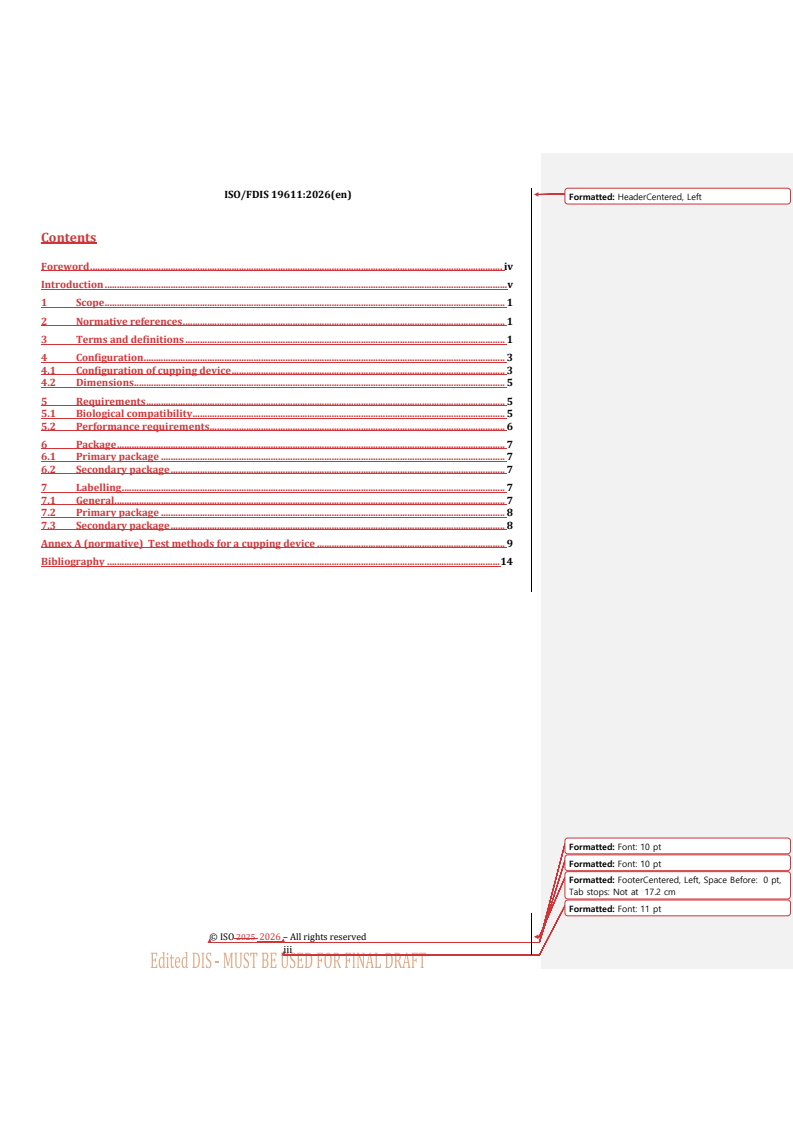
Contents Page
Foreword .iv
Introduction .v
1 Scope . 1
2 Normative references . 1
3 Terms and definitions . 1
4 Configuration. 3
4.1 Configuration of cupping device .3
4.2 Dimensions .3
4.2.1 Inner volume .3
4.2.2 Smoothness of the skin contacting edge .4
4.2.3 Diameters of air outlet .4
5 Requirements . 4
5.1 Biological compatibility .4
5.2 Performance requirements .4
5.2.1 Resisting negative pressure .4
5.2.2 Pressure maintenance . .5
5.2.3 Mechanical stability .5
5.2.4 Transparency . . .5
5.2.5 Repeated disinfection resistance .5
5.2.6 Sterilization for single-use type devices .5
5.2.7 Disinfection for multiple-use type devices .5
6 Package . 5
6.1 Primary package .5
6.2 Secondary package .6
7 Labelling . 6
7.1 General .6
7.2 Primary package .6
7.3 Secondary package .6
Annex A (normative) Test methods for a cupping device. 7
Bibliography . 9
iii
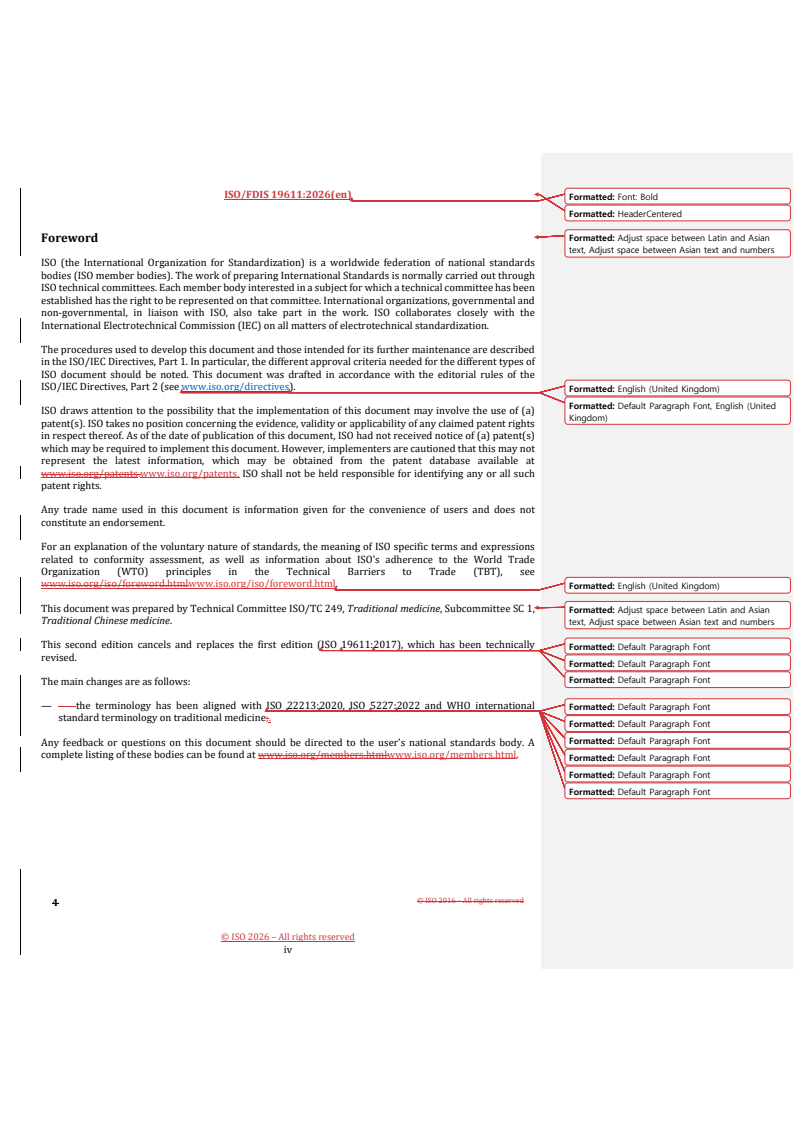
Foreword
ISO (the International Organization for Standardization) is a worldwide federation of national standards
bodies (ISO member bodies). The work of preparing International Standards is normally carried out through
ISO technical committees. Each member body interested in a subject for which a technical committee
has been established has the right to be represented on that committee. International organizations,
governmental and non-governmental, in liaison with ISO, also take part in the work. ISO collaborates closely
with the International Electrotechnical Commission (IEC) on all matters of electrotechnical standardization.
The procedures used to develop this document and those intended for its further maintenance are described
in the ISO/IEC Directives, Part 1. In particular, the different approval criteria needed for the different types
of ISO document should be noted. This document was drafted in accordance with the editorial rules of the
ISO/IEC Directives, Part 2 (see www.iso.org/directives).
ISO draws attention to the possibility that the implementation of this document may involve the use of (a)
patent(s). ISO takes no position concerning the evidence, validity or applicability of any claimed patent
rights in respect thereof. As of the date of publication of this document, ISO had not received notice of (a)
patent(s) which may be required to implement this document. However, implementers are cautioned that
this may not represent the latest information, which may be obtained from the patent database available at
www.iso.org/patents. ISO shall not be held responsible for identifying any or all such patent rights.
Any trade name used in this document is information given for the convenience of users and does not
constitute an endorsement.
For an explanation of the voluntary nature of standards, the meaning of ISO specific terms and expressions
related to conformity assessment, as well as information about ISO's adherence to the World Trade
Organization (WTO) principles in the Technical Barriers to Trade (TBT), see www.iso.org/iso/foreword.html.
This document was prepared by Technical Committee ISO/TC 249, Traditional medicine, Subcommittee SC 1,
Traditional Chinese medicine.
This second edition cancels and replaces the first edition (ISO 19611:2017), which has been technically
revised.
The main changes are as follows:
— the terminology has been aligned with ISO 22213:2020, ISO 5227:2022 and WHO international standard
terminology on traditional medicine.
Any feedback or questions on this document should be directed to the user’s national standards body. A
complete listing of these bodies can be found at www.iso.org/members.html.
iv
Introduction
Cupping therapy is one of the most widely used traditional medical methods, which creates a partial vacuum
in cups placed on the skin either by means of heat or mechanical devices (hand or electrical pumps). In the
Middle East, cupping therapy has been used since at least 1550 B.C as Hijama. In East Asia, cupping therapy
has been used since at least the Han dynasty of China and has evolved into slide cupping, medicated cupping,
retained cupping, etc. In Europe, cupping also has been used since at least the Greek era and developed
as cupping therapy in England, Schröpfkopf in German, Ventouse in France, Банки in Russia, etc. In these
days, cupping device is commonly and widely used as a traditional therapy in various techniques. Even
though cupping device is widely used and produced in a number of countries and companies, there is no
international standard for cupping device yet. In the aspect of safety, the cupping device directly contacts
the skin, and in the case of bloodletting cupping, it directly contacts open wound involving bleeding. To
prevent wound infection, it should be distinguished and developed differently in the case of intact skin
or wounded skin usage. In addition, as a medical device that directly contacts blood, it requires the use of
disposable cups. Therefore, the performance requirements of cupping devices needed for different related
functions and usages shall be specified for each intended usage.
Therefore, the performance and safety requirements for cupping devices shall be specified for each intended
usage.
v
FINAL DRAFT International Standard ISO/FDIS 19611:2026(en)
Traditional Chinese medicine — Air extraction cupping device
1 Scope
This document specifies requirements for the configuration, performance, sterilization and disinfection,
packaging and labelling of the air extraction cupping device operated by negative pressure. It also includes
the associated test methods.
The document is applicable to single-use type and multiple-use type cupping devices.
This document does not apply to the suction pump used to create the negative pressure.
2 Normative references
The following documents are referred to in the text in such a way that some or all of their content constitutes
requirements of this document. For dated references, only the edition cited applies. For undated references,
the latest edition of the referenced document (including any amendments) applies.
ISO 10993 (all parts), — Biological evaluation of medical devices
ISO 11135, Sterilization of health-care products — Ethylene oxide — Requirements for the development,
validation and routine control of a sterilization process for medical devices
ISO 11137-1, Sterilization of health care products — Radiation — Part 1: Requirements for the development,
validation and routine control of a sterilization process for medical devices
ISO 15223-1, Medical devices — Symbols to be used with information to be supplied by the manufacturer — Part
1: General requirements
ISO 13408-1:2023, Asept
...
Formatted
...
Style Definition
...
Style Definition
...
Style Definition
...
Style Definition
...
Style Definition
...
ISO/TC 249/SC 1
Style Definition
...
Style Definition
...
Secretariat: SAC
Style Definition
...
Date: 2026-04-0809-01
Style Definition
...
Style Definition
...
Style Definition
...
Style Definition
...
Style Definition
...
Style Definition
...
Traditional Chinese medicine — Air extraction cupping device
Style Definition
...
Médecine traditionnelle chinoise — Dispositif de bombement à extraction d'air
Style Definition
...
Style Definition
...
Style Definition
...
Style Definition
...
Style Definition
...
Style Definition
...
Style Definition
...
Style Definition
...
FDIS stage Style Definition
...
Style Definition
...
Style Definition
...
Style Definition
...
Style Definition
...
Style Definition
...
Style Definition
...
Style Definition
...
Style Definition
...
Style Definition
...
Style Definition
...
Style Definition
...
Style Definition
...
Style Definition
...
Style Definition
...
Style Definition
...
Style Definition
...
Style Definition
...
Style Definition
...
Style Definition
...
Style Definition
...
Style Definition
...
Style Definition
...
Style Definition
...
Style Definition
...
Style Definition
...
Style Definition
...
Style Definition
...
Style Definition
...
Style Definition
...
Style Definition
...
Style Definition
...
Style Definition
...
St l D fi iti
Formatted: Font: Bold
Formatted: HeaderCentered
Formatted: Default Paragraph Font
All rights reserved. Unless otherwise specified, or required in the context of its implementation, no part of this publication
Formatted: Right: 1.5 cm, Gutter: 0 cm, Header
may be reproduced or utilized otherwise in any form or by any means, electronic or mechanical, including photocopying,
distance from edge: 1.27 cm, Footer distance from
or posting on the internet or an intranet, without prior written permission. Permission can be requested from either ISO
edge: 0.5 cm
at the address below or ISO’s member body in the country of the requester.
ISO copyright office
CP 401 • Ch. de Blandonnet 8
CH-1214 Vernier, Geneva
Phone: + 41 22 749 01 11
EmailE-mail: copyright@iso.org
Website: www.iso.orgwww.iso.org
Published in Switzerland
ii
Formatted: HeaderCentered, Left
Contents
Foreword . iv
Introduction . v
1 Scope . 1
2 Normative references . 1
3 Terms and definitions . 1
4 Configuration . 3
4.1 Configuration of cupping device . 3
4.2 Dimensions . 5
5 Requirements . 5
5.1 Biological compatibility . 5
5.2 Performance requirements . 6
6 Package . 7
6.1 Primary package . 7
6.2 Secondary package . 7
7 Labelling . 7
7.1 General . 7
7.2 Primary package . 8
7.3 Secondary package . 8
Annex A (normative) Test methods for a cupping device . 9
Bibliography . 14
Formatted: Font: 10 pt
Formatted: Font: 10 pt
Formatted: FooterCentered, Left, Space Before: 0 pt,
Tab stops: Not at 17.2 cm
Formatted: Font: 11 pt
iii
Formatted: Font: Bold
Formatted: HeaderCentered
Foreword Formatted: Adjust space between Latin and Asian
text, Adjust space between Asian text and numbers
ISO (the International Organization for Standardization) is a worldwide federation of national standards
bodies (ISO member bodies). The work of preparing International Standards is normally carried out through
ISO technical committees. Each member body interested in a subject for which a technical committee has been
established has the right to be represented on that committee. International organizations, governmental and
non-governmental, in liaison with ISO, also take part in the work. ISO collaborates closely with the
International Electrotechnical Commission (IEC) on all matters of electrotechnical standardization.
The procedures used to develop this document and those intended for its further maintenance are described
in the ISO/IEC Directives, Part 1. In particular, the different approval criteria needed for the different types of
ISO document should be noted. This document was drafted in accordance with the editorial rules of the
ISO/IEC Directives, Part 2 (see www.iso.org/directives).
Formatted: English (United Kingdom)
Formatted: Default Paragraph Font, English (United
ISO draws attention to the possibility that the implementation of this document may involve the use of (a)
Kingdom)
patent(s). ISO takes no position concerning the evidence, validity or applicability of any claimed patent rights
in respect thereof. As of the date of publication of this document, ISO had not received notice of (a) patent(s)
which may be required to implement this document. However, implementers are cautioned that this may not
represent the latest information, which may be obtained from the patent database available at
www.iso.org/patents.www.iso.org/patents. ISO shall not be held responsible for identifying any or all such
patent rights.
Any trade name used in this document is information given for the convenience of users and does not
constitute an endorsement.
For an explanation of the voluntary nature of standards, the meaning of ISO specific terms and expressions
related to conformity assessment, as well as information about ISO's adherence to the World Trade
Organization (WTO) principles in the Technical Barriers to Trade (TBT), see
www.iso.org/iso/foreword.htmlwww.iso.org/iso/foreword.html.
Formatted: English (United Kingdom)
This document was prepared by Technical Committee ISO/TC 249, Traditional medicine, Subcommittee SC 1,
Formatted: Adjust space between Latin and Asian
Traditional Chinese medicine.
text, Adjust space between Asian text and numbers
This second edition cancels and replaces the first edition (ISO 19611:2017), which has been technically
Formatted: Default Paragraph Font
revised.
Formatted: Default Paragraph Font
Formatted: Default Paragraph Font
The main changes are as follows:
— — the terminology has been aligned with ISO 22213:2020, ISO 5227:2022 and WHO international
Formatted: Default Paragraph Font
standard terminology on traditional medicine;.
Formatted: Default Paragraph Font
Formatted: Default Paragraph Font
Any feedback or questions on this document should be directed to the user’s national standards body. A
complete listing of these bodies can be found at www.iso.org/members.htmlwww.iso.org/members.html.
Formatted: Default Paragraph Font
Formatted: Default Paragraph Font
Formatted: Default Paragraph Font
iv
Formatted: HeaderCentered, Left
Introduction
Cupping therapy is one of the most widely used traditional medical methods, which creates a partial vacuum
in cups placed on the skin either by means of heat or mechanical devices (hand or electrical pumps). In the
Middle East, cupping therapy has been used since at least 1550 B.C as Hijama. In East Asia, cupping therapy
has been used since at least the Han dynasty of China and has evolved into slide cupping, medicated cupping,
retained cupping, etc. In Europe, cupping also has been used since at least the Greek era and developed as
cupping therapy in England, Schröpfkopf in German, Ventouse in France, Банки in Russia, etc. In these days,
cupping device is commonly and widely used as a traditional therapy in various techniques. Even though
cupping device is widely used and produced in a number of countries and companies, there is no international
standard for cupping device yet. In the aspect of safety, the cupping device directly contacts the skin, and in
the case of bloodletting cupping, it directly contacts open wound involving bleeding. To prevent wound
infection, it should be distinguished and developed differently in the case of intact skin or wounded skin usage.
In addition, as a medical device that directly contacts blood, it requires the use of disposable cups. Therefore,
the performance requirements of cupping devices needed for different related functions and usages shall be
specified for each intended usage.
Therefore, the performance and safety requirements for cupping devices shall be specified for each intended
usage.
Formatted: Font: 10 pt
Formatted: Font: 10 pt
Formatted: FooterCentered, Left, Space Before: 0 pt,
Tab stops: Not at 17.2 cm
Formatted: Font: 11 pt
v
FINAL DRAFT International Standard ISO/FDIS 19611:2026(en)
Traditional Chinese Medicine-medicine — Air extraction cupping
device
1 Scope Formatted: Right: 1.5 cm, Gutter: 0 cm, Header
distance from edge: 1.27 cm, Footer distance from
This document specifies requirements for the configuration, performance, sterilization and disinfection, edge: 0.5 cm
packaging and labelling of the air extraction cupping device operated by negative pressure. It also includes the
associated test methods.
Formatted: Font: Not Italic
Formatted: Adjust space between Latin and Asian
The document is applicable to single-use type and multiple-use type cupping devices.
text, Adjust space between Asian text and numbers,
Tab stops: Not at 0.7 cm + 1.4 cm + 2.1 cm + 2.8
This document does not apply to the suction pump used to create the negative pressure.
cm + 3.5 cm + 4.2 cm + 4.9 cm + 5.6 cm + 6.3
cm + 7 cm
2 Normative references
Formatted: Default Paragraph Font
The following documents are referred to in the text in such a way that some or all of their content constitutes
Formatted: Default Paragraph Font
requirements of this document. For dated references, only the edition cited applies. For undated references,
Formatted: Default Paragraph Font
the latest edition of the referenced document (including any amendments) applies.
Formatted: Default Paragraph Font
ISO 10993 (all parts), — Biological evaluation of medical devices
Formatted: Default Paragraph Font
Formatted: Default Paragraph Font
ISO 11135, Sterilization of health-care products — Ethylene oxide — Requirements for the development,
validation and routine control of a sterilization process for medical devices Formatted: Default Paragraph Font
Formatted: Default Paragraph Font
ISO 11137--1, Sterilization of health care products — Radiation — Part 1: Requirements for the development,
Formatted: Default Paragraph Font
validation and routine control of a sterilization process for medical devices
Formatted: Default Paragraph Font
ISO 15223--1, Medical devices — Symbols to be used with information to be supplied by the manufacturer —
Formatted: Default Paragraph Font
Part 1: General requirements
Formatted: Default Paragraph Font
ISO 13408-1:2023, Aseptic processing of health care products — Part 1: General requirementrequirements
Formatted: Default Paragraph Font
Formatted: Default Paragraph Font
ISO 17664 (all parts), Processing of health care products
Formatted: English (United Kingdom)
ISO 17665, Sterilization of health care products — Moist heat: — Requirements for the development,
Formatted: English (United Kingdom)
validation and routine control of a sterilization process for medical devices
Formatted: Font: Not Italic, English (United Kingdom)
3 Terms and definitions
Formatted: Default Paragraph Font
Formatted: Default Paragraph Font
For the purposes of this document, the following terms and definitions apply.
Formatted: Adjust space between Latin and Asian
text, Adjust space between Asian text and numbers,
ISO and IEC maintain terminology databases for use in standardization at the following addresses:
Tab stops: Not at 0.7 cm + 1.4 cm + 2.1 cm + 2.8
cm + 3.5 cm + 4.2 cm + 4.9 cm + 5.6 cm + 6.3
— — IEC Electropedia: available at https://www.electropedia.org/https://www.electropedia.org/
cm + 7 cm
— — ISO Online browsing platform: available at https://www.iso.org/obphttps://www.iso.org/obp
Formatted: Default Paragraph Font
Formatted: Default Paragraph Font
Formatted: Default Paragraph Font
Formatted: Default Paragraph Font
Formatted: Font: Bold
Formatted: HeaderCentered
3.1 3.1
cupping
therapeutic technique in which cups are placed on the skin to create localized negative pressure (3.2)(3.2) by
means of either heat or a suction device (3.11),(3.11), either for affecting the surface of the body or for
increasing bloodletting (3.5),(3.5), or both
3.2 3.2
negative pressure
pressure value below the atmospheric pressure
Note 1 to entry: The method of creating negative pressure shall be stated when this term is used.
[SOURCE: ISO 8625-1:2018, 3.52, modified — The term 'suction pressure' has been deleted.
Formatted: Font: Cambria, 11 pt, Font color: Auto,
Note 1 to entry has been added.]
Pattern: Clear
3.3 3.3
cupping device
device used to perform cupping (3.1)(3.1) which includes suction cups that sustain negative pressure
3.4 3.4
air extraction cupping device
device for medical cupping, which consists of a body of the cupping device (3.8),(3.8), and an air outlet (3.9)
Formatted: Font: Italic
(3.9)
3.5 3.5
bloodletting
therapeutic method of withdrawing blood to treat or prevent illness and disease by pricking the skin with a
needle or blade
3.6 3.6
single-use type device
disposable cupping device for bloodletting (3.5)(3.5) cupping
Note 1 to entry: This type of cupping device is used when contact with blood and body fluids is likely.
3.7 3.7
multiple-use type device
cupping device used on intact area of skin for non-bloodletting cupping
Note 1 to entry: This type of cupping device used when contact with blood and body fluids is not likely.
Formatted: Adjust space between Latin and Asian
text, Adjust space between Asian text and numbers
3.8 3.8
body of the cupping device
device which maintains negative pressure (3.2)(3.2) generated by a suction device (3.11)(3.11) and has an
internal cavity and an open end to contact the body surface
Formatted: HeaderCentered, Left
3.9 3.9
air outlet
protruding outlet port of a cupping device, connecting to a suction device (3.11)(3.11) to deliver negative
pressure (3.2)(3.2)
3.10
Formatted: Font: Bold
3.10
valve unit for air outlet
one-way valve installed at the air outlet (3.9) (3.9)
Note 1 to entry: See Figure 1Figure 1 as an example of a typical structure of a cupping device.
3.11 3.11
suction device
device for generating negative pressure (3.2)(3.2) in the cupping device (3.3) (3.3)
Note 1 to entry: The suction device can be manual or automatic pump, rubber bulb, twisting rotary etc.
3.12 3.12
initial value
Formatted: English (United Kingdom)
stable value of the pressure inside air extraction cupping device (3.4) cupping device (3.4) immediately after
Formatted: Font: Not Bold, English (United Kingdom)
finishing the air extracting
Formatted: English (United Kingdom)
3.13 3.13
Formatted: English (United Kingdom)
instantaneous pressure
Formatted: Font: Not Bold, English (United Kingdom)
pressure produced inside air extraction cupping device (3.4) cupping device (3.4) at the instant moment of air
Formatted: English (United Kingdom)
extracting
Formatted: English (United Kingdom)
[SOURCE: ISO 22213:2020, 3.4, modified: The term 'glass' has been replaced by 'air extraction'. The term '
Formatted: Font: Not Bold, English (United Kingdom)
cupping' has been replaced by 'air extracting'.]
Formatted: English (United Kingdom)
4 Configuration
Formatted: English (United Kingdom)
Formatted: English (United Kingdom)
4.1 Configuration of cupping device
Formatted: English (United Kingdom)
The configuration of the cupping device and the name of each of its parts are shown in Figure 1.Figure 1.
Formatted: English (United Kingdom)
Formatted: English (United Kingdom)
Formatted: English (United Kingdom)
Formatted: English (United Kingdom)
Formatted: English (United Kingdom)
Formatted: Font: 10 pt
Formatted: Font: 10 pt
Formatted: FooterCentered, Left, Space Before: 0 pt,
Tab stops: Not at 17.2 cm
Formatted: Font: 11 pt
Formatted: Font: Bold
Formatted: HeaderCentered
Key
Formatted: Adjust space between Latin and Asian
1 body of cupping device
text, Adjust s
...