

ISO/TS 19392-1:2018
(Main)Paints and varnishes — Coating systems for wind-turbine rotor blades — Part 1: Minimum requirements and weathering
General Information
- Abstract
This document specifies minimum requirements and weathering for coating systems for wind-turbine rotor blades.
- Status
- Published
- Publication Date
- 03-May-2018
- Technical Committee
- ISO/TC 35/SC 9 - General test methods for paints and varnishes
- Drafting Committee
- ISO/TC 35/SC 9/WG 32 - Coating materials for wind-turbine rotor blades
- Current Stage
- 9092 - International Standard to be revised
- Start Date
- 10-Jun-2024
- Completion Date
- 29-Aug-2026
Buy Documents
ISO/TS 19392-1:2018 - Paints and varnishes — Coating systems for wind-turbine rotor blades — Part 1: Minimum requirements and weathering Released:4. 05. 2018
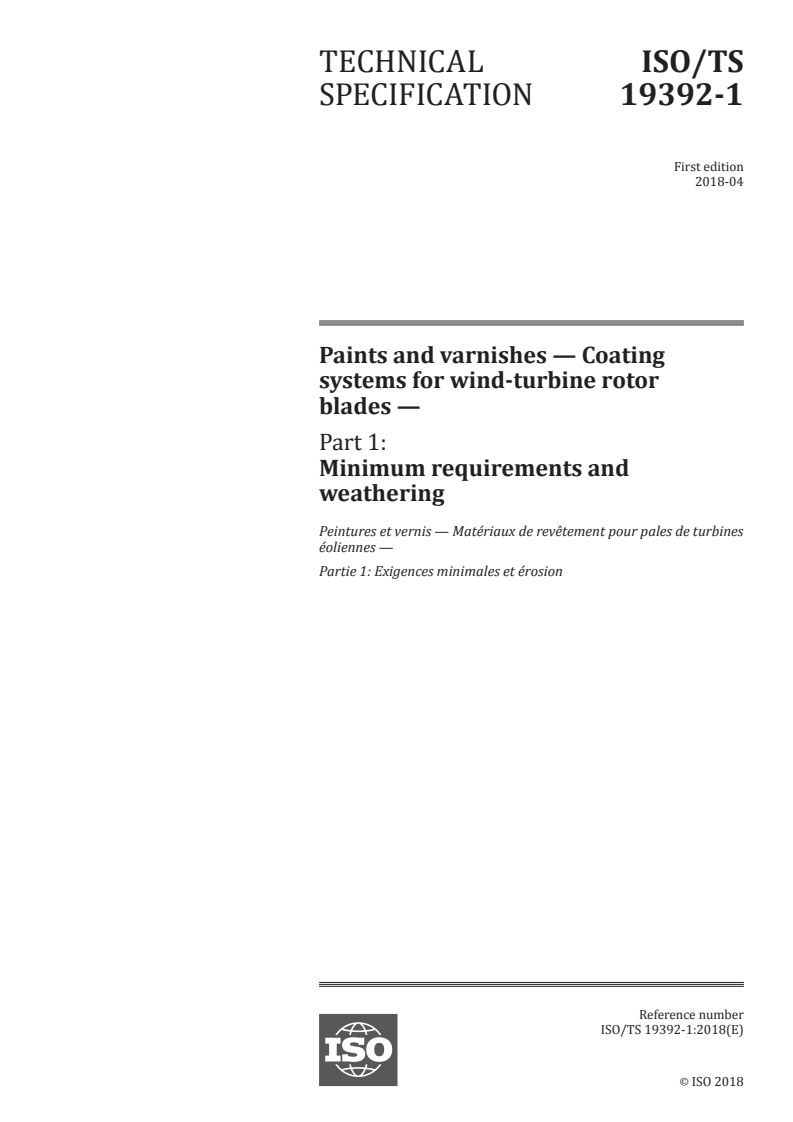
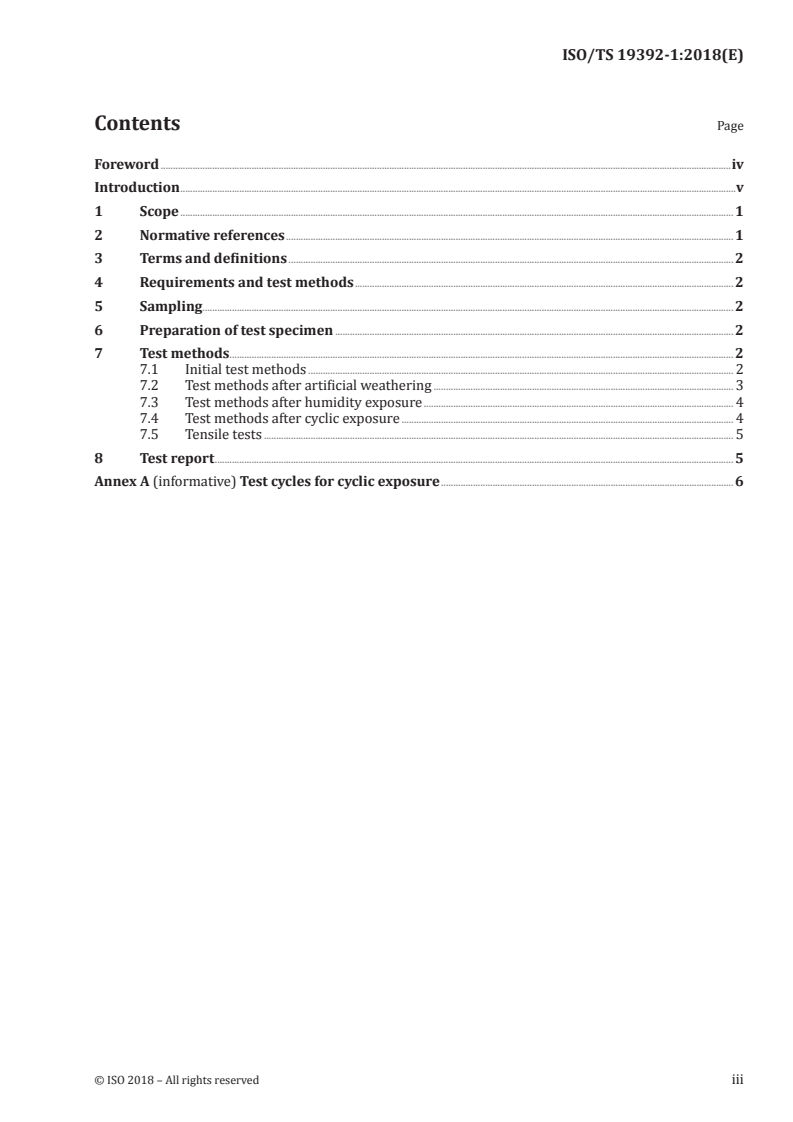
ISO/TS 19392-1:2018 - Paints and varnishes — Coating systems for wind-turbine rotor blades — Part 1: Minimum requirements and weathering/4/2018
Overview
ISO/TS 19392-1:2018 is a Technical Specification that defines minimum requirements and weathering tests for coating systems used on wind‑turbine rotor blades. Published by ISO (2018), it specifies performance criteria, sampling and preparation, and a battery of laboratory weathering and mechanical tests to assess durability against environmental stressors such as UV exposure, humidity, thermal cycling and rain erosion.
Key topics and requirements
- Scope: Minimum performance requirements and weathering/test protocols for blade coating systems.
- Performance characteristics and acceptance criteria:
- Adhesive strength: > 5 MPa (cohesion fracture) and up to > 7 MPa depending on fracture type - test: ISO 4624.
- Initial gloss: guidance of < 30 GU (60°) (to be agreed among parties) - test: ISO 2813.
- Colour stability after artificial weathering: ΔE* < 1 (ISO 11664‑4).
- Gloss change after aging: increase < 6 GU (60°).
- Chalking / blistering / cracking: target rating 0 (S0) using ISO 4628 parts.
- Tensile / elongation: film elongation at +23 °C and −40 °C better than laminate; test: ISO 527 series.
- Rain erosion resistance: evaluated by ISO/TS 19392‑2 (rotating arm) or ISO/TS 19392‑3 (water jet).
- Weathering procedures:
- Artificial weathering methods include xenon‑arc and fluorescent UV lamp cycles (ISO 16474, ISO 4892), with typical exposures of 1 000 h or 3 000 h depending on the method.
- Humidity exposure: 1 000 h per ISO 6270‑2 (condensation).
- Cyclic exposure: ~1 008 h typical, temperature/humidity cycles per IEC 60068‑2‑14 or IEC 61215‑2; Annex A provides recommended cycles.
- Test reporting: requires identification, methods/cycles used, results, compliance status and any deviations.
Applications and users
This specification is practical for:
- Coating manufacturers (product development, QA/specification).
- Wind turbine OEMs and blade manufacturers (material selection, procurement specs).
- Testing and certification laboratories (type testing, conformity assessment).
- Asset owners and maintenance teams (comparative durability evaluations). Use cases include durability qualification of new coating formulations, acceptance testing for production batches, and benchmarking for rain/UV resistance.
Related standards
- ISO/TS 19392‑2 - rain erosion: rotating arm method
- ISO/TS 19392‑3 - rain erosion: water jet method
- ISO 4624, ISO 2813, ISO 4628 (parts), ISO 11664‑4, ISO 6270‑2, ISO 16474, ISO 4892, ISO 527 series, IEC 60068‑2‑14, IEC 61215‑2
Keywords: ISO/TS 19392‑1:2018, coating systems, wind‑turbine rotor blades, rain erosion resistance, artificial weathering, adhesion testing, cyclic exposure, humidity testing, blade coatings.
Relations
- Effective Date
- 06-Jun-2022
Buy Documents
ISO/TS 19392-1:2018 - Paints and varnishes — Coating systems for wind-turbine rotor blades — Part 1: Minimum requirements and weathering Released:4. 05. 2018
ISO/TS 19392-1:2018 - Paints and varnishes — Coating systems for wind-turbine rotor blades — Part 1: Minimum requirements and weathering/4/2018
Frequently Asked Questions
ISO/TS 19392-1:2018 is a technical specification published by the International Organization for Standardization (ISO). Its full title is "Paints and varnishes — Coating systems for wind-turbine rotor blades — Part 1: Minimum requirements and weathering". This standard covers: This document specifies minimum requirements and weathering for coating systems for wind-turbine rotor blades.
This document specifies minimum requirements and weathering for coating systems for wind-turbine rotor blades.
ISO/TS 19392-1:2018 is classified under the following ICS (International Classification for Standards) categories: 87.040 - Paints and varnishes. The ICS classification helps identify the subject area and facilitates finding related standards.
ISO/TS 19392-1:2018 has the following relationships with other standards: It is inter standard links to ISO 3459:2022. Understanding these relationships helps ensure you are using the most current and applicable version of the standard.
ISO/TS 19392-1:2018 is available in PDF format for immediate download after purchase. The document can be added to your cart and obtained through the secure checkout process. Digital delivery ensures instant access to the complete standard document.
Standards Content (Sample)
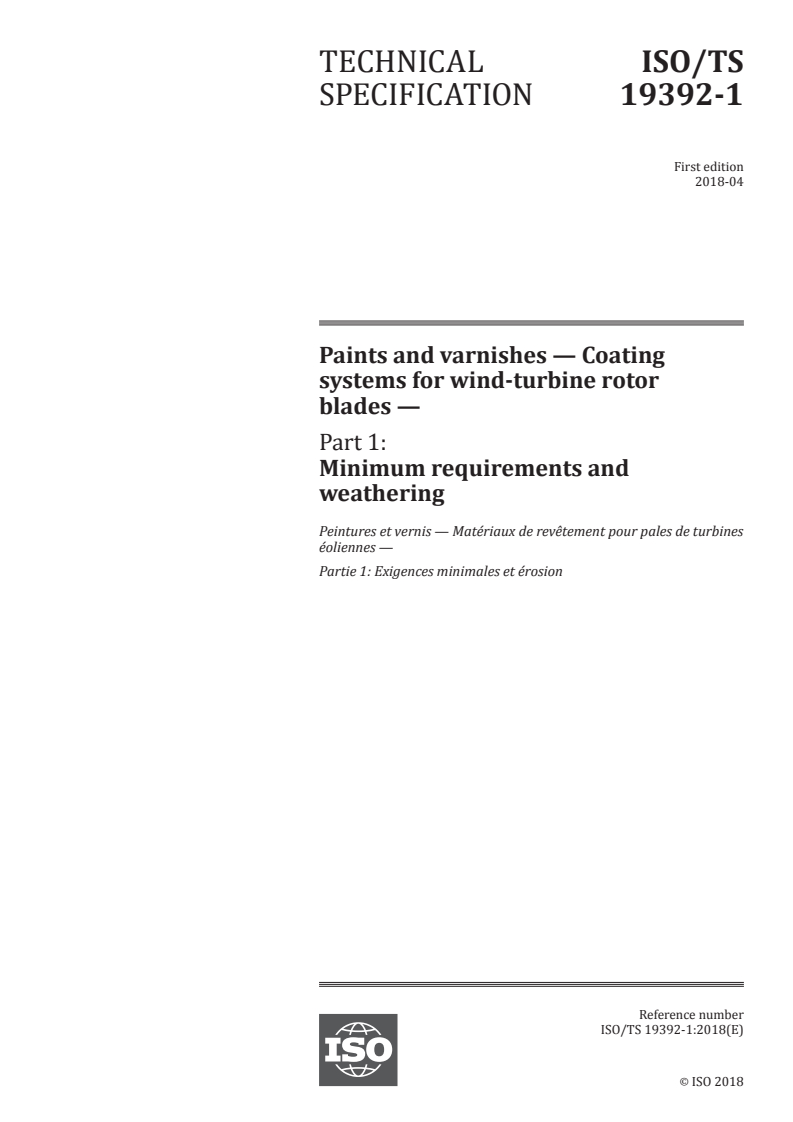
TECHNICAL ISO/TS
SPECIFICATION 19392-1
First edition
2018-04
Paints and varnishes — Coating
systems for wind-turbine rotor
blades —
Part 1:
Minimum requirements and
weathering
Peintures et vernis — Matériaux de revêtement pour pales de turbines
éoliennes —
Partie 1: Exigences minimales et érosion
Reference number
©
ISO 2018
© ISO 2018
All rights reserved. Unless otherwise specified, or required in the context of its implementation, no part of this publication may
be reproduced or utilized otherwise in any form or by any means, electronic or mechanical, including photocopying, or posting
on the internet or an intranet, without prior written permission. Permission can be requested from either ISO at the address
below or ISO’s member body in the country of the requester.
ISO copyright office
CP 401 • Ch. de Blandonnet 8
CH-1214 Vernier, Geneva
Phone: +41 22 749 01 11
Fax: +41 22 749 09 47
Email: copyright@iso.org
Website: www.iso.org
Published in Switzerland
ii © ISO 2018 – All rights reserved
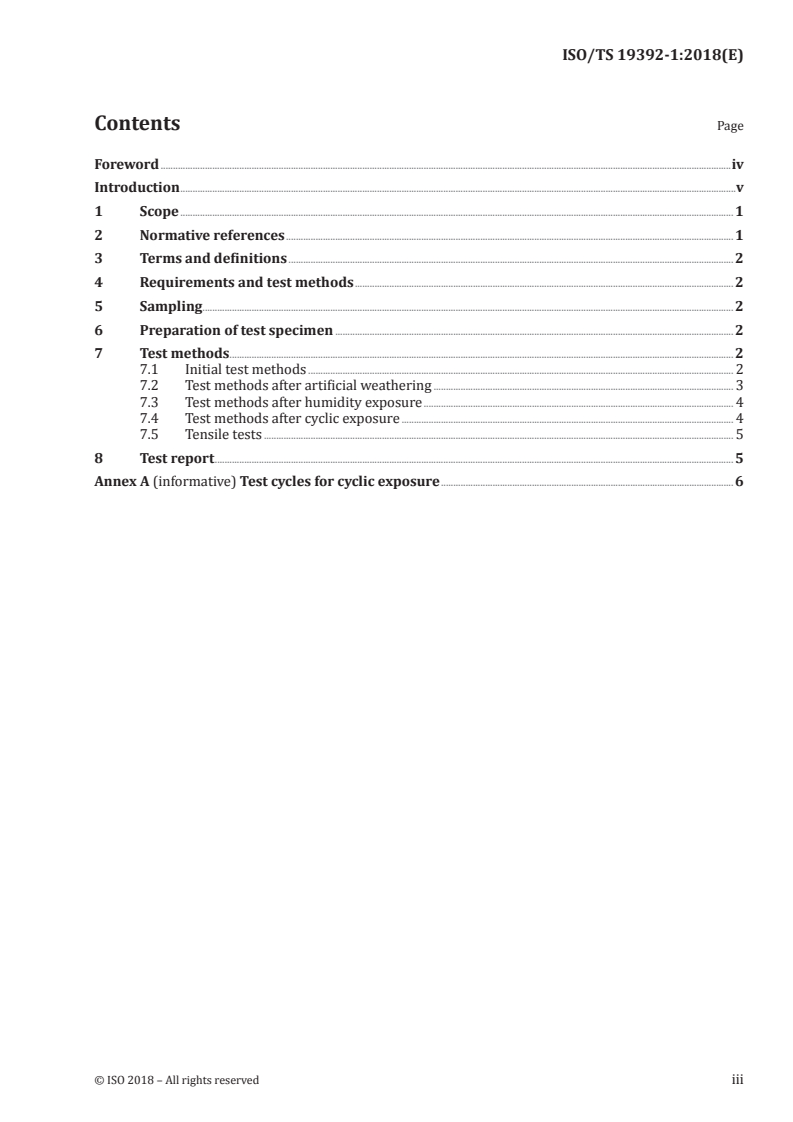
Contents Page
Foreword .iv
Introduction .v
1 Scope . 1
2 Normative references . 1
3 Terms and definitions . 2
4 Requirements and test methods . 2
5 Sampling . 2
6 Preparation of test specimen . 2
7 Test methods . 2
7.1 Initial test methods . 2
7.2 Test methods after artificial weathering . 3
7.3 Test methods after humidity exposure . 4
7.4 Test methods after cyclic exposure . 4
7.5 Tensile tests . 5
8 Test report . 5
Annex A (informative) Test cycles for cyclic exposure . 6
Foreword
ISO (the International Organization for Standardization) is a worldwide federation of national standards
bodies (ISO member bodies). The work of preparing International Standards is normally carried out
through ISO technical committees. Each member body interested in a subject for which a technical
committee has been established has the right to be represented on that committee. International
organizations, governmental and non-governmental, in liaison with ISO, also take part in the work.
ISO collaborates closely with the International Electrotechnical Commission (IEC) on all matters of
electrotechnical standardization.
The procedures used to develop this document and those intended for its further maintenance are
described in the ISO/IEC Directives, Part 1. In particular the different approval criteria needed for the
different types of ISO documents should be noted. This document was drafted in accordance with the
editorial rules of the ISO/IEC Directives, Part 2 (see www .iso .org/directives).
Attention is drawn to the possibility that some of the elements of this document may be the subject of
patent rights. ISO shall not be held responsible for identifying any or all such patent rights. Details of
any patent rights identified during the development of the document will be in the Introduction and/or
on the ISO list of patent declarations received (see www .iso .org/patents).
Any trade name used in this document is information given for the convenience of users and does not
constitute an endorsement.
For an explanation on the voluntary nature of standards, the meaning of ISO specific terms and
expressions related to conformity assessment, as well as information about ISO's adherence to the
World Trade Organization (WTO) principles in the Technical Barriers to Trade (TBT) see the following
URL: www .iso .org/iso/foreword .html.
This document was prepared by Technical Committee ISO/TC 35, Paints and varnishes, Subcommittee
SC 9, General test methods for paints and varnishes.
A list of all parts in the ISO 19392 series can be found on the ISO website.
iv © ISO 2018 – All rights reserved
Introduction
In the wind energy industry, coatings are applied to rotor blades surface to protect the glass fibre
reinforced polymer composite substrate. Rain drops and hailstones can damage these coatings in such
a way that individual layers come off or the whole coating delaminates from the substrate.
This document describes the minimum requirements and weathering of the coating system. Rain
erosion can be simulated by means of high speed water jets or water droplets impinging on the
specimen surface. ISO/TS 19392-2 describes a method which simulates rain erosion by accelerating one
or more coated panels, attached to the end of rotating arms, through a simulated rain field at a constant
rotational velocity. ISO/TS 19392-3 describes a method where a water jet or a series of water jets at a
defined pressure hits the surface of the specimen.
TECHNICAL SPECIFICATION ISO/TS 19392-1:2018(E)
Paints and varnishes — Coating systems for wind-turbine
rotor blades —
Part 1:
Minimum requirements and weathering
1 Scope
This document specifies minimum requirements and weathering for coating systems for wind-turbine
rotor blades.
2 Normative references
The following documents are referred to in the text in such a way that some or all of their content
constitutes requirements of this document. For dated references, only the edition cited applies. For
undated references, the latest edition of the referenced document (including any amendments) applies.
ISO 527-1, Plastics — Determination of tensile properties — Part 1: General principles
ISO 527-3, Plastics — Determination of tensile properties — Part 3: Test conditions for films and sheets
ISO 1513, Paints and varnishes — Examination and preparation of test samples
ISO 2813, Paints and varnishes — Determination of gloss value at 20°, 60° and 85°
ISO 4624, Paints and varnishes — Pull-off test for adhesion
ISO 4628-2, Paints and varnishes — Evaluation of degradation of coatings — Designation of quantity
and size of defects, and of intensity of uniform changes in appearance — Part 2: Assessment of degree of
blistering
ISO 4628-4, Paints and varnishes — Evaluation of degradation of coatings — Designation of quantity
and size of defects, and of intensity of uniform changes in appearance — Part 4: Assessment of degree of
cracking
ISO 4892-3, Plastics — Methods of exposure to laboratory light sources — Part 3: Fluorescent UV lamps
ISO 6270-2, Paints and varnishes — Determination of resistance to humidity — Part 2: Condensation (in-
cabinet exposure with heated water reservoir)
ISO 11664-4, Colorimetry — Part 4: CIE 1976 L*a*b* Colour space
ISO 15528, Paints, varnishes and raw materials for paints and varnishes — Sampling
ISO 16474-2, Paints and varnishes — Methods of exposure to laboratory light sources — Part 2: Xenon-
arc lamps
ISO 16474-3, Paints and varnishes — Methods of exposure to laboratory light sources — Part 3: Fluorescent
UV lamps
ISO/TS 19392-2, Paints and varnishes — Coating systems for wind-turbine rotor blades — Part 2:
Determination and evaluation of resistance to rain erosion using rotating arm
ISO/TS 19392-3, Paints and varnishes — Coating systems for wind-turbine rotor blades — Part 3:
Determination and evaluation of resistance to rain erosion using water jet
IEC 60068-2-14, Environmental testing — Part 2-14: Tests — Test N: Change of temperature
IEC 61215-2, Terrestrial photovoltaic (PV) modules — Design qualification and type approval — Part 2:
Test procedures
...
TECHNICAL ISO/TS
SPECIFICATION 19392-1
First edition
2018-04
Paints and varnishes — Coating
systems for wind-turbine rotor
blades —
Part 1:
Minimum requirements and
weathering
Peintures et vernis — Matériaux de revêtement pour pales de turbines
éoliennes —
Partie 1: Exigences minimales et érosion
Reference number
©
ISO 2018
© ISO 2018
All rights reserved. Unless otherwise specified, or required in the context of its implementation, no part of this publication may
be reproduced or utilized otherwise in any form or by any means, electronic or mechanical, including photocopying, or posting
on the internet or an intranet, without prior written permission. Permission can be requested from either ISO at the address
below or ISO’s member body in the country of the requester.
ISO copyright office
CP 401 • Ch. de Blandonnet 8
CH-1214 Vernier, Geneva
Phone: +41 22 749 01 11
Fax: +41 22 749 09 47
Email: copyright@iso.org
Website: www.iso.org
Published in Switzerland
ii © ISO 2018 – All rights reserved
Contents Page
Foreword .iv
Introduction .v
1 Scope . 1
2 Normative references . 1
3 Terms and definitions . 2
4 Requirements and test methods . 2
5 Sampling . 2
6 Preparation of test specimen . 2
7 Test methods . 2
7.1 Initial test methods . 2
7.2 Test methods after artificial weathering . 3
7.3 Test methods after humidity exposure . 4
7.4 Test methods after cyclic exposure . 4
7.5 Tensile tests . 5
8 Test report . 5
Annex A (informative) Test cycles for cyclic exposure . 6
Foreword
ISO (the International Organization for Standardization) is a worldwide federation of national standards
bodies (ISO member bodies). The work of preparing International Standards is normally carried out
through ISO technical committees. Each member body interested in a subject for which a technical
committee has been established has the right to be represented on that committee. International
organizations, governmental and non-governmental, in liaison with ISO, also take part in the work.
ISO collaborates closely with the International Electrotechnical Commission (IEC) on all matters of
electrotechnical standardization.
The procedures used to develop this document and those intended for its further maintenance are
described in the ISO/IEC Directives, Part 1. In particular the different approval criteria needed for the
different types of ISO documents should be noted. This document was drafted in accordance with the
editorial rules of the ISO/IEC Directives, Part 2 (see www .iso .org/directives).
Attention is drawn to the possibility that some of the elements of this document may be the subject of
patent rights. ISO shall not be held responsible for identifying any or all such patent rights. Details of
any patent rights identified during the development of the document will be in the Introduction and/or
on the ISO list of patent declarations received (see www .iso .org/patents).
Any trade name used in this document is information given for the convenience of users and does not
constitute an endorsement.
For an explanation on the voluntary nature of standards, the meaning of ISO specific terms and
expressions related to conformity assessment, as well as information about ISO's adherence to the
World Trade Organization (WTO) principles in the Technical Barriers to Trade (TBT) see the following
URL: www .iso .org/iso/foreword .html.
This document was prepared by Technical Committee ISO/TC 35, Paints and varnishes, Subcommittee
SC 9, General test methods for paints and varnishes.
A list of all parts in the ISO 19392 series can be found on the ISO website.
iv © ISO 2018 – All rights reserved
Introduction
In the wind energy industry, coatings are applied to rotor blades surface to protect the glass fibre
reinforced polymer composite substrate. Rain drops and hailstones can damage these coatings in such
a way that individual layers come off or the whole coating delaminates from the substrate.
This document describes the minimum requirements and weathering of the coating system. Rain
erosion can be simulated by means of high speed water jets or water droplets impinging on the
specimen surface. ISO/TS 19392-2 describes a method which simulates rain erosion by accelerating one
or more coated panels, attached to the end of rotating arms, through a simulated rain field at a constant
rotational velocity. ISO/TS 19392-3 describes a method where a water jet or a series of water jets at a
defined pressure hits the surface of the specimen.
TECHNICAL SPECIFICATION ISO/TS 19392-1:2018(E)
Paints and varnishes — Coating systems for wind-turbine
rotor blades —
Part 1:
Minimum requirements and weathering
1 Scope
This document specifies minimum requirements and weathering for coating systems for wind-turbine
rotor blades.
2 Normative references
The following documents are referred to in the text in such a way that some or all of their content
constitutes requirements of this document. For dated references, only the edition cited applies. For
undated references, the latest edition of the referenced document (including any amendments) applies.
ISO 527-1, Plastics — Determination of tensile properties — Part 1: General principles
ISO 527-3, Plastics — Determination of tensile properties — Part 3: Test conditions for films and sheets
ISO 1513, Paints and varnishes — Examination and preparation of test samples
ISO 2813, Paints and varnishes — Determination of gloss value at 20°, 60° and 85°
ISO 4624, Paints and varnishes — Pull-off test for adhesion
ISO 4628-2, Paints and varnishes — Evaluation of degradation of coatings — Designation of quantity
and size of defects, and of intensity of uniform changes in appearance — Part 2: Assessment of degree of
blistering
ISO 4628-4, Paints and varnishes — Evaluation of degradation of coatings — Designation of quantity
and size of defects, and of intensity of uniform changes in appearance — Part 4: Assessment of degree of
cracking
ISO 4892-3, Plastics — Methods of exposure to laboratory light sources — Part 3: Fluorescent UV lamps
ISO 6270-2, Paints and varnishes — Determination of resistance to humidity — Part 2: Condensation (in-
cabinet exposure with heated water reservoir)
ISO 11664-4, Colorimetry — Part 4: CIE 1976 L*a*b* Colour space
ISO 15528, Paints, varnishes and raw materials for paints and varnishes — Sampling
ISO 16474-2, Paints and varnishes — Methods of exposure to laboratory light sources — Part 2: Xenon-
arc lamps
ISO 16474-3, Paints and varnishes — Methods of exposure to laboratory light sources — Part 3: Fluorescent
UV lamps
ISO/TS 19392-2, Paints and varnishes — Coating systems for wind-turbine rotor blades — Part 2:
Determination and evaluation of resistance to rain erosion using rotating arm
ISO/TS 19392-3, Paints and varnishes — Coating systems for wind-turbine rotor blades — Part 3:
Determination and evaluation of resistance to rain erosion using water jet
IEC 60068-2-14, Environmental testing — Part 2-14: Tests — Test N: Change of temperature
IEC 61215-2, Terrestrial photovoltaic (PV) modules — Design qualification and type approval — Part 2:
Test procedures
...