

ISO/IEC DTR 25544
(Main)Effect of specific transmission media on the security evaluation of quantum key distribution
- Status
- Not Published
- Current Stage
- 5020 - Proof sent to secretariat or FDIS ballot initiated: 8 weeks - 50 Approval
- Start Date
- 21-Oct-2026
- Due Date
- 21-Oct-2026
- Completion Date
- 21-Oct-2026
Buy Documents
ISO/IEC DTR 25544 - Effect of specific transmission media on the security evaluation of quantum key distribution
REDLINE ISO/IEC DTR 25544 - Effect of specific transmission media on the security evaluation of quantum key distribution
ISO/IEC DTR 25544 is a joint ISO/IEC technical report from ISO JTC 1/SC 27 on how specific transmission media affect the security evaluation of quantum key distribution (QKD). It focuses on optical fibre, free-space, and underwater QKD, and it explains which extra components, interfaces, threats, and test impacts those media introduce. In practice, it helps people decide how to adapt security requirements and evaluation methods for QKD modules that are not limited to single-mode fibre.
What does ISO/IEC DTR 25544 specify?
ISO/IEC DTR 25544 investigates the security evaluation of QKD modules that use specific transmission media. It describes the module structures for those media, points out the additional components and interfaces that create vulnerabilities, and analyses how the media affect existing security requirements and test methods.
The document is organized into these main parts:
- Clause 5 - overview of QKD security analysis
- Clause 6 - progress in QKD security evaluation standardization
- Clause 7 - security problem analysis for QKD modules using specific transmission media
- Clause 8 - influence on existing security functional requirements
- Clause 9 - influence on security evaluation and testing methods
- Bibliography - related standards and research
The media discussed are optical fibre, free-space, and underwater. This matters because each medium changes how a QKD module is built, what can leak information, and what evaluators need to inspect.
What are the key requirements of ISO/IEC DTR 25544?
ISO/IEC DTR 25544 is primarily an analytical report, but it gives clear guidance on what security work needs to change when QKD moves beyond single-mode fibre. The most important points are the module structures, the new threats, and the extra evaluation considerations that follow from them.
Clause 5 - security analysis starts from theory and implementation
ISO/IEC DTR 25544 explains that QKD security is based on physics, but real systems can diverge from the ideal models used in proofs. That matters because practical flaws in sources, detectors, encoding, and post-processing can create attack paths that do not appear in the theory.
The report also summarizes the development of security thinking in QKD, including attacks against weak coherent sources, detector attacks, MDI-QKD, TF-QKD, and loss-tolerant analysis. For a reader, the practical message is that security evaluation must address engineering imperfections, not only protocol design.
Clause 6 - existing standards cover the baseline, but not every transmission medium
ISO/IEC DTR 25544 places ISO/IEC 23837-1 as the baseline for QKD module security requirements and ISO/IEC 23837-2 as the source of evaluation activities. It also links the topic to the ISO/IEC 15408 security evaluation framework and to related QKD standards from ITU-T and ETSI.
The practical point is that the current baseline was written mainly with single-mode fibre in mind. Where a QKD system uses free-space, underwater, multi-core fibre, few-mode fibre, or multi-mode fibre, the report argues that extra security functional requirements may be needed.
Clause 7 - each medium brings its own structure and threat profile
ISO/IEC DTR 25544 describes generic QKD module structures for optical fibre, free-space, and underwater implementations. It separates conventional network components from quantum optical components, and it identifies auxiliary parts such as control and management, key management, isolators, post-processing, and random bit generation.
This matters because evaluators need to know which component is exposed to which attack. For fibre systems, the report highlights crosstalk, mode coupling, wavelength-dependent effects, and high-power optical injection. For free-space systems, it highlights spatial-mode side channels, detector-efficiency mismatch, environmental effects, and denial-of-service against pointing, acquisition and tracking (PAT). For underwater systems, it points to the close relationship with free-space-style optical links, plus the coupling and collimation equipment needed in current implementations.
Clause 8 - additional security functional considerations are needed
ISO/IEC DTR 25544 identifies two especially important additions for protection profile and security target work: spatial mode matching and filtering, and functions for external attack protection and channel establishment protection.
For a reader, that means security specifications may need to say how to reduce leakage caused by multiple spatial modes and how to protect the optical front end, telescope system, or PAT-related functions against active optical attacks. The report ties this directly to the risks of inter-core crosstalk, mode coupling, injected light, and link-establishment disruption.
Clause 9 - test and evaluation methods must follow the medium
ISO/IEC DTR 25544 says the evaluation methods in ISO/IEC 23837-2 need to be adapted when the transmission medium changes. It highlights tests for spatial-mode behavior, injected-signal resistance, isolator performance, PAT robustness, and environmental conditions such as launch, vacuum, radiation, turbulence, and underwater effects.
In practice, this means labs should not rely only on single-mode assumptions. They need test setups that can observe mode-related artifacts, environmental degradation, and attack resistance under the operating conditions expected for the specific QKD implementation.
What terms does ISO/IEC DTR 25544 define?
- Quantum key distribution (QKD) is a method for establishing shared keys with security based on physical principles rather than computational hardness.
- Free-space propagation is the propagation of an electromagnetic wave through an ideal homogeneous dielectric medium of infinite extent.
- Free-space quantum key distribution is QKD that uses a free-space channel.
- Underwater channel is a communication channel for electromagnetic signal transmission through the region below the water surface, including rivers, lakes, and seas.
- Underwater quantum key distribution is QKD that uses an underwater channel.
- PAT (pointing, acquisition and tracking) is the subsystem that establishes and maintains a free-space optical link.
- SMF (single-mode fibre) is the fibre type used when the optical channel carries one spatial mode.
- SDM (space-division multiplexing) uses transverse spatial properties of light to increase transmission capacity.
Who uses ISO/IEC DTR 25544?
ISO/IEC DTR 25544 is useful for people designing, evaluating, testing, or specifying QKD systems. That includes QKD module manufacturers, security engineers, test laboratories, certification and evaluation bodies, and standards developers working on protection profiles or security targets.
It is also relevant to organizations deploying QKD over optical fibre, free-space links, or underwater links. Those users need to understand what extra interfaces and environmental conditions can affect security, key management, and test planning.
Which standards are used with ISO/IEC DTR 25544?
| Standard | What it contributes |
|---|---|
| ISO/IEC 23837-1:2023 | Baseline security requirements for QKD modules, including the security functional requirements discussed in the report |
| ISO/IEC 23837-2:2023 | Evaluation activities and testing methods for QKD |
| ISO/IEC 15408 (all parts) | The broader IT security evaluation framework used for protection profile and security target thinking |
| ISO/IEC 18031 | Random bit generation, relevant to non-deterministic random bit generator (NRBG) implementations |
| ITU-T X.1702, X.1710 to X.1717 | Related QKD network, protocol, key management, protection, authentication, and control-and-management standards |
| ETSI GS QKD 005, 008, 011, 016 | Related QKD security proofs, module security specification, component characterization, and a Common Criteria protection profile for prepare-and-measure QKD modules |
What does the ISO/IEC DTR 25544 document contain?
ISO/IEC DTR 25544 contains an overview of QKD security analysis, a review of standardization progress, and a detailed discussion of security issues by transmission medium. It includes generic internal and external structure descriptions for fibre, free-space, and underwater QKD modules, with figures that show how the main components fit together.
The document also covers potential threats such as crosstalk, mode coupling, side channels, optical injection, PAT interference, and environmental degradation. It then maps those issues to the security functional requirements and to the evaluation and testing methods that would need to change.
Buy Documents
ISO/IEC DTR 25544 - Effect of specific transmission media on the security evaluation of quantum key distribution
REDLINE ISO/IEC DTR 25544 - Effect of specific transmission media on the security evaluation of quantum key distribution
Get Certified
Connect with accredited certification bodies for this standard

BSI Group
BSI (British Standards Institution) is the business standards company that helps organizations make excellence a habit.

Bureau Veritas
Bureau Veritas is a world leader in laboratory testing, inspection and certification services.

DNV
DNV is an independent assurance and risk management provider.
Sponsored listings
Frequently Asked Questions
ISO/IEC DTR 25544 is a draft published by the International Organization for Standardization (ISO). Its full title is "Effect of specific transmission media on the security evaluation of quantum key distribution". This standard covers: Effect of specific transmission media on the security evaluation of quantum key distribution
Effect of specific transmission media on the security evaluation of quantum key distribution
ISO/IEC DTR 25544 is classified under the following ICS (International Classification for Standards) categories: 35.030 - IT Security. The ICS classification helps identify the subject area and facilitates finding related standards.
ISO/IEC DTR 25544 is available in PDF format for immediate download after purchase. The document can be added to your cart and obtained through the secure checkout process. Digital delivery ensures instant access to the complete standard document.
Standards Content (Sample)
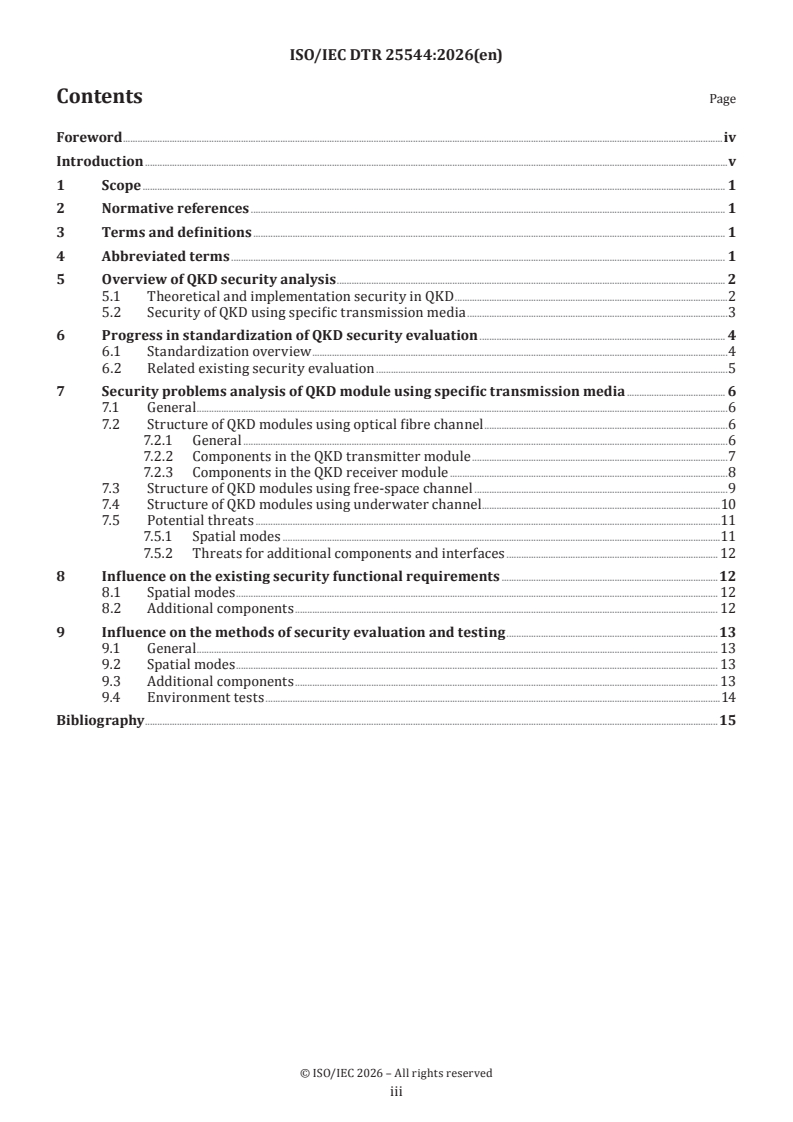
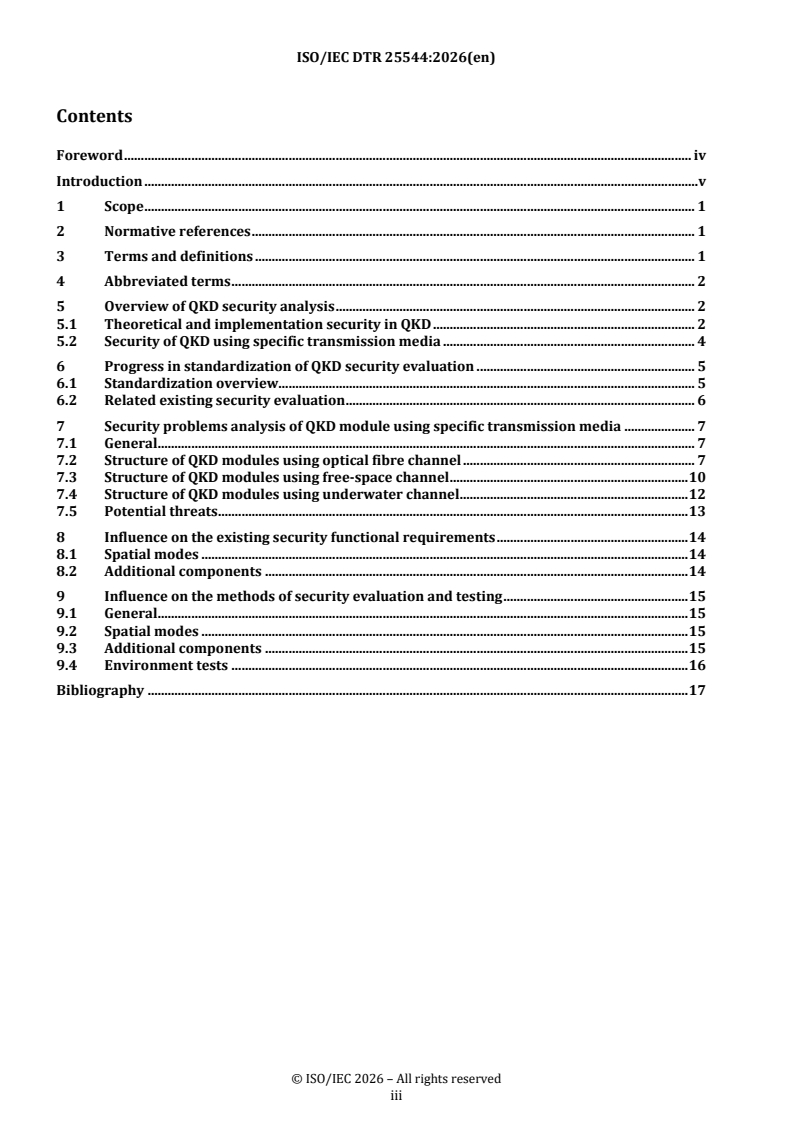
Contents
- Introduction
- 1 Scope
- 2 Normative references
- 3 Terms and definitions
- 3.1 underwater channel
- 4 Abbreviated terms
- 5 Overview of QKD security analysis
- 5.1 Theoretical and implementation security in QKD
- 5.2 Security of QKD using specific transmission media
- 6 Progress in standardization of QKD security evaluation
- 6.1 Standardization overview
- 6.2 Related existing security evaluation
- 7 Security problems analysis of QKD module using specific transmission media
- 7.1 General
- 7.2 Structure of QKD modules using optical fibre channel
- 7.3 Structure of QKD modules using free-space channel
- 7.4 Structure of QKD modules using underwater channel
- 7.5 Potential threats
- 8 Influence on the existing security functional requirements
- 8.1 Spatial modes
- 8.2 Additional components
- 9 Influence on the methods of security evaluation and testing
- 9.1 General
- 9.2 Spatial modes
- 9.3 Additional components
- 9.4 Environment tests
- Bibliography
Introduction
Quantum key distribution (QKD) offers a method for leveraging a pre-shared key to establish extended symmetric key with security guaranteed by physical principles rather than assumptions about computational limitations. The established key is subsequently deployed for cryptographic applications, such as constructing an encryption mechanism to ensure a secure communication channel. As a physicsbased protocol, QKD constitutes an information-theoretically secure key distribution method that has been both rigorously validated through theoretical proofs and broadly recognized within the scientific community. However, practical implementations inevitably encounter deviations from idealized models used in theoretical analyses due to inherent hardware imperfections. Eavesdroppers exploit such discrepancies to compromise operational QKD systems, thereby exposing vulnerabilities in real-world deployments. With the advancement of QKD, novel attack vectors targeting implementation flaws continue to emerge. This necessitates the development of comprehensive security tests and evaluations for QKD systems, like conventional cryptographic modules or network devices. Furthermore, given the diverse implementation approaches and deployment scenarios of QKD system, it is critical to develop general standards that accommodate varying equipment specifications and operational environments. [1] [2] The ISO/IEC 23837 series, based on the ISO/IEC 15408 series, has been published. It defines a set of rigorous and common security specifications for QKD modules, that reduces the risk of a failure of security due to the deviation between theoretical proofs and engineering implementations in practical deployments. However, these specifications currently focus on the security requirements and test methods of single-mode fibre-based QKD modules. QKD implementations utilizing alternative transmission media, including freespace (known as free space QKD) and water (known as underwater QKD), exhibit unique components and interfaces that need new security specifications for the evaluation of the QKD module. This document advances standardization efforts by conducting a comparative analysis of security requirements across QKD modules employing distinct transmission media. Through systematic examination of technical progress and existing standardization frameworks, this document provides the general security assumptions, threats and security functional requirement analysis. Crucially, it identifies the impact of QKD implementation changes due to utilizing different transmission media on security test and evaluation [3] methods. By cross-referencing with ISO/IEC 23837-1 baseline requirements, this document investigates security evaluation differentials attributable to physical channel variations, thereby providing the technical foundation for developing future protection profiles (PPs) for non-single-mode-fiber-based QKD modules.
FINAL DRAFT Technical Report ISO/IEC DTR 25544:2026(en) Effect of specific transmission media on the security evaluation of quantum key distribution
1 Scope
This document investigates the security evaluation of quantum key distribution (QKD) modules utilizing specific transmission media. Based on the review of QKD security analysis and their standardization progress, it specifies the structure of QKD modules implemented through specified transmission media, particularly highlighting additional components or interfaces that introduce security vulnerabilities, and analyses the impact on security requirements, test and evaluation methods in the existing standards.
2 Normative references
The following documents are referred to in the text in such a way that some or all of their content constitutes requirements of this document. For dated references, only the edition cited applies. For undated references, the latest edition of the referenced document (including any amendments) applies. ISO/IEC 23837-1, Information security — Security requirements, test and evaluation methods for quantum key distribution — Part 1: Requirements
3 Terms and definitions
For the purposes of this document, the terms and definitions given in ISO/IEC 23837-1 and the following apply.
ISO and IEC maintain terminology databases for use in standardization at the following addresses:
- ISO Online browsing platform: available at https:// www .iso .org/ obp
- IEC Electropedia: available at https:// www .electropedia .org/
3.1 underwater channel
communication channel used for electromagnetic signals transmission includes the area below the water surface, e.g. rivers, lakes and seas
4 Abbreviated terms
PAT pointing, acquisition and tracking SDM space-division multiplexing SMF single-mode fibre MCF multi-core fibre FMF few-mode fibre HD high-dimensional MMF multi-mode fibre
ISO/IEC DTR 25544:2026(en) OAM orbital angular momentum P&M prepare-and-measure QoS quality of service FOV field of view QKD quantum key distribution
5 Overview of QKD security analysis
5.1 Theoretical and implementation security in QKD
QKD protocol is used to establish key with security that does not depend upon the computational power of [4] an eavesdropper. Following the proposal of the first QKD protocol (BB84 protocol) in 1984 , significant [5][6] research efforts focused on its theoretical security proof . D. Mayers established the security proof [7] for the discrete variable BB84 protocol in 1996 . H.K. Lo and H.F. Chau formalized the security of BB84 [8] protocol in 1999 through an entanglement distillation framework . While this proof method has a relatively intuitive physical image, its implementation needs quantum computing capabilities at both the transmitter and receiver parties for quantum logical operations, which is not possible with current technology. In 2000, P.W. Shor and J. Preskill demonstrated that the security of the BB84 protocol is also proved based on classical [9] error correction and privacy amplification procedures , thus enabling practical QKD implementations, and the security framework for BB84 protocol under idealized conditions is basically established. Subsequent protocol innovations are focused on the practical security enhancements and performance [10][11][12] optimizations . The theoretical security of the QKD protocol is based upon idealized physical system models. Practical implementations inevitably manifest device characteristic discrepancies with these idealized models. Such deviations are able to result in potential security vulnerabilities in the practical QKD system. The research community critically underestimated these security implications until [13] G. Brassard’s landmark 2000 disclosure , which identified vulnerability to photon number splitting (PNS) [14] attacks through weak coherent light sources , a revelation that fundamentally constrained early QKD systems' secure transmission distances. This paradigm shift catalyzed systematic investigations into device imperfection effects on QKD security.
[15] The decoy-state protocol, originally proposed in 2003 , has proven effective in countering PNS attacks in QKD systems. In this protocol, the transmitter party randomly generates optical pulses with varying intensity levels, while the receiving part performs quantum measurements following the fundamental BB84 protocol framework. During post-processing, the transmitter party discloses intensity encoding information, enabling statistical classification of photon detection events and subsequent solution of linear equation systems. This approach allows precise quantification of single-photon quantum bit error rates (QBER) and photon detection probabilities. Subsequently, D. Gottesman et al. established the security proofs for practical QKD implementations with non-ideal devices, most notably through the seminal Gottesman-Lo- [16] Lutkenhaus-Preskill (GLLP) framework in 2004 . This theoretical framework fundamentally addresses security challenges posed by multi-photon emissions from practical weak coherent sources (WCS), calling for adaptation of conventional security models to real-world system implementations. Specifically, the GLLP analysis provides rigorous mathematical treatment for secure key generation rates from single-photon components within attenuated laser pulses.
Concurrently, methodologies for attacking QKD systems and corresponding defence strategies continue to evolve. The single photon detector (SPD) employed in practical QKD system is particularly susceptible to external influences due to its inherent characteristics. Since the beginning of this century, a significant number of studies on attacks targeting SPDs have been published. For instance, the pseudo-state attack [17] [18] [19][20] proposed in 2005 , the time-shift attack proposed in 2007 , the blinding attack proposed in 2010 , [21] and the fluorescence attack proposed in 2016 . To address vulnerabilities in detection components, the measurement-device-independent quantum key distribution (MDI-QKD) was concurrently proposed in 2012 through independent research efforts by Lo's group at the University of Toronto and Braunstein's group [22][23] at the University of York . In MDI-QKD protocols, there are two transmitter parties, and one receiver
ISO/IEC DTR 25544:2026(en) party. The transmitter parties prepare and send quantum states to the receiver party, which performs a joint measurement on these quantum states. Based on the idea of entanglement exchange and the time-reversal symmetry in entangled state distribution, MDI-QKD neutralizes all attacks against the receiver in a single step while achieving performance demonstration similar to that of traditional quantum key distribution. At the same time, the protocol is able to be combined with decoy state scheme to further enhance its security. Inspired by the MDI-QKD protocol, Lucamarini et al. from Toshiba Cambridge Research Institute proposed a new QKD protocol in 2018: the twin-field QKD protocol (TF-QKD) which shows the possibility of overcoming [24] the secret key capacity .
Although Gottesman et al. allow the security proof to account for encoding flaws, the key rate drops dramatically under their framework. This is because their analysis has a pessimistic viewpoint when assuming that the encoding flaws occur in arbitrary dimensions. To address this limitation, researchers have focused on the practical security of QKD systems at the transmitter, proposing alternative analysis methods beyond the GLLP framework. One notable example is the loss-tolerant security analysis framework, which improves the key rate of QKD systems operating over long distances with imperfect sources, and the security analysis of the source with defects and information leakage is carried out. Loss-tolerant protocol [25] was proposed by Tamaki in 2014 that enables QKD systems to tolerate channel loss in the presence of [26] source flaws . On the basis of the assumption that the single-photon components of the states prepared by transmitter remain inside a two-dimensional Hilbert space, it was shown that eavesdropper is not able to enhance state preparation flaws by exploiting the channel loss and eavesdropper’s information is bounded by the rejected data analysis. The previous loss-tolerant protocol was further developed and demonstrated [27] [28] experimentally for decoy-state BB84 and MDI-QKD . Additionally, researchers have proposed a security analysis method based on the construction of Gram matrices and numerical optimization. This approach allows for the analysis of multiple imperfections in QKD sources, further advancing the practical security of these systems.
[29] In the theory of CV-QKD security proof, in 2002, F. Grosshans and P. Grangier proposed GG02 protocol . [30] The reverse coordination algorithm was proposed by F. Grosshans in 2003 . In 2004, C. Weedbrook proposed the "No-switching" protocol based on GG02 protocol, using heterodyne detection instead of [31] [32] [33] homodyne detection . In 2006, M. Navascues and R. Garcia-Patron respectively proved that the optimal collective eavesdropping of the Gauss modulated continuous variable QKD protocol is Gaussian [34] attack. In 2009, R. Renner and J.I. Cirac used the quantum de Finetti theorem for infinite dimensional systems to extend the security of collective eavesdropping to coherent eavesdropping in general. The asymptotic security proof for unidirectional CV-QKD protocols under the assumption of an infinite data [35][36] set is obtained . Subsequent studies on the security proof of finite code long-term application and combination have been proposed in recent years. In 2017, the security rate under coherent eavesdropping [37] was further refined to improve the performance of the protocol . In the future, with the continuous improvement of security proof methods for QKD, the security of practical QKD will be further improved. The continuous advancement of theoretical and practical security analysis in QKD provides solid foundations and the basis for the security evaluation of QKD.
5.2 Security of QKD using specific transmission media
The quantum channel in the QKD system is able to be realized through various transmission medias, including optical fibres, free-space optical links, and underwater optical links. The security model of QKD assumes that an eavesdropperperforms any operation permitted by the laws of physics within the quantum channel. Consequently, physical imperfections of the channel do not compromise the theoretical security of QKD. However, the establishment and maintenance of quantum channels over different types call for specific implementations. These implementation imperfections have potentials to introduce additional security risks, create new vulnerabilities, or influence the effectiveness of existing countermeasures. This clause provides an overview of current security studies pertaining to QKD systems operating over various types of quantum channels.
QKD systems based on optical fibres have achieved a high level of technical maturity and are widely deployed. Security analyses and countermeasure evaluations have predominantly focused on this medium. One characteristic of fibre-based QKD systems is the susceptibility to attacks involving high-power optical signal injection. In such cases, the "fibre damage threshold" defines the maximum permissible optical power [38][39] before physical degradation occurs. This threshold, referenced in several studies , constrains the
ISO/IEC DTR 25544:2026(en) capabilities of potential attacks and influences the design parameters of protection schemes. Furthermore, as fibre-based QKD primarily operates within the telecom spectrum, attacks involving non-telecomband wavelengths must account for wavelength-dependent transmission loss and component-specific [40][41] responses. Attacks such as broadband Trojan-horse and photorefractive-based attacks exemplify this consideration and present emerging challenges in security evaluation. Apart from the general research on single-mode fibres, the security research on other types of optical fibres is also gradually developing. For example, as for the severe inter-core crosstalk of QKD using multi-core fibre (MCF) or multi-mode fibre (FMF), coupled signals are typically separated through the multi-input-multi-output (MIMO) signal [42] processing algorithm .
The theoretical security architecture of free-space QKD systems is generally aligned with existing models. Nonetheless, practical implementations introduce risks resulting from environmental conditions, devicelevel limitations and system complexity. For example, the use of multiple laser sources in some free-space QKD implementations has chances to introduce distinguishable properties in unintended degrees of [43][44] freedom, leading to side-channel vulnerabilities . These issues are expected to be mitigated through improvements in engineering practices. Additional risks specific to free-space transmission include spatial-mode distinguishability, which are addressed through single-mode filtering at the transmitter and spatial filtering at the receiver to minimize detection efficiency mismatches caused by beam incident [45][46][47] angles . Environmental threats such as cosmic radiation degrades detector performance by altering [48] dark count rates and afterpulse probabilities, resulting in inaccurate parameter estimation . Moreover, high-power laser-based denial-of-service (DoS) attacks have been identified as potential threats to free- [49] space QKD systems, targeting both QKD transmitter and receiver subsystems . Mitigation of these risks needs comprehensive security evaluations and the implementation of appropriate defensive measures. Research on QKD systems utilizing underwater optical links is limited and remains in an early developmental stage. Current studies focus primarily on functional feasibility and performance metrics. Due to the optical similarity between underwater and free-space links, security considerations for the former are expected to be aligned with those for free-space QKD systems. Consequently, detailed discussion of underwater-specific risks is omitted from this clause.
6 Progress in standardization of QKD security evaluation
6.1 Standardization overview
At present, major international and regional standardization organizations are actively engaged in standardization studies in the field of quantum communication, including the International Organization for Standardization (ISO), International Electrotechnical Commission (IEC), International Telecommunication Union (ITU), Institute of Electrical and Electronic Engineers (IEEE), European Telecommunications Standards Institute (ETSI), European Committee for Electrotechnical Standardization (CENELEC), Internet Research Task Force (IRTF) and European Association of National Metrology Institutes (EURAMET). Until now, a number of international standards have been published, including the following:
[3] - ISO/IEC 23837-1 ; [50] - ISO/IEC 23837-2 ; [51] - ITU-T Recommendation X.1702 ; [52] - ITU-T Recommendation X.1710 ; [53] - ITU-T Recommendation X.1711 ; [54] - ITU-T Recommendation X.1712 ; [55] - ITU-T Recommendation X.1713 ; [56] - ITU-T Recommendation X.1714 ; [57] - ITU-T Recommendation X.1715 ;
ISO/IEC DTR 25544:2026(en) [58] - ITU-T Recommendation X.1716 ; [59] - ITU-T Recommendation X.1717 ; [60] - ETSI GS QKD 005 V1.1.1 ; [61] - ETSI GS QKD 008 V1.1.1 ; [62] - ETSI GS QKD 011 V1.1.1 ; [63] - ETSI GS QKD 016 V2.1.1 .
6.2 Related existing security evaluation
Although various international organizations have been actively engaged in the standardization of QKD, among the published QKD standards reviewed in 6.1, only the ISO/IEC 23837 series provides a systematic approach to the security evaluation of QKD systems.
[64] ISO/IEC 23837-1:2023 , Clause 7, analyses the security issues of the QKD module. According to the internal structure division of the QKD module (see Figure 2), the threats to the QKD module due to component vulnerabilities mainly come from two aspects:
- threats related to conventional network components;
- threats related to quantum optical components.
Among them, conventional network-based attacks mainly pose threats through the classic external interfaces of the QKD module, including the control and management interface, the key management interface, and the classic channel interface. The threats related to the security vulnerabilities of quantum optical components mainly include threats exploiting optical source flaws, threats exploiting optical detection vulnerabilities and threats exploiting parameter adjustment vulnerabilities.
...
Contents
- Introduction
- 1 Scope
- 2 Normative references
- 3 Terms and definitions
- 3.1 free-space propagation, noun
- 3.2 free-space quantum key distribution, noun
- 3.3 underwater channel, noun
- 3.4 underwater quantum key distribution, noun
- 4 Abbreviated terms
- 5 Overview of QKD security analysis
- 5.1 Theoretical and implementation security in QKD
- 5.2 Security of QKD using specific transmission media
- 6 Progress in standardization of QKD security evaluation
- 6.1 Standardization overview
- 6.2 Related existing security evaluation
- 7 Security problems analysis of QKD module using specific transmission media
- 7.1 General
- 7.2 Structure of QKD modules using optical fibre channel
- 7.3 Structure of QKD modules using free-space channel
- 7.4 Structure of QKD modules using underwater channel
- 7.5 Potential threats
- 8 Influence on the existing security functional requirements
- 8.1 Spatial modes
- 8.2 Additional components
- 9 Influence on the methods of security evaluation and testing
- 9.1 General
- 9.2 Spatial modes
- 9.3 Additional components
- 9.4 Environment tests
- Bibliography
Introduction
Quantum key distribution (QKD) offers a method for leveraging a pre-shared key to establish extended symmetric key with security guaranteed by physical principles rather than assumptions about computational limitations. The established key is subsequently is deployed for cryptographic applications, such as constructing an encryption mechanism to ensure a secure communication channel. As a physics-based protocol, QKD constitutes an information-theoretically secure key distribution method that has been both rigorously validated through theoretical proofs and broadly recognized within the scientific community. However, practical implementations inevitably encounter deviations from idealized models used in theoretical analyses due to inherent hardware imperfections. Eavesdroppers exploit such discrepancies to compromise operational QKD systems, thereby exposing vulnerabilities in real-world deployments. With the advancement of QKD, novel attack vectors targeting implementation flaws continue to emerge. This necessitates the development of comprehensive security tests and evaluations for QKD systems, like conventional cryptographic modules or network devices. Furthermore, given the diverse implementation approaches and deployment scenarios of QKD system, it is critical to develop general standards that accommodate varying equipment specifications and operational environments. [64] [2] The ISO/IEC 23837 series, based on the ISO/IEC 15408 series, has been published. It defines a set of rigorous and common security specifications for QKD modules, that reduces the risk of a failure of security due to the deviation between theoretical proofs and engineering implementations in practical deployments. However, these specifications currently focus on the security requirements and test methods of single-mode fibre-based QKD modules. QKD implementations utilizing alternative transmission media, including freespace (known as free space QKD) and water (known as underwater QKD), exhibit unique components and interfaces that need new security specifications for the evaluation of the QKD module. This technical reportdocument advances standardization efforts by conducting a comparative analysis of security requirements across QKD modules employing distinct transmission media. Through systematic examination of technical progress and existing standardization frameworks, this technical reportdocument provides the general security assumptions, threats and security functional requirement analysis. Crucially, it identifies the impact of QKD implementation changes due to utilizing different transmission media on security [64] test and evaluation methods. By cross-referencing with ISO/IEC 23837-1 baseline requirements, this technical reportdocument investigates security evaluation differentials attributable to physical channel variations, thereby providing the technical foundation for developing future Protection Profilesprotection profiles (PPs) for non-single-mode-fiber-based QKD modules.
ISO/IEC DTR 25544:2026(en) The effectEffect of specific transmission media on the security evaluation of quantum key distribution
1 Scope
This document investigates the security evaluation of quantum key distribution (QKD) modules utilizing specific transmission media. Based on the review of QKD security analysis and their standardization progress, it specifies the structure of QKD modules implemented through specified transmission media, particularly highlighting additional components or interfaces that introduce security vulnerabilities, and analyses the impact on security requirements, test and evaluation methods in the existing standards.
2 Normative references
There are no normative references in this document.
The following documents are referred to in the text in such a way that some or all of their content constitutes requirements of this document. For dated references, only the edition cited applies. For undated references, the latest edition of the referenced document (including any amendments) applies. ISO/IEC 23837-1, Information security — Security requirements, test and evaluation methods for quantum key distribution — Part 1: Requirements
3 Terms and definitions
For the purposes of this document, the terms and definitions given in ISO/IEC 23837-1:2023 and the following apply.
ISO and IEC maintain terminologicalterminology databases for use in standardization at the following addresses:
- ISO Online browsing platform: available at https://www.iso.org/obp
- IEC Electropedia: available at https://www.electropedia.org/
3.1 free-space propagation, noun
propagation of an electromagnetic wave in a homogeneous ideal dielectric medium which may be considered of infinite extent in all directions Note 1 to entry: For propagation in free space, the magnitude of each vector of the electromagnetic field in any given direction from the source is proportional to the reciprocal of the distance from the source beyond a distance determined by the size of the source and the wavelength.
[SOURCE: IEC 60050-705:1995, 705-02-27]
3.2 free-space quantum key distribution, noun
quantum key distribution using a free-space channel
3.3 underwater channel, noun
communication channel used for electromagnetic signals transmission includes the area below the water surface, e.g.,. rivers, lakes, and seas
ISO/IEC DTR 25544:2026(en)
3.4 underwater quantum key distribution, noun
quantum key distribution using an underwater channel
4 Abbreviated terms
PAT pointing, acquisition and tracking SDM space-division multiplexing SMF single-mode fibre MCF multi-core fibre FMF few-mode fibre HD high-dimensional MMF multi-mode fibre OAM orbital angular momentum P&M prepare-and-measure QoS quality of service FOV field of view QKD quantum key distribution
5 Overview of QKD security analysis
5.1 Theoretical and implementation security in QKD
QKD protocol is used to establish key with security that does not depend upon the computational power of an [4] eavesdropper. Following the proposal of the first QKD protocol (BB84 protocol) in 1984 , significant [5] [6] research efforts focused on its theoretical security proof . D. Mayers established the security proof for the [7] discrete variable BB84 protocol in 1996 . H.K. Lo and H.F. Chau formalized the security of BB84 protocol in [8] 1999 through an entanglement distillation framework . While this proof method has a relatively intuitive physical image, its implementation needs quantum computing capabilities at both the transmitter and receiver parties for quantum logical operations, which is not possible with current technology. In 2000, P.W. Shor and J. Preskill demonstrated that the security of the BB84 protocol is also proved based on classical error [9] correction and privacy amplification procedures , thus enabling practical QKD implementations, and the security framework for BB84 protocol under idealized conditions is basically established. Subsequent protocol innovations are focused on the practical security enhancements and performance [10] [11] [12] optimizations . The theoretical security of the QKD protocol is based upon idealized physical system models. Practical implementations inevitably manifest device characteristic discrepancies with these idealized models. Such deviations are able to result in potential security vulnerabilities in the practical QKD system. The research community critically underestimated these security implications until G. Brassard’s [13] landmark 2000 disclosure , which identified vulnerability to photon number splitting (PNS) attacks through [14] weak coherent light sources , a revelation that fundamentally constrained early QKD systems' secure transmission distances. This paradigm shift catalyzed systematic investigations into device imperfection effects on QKD security.
ISO/IEC DTR 25544:2026(en) [15] The decoy-state protocol, originally proposed in 2003 , has proven effective in countering PNS attacks in QKD systems. In this protocol, the transmitter party randomly generates optical pulses with varying intensity levels, while the receiving part performs quantum measurements following the fundamental BB84 protocol framework. During post-processing, the transmitter party discloses intensity encoding information, enabling statistical classification of photon detection events and subsequent solution of linear equation systems. This approach allows precise quantification of single-photon quantum bit error rates (QBER) and photon detection probabilities. Subsequently, D. Gottesman et al. established the security proofs for practical QKD implementations with non-ideal devices, most notably through the seminal Gottesman-Lo-Lutkenhaus- [16] Preskill (GLLP) framework in 2004 . This theoretical framework fundamentally addresses security challenges posed by multi-photon emissions from practical weak coherent sources (WCS), calling for adaptation of conventional security models to real-world system implementations. Specifically, the GLLP analysis provides rigorous mathematical treatment for secure key generation rates from single-photon components within attenuated laser pulses.
Concurrently, methodologies for attacking QKD systems and corresponding defence strategies continue to evolve. The single photon detector (SPD) employed in practical QKD system is particularly susceptible to external influences due to its inherent characteristics. Since the beginning of this century, a significant number of studies on attacks targeting SPDs have been published. For instance, the pseudo-state attack proposed in [17] [18] [19] [20] 2005 , the time-shift attack proposed in 2007 , the blinding attack proposed in 2010 , and the [21] fluorescence attack proposed in 2016 . To address vulnerabilities in detection components, the measurement-device-independent quantum key distribution (MDI-QKD) was concurrently proposed in 2012 through independent research efforts by Lo's group at the University of Toronto and Braunstein's group at the [22] [23] University of York . In MDI-QKD protocols, there are two transmitter parties, and one receiver party. The transmitter parties prepare and send quantum states to the receiver party, which performs a joint measurement on these quantum states. Based on the idea of entanglement exchange and the time-reversal symmetry in entangled state distribution, MDI-QKD neutralizes all attacks against the receiver in a single step while achieving performance demonstration similar to that of traditional quantum key distribution. At the same time, the protocol is able to be combined with decoy state scheme to further enhance its security. Inspired by the MDI-QKD protocol, Lucamarini et al. from Toshiba Cambridge Research Institute proposed a new QKD protocol in 2018: the twin-field QKD protocol (TF-QKD) which shows the possibility of overcoming [24] the secret key capacity .
Although Gottesman et al. allow the security proof to account for encoding flaws, the key rate drops dramatically under their framework. This is because their analysis has a pessimistic viewpoint when assuming that the encoding flaws occur in arbitrary dimensions. To address this limitation, researchers have focused on the practical security of QKD systems at the transmitter, proposing alternative analysis methods beyond the GLLP framework. One notable example is the loss-tolerant security analysis framework, which improves the key rate of QKD systems operating over long distances with imperfect sources. And, and the security analysis of the source with defects and information leakage is carried out. Loss-tolerant protocol was proposed by [25] [26] Tamaki in 2014 that enables QKD systems to tolerate channel loss in the presence of source flaws . On the basis of the assumption that the single-photon components of the states prepared by transmitter remain inside a two-dimensional Hilbert space, it was shown that eavesdropper is not able to enhance state preparation flaws by exploiting the channel loss, and eavesdropper’s information is bounded by the rejected data analysis. The previous loss-tolerant protocol was further developed and demonstrated experimentally [27] [28] for decoy-state BB84 and MDI-QKD . Additionally, researchers have proposed a security analysis method based on the construction of Gram matrices and numerical optimization. This approach allows for the analysis of multiple imperfections in QKD sources, further advancing the practical security of these systems. [29] In the theory of CV-QKD security proof, in 2002, F. Grosshans and P. Grangier proposed GG02 protocol . The [30] reverse coordination algorithm was proposed by F. Grosshans in 2003 . In 2004, C. Weedbrook proposed the "No-switching" protocol based on GG02 protocol, using heterodyne detection instead of homodyne [31] [32] [33] detection . In 2006, M. Navascues and R. Garcia-Patron respectively proved that the optimal collective eavesdropping of the Gauss modulated continuous variable QKD protocol is Gaussian attack. In 2009, R. [34] Renner and J.I. Cirac used the quantum de Finetti theorem for infinite dimensional systems to extend the
ISO/IEC DTR 25544:2026(en) security of collective eavesdropping to coherent eavesdropping in general. The asymptotic security proof for [35] [36] unidirectional CV-QKD protocols under the assumption of an infinite data set is obtained . Subsequent studies on the security proof of finite code long-term application and combination have been proposed in recent years. In 2017, the security rate under coherent eavesdropping was further refined to improve the [37] performance of the protocol . In the future, with the continuous improvement of security proof methods for QKD, the security of practical QKD will be further improved.
The continuous advancement of theoretical and practical security analysis in QKD provides solid foundations and the basis for the security evaluation of QKD.
5.2 Security of QKD using specific transmission media
The quantum channel in the QKD system is able to be realized through various transmission medias, including optical fibres, free-space optical links, and underwater optical links. The security model of QKD assumes that an eavesdropperperforms any operation permitted by the laws of physics within the quantum channel. Consequently, physical imperfections of the channel do not compromise the theoretical security of QKD. However, the establishment and maintenance of quantum channels over different types call for specific implementations. These implementation imperfections have potentials to introduce additional security risks, create new vulnerabilities, or influence the effectiveness of existing countermeasures. This clause provides an overview of current security studies pertaining to QKD systems operating over various types of quantum channels.
QKD systems based on optical fibres have achieved a high level of technical maturity and are widely deployed. Security analyses and countermeasure evaluations have predominantly focused on this medium. One characteristic of fibre-based QKD systems is the susceptibility to attacks involving high-power optical signal injection. In such cases, the "fibre damage threshold" defines the maximum permissible optical power before [38] [39] physical degradation occurs. This threshold, referenced in several studies , constrains the capabilities of potential attacks and influences the design parameters of protection schemes. Furthermore, as fibre-based QKD primarily operates within the telecom spectrum, attacks involving non-telecom-band wavelengths must account for wavelength-dependent transmission loss and component-specific responses. Attacks such as [40] [41] broadband Trojan-horse and photorefractive-based attacks exemplify this consideration and present emerging challenges in security evaluation. Apart from the general research on single-mode fibres, the security research on other types of optical fibres is also gradually developing. For example, as for the severe inter-core crosstalk of QKD using multi-core fibre (MCF) or multi-mode fibre (FMF), coupled signals are [42] typically separated through the multi-input-multi-output (MIMO) signal processing algorithm . The theoretical security architecture of free-space QKD systems is generally aligned with existing models. Nonetheless, practical implementations introduce risks resulting from environmental conditions, device-level limitations, and system complexity. For example, the use of multiple laser sources in some free-space QKD implementations has chances to introduce distinguishable properties in unintended degrees of freedom, [43] [44] leading to side-channel vulnerabilities . These issues are expected to be mitigated through improvements in engineering practices. Additional risks specific to free-space transmission include spatialmode distinguishability, which are addressed through single-mode filtering at the transmitter and spatial [45] [46] [47] filtering at the receiver to minimize detection efficiency mismatches caused by beam incident angles . Environmental threats such as cosmic radiation degrades detector performance by altering dark count rates [48] and afterpulse probabilities, resulting in inaccurate parameter estimation . Moreover, high-power laserbased denial-of-service (DoS) attacks have been identified as potential threats to free-space QKD systems, [49] targeting both QKD transmitter and receiver subsystems . Mitigation of these risks needs comprehensive security evaluations and the implementation of appropriate defensive measures. Research on QKD systems utilizing underwater optical links is limited and remains in an early developmental stage. Current studies focus primarily on functional feasibility and performance metrics. Due to the optical similarity between underwater and free-space links, security considerations for the former are expected to be aligned with those for free-space QKD systems. Consequently, detailed discussion of underwater-specific risks is omitted from this clause.
ISO/IEC DTR 25544:2026(en)
6 Progress in standardization of QKD security evaluation
6.1 Standardization overview
At present, major international and regional standardization organizations are actively engaged in standardization studies in the field of quantum communication, including the International Organization for Standardization (ISO), International Electrotechnical Commission (IEC), International Telecommunication Union (ITU), Institute of Electrical and Electronic Engineers (IEEE), European Telecommunications Standards Institute (ETSI), European Committee for Electrotechnical Standardization (CENELEC), Internet Research Task Force (IRTF),) and European Association of National Metrology Institutes (EURAMET). Until now, a number of international standards have been published, including the following:
...