

ISO 11462-1:2026
(Main)Implementation of statistical process control (SPC) — Part 1: Statistical process management — Elements, tools and techniques of SPC
- Abstract
This document gives guidance on the implementation of a statistical process control (SPC) system and an overview of tools and techniques to assist an organisation in planning, implementing and evaluating an effective statistical process control (SPC) system. This document specifies SPC system guidelines for use when a supplier's capability to reduce variation in processes associated with design or production needs to be proven or improved, or when a supplier is beginning SPC implementation to achieve such capability. This document considers the complete industrial supply chain. It describes some essential statistical methods that can be used to continuously improve capability or performance and stability of production processes. The bottom line is that production processes are controlled economically, promptly and effectively. As a result, a predefined level of quality can be realised. The improvement of stability and performance or capability of the production processes effectively reduces waste and machine downtime or increases productivity. If defective production parts are found in a random sample, they can be sorted out and, if necessary, further measures can be initiated.
- Status
- Published
- Publication Date
- 11-Aug-2026
- Current Stage
- 6060 - International Standard published
- Start Date
- 12-Aug-2026
- Due Date
- 23-Mar-2026
- Completion Date
- 12-Aug-2026

ISO 11462-1:2026 is an International Standard from ISO on the implementation of statistical process control (SPC). It gives guidance for planning, implementing and evaluating an SPC system, with practical tools and techniques for organisations that need to prove or improve process variation reduction in design or production. It is aimed at suppliers working across the industrial supply chain and at teams that must turn process data into controlled, repeatable quality.
What does ISO 11462-1:2026 specify?
ISO 11462-1:2026 specifies guidelines for SPC system implementation when a supplier needs to demonstrate or improve process capability, or is starting SPC for that purpose. The document also describes statistical methods used to improve process stability, performance and capability, so that production can be controlled economically and with a defined quality level.
The standard is organized into clauses that move from management context to practical application:
| Clause | What it covers |
|---|---|
| 1-4 | Scope, normative references, terms and symbols |
| 5 | Statistical process management and control loops |
| 6 | Prerequisites for SPC applications |
| 7 | Method overview |
| 8 | Machine performance for release of production equipment |
| 9 | Process performance and capability for release of manufacturing process |
| 10 | Process control and ongoing process capability |
| 11 | Traceability and archiving |
| 12 | Software support |
What are the key requirements of ISO 11462-1:2026?
ISO 11462-1:2026 is centered on using SPC as a managed system, not as a stand-alone charting exercise. In practice, the document asks the organisation to prepare the process, prove measurement validity, choose the right study type, and then keep the process under statistical control with documented reactions when instability appears.
Build SPC into the quality system
Clause 6 says SPC should be integrated into company-wide quality processes. The preparatory work includes tolerancing principles, responsibility principles, risk analysis or FMEA, special characteristics, production and test planning, control plans, and measurement and test process capability. That matters because SPC works best when the process, the measurements and the reaction plan are already defined.
Separate machine studies from process studies
Clauses 7, 8 and 9 distinguish machine performance from process performance and capability. Machine performance studies isolate machine-related influence by keeping the other 4M factors constant, while process studies look at the broader 5M conditions expected in series production. This matters because a machine can look capable in a short, controlled run even though the full process is not yet stable.
Use the right capability or performance index
Clause 7 and the later study clauses use capability indices C_p and C_pk when stability has been shown, and performance indices P_p and P_pk when stability has not been shown or cannot yet be assessed. The practical point is that the index name tells the reader what kind of evidence stands behind the number. Users should not treat a performance result as proof of stable capability.
Prove measurement and test process capability first
Clause 6.7 makes measurement and test process capability a prerequisite for trustworthy SPC data. The standard ties this to valid measurement systems, validated measuring and testing processes, and documented capability for the particular monitoring task. If the measurement system is weak, the chart or capability index will only describe measurement noise.
Collect representative data and document the conditions
Clause 8 requires a continuous, uninterrupted machine study with traceability, blocked test parts, recorded sequence and documented deviations. Clause 9 requires sampling over a longer period representative of series production, with small random subgroups taken at suitable intervals. In practice, this means the data set must represent the real process, not just a convenient batch.
Select control charts according to purpose
Clause 10 distinguishes process-related control charts from tolerance-related control charts, and retrospective control charts from SPC control charts. Process-related charts are used to reduce variation and support zero-defect thinking, while tolerance-related charts allow a defined out-of-tolerance proportion and are more suited to tool-life or margin optimisation. The choice matters because the chart drives the reaction strategy on the shop floor.
Control instability, outliers and archive the evidence
Clauses 7, 10 and 11 require stability criteria, outlier handling, traceability and archiving. Outliers are values that do not belong to the process population and should be marked invalid, not simply deleted without explanation. The archiving rules matter because later audits or investigations need the calculation basis, not only the final index.
Use validated software and clear reporting
Clause 12 requires validated analysis software and validated interfaces between software elements. It also points to verification and validation of analytical tools and to reporting content that includes the characteristic, the specification, the chosen distribution model, the indices, the uncertainty and the data conditions. This matters because SPC results often depend on software settings, not only on the raw data.
What terms does ISO 11462-1:2026 define?
- Retrospective control chart - A post-process control chart used to assess past stability and to separate performance from capability; it is often called a phase 1 chart.
- SPC control chart - A chart for on-site or automatic control of a known process; any stability violation is treated as instability and requires action.
- Stable process - A process in statistical control, affected only by random causes and therefore predictable by statistical methods.
- Non-interference probability - The probability basis used to calculate warning or control limits, expressing how likely an in-control sample is to stay within those limits.
- Control plan (CP) - The cross-divisional document that lists process steps, product characteristics, process parameters, measurements, frequencies and reaction plans.
- Special characteristics (CC/SC or YC/YS) - Product characteristics or process parameters that affect safety, compliance, fit, function, performance or further processing.
- FMEA - Failure mode and effect analysis, used in Clause 6.3 to focus SPC effort on the most relevant risks.
Who uses ISO 11462-1:2026?
ISO 11462-1:2026 is used by suppliers, production teams, quality managers, planning departments and internal or external auditors who need to plan or assess SPC in manufacturing and assembly. It is also relevant to measurement and test specialists, because the document depends on capable measurement systems and validated analysis software.
The standard supports tasks such as proving process capability, releasing production equipment, setting up control plans, selecting control charts, reviewing process stability, archiving SPC records and reporting capability results to customers.
What changed in ISO 11462-1:2026 from the previous edition?
ISO 11462-1:2026 is the second edition and cancels and replaces ISO 11462-1:2001 and ISO 11462-2:2010. The revision combines the former “Elements of SPC” and the former catalog of tools and techniques, and adds a unified description of processes and control loops for implementing SPC.
It is also restructured as an overarching framework for the ISO 7870 and ISO 22514 series, showing how their parts are applied in control loops and process operations.
Which standards are used with ISO 11462-1:2026?
The normative references in ISO 11462-1:2026 are:
- ISO 3534-1 and ISO 3534-2 - statistical vocabulary used for the document’s definitions of process control and SPC.
- ISO 22514-1 - general principles and concepts for capability and performance.
- ISO 22514-2 - time-dependent process models for capability and performance.
- ISO 22514-3 - machine performance studies for measured data on discrete parts.
- ISO/IEC Guide 99 - metrology vocabulary used for measurement-related terms.
Later clauses also rely on related standards and guidance such as ISO 7870 for control charts, ISO 22514-7 for measurement process capability, ISO 9000 and ISO 9001 for quality management language and requirements, ISO/TR 11462-3, ISO/TR 11462-4 and ISO/TR 11462-5 for software validation and data exchange, and ISO 8015, ISO/IEC Guide 98-4 and ISO 14253-1 for responsibility and decision rules.
What does the ISO 11462-1:2026 document contain?
The document contains the SPC framework, the control-loop model, prerequisite checks, study methods for machine performance and process capability, and guidance for ongoing control. It also includes tables that summarize control loops, method selection and example target values, plus figures that show the preparatory flow, responsibility principles and control-chart concepts.
Clause 10 provides the practical guidance on chart selection, stability criteria, alarm handling and chart quality measures such as OC and ARL. Clause 12 and the reporting clause describe the information to include in reports, including data conditions, distributions, uncertainty, control charts and probability plots for both normally distributed and non-normally distributed data.
Relations
- Effective Date
- 02-Jul-2022
- Effective Date
- 25-Jun-2022
Get Certified
Connect with accredited certification bodies for this standard

BSI Group
BSI (British Standards Institution) is the business standards company that helps organizations make excellence a habit.

Bureau Veritas
Bureau Veritas is a world leader in laboratory testing, inspection and certification services.

DNV
DNV is an independent assurance and risk management provider.
Sponsored listings
Frequently Asked Questions
ISO 11462-1:2026 is a standard published by the International Organization for Standardization (ISO). Its full title is "Implementation of statistical process control (SPC) — Part 1: Statistical process management — Elements, tools and techniques of SPC". This standard covers: This document gives guidance on the implementation of a statistical process control (SPC) system and an overview of tools and techniques to assist an organisation in planning, implementing and evaluating an effective statistical process control (SPC) system. This document specifies SPC system guidelines for use when a supplier's capability to reduce variation in processes associated with design or production needs to be proven or improved, or when a supplier is beginning SPC implementation to achieve such capability. This document considers the complete industrial supply chain. It describes some essential statistical methods that can be used to continuously improve capability or performance and stability of production processes. The bottom line is that production processes are controlled economically, promptly and effectively. As a result, a predefined level of quality can be realised. The improvement of stability and performance or capability of the production processes effectively reduces waste and machine downtime or increases productivity. If defective production parts are found in a random sample, they can be sorted out and, if necessary, further measures can be initiated.
This document gives guidance on the implementation of a statistical process control (SPC) system and an overview of tools and techniques to assist an organisation in planning, implementing and evaluating an effective statistical process control (SPC) system. This document specifies SPC system guidelines for use when a supplier's capability to reduce variation in processes associated with design or production needs to be proven or improved, or when a supplier is beginning SPC implementation to achieve such capability. This document considers the complete industrial supply chain. It describes some essential statistical methods that can be used to continuously improve capability or performance and stability of production processes. The bottom line is that production processes are controlled economically, promptly and effectively. As a result, a predefined level of quality can be realised. The improvement of stability and performance or capability of the production processes effectively reduces waste and machine downtime or increases productivity. If defective production parts are found in a random sample, they can be sorted out and, if necessary, further measures can be initiated.
ISO 11462-1:2026 is classified under the following ICS (International Classification for Standards) categories: 03.120.30 - Application of statistical methods. The ICS classification helps identify the subject area and facilitates finding related standards.
ISO 11462-1:2026 has the following relationships with other standards: It is inter standard links to ISO 11462-2:2010, ISO 11462-1:2001. Understanding these relationships helps ensure you are using the most current and applicable version of the standard.
ISO 11462-1:2026 is available in PDF format for immediate download after purchase. The document can be added to your cart and obtained through the secure checkout process. Digital delivery ensures instant access to the complete standard document.
Standards Content (Sample)
International
Standard
ISO 11462-1
Second edition
Implementation of statistical
2026-08
process control (SPC) —
Part 1:
Statistical process management —
Elements, tools and techniques of
SPC
Mise en oeuvre de la maîtrise statistique des processus (MSP) —
Partie 1: Gestion statistique des processus (MSP) — Élements,
outils et techniques de MSP
Reference number
© ISO 2026
All rights reserved. Unless otherwise specified, or required in the context of its implementation, no part of this publication may
be reproduced or utilized otherwise in any form or by any means, electronic or mechanical, including photocopying, or posting on
the internet or an intranet, without prior written permission. Permission can be requested from either ISO at the address below
or ISO’s member body in the country of the requester.
ISO copyright office
CP 401 • Ch. de Blandonnet 8
CH-1214 Vernier, Geneva
Phone: +41 22 749 01 11
Email: copyright@iso.org
Website: www.iso.org
Published in Switzerland
ii
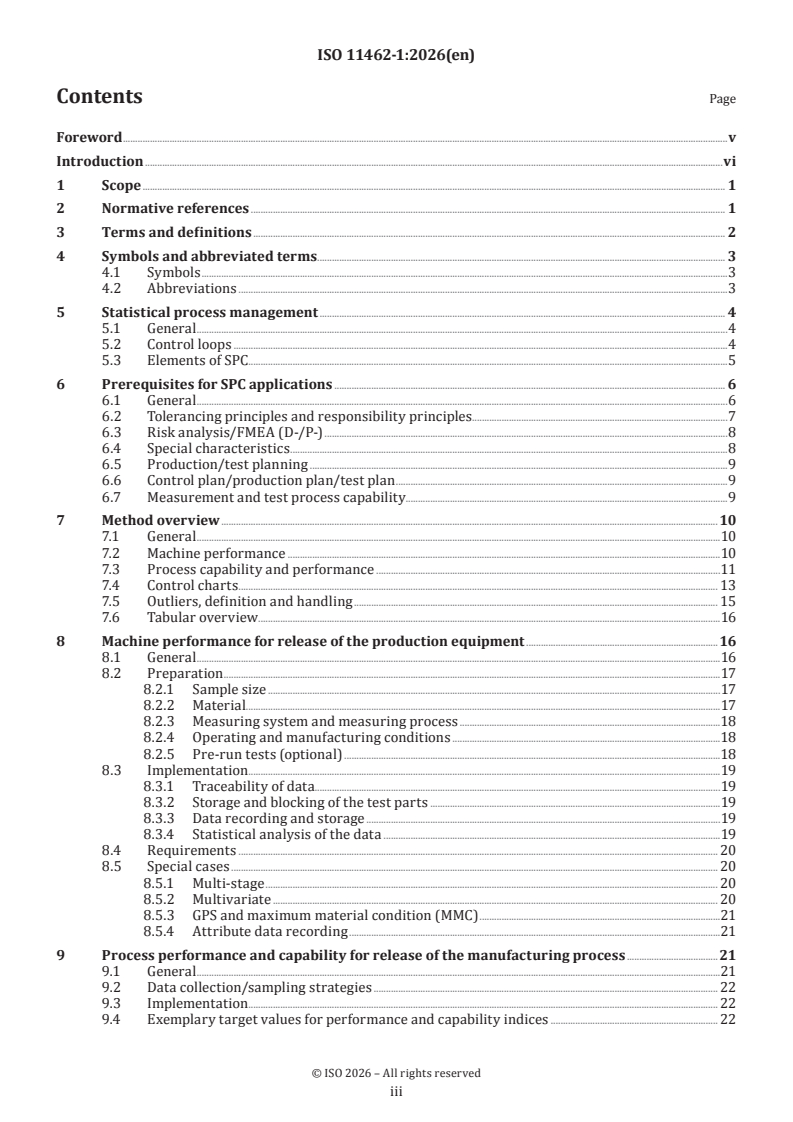
Contents Page
Foreword .v
Introduction .vi
1 Scope . 1
2 Normative references . 1
3 Terms and definitions . 2
4 Symbols and abbreviated terms. 3
4.1 Symbols .3
4.2 Abbreviations .3
5 Statistical process management . 4
5.1 General .4
5.2 Control loops .4
5.3 Elements of SPC . .5
6 Prerequisites for SPC applications . 6
6.1 General .6
6.2 Tolerancing principles and responsibility principles.7
6.3 Risk analysis/FMEA (D-/P-) .8
6.4 Special characteristics .8
6.5 Production/test planning .9
6.6 Control plan/production plan/test plan .9
6.7 Measurement and test process capability.9
7 Method overview . 10
7.1 General .10
7.2 Machine performance .10
7.3 Process capability and performance .11
7.4 Control charts . 13
7.5 Outliers, definition and handling . 15
7.6 Tabular overview . . .16
8 Machine performance for release of the production equipment .16
8.1 General .16
8.2 Preparation .17
8.2.1 Sample size .17
8.2.2 Material.17
8.2.3 Measuring system and measuring process .18
8.2.4 Operating and manufacturing conditions .18
8.2.5 Pre-run tests (optional) .18
8.3 Implementation . .19
8.3.1 Traceability of data.19
8.3.2 Storage and blocking of the test parts .19
8.3.3 Data recording and storage .19
8.3.4 Statistical analysis of the data .19
8.4 Requirements . 20
8.5 Special cases . 20
8.5.1 Multi-stage . 20
8.5.2 Multivariate . 20
8.5.3 GPS and maximum material condition (MMC) .21
8.5.4 Attribute data recording .21
9 Process performance and capability for release of the manufacturing process .21
9.1 General .21
9.2 Data collection/sampling strategies . 22
9.3 Implementation . 22
9.4 Exemplary target values for performance and capability indices . 22
iii
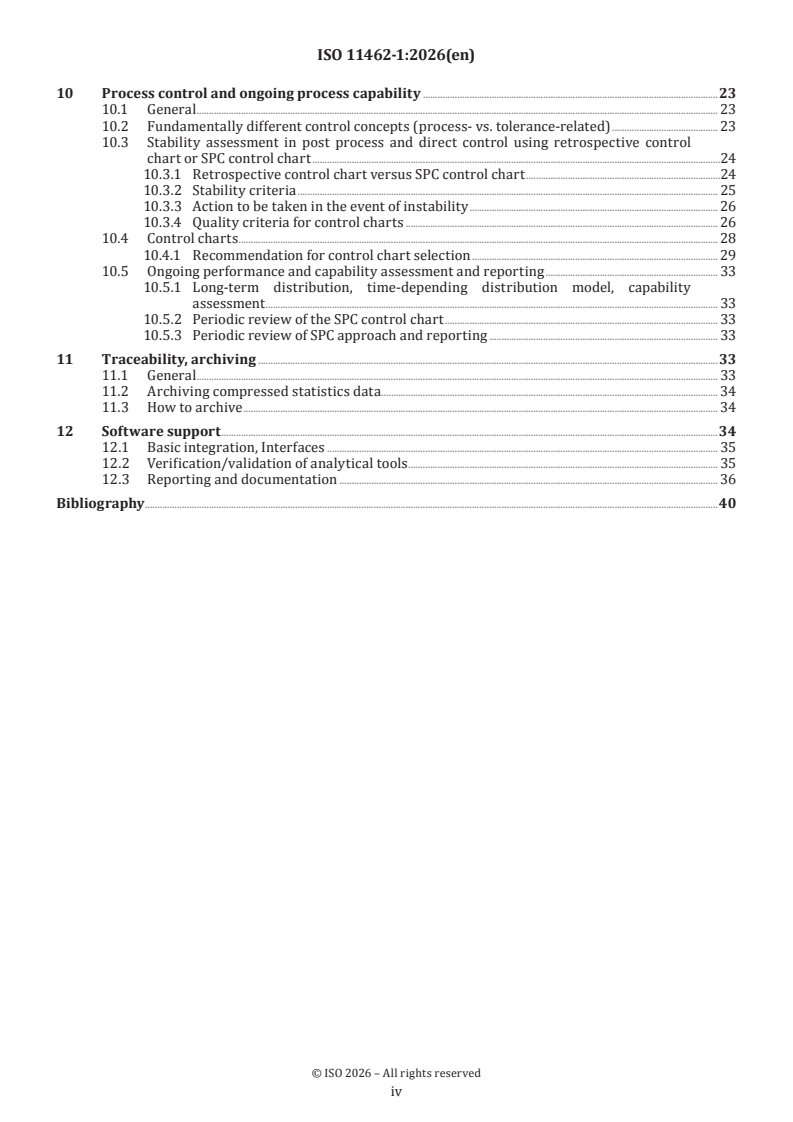
10 Process control and ongoing process capability .23
10.1 General . 23
10.2 Fundamentally different control concepts (process- vs. tolerance-related) . 23
10.3 Stability assessment in post process and direct control using retrospective control
chart or SPC control chart .24
10.3.1 Retrospective control chart versus SPC control chart .24
10.3.2 Stability criteria . 25
10.3.3 Action to be taken in the event of instability . 26
10.3.4 Quality criteria for control charts . 26
10.4 Control charts . 28
10.4.1 Recommendation for control chart selection . 29
10.5 Ongoing performance and capability assessment and reporting . 33
10.5.1 Long-term distribution, time-depending distribution model, capability
assessment . 33
10.5.2 Periodic review of the SPC control chart . 33
10.5.3 Periodic review of SPC approach and reporting . 33
11 Traceability, archiving .33
11.1 General . 33
11.2 Archiving compressed statistics data. 34
11.3 How to archive . 34
12 Software support .34
12.1 Basic integration, Interfaces . 35
12.2 Verification/validation of analytical tools . 35
12.3 Reporting and documentation . 36
Bibliography .40
iv
Foreword
ISO (the International Organization for Standardization) is a worldwide federation of national standards
bodies (ISO member bodies). The work of preparing International Standards is normally carried out through
ISO technical committees. Each member body interested in a subject for which a technical committee
has been established has the right to be represented on that committee. International organizations,
governmental and non-governmental, in liaison with ISO, also take part in the work. ISO collaborates closely
with the International Electrotechnical Commission (IEC) on all matters of electrotechnical standardization.
The procedures used to develop this document and those intended for its further maintenance are described
in the ISO/IEC Directives, Part 1. In particular, the different approval criteria needed for the different types
of ISO documents should be noted. This document was drafted in accordance with the editorial rules of the
ISO/IEC Directives, Part 2 (see www.iso.org/directives).
ISO draws attention to the possibility that the implementation of this document may involve the use of (a)
patent(s). ISO takes no position concerning the evidence, validity or applicability of any claimed patent
rights in respect thereof. As of the date of publication of this document, ISO had not received notice of (a)
patent(s) which may be required to implement this document. However, implementers are cautioned that
this may not represent the latest information, which may be obtained from the patent database available at
www.iso.org/patents. ISO shall not be held responsible for identifying any or all such patent rights.
Any trade name used in this document is information given for the convenience of users and does not
constitute an endorsement.
For an explanation of the voluntary nature of standards, the meaning of ISO specific terms and expressions
related to conformity assessment, as well as information about ISO's adherence to the World Trade
Organization (WTO) principles in the Technical Barriers to Trade (TBT), see www.iso.org/iso/foreword.html.
This document was prepared by Technical Committee ISO/TC 69, Applications of statistical methods,
Subcommittee SC 4, Applications of statistical methods in product and process management.
This second edition cancels and replaces the first editions of ISO 11462-1:2001 and ISO 11462-2:2010, which
have been technically revised.
The main changes are as follows:
— The previous editions presented the “Elements of SPC” (ISO 11462-1:2001) and a “Catalog of tools and
techniques” (ISO 11462-2:2010). The new revision combines both and integrates the elements, tools and
techniques with a description of the processes and control loops for implementing SPC.
This revision of the standard has therefore been restructured and should now be understood as an
overarching framework for the ISO 7870 and ISO 22514 series of standards. It describes and combines the
application of the individual parts of these series of standards in control loops and process operations.
A list of all parts in the ISO 11462 series can be found on the ISO website.
Any feedback or questions on this document should be directed to the user’s national standards body. A
complete listing of these bodies can be found at www.iso.org/members.html.
v
Introduction
The ISO 11462 series provides guidelines for the implementation of a statistical process control (SPC)
system. These guidelines are aimed primarily at increasing production efficiency and inherent capability
and reducing sampling interval and cost.
This document provides guidance on the implementation of a statistical process control (SPC) system and
an overview of tools and techniques to assist an organisation in planning, implementing and evaluating an
effective statistical process control (SPC) system. These tools and techniques are essential for the successful
implementation of the SPC elements specified in this document.
By implementing those elements deemed applicable and appropriate by customer and supplier, an
organisation may satisfy a requirement to adopt a comprehensive and effective SPC system. By also deploying
a quality system with the aim of ensuring that products and services meet customer requirements (such as
the system defined by ISO 9001), an organisation can improve the infrastructure so as to help hold the gains
from its SPC system.
The common economic objective of statistical process control is to increase good process outputs produced
for a given amount of resource inputs.
This document follows the definition of process control according to ISO 3534-2 in the sense of the
definitions of statistical process control as well as the activities focused on reducing dispersion, improving
knowledge about the process and controlling the process in the desired way by means of statistical methods,
and extends the definition in the sense of statistical process management by further necessary preparatory
activities which are prerequisites of statistical process control.
This document also extends the definition and usage of the term parameter to apply to a process parameter
or a product parameter; and to recognize that a product parameter can be either an in-process product
parameter or a final-product parameter. Under specified conditions of measurement, a product parameter
can be equivalent to a product characteristic.
Some considerations given in the formulations of ISO 11462 series are the following:
a) Elements of this document give guidance to an organisation in how to implement an SPC system. Specific
tools and techniques that experience has shown useful in applying these elements within processes will
be listed in this document.
b) Users of ISO 11462 series should be aware that the use of “should” throughout both parts of ISO 11462
indicates that
1) among several possibilities, one or more are recommended as being particularly suitable and
effective, without mentioning or excluding others;
2) a certain course of action is preferred but not necessarily required for a process in order to gain the
economic control of production.
This choice of language does not indicate requirements which are to be strictly followed in order to conform
to this document and from which no deviation is permitted.
vi
International Standard ISO 11462-1:2026(en)
Implementation of statistical process control (SPC) —
Part 1:
Statistical process management — Elements, tools and
techniques of SPC
1 Scope
This document gives guidance on the implementation of a statistical process control (SPC) system and an
overview of tools and techniques to assist an organisation in planning, implementing and evaluating an
effective statistical process control (SPC) system.
This document specifies SPC system guidelines for use
— when a supplier's capability to reduce variation in processes associated with design or production needs
to be proven or improved, or
— when a supplier is beginning SPC implementation to achieve such capability.
This document considers the complete industrial supply chain. It describes some essential statistical
methods that can be used to continuously improve capability or performance and stability of production
processes.
The bottom line is that production processes are controlled economically, promptly and effectively. As a
result, a predefined level of quality can be realised. The improvement of stability and performance or
capability of the production processes effectively reduces waste and machine downtime or increases
productivity. If defective production parts are found in a random sample, they can be sorted out and, if
necessary, further measures can be initiated.
2 Normative references
The following documents are referred to in the text in such a way that some or all of their content constitutes
requirements of this document. For dated references, only the edition cited applies. For undated references,
the latest edition of the referenced document (including any amendments) applies.
ISO 3534-1, Statistics — Vocabulary and symbols — Part 1: General statistical terms and terms used in
probability
ISO 3534-2, Statistics — Vocabulary and symbols — Part 2: Applied statistics
ISO 22514-1, Statistical methods in process management — Capability and performance — Part 1: General
principles and concepts
ISO 22514-2, Statistical methods in process management — Capability and performance — Part 2: Process
capability and performance of time-dependent process models
ISO 22514-3, Statistical methods in process management — Capability and performance — Part 3: Machine
performance studies for measured data on discrete parts
ISO/IEC Guide 99, International vocabulary of metrology — Basic and general concepts and associated terms
(VIM)
3 Terms and definitions
For the purposes of this document, the terms and definitions given in ISO 3534-1, ISO 3534-2 and
ISO/IEC Guide 99 and the following apply.
ISO and IEC maintain terminology databases for use in standardization at the following addresses:
— ISO Online browsing platform: available at https:// www .iso .org/ obp
— IEC Electropedia: available at https:// www .electropedia .org/
3.1
retrospective control chart
control chart for post-process analysis
Note 1 to entry: Retrospective control charts are used to assess the stability to distinguish between performance and
capability indices. In the stability assessment, violations of stability criteria (out of control situations/alarms) up to
the number of expected false alarms should not be assessed as instabilities due to the underlying non-interference
probability.
Note 2 to entry: Retrospective control charts are typically process-related control charts.
Note 3 to entry: Retrospective control charts are sometimes also called phase 1 control charts.
3.2
SPC control chart
control chart for on-site process control or automatic process control
Note 1 to entry: SPC control charts are used to assess the stability of a process with known performance or capability
indices. Any violation of stability criteria applied should be assessed as instability.
Note 2 to entry: SPC control charts are process- or tolerance related control charts.
Note 3 to entry: SPC control charts are sometimes also called phase 2 control charts.
3.3
dressing cycle
time that a tool can be used for production before it has to be reconditioned or replaced by a new tool
due to wear
3.4
non-interference probability
probability used as the basis for calculating warning or control limits which indicates the
probability that a sample drawn from an in-control process will not exceed the respective limits
Note 1 to entry: Often expressed by z-values in case of control charts based on quantiles of a normal distribution, i.e.
z = 3 for 3σ charts and 99,73 % non-interference probability, or z = 2,575 8 for charts based on 99 % non-interference
probability.
3.5
product characteristic in control
product characteristic parameter of the distribution of the characteristic values of which practically do not
change or do change only in a known manner or within known limits
[SOURCE: ISO 22514-1:2014, 3.1.20]
3.6
stable process
process in a state of statistical control
process subject only to random causes
Note 1 to entry: A production in control is a production with processes in control.
Note 2 to entry: A stable process will generally behave as though the samples from the process at any time are simple
random samples from the same population.
Note 3 to entry: This state does not imply that the random variation is large or small, within or outside of specification,
but rather that the variation is predictable using statistical techniques.
[SOURCE: ISO 3534-2:2006, 2.2.7, modified — Notes to entry have been modified and renumbered.]
4 Symbols and abbreviated terms
4.1 Symbols
C process capability index
p
C minimum process capability index
pk
C upper process capability index
pkU
C lower process capability index
pkL
U upper control limit
CL
L lower control limit
CL
k number of subgroups
n subgroup size
N total sample size across all subgroups of a machine or process assessment
P process performance index
p
P minimum process performance index
pk
P upper process performance index
pkU
P lower process performance index
pkL
U upper specification limit
L lower specification limit
4.2 Abbreviations
CC critical characteristic
CP control plan
CT-Matrix critical to – matrix (CTF critical to function. CTT critical to time, CTQ critical to quality)
EoL end of line
FMEA failure mode and effect analysis
LMR least material requirement
MMC maximum material condition
MMR maximum material requirement
QFD quality function deployment
RPR reciprocity requirement
SC significant characteristic
SPC statistical process control
YS potential significant characteristic
YC potential critical characteristic
5 Statistical process management
5.1 General
ISO 3534-2, in which the terms and formula symbols of applied statistics are defined, describes
— “Process control” as process management directed towards the fulfilment of process requirements, and
— “Statistical process control” as activities aimed at reducing dispersion, improving knowledge about the
process and controlling the process in the desired way by means of statistical methods.
This document expands the definition in terms of statistical process management to include further
necessary preparatory activities that are prerequisites for statistical process control.
5.2 Control loops
Defined quality control loops enable a differentiated view of statistical process management, which, in
addition to the interlocking methods of statistical process control (SPC), also defines higher-level goals and
designates executing persons (see Table 1 and Table 2).
Table 1 — Control loops 1 to 3
Quality
Control loop
Control loop 1 Control loop 2 Control loop 3
Naming Direct process control Quality gates Post-process control
Objectives Continuous maintenance of the Only approved lots (characteris- Understand processes by regu-
stability of the ongoing produc- tics according to specification) larly assessing stability and ca-
tion process (online control), are passed on and processed. pability, initiating improvement
documentation of results and actions where necessary.
decisions.
Methods, Each specified characteristic is Defined quality characteristics Based on data analyses, non-sta-
Standards tested on the basis of a test plan. are checked for each production ble or non-capable processes are
Stability violations require cause order, First part / last part and filtered out on a daily, weekly
analyses as well as appropriate parts in between according to and monthly basis. If required,
reactions, e.g. correction of the the inspection plan. It is a pre- individual characteristics of se-
process settings or, if necessary, requisite that only calibrated, lected parts can be traced back
a production stop. For documen- approved test equipment is used. via manufacturing, assembly,
tation and monitoring, SPC con- EoL processes in order to proac-
trol charts are used, for example, tively initiate process optimisa-
which are usually also available tions.
directly at the machine. The
following are required: the use
of approved test equipment (i.e.
as mentioned in ISO 9001:2015,
7.1.5), validated measuring and
testing processes as well as
capable machines and prelim-
inarily capable manufacturing
processes.
Executors Production Production Production, planning, quality
Table 2 — Control loops 4 to 6
Quality
Control loop
Control loop 4 Control loop 5 Control loop 6
Naming Product audits Process audits System audits
Objectives The evaluation of the quality of The evaluation of compliance The assessment of compliance
the product ready for shipment with all specifications in manu- with the QM system require-
from the customer's point of facturing, assembly and logistics ments.
view. processes.
Methods, Organisation- and custom- Organisational and custom- Organisational and custom-
Standards er-specific requirements er-specific requirements er-specific requirements (e.g.
ISO 9001)
Executors Internal auditors Internal auditors Internal and external auditors
5.3 Elements of SPC
Typical elements in the field of statistical process management that can be used to increase the knowledge
about a process and, ultimately, the performance of a process are:
a) process documentation and control plan (see 6.4, 6.5);
b) definition of process or characteristic target values and their limits and specifications (see 6.1 to 6.3);
c) measuring system and measurement process capability (see 6.7);
d) documented work instructions (not provided in this document);
e) employee training and involvement (not provided in this document);
f) data recording and collection(see Clause 12);
g) traceability (see Clause 11);
h) subcontractor performance evaluation (not provided in this document);
i) process input sequencing (see Clause 12);
j) process logs (see Clause 12);
k) process reliability (not provided in this document);
l) process output monitoring system (see Clause 12);
m) process control system (see Clause 10);
n) machine performance assessment (see 7.1 and Clause 8);
o) process performance and capability assessment (see 7.2 and Clause 9);
p) communicating results of process analyses (see Clause 12);
q) customer information system (see Clause 12);
r) internal SPC audits (see 5.2);
s) SPC projects and teams (see 5.2);
t) process optimisation and troubleshooting and corrective actions (not provided in this document).
6 Prerequisites for SPC applications
6.1 General
The SPC applications presented in this document can be used as stand-alone tools, but experience shows
that success does not come as desired. Therefore, the SPC applications need to be integrated into the
company-wide quality processes for a meaningful and successful implementation. Above all, it is important
to apply the tools in a goal-oriented way. In order to identify the decisive quality features and manufacturing
processes and to be able to apply the underlying control concepts, a number of prerequisites should be met.
These include above all
— conformity with the principles of responsibility within the framework of tolerance specification,
— risk analyses,
— determination of special characteristics,
— implementation of target-oriented production and test planning,
— preparation of a control or production control plan, and
— proof of capability for measuring and testing processes used.
See Figure 1 for a schematic flow of the preliminary work on SPC.
Figure 1 — Schematic flow of the preliminary work on SPC
The tools presented in the following subclauses are intended to clarify whether quality characteristics and
manufacturing processes have sufficient capability or performance and can be considered to be stable.
Often, when identifying the relevant quality characteristics and manufacturing processes, the question is
asked whether they can actually be controlled, or whether control by the employee on site is not possible at
all. This question is only relevant to a limited extent in this context, because it relates to the reactions to be
selected to identified insufficient skills or performance, and instabilities that have occurred. These reactions
can vary across the different control loops, from direct on-site control to changing tools and materials to
process shutdown and further safeguarding measures or containment activities.
6.2 Tolerancing principles and responsibility principles
Characteristic tolerances shall be clearly defined in a way that is suitable for function, production and
testing.
In the following, reference is made to geometric features for simplicity, although the principles and principles
naturally also apply to non-geometric features, insofar as they are applicable.
Conditions for an adequate geometry description are:
— Functional fulfilment: the component shall fulfil the defined function during its entire service life.
— Assemblability: it shall be possible to assemble the component.
— Manufacturability: it shall be possible to manufacture the component in a process-capable manner.
— Measurability/testability: characteristics of the component shall be able to be tested or measured as
easily and reliably as possible.
The principles of responsibility (e.g. according to ISO 8015) are intended to prevent situations in which
tolerance specifications already take into account uncertainties that do not fall within the area of
responsibility of the design and development department. The development department is responsible for
the specification operators, which must correspond to the functional operators, meaning that the tolerance
limits of a characteristic are identical to the functional limits
The responsibility for considering measurement uncertainty, on the other hand, lies with the party providing
evidence of conformity or non-conformity with a specification. ISO 14253-1, ISO/IEC Guide 98-4 or similar
should be observed in this regard.
As a logical consequence, the responsibility for error-free production therefore lies with the production
department. This shall minimise the probability of generating non-conforming product characteristics with
the help of sufficiently capable and stable manufacturing processes.
See Figure 2 for responsibility principles for specification, verification and realisation. SPC can only be
implemented meaningfully if these principles of responsibility are observed.
Key
Responsible Responsibility
1 specification/design 2 tolerance limits (drawing) identical to functional limits
3 verification/measurement technology 4
acceptance limits related to U of the measurement
MP
process
5 realisation/production 6 capable and stable production process (exemplified as
the total variation range of the process distribution)
7 guard bands
8 target/setpoint value
Figure 2 — Characteristic tolerance, extended measurement uncertainty of the measurement
process, and acceptance limits, capable and stable manufacturing process
6.3 Risk analysis/FMEA (D-/P-)
Another important step in the implementation of SPC is the risk assessment of the features characterising
the product and their tolerances. SPC monitoring of all characteristics often overtaxes the capacities of the
companies and does not make sense from a business point of view. Therefore, a sensible reduction to the
characteristics relevant in the respective validation stages should take place. In the case of initial inspections
and approvals of production equipment, these are naturally more characteristics than are subsequently
monitored in the long term with the help of control charts. The method to be used for this is the "failure
mode and effects analysis" FMEA.
6.4 Special characteristics
Special characteristics (critical/significant characteristics CC/SC or YC/YS) are product characteristics
or production process parameters that may have an impact on safety or regulatory compliance, fit,
function, performance, or further processing of the product. Categories are defined to distinguish special
characteristics, whereby the designations are often defined on a company or association-specific basis, e.g.:
CC/YC/s = Safety-relevant special feature;
CC/YC/h = Legal or approval-relevant special feature.
NOTE h can also be expressed by g or l .SC/ YS/ f = Functionally relevant special feature (e.g., all features relevant
to form, fit, function and performance that are not cc).
These special characteristics have to be verified by process capability and stability tests, i.e. SPC-relevant
characteristics. If sufficient process capability cannot be demonstrated, 100 % controls may have to be
introduced.
6.5 Production/test planning
Production planning is the link between design and production or assembly. It is necessary for the future
design of production and includes all measures that occur once to ensure economic production. Production
planning shall take into account the workplaces and steps necessary for an SPC application, the spatial,
logistical and organisational requirements as well as the requirements for operating resources.
Inspection planning focuses on the actual measurement and inspection process and, according to ISO 9001,
ensures that resources for monitoring and measurement are traceable and capable for the particular type of
monitoring and measurement activities undertaken. The tasks include the preparation of the measurement
and testing concepts, specification and procurement of the measurement systems as well as validation of the
measurement systems and processes. Test planning can also provide support to ensure ongoing suitability.
In this way, test planning ensures that valid data are available for an SPC application.
6.6 Control plan/production plan/test plan
The control plan CP is a central cross-divisional document and a component of the advanced quality
planning, although the name often vary depending on the company or association. It contains all production
process steps, product characteristics and process parameters that have an impact on product quality and
shall be controlled.
In particular, measurement systems, measurement and inspection processes as well as inspection methods
are defined, sampling frequencies and sizes are specified, and reaction plans to violations of control
and tolerance limits are established. The Ccontrol plan can also serve as the basis for the creation of the
inspection plans. Thus, the control plan is the basis for all SPC applications.
6.7 Measurement and test process capability
According to ISO 9001, with regard to the “resources for monitoring and measurement”, the organization
shall ensure that the resources provided:
— are suitable for the specific type of monitoring and measurement activities being undertaken;
— are maintained to ensure their continuing fitness for their purpose. Demonstrating measurement and
test process capability for all types of tests, measurements and for all test and measurement systems
and processes specified in the control plan/production control plan ensures that the data required for
SPC applications are generated using validated measurement and test processes. Without validated
measurement systems and measurement and test processes, trustworthy and reliable SPC applications
are not possible.
For further details refer to ISO 22514-7.
7 Method overview
7.1 General
According to ISO 3534-1 and ISO 22514 series, capability indices, C and C , and performance indices, P ,
p pk p
and P are calculated. The term “capability” is to be used if the stability of a specified characteristic is
pk
considered to be given. The term “performance” is to be used if stability has not been explicitly investigated,
the investigated data do not allow for stability assessment or stability violations have also been explicitly
found, e.g., if a manufacturing process has been assessed as unstable.
Capability studies can be carried out in many ways. The presentation in this document is not comprehensive
but concentrates on the most important applications in the SPC environment. If company-specific deviating
methods are used, it shall be ensured that the procedures are documented and that both designation and
abbreviations (symbols) allow a clear differentiation of the examination objectives.
7.2 Machine performance
The objective of the machine perf
...