

ISO/FDIS 21322
(Main)Cosmetics — Microbiology — Testing of impregnated or coated wipes and masks
General Information
- Abstract
This document gives guidance for the enumeration and/or detection of microorganisms present in a cosmetic product that is impregnated or coated onto a substrate (i.e. wipes and masks) where sampling and microbiological influence of the manufactured product presents particular challenges in terms of microbiological sampling and testing. The principle of this document can also be applied to test similar products (e.g. cushion, impregnated sponge, etc.) or applicators (e.g. brush, puff, sponge, etc.) with modification of the procedure as appropriate.
- Status
- Not Published
- Technical Committee
- ISO/TC 217 - Cosmetics
- Drafting Committee
- ISO/TC 217/WG 1 - Microbiological standards and limits
- Current Stage
- 5020 - FDIS ballot initiated: 2 months. Proof sent to secretariat
- Start Date
- 02-Sep-2026
- Completion Date
- 02-Sep-2026
Buy Documents

ISO/FDIS 21322 - Cosmetics — Microbiology — Testing of impregnated or coated wipes and masks
REDLINE ISO/FDIS 21322 - Cosmetics — Microbiology — Testing of impregnated or coated wipes and masks

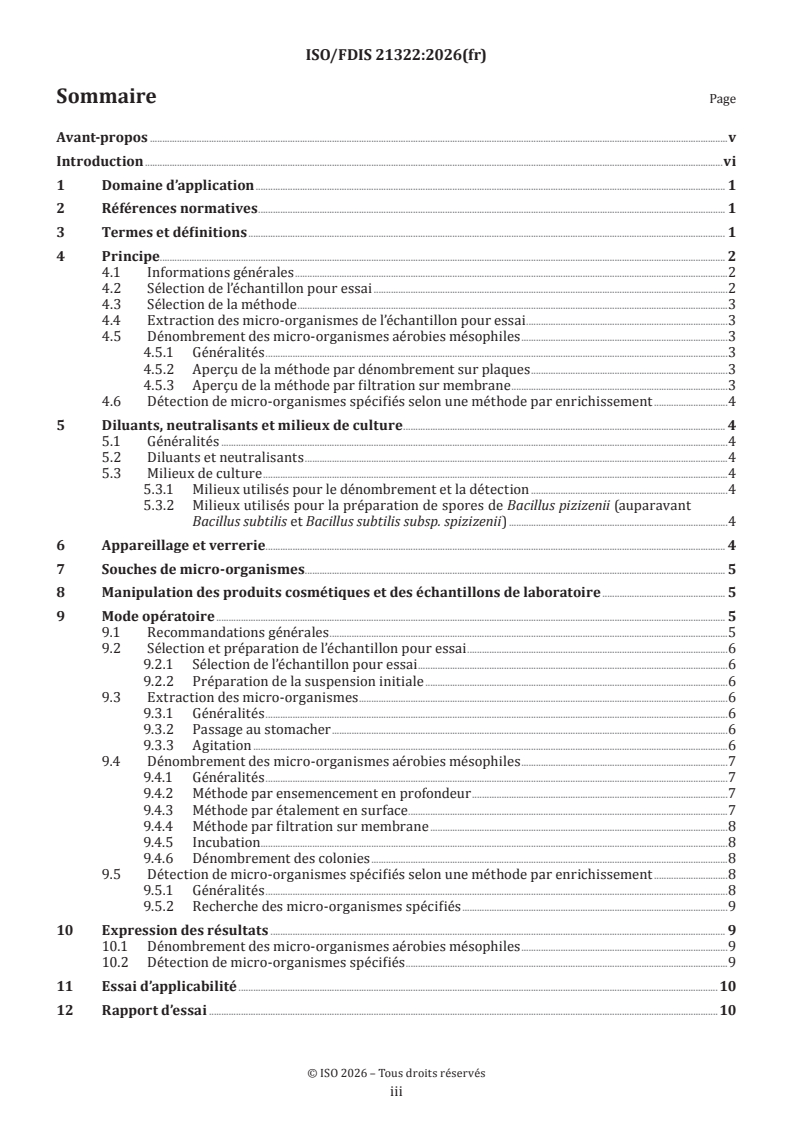
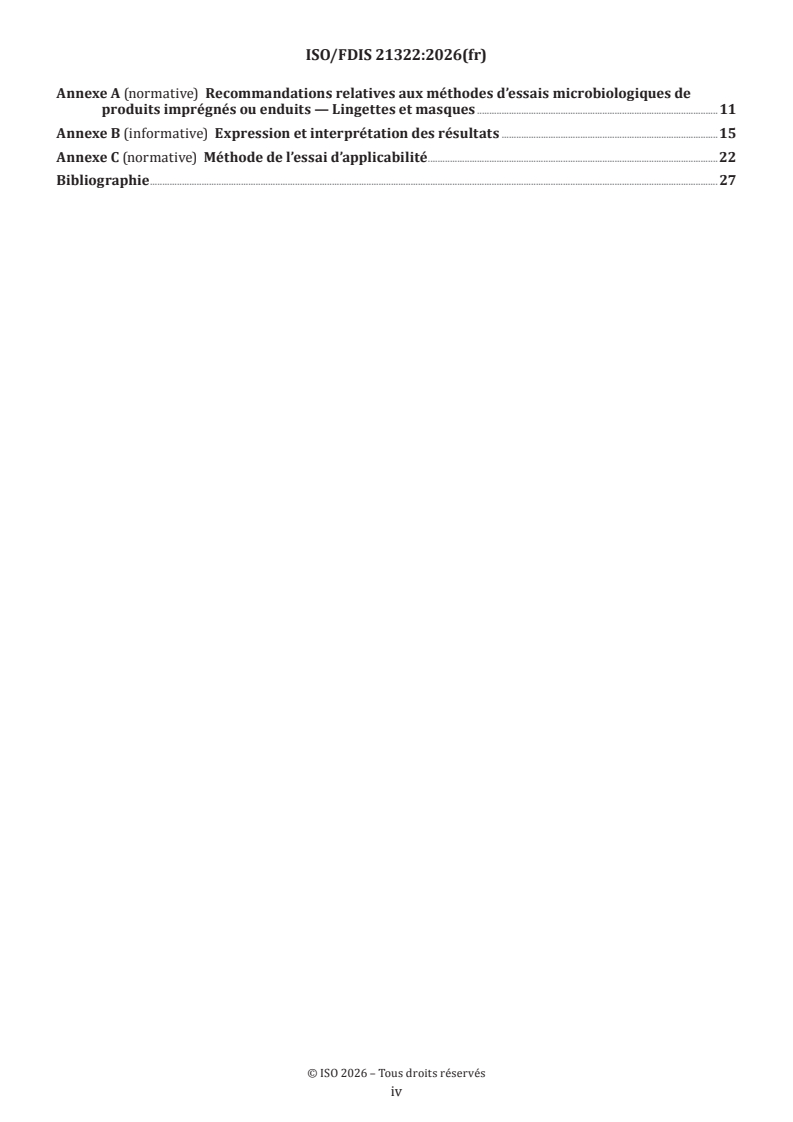
ISO/FDIS 21322 - Cosmétiques — Microbiologie — Essais sur lingettes et masques imprégnés ou enduits
Overview
ISO/FDIS 21322: Cosmetics - Microbiology - Testing of Impregnated or Coated Wipes and Masks is an international standard published by the International Organization for Standardization (ISO). This document provides essential guidance for the enumeration and/or detection of microorganisms present in cosmetic products that are impregnated or coated onto substrates. It specifically addresses challenges in microbiological testing related to wipes and masks, acknowledging the sampling complexity unique to these types of products. The standard’s principles may also be adapted for similar items such as impregnated cushions, sponges, or cosmetic applicators.
The standard is managed by ISO Technical Committee ISO/TC 217 (Cosmetics) and offers an updated approach to ensure cosmetic safety and quality by providing standardized procedures for microbiological examination.
Key Topics
Microbiological Sampling and Testing
ISO/FDIS 21322 outlines recommendations for collecting microbiologically representative test samples from impregnated or coated wipes and masks, ensuring reliable detection and enumeration of microorganisms.Test Sample Selection
The standard details how to select the appropriate test amount (minimum 1 g per sample or corresponding multiple units), and addresses special cases like small or composite samples by using Unit Item Portions (UIP).Enumeration and Detection Methods
Guidance is provided on the use of plate count and membrane filtration methods for enumerating aerobic mesophilic microorganisms, including bacteria, yeasts, and molds. The enrichment method for detection of specified organisms like Staphylococcus aureus, Pseudomonas aeruginosa, Escherichia coli, and Candida albicans is also explained.Materials and Handling
The use and quality control of diluents, neutralizers, and culture media suitable for cosmetic testing is specified, referencing other ISO standards for best practices.Suitability Testing
A critical focus is given to suitability tests, ensuring that the chosen method effectively recovers and identifies microorganisms without adverse impacts from the product matrix or preservative content.Test Reporting
The standard specifies essential reporting requirements, including complete product identification, description of methods used, and explicit results for regulatory compliance and quality assurance.
Applications
Cosmetic Product Safety Assurance
By implementing ISO/FDIS 21322, manufacturers of cosmetic wipes, facial masks, and coated products can reliably assess microbiological quality, protecting consumers from potential health hazards arising from contamination.Quality Control for New Product Forms
The guidance helps cosmetic laboratories and production managers adapt microbiological quality control methods for novel and evolving product forms (e.g., untraditional substrates like cushions or applicators) by providing modification guidance.Regulatory Compliance
The standardized approach facilitates compliance with international regulations and customer requirements in the cosmetic industry, supporting both local and global market access.Risk Assessment
Performing appropriate microbiological risk assessments, as advised, helps in determining which products require comprehensive testing, optimizing resources, and ensuring high standards of hygiene.
Related Standards
ISO/FDIS 21322 is part of a broader framework of international standards for cosmetics microbiology. Relevant related standards include:
- ISO 21149: Cosmetics - Microbiology - Enumeration and detection of aerobic mesophilic bacteria
- ISO 18416: Cosmetics - Microbiology - Detection of Candida albicans
- ISO 21150: Cosmetics - Microbiology - Detection of Escherichia coli
- ISO 22717: Cosmetics - Microbiology - Detection of Pseudomonas aeruginosa
- ISO 22718: Cosmetics - Microbiology - Detection of Staphylococcus aureus
- ISO 11930: Cosmetics - Microbiology - Evaluation of the antimicrobial protection of a cosmetic product
- ISO 16212: Cosmetics - Microbiology - Enumeration of yeast and mould
- ISO 21148: Cosmetics - Microbiology - General instructions for microbiological examination
- ISO 4973: Cosmetics - Microbiology - Quality control of culture media and diluents
Together, these standards support a robust microbiological quality management system in the cosmetics sector, with ISO/FDIS 21322 providing targeted protocols for wipes, masks, and other coated cosmetic products.
Keywords: ISO 21322, Cosmetics microbiology, Testing wipes, Microbiological analysis, Cosmetic product safety, Quality control, Cosmetic masks, Microbial enumeration, Microbiological detection, Cosmetic standards.
Relations
- Effective Date
- 12-Feb-2026
- Effective Date
- 27-Dec-2025
Buy Documents
ISO/FDIS 21322 - Cosmetics — Microbiology — Testing of impregnated or coated wipes and masks
REDLINE ISO/FDIS 21322 - Cosmetics — Microbiology — Testing of impregnated or coated wipes and masks
ISO/FDIS 21322 - Cosmétiques — Microbiologie — Essais sur lingettes et masques imprégnés ou enduits
Frequently Asked Questions
ISO/FDIS 21322 is a draft published by the International Organization for Standardization (ISO). Its full title is "Cosmetics — Microbiology — Testing of impregnated or coated wipes and masks". This standard covers: This document gives guidance for the enumeration and/or detection of microorganisms present in a cosmetic product that is impregnated or coated onto a substrate (i.e. wipes and masks) where sampling and microbiological influence of the manufactured product presents particular challenges in terms of microbiological sampling and testing. The principle of this document can also be applied to test similar products (e.g. cushion, impregnated sponge, etc.) or applicators (e.g. brush, puff, sponge, etc.) with modification of the procedure as appropriate.
This document gives guidance for the enumeration and/or detection of microorganisms present in a cosmetic product that is impregnated or coated onto a substrate (i.e. wipes and masks) where sampling and microbiological influence of the manufactured product presents particular challenges in terms of microbiological sampling and testing. The principle of this document can also be applied to test similar products (e.g. cushion, impregnated sponge, etc.) or applicators (e.g. brush, puff, sponge, etc.) with modification of the procedure as appropriate.
ISO/FDIS 21322 is classified under the following ICS (International Classification for Standards) categories: 07.100.40 - Cosmetics microbiology. The ICS classification helps identify the subject area and facilitates finding related standards.
ISO/FDIS 21322 has the following relationships with other standards: It is inter standard links to prEN ISO 21322, ISO 21322:2020. Understanding these relationships helps ensure you are using the most current and applicable version of the standard.
ISO/FDIS 21322 is available in PDF format for immediate download after purchase. The document can be added to your cart and obtained through the secure checkout process. Digital delivery ensures instant access to the complete standard document.
Standards Content (Sample)
FINAL DRAFT
International
Standard
ISO/TC 217
Cosmetics — Microbiology —
Secretariat: INSO
Testing of impregnated or coated
Voting begins on:
wipes and masks
2026-09-02
Cosmétiques — Microbiologie — Essais sur lingettes et masques
Voting terminates on:
imprégnés ou enduits
2026-11-25
RECIPIENTS OF THIS DRAFT ARE INVITED TO SUBMIT,
WITH THEIR COMMENTS, NOTIFICATION OF ANY
RELEVANT PATENT RIGHTS OF WHICH THEY ARE AWARE
AND TO PROVIDE SUPPOR TING DOCUMENTATION.
IN ADDITION TO THEIR EVALUATION AS
BEING ACCEPTABLE FOR INDUSTRIAL, TECHNO
ISO/CEN PARALLEL PROCESSING LOGICAL, COMMERCIAL AND USER PURPOSES, DRAFT
INTERNATIONAL STANDARDS MAY ON OCCASION HAVE
TO BE CONSIDERED IN THE LIGHT OF THEIR POTENTIAL
TO BECOME STAN DARDS TO WHICH REFERENCE MAY BE
MADE IN NATIONAL REGULATIONS.
Reference number
FINAL DRAFT
International
Standard
ISO/TC 217
Cosmetics — Microbiology —
Secretariat: INSO
Testing of impregnated or coated
Voting begins on:
wipes and masks
Cosmétiques — Microbiologie — Essais sur lingettes et masques
Voting terminates on:
imprégnés ou enduits
RECIPIENTS OF THIS DRAFT ARE INVITED TO SUBMIT,
WITH THEIR COMMENTS, NOTIFICATION OF ANY
RELEVANT PATENT RIGHTS OF WHICH THEY ARE AWARE
AND TO PROVIDE SUPPOR TING DOCUMENTATION.
© ISO 2026
IN ADDITION TO THEIR EVALUATION AS
All rights reserved. Unless otherwise specified, or required in the context of its implementation, no part of this publication may
BEING ACCEPTABLE FOR INDUSTRIAL, TECHNO
ISO/CEN PARALLEL PROCESSING
LOGICAL, COMMERCIAL AND USER PURPOSES, DRAFT
be reproduced or utilized otherwise in any form or by any means, electronic or mechanical, including photocopying, or posting on
INTERNATIONAL STANDARDS MAY ON OCCASION HAVE
the internet or an intranet, without prior written permission. Permission can be requested from either ISO at the address below
TO BE CONSIDERED IN THE LIGHT OF THEIR POTENTIAL
or ISO’s member body in the country of the requester.
TO BECOME STAN DARDS TO WHICH REFERENCE MAY BE
MADE IN NATIONAL REGULATIONS.
ISO copyright office
CP 401 • Ch. de Blandonnet 8
CH-1214 Vernier, Geneva
Phone: +41 22 749 01 11
Email: copyright@iso.org
Website: www.iso.org
Published in Switzerland Reference number
ii
Contents Page
Foreword .v
Introduction .vi
1 Scope . 1
2 Normative references . 1
3 Terms and definitions . 1
4 Principle . 2
4.1 General information.2
4.2 Selection of the test sample .2
4.3 Selection of the method .2
4.4 Recovery of microorganisms from the test sample .3
4.5 Enumeration of aerobic mesophilic microorganisms .3
4.5.1 General .3
4.5.2 Plate count method overview .3
4.5.3 Membrane filtration method overview .3
4.6 Detection of specified microorganisms by enrichment method.3
5 Diluents, neutralizers and culture media . 4
5.1 General .4
5.2 Diluents and neutralizers .4
5.3 Culture media .4
5.3.1 Media for enumeration and detection .4
5.3.2 Media for preparation of spores of Bacillus pizizenii (formerly known as Bacillus
subtilis and Bacillus subtilis subsp. spizizenii) .4
6 Apparatus and glassware . 4
7 Strains of microorganisms . 4
8 Handling of cosmetic products and laboratory samples. 5
9 Procedure . 5
9.1 General recommendation .5
9.2 Selection and preparation of the test sample .5
9.2.1 Selection of the test sample .5
9.2.2 Preparation of the initial suspension .5
9.3 Recovery of microorganisms .6
9.3.1 General .6
9.3.2 Stomaching .6
9.3.3 Shaking/Stirring .6
9.4 Enumeration of aerobic mesophilic microorganisms .6
9.4.1 General .6
9.4.2 Pour plate method .6
9.4.3 Surface spread method .7
9.4.4 Membrane filtration method .7
9.4.5 Incubation.7
9.4.6 Counting of colonies .7
9.5 Detection of specified microorganisms by enrichment method.8
9.5.1 General .8
9.5.2 Test for specified microorganisms .8
10 Expression of results . 8
10.1 Enumeration of aerobic mesophilic microorganisms .8
10.2 Detection of specified microorganisms .9
11 Suitability test . 9
12 Test report . 9
iii
Annex A (normative) Guidance on methods for microbiological testing of impregnated or
coated products — Wipes and masks . 10
Annex B (informative) Expression and interpretation of results .13
Annex C (normative) Suitability test method .20
Bibliography .25
iv
Foreword
ISO (the International Organization for Standardization) is a worldwide federation of national standards
bodies (ISO member bodies). The work of preparing International Standards is normally carried out through
ISO technical committees. Each member body interested in a subject for which a technical committee
has been established has the right to be represented on that committee. International organizations,
governmental and non-governmental, in liaison with ISO, also take part in the work. ISO collaborates closely
with the International Electrotechnical Commission (IEC) on all matters of electrotechnical standardization.
The procedures used to develop this document and those intended for its further maintenance are described
in the ISO/IEC Directives, Part 1. In particular, the different approval criteria needed for the different types
of ISO documents should be noted. This document was drafted in accordance with the editorial rules of the
ISO/IEC Directives, Part 2 (see www.iso.org/directives).
ISO draws attention to the possibility that the implementation of this document may involve the use of (a)
patent(s). ISO takes no position concerning the evidence, validity or applicability of any claimed patent
rights in respect thereof. As of the date of publication of this document, ISO had not received notice of (a)
patent(s) which may be required to implement this document. However, implementers are cautioned that
this may not represent the latest information, which may be obtained from the patent database available at
www.iso.org/patents. ISO shall not be held responsible for identifying any or all such patent rights.
Any trade name used in this document is information given for the convenience of users and does not
constitute an endorsement.
For an explanation of the voluntary nature of standards, the meaning of ISO specific terms and expressions
related to conformity assessment, as well as information about ISO's adherence to the World Trade
Organization (WTO) principles in the Technical Barriers to Trade (TBT), see www.iso.org/iso/foreword.html.
This document was prepared by Technical Committee ISO/TC 217, Cosmetics.
This second edition cancels and replaces the first edition (ISO 21322:2020), of which it constitutes a minor
revision.
The changes are as follows:
— the normative references (Clause 2) has been updated.
Any feedback or questions on this document should be directed to the user’s national standards body. A
complete listing of these bodies can be found at www.iso.org/members.html.
v
Introduction
For technical reasons, current standards in cosmetics microbiology might not be applicable to impregnated
or coated cosmetic products, such as wipes and masks, in which there is no direct access to the formulation.
Based on their product form or delivery, there is a need to adapt these standards to assess the microbiological
quality of these products.
vi
FINAL DRAFT International Standard ISO/FDIS 21322:2026(en)
Cosmetics — Microbiology — Testing of impregnated or
coated wipes and masks
1 Scope
This document gives guidance for the enumeration and/or detection of microorganisms present in a
cosmetic product that is impregnated or coated onto a substrate (i.e. wipes and masks) where sampling
and microbiological influence of the manufactured product presents particular challenges in terms of
microbiological sampling and testing.
The principle of this document can also be applied to test similar products (e.g. cushion, impregnated sponge,
etc.) or applicators (e.g. brush, puff, sponge, etc.) with modification of the procedure as appropriate.
2 Normative references
The following documents are referred to in the text in such a way that some or all of their content constitutes
requirements of this document. For dated references, only the edition cited applies. For undated references,
the latest edition of the referenced document (including any amendments) applies.
ISO 4973, Cosmetics — Microbiology — Quality control of culture media and diluents used in cosmetics standards
ISO 11930, Cosmetics — Microbiology — Evaluation of the antimicrobial protection of a cosmetic product
ISO 16212, Cosmetics — Microbiology — Enumeration of yeast and mould
ISO 18416, Cosmetics — Microbiology — Detection of Candida albicans
ISO 21148, Cosmetics — Microbiology — General instructions for microbiological examination
ISO 21149, Cosmetics — Microbiology — Enumeration and detection of aerobic mesophilic bacteria
ISO 21150, Cosmetics — Microbiology — Detection of Escherichia coli
ISO 22717, Cosmetics — Microbiology — Detection of Pseudomonas aeruginosa
ISO 22718, Cosmetics — Microbiology — Detection of Staphylococcus aureus
3 Terms and definitions
For the purposes of this document, the following terms and definitions apply.
ISO and IEC maintain terminology databases for use in standardization at the following addresses:
— ISO Online browsing platform: available at https:// www .iso .org/ obp
— IEC Electropedia: available at http:// www .electropedia .org/
3.1
cosmetic formulation, noun
preparation of raw materials with a qualitatively and quantitatively defined composition
3.2
cosmetic product, noun
cosmetic formulation (3.1) that has undergone all stages of production, including packaging in its final
container, for shipment
3.3
impregnated product, noun
product absorbed on the support
3.4
coated product, noun
product adsorbed on the support
3.5
test sample, noun
representative unit of the entire cosmetic product (3.2) for testing
4 Principle
4.1 General information
The method determines the population of viable microorganisms by enumeration of colonies on a non-
selective agar medium and by the presence or absence of specified microorganisms growth after enrichment.
The method involves the following steps:
— selection of the test sample;
— selection of an appropriate method;
— recovery of microorganisms;
— enumeration of the population of viable microorganisms by filtration or plate count method;
— tests for specified microorganisms by enrichment method.
The experimental conditions shall be evaluated to ensure that the method should not affect the viability of
microorganisms and the recovery of bioburden from the sample and should include the verification of the
efficacy of the neutralization (see Clause 11).
In order to ensure product quality and safety for the consumer, an appropriate microbiological risk
assessment should be performed to determine the types of cosmetic products to which this document is
[1]
applicable (see ISO 29621:2017 , Table 2).
Other methods may be substituted provided that their equivalence has been demonstrated.
4.2 Selection of the test sample
— Whenever practical, the entire unit should be used for testing with a minimum weight of 1 g. If for
technical reasons the entire unit cannot be tested, a defined Unit Item Portion (UIP) is used for testing.
A “UIP” is a microbiologically-representative subunit of the test sample and is referenced throughout the
document.
— If the unit is < 1 g per unit then the appropriate number of units should be sampled to achieve the
appropriate weight or volume.
— The weight of the test sample shall be recorded even if the results are expressed by unit.
Selection of the test sample shall be according to Clause A.1.
4.3 Selection of the method
The method should be conducted according to an appropriate procedure based on the specifics of the
product (size, volume, single unit/multi–unit package, level of bioburden, etc.) and should ensure that a
representative sample is evaluated.
Selection of the method shall be according to Clause A.1 and Clause A.2.
4.4 Recovery of microorganisms from the test sample
The degree to which microorganisms adhere to the test sample surface is dependent on the wipe or mask in
which the liquid portion of the formulation has been either impregnated or coated. Preliminary treatments
may be necessary to separate microorganisms from the test sample.
Regardless of the treatment, the verification of recovery method should be performed in order to
demonstrate that the method can release microorganisms from the test sample without having an adverse
effect on their viability (see Clause 11).
4.5 Enumeration of aerobic mesophilic microorganisms
4.5.1 General
The enumeration of aerobic mesophilic microorganisms includes bacteria, yeasts and moulds.
Based on the nature of the test sample, the volume of diluent used to immerse the test sample and the
expected level of bioburden, two types of counting methods may be used:
— plate count method;
— membrane filtration method.
4.5.2 Plate count method overview
Plate count method consists of either using a pour plate or spread plate method.
Each method consists of the following steps.
— Prepare the agar plates and diluent using a non-selective agar medium for plating the diluent in which
the sample was immersed.
— Incubate the plates for enumeration and/or detection.
— Count the number of colonies forming units (CFU) based on the number of aerobic mesophilic
microorganisms recovered per unit or g.
4.5.3 Membrane filtration method overview
Membrane filtration consists of the following steps.
— Transfer the diluent or a defined quantity of diluent in which the test sample was immersed to a filtration
apparatus wetted with a small volume of an appropriate sterile diluent.
— After filtration and rinsing, transfer the membrane filter onto the surface of plates with non-selective
agar medium.
— Aerobic incubation of the plates.
— Count the number of colony forming units (CFU) and calculate of the number of aerobic mesophilic
microorganisms per g or unit.
4.6 Detection of specified microorganisms by enrichment method
The objective of the enrichment method is to incubate a test sample in a non-selective broth medium to
increase the number of microorganisms that are present in a test sample.
— The first step of an enrichment method is to incubate the test sample in a non-selective broth medium to
increase the number of microorganisms present in the test sample.
— The second step of an enrichment method is to isolate specified microorganisms that may be present on
a test sample through the use of selective agar media followed by confirmatory identification tests for
[2] [3] [4] [5]
characteristic colonies. See ISO 18416 , ISO 21150 , ISO 22717 and ISO 22718 .
5 Diluents, neutralizers and culture media
5.1 General
The diluents, neutralizers and culture media suitable for enumeration and detection of aerobic mesophilic
[6] [7] [8]
microorganisms are described inISO 11930 , ISO 16212 and ISO 21149 . Other diluents, neutralizers
and culture media may be used if they have been demonstrated to be suitable for use.
Use the general instructions given in ISO 21148. When water is mentioned in this document, use distilled
water or purified water as specified in ISO 21148.
5.2 Diluents and neutralizers
The diluent is used to disperse the sample. It is required that it contain neutralizers if the sample to be
tested has antimicrobial properties or contains a preservative. The efficacy of the neutralization shall be
demonstrated before the determination of the count (see Clause 11). Diluents and neutralizers, including
quality control, shall be in accordance with ISO 11930, ISO 16212, ISO 18416, ISO 21149,ISO 21150, ISO 22717
ISO 22718 and ISO 4973.
5.3 Culture media
5.3.1 Media for enumeration and detection
Culture media for enumeration and/or detection shall be in accordance with ISO 11930 , ISO 16212,
ISO 18416, ISO 21149, ,ISO 21150, ISO 22717, ISO 22718 and ISO 4973.
5.3.2 Media for preparation of spores of Bacillus pizizenii (formerly known as Bacillus subtilis and
Bacillus subtilis subsp. spizizenii)
See C.1.3.1.
6 Apparatus and glassware
The laboratory equipment, apparatus and glassware are described in ISO 21148.
7 Strains of microorganisms
The culture should be reconstituted according to the procedures provided by the supplier of the reference
[9]
strain. The strains may be stored in the laboratory conforming to EN 12353 or according to another
suitable method.
For testing the recovery of microorganisms on the test samples, spores of Bacillus pizizenii (formerly known as
® 1) ® TM1)
Bacillus subtilis and Bacillus subtilis subsp. spizizenii) ATCC 6633TM (equivalent strain: WDCM 00003
or CIP 52.62 or NCIMB 8054 or NBRC 3134 or other equivalent national collection strain) are used.
For testing the efficacy of neutralizers, two strains representative of both Gram negative and Gram positive
bacteria and a yeast are used:
® TM1) ® TM1)
— Staphylococcus aureus ATCC 6538 (equivalent strain: WDCM 00032 or CIP 4.83 or NCIMB 9518
or NBRC 13276 or KCTC 1916 or other equivalent national collection strain);
1) This information is given for the convenience of users of this document and does not constitute an endorsement by
ISO.
® TM1)
— Pseudomonas paraeruginosa (formerly Pseudomonas aeruginosa) ATCC 9027 (equivalent strain:
® TM1)
WDCM 00026 or CIP 82.118 or NCIMB 8626 or NBRC 13275 or KCTC 2513 or other equivalent
national collection strain).
® TM1)
An alternative Gram negative strain may be Escherichia coli ATCC 8739 (equivalent strain:
® TM1)
WDCM 00012 or CIP 53.126 or NCIMB 8545 or NBRC 3972 or KCTC 2571 or other equivalent national
collection strain).
® TM1) ® TM1)
— Candida albicans ATCC 10231 (equivalent strain: WDCM 00054 or CIP 48.72 or NCPF 3179 or
NBRC 1594 or KCTC 17205, or other equivalent national collection strain).
[9]
The strains may be kept in the laboratory according to the EN 12353 .
8 Handling of cosmetic products and laboratory samples
If storage is necessary, keep the products to be tested at room temperature. Do not incubate, refrigerate
or freeze products and samples before or after analysis. Sampling and test procedures should follow the
[10]
guidelines specified in ISO 21148 and in accordance with the procedure outlined in Clause 9.
9 Procedure
9.1 General recommendation
Use sterile equipment and aseptic technique whenever preparing the test sample and diluent.
For the preparation of an initial suspension, the time which elapses between the end of the preparation of the
test sample and the moment the diluent of the initial suspension comes into contact with the culture medium
shall not exceed (30 ± 15) min, unless specifically mentioned in the established protocols or documents.
The method should follow the procedure developed during the suitability test, to ensure neutralization of
potential inhibitory effects (see Clause 11) and to guarantee the recovery of microorganisms.
9.2 Selection and preparation of the test sample
9.2.1 Selection of the test sample
The test sample shall weigh at least 1 g.
The test sample can be either the entire unit, or multiple units if the weight of one unit is less than 1 g, or the
UIP (see Clause A.1).
Record the exact weight of the test sample, S, and, the number of units, n.
If a UIP is used for testing, record the UIP value of the test sample (see 4.2).
9.2.2 Preparation of the initial suspension
Place the test sample (see 9.2.1) into an appropriate container, with a known volume of diluent, defined in
the suitability test (see Clause 11). The test sample should be completely immersed in the diluent.
Record the value for “V”, the volume of diluent used.
9.3 Recovery of microorganisms
9.3.1 General
After immersion, the following treatments may be used to remove microorganisms from the test sample:
— stomaching;
— shaking/stirring;
— vortexing (see Clause A.3).
NOTE If necessary, record the volume of the diluent after stomaching or shaking of test sample.
9.3.2 Stomaching
Prepare the initial suspension utilizing a sterile stomacher bag and then place it into the stomacher.
Proceed according to the parameters (time and speed) outlined in the suitability test (see Clause 11).
Record the time and the speed at which the stomaching took place.
9.3.3 Shaking/Stirring
Prepare the initial suspension in the appropriate closed container and mix according to the parameters
(duration and frequency) applied in the suitability test (see Clause 11).
Sterile glass beads may be added to enhance product mixing and organism recovery.
Record the time, frequency and the speed of shaking/stirring (if applicable) and whether glass beads are
added or not.
9.4 Enumeration of aerobic mesophilic microorganisms
9.4.1 General
The enumeration of aerobic mesophilic microorganisms includes bacteria, yeasts and moulds.
The choice of the method depends on the volume of diluent used for the preparation of the initial suspension
(see Clause A.2).
Based on the test sample size, the level of bioburden and the sensitivity of the method, all of the diluent in
which the test sample is immersed (V) or a fraction of V (Vd) is used for enumeration.
Usually, the volume V or Vd of the initial suspension diluent is the dilution used for enumeration. No further
diluting of the initial preparation is required.
The minimal volume of diluent shall be equivalent to at least 1 g of the test sample.
9.4.2 Pour plate method
Use the appropriate number of Petri dishes to properly evaluate the volume of diluent needed to properly
immerse and transfer the product to be plated (V or Vd).
The diluent (V) is divided into two work streams: one half (V/2) is for the enumeration of bacteria and the
other half (V/2) for enumeration of yeasts and moulds.
If the enumeration is conducted on a fraction of the total diluent (Vd), two equal fractions (Vd/2) shall be
plated: one for bacteria and the other for yeasts and moulds.
If Petri dishes, 85 mm to 100 mm in diameter are used, add 1 ml of the diluent and pour 15 ml to 20 ml of the
melted agar medium (as specified in ISO 21149 and ISO 16212) kept in a water bath not to exceed 48 °C.
If larger Petri dishes (140 mm in diameter) are used, add no more than 10 ml of diluent in each plate and the
appropriate amount of agar medium based on the volume of diluent dispensed.
Slowly mix the transferred diluent with the medium, carefully rotating or tilting the plates to sufficiently
disperse the agar. Allow the mixture in the Petri dishes to solidify on a horizontal surface at room
temperature. Record the volume of diluent plated for each medium V/2 or Vd/2.
9.4.3 Surface spread method
Use the appropriate number of Petri dishes to properly evaluate the volume of diluent needed to properly
immerse and transfer the product to be plated (V or Vd).
In Petri dishes 85 mm to 100 mm in diameter, put 15 ml to 20 ml of the melted agar medium kept in a water
bath at no more than 48 °C. If larger Petri dishes are used, the volume of the agar is increased accordingly.
Allow plates to cool and solidify on a horizontal surface at room temperature.
The diluent (V) is divided into two work
...
ISO/DISFDIS 21322
ISO/TC 217
Secretariat: INSO
Date: 2026-08-0318
Cosmetics — Microbiology — Testing of impregnated or coated wipes
and masks
Cosmétiques — Microbiologie — Essais sur lingettes et masques imprégnés ou enduits
DISFDIS stage
TThhiiss d drraftaft i iss s suubbmmiitttteded t too a pa pararallel vallel vootte e iinn I ISSOO,, C CEENN.
All rights reserved. Unless otherwise specified, or required in the context of its implementation, no part of this publication
may be reproduced or utilized otherwise in any form or by any means, electronic or mechanical, including photocopying,
or posting on the internet or an intranet, without prior written permission. Permission can be requested from either ISO
at the address below or ISO’s member body in the country of the requester.
ISO copyright office
CP 401 • Ch. de Blandonnet 8
CH-1214 Vernier, Geneva
Phone: + 41 22 749 01 11
E-mail: copyright@iso.org
Website: www.iso.org
Published in Switzerland
ii
Contents
Foreword . iv
Introduction . v
1 Scope . 1
2 Normative references . 1
3 Terms and definitions . 1
4 Principle . 2
4.1 General information . 2
4.2 Selection of the test sample . 2
4.3 Selection of the method . 3
4.4 Recovery of microorganisms from the test sample . 3
4.5 Enumeration of aerobic mesophilic microorganisms . 3
4.6 Detection of specified microorganisms by enrichment method. 4
5 Diluents, neutralizers and culture media . 4
5.1 General. 4
5.2 Diluents and neutralizers . 4
5.3 Culture media . 4
6 Apparatus and glassware . 4
7 Strains of microorganisms . 5
8 Handling of cosmetic products and laboratory samples . 5
9 Procedure . 5
9.1 General recommendation . 5
9.2 Selection and preparation of the test sample . 6
9.3 Recovery of microorganisms . 6
9.4 Enumeration of aerobic mesophilic microorganisms . 6
9.5 Detection of specified microorganisms by enrichment method. 8
10 Expression of results . 9
10.1 Enumeration of aerobic mesophilic microorganisms . 9
10.2 Detection of specified microorganisms . 9
11 Suitability test . 9
12 Test report . 10
Annex A (normative) Guidance on methods for microbiological testing of impregnated or
coated products — Wipes and masks . 11
Annex B (informative) Expression and interpretation of results . 17
Annex C (normative) Suitability test method . 24
Bibliography . 29
iii
Foreword
ISO (the International Organization for Standardization) is a worldwide federation of national standards
bodies (ISO member bodies). The work of preparing International Standards is normally carried out through
ISO technical committees. Each member body interested in a subject for which a technical committee has been
established has the right to be represented on that committee. International organizations, governmental and
non-governmental, in liaison with ISO, also take part in the work. ISO collaborates closely with the
International Electrotechnical Commission (IEC) on all matters of electrotechnical standardization.
The procedures used to develop this document and those intended for its further maintenance are described
in the ISO/IEC Directives, Part 1. In particular, the different approval criteria needed for the different types of
ISO documents should be noted. This document was drafted in accordance with the editorial rules of the
ISO/IEC Directives, Part 2 (see www.iso.org/directives).
Attention is drawnISO draws attention to the possibility that some of the elementsimplementation of this
document may beinvolve the subjectuse of (a) patent(s). ISO takes no position concerning the evidence,
validity or applicability of any claimed patent rights in respect thereof. As of the date of publication of this
document, ISO had not received notice of (a) patent(s) which may be required to implement this document.
However, implementers are cautioned that this may not represent the latest information, which may be
obtained from the patent database available at www.iso.org/patents. ISO shall not be held responsible for
identifying any or all such patent rights. Details of any patent rights identified during the development of the
document will be in the Introduction and/or on the ISO list of patent declarations received (see
).
Any trade name used in this document is information given for the convenience of users and does not
constitute an endorsement.
For an explanation of the voluntary nature of standards, the meaning of ISO specific terms and expressions
related to conformity assessment, as well as information about ISO's adherence to the World Trade
Organization (WTO) principles in the Technical Barriers to Trade (TBT)), see
www.iso.org/iso/foreword.html.
This document was prepared by Technical Committee ISO/TC 217, Cosmetics.
This second edition cancels and replaces the first edition (ISO 21322:2020), of which it constitutes a minor
revision.
The changes are as follows:
— the normative references (Clause 2) has been updated.
Any feedback or questions on this document should be directed to the user’s national standards body. A
complete listing of these bodies can be found at www.iso.org/members.html.
iv
Introduction
For technical reasons, current standards in cosmetics microbiology maymight not be applicable to
impregnated or coated cosmetic products, such as wipes and masks, in which there is no direct access to the
formulation.
Based on their product form or delivery, there is a need to adapt these standards to assess the microbiological
quality of these products.
v
Cosmetics — Microbiology — Testing of impregnated or coated wipes
and masks
1 Scope
This document gives guidance for the enumeration and/or detection of microorganisms present in a cosmetic
product that is impregnated or coated onto a substrate (i.e. wipes and masks) where sampling and
microbiological influence of the manufactured product presents particular challenges in terms of
microbiological sampling and testing.
The principle of this document can also be applied to test similar products (e.g. cushion, impregnated sponge,
etc.) or applicators (e.g. brush, puff, sponge, etc.) with modification of the procedure as appropriate.
2 Normative references
The following documents are referred to in the text in such a way that some or all of their content constitutes
requirements of this document. For dated references, only the edition cited applies. For undated references,
the latest edition of the referenced document (including any amendments) applies.
ISO 4973, Cosmetics — Microbiology — Quality control of culture media and diluents used in cosmetics standards
ISO 11930, Cosmetics — Microbiology — Evaluation of the antimicrobial protection of a cosmetic product
ISO 16212, Cosmetics — Microbiology — Enumeration of yeast and mould
ISO 18416, Cosmetics — Microbiology — Detection of Candida albicans
ISO 21148, Cosmetics — Microbiology — General instructions for microbiological examination
ISO 21149, Cosmetics — Microbiology — Enumeration and detection of aerobic mesophilic bacteria
ISO 21150, Cosmetics — Microbiology — Detection of Escherichia coli
ISO 22717, Cosmetics — Microbiology — Detection of Pseudomonas aeruginosa
ISO 22718, Cosmetics — Microbiology — Detection of Staphylococcus aureus
3 Terms and definitions
For the purposes of this document, the following terms and definitions apply.
ISO and IEC maintain terminologicalterminology databases for use in standardization at the following
addresses:
— ISO Online browsing platform: available at https://www.iso.org/obp
— IEC Electropedia: available at http://www.electropedia.org/http://www.electropedia.org/
3.1
cosmetic formulation, noun
preparation of raw materials with a qualitatively and quantitatively defined composition
3.2
cosmetic product, noun
cosmetic formulation (3.1) that has undergone all stages of production, including packaging in its final
container, for shipment
3.3
impregnated product, noun
product absorbed on the support
3.4
coated product, noun
product adsorbed on the support
3.5
test sample, noun
representative unit of the entire cosmetic product (3.2) for testing
4 Principle
4.1 General information
The method determines the population of viable microorganisms by enumeration of colonies on a non-
selective agar medium and by the presence or absence of specified microorganisms growth after enrichment.
The method involves the following steps:
— selection of the test sample;
— selection of an appropriate method;
— recovery of microorganisms;
— enumeration of the population of viable microorganisms by filtration or plate count method;
— tests for specified microorganisms by enrichment method.
The experimental conditions shall be evaluated to ensure that the method should not affect the viability of
microorganisms and the recovery of bioburden from the sample and should include the verification of the
efficacy of the neutralization (see Clause 11).
In order to ensure product quality and safety for the consumer, an appropriate microbiological risk
assessment should be performed to determine the types of cosmetic products to which this document is
[1]
applicable (see ISO 29621:2017 , Table 2).
Other methods may be substituted provided that their equivalence has been demonstrated.
4.2 Selection of the test sample
— Whenever practical, the entire unit should be used for testing with a minimum weight of 1 g. If for technical
reasons the entire unit cannot be tested, a defined Unit Item Portion (UIP) is used for testing. A “UIP” is a
microbiologically-representative subunit of the test sample and is referenced throughout the document.
— If the unit is < 1 g per unit then the appropriate number of units should be sampled to achieve the
appropriate weight or volume.
— The weight of the test sample shall be recorded even if the results are expressed by unit.
Selection of the test sample shall be according to Clause A.1.
4.3 Selection of the method
The method should be conducted according to an appropriate procedure based on the specifics of the product
(size, volume, single unit/multi–unit package, level of bioburden., etc.) and should ensure that a representative
sample is evaluated.
Selection of the method shall be according to Clause A.1 and Clause A.2.
4.4 Recovery of microorganisms from the test sample
The degree to which microorganisms adhere to the test sample surface is dependent on the wipe or mask in
which the liquid portion of the formulation has been either impregnated or coated. Preliminary treatments
may be necessary to separate microorganisms from the test sample.
Regardless of the treatment, the verification of recovery method should be performed in order to demonstrate
that the method can release microorganisms from the test sample without having an adverse effect on their
viability (see Clause 11).
4.5 Enumeration of aerobic mesophilic microorganisms
4.5.1 General
The enumeration of aerobic mesophilic microorganisms includes bacteria, yeasts and moulds.
Based on the nature of the test sample, the volume of diluent used to immerse the test sample and the expected
level of bioburden, two types of counting methods may be used:
— plate count method;
— membrane filtration method.
4.5.2 Plate count method overview
Plate count method consists of either using a pour plate or spread plate method.
Each method consists of the following steps.
— Prepare the agar plates and diluent using a non-selective agar medium for plating the diluent in which the
sample was immersed.
— Incubate the plates for enumeration and/or detection.
— Count the number of colonies forming units (CFU) based on the number of aerobic mesophilic
microorganisms recovered per unit or g.
4.5.3 Membrane filtration method overview
Membrane filtration consists of the following steps.
— Transfer the diluent or a defined quantity of diluent in which the test sample was immersed to a filtration
apparatus wetted with a small volume of an appropriate sterile diluent.
— After filtration and rinsing, transfer the membrane filter onto the surface of plates with non-selective agar
medium.
— Aerobic incubation of the plates.
— Count the number of colony forming units (CFU) and calculate of the number of aerobic mesophilic
microorganisms per g or unit.
4.6 Detection of specified microorganisms by enrichment method
The objective of the enrichment method is to incubate a test sample in a non-selective broth medium to
increase the number of microorganisms that are present in a test sample.
— The first step of an enrichment method is to incubate the test sample in a non-selective broth medium to
increase the number of microorganisms present in the test sample.
— The second step of an enrichment method is to isolate specified microorganisms that may be present on a
test sample through the use of selective agar media followed by confirmatory identification tests for
[2] [3] [4]
, ISO 21150 ISO 18416 , ISO 21150, ISO 22717, ISO 22717 and
characteristic colonies. See ISO 18416
[5]
ISO 22718 ISO 22718.
5 Diluents, neutralizers and culture media
5.1 General
The diluents, neutralizers and culture media suitable for enumeration and detection of aerobic mesophilic
[6] [7] [8]
microorganisms are described inISO 11930 inISO 11930, ISO 16212, ISO 16212 and ISO 21149 ISO
21149. Other diluents, neutralizers and culture media may be used if they have been demonstrated to be
suitable for use.
Use the general instructions given in ISO 21148. When water is mentioned in this document, use distilled
water or purified water as specified in ISO 21148.
5.2 Diluents and neutralizers
The diluent is used to disperse the sample. It is required that it contain neutralizers if the sample to be tested
has antimicrobial properties or contains a preservative. The efficacy of the neutralization shall be
demonstrated before the determination of the count (see Clause 11). Diluents and neutralizers, including
quality control, shall be in accordance with ISO 11930, ISO 16212, ISO 18416, ISO 21149,ISO 21150, ISO
22717ISO 22718 and ISO 4973.
5.3 Culture media
5.3.1 Media for enumeration and detection
Culture media for enumeration and/or detection shall be in accordance with ISO 11930 , ISO 16212, ISO
18416, ISO 21149, ,ISO 21150, ISO 22717, ISO 22718 and ISO 22718. Quality control of diluents shall be in
accordance with ISO 4973.
5.3.2 Media for preparation of spores of Bacillus pizizenii (formerly known as Bacillus subtilis and
Bacillus subtilis subsp. spizizenii)
See C.1.3.1.
6 Apparatus and glassware
The laboratory equipment, apparatus and glassware are described in ISO 21148.
7 Strains of microorganisms
The culture should be reconstituted according to the procedures provided by the supplier of the reference
[9]
strain. The strains may be stored in the laboratory conforming to EN 12353 or according to another suitable
method.
For testing the recovery of microorganisms on the test samples, spores of Bacillus pizizenii (formerly known
® 1)
as Bacillus subtilis and Bacillus subtilis subsp. spizizenii) ATCC 6633TM (equivalent strain:
® TM TM1)
WDCM 00003 00003 or CIP 52.62 or NCIMB 8054 or NBRC 3134 or other equivalent national collection
strain) are used.
For testing the efficacy of neutralizers, two strains representative of both Gram negative and Gram positive
bacteria and a yeast are used:
® TM TM1) ® TM TM1)
— Staphylococcus aureus ATCC 6538 6538 (equivalent strain: WDCM 00032 00032 or CIP 4.83
or NCIMB 9518 or NBRC 13276 or KCTC 1916 or other equivalent national collection strain);
® TM TM1)
— Pseudomonas paraeruginosa (formerly Pseudomonas aeruginosa) ATCC 9027 9027 (equivalent
® TM TM1)
strain: WDCM 00026 00026 or CIP 82.118 or NCIMB 8626 or NBRC 13275 or KCTC 2513 or other
equivalent national collection strain).
® TM TM1)
An alternative Gram negative strain may be Escherichia coli ATCC 8739 8739 (equivalent strain:
® TM TM1)
WDCM 00012 00012 or CIP 53.126 or NCIMB 8545 or NBRC 3972 or KCTC 2571 or other equivalent
national collection strain).
® TM TM1) ® TM TM1)
— Candida albicans ATCC 10231 10231 (equivalent strain: WDCM 00054 00054 or CIP 48.72 or
NCPF 3179 or NBRC 1594 or KCTC 17205, or other equivalent national collection strain).
[9]
The strains may be kept in the laboratory according to the EN 12353 .
8 Handling of cosmetic products and laboratory samples
If storage is necessary, keep the products to be tested at room temperature. Do not incubate, refrigerate or
freeze products and samples before or after analysis. Sampling and test procedures should follow the
[11]
guidelines specified in ISO 21148 ISO 21148 and in accordance with the procedure outlined in Clause 9.
9 Procedure
9.1 General recommendation
Use sterile equipment and aseptic technique whenever preparing the test sample and diluent.
For the preparation of an initial suspension, the time which elapses between the end of the preparation of the
test sample and the moment the diluent of the initial suspension comes into contact with the culture medium
shall not exceed (30 ± 15) min, unless specifically mentioned in the established protocols or documents.
The method should follow the procedure developed during the suitability test, to ensure neutralization of
potential inhibitory effects (see Clause 11) and to guarantee the recovery of microorganisms.
1)
This information is given for the convenience of users of this document and does not constitute an endorsement by ISO.
9.2 Selection and preparation of the test sample
9.2.1 Selection of the test sample
The test sample shall weigh at least 1 g.
The test sample can be either the entire unit, or multiple units if the weight of one unit is less than 1 g, or the
UIP (see Clause A.1).
Record the exact weight of the test sample, S, and, the number of units, n.
If a UIP is used for testing, record the UIP value of the test sample (see 4.2).
9.2.2 Preparation of the initial suspension
Place the test sample (see 9.2.1) into an appropriate container, with a known volume of diluent, defined in the
suitability test (see Clause 11). The test sample should be completely immersed in the diluent.
Record the value for “V”, the volume of diluent used.
9.3 Recovery of microorganisms
9.3.1 General
After immersion, the following treatments may be used to remove microorganisms from the test sample:
— stomaching;
— shaking/stirring;
— vortexing (see Clause A.3).
NOTE If necessary, record the volume of the diluent after stomaching or shaking of test sample.
9.3.2 Stomaching
Prepare the initial suspension utilizing a sterile stomacher bag and then place it into the stomacher.
Proceed according to the parameters (time and speed) outlined in the suitability test (see Clause 11).
Record the time and the speed at which the stomaching took place.
9.3.3 Shaking/Stirring
Prepare the initial suspension in the appropriate closed container and mix according to the parameters
(duration and frequency) applied in the suitability test (see Clause 11).
Sterile glass beads may be added to enhance product mixing and organism recovery.
Record the time, frequency and the speed of shaking/stirring (if applicable) and whether glass beads are
added or not.
9.4 Enumeration of aerobic mesophilic microorganisms
9.4.1 General
The enumeration of aerobic mesophilic microorganisms includes bacteria, yeasts and moulds.
The choice of the method depends on the volume of diluent used for the preparation of the initial suspension
(see Clause A.2).
Based on the test sample size, the level of bioburden and the sensitivity of the method, all of the diluent in
which the test sample is immersed (V) or a fraction of V (Vd) is used for enumeration.
Usually, the volume V or Vd of the initial suspension diluent is the dilution used for enumeration. No further
diluting of the initial preparation is required.
The minimal volume of diluent shall be equivalent to at least 1 g of the test sample.
9.4.2 Pour plate method
Use the appropriate number of Petri dishes to properly evaluate the volume of diluent needed to properly
immerse and transfer the product to be plated (V or Vd).
The diluent (V) is divided into two work streams: one half (V/2) is for the enumeration of bacteria and the
other half (V/2) for enumeration of yeasts and moulds.
If the enumeration is conducted on a fraction of the total diluent (Vd), two equal fractions (Vd/2) shall be
plated: one for bacteria and the other for yeasts and moulds.
If Petri dishes, 85 mm to 100 mm in diameter are used, add 1 ml of the diluent and pour 15 ml to 20 ml of the
melted agar medium (as specified in ISO 21149 and ISO 16212) kept in a water bath not to exceed 48 °C.
If larger Petri dishes (140 mm in diameter) are used, add no more than 10 ml of diluent in each plate and the
appropriate amount of agar medium based on the volume of diluent dispensed.
Slowly mix the transferred diluent with the medium, carefully rotating or tilting the plates to sufficiently
disperse the agar. Allow the mixture in the Petri dishes to solidify on a horizontal surface at room temperature.
Record the volume of diluent plated for each medium V/2 or Vd/2.
9.4.3 Surface spread method
Use the appropriate number of Petri dishes to properly evaluate the volume of diluent needed to properly
immerse and transfer the product to be plated (V or Vd).
In Petri dishes 85 mm to 100 mm in diameter, put 15 ml to 20 ml of the melted agar medium kept in a water
bath at no more than 48 °C. If larger Petri dishes are used, the volume of the agar is increased accordingly.
Allow plates to cool and solidify on a horizontal surface at room temperature.
The diluent (V) is divided into two work streams: one half (V/2) is for the enumeration of bacteria and the
other half (V/2) for enumeration of yeasts and moulds.
If the enumeration is conducted on a fraction of the total diluent (Vd), two equal fractions (Vd/2) shall be
plated: one for bacteria and the other for yeasts and moulds.
Spread over the surface of the medium a measured volume (V or Vd) of not less than 0,1 ml of the initial
suspension and/or sample dilution prepared as described in Clause 11.
Record the volume of diluent plated for each medium V/2 or Vd/2.
9.4.4 Membrane filtration method
Use membranes having a nominal pore size no greater than 0,45 μm.
If all of the diluent (V) is filtered, half (V/2) is for the enumeration of bacteria and the other half (V/2) for
enumeration of yeasts and moulds.
If the enumeration is conducted on a fraction of the diluent (Vd), two equal fractions (Vd/2) shall be filtered:
one for bacteria and the other for yeasts and moulds.
Filter the volume V/2 of diluent in which the test sample was immersed or the fraction Vd/2 through each of
two sterile filter membranes and wash according to the results of the suitability test (see Clause 11).
Transfer the membrane filters onto the surface of the agar media as specified in accordance with ISO 21149
and ISO 16212.
Record the volume of diluent filtered for each medium V/2 or Vd/2.
9.4.5 Incubation
Unless otherwise stated, place the inoculated dishes in the incubator set at 32,5 °C ± 2,5 °C for 72 h ± 6 h
(bacteria) or at 25 °C ± 2,5 °C for 3 d to 5 d (yeasts and moulds) if antibiotic is added to the medium. If a culture
medium without antibiotic is used, incubate at 22,5 °C ± 2,5 °C for 5 days to 7 days.
9.4.6 Counting of colonies
After incubation, count the colonies on each culture medium (N for bacteria or N for yeasts and moulds)
b ym
within the recommended countable ranges (see Annex B).
If several plates have been used, take the sum of the colonies counted on each plate for each culture medium.
Calculate the number of bacteria, N and the number of yeasts and moulds, N present in the volume of tested
b, ym,
diluent plated or filtered for each medium (V/2 or Vd/2) as follows.
N or N is equal to the sum of the number of colonies obtained from the plates (plate-count method) or to
b ym
the number of colonies counted on a single plate (filtration method).
Check that the counts are obtained from experimental conditions applied during the suitability test procedure
(see Clause 11).
9.5 Detection of specified microorganisms by enrichment method
9.5.1 General
The test for specified microorganisms includes the detection of P. paraeruginosa, S. aureus, E. coli, and C.
albicans.
The principle of the test is the enrichment in a non-selective broth medium, followed by an isolation on
selective agar media and the identification of characteristics colonies.
The test may be conducted on the test sample or on 1 g of the test sample.
9.5.2 Test for specified microorganisms
9.5.2.1 Preparation of the initial suspension in the enrichment broth
The initial suspension is prepared by transferring the test sample (see 9.2) or 1 g of the test sample in a closed
container with an appropriate volume of enrichment broth chosen following the procedure developed during
the suitability test (see Clause 11). The test sample shall be totally covered and the minimal quantity to be
-
...
PROJET FINAL
Norme
internationale
ISO/TC 217
Cosmétiques — Microbiologie —
Secrétariat: INSO
Essais sur lingettes et masques
Début de vote:
imprégnés ou enduits
2026-09-02
Cosmetics — Microbiology — Testing of impregnated or coated
Vote clos le:
wipes and masks
2026-11-25
LES DESTINATAIRES DU PRÉSENT PROJET SONT
INVITÉS À PRÉSENTER, AVEC LEURS OBSERVATIONS,
NOTIFICATION DES DROITS DE PROPRIÉTÉ DONT ILS
AURAIENT ÉVENTUELLEMENT CONNAISSANCE ET À
FOURNIR UNE DOCUMENTATION EXPLICATIVE.
OUTRE LE FAIT D’ÊTRE EXAMINÉS POUR
ÉTABLIR S’ILS SONT ACCEPTABLES À DES FINS
INDUSTRIELLES, TECHNOLOGIQUES ET COM-MERCIALES,
AINSI QUE DU POINT DE VUE DES UTILISATEURS, LES
PROJETS DE NORMES
TRAITEMENT PARALLÈLE ISO/CEN
INTERNATIONALES DOIVENT PARFOIS ÊTRE CONSIDÉRÉS
DU POINT DE VUE DE LEUR POSSI BILITÉ DE DEVENIR DES
NORMES POUVANT
SERVIR DE RÉFÉRENCE DANS LA RÉGLEMENTATION
NATIONALE.
Numéro de référence
PROJET FINAL
Norme
internationale
ISO/TC 217
Cosmétiques — Microbiologie —
Secrétariat: INSO
Essais sur lingettes et masques
Début de vote:
imprégnés ou enduits
2026-09-02
Cosmetics — Microbiology — Testing of impregnated or coated
Vote clos le:
wipes and masks
2026-11-25
LES DESTINATAIRES DU PRÉSENT PROJET SONT
INVITÉS À PRÉSENTER, AVEC LEURS OBSERVATIONS,
NOTIFICATION DES DROITS DE PROPRIÉTÉ DONT ILS
AURAIENT ÉVENTUELLEMENT CONNAISSANCE ET À
FOURNIR UNE DOCUMENTATION EXPLICATIVE.
DOCUMENT PROTÉGÉ PAR COPYRIGHT
OUTRE LE FAIT D’ÊTRE EXAMINÉS POUR
ÉTABLIR S’ILS SONT ACCEPTABLES À DES FINS
© ISO 2026 INDUSTRIELLES, TECHNOLOGIQUES ET COM-MERCIALES,
AINSI QUE DU POINT DE VUE DES UTILISATEURS, LES
Tous droits réservés. Sauf prescription différente ou nécessité dans le contexte de sa mise en œuvre, aucune partie de cette
PROJETS DE NORMES
TRAITEMENT PARALLÈLE ISO/CEN
INTERNATIONALES DOIVENT PARFOIS ÊTRE CONSIDÉRÉS
publication ne peut être reproduite ni utilisée sous quelque forme que ce soit et par aucun procédé, électronique ou mécanique,
DU POINT DE VUE DE LEUR POSSI BILITÉ DE DEVENIR DES
y compris la photocopie, ou la diffusion sur l’internet ou sur un intranet, sans autorisation écrite préalable. Une autorisation peut
NORMES POUVANT
être demandée à l’ISO à l’adresse ci-après ou au comité membre de l’ISO dans le pays du demandeur.
SERVIR DE RÉFÉRENCE DANS LA RÉGLEMENTATION
NATIONALE.
ISO copyright office
Case postale 401 • Ch. de Blandonnet 8
CH-1214 Vernier, Genève
Tél.: +41 22 749 01 11
E-mail: copyright@iso.org
Web: www.iso.org
Publié en Suisse Numéro de référence
ii
Sommaire Page
Avant-propos .v
Introduction .vi
1 Domaine d’application . 1
2 Références normatives . 1
3 Termes et définitions . 1
4 Principe. 2
4.1 Informations générales .2
4.2 Sélection de l’échantillon pour essai .2
4.3 Sélection de la méthode .3
4.4 Extraction des micro-organismes de l’échantillon pour essai .3
4.5 Dénombrement des micro-organismes aérobies mésophiles .3
4.5.1 Généralités .3
4.5.2 Aperçu de la méthode par dénombrement sur plaques .3
4.5.3 Aperçu de la méthode par filtration sur membrane .3
4.6 Détection de micro-organismes spécifiés selon une méthode par enrichissement .4
5 Diluants, neutralisants et milieux de culture . 4
5.1 Généralités .4
5.2 Diluants et neutralisants .4
5.3 Milieux de culture .4
5.3.1 Milieux utilisés pour le dénombrement et la détection .4
5.3.2 Milieux utilisés pour la préparation de spores de Bacillus pizizenii (auparavant
Bacillus subtilis et Bacillus subtilis subsp. spizizenii) .4
6 Appareillage et verrerie. 4
7 Souches de micro-organismes . . 5
8 Manipulation des produits cosmétiques et des échantillons de laboratoire . 5
9 Mode opératoire . 5
9.1 Recommandations générales .5
9.2 Sélection et préparation de l’échantillon pour essai .6
9.2.1 Sélection de l’échantillon pour essai .6
9.2.2 Préparation de la suspension initiale .6
9.3 Extraction des micro-organismes .6
9.3.1 Généralités .6
9.3.2 Passage au stomacher .6
9.3.3 Agitation .6
9.4 Dénombrement des micro-organismes aérobies mésophiles .7
9.4.1 Généralités .7
9.4.2 Méthode par ensemencement en profondeur .7
9.4.3 Méthode par étalement en surface .7
9.4.4 Méthode par filtration sur membrane .8
9.4.5 Incubation.8
9.4.6 Dénombrement des colonies .8
9.5 Détection de micro-organismes spécifiés selon une méthode par enrichissement .8
9.5.1 Généralités .8
9.5.2 Recherche des micro-organismes spécifiés .9
10 Expression des résultats . 9
10.1 Dénombrement des micro-organismes aérobies mésophiles .9
10.2 Détection de micro-organismes spécifiés .9
11 Essai d’applicabilité . 10
12 Rapport d’essai . 10
iii
Annexe A (normative) Recommandations relatives aux méthodes d’essais microbiologiques de
produits imprégnés ou enduits — Lingettes et masques .11
Annexe B (informative) Expression et interprétation des résultats .15
Annexe C (normative) Méthode de l’essai d’applicabilité .22
Bibliographie .27
iv
Avant-propos
L’ISO (Organisation internationale de normalisation) est une fédération mondiale d’organismes nationaux
de normalisation (comités membres de l’ISO). L’élaboration des Normes internationales est en général
confiée aux comités techniques de l’ISO. Chaque comité membre intéressé par une étude a le droit de faire
partie du comité technique créé à cet effet. Les organisations internationales, gouvernementales et non
gouvernementales, en liaison avec l’ISO participent également aux travaux. L’ISO collabore étroitement avec
la Commission électrotechnique internationale (IEC) en ce qui concerne la normalisation électrotechnique.
Les procédures utilisées pour élaborer le présent document et celles destinées à sa mise à jour sont
décrites dans les Directives ISO/IEC, Partie 1. Il convient, en particulier, de prendre note des différents
critères d’approbation requis pour les différents types de documents ISO. Le présent document
a été rédigé conformément aux règles de rédaction données dans les Directives ISO/IEC, Partie 2
(voir www.iso.org/directives).
L’ISO attire l’attention sur le fait que la mise en application du présent document peut entraîner l’utilisation
d’un ou de plusieurs brevets. L’ISO ne prend pas position quant à la preuve, à la validité et à l’applicabilité de
tout droit de propriété revendiqué à cet égard. À la date de publication du présent document, l’ISO n’avait pas
reçu notification qu’un ou plusieurs brevets pouvaient être nécessaires à sa mise en application. Toutefois,
il y a lieu d’avertir les responsables de la mise en application du présent document que des informations
plus récentes sont susceptibles de figurer dans la base de données de brevets, disponible à l’adresse
www.iso.org/brevets. L’ISO ne saurait être tenue pour responsable de ne pas avoir identifié de tels droits de
propriété et averti de leur existence.
Les appellations commerciales éventuellement mentionnées dans le présent document sont données pour
information, par souci de commodité, à l’intention des utilisateurs et ne sauraient constituer un engagement.
Pour une explication de la nature volontaire des normes, la signification des termes et expressions
spécifiques de l’ISO liés à l’évaluation de la conformité, ou pour toute information au sujet de l’adhésion de
l’ISO aux principes de l’Organisation mondiale du commerce (OMC) concernant les obstacles techniques au
commerce (OTC), voir www.iso.org/avant-propos.
Le présent document a été élaboré par le comité technique ISO/TC 217, Cosmétiques.
Cette deuxième édition annule et remplace la première édition (ISO 21322:2020), dont elle constitue une
révision mineure.
Les modifications sont les suivantes:
— les références normatives (Article 2) ont été mises à jour.
Il convient que l’utilisateur adresse tout retour d’information ou toute question concernant le présent
document à l’organisme national de normalisation de son pays. Une liste exhaustive desdits organismes se
trouve à l’adresse www.iso.org/fr/members.html.
v
Introduction
Pour des raisons techniques, les normes actuelles relatives à la microbiologie des cosmétiques pourraient ne
pas être applicables aux produits cosmétiques imprégnés ou enduits, tels que les masques et les lingettes,
dont la formulation n’est pas directement accessible.
Compte tenu de leur forme ou de l’état dans lequel ils sont mis sur le marché, il est nécessaire d’adapter
lesdites normes pour évaluer la qualité microbiologique de ces produits.
vi
PROJET FINAL Norme internationale ISO/FDIS 21322:2026(fr)
Cosmétiques — Microbiologie — Essais sur lingettes et
masques imprégnés ou enduits
1 Domaine d’application
Le présent document fournit des recommandations pour le dénombrement et/ou la détection des micro-
organismes présents dans les produits cosmétiques imprégnés ou enduits sur un substrat (lingettes et
masques), pour lesquels l’échantillonnage et le contexte microbiologique du produit fabriqué posent des
problèmes particuliers lorsqu’il s’agit de réaliser un échantillonnage et des essais microbiologiques.
Le principe du présent document peut également être appliqué à des produits similaires (par exemple,
cushion, éponges imprégnées, etc.) ou des applicateurs (par exemple, pinceau, houpette, éponge, etc.), en
modifiant le mode opératoire comme approprié.
2 Références normatives
Les documents suivants sont cités dans le texte de sorte qu’ils constituent, pour tout ou partie de leur
contenu, des exigences du présent document. Pour les références datées, seule l’édition citée s’applique. Pour
les références non datées, la dernière édition du document de référence s’applique (y compris les éventuels
amendements).
ISO 4973, Cosmétiques — Microbiologie — Contrôle qualité des milieux de culture et des diluants utilisés dans
les normes relatives aux cosmétiques
ISO 11930, Cosmétiques — Microbiologie — Évaluation de la protection antimicrobienne d'un produit cosmétique
ISO 16212, Cosmétiques — Microbiologie — Dénombrement des levures et des moisissures
ISO 18416, Cosmétiques — Microbiologie — Détection de Candida albicans
ISO 21148, Cosmétiques — Microbiologie — Instructions générales pour les examens microbiologiques
ISO 21149, Cosmétiques — Microbiologie — Dénombrement et détection des bactéries aérobies mésophiles
ISO 21150, Cosmétiques — Microbiologie — Détection d'Escherichia coli
ISO 22717, Cosmétiques — Microbiologie — Détection de Pseudomonas aeruginosa
ISO 22718, Cosmétiques — Microbiologie — Détection de Staphylococcus aureus
3 Termes et définitions
Pour les besoins du présent document, les termes et définitions suivants s’appliquent.
L’ISO et l’IEC tiennent à jour des bases de données terminologiques destinées à être utilisées en normalisation,
consultables aux adresses suivantes:
— ISO Online browsing platform: disponible à l’adresse https:// www .iso .org/ obp
— IEC Electropedia: disponible à l’adresse http:// www .electropedia .org/
3.1
formulation cosmétique
préparation constituée de matières premières dont la composition est qualitativement et quantitativement
définie
3.2
produit cosmétique
formulation cosmétique (3.1) ayant subi toutes les étapes de la production, y compris le conditionnement
dans son emballage final, en vue de son expédition
3.3
produit imprégné
produit absorbé sur le support
3.4
produit enduit
produit adsorbé sur le support
3.5
échantillon pour essai
unité représentative de la totalité du produit cosmétique (3.2) destiné à être soumis à essai
4 Principe
4.1 Informations générales
Cette méthode permet de déterminer la population de micro-organismes viables par dénombrement des
colonies sur un milieu gélosé non sélectif et par détection de la présence ou de l’absence de croissance des
micro-organismes spécifiés après enrichissement.
La méthode comprend les étapes suivantes:
— sélection de l’échantillon pour essai;
— sélection d’une méthode appropriée;
— extraction des micro-organismes;
— dénombrement de la population de micro-organismes viables selon une méthode par filtration ou par
dénombrement sur plaques;
— recherche des micro-organismes spécifiés selon une méthode par enrichissement.
Les conditions expérimentales doivent être évaluées afin de garantir que la méthode utilisée n’affecte pas
la viabilité des micro-organismes et la récupération de la biocharge de l’échantillon; il convient également
d’intégrer la vérification de l’efficacité de la neutralisation (voir Article 11).
Pour garantir la qualité du produit et la sécurité des consommateurs, il convient de procéder à une
appréciation du risque microbiologique appropriée afin de déterminer les types de produits cosmétiques
[1]
auxquels le présent document est applicable (voir ISO 29621:2017, Tableau 2).
D’autres méthodes peuvent être utilisées sous réserve que leur équivalence ait été démontrée.
4.2 Sélection de l’échantillon pour essai
— Chaque fois que possible, il convient d’utiliser pour l’essai l’unité dans sa totalité, d’une masse minimale
d’un gramme (1 g). Si, pour des raisons techniques, l’unité dans sa totalité ne peut pas être soumise à
essai, une portion de l’unité de produit (PUP) définie est utilisée pour les essais. Une portion de l’unité
de produit est une sous-unité, représentative sur le plan microbiologique, de l’échantillon pour essai, à
laquelle il est fait référence dans tout le document.
— Si l’unité pèse moins d’un gramme (<1 g), il convient d’échantillonner le nombre approprié d’unités pour
obtenir la masse ou le volume nécessaire.
— La masse de l’échantillon pour essai doit être consignée, même si les résultats sont exprimés par unité.
L’échantillon pour essai doit être sélectionné conformément à l’Article A.1.
4.3 Sélection de la méthode
Il convient que la méthode soit mise en œuvre conformément à un mode opératoire approprié fondé sur les
caractéristiques spécifiques du produit (taille, volume, emballage individuel/multiple, niveau de biocharge,
etc.) et qu’elle garantisse la représentativité de l’échantillon à évaluer.
La méthode doit être sélectionnée conformément à l’Article A.1 et l’Article A.2.
4.4 Extraction des micro-organismes de l’échantillon pour essai
Le degré d’adhérence des micro-organismes à la surface de l’échantillon pour essai dépend de la lingette ou
du masque dans lequel la portion de liquide de la formulation a été imprégnée ou enduite. Des traitements
préliminaires peuvent s’avérer nécessaires pour séparer les micro-organismes de l’échantillon pour essai.
Indépendamment du traitement, il convient de vérifier la méthode de récupération afin de démontrer qu’elle
permet d’extraire les micro-organismes de l’échantillon pour essai sans nuire à leur viabilité (voir Article 11).
4.5 Dénombrement des micro-organismes aérobies mésophiles
4.5.1 Généralités
Le dénombrement des micro-organismes aérobies mésophiles inclut les bactéries, les levures et les
moisissures.
En fonction de la nature de l’échantillon pour essai, du volume de diluant utilisé pour immerger l’échantillon
pour essai et du niveau de biocharge attendu, deux types de méthode de dénombrement peuvent être utilisés:
— la méthode par dénombrement sur plaques;
— la méthode par filtration sur membrane.
4.5.2 Aperçu de la méthode par dénombrement sur plaques
Deux méthodes peuvent être utilisées pour le dénombrement sur plaques: la méthode par ensemencement
en profondeur ou la méthode par étalement en surface.
Chaque méthode comprend les étapes suivantes:
— préparation des boîtes de gélose et du diluant en utilisant un milieu gélosé non sélectif pour ensemencer
le diluant dans lequel l’échantillon a été immergé;
— incubation des plaques en vue du dénombrement et/ou de la détection;
— dénombrement du nombre d’unités formant colonies (UFC), sur la base du nombre de micro-organismes
aérobies mésophiles récupérés par unité ou par gramme (g).
4.5.3 Aperçu de la méthode par filtration sur membrane
La filtration sur membrane comprend les étapes suivantes:
— transfert du diluant ou d’une quantité définie du diluant dans lequel l’échantillon pour essai a été immergé
dans un appareil de filtration humidifié avec un faible volume de diluant approprié stérile;
— après filtration et rinçage, transfert de la membrane de filtration à la surface des boîtes contenant le
milieu gélosé non sélectif;
— incubation en aérobiose des boîtes;
— dénombrement du nombre d’unités formant colonies (UFC) et calcul du nombre de micro-organismes
aérobies mésophiles par gramme (g) ou par unité.
4.6 Détection de micro-organismes spécifiés selon une méthode par enrichissement
L’objectif de la méthode par enrichissement est d’incuber un échantillon pour essai dans un bouillon nutritif
non sélectif pour augmenter le nombre de micro-organismes présents sur l’échantillon pour essai.
— La première étape d’une méthode par enrichissement consiste à incuber l’échantillon pour essai dans un
bouillon nutritif non sélectif pour augmenter le nombre de micro-organismes présents sur l’échantillon
pour essai.
— La seconde étape d’une méthode par enrichissement consiste à isoler les micro-organismes spécifiés
susceptibles d’être présents sur un échantillon pour essai à l’aide de milieux sélectifs de gélose et
à confirmer ensuite la présence de colonies caractéristiques par des essais d’identification. Voir
[2] [3] [4] [5]
ISO 18416, ISO 21150, ISO 22717 et ISO 22718 .
5 Diluants, neutralisants et milieux de culture
5.1 Généralités
Les diluants, neutralisants et milieux de culture appropriés pour le dénombrement et la détection de micro-
[6] [7] [8]
organismes aérobies mésophiles sont décrits dans l’ISO 11930, l’ISO 16212 et l’ISO 21149. D’autres
diluants, neutralisants et milieux de culture peuvent être utilisés s’il a été démontré qu’ils sont applicables.
Se référer aux instructions générales figurant dans l’ISO 21148. Lorsqu’il est fait mention d’eau dans le
présent document, utiliser de l’eau distillée ou de l’eau purifiée comme spécifié dans l’ISO 21148.
5.2 Diluants et neutralisants
Le diluant sert à disperser l’échantillon. Il est nécessaire qu’il contienne des neutralisants si l’échantillon
devant être soumis à essai possède des propriétés antimicrobiennes ou contient un conservateur. L’efficacité
de la neutralisation doit être démontrée avant le dénombrement (voir Article 11). Les diluants et les
neutralisants, y compris le contrôle qualité, doivent être conformes à l’ISO 11930, l’ISO 16212, l’ISO 18416,
l’ISO 21149, l’ISO 21150, l’ISO 22718 et l’ISO 4973.
5.3 Milieux de culture
5.3.1 Milieux utilisés pour le dénombrement et la détection
Les milieux de culture utilisés pour le dénombrement et/ou la détection doivent être conformes à l’ISO 11930,
l’ISO 16212, l’ISO 18416, l’ISO 21149, l’ISO 21150, l’ISO 22717, l’ISO 22718 et l’ISO 4973.
5.3.2 Milieux utilisés pour la préparation de spores de Bacillus pizizenii (auparavant Bacillus
subtilis et Bacillus subtilis subsp. spizizenii)
Voir C.1.3.1.
6 Appareillage et verrerie
Les équipements, l’appareillage et la verrerie de laboratoire sont décrits dans l’ISO 21148.
7 Souches de micro-organismes
Il convient de reconstituer la culture conformément aux modes opératoires indiqués par le fournisseur de la
[9]
souche de référence. Il est possible de conserver les souches au laboratoire conformément à l’EN 12353 ou
à une autre méthode appropriée.
Pour effectuer les essais de récupération des micro-organismes de l’échantillon pour essai, des spores de
® 1)
Bacillus pizizenii (auparavant Bacillus subtilis et Bacillus subtilis subsp. spizizenii) ATCC 6633TM (souche
® TM1)
équivalente: WDCM 00003 ou CIP 52,62 ou NCIMB 8054 ou NBRC 3134, ou toute autre souche
équivalente issue d’une collection nationale) sont utilisées.
Afin de vérifier l’efficacité des neutralisants, deux souches représentatives de bactéries à Gram négatif et de
bactéries à Gram positif et une levure sont utilisées:
® TM1) ® TM1)
— Staphylococcus aureus ATCC 6538 (souche équivalente: WDCM 00032 ou CIP 4.83 ou
NCIMB 9518 ou NBRC 13276 or KCTC 1916, ou toute autre souche équivalente issue d’une collection
nationale);
® TM1)
— Pseudomonas paraeruginosa (auparavant Pseudomonas aeruginosa) ATCC 9027 (souche équivalente:
® TM1)
WDCM 00026 ou CIP 82.118 ou NCIMB 8626 ou NBRC 13275 ou KCTC 2513, ou toute autre souche
équivalente issue d’une collection nationale).
® TM1) ® TM1)
Escherichia coli ATCC 8739 (souche équivalente: WDCM 00012 ou CIP 53.126 ou NCIMB 8545 ou
NBRC 3972 ou KCTC 2571, ou toute autre souche équivalente issue d’une collection nationale) peut être
utilisée comme souche à Gram négatif alternative.
® TM1) ® TM1)
— Candida albicans ATCC 10231 (souche équivalente: WDCM 00054 ou CIP 48.72 ou NCPF 3179 ou
NBRC 1594 ou KCTC 17205, ou toute autre souche équivalente issue d’une collection nationale).
[9]
Il est possible de conserver les souches au laboratoire conformément à l’EN 12353 .
8 Manipulation des produits cosmétiques et des échantillons de laboratoire
Si nécessaire, conserver les produits devant être soumis à essai à température ambiante. Ne pas incuber,
réfrigérer ou congeler les produits et les échantillons avant ou après l’analyse. Il convient que les
modes opératoires d’échantillonnage et d’essai soient conformes aux lignes directrices spécifiées dans
[11]
l’ISO 21148 ainsi qu’au mode opératoire décrit à l’Article 9.
9 Mode opératoire
9.1 Recommandations générales
Utiliser un équipement stérile, ainsi que des règles d’asepsie, pour la préparation de l’échantillon pour essai
et du diluant.
Pour la préparation de la suspension initiale, le temps écoulé entre la fin de la préparation de l’échantillon
pour essai et le moment où le diluant de la suspension initiale entre en contact avec le milieu de culture ne
doit pas dépasser (30 ± 15) min, sauf mention particulière dans la documentation ou les protocoles établis.
Il convient que la méthode se conforme au mode opératoire mis au point au cours de l’essai d’applicabilité
afin de s’assurer de la neutralisation des effets inhibiteurs potentiels (voir Article 11) et de garantir la
récupération des micro-organismes.
1) Cette information est donnée à l’intention des utilisateurs du présent document et ne signifie nullement que l’ISO
approuve l’emploi du produit ainsi désigné.
9.2 Sélection et préparation de l’échantillon pour essai
9.2.1 Sélection de l’échantillon pour essai
L’échantillon pour essai doit peser au moins un gramme (1 g).
L’échantillon pour essai peut être constitué soit de l’unité dans sa totalité, soit de plusieurs unités si la masse
d’une unité est inférieure à 1 g, soit d’une portion de l’unité de produit (PUP) (voir Article A.1).
Consigner la masse exacte, S, de l’échantillon pour essai et le nombre d’unités, n.
Si une portion de l’unité de produit (PUP) est utilisée pour les essais, consigner la valeur de la portion
correspondant à l’échantillon pour essai (voir 4.2).
9.2.2 Préparation de la suspension initiale
Placer l’échantillon pour essai (voir 9.2.1) dans un récipient approprié contenant un volume de diluant connu,
défini dans l’essai d’applicabilité(voir Article 11). Il convient que l’échantillon pour essai soit totalement
immergé dans le diluant.
Consigner la valeur du volume, V, de diluant utilisé.
9.3 Extraction des micro-organismes
9.3.1 Généralités
Après immersion, les traitements suivants peuvent être utilisés pour extraire les micro-organismes de
l’échantillon pour essai:
— passage au stomacher;
— agitation;
— passage à l’agitateur type Vortex (voir Article A.3).
NOTE Si nécessaire, consigner le volume de diluant après passage au stomacher ou agitation de l’échantillon pour
essai.
9.3.2 Passage au stomacher
Préparer la suspension initiale en utilisant un sac stérile pour stomacher qui est ensuite placé dans l’appareil.
Procéder conformément aux paramètres (durée et vitesse) appliqués dans l’essai d’applicabilité
(voir Article 11).
Consigner la durée et la vitesse appliquées lors du passage au stomacher.
9.3.3 Agitation
Préparer la suspension initiale dans un récipient approprié fermé et mélanger conformément aux paramètres
(durée et fréquence) appliqués dans l’essai d’applicabilité (voir Article 11).
Des billes en verre stériles peuvent être ajoutées pour optimiser le mélange du produit et améliorer la
récupération des organismes.
Consigner la durée, la fréquence et la vitesse appliquées lors de l’agitation (le cas échéant); mentionner
l’ajout éventuel de billes en verre.
9.4 Dénombrement des micro-organismes aérobies mésophiles
9.4.1 Généralités
Le dénombrement des micro-organismes aérobies mésophiles inclut les bactéries, les levures et les
moisissures.
Le choix de la méthode dépend du volume de diluant utilisé pour préparer la suspension initiale
(voir Article A.2).
En fonction de la taille de l’échantillon pour essai, du niveau de biocharge et de la sensibilité de la méthode,
le dénombrement est effectué sur la totalité du diluant dans lequel l’échantillon pour essai est immergé (V),
ou sur une fraction de V (Vd).
Le volume V ou Vd de diluant dans la suspension initiale est généralement la dilution qui est utilisée pour le
dénombrement. Il n’est pas nécessaire de diluer à nouveau la préparation initiale.
Le volume minimal de diluant doit être équivalent à au moins 1 g de l’échantillon pour essai.
9.4.2 Méthode par ensemencement en profondeur
Utiliser le nombre de boîtes de Petri nécessaire pour l’ensemencement du volume (V, Vd) de diluant défini
(immersion et transfert).
Le diluant (V) est divisé en deux parties égales: une moitié (V/2) est destinée au dénombrement des bactéries
et l’autre moitié (V/2) au dénombrement des levures et des moisissures.
Si le dénombrement est effectué sur une fraction du diluant total (Vd), deux fractions égales (Vd/2) doivent
être ensemencées: une pour les bactéries, l’autre pour les levures et les moisissures.
Si des boîtes de Petri de 85 mm à 100 mm de diamètre sont utilisées, ajouter 1 ml du diluant et verser 15 ml
à 20 ml du milieu gélosé maintenu en surfusion (comme spécifié dans l’ISO 21149 et l’ISO 16212) dans un
bain-marie à une température ne dépassant pas 48 °C.
Si des boîtes de Petri plus grandes (140 mm de diamètre) sont utilisées, ne pas ajouter plus de 10 ml de
diluant dans chaque boîte et ajouter la quantité appropriée de milieu gélosé en fonction du volume de diluant
versé.
Mélanger lentement le diluant transféré avec le milieu en faisant tourner ou en inclinant avec précaution
les boîtes, de manière à suffisamment disperser la gélose. Laisser le mélange se solidifier dans les boîtes de
Petri sur une surface horizontale à température ambiante. Consigner le volume de diluant ensemencé pour
chaque milieu, V/2 ou Vd/2.
9.4.3 Méthode par étalement en surface
Utiliser le nombre de boîtes de Petri nécessaire pour l’ensemencement du volume (V, Vd) de diluant défini
(immersion et transfert).
Dans des boîtes de Petri de 85 mm à 100 mm de diamètre, verser 15 ml à 20 ml du milieu gélosé maintenu en
surfusion dans un bain-marie à une température ne dépassant pas 48 °C. Si des boîtes de Petri plus grandes
sont utilisées, le volume de gélose est augmenté en conséquence. Laisser les boîtes refroidir et se solidifier
sur une surface horizontale à température ambiante
Le diluant (V) est divisé en deux parties égales: une moitié (V/2) est destinée au dénombrement des bactéries
et l’autre moitié (V/2) au dénombrement des levures et des moisissures.
Si le dénombrement est effectué sur une fraction du diluant total (Vd), deux fractions égales (Vd/2) doivent
être ensemencées: une pour les bactéries, l’autre pour les levures et les moisissures.
Étaler à la surface du milieu le volume défini (V ou Vd), au moins égal à 0,1 ml de la suspension initiale et/ou
de la dilution d’échantillon préparée comme décrit à l’Article 11.
Consigner le volume de diluant ensemencé pour chaque milieu, V/2 ou Vd/2.
9.4.4 Méthode par filtration sur membrane
Utiliser des membranes dont le diamètre nominal de pores n’excède pas 0,45 µm.
Si la totalité du diluant (V) est filtrée, une moitié (V/2) est destinée au dénombrement des bactéries et l’autre
moitié (V/2) au dénombrement des levures et des moisissures.
Si le dénombrement est effectué sur une fraction du diluant (Vd), deux fractions égales (Vd/2) doivent être
filtrées: une pour les bactéries, l’autre pour les levures et les moisissures.
Filtrer chaque volume V/2 de diluant dans lequel l’échantillon pour essai a été immergé ou chaque
fraction Vd/2 à travers une membrane de filtration stérile et rincer la membrane selon les paramètres
définis dans l’essai d’applicabilité (voir Article 11).
Transférer les membranes de filtration à la surface des milieux gélosés conformément à l’ISO 21149 et
l’ISO 16212.
Consigner le volume de diluant filtré pour chaque milieu, V/2 ou Vd/2.
9.4.5 Incubation
Sauf indication contraire, placer les boîtes ensemencées dans l’étuve réglée à (32,5 ± 2,5) °C pendant (72 ± 6) h
(bactéries) ou à (25 ± 2,5) °C pendant trois jours à cinq jours (levures et moisissures) si un antibiotique
est ajouté au milieu. Si un milieu de culture sans antibiotique est utilisé, incuber à (22,5 ± 2,5) °C pendant
cinq jours à sept jours.
9.4.6 Dénombrement des colonies
Après incubation, dénombrer les colonies sur chaque milieu de culture (N pour les bactéries ou N pour les
b ym
levures et les moisissures) dans les plages de dénombrement recommandées (voir Annexe B).
Si plusieurs boîtes ont été utilisées, faire la somme des colonies dénombrées sur chaque boîte pour chaque
milieu de culture.
Calculer le nombre de bactéries, N , et le nombre de levures et de moisissures, N , présentes dans le
b ym,
volume de diluant ensemencé dans les boîtes pour l’essai ou filtré pour chaque milieu (V/2 ou Vd/2), selon le
principe suivant:
N ou N est égal à la somme du nombre de colonies dénombrées sur les boîtes (méthodes par dénombrement
b ym
sur plaques) ou au nombre de colonies dénombrées sur une seule boîte (méthode par filtration).
Vérifier que les dénombrements sont obtenus à partir des conditions expérimentales appliquées au cours de
l’essai d’applicabilité (voir Article 11).
9.5 Détection de micro-organismes spécifiés selon une méthode par enrichissement
9.5.1 Généralités
La recherche des micro-organismes spécifiés inclut la détection de P. paraeruginosa, S. aureus, E. coli et
C. albicans.
Le principe de l’essai consiste à procéder à un enrichissement dans un bouillon non sélectif, suivi d’un
isolement sur des milieux sélectifs de gélose et de l’identification des colonies caractéristiques.
Il est possible de réaliser l’essai sur l’échantillon pour essai ou sur 1 g de l’échantillon pour essai.
9.5.2 Recherche des micro-organismes spécifiés
9.5.2.1 Préparation de la suspension initiale dans le bouillon d’enrichissement
La suspension initiale est préparée en transférant l’échantillon pour essai (voir 9.2) ou 1 g de l’échantillon
pour essai dans un récipient fermé contenant un volume approprié de bouillon d’enrichissement qui est
choisi conformément au mode opératoire mis au point au cours de l’essai d’applicabilité (voir Article 11).
L’échantillon pour essai doit être entièrement recouvert; il convient par ailleurs que la quantité minimale
à soumettre à essai soit équivalente à au moins un gramme (1 g) de l’échantillon pour essai. Consigner le
volume de bouillon d’enrichissement, V, la masse exacte de l’échantillon pour essai, S, et le nombre d’unités
soumises à essai, n, le cas échéant.
9.5.2.2 Incubation de la suspension initiale
Après extraction des micro-organismes (9.3), incuber la suspension initiale préparée dans le bouillon
(voir 9.5.2.1) à (32,5 ± 2,5) °C pendant au moins 20 h, sans dépasser 72 h.
9.5.2.3 Isolement
Après incubation, prélever, à l’aide d’une anse stérile, un aliquote du bouillon d’enrichissement incubé et
l’étaler par stries à la surface de milieux gélosés de détection appropriés.
Retourner les boîtes de Petri et incuber à (32,5 ± 2,5) °C pendant 48 h à 72 h pour obtenir des colonies
isolées, conformément à l’ISO 21150, l’ISO 22717, l’ISO 22718 et l’ISO 18416.
9.5.2.4 Détection de micro-organismes spécifiés
La croissance de colonies caractéristiques indique la présence possible de micro-organismes spécifiés, à
confirmer par des essais d’identification conformément à l’ISO 21150, l’ISO 22717, l’ISO 22718 et l’ISO 18416.
10 Expression des résultats
10.1 Dénombrement des micro-organismes aérobies mésophiles
Calculer NS , le nombre total de bactéries, et NS , le nombre total de levures et de moisissures, présentes
b ym
dans l’unité. Exprimer les résultats conformément aux indications données à l’Annexe B.
Le nombre total de micro-organismes aérobies mésophiles peut être exprimé en UFC par unité (NS + NS )
b ym
ou en UFC par gramme (NS + NS )/S.
b ym
10.2 Détection de micro-organismes spécifiés
Si l’identification des colonies confirme la présence de micro-organismes spécifiés, exprimer le résultat sous
la forme:
— “Présence de P. paraeruginosa, S. aureus, E. coli ou C. albicans dans l’échantillon pour essai S ou dans 1 g
de l’échantillon pour essai”.
Si aucune croissance n’est observée après enrichissement et/ou si l’identification des colonies ne confirme
pas la présence de ces micro-organismes, exprimer le résultat sous la forme:
— “Absence de P. paraeruginosa, S. aureus, E. coli ou C. albicans dans l’échantillon pour essai S ou dans 1 g de
l’échantillon pour essai”.
11 Essai d’applicabilité
L’essai d’applicabilité de la méthode d’essai consiste à démontrer que la méthode permet la détection de
micro-organismes viables, ce qui implique:
— la démonstration de la capacité de la méthode à extraire les micro-organismes de l’échantillon pour
essai;
— l’évaluation de l’effet du traitement de l’échantillon pour essai sur les micro-organismes;
— la vérification de l’efficacité de la neutralisation.
L’essai doit être réalisé comme décrit à l’Annexe C.
12 Rapport d’essai
Le rapport d’essai doit mentionner les informations suivantes:
a) toutes les informations nécessaires à l’identification complète du produit;
b) la description de la méthode utilisée, incluant l’essai d’applicabilité ou la référence du mode opératoire;
c) les résultats obtenus;
d) tout point non spécifié dans le présent document ou considéré comme optionnel, ainsi que des précisions
concernant tout incident pouvant influencer les résultats.
Annexe A
(normative)
Recommandations relatives aux méthodes d’essais microbiologiques
de produits imprégnés ou enduits — Lingettes et masques
A.1 Sélection de l’échantillon pour essai
Le choix d’un échantillon pour essai approprié peut dépendre de nombreux facteurs tels que les dimensions,
le volume, la nature (lingettes ou masques), le conditionnement (unités en emballage individuel ou unités
identiques groupées dans un même emballage).
Pour les lingettes ou les masques en emballage individuel, l’échantillon pour essai est l’unité dans sa totalité.
Pour les lingettes ou les masques en emballage multiple, l’échantillon pour essai est une unité identique.
Au moins une unité (lingette ou masque) doit être soumise à essai, à l’exception des cas suivants:
— si, pour des raisons techniques, l’unité dans sa totalité ne peut pas être utilisée, une portion de l’unité
de produit (PUP) définie peut être utilisée pour les essais. Une portion de l’unité de produit (PUP) est
une sous-unité, représentative sur le plan microbiologique, de l’échantillon pour essai. Dans ce cas, il
convient d’être attentif à la représentativité de la PUP;
— dans le cas où l’unité
...