

ISO 3506-4:2025
(Main)Fasteners — Mechanical properties of corrosion-resistant stainless steel fasteners — Part 4: Tapping screws with specified grades and hardness classes
General Information
- Abstract
This document specifies the mechanical and physical properties of tapping screws made of corrosion resistant austenitic, martensitic, ferritic and duplex stainless steels, with specified grades and hardness classes. ISO 3506-6 provides general rules and additional technical information on suitable stainless steels and their properties (detailed properties of stainless steel grades, corrosion behaviour with regards to pitting, crevice and intergranular corrosion, magnetic properties, etc.). WARNING — Tapping screws conforming to the requirements of this document are tested at the ambient temperature range of 10 °C to 35 °C and are used in applications ranging from –20 °C to +150 °C. It is possible that they do not retain the specified mechanical and physical properties at lower and/or elevated temperatures. Therefore, it is the responsibility of the user to determine the appropriate choices based on service environment conditions of the assembly (see also Clauses 5 and 6). This document applies to tapping screws with threads ST2,2 to ST8, in accordance with ISO 1478. This document does not apply to tapping screws with special properties, such as weldability.
- Status
- Published
- Publication Date
- 09-Jan-2025
- Technical Committee
- ISO/TC 2 - Fasteners
- Drafting Committee
- ISO/TC 2 - Fasteners
- Current Stage
- 6060 - International Standard published
- Start Date
- 10-Jan-2025
- Due Date
- 28-Oct-2024
- Completion Date
- 10-Jan-2025
Buy Documents
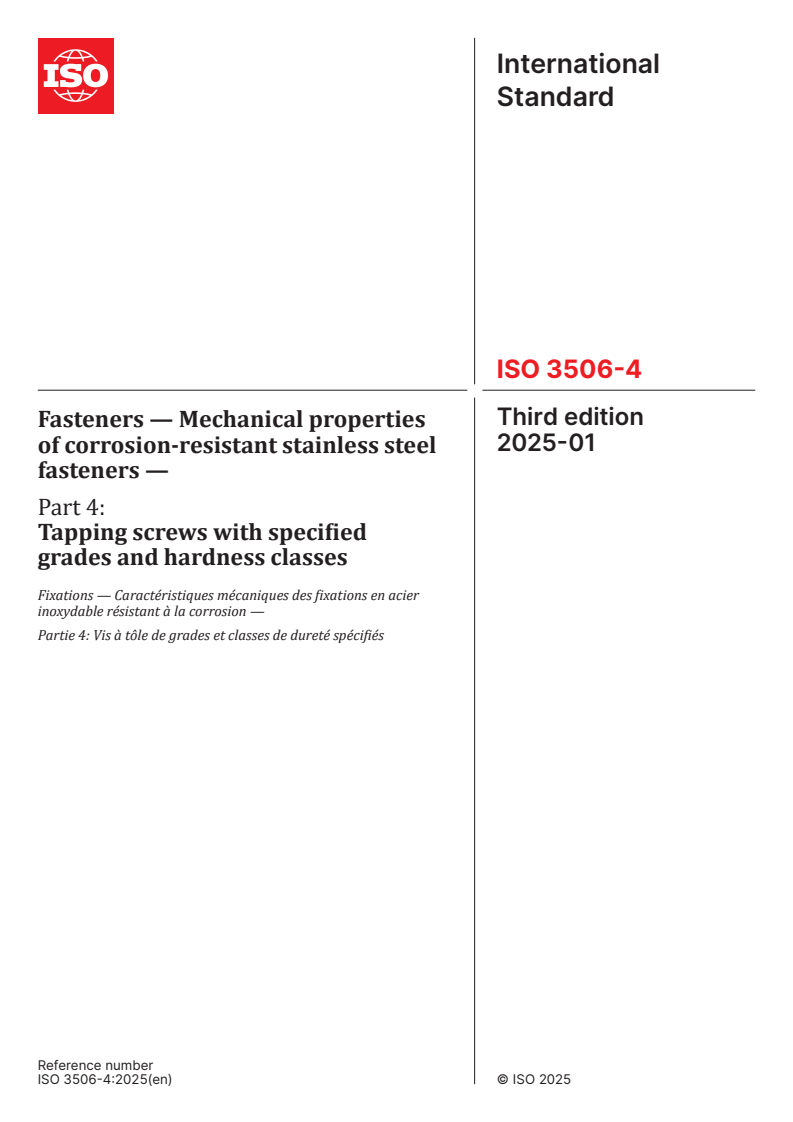
ISO 3506-4:2025 - Fasteners — Mechanical properties of corrosion-resistant stainless steel fasteners — Part 4: Tapping screws with specified grades and hardness classes Released:10. 01. 2025
ISO 3506-4:2025 - Fixations — Caractéristiques mécaniques des fixations en acier inoxydable résistant a la corrosion — Partie 4: Vis a tôle de grades et classes de dureté spécifiés Released:10. 01. 2025
Overview
ISO 3506-4:2025 - Fasteners - Mechanical properties of corrosion‑resistant stainless steel fasteners - Part 4: Tapping screws with specified grades and hardness classes specifies the mechanical and physical requirements for corrosion‑resistant tapping screws made from austenitic, martensitic, ferritic and duplex stainless steels. The standard covers grade and hardness designation, material requirements, mechanical performance (hardness, torsional strength, thread forming ability), inspection, test methods and marking/labelling. It applies to tapping screws with threads ST2,2 to ST8 (ISO 1478) and excludes tapping screws with special properties (for example weldability).
Key Topics and Requirements
- Material classes and designation: Defines a two‑block designation system (stainless steel grade - hardness class), examples include common formats like “A4‑25H” (and “A4L‑25H” for low‑carbon austenitic steels).
- Stainless steel families: Covers austenitic, martensitic, ferritic and duplex grades (newer additions include grades A8 and duplex D2–D8 for certain hardness classes).
- Hardness classes and heat treatment: Specifies surface and core hardness criteria (including surface hardness for martensitic grades) and heat‑treatment requirements where applicable.
- Mechanical and functional properties: Requirements for core hardness, thread forming ability, torsional strength and drive performance to ensure safe installation and in‑service behavior.
- Testing and inspection: Employs standardized tests (Vickers hardness per ISO 6507‑1, torsional and drive tests) with provisions for manufacturer, supplier and purchaser inspections and delivery of test results.
- Temperature limits and warning: Tapping screws are tested at ambient 10 °C to 35 °C and intended for use in the service range –20 °C to +150 °C. The standard warns that properties may not be retained outside these temperatures and places responsibility on users to verify suitability.
- Threads & exclusions: Applies to threads ST2,2–ST8 (ISO 1478) and explicitly excludes screws with special properties (e.g., weldability).
Practical Applications and Who Uses This Standard
ISO 3506-4:2025 is essential for:
- Fastener manufacturers - to specify production, heat treatment and testing regimes for stainless steel tapping screws.
- Design and mechanical engineers - selecting appropriate stainless steel grades and hardness classes for assemblies in construction, marine, automotive, HVAC, electronics and industrial equipment.
- Procurement and quality assurance teams - creating specifications, acceptance criteria and inspection plans.
- Test laboratories and certification bodies - performing hardness, torsional and drive tests and issuing conformity documentation.
Use this standard when specifying corrosion‑resistant tapping screws where mechanical integrity, corrosion performance and consistent labelling/traceability are required.
Related Standards
- ISO 3506‑6 - General rules for selection of stainless steels and nickel alloys for fasteners
- ISO 1478 - Tapping screws thread
- ISO 6507‑1 - Vickers hardness test (test method)
- ISO 16228 - Types of inspection documents
- ISO 1891‑4 - Fasteners - Vocabulary (inspection/delivery)
Keywords: ISO 3506-4:2025, tapping screws, stainless steel fasteners, hardness classes, stainless steel grades, corrosion‑resistant fasteners, Vickers hardness, torsional strength.
Relations
- Effective Date
- 12-Feb-2026
- Consolidates
ISO 24259:2022 - Steel strapping for packaging - Effective Date
- 01-Jul-2023
- Effective Date
- 06-Jun-2022
- Effective Date
- 06-Jun-2022
Buy Documents
ISO 3506-4:2025 - Fasteners — Mechanical properties of corrosion-resistant stainless steel fasteners — Part 4: Tapping screws with specified grades and hardness classes Released:10. 01. 2025
ISO 3506-4:2025 - Fixations — Caractéristiques mécaniques des fixations en acier inoxydable résistant a la corrosion — Partie 4: Vis a tôle de grades et classes de dureté spécifiés Released:10. 01. 2025
Frequently Asked Questions
ISO 3506-4:2025 is a standard published by the International Organization for Standardization (ISO). Its full title is "Fasteners — Mechanical properties of corrosion-resistant stainless steel fasteners — Part 4: Tapping screws with specified grades and hardness classes". This standard covers: This document specifies the mechanical and physical properties of tapping screws made of corrosion resistant austenitic, martensitic, ferritic and duplex stainless steels, with specified grades and hardness classes. ISO 3506-6 provides general rules and additional technical information on suitable stainless steels and their properties (detailed properties of stainless steel grades, corrosion behaviour with regards to pitting, crevice and intergranular corrosion, magnetic properties, etc.). WARNING — Tapping screws conforming to the requirements of this document are tested at the ambient temperature range of 10 °C to 35 °C and are used in applications ranging from –20 °C to +150 °C. It is possible that they do not retain the specified mechanical and physical properties at lower and/or elevated temperatures. Therefore, it is the responsibility of the user to determine the appropriate choices based on service environment conditions of the assembly (see also Clauses 5 and 6). This document applies to tapping screws with threads ST2,2 to ST8, in accordance with ISO 1478. This document does not apply to tapping screws with special properties, such as weldability.
This document specifies the mechanical and physical properties of tapping screws made of corrosion resistant austenitic, martensitic, ferritic and duplex stainless steels, with specified grades and hardness classes. ISO 3506-6 provides general rules and additional technical information on suitable stainless steels and their properties (detailed properties of stainless steel grades, corrosion behaviour with regards to pitting, crevice and intergranular corrosion, magnetic properties, etc.). WARNING — Tapping screws conforming to the requirements of this document are tested at the ambient temperature range of 10 °C to 35 °C and are used in applications ranging from –20 °C to +150 °C. It is possible that they do not retain the specified mechanical and physical properties at lower and/or elevated temperatures. Therefore, it is the responsibility of the user to determine the appropriate choices based on service environment conditions of the assembly (see also Clauses 5 and 6). This document applies to tapping screws with threads ST2,2 to ST8, in accordance with ISO 1478. This document does not apply to tapping screws with special properties, such as weldability.
ISO 3506-4:2025 is classified under the following ICS (International Classification for Standards) categories: 21.060.10 - Bolts, screws, studs. The ICS classification helps identify the subject area and facilitates finding related standards.
ISO 3506-4:2025 has the following relationships with other standards: It is inter standard links to EN ISO 3506-4:2025, ISO 24259:2022, ISO 20714:2019, ISO 3506-4:2009. Understanding these relationships helps ensure you are using the most current and applicable version of the standard.
ISO 3506-4:2025 is available in PDF format for immediate download after purchase. The document can be added to your cart and obtained through the secure checkout process. Digital delivery ensures instant access to the complete standard document.
Standards Content (Sample)
International
Standard
ISO 3506-4
Third edition
Fasteners — Mechanical properties
2025-01
of corrosion-resistant stainless steel
fasteners —
Part 4:
Tapping screws with specified
grades and hardness classes
Fixations — Caractéristiques mécaniques des fixations en acier
inoxydable résistant à la corrosion —
Partie 4: Vis à tôle de grades et classes de dureté spécifiés
Reference number
© ISO 2025
All rights reserved. Unless otherwise specified, or required in the context of its implementation, no part of this publication may
be reproduced or utilized otherwise in any form or by any means, electronic or mechanical, including photocopying, or posting on
the internet or an intranet, without prior written permission. Permission can be requested from either ISO at the address below
or ISO’s member body in the country of the requester.
ISO copyright office
CP 401 • Ch. de Blandonnet 8
CH-1214 Vernier, Geneva
Phone: +41 22 749 01 11
Email: copyright@iso.org
Website: www.iso.org
Published in Switzerland
ii
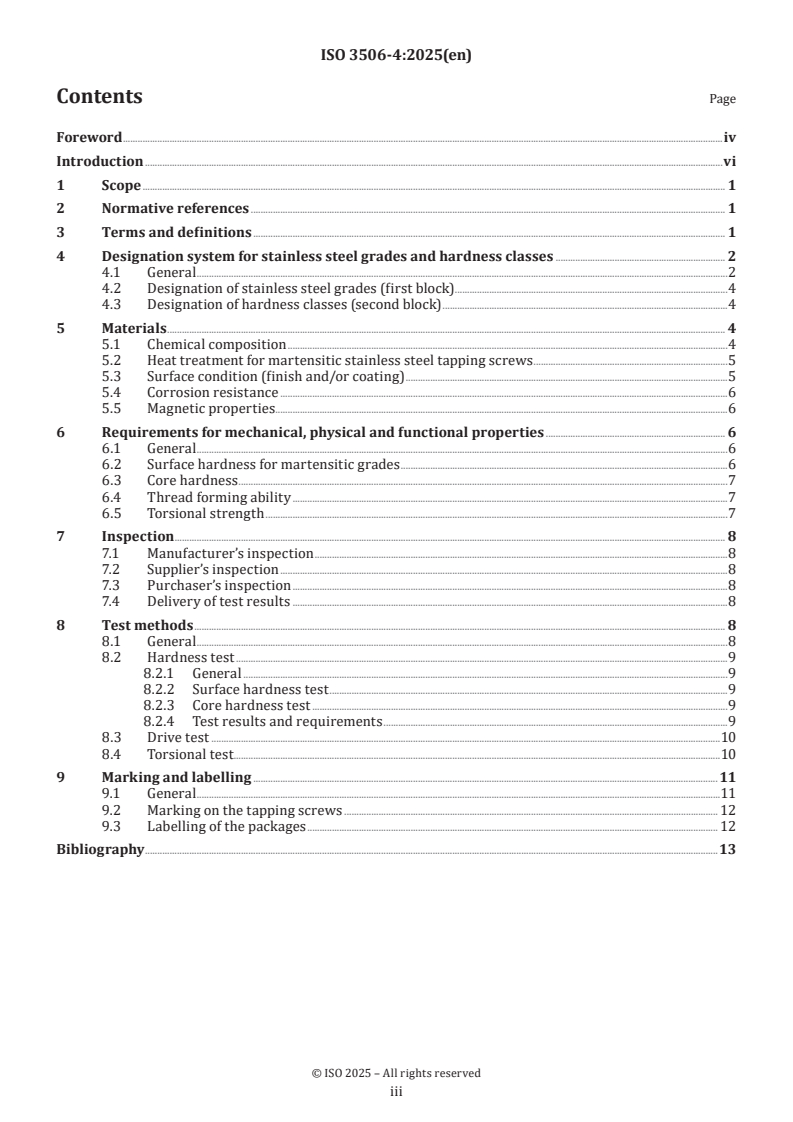
Contents Page
Foreword .iv
Introduction .vi
1 Scope . 1
2 Normative references . 1
3 Terms and definitions . 1
4 Designation system for stainless steel grades and hardness classes . 2
4.1 General .2
4.2 Designation of stainless steel grades (first block) .4
4.3 Designation of hardness classes (second block) .4
5 Materials . 4
5.1 Chemical composition .4
5.2 Heat treatment for martensitic stainless steel tapping screws .5
5.3 Surface condition (finish and/or coating) .5
5.4 Corrosion resistance .6
5.5 Magnetic properties .6
6 Requirements for mechanical, physical and functional properties . 6
6.1 General .6
6.2 Surface hardness for martensitic grades .6
6.3 Core hardness .7
6.4 Thread forming ability .7
6.5 Torsional strength .7
7 Inspection . 8
7.1 Manufacturer’s inspection .8
7.2 Supplier’s inspection .8
7.3 Purchaser’s inspection .8
7.4 Delivery of test results .8
8 Test methods . 8
8.1 General .8
8.2 Hardness test .9
8.2.1 General .9
8.2.2 Surface hardness test .9
8.2.3 Core hardness test .9
8.2.4 Test results and requirements .9
8.3 Drive test .10
8.4 Torsional test.10
9 Marking and labelling .11
9.1 General .11
9.2 Marking on the tapping screws . 12
9.3 Labelling of the packages . 12
Bibliography .13
iii
Foreword
ISO (the International Organization for Standardization) is a worldwide federation of national standards
bodies (ISO member bodies). The work of preparing International Standards is normally carried out through
ISO technical committees. Each member body interested in a subject for which a technical committee
has been established has the right to be represented on that committee. International organizations,
governmental and non-governmental, in liaison with ISO, also take part in the work. ISO collaborates closely
with the International Electrotechnical Commission (IEC) on all matters of electrotechnical standardization.
The procedures used to develop this document and those intended for its further maintenance are described
in the ISO/IEC Directives, Part 1. In particular, the different approval criteria needed for the different types
of ISO documents should be noted. This document was drafted in accordance with the editorial rules of the
ISO/IEC Directives, Part 2 (see www.iso.org/directives).
ISO draws attention to the possibility that the implementation of this document may involve the use of (a)
patent(s). ISO takes no position concerning the evidence, validity or applicability of any claimed patent
rights in respect thereof. As of the date of publication of this document, ISO had not received notice of (a)
patent(s) which may be required to implement this document. However, implementers are cautioned that
this may not represent the latest information, which may be obtained from the patent database available at
www.iso.org/patents. ISO shall not be held responsible for identifying any or all such patent rights.
Any trade name used in this document is information given for the convenience of users and does not
constitute an endorsement.
For an explanation of the voluntary nature of standards, the meaning of ISO specific terms and expressions
related to conformity assessment, as well as information about ISO's adherence to the World Trade
Organization (WTO) principles in the Technical Barriers to Trade (TBT), see www.iso.org/iso/foreword.html.
This document was prepared by Technical Committee ISO/TC 2, Fasteners, in collaboration with the
European Committee for Standardization (CEN) Technical Committee CEN/TC 185 Fasteners, in accordance
with the Agreement on technical cooperation between ISO and CEN (Vienna Agreement).
This third edition cancels and replaces the second edition (ISO 3506-4:2009), which has been technically
revised.
The main changes are as follows:
— annexes common to several parts of the ISO 3506 series have been withdrawn from this document and
are now included in the new ISO 3506-6 which is to be used with this document;
— austenitic stainless steel of grade A8 and duplex (austenitic-ferritic) stainless steels of grades D2 to D8
for hardness classes 20H, 25H and 30H have been added (see Figure 1);
— operational temperature ranges have been clarified (see Clause 1);
— terms and definitions have been added (see Clause 3);
— wording for surface conditions and corrosion resistance have been improved (see 5.3 and 5.4);
— manufacturer’s, supplier’s and purchaser’s inspections have been added (see Clause 7);
— applicability of test methods has been added, and hardness test, torsional test and drive test methods
have been improved (see Clause 8);
— marking and labelling have been improved (see Clause 9);
— structure and content of this document have been brought in line with other parts of ISO 3506 published
recently.
A list of all parts in the ISO 3506 series can be found on the ISO website.
iv
Any feedback or questions on this document should be directed to the user’s national standards body. A
complete listing of these bodies can be found at www.iso.org/members.html.
v
Introduction
The properties of stainless steel fasteners result from the chemical composition of the material (especially
corrosion resistance) and from the mechanical properties due to the manufacturing process. Austenitic,
ferritic and duplex (austenitic-ferritic) stainless steel fasteners are generally manufactured by cold working;
they consequently do not have homogeneous local material properties when compared to quenched and
tempered fasteners.
Austenitic-ferritic stainless steels referred to as duplex stainless steels were originally invented in the 1930s
and have been increasingly used since the 1980s. This document was revised to reflect their standardization
for fasteners.
All duplex stainless steels show improved resistance to stress corrosion cracking compared to the commonly
used A2 to A5 austenitic grades. Most duplex grades also show higher levels of pitting corrosion resistance,
where D2 matches at least A2 and where D4 matches at least A4.
vi
International Standard ISO 3506-4:2025(en)
Fasteners — Mechanical properties of corrosion-resistant
stainless steel fasteners —
Part 4:
Tapping screws with specified grades and hardness classes
1 Scope
This document specifies the mechanical and physical properties of tapping screws made of corrosion
resistant austenitic, martensitic, ferritic and duplex stainless steels, with specified grades and hardness
classes.
ISO 3506-6 provides general rules and additional technical information on suitable stainless steels and their
properties (detailed properties of stainless steel grades, corrosion behaviour with regards to pitting, crevice
and intergranular corrosion, magnetic properties, etc.).
WARNING — Tapping screws conforming to the requirements of this document are tested at the
ambient temperature range of 10 °C to 35 °C and are used in applications ranging from –20 °C to +150 °C.
It is possible that they do not retain the specified mechanical and physical properties at lower and/
or elevated temperatures. Therefore, it is the responsibility of the user to determine the appropriate
choices based on service environment conditions of the assembly (see also Clauses 5 and 6).
This document applies to tapping screws with threads ST2,2 to ST8, in accordance with ISO 1478.
This document does not apply to tapping screws with special properties, such as weldability.
2 Normative references
The following documents are referred to in the text in such a way that some or all of their content constitutes
requirements of this document. For dated references, only the edition cited applies. For undated references,
the latest edition of the referenced document (including any amendments) applies.
ISO 1478, Tapping screws thread
ISO 1891-4, Fasteners — Vocabulary — Part 4: Control, inspection, delivery, acceptance and quality
ISO 3506-6, Fasteners — Mechanical properties of corrosion-resistant stainless steel fasteners — Part 6: General
rules for the selection of stainless steels and nickel alloys for fasteners
ISO 6507-1, Metallic materials — Vickers hardness test — Part 1: Test method
ISO 16228, Fasteners — Types of inspection documents
3 Terms and definitions
For the purposes of this document, the following terms and definitions apply.
ISO and IEC maintain terminology databases for use in standardization at the following addresses:
— ISO Online browsing platform: available at https:// www .iso .org/ obp
— IEC Electropedia: available at https:// www .electropedia .org/
3.1
tapping screw
sheet metal screw
screw with thread in accordance with ISO 1478 which, when driven into a hole, creates its own mating threads
in the materials of the parts being assembled (usually thin metal sheets) without deforming its own thread
3.2
stainless steel
steel with at least 10,5 % (mass fraction) of chromium (Cr) and maximum 1,2 % (mass fraction) of carbon (C)
[SOURCE: ISO 3506-1:2020, 3.5]
3.3
austenitic stainless steel
stainless steel (3.2) with high amounts of chromium and nickel which usually cannot be hardened by heat
treatment, providing excellent resistance to corrosion, good ductility, and usually low or non-magnetic
properties
[SOURCE: ISO 3506-1:2020, 3.6]
3.4
martensitic stainless steel
stainless steel (3.2) with high amounts of chromium but very little nickel or other alloying elements, which
can be hardened by heat treatment for increasing strength but with reduced ductility, and with highly
magnetic properties
[SOURCE: ISO 3506-1:2020, 3.7]
3.5
ferritic stainless steel
stainless steel (3.2) containing less than 0,1 % carbon and typically 11 % to 18 % chromium, which usually
cannot be hardened by heat treatment, and with highly magnetic properties
[SOURCE: ISO 3506-1:2020, 3.8]
3.6
duplex stainless steel
stainless steel (3.2) with a micro-structure that includes both austenitic and ferritic phases providing
excellent resistance to corrosion, containing a higher amount of chromium and a reduced quantity of nickel
compared to austenitic steel, with high strength, and with magnetic properties
[SOURCE: ISO 3506-1:2020, 3.9]
4 Designation system for stainless steel grades and hardness classes
4.1 General
The designation system for stainless steel tapping screws consists of two blocks, separated by a hyphen: the
stainless steel grade and the hardness class, as specified in Figure 1.
a For low carbon austenitic stainless steels with carbon content not exceeding 0,030 %, tapping screws can additionally
be designated with the letter “L” just after the grade. EXAMPLE: A4L-25H.
b This hardness class requires a prior agreement between the purchaser and the manufacturer.
c For information only.
Figure 1 — Designation system for stainless steel tapping screws
Although a great number of stainless steel grades combined with hardness classes are specified in this
document for tapping screws, this does not mean that all combinations are appropriate due to the properties
of the material in conjunction with the fastener geometry. Nevertheless, some combinations of grades and
property classes may not be available on the market. For non-standard fasteners, it is recommended that a
fastener expert be consulted.
The marking, labelling, and designation of tapping screws with stainless steel grade and hardness class shall
be as specified in Clause 9.
This designation system may be used for sizes outside the diameter limits specified in this document (i.e. for
threads ST8), provided that all applicable chemical, mechanical, and physical requirements are met.
4.2 Designation of stainless steel grades (first block)
The designation of the stainless steel grade (first block) consists of one letter which specifies the stainless
steel group:
— A for austenitic,
— C for martensitic,
— F for ferritic,
— D for duplex (austenitic-ferritic),
and
— a digit which specifies the range of chemical compositions within this stainless steel group.
The chemical compositions of stainless steel groups and grades classified in Figure 1 are specified in Table 2.
4.3 Designation of ha
...
Norme
internationale
ISO 3506-4
Troisième édition
Fixations — Caractéristiques
2025-01
mécaniques des fixations en
acier inoxydable résistant à la
corrosion —
Partie 4:
Vis à tôle de grades et classes de
dureté spécifiés
Fasteners — Mechanical properties of corrosion-resistant
stainless steel fasteners —
Part 4: Tapping screws with specified grades and hardness classes
Numéro de référence
DOCUMENT PROTÉGÉ PAR COPYRIGHT
© ISO 2025
Tous droits réservés. Sauf prescription différente ou nécessité dans le contexte de sa mise en œuvre, aucune partie de cette
publication ne peut être reproduite ni utilisée sous quelque forme que ce soit et par aucun procédé, électronique ou mécanique,
y compris la photocopie, ou la diffusion sur l’internet ou sur un intranet, sans autorisation écrite préalable. Une autorisation peut
être demandée à l’ISO à l’adresse ci-après ou au comité membre de l’ISO dans le pays du demandeur.
ISO copyright office
Case postale 401 • Ch. de Blandonnet 8
CH-1214 Vernier, Genève
Tél.: +41 22 749 01 11
E-mail: copyright@iso.org
Web: www.iso.org
Publié en Suisse
ii
Sommaire Page
Avant-propos .iv
Introduction .vi
1 Domaine d'application . 1
2 Références normatives . 1
3 Termes et définitions . 1
4 Système de désignation pour les grades d'acier inoxydable et classes de dureté . 2
4.1 Généralités .2
4.2 Désignation des grades d’acier inoxydable (premier bloc) .4
4.3 Désignation des classes de dureté (second bloc) .4
5 Matériaux . 4
5.1 Composition chimique .4
5.2 Traitement thermique des vis à tôle en acier inoxydable martensitique .5
5.3 Condition de surface (finition et/ou revêtement) .5
5.4 Résistance à la corrosion .6
5.5 Propriétés magnétiques .6
6 Exigences pour les caractéristiques mécaniques, physiques et fonctionnelles . 6
6.1 Généralités .6
6.2 Dureté en surface pour les grades martensitiques .6
6.3 Dureté à cœur .7
6.4 Capacité de formation du taraudage .7
6.5 Résistance à la torsion .7
7 Contrôles. 8
7.1 Contrôle effectué par le fabricant .8
7.2 Contrôle effectué par le fournisseur .8
7.3 Contrôle effectué par le client .8
7.4 Fourniture de résultats d'essai .8
8 Méthodes d'essai . 8
8.1 Généralités .8
8.2 Essais de dureté .9
8.2.1 Généralités .9
8.2.2 Essai de dureté en surface .9
8.2.3 Essai de dureté à cœur .9
8.2.4 Résultats d'essai et exigences .10
8.3 Essai de taraudage .10
8.4 Essai de torsion .11
9 Marquage et étiquetage .12
9.1 Généralités . 12
9.2 Marquage sur les vis à tôle . 13
9.3 Étiquetage des conditionnements . 13
Bibliographie . 14
iii
Avant-propos
L'ISO (Organisation internationale de normalisation) est une fédération mondiale d'organismes nationaux
de normalisation (comités membres de l'ISO). L'élaboration des Normes internationales est en général
confiée aux comités techniques de l'ISO. Chaque comité membre intéressé par une étude a le droit de faire
partie du comité technique créé à cet effet. Les organisations internationales, gouvernementales et non
gouvernementales, en liaison avec l'ISO participent également aux travaux. L'ISO collabore étroitement avec
la Commission électrotechnique internationale (IEC) en ce qui concerne la normalisation électrotechnique.
Les procédures utilisées pour élaborer le présent document et celles destinées à sa mise à jour sont
décrites dans les Directives ISO/IEC, Partie 1. Il convient, en particulier, de prendre note des différents
critères d'approbation requis pour les différents types de documents ISO. Le présent document a
été rédigé conformément aux règles de rédaction données dans les Directives ISO/IEC, Partie 2 (voir
www.iso.org/directives).
L'attention est attirée sur le fait que certains des éléments du présent document peuvent faire l'objet de
droits de propriété intellectuelle ou de droits analogues. L'ISO ne saurait être tenue pour responsable
de ne pas avoir identifié de tels droits de propriété et averti de leur existence. Les détails concernant les
références aux droits de propriété intellectuelle ou autres droits analogues identifiés lors de l'élaboration du
document sont indiqués dans l'Introduction et/ou dans la liste des déclarations de brevets reçues par l'ISO
(voir www.iso.org/brevets).
Les appellations commerciales éventuellement mentionnées dans le présent document sont données pour
information, par souci de commodité, à l’intention des utilisateurs et ne sauraient constituer un engagement.
Pour une explication de la nature volontaire des normes, la signification des termes et expressions
spécifiques de l'ISO liés à l'évaluation de la conformité, ou pour toute information au sujet de l'adhésion de
l'ISO aux principes de l’Organisation mondiale du commerce (OMC) concernant les obstacles techniques au
commerce (OTC), voir www.iso.org/avant-propos.
Le présent document a été élaboré par le comité technique ISO/TC 2, Fixations, en collaboration avec le
Comité Européen de Normalisation (CEN) comité technique CEN/TC 185, Fixations, conformément à l'accord
de coopération technique entre l'ISO et le CEN (accord de Vienne).
Cette troisième édition annule et remplace la deuxième édition (ISO 3506-4:2009), qui a fait l’objet d’une
révision technique.
Les principales modifications sont les suivantes:
— les annexes communes à plusieurs parties de la série ISO 3506 ont été retirées du présent document et
sont désormais incluses dans la nouvelle ISO 3506-6 qui est à utiliser avec le présent document;
— l’acier inoxydable austénitique de grade A8 et les aciers inoxydables duplex (austéno-ferritiques) de
grades D2 à D8 pour les classes de dureté 20H, 25H et 30H ont été ajoutés (voir Figure 1);
— les plages de températures d’utilisation ont été clarifiées (voir l’Article 1);
— des termes et des définitions ont été ajoutés (voir l’Article 3);
— la rédaction relative aux conditions de surface et à la résistance à la corrosion a été améliorée (voir 5.3 et 5.4);
— les contrôles par le fabricant, le fournisseur et le client ont été ajoutés (voir l’Article 7);
— les limites d’application des méthodes d’essai ont été ajoutées, et les méthodes d’essai de dureté, de
torsion et de taraudage ont été améliorées (voir l’Article 8);
— le marquage et l’étiquetage ont été améliorés (voir l’Article 9);
— la structure et le contenu du présent document ont été mis en adéquation avec les autres parties de
l’ISO 3506 publiées récemment.
Une liste de toutes les parties de la série ISO 3506 est disponible sur le site Web de l’ISO.
iv
Il convient que l’utilisateur adresse tout retour d’information ou toute question concernant le présent
document à l’organisme national de normalisation de son pays. Une liste exhaustive desdits organismes se
trouve à l’adresse www.iso.org/fr/members.html.
v
Introduction
Les caractéristiques des fixations en acier inoxydable résultent de la composition chimique du matériau (en
particulier la résistance à la corrosion) ainsi que des caractéristiques mécaniques résultant des procédés de
fabrication. Les fixations en aciers inoxydables austénitiques, ferritiques et duplex (austéno-ferritiques) sont
généralement fabriquées par écrouissage; elles présentent de ce fait des propriétés locales du matériau non-
homogènes par rapport à des fixations trempées et revenues.
Les aciers inoxydables austéno-ferritiques, appelés aciers inoxydables duplex, ont été initialement inventés
dans les années 1930 et sont de plus en plus utilisés depuis les années 1980. Le présent document a été
révisé pour concrétiser leur normalisation pour les fixations.
Tous les grades d'acier inoxydable duplex présentent une meilleure résistance à la fissuration due à la
corrosion sous contrainte par rapport aux grades austénitiques usuels A2 à A5. La plupart des grades duplex
présentent également des niveaux plus élevés de résistance à la corrosion par piqûre, et le grade D2 est sur
ce point au moins égal au A2 de même que le grade D4 est au moins égal au A4.
vi
Norme internationale ISO 3506-4:2025(fr)
Fixations — Caractéristiques mécaniques des fixations en
acier inoxydable résistant à la corrosion —
Partie 4:
Vis à tôle de grades et classes de dureté spécifiés
1 Domaine d'application
Le présent document spécifie les caractéristiques mécaniques et physiques des vis à tôle en aciers
inoxydables austénitiques, martensitiques, ferritiques et duplex résistant à la corrosion, de grades et classes
de dureté spécifiées.
L’ISO 3506-6 fournit des règles générales et des informations techniques supplémentaires sur les
aciers inoxydables appropriés et leurs propriétés (propriétés détaillées des grades d’acier inoxydable,
comportement à la corrosion par piqûres, corrosion caverneuse et intergranulaire, magnétisme, etc.).
AVERTISSEMENT — Les vis à tôle conformes aux exigences du présent document sont soumises à
essai dans la plage de température ambiante de 10 °C à 35 °C et sont utilisées dans des applications
de −20 °C à +150 °C. Elles peuvent ne pas conserver les caractéristiques mécaniques et physiques
spécifiées à des températures basses et/ou élevées. Par conséquent, il est de la responsabilité
de l’utilisateur de déterminer les choix appropriés en fonction des conditions de l’environnement
d’utilisation de l’assemblage (voir également les Articles 5 et 6).
Le présent document s’applique aux vis à tôle de filetage ST2,2 à ST8, conformément à l’ISO 1478.
Le présent document ne s’applique pas aux vis à tôle possédant des caractéristiques particulières telles que
la soudabilité.
2 Références normatives
Les documents suivants sont cités dans le texte de sorte qu’ils constituent, pour tout ou partie de leur
contenu, des exigences du présent document. Pour les références datées, seule l’édition citée s’applique. Pour
les références non datées, la dernière édition du document de référence s'applique (y compris les éventuels
amendements).
ISO 1478, Filetage de vis à tôle
ISO 1891-4, Fixations — Vocabulaire — Partie 4: Contrôle, livraison, réception et qualité
ISO 3506-6, Fixations — Caractéristiques mécaniques des fixations en acier inoxydable résistant à la corrosion
— Partie 6: Règles générales pour la sélection des aciers inoxydables et des alliages de nickel pour les fixations
ISO 6507-1, Matériaux métalliques — Essai de dureté Vickers — Partie 1: Méthode d'essai
ISO 16228, Fixations — Types de documents de contrôle
3 Termes et définitions
Pour les besoins du présent document, les termes et définitions suivants s'appliquent.
L'ISO et l'IEC tiennent à jour des bases de données terminologiques destinées à être utilisées en normalisation,
consultables aux adresses suivantes:
— ISO Online browsing platform: disponible à l’adresse https:// www .iso .org/ obp
— IEC Electropedia: disponible à l’adresse https:// www .electropedia .org/
3.1
vis à tôle
vis dont le filetage est conforme à l’ISO 1478 qui, lorsqu'elle est vissée dans un trou, génère son propre
taraudage dans les matériaux des pièces assemblées (en général tôles métalliques) sans déformation de son
propre filetage
3.2
acier inoxydable
acier contenant au moins 10,5 % (fraction massique) de chrome (Cr) et au plus 1,2 % (fraction massique) de
carbone (C)
[SOURCE: ISO 3506-1:2020, 3.5]
3.3
acier inoxydable austénitique
acier inoxydable (3.2) avec une teneur élevée en chrome et en nickel, dont la dureté ne peut généralement pas
être augmentée par traitement thermique, lui conférant une excellente résistance à la corrosion, une bonne
ductilité et généralement un faible voire aucun magnétisme
[SOURCE: ISO 3506-1:2020, 3.6]
3.4
acier inoxydable martensitique
acier inoxydable (3.2) avec une teneur élevée en chrome mais une très faible teneur en nickel ou autres
éléments d'alliage, dont la dureté peut être augmentée par traitement thermique afin d’améliorer sa
résistance, mais qui présente une ductilité moindre et un magnétisme élevé
[SOURCE: ISO 3506-1:2020, 3.7]
3.5
acier inoxydable ferritique
acier inoxydable (3.2) contenant moins de 0,1 % de carbone et typiquement 11 % à 18 % de chrome, dont la
dureté ne peut généralement pas être augmentée par traitement thermique, et fortement magnétique
[SOURCE: ISO 3506-1:2020, 3.8]
3.6
acier inoxydable duplex
acier inoxydable (3.2) dont la microstructure comprend à la fois des phases austénitiques et ferritiques lui
conférant une excellente résistance à la corrosion, avec une teneur plus élevée en chrome et une teneur
réduite en nickel par rapport à l'acier austénitique, présentant une résistance élevée et du magnétisme
[SOURCE: ISO 3506-1:2020, 3.9]
4 Système de désignation pour les grades d'acier inoxydable et classes de dureté
4.1 Généralités
Le système de désignation des vis à tôle en acier inoxydable se compose de deux blocs séparés par un trait
d'union: le grade d'acier inoxydable et la classe de dureté, comme spécifié à la Figure 1.
a
Pour les aciers inoxydables austénitiques à faible teneur en carbone n'excédant pas 0,030 %, les vis à tôle peuvent
être désignées par la lettre «L» complémentaire juste après le grade. EXEMPLE: A4L-25H.
b
Cette classe de dureté nécessite un accord préalable entre le client et le fabricant.
c
Uniquement à titre d'information.
Figure 1 — Système de désignation pour les vis à tôle en acier inoxydable
Bien qu'un grand nombre de grades d'acier inoxydable et classes de dureté soit spécifié dans le présent
document pour les vis à tôle, cela ne signifie pas que toutes les combinaisons soient appropriées en raison des
propriétés du matériau compatibles ou non avec la géométrie des fixations. En outre, certaines combinaisons
de grades et classes de qualité peuvent ne pas être disponibles sur le marché. Pour les fixations non standard,
il est recommandé de consulter un expert en fixations.
Le marquage, l'étiquetage et la désignation des vis à tôle avec le grade d'acier inoxydable et la classe de
dureté doivent être tels que spécifiés à l'Article 9.
Le système de désignation peut être utilisé pour des dimensions en dehors des limites de diamètres
spécifiées dans le présent document (c’est-à-dire filetages < ST2,2 ou > ST8), à condition que toutes les
exigences chimiques, mécaniques et physiques applicables soient satisfaites.
4.2 Désignation des grades d’acier inoxydable (premier bloc)
La désignation du grade d'acier inoxydable (premier bloc) se compose d'une lettre qui spécifie le groupe
d'acier inoxydable:
— A pour austénitique;
— C pour martensitique;
— F pour ferritique;
— D pour duplex (austéno-ferritique)
et
— d'un chiffre qui désigne la plage de composition chimique dans ce groupe d'acier inoxydable.
Les compositions chimiques des groupes et grades d'acier inoxydable classifiés à la Figure 1 sont spécifiées
dans le Tableau 2.
4.3 Désignation des classes de dureté (second bloc)
La désignation de la classe de dureté (second bloc) se compose de deux parties, comme spécifiée dans le
Tableau 1:
— le chiffre à gauche correspond à 1/10 de la dureté Vickers minimale, et
— la lettre H à droite représente la dureté Vickers.
Tableau 1 — Désignations des classes de dureté en fonction de la dureté Vickers
Classe de dureté 20H 25H 30H 40H
Dureté Vickers, HV min. 200 250 300 400
EXEMPLE 1 A4-25H spécifie une vis à tôle en acier inoxydable austénitique de grade A4, écrouie, de dureté
minimale 250 HV.
EXEMPLE 2 C3-40H spécifie une vis à tôle en acier inoxydable martensitique de grade C3, trempée et revenue, de
dureté minimale 400 HV.
5 Matériaux
5.1 Composition chimique
Le Tableau 2 spécifie les limites pour la composition chimique des grades d'acier inoxydable pour les
f
...