


ISO/IEC 13249-6:2002
(Main)Information technology — Database languages — SQL multimedia and application packages — Part 6: Data mining
Information technology — Database languages — SQL multimedia and application packages — Part 6: Data mining
ISO/IEC 13249-6:2002 specifies an interface for data mining to enable standard access to and storage and manipulation of typical data structures in data mining. ISO/IEC 13249-6:2002 specifies user-defined types for the four major data mining functions association rules, clustering, classification, and regression, routines to manipulate these user-defined types to allow setting parameters for mining activities, training of mining models, testing of mining models, and application of mining models, user-defined types for data structures common across these data mining functions to capture metadata for data mining input. ISO/IEC 13249-6:2002 provides for interchange of data mining models so that models built on one system can be imported and deployed in other environments.
Technologies de l'information — Langages de bases de données — Multimédia SQL et paquetages d'application — Partie 6: Exploration de données
General Information
- Status
- Withdrawn
- Publication Date
- 01-Dec-2002
- Withdrawal Date
- 01-Dec-2002
- Technical Committee
- ISO/IEC JTC 1/SC 32 - Data management and interchange
- Drafting Committee
- ISO/IEC JTC 1/SC 32 - Data management and interchange
- Current Stage
- 9599 - Withdrawal of International Standard
- Start Date
- 25-Oct-2006
- Completion Date
- 12-Feb-2026
Relations
- Effective Date
- 15-Apr-2008
Get Certified
Connect with accredited certification bodies for this standard

BSI Group
BSI (British Standards Institution) is the business standards company that helps organizations make excellence a habit.

NYCE
Mexican standards and certification body.
Sponsored listings
Frequently Asked Questions
ISO/IEC 13249-6:2002 is a standard published by the International Organization for Standardization (ISO). Its full title is "Information technology — Database languages — SQL multimedia and application packages — Part 6: Data mining". This standard covers: ISO/IEC 13249-6:2002 specifies an interface for data mining to enable standard access to and storage and manipulation of typical data structures in data mining. ISO/IEC 13249-6:2002 specifies user-defined types for the four major data mining functions association rules, clustering, classification, and regression, routines to manipulate these user-defined types to allow setting parameters for mining activities, training of mining models, testing of mining models, and application of mining models, user-defined types for data structures common across these data mining functions to capture metadata for data mining input. ISO/IEC 13249-6:2002 provides for interchange of data mining models so that models built on one system can be imported and deployed in other environments.
ISO/IEC 13249-6:2002 specifies an interface for data mining to enable standard access to and storage and manipulation of typical data structures in data mining. ISO/IEC 13249-6:2002 specifies user-defined types for the four major data mining functions association rules, clustering, classification, and regression, routines to manipulate these user-defined types to allow setting parameters for mining activities, training of mining models, testing of mining models, and application of mining models, user-defined types for data structures common across these data mining functions to capture metadata for data mining input. ISO/IEC 13249-6:2002 provides for interchange of data mining models so that models built on one system can be imported and deployed in other environments.
ISO/IEC 13249-6:2002 is classified under the following ICS (International Classification for Standards) categories: 35.060 - Languages used in information technology. The ICS classification helps identify the subject area and facilitates finding related standards.
ISO/IEC 13249-6:2002 has the following relationships with other standards: It is inter standard links to ISO/IEC 13249-6:2006. Understanding these relationships helps ensure you are using the most current and applicable version of the standard.
ISO/IEC 13249-6:2002 is available in PDF format for immediate download after purchase. The document can be added to your cart and obtained through the secure checkout process. Digital delivery ensures instant access to the complete standard document.
Standards Content (Sample)
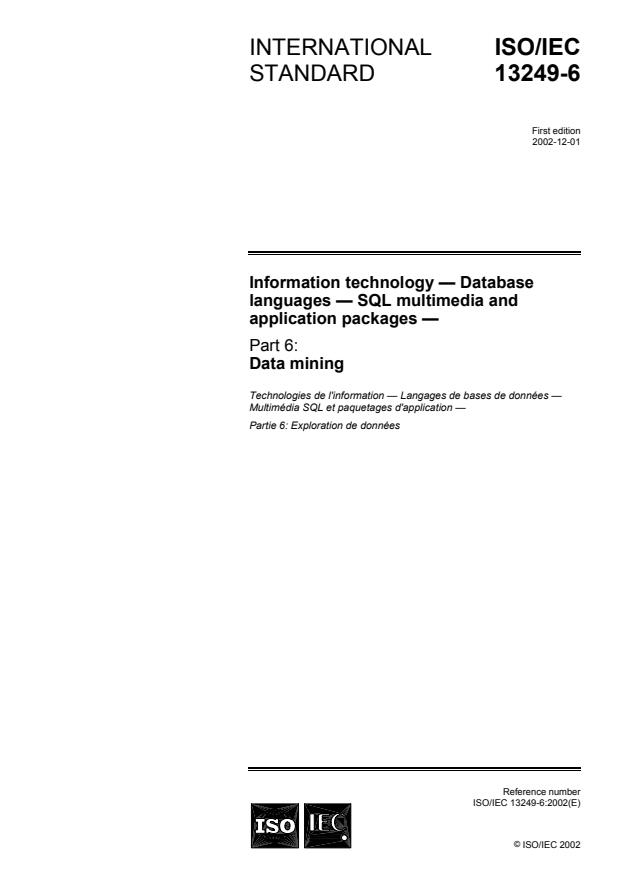
INTERNATIONAL ISO/IEC
STANDARD 13249-6
First edition
2002-12-01
Information technology — Database
languages — SQL multimedia and
application packages —
Part 6:
Data mining
Technologies de l'information — Langages de bases de données —
Multimédia SQL et paquetages d'application —
Partie 6: Exploration de données
Reference number
©
ISO/IEC 2002
PDF disclaimer
This PDF file may contain embedded typefaces. In accordance with Adobe's licensing policy, this file may be printed or viewed but
shall not be edited unless the typefaces which are embedded are licensed to and installed on the computer performing the editing. In
downloading this file, parties accept therein the responsibility of not infringing Adobe's licensing policy. The ISO Central Secretariat
accepts no liability in this area.
Adobe is a trademark of Adobe Systems Incorporated.
Details of the software products used to create this PDF file can be found in the General Info relative to the file; the PDF-creation
parameters were optimized for printing. Every care has been taken to ensure that the file is suitable for use by ISO member bodies. In
the unlikely event that a problem relating to it is found, please inform the Central Secretariat at the address given below.
© ISO/IEC 2002
All rights reserved. Unless otherwise specified, no part of this publication may be reproduced or utilized in any form or by any means,
electronic or mechanical, including photocopying and microfilm, without permission in writing from either ISO at the address below or
ISO's member body in the country of the requester.
ISO copyright office
Case postale 56 • CH-1211 Geneva 20
Tel. + 41 22 749 01 11
Fax + 41 22 749 09 47
E-mail copyright@iso.org
Web www.iso.org
Published in Switzerland
ii © ISO/IEC 2002 – All rights reserved
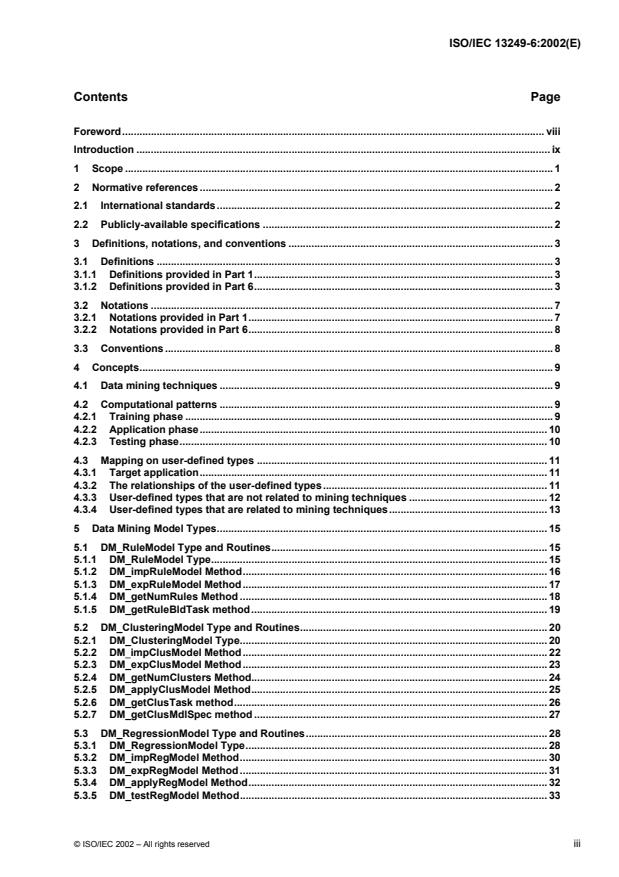
Contents Page
Foreword. viii
Introduction . ix
1 Scope . 1
2 Normative references . 2
2.1 International standards. 2
2.2 Publicly-available specifications . 2
3 Definitions, notations, and conventions . 3
3.1 Definitions . 3
3.1.1 Definitions provided in Part 1. 3
3.1.2 Definitions provided in Part 6. 3
3.2 Notations . 7
3.2.1 Notations provided in Part 1. 7
3.2.2 Notations provided in Part 6. 8
3.3 Conventions . 8
4 Concepts. 9
4.1 Data mining techniques . 9
4.2 Computational patterns . 9
4.2.1 Training phase . 9
4.2.2 Application phase. 10
4.2.3 Testing phase. 10
4.3 Mapping on user-defined types . 11
4.3.1 Target application. 11
4.3.2 The relationships of the user-defined types. 11
4.3.3 User-defined types that are not related to mining techniques . 12
4.3.4 User-defined types that are related to mining techniques. 13
5 Data Mining Model Types. 15
5.1 DM_RuleModel Type and Routines. 15
5.1.1 DM_RuleModel Type. 15
5.1.2 DM_impRuleModel Method.16
5.1.3 DM_expRuleModel Method.17
5.1.4 DM_getNumRules Method .18
5.1.5 DM_getRuleBldTask method. 19
5.2 DM_ClusteringModel Type and Routines. 20
5.2.1 DM_ClusteringModel Type. 20
5.2.2 DM_impClusModel Method. 22
5.2.3 DM_expClusModel Method.23
5.2.4 DM_getNumClusters Method. 24
5.2.5 DM_applyClusModel Method. 25
5.2.6 DM_getClusTask method. 26
5.2.7 DM_getClusMdlSpec method . 27
5.3 DM_RegressionModel Type and Routines. 28
5.3.1 DM_RegressionModel Type.28
5.3.2 DM_impRegModel Method.30
5.3.3 DM_expRegModel Method.31
5.3.4 DM_applyRegModel Method. 32
5.3.5 DM_testRegModel Method. 33
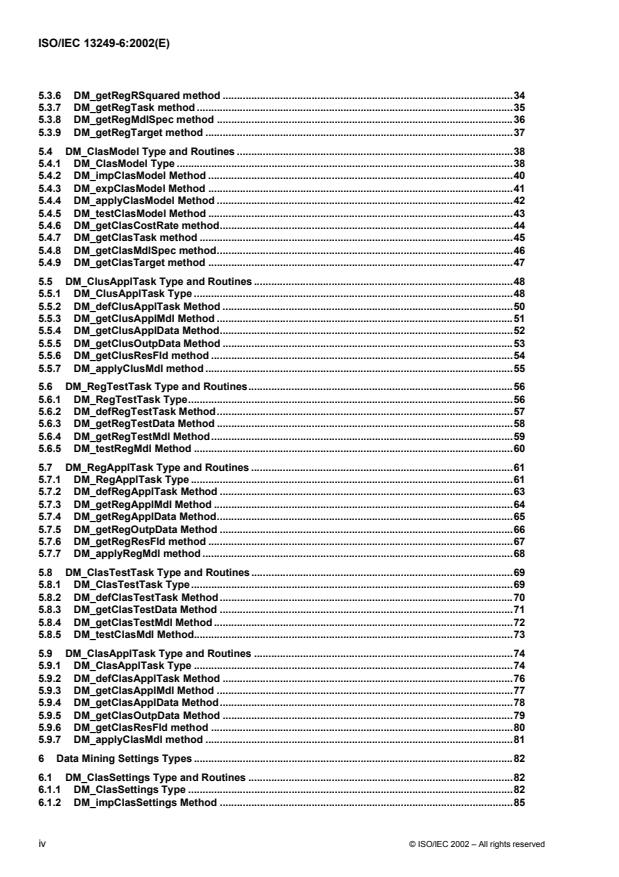
© ISO/IEC 2002 – All rights reserved iii
5.3.6 DM_getRegRSquared method .34
5.3.7 DM_getRegTask method .35
5.3.8 DM_getRegMdlSpec method .36
5.3.9 DM_getRegTarget method .37
5.4 DM_ClasModel Type and Routines .38
5.4.1 DM_ClasModel Type .38
5.4.2 DM_impClasModel Method .40
5.4.3 DM_expClasModel Method .41
5.4.4 DM_applyClasModel Method .42
5.4.5 DM_testClasModel Method .43
5.4.6 DM_getClasCostRate method.44
5.4.7 DM_getClasTask method .45
5.4.8 DM_getClasMdlSpec method.46
5.4.9 DM_getClasTarget method .47
5.5 DM_ClusApplTask Type and Routines .48
5.5.1 DM_ClusApplTask Type .48
5.5.2 DM_defClusApplTask Method .50
5.5.3 DM_getClusApplMdl Method .51
5.5.4 DM_getClusApplData Method.52
5.5.5 DM_getClusOutpData Method .53
5.5.6 DM_getClusResFld method .54
5.5.7 DM_applyClusMdl method .55
5.6 DM_RegTestTask Type and Routines.56
5.6.1 DM_RegTestTask Type.56
5.6.2 DM_defRegTestTask Method.57
5.6.3 DM_getRegTestData Method .58
5.6.4 DM_getRegTestMdl Method.59
5.6.5 DM_testRegMdl Method .60
5.7 DM_RegApplTask Type and Routines .61
5.7.1 DM_RegApplTask Type .61
5.7.2 DM_defRegApplTask Method .63
5.7.3 DM_getRegApplMdl Method .64
5.7.4 DM_getRegApplData Method.65
5.7.5 DM_getRegOutpData Method .66
5.7.6 DM_getRegResFld method .67
5.7.7 DM_applyRegMdl method .68
5.8 DM_ClasTestTask Type and Routines.69
5.8.1 DM_ClasTestTask Type.69
5.8.2 DM_defClasTestTask Method .70
5.8.3 DM_getClasTestData Method .71
5.8.4 DM_getClasTestMdl Method .72
5.8.5 DM_testClasMdl Method.73
5.9 DM_ClasApplTask Type and Routines .74
5.9.1 DM_ClasApplTask Type .74
5.9.2 DM_defClasApplTask Method .76
5.9.3 DM_getClasApplMdl Method .77
5.9.4 DM_getClasApplData Method.78
5.9.5 DM_getClasOutpData Method .79
5.9.6 DM_getClasResFld method .80
5.9.7 DM_applyClasMdl method .81
6 Data Mining Settings Types .82
6.1 DM_ClasSettings Type and Routines .82
6.1.1 DM_ClasSettings Type .82
6.1.2 DM_impClasSettings Method .85
iv © ISO/IEC 2002 – All rights reserved
6.1.3 DM_expClasSettings Method . 86
6.1.4 DM_setClasCostRate Method. 87
6.1.5 DM_getClasCostRate Method. 88
6.1.6 DM_setClasCost Method. 89
6.1.7 DM_getClasCost Method . 90
6.1.8 DM_useClasDataSpec Method . 91
6.1.9 DM_getClasDataSpec Method. 92
6.1.10 DM_setClasTarget Method. 93
6.1.11 DM_getClasTarget Method. 94
6.2 DM_ClusSettings Type and Routines. 95
6.2.1 DM_ClusSettings Type. 95
6.2.2 DM_impClusSettings Method. 98
6.2.3 DM_expClusSettings Method . 99
6.2.4 DM_setMaxNumClus Method . 100
6.2.5 DM_getMaxNumClus Method . 101
6.2.6 DM_setFldWeight Method. 102
6.2.7 DM_getFldWeight Method. 103
6.2.8 DM_setFldSimScale Method. 104
6.2.9 DM_getFldSimScale Method. 105
6.2.10 DM_useClusDataSpec Method . 106
6.2.11 DM_getClusDataSpec Method . 107
6.3 DM_RegSettings Type and Routines. 108
6.3.1 DM_RegSettings Type. 108
6.3.2 DM_impRegSettings Method. 110
6.3.3 DM_expRegSettings Method . 111
6.3.4 DM_setRegRSquared Method . 112
6.3.5 DM_getRegRSquared Method . 113
6.3.6 DM_useRegDataSpec Method. 114
6.3.7 DM_getRegDataSpec Method. 115
6.3.8 DM_setRegTarget Method . 116
6.3.9 DM_getRegTarget Method . 117
6.4 DM_RuleSettings Type and Routines. 118
6.4.1 DM_RuleSettings Type. 118
6.4.2 DM_impRuleSettings Method. 121
6.4.3 DM_expRuleSettings Method . 122
6.4.4 DM_setMinSupport Method . 123
6.4.5 DM_getMinSupport Method. 124
6.4.6 DM_setMinConf Method. 125
6.4.7 DM_getMinConf Method. 126
6.4.8 DM_setMaxLength Method . 127
6.4.9 DM_getMaxLength Method. 128
6.4.10 DM_useRuleDataSpec Method . 129
6.4.11 DM_getRuleDataSpec Method . 130
6.4.12 DM_setGroup Method. 131
6.4.13 DM_getGroup Method. 132
6.5 DM_ClasBldTask Type and Routines . 133
6.5.1 DM_ClasBldTask Type . 133
6.5.2 DM_defClasBldTask Method . 135
6.5.3 DM_getClasTrnData Method. 136
6.5.4 DM_getClasValData Method . 137
6.5.5 DM_getClasSettings Method . 138
6.5.6 DM_buildClasModel Method. 139
6.6 DM_RuleBldTask type and Routines . 140
6.6.1 DM_RuleBldTask Type . 140
6.6.2 DM_defRuleBldTask Method . 141
© ISO/IEC 2002 – All rights reserved v
6.6.3 DM_getRuleTrnData Method.142
6.6.4 DM_getRuleSettings Method .143
6.6.5 DM_buildRuleModel Method.144
6.7 DM_RegBldTask type and Routines .145
6.7.1 DM_RegBldTask Type .145
6.7.2 DM_defRegBldTask Method .147
6.7.3 DM_getRegTrnData Method.148
6.7.4 DM_getRegValData Method .149
6.7.5 DM_getRegSettings Method .150
6.7.6 DM_buildRegModel Method.151
6.8 DM_ClusBldTask type and Routines .152
6.8.1 DM_ClusBldTask Type .152
6.8.2 DM_defClusBldTask Method .153
6.8.3 DM_getClusTrnData Method.154
6.8.4 DM_getClusSettings Method .155
6.8.5 DM_buildClusModel Method.156
7 Data Mining Application Result Types.157
7.1 DM_ClusResult Type and Routines .157
7.1.1 DM_ClusResult Type .157
7.1.2 DM_getClusterID Method .158
7.1.3 DM_getQuality Method .159
7.2 DM_ClasResult Type and Routines.160
7.2.1 DM_ClasResult Type.160
7.2.2 DM_getPredClass Method.161
7.2.3 DM_getConfidence Method.162
7.3 M_RegResult Type and Routines .163
7.3.1 DM_RegResult Type .163
7.3.2 DM_getPredValue Method.164
8 Data Mining Test Result Types.165
8.1 DM_ClasTestResult Type and Routines .165
8.1.1 DM_ClasTestResult Type .165
8.1.2 DM_getClasError Method.166
8.1.3 DM_getNumClasses Method.167
8.1.4 DM_getClass Method.168
8.1.5 DM_getClasPreds Method.169
8.2 DM_RegTestResult Type and Routines.170
8.2.1 DM_RegTestResult Type.170
8.2.2 DM_getPredError Method.171
9 Data Mining Data Types.172
9.1 DM_LogicalDataSpec Type and Routines .172
9.1.1 DM_LogicalDataSpec Type .172
9.1.2 DM_addDataSpecFld Method .174
9.1.3 DM_remDataSpecFld Method .175
9.1.4 DM_getNumFields Method.176
9.1.5 DM_getFldName Method .177
9.1.6 DM_setFldType Method.178
9.1.7 DM_getFldType Method.179
9.1.8 DM_isCompatible Method .180
9.2 DM_MiningData Type and Routines.181
9.2.1 DM_MiningData Type.181
9.2.2 DM_defMiningData Method.182
9.2.3 DM_setFldAlias Method.183
vi © ISO/IEC 2002 – All rights reserved
9.2.4 DM_genDataSpec Method. 184
9.3 DM_ApplicationData Type and Routines . 185
9.3.1 DM_ApplicationData Type . 185
9.3.2 DM_genDataSpec Method. 186
9.3.3 DM_impApplData Method . 187
10 Status Codes. 188
11 Conformance. 190
11.1 Requirements for conformance . 190
11.2 Claims of conformance. 190
Annex A (informative) Implementation-defined elements. 191
A.1 Implementation-defined Meta-variables . 191
Annex B (informative) Implementation-dependent elements. 192
B.1 Implementation-dependent elements . 192
Annex C (informative) A scenario using the classification technique. 193
Figures
Figure 1 — The training phase . 10
Figure 2 — The application phase. 10
Figure 3 — The test phase . 11
Figure 4 — Overview of user-defined types for definitions. 11
Figure 5 — Overview of user-defined types for training, test and application. 12
Tables
Table 1 — Values for field types. 178
Table 2 — SQLSTATE class and subclass values. 188
© ISO/IEC 2002 – All rights reserved vii
Foreword
ISO (the International Organization for Standardization) and IEC (the International Electrotechnical
Commission) form the specialized system for worldwide standardization. National bodies that are members of
ISO or IEC participate in the development of International Standards through technical committees
established by the respective organization to deal with particular fields of technical activity. ISO and IEC
technical committees collaborate in fields of mutual interest. Other international organizations, governmental
and non-governmental, in liaison with ISO and IEC, also take part in the work. In the field of information
technology, ISO and IEC have established a joint technical committee, ISO/IEC JTC 1.
International Standards are drafted in accordance with the rules given in the ISO/IEC Directives, Part 2.
The main task of the joint technical committee is to prepare International Standards. Draft International
Standards adopted by the joint technical committee are circulated to national bodies for voting. Publication as
an International Standard requires approval by at least 75 % of the national bodies casting a vote.
Attention is drawn to the possibility that some of the elements of this document may be the subject of patent
rights. ISO and IEC shall not be held responsible for identifying any or all such patent rights.
ISO/IEC 13249-6 was prepared by Joint Technical Committee ISO/IEC JTC 1, Information technology,
Subcommittee SC 32, Data management and interchange.
ISO/IEC 13249 consists of the following parts, under the general title Information technology — Database
languages — SQL multimedia and application packages:
— Part 1: Framework
— Part 2: Full-Text
— Part 3: Spatial
— Part 5: Still Image
— Part 6: Data mining
Annexes A, B and C of this part of ISO/IEC 13249 are for information only.
viii © ISO/IEC 2002 – All rights reserved
Introduction
The purpose of this International Standard is to define multimedia and application specific types and their
associated routines using the user-defined features in ISO/IEC 9075.
SQL/MM is structured as a multi-part standard. At present it consists of the following parts:
Part 1: Framework
Part 2: Full-Text
Part 3: Spatial
Part 5: Still Image
Part 6 : Data mining
The organization of this part of ISO/IEC 13249 is as follows:
1) Clause 1, "Scope", specifies the scope of this part of ISO/IEC 13249.
2) Clause 2, "Normative references", identifies additional standards that, through reference in this part of
ISO/IEC 13249, constitute provisions of this part of ISO/IEC 13249.
3) Clause 3, "Definitions, notations, and conventions", defines the notations and conventions used in this part
of ISO/IEC 13249.
4) Clause 4, "Concepts", presents concepts used in the definition of this part of ISO/IEC 13249.
5) Clause 5, “Data Mining Model Types”, defines the user-defined types and associated routines for data
mining models.
6) Clause 6, “Data Mining Settings Types”, defines the user-defined types and associated routines for data
mining settings.
7) Clause 7, “Data Mining Application Result Types”, defines the user-defined types and associated routines
for the results of the application of a data mining model.
8) Clause 8, “Data Mining Test Result Types”, defines the user-defined types and associated routines for the
results of a test of a data mining model.
9) Clause 9, “Data Mining Data Types”, defines the user-defined types and associated routines for the data
definitions of data mining.
10) Clause 10, “Status Codes “, defines the SQLSTATE codes used in this part of ISO/IEC 13249.
11) Clause 11, “Conformance “, defines the criteria for conformance to this part of ISO/IEC 13249.
A) Annex A, “Implementation-defined elements”, is an informative Annex. It lists those features for which the
body of this part of ISO/IEC 13249 states that the syntax or meaning or effect on the database is partly or
wholly implementation-defined, and describes the defining information that an implementor shall provide in
each case.
B) Annex B, “Implementation-dependent elements”, is an informative Annex. It lists those features for which
the body of this part of ISO/IEC 13249 states explicitly that the meaning or effect on the database is
implementation-dependent.
© ISO/IEC 2002 – All rights reserved ix
C) Annex C, “A scenario using the classification technique”, is an informative Annex. It presents explanatory
material on how to use this part of 13249.
In the text of this part of ISO/IEC 13249, Clauses begin a new odd-numbered page, and in Clause 5, "Data
Model Types", through Clause 9, "Data Mining Data Types", subclauses begin a new page. Any resulting
blank space is not significant.
x © ISO/IEC 2002 – All rights reserved
INTERNATIONAL STANDARD ISO/IEC 13249-6:2002(E)
Information technology — Database languages — SQL multimedia
and application packages —
Part 6:
Data mining
1 Scope
This part of ISO/IEC 13249:
a) introduces the Data mining part of ISO/IEC 13249,
b) gives the references necessary for this part of ISO/IEC 13249,
c) defines notations and conventions specific to this part of ISO/IEC 13249,
d) defines concepts specific to this part of ISO/IEC 13249,
e) defines data mining user-defined types and their associated routines.
The data mining user-defined types defined in this part adhere to the following:
— A data mining user-defined type is generic to data mining data handling. It addresses the need to
store, manage and retrieve information based on elements such as data mining models, data mining
settings, and data mining test results.
— A data mining user-defined type does not redefine the database language SQL directly or in
combination with another data mining data type.
© ISO/IEC 2002 – All rights reserved
2 Normative references
The following normative documents contain provisions which, through reference in this text, constitute
provisions of this part of ISO/IEC 13249. For dated references, subsequent amendments to, or revisions
of, any of these publications do not apply. However, parties to agreements based on this part of
ISO/IEC 13249 are encouraged to investigate the possibility of applying the most recent editions of the
normative documents indicated below. For undated references, the latest edition of the normative
document referred to applies. Members of ISO and IEC maintain registers of currently valid International
Standards.
2.1 International standards
ISO/IEC 9075-1, Information technology — Database languages — SQL — Part 1: Framework
(SQL/Framework)
ISO/IEC 9075-2:1999, Information technology — Database languages — SQL — Part 2: Foundation
(SQL/Foundation)
ISO/IEC 9075-4:1999, Information technology — Database languages — SQL — Part 4: Persistent
Stored Modules (SQL/PSM)
ISO/IEC 13249-1, Information technology — Database languages — SQL multimedia and application
packages — Part 1: Framework
2.2 Publicly-available specifications
Extensible Markup Language (XML) 1.0 (Second Edition). 2 October 2000,
http://www.w3.org/TR/REC-xml
Predictive Model Markup Language (PMML) 1.1, http://www.dmg.org/pmml-v1-1.htm
© ISO/IEC 2002 – All rights reserved
3 Definitions, notations, and conventions
3.1 Definitions
3.1.1 Definitions provided in Part 1
This part of ISO/IEC 13249 makes use of all terms defined in part 1 of ISO/IEC 13249.
3.1.2 Definitions provided in Part 6
For the purposes of this part of ISO/IEC 13249, the following definitions apply.
3.1.2.1
active field
An input field that is used during the data mining run to compute a data mining model, evaluate or predict
a single input row.
Note: Active fields are defined in the logical data specification.
3.1.2.2
application phase
Phase, during which an input row is evaluated against a data mining model and one or more values are
computed: the identification of the cluster for data mining clustering, the predicted value for data mining
classification or data mining regression.
Note: The application phase is only used for data mining clustering, classification and regression now.
3.1.2.3
association rule
Combination of field values, which appears frequently (according to a specified threshold), i.e. there is a
significant number of groups containing the combination of the values.
Example of application: store layout.
3.1.2.4
association rule support
The percentage of transactions that contain all items of an association rule.
Note: The association rule support of the association rule “X and Y implies Z” is 100 times the number of
transactions that contain X, Y and Z divided by the total number of transactions.
3.1.2.5
categorical field type
A field being of categorical field type supports only the as a comparison operator.
Note: There is no defined order, and no arithmetic operations are supported.
3.1.2.6
class label
Target field used in data mining classification to create a classification model, whose application to data
without a class label allows it to predict a value for this class label.
Note: The class label must have a categorical field type.
3.1.2.7
classification cost rate
Maximal classification error tolerated during the validation phase of data mining classification, above
which the classification model is considered not good enough.
© ISO/IEC 2002 – All rights reserved 3
3.1.2.8
classification error
Percentage of wrongly predicted values among the total number of values predicted during the validation
phase of the classification technique.
Note: This error is returned at the end of the test phase.
3.1.2.9
classification model
The result of data mining classification.
3.1.2.10
data mining application task
Abstraction for the complete data needed to apply a data mining model, containing values of the data
mining model, the data mining data for input and output, and the result field used for the operation.
3.1.2.11
data mining classification
Data mining technique that computes a classification model such that
...
Questions, Comments and Discussion
Ask us and Technical Secretary will try to provide an answer. You can facilitate discussion about the standard in here.
Loading comments...