

ISO 21014:2019
(Main)Cryogenic vessels — Cryogenic insulation performance
General Information
- Abstract
This document defines practical methods for determining the heat-leak performance of cryogenic vessels. The methods include measurement on both open and closed systems. This document neither specifies the requirement levels for insulation performance nor when the defined methods are applied.
- Status
- Published
- Publication Date
- 11-Nov-2019
- Technical Committee
- ISO/TC 220 - Cryogenic vessels
- Drafting Committee
- ISO/TC 220/WG 3 - Supporting standards
- Current Stage
- 9093 - International Standard confirmed
- Start Date
- 10-Nov-2025
- Completion Date
- 29-Aug-2026
Buy Documents

ISO 21014:2019 - Cryogenic vessels -- Cryogenic insulation performance

ISO 21014:2019 - Cryogenic vessels — Cryogenic insulation performance/12/2019
Overview
ISO 21014:2019 - "Cryogenic vessels - Cryogenic insulation performance" defines practical, standardized methods to determine the heat‑leak performance of cryogenic vessels. The standard covers measurement techniques for both open systems (where evaporated gas is vented) and closed systems (where mass is retained and pressure rises). It specifies test setup, stabilization, measurement duration and data correction procedures, but does not set pass/fail insulation performance limits or mandate when tests must be performed.
Key Topics
- Terms & definitions: clear definitions for open/closed systems, heat‑leak rate, holding time, static experimental holding time and maximum allowable filling mass.
- General test conditions: required stabilization, agreed test fluid (liquid nitrogen commonly used), instrumentation calibration, and reference conditions (ambient temperature and reference pressure specified in the standard).
- Heat‑leak measurement methods:
- Loss of product (direct mass loss or indirect via gas volumetric/mass flow measurement).
- Conversion of measured flow to mass flow (Annex A) and correction to reference conditions (Annex B).
- Test procedure: pre‑cooling, stabilization periods, starting fill level (typically 50% unless otherwise stated), minimum measurement duration (24 h after stabilization), and precautions to avoid liquid agitation.
- Calculations:
- Convert mass‑loss rate to equivalent heat leak (W) and to percentage loss per 24 h.
- Determination of equilibrium, optimum and static experimental holding times for closed systems using heat‑leak data and thermodynamic properties (Annex C for product equivalence).
- Reporting: required test report content and specification of accessories or conditions that influence results.
Applications
ISO 21014:2019 is practical for:
- Manufacturers and designers of cryogenic storage tanks and transport vessels validating insulation performance.
- Independent test laboratories performing cryogenic insulation testing and issuing comparative data.
- Operators and fleet managers assessing vessel holding times for safety and operational planning.
- Regulatory bodies and procurement teams that require standardized measurement methods (note: ISO 21014 does not prescribe acceptance criteria).
Practical benefits include reproducible heat‑leak data, comparable holding‑time estimates, informed selection of cryogenic fluids, and improved lifecycle planning for cold‑chain and gas distribution systems.
Related Standards
- Prepared by ISO/TC 220 (Cryogenic vessels).
- The standard supersedes ISO 21014:2006 and includes normative annexes for flow conversion and product equivalence. For thermodynamic property sources and calculation details, consult the bibliography referenced within ISO 21014:2019.
Keywords: ISO 21014, cryogenic vessels, cryogenic insulation performance, heat leak measurement, holding time, loss of product method, cryogenic insulation testing.
Relations
- Amended By
ISO 21014:2019/Amd 1:2022 - Cryogenic vessels — Cryogenic insulation performance — Amendment 1 - Effective Date
- 08-Jan-2022
- Effective Date
- 04-Nov-2015
Buy Documents
ISO 21014:2019 - Cryogenic vessels -- Cryogenic insulation performance
ISO 21014:2019 - Cryogenic vessels — Cryogenic insulation performance/12/2019
Get Certified
Connect with accredited certification bodies for this standard

Institut za varilstvo d.o.o. (Welding Institute)
Slovenia's leading welding institute since 1952. ISO 3834, EN 1090, pressure equipment certification, NDT personnel, welder qualification. Only IIW Au
Sponsored listings
Frequently Asked Questions
ISO 21014:2019 is a standard published by the International Organization for Standardization (ISO). Its full title is "Cryogenic vessels — Cryogenic insulation performance". This standard covers: This document defines practical methods for determining the heat-leak performance of cryogenic vessels. The methods include measurement on both open and closed systems. This document neither specifies the requirement levels for insulation performance nor when the defined methods are applied.
This document defines practical methods for determining the heat-leak performance of cryogenic vessels. The methods include measurement on both open and closed systems. This document neither specifies the requirement levels for insulation performance nor when the defined methods are applied.
ISO 21014:2019 is classified under the following ICS (International Classification for Standards) categories: 23.020.40 - Cryogenic vessels. The ICS classification helps identify the subject area and facilitates finding related standards.
ISO 21014:2019 has the following relationships with other standards: It is inter standard links to ISO 21014:2019/Amd 1:2022, ISO 21014:2006. Understanding these relationships helps ensure you are using the most current and applicable version of the standard.
ISO 21014:2019 is available in PDF format for immediate download after purchase. The document can be added to your cart and obtained through the secure checkout process. Digital delivery ensures instant access to the complete standard document.
Standards Content (Sample)
INTERNATIONAL ISO
STANDARD 21014
Second edition
2019-10
Cryogenic vessels — Cryogenic
insulation performance
Récipients cryogéniques — Performances d'isolation cryogénique
Reference number
©
ISO 2019
© ISO 2019
All rights reserved. Unless otherwise specified, or required in the context of its implementation, no part of this publication may
be reproduced or utilized otherwise in any form or by any means, electronic or mechanical, including photocopying, or posting
on the internet or an intranet, without prior written permission. Permission can be requested from either ISO at the address
below or ISO’s member body in the country of the requester.
ISO copyright office
CP 401 • Ch. de Blandonnet 8
CH-1214 Vernier, Geneva
Phone: +41 22 749 01 11
Fax: +41 22 749 09 47
Email: copyright@iso.org
Website: www.iso.org
Published in Switzerland
ii © ISO 2019 – All rights reserved
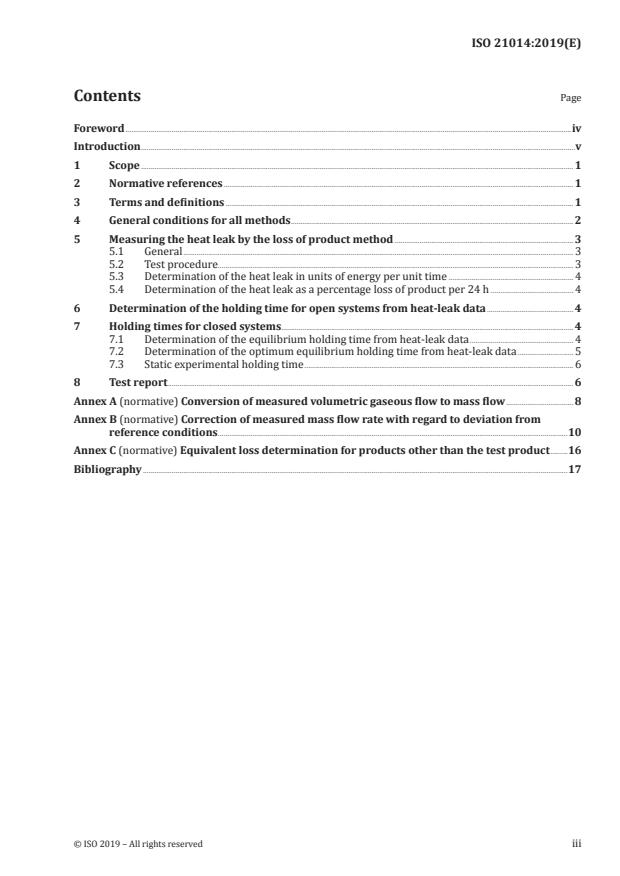
Contents Page
Foreword .iv
Introduction .v
1 Scope . 1
2 Normative references . 1
3 Terms and definitions . 1
4 General conditions for all methods . 2
5 Measuring the heat leak by the loss of product method . 3
5.1 General . 3
5.2 Test procedure . 3
5.3 Determination of the heat leak in units of energy per unit time . 4
5.4 Determination of the heat leak as a percentage loss of product per 24 h . 4
6 Determination of the holding time for open systems from heat-leak data .4
7 Holding times for closed systems . 4
7.1 Determination of the equilibrium holding time from heat-leak data . 4
7.2 Determination of the optimum equilibrium holding time from heat-leak data . 5
7.3 Static experimental holding time . 6
8 Test report . 6
Annex A (normative) Conversion of measured volumetric gaseous flow to mass flow .8
Annex B (normative) Correction of measured mass flow rate with regard to deviation from
reference conditions .10
Annex C (normative) Equivalent loss determination for products other than the test product .16
Bibliography .17
Foreword
ISO (the International Organization for Standardization) is a worldwide federation of national standards
bodies (ISO member bodies). The work of preparing International Standards is normally carried out
through ISO technical committees. Each member body interested in a subject for which a technical
committee has been established has the right to be represented on that committee. International
organizations, governmental and non-governmental, in liaison with ISO, also take part in the work.
ISO collaborates closely with the International Electrotechnical Commission (IEC) on all matters of
electrotechnical standardization.
The procedures used to develop this document and those intended for its further maintenance are
described in the ISO/IEC Directives, Part 1. In particular, the different approval criteria needed for the
different types of ISO documents should be noted. This document was drafted in accordance with the
editorial rules of the ISO/IEC Directives, Part 2 (see www .iso .org/ directives).
Attention is drawn to the possibility that some of the elements of this document may be the subject of
patent rights. ISO shall not be held responsible for identifying any or all such patent rights. Details of
any patent rights identified during the development of the document will be in the Introduction and/or
on the ISO list of patent declarations received (see www .iso .org/ patents).
Any trade name used in this document is information given for the convenience of users and does not
constitute an endorsement.
For an explanation of the voluntary nature of standards, the meaning of ISO specific terms and
expressions related to conformity assessment, as well as information about ISO's adherence to the
World Trade Organization (WTO) principles in the Technical Barriers to Trade (TBT) see www .iso .org/
iso/ foreword .html.
This document was prepared by Technical Committee ISO/TC 220, Cryogenic vessels.
This second edition cancels and replaces the first edition (ISO 21014:2006), which has been technically
revised.
The main changes compared to the previous edition are as follows:
— Clause 2 has been added and subsequent clauses and cross-references updated.
— For clarity, “set pressure of the pressure-limiting device” has been reworded to “set pressure of the
lowest set pressure-limiting device on stream” in subclauses 3.5, 3.5.3, and 3.6.
— “(100 % for helium)” has been added to 7.2 b) 1).
— In subclause 7.2 c), the denominator in the formula for m has been corrected from v to v .
ig el il
Any feedback or questions on this document should be directed to the user’s national standards body. A
complete listing of these bodies can be found at www .iso .org/ members .html.
iv © ISO 2019 – All rights reserved
Introduction
Traditionally, there have been different methods of defining the insulation performance of cryogenic
vessels. It is therefore necessary to harmonize such methods for different cryogenic vessels.
Figure 1 shows a logic diagram to help in the understanding of this document.
Figure 1 — Logic diagram
INTERNATIONAL STANDARD ISO 21014:2019(E)
Cryogenic vessels — Cryogenic insulation performance
1 Scope
This document defines practical methods for determining the heat-leak performance of cryogenic
vessels. The methods include measurement on both open and closed systems.
This document neither specifies the requirement levels for insulation performance nor when the
defined methods are applied.
2 Normative references
There are no normative references in this document.
3 Terms and definitions
For the purposes of this document, the following terms and definitions apply.
ISO and IEC maintain terminological databases for use in standardization at the following addresses:
— IEC Electropedia: available at http:// www .electropedia .org/
— ISO Online browsing platform: available at https:// www .iso .org/ obp
3.1
open system
system kept at a constant pressure (e.g. atmospheric pressure) in which the gas produced
by the evaporation of the test fluid is continuously released to atmosphere
3.2
closed system
system in which the mass of the contents is kept constant with no input or output of product
3.3
heat-leak rate
quantity of heat transferred per unit time from the ambient air to the contents of the inner vessel
Note 1 to entry: In an open system, the heat leak causes a loss of product; in a closed system, it causes a rise in
pressure.
3.4
holding time for open system
time expected to elapse, for a specified degree of filling, from initial filling level until the vessel is empty
(no more liquid) calculated from heat-leak data
3.5
holding time for closed system
time elapsed, for a specified degree of filling, from establishing the initial filling condition until the
pressure has risen, due to heat leak, to the set pressure of the lowest set pressure-limiting device
on stream
Note 1 to entry: For transportable vessels, this holding time is determined without the effects of stratification.
Note 2 to entry: Pressure-limiting devices include: a safety valve, a rupture disc, a back-pressure regulator, or
any other device installed to limit the system pressure under normal operating conditions.
3.5.1
equilibrium holding time
holding time calculated from a specified heat leak assuming that liquid and vapour are constantly in
equilibrium (without stratification)
3.5.2
longest equilibrium holding time
equilibrium holding time calculated from heat-leak data for a vessel when filled with the quantity of
product giving the longest holding time
3.5.3
static experimental holding time
time it takes starting from atmospheric pressure, or from a stated pressure in the case of fluids
where the starting pressure cannot be atmospheric pressure (e.g. 10 bar gauge for CO ), to reach the
set pressure of the lowest set pressure-limiting device on stream with the tank initially filled to its
maximum allowable filling mass
3.6
maximum allowable filling mass
initial mass that results in the tank becoming hydraulically full (98 % for all fluids except helium and
100 % for helium) at the point that the lowest set pressure-limiting device on stream operates
Note 1 to entry: For fluids in a supercritical condition, the maximum allowable filling mass will be a function of
the holding time and will be stated.
4 General conditions for all methods
4.1 The cryogenic fluid used for testing shall be agreed upon between the involved parties. Liquid
nitrogen may normally be used, except in cases where the vessel to be tested is designed for a specific
cryogenic fluid.
4.2 The liquid and gaseous phases shall be in equilibrium at the beginning of a test. When a test is
carried out at a higher pressure than atmospheric pressure, it is important that the liquid equilibrium
pressure is not lower than this test pressure.
4.3 The test environment shall be stable and constant during the test. It shall be as close as possible to
the following reference conditions:
— ambient temperature, 15 °C (288,15 K);
— atmospheric pressure, 1,013 bar (101,3 MPa) (absolute).
For products other than carbon dioxide and nitrous oxide:
— vessel reference pressure, 1,013 bar (101,3 MPa) (absolute).
For carbon dioxide and nitrous oxide:
— vessel reference pressure, 15 bar (1,5 MPa) (gauge).
4.4 The vessel and its contents shall have reached a stable temperature before the beginning of the
measuring period. Equilibrium conditions are obtained after a period of stabilization, the duration of
which depends on the size of the vessel and the type and configuration of the insulation.
4.5 All accessories of the vessel which can influence the result of the measurement shall be clearly
defined and specified in the report.
4.6 All instrumentation used shall be verified by calibration.
2 © ISO 2019 – All rights reserved
4.7 It is not necessary to use the method defined in this document to evaluate the insulation
performance resulting from small modifications; this may be done by simple extrapolation.
5 Measuring the heat leak by the loss of product method
5.1 General
There are two methods of measuring the heat leak:
— direct measurement of loss of mass;
— indirect measurement of loss of mass by measuring the gaseous volumetric discharge rate.
+10
The filling level shall be 50 % of the maximum filling level at the start of measurement, unless
otherwise stated.
The ambient temperature, ambient barometric pressure and the operating pressure at the top of the
vessel shall be recorded throughout the test so as to be used for correction purposes. The temperature
sensor(s) shall be placed in the immediate proximity of the tank being tested, but sited such that they
are unaffected directly by cold gas discharged from the vents.
The minimum measurement duration shall be 24 h after stable conditions have been reached.
During the test, precautions shall be taken to avoid agitation of the liquid, except for tanks designed for
land transport mode.
When measuring the rate of discharge of gas escaping from the vessel by a flow meter, it is essential
that the entire gas flow passes through the meter. The gas flow rate shall be determined as a mass flow
rate by using either of the following:
— mass flow meter;
— volumetric flow meter (an appropriate method is shown in Annex A).
5.2 Test procedure
The test procedure shall be as follows:
a) pre-cool the vessel;
b) leave for a first stabilization period;
+10
c) adjust the filling to the intended starting level (e.g. 50 % );
d) connect the instrumentation (e.g. gas flow meter);
e) leave for a second stabilization period;
f) take a sufficient number of readings to establish an acceptable thermal equilibrium before the start
of the measuring period;
g) determine the mass of the vessel contents at the start of measuring period, if direct measurement
of the mass is used;
h) record readings for a minimum of 24 h;
i) determine the loss of product in mass units (when gaseous flow is measured) in accordance with
Annex A;
j) reduce to reference conditions in accordance with Annex B.
5.3 Determination of the heat leak in units of energy per unit time
The rate of product loss (kg/s) during the measurement period, corrected to the reference conditions in
accordance with Annexes A and B, shall be converted to an equivalent heat leak, Q, as given in 5.4.
To calculate the heat leak with a product other than the test product, compensation using linear
extrapolation in accordance with Annex C shall be applied, but only if the difference between the boiling
temperature of these products at the reference conditions does not exceed 20 K.
5.4 Determination of the heat leak as a percentage loss of product per 24 h
Based on the result obtained in accordance with 5.3, the heat leak as a percentage loss of product per
24 h is calculated as follows.
a) Correct the measured heat leak to the reference condition for the test product by linear
extrapolation, as specified in 5.3.
b) Calculate the equivalent loss of the test product per day in accordance with the following formula:
86400 vv− Q
()
gl
L= ×100%
vh F
gfg
where
F is the maximum allowable filling mass of the test product (kg);
L is the equivalent loss of product as a percentage of F per day;
Q is the heat leak (W);
h is the latent heat of vaporization (J/kg) at the vessel reference pressure (see 4.3);
fg
ν is the specific volume of vapour (m /kg) at the vessel reference pressure (see 4.3);
g
ν is the specific volume of saturated liquid (m /kg) at the vessel reference pressure (see 4.3);
l
86 400 is the number of seconds per day.
All product-related data shall be taken at correct reference conditions for the specified product. Annex C
shall be used to determine the equivalent loss of product as a percentage of full tank content per day, for
a product other than the test product.
6 Determination of the holding time for open systems from heat-leak data
The holding time, in days, for open systems is equal to for the specified product.
L
7 Holding times for closed systems
7.1 Determination of the equilibrium holding time from heat-leak data
The system is in thermal equilibrium, i.e. the liquid and gas phases are saturated and at a temperature
corresponding to the saturation pressure at all times. The calculation process shall incorporate
correctly the temperature and pressure dependence of the thermodynamic properties. The data
source used for calculations shall be identified and the actual value shall be sho
...
INTERNATIONAL ISO
STANDARD 21014
Second edition
2019-10
Cryogenic vessels — Cryogenic
insulation performance
Récipients cryogéniques — Performances d'isolation cryogénique
Reference number
©
ISO 2019
© ISO 2019
All rights reserved. Unless otherwise specified, or required in the context of its implementation, no part of this publication may
be reproduced or utilized otherwise in any form or by any means, electronic or mechanical, including photocopying, or posting
on the internet or an intranet, without prior written permission. Permission can be requested from either ISO at the address
below or ISO’s member body in the country of the requester.
ISO copyright office
CP 401 • Ch. de Blandonnet 8
CH-1214 Vernier, Geneva
Phone: +41 22 749 01 11
Fax: +41 22 749 09 47
Email: copyright@iso.org
Website: www.iso.org
Published in Switzerland
ii © ISO 2019 – All rights reserved
Contents Page
Foreword .iv
Introduction .v
1 Scope . 1
2 Normative references . 1
3 Terms and definitions . 1
4 General conditions for all methods . 2
5 Measuring the heat leak by the loss of product method . 3
5.1 General . 3
5.2 Test procedure . 3
5.3 Determination of the heat leak in units of energy per unit time . 4
5.4 Determination of the heat leak as a percentage loss of product per 24 h . 4
6 Determination of the holding time for open systems from heat-leak data .4
7 Holding times for closed systems . 4
7.1 Determination of the equilibrium holding time from heat-leak data . 4
7.2 Determination of the optimum equilibrium holding time from heat-leak data . 5
7.3 Static experimental holding time . 6
8 Test report . 6
Annex A (normative) Conversion of measured volumetric gaseous flow to mass flow .8
Annex B (normative) Correction of measured mass flow rate with regard to deviation from
reference conditions .10
Annex C (normative) Equivalent loss determination for products other than the test product .16
Bibliography .17
Foreword
ISO (the International Organization for Standardization) is a worldwide federation of national standards
bodies (ISO member bodies). The work of preparing International Standards is normally carried out
through ISO technical committees. Each member body interested in a subject for which a technical
committee has been established has the right to be represented on that committee. International
organizations, governmental and non-governmental, in liaison with ISO, also take part in the work.
ISO collaborates closely with the International Electrotechnical Commission (IEC) on all matters of
electrotechnical standardization.
The procedures used to develop this document and those intended for its further maintenance are
described in the ISO/IEC Directives, Part 1. In particular, the different approval criteria needed for the
different types of ISO documents should be noted. This document was drafted in accordance with the
editorial rules of the ISO/IEC Directives, Part 2 (see www .iso .org/ directives).
Attention is drawn to the possibility that some of the elements of this document may be the subject of
patent rights. ISO shall not be held responsible for identifying any or all such patent rights. Details of
any patent rights identified during the development of the document will be in the Introduction and/or
on the ISO list of patent declarations received (see www .iso .org/ patents).
Any trade name used in this document is information given for the convenience of users and does not
constitute an endorsement.
For an explanation of the voluntary nature of standards, the meaning of ISO specific terms and
expressions related to conformity assessment, as well as information about ISO's adherence to the
World Trade Organization (WTO) principles in the Technical Barriers to Trade (TBT) see www .iso .org/
iso/ foreword .html.
This document was prepared by Technical Committee ISO/TC 220, Cryogenic vessels.
This second edition cancels and replaces the first edition (ISO 21014:2006), which has been technically
revised.
The main changes compared to the previous edition are as follows:
— Clause 2 has been added and subsequent clauses and cross-references updated.
— For clarity, “set pressure of the pressure-limiting device” has been reworded to “set pressure of the
lowest set pressure-limiting device on stream” in subclauses 3.5, 3.5.3, and 3.6.
— “(100 % for helium)” has been added to 7.2 b) 1).
— In subclause 7.2 c), the denominator in the formula for m has been corrected from v to v .
ig el il
Any feedback or questions on this document should be directed to the user’s national standards body. A
complete listing of these bodies can be found at www .iso .org/ members .html.
iv © ISO 2019 – All rights reserved
Introduction
Traditionally, there have been different methods of defining the insulation performance of cryogenic
vessels. It is therefore necessary to harmonize such methods for different cryogenic vessels.
Figure 1 shows a logic diagram to help in the understanding of this document.
Figure 1 — Logic diagram
INTERNATIONAL STANDARD ISO 21014:2019(E)
Cryogenic vessels — Cryogenic insulation performance
1 Scope
This document defines practical methods for determining the heat-leak performance of cryogenic
vessels. The methods include measurement on both open and closed systems.
This document neither specifies the requirement levels for insulation performance nor when the
defined methods are applied.
2 Normative references
There are no normative references in this document.
3 Terms and definitions
For the purposes of this document, the following terms and definitions apply.
ISO and IEC maintain terminological databases for use in standardization at the following addresses:
— IEC Electropedia: available at http:// www .electropedia .org/
— ISO Online browsing platform: available at https:// www .iso .org/ obp
3.1
open system
system kept at a constant pressure (e.g. atmospheric pressure) in which the gas produced
by the evaporation of the test fluid is continuously released to atmosphere
3.2
closed system
system in which the mass of the contents is kept constant with no input or output of product
3.3
heat-leak rate
quantity of heat transferred per unit time from the ambient air to the contents of the inner vessel
Note 1 to entry: In an open system, the heat leak causes a loss of product; in a closed system, it causes a rise in
pressure.
3.4
holding time for open system
time expected to elapse, for a specified degree of filling, from initial filling level until the vessel is empty
(no more liquid) calculated from heat-leak data
3.5
holding time for closed system
time elapsed, for a specified degree of filling, from establishing the initial filling condition until the
pressure has risen, due to heat leak, to the set pressure of the lowest set pressure-limiting device
on stream
Note 1 to entry: For transportable vessels, this holding time is determined without the effects of stratification.
Note 2 to entry: Pressure-limiting devices include: a safety valve, a rupture disc, a back-pressure regulator, or
any other device installed to limit the system pressure under normal operating conditions.
3.5.1
equilibrium holding time
holding time calculated from a specified heat leak assuming that liquid and vapour are constantly in
equilibrium (without stratification)
3.5.2
longest equilibrium holding time
equilibrium holding time calculated from heat-leak data for a vessel when filled with the quantity of
product giving the longest holding time
3.5.3
static experimental holding time
time it takes starting from atmospheric pressure, or from a stated pressure in the case of fluids
where the starting pressure cannot be atmospheric pressure (e.g. 10 bar gauge for CO ), to reach the
set pressure of the lowest set pressure-limiting device on stream with the tank initially filled to its
maximum allowable filling mass
3.6
maximum allowable filling mass
initial mass that results in the tank becoming hydraulically full (98 % for all fluids except helium and
100 % for helium) at the point that the lowest set pressure-limiting device on stream operates
Note 1 to entry: For fluids in a supercritical condition, the maximum allowable filling mass will be a function of
the holding time and will be stated.
4 General conditions for all methods
4.1 The cryogenic fluid used for testing shall be agreed upon between the involved parties. Liquid
nitrogen may normally be used, except in cases where the vessel to be tested is designed for a specific
cryogenic fluid.
4.2 The liquid and gaseous phases shall be in equilibrium at the beginning of a test. When a test is
carried out at a higher pressure than atmospheric pressure, it is important that the liquid equilibrium
pressure is not lower than this test pressure.
4.3 The test environment shall be stable and constant during the test. It shall be as close as possible to
the following reference conditions:
— ambient temperature, 15 °C (288,15 K);
— atmospheric pressure, 1,013 bar (101,3 MPa) (absolute).
For products other than carbon dioxide and nitrous oxide:
— vessel reference pressure, 1,013 bar (101,3 MPa) (absolute).
For carbon dioxide and nitrous oxide:
— vessel reference pressure, 15 bar (1,5 MPa) (gauge).
4.4 The vessel and its contents shall have reached a stable temperature before the beginning of the
measuring period. Equilibrium conditions are obtained after a period of stabilization, the duration of
which depends on the size of the vessel and the type and configuration of the insulation.
4.5 All accessories of the vessel which can influence the result of the measurement shall be clearly
defined and specified in the report.
4.6 All instrumentation used shall be verified by calibration.
2 © ISO 2019 – All rights reserved
4.7 It is not necessary to use the method defined in this document to evaluate the insulation
performance resulting from small modifications; this may be done by simple extrapolation.
5 Measuring the heat leak by the loss of product method
5.1 General
There are two methods of measuring the heat leak:
— direct measurement of loss of mass;
— indirect measurement of loss of mass by measuring the gaseous volumetric discharge rate.
+10
The filling level shall be 50 % of the maximum filling level at the start of measurement, unless
otherwise stated.
The ambient temperature, ambient barometric pressure and the operating pressure at the top of the
vessel shall be recorded throughout the test so as to be used for correction purposes. The temperature
sensor(s) shall be placed in the immediate proximity of the tank being tested, but sited such that they
are unaffected directly by cold gas discharged from the vents.
The minimum measurement duration shall be 24 h after stable conditions have been reached.
During the test, precautions shall be taken to avoid agitation of the liquid, except for tanks designed for
land transport mode.
When measuring the rate of discharge of gas escaping from the vessel by a flow meter, it is essential
that the entire gas flow passes through the meter. The gas flow rate shall be determined as a mass flow
rate by using either of the following:
— mass flow meter;
— volumetric flow meter (an appropriate method is shown in Annex A).
5.2 Test procedure
The test procedure shall be as follows:
a) pre-cool the vessel;
b) leave for a first stabilization period;
+10
c) adjust the filling to the intended starting level (e.g. 50 % );
d) connect the instrumentation (e.g. gas flow meter);
e) leave for a second stabilization period;
f) take a sufficient number of readings to establish an acceptable thermal equilibrium before the start
of the measuring period;
g) determine the mass of the vessel contents at the start of measuring period, if direct measurement
of the mass is used;
h) record readings for a minimum of 24 h;
i) determine the loss of product in mass units (when gaseous flow is measured) in accordance with
Annex A;
j) reduce to reference conditions in accordance with Annex B.
5.3 Determination of the heat leak in units of energy per unit time
The rate of product loss (kg/s) during the measurement period, corrected to the reference conditions in
accordance with Annexes A and B, shall be converted to an equivalent heat leak, Q, as given in 5.4.
To calculate the heat leak with a product other than the test product, compensation using linear
extrapolation in accordance with Annex C shall be applied, but only if the difference between the boiling
temperature of these products at the reference conditions does not exceed 20 K.
5.4 Determination of the heat leak as a percentage loss of product per 24 h
Based on the result obtained in accordance with 5.3, the heat leak as a percentage loss of product per
24 h is calculated as follows.
a) Correct the measured heat leak to the reference condition for the test product by linear
extrapolation, as specified in 5.3.
b) Calculate the equivalent loss of the test product per day in accordance with the following formula:
86400 vv− Q
()
gl
L= ×100%
vh F
gfg
where
F is the maximum allowable filling mass of the test product (kg);
L is the equivalent loss of product as a percentage of F per day;
Q is the heat leak (W);
h is the latent heat of vaporization (J/kg) at the vessel reference pressure (see 4.3);
fg
ν is the specific volume of vapour (m /kg) at the vessel reference pressure (see 4.3);
g
ν is the specific volume of saturated liquid (m /kg) at the vessel reference pressure (see 4.3);
l
86 400 is the number of seconds per day.
All product-related data shall be taken at correct reference conditions for the specified product. Annex C
shall be used to determine the equivalent loss of product as a percentage of full tank content per day, for
a product other than the test product.
6 Determination of the holding time for open systems from heat-leak data
The holding time, in days, for open systems is equal to for the specified product.
L
7 Holding times for closed systems
7.1 Determination of the equilibrium holding time from heat-leak data
The system is in thermal equilibrium, i.e. the liquid and gas phases are saturated and at a temperature
corresponding to the saturation pressure at all times. The calculation process shall incorporate
correctly the temperature and pressure dependence of the thermodynamic properties. The data
source used for calculations shall be identified and the actual value shall be sho
...