


ISO/FDIS 20022-5
(Main)Financial services — Universal financial industry message scheme — Part 5: Conceptual interoperability and reverse engineering
Financial services — Universal financial industry message scheme — Part 5: Conceptual interoperability and reverse engineering
ISO 20022-5:2013 was prepared to complement ISO 20022-1:2013. The reverse engineering guidelines explain how to extract relevant information from existing IndustryMessageSets in order to prepare the submission to the ISO 20022 Registration Authority of equivalent, ISO 20022 compliant BusinessTransactions and MessageSets. The ISO 20022 Repository will contain all ISO 20022 compliant BusinessTransactions and MessageSets, as outlined in ISO 20022-1:2013.
Services financiers — Schéma universel de messages pour l'industrie financière — Partie 5: Interopérabilité conceptuelle et ingénierie inverse
General Information
- Status
- Not Published
- Technical Committee
- ISO/TC 68/SC 9 - Information exchange for financial services
- Drafting Committee
- ISO/TC 68/SC 9 - Information exchange for financial services
- Current Stage
- 5020 - FDIS ballot initiated: 2 months. Proof sent to secretariat
- Start Date
- 31-Dec-2025
- Completion Date
- 31-Dec-2025
Relations
- Effective Date
- 06-Jun-2022
Overview
ISO/FDIS 20022-5, titled Financial services - Universal financial industry message scheme - Part 5: Conceptual interoperability and reverse engineering, is a vital international standard developed by ISO’s Technical Committee ISO/TC 68/SC 9. This standard complements ISO 20022-1 by providing detailed guidelines on how to perform reverse engineering on existing financial messaging IndustryMessageSets. The ultimate goal is to extract relevant information to create ISO 20022-compliant BusinessTransactions and MessageSets for submission to the ISO 20022 Registration Authority.
By focusing on conceptual interoperability and reverse engineering workflows, ISO 20022-5 supports the evolution of the universal financial messaging standards needed for seamless communication between different financial industry systems and services. It ensures consistent, scalable, and technology-independent message definitions, which are crucial in today's complex financial services ecosystem.
Key Topics
Reverse Engineering Methodology
ISO 20022-5 outlines a structured workflow for reverse engineering legacy or existing IndustryMessageSets. This includes conducting thorough gap analyses to identify differences and discrepancies between existing message sets and ISO 20022-compliant models.Conceptual Interoperability Enhancement
The standard defines processes to enhance interoperability at a conceptual level by developing or modifying BusinessComponents and BusinessTransactions to align with ISO 20022’s universal messaging framework.Gap Analysis Procedures
Detailed guidance is provided for performing gap analysis across multiple layers, including BusinessAreas, BusinessProcesses, BusinessTransactions, MessageDefinitions, and BusinessRoles. This ensures that migrated or newly developed message sets fully meet ISO 20022 requirements.Workflow and Deliverables
A clear workflow is described for the entire reverse engineering lifecycle: from initial analysis, through development, registration with the ISO 20022 Registration Authority, to preparation for migration and coexistence with legacy systems.ISO 20022 Registration Support
The document also covers standards for preparing submissions to the ISO 20022 Registration Authority, ensuring that all new or modified BusinessTransactions and MessageSets meet official registration protocols.Migration Planning and Documentation
Strategies and documentation requirements for smooth migration from legacy messaging formats to ISO 20022-compliant messages, including convergence and coexistence documentation, are outlined.
Applications
ISO/FDIS 20022-5 is highly relevant for:
Financial Institutions
Banks, payment systems, and other financial organizations can use this standard to transition their existing messaging infrastructures to ISO 20022-compliant formats while ensuring interoperability and minimizing disruption.Software Vendors and System Integrators
Developers and implementers of financial messaging software can employ the reverse engineering workflow and interoperability concepts to design flexible, future-proof systems supporting ISO 20022 messages.Financial Market Infrastructures (FMIs)
Clearinghouses, settlement platforms, and securities depositories benefit by aligning their message standards with ISO 20022 for greater harmonization and operational efficiency.Regulatory Bodies
Regulators and standardization authorities can use this standard to guide industry-wide adoption of ISO 20022-compliant messaging for improved transparency and communication between diverse financial market participants.Migrating Legacy Systems
Companies seeking to modernize legacy financial message protocols, including those based on ISO 15022 or other proprietary formats, will find the reverse engineering guidelines essential for successful migration and registration.
Related Standards
ISO 20022-5 is part of the broader ISO 20022 series which includes:
ISO 20022-1: Universal financial industry message scheme - Methodology and general requirements
Defines the foundational framework, UML modeling, and rules for ISO 20022 message creation.ISO 20022-2 to 20022-4: Covering metamodels, message definition principles, and business processes descriptions.
This standard also aligns with:
- ISO 15022: Securities messaging standards, predecessor to ISO 20022.
- Financial industry protocols and data exchange frameworks supported by XML and evolving technology standards.
Keywords
ISO 20022, financial messaging standards, universal message scheme, conceptual interoperability, reverse engineering, BusinessTransactions, MessageSets, financial services messaging, ISO 20022 Registration Authority, financial systems migration, financial industry message exchange, interoperability standards, BusinessComponents, gap analysis, financial technology standards.

ISO/FDIS 20022-5 - Financial services — Universal financial industry message scheme — Part 5: Conceptual interoperability and reverse engineering Released:17. 12. 2025
REDLINE ISO/FDIS 20022-5 - Financial services — Universal financial industry message scheme — Part 5: Conceptual interoperability and reverse engineering Released:17. 12. 2025
Get Certified
Connect with accredited certification bodies for this standard

Great Wall Tianjin Quality Assurance Center
Established 1993, first batch to receive national accreditation with IAF recognition.
Hong Kong Quality Assurance Agency (HKQAA)
Hong Kong's leading certification body.

Innovative Quality Certifications Pvt. Ltd. (IQCPL)
Known for integrity, providing ethical & impartial Assessment & Certification. CMMI Institute Partner.
Sponsored listings
Frequently Asked Questions
ISO/FDIS 20022-5 is a draft published by the International Organization for Standardization (ISO). Its full title is "Financial services — Universal financial industry message scheme — Part 5: Conceptual interoperability and reverse engineering". This standard covers: ISO 20022-5:2013 was prepared to complement ISO 20022-1:2013. The reverse engineering guidelines explain how to extract relevant information from existing IndustryMessageSets in order to prepare the submission to the ISO 20022 Registration Authority of equivalent, ISO 20022 compliant BusinessTransactions and MessageSets. The ISO 20022 Repository will contain all ISO 20022 compliant BusinessTransactions and MessageSets, as outlined in ISO 20022-1:2013.
ISO 20022-5:2013 was prepared to complement ISO 20022-1:2013. The reverse engineering guidelines explain how to extract relevant information from existing IndustryMessageSets in order to prepare the submission to the ISO 20022 Registration Authority of equivalent, ISO 20022 compliant BusinessTransactions and MessageSets. The ISO 20022 Repository will contain all ISO 20022 compliant BusinessTransactions and MessageSets, as outlined in ISO 20022-1:2013.
ISO/FDIS 20022-5 is classified under the following ICS (International Classification for Standards) categories: 03.060 - Finances. Banking. Monetary systems. Insurance. The ICS classification helps identify the subject area and facilitates finding related standards.
ISO/FDIS 20022-5 has the following relationships with other standards: It is inter standard links to ISO 20022-5:2013. Understanding these relationships helps ensure you are using the most current and applicable version of the standard.
ISO/FDIS 20022-5 is available in PDF format for immediate download after purchase. The document can be added to your cart and obtained through the secure checkout process. Digital delivery ensures instant access to the complete standard document.
Standards Content (Sample)
FINAL DRAFT
International
Standard
ISO/TC 68/SC 9
Financial services — Universal
Secretariat: AFNOR
financial industry message
Voting begins on:
scheme —
2025-12-31
Part 5:
Voting terminates on:
2026-02-25
Conceptual interoperability and
reverse engineering
RECIPIENTS OF THIS DRAFT ARE INVITED TO SUBMIT,
WITH THEIR COMMENTS, NOTIFICATION OF ANY
RELEVANT PATENT RIGHTS OF WHICH THEY ARE AWARE
AND TO PROVIDE SUPPOR TING DOCUMENTATION.
IN ADDITION TO THEIR EVALUATION AS
BEING ACCEPTABLE FOR INDUSTRIAL, TECHNO-
LOGICAL, COMMERCIAL AND USER PURPOSES, DRAFT
INTERNATIONAL STANDARDS MAY ON OCCASION HAVE
TO BE CONSIDERED IN THE LIGHT OF THEIR POTENTIAL
TO BECOME STAN DARDS TO WHICH REFERENCE MAY BE
MADE IN NATIONAL REGULATIONS.
Reference number
FINAL DRAFT
International
Standard
ISO/TC 68/SC 9
Financial services — Universal
Secretariat: AFNOR
financial industry message
Voting begins on:
scheme —
Part 5:
Voting terminates on:
Conceptual interoperability and
reverse engineering
RECIPIENTS OF THIS DRAFT ARE INVITED TO SUBMIT,
WITH THEIR COMMENTS, NOTIFICATION OF ANY
RELEVANT PATENT RIGHTS OF WHICH THEY ARE AWARE
AND TO PROVIDE SUPPOR TING DOCUMENTATION.
© ISO 2025
IN ADDITION TO THEIR EVALUATION AS
All rights reserved. Unless otherwise specified, or required in the context of its implementation, no part of this publication may
BEING ACCEPTABLE FOR INDUSTRIAL, TECHNO-
LOGICAL, COMMERCIAL AND USER PURPOSES, DRAFT
be reproduced or utilized otherwise in any form or by any means, electronic or mechanical, including photocopying, or posting on
INTERNATIONAL STANDARDS MAY ON OCCASION HAVE
the internet or an intranet, without prior written permission. Permission can be requested from either ISO at the address below
TO BE CONSIDERED IN THE LIGHT OF THEIR POTENTIAL
or ISO’s member body in the country of the requester.
TO BECOME STAN DARDS TO WHICH REFERENCE MAY BE
MADE IN NATIONAL REGULATIONS.
ISO copyright office
CP 401 • Ch. de Blandonnet 8
CH-1214 Vernier, Geneva
Phone: +41 22 749 01 11
Email: copyright@iso.org
Website: www.iso.org
Published in Switzerland Reference number
ii
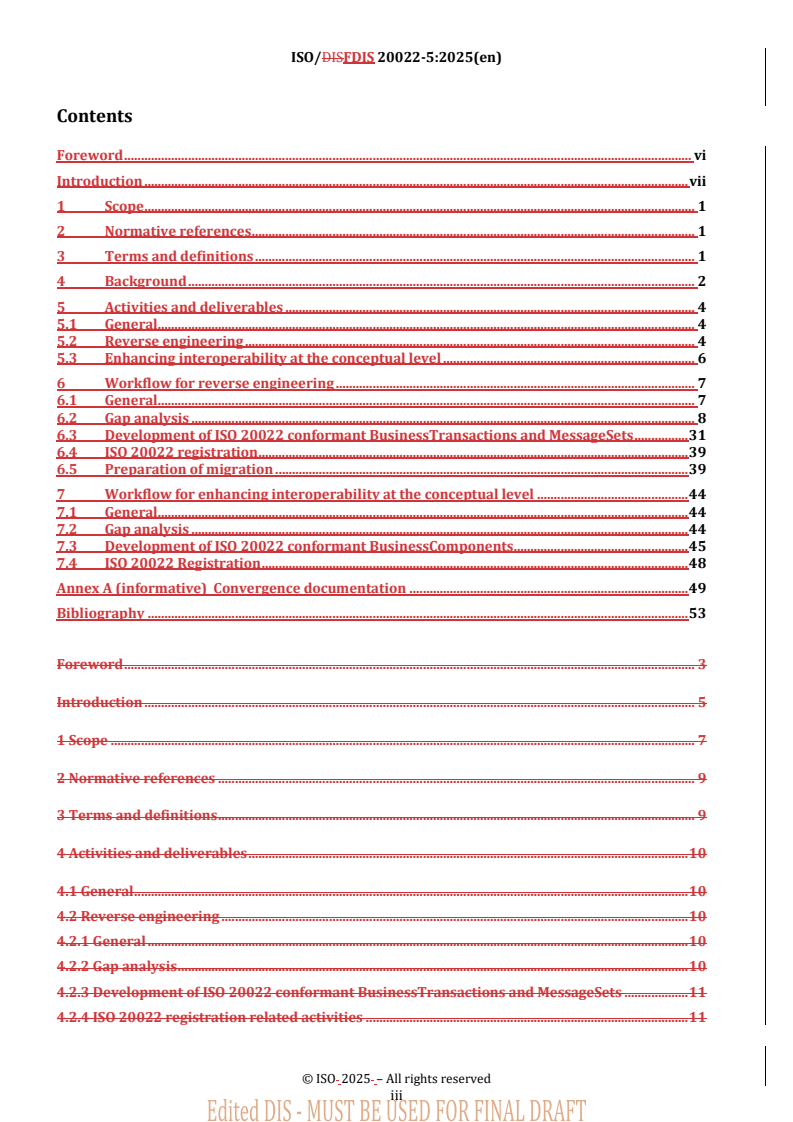
Contents Page
Foreword .v
Introduction .vi
1 Scope . 1
2 Normative references . 1
3 Terms and definitions . 1
4 Background . 2
5 Activities and deliverables . 3
5.1 General .3
5.2 Reverse engineering .4
5.2.1 General .4
5.2.2 Gap analysis .4
5.2.3 Development of ISO 20022 conformant BusinessTransactions and MessageSets .5
5.2.4 ISO 20022 registration related activities .5
5.2.5 Preparation of migration .5
5.3 Enhancing interoperability at the conceptual level .5
5.3.1 General .5
5.3.2 Gap analysis .6
5.3.3 Development of ISO 20022 conformant BusinessComponents .6
5.3.4 ISO 20022 registration related activities .6
6 Workflow for reverse engineering . 7
6.1 General .7
6.2 Gap analysis .7
6.2.1 General .7
6.2.2 IndustryMessageSet documentation . .8
6.2.3 BusinessArea gap analysis .9
6.2.4 BusinessProcess gap analysis .11
6.2.5 BusinessTransaction gap analysis . 13
6.2.6 MessageDefinition gap analysis .16
6.2.7 BusinessRoles gap analysis .19
6.3 Development of ISO 20022 conformant BusinessTransactions and MessageSets .21
6.3.1 General .21
6.3.2 New BusinessArea . 22
6.3.3 Modified BusinessArea . 23
6.3.4 New BusinessProcess . 23
6.3.5 Modified BusinessProcess .24
6.3.6 Requirements use case .24
6.3.7 New BusinessTransaction .24
6.3.8 Modified BusinessTransaction . 25
6.3.9 New MessageDefinition . 26
6.3.10 Modified MessageDefinition . 26
6.3.11 New or modified BusinessRole .27
6.4 ISO 20022 registration .27
6.5 Preparation of migration . . 28
6.5.1 General . 28
6.5.2 Convergence documentation . 28
6.5.3 Coexistence documentation .31
6.5.4 Migration planning .32
7 Workflow for enhancing interoperability at the conceptual level .32
7.1 General .32
7.2 Gap analysis .32
7.3 Development of ISO 20022 conformant BusinessComponents . 33
7.3.1 General . 33
iii
7.3.2 A new BusinessComponent . 34
7.3.3 A modified BusinessComponent . 35
7.4 ISO 20022 Registration . 35
Annex A (informative) Convergence documentation .36
Bibliography .39
iv
Foreword
ISO (the International Organization for Standardization) is a worldwide federation of national standards
bodies (ISO member bodies). The work of preparing International Standards is normally carried out through
ISO technical committees. Each member body interested in a subject for which a technical committee
has been established has the right to be represented on that committee. International organizations,
governmental and non-governmental, in liaison with ISO, also take part in the work. ISO collaborates closely
with the International Electrotechnical Commission (IEC) on all matters of electrotechnical standardization.
The procedures used to develop this document and those intended for its further maintenance are described
in the ISO/IEC Directives, Part 1. In particular, the different approval criteria needed for the different types
of ISO document should be noted. This document was drafted in accordance with the editorial rules of the
ISO/IEC Directives, Part 2 (see www.iso.org/directives).
ISO draws attention to the possibility that the implementation of this document may involve the use of (a)
patent(s). ISO takes no position concerning the evidence, validity or applicability of any claimed patent
rights in respect thereof. As of the date of publication of this document, ISO had not received notice of (a)
patent(s) which may be required to implement this document. However, implementers are cautioned that
this may not represent the latest information, which may be obtained from the patent database available at
www.iso.org/patents. ISO shall not be held responsible for identifying any or all such patent rights.
Any trade name used in this document is information given for the convenience of users and does not
constitute an endorsement.
For an explanation of the voluntary nature of standards, the meaning of ISO specific terms and expressions
related to conformity assessment, as well as information about ISO's adherence to the World Trade
Organization (WTO) principles in the Technical Barriers to Trade (TBT), see www.iso.org/iso/foreword.html.
This document was prepared by Technical Committee ISO/TC 68, Financial services, Subcommittee SC 9,
Information exchange for financial services.
This second edition cancels and replaces the first edition (ISO 20022-5:2013), which has been technically
revised.
The main changes are as follows:
— Activities and workflows for enhancing interoperability at the conceptual level have been added.
— Reverse engineering workflow has been amended based on previous experience.
A list of all parts in the ISO 20022 series can be found on the ISO website.
Any feedback or questions on this document should be directed to the user’s national standards body. A
complete listing of these bodies can be found at www.iso.org/members.html.
v
Introduction
The ISO 20022 series defines a scalable, methodical process to ensure consistent descriptions of messages
throughout the financial services industry.
The purpose of the ISO 20022 series is to describe precisely and completely the externally observable aspects
of financial services messaging in a way that can be verified independently against operational messaging.
The trigger for the creation of the ISO 20022 series was the rapid growth in the scale and sophistication
of messaging within financial services during the 1990s using the ISO 15022 series. The financial services
industry (hereafter referred to as "the industry") created the first version of the ISO 20022 series as the
successor to the ISO 15022 series in response to that trigger. Since the ISO 15022 series, the industry has
broadened the scope from securities to the entire industry for the ISO 20022 series.
The ISO 20022 series is based on open technology standards, which historically have evolved more rapidly
than the industry itself. Consequently, the ISO 20022 series adopted a model-driven approach where the
model of the industry's messaging can evolve separately from the evolution of the messaging technology
standards. The period during which the ISO 20022 series has emerged followed the widespread adoption
of the internet for business. The eXtensible Mark-up Language (XML) emerged as the de facto standard for
document representation on the internet and it became the first syntax for the ISO 20022 series.
The modelling process is further refined into three levels which, in addition to the messaging technology
standard, is why the ISO 20022 series is based on four levels: the scope level, the conceptual level, the
logical level and the physical level. This four-level approach is based on the first four levels of the Zachman
[2]
Framework . The remaining two levels of the Zachman Framework are equivalent to the implementations
and the operational levels, respectively.
In ISO 20022-1, the first, second and third levels are described in Unified Modelling Language (UML) because
it is widely supported and supports multiple levels of abstraction. The models created in accordance with
ISO 20022-1 are technology independent in that they do not require any particular physical expression
or implementation. Such models aim to describe all parts of the message exchange. The models form the
definition of the protocol between participants exchanging messages. ISO 20022-1 defines a method that
describes a process by which these models can be created and maintained by the modellers.
The model artefacts are stored in an ISO 20022 Repository (hereafter referred to as "the Repository").
The Repository and physical level artefacts are exposed in a publicly accessible location, such as a website,
serviced by a Registration Authority. The name and contact information of the Registration Authority for
the ISO 20022 series can be found at www.iso.org/maintenance_agencies.
The Repository is organized into two areas:
— a DataDictionary containing the industry model elements likely to have further or repeated use;
— a BusinessProcessCatalogue that contains models describing specific message definitions and business
processes and physical syntax implementations.
The ISO 20022 series is organized into the following parts.
— ISO 20022-1 describes the metamodel of all the models and the Repository according to ISO/IEC 19502:2005
(MOF).
— ISO 20022-2 covers the UML profile, a grounding of general UML into a specific subset defined for the
ISO 20022 series (to be used when UML is selected to define the models).
— ISO 20022-3 describes a modelling method to produce models for the ISO 20022 series.
— ISO 20022-4 covers XML schema generation rules to transform a logical level model into a physical level
description in the syntaxes.
— This document covers business concept model interoperability, and logical model alignment and reverse
engineering.
vi
— ISO 20022-6 covers message transport characteristics that define the quality of service required by the
business process definitions so that they can operate successfully.
— ISO 20022-7 describes the process of managing the registration of models and physical syntax
implementations.
— ISO 20022-8 gives ASN.1 syntax generation rules to transform a logical level model into a physical level
description in ASN.1.
— ISO 20022-9 describes generic guidelines, which are used to define schema generation rules for any
specific syntax.
vii
FINAL DRAFT International Standard ISO/FDIS 20022-5:2025(en)
Financial services — Universal financial industry message
scheme —
Part 5:
Conceptual interoperability and reverse engineering
1 Scope
This document defines a scalable, methodical process to ensure business concept model interoperability and
logical model alignment and reverse engineering.
This document provides guidance on conceptual interoperability and reverse engineering to explain how
to extract relevant information from existing IndustryMessageSet, proprietary MessageSet or business
model in order to prepare the submission to the ISO 20022 Registration Authority of equivalent, ISO 20022
conformant BusinessTransactions, BusinessComponents (including BusinessElements and Constraints) and
MessageSets.
This document describes the activities of ISO 20022 conceptual interoperability and reverse engineering
from the point of view of the user who wants to verify that the business functionality, covered by their own
IndustryMessageSet, proprietary MessageSets or business model, is covered by ISO 20022 conformant
BusinessTransactions, BusinessComponents (including BusinessElements and Constraints) and MessageSets.
2 Normative references
The following documents are referred to in the text in such a way that some or all of their content constitutes
requirements of this document. For dated references, only the edition cited applies. For undated references,
the latest edition of the referenced document (including any amendments) applies.
ISO 20022-1, Financial services — Universal financial industry message scheme — Part 1: Metamodel
3 Terms and definitions
For the purposes of this document, the terms and definitions given in ISO 20022-1 and the following apply.
ISO and IEC maintain terminology databases for use in standardization at the following addresses:
— ISO Online browsing platform: available at https:// www .iso .org/ obp
— IEC Electropedia: available at https:// www .electropedia .org/
3.1
IndustryMessage
message that offers a particular MessageDefinition functionality (possibly multi-functional) and whose
MessageDefinition is part of an IndustryMessageSet
3.2
message item
element or field used at a particular place in a MessageDefinition
Note 1 to entry: This exact place is typically described by the MessagePath.
3.3
MessagePath
exact position in a particular MessageDefinition
Note 1 to entry: This position is uniquely identified by the full hierarchy (i.e. “path”) from the message level (i.e. the
highest level) down to the element level (i.e. the lowest level).
3.4
convergence
planned replacement of IndustryMessageSet (or proprietary MessageSet) with ISO 20022 MessageSet
3.5
coexistence
compatible, contemporaneous use of IndustryMessageSet (or proprietary MessageSet) with ISO 20022
MessageSet for similar or related business purposes
3.6
interoperability
ability of ISO 20022 conformant MessageSets and IndustryMessageSets to cooperate and collaborate, with
the aim of sharing and making use of data
4 Background
This document was prepared to complement ISO 20022-1. The ISO 20022 Repository contains all ISO 20022
conformant BusinessTransactions, BusinessComponents (including BusinessElements and Constraints) and
MessageSets, as outlined in ISO 20022-1. The approach to be followed for adding ISO 20022 conformant
BusinessTransactions, BusinessComponents (including BusinessElements and Constraints) and MessageSets
to the Repository can be classified according to the following scenarios:
a) Case 1:
1) No ISO 20022 conformant BusinessTransactions and MessageSets exist.
2) No IndustryMessageSet exists.
EXAMPLE 1 Collective investment vehicles.
3) Approach: full development of ISO 20022 conformant BusinessTransactions and MessageSets using
ISO 20022-3.
b) Case 2:
1) No ISO 20022 conformant BusinessTransactions and MessageSets exist.
2) One or more IndustryMessageSets, proprietary MessageSets or business models exist.
EXAMPLE 2 Securities Pre-Trade (FIX IndustryMessageSet exists).
3) Approach option 1 (reverse engineering): conversion of the IndustryMessageSet(s) or proprietary
MessageSet(s) into ISO 20022 conformant BusinessTransactions and MessageSets, using this
document.
4) Approach option 2 (enhance interoperability at the conceptual level): modelling of the
IndustryMessageSet(s) into ISO 20022 conformant BusinessComponents (including
BusinessElements and Constraints), using this document.
c) Case 3:
1) ISO 20022 conformant BusinessTransactions and MessageSets exist.
2) One or more existing IndustryMessageSets, proprietary MessageSets or business models exist as
well.
EXAMPLE 3 Securities Post-Trade (FIX and Omgeo IndustryMessageSets exist).
3) Approach option 1 (reverse engineering): comparison of the existing IndustryMessageSet(s) with
the ISO 20022 conformant BusinessTransactions and MessageSets and extension of the ISO 20022
conformant BusinessTransactions and MessageSets, using this document.
4) Approach option 2 (enhance interoperability at the conceptual level): comparison of the existing
IndustryMessageSet(s) with the ISO 20022 conformant BusinessTransactions and MessageSets,
and enhancement or extension of the ISO 20022 conformant BusinessComponents (including
BusinessElements and Constraints), using this document.
This document describes the activities of ISO 20022 conceptual interoperability and reverse engineering
from the point of view of the user who wants to verify that the business functionality, covered by their own
IndustryMessageSet, proprietary MessageSets or business model, is covered by ISO 20022 conformant
BusinessTransactions, BusinessComponents (including BusinessElements and Constraints) and MessageSets.
The intention of this document is not to attempt to define a “methodology” for reverse engineering.
This document describes the following set of activities:
— extract relevant information from existing IndustryMessageSets, proprietary MessageSets or business
model and compare it to the related information in the ISO 20022 Repository;
— use the results of this comparison for the development of ISO 20022 conformant BusinessTransactions,
BusinessComponents (including BusinessElements and Constraints) and MessageSets as necessary;
— submit the resulting update requests to the Registration Authority;
— prepare the migration to the ISO 20022 conformant BusinessTransactions and MessageSets for
community of users who desires a migration.
The main objectives of this document are to:
— capture the industry knowledge covered by existing IndustryMessageSets and business models;
— build upon former standardization efforts in the industry when building ISO 20022 conformant
BusinessTransactions, BusinessComponents (including BusinessElements and Constraints) and
MessageSets;
— ensure that the resulting ISO 20022 conformant BusinessTransactions, BusinessComponents (including
BusinessElements and Constraints) and MessageSets cover fully the business scope of existing
IndustryMessageSets;
— facilitate interoperability between existing IndustryMessageSets or proprietary MessageSets or
business models and ISO 20022 conformant BusinessTransactions, BusinessComponents (including
BusinessElements and Constraints) and MessageSets when applicable;
— support the migration from existing IndustryMessageSets to ISO 20022 conformant BusinessTransactions
and MessageSets if needed by users of IndustryMessageSets.
NOTE Whilst API Resources are not explicitly stipulated in this document, the same thought process for
conceptual interoperability and reverse engineering is expected to apply for API Resources, once they become
available for Registration.
5 Activities and deliverables
5.1 General
This clause is subdivided as follows:
— 5.2 describes the major objectives and deliverables related to activities of reverse engineering at the
logical and physical level.
— 5.3 describes the major objectives and deliverables related to activities of enhancing interoperability at
the conceptual level.
5.2 Reverse engineering
5.2.1 General
There are four main activities in the ISO 20022 reverse engineering:
— gap analysis;
— development of ISO 20022 conformant BusinessTransactions and MessageSets;
— ISO 20022 registration;
— preparation of migration.
5.2.2 Gap analysis
The objectives of the gap analysis are to:
— determine the BusinessArea of the IndustryMessageSet and identify the corresponding BusinessArea,
BusinessProcesses, activities and supporting BusinessTransactions in the ISO 20022 BusinessProcess
Catalogue;
— compare BusinessRoles in ISO 20022 BusinessProcesses and BusinessTransactions to the parties that
use the IndustryMessages, or that are identified in the IndustryMessages;
— verify whether existing MessageInstances offer the complete MessageDefinition functionality that is
offered by the IndustryMessages;
— evaluate whether the business content of the relevant MessageInstances cover the business content of
the individual IndustryMessages;
— compare the meaning and the data typing of the used MessageComponentTypes and BusinessComponents
to the individual IndustryMessage items.
If there are any gaps, the deliverables of the gap analysis are as follows:
— Documentation concerning the coverage, the differences and the gaps between the IndustryMessageSet
and the ISO 20022 conformant BusinessTransactions and MessageSets. This documentation concerns
the following repository items:
— BusinessAreas;
— BusinessProcesses;
— BusinessTransactions and MessageSets;
— MessageDefinitions (including MessageDefinition Constraints);
— BusinessRoles;
— BusinessComponents (including BusinessElements and Constraints);
— MessageComponentTypes (including MessageElements and Constraints);
— DataTypes.
— The documentation of the IndustryMessageSet for those repository items that were missing (i.e. the
gaps) or for which a difference was identified.
5.2.3 Development of ISO 20022 conformant BusinessTransactions and MessageSets
The objectives of this activity are to:
— complete the gap analysis with all additional information that is required to define or complete ISO 20022
conformant BusinessTransactions and MessageSets;
— define the required updates and additions to the existing ISO 20022 conformant BusinessTransactions
and MessageSets.
This step shall focus only on the identified gaps and differences. It shall verify whether a valid request exists
to include this additional information to rectify these gaps and differences in the ISO 20022 repository.
The goal of reverse engineering is not to question (except with respect to business justification), modify or
complement the business functionality that is currently supported in the IndustryMessageSet.
The deliverable of this activity is a detailed documentation describing how the existing ISO 20022
conformant BusinessTransactions and MessageSets shall be updated to incorporate the identified gaps and
differences.
5.2.4 ISO 20022 registration related activities
The objective of this activity is to prepare the information in order for the ISO 20022 Registration Authority
to request the update of the ISO 20022 repository with all required additions and modifications.
The deliverables are the requests to the ISO 20022 Registration Authority to add or modify either Dictionary
Items or Catalogue Items or both.
5.2.5 Preparation of migration
The objective of this activity is to define and document the relationship between the IndustryMessageSet
and ISO 20022 conformant BusinessTransactions and MessageSets. The required amount of information
depends on the chosen migration path:
— In case of migration, it is sufficient to document the relationship in a way that supports the
convergence towards ISO 20022 and to define a plan for the migration to the ISO 20022 conformant
BusinessTransactions and MessageSets.
— In case of coexistence, there is a need to document the relationship that supports coexistence of ISO 20022
and the IndustryMessageSets.
The deliverables of this activity are:
a) the convergence documentation and the migration plan (in case of migration);
b) the coexistence documentation (in case of coexistence).
5.3 Enhancing interoperability at the conceptual level
5.3.1 General
There are three main activities in enhancing interoperability at the conceptual level:
— gap analysis;
— development of ISO 20022 conformant BusinessComponents (including BusinessElements and
Constraints);
— ISO 20022 registration.
5.3.2 Gap analysis
The objectives of the gap analysis are to:
— determine the BusinessArea of the IndustryMessageSet, proprietary MessageSet or business
model and identify the corresponding BusinessArea, BusinessProcesses, activities and supporting
BusinessTransactions in the ISO 20022 BusinessProcess Catalogue if there are any;
— compare BusinessRoles in ISO 20022 BusinessProcesses and BusinessTransactions to the parties that
use the IndustryMessageSet, proprietary MessageSet or business model;
— compare BusinessComponents and BusinessElements in ISO 20022 repository to the business components
and business elements that are identified in the IndustryMessageSet, proprietary MessageSet or business
model. The definitions of BusinessComponents and BusinessElements should also be compared.
The deliverables of the gap analysis are as follows:
— Document the coverage, the differences and the gaps between the IndustryMessageSet, proprietary
MessageSet or business model, and the ISO 20022 conformant BusinessTransactions and BusinessProcesses
(including conceptual and contextual). This documentation concerns the following repository items:
— BusinessAreas;
— BusinessProcesses;
— BusinessTransactions;
— BusinessRoles;
— BusinessComponents (including BusinessElements and Constraints);
— DataTypes.
— The documentation of the BusinessComponents (including BusinessElements and Constraints) for those
repository items that were missing or for which a conceptual or contextual difference was identified (i.e.
the differences and gaps).
5.3.3 Development of ISO 20022 conformant BusinessComponents
The objectives of this activity are to:
— complete the gap analysis with all additional information that is required to define or complete ISO 20022
conformant BusinessComponents (including BusinessElements and Constraints);
— define the required updates and additions to the existing ISO 20022 conformant BusinessComponents
(including BusinessElements and Constraints), or additions of new ISO 20022 conformant
BusinessComponents (including BusinessElements and Constraints).
This step shall focus only on the identified gaps and differences at the conceptual model layer between the
ISO 20022 repository and the IndustryMessageSet, proprietary MessageSet or business model. It shall verify
whether a valid request exists to include these additional concepts to rectify the gaps and differences in the
ISO 20022 repository to facilitate conceptual interoperability.
The deliverable of this activity is a detailed documentation describing how the existing ISO 20022
conformant BusinessComponents and BusinessElements shall be updated to incorporate the identified gaps
and differences.
5.3.4 ISO 20022 registration related activities
The objective of this activity is to prepare the information in order for the ISO 20022 Registration Authority
to request the update of the ISO 20022 repository with all required additions and modifications.
The deliverables are the requests to the ISO 20022 Registration Authority to add or modify
BusinessComponents (including BusinessElements and Constraints).
6 Workflow for reverse engineering
6.1 General
This clause contains a detailed workflow description of the four main activities in ISO 20022 reverse
engineering.
6.2 Gap analysis
6.2.1 General
6.2.1.1 Preliminary remarks
The gap analysis requires considerable expertise and documentation regarding the IndustryMessageSet.
In case this documentation is not readily available, it is necessary to perform a thorough analysis of the
IndustryMessageSet and its use (see the first step in Figure 1).
The gap analysis also requires considerable documentation about the ISO 20022 conformant
BusinessTransactions and MessageSets. The repository outputs include this documentation.
Gap analysis is crucial for all subsequent steps.
— identifying the differences and gaps defines the scope of the subsequent development of ISO 20022
conformant BusinessTransactions and MessageSets and ISO 20022 registration;
— identifying the overlaps provides the required information for the convergence documentation and the
related migration.
6.2.1.2 Main steps
Figure 1 — Main steps in gap analysis
These steps, which are described in more detail in 6.2.2 to 6.2.7, are executed in an iterative and incremental
way. In the “reverse engineering case 2” scenario (i.e. no existing ISO 20022 conformant BusinessTransactions
and MessageSets, as described in the Scope), it is necessary to collect only the IndustryMessageSet
documentation.
6.2.2 IndustryMessageSet documentation
The recommended approach to complete the IndustryMessageSet documentation is depicted in Figure 2 and
as follows:
a) Start from the description of the IndustryMessage.
b) For each IndustryMessage, describe the MessageDefinition functionality (i.e. the purpose or purposes
for which the IndustryMessage can be used). IndustryMessages can be multi-functional and each
function should be described.
c) Describe the business meaning for each IndustryMessage item. The meaning of the Item can depend
on the specific MessageDefinition functionality, in case the IndustryMessage is multi-functional. In this
case, all meanings shall be described.
NOTE 1 One of the big challenges of this step is to identify the real business meaning of the fields, e.g. one
IndustryMessage field can contain multiple BusinessElements and can contain partial BusinessElements. In such
cases, it can be combined with other IndustryMessage fields to obtain meaningful BusinessElements.
NOTE 2 A multi-functional IndustryMessage can also contain fields to specify the used functionality. These
fields do not have a corresponding MessageElement in the MessageInstance. For these fields, the MessageDefinition
functionality they represent is documented.
NOTE 3 An IndustryMessage can contain “technical” fields, which have no business meaning. In some cases,
these fields can have a corresponding technical MessageElement in the ISO 20022 MessageDefinition but they do
not have a corresponding BusinessElement.
d) Extract from each IndustryMessage the BusinessRoles. This is done by identifying the functional roles
of the sender and the receiver of the IndustryMessage and by identifying the functional roles of all other
parties that appear in the IndustryMessage content.
NOTE 4 “BusinessRoles” indicate functional roles (e.g. buyer, seller).
e) Analyse the use of the IndustryMessages in order to identify the “BusinessTransactions” (i.e. the
different message flows that occur in the industry) in which the IndustryMessages are used. Document
each of these BusinessTransactions, ideally using a message flow diagram and a textual description.
f) Analyse the list of identified BusinessTransactions in order to identify the BusinessProcesses that are
supported.
g) Identify the BusinessArea(s) to which the BusinessProcesses belong.
h) Create documentation in the same format as ISO 20022 Message Definition Report.
Figure 2 — Recommended approach to complete the IndustryMessageSet documentation
If the IndustryMessageSet is well documented (i.e. a full description including the BusinessArea, the
BusinessProcesses and the BusinessTransactions), IndustryMessageSet documentation is limited to step 8:
the creation of the IndustryMessageSet documentation in the same format as ISO 20022 Message Definition
Report.
In many cases, however, the IndustryMessageSet documentation focuses only on the MessageDefinitions
and mainly documents the functionality and content of all IndustryMessages. In some cases, even this
documentation can be very limited (e.g. restricted to a description of the physical structure). In these cases,
it is recommended to carry out all of the eight steps of IndustryMessageSet documentation.
6.2.3 BusinessArea gap analysis
6.2.3.1 General
The objective of BusinessArea gap analysis is to identify the ISO 20022 BusinessAreas for which the
IndustryMessageSet is used. Additionally, investigate whether the IndustryMessageSet is also used for other
BusinessAreas that are not yet part of the ISO 20022 Repository.
6.2.3.2 Input
Input the following information:
a) a list of ISO 20022 BusinessAreas, including definitions;
b) IndustryMessageSet documentation related to BusinessAreas.
6.2.3.3 Activities
The recommended approach for BusinessArea gap analysis is depicted in Figure 3 and as follows:
Figure 3 — Recommended approach for BusinessArea gap analysis
a) Go through the list of BusinessAreas that are stored in the ISO 20022 BusinessProcess Catalogue. Use the
definitions of these BusinessAreas to identify the BusinessArea(s) that best cover(s) the BusinessArea(s)
of the IndustryMessageSet.
b) The following cases can be identified:
1) None of the ISO 20022 BusinessAreas covers the BusinessArea(s) of the IndustryMessageSet.
i) Document this additional BusinessArea, based on the documentation of the IndustryMessageSet.
2) One or multiple ISO 20022 BusinessAreas cover precisely the BusinessArea(s) of the
IndustryMessageSet.
i) Document this coverage.
ii) Document possible differences that are identified between the definition of the BusinessArea in
ISO 20022 and in the corresponding IndustryMessageSet.
3) One ISO 20022 BusinessArea covers more than the BusinessArea(s) of the IndustryMessageSet.
i) Document which part of the ISO 20022 BusinessArea covers the IndustryMessageSet.
ii) Document possible differences that are identified between the definition of the BusinessArea in
ISO 20022 and in the corresponding IndustryMessageSet.
4) One or multiple ISO 20022 BusinessAreas cover a part of the BusinessArea(s) of the
IndustryMessageSet and the rest of the IndustryMessageSet is not covered.
i) Document each coverage (i.e. which part of which ISO 20022 BusinessArea covers which part of
the IndustryMessageSet).
ii) Document the part of the Indust
...
INTERNATIONAL STANDARD
ISO/DISFDIS 20022-5:2025(en)
ISO/TC 68/SC 9
Secretariat: AFNOR
Date: 2025-08-2212-12
Financial services — Universal financial industry message scheme —
Part 5:
Conceptual interoperability and reverse engineering
Services financiers — Schéma universel de messages pour l'industrie financière —
Partie 5: Interopérabilité conceptuelle et Ingénierie inverse
FDIS stage
ISO/AWIFDIS 20022-5:2023(E2025(en)
All rights reserved. Unless otherwise specified, or required in the context of its implementation, no part of this publication
may be reproduced or utilized otherwise in any form or by any means, electronic or mechanical, including photocopying,
or posting on the internet or an intranet, without prior written permission. Permission can be requested from either ISO
at the address below or ISO’s member body in the country of the requester.
ISO copyright office
CP 401 • Ch. de Blandonnet 8
CH-1214 Vernier, Geneva
Phone: + 41 22 749 01 11
E-mail: copyright@iso.org
Website: www.iso.org
Published in Switzerland
ii © ISO 20232025 – All rights reserved
ii
ISO/DISFDIS 20022-5:2025(en)
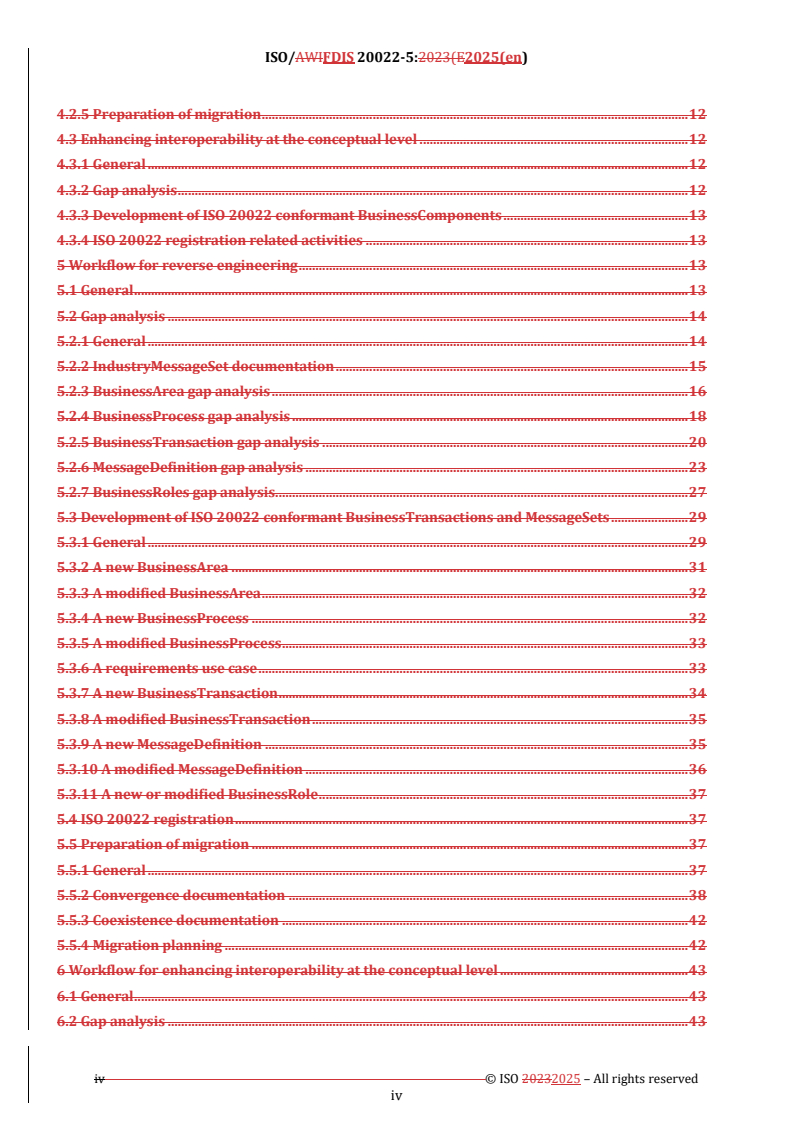
Contents
Foreword . vi
Introduction . vii
1 Scope . 1
2 Normative references . 1
3 Terms and definitions . 1
4 Background . 2
5 Activities and deliverables . 4
5.1 General. 4
5.2 Reverse engineering . 4
5.3 Enhancing interoperability at the conceptual level . 6
6 Workflow for reverse engineering . 7
6.1 General. 7
6.2 Gap analysis . 8
6.3 Development of ISO 20022 conformant BusinessTransactions and MessageSets . 31
6.4 ISO 20022 registration . 39
6.5 Preparation of migration . 39
7 Workflow for enhancing interoperability at the conceptual level . 44
7.1 General. 44
7.2 Gap analysis . 44
7.3 Development of ISO 20022 conformant BusinessComponents. 45
7.4 ISO 20022 Registration . 48
Annex A (informative) Convergence documentation . 49
Bibliography . 53
Foreword . 3
Introduction . 5
1 Scope . 7
2 Normative references . 9
3 Terms and definitions . 9
4 Activities and deliverables . 10
4.1 General . 10
4.2 Reverse engineering . 10
4.2.1 General . 10
4.2.2 Gap analysis . 10
4.2.3 Development of ISO 20022 conformant BusinessTransactions and MessageSets . 11
4.2.4 ISO 20022 registration related activities . 11
© ISO 2025 – All rights reserved
iii
ISO/AWIFDIS 20022-5:2023(E2025(en)
4.2.5 Preparation of migration . 12
4.3 Enhancing interoperability at the conceptual level . 12
4.3.1 General . 12
4.3.2 Gap analysis . 12
4.3.3 Development of ISO 20022 conformant BusinessComponents . 13
4.3.4 ISO 20022 registration related activities . 13
5 Workflow for reverse engineering . 13
5.1 General . 13
5.2 Gap analysis . 14
5.2.1 General . 14
5.2.2 IndustryMessageSet documentation . 15
5.2.3 BusinessArea gap analysis . 16
5.2.4 BusinessProcess gap analysis . 18
5.2.5 BusinessTransaction gap analysis . 20
5.2.6 MessageDefinition gap analysis . 23
5.2.7 BusinessRoles gap analysis . 27
5.3 Development of ISO 20022 conformant BusinessTransactions and MessageSets . 29
5.3.1 General . 29
5.3.2 A new BusinessArea . 31
5.3.3 A modified BusinessArea . 32
5.3.4 A new BusinessProcess . 32
5.3.5 A modified BusinessProcess . 33
5.3.6 A requirements use case . 33
5.3.7 A new BusinessTransaction . 34
5.3.8 A modified BusinessTransaction . 35
5.3.9 A new MessageDefinition . 35
5.3.10 A modified MessageDefinition . 36
5.3.11 A new or modified BusinessRole . 37
5.4 ISO 20022 registration . 37
5.5 Preparation of migration . 37
5.5.1 General . 37
5.5.2 Convergence documentation . 38
5.5.3 Coexistence documentation . 42
5.5.4 Migration planning . 42
6 Workflow for enhancing interoperability at the conceptual level . 43
6.1 General . 43
6.2 Gap analysis . 43
iv © ISO 20232025 – All rights reserved
iv
ISO/DISFDIS 20022-5:2025(en)
6.3 Development of ISO 20022 conformant BusinessComponents . 43
6.3.1 General . 43
6.3.2 A new BusinessComponent . 45
6.3.3 A modified BusinessComponent . 45
6.4 ISO 20022 Registration . 46
Annex A . 47
Bibliography . 51
© ISO 2025 – All rights reserved
v
ISO/AWIFDIS 20022-5:2023(E2025(en)
Foreword
ISO (the International Organization for Standardization) is a worldwide federation of national standards
bodies (ISO member bodies). The work of preparing International Standards is normally carried out through
ISO technical committees. Each member body interested in a subject for which a technical committee has been
established has the right to be represented on that committee. International organizations, governmental and
non-governmental, in liaison with ISO, also take part in the work. ISO collaborates closely with the
International Electrotechnical Commission (IEC) on all matters of electrotechnical standardization.
The procedures used to develop this document and those intended for its further maintenance are described
in the ISO/IEC Directives, Part 1. In particular, the different approval criteria needed for the different types of
ISO document should be noted. This document was drafted in accordance with the editorial rules of the
ISO/IEC Directives, Part 2 (see www.iso.org/directives).
ISO draws attention to the possibility that the implementation of this document may involve the use of (a)
patent(s). ISO takes no position concerning the evidence, validity or applicability of any claimed patent rights
in respect thereof. As of the date of publication of this document, ISO had not received notice of (a) patent(s)
which may be required to implement this document. However, implementers are cautioned that this may not
represent the latest information, which may be obtained from the patent database available at
www.iso.org/patents. ISO shall not be held responsible for identifying any or all such patent rights.
Any trade name used in this document is information given for the convenience of users and does not
constitute an endorsement.
For an explanation of the voluntary nature of standards, the meaning of ISO specific terms and expressions
related to conformity assessment, as well as information about ISO's adherence to the World Trade
Organization (WTO) principles in the Technical Barriers to Trade (TBT), see www.iso.org/iso/foreword.html.
This document was prepared by Technical Committee ISO/TC 68, Financial services, Subcommittee SC 9,
Information exchange for financial services.
This second edition cancels and replaces the first edition (ISO 20022-5:2013), which has been technically
revised.
The main changes compared with ISO 20022-5:2013 are as follows:
— Activities and workflows for enhancing interoperability at the conceptual level have been added.
— Reverse engineering workflow has been amended based on previous experience.
A list of all parts in the ISO 20022 series can be found on the ISO website.
Any feedback or questions on this document should be directed to the user’s national standards body. A
complete listing of these bodies can be found at www.iso.org/members.html.
vi © ISO 20232025 – All rights reserved
vi
ISO/DISFDIS 20022-5:2025(en)
Introduction
The ISO 20022 series defines a scalable, methodical process to ensure consistent descriptions of messages
throughout the financial services industry.
The purpose of the ISO 20022 series is to describe precisely and completely the externally observable aspects
of financial services messaging in a way that can be verified independently against operational messaging.
The trigger for the creation of the ISO 20022 series was the rapid growth in the scale and sophistication of
[1]
messaging within financial services during the 1990s using the ISO 15022 series. . The financial services
industry (from here onhereafter referred to as "the industry") created the first version of the ISO 20022 series
as the successor to the ISO 15022 series in response to that trigger. Since the ISO 15022 series, the industry
has broadened the scope from securities to the entire industry for the ISO 20022 series.
The ISO 20022 series is based on open technology standards, which historically have evolved more rapidly
than the industry itself. Consequently, the ISO 20022 series adopted a model-driven approach where the
model of the industry's messaging can evolve separately from the evolution of the messaging technology
standards. The period during which the ISO 20022 series has emerged followed the widespread adoption of
the internet. for business. The eXtensible Mark-up Language (XML) emerged as the de facto standard for
document representation on the internet and it became the first syntax for the ISO 20022 series.
The modelling process is further refined into three levels which, in addition to the messaging technology
standard, is why the ISO 20022 series is based on four levels: the scope level, the conceptual level, the logical
level and the physical level.
[2][ ]
This four-level approach is based on the first four levels of the Zachman Framework. 0 . The remaining two
levels of the Zachman Framework are equivalent to the implementations and the operational levels,
respectively.
In ISO 20022-1, the first, second and third levels are described in Unified Modelling Language (UML) because
it is widely supported and supports multiple levels of abstraction. The models created in accordance with the
ISO 20022 series-1 are technology independent in that they do not require any particular physical expression
or implementation. Such models aim to describe all parts of the message exchange. The models form the
definition of the protocol between participants exchanging messages. The ISO 20022 series-1 defines a
method that describes a process by which these models can be created and maintained by the modellers.
The modelsmodel artefacts are stored in an ISO 20022 Repository (hereafter referred to as "the Repository").
The Repository and the Physicalphysical level artefacts are storedexposed in a central repositorypublicly
accessible location, such as a website, serviced by a Registration Authority. The name and contact information
of the registration authorityRegistration Authority for this documentthe ISO 20022 series can be found at
www.iso.org/maintenance_agencieswww.iso.org/maintenance_agencies.
The ISO 20022 series’ repository is available on the internet and offers public access for browsing.
The Repository is organized into two areas:
— — a DataDictionary containing the industry model elements likely to have further or repeated use.;
— — a BusinessProcessCatalogue that contains models describing specific message definitions and
business processes, and physical syntax implementations.
The ISO 20022 series is organized into the following parts.
— — ISO 20022-1 describes in Meta-Object Facility (MOF) the metamodel of all the models and the
[3]
Repository. according to ISO/IEC 19502:2005 (MOF).
© ISO 2025 – All rights reserved
vii
ISO/AWIFDIS 20022-5:2023(E2025(en)
— — ISO 20022-2 covers the UML profile, a grounding of general UML into a specific subset defined for the
[4]
ISO 20022 series (to be used when UML is selected to define the models). ).
[5]
— — ISO 20022-3 describes a modelling method to produce models for the ISO 20022 series. .
— — ISO 20022-4 covers XML schema generation rules to transform a Logicallogical level model into a
[6]
Physicalphysical level description in the syntaxes. .
— — This document covers business concept model interoperability, and logical model alignment and
reverse engineering.
— — ISO 20022-6 covers message transport characteristics that define the quality of service required by
[7]
the business process definitions so that they can operate successfully. .
— — ISO 20022-7 describes the process of managing the registration of models and physical syntax
[8]
implementations. .
— — ISO 20022-8 gives ASN.1 syntax generation rules to transform a Logicallogical level model into a
[9]
Physicalphysical level description in ASN.1. .
— — ISO 20022-9 describes generic guidelines, which are used to define schema generation rules for any
[10]
specific syntax. .
viii © ISO 20232025 – All rights reserved
viii
ISO/DIS 20022-5:2025(en)
DRAFT International Standard
Financial services — Universal financial industry message scheme —
Part 5:
Conceptual interoperability and reverse engineering
1 Scope
This document defines a scalable, methodical process to ensure business concept model interoperability, and
logical model alignment and reverse engineering.
This document givesprovides guidance on conceptual interoperability and reverse engineering to explain how
to extract relevant information from existing IndustryMessageSet, proprietary MessageSet or business model
in order to prepare the submission to the ISO 20022 Registration Authority of equivalent, ISO 20022
conformant BusinessTransactions, BusinessComponents (including BusinessElements and Constraints) and
MessageSets.
This document describes the activities of ISO 20022 conceptual interoperability and reverse engineering from
the point of view of the user who wants to verify that the business functionality, covered by their own
IndustryMessageSet, proprietary MessageSets or business model, is covered by ISO 20022 conformant
BusinessTransactions, BusinessComponents (including BusinessElements and Constraints) and MessageSets.
2 Normative references
The following documents are referred to in the text in such a way that some or all of their content constitutes
requirements of this document. For dated references, only the edition cited applies. For undated references,
the latest edition of the referenced document (including any amendments) applies.
ISO 20022--1, Financial services — Universal financial industry message scheme — Part 1: Metamodel
3 Terms and definitions
For the purposes of this document, the terms and definitions given in ISO 20022-1 and the following apply.
ISO and IEC maintain terminology databases for use in standardization at the following addresses:
— ISO Online browsing platform: available at https://www.iso.org/obp
— IEC Electropedia: available at https://www.electropedia.org/
3.1
IndustryMessage
message that offers a particular MessageDefinition functionality (possibly multi-functional) and whose
MessageDefinition is part of an IndustryMessageSet
3.2
message item
element or field used at a particular place in a MessageDefinition
ISO/AWIFDIS 20022-5:2023(E2025(en)
Note 1 to entry: This exact place is typically described by the MessagePath.
3.3
MessagePath
exact position in a particular MessageDefinition
Note 1 to entry: This position is uniquely identified by the full hierarchy (i.e. “path”) from the message level (i.e. the
highest level) down to the element level (i.e. the lowest level).
3.4
convergence
planned replacement of IndustryMessageSet (or proprietary MessageSet) with ISO 20022 MessageSet
3.5
coexistence
compatible, contemporaneous use of IndustryMessageSet (or proprietary MessageSet) with ISO 20022
MessageSet for similar or related business purposes
3.6
interoperability
ability of ISO 20022 conformant MessageSets and IndustryMessageSets to cooperate and collaborate, with the
aim of sharing and making use of data
4 Background
This document was prepared to complement ISO 20022-1. The ISO 20022 Repository contains all ISO 20022
conformant BusinessTransactions, BusinessComponents (including BusinessElements and Constraints) and
MessageSets, as outlined in ISO 20022-1. The approach to be followed for adding ISO 20022 conformant
BusinessTransactions, BusinessComponents (including BusinessElements and Constraints) and MessageSets
to the Repository can be classified according to the following scenarios.:
a) a) Case 1:
1) — No ISO 20022 conformant BusinessTransactions and MessageSets exist.
2) — No IndustryMessageSet exists.
EXAMPLE 1 Collective investment vehicles.
3) — Approach: full development of ISO 20022 conformant BusinessTransactions and MessageSets
using ISO 20022-3.
b) b) Case 2:
1) — No ISO 20022 conformant BusinessTransactions and MessageSets exist.
2) — One or more IndustryMessageSets, proprietary MessageSets or business models exist.
EXAMPLE 2 Securities Pre-Trade (FIX IndustryMessageSet exists).
3) — Approach option 1 (reverse engineering): conversion of the IndustryMessageSet(s) or
proprietary MessageSet(s) into ISO 20022 conformant BusinessTransactions and MessageSets, using
this document.
2 © ISO 20232025 – All rights reserved
ISO/DISFDIS 20022-5:2025(en)
4) — Approach option 2 (enhance interoperability at the conceptual level): modelling of the
IndustryMessageSet(s) into ISO 20022 conformant BusinessComponents (including
BusinessElements and Constraints), using this document.
c) c) Case 3:
1) — ISO 20022 conformant BusinessTransactions and MessageSets exist.
2) — One or more existing IndustryMessageSets, proprietary MessageSets or business models exist
as well.
EXAMPLE 3 Securities Post-Trade (FIX and Omgeo IndustryMessageSets exist).
3) — Approach option 1 (reverse engineering): comparison of the existing IndustryMessageSet(s)
with the ISO 20022 conformant BusinessTransactions and MessageSets and extension of the
ISO 20022 conformant BusinessTransactions and MessageSets, using this document.
4) — Approach option 2 (enhance interoperability at the conceptual level): comparison of the
existing IndustryMessageSet(s) with the ISO 20022 conformant BusinessTransactions and
MessageSets, and enhancement or extension of the ISO 20022 conformant BusinessComponents
(including BusinessElements and Constraints), using this document.
This document describes the activities of ISO 20022 conceptual interoperability and reverse engineering from
the point of view of the user who wants to verify that the business functionality, covered by their own
IndustryMessageSet, proprietary MessageSets or business model, is covered by ISO 20022 conformant
BusinessTransactions, BusinessComponents (including BusinessElements and Constraints) and MessageSets.
The intention of this document is not to attempt to define a “methodology” for reverse engineering.
This document describes the following set of activities:
— — extract relevant information from existing IndustryMessageSets, proprietary MessageSets or business
model and compare it to the related information in the ISO 20022 Repository;
— — use the results of this comparison for the development of ISO 20022 conformant
BusinessTransactions, BusinessComponents (including BusinessElements and Constraints) and
MessageSets as necessary;
— — submit the resulting update requests to the Registration Authority;
— — prepare the migration to the ISO 20022 conformant BusinessTransactions and MessageSets for
community of users who desires a migration.
The main objectives of this document are to:
— — capture the industry knowledge covered by existing IndustryMessageSets and business models;
— — build upon former standardization efforts in the industry when building ISO 20022 conformant
BusinessTransactions, BusinessComponents (including BusinessElements and Constraints) and
MessageSets;
— — ensure that the resulting ISO 20022 conformant BusinessTransactions, BusinessComponents
(including BusinessElements and Constraints) and MessageSets cover fully the business scope of existing
IndustryMessageSets;
© ISO 2025 – All rights reserved
ISO/AWIFDIS 20022-5:2023(E2025(en)
— — facilitate interoperability between existing IndustryMessageSets or proprietary MessageSets or
business models and ISO 20022 conformant BusinessTransactions, BusinessComponents (including
BusinessElements and Constraints) and MessageSets when applicable;
— — support the migration from existing IndustryMessageSets to ISO 20022 conformant
BusinessTransactions and MessageSets if needed by users of IndustryMessageSets.
NOTE Whilst API Resources are not explicitly stipulated in this document, the same thought process for conceptual
interoperability and reverse engineering is expected to apply for API Resources, once they become available for
Registration.
5 Activities and deliverables
5.1 General
This clause is subdivided as follows:
— — 4.25.2 describes the major objectives and deliverables related to activities of reverse engineering at the
Logicallogical and Physicalphysical level.
— — 4.35.3 describes the major objectives and deliverables related to activities of enhancing interoperability
at the conceptual level.
5.2 Reverse engineering
5.2.1 General
There are four main activities in the ISO 20022 reverse engineering:
— — gap analysis;
— — development of ISO 20022 conformant BusinessTransactions and MessageSets;
— — ISO 20022 registration;
— — preparation of migration.
5.2.2 Gap analysis
The objectives of the gap analysis are to:
— — determine the BusinessArea of the IndustryMessageSet and identify the corresponding BusinessArea,
BusinessProcesses, activities and supporting BusinessTransactions in the ISO 20022 BusinessProcess
Catalogue;
— — compare BusinessRoles in ISO 20022 BusinessProcesses and BusinessTransactions to the parties that
use the IndustryMessages, or that are identified in the IndustryMessages;
— — verify whether existing MessageInstances offer the complete MessageDefinition functionality that is
offered by the IndustryMessages;
— — evaluate whether the business content of the relevant MessageInstances cover the business content of
the individual IndustryMessages;
— — compare the meaning and the data typing of the used MessageComponentTypes and
BusinessComponents to the individual IndustryMessage items.
4 © ISO 20232025 – All rights reserved
ISO/DISFDIS 20022-5:2025(en)
If there are any gaps, the deliverables of the gap analysis are as follows:
— a) Documentation concerning the coverage, the differences and the gaps between the
IndustryMessageSet and the ISO 20022 conformant BusinessTransactions and MessageSets. This
documentation concerns the following repository items:
— — BusinessAreas;
— — BusinessProcesses;
— — BusinessTransactions and MessageSets;
— — MessageDefinitions (including MessageDefinition Constraints);
— — BusinessRoles;
— — BusinessComponents (including BusinessElements and Constraints);
— — MessageComponentTypes (including MessageElements and Constraints);
— — DataTypes.
— b) The documentation of the IndustryMessageSet for those repository items that were missing (i.e. the
gaps) or for which a difference was identified.
5.2.3 Development of ISO 20022 conformant BusinessTransactions and MessageSets
The objectives of this activity are to:
— — complete the gap analysis with all additional information that is required to define or complete
ISO 20022 conformant BusinessTransactions and MessageSets;
— — define the required updates and additions to the existing ISO 20022 conformant BusinessTransactions
and MessageSets.
This step shall focus only on the identified gaps and differences. It shall verify whether a valid request exists
to include this additional information to rectify these gaps and differences in the ISO 20022 repository. It shall
also take into account that theThe goal of reverse engineering is not to question (except with respect to
business justification), modify or complement the business functionality that is currently supported in the
IndustryMessageSet.
The deliverable of this activity is a detailed documentation describing how the existing ISO 20022 conformant
BusinessTransactions and MessageSets shall be updated to incorporate the identified gaps and differences.
5.2.4 ISO 20022 registration related activities
The objective of this activity is to prepare the information in order for the ISO 20022 Registration Authority
to request the update of the ISO 20022 repository with all required additions and modifications.
The deliverables are the requests to the ISO 20022 Registration Authority to add or modify either Dictionary
Items or Catalogue Items, or both.
© ISO 2025 – All rights reserved
ISO/AWIFDIS 20022-5:2023(E2025(en)
5.2.5 Preparation of migration
The objective of this activity is to define and document the relationship between the IndustryMessageSet and
ISO 20022 conformant BusinessTransactions and MessageSets. The required amount of information depends
on the chosen migration path:
— — In case of migration, it is sufficient to document the relationship in a way that supports the
convergence towards ISO 20022 and to define a plan for the migration to the ISO 20022 conformant
BusinessTransactions and MessageSets.
— — In case of coexistence, there is a need to document the relationship that supports coexistence of
ISO 20022 and the IndustryMessageSets.
The deliverables of this activity are:
a) 1) the convergence documentation and the migration plan (in case of migration);
b) 2) the coexistence documentation (in case of coexistence).
5.3 Enhancing interoperability at the conceptual level
5.3.1 General
There are three main activities in enhancing interoperability at the conceptual level:
— — gap analysis;
— — development of ISO 20022 conformant BusinessComponents (including BusinessElements and
Constraints);
— — ISO 20022 registration.
5.3.2 Gap analysis
The objectives of the gap analysis are to:
— — determine the BusinessArea of the IndustryMessageSet, proprietary MessageSet or business model,
and identify the corresponding BusinessArea, BusinessProcesses, activities and supporting
BusinessTransactions in the ISO 20022 BusinessProcess Catalogue if there are any;
— — compare BusinessRoles in ISO 20022 BusinessProcesses and BusinessTransactions to the parties that
use the IndustryMessageSet, proprietary MessageSet or business model;
— — compare BusinessComponents and BusinessElements in ISO 20022 repository to the business
components and business elements that are identified in the IndustryMessageSet, proprietary MessageSet
or business model. The definitions of BusinessComponents and BusinessElements should also be
compared.
The deliverables of the gap analysis are as follows:
— a) Document the coverage, the differences and the gaps between the IndustryMessageSet, proprietary
MessageSet or business model, and the ISO 20022 conformant BusinessTransactions and
BusinessProcesses (including conceptual and contextual). This documentation concerns the following
repository items:
— — BusinessAreas;
6 © ISO 20232025 – All rights reserved
ISO/DISFDIS 20022-5:2025(en)
— — BusinessProcesses;
— — BusinessTransactions;
— — BusinessRoles;
— — BusinessComponents (including BusinessElements and Constraints);
— — DataTypes.
— b) The documentation of the BusinessComponents (including BusinessElements and Constraints) for
those repository items that were missing or for which a conceptual or contextual difference was identified
(i.e. the differences and gaps).
5.3.3 Development of ISO 20022 conformant BusinessComponents
The objectives of this activity are to:
— — complete the gap analysis with all additional information that is required to define or complete
ISO 20022 conformant BusinessComponents (including BusinessElements and Constraints);
— — define the required updates and additions to the existing ISO 20022 conformant BusinessComponents
(including BusinessElements and Constraints), or additions of new ISO 20022 conformant
BusinessComponents (including BusinessElements and Constraints).
This step shall focus only on the identified gaps and differences at the conceptual model layer between the ISO
20022 repository and the IndustryMessageSet, proprietary MessageSet or business model. It shall verify
whether a valid request exists to include these additional concepts to rectify the gaps and differences in the
ISO 20022 repository to facilitate conceptual interoperability.
The deliverable of this activity is a detailed documentation describing how the existing ISO 20022 conformant
BusinessComponents and BusinessElements shall be updated to incorporate the identified gaps and
differences.
5.3.4 ISO 20022 registration related activities
The objective of this activity is to prepare the information in order for the ISO 20022 Registration Authority
to request the update of the ISO 20022 repository with all required additions and modifications.
The deliverables are the requests to the ISO 20022 Registration Authority to add or modify
BusinessComponents (including BusinessElements and Constraints).
6 Workflow for reverse engineering
6.1 General
This clause contains a detailed workflow description of the four main activities in ISO 20022 reverse
engineering.
© ISO 2025 – All rights reserved
ISO/AWIFDIS 20022-5:2023(E2025(en)
6.2 Gap analysis
6.2.1 General
6.2.1.1 Preliminary remarks
The gap analysis requires considerable expertise and documentation regarding the IndustryMessageSet. In
case this documentation is not readily available, it is necessary to perform a thorough analysis of the
IndustryMessageSet and its use (see the first step in Figure 1).0).
The gap analysis also requires considerable documentation about the ISO 20022 conformant
BusinessTransactions and MessageSets. The repository outputs include this documentation.
Gap analysis is crucial for all subsequent steps.
— — identifying the differences and gaps defines the scope of the subsequent development of ISO 20022
conformant BusinessTransactions and MessageSets and ISO 20022 registration;
— — identifying the overlaps provides the required information for the convergence documentation and
the related migration.
8 © ISO 20232025 – All rights reserved
ISO/DISFDIS 20022-5:2025(en)
6.2.1.2 Main steps
Figure 1 — Main steps in gap analysis
These steps, which are described in more detail in 6.2.26.2.2 to 6.2.7,6.2.7, are executed in an iterative and
incremental way. In the “reverse engineering case 2” scenario (i.e. no existing ISO 20022 conformant
BusinessTransactions and MessageSets, as described in the Scope)), it is necessary to collect only the
IndustryMessageSet documentation.
© ISO 2025 – All rights reserved
ISO/AWIFDIS 20022-5:2023(E2025(en)
6.2.2 IndustryMessageSet documentation
The recommended approach to complete the IndustryMessageSet documentation is depicted in Figure 20 and
as follows:
a) a) Start from the description of the IndustryMessage.
b) b) For each IndustryMessage, describe the MessageDefinition functionality (i.e. the purpose or
purposes for which the IndustryMessage can be used). IndustryMessages can be multi-functional and that
each function should be described.
c) c) Describe the business meaning for each IndustryMessage item the business meaning. The
meaning of the Item can depend on the specific MessageDefinition functionality, in case the
IndustryMessage is multi-functional. In this case, all meanings shall be described.
NOTE 1 One of the big challenges of this step is to identify the real business meaning of the fields, e.g. one
IndustryMessage field can contain multiple BusinessElements and can contain partial BusinessElements. In such
cases, it can be combined with other IndustryMessage fields to obtain meaningful BusinessElements.
NOTE 2 A multi-functional IndustryMessage can also contain fields to specify the used functionality. These fields
do not have a corresponding MessageElement in the MessageInstance. For these fields, the MessageDefinition
functionality they represent is documented.
NOTE 3 An IndustryMessage can contain “technical” fields, which have no business meaning. In some cases, these
fields can have a corresponding technical MessageElement in the ISO 20022 MessageDefinition but they do not have
a corresponding BusinessElement.
d) d) Extract from each IndustryMessage the BusinessRoles. This is done by identifying the
functional roles of the sender and the receiver of the IndustryMessage and by identifying the functional
roles of all other parties that appear in the IndustryMessage content.
NOTE 4 “BusinessRoles” indicate functional roles (e.g. buyer, seller).
e) e) Analyse the use of the IndustryMessages in order to identify the “BusinessTransactions” (i.e.
the different message flows that occur in the industry) in which the IndustryMessages are used. Document
each of these BusinessTransactions, ideally using a message flow diagram and a textual description.
f) f) Analyse the list of identified BusinessTransactions in order to identify the BusinessProcesses
that are supported.
g) g) Identify the BusinessArea(s) to which the BusinessProcesses belong.
h) h) Create documentation in the same format as ISO 20022 Message Definition Report.
10 © ISO 20232025 – All rights reserved
ISO/DISFDIS 20022-5:2025(en)
© ISO 2025 – All rights reserved
ISO/AWIFDIS 20022-5:2023(E2025(en)
Figure 2 — Recommended approach to complete the IndustryMessageSet documentation
If the IndustryMessageSet is well documented (i.e. a full description including the BusinessArea, the
BusinessProcesses and the BusinessTransactions), IndustryMessageSet documentation is limited to step 8:
the creation of the IndustryMessageSet documentation in the same format as ISO 20022 Message Definition
Report.
In many cases, however, the IndustryMessageSet documentation focuses only on the MessageDefinitions and
mainly documents the functionality and content of all IndustryMessages. In some cases, even this
documentation can be very limited (e.g. restricted to a description of the physical structure). In these cases, it
is recommended to carry out all of the eight steps of IndustryMessageSet documentation.
6.2.3 BusinessArea gap analysis
6.2.3.1 General
The objective of BusinessArea gap analysis is to identify the ISO 20022 BusinessAreas for which the
IndustryMessageSet is used. Additionally, investigate whether the IndustryMe
...
Questions, Comments and Discussion
Ask us and Technical Secretary will try to provide an answer. You can facilitate discussion about the standard in here.
Loading comments...