


ISO/IEC 9594-4:2001
(Main)Information technology — Open Systems Interconnection — The Directory: Procedures for distributed operation — Part 4:
Information technology — Open Systems Interconnection — The Directory: Procedures for distributed operation — Part 4:
ISO/IEC 9594-4:2001 specifies the procedures by which the distributed components of the Directory interwork in order to provide a consistent service to its users.
Technologies de l'information — Interconnexion de systèmes ouverts (OSI) — L'annuaire: Procédures pour le fonctionnement réparti — Partie 4:
L'ISO/CEI 9594-4:2001 spécifie les procédures d'interfonctionnement que les composants répartis de l'annuaire mettent en oeuvre pour fournir un service cohérent à ses utilisateurs.
General Information
- Status
- Withdrawn
- Publication Date
- 14-Dec-2001
- Withdrawal Date
- 14-Dec-2001
- Drafting Committee
- ISO/IEC JTC 1/SC 6/WG 7 - Network, transport and future network
- Current Stage
- 9599 - Withdrawal of International Standard
- Start Date
- 02-Nov-2009
- Completion Date
- 12-Feb-2026
Relations
- Effective Date
- 06-Jun-2022
- Effective Date
- 16-Oct-2025
- Effective Date
- 16-Oct-2025
- Effective Date
- 15-Apr-2008
- Effective Date
- 15-Apr-2008
ISO/IEC 9594-4:2001 - Information technology -- Open Systems Interconnection -- The Directory: Procedures for distributed operation
ISO/IEC 9594-4:2001 - Technologies de l'information -- Interconnexion de systemes ouverts (OSI) -- L'annuaire: Procédures pour le fonctionnement réparti
Get Certified
Connect with accredited certification bodies for this standard

BSI Group
BSI (British Standards Institution) is the business standards company that helps organizations make excellence a habit.

NYCE
Mexican standards and certification body.
Sponsored listings
Frequently Asked Questions
ISO/IEC 9594-4:2001 is a standard published by the International Organization for Standardization (ISO). Its full title is "Information technology — Open Systems Interconnection — The Directory: Procedures for distributed operation — Part 4:". This standard covers: ISO/IEC 9594-4:2001 specifies the procedures by which the distributed components of the Directory interwork in order to provide a consistent service to its users.
ISO/IEC 9594-4:2001 specifies the procedures by which the distributed components of the Directory interwork in order to provide a consistent service to its users.
ISO/IEC 9594-4:2001 is classified under the following ICS (International Classification for Standards) categories: 35.100.70 - Application layer. The ICS classification helps identify the subject area and facilitates finding related standards.
ISO/IEC 9594-4:2001 has the following relationships with other standards: It is inter standard links to ISO/TS 17425:2016, ISO/IEC 9594-4:1998/Cor 2:2002, ISO/IEC 9594-4:1998/Cor 1:2001, ISO/IEC 9594-4:2005, ISO/IEC 9594-4:1998. Understanding these relationships helps ensure you are using the most current and applicable version of the standard.
ISO/IEC 9594-4:2001 is available in PDF format for immediate download after purchase. The document can be added to your cart and obtained through the secure checkout process. Digital delivery ensures instant access to the complete standard document.
Standards Content (Sample)
INTERNATIONAL ISO/IEC
STANDARD 9594-4
Fourth edition
2001-12-15
Information technology — Open Systems
Interconnection — The Directory:
Procedures for distributed operation
Technologies de l'information — Interconnexion de systèmes ouverts
(OSI) — L'annuaire: Procédures pour le fonctionnement réparti
Reference number
©
ISO/IEC 2001
PDF disclaimer
This PDF file may contain embedded typefaces. In accordance with Adobe's licensing policy, this file may be printed or viewed but
shall not be edited unless the typefaces which are embedded are licensed to and installed on the computer performing the editing. In
downloading this file, parties accept therein the responsibility of not infringing Adobe's licensing policy. The ISO Central Secretariat
accepts no liability in this area.
Adobe is a trademark of Adobe Systems Incorporated.
Details of the software products used to create this PDF file can be found in the General Info relative to the file; the PDF-creation
parameters were optimized for printing. Every care has been taken to ensure that the file is suitable for use by ISO member bodies. In
the unlikely event that a problem relating to it is found, please inform the Central Secretariat at the address given below.
© ISO/IEC 2001
All rights reserved. Unless otherwise specified, no part of this publication may be reproduced or utilized in any form or by any means,
electronic or mechanical, including photocopying and microfilm, without permission in writing from either ISO at the address below or
ISO's member body in the country of the requester.
ISO copyright office
Case postale 56 • CH-1211 Geneva 20
Tel. + 41 22 749 01 11
Fax + 41 22 749 09 47
E-mail copyright@iso.org
Web www.iso.org
Published by ISO in 2002
Printed in Switzerland
ii © ISO/IEC 2001 – All rights reserved
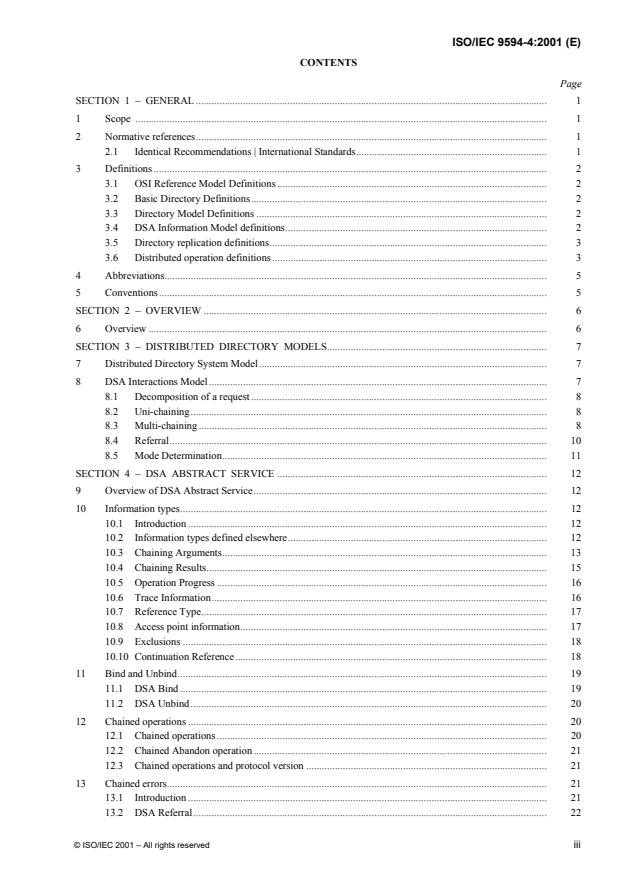
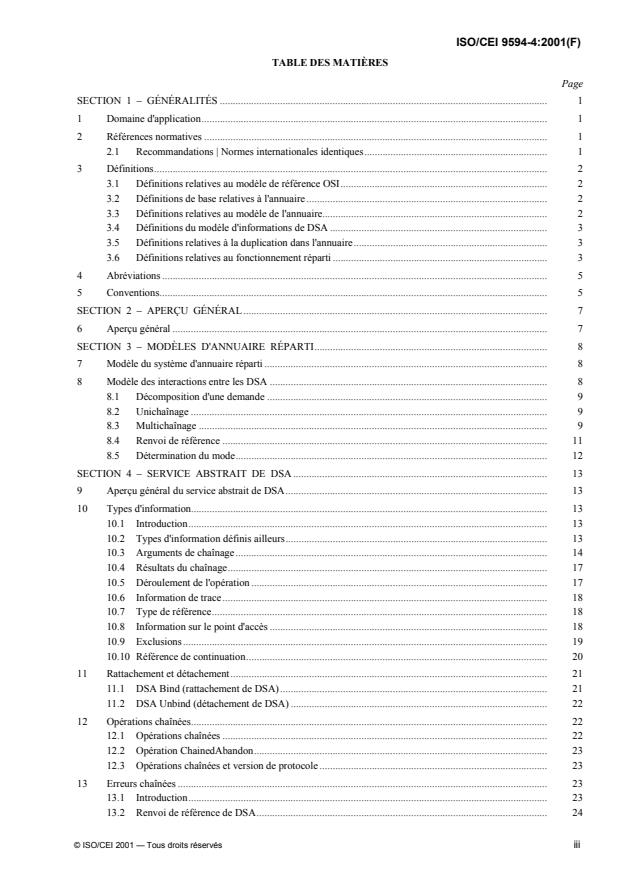
CONTENTS
Page
SECTION 1 – GENERAL . 1
1 Scope . 1
2 Normative references. 1
2.1 Identical Recommendations | International Standards. 1
3 Definitions . 2
3.1 OSI Reference Model Definitions . 2
3.2 Basic Directory Definitions. 2
3.3 Directory Model Definitions . 2
3.4 DSA Information Model definitions. 2
3.5 Directory replication definitions. 3
3.6 Distributed operation definitions . 3
4 Abbreviations. 5
5 Conventions. 5
SECTION 2 – OVERVIEW . 6
6 Overview . 6
SECTION 3 – DISTRIBUTED DIRECTORY MODELS. 7
7 Distributed Directory System Model. 7
8 DSA Interactions Model . 7
8.1 Decomposition of a request . 8
8.2 Uni-chaining. 8
8.3 Multi-chaining. 8
8.4 Referral. 10
8.5 Mode Determination. 11
SECTION 4 – DSA ABSTRACT SERVICE . 12
9 Overview of DSA Abstract Service. 12
10 Information types. 12
10.1 Introduction . 12
10.2 Information types defined elsewhere. 12
10.3 Chaining Arguments. 13
10.4 Chaining Results. 15
10.5 Operation Progress . 16
10.6 Trace Information. 16
10.7 Reference Type. 17
10.8 Access point information. 17
10.9 Exclusions . 18
10.10 Continuation Reference. 18
11 Bind and Unbind. 19
11.1 DSA Bind . 19
11.2 DSA Unbind. 20
12 Chained operations . 20
12.1 Chained operations . 20
12.2 Chained Abandon operation . 21
12.3 Chained operations and protocol version . 21
13 Chained errors. 21
13.1 Introduction . 21
13.2 DSA Referral. 22
© ISO/IEC 2001 – All rights reserved iii
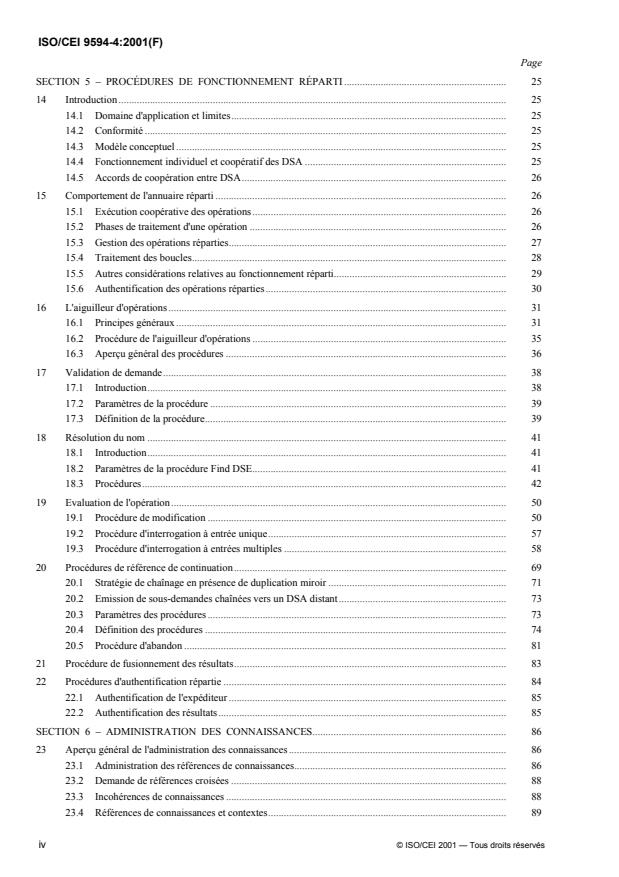
Page
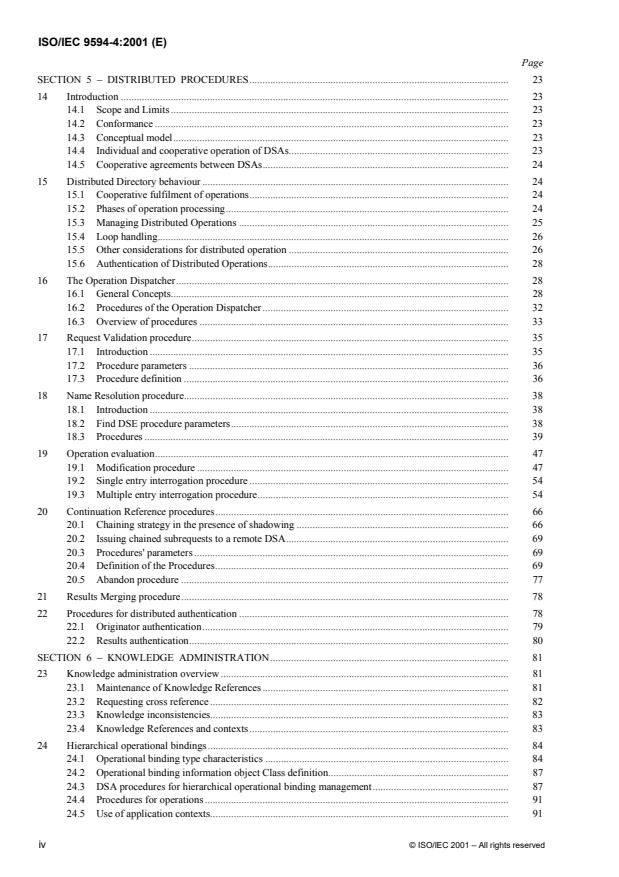
SECTION 5 – DISTRIBUTED PROCEDURES. 23
14 Introduction . 23
14.1 Scope and Limits . 23
14.2 Conformance . 23
14.3 Conceptual model. 23
14.4 Individual and cooperative operation of DSAs. 23
14.5 Cooperative agreements between DSAs. 24
15 Distributed Directory behaviour . 24
15.1 Cooperative fulfilment of operations. 24
15.2 Phases of operation processing. 24
15.3 Managing Distributed Operations . 25
15.4 Loop handling. 26
15.5 Other considerations for distributed operation . 26
15.6 Authentication of Distributed Operations. 28
16 The Operation Dispatcher. 28
16.1 General Concepts. 28
16.2 Procedures of the Operation Dispatcher. 32
16.3 Overview of procedures . 33
17 Request Validation procedure. 35
17.1 Introduction . 35
17.2 Procedure parameters . 36
17.3 Procedure definition . 36
18 Name Resolution procedure. 38
18.1 Introduction . 38
18.2 Find DSE procedure parameters. 38
18.3 Procedures . 39
19 Operation evaluation. 47
19.1 Modification procedure . 47
19.2 Single entry interrogation procedure . 54
19.3 Multiple entry interrogation procedure. 54
20 Continuation Reference procedures. 66
20.1 Chaining strategy in the presence of shadowing . 66
20.2 Issuing chained subrequests to a remote DSA. 69
20.3 Procedures' parameters . 69
20.4 Definition of the Procedures. 69
20.5 Abandon procedure . 77
21 Results Merging procedure. 78
22 Procedures for distributed authentication . 78
22.1 Originator authentication. 79
22.2 Results authentication. 80
SECTION 6 – KNOWLEDGE ADMINISTRATION. 81
23 Knowledge administration overview . 81
23.1 Maintenance of Knowledge References . 81
23.2 Requesting cross reference . 82
23.3 Knowledge inconsistencies. 83
23.4 Knowledge References and contexts. 83
24 Hierarchical operational bindings. 84
24.1 Operational binding type characteristics . 84
24.2 Operational binding information object Class definition. 87
24.3 DSA procedures for hierarchical operational binding management. 87
24.4 Procedures for operations . 91
24.5 Use of application contexts. 91
iv © ISO/IEC 2001 – All rights reserved
Page
25 Non-specific hierarchical operational binding. 91
25.1 Operational binding type characteristics . 91
25.2 Operational binding information object class definition . 92
25.3 DSA procedures for non-specific hierarchical operational binding management . 93
25.4 Procedures for operations . 94
25.5 Use of application contexts. 94
Annex A – ASN.1 for Distributed Operations . 95
Annex B – Example of distributed name resolution . 99
Annex C – Distributed use of authentication . 101
C.1 Summary . 101
C.2 Distributed protection model. 101
C.3 Signed Chained Operations . 102
C.4 Encrypted Chained Operations. 103
C.5 Signed and Encrypted Distributed Operations. 106
Annex D – Specification of hierarchical and non-specific hierarchical operational binding types. 108
Annex E – Knowledge maintenance example. 110
Annex F – Amendments and corrigenda. 112
© ISO/IEC 2001 – All rights reserved v
Foreword
ISO (the International Organization for Standardization) and IEC (the International Electrotechnical Commission) form
the specialized system for worldwide standardization. National bodies that are members of ISO or IEC participate in the
development of International Standards through technical committees established by the respective organization to deal
with particular fields of technical activity. ISO and IEC technical committees collaborate in fields of mutual interest.
Other international organizations, governmental and non-governmental, in liaison with ISO and IEC, also take part in the
work. In the field of information technology, ISO and IEC have established a joint technical committee, ISO/IEC JTC 1.
International Standards are drafted in accordance with the rules given in the ISO/IEC Directives, Part 3.
The main task of the joint technical committee is to prepare International Standards. Draft International Standards
adopted by the joint technical committee are circulated to national bodies for voting. Publication as an International
Standard requires approval by at least 75 % of the national bodies casting a vote.
Attention is drawn to the possibility that some of the elements of this part of ISO/IEC 9594 may be the subject of patent
rights. ISO and IEC shall not be held responsible for identifying any or all such patent rights.
Users and implementors should note the existence of a “defect resolution” procedure in ISO/IEC JTC 1 to identify and
correct errors in International Standards through the publication of Technical Corrigenda. Identical corrections are made
to the corresponding ITU-T Recommendations through Corrigenda and may also be made in the form of Implementors'
Guides. Details of Technical Corrigenda to International Standards are available on the ISO website; published Technical
Corrigenda can be obtained via the ISO webstore or from the ISO and IEC national bodies. Corrigenda and
Implementors' Guides to ITU-T Recommendations can be obtained from the ITU-T website.
ISO/IEC 9594-4 was prepared by Joint Technical Committee ISO/IEC JTC 1, Information technology, Subcommittee
SC 6, Telecommunications and information exchange between systems, in collaboration with ITU-T. The identical text is
published as ITU-T Rec. X.518.
This fourth edition of ISO/IEC 9594-4 constitutes a technical revision of the third edition (ISO/IEC 9594-4:1998), which
is provisionally retained in order to support implementations based on the third edition. This edition also incorporates
Corrigendum 1:2002.
ISO/IEC 9594 consists of the following parts, under the general title Information technology — Open Systems
Interconnection — The Directory:
— Part 1: Overview of concepts, models and services
— Part 2: Models
— Part 3: Abstract service definition
— Part 4: Procedures for distributed operation
— Part 5: Protocol specifications
— Part 6: Selected attribute types
— Part 7: Selected object classes
— Part 8: Public-key and attribute certificate frameworks
— Part 9: Replication
— Part 10: Use of systems management for administration of the Directory
Annexes A and D form a normative part of this part of ISO/IEC 9594. Annexes B, C, E and F are for information only.
vi © ISO/IEC 2001 – All rights reserved
Introduction
This Recommendation | International Standard part together with other Recommendations | International Standards, has
been produced to facilitate the interconnection of information processing systems to provide directory services. A set of
such systems, together with the directory information that they hold, can be viewed as an integrated whole, called the
Directory. The information held by the Directory, collectively known as the Directory Information Base (DIB), is
typically used to facilitate communication between, with or about objects such as application entities, people, terminals
and distribution lists.
The Directory plays a significant role in Open Systems Interconnection, whose aim is to allow, with a minimum of
technical agreement outside of the interconnection standards themselves, the interconnection of information processing
systems:
– from different manufacturers;
– under different managements;
– of different levels of complexity; and
– of different ages.
This Recommendation | International Standard specifies the procedures by which the distributed components of the
Directory interwork in order to provide a consistent service to its users.
This fourth edition technically revises and enhances, but does not replace, the third edition of this Recommendation |
International Standard. Implementations may still claim conformance to the third edition. However, at some point, the
third edition will not be supported (i.e. reported defects will no longer be resolved). It is recommended that
implementations conform to this fourth edition as soon as possible.
This fourth edition specifies version 1 and version 2 of the Directory protocols.
The first and second editions specified only version 1. Most of the services and protocols specified in this edition are
designed to function under version 1. However, some enhanced services and protocols, e.g. signed errors, will not
function unless all Directory entities involved in the operation have negotiated version 2. Whichever version has been
negotiated, differences between the services and between the protocols defined in the four editions, except for those
specifically assigned to version 2, are accommodated using the rules of extensibility defined in this edition of ITU-T
Rec. X.519 | ISO/IEC 9594-5.
Annex A, which is an integral part of this Recommendation | International Standard, provides the ASN.1 module for
directory distributed operations.
Annex B, which is not an integral part of this Recommendation | International Standard, describes an example of
distributed name resolution.
Annex C, which is not an integral part of this Recommendation | International Standard, describes authentication in the
distributed operations environment.
Annex D, which is an integral part of this Recommendation | International Standard, provides the definitions of the
ASN.1 information object classes introduced in this Directory Specification.
Annex E, which is not an integral part of this Recommendation | International Standard, illustrates knowledge
maintenance.
Annex F, which is not an integral part of this Recommendation | International Standard, lists the amendments and defect
reports that have been incorporated to form this edition of this Recommendation | International Standard.
© ISO/IEC 2001 – All rights reserved vii
INTERNATIONAL STANDARD
ITU-T RECOMMENDATION
Information technology – Open Systems Interconnection –
The Directory: Procedures for distributed operation
SECTION 1 – GENERAL
1 Scope
This Recommendation | International Standard specifies the behaviour of DSAs taking part in the distributed Directory
application. The allowed behaviour has been designed so as to ensure a consistent service given a wide distribution of the
DIB across many DSAs.
The Directory is not intended to be a general purpose database system, although it may be built on such systems. It is
assumed that there is a considerably higher frequency of queries than of updates.
2 Normative references
The following Recommendations and International Standards contain provisions which, through reference in this text,
constitute provisions of this Recommendation | International Standard. At the time of publication, the editions indicated
were valid. All Recommendations and Standards are subject to revision, and parties to agreements based on this
Recommendation | International Standard are encouraged to investigate the possibility of applying the most recent
edition of the Recommendations and Standards listed below. Members of IEC and ISO maintain registers of currently
valid International Standards. The Telecommunication Standardization Bureau of the ITU maintains a list of currently
valid ITU-T Recommendations.
2.1 Identical Recommendations | International Standards
– ITU-T Recommendation X.200 (1994) | ISO/IEC 7498-1:1994, Information technology – Open Systems
Interconnection – Basic Reference Model: The Basic Model.
– ITU-T Recommendation X.500 (2001) | ISO/IEC 9594-1:2001, Information technology – Open Systems
Interconnection – The Directory: Overview of concepts, models and services.
– ITU-T Recommendation X.501 (2001) | ISO/IEC 9594-2:2001, Information technology – Open Systems
Interconnection – The Directory: Models.
– ITU-T Recommendation X.509 (2000) | ISO/IEC 9594-8:2001, Information technology – Open Systems
Interconnection – The Directory: Public-key and attribute certificate frameworks.
– ITU-T Recommendation X.511 (2001) | ISO/IEC 9594-3:2001, Information technology – Open Systems
Interconnection – The Directory: Abstract service definition.
– ITU-T Recommendation X.519 (2001) | ISO/IEC 9594-5:2001, Information technology – Open Systems
Interconnection – The Directory: Protocol specifications.
– ITU-T Recommendation X.520 (2001) | ISO/IEC 9594-6:2001, Information technology – Open Systems
Interconnection – The Directory: Selected attribute types.
– ITU-T Recommendation X.521 (2001) | ISO/IEC 9594-7:2001, Information technology – Open Systems
Interconnection – The Directory: Selected object classes.
– ITU-T Recommendation X.525 (2001) | ISO/IEC 9594-9:2001, Information technology – Open Systems
Interconnection – The Directory: Replication.
– ITU-T Recommendation X.530 (2001) | ISO/IEC 9594-10:2001, Information technology – Open Systems
Interconnection – The Directory: Use of systems management for administration of the Directory.
ITU-T Rec. X.518 (02/2001) 1
– ITU-T Recommendation X.680 (1997) | ISO/IEC 8824-1:1998, Information technology – Abstract Syntax
Notation One (ASN.1): Specification of basic notation.
– ITU-T Recommendation X.681 (1997) | ISO/IEC 8824-2:1998, Information technology – Abstract Syntax
Notation One (ASN.1): Information object specification.
– ITU-T Recommendation X.682 (1997) | ISO/IEC 8824-3:1998, Information technology – Abstract Syntax
Notation One (ASN.1): Constraint specification.
– ITU-T Recommendation X.683 (1997) | ISO/IEC 8824-4:1998, Information technology – Abstract Syntax
Notation One (ASN.1): Parameterization of ASN.1 specifications.
– ITU-T Recommendation X.880 (1994) | ISO/IEC 13712-1:1995, Information technology – Remote
Operations: Concepts, model and notation plus Technical Corrigendum 1 (1995).
– ITU-T Recommendation X.880 (1994)/Amd.1(1995) | ISO/IEC 13712-1:1995/Amd.1:1996, Information
technology – Remote Operations: Concepts, model and notation – Amendment 1: Built-in operations.
– ITU-T Recommendation X.881 (1994) | ISO/IEC 13712-2:1995, Information technology – Remote
Operations: OSI realizations – Remote Operations Service Element (ROSE) service definition.
– ITU-T Recommendation X.881 (1994)/Amd.1(1995) | ISO/IEC 13712-2:1995/Amd.1:1996, Information
technology – Remote Operations: OSI realizations – Remote Operations Service Element (ROSE) service
definition – Amendment 1: Mapping to A-UNIT-DATA and built-in operations.
3 Definitions
For the purposes of this Recommendation | International Standard the following definitions apply:
3.1 OSI Reference Model Definitions
The following term is defined in ITU-T Rec. X.200 | ISO/IEC 7498-1:
a) application entity title.
3.2 Basic Directory Definitions
The following terms are defined in ITU-T Rec. X.500 | ISO/IEC 9594-1:
a) (the) Directory;
b) Directory Information Base.
3.3 Directory Model Definitions
The following terms are defined in ITU-T Rec. X.501 | ISO/IEC 9594-2:
a) access point;
b) alias;
c) distinguished name;
d) Directory Information Tree;
e) Directory System Agent (DSA);
f) Directory User Agent (DUA);
g) relative distinguished name.
3.4 DSA Information Model definitions
The following terms are defined in ITU-T Rec. X.501 | ISO/IEC 9594-2:
a) category;
b) commonly usable;
c) context prefix;
d) cross reference;
2 ITU-T Rec. X.518 (02/2001)
e) DIB fragment;
f) DSA information tree;
g) DSA-Specific Entry (DSE);
h) DSE type;
i) immediate superior reference;
j) knowledge information;
k) knowledge reference category;
l) knowledge reference type;
m) naming context;
n) non-specific knowledge;
o) non-specific subordinate reference;
p) operational attribute;
q) reference path;
r) specific knowledge;
s) subordinate reference;
t) superior reference.
3.5 Directory replication definitions
The following terms are defined in ITU-T Rec. X.525 | ISO/IEC 9594-9:
a) attribute completeness;
b) shadowing operational binding;
c) subordinate completeness;
d) unit of replication.
3.6 Distributed operation definitions
The following terms are defined in this Recommendation | International Standard:
3.6.1 base object: The object or alias entry that is the target for an operation as issued by the originator.
3.6.2 chaining: The generic term for uni-chaining or multi-chaining.
3.6.3 context prefix information: Operational and user information supplied by the superior DSA to the subordinate
DSA in a RHOB regarding DIT vertices superior to the subordinate context prefix.
3.6.4 distributed name resolution: The process by which name resolution is performed in more than one DSA.
3.6.5 error: Information sent from the performer to the requester conveying a negative outcome of a previously
received request.
3.6.6 hard error: A definite error which indicates that the operation cannot currently be performed without external
intervention.
3.6.7 hierarchical operational binding (HOB): Relationship between two master DSAs holding naming contexts,
one of which is immediately subordinate to the other, in which the superior DSA holds a subordinate reference to the
subordinate DSA.
3.6.8 modification operations: These are the Directory Modify Operations, i.e. Modify Entry, Add Entry, Remove
Entry and Modify DN.
3.6.9 multi-chaining: A mode of interaction in which a DSA processing a request itself sends multiple requests
either in parallel or sequentially to a set of other DSAs.
3.6.10 multiple entry interrogation operations: These are the Directory Search Operations, i.e. List and Search.
ITU-T Rec. X.518 (02/2001) 3
3.6.11 name resolution: The process of locating an entry by sequentially matching each RDN in a purported name to
a vertex of the DIT.
3.6.12 non-specific hierarchical operational binding (NHOB): Relationship between two master DSAs holding
naming contexts, one of which is immediately subordinate to the other, in which the superior DSA holds a non-specific
subordinate reference to the subordinate DSA.
3.6.13 NSSR decomposition: Decomposition of non-specific knowledge references into subrequests for other DSAs
to pursue; these subrequests may be either chained to these DSAs by the DSA performing the decomposition, or a
continuation reference identifying the DSAs may be returned to the requester for it to pursue, or the decomposing DSA
may pursue some of the subrequests, leaving others unexplored for the requester to pursue.
3.6.14 operation progress: A set of values which denotes the extent to which name resolution has taken place.
3.6.15 originator: The DUA that has initiated a specific (distributed) operation.
3.6.16 performer: DSA receiving a request (i.e. to perform an operation).
3.6.17 procedure: An (informal) specification of how a DSA maps a given set of input arguments and its DSA
information tree into a result.
NOTE – Input arguments and results may correspond to information received in a requested operation and information sent in a
reply, or they may represent intermediate stages in the computation of a reply from a requested operation. In 14.2 the former
variety of input arguments and results are termed external.
3.6.18 relevant hierarchical operational binding (RHOB): Either a HOB or a NHOB, depending on the context.
3.6.19 referral: An outcome which can be returned by a DSA which cannot perform an operation itself, and which
identifies one or more other DSAs more able to perform the operation.
3.6.20 reply: A result or an error.
3.6.21 request: Information consisting of an operation code and associated arguments to convey a directory operation
from a requester to a performer.
3.6.22 request decomposition: Decomposition of a request into subrequests for other DSAs to pursue; these
subrequests may be either chained to these DSAs by the DSA performing the decomposition, or continuation references
identifying the DSAs may be returned to the requester for it to pursue, or the decomposing DSA may pursue some of the
subrequests, leaving others unexplored for the requester to pursue.
3.6.23 requester: A DUA or DSA sending a request to perform (i.e. invoke) an operation.
3.6.24 single entry interrogation operations: These are the Directory Read Operations, i.e. Read and Compare.
3.6.25 soft error: An error which may be transient, or which may indicate a localized problem, in which case the use
of a different knowledge reference or access point may enable a result or hard error to be obtained.
3.6.26 subordinate DSA: Of the two DSAs sharing a HOB or a NHOB, the DSA holding the subordinate naming
context.
3.6.27 subrequest: A request generated by request decomposition.
3.6.28 superior DSA: Of the two DSAs sharing a HOB or a NHOB, the DSA holding the superior naming context.
3.6.29 superior, subordinate DSA: Two master DSAs holding naming contexts, one of which is immediately
subordinate to the other; the relationship between the two DSAs is managed explicitly via a HOB (or NHOB), or exists
implicitly by virtue of the superior DSA holding a subordinate (or non-specific subordinate) reference to the
subordinate DSA.
3.6.30 target object name: The name of an entry either to which the operation is to be directed at a particular stage of
name resolution, or which is involved in the evaluation of the operation.
3.6.31 uni-chaining: A mode of interaction optionally used by a DSA which cannot perform an operation itself. The
DSA chains by invoking an operation of another DSA and then relaying the outcome to the original requester.
4 ITU-T Rec. X.518 (02/2001)
4 Abbreviations
For the purposes of this Recommendation | International Standard, the following abbreviations apply:
ASN.1 Abstract Syntax Notation One
DISP Directory Information Shadowing Protocol
DMD Directory Management Domain
DOP Directory Operational Binding Management Protocol
DSE DSA-Specific Entry
HOB Hierarchical Operational Binding
NHOB Non-specific Hierarchical Operational Binding
NSSR Non-specific Subordinate Reference
RHOB Relevant Hierarchical Operational Binding
5 Conventions
With minor exceptions this Directory Specification has been prepared according to the "Rules for presentation of ITU-T |
ISO/IEC common text" in the Guide for ITU-T and ISO/IEC JTC 1 Cooperation, October 1996.
The term "Directory Specification" (as in "this Directory Specification") shall be taken to mean ITU-T Rec. X.518 |
ISO/IEC 9594-4. The term "Directory Specifications" shall be taken to mean the X.500-series Recommendations and all
parts of ISO/IEC 9594.
This Directory Specification uses the term "1988 edition systems" to refer to systems conforming to the first edition of
the Directory Specifications, i.e. the 1988 edition of the series of CCITT X.500 Recommendations and the ISO/IEC
9594:1990 edition. This Directory Specification uses the term "1993 edition systems" to refer to systems conforming to
the second (1993) edition of the Directory Specifications, i.e. the 1993 edition of the series of ITU-T X.500
Recommendations and the ISO/IEC 9594:1995 edition. This Directory Specification uses the term "1997 edition
systems" to refer to systems conforming to the third edition of the Directory Specifications, i.e. the 1997 edition of the
series of ITU-T X.500 Recommendations and the ISO/IEC 9594:1998 edition. This Directory Specification uses the term
"4th edition systems" to refer to systems conforming to this fourth edition of the Directory Specifications, i.e. the 2001
editions of ITU-T X.500, X.501, X.511, X.518, X.519, X.520, X.521, X.525, and X.530, the 2000 edition of ITU-T
X.509, and parts 1-10 of the ISO/IEC 9594:2001 edition.
This Directory Specification presents ASN.1 notation in the bold Helvetica typeface. When ASN.1 types and values are
referenced in normal text, they are differentiated from normal text by presenting them in the bold Helvetica typeface.
The names of procedures, typically referenced when specifying the semantics of processing, are differentiated from
normal text by displaying them in bold Times. Access control permissions are presented in italicized Times.
If the items in a list are numbered (as opposed to using "–" or letters), then the items shall be considered steps in a
procedure.
This Directory Specification defines directory operations using the Remote Operation notation defined in
ITU-T Rec. X.880 | ISO/IEC 13712-1.
ITU-T Rec. X.518 (02/2001) 5
SECTION 2 – OVERVIEW
6 Overview
The Directory Abstract Service allows the interrogation, retrieval and modification of Directory information in the DIB.
This service is described in terms of the abstract Directory object as specified in ITU-T Rec. X.511 | ISO/IEC 9594-3.
Necessarily, the specification of the abstract Directory object does not in any way address the physical realization of the
Directory: in particular it does not address the specification of Directory System Agents (DSA) within which the DIB is
stored and managed, and through which the service is provided. Furthermore, it does not consider whether the DIB is
centralized, i.e. contained within a single DSA, or distributed over a number of DSAs. Consequently, the requirements
for DSAs to have knowledge of, navigate to, and cooperate with other DSAs, in order to support the abstract service in a
distributed environment is also not covered by the service description.
This Directory Specification specifies the refinement of the abstract Directory object, the refinement being expressed in
terms of a set of one or more DSA objects which collectively constitute the distributed directory service.
In addition, this Directory Specification specifies the permissible ways in which the DIB may be distributed over one or
more DSAs. For the limiting case where the DIB is contained within a single DSA, the Directory is in fact centralized;
for the case where the DIB is distributed over two or more DSAs, knowledge and navigation mechanisms are specified
which ensure that the whole of the DIB is potentially accessible from all DSAs that hold constituent entries.
Portions of the DIB may also be replicated in multiple DSAs. The protocols described in this Directory Specification
allow the use of replicated information to improve the availability, performance and efficiency of the distributed
directory service. The use of replicated information is, to some extent, under the user's control, through the use of service
control options. The procedures described in this Directory Specification also indicate some of the opportunities for
design optimizations when using the replicated information.
Additionally, request handling interactions are specified that enable particular operational characteristics of the Directory
to be controlled by its users. In particular, the user has control over whether a DSA, responding to a directory inquiry
pertaining to information held in other DSA(s), has the option of interrogating the other DSA(s) directly (chaining) or,
whether it should respond with information about other DSA(s) which could further progress the inquiry (referral).
Generally, the decision by a DSA to chain or refer is determined by the service controls set by the user, and by the DSA's
own administrative, operational or technical circumstances.
Recognizing that, in general, the Directory will be distributed, and that directory inquiries will be satisfied by an arbitrary
number of cooperating DSAs which may arbitrarily chain or refer according to the above criteria, this Directory
Specification specifies the appropriate procedures to be effected by DSAs in responding to distributed directory
inquiries. These procedures will ensure that users of the distributed Directory service perceive it to be both user-friendly
and
...
NORME ISO/CEI
INTERNATIONALE 9594-4
Quatrième édition
2001-12-15
Technologies de l'information —
Interconnexion de systèmes ouverts
(OSI) — L'annuaire: Procédures pour
le fonctionnement réparti
Information technology — Open Systems Interconnection —
The Directory: Procedures for distributed operation
Numéro de référence
ISO/CEI 9594-4:2001(F)
©
ISO/CEI 2001
ISO/CEI 9594-4:2001(F)
PDF – Exonération de responsabilité
Le présent fichier PDF peut contenir des polices de caractères intégrées. Conformément aux conditions de licence d'Adobe, ce fichier
peut être imprimé ou visualisé, mais ne doit pas être modifié à moins que l'ordinateur employé à cet effet ne bénéficie d'une licence
autorisant l'utilisation de ces polices et que celles-ci y soient installées. Lors du téléchargement de ce fichier, les parties concernées
acceptent de fait la responsabilité de ne pas enfreindre les conditions de licence d'Adobe. Le Secrétariat central de l'ISO décline toute
responsabilité en la matière.
Adobe est une marque déposée d'Adobe Systems Incorporated.
Les détails relatifs aux produits logiciels utilisés pour la création du présent fichier PDF sont disponibles dans la rubrique General Info
du fichier; les paramètres de création PDF ont été optimisés pour l'impression. Toutes les mesures ont été prises pour garantir
l'exploitation de ce fichier par les comités membres de l'ISO. Dans le cas peu probable où surviendrait un problème d'utilisation,
veuillez en informer le Secrétariat central à l'adresse donnée ci-dessous.
© ISO/CEI 2001
Droits de reproduction réservés. Sauf prescription différente, aucune partie de cette publication ne peut être reproduite ni utilisée sous
quelque forme que ce soit et par aucun procédé, électronique ou mécanique, y compris la photocopie et les microfilms, sans l'accord écrit
de l'ISO à l'adresse ci-après ou du comité membre de l'ISO dans le pays du demandeur.
ISO copyright office
Case postale 56 • CH-1211 Geneva 20
Tel. + 41 22 749 01 11
Fax. + 41 22 749 09 47
E-mail copyright@iso.org
Web www.iso.org
Publié par l'ISO en 2002
Version française parue en 2003
Publié en Suisse
ii © ISO/CEI 2001 — Tous droits réservés
ISO/CEI 9594-4:2001(F)
TABLE DES MATIÈRES
Page
SECTION 1 – GÉNÉRALITÉS . 1
1 Domaine d'application. 1
2 Références normatives . 1
2.1 Recommandations | Normes internationales identiques. 1
3 Définitions. 2
3.1 Définitions relatives au modèle de référence OSI. 2
3.2 Définitions de base relatives à l'annuaire . 2
3.3 Définitions relatives au modèle de l'annuaire. 2
3.4 Définitions du modèle d'informations de DSA . 3
3.5 Définitions relatives à la duplication dans l'annuaire. 3
3.6 Définitions relatives au fonctionnement réparti . 3
4 Abréviations . 5
5 Conventions. 5
SECTION 2 – APERÇU GÉNÉRAL . 7
6 Aperçu général . 7
SECTION 3 – MODÈLES D'ANNUAIRE RÉPARTI. 8
7 Modèle du système d'annuaire réparti . 8
8 Modèle des interactions entre les DSA . 8
8.1 Décomposition d'une demande . 9
8.2 Unichaînage . 9
8.3 Multichaînage . 9
8.4 Renvoi de référence . 11
8.5 Détermination du mode. 12
SECTION 4 – SERVICE ABSTRAIT DE DSA . 13
9 Aperçu général du service abstrait de DSA. 13
10 Types d'information. 13
10.1 Introduction. 13
10.2 Types d'information définis ailleurs. 13
10.3 Arguments de chaînage. 14
10.4 Résultats du chaînage. 17
10.5 Déroulement de l'opération . 17
10.6 Information de trace. 18
10.7 Type de référence. 18
10.8 Information sur le point d'accès . 18
10.9 Exclusions. 19
10.10 Référence de continuation. 20
11 Rattachement et détachement. 21
11.1 DSA Bind (rattachement de DSA). 21
11.2 DSA Unbind (détachement de DSA) . 22
12 Opérations chaînées. 22
12.1 Opérations chaînées . 22
12.2 Opération ChainedAbandon. 23
12.3 Opérations chaînées et version de protocole . 23
13 Erreurs chaînées . 23
13.1 Introduction. 23
13.2 Renvoi de référence de DSA. 24
© ISO/CEI 2001 — Tous droits réservés iii
ISO/CEI 9594-4:2001(F)
Page
SECTION 5 – PROCÉDURES DE FONCTIONNEMENT RÉPARTI . 25
14 Introduction . 25
14.1 Domaine d'application et limites. 25
14.2 Conformité . 25
14.3 Modèle conceptuel . 25
14.4 Fonctionnement individuel et coopératif des DSA . 25
14.5 Accords de coopération entre DSA. 26
15 Comportement de l'annuaire réparti . 26
15.1 Exécution coopérative des opérations. 26
15.2 Phases de traitement d'une opération . 26
15.3 Gestion des opérations réparties. 27
15.4 Traitement des boucles. 28
15.5 Autres considérations relatives au fonctionnement réparti. 29
15.6 Authentification des opérations réparties. 30
16 L'aiguilleur d'opérations . 31
16.1 Principes généraux . 31
16.2 Procédure de l'aiguilleur d'opérations . 35
16.3 Aperçu général des procédures . 36
17 Validation de demande. 38
17.1 Introduction. 38
17.2 Paramètres de la procédure . 39
17.3 Définition de la procédure. 39
18 Résolution du nom . 41
18.1 Introduction. 41
18.2 Paramètres de la procédure Find DSE. 41
18.3 Procédures. 42
19 Evaluation de l'opération. 50
19.1 Procédure de modification . 50
19.2 Procédure d'interrogation à entrée unique. 57
19.3 Procédure d'interrogation à entrées multiples . 58
20 Procédures de référence de continuation. 69
20.1 Stratégie de chaînage en présence de duplication miroir . 71
20.2 Emission de sous-demandes chaînées vers un DSA distant. 73
20.3 Paramètres des procédures . 73
20.4 Définition des procédures . 74
20.5 Procédure d'abandon . 81
21 Procédure de fusionnement des résultats. 83
22 Procédures d'authentification répartie . 84
22.1 Authentification de l'expéditeur . 85
22.2 Authentification des résultats. 85
SECTION 6 – ADMINISTRATION DES CONNAISSANCES. 86
23 Aperçu général de l'administration des connaissances . 86
23.1 Administration des références de connaissances. 86
23.2 Demande de références croisées . 88
23.3 Incohérences de connaissances . 88
23.4 Références de connaissances et contextes. 89
iv © ISO/CEI 2001 — Tous droits réservés
ISO/CEI 9594-4:2001(F)
Page
24 Rattachements opérationnels hiérarchiques. 89
24.1 Caractéristiques du type de rattachement opérationnel. 89
24.2 Définition de la classe d'objets d'information de type operational-binding. 92
24.3 Procédures de DSA pour la gestion des rattachements opérationnels hiérarchiques . 93
24.4 Procédures pour les opérations. 97
24.5 Utilisation des contextes d'application . 97
25 Rattachement opérationnel hiérarchique non spécifique. 97
25.1 Caractéristiques typiques du rattachement opérationnel . 97
25.2 Définition de la classe d'objets d'information de rattachement opérationnel . 99
25.3 Procédures relatives au DSA pour la gestion des rattachements opérationnels non spécifiques. 99
25.4 Procédures applicables aux opérations. 101
25.5 Utilisation des contextes d'application . 101
Annexe A – ASN.1 pour les opérations réparties. 102
Annexe B – Exemple de résolution répartie du nom . 106
Annexe C – Utilisation répartie de l'authentification. 108
C.1 Résumé. 108
C.2 Modèle de protection répartie . 108
C.3 Opérations chaînées signées. 109
C.4 Opérations chaînées chiffrées . 110
C.5 Opérations réparties signées et chiffrées. 113
Annexe D – Spécification des types de rattachement opérationnel hiérarchique et de rattachement opérationnel
hiérarchique non spécifique. 115
Annexe E – Exemple d'administration des connaissances. 118
Annexe F – Amendements et corrigenda. 121
© ISO/CEI 2001 — Tous droits réservés v
ISO/CEI 9594-4:2001(F)
Avant-propos
L'ISO (Organisation internationale de normalisation) et la CEI (Commission électrotechnique internationale)
forment le système spécialisé de la normalisation mondiale. Les organismes nationaux membres de l'ISO ou
de la CEI participent au développement de Normes internationales par l'intermédiaire des comités techniques
créés par l'organisation concernée afin de s'occuper des domaines particuliers de l'activité technique. Les
comités techniques de l'ISO et de la CEI collaborent dans des domaines d'intérêt commun. D'autres
organisations internationales, gouvernementales et non gouvernementales, en liaison avec l'ISO et la CEI
participent également aux travaux. Dans le domaine des technologies de l'information, l'ISO et la CEI ont créé
un comité technique mixte, l'ISO/CEI JTC 1.
Les Normes internationales sont rédigées conformément aux règles données dans les Directives ISO/CEI,
Partie 3.
La tâche principale du comité technique mixte est d'élaborer les Normes internationales. Les projets de
Normes internationales adoptés par le comité technique mixte sont soumis aux organismes nationaux pour
vote. Leur publication comme Normes internationales requiert l'approbation de 75 % au moins des
organismes nationaux votants.
L'attention est appelée sur le fait que certains des éléments du présent document peuvent faire l'objet de
droits de propriété intellectuelle ou de droits analogues. L'ISO et la CEI ne sauraient être tenues pour
responsables de ne pas avoir identifié de tels droits de propriété et averti de leur existence.
Il convient que ceux qui utilisent et ceux qui mettent en application des normes notent l'existence d'une
procédure de «résolution de défaut» dans l'ISO/CEI JTC 1, pour identifier et corriger des erreurs éventuelles
dans les Normes internationales, par la publication de Rectificatifs techniques. Des corrections identiques ont
lieu pour les Recommandations UIT-T correspondantes à travers des Corrigenda, et peuvent aussi se
présenter sous la forme de Guides de mise en application. Les détails concernant les Rectificatifs techniques
aux Normes internationales sont disponibles sur le site Web de l'ISO; les Rectificatifs techniques publiés
peuvent être obtenus sur le site Web de l'ISO ou auprès des comités membres de l'ISO et de la CEI. Les
Corrigenda et Guides de mise en application aux Recommandations UIT-T peuvent être obtenus sur le site
Web de l'UIT-T.
L'ISO/CEI 9594-4 a été élaborée par le comité technique mixte ISO/CEI JTC 1, Technologies de l'information,
sous-comité SC 6, Téléinformatique, en collaboration avec l'UIT-T. Le texte identique est publié en tant que
Rec. UIT-T X.518.
La quatrième édition de l'ISO/CEI 9594-4 constitue une révision technique de la troisième édition
(ISO/CEI 9594-4:1998), qui est provisoirement retenue afin de soutenir les mises en application basées sur la
troisième édition. Elle incorpore aussi le Rectificatif technique 1:2002.
L'ISO/CEI 9594 comprend les parties suivantes, présentées sous le titre général Technologies de
l'information — Interconnexion de systèmes ouverts (OSI) — L'annuaire:
Partie 1: Aperçu général des concepts, modèles et services
Partie 2: Les modèles
Partie 3: Définition du service abstrait
Partie 4: Procédures pour le fonctionnement réparti
Partie 5: Spécification du protocole
vi © ISO/CEI 2001 — Tous droits réservés
ISO/CEI 9594-4:2001(F)
Partie 6: Types d'attributs sélectionnés
Partie 7: Classes d'objets sélectionnées
Partie 8: Cadre général des certificats de clé publique et d'attribut
Partie 9: Duplication
Partie 10: Utilisation de la gestion-systèmes pour l'administration de l'annuaire
Les annexes A et D constituent des éléments normatifs de la présente partie de l'ISO/CEI 9594. Les annexes
B, C, E et F sont données uniquement à titre d'information.
© ISO/CEI 2001 — Tous droits réservés vii
ISO/CEI 9594-4:2001(F)
Introduction
La présente Recommandation | partie de Norme internationale a été élaborée, ainsi que d'autres Recommandations |
Normes internationales, pour faciliter l'interconnexion des systèmes de traitement de l'information et permettre ainsi
d'assurer des services d'annuaire. L'ensemble de tous ces systèmes, avec les informations d'annuaire qu'ils contiennent,
peut être considéré comme un tout intégré, appelé annuaire. Les informations de l'annuaire, appelées collectivement base
d'informations d'annuaire (DIB), sont généralement utilisées pour faciliter la communication entre, avec ou à propos
d'objets tels que des entités d'application, des personnes, des terminaux et des listes de distribution.
L'annuaire joue un rôle important dans l'interconnexion des systèmes ouverts, dont le but est de permettre, moyennant un
minimum d'accords techniques en dehors des normes d'interconnexion proprement dites, l'interconnexion des systèmes
de traitement de l'information:
– provenant de divers fabricants;
– gérés différemment;
– de niveaux de complexité différents;
– de générations différentes.
La présente Recommandation | Norme internationale spécifie les procédures d'interfonctionnement que les composants
répartis de l'annuaire mettent en œuvre pour fournir un service cohérent à ses utilisateurs.
Cette quatrième édition révise techniquement et améliore, mais ne remplace pas, la troisième édition de la présente
Recommandation | Norme internationale. Les implémentations peuvent encore revendiquer la conformité à la troisième
édition mais celle-ci finira par ne plus être prise en compte (c'est-à-dire que les erreurs signalées ne seront plus
corrigées). Il est recommandé que les implémentations se conforment, dès que possible, à la présente quatrième édition.
Cette quatrième édition spécifie les versions 1 et 2 des protocoles de l'annuaire.
Les première et deuxième éditions ne spécifiaient que la version 1. La plupart des services et protocoles spécifiés dans la
présente édition sont conçus pour fonctionner selon la version 1. Certains services et protocoles améliorés, par exemple
les erreurs signées, ne fonctionneront cependant pas avant que toutes les entités d'annuaire mises en jeu dans
l'exploitation aient négocié la version 2. Quelle que soit la version négociée, on a traité les différences entre les services
et entre les protocoles définis dans les quatre éditions, à l'exception de ceux qui sont spécifiquement définis dans la
version 2, en utilisant les règles d'extensibilité définies dans l'édition actuelle de la Rec. UIT-T X.519 | ISO/CEI 9594-5.
L'Annexe A, qui fait partie intégrante de la présente Recommandation | Norme internationale, fournit le module ASN.1
pour les opérations réparties de l'annuaire.
L'Annexe B, qui ne fait pas partie intégrante de la présente Recommandation | Norme internationale, décrit un exemple
de résolution répartie du nom.
L'Annexe C, qui ne fait pas partie intégrante de la présente Recommandation | Norme internationale, décrit
l'authentification dans un environnement d'opérations réparties.
L'Annexe D, qui fait partie intégrante de la présente Recommandation | Norme internationale, fournit les définitions des
classes d'objets d'information en notation ASN.1 qui sont introduites dans la présente Spécification d'annuaire.
L'Annexe E, qui ne fait pas partie intégrante de la présente Recommandation | Norme internationale, décrit la
maintenance des connaissances.
L'Annexe F, qui ne fait pas partie intégrante de la présente Recommandation | Norme internationale, énumère les
amendements et relevés de défauts qui ont été incorporés pour former la présente édition de cette Recommandation |
Norme internationale.
viii © ISO/CEI 2001 — Tous droits réservés
ISO/CEI 9594-4:2001 (F)
NORME INTERNATIONALE
RECOMMANDATION UIT-T
Technologies de l'information – Interconnexion des systèmes ouverts –
L'annuaire: procédures pour le fonctionnement réparti
SECTION 1 – GÉNÉRALITÉS
1 Domaine d'application
La présente Recommandation | Norme internationale spécifie le comportement des agents de système d'annuaire (DSA,
directory system agent) qui participent à la mise en œuvre répartie de l'annuaire. Le comportement autorisé a été conçu
pour assurer un service cohérent, compte tenu d'une large répartition de la base d'informations annuaire (DIB, directory
information base) entre de nombreux DSA.
Bien qu'il puisse être construit à partir de tels systèmes, l'annuaire n'est pas destiné à être un système de base de données
à usage général. La fréquence des demandes est censée être considérablement plus élevée que celle des mises à jour.
2 Références normatives
Les Recommandations et les Normes internationales suivantes contiennent des dispositions qui, par suite de la référence
qui y est faite, constituent des dispositions valables pour la présente Recommandation | Norme internationale. Au
moment de la publication, les éditions indiquées étaient en vigueur. Toutes Recommandations et Normes sont sujettes à
révision et les parties prenantes aux accords fondés sur la présente Recommandation | Norme internationale sont invitées
à rechercher la possibilité d'appliquer les éditions les plus récentes des Recommandations et Normes indiquées ci-après.
Les membres de la CEI et de l'ISO possèdent le registre des Normes internationales en vigueur. Le Bureau de la
normalisation des télécommunications de l'UIT tient à jour une liste des Recommandations UIT-T en vigueur.
2.1 Recommandations | Normes internationales identiques
– Recommandation UIT-T X.200 (1994) | ISO/CEI 7498-1:1994, Technologies de l'information –
Interconnexion des systèmes ouverts – Modèle de référence de base: le modèle de référence de base.
– Recommandation UIT-T X.500 (2001) | ISO/CEI 9594-1:2001, Technologies de l'information –
Interconnexion des systèmes ouverts – L'annuaire: aperçu général des concepts, modèles et services.
– Recommandation UIT-T X.501 (2001) | ISO/CEI 9594-2:2001, Technologies de l'information –
Interconnexion des systèmes ouverts – L'annuaire: les modèles.
– Recommandation UIT-T X.509 (2000) | ISO/CEI 9594-8:2001, Technologies de l'information –
Interconnexion des systèmes ouverts – L'annuaire: cadre général des certificats de clé publique et
d'attribut.
– Recommandation UIT-T X.511 (2001) | ISO/CEI 9594-3:2001, Technologies de l'information –
Interconnexion des systèmes ouverts – L'annuaire: définition du service abstrait.
– Recommandation UIT-T X.519 (2001) | ISO/CEI 9594-5:2001, Technologies de l'information –
Interconnexion des systèmes ouverts – L'annuaire: spécification du protocole.
– Recommandation UIT-T X.520 (2001) | ISO/CEI 9594-6:2001, Technologies de l'information –
Interconnexion des systèmes ouverts – L'annuaire: types d'attributs sélectionnés.
– Recommandation UIT-T X.521 (2001) | ISO/CEI 9594-7:2001, Technologies de l'information –
Interconnexion des systèmes ouverts – L'annuaire: classes d'objets sélectionnées.
Rec. UIT-T X.518 (02/2001) 1
ISO/CEI 9594-4:2001 (F)
– Recommandation UIT-T X.525 (2001) | ISO/CEI 9594-9:2001, Technologies de l'information –
Interconnexion des systèmes ouverts – L'annuaire: duplication.
– Recommandation UIT-T X.530 (2001) | ISO/CEI 9594-10:2001, Technologies de l'information –
Interconnexion des systèmes ouverts – L'annuaire: utilisation de la gestion-systèmes pour l'administration
de l'annuaire.
– Recommandation UIT-T X.680 (1997) | ISO/CEI 8824-1:1998, Technologies de l'information – Notation
de syntaxe abstraite numéro un: spécification de la notation de base.
– Recommandation UIT-T X.681 (1997) | ISO/CEI 8824-2:1998, Technologies de l'information – Notation
de syntaxe abstraite numéro un: spécification des objets informationnels.
– Recommandation UIT-T X.682 (1997) | ISO/CEI 8824-3:1998, Technologies de l'information – Notation
de syntaxe abstraite numéro un: spécification des contraintes.
– Recommandation UIT-T X.683 (1997) | ISO/CEI 8824-4:1998, Technologies de l'information – Notation
de syntaxe abstraite numéro un: paramétrage des spécifications de la notation de syntaxe abstraite
numéro un.
– Recommandation UIT-T X.880 (1994) | ISO/CEI 13712-1:1995, Technologies de l'information –
Opérations distantes: Concepts, modèle et notation plus Corrigendum technique 1 (1995).
– Recommandation UIT-T X.880 (1994)/Amd.1 (1995) | ISO/CEI 13712-1:1995/Amd.1:1996, Technologies
de l'information – Opérations distantes: Concepts, modèle et notation – Amendement 1: opérations
intégrées.
– Recommandation UIT-T X.881 (1994) | ISO/CEI 13712-2:1995, Technologies de l'information –
Opérations distantes: Réalisations OSI – Définition du service de l'élément de service d'opérations
distantes.
– Recommandation UIT-T X.881 (1994)/Amd.1 (1995) | ISO/CEI 13712-2:1995/Amd.1:1996, Technologies
de l'information – Opérations distantes: Réalisations OSI – Définition du service de l'élément de service
d'opérations distantes – Amendement 1: mappage sur A-UNIT-DATA et opérations intégrées.
3 Définitions
Pour les besoins de la présente Recommandation | Norme internationale, les définitions suivantes s'appliquent:
3.1 Définitions relatives au modèle de référence OSI
Le terme suivant est défini dans la Rec. UIT-T X.200 | ISO/CEI 7498-1:
a) titre d'entité d'application.
3.2 Définitions de base relatives à l'annuaire
Les termes suivants sont définis dans la Rec. UIT-T X.500 | ISO/CEI 9594-1:
a) (l')annuaire;
b) base d'informations annuaire.
3.3 Définitions relatives au modèle de l'annuaire
Les termes suivants sont définis dans la Rec. UIT-T X.501 | ISO/CEI 9594-2:
a) point d'accès;
b) alias; pseudonyme;
c) nom distinctif;
d) arbre d'informations annuaire;
e) agent de système d'annuaire (DSA, directory system agent);
f) agent utilisateur d'annuaire (DUA, directory user agent);
g) nom distinctif relatif.
2 Rec. UIT-T X.518 (02/2001)
ISO/CEI 9594-4:2001 (F)
3.4 Définitions du modèle d'informations de DSA
Les termes suivants sont définis dans la Rec. UIT-T X.501 | ISO/CEI 9594-2:
a) catégorie;
b) d'utilisation commune;
c) préfixe de contexte;
d) référence croisée;
e) fragment de base DIB;
f) arbre des informations de DSA;
g) entrée spécifique de DSA (DSE, DSA – specific entry);
h) type d'entrée DSE;
i) référence de supérieur immédiat;
j) information de connaissance;
k) catégorie de référence de connaissance;
l) type de référence de connaissance;
m) contexte de dénomination;
n) connaissance non spécifique;
o) référence subordonnée non spécifique;
p) attribut opérationnel;
q) chemin de référence;
r) connaissance spécifique;
s) référence subordonnée;
t) référence supérieure.
3.5 Définitions relatives à la duplication dans l'annuaire
Les termes suivants sont définis dans la Rec. UIT-T X.525 | ISO/CEI 9594-9:
a) exhaustivité d'attribut;
b) rattachement opérationnel de duplication miroir;
c) exhaustivité de subordonnés;
d) unité de duplication.
3.6 Définitions relatives au fonctionnement réparti
Les termes suivants sont définis dans la présente Recommandation | Norme internationale:
3.6.1 objet de base: entrée d'objet ou d'alias qui est l'objectif d'une opération, tel qu'il est désigné par l'entité à
l'origine de l'opération.
3.6.2 chaînage: terme générique pouvant désigner l'unichaînage et le multichaînage.
3.6.3 information du préfixe de contexte: information opérationnelle et d'utilisateur fournie par le DSA supérieur
au DSA subordonné dans un RHOB concernant les nœuds d'arbre DIT supérieurs au préfixe de contexte subordonné.
3.6.4 résolution répartie du nom: processus par lequel la résolution du nom est effectuée dans plus d'un DSA.
3.6.5 erreur: information envoyée par l'exécuteur au demandeur et acheminant un résultat négatif concernant une
demande précédemment reçue.
Rec. UIT-T X.518 (02/2001) 3
ISO/CEI 9594-4:2001 (F)
3.6.6 erreur bloquante: erreur définie qui indique que l'opération ne peut être accomplie sans intervention
extérieure.
3.6.7 rattachement opérationnel hiérarchique (HOB, hierarchical operational binding): relation entre deux DSA
maîtres détenant des contextes de dénomination, dont l'un est immédiatement subordonné à l'autre, où le DSA supérieur
détient une référence subordonnée au DSA subordonné.
3.6.8 opérations de modification: opérations de type Directory Modify (modification d'annuaire), comme Modify
Entry (modifier entrée), Add Entry (ajouter entrée), Remove Entry (supprimer entrée) et Modify DN (modifier nom
distinctif).
3.6.9 multichaînage: mode d'interaction dans lequel un DSA traitant une demande lui-même, envoie des demandes
multiples, soit parallèlement soit séquentiellement, à une série d'autres DSA.
3.6.10 opérations d'interrogation à entrées multiples: opérations de type Directory Search Operations (recherche
dans l'annuaire) comme List (listage) et Search (recherche).
3.6.11 résolution du nom: processus de localisation d'une entrée par adaptation séquentielle, à un nœud du DIT de
chaque nom distinctif relatif (RDN) contenu dans un nom prétendu.
3.6.12 rattachement opérationnel hiérarchique non spécifique (NHOB, non-specific hierarchical operational
binding): relation entre deux DSA maîtres détenant des contextes de dénomination, dont l'un est immédiatement
subordonné à l'autre, où le DSA supérieur détient une référence subordonnée non spécifique au DSA subordonné.
3.6.13 décomposition de référence subordonnée non spécifique (NSSR, non-specific subordinate reference):
décomposition de références non spécifiques de connaissances en sous-demandes de continuation adressées à des DSA;
ces sous-demandes peuvent soit être concaténées avec ces DSA par le DSA exécutant la décomposition ou prendre la
forme de références de continuation identifiant les DSA: ces références pourront être retournées au demandeur pour lui
permettre de continuer; ou bien le DSA décomposeur peut donner suite à certaines des sous-demandes, laissant les autres
sans suite, pour continuation par le demandeur.
3.6.14 avancement d'opération: série de valeurs qui dénotent la mesure dans laquelle la résolution de nom a eu lieu.
3.6.15 initiateur: DUA qui a lancé une opération spécifique (répartie).
3.6.16 exécuteur: DSA recevant une demande (pour accomplir une opération).
3.6.17 procédure: spécification (informelle) de la manière dont un DSA applique, à un résultat, une série d'arguments
d'entrée et son arbre d'informations de DSA.
NOTE – Les arguments d'entrée et les résultats peuvent correspondre à l'information reçue dans une opération demandée et à
l'information envoyée dans une réponse; ils peuvent aussi représenter des étapes intermédiaires dans le calcul d'une réponse suite à
une opération demandée. Au § 14.2, le premier type d'arguments d'entrée et de résultats est qualifié d'externe.
3.6.18 rattachement opérationnel hiérarchique approprié (RHOB, relevant hierarchical operational binding):
rattachement HOB ou NHOB, selon le contexte.
3.6.19 renvoi de référence: résultat qui peut être renvoyé par un DSA qui ne peut effectuer l'opération lui-même; ce
résultat identifie un ou plusieurs autres DSA ayant davantage la capacité d'effectuer l'opération.
3.6.20 réponse: résultat ou erreur.
3.6.21 demande: information consistant en un code d'opération et en arguments associés pour acheminer une
opération d'annuaire d'un demandeur à un exécuteur.
3.6.22 décomposition de demande: décomposition d'une demande en sous-demandes en vue de la poursuite du
traitement par d'autres DSA; ces sous-demandes peuvent être concaténées avec les DSA en question par les DSA qui
accomplissent la décomposition, ou bien des références de continuation identifiant les DSA peuvent être renvoyées au
demandeur en vue de la poursuite du traitement, ou encore le DSA qui procède à la décomposition peut poursuivre le
traitement de certaines des sous-demandes, laissant le soin au demandeur de poursuivre le traitement de celles qu'il
ignore.
3.6.23 demandeur: DUA ou DSA envoyant une demande d'exécution (c'est-à-dire invoquant) une opération.
3.6.24 opérations d'interrogation à entrée unique: opérations du type Directory Read Operations, c'est-à-dire Read
(lire) et Compare (comparer).
4 Rec. UIT-T X.518 (02/2001)
ISO/CEI 9594-4:2001 (F)
3.6.25 erreur simple: erreur qui peut être passagère ou qui peut dénoter un problème localisé, auquel cas l'utilisation
d'une référence de connaissances différente ou d'un point d'accès différent peut permettre l'obtention d'un résultat ou
d'une erreur bloquante.
3.6.26 DSA subordonné: de deux DSA partageant un HOB ou un NHOB, celui qui détient le contexte de
dénomination subordonné.
3.6.27 sous-demande: demande obtenue par subdivision d'une demande.
3.6.28 DSA supérieur: de deux DSA partageant un HOB ou NHOB, celui qui détient le contexte de dénomination
supérieur.
3.6.29 DSA subordonné: de deux DSA maîtres détenant des contextes de dénomination, celui qui est immédiatement
subordonné à l'autre; la relation entre les deux DSA est gérée de manière explicite par l'intermédiaire d'un HOB (ou
NHOB), ou existe de manière implicite du fait que le DSA supérieur détient une référence subordonnée (ou subordonnée
non spécifique) par rapport au DSA subordonné.
3.6.30 nom d'objet cible: nom d'une entrée vers laquelle l'opération doit être dirigée à un stade particulier de la
résolution du nom ou qui est impliquée dans l'évaluation de cette opération.
3.6.31 unichaînage: mode d'interaction utilisé facultativement par un DSA qui ne peut effectuer lui-même l'opération
demandée. Le DSA chaîne par invocation d'une opération d'un autre DSA puis par renvoi du résultat au demandeur
initial.
4 Abréviations
Pour les besoins de la présente Recommandation | Norme internationale, les abréviations suivantes sont utilisées:
ASN.1 Notation de syntaxe abstraite numéro un (abstract syntax notation one)
DISP Protocole de duplication miroir d'informations de l'annuaire (directory information shadowing
protocol)
DMD Domaine de gestion d'annuaire (directory management domain)
DOP Protocole de gestion des rattachements opérationnels pour l'annuaire (directory operational binding
management protocol)
DSE Entrée spécifique de DSA (DSA-specific entry)
HOB Rattachement opérationnel hiérarchique (hierarchical operational binding)
NHOB Rattachement opérationnel hiérarchique non spécifique (non-specific hierarchical operational
binding)
NSSR Référence subordonnée non spécifique (non-specific subordinate reference)
RHOB Rattachement opérationnel hiérarchique approprié (relevant hierarchical operational binding)
5 Conventions
A quelques exceptions mineures près, la présente Spécification d'annuaire a été élaborée conformément aux "Règles de
présentation des textes communs UIT-T | ISO/CEI", qui figurent dans le Guide relatif à la coopération entre l'UIT-T et
l'ISO/CEI JTC 1, octobre 1996.
Le terme "Spécification d'annuaire" (comme dans "la présente Spécification d'annuaire") s'entend selon l'acception de la
présente Recommandation | Norme internationale. Le terme "Spécification d'annuaire" s'entend selon l'acception de
toutes les Recommandations de la série X.500 et de toutes les parties de l'ISO/CEI 9594.
La présente Spécification d'annuaire utilise le terme "systèmes de l'édition 1988" pour désigner les systèmes conformes à
la première édition des Spécifications d'annuaire, c'est-à-dire à l'édition 1988 des Recommandations CCITT de la série
X.500 et de l'ISO/CEI 9594:1990. La présente Spécification d'annuaire utilise le terme "systèmes de l'édition 1993" pour
désigner les systèmes conformes à la deuxième édition (1993) des Spécifications d'annuaire, c'est-à-dire à l'édition 1993
des Recommandations UIT-T de la série X.500 et de l'ISO/CEI 9594:1995. La présente Spécification d'annuaire utilise le
terme "systèmes de l'édition 1997" pour désigner les systèmes conformes à la troisième édition des Spécifications
d'annuaire, c'est-à-dire à l'édition 1997 des Recommandations UIT-T de la série X.500 et de l'ISO/CEI 9594:1998. La
présente Spécification d'annuaire utilise le terme "systèmes de la quatrième édition" pour désigner les systèmes
conformes à la présente quatrième édition des Spécifications d'annuaire, c'est-à-dire aux éditions 2001 des
Recommandations UIT-T X.500, X.501, X.511, X.518, X.519, X.520, X.521, X.525 et X.530 et à l'édition 2000 de la
Recommandation UIT-T X.509 et aux parties 1 à 10 de l'ISO/CEI 9594:2001.
Rec. UIT-T X.518 (02/2001) 5
ISO/CEI 9594-4:2001 (F)
Cette Spécification d'annuaire présente la notation ASN.1 en caractères gras de la police Helvetica
...
Questions, Comments and Discussion
Ask us and Technical Secretary will try to provide an answer. You can facilitate discussion about the standard in here.
Loading comments...