

ISO 9044:2016
(Main)Industrial woven wire cloth — Technical requirements and tests
General Information
- Abstract
ISO 9044:2016 defines terms regarding industrial woven wire cloth for screening purposes and specifies maximum permissible error, requirements, and test methods. It applies to industrial woven wire cloth with square apertures, made of steel, stainless steel, or non-ferrous metals (see ISO 4783‑2). It does not apply to woven wire cloth coated after weaving nor does it apply to pre-crimped and welded wire screens which are covered in ISO 4783‑3 and ISO 14315. It is of limited application to woven wire cloth used for purposes other than screening which may necessitate other requirements. The alternative requirements may be agreed between the purchaser and the supplier at the time of placing the order.
- Status
- Published
- Publication Date
- 22-Jun-2016
- Technical Committee
- ISO/TC 24/SC 8 - Test sieves, sieving and industrial screens
- Drafting Committee
- ISO/TC 24/SC 8/WG 2 - Industrial wire cloth
- Current Stage
- 9020 - International Standard under periodical review
- Start Date
- 15-Jul-2026
- Completion Date
- 15-Jul-2026
Buy Documents
ISO 9044:2016 - Industrial woven wire cloth -- Technical requirements and tests
ISO 9044:2016 - Industrial woven wire cloth — Technical requirements and tests/23/2016
Overview
ISO 9044:2016 - Industrial woven wire cloth - Technical requirements and tests - defines terminology, dimensional tolerances, acceptance criteria and test methods for industrial woven wire cloth used for screening purposes. It covers square-aperture woven cloth manufactured from steel, stainless steel (including austenitic grades) and non‑ferrous metals. The standard specifies maximum permissible error, inspection documentation and requirements for manufacture, measurement and delivery, while excluding post‑weave coated cloth and pre‑crimped or welded screens (covered by other ISO documents).
Key topics
- Scope and terms: Definitions for aperture width, wire diameter, pitch, warp/weft, open screening area, weave type, firmness and mass per unit area.
- Dimensional requirements: Nominal aperture and wire diameter combinations are selected from referenced ISO tables; maximum permissible errors for aperture widths are provided (Table 1) and depend on material and nominal size.
- Tolerance parameters: The standard defines:
- Y - allowable deviation of the arithmetic mean aperture (warp and weft separately),
- s - maximum standard deviation of aperture measurements,
- X - maximum permissible positive deviation of a single aperture (single-aperture limit).
Formulas and calculation methods for Y, X and s are included.
- Quality defects: Definition and treatment of major blemishes; permissible number and nature of blemishes are agreed between purchaser and supplier.
- Test methods: Procedures for measuring wire diameter, aperture width (average and individual), material composition, overall size, flatness and weaving blemishes.
- Inspection & documentation: Requirements for certificates of compliance, test reports, inspection certificates and chemical analysis.
- Ordering & delivery: Essential ordering information, roll packing, labelling and delivery provisions.
Applications and users
ISO 9044 is practical for:
- Manufacturers of woven wire cloth and industrial screens,
- Quality-control and metrology labs performing sieve and screen testing,
- Procurement and specification engineers drafting purchase orders for screening media,
- End users in mining, aggregate processing, food, chemical, pharmaceutical and filtration/ sieving operations where accurate aperture control and screening performance matter.
The standard helps ensure consistent screening performance, interchangeability of screens and traceable inspection documentation.
Related standards
- ISO 2194 - designation and nominal sizes of openings
- ISO 4782 - metal wire for industrial wire screens
- ISO 4783‑1 / ISO 4783‑2 - guidance on aperture and wire diameter combinations
- ISO 4783‑3 and ISO 14315 - pre‑crimped and welded wire screens (exclusions)
Keywords: ISO 9044:2016, industrial woven wire cloth, screening, aperture width, wire diameter, maximum permissible error, test methods, woven wire cloth requirements.
Relations
- Effective Date
- 09-Feb-2026
- Effective Date
- 09-Feb-2026
- Referred By
CEN/TS 17627:2021 - Plastics - Recycled plastics - Determination of solid contaminants content - Effective Date
- 09-Feb-2026
- Effective Date
- 06-Jul-2012
Buy Documents
ISO 9044:2016 - Industrial woven wire cloth -- Technical requirements and tests
ISO 9044:2016 - Industrial woven wire cloth — Technical requirements and tests/23/2016
Get Certified
Connect with accredited certification bodies for this standard

Bureau Veritas Chile
Bureau Veritas certification services in Chile.
Bureau Veritas Peru
Bureau Veritas certification services in Peru.
BVQI Peru
Bureau Veritas certification in Peru.
Sponsored listings
Frequently Asked Questions
ISO 9044:2016 is a standard published by the International Organization for Standardization (ISO). Its full title is "Industrial woven wire cloth — Technical requirements and tests". This standard covers: ISO 9044:2016 defines terms regarding industrial woven wire cloth for screening purposes and specifies maximum permissible error, requirements, and test methods. It applies to industrial woven wire cloth with square apertures, made of steel, stainless steel, or non-ferrous metals (see ISO 4783‑2). It does not apply to woven wire cloth coated after weaving nor does it apply to pre-crimped and welded wire screens which are covered in ISO 4783‑3 and ISO 14315. It is of limited application to woven wire cloth used for purposes other than screening which may necessitate other requirements. The alternative requirements may be agreed between the purchaser and the supplier at the time of placing the order.
ISO 9044:2016 defines terms regarding industrial woven wire cloth for screening purposes and specifies maximum permissible error, requirements, and test methods. It applies to industrial woven wire cloth with square apertures, made of steel, stainless steel, or non-ferrous metals (see ISO 4783‑2). It does not apply to woven wire cloth coated after weaving nor does it apply to pre-crimped and welded wire screens which are covered in ISO 4783‑3 and ISO 14315. It is of limited application to woven wire cloth used for purposes other than screening which may necessitate other requirements. The alternative requirements may be agreed between the purchaser and the supplier at the time of placing the order.
ISO 9044:2016 is classified under the following ICS (International Classification for Standards) categories: 73.120 - Equipment for processing of minerals. The ICS classification helps identify the subject area and facilitates finding related standards.
ISO 9044:2016 has the following relationships with other standards: It is inter standard links to EN 15426:2018, EN ISO/ASTM 52904:2020, CEN/TS 17627:2021, ISO 9044:1999. Understanding these relationships helps ensure you are using the most current and applicable version of the standard.
ISO 9044:2016 is available in PDF format for immediate download after purchase. The document can be added to your cart and obtained through the secure checkout process. Digital delivery ensures instant access to the complete standard document.
Standards Content (Sample)
INTERNATIONAL ISO
STANDARD 9044
Third edition
2016-07-01
Industrial woven wire cloth —
Technical requirements and tests
Tissus métalliques industriels — Exigences techniques et vérifications
Reference number
©
ISO 2016
© ISO 2016, Published in Switzerland
All rights reserved. Unless otherwise specified, no part of this publication may be reproduced or utilized otherwise in any form
or by any means, electronic or mechanical, including photocopying, or posting on the internet or an intranet, without prior
written permission. Permission can be requested from either ISO at the address below or ISO’s member body in the country of
the requester.
ISO copyright office
Ch. de Blandonnet 8 • CP 401
CH-1214 Vernier, Geneva, Switzerland
Tel. +41 22 749 01 11
Fax +41 22 749 09 47
copyright@iso.org
www.iso.org
ii © ISO 2016 – All rights reserved
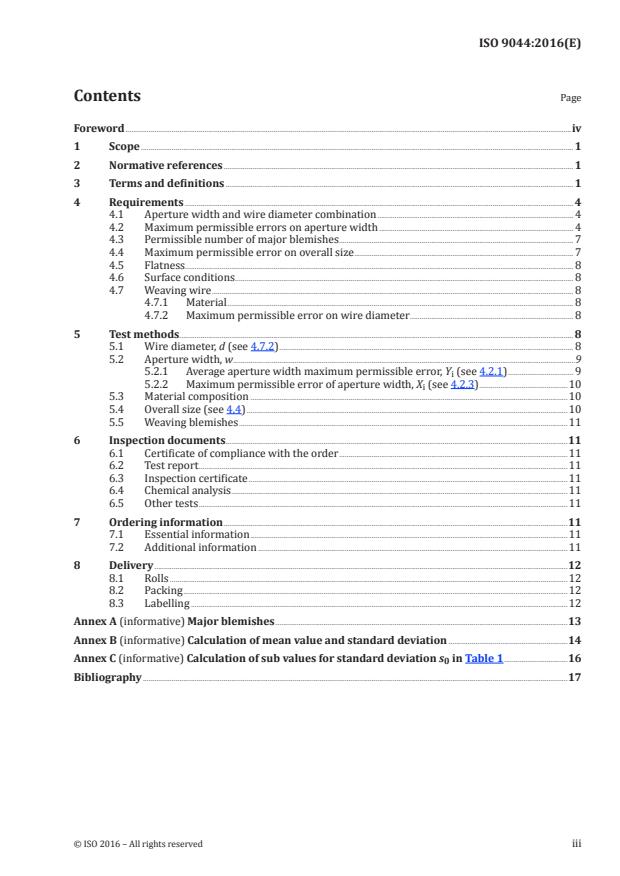
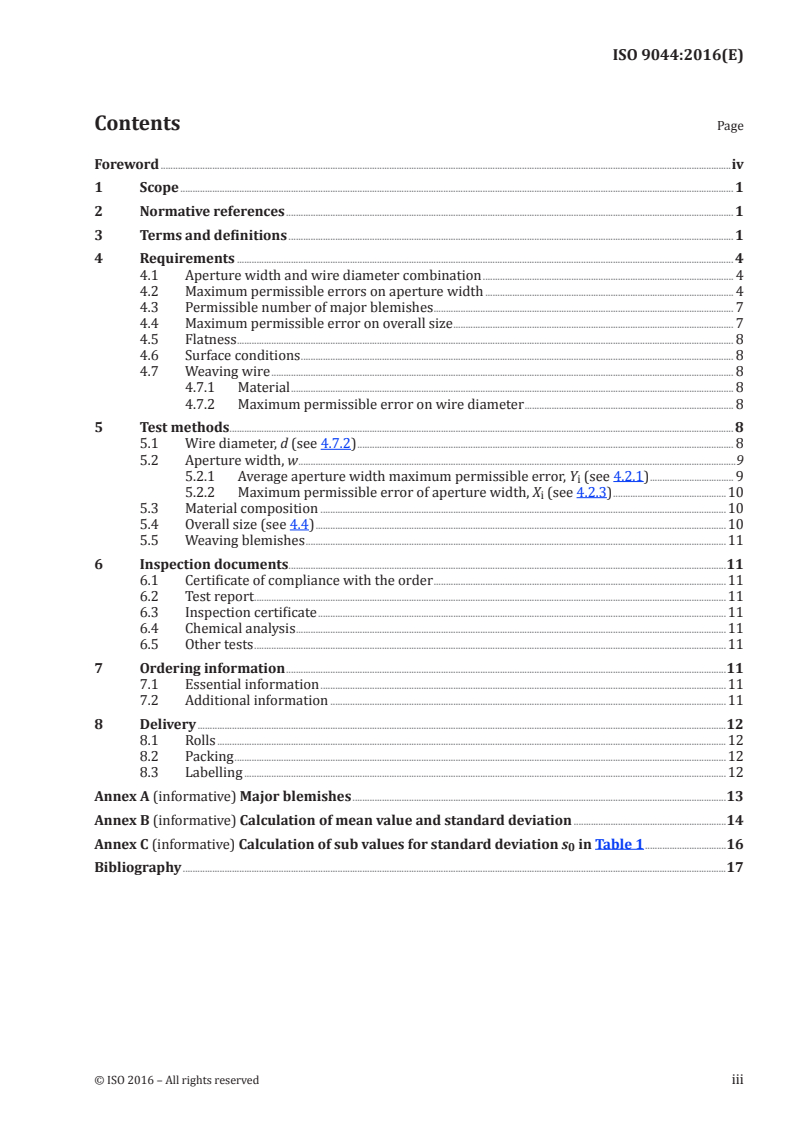
Contents Page
Foreword .iv
1 Scope . 1
2 Normative references . 1
3 Terms and definitions . 1
4 Requirements . 4
4.1 Aperture width and wire diameter combination . 4
4.2 Maximum permissible errors on aperture width . 4
4.3 Permissible number of major blemishes . 7
4.4 Maximum permissible error on overall size . 7
4.5 Flatness . 8
4.6 Surface conditions . 8
4.7 Weaving wire . 8
4.7.1 Material . 8
4.7.2 Maximum permissible error on wire diameter . 8
5 Test methods . 8
5.1 Wire diameter, d (see 4.7.2) . 8
5.2 Aperture width, w .9
5.2.1 Average aperture width maximum permissible error, Y (see 4.2.1) . 9
i
5.2.2 Maximum permissible error of aperture width, X (see 4.2.3) .10
i
5.3 Material composition .10
5.4 Overall size (see 4.4) .10
5.5 Weaving blemishes .11
6 Inspection documents .11
6.1 Certificate of compliance with the order .11
6.2 Test report .11
6.3 Inspection certificate .11
6.4 Chemical analysis .11
6.5 Other tests .11
7 Ordering information .11
7.1 Essential information .11
7.2 Additional information .11
8 Delivery .12
8.1 Rolls .12
8.2 Packing .12
8.3 Labelling .12
Annex A (informative) Major blemishes .13
Annex B (informative) Calculation of mean value and standard deviation .14
Annex C (informative) Calculation of sub values for standard deviation s in Table 1 .16
Bibliography .17
Foreword
ISO (the International Organization for Standardization) is a worldwide federation of national standards
bodies (ISO member bodies). The work of preparing International Standards is normally carried out
through ISO technical committees. Each member body interested in a subject for which a technical
committee has been established has the right to be represented on that committee. International
organizations, governmental and non-governmental, in liaison with ISO, also take part in the work.
ISO collaborates closely with the International Electrotechnical Commission (IEC) on all matters of
electrotechnical standardization.
The procedures used to develop this document and those intended for its further maintenance are
described in the ISO/IEC Directives, Part 1. In particular the different approval criteria needed for the
different types of ISO documents should be noted. This document was drafted in accordance with the
editorial rules of the ISO/IEC Directives, Part 2 (see www.iso.org/directives).
Attention is drawn to the possibility that some of the elements of this document may be the subject of
patent rights. ISO shall not be held responsible for identifying any or all such patent rights. Details of
any patent rights identified during the development of the document will be in the Introduction and/or
on the ISO list of patent declarations received (see www.iso.org/patents).
Any trade name used in this document is information given for the convenience of users and does not
constitute an endorsement.
For an explanation on the meaning of ISO specific terms and expressions related to conformity
assessment, as well as information about ISO’s adherence to the WTO principles in the Technical
Barriers to Trade (TBT) see the following URL: Foreword - Supplementary information
ISO 9044 was prepared by Technical Committee ISO/TC 24, Particle characterization including sieving,
Subcommittee SC 8, Test sieves, sieving and industrial screens.
This third edition cancels and replaces the second edition (ISO 9044:1999), which has been technically
revised.
iv © ISO 2016 – All rights reserved
INTERNATIONAL STANDARD ISO 9044:2016(E)
Industrial woven wire cloth — Technical requirements
and tests
1 Scope
This International Standard defines terms regarding industrial woven wire cloth for screening
purposes and specifies maximum permissible error, requirements, and test methods.
It applies to industrial woven wire cloth with square apertures, made of steel, stainless steel, or non-
ferrous metals (see ISO 4783-2). It does not apply to woven wire cloth coated after weaving nor does it
apply to pre-crimped and welded wire screens which are covered in ISO 4783-3 and ISO 14315.
It is of limited application to woven wire cloth used for purposes other than screening which may
necessitate other requirements. The alternative requirements may be agreed between the purchaser
and the supplier at the time of placing the order.
2 Normative references
The following documents, in whole or in part, are normatively referenced in this document and are
indispensable for its application. For dated references, only the edition cited applies. For undated
references, the latest edition of the referenced document (including any amendments) applies.
ISO 2194, Industrial screens — Woven wire cloth, perforated plate and electroformed sheet — Designation
and nominal sizes of openings
ISO 4782, Metal wire for industrial wire screens and woven wire cloth
ISO 4783-1, Industrial wire screens and woven wire cloth — Guide to the choice of aperture size and wire
diameter combinations — Part 1: Generalities
ISO 4783-2:1989, Industrial wire screens and woven wire cloth — Guide to the choice of aperture size and
wire diameter combinations — Part 2: Preferred combinations for woven wire cloth
3 Terms and definitions
For the purposes of this document, the following terms and definitions apply.
3.1
aperture width
w
distance between two adjacent warp or weft wires, measured in the projected plane at the mid-
positions
Note 1 to entry: See Figure 1.
Figure 1 — Aperture width, wire diameter, and pitch
3.2
wire diameter
d
diameter of the wire in the wire screen
Note 1 to entry: The wire diameter may be altered slightly during the weaving process. See Figure 1.
3.3
pitch
p
distance between the mid-points of two adjacent wires
Note 1 to entry: The pitch is the sum of the aperture width, w, and the wire diameter, d. See Figure 1.
3.4
warp
all wires running lengthwise in the cloth as woven
3.5
weft
all wires running crosswise in the cloth as woven
3.6
number of apertures per unit length
n
number of measurements taken
3.7
open screening area
A
percentage of the surface of all the apertures in the total screening surface
Note 1 to entry: The open screening area is calculated as the ratio of the square of the nominal aperture width, w,
and the square of the nominal pitch, p = w + d, rounded to a full percentage value:
w
A = ⋅100%
wd+
()
2 © ISO 2016 – All rights reserved
3.8
type of weave
way in which the warp (3.4) and weft (3.5) wires cross each other
Note 1 to entry: Industrial woven wire cloth is manufactured with square apertures in plain or twilled weave
(see Figure 2).
a) Plain weave b) Twilled weave
Figure 2 — Types of weave
3.9
firmness of woven wire cloth
tension existing between the crossing warp (3.4) and weft (3.5) wires and which determines the
firmness of the wire cloth
Note 1 to entry: It is affected by the relationship of w to d and by the type of weave.
3.10
mass per unit area
ρ
A
quantity calculated using the following formula:
d ⋅ρ
ρ =
A
618,1⋅+wd
()
where
d is the wire diameter, in mm;
w is the aperture width, in mm;
ρ is the material density, in kg/m(s) ;
ρ is the mass per unit area, in kg/m(s)
A
Note 1 to entry: This formula gives the calculated mass per unit area.
Note 2 to entry: The value 618,1 is based on the crimped wire.
Note 3 to entry: Typical values of ρ for various materials are given in ISO 4783-2:1989, Table 2. For example, the
mass per unit area for plain or carbon steel with a density of 7 850 kg/m can be calculated using the formula
provided as follows:
d ⋅7850
12,7⋅d
ρ = =
A
wd+
618,1⋅+wd
()
The formula provided can also be used to calculate the wire diameter (3.2), d, when the pitch (3.3), p, or
(w + d), and the mass per unit area, ρ are known. ln the case of plain or carbon steel (ρ = 7 850 kg/m ),
A,
see the following formula:
ρ ⋅p
A
d =
12,7
3.11
major blemishes
production defects which significantly affect the aperture width (3.1) or surface quality of the wire cloth
Note 1 to entry: See Annex A for information.
4 Requirements
4.1 Aperture width and wire diameter combination
Unless otherwise agreed between the supplier and the purchaser, the aperture width and wire diameter
combination shall be selected from ISO 2194, ISO 4782, ISO 4783-1, or ISO 4783-2, as appropriate.
4.2 Maximum permissible errors on aperture width
The maximum permissible errors on aperture width are given in Table 1.
In Table 1 and Formulae (1) to (7), the suffix “i”, used with the symbols denotes “industrial wire cloth”.
In Formulae (1) to (8), X , Y , s , and w are expressed in micrometres.
i i 0
NOTE Nominal apertures in Table 1 lower than 1 mm are in µm, higher or equal in mm.
4 © ISO 2016 – All rights reserved
Table 1 — Maximum permissible error of aperture width
Maximum permissible error on aperture width, w
for woven wire cloth made of…
Nominal
steel, copper, b
...
INTERNATIONAL ISO
STANDARD 9044
Third edition
2016-07-01
Industrial woven wire cloth —
Technical requirements and tests
Tissus métalliques industriels — Exigences techniques et vérifications
Reference number
©
ISO 2016
© ISO 2016, Published in Switzerland
All rights reserved. Unless otherwise specified, no part of this publication may be reproduced or utilized otherwise in any form
or by any means, electronic or mechanical, including photocopying, or posting on the internet or an intranet, without prior
written permission. Permission can be requested from either ISO at the address below or ISO’s member body in the country of
the requester.
ISO copyright office
Ch. de Blandonnet 8 • CP 401
CH-1214 Vernier, Geneva, Switzerland
Tel. +41 22 749 01 11
Fax +41 22 749 09 47
copyright@iso.org
www.iso.org
ii © ISO 2016 – All rights reserved
Contents Page
Foreword .iv
1 Scope . 1
2 Normative references . 1
3 Terms and definitions . 1
4 Requirements . 4
4.1 Aperture width and wire diameter combination . 4
4.2 Maximum permissible errors on aperture width . 4
4.3 Permissible number of major blemishes . 7
4.4 Maximum permissible error on overall size . 7
4.5 Flatness . 8
4.6 Surface conditions . 8
4.7 Weaving wire . 8
4.7.1 Material . 8
4.7.2 Maximum permissible error on wire diameter . 8
5 Test methods . 8
5.1 Wire diameter, d (see 4.7.2) . 8
5.2 Aperture width, w .9
5.2.1 Average aperture width maximum permissible error, Y (see 4.2.1) . 9
i
5.2.2 Maximum permissible error of aperture width, X (see 4.2.3) .10
i
5.3 Material composition .10
5.4 Overall size (see 4.4) .10
5.5 Weaving blemishes .11
6 Inspection documents .11
6.1 Certificate of compliance with the order .11
6.2 Test report .11
6.3 Inspection certificate .11
6.4 Chemical analysis .11
6.5 Other tests .11
7 Ordering information .11
7.1 Essential information .11
7.2 Additional information .11
8 Delivery .12
8.1 Rolls .12
8.2 Packing .12
8.3 Labelling .12
Annex A (informative) Major blemishes .13
Annex B (informative) Calculation of mean value and standard deviation .14
Annex C (informative) Calculation of sub values for standard deviation s in Table 1 .16
Bibliography .17
Foreword
ISO (the International Organization for Standardization) is a worldwide federation of national standards
bodies (ISO member bodies). The work of preparing International Standards is normally carried out
through ISO technical committees. Each member body interested in a subject for which a technical
committee has been established has the right to be represented on that committee. International
organizations, governmental and non-governmental, in liaison with ISO, also take part in the work.
ISO collaborates closely with the International Electrotechnical Commission (IEC) on all matters of
electrotechnical standardization.
The procedures used to develop this document and those intended for its further maintenance are
described in the ISO/IEC Directives, Part 1. In particular the different approval criteria needed for the
different types of ISO documents should be noted. This document was drafted in accordance with the
editorial rules of the ISO/IEC Directives, Part 2 (see www.iso.org/directives).
Attention is drawn to the possibility that some of the elements of this document may be the subject of
patent rights. ISO shall not be held responsible for identifying any or all such patent rights. Details of
any patent rights identified during the development of the document will be in the Introduction and/or
on the ISO list of patent declarations received (see www.iso.org/patents).
Any trade name used in this document is information given for the convenience of users and does not
constitute an endorsement.
For an explanation on the meaning of ISO specific terms and expressions related to conformity
assessment, as well as information about ISO’s adherence to the WTO principles in the Technical
Barriers to Trade (TBT) see the following URL: Foreword - Supplementary information
ISO 9044 was prepared by Technical Committee ISO/TC 24, Particle characterization including sieving,
Subcommittee SC 8, Test sieves, sieving and industrial screens.
This third edition cancels and replaces the second edition (ISO 9044:1999), which has been technically
revised.
iv © ISO 2016 – All rights reserved
INTERNATIONAL STANDARD ISO 9044:2016(E)
Industrial woven wire cloth — Technical requirements
and tests
1 Scope
This International Standard defines terms regarding industrial woven wire cloth for screening
purposes and specifies maximum permissible error, requirements, and test methods.
It applies to industrial woven wire cloth with square apertures, made of steel, stainless steel, or non-
ferrous metals (see ISO 4783-2). It does not apply to woven wire cloth coated after weaving nor does it
apply to pre-crimped and welded wire screens which are covered in ISO 4783-3 and ISO 14315.
It is of limited application to woven wire cloth used for purposes other than screening which may
necessitate other requirements. The alternative requirements may be agreed between the purchaser
and the supplier at the time of placing the order.
2 Normative references
The following documents, in whole or in part, are normatively referenced in this document and are
indispensable for its application. For dated references, only the edition cited applies. For undated
references, the latest edition of the referenced document (including any amendments) applies.
ISO 2194, Industrial screens — Woven wire cloth, perforated plate and electroformed sheet — Designation
and nominal sizes of openings
ISO 4782, Metal wire for industrial wire screens and woven wire cloth
ISO 4783-1, Industrial wire screens and woven wire cloth — Guide to the choice of aperture size and wire
diameter combinations — Part 1: Generalities
ISO 4783-2:1989, Industrial wire screens and woven wire cloth — Guide to the choice of aperture size and
wire diameter combinations — Part 2: Preferred combinations for woven wire cloth
3 Terms and definitions
For the purposes of this document, the following terms and definitions apply.
3.1
aperture width
w
distance between two adjacent warp or weft wires, measured in the projected plane at the mid-
positions
Note 1 to entry: See Figure 1.
Figure 1 — Aperture width, wire diameter, and pitch
3.2
wire diameter
d
diameter of the wire in the wire screen
Note 1 to entry: The wire diameter may be altered slightly during the weaving process. See Figure 1.
3.3
pitch
p
distance between the mid-points of two adjacent wires
Note 1 to entry: The pitch is the sum of the aperture width, w, and the wire diameter, d. See Figure 1.
3.4
warp
all wires running lengthwise in the cloth as woven
3.5
weft
all wires running crosswise in the cloth as woven
3.6
number of apertures per unit length
n
number of measurements taken
3.7
open screening area
A
percentage of the surface of all the apertures in the total screening surface
Note 1 to entry: The open screening area is calculated as the ratio of the square of the nominal aperture width, w,
and the square of the nominal pitch, p = w + d, rounded to a full percentage value:
w
A = ⋅100%
wd+
()
2 © ISO 2016 – All rights reserved
3.8
type of weave
way in which the warp (3.4) and weft (3.5) wires cross each other
Note 1 to entry: Industrial woven wire cloth is manufactured with square apertures in plain or twilled weave
(see Figure 2).
a) Plain weave b) Twilled weave
Figure 2 — Types of weave
3.9
firmness of woven wire cloth
tension existing between the crossing warp (3.4) and weft (3.5) wires and which determines the
firmness of the wire cloth
Note 1 to entry: It is affected by the relationship of w to d and by the type of weave.
3.10
mass per unit area
ρ
A
quantity calculated using the following formula:
d ⋅ρ
ρ =
A
618,1⋅+wd
()
where
d is the wire diameter, in mm;
w is the aperture width, in mm;
ρ is the material density, in kg/m(s) ;
ρ is the mass per unit area, in kg/m(s)
A
Note 1 to entry: This formula gives the calculated mass per unit area.
Note 2 to entry: The value 618,1 is based on the crimped wire.
Note 3 to entry: Typical values of ρ for various materials are given in ISO 4783-2:1989, Table 2. For example, the
mass per unit area for plain or carbon steel with a density of 7 850 kg/m can be calculated using the formula
provided as follows:
d ⋅7850
12,7⋅d
ρ = =
A
wd+
618,1⋅+wd
()
The formula provided can also be used to calculate the wire diameter (3.2), d, when the pitch (3.3), p, or
(w + d), and the mass per unit area, ρ are known. ln the case of plain or carbon steel (ρ = 7 850 kg/m ),
A,
see the following formula:
ρ ⋅p
A
d =
12,7
3.11
major blemishes
production defects which significantly affect the aperture width (3.1) or surface quality of the wire cloth
Note 1 to entry: See Annex A for information.
4 Requirements
4.1 Aperture width and wire diameter combination
Unless otherwise agreed between the supplier and the purchaser, the aperture width and wire diameter
combination shall be selected from ISO 2194, ISO 4782, ISO 4783-1, or ISO 4783-2, as appropriate.
4.2 Maximum permissible errors on aperture width
The maximum permissible errors on aperture width are given in Table 1.
In Table 1 and Formulae (1) to (7), the suffix “i”, used with the symbols denotes “industrial wire cloth”.
In Formulae (1) to (8), X , Y , s , and w are expressed in micrometres.
i i 0
NOTE Nominal apertures in Table 1 lower than 1 mm are in µm, higher or equal in mm.
4 © ISO 2016 – All rights reserved
Table 1 — Maximum permissible error of aperture width
Maximum permissible error on aperture width, w
for woven wire cloth made of…
Nominal
steel, copper, b
...