


ISO 20344:2021
(Main)Personal protective equipment — Test methods for footwear
Personal protective equipment — Test methods for footwear
This document specifies methods for testing footwear designed as personal protective equipment.
Équipement de protection individuelle — Méthodes d'essai pour les chaussures
Le présent document spécifie des méthodes d'essai pour les chaussures conçues comme des équipements de protection individuelle.
General Information
- Status
- Published
- Publication Date
- 31-Oct-2021
- Technical Committee
- ISO/TC 94/SC 3 - Foot protection
- Drafting Committee
- ISO/TC 94/SC 3/WG 1 - PPE footwear – Test methods
- Current Stage
- 6060 - International Standard published
- Start Date
- 01-Nov-2021
- Due Date
- 09-Feb-2022
- Completion Date
- 29-Oct-2021
Relations
- Effective Date
- 09-Feb-2026
- Effective Date
- 09-Feb-2026
- Referred By
EN ISO 20347:2022 - Personal protective equipment - Occupational footwear (ISO 20347:2021) - Effective Date
- 09-Feb-2026
- Effective Date
- 09-Feb-2026
- Consolidates
EN ISO 20344:2021 - Personal protective equipment - Test methods for footwear (ISO 20344:2021) - Effective Date
- 12-Feb-2026
- Effective Date
- 06-Jun-2022
- Amended By
ISO 20344:2021/Amd 1:2024 - Personal protective equipment — Test methods for footwear — Amendment 1 - Effective Date
- 28-Jan-2023
- Effective Date
- 04-Feb-2017
Overview
ISO 20344:2021 - "Personal protective equipment - Test methods for footwear" is the international reference for standardized PPE footwear testing. The third edition (2021) specifies the procedures, sampling, conditioning and reporting requirements for laboratory tests used to evaluate protective footwear performance. It is intended to be used together with product performance standards (for example safety footwear standards) to verify compliance with specified protective properties.
Key technical topics and requirements
ISO 20344:2021 defines a structured approach to testing whole footwear and individual protective components. Major technical topics include:
- General testing parameters
- Sampling plans, conditioning before and during tests, prerequisites, and standardized test reports.
- Whole-footwear test methods
- Ergonomic features and fit assessments.
- Upper/outsole and sole interlayer bond strength.
- Toecap dimensions, impact resistance and compression resistance.
- Behaviour of toecaps and perforation-resistant inserts under thermal and chemical exposure.
- Leak proofness and water resistance (trough and dynamic tests).
- Perforation resistance (metallic and non-metallic inserts) and insert flex resistance.
- Electrical resistance testing for dissipative or conductive footwear.
- Slip resistance evaluations on defined surfaces and test liquids.
- Insulation against heat and cold, plus energy absorption in the seat region.
- Metatarsal protection impact testing.
- For each test the standard sets out the principle, required test equipment, sampling & conditioning, test method and reporting elements.
Practical applications and who uses ISO 20344:2021
ISO 20344:2021 is used to create consistent, repeatable results for evaluating protective footwear. Typical applications:
- Footwear manufacturers: to design, validate and document protective properties during product development and quality control.
- Accredited testing laboratories: to perform standardized PPE footwear testing for certification and compliance.
- Certification and conformity assessment bodies: to verify manufacturer claims against performance standards.
- Occupational safety professionals and procurement teams: to compare products based on documented test results (impact resistance, slip resistance, insulation, etc.).
- Regulators and industry standards committees: to harmonize test practice across markets.
Related standards
- ISO 20345 - safety footwear performance requirements (commonly paired with ISO 20344 test methods).
- ISO 20346, ISO 20347 - alternative footwear performance categories.
For implementation or certification, consult the full ISO 20344:2021 text and the applicable product performance standard (e.g., ISO 20345) to ensure complete compliance with both test methods and performance criteria.
Buy Documents



ISO 20344:2021 - Personal protective equipment -- Test methods for footwear

ISO 20344:2021 - Personal protective equipment — Test methods for footwear Released:11/1/2021



ISO 20344:2021 - Équipement de protection individuelle -- Méthodes d'essai pour les chaussures

ISO 20344:2021 - Équipement de protection individuelle — Méthodes d'essai pour les chaussures Released:11/1/2021
Get Certified
Connect with accredited certification bodies for this standard

NSF International
Global independent organization facilitating standards development and certification.

CIS Institut d.o.o.
Personal Protective Equipment (PPE) certification body. Notified Body NB-2890 for EU Regulation 2016/425 PPE.

Kiwa BDA Testing
Building and construction product certification.
Sponsored listings
Frequently Asked Questions
ISO 20344:2021 is a standard published by the International Organization for Standardization (ISO). Its full title is "Personal protective equipment — Test methods for footwear". This standard covers: This document specifies methods for testing footwear designed as personal protective equipment.
This document specifies methods for testing footwear designed as personal protective equipment.
ISO 20344:2021 is classified under the following ICS (International Classification for Standards) categories: 13.340.50 - Leg and foot protection. The ICS classification helps identify the subject area and facilitates finding related standards.
ISO 20344:2021 has the following relationships with other standards: It is inter standard links to EN ISO 22568-4:2021, EN ISO 20345:2022, EN ISO 20347:2022, EN ISO 20346:2022, EN ISO 20344:2021, ISO 4604:2011, ISO 20344:2021/Amd 1:2024, ISO 20344:2011. Understanding these relationships helps ensure you are using the most current and applicable version of the standard.
ISO 20344:2021 is available in PDF format for immediate download after purchase. The document can be added to your cart and obtained through the secure checkout process. Digital delivery ensures instant access to the complete standard document.
Standards Content (Sample)
INTERNATIONAL ISO
STANDARD 20344
Third edition
2021-10
Personal protective equipment — Test
methods for footwear
Équipement de protection individuelle — Méthodes d'essai pour les
chaussures
Reference number
© ISO 2021
All rights reserved. Unless otherwise specified, or required in the context of its implementation, no part of this publication may
be reproduced or utilized otherwise in any form or by any means, electronic or mechanical, including photocopying, or posting on
the internet or an intranet, without prior written permission. Permission can be requested from either ISO at the address below
or ISO’s member body in the country of the requester.
ISO copyright office
CP 401 • Ch. de Blandonnet 8
CH-1214 Vernier, Geneva
Phone: +41 22 749 01 11
Email: copyright@iso.org
Website: www.iso.org
Published in Switzerland
ii
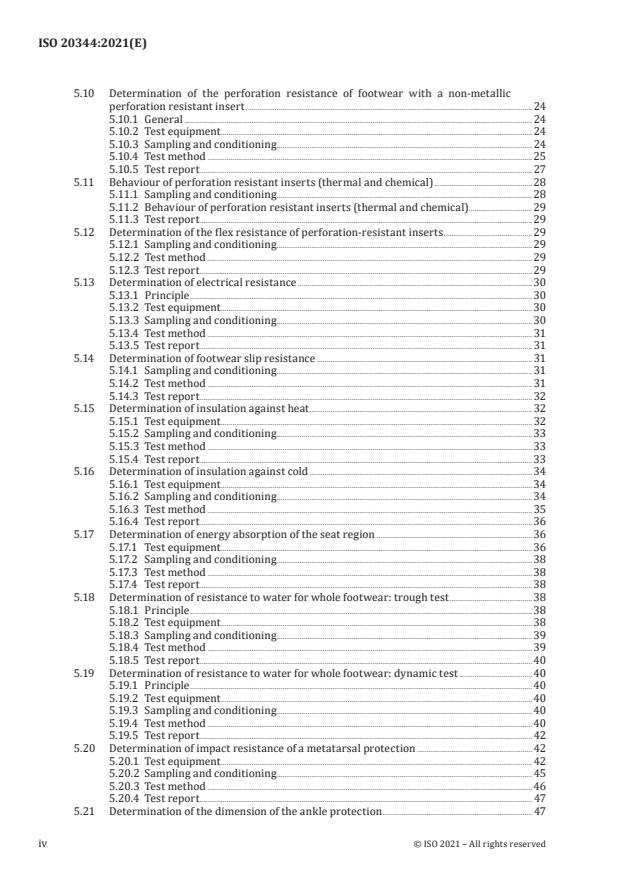
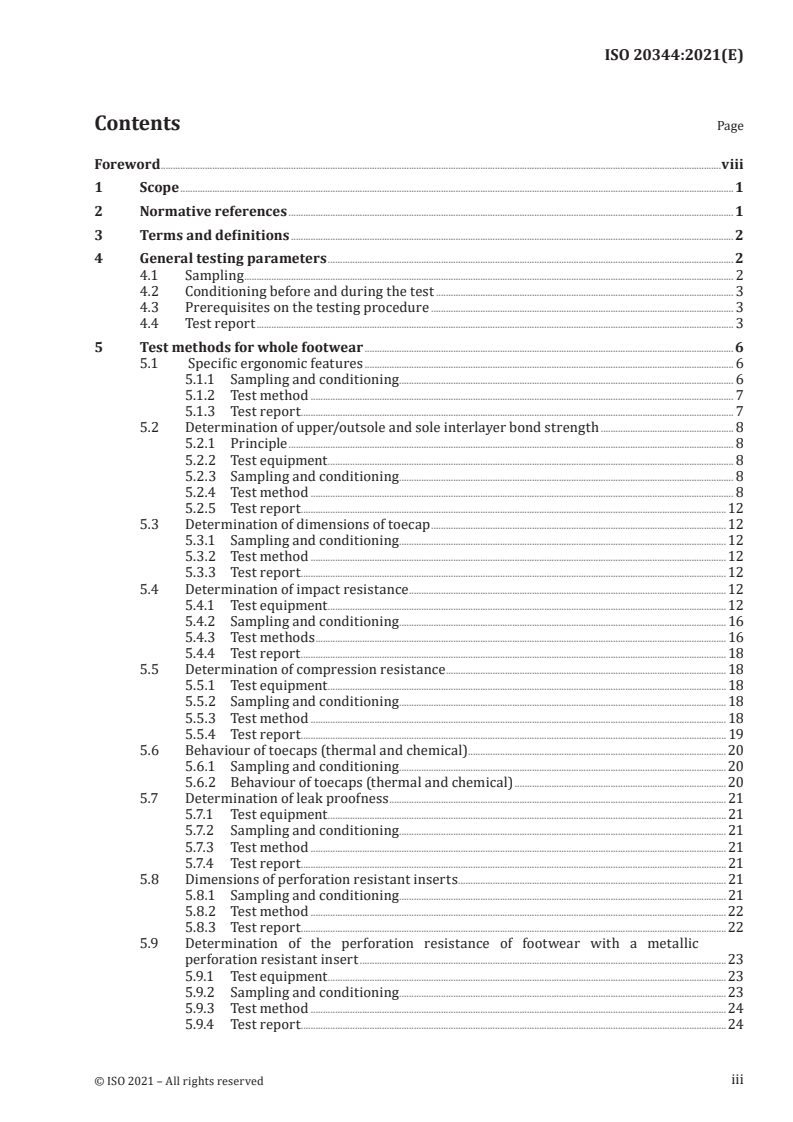
Contents Page
Foreword .viii
1 Scope . 1
2 Normative references . 1
3 Terms and definitions . 2
4 General testing parameters . 2
4.1 Sampling . 2
4.2 Conditioning before and during the test . 3
4.3 Prerequisites on the testing procedure . 3
4.4 Test report . 3
5 Test methods for whole footwear . 6
5.1 Specific ergonomic features . 6
5.1.1 Sampling and conditioning . 6
5.1.2 Test method . 7
5.1.3 Test report . 7
5.2 Determination of upper/outsole and sole interlayer bond strength . 8
5.2.1 Principle . 8
5.2.2 Test equipment . 8
5.2.3 Sampling and conditioning . 8
5.2.4 Test method . 8
5.2.5 Test report .12
5.3 Determination of dimensions of toecap .12
5.3.1 Sampling and conditioning .12
5.3.2 Test method . 12
5.3.3 Test report .12
5.4 Determination of impact resistance .12
5.4.1 Test equipment .12
5.4.2 Sampling and conditioning . 16
5.4.3 Test methods . 16
5.4.4 Test report . 18
5.5 Determination of compression resistance . 18
5.5.1 Test equipment . 18
5.5.2 Sampling and conditioning . 18
5.5.3 Test method . 18
5.5.4 Test report . 19
5.6 Behaviour of toecaps (thermal and chemical). 20
5.6.1 Sampling and conditioning . 20
5.6.2 Behaviour of toecaps (thermal and chemical) . 20
5.7 Determination of leak proofness . 21
5.7.1 Test equipment . 21
5.7.2 Sampling and conditioning . 21
5.7.3 Test method . 21
5.7.4 Test report . 21
5.8 Dimensions of perforation resistant inserts . 21
5.8.1 Sampling and conditioning . 21
5.8.2 Test method . 22
5.8.3 Test report .22
5.9 Determination of the perforation resistance of footwear with a metallic
perforation resistant insert .23
5.9.1 Test equipment . 23
5.9.2 Sampling and conditioning . 23
5.9.3 Test method . 24
5.9.4 Test report . 24
iii
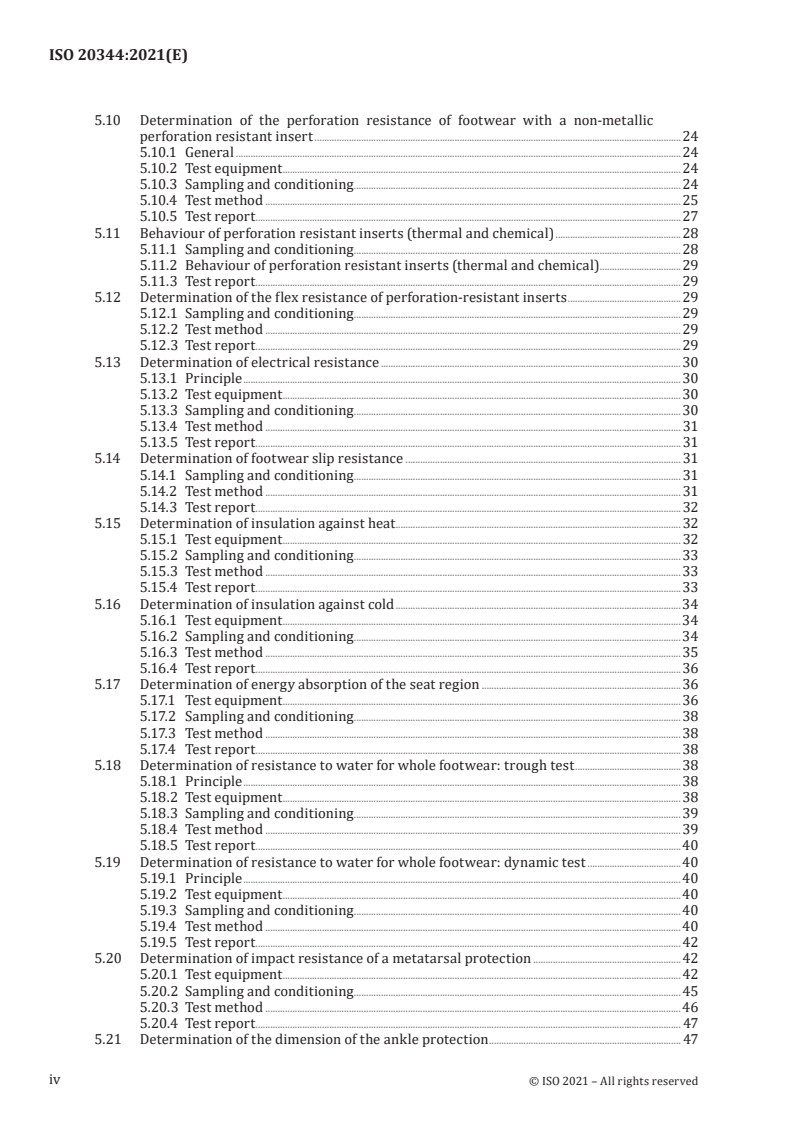
5.10 Determination of the perforation resistance of footwear with a non-metallic
perforation resistant insert . 24
5.10.1 General . 24
5.10.2 Test equipment . 24
5.10.3 Sampling and conditioning . 24
5.10.4 Test method . 25
5.10.5 Test report . 27
5.11 Behaviour of perforation resistant inserts (thermal and chemical) .28
5.11.1 Sampling and conditioning .28
5.11.2 Behaviour of perforation resistant inserts (thermal and chemical) .29
5.11.3 Test report .29
5.12 Determination of the flex resistance of perforation-resistant inserts .29
5.12.1 Sampling and conditioning .29
5.12.2 Test method .29
5.12.3 Test report .29
5.13 Determination of electrical resistance .30
5.13.1 Principle . 30
5.13.2 Test equipment .30
5.13.3 Sampling and conditioning .30
5.13.4 Test method . 31
5.13.5 Test report . 31
5.14 Determination of footwear slip resistance . 31
5.14.1 Sampling and conditioning . 31
5.14.2 Test method . 31
5.14.3 Test report . 32
5.15 Determination of insulation against heat . 32
5.15.1 Test equipment . 32
5.15.2 Sampling and conditioning . 33
5.15.3 Test method . 33
5.15.4 Test report . 33
5.16 Determination of insulation against cold .34
5.16.1 Test equipment .34
5.16.2 Sampling and conditioning .34
5.16.3 Test method . 35
5.16.4 Test report .36
5.17 Determination of energy absorption of the seat region .36
5.17.1 Test equipment .36
5.17.2 Sampling and conditioning .38
5.17.3 Test method .38
5.17.4 Test report .38
5.18 Determination of resistance to water for whole footwear: trough test .38
5.18.1 Principle .38
5.18.2 Test equipment .38
5.18.3 Sampling and conditioning . 39
5.18.4 Test method . 39
5.18.5 Test report .40
5.19 Determination of resistance to water for whole footwear: dynamic test .40
5.19.1 Principle .40
5.19.2 Test equipment .40
5.19.3 Sampling and conditioning .40
5.19.4 Test method .40
5.19.5 Test report . 42
5.20 Determination of impact resistance of a metatarsal protection . 42
5.20.1 Test equipment . 42
5.20.2 Sampling and conditioning . 45
5.20.3 Test method .46
5.20.4 Test report . 47
5.21 Determination of the dimension of the ankle protection . 47
iv
5.21.1 Sampling and conditioning . 47
5.21.2 Test method . 47
5.21.3 Test report .48
5.22 Determination of the shock absorption capacity of ankle protection materials
incorporated into the upper .48
5.22.1 Principle .48
5.22.2 Test equipment .49
5.22.3 Sampling and conditioning .50
5.22.4 Test method . 50
5.22.5 Test report .50
5.23 Determination of cutting resistance . 51
5.23.1 Sampling and conditioning . 51
5.23.2 Dimension of the cut resistant protective area . 51
5.23.3 Test method . 52
5.23.4 Test report . 52
5.24 Scuff caps . 52
5.24.1 Sampling and conditioning . 52
5.24.2 Test method for the abrasion resistance of the scuff caps . 52
5.24.3 Test report . 52
5.25 Determination of seam strength . 53
5.25.1 Sampling and conditioning . 53
5.25.2 Test method . 53
5.25.3 Test report .53
6 Test methods for upper, lining and tongue .53
6.1 Determination of thickness of upper . 53
6.1.1 Sampling and conditioning . 53
6.1.2 Test method . 53
6.1.3 Test report .53
6.2 Measurement of the height of the upper . 53
6.2.1 Sampling and conditioning . 53
6.2.2 Test method for the complete upper .54
6.2.3 Test method for the determination of the area for non-water vapour
permeable materials .54
6.3 Determination of tear strength of the upper, lining and/or tongue .56
6.3.1 Sampling and conditioning .56
6.3.2 Test method . 56
6.3.3 Test report . 57
6.4 Determination of the tensile properties of the upper material . 57
6.4.1 Sampling and conditioning . 57
6.4.2 Test method . 57
6.4.3 Test report .58
6.5 Determination of upper flexing resistance .58
6.5.1 Sampling and conditioning .58
6.5.2 Test method .58
6.5.3 Test report . 61
6.6 Determination of water vapour permeability (WVP) . 61
6.6.1 Principle . 61
6.6.2 Sampling and conditioning . 61
6.6.3 Pre-treatment test method . 61
6.6.4 WVP measurement. 61
6.6.5 Test report . 61
6.7 Determination of water vapour absorption (WVA) . 62
6.7.1 Principle . 62
6.7.2 Test equipment . 62
6.7.3 Sampling and conditioning . 62
6.7.4 Test method . 62
6.7.5 Test report .64
6.8 Determination of water vapour coefficient (WVC) .64
v
6.8.1 Calculation of WVC .64
6.8.2 Test report .64
6.9 Determination of pH value .64
6.9.1 Sampling and conditioning .64
6.9.2 Test method .65
6.9.3 Test report .65
6.10 Determination of resistance to hydrolysis of upper .65
6.10.1 Sampling and conditioning .65
6.10.2 Test method .65
6.10.3 Test report .65
6.11 Determination of chromium VI content .65
6.11.1 Sampling and conditioning .65
6.11.2 Test method .65
6.11.3 Test report .66
6.12 Determination of abrasion resistance of lining and insock .66
6.12.1 Principle .66
6.12.2 Test equipment .66
6.12.3 Sampling and conditioning . 67
6.12.4 Test method . 67
6.12.5 Test report .68
6.13 Determination of water penetration and water absorption for upper .69
6.13.1 Principle . 69
6.13.2 Test equipment . 69
6.13.3 Sampling and conditioning . 69
6.13.4 Test method . 69
6.13.5 Test report . 70
7 Test methods for insole, insock and footbed .71
7.1 Determination of insole, insock and footbed thickness . 71
7.1.1 Sampling and conditioning . 71
7.1.2 Test method . 71
7.1.3 Test report . 71
7.2 Determination of water absorption and desorption of insole and/or insock . 71
7.2.1 Principle . 71
7.2.2 Test equipment . 71
7.2.3 Sampling and conditioning .72
7.2.4 Test method .72
7.2.5 Test report .73
7.3 Determination of abrasion resistance of insole .73
7.3.1 Principle .73
7.3.2 Test equipment .73
7.3.3 Sampling and conditioning .74
7.3.4 Test method .74
7.3.5 Test report . 75
8 Test methods for outsole .75
8.1 General remarks . 75
8.2 Determination of outsole dimensions . 75
8.2.1 Sampling and conditioning . 75
8.2.2 Determination of the cleated area . 75
8.2.3 Outsole thickness and cleat height . 76
8.2.4 Determination of cleat design in the waist area . 78
8.3 Determination of tear strength of outsole . 79
8.3.1 Sampling and conditioning . 79
8.3.2 Test method . 79
8.3.3 Test report .79
8.4 Determination of outsole abrasion resistance . 79
8.4.1 Sampling and conditioning . 79
8.4.2 Test method . 79
vi
8.4.3 Test report .79
8.5 Determination of footwear rigidity . 79
8.5.1 Principle . 79
8.5.2 Test equipment .80
8.5.3 Sampling and conditioning .80
8.5.4 Test method .80
8.5.5 Test report .82
8.6 Determination of flexing resistance of outsole .82
8.6.1 Principle .82
8.6.2 Test equipment .82
8.6.3 Sampling and conditioning .82
8.6.4 Test method .82
8.6.5 Test report .84
8.7 Determination of resistance to hydrolysis of outsole .84
8.7.1 Sampling and conditioning .84
8.7.2 Test method .84
8.7.3 Test report .84
8.8 Determination of resistance to fuel oil .84
8.8.1 Sampling and conditioning .84
8.8.2 Test methods .
...
INTERNATIONAL ISO
STANDARD 20344
Third edition
2021-10
Personal protective equipment — Test
methods for footwear
Équipement de protection individuelle — Méthodes d'essai pour les
chaussures
Reference number
© ISO 2021
All rights reserved. Unless otherwise specified, or required in the context of its implementation, no part of this publication may
be reproduced or utilized otherwise in any form or by any means, electronic or mechanical, including photocopying, or posting on
the internet or an intranet, without prior written permission. Permission can be requested from either ISO at the address below
or ISO’s member body in the country of the requester.
ISO copyright office
CP 401 • Ch. de Blandonnet 8
CH-1214 Vernier, Geneva
Phone: +41 22 749 01 11
Email: copyright@iso.org
Website: www.iso.org
Published in Switzerland
ii
Contents Page
Foreword .viii
1 Scope . 1
2 Normative references . 1
3 Terms and definitions . 2
4 General testing parameters . 2
4.1 Sampling . 2
4.2 Conditioning before and during the test . 3
4.3 Prerequisites on the testing procedure . 3
4.4 Test report . 3
5 Test methods for whole footwear . 6
5.1 Specific ergonomic features . 6
5.1.1 Sampling and conditioning . 6
5.1.2 Test method . 7
5.1.3 Test report . 7
5.2 Determination of upper/outsole and sole interlayer bond strength . 8
5.2.1 Principle . 8
5.2.2 Test equipment . 8
5.2.3 Sampling and conditioning . 8
5.2.4 Test method . 8
5.2.5 Test report .12
5.3 Determination of dimensions of toecap .12
5.3.1 Sampling and conditioning .12
5.3.2 Test method . 12
5.3.3 Test report .12
5.4 Determination of impact resistance .12
5.4.1 Test equipment .12
5.4.2 Sampling and conditioning . 16
5.4.3 Test methods . 16
5.4.4 Test report . 18
5.5 Determination of compression resistance . 18
5.5.1 Test equipment . 18
5.5.2 Sampling and conditioning . 18
5.5.3 Test method . 18
5.5.4 Test report . 19
5.6 Behaviour of toecaps (thermal and chemical). 20
5.6.1 Sampling and conditioning . 20
5.6.2 Behaviour of toecaps (thermal and chemical) . 20
5.7 Determination of leak proofness . 21
5.7.1 Test equipment . 21
5.7.2 Sampling and conditioning . 21
5.7.3 Test method . 21
5.7.4 Test report . 21
5.8 Dimensions of perforation resistant inserts . 21
5.8.1 Sampling and conditioning . 21
5.8.2 Test method . 22
5.8.3 Test report .22
5.9 Determination of the perforation resistance of footwear with a metallic
perforation resistant insert .23
5.9.1 Test equipment . 23
5.9.2 Sampling and conditioning . 23
5.9.3 Test method . 24
5.9.4 Test report . 24
iii
5.10 Determination of the perforation resistance of footwear with a non-metallic
perforation resistant insert . 24
5.10.1 General . 24
5.10.2 Test equipment . 24
5.10.3 Sampling and conditioning . 24
5.10.4 Test method . 25
5.10.5 Test report . 27
5.11 Behaviour of perforation resistant inserts (thermal and chemical) .28
5.11.1 Sampling and conditioning .28
5.11.2 Behaviour of perforation resistant inserts (thermal and chemical) .29
5.11.3 Test report .29
5.12 Determination of the flex resistance of perforation-resistant inserts .29
5.12.1 Sampling and conditioning .29
5.12.2 Test method .29
5.12.3 Test report .29
5.13 Determination of electrical resistance .30
5.13.1 Principle . 30
5.13.2 Test equipment .30
5.13.3 Sampling and conditioning .30
5.13.4 Test method . 31
5.13.5 Test report . 31
5.14 Determination of footwear slip resistance . 31
5.14.1 Sampling and conditioning . 31
5.14.2 Test method . 31
5.14.3 Test report . 32
5.15 Determination of insulation against heat . 32
5.15.1 Test equipment . 32
5.15.2 Sampling and conditioning . 33
5.15.3 Test method . 33
5.15.4 Test report . 33
5.16 Determination of insulation against cold .34
5.16.1 Test equipment .34
5.16.2 Sampling and conditioning .34
5.16.3 Test method . 35
5.16.4 Test report .36
5.17 Determination of energy absorption of the seat region .36
5.17.1 Test equipment .36
5.17.2 Sampling and conditioning .38
5.17.3 Test method .38
5.17.4 Test report .38
5.18 Determination of resistance to water for whole footwear: trough test .38
5.18.1 Principle .38
5.18.2 Test equipment .38
5.18.3 Sampling and conditioning . 39
5.18.4 Test method . 39
5.18.5 Test report .40
5.19 Determination of resistance to water for whole footwear: dynamic test .40
5.19.1 Principle .40
5.19.2 Test equipment .40
5.19.3 Sampling and conditioning .40
5.19.4 Test method .40
5.19.5 Test report . 42
5.20 Determination of impact resistance of a metatarsal protection . 42
5.20.1 Test equipment . 42
5.20.2 Sampling and conditioning . 45
5.20.3 Test method .46
5.20.4 Test report . 47
5.21 Determination of the dimension of the ankle protection . 47
iv
5.21.1 Sampling and conditioning . 47
5.21.2 Test method . 47
5.21.3 Test report .48
5.22 Determination of the shock absorption capacity of ankle protection materials
incorporated into the upper .48
5.22.1 Principle .48
5.22.2 Test equipment .49
5.22.3 Sampling and conditioning .50
5.22.4 Test method . 50
5.22.5 Test report .50
5.23 Determination of cutting resistance . 51
5.23.1 Sampling and conditioning . 51
5.23.2 Dimension of the cut resistant protective area . 51
5.23.3 Test method . 52
5.23.4 Test report . 52
5.24 Scuff caps . 52
5.24.1 Sampling and conditioning . 52
5.24.2 Test method for the abrasion resistance of the scuff caps . 52
5.24.3 Test report . 52
5.25 Determination of seam strength . 53
5.25.1 Sampling and conditioning . 53
5.25.2 Test method . 53
5.25.3 Test report .53
6 Test methods for upper, lining and tongue .53
6.1 Determination of thickness of upper . 53
6.1.1 Sampling and conditioning . 53
6.1.2 Test method . 53
6.1.3 Test report .53
6.2 Measurement of the height of the upper . 53
6.2.1 Sampling and conditioning . 53
6.2.2 Test method for the complete upper .54
6.2.3 Test method for the determination of the area for non-water vapour
permeable materials .54
6.3 Determination of tear strength of the upper, lining and/or tongue .56
6.3.1 Sampling and conditioning .56
6.3.2 Test method . 56
6.3.3 Test report . 57
6.4 Determination of the tensile properties of the upper material . 57
6.4.1 Sampling and conditioning . 57
6.4.2 Test method . 57
6.4.3 Test report .58
6.5 Determination of upper flexing resistance .58
6.5.1 Sampling and conditioning .58
6.5.2 Test method .58
6.5.3 Test report . 61
6.6 Determination of water vapour permeability (WVP) . 61
6.6.1 Principle . 61
6.6.2 Sampling and conditioning . 61
6.6.3 Pre-treatment test method . 61
6.6.4 WVP measurement. 61
6.6.5 Test report . 61
6.7 Determination of water vapour absorption (WVA) . 62
6.7.1 Principle . 62
6.7.2 Test equipment . 62
6.7.3 Sampling and conditioning . 62
6.7.4 Test method . 62
6.7.5 Test report .64
6.8 Determination of water vapour coefficient (WVC) .64
v
6.8.1 Calculation of WVC .64
6.8.2 Test report .64
6.9 Determination of pH value .64
6.9.1 Sampling and conditioning .64
6.9.2 Test method .65
6.9.3 Test report .65
6.10 Determination of resistance to hydrolysis of upper .65
6.10.1 Sampling and conditioning .65
6.10.2 Test method .65
6.10.3 Test report .65
6.11 Determination of chromium VI content .65
6.11.1 Sampling and conditioning .65
6.11.2 Test method .65
6.11.3 Test report .66
6.12 Determination of abrasion resistance of lining and insock .66
6.12.1 Principle .66
6.12.2 Test equipment .66
6.12.3 Sampling and conditioning . 67
6.12.4 Test method . 67
6.12.5 Test report .68
6.13 Determination of water penetration and water absorption for upper .69
6.13.1 Principle . 69
6.13.2 Test equipment . 69
6.13.3 Sampling and conditioning . 69
6.13.4 Test method . 69
6.13.5 Test report . 70
7 Test methods for insole, insock and footbed .71
7.1 Determination of insole, insock and footbed thickness . 71
7.1.1 Sampling and conditioning . 71
7.1.2 Test method . 71
7.1.3 Test report . 71
7.2 Determination of water absorption and desorption of insole and/or insock . 71
7.2.1 Principle . 71
7.2.2 Test equipment . 71
7.2.3 Sampling and conditioning .72
7.2.4 Test method .72
7.2.5 Test report .73
7.3 Determination of abrasion resistance of insole .73
7.3.1 Principle .73
7.3.2 Test equipment .73
7.3.3 Sampling and conditioning .74
7.3.4 Test method .74
7.3.5 Test report . 75
8 Test methods for outsole .75
8.1 General remarks . 75
8.2 Determination of outsole dimensions . 75
8.2.1 Sampling and conditioning . 75
8.2.2 Determination of the cleated area . 75
8.2.3 Outsole thickness and cleat height . 76
8.2.4 Determination of cleat design in the waist area . 78
8.3 Determination of tear strength of outsole . 79
8.3.1 Sampling and conditioning . 79
8.3.2 Test method . 79
8.3.3 Test report .79
8.4 Determination of outsole abrasion resistance . 79
8.4.1 Sampling and conditioning . 79
8.4.2 Test method . 79
vi
8.4.3 Test report .79
8.5 Determination of footwear rigidity . 79
8.5.1 Principle . 79
8.5.2 Test equipment .80
8.5.3 Sampling and conditioning .80
8.5.4 Test method .80
8.5.5 Test report .82
8.6 Determination of flexing resistance of outsole .82
8.6.1 Principle .82
8.6.2 Test equipment .82
8.6.3 Sampling and conditioning .82
8.6.4 Test method .82
8.6.5 Test report .84
8.7 Determination of resistance to hydrolysis of outsole .84
8.7.1 Sampling and conditioning .84
8.7.2 Test method .84
8.7.3 Test report .84
8.8 Determination of resistance to fuel oil .84
8.8.1 Sampling and conditioning .84
8.8.2 Test methods .
...
NORME ISO
INTERNATIONALE 20344
Troisième édition
2021-10
Équipement de protection
individuelle — Méthodes d'essai pour
les chaussures
Personal protective equipment — Test methods for footwear
Numéro de référence
DOCUMENT PROTÉGÉ PAR COPYRIGHT
© ISO 2021
Droits de reproduction réservés. Sauf indication contraire, aucune partie de cette publication ne peut être reproduite ni utilisée
sous quelque forme que ce soit et par aucun procédé, électronique ou mécanique, y compris la photocopie, l’affichage sur l’internet
ou sur un Intranet, sans autorisation écrite préalable. Les demandes d’autorisation peuvent être adressées à l’ISO à l’adresse ci-
après ou au comité membre de l’ISO dans le pays du demandeur.
ISO copyright office
Case postale 401 • Ch. de Blandonnet 8
CH-1214 Vernier, Genève
Tél.: +41 22 749 01 11
E-mail: copyright@iso.org
Web: www.iso.org
Publié en Suisse
ii
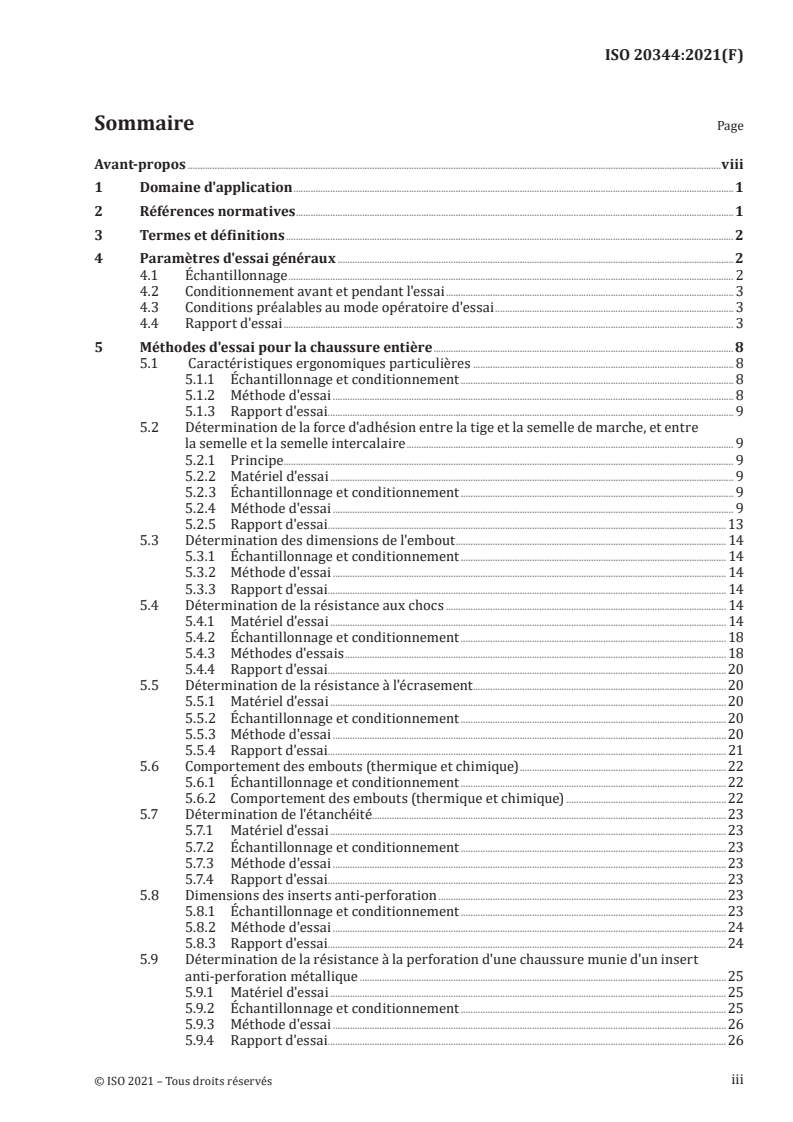
Sommaire Page
Avant-propos .viii
1 Domaine d'application .1
2 Références normatives .1
3 Termes et définitions . 2
4 Paramètres d'essai généraux .2
4.1 Échantillonnage . 2
4.2 Conditionnement avant et pendant l'essai . 3
4.3 Conditions préalables au mode opératoire d'essai . 3
4.4 Rapport d'essai . 3
5 Méthodes d'essai pour la chaussure entière . 8
5.1 Caractéristiques ergonomiques particulières . 8
5.1.1 Échantillonnage et conditionnement . 8
5.1.2 Méthode d'essai . 8
5.1.3 Rapport d'essai. 9
5.2 Détermination de la force d'adhésion entre la tige et la semelle de marche, et entre
la semelle et la semelle intercalaire . 9
5.2.1 Principe. 9
5.2.2 Matériel d'essai . 9
5.2.3 Échantillonnage et conditionnement . 9
5.2.4 Méthode d'essai . 9
5.2.5 Rapport d'essai. 13
5.3 Détermination des dimensions de l'embout . 14
5.3.1 Échantillonnage et conditionnement . 14
5.3.2 Méthode d'essai . 14
5.3.3 Rapport d'essai. 14
5.4 Détermination de la résistance aux chocs . 14
5.4.1 Matériel d'essai . 14
5.4.2 Échantillonnage et conditionnement . 18
5.4.3 Méthodes d'essais . 18
5.4.4 Rapport d'essai.20
5.5 Détermination de la résistance à l'écrasement . 20
5.5.1 Matériel d'essai . 20
5.5.2 Échantillonnage et conditionnement . 20
5.5.3 Méthode d'essai .20
5.5.4 Rapport d'essai. 21
5.6 Comportement des embouts (thermique et chimique) . 22
5.6.1 Échantillonnage et conditionnement . 22
5.6.2 Comportement des embouts (thermique et chimique) .22
5.7 Détermination de l'étanchéité . 23
5.7.1 Matériel d'essai . 23
5.7.2 Échantillonnage et conditionnement . 23
5.7.3 Méthode d'essai .23
5.7.4 Rapport d'essai. 23
5.8 Dimensions des inserts anti-perforation . 23
5.8.1 Échantillonnage et conditionnement . 23
5.8.2 Méthode d'essai . 24
5.8.3 Rapport d'essai. 24
5.9 Détermination de la résistance à la perforation d'une chaussure munie d'un insert
anti-perforation métallique .25
5.9.1 Matériel d'essai . 25
5.9.2 Échantillonnage et conditionnement . 25
5.9.3 Méthode d'essai .26
5.9.4 Rapport d'essai. 26
iii
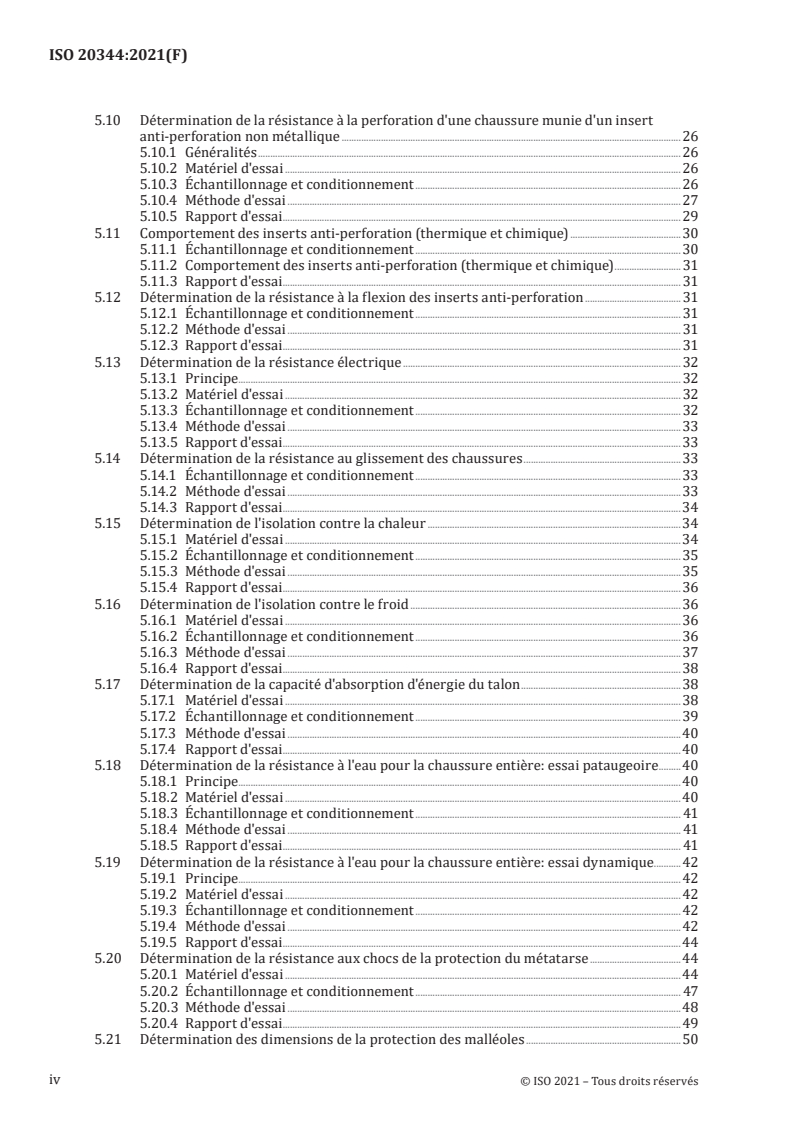
5.10 Détermination de la résistance à la perforation d'une chaussure munie d'un insert
anti-perforation non métallique . 26
5.10.1 Généralités . 26
5.10.2 Matériel d'essai . 26
5.10.3 Échantillonnage et conditionnement . 26
5.10.4 Méthode d'essai . 27
5.10.5 Rapport d'essai.29
5.11 Comportement des inserts anti-perforation (thermique et chimique) .30
5.11.1 Échantillonnage et conditionnement .30
5.11.2 Comportement des inserts anti-perforation (thermique et chimique) . 31
5.11.3 Rapport d'essai. 31
5.12 Détermination de la résistance à la flexion des inserts anti-perforation . 31
5.12.1 Échantillonnage et conditionnement . 31
5.12.2 Méthode d'essai . 31
5.12.3 Rapport d'essai. 31
5.13 Détermination de la résistance électrique . 32
5.13.1 Principe. 32
5.13.2 Matériel d'essai . 32
5.13.3 Échantillonnage et conditionnement . 32
5.13.4 Méthode d'essai .33
5.13.5 Rapport d'essai. 33
5.14 Détermination de la résistance au glissement des chaussures . 33
5.14.1 Échantillonnage et conditionnement . 33
5.14.2 Méthode d'essai .33
5.14.3 Rapport d'essai.34
5.15 Détermination de l'isolation contre la chaleur .34
5.15.1 Matériel d'essai .34
5.15.2 Échantillonnage et conditionnement . 35
5.15.3 Méthode d'essai . 35
5.15.4 Rapport d'essai.36
5.16 Détermination de l'isolation contre le froid .36
5.16.1 Matériel d'essai .36
5.16.2 Échantillonnage et conditionnement .36
5.16.3 Méthode d'essai . 37
5.16.4 Rapport d'essai.38
5.17 Détermination de la capacité d'absorption d'énergie du talon .38
5.17.1 Matériel d'essai .38
5.17.2 Échantillonnage et conditionnement .39
5.17.3 Méthode d'essai .40
5.17.4 Rapport d'essai.40
5.18 Détermination de la résistance à l'eau pour la chaussure entière: essai pataugeoire .40
5.18.1 Principe.40
5.18.2 Matériel d'essai .40
5.18.3 Échantillonnage et conditionnement . 41
5.18.4 Méthode d'essai . 41
5.18.5 Rapport d'essai. 41
5.19 Détermination de la résistance à l'eau pour la chaussure entière: essai dynamique . . 42
5.19.1 Principe. 42
5.19.2 Matériel d'essai . 42
5.19.3 Échantillonnage et conditionnement . 42
5.19.4 Méthode d'essai . 42
5.19.5 Rapport d'essai.44
5.20 Détermination de la résistance aux chocs de la protection du métatarse .44
5.20.1 Matériel d'essai .44
5.20.2 Échantillonnage et conditionnement . 47
5.20.3 Méthode d'essai .48
5.20.4 Rapport d'essai.49
5.21 Détermination des dimensions de la protection des malléoles .50
iv
5.21.1 Échantillonnage et conditionnement .50
5.21.2 Méthode d'essai .50
5.21.3 Rapport d'essai. 51
5.22 Détermination de la capacité d'absorption des chocs des matériaux de protection
des malléoles incorporés dans la tige . 51
5.22.1 Principe. 51
5.22.2 Matériel d'essai . 51
5.22.3 Échantillonnage et conditionnement . 53
5.22.4 Méthode d'essai .53
5.22.5 Rapport d'essai. 53
5.23 Détermination de la résistance à la coupure .54
5.23.1 Échantillonnage et conditionnement .54
5.23.2 Dimensions de la zone de protection résistante aux coupures .54
5.23.3 Méthode d'essai .54
5.23.4 Rapport d'essai. 55
5.24 Pare-pierre . 55
5.24.1 Échantillonnage et conditionnement . 55
5.24.2 Méthode d'essai pour la résistance à l'abrasion des pare-pierre .55
5.24.3 Rapport d'essai. 55
5.25 Détermination de la résistance des coutures . 55
5.25.1 Échantillonnage et conditionnement . 55
5.25.2 Méthode d'essai .56
5.25.3 Rapport d'essai.56
6 Méthodes d'essai pour la tige, la doublure et la languette .56
6.1 Détermination de l'épaisseur de la tige .56
6.1.1 Échantillonnage et conditionnement .56
6.1.2 Méthode d'essai .56
6.1.3 Rapport d'essai.56
6.2 Mesurage de la hauteur de la tige .56
6.2.1 Échantillonnage et conditionnement .56
6.2.2 Méthode d'essai pour la tige complète .56
6.2.3 Méthode d'essai pour la détermination de la surface de matériau non
perméable à la vapeur d'eau . 57
6.3 Détermination de la résistance au déchirement de la tige, de la doublure et/ou de
la languette . 59
6.3.1 Échantillonnage et conditionnement . 59
6.3.2 Méthode d'essai . 59
6.3.3 Rapport d'essai.60
6.4 Détermination des propriétés en traction des matériaux utilisés pour la tige .60
6.4.1 Échantillonnage et conditionnement .60
6.4.2 Méthode d'essai .60
6.4.3 Rapport d'essai. 61
6.5 Détermination de la résistance à la flexion de la tige . 62
6.5.1 Échantillonnage et conditionnement . 62
6.5.2 Méthode d'essai . 62
6.5.3 Rapport d'essai.65
6.6 Détermination de la perméabilité à la vapeur d'eau (WVP) .65
6.6.1 Principe.65
6.6.2 Échantillonnage et conditionnement .65
6.6.3 Méthode d'essai de prétraitement .65
6.6.4 Mesurage de la perméabilité à la vapeur d'eau (WVP) .65
6.6.5 Rapport d'essai.65
6.7 Détermination de l'absorption de la vapeur d'eau (WVA) .65
6.7.1 Principe.65
6.7.2 Matériel d'essai .66
6.7.3 Échantillonnage et conditionnement .66
6.7.4 Méthode d'essai .66
6.7.5 Rapport d'essai.68
v
6.8 Détermination du coefficient de vapeur d'eau (WVC) .68
6.8.1 Calcul du WVC .68
6.8.2 Rapport d'essai.68
6.9 Détermination de la valeur du pH .68
6.9.1 Échantillonnage et conditionnement .68
6.9.2 Méthode d'essai .68
6.9.3 Rapport d'essai.69
6.10 Détermination de la résistance à l'hydrolyse de la tige . 69
6.10.1 Échantillonnage et conditionnement . 69
6.10.2 Méthode d'essai .69
6.10.3 Rapport d'essai. 69
6.11 Détermination de la teneur en chrome VI . 69
6.11.1 Échantillonnage et conditionnement . 69
6.11.2 Méthode d'essai .69
6.11.3 Rapport d'essai.69
6.12 Détermination de la résistance à l'abrasion de la doublure et de la première de
propreté . 70
6.12.1 Principe. 70
6.12.2 Matériel d'essai . 70
6.12.3 Échantillonnage et conditionnement . 71
6.12.4 Méthode d'essai . 71
6.12.5 Rapport d'essai.72
6.13 Détermination de la pénétration et de l'absorption d'eau pour la tige .72
6.13.1 Principe.72
6.13.2 Matériel d'essai .73
6.13.3 Échantillonnage et conditionnement .73
6.13.4 Méthode d'essai .73
6.13.5 Rapport d'essai.74
7 Méthodes d'essai pour la première de montage, la première de propreté et la
semelle anatomique.74
7.1 Détermination de l'épaisseur de la première de montage, de la première de
propreté et de la semelle anatomique .74
7.1.1 Échantillonnage et conditionnement .74
7.1.2 Méthode d'essai .75
7.1.3 Rapport d'essai. 75
7.2 Détermination de l'absorption et de la désorption d'eau de la première de montage
et/ou de la première de propreté . 75
7.2.1 Principe. 75
7.2.2 Matériel d'essai . 75
7.2.3 Échantillonnage et conditionnement . 75
7.2.4 Méthode d'essai . 76
7.2.5 Rapport d'essai.77
7.3 Détermination de la résistance à l'abrasion de la première de montage.77
7.3.1 Principe.77
7.3.2 Matériel d'essai .77
7.3.3 Échantillonnage et conditionnement .77
7.3.4 Méthode d'essai .78
7.3.5 Rapport d'essai. 78
8 Méthodes d'essai pour la semelle de marche .79
8.1 Remarques générales . .79
8.2 Détermination des dimensions de la semelle de marche. 79
8.2.1 Échantillonnage et conditionnement . 79
8.2.2 Détermination de la surface munie de crampons . 79
8.2.3 Épaisseur de la semelle de marche et hauteur des crampons .80
8.2.4 Détermination de la conception des crampons dans la zone des cambrures .81
8.3 Détermination de la résistance au déchirement de la semelle de marche .82
8.3.1 Échantillonnage et conditionnement .82
vi
8.3.2 Méthode d'essai .82
8.3.3 Rapport d'essai.83
8.4 Détermination de la résistance à l'abrasion de la semelle de marche .83
8.4.1 Échantillonnage et conditionnement .83
8.4.2 Méthode d'essai .83
8.4.3 Rapport d'essai.83
8.5 Détermination de la rigidité de la chaussure .83
8.5.1 Principe.83
8.5.2 Matériel d'essai .83
8.5.3 Échantillonnage et conditionnement .83
8.5.4 Méthode d'essai .84
8.5.5 Rapport d'essai.85
8.6 Détermination de la résistance à la flexion de la semelle de marche .86
8.6.1 Principe.86
8.6.2 Matériel d'essai .86
8.6.3 Échantillonnage et conditionnement .86
8.6.4 Méthode d'essai .86
8.6.5 Rapport d'essai.88
8.7 Détermination de la résistance à l'hydrolyse de la semelle de marche .88
8.7.1 Échantillonnage et conditionnement .88
8.7.2 Méthode d'essai .88
8.7.3 Rapport d'essai.88
8.8 Détermination de la résistance aux hydrocarbures.88
8.8.1 Échantillonnage et conditionnement .88
8.8.2 Méthodes d'essais .88
8.8.3 Rapport d'essai.89
8.9 Détermination de la résistance à la chaleur par contact .89
8.9.1 Matériel d'essai .89
8.9.2 Échantillonnage et conditionnement . 91
8.9.3 Méthodes d'essais . 91
8.9.4 Rapport d'essai. 92
Annexe A (normative) Évaluation des chaussures par le laboratoire pendant les essais de
comportement thermique .93
Annexe B (informative) Pointures de chaussur
...
NORME ISO
INTERNATIONALE 20344
Troisième édition
2021-10
Équipement de protection
individuelle — Méthodes d'essai pour
les chaussures
Personal protective equipment — Test methods for footwear
Numéro de référence
DOCUMENT PROTÉGÉ PAR COPYRIGHT
© ISO 2021
Droits de reproduction réservés. Sauf indication contraire, aucune partie de cette publication ne peut être reproduite ni utilisée
sous quelque forme que ce soit et par aucun procédé, électronique ou mécanique, y compris la photocopie, l’affichage sur l’internet
ou sur un Intranet, sans autorisation écrite préalable. Les demandes d’autorisation peuvent être adressées à l’ISO à l’adresse ci-
après ou au comité membre de l’ISO dans le pays du demandeur.
ISO copyright office
Case postale 401 • Ch. de Blandonnet 8
CH-1214 Vernier, Genève
Tél.: +41 22 749 01 11
E-mail: copyright@iso.org
Web: www.iso.org
Publié en Suisse
ii
Sommaire Page
Avant-propos .viii
1 Domaine d'application .1
2 Références normatives .1
3 Termes et définitions . 2
4 Paramètres d'essai généraux .2
4.1 Échantillonnage . 2
4.2 Conditionnement avant et pendant l'essai . 3
4.3 Conditions préalables au mode opératoire d'essai . 3
4.4 Rapport d'essai . 3
5 Méthodes d'essai pour la chaussure entière . 8
5.1 Caractéristiques ergonomiques particulières . 8
5.1.1 Échantillonnage et conditionnement . 8
5.1.2 Méthode d'essai . 8
5.1.3 Rapport d'essai. 9
5.2 Détermination de la force d'adhésion entre la tige et la semelle de marche, et entre
la semelle et la semelle intercalaire . 9
5.2.1 Principe. 9
5.2.2 Matériel d'essai . 9
5.2.3 Échantillonnage et conditionnement . 9
5.2.4 Méthode d'essai . 9
5.2.5 Rapport d'essai. 13
5.3 Détermination des dimensions de l'embout . 14
5.3.1 Échantillonnage et conditionnement . 14
5.3.2 Méthode d'essai . 14
5.3.3 Rapport d'essai. 14
5.4 Détermination de la résistance aux chocs . 14
5.4.1 Matériel d'essai . 14
5.4.2 Échantillonnage et conditionnement . 18
5.4.3 Méthodes d'essais . 18
5.4.4 Rapport d'essai.20
5.5 Détermination de la résistance à l'écrasement . 20
5.5.1 Matériel d'essai . 20
5.5.2 Échantillonnage et conditionnement . 20
5.5.3 Méthode d'essai .20
5.5.4 Rapport d'essai. 21
5.6 Comportement des embouts (thermique et chimique) . 22
5.6.1 Échantillonnage et conditionnement . 22
5.6.2 Comportement des embouts (thermique et chimique) .22
5.7 Détermination de l'étanchéité . 23
5.7.1 Matériel d'essai . 23
5.7.2 Échantillonnage et conditionnement . 23
5.7.3 Méthode d'essai .23
5.7.4 Rapport d'essai. 23
5.8 Dimensions des inserts anti-perforation . 23
5.8.1 Échantillonnage et conditionnement . 23
5.8.2 Méthode d'essai . 24
5.8.3 Rapport d'essai. 24
5.9 Détermination de la résistance à la perforation d'une chaussure munie d'un insert
anti-perforation métallique .25
5.9.1 Matériel d'essai . 25
5.9.2 Échantillonnage et conditionnement . 25
5.9.3 Méthode d'essai .26
5.9.4 Rapport d'essai. 26
iii
5.10 Détermination de la résistance à la perforation d'une chaussure munie d'un insert
anti-perforation non métallique . 26
5.10.1 Généralités . 26
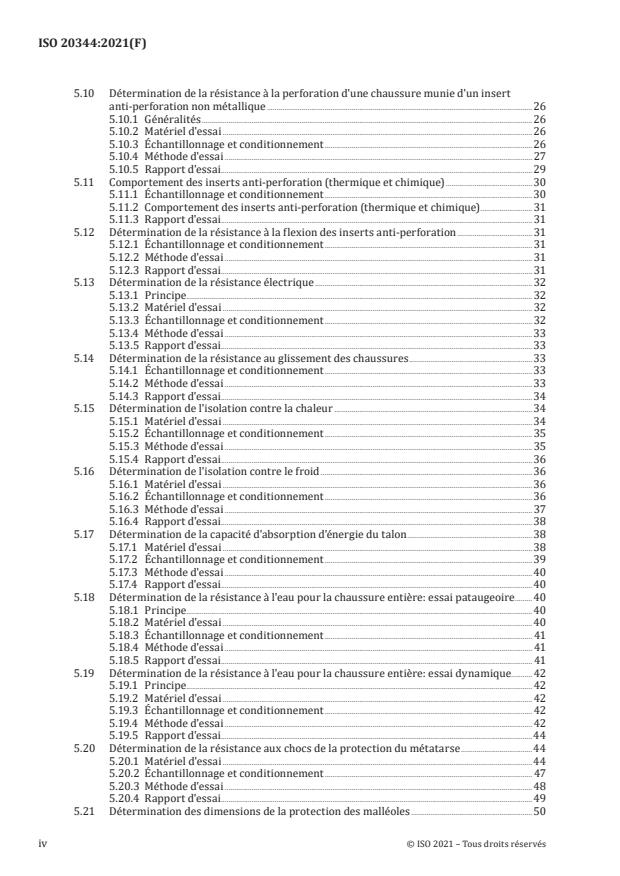
5.10.2 Matériel d'essai . 26
5.10.3 Échantillonnage et conditionnement . 26
5.10.4 Méthode d'essai . 27
5.10.5 Rapport d'essai.29
5.11 Comportement des inserts anti-perforation (thermique et chimique) .30
5.11.1 Échantillonnage et conditionnement .30
5.11.2 Comportement des inserts anti-perforation (thermique et chimique) . 31
5.11.3 Rapport d'essai. 31
5.12 Détermination de la résistance à la flexion des inserts anti-perforation . 31
5.12.1 Échantillonnage et conditionnement . 31
5.12.2 Méthode d'essai . 31
5.12.3 Rapport d'essai. 31
5.13 Détermination de la résistance électrique . 32
5.13.1 Principe. 32
5.13.2 Matériel d'essai . 32
5.13.3 Échantillonnage et conditionnement . 32
5.13.4 Méthode d'essai .33
5.13.5 Rapport d'essai. 33
5.14 Détermination de la résistance au glissement des chaussures . 33
5.14.1 Échantillonnage et conditionnement . 33
5.14.2 Méthode d'essai .33
5.14.3 Rapport d'essai.34
5.15 Détermination de l'isolation contre la chaleur .34
5.15.1 Matériel d'essai .34
5.15.2 Échantillonnage et conditionnement . 35
5.15.3 Méthode d'essai . 35
5.15.4 Rapport d'essai.36
5.16 Détermination de l'isolation contre le froid .36
5.16.1 Matériel d'essai .36
5.16.2 Échantillonnage et conditionnement .36
5.16.3 Méthode d'essai . 37
5.16.4 Rapport d'essai.38
5.17 Détermination de la capacité d'absorption d'énergie du talon .38
5.17.1 Matériel d'essai .38
5.17.2 Échantillonnage et conditionnement .39
5.17.3 Méthode d'essai .40
5.17.4 Rapport d'essai.40
5.18 Détermination de la résistance à l'eau pour la chaussure entière: essai pataugeoire .40
5.18.1 Principe.40
5.18.2 Matériel d'essai .40
5.18.3 Échantillonnage et conditionnement . 41
5.18.4 Méthode d'essai . 41
5.18.5 Rapport d'essai. 41
5.19 Détermination de la résistance à l'eau pour la chaussure entière: essai dynamique . . 42
5.19.1 Principe. 42
5.19.2 Matériel d'essai . 42
5.19.3 Échantillonnage et conditionnement . 42
5.19.4 Méthode d'essai . 42
5.19.5 Rapport d'essai.44
5.20 Détermination de la résistance aux chocs de la protection du métatarse .44
5.20.1 Matériel d'essai .44
5.20.2 Échantillonnage et conditionnement . 47
5.20.3 Méthode d'essai .48
5.20.4 Rapport d'essai.49
5.21 Détermination des dimensions de la protection des malléoles .50
iv
5.21.1 Échantillonnage et conditionnement .50
5.21.2 Méthode d'essai .50
5.21.3 Rapport d'essai. 51
5.22 Détermination de la capacité d'absorption des chocs des matériaux de protection
des malléoles incorporés dans la tige . 51
5.22.1 Principe. 51
5.22.2 Matériel d'essai . 51
5.22.3 Échantillonnage et conditionnement . 53
5.22.4 Méthode d'essai .53
5.22.5 Rapport d'essai. 53
5.23 Détermination de la résistance à la coupure .54
5.23.1 Échantillonnage et conditionnement .54
5.23.2 Dimensions de la zone de protection résistante aux coupures .54
5.23.3 Méthode d'essai .54
5.23.4 Rapport d'essai. 55
5.24 Pare-pierre . 55
5.24.1 Échantillonnage et conditionnement . 55
5.24.2 Méthode d'essai pour la résistance à l'abrasion des pare-pierre .55
5.24.3 Rapport d'essai. 55
5.25 Détermination de la résistance des coutures . 55
5.25.1 Échantillonnage et conditionnement . 55
5.25.2 Méthode d'essai .56
5.25.3 Rapport d'essai.56
6 Méthodes d'essai pour la tige, la doublure et la languette .56
6.1 Détermination de l'épaisseur de la tige .56
6.1.1 Échantillonnage et conditionnement .56
6.1.2 Méthode d'essai .56
6.1.3 Rapport d'essai.56
6.2 Mesurage de la hauteur de la tige .56
6.2.1 Échantillonnage et conditionnement .56
6.2.2 Méthode d'essai pour la tige complète .56
6.2.3 Méthode d'essai pour la détermination de la surface de matériau non
perméable à la vapeur d'eau . 57
6.3 Détermination de la résistance au déchirement de la tige, de la doublure et/ou de
la languette . 59
6.3.1 Échantillonnage et conditionnement . 59
6.3.2 Méthode d'essai . 59
6.3.3 Rapport d'essai.60
6.4 Détermination des propriétés en traction des matériaux utilisés pour la tige .60
6.4.1 Échantillonnage et conditionnement .60
6.4.2 Méthode d'essai .60
6.4.3 Rapport d'essai. 61
6.5 Détermination de la résistance à la flexion de la tige . 62
6.5.1 Échantillonnage et conditionnement . 62
6.5.2 Méthode d'essai . 62
6.5.3 Rapport d'essai.65
6.6 Détermination de la perméabilité à la vapeur d'eau (WVP) .65
6.6.1 Principe.65
6.6.2 Échantillonnage et conditionnement .65
6.6.3 Méthode d'essai de prétraitement .65
6.6.4 Mesurage de la perméabilité à la vapeur d'eau (WVP) .65
6.6.5 Rapport d'essai.65
6.7 Détermination de l'absorption de la vapeur d'eau (WVA) .65
6.7.1 Principe.65
6.7.2 Matériel d'essai .66
6.7.3 Échantillonnage et conditionnement .66
6.7.4 Méthode d'essai .66
6.7.5 Rapport d'essai.68
v
6.8 Détermination du coefficient de vapeur d'eau (WVC) .68
6.8.1 Calcul du WVC .68
6.8.2 Rapport d'essai.68
6.9 Détermination de la valeur du pH .68
6.9.1 Échantillonnage et conditionnement .68
6.9.2 Méthode d'essai .68
6.9.3 Rapport d'essai.69
6.10 Détermination de la résistance à l'hydrolyse de la tige . 69
6.10.1 Échantillonnage et conditionnement . 69
6.10.2 Méthode d'essai .69
6.10.3 Rapport d'essai. 69
6.11 Détermination de la teneur en chrome VI . 69
6.11.1 Échantillonnage et conditionnement . 69
6.11.2 Méthode d'essai .69
6.11.3 Rapport d'essai.69
6.12 Détermination de la résistance à l'abrasion de la doublure et de la première de
propreté . 70
6.12.1 Principe. 70
6.12.2 Matériel d'essai . 70
6.12.3 Échantillonnage et conditionnement . 71
6.12.4 Méthode d'essai . 71
6.12.5 Rapport d'essai.72
6.13 Détermination de la pénétration et de l'absorption d'eau pour la tige .72
6.13.1 Principe.72
6.13.2 Matériel d'essai .73
6.13.3 Échantillonnage et conditionnement .73
6.13.4 Méthode d'essai .73
6.13.5 Rapport d'essai.74
7 Méthodes d'essai pour la première de montage, la première de propreté et la
semelle anatomique.74
7.1 Détermination de l'épaisseur de la première de montage, de la première de
propreté et de la semelle anatomique .74
7.1.1 Échantillonnage et conditionnement .74
7.1.2 Méthode d'essai .75
7.1.3 Rapport d'essai. 75
7.2 Détermination de l'absorption et de la désorption d'eau de la première de montage
et/ou de la première de propreté . 75
7.2.1 Principe. 75
7.2.2 Matériel d'essai . 75
7.2.3 Échantillonnage et conditionnement . 75
7.2.4 Méthode d'essai . 76
7.2.5 Rapport d'essai.77
7.3 Détermination de la résistance à l'abrasion de la première de montage.77
7.3.1 Principe.77
7.3.2 Matériel d'essai .77
7.3.3 Échantillonnage et conditionnement .77
7.3.4 Méthode d'essai .78
7.3.5 Rapport d'essai. 78
8 Méthodes d'essai pour la semelle de marche .79
8.1 Remarques générales . .79
8.2 Détermination des dimensions de la semelle de marche. 79
8.2.1 Échantillonnage et conditionnement . 79
8.2.2 Détermination de la surface munie de crampons . 79
8.2.3 Épaisseur de la semelle de marche et hauteur des crampons .80
8.2.4 Détermination de la conception des crampons dans la zone des cambrures .81
8.3 Détermination de la résistance au déchirement de la semelle de marche .82
8.3.1 Échantillonnage et conditionnement .82
vi
8.3.2 Méthode d'essai .82
8.3.3 Rapport d'essai.83
8.4 Détermination de la résistance à l'abrasion de la semelle de marche .83
8.4.1 Échantillonnage et conditionnement .83
8.4.2 Méthode d'essai .83
8.4.3 Rapport d'essai.83
8.5 Détermination de la rigidité de la chaussure .83
8.5.1 Principe.83
8.5.2 Matériel d'essai .83
8.5.3 Échantillonnage et conditionnement .83
8.5.4 Méthode d'essai .84
8.5.5 Rapport d'essai.85
8.6 Détermination de la résistance à la flexion de la semelle de marche .86
8.6.1 Principe.86
8.6.2 Matériel d'essai .86
8.6.3 Échantillonnage et conditionnement .86
8.6.4 Méthode d'essai .86
8.6.5 Rapport d'essai.88
8.7 Détermination de la résistance à l'hydrolyse de la semelle de marche .88
8.7.1 Échantillonnage et conditionnement .88
8.7.2 Méthode d'essai .88
8.7.3 Rapport d'essai.88
8.8 Détermination de la résistance aux hydrocarbures.88
8.8.1 Échantillonnage et conditionnement .88
8.8.2 Méthodes d'essais .88
8.8.3 Rapport d'essai.89
8.9 Détermination de la résistance à la chaleur par contact .89
8.9.1 Matériel d'essai .89
8.9.2 Échantillonnage et conditionnement . 91
8.9.3 Méthodes d'essais . 91
8.9.4 Rapport d'essai. 92
Annexe A (normative) Évaluation des chaussures par le laboratoire pendant les essais de
comportement thermique .93
Annexe B (informative) Pointures de chaussur
...
Questions, Comments and Discussion
Ask us and Technical Secretary will try to provide an answer. You can facilitate discussion about the standard in here.
Loading comments...