

ISO 13399-1:2006
(Main)Cutting tool data representation and exchange — Part 1: Overview, fundamental principles and general information model
General Information
- Abstract
ISO 13399-1:2006 covers the main categories of cutting tool data and the relationships between them. It provides a general information model of data representation and information exchange for these categories, as well as an overview of the principles of product data exchange used in ISO 13399 as a whole, a description of the other parts of ISO 13399 and a method for transferring cutting tool data.
- Status
- Published
- Publication Date
- 08-Feb-2006
- Technical Committee
- ISO/TC 29 - Small tools
- Drafting Committee
- ISO/TC 29/WG 34 - Cutting tool data representation and exchange
- Current Stage
- 9093 - International Standard confirmed
- Start Date
- 03-Dec-2021
- Completion Date
- 29-Aug-2026
Overview
ISO 13399-1:2006 - Cutting tool data representation and exchange - Part 1: Overview, fundamental principles and general information model - defines the general information model and principles for representing and exchanging cutting tool data. The standard identifies the main categories of cutting tool data, their relationships, and a method for transferring tool data between systems. Part 1 provides an architectural overview and describes how the rest of the ISO 13399 family is organized, establishing a consistent basis for tool data exchange across CAD/CAM, PDM/PLM and manufacturing systems.
Keywords: ISO 13399-1, cutting tool data representation, information exchange, tool data model, cutting tool standards.
Key Topics
ISO 13399-1 addresses foundational concepts and data structures used throughout the ISO 13399 series, including:
- General information model for cutting tool data and relationships between data categories
- Units of functionality such as classification, dimension_tolerance, effectivity, and external_reference_mechanism
- Item and product management structures: item_definition, item_instance, item_version, product_management_data
- Application objects and document handling: digital_document, document_version, document_format and external_file_id_and_location
- Property and value models: property, property_value, property_value_representation and property_relationship
- Geometric and external references: external_geometric_model, external_model, geometric_model_relationship_with_transformation
- Classification and PLIB references: classification_system, classification_association and plib_class_reference / plib_property_reference
- Effectivity and lifecycle: effectivity, effectivity_assignment and item_version_relationship
These topics form the technical requirements for consistent tool data representation used by downstream parts of ISO 13399.
Applications
ISO 13399-1 is intended for organizations that need standardized cutting tool data exchange and integration:
- Cutting tool manufacturers creating digital tool catalogs and digital tool libraries
- CAM/CAD software vendors implementing tool data models for accurate toolpath generation
- PDM/PLM and ERP integrators synchronizing tooling data across procurement, inventory and production
- Machine shops and manufacturing engineers using standardized tool definitions for setup, simulation and lifecycle management
- Tooling data management systems exchanging classification, geometry, document and property data between suppliers and consumers
Practical uses include interoperable tool catalogs, automated tool selection in CAM, accurate procurement and lifecycle tracking, and consistent representation of tool geometry and properties.
Related Standards
ISO 13399-1 is Part 1 of the ISO 13399 family (cutting tool data representation and exchange). It references product data exchange principles and integrates with tooling library concepts (PLIB references) used in tooling data exchange workflows. For implementation, consult the other parts of ISO 13399 that define detailed file formats, reference dictionaries and exchange mechanisms.
Relations
- Effective Date
- 06-Jun-2022
- Effective Date
- 15-Apr-2008
Get Certified
Connect with accredited certification bodies for this standard

BSI Group
BSI (British Standards Institution) is the business standards company that helps organizations make excellence a habit.

DVS-ZERT GmbH
German welding certification society.
CARES (UK Certification Authority for Reinforcing Steels)
UK certification for reinforcing steels and construction.
Sponsored listings
Frequently Asked Questions
ISO 13399-1:2006 is a standard published by the International Organization for Standardization (ISO). Its full title is "Cutting tool data representation and exchange — Part 1: Overview, fundamental principles and general information model". This standard covers: ISO 13399-1:2006 covers the main categories of cutting tool data and the relationships between them. It provides a general information model of data representation and information exchange for these categories, as well as an overview of the principles of product data exchange used in ISO 13399 as a whole, a description of the other parts of ISO 13399 and a method for transferring cutting tool data.
ISO 13399-1:2006 covers the main categories of cutting tool data and the relationships between them. It provides a general information model of data representation and information exchange for these categories, as well as an overview of the principles of product data exchange used in ISO 13399 as a whole, a description of the other parts of ISO 13399 and a method for transferring cutting tool data.
ISO 13399-1:2006 is classified under the following ICS (International Classification for Standards) categories: 25.100.01 - Cutting tools in general; 35.240.50 - IT applications in industry. The ICS classification helps identify the subject area and facilitates finding related standards.
ISO 13399-1:2006 has the following relationships with other standards: It is inter standard links to ISO 13399-1:2006/Amd 1:2010; is excused to ISO 13399-1:2006/Amd 1:2010. Understanding these relationships helps ensure you are using the most current and applicable version of the standard.
ISO 13399-1:2006 is available in PDF format for immediate download after purchase. The document can be added to your cart and obtained through the secure checkout process. Digital delivery ensures instant access to the complete standard document.
Standards Content (Sample)
INTERNATIONAL ISO
STANDARD 13399-1
First edition
2006-02-15
Cutting tool data representation and
exchange —
Part 1:
Overview, fundamental principles and
general information model
Représentation et échange des données relatives aux outils
coupants —
Partie 1: Vue d'ensemble, principes fondamentaux et modèle général
d'informations
Reference number
©
ISO 2006
PDF disclaimer
This PDF file may contain embedded typefaces. In accordance with Adobe's licensing policy, this file may be printed or viewed but
shall not be edited unless the typefaces which are embedded are licensed to and installed on the computer performing the editing. In
downloading this file, parties accept therein the responsibility of not infringing Adobe's licensing policy. The ISO Central Secretariat
accepts no liability in this area.
Adobe is a trademark of Adobe Systems Incorporated.
Details of the software products used to create this PDF file can be found in the General Info relative to the file; the PDF-creation
parameters were optimized for printing. Every care has been taken to ensure that the file is suitable for use by ISO member bodies. In
the unlikely event that a problem relating to it is found, please inform the Central Secretariat at the address given below.
© ISO 2006
All rights reserved. Unless otherwise specified, no part of this publication may be reproduced or utilized in any form or by any means,
electronic or mechanical, including photocopying and microfilm, without permission in writing from either ISO at the address below or
ISO's member body in the country of the requester.
ISO copyright office
Case postale 56 • CH-1211 Geneva 20
Tel. + 41 22 749 01 11
Fax + 41 22 749 09 47
E-mail copyright@iso.org
Web www.iso.org
Published in Switzerland
ii © ISO 2006 – All rights reserved
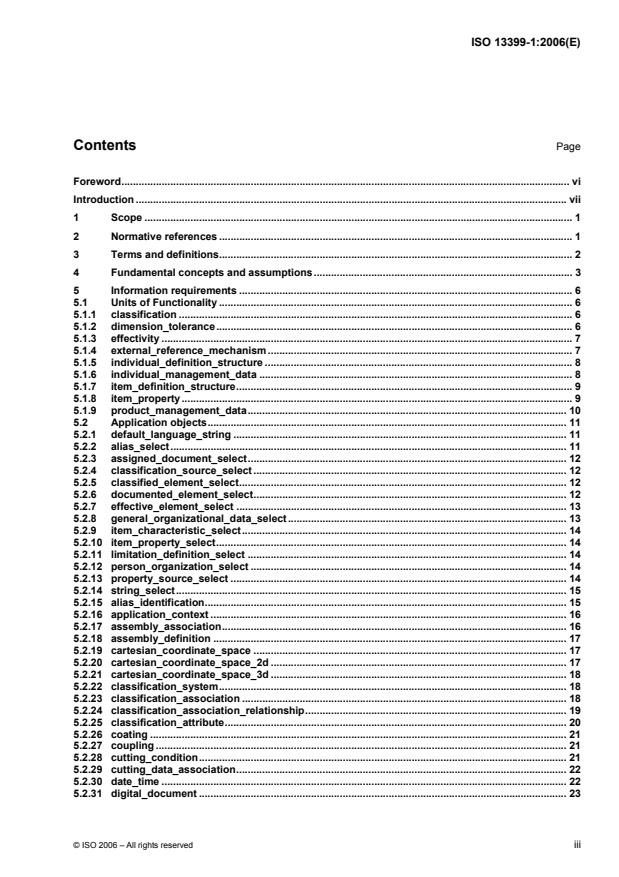
Contents Page
Foreword. vi
Introduction . vii
1 Scope . 1
2 Normative references . 1
3 Terms and definitions. 2
4 Fundamental concepts and assumptions. 3
5 Information requirements . 6
5.1 Units of Functionality . 6
5.1.1 classification . 6
5.1.2 dimension_tolerance. 6
5.1.3 effectivity . 7
5.1.4 external_reference_mechanism . 7
5.1.5 individual_definition_structure . 8
5.1.6 individual_management_data . 8
5.1.7 item_definition_structure. 9
5.1.8 item_property. 9
5.1.9 product_management_data. 10
5.2 Application objects. 11
5.2.1 default_language_string . 11
5.2.2 alias_select. 11
5.2.3 assigned_document_select. 12
5.2.4 classification_source_select . 12
5.2.5 classified_element_select. 12
5.2.6 documented_element_select. 12
5.2.7 effective_element_select . 13
5.2.8 general_organizational_data_select. 13
5.2.9 item_characteristic_select. 14
5.2.10 item_property_select. 14
5.2.11 limitation_definition_select . 14
5.2.12 person_organization_select . 14
5.2.13 property_source_select . 14
5.2.14 string_select. 15
5.2.15 alias_identification. 15
5.2.16 application_context . 16
5.2.17 assembly_association. 16
5.2.18 assembly_definition . 17
5.2.19 cartesian_coordinate_space . 17
5.2.20 cartesian_coordinate_space_2d . 17
5.2.21 cartesian_coordinate_space_3d . 18
5.2.22 classification_system. 18
5.2.23 classification_association . 18
5.2.24 classification_association_relationship. 19
5.2.25 classification_attribute. 20
5.2.26 coating . 21
5.2.27 coupling . 21
5.2.28 cutting_condition. 21
5.2.29 cutting_data_association. 22
5.2.30 date_time . 22
5.2.31 digital_document . 23
5.2.32 digital_file. 23
5.2.33 din4000_reference. 23
5.2.34 document . 23
5.2.35 document_assignment . 24
5.2.36 document_content_property . 25
5.2.37 document_creation_property . 26
5.2.38 document_file. 27
5.2.39 document_format_property . 28
5.2.40 document_location_property. 29
5.2.41 document_representation. 30
5.2.42 document_size_property. 31
5.2.43 document_type_property. 31
5.2.44 document_version . 32
5.2.45 document_version_relationship. 33
5.2.46 duration. 34
5.2.47 effectivity. 34
5.2.48 effectivity_assignment . 36
5.2.49 effectivity_relationship . 36
5.2.50 external_file_id_and_location. 37
5.2.51 external_geometric_model. 38
5.2.52 external_library_reference . 38
5.2.53 external_model. 39
5.2.54 external_picture . 39
5.2.55 general_classification_hierarchy . 40
5.2.56 general_classification. 40
5.2.57 geometric_model_relationship_with_transformation . 41
5.2.58 grade. 42
5.2.59 grade_relationship . 42
5.2.60 item . 43
5.2.61 item_characteristic_association . 44
5.2.62 item_definition. 44
5.2.63 item_definition_relationship . 45
5.2.64 item_instance . 45
5.2.65 item_structure_association . 46
5.2.66 item_version . 47
5.2.67 item_version_relationship. 47
5.2.68 language. 49
5.2.69 limits_and_fits . 49
5.2.70 location. 50
5.2.71 mated_item_relationship. 50
5.2.72 material_designation . 50
5.2.73 mating_association. 50
5.2.74 mating_definition . 51
5.2.75 multi_language_string. 51
5.2.76 named_size. 52
5.2.77 numerical_value . 52
5.2.78 organization. 53
5.2.79 person . 54
5.2.80 person_in_organization. 54
5.2.81 person_organization_assignment. 55
5.2.82 physical_document. 56
5.2.83 physical_file. 56
5.2.84 physical_item. 57
5.2.85 physical_item_location_association. 57
5.2.86 physical_item_definition . 57
5.2.87 physical_item_state_association . 57
5.2.88 physical_item_structure_association. 57
5.2.89 physical_item_version. 58
5.2.90 plib_class_reference. 58
5.2.91 plib_property_reference . 58
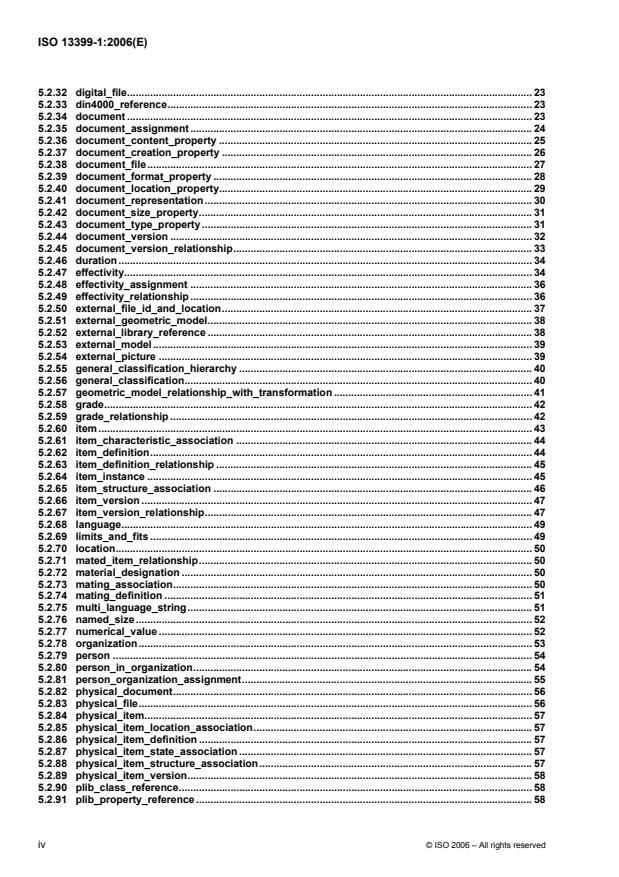
iv © ISO 2006 – All rights reserved
5.2.92 plus_minus_bounds. 59
5.2.93 property . 59
5.2.94 property_relationship. 61
5.2.95 property_value . 61
5.2.96 property_value_association . 62
5.2.97 property_value_representation. 63
5.2.98 property_value_representation_relationship . 64
5.2.99 quantified_instance . 65
5.2.100 realized_item_association . 65
5.2.101 rectangular_size. 65
5.2.102 specific_item_classification . 66
5.2.103 specific_item_classification_hierarchy. 67
5.2.104 state. 67
5.2.105 string_value. 67
5.2.106 string_with_language. 67
5.2.107 substrate. 68
5.2.108 transformation. 68
5.2.109 transformation_2d . 68
5.2.110 transformation_3d . 68
5.2.111 unit. 69
5.2.112 value_limit . 69
5.2.113 value_limitation. 69
5.2.114 value_list. 70
5.2.115 value_range . 70
5.2.116 value_with_unit. 71
5.2.117 workpiece_feature . 71
6 Application interpreted model. 73
6.1 Mapping specification . 73
6.1.1 classification UoF . 75
6.1.2 dimension_tolerance UoF. 93
6.1.3 effectivity UoF . 96
6.1.4 external_reference_mechanism UoF. 107
6.1.5 individual_definition_structure UoF . 140
6.1.6 individual_management_data UoF . 142
6.1.7 item_definition_structure UoF. 151
6.1.8 item_property UoF. 160
6.1.9 product_management_data UoF. 186
6.2 AIM EXPRESS short listing. 226
6.2.1 cutting_tool_schema types . 226
6.2.2 cutting_tool_schema entities . 231
6.2.3 cutting_tool_schema rules . 232
Annex A (normative) AIM longform. 285
Annex B (normative) AIM short names. 372
Annex C (normative) ARM EXPRESS listing . 376
Annex D (informative) ARM EXPRESS-G diagrams. 390
Annex E (informative) AIM EXPRESS-G diagrams. 411
Bibliography . 443
Foreword
ISO (the International Organization for Standardization) is a worldwide federation of national standards bodies
(ISO member bodies). The work of preparing International Standards is normally carried out through ISO
technical committees. Each member body interested in a subject for which a technical committee has been
established has the right to be represented on that committee. International organizations, governmental and
non-governmental, in liaison with ISO, also take part in the work. ISO collaborates closely with the
International Electrotechnical Commission (IEC) on all matters of electrotechnical standardization.
International Standards are drafted in accordance with the rules given in the ISO/IEC Directives, Part 2.
The main task of technical committees is to prepare International Standards. Draft International Standards
adopted by the technical committees are circulated to the member bodies for voting. Publication as an
International Standard requires approval by at least 75 % of the member bodies casting a vote.
Attention is drawn to the possibility that some of the elements of this document may be the subject of patent
rights. ISO shall not be held responsible for identifying any or all such patent rights.
ISO 13399-1 was prepared by Technical Committee ISO/TC 29, Small tools.
ISO 13399 consists of the following parts, under the general title Cutting tool data representation and
exchange:
⎯ Part 1: Overview, fundamental principles and general information model
⎯ Part 2: Reference dictionary for the cutting items [Technical Specification]
⎯ Part 100: Definitions, principles and methods for reference dictionaries [Technical Specification]
The following parts are under preparation:
⎯ Part 3: Reference dictionary for the tool items [Technical Specification]
⎯ Part 4: Reference dictionary of terms for adaptive items [Technical Specification]
⎯ Part 50: Reference dictionary for reference systems and common concepts [Technical Specification]
⎯ Part 60: Reference dictionary for connection systems [Technical Specification]
Assembly items is to form the subject of a future Part 5.
vi © ISO 2006 – All rights reserved
Introduction
ISO 13399 provides the means to achieve an electronic representation of cutting tool data by providing the
information structure needed to describe various data about cutting tools and cutting tool assemblies. It is
intended to facilitate the use, manipulation and exchange of cutting tool data within and between
manufacturing, distribution, and usage.
A cutting tool with defined cutting edges is used on a machine tool to remove workpiece material through a
shearing action at the cutting edge(s) of the tool. Cutting tool data are characteristics of the cutting tool and its
use that must be known and evaluated in order to make manufacturing decisions and to perform
manufacturing operations.
ISO 13399 includes the data representation of everything between the workpiece and the machine tool.
Information about inserts, solid tools (e.g. solid drill and solid endmill), assembled tools (e.g. boring bars,
indexable drills and indexable milling cutters), adaptors (e.g. milling arbor and chucks), components (e.g.
shims, screws and clamps) or any combination of the above can be exchanged.
The cutting tool data described include, but are not limited to, geometrical and dimensional data, identification
and designation data, miscellaneous and spare part data, cutting material data, and component connectivity.
The use of the tool information model established by ISO 13399 will provide increased productivity for the user
in the same way as do the tools. The effective management of tool information will improve the management
of the tools themselves. Use of the tool information model will enable the identification of the “right” tool in
every operation — from tool purchase, through planning, set-up in machine-tools, maintenance and reuse of
the tools — with short lead times and with high reliability and product quality. Tool users will benefit from
improved support from the tool vendors who will be able to provide a standard information product to
accompany the tool products. Computer interfaces for information exchange will be more efficient.
The representation of product data is defined by ISO 10303, which specifies the computer-interpretable
representation of product information and the exchange of product data. The objective is to provide a neutral
mechanism capable of describing products throughout their life cycle. This mechanism is suitable not only for
neutral file exchange, but also as a basis for implementing and sharing product databases, and as a basis for
archiving (ISO 10303-1).
This part of ISO 13399 uses the following resources according to ISO 10303:
a) the EXPRESS language defined in ISO 10303-11;
b) the file format for data exchange defined in ISO 10303-21 and ISO 10303-28;
c) the integrated resources given in parts ISO 10303-40 to ISO 10303-56.
ISO 13399 is intended for use by manufacturers, tool vendors or producers, and developers of manufacturing
software, among others. It provides a common structure for exchanging data about cutting tools (see Figure 1),
and is intended to allow or improve several capabilities, including
⎯ provision of a common set of definitions for use in describing cutting tools and cutting tool assemblies,
⎯ the integration and sharing of cutting tool and assembly data between software applications,
⎯ direct import of vendor cutting tool data into customer databases or applications, and
⎯ a reduction in the level of effort required for manufacturers to maintain accurate and current cutting tool
information from multiple sources and for multiple applications.
Figure 1 — Role of ISO 13399 in communication of cutting tool data and potential user viewpoints
While the use of ISO 13399 can facilitate the creation of an electronic catalogue, it does not set forth the rules
or procedures for creating electronic catalogues. These are defined in ISO 13584.
The responsibility for providing different viewpoints lies outside the scope of ISO 13399. Viewpoints might be
the material to be cut, the shape to be produced, the application for which the tool will be used or any other
valid viewpoint.
NOTE Use of the modelled information for different purposes can be regarded as different viewpoints of the
information. Although ISO 13399 does not provide the viewpoints, the information may be viewed from several alternative
viewpoints (see Figure 1).
Different companies use different business models to determine their need for the communication of
information about their products. For example, one cutting tool manufacturer could regrind its customers’ tools
while another could allow its customers to do the regrinding and provide the information to enable them to do
so. Therefore, the two cutting tool manufacturers could have a different set of cutting tool properties to
communicate using the information model and dictionaries provided by ISO 13399.
ISO 13399 defines only that information which could be communicated; it not specify what information must
be communicated.
viii © ISO 2006 – All rights reserved
INTERNATIONAL STANDARD ISO 13399-1:2006(E)
Cutting tool data representation and exchange —
Part 1:
Overview, fundamental principles and general information
model
1 Scope
This part of ISO 13399 covers the main categories of cutting tool data and the relationships between them. It
provides a general information model of data representation and information exchange for these categories,
as well as an overview of the principles of product data exchange used in ISO 13399 as a whole, a description
of the other parts of ISO 13399 and a method for transferring cutting tool data.
The following is not covered by this part of ISO 13399:
⎯ general data transfer and representations other than cutting tool data;
⎯ data describing rules, guidelines and expert knowledge used to design and manufacture machined parts
and cutting tools;
⎯ data describing why a particular design or manufacturing decision was made.
Cutting tool data and exchange for specific items (cutting, tool, adaptive and assembly items) and the
classification and definition of terms used in the description of cutting tools are defined in the other parts of
ISO 13399, respectively, and referenced by them.
ISO 13399 establishes a means of communicating industrial data between different computer systems that is
independent of any proprietary system.
2 Normative references
The following referenced documents are indispensable for the application of this document. For dated
references, only the edition cited applies. For undated references, the latest edition of the referenced
document (including any amendments) applies.
ISO 639-2, Codes for the representation of names of languages — Part 2: Alpha-3 code
ISO 3002-1, Basic quantities in cutting and grinding — Part 1: Geometry of the active part of cutting tools —
General terms, reference systems, tool and working angles, chip breakers
ISO 3002-3, Basic quantities in cutting and grinding — Part 3: Geometric and kinematic quantities in cutting
ISO 3166-1, Codes for the representation of names of countries and their subdivisions — Part 1: Country
codes
ISO 10303-41, Industrial automation systems and integration — Product data representation and exchange —
Part 41: Integrated generic resource: Fundamentals of product description and support
ISO 10303-42, Industrial automation systems and integration — Product data representation and exchange —
Part 42: Integrated generic resource: Geometric and topological representation
ISO 10303-43, Industrial automation systems and integration — Product data representation and exchange —
Part 43: Integrated generic resource: Representation structures
ISO 10303-44, Industrial automation systems and integration — Product data representation and exchange —
Part 44: Integrated generic resource: Product structure configuration
ISO 10303-45, Industrial automation systems and integration — Product data representation and exchange —
Part 45: Integrated generic resource: Materials
ISO 10303-46, Industrial automation systems and integration — Product data representation and exchange —
Part 46: Integrated generic resources: Visual presentation
ISO 10303-47, Industrial automation systems and integration — Product data representation and exchange —
Part 47: Integrated generic resource: Shape variation tolerances
ISO/DIS 10303-56, Industrial automation systems and integration — Product data representation and
exchange — Part 56: Integrated generic resource: State
ISO 10303-214, Industrial automation systems and integration — Product data representation and
exchange — Part 214: Application protocol: Core data for automotive mechanical design processes
ISO 13584-26, Industrial automation systems and integration — Parts library — Part 26: Logical resource:
Information supplier identification
ISO 13584-42, Industrial automation systems and integration — Parts library — Part 42: Description
methodology: Methodology for structuring part families
3 Terms and definitions
For the purposes of this document, the terms and definitions given in ISO 13399-100 and the following apply.
3.1
cutting tool
device or assembly of items for removing material from a workpiece through a shearing action at the defined
cutting edge or edges of the device
NOTE A cutting tool could be the assembly of one or more adaptive items, a tool item and several cutting items on a
tool item. See Figure 3.
3.2
information model
formal model of a bounded set of facts, concepts, or instructions to meet a specified requirement
NOTE See Reference [3].
NOTE “An information model is a formal description of types of ideas, facts and processes which together form a
model of a portion of interest of the real world and which provides an explicit set of interpretation rules. (If an information
model is written in EXPRESS or any other computer-sensible representation, it has the additional quality of being
[9]
computer processible.)” .
2 © ISO 2006 – All rights reserved
4 Fundamental concepts and assumptions
ISO 13399 does not standardize cutting tools but the representation of information about cutting tools. Any
standard dealing with information representation must be designed with the intent to standardize the
description of the items that the standard deals with and not to standardize the items themselves. This method
is also a step towards having standards that are not made obsolete by developments within the area where
[10]
the standard applies .
The intent of ISO 13399 is achieved by means of a computer-processable information model that defines the
framework within which data values can be placed. The benefits of such an information model are that it can
be interpreted by different computer applications and be generic enough to describe many different kinds of
tools. The aim of ISO 13399 is to allow for the different tools and machining operations that can be expected
in the future, while meeting the needs of current types of tool and their uses. It should also be possible to
describe a tool independently of its use, since the combination of modern tools and machines may allow a tool
to be used for many different kinds of cutting operation.
ISO 13399 specifies the representation of information on
⎯ cutting tools,
⎯ cutting items,
⎯ tool items,
⎯ adaptive items, and
⎯ assembly items.
See Figure 2.
Figure 2 — Examples of the main groups
The definitions of these groups are given in their respective parts of ISO 13399. Different combinations of
these groups are shown in Figure 3.
4 © ISO 2006 – All rights reserved
Figure 3 — Examples of different types of assemblies of items
The allowed relationships between these groups are shown in Table 1.
Table 1 — Matrix of Combinations
Machine side
Tool item Adaptive item Assembly item
Cutting item X X
Tool item X X X
Workpiece side
Adaptive item X X
Assembly item X X X
ISO 13399 does not deal with how to construct a cutting tool item, but provides an information representation
for cutting tools. Tools may be classified according to any scheme, and viewed from many viewpoints.
5 Information requirements
5.1 Units of Functionality
5.1.1 classification
This unit of functionality provides the capability to classify items into specific categories.
EXAMPLE Examples are the classification as raw materials, parts, or tools, or as safety or in-process items.
Additionally items may be classified by their attributes.
EXAMPLE Examples for categories of attribute based classification are screws, bolts, nuts, shafts, or brackets.
The following application objects are used by the classification UoF:
⎯ classification_association
⎯ classification_association_relationship
⎯ classification_attribute
⎯ classification_system
⎯ din4000_reference
⎯ external_library_reference
⎯ general_classification
⎯ general_classification_hierarchy
⎯ plib_class_reference
⎯ plib_property_reference
⎯ specific_item_classification
⎯ specific_item_classification_hierarchy
5.1.2 dimension_tolerance
This unit of functionality specifies the representation of geometric dimensions and of tolerances limiting
geometric dimensions. Tolerances for geometric dimensions are characterized by plus-minus-tolerances,
limits and fits, dimension ranges, or dimension limits and describe the allowable deviation range.
The following application objects are used by the dimension_tolerance UoF:
⎯ limits_and_fits
⎯ plus_minus_bounds
⎯ value_limitation
6 © ISO 2006 – All rights reserved
5.1.3 effectivity
This unit of functionality provides the capability to represent information concerning the validity of data. Implicit
propagation of data specifying validity is not available.
The validity of data can be expressed by effectivities that specify time ranges within which data may be used.
The following application objects are used by the effectivity UoF:
⎯ duration
⎯ effectivity
⎯ effectivity_assignment
⎯ effectivity_relationship
5.1.4 external_reference_mechanism
This unit of functionality provides a reference mechanism to specify external documents that are associated
with objects defined in this part of ISO 13399. These documents may contain data that are not in scope of this
part of ISO 13399. This includes conventional non-digital data and digital data in other computer interpretable
formats.
EXAMPLE Technical drawings on paper, standards documents, or hand-written documents, are examples of non-
digital data referenced by the external reference mechanism.
EXAMPLE CAD data in a system's native format, text documents in SGML, or NC-data in ISO 6983 are examples of
digital data referenced by the external reference mechanism.
The following application objects are used by the external_reference_mechanism UoF:
⎯ cartesian_coordinate_space
⎯ cartesian_coordinate_space_2d
⎯ cartesian_coordinate_space_3d
⎯ digital_document
⎯ digital_file
⎯ document
⎯ document_assignment
⎯ document_content_property
⎯ document_creation_property
⎯ document_file
⎯ document_format_property
⎯ document_location_property
⎯ document_representation
⎯ document_size_property
⎯ document_type_property
⎯ document_version
⎯ document_version_relationship
⎯ external_file_id_and_location
⎯ external_geometric_model
⎯ external_model
⎯ external_picture
⎯ geometric_model_relationship_with_transformation
⎯ named_size
⎯ physical_document
⎯ physical_file
⎯ rectangular_size
⎯ transformation
⎯
...