


ISO/IEC 23005-7:2019
(Main)Information technology — Media context and control — Part 7: Conformance and reference software
Information technology — Media context and control — Part 7: Conformance and reference software
This document specifies the conformance and reference software implementing the normative clauses of all parts of the ISO/IEC 23005 series. The information provided is applicable for determining the reference software modules available for the parts of the ISO/IEC 23005 series, understanding the functionality of the available reference software modules, and utilizing the available reference software modules. The available reference software modules are specified in the form of application programming interfaces (API) according to ISO/IEC 23006-1. Furthermore, this document provides the means for conformance testing, i.e. bitstreams ? XML descriptions ? that conform or do not conform to the normative clauses of the other parts of the ISO/IEC 23005 series and informative descriptions thereof.
Technologies de l'information — Contrôle et contexte de supports — Partie 7: Conformité et logiciel de référence
General Information
Relations
Standards Content (Sample)
INTERNATIONAL ISO/IEC
STANDARD 23005-7
Fourth edition
2019-12
Information technology — Media
context and control —
Part 7:
Conformance and reference software
Technologies de l'information — Contrôle et contexte de supports —
Partie 7: Conformité et logiciel de référence
Reference number
©
ISO/IEC 2019
© ISO/IEC 2019
All rights reserved. Unless otherwise specified, or required in the context of its implementation, no part of this publication may
be reproduced or utilized otherwise in any form or by any means, electronic or mechanical, including photocopying, or posting
on the internet or an intranet, without prior written permission. Permission can be requested from either ISO at the address
below or ISO’s member body in the country of the requester.
ISO copyright office
CP 401 • Ch. de Blandonnet 8
CH-1214 Vernier, Geneva
Phone: +41 22 749 01 11
Fax: +41 22 749 09 47
Email: copyright@iso.org
Website: www.iso.org
Published in Switzerland
ii © ISO/IEC 2019 – All rights reserved
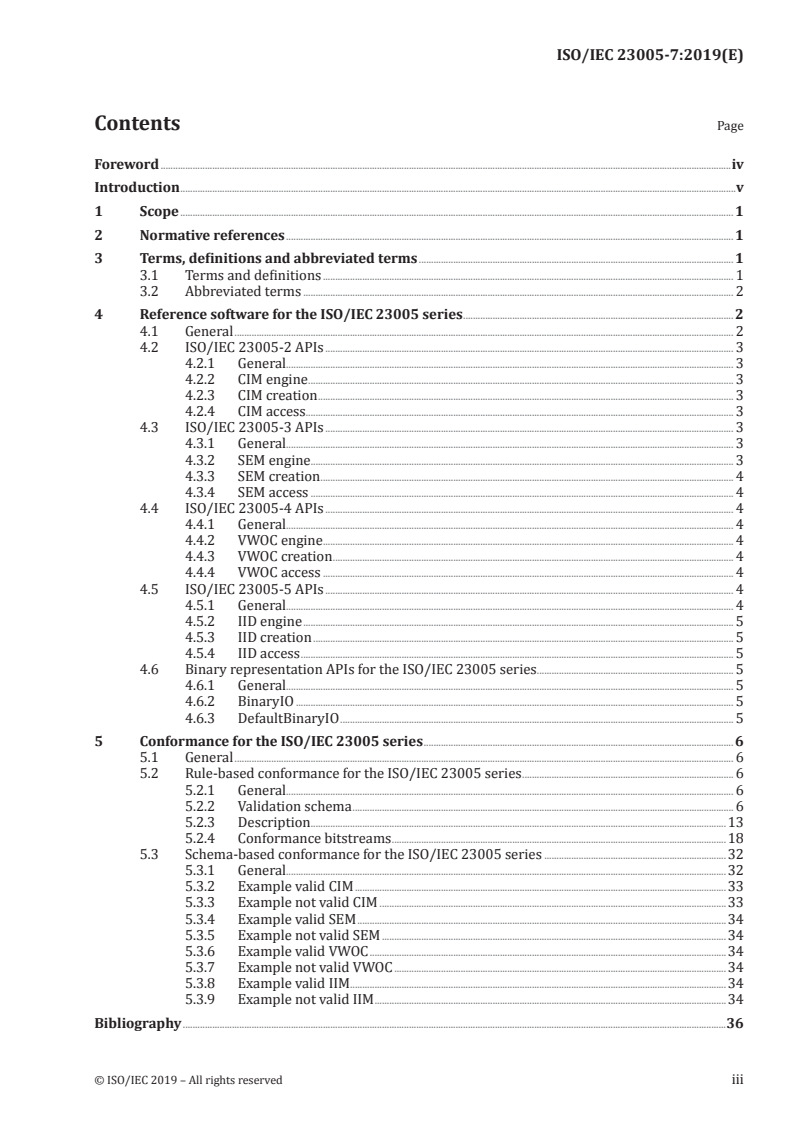
Contents Page
Foreword .iv
Introduction .v
1 Scope . 1
2 Normative references . 1
3 Terms, definitions and abbreviated terms . 1
3.1 Terms and definitions . 1
3.2 Abbreviated terms . 2
4 Reference software for the ISO/IEC 23005 series . 2
4.1 General . 2
4.2 ISO/IEC 23005-2 APIs . 3
4.2.1 General. 3
4.2.2 CIM engine . 3
4.2.3 CIM creation . 3
4.2.4 CIM access. 3
4.3 ISO/IEC 23005-3 APIs . 3
4.3.1 General. 3
4.3.2 SEM engine . . 3
4.3.3 SEM creation . 4
4.3.4 SEM access . 4
4.4 ISO/IEC 23005-4 APIs . 4
4.4.1 General. 4
4.4.2 VWOC engine . . 4
4.4.3 VWOC creation . 4
4.4.4 VWOC access . 4
4.5 ISO/IEC 23005-5 APIs . 4
4.5.1 General. 4
4.5.2 IID engine . 5
4.5.3 IID creation . 5
4.5.4 IID access . 5
4.6 Binary representation APIs for the ISO/IEC 23005 series . 5
4.6.1 General. 5
4.6.2 BinaryIO . 5
4.6.3 DefaultBinaryIO . 5
5 Conformance for the ISO/IEC 23005 series . 6
5.1 General . 6
5.2 Rule-based conformance for the ISO/IEC 23005 series . 6
5.2.1 General. 6
5.2.2 Validation schema . 6
5.2.3 Description . . .13
5.2.4 Conformance bitstreams .18
5.3 Schema-based conformance for the ISO/IEC 23005 series .32
5.3.1 General.32
5.3.2 Example valid CIM .33
5.3.3 Example not valid CIM .33
5.3.4 Example valid SEM .34
5.3.5 Example not valid SEM .34
5.3.6 Example valid VWOC .34
5.3.7 Example not valid VWOC .34
5.3.8 Example valid IIM.34
5.3.9 Example not valid IIM .34
Bibliography .36
© ISO/IEC 2019 – All rights reserved iii
Foreword
ISO (the International Organization for Standardization) and IEC (the International Electrotechnical
Commission) form the specialized system for worldwide standardization. National bodies that
are members of ISO or IEC participate in the development of International Standards through
technical committees established by the respective organization to deal with particular fields of
technical activity. ISO and IEC technical committees collaborate in fields of mutual interest. Other
international organizations, governmental and non-governmental, in liaison with ISO and IEC, also
take part in the work.
The procedures used to develop this document and those intended for its further maintenance are
described in the ISO/IEC Directives, Part 1. In particular, the different approval criteria needed for
the different types of document should be noted. This document was drafted in accordance with the
editorial rules of the ISO/IEC Directives, Part 2 (see www .iso .org/ directives).
Attention is drawn to the possibility that some of the elements of this document may be the subject
of patent rights. ISO and IEC shall not be held responsible for identifying any or all such patent
rights. Details of any patent rights identified during the development of the document will be in the
Introduction and/or on the ISO list of patent declarations received (see www .iso .org/ patents) or the IEC
list of patent declarations received (see http:// patents .iec .ch).
Any trade name used in this document is information given for the convenience of users and does not
constitute an endorsement.
For an explanation of the voluntary nature of standards, the meaning of ISO specific terms and
expressions related to conformity assessment, as well as information about ISO's adherence to the
World Trade Organization (WTO) principles in the Technical Barriers to Trade (TBT) see www .iso .org/
iso/ foreword .html.
This document was prepared by Joint Technical Committee ISO/IEC JTC 1, Information technology,
Subcommittee SC 29, Coding of audio, picture, multimedia and hypermedia information.
This fourth edition cancels and replaces the third edition (ISO/IEC 23005-7:2017), which has been
technically revised. The main changes compared to the previous edition are as follows:
— modification of introduction;
— modification of schema namespace.
A list of all parts in the ISO/IEC 23005 series can be found on the ISO website.
Any feedback or questions on this document should be directed to the user’s national standards body. A
complete listing of these bodies can be found at www .iso .org/ members .html.
iv © ISO/IEC 2019 – All rights reserved
Introduction
The ISO/IEC 23005 series provides an architecture and specifies information representation of data
flowing in and out of the real world and virtual worlds.
The data for the real world are communicated through sensors and actuators. The data for virtual
worlds consist of properties of virtual objects and multi-sensorial data embedded in audio-visual
content. The ISO/IEC 23005 series specifies data formats for sensors, actuators, virtual objects, and
audio-visual content.
Data captured from the real world could need to be adapted for use in a virtual world and data from
virtual worlds could also need to be adapted for use in the real world. The ISO/IEC 23005 series does
not specify how the adaptation is carried out but only specifies the interfaces:
— data for sensors are sensor capabilities, sensed data, and sensor adaptation preferences;
— data for actuators are sensory device capabilities, sensory device commands, and sensory effect
preferences;
— data for virtual objects are characteristics of avatars and virtual world objects;
— sensory effect could be needed to enrich audio-visual contents.
The conformance and reference software is available at https:// standards .iso .org/ iso -iec/ 23005/ -7/ ed
-4/ en.
© ISO/IEC 2019 – All rights reserved v
INTERNATIONAL STANDARD ISO/IEC 23005-7:2019(E)
Information technology — Media context and control —
Part 7:
Conformance and reference software
1 Scope
This document specifies the conformance and reference software implementing the normative clauses
of all parts of the ISO/IEC 23005 series. The information provided is applicable for determining the
reference software modules available for the parts of the ISO/IEC 23005 series, understanding
the functionality of the available reference software modules, and utilizing the available reference
software modules. The available reference software modules are specified in the form of application
programming interfaces (API) according to ISO/IEC 23006-1.
Furthermore, this document provides the means for conformance testing, i.e. bitstreams – XML
descriptions – that conform or do not conform to the normative clauses of the other parts of the
ISO/IEC 23005 series and informative descriptions thereof.
2 Normative references
The following documents are referred to in the text in such a way that some or all of their content
constitutes requirements of this document. For dated references, only the edition cited applies. For
undated references, the latest edition of the referenced document (including any amendments) applies.
ISO/IEC 23005-2, Information technology — Media context and control — Part 2: Control information
ISO/IEC 23005-3, Information technology — Media context and control — Part 3: Sensory information
ISO/IEC 23005-4, Information technology — Media context and control — Part 4: Virtual world object
characteristics
ISO/IEC 23005-5, Information technology — Media context and control — Part 5: Data formats for
interaction devices
ISO/IEC 23005-6, Information technology — Media context and control — Part 6: Common types and tools
ISO/IEC 23006-1, Information technology — Multimedia service platform technologies — Part 1:
Architecture
W3C, Extensible Markup Language (XML) 1.0 (Fifth Edition) W3C Recommendation 26 November 2008.
Available at https:// www .w3 .org/ TR/ xml/
3 Terms, definitions and abbreviated terms
3.1 Terms and definitions
For the purposes of this document, the terms and definitions given in ISO/IEC 23006-1 apply.
ISO and IEC maintain terminological databases for use in standardization at the following addresses:
— ISO Online browsing platform: available at https:// www .iso .org/ obp
— IEC Electropedia: available at http:// www .electropedia .org/
© ISO/IEC 2019 – All rights reserved 1
3.2 Abbreviated terms
API application programming interface
CIM control information metadata
MXM MPEG extensible middleware
SEM sensory effect metadata
VWOC virtual world object characteristics
IIM interaction information metadata
4 Reference software for the ISO/IEC 23005 series
4.1 General
This clause specifies the reference software for the ISO/IEC 23005 series. The ISO/IEC 23005 series
[1]
reference software is written in Java , which is a general purpose programming language and adopts
the following package structure:
Name Definition
org
Java package name for reference software provided by organizations such
as ISO/IEC, W3C, or similar.
org.iso
Java package name for reference software provided by ISO/IEC.
org.iso.mpeg
Java package name for reference software provided by ISO/IEC.
org.iso.mpeg.mpegv
Java package name for reference software provided in the course of the
development of the ISO/IEC 23005 series.
NOTE 1 Subsequent packages for the individual parts of the ISO/IEC 23005
series use the uncapitalized abbreviations as defined in 3.2, e.g.,
— org.iso.mpeg.mpegv.cidl, org.iso.mpeg.mpegv.dcdv, org.iso.
mpeg.mpegv.sapv, org.iso.mpeg.mpegv.scdv and org.iso.mpeg.
mpegv.sepv for ISO/IEC 23005-2,
— org.iso.mpeg.mpegv.sedl and org.iso.mpeg.mpegv.sev for
ISO/IEC 23005-3,
— org.iso.mpeg.mpegv.vwoc for ISO/IEC 23005-4, or
— org.iso.mpeg.mpegv.iidl, org.iso.mpeg.mpegv.dcv and org.
iso.mpeg.mpegv.siv for ISO/IEC 23005-5.
— org.iso.mpeg.mpegv.ct for ISO/IEC 23005-6.
NOTE 2 Code included within these packages can be generated automati-
cally by using tools such as JAXB (Java Architecture for XML Binding).
org.iso.mpeg.mpegv.{part}.
Java package name for binary representation of reference software pro-
binary
vided in the course of the development of the ISO/IEC 23005 series.
the {part} placeholder is replaced by the component of each part, i.e.,
cidl, dvdv, sapv, scdv, sepv, sedl, sev, vwoc, iidl, dcv, siv and ct.
org.iso.mpeg.mxm
Java package name for reference software provided in the course of the
development of ISO/IEC 23006-1. The actual API is defined within this
package.
2 © ISO/IEC 2019 – All rights reserved
4.2 ISO/IEC 23005-2 APIs
4.2.1 General
This subclause specifies the API to the ISO/IEC 23005-2 reference software. The API is defined in Java
and adopts the following package structure.
Name Definition
org.iso.mpeg.mxm.engine.cimengine
Java package name for API to the ISO/IEC 23005-2 reference
software.
4.2.2 CIM engine
The CIMEngine interface defines the methods for operating over data structures as defined within
ISO/IEC 23005-2. Classes implementing the CIM engine interface act as factories creating instances of
classes performing the following functionalities:
— classes to create data structures, by means of the CIM creation engine;
— classes to access data contained in data structures, by means of CIM parser engine.
4.2.3 CIM creation
Creating CIM structures involves the following interfaces:
— CIMCreator: an interface defining the methods to create CIM structures.
4.2.4 CIM access
Accessing CIM structures involves the following interfaces:
— CIMParser: an interface defining the methods to parse CIM structures.
4.3 ISO/IEC 23005-3 APIs
4.3.1 General
This subclause specifies the API to the ISO/IEC 23005-3 reference software. The API is defined in Java
and adopts the following package structure.
Name Definition
org.iso.mpeg.mxm.engine.semengine
Java package name for API to the ISO/IEC 23005-3 reference
software.
4.3.2 SEM engine
The SEMEngine interface defines the methods for operating over data structures as defined within
ISO/IEC 23005-3. Classes implementing the SEM engine interface act as factories creating instances of
classes performing the following functionalities:
— classes to create data structures, by means of the SEM creation engine;
— classes to access data contained in data structures, by means of SEM parser engine.
© ISO/IEC 2019 – All rights reserved 3
4.3.3 SEM creation
Creating SEM structures involves the following interfaces:
— SEMCreator: an interface defining the methods to create SEM structures.
4.3.4 SEM access
Accessing SEM structures involves the following interfaces:
— SEMParser: an interface defining the methods to parse SEM structures.
4.4 ISO/IEC 23005-4 APIs
4.4.1 General
This subclause specifies the API to the ISO/IEC 23005-4 reference software. The API is defined in Java
and adopts the following package structure.
Name Definition
org.iso.mpeg.mxm.engine.vwocengine
Java package name for API to the ISO/IEC 23005-4 reference
software.
4.4.2 VWOC engine
The VWOCEngine interface defines the methods for operating over data structures as defined within
ISO/IEC 23005-4. Classes implementing the VWOC engine interface act as factories creating instances
of classes performing the following functionalities:
— classes to create data structures, by means of the VWOC creation engine;
— classes to access data contained in data structures, by means of VWOC parser engine.
4.4.3 VWOC creation
Creating VWOC structures involves the following interfaces:
— VWOCCreator: an interface defining the methods to create VWOC structures.
4.4.4 VWOC access
Accessing VWOC structures involves the following interfaces:
— VWOCParser: an interface defining the methods to parse VWOC structures.
4.5 ISO/IEC 23005-5 APIs
4.5.1 General
This subclause specifies the API to the ISO/IEC 23005-5 reference software. The API is defined in Java
and adopts the following package structure.
Name Definition
org.iso.mpeg.mxm.engine.iidengine
Java package name for API to the ISO/IEC 23005-5 reference
software.
4 © ISO/IEC 2019 – All rights reserved
4.5.2 IID engine
The IIDEngine interface defines the methods for operating over data structures as defined within
ISO/IEC 23005-2. Classes implementing the IID engine interface act as factories creating instances of
classes performing the following functionalities:
— classes to create data structures, by means of the IID creation engine;
— classes to access data contained in data structures, by means of IID parser engine.
4.5.3 IID creation
Creating IID structures involves the following interfaces:
— IIDCreator: an interface defining the methods to create IID structures.
4.5.4 IID access
Accessing IID structures involves the following interfaces:
— IIDParser: an interface defining the methods to parse IID structures.
4.6 Binary representation APIs for the ISO/IEC 23005 series
4.6.1 General
This subclause specifies the API to the ISO/IEC 23005 series reference software for binary
representation. The API is defined in Java and adopts the following package structure.
Name Definition
org.iso.mpeg.mpegv.binary.core
Java package name for API to the ISO/IEC 23005 series refer-
ence software for binary representation.
4.6.2 BinaryIO
The BinaryIO interface defines the methods for operating over data structures as defined within the
ISO/IEC 23005 series. Classes implementing the BinaryIO interface act as factories creating instances
of classes performing the following functionalities:
— classes to generate a binary structure from a MXM object tree, by means of the construct binary
structure function;
— classes to generate a binary file from a binary structure, by means of the write binary function;
— classes to generate a binary structure from a binary structure, by means of the read binary function;
— classes to restore a MXM object tree from a binary structure, by means of the create MXM object
function.
4.6.3 DefaultBinaryIO
DefaultBinaryIO class defines the functions “encode” and “decode”. Root elements of other parts (e.g.
ISO/IEC 23005-2, ISO/IEC 23005-3, ISO/IEC 23005-4) can be extended from this DefaultBinaryIO class.
DefaultBinaryIO involves the following functions:
— encode: a function defining the methods to create binary file from a MXM object tree;
— decode: a function defining the methods to restore a MXM object tree from a binary file.
© ISO/IEC 2019 – All rights reserved 5
5 Conformance for the ISO/IEC 23005 series
5.1 General
This clause defines conformance for the ISO/IEC 23005 series. A bitstream is compliant to the
ISO/IEC 23005 series if it conforms to the conformance definitions specified in 5.2 and 5.3.
5.2 Rule-based conformance for the ISO/IEC 23005 series
5.2.1 General
This subclause defines a validation schema based on ISO/IEC 19757-3 to check the conformance
bitstreams – XML descriptions – that conform or do not conform to the normative clauses of the other
parts of the ISO/IEC 23005 series and descriptions thereof. In particular, the additional validation rules
as specified in the other parts of the ISO/IEC 23005 series are checked with this validation schema. The
actual schema can be found in 5.2.2 and a more readable version of the rules and assertion messages
is provided in 5.2.3. The actual conformance bitstreams – XML descriptions – are defined in 5.2.4. The
actual conformance bitstreams and corresponding code are available at https:// standards .iso .org/ iso
-iec/ 23005/ -7/ ed -4/ en.
[2]
For transforming the validation schema according to ISO/IEC 19757-3 and for validating the examples,
[1]
Saxon is used. Saxon is not mandatory and other tools can be used for validating the examples.
5.2.2 Validation schema
xmlns="http://purl.oclc.org/dsdl/schematron"
xmlns:sedl="urn:mpeg:mpeg-v:2018:01-SEDL-NS"
xmlns:sev="urn:mpeg:mpeg-v:2018:01-SEV-NS"
xmlns:xsi="http://www.w3.org/2001/XMLSchema-instance"
xmlns:si="urn:mpeg:mpeg21:2003:01-DIA-XSI-NS"
xmlns:cidl="urn:mpeg:mpeg-v:2018:01-CIDL-NS"
xmlns:dcdv="urn:mpeg:mpeg-v:2018:01-DCDV-NS"
xmlns:scdv="urn:mpeg:mpeg-v:2018:01-SCDV-NS"
xmlns:sepv="urn:mpeg:mpeg-v:2018:01-SEPV-NS"
xmlns:mpegvct="urn:mpeg:mpeg-v:2018:01-CT-NS"
xmlns:mpeg7="urn:mpeg:mpeg7:schema:2004"
xmlns:dia="urn:mpeg:mpeg21:2003:01-DIA-NS"
xmlns:iidl="urn:mpeg:mpeg-v:2018:01-IIDL-NS"
xmlns:dcv="urn:mpeg:mpeg-v:2018:01-DCV-NS"
xmlns:siv="urn:mpeg:mpeg-v:2018:01-SIV-NS"
queryBinding='xslt' schemaVersion='ISO19757-3'>
Schema for validating SEDL/CIDL/IIDL descriptions
6 © ISO/IEC 2019 – All rights reserved
A minValue shall be less than or equal to a maxValue.
A minValue shall be less than or equal to a maxValue.
A minValue shall be less than or equal to a maxValue.
A minValue shall be less than or equal to a maxValue.
A minValue shall be less than or equal to a maxValue.
A minValue shall be less than or equal to a maxValue.
A minValue shall be less than or equal to a maxValue.
An XminValue shall be less than or equal to an XmaxValue.
An YminValue shall be less than or equal to an YmaxValue.
© ISO/IEC 2019 – All rights reserved 7
A ZminValue shall be less than or equal to a ZmaxValue.
An YawMin shall be less than or equal to an YawMax.
A PitchMin shall be less than or equal to a PitchMax.
A RollMin shall be less than or equal to a RollMax.
The SEM element shall have a timeScale attribute.
A GroupOfEffects outside of a Declarations shall have a timestamp (i.e., pts,
ptsDelta, or absTime).
A GroupOfEffects outside of a Declarations shall not have both a pts and an
absTime at the same time.
A GroupOfEffects within a Declarations shall have only a ptsDelta for a timestamp.
At least activate, duration, or fade shall be defined.
8 © ISO/IEC 2019 – All rights reserved
An effect outside of a GroupOfEffects shall have a timestamp (i.e., pts, ptsDelta,
or absTime).
An effect within a GroupOfEffects shall not have a timestamp (i.e., pts, ptsDelta,
or absTime).
If duration is defined activate may not be defined.
If fade and duration are defined activate may not be defined.
If fade is defined intensity-value and intensity-range shall be defined.
If two (or more) consecutive Effect elements of the same type share the same
timestamp (i.e., pts, ptsDelta, or absTime) and location only the latest in their order of
appearance shall be used.
If intensity-value is present, intensity-range shall be present and vice versa.
The intensity-value shall be within the intensity-range.
A number of trajectory samples at an update period shall have a timeSamples
attribute, but duration attribute shall not be described.
Passive kinesthetic force effect element shall have a timeSamples attribute in
parent element, but duration attribute shall not be described.
Passive kinesthetic force effect element shall not be described with active
kinesthetic effect at the same time.
If fade and duration are defined fade shall be less or equal to duration.
An Effect shall not have both a pts and an absTime at the same time.
An Effect within a Declarations shall have only a ptsDelta for a timestamp.
A number of trajectory samples shall be in multiples of 6 since 6 samples include
three positions and three orientations at each period Therefore number of rows are fixed
to 6.
Rows indicate 3 forces and 3 torques. Therefore, the number of row shall be '6'.
Wave effect element shall have duration attribute in parent element.
Shake effect element shall have duration attribute in parent element.
Spin effect element shall have duration attribute in parent element.
At least directionH or directionV shall be defined.
10 © ISO/IEC 2019 – All rights reserved
At least pitch, roll, or yaw shall be defined.
If pitch is defined pitchSpeed or pitchAcceleration shall be defined.
If yaw is defined yawSpeed or yawAcceleration shall be defined.
If roll is defined rollSpeed or rollAcceleration shall be defined.
The number of RGB_value shall be 3(red, green, blue). Therefore the length of
vector is fixed to 3.
The size of REG2XYZ_LUT matrix shall be 3 by 3. Therefore the number of rows is
fixed to 3 and the number of columns is fixed to 3.
The number of RGBScalar_Max shall be 3(red, green, blue). Therefore the length of
RGBScalar_Max vector is fixed to 3.
The number of Offset_Value shall be 3(red offset, green offset, blue offset).
Therefore the length of Offset_Value vector is fixed to 3.
The size of Gain, Offset, and Gamma is 3, respectively. The size of matrix Gain_
Offset_Gamma is 3 by 3. Therefore the number of rows is fixed to 3 and the number of
columns is fixed to 3.
Questions, Comments and Discussion
Ask us and Technical Secretary will try to provide an answer. You can facilitate discussion about the standard in here.
Loading comments...