


ISO/IEC 8613-10:1991/Amd 5:1993
(Amendment)Information processing — Text and office systems — Office Document Architecture (ODA) and interchange format — Part 10: Formal specifications — Amendment 5
Information processing — Text and office systems — Office Document Architecture (ODA) and interchange format — Part 10: Formal specifications — Amendment 5
Traitement de l'information — Bureautique — Architecture des documents de bureau (ODA) et format d'échange — Partie 10: Spécifications formelles — Amendement 5
General Information
- Status
- Withdrawn
- Publication Date
- 12-May-1993
- Withdrawal Date
- 12-May-1993
- Technical Committee
- ISO/IEC JTC 1 - Information technology
- Drafting Committee
- ISO/IEC JTC 1 - Information technology
- Current Stage
- 9599 - Withdrawal of International Standard
- Start Date
- 16-Dec-1996
- Completion Date
- 14-Feb-2026
Relations
- Effective Date
- 06-Jun-2022
- Effective Date
- 15-Apr-2008
- Effective Date
- 15-Apr-2008
Get Certified
Connect with accredited certification bodies for this standard

BSI Group
BSI (British Standards Institution) is the business standards company that helps organizations make excellence a habit.

NYCE
Mexican standards and certification body.
Sponsored listings
Frequently Asked Questions
ISO/IEC 8613-10:1991/Amd 5:1993 is a standard published by the International Organization for Standardization (ISO). Its full title is "Information processing — Text and office systems — Office Document Architecture (ODA) and interchange format — Part 10: Formal specifications — Amendment 5". This standard covers: Information processing — Text and office systems — Office Document Architecture (ODA) and interchange format — Part 10: Formal specifications — Amendment 5
Information processing — Text and office systems — Office Document Architecture (ODA) and interchange format — Part 10: Formal specifications — Amendment 5
ISO/IEC 8613-10:1991/Amd 5:1993 is classified under the following ICS (International Classification for Standards) categories: 35.240.20 - IT applications in office work. The ICS classification helps identify the subject area and facilitates finding related standards.
ISO/IEC 8613-10:1991/Amd 5:1993 has the following relationships with other standards: It is inter standard links to ISO/IEC 8613-10:1991, ISO/IEC 8613-10:1995; is excused to ISO/IEC 8613-10:1991. Understanding these relationships helps ensure you are using the most current and applicable version of the standard.
ISO/IEC 8613-10:1991/Amd 5:1993 is available in PDF format for immediate download after purchase. The document can be added to your cart and obtained through the secure checkout process. Digital delivery ensures instant access to the complete standard document.
Standards Content (Sample)
INTERNATIONAL
ISO/IEC
STANDARD
8613-10
First edition
1991-06-01
AMENDMENT 5
1993-05- 15
Information processing - Text and office systems -
Office Document Architecture (ODA) and
interchange format -
Part 10:
Formal specifications
AMENDMENT 5 : Formal specification of the
defaulting mechanism for defaultable attributes
Traitement de /‘information - Bureautique - Architecture des documents de
bureau (ODA) et format d’kchange -
Partie 70: Sp&ifkations formeiies
AMENDEMENT 5 : Sp6cification formeiie du mkcanisme par defaut pour /es
attributs par dkfaut
Reference number
lSO/IEC 8613-10:1991/Amd.5:1993 (E)
ISWIEC 8613910:1991/Amd.5:1993 (E)
Foreword
IS0 (the International Organization for Standardization) and IEC (the International
Electrotechnical Commission) form the specialized system for worldwide
standardization. National bodies that are members of IS0 or IEC participate in the
development of International Standards through technical committees established by
the respective organization to deal with particular fields of technical activity. IS0 and
IEC technical committees collaborate in fields of mutual interest. Other international
organizations, governmental and non-governmental, in liaison with IS0 and IEC, also
take part in the work.
In the field of information technology, IS0 and IEC have established a joint technical
committee, ISO/IEC JTC 1. Draft International Standards adopted by the joint
technical committee are circulated to national bodies for voting. Publication as an
International Standard requires approval by at least 75 % of the national bodies casting
a vote.
Amendment 5 to International Standard ISOLEC 8613-10: 1991 was prepared by Joint
Technical Committee ISO/IEC JTC 1, Information technology, Sub-Committee
SC 18, Document processing and related communication.
ISOAEC 8613 consists of the following parts, under the general tile Infomuxtion
processing - O#ice Document Architecture (ODA) and
Text and ofice systems -
interchange fommt:
-
Pati 1: Introduction and general principles
- Part 2: Document structures
-
Part 4: Document profile
-
Part 5: OjJice Document Interchange Format (ODIF)
-
Part 6: Character content architectures
- Part 7: Raster graphics content architectures
-
Part 8: Geomtric graphics content architectures
- Part 10: Formal specifications
Annex F forms an integral part of this part of ISO/IEX 8613.
0 1s0/IEc 1993
All rights reserved. No part of this publication may be reproduced or utilized in any form or by
any means, electronic or mechanical, including photocopying and microfilm, without
permission in writing from the publisher.
ISO/IEC Copyright Office l Case postale 56 l CH- 1211 Genkve 20 l Switzerland
Printed in Switzerland
ISO/IEC 8613~10:199l/Amd.5:1993 (E)
0 ISO/IEC
Information processing - Text and office systems - Office Document
Architecture (ODA) and interchange format -
Part 10:
Formal specifications
AMENDMENT 5 : Formal specification of the defaulting mechanism
for defaultable attributes
ISO/IEC 8613~10:199l/Amd.5:1993 (E)
0 ISO/IEC
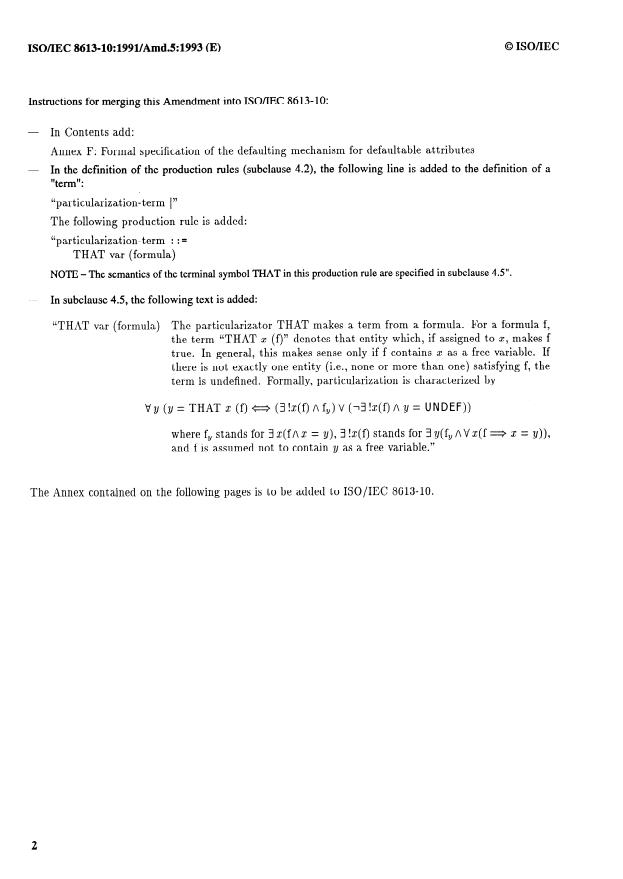
Instructions for merging this Amendment into ISO/IEC 8613- 10:
- In Contents add:
Annex F: Formal specification of the defaulting mechanism for defaultable attributes
-
In the definition of the production rules (subclause 4.2), the following line is added to the definition of a
“term”:
“particularization-term I”
- The following production rule is added:
“particularization-term : : =
THAT var (formula)
NOTE - The semantics of the terminal symbol THAT in this production rule are specified in subclause 4.5”.
- In subclause 4.5, the following text is added:
“THAT var (formula) The particularizator THAT makes a term from a formula. For a formula f,
the term “THAT x (f)” c 1 enotes that entity which, if assigned to x, ma,kes f
true. In general, this makes sense only if f contains x as a free variable. If
there is not exactly one entity (i.e., none or more than one) satisfying f, the
term is undefined. Formally, particularization is characterized by
Vy (jj = THAT x (f) e (3!x(f) A fY) v (4!x(f) A y = UNDEF))
where f3 stands for 3 x(fA x = y), 3 !x(f) stands for 3 v(fP AV x(f =+ x = y>),
and f is assumed not to contain ‘y as a free variable.”
The Annex contained on the following pages is to be added to ISO/IEC 8613-10.
0 ISO/IEC
ISOLIEC 8613~10:1991/Amd.5:1993 (E)
Annex F
(normative)
Formal specification of the defaulting mechanism for defaultable attributes
F.1 Introduction
This annex gives a formal specification of the defaulting mechanism for defaultable attributes.
Clause F.2 defines a set of general functions which are used in clause F.3.
Clause F.3 defines a set, of functions which describe the derivation of all defaultable attributes in IS0 8613. It
is substructured into clauses F.3.1 (defaultable attributes of IS0 8613-2), c 1 auses F.3.2 (defaultable attributes of
IS0 8613-6) c 1 auses F.3.3 (defaultable attributes of IS0 8613-7) and clauses F.3.4 (defaultable attributes of IS0
8613-S).
Clause F.4 is an index for the predicate symbols, operator symbols and attribute names used in clauses F.2 and
F.3.
F.2 General functions
This clause defines the general functions for determining the values of defaultable attributes according to clause
5.1.2.4 of IS0 8613-2.
[ Semiformal Description 9.1 1
Function “II: ORELSE y”
The function .1: ORELSE 2/ returns the value x if XT is not undefined, otherwise the value y.
1 Definition 9.1 1
1 vz,y
2 (g ORELSE y =
IF ,1: # UNDEF THEN z ELSE :I,,)
1 Semiformal Descript,ion 9.2 ]
Function “Attribute value by step BL”
If a layout, style is referenced by a constituent, cst and if the attribute cd-t is specified for this layout style (3) then
it,s value is the value determined by step BL (4). Otherwise the value is undefined by step BL.
1 Definition 9.2 1
1 Q cst, doby, cttt
2 ((, STEP-BL,JALUE(cst, doby, dt) =
3 IF ’ layout style I E NAMS1*18(cst) a& utt E NAMS1*18(REF-LAY-STYLE”.4(cst, doby))
4 THEN C n(REF-LAY-STYLEg.4(c.st, doby)) l ntt
5 ELSE UNDEF,,)
ISOAEC 8613~10:199l/Amd.5:1993 (E) 0 ISO/IEC
Semiformal Description 9.3
Function “Attribute value by step BP”
If a presentation style is referenced by a constituent cst and if the attribute utt is specified for this presentation
style (3) then its value is the value determined by step BP (4). Otherwise the value is undefined by step BP.
Definition 9.3
v cst, doby, utt
(() STEP-BP-VALUE(cst, doby, utt) =
IF ’ presentation style’ E NAMS1*18(cst) and att E NAMS1.ls(REF,PRES-STYLE’*‘@, doby))
THEN C -(REF-PRES-STYLE’*“(cst, doby)) l ntt
ELSE UNDEF,,)
1 Semiformal Description 9.4 1
Function “Referenced layout, style”
If a layout> style exists within the document body doby for which tjhe value of the attribute ’ layout style identifier 1
is the same as the value of the attribute ’ layout style’ of a particular constituent cst this is called the referenced
layout, style (3) which is returned by this function. Otherwise, t,he function returns the empty nomination.
Definition 9.4
1 v cst , doby
2 (‘) REF-LAY-STYLE(cst, doby) =
C *doby.
4 ORELSE’.1 [ : 1 J
Semiformal Description 9.5
Function “Referenced presentation style”
If a presentation style exists within the document, body doby for which the value of the attribute ’ presentation style
identifier’ is the same as the value of the attribute ’ presentation style’ of a particular constituent cst this is called
the referenced presentation style (3, 4) which is returned by this function. Otherwise, the function returns the
empty nomination.
Definition 9.5
1 v cst ) doby
2 ((I REF-PRES-ST.YLE( cst , dab y) =
C -doby. ~IsPresentationSt,ylez~~l(C XS) ulz(l
4 c Z*S* ’ presentation style identifier ’ = C *cst . ’ presentation style’>
ORELSE’.’ [ : I(,)
0 ISO/IEC ISO/IEC 8613~10:1991/Amd.5:1993 (E)
Semiformal Description 9.6
Function “Attribute value by step C”
If an object class is referenced by a constituent cst and if the attribute utt is specified for this object class (3) then
its value is the value determined by step C (4). Otherwise the value is undefined by step C.
(Definition 9.6 1
1 if cst, doby, utt
2 ((, STEP-C-VALUE(cst, doby, utt) =
3 IF 'object class' c NAMS1.18(cst) and utt E NAMS1*18 (REF-OBJECT,CLASSg.7(cst, doby))
THEN C n(REF-OBJECT7CLASSg*7(cst, doby)) l att
5 ELSE UNDEF,,)
Semiformal Description 9.7
Function “Referenced object, class”
If an object, class exists within the document, body doby for which the value of the attribute ‘object class identifier’
is the same as the value of the attribute 'object class' of a particular constituent cst this is called the referenced
Otherwise, the funct,ion returns the empty nomination.
object, class (3) which is returned by this function.
1 Definition 9.7 1
1 Q cst , dab y
2 (, REF-OBJECT-CLASS(cst, doby) =
3 C nd~b~~o
4 OR.,ELSE’.’ [ : ] ,,)
1 Semiformal Description 9.8 1
Function “Attribute value by step DP”
If an object, class is referenced by a constituent cst, and a presentation style is referenced by this object class and
t,he attribute utt is specified for this presentation style (3-5) th en its value is the value determined by step DP (6).
Otherwise t,he value is undefined by step DP.
1 Definition 9.8 1
1 v cst ) dohy, utt
2 ((, STEP-DP-VALUE(cst, doby, utt) =
‘*l’(cst) and
3 IF 'object class' E NAMS
4 'presentation style' E NAMSlls (R.EF_BBJECT-CLASS’*7(cst, doby)) and
5 utt E NAMS1.18 (REF-PRES.STYLE’.‘(REF-OBJECT-CLASSg.7(cst, doby), doby))
6 THEN C n(REF~PRES~STYLEg~“(REF~OBJECT~CLASSg*7(cst, ‘lob!/), doby)) l ntt
7 ELSE UNDEF,,)
ISO/IEC 8613~10:199l/Amd.5:1993 (E) 0 ISO/IEC
1 Semiformal Description 9.9 1
Function “Attribute value by step DL”
If an object, class is referenced by a constituent, cst, and a layout, style is referenced by this object class and the
attribute utt is specified for this layout, style (3-5) th en it,s value is the value determined by step DL (6). Otherwise
the value is undefined by step DL.
1 Definition 9.9 1
1 V cst, doby, att
2 (, STEP,DL-VALUE(cst, Hoby, utt) =
3 IF ‘object class’ f NAMS’*ls(cst) una!
4 ‘layout style’ E NAMS ‘*18(REF-OBJECT-CLASSg*7(cst, doby)) and
5 utt E NAMS 1*18(REF-LAY-STYLEg~4(REF70BJECT-CLASSg-7(cst, doby), doby))
6 THEN C n(REF~LAY~STYLEg*4(REF~OBJECT~CLASSg~7(cst, noby), doby)) l utt
7 ELSE UNDEF,,)
I Semiformal Description 9.10 I
Function “Attribute value by step E”
constituent cst, and a (resource) object class in a resource document is referenced
If an object, class is referenced by a
by this object class and the attribute utt is specified for this (resource) object, class (3-6) then this attribute value
is the value determined by step E (7, 8). Otherwise the value is undefined by step E.
Definition 9.10 ]
Vest, doby, rdoby,yrof, utt
(,, STEP-E_VALUE(cst, doby, rdoby, prof, att) =
IF ‘object class’ f NAMS1.Is(cst) und
’ resource ’ E NAMS1.18 (REF-OBJECT-CLASSg*7(cst, doby)) und
utt E NAMS1*18
(RESOIJRCE-OBJECT-CLASSg*ll(rdoby,
OBJECT-CLASSID,INRESg*12 (p-of, REF-OBJECT-CLASSg*7(cst, ctoby))))
THEN C n(RESOURCE~OBJECT~CLASSg~ll(~~~o~y,
OBJECT.CLASSID~INRESg~12(prof, REF-OBJECT-CLASSg.7(cst, doby)))) l utt
ELSE UNDEF,)
Semiformal Description 9.11
Function “Resource object, class”
If an object, class exists within the document body rdoby (of a resource document,) for which the value of the
attribute ‘object class identifier ’ corresponds to objcirt, this is called the resource object class (3) which is returned
by this function. Otherwise, the function returns the empty nomination.
Definition 9.11
1 v rdob y, objcid
2 ([, RESOURCE_OBJECT,CLASS(rdoby, objcirl) =
3 C *rtloby .
4 ORELSE”l [ : 1 0)
0 ISO/IEC ISO/IEC 8613~10:199l/Amd.5:1993 (E)
Semiformal Description 9.12
Function “Object class identifier in a resource document”
The object, class identifier of an object, class in a resource document is determined by the attribute I resources I in
the document, profile by taking the second component of that construct in the value of this attribute for which
the first component, corresponds to the value of the attribute ’ resource ’ for a particular constituent, est. If such a
constructl cannot, be found the value of the function is undefined.
Definition 9.12
1 Qpof,cst
2 (,, OBJECT-CLASSID_INRES(prof, cst) =
3 LASTC1*14 (C -prof. ‘resources ’ . ). ,,)
Semiformal Description 9.13A
Function “Attribute value by step FP”
If an object, class is referenced by a consti-t,uent cst, and a (resource) object, class in a resource document is referenced
by this object, class, and a presentation style is referenced by the (resource) object class and the attribute utt is
specified for this presentation style (3-8) then this attribute value is the value determined by step FP (9, 10).
Otherwise the value is undefined by step FP.
Definition 9.13
1 Qcst,noby,rdoby,yrof,att
2 ((, STEP-FP-VALUE(cst, cloby, rdoby, yrof, utt) =
’
3 IF ‘object class’ E NAMS1*18(cst) and
4 ’ resource ’ E NAMS1*ls (REF-OBJECT-CLASSg*7(cst, doby)) und
5 (RESOURCE-OBJECT-CLASSg*ll(rdoby,
’ presentation style’ E NAMSl*l*
6 OBJECT_CLASSID_INRES”.12(prof, REF_OBJECT,CLASSg.7(cst, doby)))) und
7 utt E NAMS1*18 ( RESOURCE-PRES-STYLEg.14( rdoby,
8 OBJECT-CLASSID,INRES’.‘” @of, REF-OBJECT-CLASSg*7(cst, doby))))
9 THEN C ^( R,ESOURCE-PRES-STYLEg*14(rrloby,
10 OBJECT-CLASSID-INRES”.‘“(yrof, REF-OBJECT7CLASSg*7(cst, doby)))). utt
11 ELSE UNDEF,,)
0 ISO/IEC
ISO/IEC 8613,10:199l/Amd.5:1993 (E)
1 Semiformal Description 9.14 1
Function “Presentation style in a resource document?
The presentation st,yle in a resource document, belonging to an object class with tlhe object class identifier oljcid is
that constituent, rpres in a resource document, rdoby which is a presentation style (3, 4) and for which there exists
suc.h that, the value of the attribute ’ presentation style identifier ’
a constituent, rest in the resource document, (5)
of the constituent, rest and the
of the presentation style is equal to the value of the attribute ’ presentation style ’
of t,he constituent, rest equals objcid (6, 7). If such a presentation style
value of the attribute ’ object class identifier ’
cannot be found the resource presentation style is undefined.
Definition 9.14
if rdob y, objcid
((, RESOURCE,PRES,STYLE(rdoby, objcid) =
THAT rpres
(1 rpres E rdoby und IsPresentat,ionStyle2.“l(r~rcs) und
3 rest E rdoby
(2 C Ypres l ’ presentation style identifier ’ = C *rest . ’ presentation style’ and
*rest .
C ‘object class identifier ’ = objcid,),),)
Semiformal Description 9.15
Function “Attribute value by step FL”
If an object, class is referenced by a constituent cst, and a (resource) object, class in a resource document is referenced
by this object, class, and a layout, style is referenced by the (resource) object, class and the attribut,e utt is specified
for this layout style (3-8) then this attribute value is the value determined by step FL (9, 10). Otherwise the value
is undefined by step FL.
Definition 9.15 1
1 if cst, doby, rdoby, prof, cltt
2 (() STEP-FL-VALUE(cst, doby, rdoby, prof, cltt) =
3 IF ‘object class’ E NAMS1*(cst) und
4 ’ resource ’ E NAM!!?*‘* (REF-OBJECT-CLASSg+7(cst, cEoby)) und
’ layout style’ E NAMSl*l* (RESOURCE-OBJECT-CLASSg*ll(rdoby,
6 OBJECT-CLASSID-INRESg*12(prof, REF-OBJECT-CLASSg*7(cst, doby)))) untl
7 utt E NAMS1*18 (RESOURCE-LAY-STYLE’*“(rdoby,
8 OBJECT-CLASSID-INRES’+l”(prof, REF,0BJECT-CLASSg.7(cst, doby))))
9 THEN C n(R.ESOURCE-LAY-STYLE’.l’i(rdoby,
10 OBJECT-CLASSID-INRES”*12(prof, REF-OBJECT-CLASSg*7(cst, doby)))). att
11 ELSE UNDEF,,)
ISO/IEC 861340: 199UAmd.S: 1993 (E)
0 ISO/IEC
1 Semiformal Description 9.16 [
Function “Layout style in a resource document?
The la,yout style in a resource document, belonging to an object class with the object class identifier objcid is
that, constituent rhy in a resource document rdoby which is a layout style (3, 4) and for which there exists a
constituent, rest in t,he resource document, (5) such that, the value of the attribute ’ layout style identifier’ of the
layout, style is equal to the value of the attribute ‘layout style’ of the constituent, rest and the value of the attribute
such a layout, style cannot be found the
‘object class identifier ’ of the constituent rest equals objcid (6, 7). If
resource layout, style is undefined.
I Definition 9.16 I
v rdoby, objcid
(,, RESOURCE-LAY-STYLE( rdoby, objcid) =
THAT day
(1 day E rdoby and IsLayoutStyle2*‘“(rlcly) und
3 rest E rdoby
($ Way. ’ layout style identifier ’ = C “rest . ’ layout style I urd
C Ycst. ’ object class identifier ’ = o~jcid2),),J
I Semiformal Description 9.17 I
Function “Attribute value by step G”
If there exists a constituent ;SZL, in the document, body to which the constituent cst is immediately subordinate (3)
and if the attribute value can be found (in a clefauk value list,) on the superior constituent sup (3, 4) then this
attribute value is the value determined by step G. Otherwise, if a superior constituent exists, the search for the
attribute value according to st,ep G is continued (recursively) on the superior constituent cst (6). Otherwise, if no
superior constituent exists or if the attribute value cannot, be found there, the value is undefined by step G.
1 Definition 9.17 1
1 V cst, dohy, rdoby, prof, cltt, ctype
2 (() STEP-G-VALUE(cst, doby, rdob!y, pof, dt, ctyye) =
3 S17PERIOR.-VAL1JE”.‘* (1 THAT sq) (c, sqj E doby urd (cst)DescribesImSubOf2.‘“2(sup),),
4 doby, rdo6:y, 1,1,*(., j*, cltt , ct ype J
5 ORELSE”.l STEP-G-VAL1JEg.17(, THAT suck (4 szq) E ( I o 6~ 1 und (cst)DescribesImSubOf2*1’2(su~)~),),
6 dohy, rdoby, prof, cltt, ctype,),,)
0 ISO/IEC
ISO/IEC 8613~10:199l/Amd.5:1993 (E)
Semiformal Description 9.18
Function “Superior value”
If the attribute value can be found in the default, value list, of the constituent cst, then this value is returned as the
and the attribute value can be found in
superior value (3). Otherwise, if the constituent refers to an object class (4)
the default value list, of the referenced object, class, then this value is returned as the superior value (5). Otherwise,
if the referenced object class refers to a resource document (6) and the attribute value can be found in the resource
default, value list, of the referenced object, class, then this value is returned as the superior value (7). Otherwise the
superior value is undefined.
Definition 9.18
‘dcst, doby, rdoby,prof, cltt, ctype
([) SUPERIOR-VALUE(cst, cloby, rdoby, prof, att, “type) =
DEFAULT-VALUE”-” (cst, att, ctyye, doby) ORELSE”.l
4 (1 IF ’ object class ’ E NAMZ?*(cst)
5 THEN (z DEFAULT-VALUE g*1g(REF~OBJECT~CLASSg~7(cst, doby), utt, ctype, doby) ORELSE’*l
6 (,IF ’ resource ’ E NAMS 1-18(REF-OBJECT-CLASSg*7(cst, doby))
7 THEN (4 RES,DEFAIJLT,VALIJE g*21(REF-OBJECT-CLASSg~7(cst, dohy), rdoby,prof, cttt, ctype)
ORELSE’*l UNDEF,)
9 ELSE UNDEF,),)
10 ELSE UNDEF,),,)
Semiformal Description 9.19
Function “Default, value”
If a default, value list is specified for the constituent cst (4), and default, values for the particular type of constituent,
and a default, value for the particular attribute is specified (7, 8) then this value is the default
are specified (5, 6)
value. Otherwise it is tested whether a style is referenced from the default, value list, which provides a value for the
attribute (9). This function reflects the two cases that, one (7) or more (8) sets of default, values are specified, i.e.,
one or more sets may be specified for basic object types
(a) one set, is specified for composite object, types (7); (b)
.
Definition 9.19
V cst, utt, ct ype, dohy
([, DEFAULT-VALUE(cst, utt, ctyye, doby) =
C (,THAT CL
(2 ‘default value lists’ E NAMS1*18(cst) and
3V
(3v E 2st. ’ default value lists’ . and v = ctype and
und CL = v. cltt,) E
(4 (,IsNom(C v)
(,IsCol(C v) und u = ve .dt,),)J2)
ORELSE’.l DEFAULT-VALUE-BY-STYLE”.““(cst, doby, utt, ctype) &)
0 ISO/IEC ISOI/IEC 8613~10:1991/Amd.5:1993 (E)
I Semiformal Description 9.20 1
Function “Default, value by style”
contains an entry for the particular type of constituent (4, 5),
If the attribute ’ default value lists’ is specified (3),
and this layout style contains the attribute ($), then the value of this
there exists a reference to a layout, style (7)
Similarly, the value may also be supplied by a reference to a
attribute is the default, value supplied by a style.
presentation style from within a default, value list (10-15). Th is f unction reflects the two cases that one (10-12) or
more (13-15) sets of default, values are specified, i.e., (a) one set is specified for composite object types; (b) one or
more sets may be specified for basic object, types.
[ Definition 9.20
1 Q cst, dohy, utt, ctype
((, DEFAULT-VALUE-BY-STYLE(cst, cloby, utt, ctype) =
3 IF ‘default value lists’ E NAMS1*18(c.st) urr.d!
4 3V
5 (1'1) c -est. ‘default value lists’ . und v = hype und
3 (I
7 (a (3 IsNom(C v) and (1 = v . ’ layout style’ ancl
8 att E NAMS1*18 (REF-LAY-YTYLE(3*4(C P), rloby))
9 THEN C n(REF-LAY-STYLE’.4(C v, ‘loby)) l cltt,) 0
10 (4 IsNom(C v) and (I = v . ’ presentation style’ amI
11 att E NAM!?’ (REF-PRES-STYLE”“(C v, ‘loby))
12 THEN C n(REF_PR,ES-STYLE”*“(C v, doby)) l dt,) 0
13 (5 IsCol(C v) a~cd (I = 2,. . ’ presentation style’ und
14 c&! E NAMS”8(REF-PR,ES-STYLE’.‘(C v a, nor)~))
15 THEN C ^(R,EF-PRES-STYLE”*“(C v l , doby)) l ntt,),),)~,)
Semiformal Description 9.2 1
Function “Resource defa8ult value”
If a default value is specified in a resource object, class referenced by the object, class cst, then this value is the
resource default, value. Otherwise the resource default, value is undefined.
1 Definition 9.21
cst , doby, prof, utt , ct ype
1 Q
2 ((I R.ES-DEFATJLT-VALTJE(cst, rdobjj, prof, cttt, ctype) =
3 DEFA‘CJLT-VALIJE”.” (RESOTJRCE-OBJECT-CLASS”.l’(rdoby,
4 OBJECT-CLASSIDWINRES(3*1”(prof, cst)), cdt, ctype, doby),)
mmiformal Description 9.22 (
Function “Attribute value by step H”
If the attribute I document application profile defaults’ is specified in the document, profile and this attribute specifies
a, value for t,he attribute utt (3) tk len this is the value determined by st,ep H. Otherwise the value is undefined by
step H.
1 Definition 9.22 1
1 Q pro j’, wtt
2 (o STEP-H-VALUE(prof, cltt) =
‘d ocument application profile defaults ’ und N CL = ~hhJ,)J
3 C (,THAT Q (za c ^prof.
0 ISO/IEC
ISO/IEC 8613~10:199l/Amd.5:1993 (E)
1 Semiformal Description 9.23 1
Function “Parameter value by step BL”
If a layout, style is referenced by a constituent, cst and if the attribute utt is specified for this layout style (3) and if
the parameter pc~r is specified for t,his attribute (4)) then its value is t,he value determined by st,ep BL (5). Otherwise
the value is undefined by step BL.
I Definition 9.23 I
Q cst , dOby, utt , ~CLY
2 (,, STEP-BL-PAR,VALIJE(cst, c-lohj, (Ltt, Y’LT) =
3 IF ' layout style' E NAMS’*18(cst) a& utt E NAMS1.1s(REF-LAY-STYLE”.4(cst, doby)) und
4 pc~r E NAMS ‘.l’(C nREF-LAY-STYLE’*4(cst, dOby) l cltt)
5 THEN C -(REF-LAY-STYLE’.4(cst, doby)) l utt l pc~r
6 ELSE UNDEF,,)
Semiformal Description 9.24
Function “Parameter value by step C”
If an object, class is referenced by a constituent, cst and if the attribute utt is specified for this object class (3) and if
the parameter pc~r is specified for the attribute (4)) t,hen its value is the value determined by step C (5). Otherwise
t,he value is undefined by st,ep C.
I Definition 9.24 1
1 Q cst, dohj, ntt, ~CLI*
2 ((, STEP-C,PAR_VALIJE(cst, dOby, cLtt, pw) =
3 IF 'object class' E NAMS’.18(cst) urd utt E NAMP8 (REF-OBJECT-CLASS”.7(cst, doby)) ur~ll
pctr E NAMS ‘.l’(C aREF-OBJECT-CLASS’.7(cst, cloby) l utt)
5 THEN C “(REF-OBJECT-CLASS’*7(cst, dOby)) l cLtt l jx~r
6 ELSE UNDEF,,)
1 Semiformal Description 9.25 1
Funct,ion “Parameter value by step DL”
If an object, class is referenced by a constituent cd, and a layout, style is referenced by this object class and the
attribut,e utt is specified for this layout, style (3-5) and the parameter pnr is specified for this attribute (6), then its
value is the value determined by step DL (7). 00 ierwise the value is undefined by step DL.
1 Definition 9.25 1
1 Q cst, doby, cLtt, pc~r
2 (,, STEP-DL-PAR-V4LUE(cst, doby, utt, pclr) =
IF 'object class' f NAMS1*18(cst) (Lnd
4 'layout style' E NAMS1.18 (REF-OBJECT-CLASS”*7(cst, doby)) und
5 utt E NAMS1-18(REF_LAY_STYLE~.4(REF_OBJECT_CLASS~.7(cst, ctoby), ‘loby)) und
pc~r E NAMS’.”
6 (C ^REF-LAY-STYLE”.4(REF_OBJECT-CLASS”.7(cst, doby), doby) l utt)
7 THEN C n(REF-LAY-STYLEY.4(REF-OBJECT-CLASSg.7(cst, ctohj), doby) l cLtt l pc~r
8 ELSE UNDEF,,)
ISO/IEC 8613~10:199l/Amd.5:1993 (E)
0 ISO/IEC
Semiformal Description 9.26
b
Function ‘(Parameter value by step E”
If an object, class is referenced by a constituent, cst, and a (resource) object class in a resource document is referenced
by this object class and the attribute cltt is specified for this (resource) object class (3-6) and the parameter pur is
specified for this attribute (7, 8) then this attribute value is the value determined by step E (9, 10). Otherwise the
value is undefined by step E.
Definition 9.26
1 Q cst , dab y, rdob y, pro f, att , par
2 ((I STEP-E-PAR.,VALUE(cst, doby, rdoby, prof, att, par) =
3 IF ‘object class’ E NAM!V8(cst) und
4 ’ resource ’ E NAMS1” (REF-OBJECT7CLASS”*7(cst, ‘loby)) urd
5 at-ii E NAMSl.” ( RESOURCE-OBJECT-CLASSy.ll(rdoby,
6 OBJECT-CLASSID,INRES’*12 (prof, REF70BJECT,CLASSY*7(cst, doby)))) und
7 ywr E NAMS1-18 (C -RESOURCE-OBJECT,CLASS”*ll(rtloby,
8 OBJECT-CLASSID-INRES”.l”(prof, REF-OBJECT-CLASS”*7(cst, ctoby))) l att)
9 THEN C ^( RESOURCE-OBJECT-CLASS”*ll(~~loby,
10 OBJECT_CLASSID-INRESS.12 (prof, REF-OBJECT-CLASSg*7(cst, ctoby)))) l att l par
11 ELSE UNDEF,,)
-Semiformal Description 9.27 I
Function “Parameter value by step FL”
If an object, class is referenced by a constituent, cst, and a (resource) object, class in a resource document is referenced
by this object, class, and a layout, style is referenced by the (resource) object, class and the attribute att is specified
for this layout style (3-8) and the parameter pc~r is specified for this attribute (9, lo), then this attribute value is
the value determined by step FL (11, 12). Otherwise the value is undefined by step FL.
Definition 9.27
1 Q cst, dohJ, dohJ, pro f, att, yc~r
2 ((‘STEP-FL-PAR,VALUE(cst, doby, dOhJ, pr-of, cdt, par) =
‘*l’(cst) and
3 IF ‘object class’ E NAMS
4 ’ resource’ E NAMS’*l” (REF-OBJECT-CLASSg.7(cst, ‘loby)) und
5 ’ layout style’ E NAMS 1*18(RESOURCE-OBJECT-CLASSg*11(~~10~y,
6 OBJECT-CLASSID-INRES’*12(p~of, REF-OBJECT-CLASSg*7(cst, doby)))) und
7 att E NAMSl.l” ( R.ESOURCE-LAY-STYLE’*l’(rdoby,
8 OBJECT-CLASSID,INRES’*12(prof, REF-OBJECT-CLASSg*7(cst, (toby)))) unll
9 par E NAMS l.18(C nRESOURCE-LAY-STYLEg*l’(rdoby,
10 OBJECT-CLASSID,INRES”.‘“(prof, REF-OBJECT_CLASS’*7(cst, doby))) l ntt)
THEN C ^(RESOURCE-LAY-STYLE”.l”(rdoby,
(prof, REF-OBJECT_CLASSg.7(cst, doby)))) l ntt l par
12 OBJECT-CLASSID-INR,ESg*12
13 ELSE UNDEF,,)
ISO/IEC 8613~10:199l/Amd.5:1993 (E) 0 ISO/IEC
1 Semiformal Description 9.28 1
Function “Parameter value by step G”
If there exists a constituent, sup in the document, body to which the constituent cst is immediately subordinate (3)
and if the parameter value can be found (in a default, value list) on the superior constituent sup (3, 4) then this
if a superior constituent, exists, the search for the
parameter value is the value determined by step G. Otherwise,
parameter value according to step G is continued (recursively) on the superior constituent cst (6). Otherwise, if no
superior constituent, exists or if the parameter value cannot, be found there, the value is undefined by step G.
1 Definition 9.28 ]
1 Qcst, doby, rdoby,prof, att,par, ctype
2 (,,STEP-G-PAR-VALUE(cst, doby, rdoby,prof, cltt,pctr, ctype) =
( o 1 und (cst)DescribesImSubOf”.15”(sup),),
3 SUPERIOR-PAR-VALUE g-3”(1 THAT sup (3 SUP E 1 bcJ
4 dohj, rdob y, pro f, cttt , pw, ct ype J
5 OREL,~Eg~l STEP_G_PAR_VAL~JE~.2”(,THAT sup (4 sup E do69 und (cst)DescribesImSubOf2*152(sup),),
doby, rdoby,prof, att,pcw, ctype,),,)
I Semiformal Description 9.29 I
Function “Parameter value by step H”
If the attribute 1 document application profile defaults I is specified in the document, profile and this attribute specifies
a value for the attribute att (4) and if this attribute specifies a value for the parameter par (5), then this is the
value determined by step H. Otherwise the value is undefined by step H.
Definition 9.29
,
1 Qprof, utt, par
2 (,, STEP_H_PAR,VALUE(prof, ntt, par) =
3 C (,THAT (I
4 (zcl e -Prof. 1 document application profile defaults’ and N a = att and
5 3p (,p C -prof l ‘document application profile defaults’ . dt und N p = pm-&)&,)
ISO/IEC 8613~10:1991/Amd.5:1993 (E)
0 ISO/IEC
I Semiformal Description 9.30 1
Function “Superior parameter value”
If the parameter value can be found in the default value list of the constJituentj cst, then this value is returned as
the superior value (3). Otherwise, if the constituent, refers to an object class (4) and the parameter value can be
found in the default, value list, of the referenced object class, then this value is returned as the superior value (5).
Otherwise, if the referenced object, class refers to a resource document (6) and the parameter value can be found
in the resource default, value list, of the referenced object class, then this value is returned as the superior value (7,
8). Otherwise the superior value is undefined.
I Definition 9.30 I
1 Qcst, doby, rdoby,prof, att, ctype,par
2 (,,SUPERIOR,PAR-VALUE@&, doby, rdoby,prof, cltt, ctype,pm) =
3 DEFAULT7PAR-VALUEg*31(cst, ntt, hype, par, doby) ORELSEgel
4 (,IF 'object class' E NAMS’.“(cst)
5 THEN (2 DEFAULT-PAR-VALTJE’*31 (REF-OBJECT-CLASS”*7(cst, doby), cttt, ctype,pnr, doby)
6 ' resource ' E NAMS1.18 (REF_OBJECT-CLASS”*7(cst, doby))
ORELSE’.’ (3 IF
7 THEN (, R,ES_DEFAULT_PAR-VALUEg.33(REF_OBJECT-CLASSg.7(~st, doby),
8 rdoby, pro f, att , ct ype, par)
9 ORELSE’.1 UNDEF,)
ELSE UNDEF,),)
11 ELSE UNDEF,),,)
I Semiformal Description 9.31 I
n
r unction “Default value of a parameter”
If a default, value list, is specified for the constituent cst (4), and default, values for the particular type of constituent
are specified (5, 6) and a, default, value for the particular parameter is specified (7, 8) then this value is the default
value. Otherwise it, is tested whether a style is referenced from the default value list which provides a value for the
parameter (9). This function reflects the two cases that one (7) or more (8) sets of default, values are specified, i.e.,
(a) one set, is specified for composite object types (7); (b) one or more sets may be specified for basic object types
.
(8)
Definition 9.31
1 Q cst , cttt , ct ype, par, dab y
(,, DEFAIJLT_PAR_VALUE(cst, att, ctype, pm, doby) =
3 C (,THAT u
4 (2 ' default value lists' E NAMS1*18(cst) and
5 3V
6 (,v G nest. 'default value lists' . und 1) = hype and
7 (4 (5 IsNom(C v) urd CL = v l cltt . par,) 0
c
8 (,IsCol(C v) arid (I = ve l att .pq.),>,>,)
ORELSE’*l DEFAIJLT_PAR_VALIJE7BY_STYiE”.““(cst, doby, cltt, ctype,pnr),),)
0 ISO/IEC
ISO/IEC 8613~10:1991/Amd.5:1993 (E)
Semiformal Description 9.32 1
Function “Default, parameter value by style”
If the attribute ’ default value lists’ is specified (3), contains an entry for the particular type of constituent, (4, 5),
and t,his layout, style contains the attribute (8) and the parameter (9),
there exists a reference to a layout, style (7)
then the value of this parameter is the default, parameter value supplied by a style (10). Similarly, the value may
also be supplied by a reference to a presentation style from within a default, value list, (1 l-18). This function reflects
the two cases that, one (11-14) or more (15-18) sets of defa~ult, values are specified, i.e., (a) one set is specified for
composite object types; (b) one or more sets may be specified for basic object types.
[ Definition 9.32
1 Q cst, doby, cG!t, ctyye, par
(0 DEFAULT-PAR-VALUE,BY_STYLE( cst , doby, citt , ct ype, Y”T) =
3 IF ‘default value lists’ E NAMS1*18(c.st) wnd
4 3V
ct yye and
5 (p G *cst l ‘default value lists’ . and v =
6 3 (I
7 (2 (3 IsNom(C v) md (I = v e ’ layout style’ amZ
8 dt E NAMS 1*18(REF7LAY-STYLE”*4(C v, doby)) tirctl
9 yc~r E NAMS 1-18(REF-LAY-STYLE”.4(C 21, doby) l pc~r)
10 THEN C -(REF-LAY-STYLE”.4(C zj, noby)) l att . pnr,) or’
11 (4 IsNom(C v) umi CL = v . ’ presentation style’ und
(REF-PRES-STYLE”.“(C v, rloby)) arLd
12 att E NAM+”
13 pnr E NAMS1*18(REF-PRES-STYLE”.“(C v, doby) l att)
14 THEN C -(REF-PRES-STYLE”*“(C P,, doby)) l ntt .pt~r~) 0
’ und
15 (,IsCol(C v) und (I = v. . ’ presentation style
‘*18(REF-PRES-STYLE!‘“(C 1) a , doby)) unll
16 citt E NAMS
17 pc~r E NAMS 1.‘8(REF-PRES-STYLE”-“(C: v l , dobjy) l ntt)
18 THEN C -(REF-PRES-STYLE!‘“(C v l , doby)) l dt .p~r,),),>,,)
1 Semiformal Description 9.33 I
Function “Resource default, value of a paramet,er”
If a default, value is specified in a resource object, class referenced by the object1 class cst, then this value is the
resource default, value. Otherwise the resource default, value is undefined.
Definition 9.33 [
,
1 Q cst , rdohy, pro f, d t , ct ype, pctr
2 ([, RES-DEFAIJLT-PA&VALUE(cst , ~ioby, prof, citt, ct ypc, y”‘) =
( RESOIiRCE-OBJECT-CLASSg*ll (doby,
3 DEFAULT-PAR-VALUE9*“1
4 OBJECT~CLASSID,INRESg~12(ypof, cst)), cltt, ctyye, par, rdoby),,)
ISO/IEC 861340: 199l/Amd.5:1993 (E)
0 ISO/IEC
Semiformal Description 9.34
Function Yub-parameter value by step C”
If an object class is referenced by a constituent cst and if the attribute dt is specified for this object class (3)
and if the parameter yc~r and sub-parameter subpar are specified for the attribute (4, 5), then the value of the
erwise the value is undefined by step C.
sub-parameter is the value determined by step C (6). 0th
\
I
Definition 9.34 I
1 Q cst, doby, ntt, pw, subpnr
2 ((, STEP-C-SIJBPAR-VALIJE(cst, tiolry, ntt, z)(Lr, subynr) =
(REF-OBJECT-CLASSg*7(cst, doby)) und
3 IF ’ object class’ E NAMS1*“(cst) und att E NAMS’.‘”
4 pmr E NAMS ‘*l’(C nREF-OBJECT,CLASSg.7(Cst, doby) l att) und
subpar E NAMS 1*18(C nREF-OBJECT-CLASSg*7(cst, doby). att . par)
THEN C n(REF-OBJECT-CLASS”.7(cst, doby)) . dt. par. subpar
7 ELSE UNDEF,,)
Semiformal Description 9.35
Function “Sub-parameter value by step E”
If an object class is referenced by a constituent cst, and a (resource) object1 class in a resource document is referenced
by this object class and the attribute cltt is specified for this (resource) object class (3-6) and the parameter pw
and sub-parameter subpw are specified for this attribute (7-W) then the value of the sub-parameter is the value
determined by step E (11, 12). Otherwise the value is undefined by step E.
Definition 9.35 ]
1 Q cst , dohy, rdoby, pro f, (At, par, subpr
2 ((I STEP-E-SUBPAR-VALUE( cst , doby, rdoby, pro f, att , par, subpar) =
3 IF ’ object class’ E NAM!?“(cst) wd
( REF-OBJECT-CLASSg*7(cst, ‘loby)) ur~d
4 ’ resource ’ E NAM!!Y8
5 wtt E NAM!?” (RESOIJRCE-OBJECT-CLASSg*ll(rdoly,
6 OBJECT~CLASSID~INRESg~12 (prof, R,EF,0BJECT-CLASSg.7(cst, doby)))) und
7 par E NAMS ‘*18(C “RESOIJRCE-OBJECT-CLASSg*ll(rdoby,
8 OBJECT-CLASSID-INR.ES!‘.‘2(prof, REF,0BJECT-CLASSg*7(cst, doby))). att) und
9 subyw ENAMS’*~~ (C nRESOURCE-OBJECT-CLASSg~ll(rrloby,
OBJECT-CLASSID-INRES”.l” (prof, REF,0BJECT-CLASSg*7(cst, doby))) l att. pm)
THEN C ^( RESOURCE_OBJECT-CLASSg*ll(r~~oby,
12 OBJECT-CLASSID-INRES”*‘“(yrof, REF-OBJECT-CLASSg*7(cst, doby)))). cttt. par. subyar
13 ELSE UNDEF,,)
ISO/IEC 8613~10:1991/Amd.5:1993 (E)
0 ISO/IEC
Semiformal Description 9.36
Function “Sub-parameter value by step G”
If there exists a constituent sup in the document body to which the constituent cst is immediately subordinate
(3) and if the sub-parameter value can be found (in a default value list) on the superior constituent sup (3, 4)
then this sub-parameter value is the value determined by step G. Otherwise, if a superior constituent exists, the
search for the sub-parameter value according to step G is continued (recursively) on the superior constituent cst
(6-8). Otherwise, if no superior constituent exists or if the sub-parameter value cannot be found there, the value is
undefined by step G.
Definition 9.36
1 Q cd, doby, doby, prof, att, par, subpw, ct ype
2 ((, STEP-G-SUBPAR,VALUE(cst, doby, rdoby, p-of, dt, par, ct ype) =
.
3 SUPERIOR-PAR-VALUE’*30(1 THAT su~j (2 sup E doby und
4 (cst)DescribesImSubOf2.‘“2(su&),
5 doby, rdoby, prof, att, par l subpar, ctjype J
6 ORELSE’*l STEP-G7SUBPAR-VALUE’*3’i(~ THAT suyl (4 sup E doby und
7 (cst)DescribesImSubOf2.1”2(su&),
8 doby, rdohy, prof, att, pm, subpcw, ctype,),)
F.3 Functions for the values of defaultable attributes
This clause defines for each defaultable attribute the rules to determine its value.
NOTE - Default values for attributes are only derived for objects or content portions, not for object classes.
Therefore, the argument cst in the functions defined below denotes always an object or content portion, never an
object, class.
F.3.1 Defaultable attributes of IS0 8613-2
I Semiformal Description 9.37 1
Function ‘Value of the attribute ’ application comments’ ”
The value of the attribute ‘application comments’ may be specified directly on a particular constituent (3-5). If
this is not the case, test if the attribute value can be found by step C (6). If this is not the case, test if the attribute
value can be found by step E (7). If this is not the case, the value of the attribute ‘application comments’ is the
empty catenation.
1 Definition 9.37 1
1 Q cst, doby, prof, rdohy
2 (,, APPLICATION-COMMENTS_VALIJE(cst, doby, prof, rdoby) =
3 IF IsAttributeSet”.“” (cst) and ’ application comments’ E NAMP8(cst) CL’ILCI
4 not IsPlaceholder’.lg(C ^cst . ’ application comments’)
5 THEN C -cst l ’ application comments’
ELSE STEP-C-VALIJE’.“(cst, doby, ’ application comments’) ORELSE’.’
7 (1 STEP-E-VALUE “.lo(ost, doby, rdoby,prof, ‘application comments’)
8 ORELSE”.l C ---f 1 ,),,)
ISO/IEC 8613~10:199l/Amd.5:1993 (E)
0 ISOAEC
1 Semiformal Description 9.38 1
Function “Value of the attribute ’ balance “’
The value of the attribute ’ balance I may be specified directly on a particular constituent (3-5). If this is not the
case, test if the attribute value can be found by step C (6). If this is not the case, test if the attribute value can be
found by step E (7). If this is not the case, the value of the attribute ’ balance’ is ‘null ’ .
1 Definition 9.38 1
1 Q cst, doby, yrof, rdoby
2 ((, BALANCE-VALUE(cst, doby, prof, rdoby) =
3 IF IsAttribut,eSet2*“2(cst) and ’ balance ’ E NAMP8(cst) und
4 not IsPlaceholderl.‘“(C ^cst . ’ balance ‘)
5 THEN C ^cst e ’ balance’
6 ELSE STEP-C-VALUE’.“(cst, doby, ’ balance ‘) ORELSE”*l
7 (1 STEP-E-VALUE’.l”(cst, doby, rdohy, yrof, ’ balance ‘)
8 OR.ELSE’.l ’ null ’ 1>,,)
1 Semiformal Description 9.39 1
Function “Value of the attribute ’ bindings ’ ”
The value of the attribute ’ bindings ’ may be specified directly on a particular constituent (3-5). If this is not the
case, test if the attribute value can be found by step C (6). If this is not, the case, test if the attribute value can be
found by step E (7). If this is not t,he case, the value of the attribute ’ bindings ’ is the empty set.
1 Definition 9.39 1
1 Q cst, doby, prof, r&by
2 ((, BINDINGS-VALUE(cst, doby, prof, rdoby) =
l.18(cst) and
3 IF IsAttrib~lteSet~.“” (cst) und ’ bindings’ E NAMS
4 not IsPlaceholderl*l’(C ^cst . ’ bindings ‘)
5 THEN C ^cst . ’ bindings’
6 ELSE STEP-C-VALUE’.“(cst, dohy, ’ bindings ’ ) ORELSE”*l
7 (, STEP-E7VALIJE’.10 (cst, doby, ddy, prof, ’ bindings ’ )
ORELSE’.l [ I ,),,)
ISO/IEC 8613~10:199l/Amd.5:1993 (E)
0 ISO/IEC
1 Semiformal Description 9.40 1
Function ‘Value of the attribute ’ block alignment ’ ”
may be specified directly on a particular constituent (3-5). If this is
The value of the attribute ‘block alignment’
not the case, test if the attribute value can be found by step BL (6). If this is not the case, test if the attribute
value can be found by step DL (7). If this is not the case, test if the attribute value can be found by step FL ($).
If this is not the case, test, if the attribute value can be found by st,ep G (9). If this is not, the case, test if the
the value of the attribute ’ block alignment’ is
attribute value can be found by step H (10). If this is not the case,
’ right-hand aligned ’ .
I Definition 9.40 1
1 Q cst , doby, prof, rdoby
2 ([’ BLOCK-ALIGNMENT-VALUE(cst, dob!y, prof, doby) =
3 IF IsAt8t,ribut,eSetj”.“2(cst) und ’ block alignment’ E NAMS1*“(cst) urd
4 not IsPlaceholderl.l”(C ^cst . ’ block alignment ‘)
5 THEN C *cst l ’ block alignment’
ELSE STEP-BL-VALUE”.2(cst, dobjy, ’ block alignment ‘) ORELSE”.l
(1 STEP-DL-VALtJE’*‘(cst , dob;y, ’ block alignment’ ) ORELSE’.’
8 (, STEP-FL-VALUE”.‘“(cst, doby, rdoby, roof, ’ block alignment’ ) OR,ELSE”+l
9 (:, STEP-G-VALIJE’.17(cst, dobjy, rdob!y, y~of, ’ block alignment’, OB3EC:T_TYPE_VALUES.“l(cst, &by))
10 (IW& ’ block alignment ’ )
OR.ELSE”.l (4 STEP-II-VALTJE”.“”
11 OR.ELSE”. ’ ’ right-hand aligned ’ J3)J1)J
1 Semiformal Description 9.411
Function “Value of the attribute ’ border ’ ”
The value of the attribute ’ border ’ may be specified directly on a particular constituent (3-5). If this is not the
case, test, if the attribute value can be found by step BP (6). If this is not the case, test if the attribute value ca.n
be found by step C (7). If this is not the case, test if the attribute value can be found by step DP (8). If this is
not the case, test, if the attribute value can be found by step E (9). If this is not the case, test if the attribute value
can be found by step FP (10). If this is not, the case, test if the attribute value can be found by step G (11). If this
is not, the case, test, if the a~ttribute value cm be found by step H (12). If this is not the case, the value comprises
three parameters where the value of the parameters ‘border line width’ and ‘border freespace width’ is 0 ant1 the
value of the parameter ’ border line type ’ is ‘solid ’ .
1 Definition 9.41 1
1 Q cst , doby, pro f, rdob y
2 ((I BORDER-VALUE@, doby, prof, rdoby) =
3 IF IsAt~tribut~eSet~2~‘2(cst) und ’ border ’ E NAMS’*“(cst) urd
4 not IsPlaceholder’*l”(C ^cst . ’ border ‘)
L
5 THEN C ^cst . ’ border’
6 ELSE STEP_BP_VAL1JE’*“(cst, dob!y, ’ border ’ ) ORELSE’*l
7 (1 STEP-C-VALIJE9.C’( cst , dobjy, ’ border ’ ) OR.ELSE’*l
8 (z STEP-DP-VALIJE!‘.“(cst, doby, ’ border ‘) ORELSE”.l
9 (3 STEP-E-VALUE”.lO(cst, dob!y, dobjy, prof, ’ border ’ ) ORELSE’.l
(‘1 STEP-FP-VALUE”.l”(cst, dob!y, rdob?y, prof, ’ border ’ ) ORELSE’*l
(s STEP-G-VALUE”17(cst, doby, rdoby, pwf, ’ border ’ , OBJECT-TYPE-VALUEg*‘l(cst, doby))
12 ORELSE”.’ (G STEP-H-VAL[JEg*22(y~of, ’ border ’ )
13 ORELSEgel [I border
...
Questions, Comments and Discussion
Ask us and Technical Secretary will try to provide an answer. You can facilitate discussion about the standard in here.
Loading comments...