

ISO 20616-1:2021
(Main)Graphic technology — File format for quality control and metadata — Part 1: Print requirements eXchange (PRX)
General Information
- Abstract
This document specifies an extensible file format in conformity with W3C Extensible Markup Language (XML) 1.0, for the exchange of print quality requirements data and metadata between print quality control applications including, but not limited to, print quality management systems. This document is not intended for automating the loading of print requirement goals into the quality control systems employed by print quality service providers.
- Status
- Published
- Publication Date
- 29-Sep-2021
- Technical Committee
- ISO/TC 130 - Graphic technology
- Drafting Committee
- ISO/TC 130/WG 2 - Prepress data exchange
- Current Stage
- 9020 - International Standard under periodical review
- Start Date
- 15-Jul-2026
- Completion Date
- 15-Jul-2026
Buy Documents

ISO 20616-1:2021 - Graphic technology -- File format for quality control and metadata


ISO 20616-1:2021 - Graphic technology — File format for quality control and metadata — Part 1: Print requirements eXchange (PRX)/30/2021
Overview
ISO 20616-1:2021 - Print requirements eXchange (PRX) - defines an extensible XML 1.0 file format for exchanging print quality requirements and associated metadata. Designed by ISO/TC 130, PRX enables one-way digital transmission of a print buyer’s quality expectations (references, tolerances, scoring/grading rules and calculation formulas) to print quality control applications and print quality management systems. It is explicitly not intended for automating the loading of job orders or directly populating service provider production systems.
Key topics and technical requirements
- XML-based schema: Conforms with W3C XML 1.0; an official XML schema (ISO20616-1prx.xsd) is provided (Annex A).
- Extensibility: Support for TagCollection and CustomResources to allow vendor‑ or customer‑specific metadata without breaking interoperability.
- CxF integration: References ISO 17972‑3 (CxF/X‑3) for colour target and output target data; elements exist to employ CxF reference data.
- PRX quality specification model: Structured elements such as PRX, PRXInfo, BuyerInfo, EvaluationInfo, GradingInfo, GradingScale, Grade, ValueRange, ZeroBaseline and BasisOfCalculation define how buyers express quality expectations.
- Scoring, weighting and grading: Elements for ScoreWeightingFactor, GradeWeightingFactor and CalculationVariable let buyers define mathematical formulas for assessment.
- Sampling and evidence: SamplingPosition, SamplingPositionImageData, PositionLocationImage and SamplingPositionMatrix support where and how measurements/images relate to quality checks.
- Quality aspects covered: Color, registration, defects, barcodes, customer job/item metadata and compliance goals are supported.
- Supporting materials: Annex C contains samples; electronic files and examples (parsable .prx samples and printable PDFs) are available from the ISO resources listed in the standard.
Applications and users
- Print buyers: Capture and communicate formal quality policies and acceptance criteria to suppliers.
- Print service providers & quality labs: Interpret buyer requirements for manual review, reporting, or to inform internal QC checks (note: not for automated loading of production targets).
- Quality management systems (QMS) and MIS vendors: Integrate PRX import/export to standardize exchange of quality metadata across the supply chain.
- Prepress and color management specialists: Use CxF-linked data in PRX to align color targets and tolerances with buyer expectations.
Related standards
- ISO 20616 (series) - other parts of the series address complementary exchange formats.
- ISO 17972‑3 (CxF/X‑3) - normative reference for output target (CxF) data used by PRX.
Keywords: ISO 20616-1, PRX, print quality, XML schema, print quality management, CxF, quality control metadata, print buyer, grading scale.
Buy Documents
ISO 20616-1:2021 - Graphic technology -- File format for quality control and metadata
ISO 20616-1:2021 - Graphic technology — File format for quality control and metadata — Part 1: Print requirements eXchange (PRX)/30/2021
Get Certified
Connect with accredited certification bodies for this standard

BSI Group
BSI (British Standards Institution) is the business standards company that helps organizations make excellence a habit.

NYCE
Mexican standards and certification body.
Sponsored listings
Frequently Asked Questions
ISO 20616-1:2021 is a standard published by the International Organization for Standardization (ISO). Its full title is "Graphic technology — File format for quality control and metadata — Part 1: Print requirements eXchange (PRX)". This standard covers: This document specifies an extensible file format in conformity with W3C Extensible Markup Language (XML) 1.0, for the exchange of print quality requirements data and metadata between print quality control applications including, but not limited to, print quality management systems. This document is not intended for automating the loading of print requirement goals into the quality control systems employed by print quality service providers.
This document specifies an extensible file format in conformity with W3C Extensible Markup Language (XML) 1.0, for the exchange of print quality requirements data and metadata between print quality control applications including, but not limited to, print quality management systems. This document is not intended for automating the loading of print requirement goals into the quality control systems employed by print quality service providers.
ISO 20616-1:2021 is classified under the following ICS (International Classification for Standards) categories: 35.240.30 - IT applications in information, documentation and publishing; 37.100.99 - Other standards related to graphic technology. The ICS classification helps identify the subject area and facilitates finding related standards.
ISO 20616-1:2021 is available in PDF format for immediate download after purchase. The document can be added to your cart and obtained through the secure checkout process. Digital delivery ensures instant access to the complete standard document.
Standards Content (Sample)
INTERNATIONAL ISO
STANDARD 20616-1
First edition
2021-09
Graphic technology — File format for
quality control and metadata —
Part 1:
Print requirements eXchange (PRX)
Technologie graphique — Format de fichier pour le contrôle qualité
et les métadonnées —
Partie 1: Print requirements eXchange (PRX)
Reference number
©
ISO 2021
© ISO 2021
All rights reserved. Unless otherwise specified, or required in the context of its implementation, no part of this publication may
be reproduced or utilized otherwise in any form or by any means, electronic or mechanical, including photocopying, or posting
on the internet or an intranet, without prior written permission. Permission can be requested from either ISO at the address
below or ISO’s member body in the country of the requester.
ISO copyright office
CP 401 • Ch. de Blandonnet 8
CH-1214 Vernier, Geneva
Phone: +41 22 749 01 11
Email: copyright@iso.org
Website: www.iso.org
Published in Switzerland
ii © ISO 2021 – All rights reserved
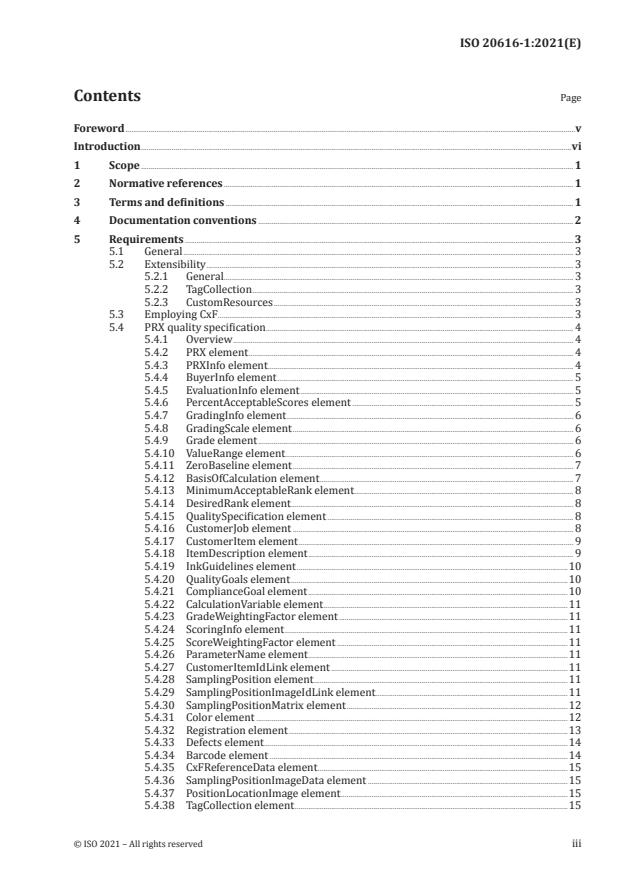
Contents Page
Foreword .v
Introduction .vi
1 Scope . 1
2 Normative references . 1
3 Terms and definitions . 1
4 Documentation conventions . 2
5 Requirements . 3
5.1 General . 3
5.2 Extensibility . 3
5.2.1 General. 3
5.2.2 TagCollection . 3
5.2.3 CustomResources . 3
5.3 Employing CxF . 3
5.4 PRX quality specification . 4
5.4.1 Overview . 4
5.4.2 PRX element . 4
5.4.3 PRXInfo element . . 4
5.4.4 BuyerInfo element . 5
5.4.5 EvaluationInfo element . 5
5.4.6 PercentAcceptableScores element . 5
5.4.7 GradingInfo element . 6
5.4.8 GradingScale element . 6
5.4.9 Grade element . 6
5.4.10 ValueRange element. 6
5.4.11 ZeroBaseline element . 7
5.4.12 BasisOfCalculation element . 7
5.4.13 MinimumAcceptableRank element . 8
5.4.14 DesiredRank element . . . 8
5.4.15 QualitySpecification element . 8
5.4.16 CustomerJob element . 8
5.4.17 CustomerItem element . 9
5.4.18 ItemDescription element . 9
5.4.19 InkGuidelines element .10
5.4.20 QualityGoals element .10
5.4.21 ComplianceGoal element .10
5.4.22 CalculationVariable element .11
5.4.23 GradeWeightingFactor element .11
5.4.24 ScoringInfo element .11
5.4.25 ScoreWeightingFactor element .11
5.4.26 ParameterName element .11
5.4.27 CustomerItemIdLink element .11
5.4.28 SamplingPosition element .11
5.4.29 SamplingPositionImageIdLink element.11
5.4.30 SamplingPositionMatrix element .12
5.4.31 Color element .12
5.4.32 Registration element .13
5.4.33 Defects element.14
5.4.34 Barcode element .14
5.4.35 CxFReferenceData element .15
5.4.36 SamplingPositionImageData element .15
5.4.37 PositionLocationImage element .15
5.4.38 TagCollection element .15
5.4.39 CustomResources element .15
5.4.40 PRX simple types .15
Annex A (normative) ISO 20616-1 XML schema .24
Annex B (informative) PRX principles and concepts .25
Annex C (informative) Samples .27
Bibliography .30
iv © ISO 2021 – All rights reserved
Foreword
ISO (the International Organization for Standardization) is a worldwide federation of national standards
bodies (ISO member bodies). The work of preparing International Standards is normally carried out
through ISO technical committees. Each member body interested in a subject for which a technical
committee has been established has the right to be represented on that committee. International
organizations, governmental and non-governmental, in liaison with ISO, also take part in the work.
ISO collaborates closely with the International Electrotechnical Commission (IEC) on all matters of
electrotechnical standardization.
The procedures used to develop this document and those intended for its further maintenance are
described in the ISO/IEC Directives, Part 1. In particular, the different approval criteria needed for the
different types of ISO documents should be noted. This document was drafted in accordance with the
editorial rules of the ISO/IEC Directives, Part 2 (see www .iso .org/ directives).
Attention is drawn to the possibility that some of the elements of this document may be the subject of
patent rights. ISO shall not be held responsible for identifying any or all such patent rights. Details of
any patent rights identified during the development of the document will be in the Introduction and/or
on the ISO list of patent declarations received (see www .iso .org/ patents).
Any trade name used in this document is information given for the convenience of users and does not
constitute an endorsement.
For an explanation of the voluntary nature of standards, the meaning of ISO specific terms and
expressions related to conformity assessment, as well as information about ISO's adherence to the
World Trade Organization (WTO) principles in the Technical Barriers to Trade (TBT), see www .iso .org/
iso/ foreword .html.
This document was prepared by Technical Committee ISO/TC 130, Graphic technology.
A list of all parts in the ISO 20616 series can be found on the ISO website.
Any feedback or questions on this document should be directed to the user’s national standards body. A
complete listing of these bodies can be found at www .iso .org/ members .html.
Introduction
The ISO 20616 series defines standard XML schemas designed to enable the digital exchange of print
quality data and metadata between trading partners within the graphic arts supply chain. In the
past, a number of different non-standard data formats have been used to communicate print quality
metrics. It is a general observation that many of these existing non-standard data formats describe
similar types of information. Existing standard data formats cover either too much or too little scope
to address industry requirements. Hence, there is an industry need for a single, standard, concise set of
data formats for the communication of print quality.
Each part of the ISO 20616 series is intended to stand alone, but may be used together, if that option is
chosen. The goal of ISO 20616 is to maintain the degree of flexibility required by print buyers for all
kinds of print generated for all purposes from any print device while minimizing the uncertainty of the
data exchanged.
ISO 20616-1, PRX, is intended to facilitate the one-way digital transmission of customer expectations
(i.e. print quality requirements) for a print job or class of print jobs, from a print buyer to print service
providers and other relevant stakeholders. PRX is not designed for ordering print jobs, but rather to
establish a buyer’s policy for expected quality. PRX is designed to enable the print buyer to specify
references, tolerances, scoring/grading scales and the mathematical formula to be employed by the
print buyer to assess the quality of their printed materials. PRX may also be used communicate a print
buyer’s compliance requirements.
Some portions of ISO 20616-1 are available as electronic files found at https:// standards .iso .org/ iso/
20616/ -1/ ed -1/ en/ :
— ISO-TC130_N4211_CD__20616-1_3_Electronic_Files.zip (all 20616-1 support documents);
— ISO20616-1prx.xsd;
— ISO20616-1prx_lines.pdf (printable PRX schema with reference lines numbered);
— ISO20616-1SchemaDoc.pdf (detailed schema documentation with graphics);
— PRX_MasterSampleA.pdf (printable sample with reference lines numbered);
— PRX_MasterSampleA.prx (parsable sample);
— PRX_MasterSampleB.pdf (printable sample with reference lines numbered);
— PRX_MasterSampleB.prx (parsable sample);
— PRX_MasterSampleC.pdf (printable sample with reference lines numbered);
— PRX_MasterSampleC.prx (parsable sample).
vi © ISO 2021 – All rights reserved
INTERNATIONAL STANDARD ISO 20616-1:2021(E)
Graphic technology — File format for quality control and
metadata —
Part 1:
Print requirements eXchange (PRX)
1 Scope
This document specifies an extensible file format in conformity with W3C Extensible Markup Language
(XML) 1.0, for the exchange of print quality requirements data and metadata between print quality
control applications including, but not limited to, print quality management systems.
This document is not intended for automating the loading of print requirement goals into the quality
control systems employed by print quality service providers.
2 Normative references
The following documents are referred to in the text in such a way that some or all of their content
constitutes requirements of this document. For dated references, only the edition cited applies. For
undated references, the latest edition of the referenced document (including any amendments) applies.
ISO 17972-3, Graphic technology — Colour data exchange format (CxF/X) — Part 3: Output target data
(CxF/X-3)
3 Terms and definitions
For the purposes of this document, the following terms and definitions apply.
ISO and IEC maintain terminological databases for use in standardization at the following addresses:
— ISO Online browsing platform: available at https:// www .iso .org/ obp
— IEC Electropedia: available at http:// www .electropedia .org/
3.1
basis of calculation
formula by which print quality is calculated by the print buyer (3.3)
3.2
grade
print buyer's (3.3) evaluation of the overall level of print quality for a printed item
3.3
print buyer
name of the customer or entity purchasing printing services and products
3.4
rank
integer value assigned to a print quality grade (3.2) or score (3.5) based on a scale of zero or more,
where the higher the integer, the better the print quality
3.5
score
print buyer's (3.3) evaluation of the quality for a single quality parameter such as colour or defects
3.6
XML
Extensible Markup Language
set of rules recommended by the World Wide Web Consortium (W3C) for encoding documents in a
digital format which is both human-readable and machine-readable
3.7
XML attribute
attribute
XML construct included within the start tag of an XML element that modifies, or provides descriptive
metadata about, that element’s content
3.8
XML element
element
data structure including a start tag, an end tag, data between these tags, and, possibly, a set of XML
attributes
[SOURCE: ISO 13584-32:2010, 3.22, modified — Added admitted term.]
3.9
XML root element
root element
single XML element that encloses all the other elements and is therefore the sole parent element to all
the other elements
3.10
XML schema
language for describing the structure and constraining the contents of XML documents
[SOURCE: ISO 25720:2009, 4.32]
3.11
XML schema parser
application that is capable of validating document schemes (content and structure) and descriptor data
types against their schema definition
4 Documentation conventions
The following documentation conventions are used.
— Names of XML elements are shown in bold type; for example, BuyerInfo.
— Names of XML attributes are shown in italics; for example, @DisplayName.
— Names of XML datatypes are shown in italics; for example, originType.
XML XPaths are used to identify XML elements. For example, BuyerInfo/ParentCompany refers to an
element (ParentCompany) that is a child of another element (BuyerInfo).
Similarly, XML XPaths are used to refer to XML attributes. For example, CustomerItem/@Id refers to
an attribute (Id) of an element (CustomerItem).
2 © ISO 2021 – All rights reserved
5 Requirements
5.1 General
The following general requirements shall be met when using PRX XML to exchange print quality data
and metadata:
— PRX print quality requirements data should be validated using an XML schema parser employing
the ISO 20616-1 XML schema, ISO20616-1PRX.xsd.
— If PRX quality requirements data is exchanged as a standalone file, the file extension shall be ".prx".
— The root element of ISO 20616-1 print quality requirements data shall be a single PRX element.
— A valid PRX element shall contain the required namespace information in the root element: (
xmlns:p rx = "https:// idealliance .org/ prx">) followed by the XML elements and XML attributes
specified by the ISO 20616-1 XML schema, ISO20616-1PRX.xsd.
— If colour quality reference data is being exchanged, the PRX root element shall contain the required
namespace information for CxF, "xmlns: cc = http:// colorexchangeformat .com/ CxF3 -core".
5.2 Extensibility
5.2.1 General
To provide for extensibility in the PRX model, the specification includes two blocks modelled directly
from the extensibility provided by CxF; TagCollection and CustomResources.
5.2.2 TagCollection
TagCollection may only be used to insert additional application-specific XML print quality
requirements child elements into a PRX data structure at the agreement of all trading partners. Use of
TagCollection is highly discouraged.
5.2.3 CustomResources
CustomResources may only be used to insert additional application-specific XML print quality
requirements data models into a PRX data structure at the agreement of all trading partners. Use of
CustomResources is highly discouraged.
5.3 Employing CxF
ISO 17972-1 shall be used to exchange print quality colour data and metadata. The following
requirements shall be met when using CxF to exchange print quality colour requirements data and
metadata.
— Only Core CxF data shall be employed as the data store for colour requirements data.
— CxF shall be employed as a complete CxF hierarchy.
NOTE Retaining < c c: C x F > as the root element ensures direct importability from colour measurement
devices.
— CxF should only be used to customize CxF if specified by a business agreement among
trading partners.
— CxF should only be used to customize CxF if specified by a business
agreement among trading partners.
— CxF and should only
be used to customize CxF if specified by a business agreement among trading partners.
— Non-appropriate CxF elements (listed above) may be written into a PRX data, but should only be
processed by receiving systems if specified by a business agreement among trading partners.
5.4 PRX quality specification
5.4.1 Overview
The ISO20616-1PRX schema provides the rules for the order, occurrence and datatypes for the fields
that make up a print-quality requirements exchange. The PRX schema is the immutable specification.
Annex A, a PDF version of the schema printed with reference line numbers, shall be used to provide a
line number reference for each element documented in this subclause. Additional requirements that
cannot be specified by an XML schema are found in the following subclauses.
NOTE The spelling of fields in PRX were designed to match the spelling of fields taken from ISO 17972-3. A
specific example is the use of the word "color" instead of "colour".
See Annex B for documentation about the principles and concepts underlying the design and usage of
this document. See Annex C for usage samples to help guide implementing this document.
5.4.2 PRX element
The PRX element is the root element of a print quality requirements data exchange. The PRX element
shall be used to specify a print buyer’s print quality requirements. The PRX element shall conform to
the rules specified by ISO20616-1PRX.xsd (lines 12 to 30). See Table 1.
Table 1 — PRX fields
Field name Normative description
PRXInfo See 5.4.3 PRXInfo element.
BuyerInfo See 5.4.4 BuyerInfo element.
EvaluationInfo See 5.4.5 EvaluationInfo element.
QualitySpecification See 5.4.15 QualitySpecification element.
CxFReferenceData See 5.4.34 CxFReferenceData element.
SamplingPositionImageData See 5.4.35 SamplingPositionImageData element.
5.4.3 PRXInfo element
5.4.3.1 General
The PRXInfo element shall be used to identify the instance of print quality requirements being
exchanged. The PRXInfo element shall conform to the rules specified by ISO20616-1PRX.xsd (lines 35
to 47). The PRXInfo element is made up of elements described in 5.4.3.2 to 5.4.3.4.
5.4.3.2 PRXDate element
The PRXDate element shall be used to identify date or date/time this PRX data was generated. The
PRXDate element element shall conform to the rules specified by ISO20616-1PRX.xsd (lines 51 to 55).
5.4.3.3 PRXId element
The PRXId element shall be used to provide an identifier (unique in the context of system generated
identifiers assigned on the specified PRXDate) for this print quality requirements specification. The
PRXId element shall conform to the rules specified by ISO20616-1PRX.xsd (lines 59 to 63).
4 © ISO 2021 – All rights reserved
5.4.3.4 PRXSoftware-Version
PRXSoftware-Version shall be used to identify the software and version that generated this PRX file.
PRXId element shall conform to the rules specified by ISO20616-1PRX.xsd (lines 67 to 71)
NOTE Concatenation of the PRXDate, PRXId and PRXSoftware-Version make up a unique identifier for
this print quality data report.
5.4.4 BuyerInfo element
5.4.4.1 General
The BuyerInfo element shall be used to identify the business entity buying print and specifying print
quality requirements. The BuyerInfo element shall conform to the rules specified by ISO20616-1PRX.xsd
(lines 76 to 89). The BuyerInfo element is made up of elements described in 5.4.4.2 to 5.4.4.5.
5.4.4.2 ParentCompany element
The ParentCompany element shall be used to identify the company that controls an entity such as a
print buyer. The ParentCompany element shall conform to the rules specified by ISO20616-1PRX.xsd
(lines 93 to 97).
5.4.4.3 CompanyName element
The CompanyName element shall be used to identify the print buyer’s business entity. The
CompanyName element shall conform to the rules specified by ISO20616-1PRX.xsd (lines 101 to 105).
5.4.4.4 LocationDesignator
The LocationDesignator element shall be used to provide a designation for the location of a company
or party as a second level of identification for that company or party. The LocationDesignator element
shall conform to the rules specified by ISO20616-1PRX.xsd (lines 109 to 113).
NOTE LocationDesignator can be a unique identifier, city/state/country designation, postal code,
geographic coordinates or simply be a designator code employed by the print buyer. This element is purposefully
flexible to facilitate broad print buyer adoption.
5.4.4.5 ContactDesignator
The ContactDesignator element shall be used to provide a designation for information required to
communicate with a business entity. The ContactDesignator element shall conform to the rules
specified by ISO20616-1PRX.xsd (lines 117 to 121).
NOTE ContactDesignator can be email, street address, phone, fax, etc. or simply be a designator code
employed by the print buyer. This element is purposefully flexible to facilitate broad print buyer adoption.
5.4.5 EvaluationInfo element
The EvaluationInfo element shall be used to provide information about the evaluation method that
the print buyer intends to use. The EvaluationInfo element shall conform to the rules specified by the
ISO20616-1PRX.xsd (lines 227 to 238). The EvaluationInfo element is made up of elements described
in 5.4.6 to 5.4.7.
5.4.6 PercentAcceptableScores element
The PercentAcceptableScores element shall be used to provide the calculated percent of
all scored parameters that shall be within the print buyers acceptable scoring range. The
PercentAcceptableScores element shall conform to the rules specified by ISO20616-1PRX.xsd (lines
389 to 393).
5.4.7 GradingInfo element
The GradingInfo element shall be used to provide grading criteria that the print buyer intends to use
to evaluate overall print quality as a formal grade. The GradingInfo element shall be as specified by the
ISO20616-1PRX.xsd (lines 242 to 255). The GradingInfo element is made up of elements described in
5.4.8 to 5.4.14.
5.4.8 GradingScale element
The GradingScale element shall be used to provide the print buyer’s method to assign grades for
overall print quality. The GradingScale element shall be as specified by the ISO20616-1PRX.xsd (lines
446 to 457). The GradingScale element is made up of elements described in 5.4.9 to 5.4.11.
5.4.9 Grade element
The Grade element shall be used to provide the print buyer’s indicator for the overall print quality of a
printed item. The Grade element shall be as specified by the ISO20616-1PRX.xsd (lines 461 to 473).
The Grade element is made up of elements described in 5.4.10.
The @DisplayLabel attribute shall be used to provide the print buyer’s name for a grade and the @
Rank attribute shall be used to standardize the meaning of a grade based on a positive integer value.
NOTE 1 Grade labels include A, B, C, D, F; Platinum, Gold, Silver, Bronze; Superior, Excellent, Good, Poor; Pass
and Fail or a print buyer’s custom labels.
NOTE 2 The greater the value of the Rank attribute, the higher the print quality.
5.4.10 ValueRange element
5.4.10.1 General
The ValueRange element shall be used to provide a mechanism to construct a logical expression that
the print buyer intends to use to assign a numeric rank to a print quality grade or score. The ValueRange
element shall conform to the rules specified by ISO20616-1PRX.xsd (lines 477 to 493). The ValueRange
element is made up of elements described in 5.4.10.2 to 5.4.10.4.
When using the ValueRange element to assign a rank for a grade or score, a result fulfilling 2 or more
evaluation definitions shall be assigned the grade/score with the higher rank.
NOTE The ValueRange element uses a series of logical operators and logical connectors to construct value
statements that are assigned to rankings.
5.4.10.2 LogicalOperator element
The LogicalOperator element shall be used to specify the mathematical operation to be used by the
print buyer for calculation. The LogicalOperator element shall conform to the rules specified by
ISO20616-1PRX.xsd (lines 497 to 502).
5.4.10.3 LogicalConnector element
The LogicalConnector element shall be used to specify a mathematical connector to be used by the
print buyer to combine complex functions used for calculations of print quality grades or scores. The
LogicalConnector element shall conform to the rules specified by ISO20616-1PRX.xsd (lines 515 to
520).
6 © ISO 2021 – All rights reserved
5.4.10.4 CalculatedValue element
The CalculatedValue element shall be used to specify the result of a print quality calculation. The
CalculatedValue element shall conform to the rules specified by ISO20616-1PRX.xsd (lines 506 to 511).
5.4.11 ZeroBaseline element
The ZeroBaseline element shall be used to provide a mathematical point beyond the lowest defined
ranking for a print quality grade or score. The ZeroBaseline element shall conform to the rules
specified by ISO20616-1PRX.xsd (lines 1543to 1550).
5.4.12 BasisOfCalculation element
5.4.12.1 General
The BasisOfCalculation element shall be used to provide the print buyer’s method to calculate
grades for overall print quality. The BasisOfCalculation element shall conform to the rules specified
by ISO20616-1PRX.xsd (lines 371to 381). The BasisOfCalculation element is made up of elements
described in 5.4.12.2 to 5.4.12.6.
5.4.12.2 WeightedPercentage element
The WeightedPercentage element shall be used to indicate the calculation is a weighted percentage
formula. The WeightedPercentage element shall conform to the rules specified by ISO20616-1PRX.xsd
(line 385).
5.4.12.3 Formula element
The Formula element shall be used to express the mathematical formula used to calculate a grade or
score. The Formula element shall conform to the rules specified by ISO20616-1PRX.xsd (lines 398 to
411). The Formula element is made up of elements described in 5.4.12.4 to 5.4.12.6.
5.4.12.4 FormulaDescription element
The FormulaDescription element shall be used to a narrative account of the formula used to
calculate a grade or score. The FormulaDescription element shall conform to the rules specified by
ISO20616-1PRX.xsd (lines 415 to 419).
5.4.12.5 FormulaName element
The FormulaName element shall be used to specify the word or set of words by which a
mathematical formula is known. The FormulaName element shall conform to the rules specified by
ISO20616-1PRX.xsd (lines 423 to 427).
5.4.12.6 MathOrMethod element
The MathOrMethod element shall be used to specify the mathematical expression of a formula in
any expression language or written method. The MathOrMethod element shall conform to the rules
specified by ISO20616-1PRX.xsd (lines 431 to 442).
NOTE Compliant PRX XML parsers are not required to process this data as it can be an XML-encoded formula
(such as MathML or OpenMath) or it can be a formula expressed in a non-XML format such as LaTex or ASCIImath
or even a method described in written language.
5.4.13 MinimumAcceptableRank element
The MinimumAcceptableRank element shall be used to provide the print buyer's minimum quality
ranking on an integer scale greater than zero. The MinimumAcceptableRank element shall conform
to the rules specified by ISO20616-1PRX.xsd (lines 550 to 555).
5.4.14 DesiredRank element
The DesiredRank element shall be used to provide the print buyer's target quality ranking on an
integer scale greater than zero. The DesiredRank element shall conform to the rules specified by
ISO20616-1PRX.xsd (lines 541 to 546).
5.4.15 QualitySpecification element
5.4.15.1 General
The QualitySpecification element shall be used to provide the print buyer's target quality ranking
on an integer scale greater than zero. The QualitySpecification element shall conform to the rules
specified by ISO20616-1PRX.xsd (lines 159 to 177). The QualitySpecification element is made up of
elements described in 5.4.15.2 to 5.4.15.5 and 5.4.16.4 to 5.4.16.5.
5.4.15.2 QualitySpecName element
The QualitySpecName element shall be used to provide the shall be used to provide a word or set of
words used by a print buyer to identify a quality specification that has been updated or changed over
time. The QualitySpecName element shall conform to the rules specified by ISO20616-1PRX.xsd (lines
181 to 186).
5.4.15.3 QualitySpecVersion element
The QualitySpecVersion element shall be used to provide a version identifier for a quality specification
that has been updated or changed overtime. The QualitySpecVersion element shall conform to the
rules specified by ISO20616-1PRX.xsd (lines 190 to 195).
5.4.15.4 PrintMethod element
The PrintMethod element shall be used to provide the print method for which a print quality
specification is being exchanged. The PrintMethod shall conform to the rules specified by
ISO20616-1PRX.xsd (lines 125 to 129).
5.4.15.5 Specifier element
The Specifier element shall be used to provide the party responsible for specifying print quality
requirements. The Specifier element shall conform to the rules specified by ISO20616-1PRX.xsd (lines
142 to 154).
5.4.16 CustomerJob element
5.4.16.1 General
The CustomerJob element shall be used to provide a designation for the category of customer job for
which a print quality specification is being defined. The CustomerJob element shall conform to the
rules specified by ISO20616-1PRX.xsd (lines 199 to 223). The CustomerJob element is made up of
elements described in 5.4.16.2 to 5.4.16.8.
8 © ISO 2021 – All rights reserved
5.4.16.2 JobTypeName element
The JobTypeName element shall be used to provide the print buyer’s designation for the type of print
job for which a print quality specification is being defined. The JobTypeName element shall conform to
the rules specified by ISO20616-1PRX.xsd (lines 355 to 359).
5.4.16.3 JobDescription element
The JobDescription element shall be used to provide an account of the type of print job for which a
print quality specification is being defined. The JobDescription element shall conform to the rules
specified by ISO20616-1PRX.xsd (lines 363 to 367).
5.4.16.4 Brand element
The Brand element shall be used to provide a manufacturer’s high-level designation for a product or set
of products. The Brand element shall conform to the rules specified by ISO20616-1PRX.xsd (lines 323
to 327).
5.4.16.5 Product element
The Product element shall be used to provide a word or words by which an item offered for sale is
known. The Product element shall conform to the rules specified by ISO20616-1PRX.xsd (lines 331 to
335),
5.4.16.6 Brand-Product element
The Brand-Product element shall be used to provide the owner’s brand and product designation
(expressed as a concatenated string with a vertical bar separator) for an item offered for sale. The
Brand-Product element shall conform to the rules specified by ISO20616-1PRX.xsd (lines 339 to 343).
5.4.16.7 PrintSide element
The PrintSide element shall be used to provide information about the side of substrate to which ink
is applied for a print job or general type of print job. The PrintSide element shall conform to the rules
specified by ISO20616-1PRX.xsd (lines 133 to 138).
5.4.16.8 DesignersGoal element
The DesignersGoal element shall be used to provide a narrative of the print designer’s quality intents
to be used by a print buyer to evaluate overall print quality. The DesignersGoal element shall conform
to the rules specified by ISO20616-1PRX.xsd (lines 277 to 282).
5.4.17 CustomerItem element
The CustomerItem element shall be used to provide identification of a printed customer item for which
a print quality specification is being defined. The CustomerItem element shall conform to the rules
specified by ISO20616-1PRX.xsd (lines 286 to 319).
5.4.18 ItemDescription element
The ItemDescription element shall be used to provide a descriptive account of a printed customer item
for which a print quality specification is being defined. The ItemDescription element shall conform to
the rules specified by ISO20616-1PRX.xsd (lines 347 to 351).
5.4.19 InkGuidelines element
5.4.19.1 General
The InkGuidelines element shall be used to provide guidelines for selection of inks/coatings for a print
job or general type of print job. The InkGuidelines element shall conform to the rules specified by
ISO20616-1PRX.xsd (lines 2051 to 2067). The InkGuidelines element is made up of elements described
in 5.4.19.2 to 5.4.19.7.
5.4.19.2 Ink element
The Ink element shall be used to provide the print buyer’s intent for the inks to be used by the printer.
The Ink element shall conform to the rules specified by ISO20616-1PRX.xsd (lines 2071 to 2083).
5.4.19.3 Coating element
The Coating element shall be used to provide the print buyer’s intent for the coating(s) to be used by
the printer. The Coating element shall conform to the rules specified by ISO20616-1PRX.xsd (lines 2137
to 2149).
5.4.19.4 Resistance element
The Resistance element shall be used to provide a description of the conditions that the print buyer
expects ink quality to withstand. The Resistance element shall conform to the rules specified by
ISO20616-1PRX.xsd (lines 2169 to 2184).
5.4.19.5 LightFastness element
The LightFastness element shall be used to indicate whether the print buyer expects ink quality to
withstand light. The LightFastness element shall conform to the rules specified by ISO20616-1PRX.xsd
(lines 2208 to 2212).
5.4.19.6 PPMSolventRetention element
The PPMSolventRetention element shall be used to provide the maximum parts per million that the
print buyer allows for solvent retention of the inks used. The PPMSolventRetention element shall
conform to the rules specified by ISO20616-1PRX.xsd (lines 2216 to 2220).
5.4.19.7 MaterialProhibited element
The MaterialProhibited element shall be used to provide the materials that a print buyer prohibits for
use within an ink or coating chemical compound. The MaterialProhibited element shall conform to
the rules specified by ISO20616-1PRX.xsd (lines 2224 to 2228).
5.4.20 QualityGoals element
The QualityGoals element shall be used to communicate the print buyer’s goals for specific parameters
of print quality. The QualityGoals element shall conform to the rules specified by ISO20616-1PRX.xsd
(lines 259 to 273).
Up to four quality parameters (Color, Registration, Defects, Barcode) may be specified per
QualityGoals element. Duplicate quality goal parameters shall not be allowed.
5.4.21 ComplianceGoal element
The ComplianceGoal element shall be used to designate a print buyer's compliance goal. The
ComplianceGoal element shall conform to the rules specified by ISO20616-1PRX.xsd (lines 1628 to
1634).
10 © ISO 2021 – All rights reserved
The ComplianceGoal may be a named specification or it may be a link to a specification. Only a
single goal specification shall be listed per ComplianceGoal element. If the print buyer has multiple
compliance goals, multiple ComplianceGoal elements shall be transmitted.
5.4.22 CalculationVariable element
The CalculationVariable element shall be used to specify the variable to be used in a grade calculation
formula. The CalculationVariable element shall conform to the rules specified by ISO20616-1PRX.xsd
(lines 611 to 616).
5.4.23 GradeWeightingFactor element
The GradeWeightingFactor element shall be used to specify a positive integer mathematical weighting
factor for this quality goal in a grade calculation formula. The GradeWeightingFactor element shall
conform to the rules specified by ISO20616-1PRX.xsd (lines 620 to 625).
5.4.24 ScoringInfo element
The ScoringInfo element shall be used to provide information required to indicate how that print
parameter is scored by the print buyer. The ScoringInfo element shall conform to the rules specified by
ISO20616-1PRX.xsd (lines 594 to 607).
5.4.25 ScoreWeightingFactor element
The ScoreWeightingFactor element shall be used to specify a positive integer mathematical weighting
factor for this quality goal in a score calculation formula. The ScoreWeightingFactor element shall
conform to the rules specified by ISO20616-1PRX.xsd (lines 684 to 689).
5.4.26 ParameterName element
The ParameterName element shall be used to provide a label for the print quality parameter being
specified. The ParameterName element shall conform to the rules specified by ISO20616-1PRX.xsd
(lines 847 to 851).
5.4.27 CustomerItemIdLink element
The CustomerItemIdLink element shall be used to provide a connection from a customer item to print
buyer quality requirements. The CustomerItemIdLink element shall conform to the rules specified by
ISO20616-1PRX.xsd (lines 703 to 707).
5.4.28 SamplingPosition element
The SamplingPosition element shall be used to provide the positions on a sample that the buyer
requires quality measurement or observation and reporting. The SamplingPosition element shall
conform to the rules specified by ISO20616-1PRX.xsd (lines 1575 to 1590). The element is made up of
elements described in 5.4.29 to 5.4.30.
5.4.29 SamplingPositionImageIdLink element
The SamplingPositionImageIdLink element shall be used to
...
INTERNATIONAL ISO
STANDARD 20616-1
First edition
2021-09
Graphic technology — File format for
quality control and metadata —
Part 1:
Print requirements eXchange (PRX)
Technologie graphique — Format de fichier pour le contrôle qualité
et les métadonnées —
Partie 1: Print requirements eXchange (PRX)
Reference number
©
ISO 2021
© ISO 2021
All rights reserved. Unless otherwise specified, or required in the context of its implementation, no part of this publication may
be reproduced or utilized otherwise in any form or by any means, electronic or mechanical, including photocopying, or posting
on the internet or an intranet, without prior written permission. Permission can be requested from either ISO at the address
below or ISO’s member body in the country of the requester.
ISO copyright office
CP 401 • Ch. de Blandonnet 8
CH-1214 Vernier, Geneva
Phone: +41 22 749 01 11
Email: copyright@iso.org
Website: www.iso.org
Published in Switzerland
ii © ISO 2021 – All rights reserved
Contents Page
Foreword .v
Introduction .vi
1 Scope . 1
2 Normative references . 1
3 Terms and definitions . 1
4 Documentation conventions . 2
5 Requirements . 3
5.1 General . 3
5.2 Extensibility . 3
5.2.1 General. 3
5.2.2 TagCollection . 3
5.2.3 CustomResources . 3
5.3 Employing CxF . 3
5.4 PRX quality specification . 4
5.4.1 Overview . 4
5.4.2 PRX element . 4
5.4.3 PRXInfo element . . 4
5.4.4 BuyerInfo element . 5
5.4.5 EvaluationInfo element . 5
5.4.6 PercentAcceptableScores element . 5
5.4.7 GradingInfo element . 6
5.4.8 GradingScale element . 6
5.4.9 Grade element . 6
5.4.10 ValueRange element. 6
5.4.11 ZeroBaseline element . 7
5.4.12 BasisOfCalculation element . 7
5.4.13 MinimumAcceptableRank element . 8
5.4.14 DesiredRank element . . . 8
5.4.15 QualitySpecification element . 8
5.4.16 CustomerJob element . 8
5.4.17 CustomerItem element . 9
5.4.18 ItemDescription element . 9
5.4.19 InkGuidelines element .10
5.4.20 QualityGoals element .10
5.4.21 ComplianceGoal element .10
5.4.22 CalculationVariable element .11
5.4.23 GradeWeightingFactor element .11
5.4.24 ScoringInfo element .11
5.4.25 ScoreWeightingFactor element .11
5.4.26 ParameterName element .11
5.4.27 CustomerItemIdLink element .11
5.4.28 SamplingPosition element .11
5.4.29 SamplingPositionImageIdLink element.11
5.4.30 SamplingPositionMatrix element .12
5.4.31 Color element .12
5.4.32 Registration element .13
5.4.33 Defects element.14
5.4.34 Barcode element .14
5.4.35 CxFReferenceData element .15
5.4.36 SamplingPositionImageData element .15
5.4.37 PositionLocationImage element .15
5.4.38 TagCollection element .15
5.4.39 CustomResources element .15
5.4.40 PRX simple types .15
Annex A (normative) ISO 20616-1 XML schema .24
Annex B (informative) PRX principles and concepts .25
Annex C (informative) Samples .27
Bibliography .30
iv © ISO 2021 – All rights reserved
Foreword
ISO (the International Organization for Standardization) is a worldwide federation of national standards
bodies (ISO member bodies). The work of preparing International Standards is normally carried out
through ISO technical committees. Each member body interested in a subject for which a technical
committee has been established has the right to be represented on that committee. International
organizations, governmental and non-governmental, in liaison with ISO, also take part in the work.
ISO collaborates closely with the International Electrotechnical Commission (IEC) on all matters of
electrotechnical standardization.
The procedures used to develop this document and those intended for its further maintenance are
described in the ISO/IEC Directives, Part 1. In particular, the different approval criteria needed for the
different types of ISO documents should be noted. This document was drafted in accordance with the
editorial rules of the ISO/IEC Directives, Part 2 (see www .iso .org/ directives).
Attention is drawn to the possibility that some of the elements of this document may be the subject of
patent rights. ISO shall not be held responsible for identifying any or all such patent rights. Details of
any patent rights identified during the development of the document will be in the Introduction and/or
on the ISO list of patent declarations received (see www .iso .org/ patents).
Any trade name used in this document is information given for the convenience of users and does not
constitute an endorsement.
For an explanation of the voluntary nature of standards, the meaning of ISO specific terms and
expressions related to conformity assessment, as well as information about ISO's adherence to the
World Trade Organization (WTO) principles in the Technical Barriers to Trade (TBT), see www .iso .org/
iso/ foreword .html.
This document was prepared by Technical Committee ISO/TC 130, Graphic technology.
A list of all parts in the ISO 20616 series can be found on the ISO website.
Any feedback or questions on this document should be directed to the user’s national standards body. A
complete listing of these bodies can be found at www .iso .org/ members .html.
Introduction
The ISO 20616 series defines standard XML schemas designed to enable the digital exchange of print
quality data and metadata between trading partners within the graphic arts supply chain. In the
past, a number of different non-standard data formats have been used to communicate print quality
metrics. It is a general observation that many of these existing non-standard data formats describe
similar types of information. Existing standard data formats cover either too much or too little scope
to address industry requirements. Hence, there is an industry need for a single, standard, concise set of
data formats for the communication of print quality.
Each part of the ISO 20616 series is intended to stand alone, but may be used together, if that option is
chosen. The goal of ISO 20616 is to maintain the degree of flexibility required by print buyers for all
kinds of print generated for all purposes from any print device while minimizing the uncertainty of the
data exchanged.
ISO 20616-1, PRX, is intended to facilitate the one-way digital transmission of customer expectations
(i.e. print quality requirements) for a print job or class of print jobs, from a print buyer to print service
providers and other relevant stakeholders. PRX is not designed for ordering print jobs, but rather to
establish a buyer’s policy for expected quality. PRX is designed to enable the print buyer to specify
references, tolerances, scoring/grading scales and the mathematical formula to be employed by the
print buyer to assess the quality of their printed materials. PRX may also be used communicate a print
buyer’s compliance requirements.
Some portions of ISO 20616-1 are available as electronic files found at https:// standards .iso .org/ iso/
20616/ -1/ ed -1/ en/ :
— ISO-TC130_N4211_CD__20616-1_3_Electronic_Files.zip (all 20616-1 support documents);
— ISO20616-1prx.xsd;
— ISO20616-1prx_lines.pdf (printable PRX schema with reference lines numbered);
— ISO20616-1SchemaDoc.pdf (detailed schema documentation with graphics);
— PRX_MasterSampleA.pdf (printable sample with reference lines numbered);
— PRX_MasterSampleA.prx (parsable sample);
— PRX_MasterSampleB.pdf (printable sample with reference lines numbered);
— PRX_MasterSampleB.prx (parsable sample);
— PRX_MasterSampleC.pdf (printable sample with reference lines numbered);
— PRX_MasterSampleC.prx (parsable sample).
vi © ISO 2021 – All rights reserved
INTERNATIONAL STANDARD ISO 20616-1:2021(E)
Graphic technology — File format for quality control and
metadata —
Part 1:
Print requirements eXchange (PRX)
1 Scope
This document specifies an extensible file format in conformity with W3C Extensible Markup Language
(XML) 1.0, for the exchange of print quality requirements data and metadata between print quality
control applications including, but not limited to, print quality management systems.
This document is not intended for automating the loading of print requirement goals into the quality
control systems employed by print quality service providers.
2 Normative references
The following documents are referred to in the text in such a way that some or all of their content
constitutes requirements of this document. For dated references, only the edition cited applies. For
undated references, the latest edition of the referenced document (including any amendments) applies.
ISO 17972-3, Graphic technology — Colour data exchange format (CxF/X) — Part 3: Output target data
(CxF/X-3)
3 Terms and definitions
For the purposes of this document, the following terms and definitions apply.
ISO and IEC maintain terminological databases for use in standardization at the following addresses:
— ISO Online browsing platform: available at https:// www .iso .org/ obp
— IEC Electropedia: available at http:// www .electropedia .org/
3.1
basis of calculation
formula by which print quality is calculated by the print buyer (3.3)
3.2
grade
print buyer's (3.3) evaluation of the overall level of print quality for a printed item
3.3
print buyer
name of the customer or entity purchasing printing services and products
3.4
rank
integer value assigned to a print quality grade (3.2) or score (3.5) based on a scale of zero or more,
where the higher the integer, the better the print quality
3.5
score
print buyer's (3.3) evaluation of the quality for a single quality parameter such as colour or defects
3.6
XML
Extensible Markup Language
set of rules recommended by the World Wide Web Consortium (W3C) for encoding documents in a
digital format which is both human-readable and machine-readable
3.7
XML attribute
attribute
XML construct included within the start tag of an XML element that modifies, or provides descriptive
metadata about, that element’s content
3.8
XML element
element
data structure including a start tag, an end tag, data between these tags, and, possibly, a set of XML
attributes
[SOURCE: ISO 13584-32:2010, 3.22, modified — Added admitted term.]
3.9
XML root element
root element
single XML element that encloses all the other elements and is therefore the sole parent element to all
the other elements
3.10
XML schema
language for describing the structure and constraining the contents of XML documents
[SOURCE: ISO 25720:2009, 4.32]
3.11
XML schema parser
application that is capable of validating document schemes (content and structure) and descriptor data
types against their schema definition
4 Documentation conventions
The following documentation conventions are used.
— Names of XML elements are shown in bold type; for example, BuyerInfo.
— Names of XML attributes are shown in italics; for example, @DisplayName.
— Names of XML datatypes are shown in italics; for example, originType.
XML XPaths are used to identify XML elements. For example, BuyerInfo/ParentCompany refers to an
element (ParentCompany) that is a child of another element (BuyerInfo).
Similarly, XML XPaths are used to refer to XML attributes. For example, CustomerItem/@Id refers to
an attribute (Id) of an element (CustomerItem).
2 © ISO 2021 – All rights reserved
5 Requirements
5.1 General
The following general requirements shall be met when using PRX XML to exchange print quality data
and metadata:
— PRX print quality requirements data should be validated using an XML schema parser employing
the ISO 20616-1 XML schema, ISO20616-1PRX.xsd.
— If PRX quality requirements data is exchanged as a standalone file, the file extension shall be ".prx".
— The root element of ISO 20616-1 print quality requirements data shall be a single PRX element.
— A valid PRX element shall contain the required namespace information in the root element: (
xmlns:p rx = "https:// idealliance .org/ prx">) followed by the XML elements and XML attributes
specified by the ISO 20616-1 XML schema, ISO20616-1PRX.xsd.
— If colour quality reference data is being exchanged, the PRX root element shall contain the required
namespace information for CxF, "xmlns: cc = http:// colorexchangeformat .com/ CxF3 -core".
5.2 Extensibility
5.2.1 General
To provide for extensibility in the PRX model, the specification includes two blocks modelled directly
from the extensibility provided by CxF; TagCollection and CustomResources.
5.2.2 TagCollection
TagCollection may only be used to insert additional application-specific XML print quality
requirements child elements into a PRX data structure at the agreement of all trading partners. Use of
TagCollection is highly discouraged.
5.2.3 CustomResources
CustomResources may only be used to insert additional application-specific XML print quality
requirements data models into a PRX data structure at the agreement of all trading partners. Use of
CustomResources is highly discouraged.
5.3 Employing CxF
ISO 17972-1 shall be used to exchange print quality colour data and metadata. The following
requirements shall be met when using CxF to exchange print quality colour requirements data and
metadata.
— Only Core CxF data shall be employed as the data store for colour requirements data.
— CxF shall be employed as a complete CxF hierarchy.
NOTE Retaining < c c: C x F > as the root element ensures direct importability from colour measurement
devices.
— CxF should only be used to customize CxF if specified by a business agreement among
trading partners.
— CxF should only be used to customize CxF if specified by a business
agreement among trading partners.
— CxF and should only
be used to customize CxF if specified by a business agreement among trading partners.
— Non-appropriate CxF elements (listed above) may be written into a PRX data, but should only be
processed by receiving systems if specified by a business agreement among trading partners.
5.4 PRX quality specification
5.4.1 Overview
The ISO20616-1PRX schema provides the rules for the order, occurrence and datatypes for the fields
that make up a print-quality requirements exchange. The PRX schema is the immutable specification.
Annex A, a PDF version of the schema printed with reference line numbers, shall be used to provide a
line number reference for each element documented in this subclause. Additional requirements that
cannot be specified by an XML schema are found in the following subclauses.
NOTE The spelling of fields in PRX were designed to match the spelling of fields taken from ISO 17972-3. A
specific example is the use of the word "color" instead of "colour".
See Annex B for documentation about the principles and concepts underlying the design and usage of
this document. See Annex C for usage samples to help guide implementing this document.
5.4.2 PRX element
The PRX element is the root element of a print quality requirements data exchange. The PRX element
shall be used to specify a print buyer’s print quality requirements. The PRX element shall conform to
the rules specified by ISO20616-1PRX.xsd (lines 12 to 30). See Table 1.
Table 1 — PRX fields
Field name Normative description
PRXInfo See 5.4.3 PRXInfo element.
BuyerInfo See 5.4.4 BuyerInfo element.
EvaluationInfo See 5.4.5 EvaluationInfo element.
QualitySpecification See 5.4.15 QualitySpecification element.
CxFReferenceData See 5.4.34 CxFReferenceData element.
SamplingPositionImageData See 5.4.35 SamplingPositionImageData element.
5.4.3 PRXInfo element
5.4.3.1 General
The PRXInfo element shall be used to identify the instance of print quality requirements being
exchanged. The PRXInfo element shall conform to the rules specified by ISO20616-1PRX.xsd (lines 35
to 47). The PRXInfo element is made up of elements described in 5.4.3.2 to 5.4.3.4.
5.4.3.2 PRXDate element
The PRXDate element shall be used to identify date or date/time this PRX data was generated. The
PRXDate element element shall conform to the rules specified by ISO20616-1PRX.xsd (lines 51 to 55).
5.4.3.3 PRXId element
The PRXId element shall be used to provide an identifier (unique in the context of system generated
identifiers assigned on the specified PRXDate) for this print quality requirements specification. The
PRXId element shall conform to the rules specified by ISO20616-1PRX.xsd (lines 59 to 63).
4 © ISO 2021 – All rights reserved
5.4.3.4 PRXSoftware-Version
PRXSoftware-Version shall be used to identify the software and version that generated this PRX file.
PRXId element shall conform to the rules specified by ISO20616-1PRX.xsd (lines 67 to 71)
NOTE Concatenation of the PRXDate, PRXId and PRXSoftware-Version make up a unique identifier for
this print quality data report.
5.4.4 BuyerInfo element
5.4.4.1 General
The BuyerInfo element shall be used to identify the business entity buying print and specifying print
quality requirements. The BuyerInfo element shall conform to the rules specified by ISO20616-1PRX.xsd
(lines 76 to 89). The BuyerInfo element is made up of elements described in 5.4.4.2 to 5.4.4.5.
5.4.4.2 ParentCompany element
The ParentCompany element shall be used to identify the company that controls an entity such as a
print buyer. The ParentCompany element shall conform to the rules specified by ISO20616-1PRX.xsd
(lines 93 to 97).
5.4.4.3 CompanyName element
The CompanyName element shall be used to identify the print buyer’s business entity. The
CompanyName element shall conform to the rules specified by ISO20616-1PRX.xsd (lines 101 to 105).
5.4.4.4 LocationDesignator
The LocationDesignator element shall be used to provide a designation for the location of a company
or party as a second level of identification for that company or party. The LocationDesignator element
shall conform to the rules specified by ISO20616-1PRX.xsd (lines 109 to 113).
NOTE LocationDesignator can be a unique identifier, city/state/country designation, postal code,
geographic coordinates or simply be a designator code employed by the print buyer. This element is purposefully
flexible to facilitate broad print buyer adoption.
5.4.4.5 ContactDesignator
The ContactDesignator element shall be used to provide a designation for information required to
communicate with a business entity. The ContactDesignator element shall conform to the rules
specified by ISO20616-1PRX.xsd (lines 117 to 121).
NOTE ContactDesignator can be email, street address, phone, fax, etc. or simply be a designator code
employed by the print buyer. This element is purposefully flexible to facilitate broad print buyer adoption.
5.4.5 EvaluationInfo element
The EvaluationInfo element shall be used to provide information about the evaluation method that
the print buyer intends to use. The EvaluationInfo element shall conform to the rules specified by the
ISO20616-1PRX.xsd (lines 227 to 238). The EvaluationInfo element is made up of elements described
in 5.4.6 to 5.4.7.
5.4.6 PercentAcceptableScores element
The PercentAcceptableScores element shall be used to provide the calculated percent of
all scored parameters that shall be within the print buyers acceptable scoring range. The
PercentAcceptableScores element shall conform to the rules specified by ISO20616-1PRX.xsd (lines
389 to 393).
5.4.7 GradingInfo element
The GradingInfo element shall be used to provide grading criteria that the print buyer intends to use
to evaluate overall print quality as a formal grade. The GradingInfo element shall be as specified by the
ISO20616-1PRX.xsd (lines 242 to 255). The GradingInfo element is made up of elements described in
5.4.8 to 5.4.14.
5.4.8 GradingScale element
The GradingScale element shall be used to provide the print buyer’s method to assign grades for
overall print quality. The GradingScale element shall be as specified by the ISO20616-1PRX.xsd (lines
446 to 457). The GradingScale element is made up of elements described in 5.4.9 to 5.4.11.
5.4.9 Grade element
The Grade element shall be used to provide the print buyer’s indicator for the overall print quality of a
printed item. The Grade element shall be as specified by the ISO20616-1PRX.xsd (lines 461 to 473).
The Grade element is made up of elements described in 5.4.10.
The @DisplayLabel attribute shall be used to provide the print buyer’s name for a grade and the @
Rank attribute shall be used to standardize the meaning of a grade based on a positive integer value.
NOTE 1 Grade labels include A, B, C, D, F; Platinum, Gold, Silver, Bronze; Superior, Excellent, Good, Poor; Pass
and Fail or a print buyer’s custom labels.
NOTE 2 The greater the value of the Rank attribute, the higher the print quality.
5.4.10 ValueRange element
5.4.10.1 General
The ValueRange element shall be used to provide a mechanism to construct a logical expression that
the print buyer intends to use to assign a numeric rank to a print quality grade or score. The ValueRange
element shall conform to the rules specified by ISO20616-1PRX.xsd (lines 477 to 493). The ValueRange
element is made up of elements described in 5.4.10.2 to 5.4.10.4.
When using the ValueRange element to assign a rank for a grade or score, a result fulfilling 2 or more
evaluation definitions shall be assigned the grade/score with the higher rank.
NOTE The ValueRange element uses a series of logical operators and logical connectors to construct value
statements that are assigned to rankings.
5.4.10.2 LogicalOperator element
The LogicalOperator element shall be used to specify the mathematical operation to be used by the
print buyer for calculation. The LogicalOperator element shall conform to the rules specified by
ISO20616-1PRX.xsd (lines 497 to 502).
5.4.10.3 LogicalConnector element
The LogicalConnector element shall be used to specify a mathematical connector to be used by the
print buyer to combine complex functions used for calculations of print quality grades or scores. The
LogicalConnector element shall conform to the rules specified by ISO20616-1PRX.xsd (lines 515 to
520).
6 © ISO 2021 – All rights reserved
5.4.10.4 CalculatedValue element
The CalculatedValue element shall be used to specify the result of a print quality calculation. The
CalculatedValue element shall conform to the rules specified by ISO20616-1PRX.xsd (lines 506 to 511).
5.4.11 ZeroBaseline element
The ZeroBaseline element shall be used to provide a mathematical point beyond the lowest defined
ranking for a print quality grade or score. The ZeroBaseline element shall conform to the rules
specified by ISO20616-1PRX.xsd (lines 1543to 1550).
5.4.12 BasisOfCalculation element
5.4.12.1 General
The BasisOfCalculation element shall be used to provide the print buyer’s method to calculate
grades for overall print quality. The BasisOfCalculation element shall conform to the rules specified
by ISO20616-1PRX.xsd (lines 371to 381). The BasisOfCalculation element is made up of elements
described in 5.4.12.2 to 5.4.12.6.
5.4.12.2 WeightedPercentage element
The WeightedPercentage element shall be used to indicate the calculation is a weighted percentage
formula. The WeightedPercentage element shall conform to the rules specified by ISO20616-1PRX.xsd
(line 385).
5.4.12.3 Formula element
The Formula element shall be used to express the mathematical formula used to calculate a grade or
score. The Formula element shall conform to the rules specified by ISO20616-1PRX.xsd (lines 398 to
411). The Formula element is made up of elements described in 5.4.12.4 to 5.4.12.6.
5.4.12.4 FormulaDescription element
The FormulaDescription element shall be used to a narrative account of the formula used to
calculate a grade or score. The FormulaDescription element shall conform to the rules specified by
ISO20616-1PRX.xsd (lines 415 to 419).
5.4.12.5 FormulaName element
The FormulaName element shall be used to specify the word or set of words by which a
mathematical formula is known. The FormulaName element shall conform to the rules specified by
ISO20616-1PRX.xsd (lines 423 to 427).
5.4.12.6 MathOrMethod element
The MathOrMethod element shall be used to specify the mathematical expression of a formula in
any expression language or written method. The MathOrMethod element shall conform to the rules
specified by ISO20616-1PRX.xsd (lines 431 to 442).
NOTE Compliant PRX XML parsers are not required to process this data as it can be an XML-encoded formula
(such as MathML or OpenMath) or it can be a formula expressed in a non-XML format such as LaTex or ASCIImath
or even a method described in written language.
5.4.13 MinimumAcceptableRank element
The MinimumAcceptableRank element shall be used to provide the print buyer's minimum quality
ranking on an integer scale greater than zero. The MinimumAcceptableRank element shall conform
to the rules specified by ISO20616-1PRX.xsd (lines 550 to 555).
5.4.14 DesiredRank element
The DesiredRank element shall be used to provide the print buyer's target quality ranking on an
integer scale greater than zero. The DesiredRank element shall conform to the rules specified by
ISO20616-1PRX.xsd (lines 541 to 546).
5.4.15 QualitySpecification element
5.4.15.1 General
The QualitySpecification element shall be used to provide the print buyer's target quality ranking
on an integer scale greater than zero. The QualitySpecification element shall conform to the rules
specified by ISO20616-1PRX.xsd (lines 159 to 177). The QualitySpecification element is made up of
elements described in 5.4.15.2 to 5.4.15.5 and 5.4.16.4 to 5.4.16.5.
5.4.15.2 QualitySpecName element
The QualitySpecName element shall be used to provide the shall be used to provide a word or set of
words used by a print buyer to identify a quality specification that has been updated or changed over
time. The QualitySpecName element shall conform to the rules specified by ISO20616-1PRX.xsd (lines
181 to 186).
5.4.15.3 QualitySpecVersion element
The QualitySpecVersion element shall be used to provide a version identifier for a quality specification
that has been updated or changed overtime. The QualitySpecVersion element shall conform to the
rules specified by ISO20616-1PRX.xsd (lines 190 to 195).
5.4.15.4 PrintMethod element
The PrintMethod element shall be used to provide the print method for which a print quality
specification is being exchanged. The PrintMethod shall conform to the rules specified by
ISO20616-1PRX.xsd (lines 125 to 129).
5.4.15.5 Specifier element
The Specifier element shall be used to provide the party responsible for specifying print quality
requirements. The Specifier element shall conform to the rules specified by ISO20616-1PRX.xsd (lines
142 to 154).
5.4.16 CustomerJob element
5.4.16.1 General
The CustomerJob element shall be used to provide a designation for the category of customer job for
which a print quality specification is being defined. The CustomerJob element shall conform to the
rules specified by ISO20616-1PRX.xsd (lines 199 to 223). The CustomerJob element is made up of
elements described in 5.4.16.2 to 5.4.16.8.
8 © ISO 2021 – All rights reserved
5.4.16.2 JobTypeName element
The JobTypeName element shall be used to provide the print buyer’s designation for the type of print
job for which a print quality specification is being defined. The JobTypeName element shall conform to
the rules specified by ISO20616-1PRX.xsd (lines 355 to 359).
5.4.16.3 JobDescription element
The JobDescription element shall be used to provide an account of the type of print job for which a
print quality specification is being defined. The JobDescription element shall conform to the rules
specified by ISO20616-1PRX.xsd (lines 363 to 367).
5.4.16.4 Brand element
The Brand element shall be used to provide a manufacturer’s high-level designation for a product or set
of products. The Brand element shall conform to the rules specified by ISO20616-1PRX.xsd (lines 323
to 327).
5.4.16.5 Product element
The Product element shall be used to provide a word or words by which an item offered for sale is
known. The Product element shall conform to the rules specified by ISO20616-1PRX.xsd (lines 331 to
335),
5.4.16.6 Brand-Product element
The Brand-Product element shall be used to provide the owner’s brand and product designation
(expressed as a concatenated string with a vertical bar separator) for an item offered for sale. The
Brand-Product element shall conform to the rules specified by ISO20616-1PRX.xsd (lines 339 to 343).
5.4.16.7 PrintSide element
The PrintSide element shall be used to provide information about the side of substrate to which ink
is applied for a print job or general type of print job. The PrintSide element shall conform to the rules
specified by ISO20616-1PRX.xsd (lines 133 to 138).
5.4.16.8 DesignersGoal element
The DesignersGoal element shall be used to provide a narrative of the print designer’s quality intents
to be used by a print buyer to evaluate overall print quality. The DesignersGoal element shall conform
to the rules specified by ISO20616-1PRX.xsd (lines 277 to 282).
5.4.17 CustomerItem element
The CustomerItem element shall be used to provide identification of a printed customer item for which
a print quality specification is being defined. The CustomerItem element shall conform to the rules
specified by ISO20616-1PRX.xsd (lines 286 to 319).
5.4.18 ItemDescription element
The ItemDescription element shall be used to provide a descriptive account of a printed customer item
for which a print quality specification is being defined. The ItemDescription element shall conform to
the rules specified by ISO20616-1PRX.xsd (lines 347 to 351).
5.4.19 InkGuidelines element
5.4.19.1 General
The InkGuidelines element shall be used to provide guidelines for selection of inks/coatings for a print
job or general type of print job. The InkGuidelines element shall conform to the rules specified by
ISO20616-1PRX.xsd (lines 2051 to 2067). The InkGuidelines element is made up of elements described
in 5.4.19.2 to 5.4.19.7.
5.4.19.2 Ink element
The Ink element shall be used to provide the print buyer’s intent for the inks to be used by the printer.
The Ink element shall conform to the rules specified by ISO20616-1PRX.xsd (lines 2071 to 2083).
5.4.19.3 Coating element
The Coating element shall be used to provide the print buyer’s intent for the coating(s) to be used by
the printer. The Coating element shall conform to the rules specified by ISO20616-1PRX.xsd (lines 2137
to 2149).
5.4.19.4 Resistance element
The Resistance element shall be used to provide a description of the conditions that the print buyer
expects ink quality to withstand. The Resistance element shall conform to the rules specified by
ISO20616-1PRX.xsd (lines 2169 to 2184).
5.4.19.5 LightFastness element
The LightFastness element shall be used to indicate whether the print buyer expects ink quality to
withstand light. The LightFastness element shall conform to the rules specified by ISO20616-1PRX.xsd
(lines 2208 to 2212).
5.4.19.6 PPMSolventRetention element
The PPMSolventRetention element shall be used to provide the maximum parts per million that the
print buyer allows for solvent retention of the inks used. The PPMSolventRetention element shall
conform to the rules specified by ISO20616-1PRX.xsd (lines 2216 to 2220).
5.4.19.7 MaterialProhibited element
The MaterialProhibited element shall be used to provide the materials that a print buyer prohibits for
use within an ink or coating chemical compound. The MaterialProhibited element shall conform to
the rules specified by ISO20616-1PRX.xsd (lines 2224 to 2228).
5.4.20 QualityGoals element
The QualityGoals element shall be used to communicate the print buyer’s goals for specific parameters
of print quality. The QualityGoals element shall conform to the rules specified by ISO20616-1PRX.xsd
(lines 259 to 273).
Up to four quality parameters (Color, Registration, Defects, Barcode) may be specified per
QualityGoals element. Duplicate quality goal parameters shall not be allowed.
5.4.21 ComplianceGoal element
The ComplianceGoal element shall be used to designate a print buyer's compliance goal. The
ComplianceGoal element shall conform to the rules specified by ISO20616-1PRX.xsd (lines 1628 to
1634).
10 © ISO 2021 – All rights reserved
The ComplianceGoal may be a named specification or it may be a link to a specification. Only a
single goal specification shall be listed per ComplianceGoal element. If the print buyer has multiple
compliance goals, multiple ComplianceGoal elements shall be transmitted.
5.4.22 CalculationVariable element
The CalculationVariable element shall be used to specify the variable to be used in a grade calculation
formula. The CalculationVariable element shall conform to the rules specified by ISO20616-1PRX.xsd
(lines 611 to 616).
5.4.23 GradeWeightingFactor element
The GradeWeightingFactor element shall be used to specify a positive integer mathematical weighting
factor for this quality goal in a grade calculation formula. The GradeWeightingFactor element shall
conform to the rules specified by ISO20616-1PRX.xsd (lines 620 to 625).
5.4.24 ScoringInfo element
The ScoringInfo element shall be used to provide information required to indicate how that print
parameter is scored by the print buyer. The ScoringInfo element shall conform to the rules specified by
ISO20616-1PRX.xsd (lines 594 to 607).
5.4.25 ScoreWeightingFactor element
The ScoreWeightingFactor element shall be used to specify a positive integer mathematical weighting
factor for this quality goal in a score calculation formula. The ScoreWeightingFactor element shall
conform to the rules specified by ISO20616-1PRX.xsd (lines 684 to 689).
5.4.26 ParameterName element
The ParameterName element shall be used to provide a label for the print quality parameter being
specified. The ParameterName element shall conform to the rules specified by ISO20616-1PRX.xsd
(lines 847 to 851).
5.4.27 CustomerItemIdLink element
The CustomerItemIdLink element shall be used to provide a connection from a customer item to print
buyer quality requirements. The CustomerItemIdLink element shall conform to the rules specified by
ISO20616-1PRX.xsd (lines 703 to 707).
5.4.28 SamplingPosition element
The SamplingPosition element shall be used to provide the positions on a sample that the buyer
requires quality measurement or observation and reporting. The SamplingPosition element shall
conform to the rules specified by ISO20616-1PRX.xsd (lines 1575 to 1590). The element is made up of
elements described in 5.4.29 to 5.4.30.
5.4.29 SamplingPositionImageIdLink element
The SamplingPositionImageIdLink element shall be used to
...