

ISO 9285:1997
(Main)Abrasive grains and crude — Chemical analysis of fused aluminium oxide
General Information
- Abstract
Deals with the chemical analysis of abrasive grains based on fused aluminium oxide. Describes the gravimetric, colorimetric and the atomic absorption spectrometric determination of the silicon dioxid, iron oxide, titanium oxide, calcium oxide, magnesium oxide, zirconium oxide and aluminium oxide content and the loss on ignition.
- Status
- Published
- Publication Date
- 21-Jan-1997
- Technical Committee
- ISO/TC 29/SC 5 - Grinding wheels and abrasives
- Drafting Committee
- ISO/TC 29/SC 5/WG 7 - Grain characteristics
- Current Stage
- 9092 - International Standard to be revised
- Start Date
- 05-Feb-2025
- Completion Date
- 29-Aug-2026
Buy Documents

ISO 9285:1997 - Abrasive grains and crude — Chemical analysis of fused aluminium oxide Released:1/22/1997

ISO 9285:1997 - Abrasifs en grains et en roche — Analyse chimique de l'oxyde d'aluminium électrofondu Released:1/22/1997

ISO 9285:1997 - Abrasifs en grains et en roche — Analyse chimique de l'oxyde d'aluminium électrofondu Released:1/22/1997
Standard: ISO 9285:1997 - Abrasive grains and crude - Chemical analysis of fused aluminium oxide
Overview
ISO 9285:1997 specifies standardized chemical analysis methods for abrasive grains and crude materials based on fused aluminium oxide (Al2O3). The standard covers sample preparation, required reagents and apparatus, and detailed procedures for determining loss on ignition and the content of major oxides: silicon dioxide (SiO2), iron oxide (Fe2O3), titanium dioxide (TiO2), calcium oxide (CaO), magnesium oxide (MgO), zirconium oxide (ZrO2) and aluminium oxide (Al2O3). Analytical approaches include gravimetric, colorimetric and atomic absorption spectrometric (AAS) methods. The document also addresses separation steps needed to isolate Fe, Ti, Mg and Ca from aluminium-rich matrices.
Key topics and technical requirements
- Scope and applicability: Applies to commercially available fused-alumina abrasive grains and crude (not necessarily altered-by-use material).
- Sample preparation: Crushing, sieving (2 mm and 150 µm mesh sizes), coning and quartering to obtain representative 10–20 g test portions; precautions to avoid iron contamination (magnetic separation, alternative mortars).
- Loss on ignition: Measured by heating samples in a platinum crucible at 1 100 °C to constant mass.
- Silicon dioxide determination: Two routes - a gravimetric silica separation (fusion, acid treatments, HF step) and a colorimetric molybdosilicate method (spectrophotometric read at 700 nm).
- Separation procedures: Evaporation and controlled alkalinity adjustments to precipitate and separate aluminium from Fe, Ti, Mg and Ca prior to individual determinations.
- Specific determinations: Fe2O3 (colorimetric/gravimetric approaches mentioned), TiO2 (colorimetric), CaO/MgO/ZrO2 (gravimetric), Al2O3 (final determination) and analysis by atomic absorption spectrometry as an alternative for elemental quantification.
- Quality control: Blank determinations and standardized reagents (references to ISO 6353 series) and reporting requirements.
Applications and users
ISO 9285 is designed for:
- Quality control and incoming inspection in abrasives manufacturing and processing plants.
- Analytical laboratories performing certification, material specification compliance and batch release testing for fused aluminium oxide abrasives.
- R&D and failure analysis where impurity levels (SiO2, Fe, Ti, Ca, Mg, Zr) affect abrasive performance, life or bonding behavior.
- Third‑party test houses and standards compliance auditors needing reproducible, internationally recognized chemical analysis methods.
Practical benefits include consistent reporting, improved comparability between labs, and clearer specification limits for abrasive products.
Related standards
- ISO 6353 series - Reagents for chemical analysis
- ISO 9138 - Abrasive grains - Sampling and splitting
- ISO/TC 29 (technical committee) references and Annex A of ISO 9285 for additional methods
Keywords: ISO 9285, fused aluminium oxide, abrasive grains, chemical analysis, silicon dioxide, iron oxide, titanium dioxide, aluminium oxide, atomic absorption spectrometry, loss on ignition, gravimetric, colorimetric.
Buy Documents
ISO 9285:1997 - Abrasive grains and crude — Chemical analysis of fused aluminium oxide Released:1/22/1997
ISO 9285:1997 - Abrasifs en grains et en roche — Analyse chimique de l'oxyde d'aluminium électrofondu Released:1/22/1997
ISO 9285:1997 - Abrasifs en grains et en roche — Analyse chimique de l'oxyde d'aluminium électrofondu Released:1/22/1997
Get Certified
Connect with accredited certification bodies for this standard

DVS-ZERT GmbH
German welding certification society.
CARES (UK Certification Authority for Reinforcing Steels)
UK certification for reinforcing steels and construction.
EWF/IIW (European/International Welding Federation)
International welding personnel certification.
Sponsored listings
Frequently Asked Questions
ISO 9285:1997 is a standard published by the International Organization for Standardization (ISO). Its full title is "Abrasive grains and crude — Chemical analysis of fused aluminium oxide". This standard covers: Deals with the chemical analysis of abrasive grains based on fused aluminium oxide. Describes the gravimetric, colorimetric and the atomic absorption spectrometric determination of the silicon dioxid, iron oxide, titanium oxide, calcium oxide, magnesium oxide, zirconium oxide and aluminium oxide content and the loss on ignition.
Deals with the chemical analysis of abrasive grains based on fused aluminium oxide. Describes the gravimetric, colorimetric and the atomic absorption spectrometric determination of the silicon dioxid, iron oxide, titanium oxide, calcium oxide, magnesium oxide, zirconium oxide and aluminium oxide content and the loss on ignition.
ISO 9285:1997 is classified under the following ICS (International Classification for Standards) categories: 25.100.70 - Abrasives. The ICS classification helps identify the subject area and facilitates finding related standards.
ISO 9285:1997 is available in PDF format for immediate download after purchase. The document can be added to your cart and obtained through the secure checkout process. Digital delivery ensures instant access to the complete standard document.
Standards Content (Sample)
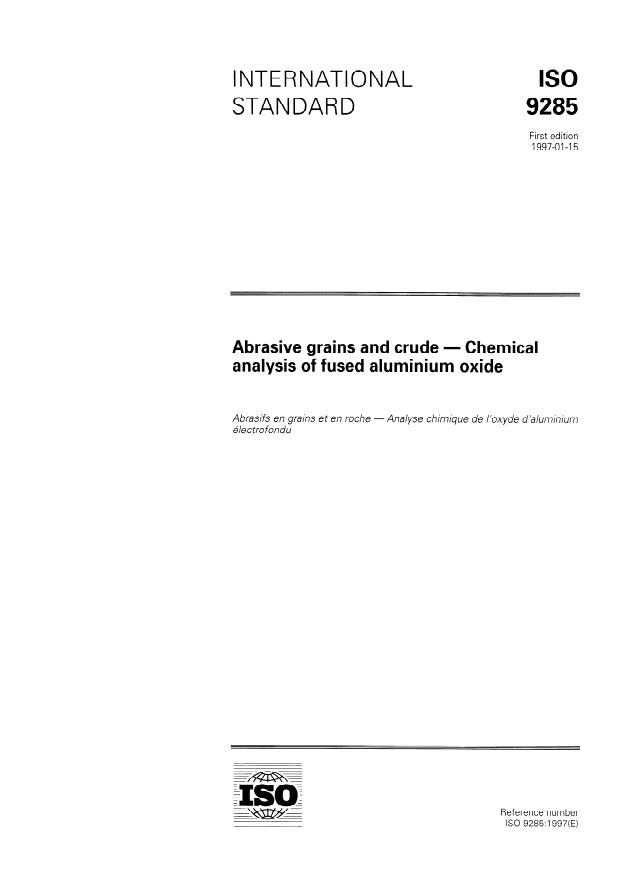
INTERNATIONAL
STANDARD
First edition
1997-01-I 5
Abrasive grains and crude - Chemical
analysis of fused aluminium oxide
- Analyse chimique de I’oxyde d ‘aluminium
Abrasifs en grains et en roche
6lectrofondu
Reference number
IS0 9285: 1997(E)
IS0 9285:1997(E)
Page
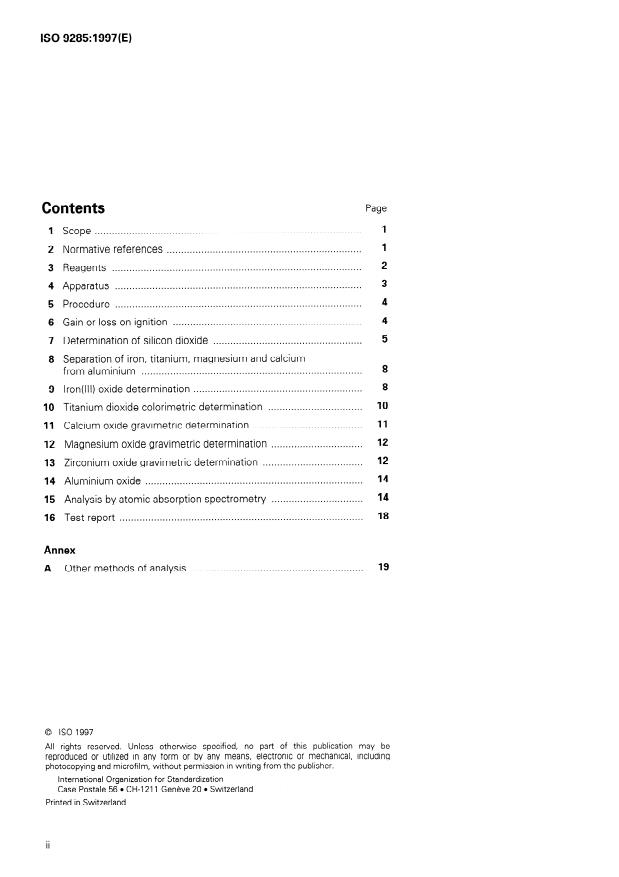
Contents
. . . . . . . . . . . . . . . . . . . . . . . . . . . . . . . . . . . . . . . . . .
1 Scope . . . . . . . . . . . . . . . . . . . . . . . . . . . . . . . . . . . . . . . . . . . . . . . . . . .
. . . . . . . . . . . . . . . . . . . . . . . . . . . . . . . . . . . . . .
2 Normative references . . . . . . . . . . . . . . . . . . . . . . . . . . . . . .
3 Reagents . . . . . . . . . . . . . . . . . . . . . . . . . . . . . . . . . . . . . . . . . . . . . . . . . . . . . . . . . . . . . . . . . . . . . . . . . . . . . . . . . . . . . . .
......................................................................................
4 Apparatus
5 Procedure .
....................... ...........................................
6 Gain or loss on ignition
7 Determination of silicon dioxide .
8 Separation of iron, titanium, magnesium and calcium
. . . . . . . . . . . . . . . . . . . . . . . . . . . . . . . . . . .
from aluminium e.
...........................................................
9 I ron( I I I) oxide determination
.................................
10 Titanium dioxide calorimetric determination
. . . . . . . . . . . . . . . . . . . . . . . . . . . . . . . . . . . . . .
11 Calcium oxide gravimetric determination
. . . . .*.
12 Magnesium oxide gravimetric determination
. . . . . . . . . . . . . . . . . . . . . . . . . . . . . . . . . . .
13 Zirconium oxide gravimetric determination
. . . . . . . . . . . . . . . . . . . . . . . . . . . . . . . . . . . . . . . . . . . . . . . . . . . . . . . . . . . . . . . . . . . . . . . . . . . .
14 Aluminium oxide
. . . . . . . . . . . . . . . . . . . . . . . . . . . . . . . .
15 Analysis by atomic absorption spectrometry
. . . . . . . . . . . . . . . . . . . . . . . . . . . . . . . . . . . . . . . . . . . . . .
16 Test report . . . . . . . . . . . . . . . . . . . . . . . . . . . . . . . . . . . . . . .
Annex
. . . . . . . . . . . . . . . . . . . . . . . . . . . . . . . . . . . . . . . . . . . . . . . . . . . . . . . . . . . . .
A Other methods of analysis
0 IS0 1997
All rights reserved. Unless otherwise specified, no part of this publication may be
reproduced or utilized in any form or by any means, electronic or mechanical, including
photocopying and microfilm, without permission in writing from the publisher.
International Organization for Standardization
Case Postale 56 l CH-1211 Geneve 20 l Switzerland
Printed in Switzerland
II
IS0 9285:1997(E)
@ IS0
Foreword
IS0 (the International Organization for Standardization) is a worldwide
federation of national standards bodies (IS0 member bodies). The work of
preparing International Standards is normally carried out through IS0
technical committees. Each member body interested in a subject for
which a technical committee has been established has the right to be
represented on that committee. International organizations, governmental
and non-governmentai, in liaison with ISO, also take part in the work. IS0
collaborates closely with the International Electrotechnical Commission
(I EC) on all matters of electrotechnical standardization.
Draft International Standards adopted by the technical committees are
circulated to the member bodies for voting. Publication as an International
Standard requires approval by at least 75 % of the member bodies casting
a vote.
International Standard IS0 9285 was prepared by Technical Committee
lSO/TC 29, Small too/s, Subcommittee SC 5, Grinding wheels and
abrasives.
Annex A of this International Standard is for information only.
This page intentionally left blank
IS0 9285:1997(E)
INTERNATIONAL STANDARD @ IS0
Abrasive grains and crude - Chemical analysis of fused aluminium
oxide
1 Scope
This International Standard deals with the chemical analysis of abrasive grains or crude based on fused aluminium
oxide. It applies to commercially available products but not necessarily to products which have been altered by use.
It includes the following determinations:
Loss on ignition
Silicon dioxide
Iron oxide
Titanium dioxide
Calcium oxide
Magnesium oxide
Zirconium oxide
Aluminium oxide
Analysis by atomic absorption spectrometry
2 Normative references
The following standards contain provisions which, through reference in this text, constitute provisions of this
International Standard. At the time of publication the editions indicated were valid. All standards are subject to
revision, and parties to agreements based on this International Standard are encouraged to investigate the
possibility of applying the most recent editions of the standards indicated below. Members of IEC and IS0 maintain
registers of currently valid International Standards.
IS0 6353-l :I 982, Reagents for chemical analysis - Part 1: General test methods.
ISO 6353-Z: 1983, Reagents for chemical analysis - Part 2: Specifications - First series.
IS0 6353-Z/Add.29 986, Addendum 2 to IS0 6353~2:1983.
IS0 6353-3: 1987, Reagents for chemical analysis - Part 3: Specifications - Second series.
IS0 9138: 1993, Abrasive grains - Sampling and splitting.
IS0 9285:1997(E)
3 Reagents
3.1 General
Unless otherwise indicated, it is intended that all reagents shall conform to the specifications given in IS0 6353-l l
IS0 6353-2 and IS0 6353-3. Other grades may be used, provided it be first ascertained that the reagent is’of
sufficiently high purity to permit its use without lessening the accuracy of the determination. Unless otherwise
indicated, references to water shall be understood to mean distilled water.
e reagen ts common lytical procedures. Other reagents will
Paragraphs 3.2 to 3.21 include thos to tw 0 or more ana
be found in the section which deals with the rticular m ethod In w hich they are us ed.
Pa
3.2 Concentrated acids and ammonium hydroxide.
Concentrated acids and ammonium hydroxide having the following approximate volumetric masses p, in grams per
millilitre or concentrations, in percentage by mass will be required:
p = I,18 g/ml
Hydrochloric acid (HCI):
p = I,42 g/ml
Nitric acid (HN03):
Sulphuric acid (H2S04): p = I,84 g/ml
Hydrofluoric acid (HF): 40 % (m/m)
Phosphoric acid (H3P04): 85 % (m/m)
Ammonium hydroxide (NH40H): p = 0,90 g/ml
3.3 Dilute acids and ammonium hydroxide.
The dilute acids and ammonium hydroxide referred to have varying concentrations. They shall be made up by
mixing proportional volumes of the concentrated reagent and water. The dilute sulphuric acid mixtures shall be
made up by slowly adding the acid to the water and stirring continuously. These dilutions are designated in the test
procedures as (1 + 5), (1 + 8), etc., except for the very dilute solutions which are characterized by the percentage
of reagent added. The designations in parentheses indicate the volume of the reagent added to the volume of
water; for example H2S04 (1 + 9) contains 10 % (V/V) of H2SO4 (p = I,84 g/ml).
3.4 Ammonium acetate, 300 g/l solution.
Dissolve 300 g of NH4C2H302 in water. Fill to the 1 l mark with water.
3.5 Ammonium chloride (NH4CI).
3.6 Ammonium oxalate [(NH4)&04], saturated solution.
3.7 Diammonium hydrophosphate, 100 g/l solution.
Dissolve 10 g of (NH4)2HP04 in 100 ml of water.
3.8 Barium diphenylamine sulphonate, 2 g/l solution.
Dissolve 0,5 g of the salt in 250 ml of H2SO4.
3.9 Hydrogen peroxide, 30 g/l solution.
0 IS0 ISO9285:1997(E)
3.10 Hydrogen sulfide gas (t-i&
3.11 Hydroxylamine hydrochloride or hydroxylammonium chloride, 100 g/l solution.
Dissolve 50 g of CINHsOH in 500 ml of water. Filter if necessary.
3.12 Mercuric chloride (HgClz), saturated solution.
3.13 Methyl red indicator, 1 g/l solution.
Dissolve 0,l g methyl red in 100 ml of methanol.
3.14 o-Phenanthroline [l,lQ-phenanthroline), 7 g/l solution.
Dissolve l g ephenanthroline monohydrate in 15 ml of ethanol (95 %). Dilute to 1 I with water.
3.15 Potassium dichromate (K$r207), 0,Ol mol/l solution.
I
Dissolve 2,942 4 g of K2Cr207 in water. Make up the solution to the 1 I mark of a volumetric f ask. Standardize the
solution against a sample with a certified iron content.
3.16 Potassium permanganate (KMnO,& standardized solution, c (l/5 KMn04) = 0,Ol mol/l.
Dissolve 1,580 0 g of KMn04 in 500 ml of water. Allow to stand for 1 d-2 d. Filter through an asbestos mat and
dilute to the 1 1 mark of a volumetric flask with water. Standardize against sodium oxalate.
3.17 Potassium permanganate (KMnOa), 50 g/l solution.
Dissolve 5 g KMn04 in 100 ml of water.
3.18 Potassium pyrosulfate (K&07).
3.19 Anhydrous sodium carbonate (NazC03).
3.20 Sodium tetraborate (Na2B407).
3.21 Stannous chloride (SnClz), 50 g/l solution.
Dissolve 50 g of SnCl2 in 100 ml of HCI. Make up to the 1 I mark of a volumetric flask with water. Store the solution
with metallic tin in the bottle.
4 Apparatus
4.1 Small jaw or roll crusher with hardened steel faces.
4.2 Tool steel mortar.
In situations where it is vital that iron contamination be eliminated, the crushing should be carried out in a tungsten
carbide mortar.
4.3 Sieve, with mesh of 150 pm aperture size.
IS0 9285:1997(E)
4.4 Sieve, with 2 mm aperture size.
4.5 Platinum crucible, weighed, 30 ml, with lid.
5 Procedure
5.1 Preparation of samples for analysis
5.1 .I Abrasive crude
The sample, carefully obtained by means of an approved sampling method, is crushed in a small jaw or roll type
crusher with hardened steel faces until it can be passed through a sieve having a mesh size of 2 mm; it is then
mixed and divided by coning and quartering until approximately 500 g are obtained. The 500 g sample is in turn
mixed and divided by coning and quartering until a sample weighing between 10 g and 20 g is obtained. ‘This 20 g
sample is then pulverized in a tool steel mortar until, unless otherwise specified, it completely passes through a
sieve having a mesh size of 150 pm; it is then mixed thoroughly and placed in a container which will ensure
freedom from contamination.
Precautions shall be taken in order to prevent the sample being contaminated by steel particles from the sampling
and crushing equipment. Magnetic separation of the sample shall be carried out in order to remove this iron
contamination.
5.1.2 Abrasive grain
The sample, carefully obtained by one of the approved methods, is thoroughly mixed and divided by coning and
quartering until 10 g to 20 g are obtained. It is then crushed until, unless otherwise specified, it completely passes
through a sieve having a mesh size of 150 pm; it is then carefully mixed and placed in a container which will ensure
freedom from contamination (see IS0 9138).
5.2 Blank determination
Blank determination on the reagents shall be made for each determination and the necessary corrections applied in
each case.
6 Gain or loss on ignition
6.1 Procedure
Weigh a 1 g sample to within 0,000 1 g and place it in a weighed platinum crucible which has been previously
heated to 1 100 OC. Record the mass of the sample and the crucible. Heat the crucible plus sample at 1 100 “C until
a constant mass is obtained. Cool the crucible in a desiccator and weigh the crucible plus sample.
6.2 Expression of results
Loss on ignition, expressed as a percentage, is given by the formula
ml - m2
( >
x100
m0
where
is the mass of the crucible plus sample before ignition, in grams;
ml
0 IS0 IS0 9285:1997(E)
m2 is the mass of crucible plus sample after ignition, in grams;
mo is the mass of sample, in grams.
NOTE- If the sample gains in mass, report as a gain, and use tRe formula:
cm2 - ml) x loo
"0
7 Determination of silicon dioxide
7.1 Gravimetric method
7.1.1 Apparatus
7.1 .I .I Platinium crucible, with lid.
7.1.1.2 Beaker, 400 ml.
7.1.1.3 Filter paper, medium grade.
7.1 .I .4 Desiccator.
7.1.2 Procedure
Weigh a 1 g sample to within 0,000 1 g and place in a platinum crucible containing 3 g of Na2COs and 3 g of
Na2BdOT. Mix the sample and fuse mixture thoroughly. Cover the crucible with a platinum lid and fuse the mixture
at 1 000 “C until the entire sample is in solution. Rotate the crucible during cooling to deposit the melt in a thin layer
on the side of the crucible. Place crucible and lid in a 400 ml beaker.
Dissolve the fusion in 100 ml of H2S04 (I + 4). When fully dissolved, thoroughly wash crucible and lid, adding
washes to main solution.
Carefully evaporate the solution to fumes of SO3 and leave to cool. Add 100 ml of water and boil to dissolve salts.
Filter using a medium grade ashless filter paper. Wash the paper and precipitate with hot H2S04 (2 + 98). Retain
the filtrate for the Fe203, Ti02, CaO and MgO determinations. Transfer the filter paper to a platinum crucible and
char at low heat. When fully charred ignite at 1 000 “C. Leave the crucible to cool in a desiccator and weigh to
constant mass.
Moisten the solid mass with 1 or 2 drops of water, add 10 ml of HF acid and 2 or 3 drops of H2S04 (1 + 1). Slowly
evaporate to dryness then ignite at 1 000 “C. Cool the crucible in a desiccator and weigh to constant mass.
Evaluate the loss in mass due to HF, H2S04 treatment.
7.1.3 Expression of results
Silicon dioxide content, expressed as a percentage by mass, is given by the equation
w(Si02)=Tx 100
m0
where
ml is the mass loss due to the HF, H2S04 treatment, in grams;
mg is the mass of the sample, in grams.
IS0 9285:1997(E)
7.2 Calorimetric method
7.2.1 Reagents
7.2.1 .I Molybdic acid solution.
Dissolve 100 g of ammonium moiybdate [82 % (m/m) of Moo31 in approximately 600 ml of water. Add 70 ml of
H2S04 (p = I,84 g/ml). Filter the solution. Dilute to 1 I with water in a volumetric flask.
7.2.1.2 Reducing solution.
Dissolve 25 g of sodium hydrogen sulphite (NaHSO$ in 25 ml of water. Dissolve 2 g of sodium sulphite (Na2S03)
and 0,4 g of I-amino-2-naphthol-4-sulphonic acid in 25 ml of water.
ric flask. Note that this solution has a maximum
Mix the two solutions a nd dilute to 250 ml with water in a vol umet
shelf life of two weeks.
7.2.1.3 Silicon dioxide, standard solution corresponding to 0,l mg SiO2 per millilitre.
Melt 0,100 g of anhydrous SiO2 and 1 g of Na&Os in a platinum crucible. Cool the molten mass. Dissolve in water
and make up to 1 000 ml in a volumetric flask. Transfer to a polyethylene bottle.
7.2.1.4 Tartaric acid, 100 g/l solution.
Dissolve 100 g of tartaric acid in water. Dilute to 1 000 ml in a volumetric flask.
Salts
7.2.1.5 Fusion mixture, comprising 3 parts Na2C03 or 1 part B203. (Boric oxide is the preferred reagent.
containing boron have varying amounts of SiO2 giving high and frequently inconststent blank values.)
7.2.1.6 Hydrofluoric acid, 2 % (V/V) solution (for cleaning PTFE).
7.2.2 Apparatus
7.2.2.1 Platinum crucible.
7.2.2.2 PTFE beaker, 250 ml.
7.2.2.3 Magnetic stirrer.
7.2.2.4 PTFE stirring bar
7.2.2.5 pH-meter.
7.2.2.6 Volumetric flask, 100 ml.
7.2.2.7 Spectrophotometer.
7.2.3 Procedure
7.2.3.1 Sample size and dilutions
Use the table 1 to determine appropriate sample test portions and dilution.
7.2.3.2 Preparation of test solution
Weigh 5 g of fusion mixture into a 30 ml platinum crucible then weigh the appropriate size sample (see 7.2.3.1) into
the crucible and cover with an additional 5 g of fusion mixture. Melt over a burner using platinum or nichrome
triangles. Cool the melt to room temperature. Wash the outside of the crucible with water. Place the crucible in a
@ IS0
IS0 9285:1997(E)
250 ml PTFE beaker and add enough water to cover the crucible. Bring to the boil until the melt is dissolved. Cool
to room temperature and dilute to approximately 175 ml to 200 ml. Place the PTFE stirring bar in the beaker and
place on a magnetic stirrer.
Using a pH-meter, adjust very carefully the pH of the solution to I,8 using H2SO4 (1 + 1). (Do not allow pH to go
below I ,8.)
If pH goes below I,8 polymerization of the silicic acid starts to take place and polymerized siiicic acid will not react
to form silicomoiybdic acid capable of being reduced to form the proper colour.
Transfer the solution to a volumetric flask (see 7.2.3.1 for flask size), dilute to the mark with water and mix.
Pipette an appropriate aliquot (see 7.2.3.1) into a 100 ml volumetric flask to which is added in the following order:
1) 2 ml of freshly prepared molybdic acid solution (see 7.2.1 .I). Mix and allow to stand for 7 min;
2) 10 ml of tartaric acid solution (see 7.2.1.4);
3) 2 ml of reducing solution (see 7.2.1.2). Mix and allow to stand for 30 min.
Read absorbance at a wavelength of 700 nm, using 1 cm cells (for best accuracy, absorbance shall be in the range
of 0,2 to 0,6).
Table I
Assumed SiO;! content Mass of test portion Dilution
Dilution factor
% d
g
0,l to 0,5 1 250 ml - 25 ml 10
0,5 to 2,0 015 250ml-IOml 25
1 ,o to 5,0 02 250ml-IOml 25
3,0 to IO,0 a1 250ml-IOml 25
lOto 500ml-IOml 50
OrI
15to40 011 250 ml - 25 ml 10
250 ml - 2,5 ml 100
7.2.3.3 Preparation of calibration curve
Prepare a series of standard solutions to cover the expected range of silicon dioxide concentrations. Determine the
absorbance of the solutions as described for the sample in 7.2.3.2. Prepare a calibration curve by plotting the
absorbance values for the standard solutions against the concentration of SiO2, in grams, per 100 ml of solution.
7.2.4 Expression of results
Silica content, expressed as a percentage by mass is given by the equation
mlXd
xl00
w(Si02)=-
mO
where
is the dilution factor (see 7.2.3.1);
d
ml is the mass, in grams, of silicon dioxide per 100 ml of sample solution as found by interpolation from the
calibration curve;
rng is the mass of the sample, in grams.
@ IS0
IS0 9285:1997(E)
8 Separation of iron, titanium, magnesium and calcium from aluminium
Evaporate the filtrate obtained from the gravimetric SiO2 determination (see 7.1) or an aliquot of the solution from
the calorimetric SiO2 determination (see 7.2) until 150 ml to 200 ml of the solution is obtained. Adjust the acidity of
the solution to nearly neutral with NaOH (550 g/l).
Add NaOH (550 g/l) dropwise until the precipitate just completely dissolves. Transfer the solution into a beaker
containing 150 ml of cold NaOH (150 g/l) and 1 g of Na2COz. Heat the solution and allow it to digest for one hour.
Cool the solution. Filter the precipitate using a medium grade filter paper which has been treated with NaOH
solution (150 g/l).
Wash with Na2COs (IO g/l). Dissolve the precipitate through the paper with 25 ml of hot HCI (1 + 9). Wash the
paper with hot HCI (2 + 98). Dilute approximately 150 ml. Add 5 ml of Hz02 [3 % (V/v)]. Bring the solution to the
boil. Add 1 g of ammonium chloride (NH&I) and 3 drops of methyl red indicator solution. Add NH40H (1 + 1)
dropwise until a persistent yellow colour is produced. Then add approximately 10 extra drops in excess. Bring the
solution to the boil. Allow the solution to stand for one minute. Filter using a medium grade paper. Wash the paper
and the precipitate with a hot ammonium chloride solution (NH&I at 20 g/l) which has been made alkaline with
NH40H.
Return the precipitate and the paper to the original beaker. Add 100 ml HCI (1 + 9). Stir until the precipitate has
dissolved and the paper is completely macerated. Dilute to approximately 200 ml with water. Bring the solution to
the boil.
Repeat both the precipitation with NH40H and the filtration. Combine the filtrates from the two precipitations and
retain them for the CaO and MgO determinations. Dissolve the precipitate in 50 ml of H2SO4 (1 + 4). Transfer the
solution to a 100 ml volumetric flask. Bring up to the mark with water.
9 Iron(M) oxide determination
9.1 Volumetric method
9.1.1 Apparatus
9.1.1.1 Filter paper, medium grade.
9.1.1.2 Beaker, 250 ml.
9.1.2 Procedure
Transfer a 50 ml aliquot of the mixed oxide solution prepared in 7.1.2 and treated as in clause 8 to a 250 ml beaker.
Add 5 ml of HCI. Dilute to approximately 150 ml. Bring the solution to the boil and remove from heat. Pass a rapid
stream of hydrogen sulphide (H2S) through the solution for 30 min. Filter the solution through a medium grade
paper. Wash the paper with HCI [I % (V/V)] which has been previously saturated with H2S. Evaporate the filtrate to
approximately 100 ml. Add 10 ml of Hz02 [3 % (V/V)]. Boil the solution to remove excess H202. Add 10 ml HCI.
Oxidize the solution by adding KMn04 solution
...
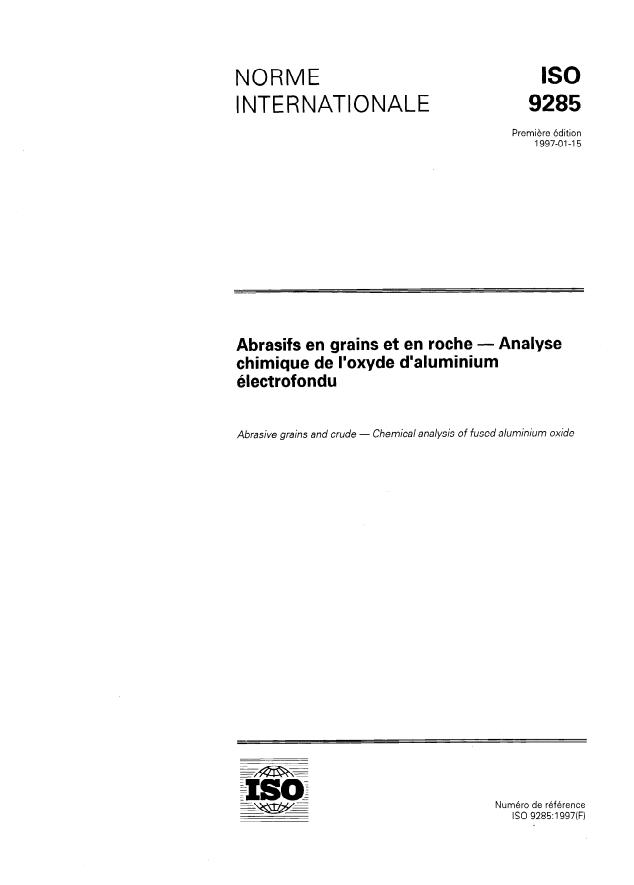
NORME
ISO
INTERNATIONALE
Première édition
1997-01-I 5
Abrasifs en grains et en roche - Analyse
chimique de l’oxyde d’aluminium
électrofondu
Chemical analysis of fused aluminium oxide
Abrasive grains and crude -
Numéro de référence
ISO 92859 997(F)
Page
Sommaire
...................................................................
1 Domaine d’application
.................................................................
2 Références normatives
3 Réactifs .
...................................................................................
4 Appareillage
5 Mode opératoire .
. . . . . . . . . . . . . . . . . . . . . . . . . . . . . . . . . . . . . . . . . . . . . . . . . . . . . . . . . . . . . . . . . . . . . .
6 Gain ou perte au feu
7 Dosage du dioxyde de silicium . . . . . . . . . . . . . . . . . . . . . . . . . . . . . . . . . . . . . . . . . . . . . . . . . . . . . .
8 Séparation du fer, du titane, du magnésium et du calcium,
de l’aluminium . . . . . . . . . . . . . . . . . . . . . . . . . . . . . . . . . . . . . . . . . . . . . . . . . . . . . . . . . . . . . . . . . . . . . . . . . . . . . . .
..........................................................
9 Dosage de l’oxyde de fer-(1 II)
.................................
Dosage calorimétrique du dioxyde de titane
II
. . . . . . . . . . . . . . . . . . . . . . . . . . . . . . . .
11 Dosage gravimétrique de l’oxyde de calcium
Dosage gravimétrique de l’oxyde de magnésium . . . . . . . . . . . . . . . . . . . . . . . . .
. . . . . . . . . . . . . . . . . . . . . . . . . . . .
13 Dosage gravimétrique de l’oxyde de zirconium
Oxyde d’aluminium . . . . . . . . . . . . . . . . . . . . . . . . . . . . . . . . . . . . . . . . . . . . . . . . . . . . . . . . . . . . . . . . . . . . . . . .
. . . . . . . . . . . . . . . . . . . . . . . . 15
15 Analyse par spectrométrie d’absorption atomique
. . . . . . . . . . . . . . . . . . . . . . . . . . . . . . . . . . . . . . . . . . . . . . . . . . . . . . . . . . . . . .*.
16 Rapport d’essai
Annexe
A Autres méthodes d’analyse . . . . . . . . . . . . .*.
0 ISO 1997
Droits de reproduction réservés. Sauf prescription différente, aucune partie de cette publi-
cation ne peut être reproduite ni utilisée sous quelque forme que ce soit et par aucun pro-
cédé, électronique ou mécanique, y compris la photocopie et les microfilms, sans l’accord
écrit de l’éditeur.
Organisation internationale de normalisation
Case postale 56 l CH-121 1 Genève 20 l Suisse
Imprimé en Suisse
II
@ ISO ISO 9285:1997(F)
Avant-propos
L’ISO (Organisation internationale de normalisation) est une fédération
mondiale d’organismes nationaux de normalisation (comités membres de
I’ISO). L’élaboration des Normes internationales est en général confiée aux
comités techniques de I’ISO. Chaque comité membre intéressé par une
étude a le droit de faire partie du comité technique créé à cet effet. Les
organisations internationales, gouvernementales et non gouvernemen-
tales, en liaison avec I’ISO participent également aux travaux. L’ISO colla-
bore étroitement avec la Commission électrotechnique internationale (CEI)
en ce qui concerne la normalisation électrotechnique.
Les projets de Normes internationales adoptés par les comités techniques
sont soumis aux comités membres pour vote. Leur publication comme
Normes internationales requiert l’approbation de 75 % au moins des co-
mités membres votants.
La Norme internationale ISO 9285 a été élaborée par le comité technique
ISO/TC 29, Petit outillage, sous-comité SC 5, Meules et abrasifs.
L’annexe A de la présente Norme internationale est donnée uniquement à
titre d’information.
Page blanche
NORME INTERNATIONALE @ ISO ISO 9285:1997(F)
Abrasifs en grains et en roche - Analyse chimique de l’oxyde
d’aluminium électrofondu
1 Domaine d’application
La présente Norme internationale traite de l’analyse chimique des abrasifs en grains ou en roche à base d’oxyde
d’aluminium électrofondu. Elle est applicable aux produits vendus dans le commerce mais pas nécessairement aux
produits altérés par l’usage.
Elle comprend les déterminations suivantes:
- Perte au feu
- Dioxyde de silicium
- Oxyde de fer
- Dioxyde de titane
- Oxyde de calcium
- Oxyde de magnésium
- Oxyde de zirconium
- Oxyde d’aluminium
- Analyse par spectrométrie d’absorption atomique
2 Références normatives
Les normes suivantes contiennent des dispositions qui, par suite de la référence qui en est faite, constituent des
dispositions valables pour la présente Norme internationale. Au moment de la publication, les éditions indiquées
étaient en vigueur. Toute norme est sujette à révision et les parties prenantes des accords fondés sur la présente
Norme internationale sont invitées à rechercher la possibilité d’appliquer les éditions les plus récentes des normes
indiquées ci-après. Les membres de la CEI et de I’ISO possèdent le registre des Normes internationales en vigueur
à un moment donné.
ISO 6353-l : 1982, Réactifs pour analyse chimique - Partie 7: Méthodes générales d’essai.
ISO 6353-2:1983, Réactifs pour analyse chimique - Partie 2: Spécifications - Première série.
ISO 6353-2/Add.2:1986, Additif 2 à I’ISO 6353~2:1983.
ISO 6353-3: 1987, Réactifs pour analyse chimique - Partie 3: Spécifications - Deuxième série.
ISO 9138: 1993, Grains abrasifs - Échantillonnage et division.
ISO9285:1997(F)
3 Réactifs
3.1 Généralités
Sauf spécification contraire, il est prévu que tous les réactifs correspondent aux spécifications indiquées dans
I’ISO 6353-‘9, I’ISO 6353-2 et I’ISO 6353-3. D’autres qualités peuvent être utilisées s’il peut être démontré au
préalable que le réactif est de pureté suffisante pour être utilisé sans amoindrir la précision de dosage. Sauf
indication contraire, toute référence à l’eau sous-entend eau ((distillée)).
ou plusieurs modes opératoires. Les autres
Les paragraphes 3.2 à 3.21 reprennent les réactifs communs à deux
réactifs sont indiqués dans les articles relatifs à la méthode particulière qui les emploie.
3.2 Acides et hydroxyde d’ammonium concentrés.
cides et h ydroxyde d’ammonium concent rés doive nt avoir ap roximativement le s masses volumiques
Les a requis
P
grammes par millilitre, ou concentrations, en pource ntage en masse, i ndiquées ci-après:
p, en
Acide chlorhydrique (HCI): p= 1,18g/ml
Acide nitrique (HNO$: p = 1,42 g/ml
Acide sulfurique (H2S04): p = 1,84 g/ml
Acide fluorhydrique (HF): 40 % (m/m)
Acide phosphorique (H3P04): 85 % (m/m)
Hydroxyde d’ammonium (NHbOH): p = 0,90 g/ml
3.3 Acides et hydroxyde d’ammonium dilués.
Les acides et hydroxyde d’ammonium considérés ont des concentrations variables en volume. Ils sont obtenus par
mélange, en proportions données, de volumes de réactif concentré et d’eau. Les mélanges dilués à base d’acide
sulfurique doivent être obtenus par addition d’acide dans l’eau, lentement et sans cesser de remuer. Ces dilutions
sont désignées dans les modes opératoires sous la forme: (1 + 5), (1 + 8) etc., sauf pour les solutions très diluées
qui sont caractérisées par le pourcentage de réactif ajoute. Les chiffres entre parenthèses indiquent le volume de
réactif ajouté au volume d’eau. Ainsi, H2S04 (1 + 9) contient 10 % (V/V) de H2S04 (p = 1,84 g/ml).
3.4 Acétate d’ammonium, solution à 300 g/l.
Mettre en solution 300 g de NH&H302 dans de l’eau. Amener à l l avec de l’eau.
3.5 Chlorure d’ammonium (NHJI).
3.6 Oxalate d’ammonium [(NH&C2041, solution saturée.
3.7 Monohydrogénophosphate d’ammonium, solution à 100 g/l.
Mettre en solution 10 g de (NH&HPOd dans 100 ml d’eau.
3.8 Diphénylamine-sulfonate de baryum, solution à 2 g/l.
Mettre en solution 0,5 g de sel dans 250 ml de H2SOd.
3.9 Peroxyde d’hydrogène, solution à 30 g/l.
3.10 Sulfure d’hydrogène (HZ~).
@ ISO ISO 9285:1997(F)
3.11 Chlorhydrate d’hydroxylamine ou chlorure d’hydroxylammonium, solution à 100 g/l.
Mettre en solution 50 g de CINH30H dans 500 ml d’eau. Filtrer si nécessaire.
3.12 Chlorure de mercure(H) (HgClz), solution saturée.
3.13 Indicateur au rouge de méthyle, solution à 1 g/l.
Mettre en solution 0,l g de rouge de méthyle dans 100 ml de méthanol.
3.14 Phénanthroline-l,lO, solution à 1 g/l.
Mettre en solution 1 g de monohydrate de phénanthroline-1 ,lO dans 15 ml d’éthanol à 95 %. Amener à 1 I avec
de l’eau.
3.15 Dichromate de potassium (KzCr207), solution à 0,Ol mol/l.
Mettre en solution 2,942 4 g de K&O7 dans de l’eau. Amener la solution à 1 1. Déterminer le titre de la solution
par rapport à un échantillon à teneur en fer certifiee.
3.16 Permanganate de potassium (KMnOd), solution titrée, c (1/5 KMn04) = 0,Ol mol/l.
Mettre en solution 1,580 0 g de KMnOJ dans 500 ml d’eau. Laisser reposer 1 jour ou 2 jours. Filtrer sur un tampon
d’amiante et amener à 1 I avec de l’eau. Titrer la solution par I’oxalate de sodium.
3.17 Permanganate de potassium (KMnOa), solution à 50 g/l.
Mettre en solution 5 g de KMn04 dans 100 ml d’eau.
3.18 Pyrolsulfate de potassium (K&07).
3.19 Carbonate de sodium anhydre (Na2C03).
3.20 Tétraborate de sodium (Na2B407).
3.21 Chlorure d’étain(H) (SnClz), solution à 50 g/l.
Mettre en solution 50 g de SnCl2 dans 100 ml de HCI. Amener à 1 I avec de l’eau. Conserver cette solution dans un
flacon. Additionner de l’étain métallique dans le flacon.
4 Appareillage
4.1 Petit broyeur à mâchoires ou à cylindres en acier trempé.
4.2 Mortier en acier à outils.
Dans les cas nécessitant l’élimination du fer, effectuer le broyage dans un mortier en carbure de tungstène.
4.3 Tamis, d’ouverture de maille de 150 prn.
4.4 Tamis, d’ouverture de maille de 2 mm.
@ ISO
4.5 Creuset en platine, taré, de 30 ml muni d’un couvercle.
5 Mode opératoire
5.1 Préparation des échantillons pour analyse
5.1 .l Abrasif en roche
L’échantillon, prélevé avec soin par une méthode d’échantillonnage agréée, est broyé dans un petit broyeur à
mâchoires ou a cylindres en acier trempé jusqu’à pouvoir passer au travers d’un tamis d’ouverture de maille de
2 mm; il est ensuite homogénéisé et divisé par quartation jusqu’à obtenir environ 500 g. L’échantillon de 500 g est
à son tour homogénéisé puis divisé par quartation jusqu’à peser 10 g à 20 g. Cet échantillon de 20 g est alors
pulvérisé dans un mortier en acier à outils jusqu’à pouvoir passer, sauf spécification contraire, au travers d’un tamis
d’ouverture de maille de 150 prn; il est ensuite homogénéisé soigneusement et placé dans un récipient qui le
préservera de toute contamination.
Des précautions doivent être prises pour éviter la contamination de l’échantillon par les particules d’acier provenant
du matériel d’échantillonnage et de broyage. Une séparation magnétique doit être effectuée pour éliminer cette
contamination par le fer.
5.1.2 Abrasifs en grains
L’échantillon, recueilli avec soin par l’une des méthodes agréées, est homogénéisé puis divisé par quartation
jusqu’à obtenir 10 g a 20 g. II est ensuite broyé de manière à passer, sauf spécification contraire, au travers d’un
tamis d’ouverture de maille de 150 prn, homogénéisé soigneusement et placé dans un récipient qui le préservera
de toute contamination (voir ISO 9138).
5.2 Essai à blanc
Des essais à blanc avec les réactifs doivent être faits pour chaque détermination. Ils permettent dans chaque cas
d’effectuer les corrections nécessaires.
6 Gain ou perte au feu
6.1 Mode opératoire
Peser un échantillon de 1 g à 0,000 1 g près et le placer dans un creuset en platine, taré, de 30 ml préalablement
calciné à 1 100 OC. Enregistrer la masse de l’échantillon et du creuset. Calciner le creuset contenant l’échantillon à
1 100 “C jusqu’à masse constante. Laisser refroidir le creuset dans un dessiccateur. Peser.
6.2 Expression des résultats
La perte au feu, exprimée en pourcentage, est donnée par la formule
( ml - m2> )( 100
mg
où
ml est la masse du creuset contenant l’échantillon avant calcination, en grammes;
m2 est la masse du creuset contenant l’échantillon après calcination, en grammes;
mg est la masse de l’échantillon, en grammes.
@ ISO
NOTE - Si la masse de l’échantillon a augmenté, indiquer qu’il s’agit d’un gain et utiliser la formule
tm2 - ml> x loo
mg
7 Dosage du dioxyde de silicium
7.1 Méthode gravimétrique
7.1 .l Appareillage
7.1.1.11 Creuset en platine, muni d’un couvercle.
7.1.1.2 Becher, de 400 ml.
7.1 .1.3 Papier filtre, de rapidité moyenne.
7.1 .1.4 Dessiccateur.
7.1.2 Mode opératoire
Peser un échantillon de 1 g à 0,000 1 g près et le placer dans un creuset en platine. Ajouter dans le creuset 3 g de
Na2C03 et 3 g de Na2B407. Homogénéiser soigneusement l’échantillon et le faire fondre complètement. Recouvrir
le creuset à l’aide d’un couvercle de platine, faire fondre le mélange à 1 000 “C jusqu’à mise en solution complète
de l’échantillon. Faire osciller le creuset pendant le refroidissement de manière à obtenir une couche mince de
masse fondue sur les parois. Placer le creuset et le couvercle dans un becher de 400 ml.
Mettre en solution la masse fondue dans 100 ml de H$O4 (1 + 4). Après dissolution complète, rincer
soigneusement le creuset et le couvercle et ajouter la solution de rinçage dans le becher.
Faire évaporer la solution jusqu’à dégagement de SO3. Faire refroidir le becher. Ajouter 100 ml d’eau et porter à
ébullition jusqu’à dissolution des sels. Filtrer sur un papier filtre sans cendre de rapidité moyenne. Laver la papier et
le précipité avec H2S04 chaud (2 + 98). Conserver le filtre pour les dosages du FezOs, Ti02, Ca0 et Mgo.
Transférer le papier dans un creuset en platine. Calciner à 1 000 “C jusqu’à masse constante. Laisser refroidir le
creuset dans un dessiccateur et peser.
Humidifier la masse solide avec une ou deux gouttes d’eau, ajouter 10 ml de HF et 2 ou 3 gouttes de H$O4
(1 + 1). Faire évaporer jusqu’à siccité. Calciner à 1 000 “C jusqu’à masse constante. Refroidir dans un dessiccateur
et évaluer la perte de masse due au traitement à HF, H2S04.
7.1.3 Expression des résultats
La teneur en dioxyde de silicium, exprimée en pourcentage en masse, est donnée par l’équation
w(Si02)=mlx 100
mg
où
ml est la perte de masse au traitement à HF, H2S04, en grammes;
mg est la masse de l’échantillon, en grammes.
@ ISO
7.2 Méthode calorimétrique
7.2.1 Réactifs
7.2.1 .l Solution d’acide molybdique.
Mettre en solution 100 g de molybdate d’ammonium [à 82 % (m/m) de Mo031 dans environ 600 ml d’eau. Ajouter
70 ml de H2S04 (p = 1,84 g/ml). Filtrer la solution. Diluer à 1 I avec de l’eau.
7.2.1.2 Solution réductrice.
Faire une solution avec 25 g d’hydrogénosulfite de sodium (NaHS03) dans 25 ml d’eau puis une autre solution avec
2 g de sulfite de sodium (Na2S03) et 0,4 g d’acide amino-l hydroxy-2 naphtalènesulfonique-4 dans 25 ml d’eau.
Mélanger les deux solutions et diluer à 250 ml avec de l’eau. Noter que cette solution présente une durée
maximale de conservation de deux semaines.
7.2.1.3 Dioxyde de silicium, solution témoin correspondant à 0,l mg Si02 par millilitre.
Faire fondre 0,100 g de Si02 anhydre et 1 g de Na2C03 dans un creuset en platine. Faire refroidir la masse fondue.
Mettre en solution dans l’eau et ajuster à 1 000 ml dans une fiole jaugée. Transvaser dans un flacon en
polyéthylène.
7.2.1.4 Acide tartrique, solution à 100 g/l.
Mettre en solution 100 g d’acide tartrique dans de l’eau. Diluer à 1 000 ml dans une fiole jaugée.
7.2.1.5 Fondant, constitué de 3 parties de Na2C03 ou 1 partie de B2O3 (le trioxyde de bore est le réactif préféré.
Les sels de bore contiennent des quantités variables de Si02 donnant des valeurs à blanc élevées et peu
reproductibles).
7.2.1.6 Acide fluorhydrique, solution à 2 % (V/V) (pour nettoyage PTFE).
7.2.2 Appareillage
7.2.2.1 Creuset en platine.
7.2.2.2 Becher en PTFE, de 250 ml.
7.2.2.3 Agitateur magnétique.
7.2.2.4 Barreau magnétique enrobé de PTFE.
7.2.2.5 pH-mètre.
7.2.2.6 Fiole jaugée, de 100 ml.
7.2.2.7 Spectrophotomètre.
7.2.3 Mode opératoire
7.2.3.1 Prise d’essai
À l’aide du tableau 1, déterminer les prise d’essai et les dilutions appropriées:
0 ISO
Tableau 1
250ml-IOml
250ml-IOml
250ml40ml
500ml-IOml
250 ml - 25 ml
250 ml - 2,5 ml
7.2.3.2 Préparation de la solution de dosage
Dans un creuset en platine de 30 ml, peser 5 g de fondant puis la quantité convenable d’échantillon (voir 7.2.3.1) et
recouvrir de 5 g supplémentaires de fondant. Faire fondre au-dessus de la flamme en utilisant des triangles en
platine ou en nichrome. Faire refroidir la masse fondue à température ambiante. Rincer à l’eau l’extérieur du
creuset. Placer le creuset dans un becher en PTFE de 250 ml et ajouter l’eau nécessaire pour recouvrir le creuset.
Porter à ébullition jusqu’à mise en solution de la masse fondue. Faire refroidir à température ambiante et diluer à
environ 175 ml à 200 ml. Placer un barreau magnétique enrobé de PTFE dans le becher et mettre le tout sur un
agitateur magnétique.
À l’aide d’un pH-mètre, ajuster très soigneusement le pH de la solution à 1,8 avec H2S04 (1 + 1). (Ne pas laisser le
pH descendre au-dessous de 1,8.)
Si le pH descend au-dessous de 1,8, un début de polymérisation de l’acide silicique a lieu et l’acide silicique
polymérisé ne réagira pas pour donner un acide silicomolybdique réductible et donnant la couleur appropriée.
Transvaser la solution dans une fiole jaugée (voir 7.2.3.1), ajuster au volume et homogénéiser.
Prélever à la pipette une partie aliquote appropriée (voir 7.2.3.1) et la verser dans une fiole jaugée de 100 ml dans
laquelle on ajoute, dans l’ordre suivant:
1) 2 ml de solution d’acide molybdique (voir 7.2.1 .l) fraîchement préparée. Homogénéiser et laisser reposer
7 min.;
2) 10 ml de solution d’acide tartrique (voir 7.2.1.4);
3) 2 ml de solution réductrice (voir 7.2.1.2). Homogénéiser et laisser reposer 30 min.
Relever I’absorbance à 700 nm, en utilisant une cuve d’épaisseur 1 cm (pour une précision optimale, I’absorbance
doit se situer entre 0,2 et 0,6).
7.2.3.3 Établissement de la courbe d’étalonnage
Préparer une série de solutions étalons couvrant la gamme probable des concentrations en dioxyde de silicium.
Déterminer I’absorbance des solutions de la manière décrite pour la solution étalon en 7.2.3.2. Établir une courbe
d’étalonnage, en portant les valeurs d’absorbance des solutions étalons en fonction des quantités, en grammes, de
Si02 par 100 ml de solution.
7.2.4 Expression des résultats
La teneur en dioxyde de silicium, exprimée en pourcentage en masse, est donnée par l’équation
m+d
w(SiO2)=- x100
mO
où
@ ISO
ml est la masse, en grammes, de dioxyde de silicium pour 100 ml de solution échantillon déterminée par
interpolation sur la courbe d’étalonnage;
est le coefficient de dilution (voir 7.2.3.1);
d
mg est la masse de l’échantillon, en grammes.
8 Séparation du fer, du titane, du magnésium et du calcium, de l’aluminium
Faire évaporer le filtrat obtenu lors du dosage gravimétrique de Si02 (voir 7.1) ou une partie aliquote de 250 ml de la
solution de dosage calorimétrique de Si02 (voir 7.2) jusqu’à obtenir 150 ml à 200 ml de solution. Ajuster l’acidité de
la solution à une valeur quasi neutre à l’aide de NaOH (550 g/l).
Ajouter du NaOH (550 g/l) goutte à goutte jusqu’à exacte mise en solution du précipité. Transvaser la solution dans
un becher contenant 150 ml de NaOH (150 g/l) froid et 1 g de Na2C03. Faire chauffer la solution et laisser digérer
h. Faire refroidir la SO
ndant 1 ution. Filtrer le précipité sur un papier de rapidité moyenne traité avec une solution
Pe
de NaOH (150 g/l).
Laver avec du Na2C03 (10 g/l). Dissoudre le précipité à travers le papier filtre avec 25 ml de HCI (1 + 9) chaud.
Laver le papier avec du HCI (2 4 98) chaud. Diluer à environ 150 ml. Ajouter 5 ml de Hz02 [3 % (V/V)]. Faire bouillir
la solution. Ajouter 1 g de chlorure d’ammonium (NHJI) et 3 gouttes de solution d’indicateur au rouge de méthyle.
Ajouter du NH40H (1 + 1) goutte à goutte jusqu’à apparition d’une couleur jaune persistante. Ajouter environ 10
gouttes en excès. Porter la solution a ébullition. Laisser la solution reposer 1 min. Filtrer sur un papier de filtration
moyenne. Laver le papier et le précipité avec une solution de chlorure d’ammonium chaude (NH&1 à 20 g/l) et
rendue alcaline par NH40H.
Remettre le précipité et le papier filtre dans le becher. Ajouter 100 ml de HCI (1 + 9). Agiter jusqu’à mise en
solution du précipite et macération complète du papier. Diluer à environ 200 ml avec de l’eau. Porter la solution
à ébullition.
Répéter la précipitation avec NH40H et la filtration. Réunir les filtrats des deux précipitations et les conserver pour
les dosages de Ca0 et Mgo. Mettre le précipité en solution dans 50 ml de H2SO4 (1 + 4). Transvaser la solution
dans une fiole jaugée de 100 ml. Ajuster le volume avec de l’eau.
9 Dosage de l’oxyde de fer(M)
9.1 Méthode volumétrique
9.1 .l Appareillage
9.1.1.1 Papier filtre, de filtration moyenne.
9.1.1.2 Becher, de 250 ml.
9.1.2 Mode opératoire
Placer une partie aliquote de 50 ml de la solution des oxydes préparée en 7.1.2, puis traitée dans l’article 8, dans un
becher de 250 ml. Ajouter 5 ml de HCI. Diluer à environ 150 ml. Porter la solution à ébullition et cesser le chauffage.
Faire passer rapidement pendant 30 min un courant de sulfure d’hydrogène (H2S) dans la solution. Filtrer la solution
sur un papier de filtration moyenne. Laver la papier avec du HCI [1 % (V’V)] préalablement saturé avec H2S. Faire
évaporer le filtrat jusqu’à environ 100 ml. Ajouter 10 ml de Hz02 [3 % (V/V)]. Faire bouillir la solution pour éliminer
Hz02 en excès. Ajouter 10 ml de HCI.
Oxyder la solution en ajoutant une solution de KMn04 (100 g/l) goutte à goutte jusqu’à apparition d’une couleur
rose persistante. Ajouter une solution de SnCl2 goutte à goutte en agitant constamment jusqu’à ce que la solution
devienne incolore. Ajouter 1 goutte en excès. Refroidir la solution rapidement dans un bain d’eau. Ajouter 15 ml de
@ ISO
solution de HgCl2. Laisser la solution reposer 3 min. Ajouter 15 ml de H3PO4 (1 + 1) puis 3 gouttes de solution
d’indicateur de diphénylami ne-sulfonate de baryum.
Titrer avec le dichromate de potassium jusqu’à apparition d’une couleur pourpre persistante qui marque le
...
NORME
ISO
INTERNATIONALE
Première édition
1997-01-I 5
Abrasifs en grains et en roche - Analyse
chimique de l’oxyde d’aluminium
électrofondu
Chemical analysis of fused aluminium oxide
Abrasive grains and crude -
Numéro de référence
ISO 92859 997(F)
Page
Sommaire
...................................................................
1 Domaine d’application
.................................................................
2 Références normatives
3 Réactifs .
...................................................................................
4 Appareillage
5 Mode opératoire .
. . . . . . . . . . . . . . . . . . . . . . . . . . . . . . . . . . . . . . . . . . . . . . . . . . . . . . . . . . . . . . . . . . . . . .
6 Gain ou perte au feu
7 Dosage du dioxyde de silicium . . . . . . . . . . . . . . . . . . . . . . . . . . . . . . . . . . . . . . . . . . . . . . . . . . . . . .
8 Séparation du fer, du titane, du magnésium et du calcium,
de l’aluminium . . . . . . . . . . . . . . . . . . . . . . . . . . . . . . . . . . . . . . . . . . . . . . . . . . . . . . . . . . . . . . . . . . . . . . . . . . . . . . .
..........................................................
9 Dosage de l’oxyde de fer-(1 II)
.................................
Dosage calorimétrique du dioxyde de titane
II
. . . . . . . . . . . . . . . . . . . . . . . . . . . . . . . .
11 Dosage gravimétrique de l’oxyde de calcium
Dosage gravimétrique de l’oxyde de magnésium . . . . . . . . . . . . . . . . . . . . . . . . .
. . . . . . . . . . . . . . . . . . . . . . . . . . . .
13 Dosage gravimétrique de l’oxyde de zirconium
Oxyde d’aluminium . . . . . . . . . . . . . . . . . . . . . . . . . . . . . . . . . . . . . . . . . . . . . . . . . . . . . . . . . . . . . . . . . . . . . . . .
. . . . . . . . . . . . . . . . . . . . . . . . 15
15 Analyse par spectrométrie d’absorption atomique
. . . . . . . . . . . . . . . . . . . . . . . . . . . . . . . . . . . . . . . . . . . . . . . . . . . . . . . . . . . . . .*.
16 Rapport d’essai
Annexe
A Autres méthodes d’analyse . . . . . . . . . . . . .*.
0 ISO 1997
Droits de reproduction réservés. Sauf prescription différente, aucune partie de cette publi-
cation ne peut être reproduite ni utilisée sous quelque forme que ce soit et par aucun pro-
cédé, électronique ou mécanique, y compris la photocopie et les microfilms, sans l’accord
écrit de l’éditeur.
Organisation internationale de normalisation
Case postale 56 l CH-121 1 Genève 20 l Suisse
Imprimé en Suisse
II
@ ISO ISO 9285:1997(F)
Avant-propos
L’ISO (Organisation internationale de normalisation) est une fédération
mondiale d’organismes nationaux de normalisation (comités membres de
I’ISO). L’élaboration des Normes internationales est en général confiée aux
comités techniques de I’ISO. Chaque comité membre intéressé par une
étude a le droit de faire partie du comité technique créé à cet effet. Les
organisations internationales, gouvernementales et non gouvernemen-
tales, en liaison avec I’ISO participent également aux travaux. L’ISO colla-
bore étroitement avec la Commission électrotechnique internationale (CEI)
en ce qui concerne la normalisation électrotechnique.
Les projets de Normes internationales adoptés par les comités techniques
sont soumis aux comités membres pour vote. Leur publication comme
Normes internationales requiert l’approbation de 75 % au moins des co-
mités membres votants.
La Norme internationale ISO 9285 a été élaborée par le comité technique
ISO/TC 29, Petit outillage, sous-comité SC 5, Meules et abrasifs.
L’annexe A de la présente Norme internationale est donnée uniquement à
titre d’information.
Page blanche
NORME INTERNATIONALE @ ISO ISO 9285:1997(F)
Abrasifs en grains et en roche - Analyse chimique de l’oxyde
d’aluminium électrofondu
1 Domaine d’application
La présente Norme internationale traite de l’analyse chimique des abrasifs en grains ou en roche à base d’oxyde
d’aluminium électrofondu. Elle est applicable aux produits vendus dans le commerce mais pas nécessairement aux
produits altérés par l’usage.
Elle comprend les déterminations suivantes:
- Perte au feu
- Dioxyde de silicium
- Oxyde de fer
- Dioxyde de titane
- Oxyde de calcium
- Oxyde de magnésium
- Oxyde de zirconium
- Oxyde d’aluminium
- Analyse par spectrométrie d’absorption atomique
2 Références normatives
Les normes suivantes contiennent des dispositions qui, par suite de la référence qui en est faite, constituent des
dispositions valables pour la présente Norme internationale. Au moment de la publication, les éditions indiquées
étaient en vigueur. Toute norme est sujette à révision et les parties prenantes des accords fondés sur la présente
Norme internationale sont invitées à rechercher la possibilité d’appliquer les éditions les plus récentes des normes
indiquées ci-après. Les membres de la CEI et de I’ISO possèdent le registre des Normes internationales en vigueur
à un moment donné.
ISO 6353-l : 1982, Réactifs pour analyse chimique - Partie 7: Méthodes générales d’essai.
ISO 6353-2:1983, Réactifs pour analyse chimique - Partie 2: Spécifications - Première série.
ISO 6353-2/Add.2:1986, Additif 2 à I’ISO 6353~2:1983.
ISO 6353-3: 1987, Réactifs pour analyse chimique - Partie 3: Spécifications - Deuxième série.
ISO 9138: 1993, Grains abrasifs - Échantillonnage et division.
ISO9285:1997(F)
3 Réactifs
3.1 Généralités
Sauf spécification contraire, il est prévu que tous les réactifs correspondent aux spécifications indiquées dans
I’ISO 6353-‘9, I’ISO 6353-2 et I’ISO 6353-3. D’autres qualités peuvent être utilisées s’il peut être démontré au
préalable que le réactif est de pureté suffisante pour être utilisé sans amoindrir la précision de dosage. Sauf
indication contraire, toute référence à l’eau sous-entend eau ((distillée)).
ou plusieurs modes opératoires. Les autres
Les paragraphes 3.2 à 3.21 reprennent les réactifs communs à deux
réactifs sont indiqués dans les articles relatifs à la méthode particulière qui les emploie.
3.2 Acides et hydroxyde d’ammonium concentrés.
cides et h ydroxyde d’ammonium concent rés doive nt avoir ap roximativement le s masses volumiques
Les a requis
P
grammes par millilitre, ou concentrations, en pource ntage en masse, i ndiquées ci-après:
p, en
Acide chlorhydrique (HCI): p= 1,18g/ml
Acide nitrique (HNO$: p = 1,42 g/ml
Acide sulfurique (H2S04): p = 1,84 g/ml
Acide fluorhydrique (HF): 40 % (m/m)
Acide phosphorique (H3P04): 85 % (m/m)
Hydroxyde d’ammonium (NHbOH): p = 0,90 g/ml
3.3 Acides et hydroxyde d’ammonium dilués.
Les acides et hydroxyde d’ammonium considérés ont des concentrations variables en volume. Ils sont obtenus par
mélange, en proportions données, de volumes de réactif concentré et d’eau. Les mélanges dilués à base d’acide
sulfurique doivent être obtenus par addition d’acide dans l’eau, lentement et sans cesser de remuer. Ces dilutions
sont désignées dans les modes opératoires sous la forme: (1 + 5), (1 + 8) etc., sauf pour les solutions très diluées
qui sont caractérisées par le pourcentage de réactif ajoute. Les chiffres entre parenthèses indiquent le volume de
réactif ajouté au volume d’eau. Ainsi, H2S04 (1 + 9) contient 10 % (V/V) de H2S04 (p = 1,84 g/ml).
3.4 Acétate d’ammonium, solution à 300 g/l.
Mettre en solution 300 g de NH&H302 dans de l’eau. Amener à l l avec de l’eau.
3.5 Chlorure d’ammonium (NHJI).
3.6 Oxalate d’ammonium [(NH&C2041, solution saturée.
3.7 Monohydrogénophosphate d’ammonium, solution à 100 g/l.
Mettre en solution 10 g de (NH&HPOd dans 100 ml d’eau.
3.8 Diphénylamine-sulfonate de baryum, solution à 2 g/l.
Mettre en solution 0,5 g de sel dans 250 ml de H2SOd.
3.9 Peroxyde d’hydrogène, solution à 30 g/l.
3.10 Sulfure d’hydrogène (HZ~).
@ ISO ISO 9285:1997(F)
3.11 Chlorhydrate d’hydroxylamine ou chlorure d’hydroxylammonium, solution à 100 g/l.
Mettre en solution 50 g de CINH30H dans 500 ml d’eau. Filtrer si nécessaire.
3.12 Chlorure de mercure(H) (HgClz), solution saturée.
3.13 Indicateur au rouge de méthyle, solution à 1 g/l.
Mettre en solution 0,l g de rouge de méthyle dans 100 ml de méthanol.
3.14 Phénanthroline-l,lO, solution à 1 g/l.
Mettre en solution 1 g de monohydrate de phénanthroline-1 ,lO dans 15 ml d’éthanol à 95 %. Amener à 1 I avec
de l’eau.
3.15 Dichromate de potassium (KzCr207), solution à 0,Ol mol/l.
Mettre en solution 2,942 4 g de K&O7 dans de l’eau. Amener la solution à 1 1. Déterminer le titre de la solution
par rapport à un échantillon à teneur en fer certifiee.
3.16 Permanganate de potassium (KMnOd), solution titrée, c (1/5 KMn04) = 0,Ol mol/l.
Mettre en solution 1,580 0 g de KMnOJ dans 500 ml d’eau. Laisser reposer 1 jour ou 2 jours. Filtrer sur un tampon
d’amiante et amener à 1 I avec de l’eau. Titrer la solution par I’oxalate de sodium.
3.17 Permanganate de potassium (KMnOa), solution à 50 g/l.
Mettre en solution 5 g de KMn04 dans 100 ml d’eau.
3.18 Pyrolsulfate de potassium (K&07).
3.19 Carbonate de sodium anhydre (Na2C03).
3.20 Tétraborate de sodium (Na2B407).
3.21 Chlorure d’étain(H) (SnClz), solution à 50 g/l.
Mettre en solution 50 g de SnCl2 dans 100 ml de HCI. Amener à 1 I avec de l’eau. Conserver cette solution dans un
flacon. Additionner de l’étain métallique dans le flacon.
4 Appareillage
4.1 Petit broyeur à mâchoires ou à cylindres en acier trempé.
4.2 Mortier en acier à outils.
Dans les cas nécessitant l’élimination du fer, effectuer le broyage dans un mortier en carbure de tungstène.
4.3 Tamis, d’ouverture de maille de 150 prn.
4.4 Tamis, d’ouverture de maille de 2 mm.
@ ISO
4.5 Creuset en platine, taré, de 30 ml muni d’un couvercle.
5 Mode opératoire
5.1 Préparation des échantillons pour analyse
5.1 .l Abrasif en roche
L’échantillon, prélevé avec soin par une méthode d’échantillonnage agréée, est broyé dans un petit broyeur à
mâchoires ou a cylindres en acier trempé jusqu’à pouvoir passer au travers d’un tamis d’ouverture de maille de
2 mm; il est ensuite homogénéisé et divisé par quartation jusqu’à obtenir environ 500 g. L’échantillon de 500 g est
à son tour homogénéisé puis divisé par quartation jusqu’à peser 10 g à 20 g. Cet échantillon de 20 g est alors
pulvérisé dans un mortier en acier à outils jusqu’à pouvoir passer, sauf spécification contraire, au travers d’un tamis
d’ouverture de maille de 150 prn; il est ensuite homogénéisé soigneusement et placé dans un récipient qui le
préservera de toute contamination.
Des précautions doivent être prises pour éviter la contamination de l’échantillon par les particules d’acier provenant
du matériel d’échantillonnage et de broyage. Une séparation magnétique doit être effectuée pour éliminer cette
contamination par le fer.
5.1.2 Abrasifs en grains
L’échantillon, recueilli avec soin par l’une des méthodes agréées, est homogénéisé puis divisé par quartation
jusqu’à obtenir 10 g a 20 g. II est ensuite broyé de manière à passer, sauf spécification contraire, au travers d’un
tamis d’ouverture de maille de 150 prn, homogénéisé soigneusement et placé dans un récipient qui le préservera
de toute contamination (voir ISO 9138).
5.2 Essai à blanc
Des essais à blanc avec les réactifs doivent être faits pour chaque détermination. Ils permettent dans chaque cas
d’effectuer les corrections nécessaires.
6 Gain ou perte au feu
6.1 Mode opératoire
Peser un échantillon de 1 g à 0,000 1 g près et le placer dans un creuset en platine, taré, de 30 ml préalablement
calciné à 1 100 OC. Enregistrer la masse de l’échantillon et du creuset. Calciner le creuset contenant l’échantillon à
1 100 “C jusqu’à masse constante. Laisser refroidir le creuset dans un dessiccateur. Peser.
6.2 Expression des résultats
La perte au feu, exprimée en pourcentage, est donnée par la formule
( ml - m2> )( 100
mg
où
ml est la masse du creuset contenant l’échantillon avant calcination, en grammes;
m2 est la masse du creuset contenant l’échantillon après calcination, en grammes;
mg est la masse de l’échantillon, en grammes.
@ ISO
NOTE - Si la masse de l’échantillon a augmenté, indiquer qu’il s’agit d’un gain et utiliser la formule
tm2 - ml> x loo
mg
7 Dosage du dioxyde de silicium
7.1 Méthode gravimétrique
7.1 .l Appareillage
7.1.1.11 Creuset en platine, muni d’un couvercle.
7.1.1.2 Becher, de 400 ml.
7.1 .1.3 Papier filtre, de rapidité moyenne.
7.1 .1.4 Dessiccateur.
7.1.2 Mode opératoire
Peser un échantillon de 1 g à 0,000 1 g près et le placer dans un creuset en platine. Ajouter dans le creuset 3 g de
Na2C03 et 3 g de Na2B407. Homogénéiser soigneusement l’échantillon et le faire fondre complètement. Recouvrir
le creuset à l’aide d’un couvercle de platine, faire fondre le mélange à 1 000 “C jusqu’à mise en solution complète
de l’échantillon. Faire osciller le creuset pendant le refroidissement de manière à obtenir une couche mince de
masse fondue sur les parois. Placer le creuset et le couvercle dans un becher de 400 ml.
Mettre en solution la masse fondue dans 100 ml de H$O4 (1 + 4). Après dissolution complète, rincer
soigneusement le creuset et le couvercle et ajouter la solution de rinçage dans le becher.
Faire évaporer la solution jusqu’à dégagement de SO3. Faire refroidir le becher. Ajouter 100 ml d’eau et porter à
ébullition jusqu’à dissolution des sels. Filtrer sur un papier filtre sans cendre de rapidité moyenne. Laver la papier et
le précipité avec H2S04 chaud (2 + 98). Conserver le filtre pour les dosages du FezOs, Ti02, Ca0 et Mgo.
Transférer le papier dans un creuset en platine. Calciner à 1 000 “C jusqu’à masse constante. Laisser refroidir le
creuset dans un dessiccateur et peser.
Humidifier la masse solide avec une ou deux gouttes d’eau, ajouter 10 ml de HF et 2 ou 3 gouttes de H$O4
(1 + 1). Faire évaporer jusqu’à siccité. Calciner à 1 000 “C jusqu’à masse constante. Refroidir dans un dessiccateur
et évaluer la perte de masse due au traitement à HF, H2S04.
7.1.3 Expression des résultats
La teneur en dioxyde de silicium, exprimée en pourcentage en masse, est donnée par l’équation
w(Si02)=mlx 100
mg
où
ml est la perte de masse au traitement à HF, H2S04, en grammes;
mg est la masse de l’échantillon, en grammes.
@ ISO
7.2 Méthode calorimétrique
7.2.1 Réactifs
7.2.1 .l Solution d’acide molybdique.
Mettre en solution 100 g de molybdate d’ammonium [à 82 % (m/m) de Mo031 dans environ 600 ml d’eau. Ajouter
70 ml de H2S04 (p = 1,84 g/ml). Filtrer la solution. Diluer à 1 I avec de l’eau.
7.2.1.2 Solution réductrice.
Faire une solution avec 25 g d’hydrogénosulfite de sodium (NaHS03) dans 25 ml d’eau puis une autre solution avec
2 g de sulfite de sodium (Na2S03) et 0,4 g d’acide amino-l hydroxy-2 naphtalènesulfonique-4 dans 25 ml d’eau.
Mélanger les deux solutions et diluer à 250 ml avec de l’eau. Noter que cette solution présente une durée
maximale de conservation de deux semaines.
7.2.1.3 Dioxyde de silicium, solution témoin correspondant à 0,l mg Si02 par millilitre.
Faire fondre 0,100 g de Si02 anhydre et 1 g de Na2C03 dans un creuset en platine. Faire refroidir la masse fondue.
Mettre en solution dans l’eau et ajuster à 1 000 ml dans une fiole jaugée. Transvaser dans un flacon en
polyéthylène.
7.2.1.4 Acide tartrique, solution à 100 g/l.
Mettre en solution 100 g d’acide tartrique dans de l’eau. Diluer à 1 000 ml dans une fiole jaugée.
7.2.1.5 Fondant, constitué de 3 parties de Na2C03 ou 1 partie de B2O3 (le trioxyde de bore est le réactif préféré.
Les sels de bore contiennent des quantités variables de Si02 donnant des valeurs à blanc élevées et peu
reproductibles).
7.2.1.6 Acide fluorhydrique, solution à 2 % (V/V) (pour nettoyage PTFE).
7.2.2 Appareillage
7.2.2.1 Creuset en platine.
7.2.2.2 Becher en PTFE, de 250 ml.
7.2.2.3 Agitateur magnétique.
7.2.2.4 Barreau magnétique enrobé de PTFE.
7.2.2.5 pH-mètre.
7.2.2.6 Fiole jaugée, de 100 ml.
7.2.2.7 Spectrophotomètre.
7.2.3 Mode opératoire
7.2.3.1 Prise d’essai
À l’aide du tableau 1, déterminer les prise d’essai et les dilutions appropriées:
0 ISO
Tableau 1
250ml-IOml
250ml-IOml
250ml40ml
500ml-IOml
250 ml - 25 ml
250 ml - 2,5 ml
7.2.3.2 Préparation de la solution de dosage
Dans un creuset en platine de 30 ml, peser 5 g de fondant puis la quantité convenable d’échantillon (voir 7.2.3.1) et
recouvrir de 5 g supplémentaires de fondant. Faire fondre au-dessus de la flamme en utilisant des triangles en
platine ou en nichrome. Faire refroidir la masse fondue à température ambiante. Rincer à l’eau l’extérieur du
creuset. Placer le creuset dans un becher en PTFE de 250 ml et ajouter l’eau nécessaire pour recouvrir le creuset.
Porter à ébullition jusqu’à mise en solution de la masse fondue. Faire refroidir à température ambiante et diluer à
environ 175 ml à 200 ml. Placer un barreau magnétique enrobé de PTFE dans le becher et mettre le tout sur un
agitateur magnétique.
À l’aide d’un pH-mètre, ajuster très soigneusement le pH de la solution à 1,8 avec H2S04 (1 + 1). (Ne pas laisser le
pH descendre au-dessous de 1,8.)
Si le pH descend au-dessous de 1,8, un début de polymérisation de l’acide silicique a lieu et l’acide silicique
polymérisé ne réagira pas pour donner un acide silicomolybdique réductible et donnant la couleur appropriée.
Transvaser la solution dans une fiole jaugée (voir 7.2.3.1), ajuster au volume et homogénéiser.
Prélever à la pipette une partie aliquote appropriée (voir 7.2.3.1) et la verser dans une fiole jaugée de 100 ml dans
laquelle on ajoute, dans l’ordre suivant:
1) 2 ml de solution d’acide molybdique (voir 7.2.1 .l) fraîchement préparée. Homogénéiser et laisser reposer
7 min.;
2) 10 ml de solution d’acide tartrique (voir 7.2.1.4);
3) 2 ml de solution réductrice (voir 7.2.1.2). Homogénéiser et laisser reposer 30 min.
Relever I’absorbance à 700 nm, en utilisant une cuve d’épaisseur 1 cm (pour une précision optimale, I’absorbance
doit se situer entre 0,2 et 0,6).
7.2.3.3 Établissement de la courbe d’étalonnage
Préparer une série de solutions étalons couvrant la gamme probable des concentrations en dioxyde de silicium.
Déterminer I’absorbance des solutions de la manière décrite pour la solution étalon en 7.2.3.2. Établir une courbe
d’étalonnage, en portant les valeurs d’absorbance des solutions étalons en fonction des quantités, en grammes, de
Si02 par 100 ml de solution.
7.2.4 Expression des résultats
La teneur en dioxyde de silicium, exprimée en pourcentage en masse, est donnée par l’équation
m+d
w(SiO2)=- x100
mO
où
@ ISO
ml est la masse, en grammes, de dioxyde de silicium pour 100 ml de solution échantillon déterminée par
interpolation sur la courbe d’étalonnage;
est le coefficient de dilution (voir 7.2.3.1);
d
mg est la masse de l’échantillon, en grammes.
8 Séparation du fer, du titane, du magnésium et du calcium, de l’aluminium
Faire évaporer le filtrat obtenu lors du dosage gravimétrique de Si02 (voir 7.1) ou une partie aliquote de 250 ml de la
solution de dosage calorimétrique de Si02 (voir 7.2) jusqu’à obtenir 150 ml à 200 ml de solution. Ajuster l’acidité de
la solution à une valeur quasi neutre à l’aide de NaOH (550 g/l).
Ajouter du NaOH (550 g/l) goutte à goutte jusqu’à exacte mise en solution du précipité. Transvaser la solution dans
un becher contenant 150 ml de NaOH (150 g/l) froid et 1 g de Na2C03. Faire chauffer la solution et laisser digérer
h. Faire refroidir la SO
ndant 1 ution. Filtrer le précipité sur un papier de rapidité moyenne traité avec une solution
Pe
de NaOH (150 g/l).
Laver avec du Na2C03 (10 g/l). Dissoudre le précipité à travers le papier filtre avec 25 ml de HCI (1 + 9) chaud.
Laver le papier avec du HCI (2 4 98) chaud. Diluer à environ 150 ml. Ajouter 5 ml de Hz02 [3 % (V/V)]. Faire bouillir
la solution. Ajouter 1 g de chlorure d’ammonium (NHJI) et 3 gouttes de solution d’indicateur au rouge de méthyle.
Ajouter du NH40H (1 + 1) goutte à goutte jusqu’à apparition d’une couleur jaune persistante. Ajouter environ 10
gouttes en excès. Porter la solution a ébullition. Laisser la solution reposer 1 min. Filtrer sur un papier de filtration
moyenne. Laver le papier et le précipité avec une solution de chlorure d’ammonium chaude (NH&1 à 20 g/l) et
rendue alcaline par NH40H.
Remettre le précipité et le papier filtre dans le becher. Ajouter 100 ml de HCI (1 + 9). Agiter jusqu’à mise en
solution du précipite et macération complète du papier. Diluer à environ 200 ml avec de l’eau. Porter la solution
à ébullition.
Répéter la précipitation avec NH40H et la filtration. Réunir les filtrats des deux précipitations et les conserver pour
les dosages de Ca0 et Mgo. Mettre le précipité en solution dans 50 ml de H2SO4 (1 + 4). Transvaser la solution
dans une fiole jaugée de 100 ml. Ajuster le volume avec de l’eau.
9 Dosage de l’oxyde de fer(M)
9.1 Méthode volumétrique
9.1 .l Appareillage
9.1.1.1 Papier filtre, de filtration moyenne.
9.1.1.2 Becher, de 250 ml.
9.1.2 Mode opératoire
Placer une partie aliquote de 50 ml de la solution des oxydes préparée en 7.1.2, puis traitée dans l’article 8, dans un
becher de 250 ml. Ajouter 5 ml de HCI. Diluer à environ 150 ml. Porter la solution à ébullition et cesser le chauffage.
Faire passer rapidement pendant 30 min un courant de sulfure d’hydrogène (H2S) dans la solution. Filtrer la solution
sur un papier de filtration moyenne. Laver la papier avec du HCI [1 % (V’V)] préalablement saturé avec H2S. Faire
évaporer le filtrat jusqu’à environ 100 ml. Ajouter 10 ml de Hz02 [3 % (V/V)]. Faire bouillir la solution pour éliminer
Hz02 en excès. Ajouter 10 ml de HCI.
Oxyder la solution en ajoutant une solution de KMn04 (100 g/l) goutte à goutte jusqu’à apparition d’une couleur
rose persistante. Ajouter une solution de SnCl2 goutte à goutte en agitant constamment jusqu’à ce que la solution
devienne incolore. Ajouter 1 goutte en excès. Refroidir la solution rapidement dans un bain d’eau. Ajouter 15 ml de
@ ISO
solution de HgCl2. Laisser la solution reposer 3 min. Ajouter 15 ml de H3PO4 (1 + 1) puis 3 gouttes de solution
d’indicateur de diphénylami ne-sulfonate de baryum.
Titrer avec le dichromate de potassium jusqu’à apparition d’une couleur pourpre persistante qui marque le
...