

ISO 10319:2015
(Main)Geosynthetics — Wide-width tensile test
General Information
- Abstract
ISO 10319:2015 describes an index test method for the determination of the tensile properties of geosynthetics (polymeric, glass, and metallic), using a wide-width strip. It is applicable to most geosynthetics, including woven geotextiles, nonwoven geotextiles, geocomposites, knitted geotextiles, geonets, geomats, and metallic products. It is also applicable to geogrids and similar open-structure geotextiles, but specimen dimensions might need to be altered. It is not applicable to polymeric or bituminous geosynthetic barriers, while it is applicable to clay geosynthetic barriers. ISO 10319:2015 specifies a tensile test method that covers the measurement of load elongation characteristics and includes procedures for the calculation of secant stiffness, maximum load per unit width and strain at maximum load. Singular points on the load-extension curve are also indicated. Procedures for measuring the tensile properties of both conditioned and wet specimens are included in ISO 10319:2015.
- Status
- Withdrawn
- Publication Date
- 10-May-2015
- Technical Committee
- ISO/TC 221 - Geosynthetics
- Drafting Committee
- ISO/TC 221/WG 3 - Mechanical properties
- Current Stage
- 9599 - Withdrawal of International Standard
- Start Date
- 04-Oct-2024
- Completion Date
- 29-Aug-2026
Buy Documents
ISO 10319:2015 - Geosynthetics — Wide-width tensile test Released:5/11/2015
ISO 10319:2015 - Géosynthétiques — Essai de traction des bandes larges Released:5/11/2015
Overview
ISO 10319:2015 - Geosynthetics - Wide-width tensile test - defines an index method for measuring the tensile properties of geosynthetics using a wide‑width strip. The standard covers polymeric, glass and metallic geosynthetics and is applicable to woven and nonwoven geotextiles, geocomposites, geonets, geomats, knitted products, geogrids (with possible specimen-dimension adjustments) and clay geosynthetic barriers. It is not applicable to polymeric or bituminous geosynthetic barriers. ISO 10319:2015 provides procedures to record load–elongation behaviour and to calculate tensile strength, strain at maximum load and secant stiffness for both conditioned and wet specimens.
Key topics and technical requirements
- Test principle: Wide-width strip clamped across its full width and pulled in a constant displacement tensile machine until rupture; reduces necking and better represents field behaviour.
- Strain measurement: Use an extensometer with reference points separated by 60 mm (30 mm each side of specimen centre) unless adapted (e.g., for geogrids). Extensometer accuracy: ±2% of reading.
- Strain rate and test speed: Typical target strain rate is (20 ± 5) %/min; low-strain products (≤5% strain) are tested so rupture occurs in 30 ± 5 s.
- Specimen dimensions and preparation:
- Minimum five specimens in machine (MD) and cross‑machine (CMD) directions.
- Typical finished specimen width: 200 mm ±1 mm for many products; woven textiles often cut ~220 mm then fringed to 200 mm.
- Ensure 100 mm between jaws; special rules for geogrids and other open-structure products.
- Apparatus: Constant rate of extension tensile testing machine compliant with ISO 7500-1 (Class 2 or better), appropriate clamps (compressive or capstan), and extensometer.
- Wet testing: Use distilled water (ISO 3696 Grade 3) and a non‑ionic wetting agent (polyoxyethylene glycol alkyl ether at 0.05% v/v).
- Output/Calculations: Maximum load per unit width (tensile strength), tensile strain at maximum load, secant stiffness, and singular points on the load–extension curve.
Applications and users
ISO 10319:2015 is used for quality control, product comparison, material selection and design input in geotechnical and civil engineering projects. Typical users:
- Manufacturers and suppliers of geosynthetics (geotextiles, geogrids, geocomposites)
- Independent testing laboratories and QA/QC teams
- Geotechnical and civil engineers specifying reinforcement, drainage or erosion-control materials
- Contractors validating material performance for roadworks, embankments, retaining walls, landfill liners (except polymeric/bituminous barriers)
Practical benefits include standardized tensile strength and stiffness data for design, acceptance testing, and material comparisons.
Related standards
- ISO 7500-1 - Verification of tension/compression testing machines
- ISO 9862 - Sampling and preparation of test specimens
- ISO 10318 - Geosynthetics - Terms and definitions
- ISO 10321 - Tensile test for joints/seams (wide‑width strip)
- ISO 3696 - Water for analytical laboratory use
- ISO 554 - Standard atmospheres for conditioning/testing
- EN 10223-3 - Hexagonal steel wire mesh (engineering wire products)
Keywords: ISO 10319:2015, wide-width tensile test, geosynthetics, geotextiles, geogrids, tensile strength, secant stiffness, extensometer, tensile testing machine.
Relations
- Effective Date
- 09-Feb-2026
- Effective Date
- 09-Feb-2026
- Effective Date
- 12-Feb-2026
- Effective Date
- 06-Jun-2022
- Effective Date
- 06-Jun-2022
- Effective Date
- 13-Nov-2010
Buy Documents
ISO 10319:2015 - Geosynthetics — Wide-width tensile test Released:5/11/2015
ISO 10319:2015 - Géosynthétiques — Essai de traction des bandes larges Released:5/11/2015
Get Certified
Connect with accredited certification bodies for this standard

Control Union Certifications
Global certification for agriculture and sustainability.

Hohenstein Institut
Textile testing and certification.

Bureau Veritas Bangladesh
Bureau Veritas certification services in Bangladesh.
Sponsored listings
Frequently Asked Questions
ISO 10319:2015 is a standard published by the International Organization for Standardization (ISO). Its full title is "Geosynthetics — Wide-width tensile test". This standard covers: ISO 10319:2015 describes an index test method for the determination of the tensile properties of geosynthetics (polymeric, glass, and metallic), using a wide-width strip. It is applicable to most geosynthetics, including woven geotextiles, nonwoven geotextiles, geocomposites, knitted geotextiles, geonets, geomats, and metallic products. It is also applicable to geogrids and similar open-structure geotextiles, but specimen dimensions might need to be altered. It is not applicable to polymeric or bituminous geosynthetic barriers, while it is applicable to clay geosynthetic barriers. ISO 10319:2015 specifies a tensile test method that covers the measurement of load elongation characteristics and includes procedures for the calculation of secant stiffness, maximum load per unit width and strain at maximum load. Singular points on the load-extension curve are also indicated. Procedures for measuring the tensile properties of both conditioned and wet specimens are included in ISO 10319:2015.
ISO 10319:2015 describes an index test method for the determination of the tensile properties of geosynthetics (polymeric, glass, and metallic), using a wide-width strip. It is applicable to most geosynthetics, including woven geotextiles, nonwoven geotextiles, geocomposites, knitted geotextiles, geonets, geomats, and metallic products. It is also applicable to geogrids and similar open-structure geotextiles, but specimen dimensions might need to be altered. It is not applicable to polymeric or bituminous geosynthetic barriers, while it is applicable to clay geosynthetic barriers. ISO 10319:2015 specifies a tensile test method that covers the measurement of load elongation characteristics and includes procedures for the calculation of secant stiffness, maximum load per unit width and strain at maximum load. Singular points on the load-extension curve are also indicated. Procedures for measuring the tensile properties of both conditioned and wet specimens are included in ISO 10319:2015.
ISO 10319:2015 is classified under the following ICS (International Classification for Standards) categories: 59.080.70 - Geotextiles. The ICS classification helps identify the subject area and facilitates finding related standards.
ISO 10319:2015 has the following relationships with other standards: It is inter standard links to EN ISO 10722:2019, EN ISO 13431:2024, EN ISO 10319:2015, ISO/IEC 22092:2002, ISO 10319:2024, ISO 10319:2008. Understanding these relationships helps ensure you are using the most current and applicable version of the standard.
ISO 10319:2015 is available in PDF format for immediate download after purchase. The document can be added to your cart and obtained through the secure checkout process. Digital delivery ensures instant access to the complete standard document.
Standards Content (Sample)
INTERNATIONAL ISO
STANDARD 10319
Third edition
2015-05-15
Geosynthetics — Wide-width tensile
test
Géosynthétiques — Essai de traction des bandes larges
Reference number
©
ISO 2015
© ISO 2015, Published in Switzerland
All rights reserved. Unless otherwise specified, no part of this publication may be reproduced or utilized otherwise in any form
or by any means, electronic or mechanical, including photocopying, or posting on the internet or an intranet, without prior
written permission. Permission can be requested from either ISO at the address below or ISO’s member body in the country of
the requester.
ISO copyright office
Ch. de Blandonnet 8 • CP 401
CH-1214 Vernier, Geneva, Switzerland
Tel. +41 22 749 01 11
Fax +41 22 749 09 47
copyright@iso.org
www.iso.org
ii © ISO 2015 – All rights reserved
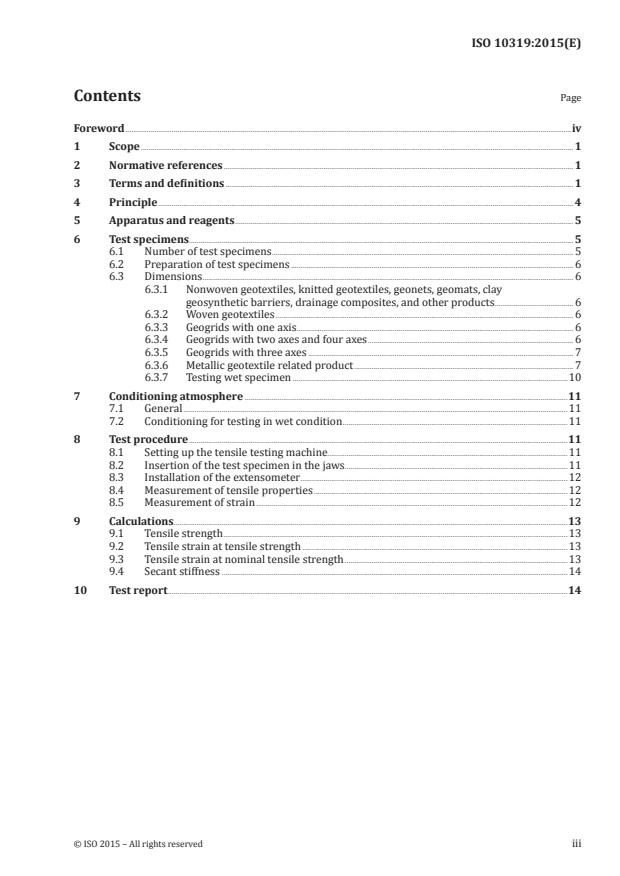
Contents Page
Foreword .iv
1 Scope . 1
2 Normative references . 1
3 Terms and definitions . 1
4 Principle . 4
5 Apparatus and reagents . 5
6 Test specimens. 5
6.1 Number of test specimens . 5
6.2 Preparation of test specimens . 6
6.3 Dimensions . 6
6.3.1 Nonwoven geotextiles, knitted geotextiles, geonets, geomats, clay
geosynthetic barriers, drainage composites, and other products . 6
6.3.2 Woven geotextiles . 6
6.3.3 Geogrids with one axis . . 6
6.3.4 Geogrids with two axes and four axes . 6
6.3.5 Geogrids with three axes . 7
6.3.6 Metallic geotextile related product . 7
6.3.7 Testing wet specimen .10
7 Conditioning atmosphere .11
7.1 General .11
7.2 Conditioning for testing in wet condition .11
8 Test procedure .11
8.1 Setting up the tensile testing machine.11
8.2 Insertion of the test specimen in the jaws.11
8.3 Installation of the extensometer .12
8.4 Measurement of tensile properties .12
8.5 Measurement of strain .12
9 Calculations.13
9.1 Tensile strength .13
9.2 Tensile strain at tensile strength .13
9.3 Tensile strain at nominal tensile strength .13
9.4 Secant stiffness .14
10 Test report .14
Foreword
ISO (the International Organization for Standardization) is a worldwide federation of national standards
bodies (ISO member bodies). The work of preparing International Standards is normally carried out
through ISO technical committees. Each member body interested in a subject for which a technical
committee has been established has the right to be represented on that committee. International
organizations, governmental and non-governmental, in liaison with ISO, also take part in the work.
ISO collaborates closely with the International Electrotechnical Commission (IEC) on all matters of
electrotechnical standardization.
The procedures used to develop this document and those intended for its further maintenance are
described in the ISO/IEC Directives, Part 1. In particular the different approval criteria needed for the
different types of ISO documents should be noted. This document was drafted in accordance with the
editorial rules of the ISO/IEC Directives, Part 2 (see www.iso.org/directives).
Attention is drawn to the possibility that some of the elements of this document may be the subject of
patent rights. ISO shall not be held responsible for identifying any or all such patent rights. Details of
any patent rights identified during the development of the document will be in the Introduction and/or
on the ISO list of patent declarations received (see www.iso.org/patents).
Any trade name used in this document is information given for the convenience of users and does not
constitute an endorsement.
For an explanation on the meaning of ISO specific terms and expressions related to conformity
assessment, as well as information about ISO’s adherence to the WTO principles in the Technical Barriers
to Trade (TBT), see the following URL: Foreword — Supplementary information.
The committee responsible for this document is ISO/TC 221, Geosynthetics.
This third edition cancels and replaces the second edition (ISO 10319:2008), which has been
technically revised.
iv © ISO 2015 – All rights reserved
INTERNATIONAL STANDARD ISO 10319:2015(E)
Geosynthetics — Wide-width tensile test
1 Scope
This International Standard describes an index test method for the determination of the tensile properties
of geosynthetics (polymeric, glass, and metallic), using a wide-width strip. This International Standard
is applicable to most geosynthetics, including woven geotextiles, nonwoven geotextiles, geocomposites,
knitted geotextiles, geonets, geomats, and metallic products. It is also applicable to geogrids and similar
open-structure geotextiles, but specimen dimensions might need to be altered. It is not applicable to
polymeric or bituminous geosynthetic barriers, while it is applicable to clay geosynthetic barriers.
This International Standard specifies a tensile test method that covers the measurement of load elongation
characteristics and includes procedures for the calculation of secant stiffness, maximum load per unit
width and strain at maximum load. Singular points on the load-extension curve are also indicated.
Procedures for measuring the tensile properties of both conditioned and wet specimens are included in
this International Standard.
2 Normative references
The following documents, in whole or in part, are normatively referenced in this document and are
indispensable for its application. For dated references, only the edition cited applies. For undated
references, the latest edition of the referenced document (including any amendments) applies.
ISO 554, Standard atmospheres for conditioning and/or testing — Specifications
ISO 3696, Water for analytical laboratory use — Specification and test methods
ISO 7500-1, Metallic materials — Verification of static uniaxial testing machines — Part 1: Tension/
compression testing machines — Verification and calibration of the force-measuring system
ISO 9862, Geosynthetics — Sampling and preparation of test specimens
ISO 10318, Geosynthetics — Terms and definitions
ISO 10321, Geosynthetics — Tensile test for joints/seams by wide-width strip method
EN 10223-3, Steel wire and wire products for fencing and netting — Part 3: Hexagonal steel wire mesh
products for engineering purposes
3 Terms and definitions
For the purposes of this document, the terms and definitions given in ISO 10318 and the following apply.
3.1
nominal gauge length
initial distance, normally 60 mm (30 mm on either side of the specimen symmetrical centre), between
two reference points located on the specimen parallel to the applied load direction
3.2
elongation at preload
measured increase in gauge length (mm) corresponding to an applied load of 1 % of the maximum load
Note 1 to entry: The elongation at preload is indicated as SA in Figure 1.
3.3
true gauge length
L
nominal gauge length (3.1) in millimetres plus the elongation at preload (3.2) in millimetres
3.4
maximum tensile Force
F
max
maximum tensile force obtained during a test
Note 1 to entry: The maximum load is expressed in kilonewtons (kN).
3.5
tensile strain
ε
increase in true gauge length (3.3) of a specimen during a test divided by true gauge length
Note 1 to entry: Tensile strain is expressed as a percentage of the true gauge length.
3.6
tensile strain at maximum tensile load
ε
max
tensile strain (3.5) exhibited by the specimen under maximum tensile load
Note 1 to entry: Tensile strain at maximum tensile load is expressed in percent.
3.7
tensile strain at nominal strength
ε
nom
strain at the guaranteed strength as defined by the manufacturer
3.8
tensile secant stiffness
J
ratio of tensile force per unit width to an associated value of strain
Note 1 to entry: Tensile secant stiffness is expressed in kilonewtons per metre (kN/m).
3.9
tensile strength
T
max
maximum force per unit width observed during a test in which the specimen is stretched to rupture
Note 1 to entry: Tensile strength is expressed in kilonewtons per metre (kN/m).
3.10
strain rate
strain at maximum load, divided by the duration of the test, i.e. the time to attainment of maximum
tensile load from preload
Note 1 to entry: Strain rate is expressed in percentage per minute.
2 © ISO 2015 – All rights reserved
Key
T load/unit width, in kN/m
ε strain, in %
AC strain for secant stiffness
AZ secant
SA elongation at preload
Figure 1 — Typical load per unit width/strain curve
Key
T tensile strength (kN/m)
max
Ɛ tensile strain (%)
max
T’ tensile strength (kN/m) at second peak
max
Ɛ’ tensile strain (%) at second peak
max
Figure 2 — Typical tensile load per unit width — strain — curves of two geocomposites second
peak-values marked by “’”, e.g. T’ , ε’
max max
4 Principle
A specimen is held across its entire width in a set of clamps or jaws (see Figure 3) of a tensile testing
machine operated at a constant displacement speed, and a longitudinal force is applied to the test
specimen until the specimen ruptures. The tensile properties of the test specimen are calculated from
machine scales, dials, autographic recording charts, or an interfaced computer. A constant test speed is
selected so as to give a strain rate of (20 ±5) % per minute in the gauge length of the specimen, except for
products that exhibit a low strain, i.e. less than or equal to 5 %. For these products, e.g. glass, the speed
is reduced so that the specimen breaks in 30 ±5 s.
The basic distinction between the current method and other methods for measuring tensile properties
of fabrics is the width of the specimen. In the current method, the width is greater than the length
of the specimen, as some geosynthetics have a tendency to contract (neck down) under load in the
gauge length area.
The greater width reduces the contraction effect of such fabrics and provides a relationship closer to the
expected fabric behaviour in the field, as well as a standard for comparison of geosynthetics.
When information on strain is required, extension measurements are made by means of an extensometer,
which follows the movement of two reference points on the specimen. These reference points are situated
on the specimen symmetry axis, which is parallel to the applied load, and are separated by a distance of
60 mm (30 mm on each side of the specimen symmetry centre). This distance can be adapted for some
types of geogrid in order to include at least one row of nodes or internal junctions.
4 © ISO 2015 – All rights reserved
5 Apparatus and reagents
5.1 Tensile testing machine (constant rate of extension), complying with ISO 7500-1, Class 2 or better,
in which the rate of increase of specimen length is uniform with time, fitted with a set of clamps or jaws
which are sufficiently wide to hold the entire width of the specimen and equipped with appropriate
means to limit slippage or damage. One clamp may be supported by a free swivel or universal joint to
compensate for uneven distribution of force across the specimen.
Compressive jaws should be used for most materials, but for materials where the use of these grips gives
rise to excessive jaw breaks or slippage, capstan grips may be used.
It is essential to choose jaw faces that limit slippage of the specimen, especially in stronger geosynthetics.
Examples of jaw faces that have been found satisfactory are shown in Figure 3.
5.2 Extensometer, capable of measuring the distance between two reference points on the specimen
without any damage to the specimen or slippage, care being taken to ensure that the measurement
represents the true movement of the reference points.
EXAMPLE Mechanical, optical, infrared or other types, all with an electrical output.
The extensometer shall be capable of measuring to an accuracy of ±2 % of the indicated reading. If any
irregularity of the stress-strain curve due to the extensometer is observed, this result shall be discarded
and another specimen shall be tested.
5.3 Distilled water, for wet specimens only, complying with Grade 3 of ISO 3696.
5.4 Non-ionic wetting agent, for wet specimens only.
The wetting agent used shall be a general purpose polyoxyethylene glycol alkyl ether at 0,05 % volume.
a) friction by lateral pressure b) capstan or roller clamps friction
(hydraulic or mechanic) on circular tube
Figure 3 — Examples of jaw faces for tensile testing of geosynthetics
6 Test specimens
6.1 Number of test specimens
Cut a minimum of five test specimens in both machine direction (MD) and cross machine direction (CMD).
6.2 Prepar
...
NORME ISO
INTERNATIONALE 10319
Troisième édition
2015-05-15
Géosynthétiques — Essai de traction
des bandes larges
Geosynthetics — Wide-width tensile test
Numéro de référence
©
ISO 2015
DOCUMENT PROTÉGÉ PAR COPYRIGHT
© ISO 2015
Droits de reproduction réservés. Sauf indication contraire, aucune partie de cette publication ne peut être reproduite ni utilisée
sous quelque forme que ce soit et par aucun procédé, électronique ou mécanique, y compris la photocopie, l’affichage sur
l’internet ou sur un Intranet, sans autorisation écrite préalable. Les demandes d’autorisation peuvent être adressées à l’ISO à
l’adresse ci-après ou au comité membre de l’ISO dans le pays du demandeur.
ISO copyright office
Case postale 56 • CH-1211 Geneva 20
Tel. + 41 22 749 01 11
Fax + 41 22 749 09 47
E-mail copyright@iso.org
Web www.iso.org
Publié en Suisse
ii © ISO 2015 – Tous droits réservés
Sommaire Page
Avant-propos .iv
1 Domaine d’application . 1
2 Références normatives . 1
3 Termes et définitions . 1
4 Principe . 4
5 Appareillage et réactifs . 5
6 Éprouvettes d’essai . 6
6.1 Nombre d’éprouvettes d’essai . 6
6.2 Préparation des éprouvettes d’essai . 6
6.3 Dimensions . 6
6.3.1 Géotextiles nontissés, géotextiles maillés, géofilets, géomatelas,
géosynthétiques bentonitiques, composites de drainage et autres produits . 6
6.3.2 Géotextiles tissés . 6
6.3.3 Géogrilles uniaxiales . 6
6.3.4 Géogrilles biaxiales ou quadriaxiales . 7
6.3.5 Géogrilles triaxiales . 7
6.3.6 Produit apparenté à un géotextile métallique . 7
6.3.7 Essai sur éprouvette humide .10
7 Atmosphère de conditionnement .11
7.1 Généralités .11
7.2 Conditionnement pour les essais à l’état humide .11
8 Mode opératoire d’essai.11
8.1 Réglage de la machine . .11
8.2 Mise en place de l’éprouvette d’essai entre les mors .11
8.3 Mise en place de l’extensomètre .12
8.4 Mesurage des propriétés mécaniques en traction .12
8.5 Mesurage de la déformation .12
9 Calculs .13
9.1 Résistance à la traction .13
9.2 Déformation à la force maximale .13
9.3 Déformation à la résistance à la traction nominale .13
9.4 Raideur sécante .14
10 Rapport d’essai .14
Avant-propos
L’ISO (Organisation internationale de normalisation) est une fédération mondiale d’organismes
nationaux de normalisation (comités membres de l’ISO). L’élaboration des Normes internationales est
en général confiée aux comités techniques de l’ISO. Chaque comité membre intéressé par une étude
a le droit de faire partie du comité technique créé à cet effet. Les organisations internationales,
gouvernementales et non gouvernementales, en liaison avec l’ISO participent également aux travaux.
L’ISO collabore étroitement avec la Commission électrotechnique internationale (IEC) en ce qui concerne
la normalisation électrotechnique.
Les procédures utilisées pour élaborer le présent document et celles destinées à sa mise à jour sont
décrites dans les Directives ISO/IEC, Partie 1. Il convient, en particulier de prendre note des différents
critères d’approbation requis pour les différents types de documents ISO. Le présent document a été
rédigé conformément aux règles de rédaction données dans les Directives ISO/IEC, Partie 2 (voir www.
iso.org/directives).
L’attention est appelée sur le fait que certains des éléments du présent document peuvent faire l’objet de
droits de propriété intellectuelle ou de droits analogues. L’ISO ne saurait être tenue pour responsable
de ne pas avoir identifié de tels droits de propriété et averti de leur existence. Les détails concernant les
références aux droits de propriété intellectuelle ou autres droits analogues identifiés lors de l’élaboration
du document sont indiqués dans l’Introduction et/ou dans la liste des déclarations de brevets reçues par
l’ISO (voir www.iso.org/brevets).
Les appellations commerciales éventuellement mentionnées dans le présent document sont données pour
information, par souci de commodité, à l’intention des utilisateurs et ne sauraient constituer un engagement.
Pour une explication de la signification des termes et expressions spécifiques de l’ISO liés à l’évaluation de
la conformité, ou pour toute information au sujet de l’adhésion de l’ISO aux principes de l’OMC concernant
les obstacles techniques au commerce (OTC), voir le lien suivant: Avant-propos — Informations
supplémentaires.
L’ISO 10319 a été élaborée par le comité technique ISO/TC 221, Produits géosynthétiques.
Cette troisième édition annule et remplace la deuxième édition (ISO 10319:2008), qui a fait l’objet d’une
révision technique.
iv © ISO 2015 – Tous droits réservés
NORME INTERNATIONALE ISO 10319:2015(F)
Géosynthétiques — Essai de traction des bandes larges
1 Domaine d’application
La présente Norme internationale décrit une méthode d’essai de référence pour la détermination des
propriétés mécaniques en traction des géosynthétiques (à base de polymère, de verre et de métal) à
l’aide d’une bande de grande largeur. La présente Norme internationale est applicable à la plupart des
géosynthétiques, notamment les géotextiles tissés, les géotextiles nontissés, les géocomposites, les
géotextiles maillés, les géomatelas et les produits métalliques. Elle s’applique également aux géogrilles
et aux géosynthétiques à structure ouverte similaires, mais il peut s’avérer nécessaire de modifier les
dimensions de l’éprouvette. Elle est applicable aux produits métalliques, en particulier aux maillages
d’acier à double torsade. Cet essai n’est pas applicable aux géomembranes polymériques ou bitumineuses
alors qu’il est applicable aux géosynthétiques bentonitiques.
La présente Norme internationale spécifie une méthode d’essai de traction qui couvre le mesurage des
caractéristiques de force et de déformation et comprend les modes opératoires de calcul de la raideur
sécante, de la force maximale par unité de largeur et de la déformation à la force maximale. Des points
singuliers sont également indiqués sur la courbe de force/déformation.
La présente Norme internationale fournit également des modes opératoires de mesure des propriétés
mécaniques en traction d’éprouvettes conditionnées et d’éprouvettes humides.
2 Références normatives
Les documents de référence suivants sont indispensables pour l’application du présent document. Pour
les références datées, seule l’édition citée s’applique. Pour les références non datées, la dernière édition
du document de référence s’applique (y compris les éventuels amendements).
ISO 554, Atmosphères normales de conditionnement et/ou d’essai — Spécifications.
ISO 3696, Eau pour laboratoire à usage analytique — Spécification et méthodes d’essai.
ISO 7500-1, Matériaux métalliques — Vérification des machines pour essais statiques uniaxiaux — Partie
1: Machines d’essai de traction/compression — Vérification et étalonnage du système de mesure de force.
ISO 9862, Géosynthétiques — Échantillonnage et préparation des éprouvettes.
ISO 10318:2005, Géosynthétiques — Termes et définitions.
ISO 10321, Géosynthétiques — Essai de traction des joints/coutures par la méthode de la bande large.
EN 10223-3, Fils et produits tréfilés en acier pour clôtures et grillages — Partie 3: produits en grillage à
mailles hexagonales en acier pour applications en génie civil.
3 Termes et définitions
Pour les besoins du présent document, les termes et définitions donnés dans l’ISO 10318 ainsi que les
suivants s’appliquent.
3.1
longueur nominale entre repères
distance initiale, normalement 60 mm (30 mm de part et d’autre du centre symétrique de l’éprouvette),
entre deux points de référence situés sur l’éprouvette, parallèlement à la force appliquée
3.2
élongation à la pré-tension
augmentation mesurée de la longueur entre repères correspondant à une force appliquée égale à 1 % de
la force maximale
Note 1 à l’article: L’élongation à la pré-tension est mentionnée SA sur la Figure 1.
3.3
longueur réelle entre repères
L
longueur nominale entre repères (3.1) en millimètres plus l’élongation à la pré-tension (3.2) en millimètres
3.4
force maximale
F
max
force maximale de traction obtenue au cours d’un essai
Note 1 à l’article: La force maximale est exprimée en kilonewtons (kN).
3.5
déformation
ε
augmentation de la longueur réelle (3.3) d’une éprouvette au cours d’un essai divisée par la longueur
réelle entre repères.
Note 1 à l’article: La déformation est exprimée en pourcentage de la longueur réelle entre repères.
3.6
déformation à la force maximale
ε
max
déformation (3.5) subie par l’éprouvette sous la force maximale
Note 1 à l’article: La déformation à la force maximale est exprimée en pourcentage.
3.7
déformation à la résistance nominale
ε
nom
déformation à la résistance garantie telle que définie par le fabricant
3.8
raideur sécante
J
rapport de la force par unité de largeur à une valeur de déformation donnée
Note 1 à l’article: La raideur sécante est exprimée en kilonewtons par mètre (kN/m).
3.9
résistance à la traction
T
max
résistance maximale par unité de largeur observée pendant un essai au cours duquel l’éprouvette est
étirée jusqu’à la rupture
Note 1 à l’article: La résistance à la traction est exprimée en kilonewtons par mètre (kN/m).
3.10
vitesse de déformation
pourcentage d’augmentation de la longueur réelle entre repères à la force maximale, divisé par la durée
de l’essai, c’est-à-dire le temps nécessaire pour atteindre la force maximale à partir de la pré-tension
Note 1 à l’article: La vitesse de déformation est exprimée en pourcentage par minute.
2 © ISO 2015 – Tous droits réservés
Légende
T force par unité de largeur, en kN/m
ε déformation, en %
AC déformation pour une raideur sécante
AZ raideur sécante
SA élongation à la pré-tension
Figure 1 — Courbe type de la force par unité de largeur/déformation
Légende
T résistance à la traction ( kN/m)
max
ε déformation, en %
max
T’ résistance à la traction (kN/m) au second pic
max
ε’ raideur sécante
max
Figure 2 — Courbes types de la force par unité de largeur/déformation de deux géocomposites,
valeurs pics secondaires indiquées par « «’, par exemple T’max, ε’max
4 Principe
Une éprouvette d’essai est maintenue sur toute sa largeur entre les mors ou les mâchoires (voir la
Figure 3) d’une machine d’essai de traction fonctionnant à vitesse constante et appliquant une force
longitudinale sur l’éprouvette jusqu’à la rupture de celle-ci. Les propriétés mécaniques en traction de
l’éprouvette d’essai sont calculées à partir des lectures faites sur les échelles, cadrans de la machine, à
l’aide de diagrammes d’enregistrement graphiques ou grâce à un ordinateur relié à la machine. Une vitesse
d’essai constante est sélectionnée de manière à obtenir une vitesse de déformation de (20 ± 5) %/min de
la longueur entre repères de l’éprouvette, sauf pour les produits qui présentent une faible déformation,
c’est-à-dire inférieure à 5 %. Pour ces produits, par exemple le verre, la vitesse est réduite de sorte que
l’éprouvette se rompe au bout de (30 ± 5) s.
La principale différence entre cette méthode et d’autres méthodes employées pour le mesurage des
propriétés mécaniques en traction des textiles est la largeur de l’éprouvette. Dans cette méthode, la
largeur de l’éprouvette est plus grande que sa longueur, certains géosynthétiques ayant tendance à subir
un rétrécissement (striction) sous charge dans la zone entre repères de mesure. Une plus grande largeur
diminue l’effet de striction de ces textiles et fournit une relation plus proche du comportement escompté
des textiles in situ, de même qu’une méthode de comparaison normalisée des géosynthétiques.
Si des informations sur les déformations sont requises, des mesurages d’élongation sont effectués à
l’aide d’un extensomètre qui suit le déplacement de deux points de référence sur l’éprouvette. Ces points
de référence sont situés sur l’axe de symétrie de l’éprouvette, cet axe étant parallèle à la direction de
l’effort appliqué, et se trouvent à 60 mm l’un de l’autre (30 mm de part et d’autre du centre de symétrie
de l’éprouvette). Cette distance peut être modifiée pour certains types de géogrilles afin d’inclure au
moins une rangée de nœuds.
4 © ISO 2015 – Tous droits réservés
5 Appareillage et réactifs
5.1 Machine d’essai de traction (vitesse de déformation constante), conforme à l’ISO 7500-1, classe 2
ou supérieure, sur laquelle la vitesse d’augmentation de la longueur de l’éprouvette est constante dans le
temps et dont les mors ou les mâchoires sont suffisamment larges pour maintenir l’éprouvette sur toute
sa largeur et dotés de moyens appropriés pour limiter le glissement ou l’endommagement. Il convient
qu’au moins une mâchoire soit supportée par une articulation libre ou un joint universel pour compenser
la répartition inégale de la force sur l’éprouvette.
Il convient d’utiliser des mors de compression pour la plupart des matériaux mais, lorsque l’utilisation
de tels mors entraîne un nombre excessif de ruptures au droit des mors ou de glissements, des mors à
cabestan peuvent être utilisés.
Il est indispensable de choisir des surfaces de mors qui limitent le glissement de l’éprouvette, surtout
dans le cas des géosynthétiques résistants. La Figure 3 montre quelques exemples de surfaces de mors
qui se sont révélées satisfaisantes.
5.2 Extensomètre, capable de mesurer la distance entre deux points de référence sur l’éprouvette, sans
détérioration ni glissement de cette dernière, en veillant à ce que le mesurage représente le déplacement
réel des points de référence.
EXEMPLE Les appareils mécaniques, optiques, à infrarouge ou d’autres types d’appareils, tous avec une
sortie électrique.
L’extensomètre doit avoir une erreur maximale admissible de ± 2 % de la lecture. Si une irrégularité
quelconque de la courbe de force/déformation liée à l’extensomètre est constatée, le résultat
correspondant doit être rejeté et une autre éprouvette doit être soumise à essai.
5.3 Eau distillée, pour les éprouvettes humides uniquement, de qualité 3 conformément à l’ISO 3696.
5.4 Tensioactif non ionique, pour les éprouvettes humides uniquement.
Le tensioactif utilisé doit être un poly(oxyéthylène glycol) alkyl éther d’usage général ayant une
concentration de 0,05 % en volume.
a) frottement par pression latérale circulaire b) cabestan ou pinces rouleaux de friction sur
(hydraulique ou mécanique) tube
Figure 3 — Exemples de faces de mors pour l’essai de traction des géosynthétiques
6 Éprouvettes d’essai
6.1 Nombre d’éprouvettes d’essai
Découper un minimum de cinq éprouvettes d’essai dans les deux sens, sens production (SP) et sens
travers (ST).
6.2 Préparation des éprouvettes d’essai
Préparer les éprouvettes d’essai conformément à l’ISO 9862.
6.3 Dimensions
6.3.1 Géotextiles nontissés, géotextiles maillés, géofilets, géomatelas, géosynthétiques
bentonitiques, composites de drainage et autres produits
Préparer chaque éprouvette d’essai finie pour obtenir une largeur nominale de 200 mm ± 1 mm et une
longueur suffisante pour garantir une distance de 100 mm entre les mors, la longueur étant déterminée
et parallèle au sens d’application de la force de traction. Pour certains matériaux, l’utilisation d’un couteau
ou de ciseaux peut affecter la structure. Dans ce
...