

ISO/TS 22220:2026
(Main)Health informatics — Identification of persons, healthcare providers and healthcare organizations
- Abstract
This document indicates the data elements and structure suited to accurately and consistently identify persons (including subjects of care), healthcare providers and healthcare organizations. The data elements names and definitions are provided in Clause 3; the full data element definitional structure is given in Clauses 5, 6 and 7. This document identifies conformance requirements in the following use cases: Populate and manage an index or registry. This can include the storage of a person, healthcare provider or organization within an index or registry. Record or share information for administrative purposes. Record or share information for clinical purposes. Application of this document will increase the capacity for data access. Authorization of such access is determined by the application of legislation, organizational policies and guidelines, and professional ethics. It is recognized that specific applications might require additional data to fulfil their purpose, such as value sets or adjustments to conformance requirements. This document provides a generic set of identifying information, which is application-independent. Implementations in different healthcare environments and national settings can require the establishment of data sub-sets, additional guidelines and rules in the use of the data elements. The following are outside the scope of this document: Additional factors to be considered in providing access to distributed person data, including privacy, security, authentication, access and data transfer mechanisms. Collection and processing of data for purposes other than the identification of persons and their associated records, even though some of the data elements collected for identification can be used for other purposes such as the determination and delivery of care, the compilation of statistics, contact tracing and reimbursement. This includes clinical content, care processes and financial identifiers not used for person or provider identification. Handling of person electronic consent in forms and other use cases, although this can be considered for addition by implementers and dependent on electronic signature policy for medical records. Naming conventions, and rules for specifying data element names and data element definitions.
- Status
- Published
- Publication Date
- 12-Jul-2026
- Technical Committee
- ISO/TC 215 - Health informatics
- Drafting Committee
- ISO/TC 215 - Health informatics
- Current Stage
- 6060 - International Standard published
- Start Date
- 13-Jul-2026
- Due Date
- 29-Nov-2026
- Completion Date
- 13-Jul-2026
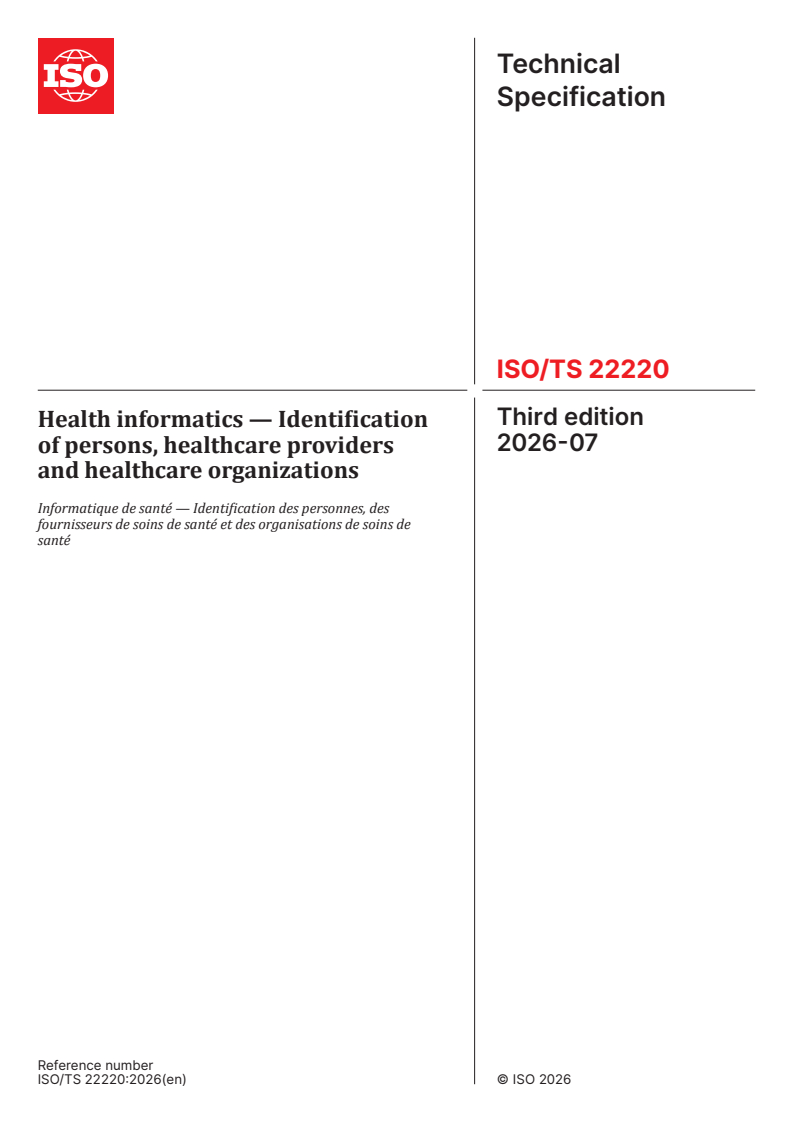

ISO/TS 22220:2026 is an ISO technical specification for health informatics. It specifies a generic set of data elements and structures for accurately and consistently identifying persons, healthcare providers and healthcare organizations in healthcare settings.
It is intended for use in registries, administrative record sharing and clinical record sharing. The document is written for implementers who need a common identification model that can be adapted to local healthcare environments and national settings.
What does ISO/TS 22220:2026 specify?
ISO/TS 22220:2026 specifies the identifying data elements and their structure for persons, healthcare providers and healthcare organizations. It also sets out conformance for three use cases: managing an index or registry, and recording or sharing information for administrative or clinical purposes.
The document is organized into these main parts:
- Clause 3 - terms and definitions
- Clause 4 - components of data elements and conformance strengths
- Clause 5 - person identification
- Clause 6 - individual healthcare provider identification
- Clause 7 - healthcare organization
The scope is intentionally focused on identification data. It excludes privacy, security, authentication, access and transfer mechanisms; clinical content; care processes; financial identifiers not used for identification; electronic consent handling; and naming conventions for data element names and definitions. In practice, that means the standard tells you what identifying data to capture and how to structure it, but not how to secure or govern the surrounding system.
What are the key requirements of ISO/TS 22220:2026?
ISO/TS 22220:2026 defines a conformance model and then applies it to person, provider and organization identifiers. The practical effect is that implementers can see which data elements are mandatory, required, conditionally required, optional or not required for each use case.
Conformance strengths matter
Clause 4.3 defines the conformance strengths:
- M - mandatory
- R - required
- RK - required if known
- C - conditional
- O - optional
- NR - not required
This matters because the same data element can have different importance depending on whether a system is managing a registry or only sharing information. Teams can use the tables to decide what must be present in their own implementation and what can remain local or optional.
Person identification is built from grouped data elements
Clause 5 groups person identification into identifier, name, additional demographics, address, electronic communications and address communication suppression. The person identifier group requires a person identifier designation in all use cases, while the issuer, type and geographic area become important for registry management. In practice, that supports matching and de-duplication in systems that may hold multiple identifiers for one person.
The person name group allows more than one name, more than one title, and a single name to use at a given time. It also includes personal pronouns and dates for when pronouns start and stop being used. This is important because healthcare systems often need both a formal name for records and a preferred name for day-to-day communication.
The document treats birth, death, sex and gender as identification data
Clause 5.4 includes birth, death, and sex and gender data. It defines items such as date of birth, accuracy and follow-up indicators, birth plurality and order, sex at birth, recorded sex or gender, gender identity, and start and end dates for gender identity. In practice, these fields help resolve identity when names are shared or change over time, and they support better reconciliation of records.
Addresses and communications are structured, not free text only
Clause 5.5 defines a detailed person address structure with address type, status, unit, site name, floor, street details, postal elements, location descriptor, address line and geocode elements. For registry management, several of these are treated as required if known or mandatory, including street number, street name, postal code and geocode items. This matters because structured addresses improve matching, searching and safe communication.
Clause 5.6 adds electronic communication type, details and contact usage. Clause 5.7 adds a suppression flag, source and dates so address or electronic communication data can be withheld under administrative, personal or legal rules. In practice, this lets implementers protect sensitive contact details while still keeping identity data usable where permitted.
Provider identification extends person data with professional context
Clause 6 reuses person data and adds provider-specific information. For regulated providers, it includes profession type, profession identifier, area of profession and profession start date. It also covers provider language, qualifications, place of practice, registration, and special restrictions or extensions to practice such as endorsements, conditions, reprimands and cautions.
This matters for provider registries because the system must distinguish who someone is from what role they are authorized to perform. Clause 6 also includes an unregulated healthcare provider group for volunteers or employed unregulated staff, with type, identifier, limitations of care and practice dates.
Healthcare organizations are identified separately from people
Clause 7 defines organization identifier, name and address data elements. Organization identifiers can have an issuer, a type, a geographic area and a usage, and names can have usage start and end dates. Addresses are structured in the same practical way as person addresses, with fields for street, locality, state or province, postal code, country and address usage.
In practice, this supports hospitals, clinics, departments and service locations that need their own identity records for referral, billing, directory and care delivery workflows.
What terms does ISO/TS 22220:2026 define?
- capture - the deliberate action that registers a record in a record keeping system.
- registration - the act of giving a record a unique identity in a record keeping system.
- data element - the basic unit of identifiable and definable data used by the document.
- logical data type - the kind of data that can be held in a field without implementation details.
- person identifier designation - the number or code assigned to a person to uniquely identify that person in a healthcare context.
- name usage - the classification that shows why a name is being used and how it should be interpreted.
- suppression flag - the representation that shows a person’s address details may be subject to suppression.
- healthcare organization identifier usage - the intended use of an organization identifier within the organization or jurisdiction.
Who uses ISO/TS 22220:2026?
ISO/TS 22220:2026 is used by health informatics teams, registry managers, EHR and HIE implementers, identity and master data teams, and organizations that manage patient, provider or organization indexes. It is also relevant to registration authorities, quality managers, privacy officers and buyers assessing identity data requirements for healthcare systems.
The document is especially useful where data must be shared across clinical, administrative and registry workflows. It helps teams define which identifying data to capture, how to store it consistently, and how to support matching and search across different sites or jurisdictions.
What changed in ISO/TS 22220:2026 from the previous edition?
ISO/TS 22220:2026 is the third edition and replaces ISO/TS 22220:2011 and ISO/TS 27527:2010.
The foreword lists these main changes:
- further elaboration on sex and gender data elements related to person identification
- the term “subject of care” was replaced with “person”
- all data elements were updated
- three use cases were added, including conformance for each use case
Which standards are used with ISO/TS 22220:2026?
ISO/TS 22220:2026 cites related standards and documents that help with implementation and interpretation:
- ISO 18530 - referenced in Clause 5.2 for further information on person identifier combinations
- ISO 2146:2010 - source for the definition of data element
- ISO 3166-1 - used as an example source for country codes
- ISO 8000-1 - cited in the bibliography for data quality context
- ISO 8601 - cited in the bibliography for date and time representation
- ISO/IEC 11179-3:2023 - cited as a development reference for metadata registry structure
- ISO 15489-1:2016 - source for the definition of record
- ISO/TS 16599-1 and ISO/TS 16599-2 - cited as related data quality and governance work
- HL7 Gender Harmony - cited in the bibliography for sex and gender modeling context
What does the ISO/TS 22220:2026 document contain?
The document contains detailed tables for person, provider and organization data elements, along with conformance tables for each use case. It also contains figures showing the data element group structure for persons, healthcare providers and healthcare organizations.
The body of the standard includes definitions, guidance and examples for names, demographics, addresses, electronic communications, suppression handling, professional registration, qualifications and organization identity. For implementation work, the most useful parts are the grouped data element tables and the conformance tables, because they show what information to capture and how strongly each item is treated in different use cases.
It also includes bibliography references that point to related standards and guidance for records, metadata, dates, countries, data quality and sex and gender representation.
Relations
- Effective Date
- 19-Apr-2025
- Effective Date
- 06-Jun-2022
Get Certified
Connect with accredited certification bodies for this standard

BSI Group
BSI (British Standards Institution) is the business standards company that helps organizations make excellence a habit.

NYCE
Mexican standards and certification body.
Sponsored listings
Frequently Asked Questions
ISO/TS 22220:2026 is a technical specification published by the International Organization for Standardization (ISO). Its full title is "Health informatics — Identification of persons, healthcare providers and healthcare organizations". This standard covers: This document indicates the data elements and structure suited to accurately and consistently identify persons (including subjects of care), healthcare providers and healthcare organizations. The data elements names and definitions are provided in Clause 3; the full data element definitional structure is given in Clauses 5, 6 and 7. This document identifies conformance requirements in the following use cases: Populate and manage an index or registry. This can include the storage of a person, healthcare provider or organization within an index or registry. Record or share information for administrative purposes. Record or share information for clinical purposes. Application of this document will increase the capacity for data access. Authorization of such access is determined by the application of legislation, organizational policies and guidelines, and professional ethics. It is recognized that specific applications might require additional data to fulfil their purpose, such as value sets or adjustments to conformance requirements. This document provides a generic set of identifying information, which is application-independent. Implementations in different healthcare environments and national settings can require the establishment of data sub-sets, additional guidelines and rules in the use of the data elements. The following are outside the scope of this document: Additional factors to be considered in providing access to distributed person data, including privacy, security, authentication, access and data transfer mechanisms. Collection and processing of data for purposes other than the identification of persons and their associated records, even though some of the data elements collected for identification can be used for other purposes such as the determination and delivery of care, the compilation of statistics, contact tracing and reimbursement. This includes clinical content, care processes and financial identifiers not used for person or provider identification. Handling of person electronic consent in forms and other use cases, although this can be considered for addition by implementers and dependent on electronic signature policy for medical records. Naming conventions, and rules for specifying data element names and data element definitions.
This document indicates the data elements and structure suited to accurately and consistently identify persons (including subjects of care), healthcare providers and healthcare organizations. The data elements names and definitions are provided in Clause 3; the full data element definitional structure is given in Clauses 5, 6 and 7. This document identifies conformance requirements in the following use cases: Populate and manage an index or registry. This can include the storage of a person, healthcare provider or organization within an index or registry. Record or share information for administrative purposes. Record or share information for clinical purposes. Application of this document will increase the capacity for data access. Authorization of such access is determined by the application of legislation, organizational policies and guidelines, and professional ethics. It is recognized that specific applications might require additional data to fulfil their purpose, such as value sets or adjustments to conformance requirements. This document provides a generic set of identifying information, which is application-independent. Implementations in different healthcare environments and national settings can require the establishment of data sub-sets, additional guidelines and rules in the use of the data elements. The following are outside the scope of this document: Additional factors to be considered in providing access to distributed person data, including privacy, security, authentication, access and data transfer mechanisms. Collection and processing of data for purposes other than the identification of persons and their associated records, even though some of the data elements collected for identification can be used for other purposes such as the determination and delivery of care, the compilation of statistics, contact tracing and reimbursement. This includes clinical content, care processes and financial identifiers not used for person or provider identification. Handling of person electronic consent in forms and other use cases, although this can be considered for addition by implementers and dependent on electronic signature policy for medical records. Naming conventions, and rules for specifying data element names and data element definitions.
ISO/TS 22220:2026 is classified under the following ICS (International Classification for Standards) categories: 35.240.80 - IT applications in health care technology. The ICS classification helps identify the subject area and facilitates finding related standards.
ISO/TS 22220:2026 has the following relationships with other standards: It is inter standard links to ISO/TS 27527:2010, ISO/TS 22220:2011. Understanding these relationships helps ensure you are using the most current and applicable version of the standard.
ISO/TS 22220:2026 is available in PDF format for immediate download after purchase. The document can be added to your cart and obtained through the secure checkout process. Digital delivery ensures instant access to the complete standard document.
Standards Content (Sample)
Technical
Specification
ISO/TS 22220
Third edition
Health informatics — Identification
2026-07
of persons, healthcare providers
and healthcare organizations
Informatique de santé — Identification des personnes, des
fournisseurs de soins de santé et des organisations de soins de
santé
Reference number
© ISO 2026
All rights reserved. Unless otherwise specified, or required in the context of its implementation, no part of this publication may
be reproduced or utilized otherwise in any form or by any means, electronic or mechanical, including photocopying, or posting on
the internet or an intranet, without prior written permission. Permission can be requested from either ISO at the address below
or ISO’s member body in the country of the requester.
ISO copyright office
CP 401 • Ch. de Blandonnet 8
CH-1214 Vernier, Geneva
Phone: +41 22 749 01 11
Email: copyright@iso.org
Website: www.iso.org
Published in Switzerland
ii
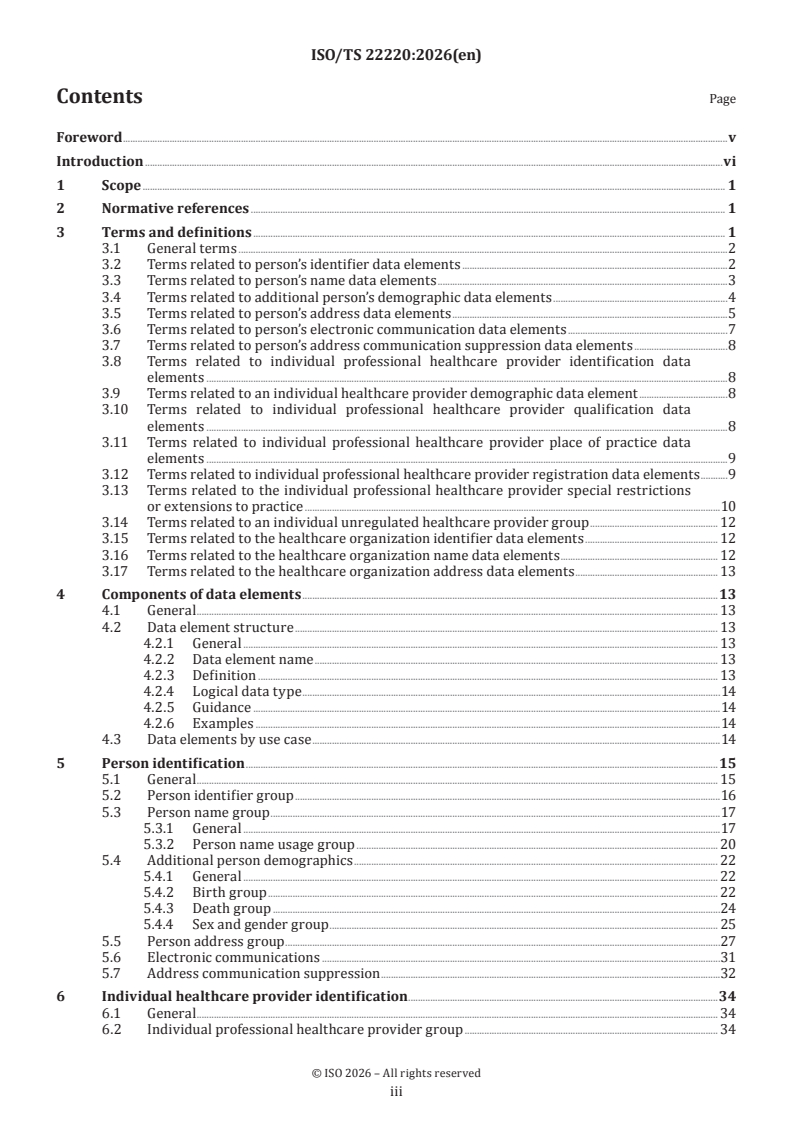
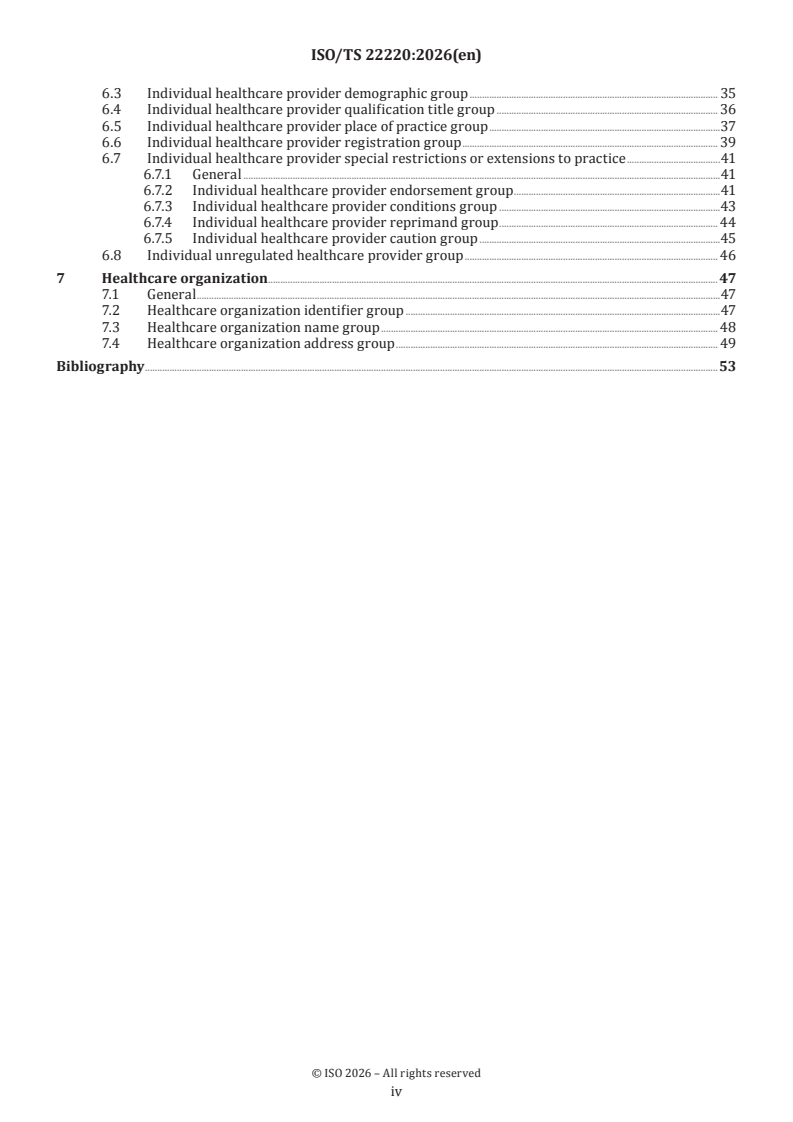
Contents Page
Foreword .v
Introduction .vi
1 Scope . 1
2 Normative references . 1
3 Terms and definitions . 1
3.1 General terms .2
3.2 Terms related to person’s identifier data elements .2
3.3 Terms related to person’s name data elements .3
3.4 Terms related to additional person’s demographic data elements .4
3.5 Terms related to person’s address data elements .5
3.6 Terms related to person’s electronic communication data elements .7
3.7 Terms related to person’s address communication suppression data elements .8
3.8 Terms related to individual professional healthcare provider identification data
elements .8
3.9 Terms related to an individual healthcare provider demographic data element .8
3.10 Terms related to individual professional healthcare provider qualification data
elements .8
3.11 Terms related to individual professional healthcare provider place of practice data
elements .9
3.12 Terms related to individual professional healthcare provider registration data elements .9
3.13 Terms related to the individual professional healthcare provider special restrictions
or extensions to practice .10
3.14 Terms related to an individual unregulated healthcare provider group . 12
3.15 Terms related to the healthcare organization identifier data elements . 12
3.16 Terms related to the healthcare organization name data elements . 12
3.17 Terms related to the healthcare organization address data elements . 13
4 Components of data elements .13
4.1 General . 13
4.2 Data element structure . 13
4.2.1 General . 13
4.2.2 Data element name . 13
4.2.3 Definition . 13
4.2.4 Logical data type .14
4.2.5 Guidance .14
4.2.6 Examples .14
4.3 Data elements by use case .14
5 Person identification .15
5.1 General . 15
5.2 Person identifier group .16
5.3 Person name group .17
5.3.1 General .17
5.3.2 Person name usage group . 20
5.4 Additional person demographics . 22
5.4.1 General . 22
5.4.2 Birth group . 22
5.4.3 Death group .24
5.4.4 Sex and gender group . 25
5.5 Person address group .27
5.6 Electronic communications .31
5.7 Address communication suppression .32
6 Individual healthcare provider identification .34
6.1 General . 34
6.2 Individual professional healthcare provider group . 34
iii
6.3 Individual healthcare provider demographic group . 35
6.4 Individual healthcare provider qualification title group . 36
6.5 Individual healthcare provider place of practice group .37
6.6 Individual healthcare provider registration group . 39
6.7 Individual healthcare provider special restrictions or extensions to practice .41
6.7.1 General .41
6.7.2 Individual healthcare provider endorsement group .41
6.7.3 Individual healthcare provider conditions group .43
6.7.4 Individual healthcare provider reprimand group . 44
6.7.5 Individual healthcare provider caution group .45
6.8 Individual unregulated healthcare provider group . 46
7 Healthcare organization . 47
7.1 General .47
7.2 Healthcare organization identifier group .47
7.3 Healthcare organization name group . 48
7.4 Healthcare organization address group . 49
Bibliography .53
iv
Foreword
ISO (the International Organization for Standardization) is a worldwide federation of national standards
bodies (ISO member bodies). The work of preparing International Standards is normally carried out through
ISO technical committees. Each member body interested in a subject for which a technical committee
has been established has the right to be represented on that committee. International organizations,
governmental and non-governmental, in liaison with ISO, also take part in the work. ISO collaborates closely
with the International Electrotechnical Commission (IEC) on all matters of electrotechnical standardization.
The procedures used to develop this document and those intended for its further maintenance are described
in the ISO/IEC Directives, Part 1. In particular, the different approval criteria needed for the different types
of ISO documents should be noted. This document was drafted in accordance with the editorial rules of the
ISO/IEC Directives, Part 2 (see www.iso.org/directives).
ISO draws attention to the possibility that the implementation of this document may involve the use of (a)
patent(s). ISO takes no position concerning the evidence, validity or applicability of any claimed patent
rights in respect thereof. As of the date of publication of this document, ISO had not received notice of (a)
patent(s) which may be required to implement this document. However, implementers are cautioned that
this may not represent the latest information, which may be obtained from the patent database available at
www.iso.org/patents. ISO shall not be held responsible for identifying any or all such patent rights.
Any trade name used in this document is information given for the convenience of users and does not
constitute an endorsement.
For an explanation of the voluntary nature of standards, the meaning of ISO specific terms and expressions
related to conformity assessment, as well as information about ISO’s adherence to the World Trade
Organization (WTO) principles in the Technical Barriers to Trade (TBT), see www.iso.org/iso/foreword.html.
This document was prepared by Technical Committee ISO/TC 215, Health informatics.
This third edition of ISO/TS 22220 cancels and replaces ISO/TS 22220:2011 and ISO/TS 27527:2010, which
have been technically revised.
The main changes are as follows:
— further elaboration on the sex and gender data elements related to person identification;
— the term “subject of care” has been replaced with the term “person” since it now applies to individual
healthcare providers and patients;
— all data elements have been updated;
— three use cases were added, including conformance for each use case.
Any feedback or questions on this document should be directed to the user’s national standards body. A
complete listing of these bodies can be found at www.iso.org/members.html.
v
Introduction
The healthcare system relies heavily on the ability to uniquely and accurately identify a person, an individual
healthcare provider and healthcare organizations when they attend for care. The healthcare system and the
digital health technologies that support the healthcare require accuracy and consistency in the collection
of, the sharing and the exchange data concerning individual person, an individual healthcare provider and
healthcare organization.
More effective communication between healthcare providers is key to securing closer co-operation,
improving the handling of persons in terms of quality and continuity of care and prevention, and promoting
health system efficiency.
Reliable identification of the individual has always been a critical part of the healthcare process. The ability
of computerized systems to support and enhance the manual process of identification is vital, as is the ability
of these systems to identify individuals, individual healthcare providers and healthcare organizations when
communicating patient information electronically. High quality identification is necessary to ensure that
healthcare professionals have access to patient information, facilitating closer co-ordination and continuity
of care and improving service in terms of prevention and follow-up. Modern service delivery networks
result in greater flows of persons and services across national, functional, jurisdictional and professional
boundaries. However, high quality identification can be very complex in a more integrated healthcare
environment.
Within healthcare service delivery environments, the process of positively identifying persons entails
matching data supplied manually, electronically or through hard documentation by those persons against
data the healthcare provider holds about them. This process occurs both manually, increasingly with
computer support, and electronically, where systems have to communicate information about individuals
securely and accurately. Impediments to high quality identification include variable data quality (see the
ISO/TS 16599 series), inadequately considered manual identification processes, differing data capture
requirements and mechanisms, and varying data matching methods.
This document identifies the data elements and relevant structure and content of the data used to identify
individuals, individual healthcare providers and healthcare organizations in a healthcare setting. In addition,
it provides support to the identification of individuals, individual healthcare providers and healthcare
organizations in a consistent manner between systems that will support the natural changes in usage and
application of the various names used by people over time.
This document addresses the business requirements of identification as well as the data needed to improve
the confidence of healthcare providers and person identification. It defines the data used to identify persons
and the business processes associated with this activity, whether computerized or manual. It is intended
to be used both to support the processes of the identification of persons by individuals and computerized
identification in automated matching systems.
Within a healthcare service delivery context, the process of positively identifying individuals entails
matching data supplied by those individuals against data the service provider holds about them. The ability
to positively identify individuals and to locate their relevant details is critical to the provision of speedy,
safe, high quality, comprehensive and efficient healthcare. The benefits of positive identification include:
— less time wasted and inconvenience generated in hunting for or re-gathering information about the
individual, which translates to more efficient healthcare;
— more complete and accurate information on which to base potentially life-critical clinical decisions;
— fewer duplicate entries for an individual, leading to less duplication of testing and prescribing;
— safer treatment from having clinical details for the correct individual;
— more complete and accurate information on which to base potential data use and disclosure decisions.
The delivery of healthcare is undergoing a paradigm change, brought about by changing consumer
expectations, technological advances, economic pressures, socio-demographic change and changes in the
patterns of health and ill health in communities.
vi
These new service directions will necessitate a much greater flow of information on persons and services
across functional, jurisdictional, administrative and professional boundaries. In a more integrated
healthcare environment, positive identification is no less critical but is much more complex. Population
mobility and multiple points of access to the healthcare system led to the accumulation of subject-related
data in a variety of fragmented, unrelated repositories. Positive person identification is recognized around
the world as a critical success factor for healthcare reform.
Some examples of the many barriers to successfully identifying individuals in healthcare settings are:
— variable data quality and changes in key identifying information over time.
— the patient’s capacity to provide information. In a healthcare environment, it is important that the
identification system can cope with the fact that people’s memories and capacity to communicate
vary according to their mental and physical capacity and to their willingness to seek and receive care.
Information is often provided by third parties (family and friends) who might know the person by a
preferred name rather than by the person’s formal name.
— differing data capture requirements and mechanisms and varying data matching methods. This
document provides a framework for improving the confidence of healthcare providers and persons alike
so that the data being associated with any given individual, and upon which clinical decisions are made,
are appropriately associated, and suited to the flexibility of the healthcare setting.
— the need to respect the wishes of the person. If the system is unable to accommodate the wishes of an
individual who prefers that others not know their full name, or who prefers to be known by a preferred
name or nickname, this patient might not seek healthcare. System planning is required to consider how
to communicate the formal name when required to other systems and also to capture and share the
preferred name so as not to cause unnecessary stress to the person or confuse family and friends during
healthcare encounters.
Where permitted by law, data matching can be undertaken in a variety of contexts and settings, including
for administrative purposes. However, the specific focus of this document is the positive identification of
persons, individual healthcare providers and healthcare organizations for healthcare service delivery
purposes. It is recognized that implementations in different systems and national settings might vary
according to local needs.
It is recognized that this document can support national client registry projects in healthcare but does not
represent a registry content, structural or operational specification.
The positive and unique identification of persons within and between healthcare organizations is a critical
event in health service delivery, with direct implications for the safety and quality of healthcare.
It is important that responsibilities for the quality, capture, storage and use of identifying data for persons,
including implementation of this document are clearly and unambiguously assigned within the organization,
and documented in relevant policies, procedures and work instructions.
Users of this document can refer to relevant privacy legislation, authentication and authorization
specifications and other guidelines so as not to breach personal privacy in their collection, use, storage and
disclosure of person information.
Relevant staff can receive training that highlights the nature, importance and health benefits of high-quality
procedures for the capture, storage and use of health identifying data and the safety implications of errors
and duplications of person and organization information.
Business processes associated with the capture, storage and use of subject identifying data can be designed
and continuously improved to ensure that accurate, consistent, and complete data collection, communication
and storage practices are used.
There are several data elements defined in this document that are also common terms, such as date of birth.
Although the meaning of the data element is evident, all data elements must be defined to include context
and usage within the overall information model covering the scope of this document.
vii
[9]
The Australian Person and provider identification in healthcare standard and ISO/IEC 11179-3:2023 were
leveraged in the development of this document.
viii
Technical Specification ISO/TS 22220:2026(en)
Health informatics — Identification of persons, healthcare
providers and healthcare organizations
1 Scope
This document indicates the data elements and structure suited to accurately and consistently identify
persons (including subjects of care), healthcare providers and healthcare organizations. The data elements
names and definitions are provided in Clause 3; the full data element definitional structure is given in
Clauses 5, 6 and 7. This document identifies conformance requirements in the following use cases:
— Populate and manage an index or registry. This can include the storage of a person, healthcare provider
or organization within an index or registry.
— Record or share information for administrative purposes.
— Record or share information for clinical purposes.
Application of this document will increase the capacity for data access. Authorization of such access is
determined by the application of legislation, organizational policies and guidelines, and professional ethics.
It is recognized that specific applications might require additional data to fulfil their purpose, such as value
sets or adjustments to conformance requirements. This document provides a generic set of identifying
information, which is application-independent. Implementations in different healthcare environments and
national settings can require the establishment of data sub-sets, additional guidelines and rules in the use of
the data elements.
The following are outside the scope of this document:
— Additional factors to be considered in providing access to distributed person data, including privacy,
security, authentication, access and data transfer mechanisms.
— Collection and processing of data for purposes other than the identification of persons and their
associated records, even though some of the data elements collected for identification can be used for
other purposes such as the determination and delivery of care, the compilation of statistics, contact
tracing and reimbursement.
— This includes clinical content, care processes and financial identifiers not used for person or provider
identification.
— Handling of person electronic consent in forms and other use cases, although this can be considered for
addition by implementers and dependent on electronic signature policy for medical records.
— Naming conventions, and rules for specifying data element names and data element definitions.
2 Normative references
There are no normative references in this document.
3 Terms and definitions
For the purposes of this document, the following terms and definitions apply.
ISO and IEC maintain terminology databases for use in standardization at the following addresses:
— ISO Online browsing platform: available at https:// www .iso .org/ obp
— IEC Electropedia: available at https:// www .electropedia .org/
3.1 General terms
3.1.1
capture
deliberate action, which results in the registration of a record (3.1.2) into a record keeping system
3.1.2
record
information created, received and maintained as an asset by an organization or person in the transaction of
business and kept as evidence of such activity
Note 1 to entry: Adapted from ISO 15489-1:2016, 3.14.
3.1.3
registration
act of giving a record (3.1.2) a unique identity in a record keeping system
3.1.4
storage
function of storing records (3.1.2) for future retrieval and use
3.1.5
data element
basic unit of identifiable and definable data
[SOURCE: ISO 2146:2010, 3.4]
3.1.6
logical data type
kind of data that can be included in a field based on foundational notions in computer science and
mathematics without implementation details
Note 1 to entry: Physical datatypes generally additionally specify storage requirements or metadata, or both ‒ for
instance an integer is a real number without fractional component, whereas a Java ‘int’ is a representation of an integer
that is four bytes long, storing whole numbers from ‒2 147 483 648 to +2 147 483 647.
3.2 Terms related to person’s identifier data elements
3.2.1
person identifier designation
number or code assigned to a person by an organization, establishment, agency or domain in order to
uniquely identify that person as a subject of healthcare within that healthcare organization, establishment,
agency or domain
3.2.2
person identifier issuer
organization, agency or provider that allocates a person identifier designation (3.2.1)
3.2.3
person identifier type
type of the identifier for use within the organization or jurisdiction
3.2.4
person identifier geographic area
geographic scope within which this identifier is used
3.2.5
person identification comment
comments recorded for a person where follow up to distinguish between two or more subjects with the
same or similar demographic information may be required
3.3 Terms related to person’s name data elements
3.3.1
name title
honorific form of address commencing a name, used when addressing a person by name in person, by phone,
mail or other written correspondence, or depending upon cultural situation
3.3.2
name title sequence number
indicator of the order of use for name titles (3.3.1)
3.3.3
personal pronoun
nouns or noun-phrases specified by the person to be used when replacing the person’s name when referring
to the patient in speech, in clinical notes, and in written instructions to caregivers
3.3.4
pronoun start date
date at which a pronoun starts to be used
3.3.5
pronoun end date
date at which a pronoun is not to be used
3.3.6
family name
part of a name a person usually has in common with some other members of their family, as distinguished
from the person’s given names (3.3.8)
3.3.7
family name sequence number
indicator of the order of use for family names (3.3.6)
3.3.8
given name
person’s identifying name(s) within the family group or by which the person is uniquely socially identified
3.3.9
given name sequence number
indicator of the order of use for given names (3.3.8)
3.3.10
name suffix
additional term used to follow a person’s name to identify a person usually in relation to others in the
person’s family, or to acknowledge qualifications, positions held and honours awarded
3.3.11
name suffix sequence number
indicator of the order of use for name suffix (3.3.10)
3.3.12
name usage
classification that identifies the use and purpose of the name to enable differentiation between names
3.3.13
name usage start date
date at which the name usage (3.3.12) for the name to which the usage is associated starts
3.3.14
name usage end date
date at which the name usage (3.3.12) for the name to which the usage is associated ceased
3.3.15
name usage identifier
designation used to represent the individual in a specific organization or situations
EXAMPLE The name associated with a specific healthcare number.
3.3.16
name usage restriction type
indicator of specific conditions or rules to be applied to a particular name
3.3.17
name usage restriction start date
date at which a name usage restriction type (3.3.16) starts
3.3.18
name usage restriction end date
date at which a name usage restriction type (3.3.16) ends
3.4 Terms related to additional person’s demographic data elements
3.4.1
date of birth
date, as exact as possible, when the person is known or estimated to have been born
3.4.2
date of birth accuracy indicator
indication of the accuracy of a date of birth (3.4.1)
3.4.3
date of birth follow-up indicator
flag that indicates when the current date of birth (3.4.1) requires follow-up to obtain a more accurate date
3.4.4
birth plurality
indicator of multiple births showing the total number of births resulting from a single pregnancy
3.4.5
birth order
sequential order of this person in a multiple birth regardless of live or still birth
3.4.6
country of birth
country in which the person was born
3.4.7
province of birth
state, province or territory in which the person was born
3.4.8
locality of birth
town or equivalent location in which the person was born
3.4.9
mother’s original family name
family name (3.3.6) of the person’s mother at the time of her birth
3.4.10
date of death
specific date when a person is declared deceased
3.4.11
date of death follow-up indicator
flag that indicates when the date of death requires follow-up
3.4.12
source of death notification
source of information about a person’s death
3.4.13
sex at birth
sex of the person documented at birth
3.4.14
recorded sex or gender
documentation of a specific instance of sex or gender information where only one data field for sex and
gender is available and where it is found in the local system or historical documentation
3.4.15
gender identity
individual’s personal sense of being a man, woman or nonbinary
3.4.16
gender identity start date
date at which a gender identity (3.4.15) starts
3.4.17
gender identity end date
date at which a gender identity (3.4.15) ends
3.5 Terms related to person’s address data elements
3.5.1
address purpose
role or use of the address by the individual or organization
3.5.2
address type
representation of the type of address in order to distinguish the type of physical or virtual address
3.5.3
address type start date
date on which the address type (3.5.2) is first applicable to the person
3.5.4
address type end date
date on which the address type (3.5.2) is no longer applicable to the person
3.5.5
address status
status of a person’s or organization’s address
3.5.6
address status start date
date when the address status (3.5.5) was first used
3.5.7
address status end date
date when this address status (3.5.5) was or is no longer to be used
3.5.8
address unit type
specification of the type of a separately identifiable portion (address unit) within a building or complex, etc.
to clearly distinguish it from another
3.5.9
address unit number
identifier to distinguish an address within a building or complex
3.5.10
address site name
full name used to identify the physical building or property as part of its address
3.5.11
address floor number type
descriptor used to classify the type of floor or level of a multi-storey building or complex
3.5.12
address floor number
descriptor used to identify the floor or level of a multi-storey building or complex
3.5.13
address street number
identifier of a house or property that is unique within a street name
3.5.14
address lot number
lot reference allocated to an address in the absence of street numbering
3.5.15
address street name
name that identifies a thoroughfare and differentiates it from others in the same suburb, town or locality
3.5.16
address street type
designation that identifies the type of thoroughfare
3.5.17
address street suffix
term used to qualify street name issued for directional references
3.5.18
postal delivery type
unique designation forming part of the mailing address for the channel of postal service as defined by the
post office
3.5.19
postal delivery number
number forming part of the mailing address for the channel of postal service as defined by the post office
3.5.20
address locality
full name of the city, suburb, or town containing the specific address
3.5.21
state or territory or province identifier designation
identifier of the province, state or territory in which a person resides, or an organization exists
3.5.22
postal code
designation for a postal delivery area, aligned with locality, suburb or place for the address as defined by the
postal service
3.5.23
country identifier designation
identifier representing the country in which a person resides, or an organization exists
3.5.24
address location descriptor
description of the location of an address relative to another physical site
3.5.25
address line
composite of one or more standard address components that describe a low level of geographical and
physical description of a location that, used in conjunction with the other high-level address components,
forms a complete geographical or physical address
3.5.26
address geocode datum
reference frame that defines the position of locations on Earth using geodetic coordinates
3.5.27
address geocode latitude
geographic coordinate that specifies the north-south position of a point on the earth’s surface relative to the
equator
3.5.28
address geocode longitude
geographic coordinate that specifies the east-west position of a point on the earth’s surface relative to
Greenwich
3.5.29
address geocode altitude
geographic coordinate that specifies the vertical position of a point on the earth’s surface relative to the
mean sea level
Note 1 to entry: Mean sea level is defined as the average height of seawater relative to a fixed datum established by a
statistical average of water heights over a period of time.
3.6 Terms related to person’s electronic communication data elements
3.6.1
electronic communication type
unique designation to indicate the communication mechanism for use
3.6.2
electronic communication detail
unique combination of characters used as input to electronic telecommunication equipment for the purpose
of contact and correspondence.
3.6.3
electronic contact usage
representation of the manner of use that a person or organization applies to a specific electronic
communication detail (3.6.2)
3.7 Terms related to person’s address communication suppression data elements
3.7.1
suppression flag
unique representation that identifies a person’s address details may be subject to suppression
3.7.2
suppression start date
effective start date from which the suppression flag (3.7.1) was or is to be subject to a suppression order
3.7.3
suppression end date
effective end date from which the suppression flag (3.7.1) was or is to be subject to a suppression order
3.8 Terms related to individual professional healthcare provider identification data
elements
3.8.1
healthcare provider profession type
unique designation of the professional title of a person recognized by a specific regulated field of practice as
defined by the profession’s registration body
3.8.2
healthcare provider profession identifier
number or identifier allocated to the health profession by the profession’s registration body
3.8.3
healthcare provider area of profession
unique designation of the geographic area within which the provider identifier is used
3.8.4
healthcare provider profession start date
date the healthcare provider commenced practice in the health profession as advised by the profession’s
registration body
3.9 Terms related to an individual healthcare provider demographic data element
3.9.1
healthcare provider language
unique designation of the language, in addition to English, in which the healthcare provider is identified as
being clinically proficient
3.10 Terms related to individual professional healthcare provider qualification data
elements
3.10.1
healthcare provider qualification title
unique designation of the title of a professional qualification held by the individual healthcare provider
3.10.2
healthcare provider qualification awarding institution
unique designation of the institution that awarded a professional qualification held by the individual
healthcare provider
3.10.3
healthcare provider qualification country
unique designation of the country in which the institution that awarded a professional qualification held by
the individual healthcare provider is domiciled
3.10.4
healthcare provider qualification year
year in which the institution awarded the professional qualification held by the individual healthcare
provider
3.10.5
healthcare provider qualification end date
date on which the healthcare provider’s qualification is no longer valid
3.11 Terms related to individual professional healthcare provider place of practice data
elements
3.11.1
healthcare provider place of practice locality
designation of the city, suburb or town of the individual healthcare provider place of practice address
3.11.2
healthcare provider place of practice state or province
unique designation of the state province or territory of the individual healthcare provider place of practice
address
3.11.3
healthcare provider place of practice postal code
designation for a postal delivery area, as defined by the postal service for the individual healthcare provider
place of practice address
3.11.4
healthcare provider place of practice country
unique designation for the country of the individual healthcare provider place of practice address
3.11.5
healthcare provider place of practice edit date
date the record (3.1.2) for place of practice identified by the individual healthcare provider was changed
3.12 Terms related to individual professional healthcare provider registration data elements
3.12.1
healthcare provider registration sequence designation
additional number or text added to the healthcare provider profession identifier designation to identify
different registration records (3.1.2) for each individual healthcare provider
3.12.2
healthcare provider registration division
unique designation of the highest-level professional category within which an individual healthcare provider
is registered
3.12.3
healthcare provider registration type
unique designation of the extent of registration awarded to the individual healthcare provider by the
registration body
3.12.4
healthcare provider registration sub-type
unique designation of the registration specification to differentiate the registration type more clearly
3.12.5
healthcare provider registration status
unique designation that indicates whether the registration of the individual healthcare provider is active or
restricted in some way
...